
Always after attacks like these some rush to help and some rush to hate. The helpers try to contain the blast, the haters help to spread it.
Posted by cathannabel in Refugees on June 22, 2017
What every asylum-seeker dreams of, prays for, longs for. To be granted asylum, to be safe, to be able to start a new life in a new home.
 However…
If asylum is granted, a brutal countdown starts. People have 28 days before payments stop and they are moved out of their homes. The UK Home Office calls it the “move on” period.
https://www.opendemocracy.net/uk/shinealight/lydia-noon/theresa-may-refugee
So, in a language that’s not your own, in a system that is unfamiliar and which is likely to seem hostile if you’ve already had to battle with it since arrival, without a network of friends and family around you, perhaps with small children in tow, and struggling with the traumas that led you to seek asylum in the first place, you now have to:
And more:
The stories with which we are all familiar of benefit claimants repeatedly falling foul of delays and sanctions now apply to the refugee too.
Lydia Noon tells ‘Kia”s story:
On the day Kia’s 28 day ‘move-on’ period was up, an employee from private housing contractor G4S came to her shared house to get her key.
Her last Home Office payment of £10 arrived ten days before her financial support was stopped. When she packed her suitcase and walked to the nearest bus stop on 23 March, Kia had just £6 in her purse. She was still waiting for her National Insurance number and hadn’t applied for benefits.
Kia counted out £4 for a daysaver and took a bus to Birmingham’s Neighbourhood Office to ask for help.
She arrived at 9.30am when the office doors opened. The housing officer couldn’t see her right away so Kia took her suitcase and sat in the waiting room. There were three other people there, says Kia, also waiting to be allocated a place to live. Lunchtime came and went.
More than eight hours later, the housing officer finally saw her. He asked her questions about her health then told her there was no accommodation available. He scribbled down an address for a B&B and told Kia to go there.
“I’m in tears, it’s late, it’s wet and freezing cold. I don’t know where I’m going,” Kia recalls.
She got the bus as far as she could and her friend booked her a taxi for the last leg of her journey.
Too scared to use her last £2, Kia didn’t eat or drink anything all day
When she arrived at the run-down B&B, located near a motorway, Kia gave the receptionist a letter that the housing officer had handed her. She had a shower but nothing to eat.
“It was a nice room. I can’t complain,” she says.
Every morning there was cornflakes and juice.
Then, nothing.
In three weeks, Kia ate three times, when a friend came to visit and brought food.
“I’m a bit to blame because I should have acted,” Kia sighs. “But when you can’t express yourself, you can’t explain what you’re going through. I should have started chasing this Job Seekers Allowance thing during those 28 days.
“If I had known what to do, what to ask for, I wouldn’t have gone hungry.”
Still Human Still Here primarily work to address the huge problem of destitution for refused asylum seekers. But they too report that newly recognised refugees end up destitute because their section 95 asylum support is cut off before they are able to access mainstream benefits or start working.
Despite repeated efforts to solve this issue through procedural improvements, the evidence shows that the problem has got worse in recent years and that very significant numbers of refugees are ending up destitute after the 28 day move-on period expires. For example:
In 2015, the British Red Cross supported over 9,000 destitute refugees and asylum
seekers of which 1,155 had refugee status (13%). This represents a significant
increase on 2014 during which they supported 7,700 destitute refugees and asylum
seekers of which 700 were refugees (9%).
In 2015, 38% (225 people) of those housed by the No Accommodation Network
(NACCOM) were refugees who were made homeless after obtaining leave to remain.
An increase from 36% (186 people) in 2014.https://stillhumanstillhere.files.wordpress.com/2009/01/28-day-move-on-period-briefing-final.pdf
Theresa May, as Home Secretary, set out quite explicitly to create a ‘hostile environment’ for illegal migrants. But asylum-seekers and newly recognised refugees are caught in that same hostility. They encounter it in the requirement that private landlords verify the immigration status of their tenants, and face fines if they fail to do so, thus creating not only an administrative barrier if the refugee is unable to provide all of the required documents, but a strong incentive for the landlord to refuse tenancy to those who can’t immediately provide unequivocal evidence of British nationality. They encounter it in the requirement for the same checks to be carried out before they can open a bank account or access health treatment. They encounter it in the inadequate or simply wrong advice that may be given by advisers at the Job Centre and elsewhere – advice which they are not equipped to challenge – for example:
Some centres refused to accept JSA/ESA claims until after the grace period had ended, meaning that new refugees were forced into destitution before they can even start their claims for mainstream benefits. One service in Barnsley spoke of a couple who were wrongly advised by the Job Centre that they could not attend a work-focused interview until after their Home Office support had been terminated.
The vulnerability of the asylum seeker, the many Catch-22s which make it so difficult for them to survive whilst waiting for their status to be confirmed, let alone if their claim is refused, are shocking enough. What we may be less aware of is that the longed-for refugee status does not mean that the threat of destitution, homelessness, lack of health care and so on is lifted.
As ‘Kia’ said, ‘If I’d known what to ask for, I wouldn’t have gone hungry’. And if it weren’t for the voluntary organisations working to support both asylum seekers and refugees, things would be much, much worse.
There’s another thing. In the past anyone recognised as a refugee would have five years’ refugee status or humanitarian protection, after which they could apply for permanent settlement (indefinite leave to remain), which was normally granted fairly automatically. Now new guidelines (March 2017) from the Home Office say that all who apply for settlement will be subject to a ‘safe return review’, to see if the country they left is now deemed safe for them to return to.
This means that the refugee, having overcome immense barriers to reach safety and to be granted refugee status, now faces the threat that if they cannot convince the authorities that the homeland they fled is still not a safe place for them, they will be returned there.
The awarding of refugee status should bring with it the promise of stability and security. It is a chance to build a new home, to study or work, to become a part of the community. …. These changes put an end to that hope of stability, and introduce an additional layer of bureaucracy, uncertainty, and evaluation at the hands of a dispassionate state. All of the difficult administrative hurdles to get status in the first place will be repeated. There is no question that this will have a devastating impact on the mental health of those who have sought to make a new life in the UK.
How can a refugee plan for their future, given this uncertainty? How can they begin to feel truly part of the community? How can they be part of our shared future?


These are just a few of the organisations working to support asylum seekers and refugees in the UK:
UK Refugee Welcome – People to People Solidarity is a network on Facebook that connects volunteers around the country with asylum seekers and refugees who need practical help or advice.
The Red Cross support around 6,000 refugees and asylum seekers each year who are destitute.
Refugees at Home is a charity that connects people who have a spare room with refugees who need one.
Posted by cathannabel in Refugees on June 21, 2017

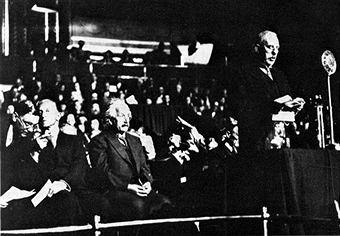
These are the words of a remarkable woman. A secretary, who through her tireless work for the organisation now known as CARA – the Council for At-risk Academics – helped to arrange for the rescue of prominent scholars who had been dismissed from German universities on racial and political grounds. The Academic Assistance Council, as it was first known, was set up by William Beveridge in 1933, and its first president was Ernest Rutherford. Joining with other organisations, the AAC organised a fundraising event under the umbrella of the Refugee Assistance Fund, at which Albert Einstein spoke powerfully about intellectual and individual freedom:
“If we want to resist the powers which threaten to suppress intellectual and individual freedom we must keep clearly before us what is at stake, and what we owe to that freedom which our ancestors have won for us after hard struggles. Without such freedom, there would have been no Shakespeare, no Goethe, no Newton, no Pasteur and no Lister … Most people would lead a dull life of slavery … It is only men who are free who create the inventions and intellectual works which to us moderns make life worthwhile.”
As persecution in Germany intensified, and it became clear that Jewish scholars, and those who opposed Nazism, were not only losing their jobs and their freedom to work, but that their lives were at risk, the AAC set up a more formal structure to continue the work, the Society for the Protection of Science and Learning (SPSL).
In the years between Hitler coming to power and the outbreak of war, they raised the equivalent of some £4 million in today’s terms, which they used to support individuals and their families while they found new posts in universities in the UK or in other safe countries.
In all some two thousand people were saved, and helped to build new lives. Sixteen won Nobel Prizes; eighteen were knighted; over one hundred became Fellows of The Royal Society or The British Academy. Their contribution to British scientific, intellectual and cultural life was enormous. To give just a few examples: Ernst Chain, Nobel Prize in Physiology or Medicine, 1945; Hans Krebs, Nobel Prize in Physiology or Medicine, 1953; Max Born, Nobel Prize in Physics, 1954; Max Perutz, Nobel Prize in Chemistry, 1962; Lise Meitner, celebrated nuclear physicist; Nikolaus Pevsner, architectural historian and author; Marthe Vogt, prominent neuroscientist; Geoffrey Elton (born Gottfried Ehrenberg), Tudor historian and philosopher of history; Ernst Gombrich, the notable art historian, who was able to work as a Warburg Institute research fellow in London; Karl Popper, political and social philosopher; Ludwig Guttmann, neurologist at Stoke Mandeville, ‘father’ of the Paralympic movement. It was a unique effort; there was no parallel elsewhere in Europe. At a commemorative event at the House of Lords in 2012, Mrs Eva Loeffler, Sir Ludwig Guttmann’s daughter, warmly thanked Cara for its vital role in obtaining visas for her family and for giving her father a grant to support his needs and to enable him to continue his research at the Radcliffe Infirmary in Oxford. Without Cara’s help, she said, they would all have perished in the Nazi concentration camps. Instead, her father’s dream of the Paralympics had come true.


Many eminent men headed up the organisation in its various forms (its work continued after the war – oppression and persecution continued and their efforts were as desperately needed as ever), and many eminent men were saved by its work. But it couldn’t have happened without Esther Simpson.

She became the AAC’s Assistant Secretary, recruited thanks to her work with the Fellowship of Reconciliation.
For the AAC it was an inspired appointment, as Beveridge would write, “of lasting and growing importance”. She had a rare talent for organization, for friendship and for persuading people to do what she asked without provoking resentment. She also had the most astounding reserves of energy, resilience and patience. She would routinely work until 10 pm when the gates outside their office were locked.
She had pots of funding to allocate, according to strict criteria, but most importantly she was the link between British (and later US) academic institutions and at-risk academics, finding ways of getting them out of Germany and providing support whilst they secured longer-term posts.
After the borders closed with the declaration of war, demonstrating what Max Perutz called ‘an iron toughness in the face of officialdom’, she helped to get Jewish refugees out of the British internment camps where they were being incarcerated (alongside Nazis) as ‘enemy aliens’.
Over 500 of those detained were academics, almost all of whom she had helped to settle in the UK. They included molecular biologist Max Perutz, architectural historian Nikolaus Pevsner and art historian Ernst Gombrich. She opened a file on each of them and began to prepare the documentation to petition for their release. A turning point came when the government announced that those who posed no danger and had a vital contribution to make to the nation were free to go. The Home Secretary then agreed that this would include contributions to science and learning.
Simpson ‘chivvies officials, chases references, comforts wives, sends food parcels, performs innumerable small acts of kindness. Practical humanity. The banality of goodness.’
After the war, Esther Simpson continued to work for the AAC/SPSL (Society for the Protection of Science & Learning) to secure the safety of at-risk academics from Czechoslovakia, Greece, Poland, Brazil, South Africa, Hungary, Romania, Biafra, Bangladesh, Argentina, Chile, Uganda, Zimbabwe, China …. As she said, ‘there is no end.’
And the organisation that she worked so tirelessly for is still pursuing the same goals today.
Its name changed yet again – from SPSL to the Council for Assisting Refugee Academics (CARA) and then in 2014 to the Council for At-Risk Academics,
reflecting the fact that Cara helps many who are at great risk but do not see themselves as ‘refugees’, and instead still hope to return to their home countries when conditions allow.
The academics with whom CARA works today come from different parts of the world – their circumstances and their needs may be different to those of the first groups to whom the organisation reached out. But the fundamentals remain the same.
Alier’s Story
Alier was first arrested in 1992, accused of supporting the Sudan People’s Liberation Army, a multi-ethnic resistance group based in the south. He was released, but then faced with conscription into the Sudanese state’s army. He fled to the UK. He was supported by Cara to do an MSc in Water Management. Following the 2005 Peace Agreement he returned home and worked for a UK charity as a Water and Sanitation Engineer. After South Sudan’s independence, he took over a senior position in the Directorate of Water Resources Management, before beginning a new role as the Head of Technical Affairs, South Sudan National Petroleum and Gas Commission in January 2015.
Cara Fellows from Syria tell their story
In this short video, two Cara Fellows from Syria, Reem and Saeed, explore what they had to leave behind, talk about what they are doing now and discuss their hopes of returning in the future. Click here to hear their stories
The theme of this year’s Refugee Week is ‘our shared future’. The world we live in would be very different without the contribution of those who were rescued from the horror of Nazi Europe.
We cannot yet know what the contributions of those who Cara is helping today may be. One day, who knows, the names of some of those being supported now may be as well-known as those above. All we can know for sure is that without this work, gifted researchers and scholars who have the potential to make a difference in their field – whether it is medicine or engineering or plant science or law – will die.
Cara reports that the battle for Mosul has just this year cost the lives of a number of academics: Professor Lokman Safar, Professor Abdul Aziz Mahmoo, Professor Mohammed Mahmoud Sheikh-Isa, and Dr Ali Salah.

Executive Director Stephen Wordsworth says that
There has, sadly, been no let-up in the pace of work recently, as university academics around the world continue to be targets for repressive governments and extremist groups. Just now, most of those seeking the help of our Fellowship Programme to get to safety come from from Syria and Turkey, but there are many other places too where intellectuals are seen as ‘opposition’ and find themselves, sometimes quite literally, in the firing line.
…As well as Fellowships, we are also developing our Syria Programme, to provide support in the region to Syrian academics affected by the crisis. This draws on our experience from earlier crises in Iraq and Zimbabwe, and is aimed at helping those who have been forced into exile to stay engaged academically, and to develop their skills.
 Like all of the agencies working with the refugee crisis, Cara needs support. Find out how, here.
As an alumna, current student and retired member of staff at the University of Sheffield, I’m immensely proud that my University is at the forefront of initiatives to support both at-risk academics (working with Cara and other agencies) and asylum-seeker students.
Amongst many notable alumni, we remember in particular during Refugee Week, one scholar who came to Sheffield thanks to the efforts of the AAC.

Hans Krebs is just one person who came as a refugee from Nazi Germany. He came to Sheffield and established a group that worked on aspects of biochemistry that have been important to the world. His discovery of the Krebs cycle saw him awarded a Nobel Prize, but he has also left a legacy in Sheffield which continues to inspire future generations. We celebrated this legacy in 2015, 80 years after his arrival here.


In generations to come, we may be celebrating the legacy of one of our current Cara scholars, or one of the students at present on our scholarship programme, funded by the 2016 Big Walk.


Like Esther Simpson, we have to belong to the world. We are international, we always will be. Our community is made up of people from over 120 nations. Academics from all over the world teach students from all over the world, collaborating with institutions across the world. Only when we belong to the world can we truly ‘discover, understand, explore’, push the boundaries of knowledge, dig deeper, shed brighter light, make a difference by fighting back against disease, creating innovation, challenging received wisdom.


https://www.thejc.com/news/news-features/esther-simpson-the-unknown-heroine-1.438317
Posted by cathannabel in Refugees on June 20, 2017
Today, on World Refugee Day, Help Refugees‘ legal action against Home Secretary Amber Rudd goes to the High Court. It’s the last chance to re-open the Dubs Scheme and give hope to some of the 95,000 unaccompanied refugee children across Europe.
 As a six-year-old in 1939, Alfred Dubs was one of 669 mainly Jewish children from Czechoslovakia who escaped to the UK thanks to a young stockbroker, Nicholas Winton, who has been described as Britain’s Oskar Schindler. There were a number of such initiatives, known collectively as the Kindertransports, taking children from Germany, Austria, Czechoslovakia, Poland and Danzig to safety in the UK – overall around 10000 children were rescued. An American initiative saved another 1400 children. Some of them were subsequently reunited with their parents, others were the only survivors from their families. The transports took place between Kristallnacht, the point at which awareness of the grave danger facing Jews in Nazi territory became much more widespread, and the outbreak of war.


Even at such a time there were those who opposed any mass influx of refugees from Nazism, on the usual grounds (we’re full, we don’t have the resources, they’ll take ‘our’ jobs/houses etc) – but these objections seem to have been largely dropped when it came to the proposal to rescue the children.
The British government had just refused to allow 10,000 Jewish children to enter Palestine, but the atrocities in Germany and Austria, the untiring persistence of the refuge advocates, and philosemitic sympathy in some high places – in the words of British Foreign Minister Samuel Hoare “Here is a chance of taking the young generation of a great people, here is a chance of mitigating to some extend the terrible suffering of their parents and their friends” – swayed the government to permit an unspecified number of children under the age of 17 to enter the United Kingdom. It was agreed to admit the children on temporary travel documents, with the idea that they would rejoin their parents when the crisis was over. A fifty Pound Sterling bond had to be posted for each child “to assure their ultimate resettlement.” (http://www.kindertransport.org/history03_rising.htm)
Alf Dubs, now a Labour peer, sponsored an amendment to the Immigration Act in April last year that required the government to relocate to the UK a number of refugee children who had reached Europe unaccompanied. Though his proposed figure of 3,000 was not included in the law, many MPs and peers believed the government had committed to accepting something around that number.
However, Home Secretary, Amber Rudd, told MPs that the UK had admitted many children through other refugee schemes, amounting to a total of 8,000 in the year to 2016 (including those resettled directly from camps in or near Syria). But, she said, that “the specified number of 350 children … reasonably meets the intention and spirit behind the provision” of the Dubs amendment.
The Government have always been clear that we do not want to incentivise perilous journeys to Europe, particularly by the most vulnerable children. That is why children must have arrived in Europe before 20 March 2016 to be eligible under section 67 of the Immigration Act. The section 67 obligation was accepted on the basis that the measure would not act as a pull factor for children to travel to Europe and that it would be based on local authority capacity. The Government have a clear strategy and we believe this is the right approach.
Yvette Cooper’s response was robust:
This week, the Government cancelled the Dubs scheme after it had been running for less than six months. The Home Secretary said that it has not closed, but will she confirm what it said in the statement yesterday: that once those 350 children are here, that is it—it is closed? Where does it say in the Hansard record of our debates on the Dubs amendment that I have here that we will help lone child refugees for only six months? Where does it say that, instead of the 3,000 that Parliament debated, we will help only one tenth of that number? Where does it say that when we get the chance we will somehow turn our backs once again? It does not, because we did not say that at the time.
The Home Secretary knows that what she is doing is shameful. Not only has she closed the Dubs programme, but she has cancelled the fast-track Dublin scheme to help those with family here. The Home Secretary did very good work in the autumn of last year to help those in Calais and to make sure we could take as many children as possible, and I commended her for it. But she also knows that most of those have family here already and were entitled to be here. She has said local councils cannot do more; the truth is that many local councils have said they can do more with more support or more time. It takes time to set up these schemes, and they should not be closed down so quickly.
There are still so many children in need of help. The Home Secretary knows there are thousands in Greece in overcrowded accommodation or homeless, or in Italy still at risk of human trafficking, or teenagers in French centres, which are being closed down now, who have nowhere left to go. The Home Secretary talked about clearing Calais; they are heading back to Calais, and back to Dunkirk: back to the mud, back to the danger, back into the arms of the people traffickers and the smugglers, the exploitation, the abuse, the prostitution rings—back into the modern slavery that this Parliament and this Government have pledged to end. … We can do this; Britain can do better than this. Will the Home Secretary accept that and reinstate the Dubs programme now?
Clearly, the Home Secretary was unmoved. Thus the legal challenge which goes to the High Court today.
All we’re asking for is the government to do their job properly and talk to local authorities about the actual number of spaces available. We know, and they know, there are hundreds more spaces available across the UK waiting to be filled.
How is it that, when there is evidence that we do have the capacity to support at least the number of unaccompanied minors proposed in the Dubs Amendment, the Government is unwilling to do any more? Could it have anything to do with what they anticipate would be the response of certain newspapers, always obsessed with the threat posed by ‘migrants’?
Analogies with the Kindertransports are, of course, not precise. As was pointed out by one Tory MP opposed to the scheme, today’s child refugees are already in countries that are deemed safe, having already survived the threat that they faced in their home country, and the perilous journey to Europe. And the very real threat of Islamist terrorism makes it easy to demonise the adolescent males who would be eligible to come here under the Dubs scheme. It’s not the same.


But at heart, it’s still just as simple as it ever was. There are children and young people who have fled from unimaginable horrors, who are orphaned or have become separated from their parents in the chaos of flight, who are vulnerable because of their youth (even those boys in their mid-late teens who look almost like men, but aren’t). Of course they are ‘our’ problem, ‘our’ responsibility, if we regard ourselves as members of the human race first and of a particular nation second. It’s a moral question first, and only secondarily a political or even a practical one. There’s a very clear and obvious right thing to do so we should do it, and deal with the political and practical impacts as necessary.
Tragically, and to our shame, that isn’t the way the government sees things.
Mrs May calculates that the acceptance of refugees in any numbers constitutes a political problem. She sees the provision of asylum not as a moral or legal duty but as a risk of contamination. She looks at Europe’s refugees as a continental affliction best managed by quarantine. And she will gladly suffer the opprobrium of liberal-minded MPs, charities and religious leaders – including the archbishop of Canterbury – if it means escaping wrathful tabloid headlines stoking fear of invading foreign hordes. The numbers actually involved in the Dubs scheme are tiny, the least the government could do after every effort had been made to prick ministerial consciences. Now even that ember of compassion is to be extinguished.
The manner of its snuffing out – the news buried in a statement issued on the eve of parliament’s recess – proves that the government knows what it has done is shameful. That does not mean the prime minister or home secretary are truly ashamed. They hope the moment will pass; that not enough people will care about the cold-blooded cruelty of their actions; that the political cost of callousness is negligible. For the sake of Britain’s reputation as a country that still knows some solidarity with victims of war and terror, we must hope they are wrong. Mrs May must reverse this decision or be haunted by it.
History is likely to judge us harshly for this failure. Meanwhile, there are children and young people who could by now have been starting a new life here, safe and secure, with the chance to regain their health and confidence, make friends, develop their skills and fulfil their potential, but who will at best continue to live the half-life of a stateless refugee, at worst who will vanish for ever.
Those who do give a damn aren’t giving up though. No chance.
“In February Theresa May put Britain on the wrong side of history. To our country’s shame, she decided to shut down the Dubs Scheme, which promised child refugees a safe future in the UK. We fought tooth and nail to win this last year. I won’t let it slip away. Join me in saying YES – I want Britain to rescue the most vulnerable child refugees. The Dubs Amendment was a promise to us – to honour our proud British tradition of welcoming those most in need. I saw that compassion and courage in Sir Nicholas Winton, who rescued me as a child from the Nazi regime, along with 669 Jewish children. Acts of heroism like this define our country. They characterise the values we hold dear. Now we are faced with another such turning point in our nation’s history. Will we choose to follow Trump, or to honour our tradition of generosity, compassion and courage? We’ll need to fight harder than ever, organising our communities in the days to come. In the streets, in the offices of MPs, by joining local actions. We’ve won before. We will win again.”
Lord Alf Dubs.
Posted by cathannabel in Events, Refugees on June 19, 2017

Sheffield was the UK’s first City of Sanctuary and it is a city that remains rich with diversity and interconnecting cultures. This year’s festival seeks to celebrate this history and culture with a vibrant and inclusive series of events.
 Opening on the 20th June, Migration Matters Festival will run alongside the annual Refugee Week celebrated across the UK.
The festival takes place across a series of city centre venues, uniting Sheffield’s communities and cultures.
The 2017 line up features established companies, emerging artists, community arts groups and charitable organisations. It’s a rich and soulful programme that brings the diverse and global mix of Sheffield’s communities together with artists from all over the world in a celebration of food, culture and performance.
Check out the full programme – there’s truly something for everyone!
All events are Pay-What-You-Decide though you are recommended to reserve tickets for high profile events – follow the link and search for Migration Matters to see everything that’s on offer.
Posted by cathannabel in Refugees on June 18, 2017
Since I started this blog, back in 2012, I’ve given myself the challenge to publish something every day during Refugee Week addressing some aspect of the refugee crisis past and present, in all parts of the world. There are so many stories, and no matter how many Refugee Weeks come around, there seems little prospect that one year I will find there is nothing to say.
This year’s theme sets me a different kind of challenge, however. Many of my posts over the years have focused on the past – specifically on the refugees escaping Nazi genocide, whether through the Kindertransport or the activities of the AAC, or through the actions of individuals such as Varian Fry or communities such as Le Chambon sur Lignon. Which is fine, and I will be revisiting some of those topics this week. But the theme is ‘our shared future’, and I don’t want to neglect that.
There are as always many examples of generosity and hospitality being shown to refugees, by organisations and individuals.
In Edinburgh, Dr Amer Masri and Nadin Akta, both refugees from Syria who came here in 2011, have worked with the University’s Chaplain and student volunteers to support newly-arrived Syrian teenagers. The Teenage Syrian Refugee Tutoring pilot project aims to help with the disorientation and sense of isolation that the new arrivals will experience. The programme is focused specifically on the needs of young people, fitting in to school, making decisions about their futures and facing the kinds of challenge that are common to their age group but with the added pressure of cultural and language barriers and the trauma of their past experiences.


Meanwhile in Madrid, a project linking refugees with local mentors has been overwhelmed with volunteers. Rescate ‘s befriending programme again helps to address the disorientation and isolation that refugees face, as well as working with them to solve practical problems about housing and education, finding their way through the system to access the help they need.
But it is not just a one-way process.
Liverpool-based rapper Farhood fled his home country Iran after facing persecution as a result of his political activism. He will play M.I.A.’s Meltdown festival at Southbank Centre, London, 9-18 June, and launch Refugee Week on 18 June.

Across the world there are thousands of people who are displaced and seen as just migrants, not people with skills, abilities, talents and stories. I want to help change this situation. I want to help change the way we think and talk about this global crisis. Whose crisis is it anyway? Crises for Europe and the developed world which needs to ‘cope’ with refugees? Refugees in the UK are facing harder times now, with issues like Brexit and racism, and I want to show them hope in the face of depression, which I experience myself. … It shows that a refugee can make a transition, from being unheard in a prison in the UK to a point where I can talk about the problems in Iran and the UK to the world. I can be a voice for the voiceless.
Online magazine Vice has just published an issue edited by young refugees from across Europe. They’re not talking about being refugees, or at least not just that.
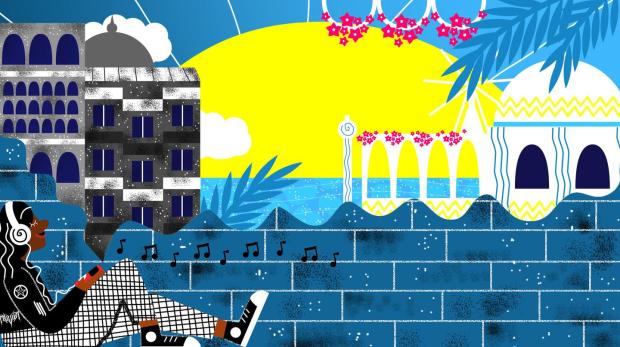 Vice’s editor says:
We wanted to show that just like all our writers and every single neighbour you’ve ever had, these young people have multifaceted personalities that cannot be defined merely by them being refugees.
The result is a collection of 16 articles that today we are publishing simultaneously in 12 languages and 14 European territories, in collaboration with UNHCR. Highlights include How to Be Fashionable on a Budget, All the Gaffes I’ve Made Since Arriving to the UK and A Playlist of the Songs I Listened to While Trying to Get from Syria to Europe.
And poet Malka Al-Haddad is crowd-funding publication of a collection of her work which she hopes will raise funds for Baobab Women’s Project in Birmingham, Leicester City of Sanctuary and East Lindsey Area of Sanctuary.

She says:
I know that there are many people that need help and this what they do. Therefore I’m willing to support them. I would like to help people as much as I can, that is my love, it makes me feel like a better person, I want to help the community in some way …. When I was in Iraq I was working very hard to get good salary to support disadvantaged people and protect women’s rights. I am now in the UK but I can not earn money or have job because I have not been recognised as a refugee. I’m glad that I have written a poetry book that, I hope, will go on to raise some funding to these small charities/organisation that support refugees and asylum seekers. They aim to make individuals’ participation positive and help people be themselves again after they lost hope and their home land.
Once we see refugees not as ‘other’, but as people like us, ordinary people (if there is such a thing) whose circumstances happen to be extraordinary and traumatic, we should not be surprised when they are not only refugees but also poets, musicians, artists, engineers, lawyers, writers, footballers, nurses, teachers and so on. Whilst they are in flight, it may be impossible to be anything other than a refugee, but what people will hope for, long for, is the chance to be those other things, to find others in their new home with whom they can share their interests and skills. As Malka says, to be themselves again.
That way, we all win.
Posted by cathannabel in Politics on June 16, 2017

We don’t know how many. We don’t know who. We don’t know why.
In this vacuum of information, anger is building.
Some of this anger will be misdirected, as people lash out in their pain and grief. That’s inevitable. Since the early hours of Wednesday morning, those living near Grenfell Tower, those who escaped from it, those who have friends and family unaccounted for, will not have slept, will have been obsessively checking phones and ringing hospitals and begging for answers, at the same time as they figure out how to cope without their most basic possessions, how to deal with the practicalities of life in this new chaos. Under that intolerable pressure, those we have heard speak have shown remarkable dignity and calm.
That may not hold. Even if the bigger questions cannot be answered immediately, there needs to be a more coordinated, coherent response to the desperate need to know the fate of those still unaccounted for, and to the practical questions about rehousing and resources for those left homeless. And even if those are the most urgent questions, the community needs to be convinced that the bigger questions – what caused the fire? why did it spread so quickly? why was the material used for the cladding in the recent refurb of a standard that is currently banned in the US and Germany because of its flammability? – will be answered without obfuscation.
Answers need to come, and come swiftly. And with them, practical help. Voluntary generosity has been overwhelming, and almost unmanageable – it must now be matched by an ‘official’ response. That official response must be generous, if it is to defuse the tension, the gut feeling that had the inhabitants of Grenfell Tower been white, been wealthy, the building would have been designed to be safe, and any refurbishments would have made it even safer.
We have in the last few weeks alone logged so many unnecessary deaths. The murders of (mainly) young people attending Ariane Grande’s concert in Manchester, and (mainly) young people in Borough Market and on London Bridge. And now unknown numbers of all ages, dead because a fire that started accidentally (as far as we know) spread with unimaginable speed through a high rise block of flats.
What those of us who have tried to honour the dead by recording their names and something of their story quickly discovered was that there is no such thing as an ordinary person. The three names that have officially been released from Grenfell Tower confirm that.

Khadija Saye was 24. A remarkable artist, her work is currently exhibited at the Diaspora Pavilion during the 57th Venice Biennale. Her death has been confirmed; her mother is missing, presumed dead.

Mohammed Alhajali was 23, and had been living on the 14th floor with his brother Omar. He came to the UK in 2014 and was studying civil engineering. Syria Solidarity Campaign said: “[He] undertook a dangerous journey to flee war and death in Syria, only to meet it here in the UK, in his own home.” The brothers had been due to join the Syria Solidarity Campaign on Saturday to take part in The Great Get Together, celebrating the life of murdered MP Jo Cox and marking Refugee Week.

Of the third confirmed fatality, what can we say? He was five years old. Isaac Shawo has been described by his mother as a “beautiful boy”. He was a pupil at Saint Francis of Assisi Catholic Primary School and lived on the 18th floor of Grenfell Tower with his parents and three year old brother Luca, all of whom have survived. He gazes out from this photograph, and one can read so many possibilities into that gaze. Possibilities that will never be realised.
Only three stories so far. There will be so many more. Their deaths are as arbitrary as those of the Manchester and London terrorist murders, even if no individual or group is as directly culpable. They should not have died, they need not have died.
We have to change, we cannot continue to value property over humanity, to dismiss ‘health and safety’ which has saved the lives of so many as ‘red tape’, to denigrate the poor, the unemployed, benefit claimants and asylum seekers as scroungers and skivers. We have to change.
David Lammy MP: “For your middle-class viewers, this is about whether the welfare state is just schools and hospitals or whether it’s about having a safety net. I get quite emotional as I say that. We need to live in a society where we care for the poorest and the vulnerable. And that means housing. It means somewhere decent to live. It was a noble idea that we built… and it’s falling apart around our eyes. That’s what it’s about.
You can’t contract out everything to the private sector; the private sector do some wonderful things, but they have for-profit motives, they cut corners. If you haven’t got the officers to check on the enforcement of buildings, don’t expect it to be done.
You know… are there fire extinguishers? Where are the fire extinguishers on every corridor? Where are the hoses? Are the fire doors really working? Where are the sprinklers? If you want to build these buildings, then let them at least be as good as the luxury penthouse buildings that are also being built.
But these buildings aren’t …. So you either demolish them and house people in a different way, or you absolutely refurbish them to the best quality that we can do.”
Jackie Long: “Do you think this says anything about the value that is placed on the life of people who cannot afford to buy their own property; to live in some of the nicer bits of Britain?”
David Lammy MP: “This is a tale of two cities. This is what Dickens was writing about in the century before the last, and it’s still here in 2017. It’s the face of the poorest and the most vulnerable. My friend who lost her life was a talented artist, but she was a young, black woman making her way in this country and she absolutely had no power, or locus, or agency. She had not yet achieved that in her life. She’d done amazing things: gone to university, the best in her life. But she’s died with her mother on the 22nd floor of a building. And it breaks my heart that that’s happening in Britain in 2017. Breaks my heart.
Lammy refers here to Dickens. A tale of two cities, a tale of two tower blocks. Different worlds, existing cheek by jowl, not recognising or understanding each other. In Kensington, some of the wealthiest people in our land live alongside some of the most deprived. The top quarter earn at least £41 per hour, three and a half times the level of the lowest quarter at £12 per hour or less. Within the smallest borough in London, and the second smallest in England, we can see starkly and uncompromisingly the divisions in our society.
These words are from perhaps Dickens’ finest novel, Bleak House, as he marks the death of a nobody, a boy called Jo.
Is there any light a comin?”
“It is coming fast, Jo.”
Fast. The cart is shaken all to pieces, and the rugged road is very near its end.
“Jo, my poor fellow!”
“I hear you, sir, in the dark, but I’m a gropin — a gropin — let me catch hold of your hand.”
“Jo, can you say what I say?”
“I’ll say anythink as you say, sir, for I knows it’s good.”
“OUR FATHER.”
“Our Father! — Yes, that’s wery good, sir.”
“WHICH ART IN HEAVEN.”
“Art in Heaven — is the light a comin, sir?”
“It is close at hand. HALLOWED BE THY NAME!”
“Hallowed be — thy—”
The light is come upon the dark benighted way. Dead!
Dead, your Majesty. Dead, my lords and gentlemen. Dead, Right Reverends and Wrong Reverends of every order. Dead, men and women, born with Heavenly compassion in your hearts. And dying thus around us, every day.
I do not pray. At times like this I almost wish I could. But my faith is not in any god but in humanity. In the kindness of strangers, the coming together of communities in a crisis, the refusal to tolerate those who want to use such a crisis to disseminate hatred and suspicion. I don’t pray, but I hope, I hang on to my hope. And my heart hurts for the people of Grenfell Tower.
Posted by cathannabel in Music on June 1, 2017
The release of Sgt Pepper’s Hearts Club Band, fifty years ago today, is one of those moments in musical history. So much has been written about the album over the years since. But this personal account, from Mike Press, is for me the perfect tribute to Pepper, to what it meant and what it means, and to the power of music. Thanks, Mike, for letting me share this.
============================================================================
My Mum, my Dad, Sgt Pepper and me – Mike Press
Unusually, I remember exactly what I was doing 50 years ago today at around 6 pm.
It all began with She Loves You.
My Dad ordered it in advance of its release and picked it up from the Record Room in St Albans on his way home from work on the day it came out. And he did the same with every Beatles’ release up to the White Album. It was a family ritual. Part of this same ritual was that we would play the new record over and over at least six times as soon as he got home (to be honest, it was six with a single and at least twice with an album). She Loves You was a revelation, in part because after we’d played it half a dozen times he says “right, shall we play the B side now?”. THERE’S A B SIDE??? You mean they actually give you another song for free? I was stunned with both the concept and the clear generosity of the recording industry, which was perhaps one reason that I gave them so much money in return over my extended adolescence. In this case the B side was even better than the A side.
Thursday the First of June 1967 was just another school day at Fleetville Junior Mixed Infants. We were coasting down towards the end of our primary schooling with the first year of Grammar School just a few months away. Dad and I had been Beatles fans since their first hit. He bought all the records, which we played relentlessly the day they came out, and every so often he’d say “fancy a Beatles’ session?” and we’d play the whole lot in one go. These sessions often drove my Mum to distraction. Mind you, she had a far better grasp of the interpretation of the lyrics than either of us did. When she first suggested that Ticket to Ride was about the Isle of Wight ferry I remember us firmly dismissing this as the overly literal interpretation of a geographer. When John Lennon was asked some years later what the song was about he replied that it was about a friend who ran away to the Isle of Wight.
He drove home from London and stopped by the Record Room, a small shop on Chequer Street run by Mark Greene. Donovan, The Zombies and others reckoned that his was the best record shop outside London. Back then we didn’t have chain stores, we just had people who loved music who simply wanted to share it, and make an honest profit in the process. He knew his music, did Mark, and over the years a fair bit of my pocket money went over his counter. He sold records, and around the corner his brother Sol ran the town’s drapery business, both playing up their Jewishness to give their shops a real character and passion for what they sold. Mark had a humour that was so deadpan that you often weren’t sure if he was quipping or just naive. Like the time a couple of years later I went in to buy John and Yoko’s first album. He scoured the shelves, went down to the cellar, was clearly rattled that somehow it had been misfiled, and then shouted over to his assistant “Mac, I can’t seem to lay my hands on Two Virgins.”
So the old man got home from Mark’s shop with a record in a brown paper bag.
I distinctly remember taking the record out of the bag. It was the most beautiful and wonderful object I had ever held. This was no album cover. As you opened the then unique gatefold sleeve, it suggested opening a door into something unearthly and wonderful. A front cover which immediately engaged my Mum and Dad into a competition on who they could recognise, a back cover with – again uniquely – all their lyrics, and the inner gatefold with the fabs in all their acid drenched glory. Then there was the insert of cutouts, and the inner sleeve, normally white, which was presented in washes of pink.
My Dad took out the record, placed it on the platter, lowered the needle and we listened.
Well it was twenty years ago today…
I simply cannot describe the sense of wonder, of illumination that I experienced as we listened. The next week Kenneth Tynan in The Times described it as the high water mark of human civilisation. At the time people suggested that he was perhaps over egging it a bit, but in retrospect I think we can probably all agree that he’s broadly right. It’s up there with the Mona Lisa and the the Brandenburg Concertos – if not actually just a wee bit better. The sixties were a rollercoaster for all of us, but especially when you were a child. From She Loves You to A Day in The Life. Four years. Culture has never moved with such a frenetic pace or passion.
It was a record that was liberally peppered with wonderful characters, all vividly portrayed. There was Billy Shears, the Sergeant’s bandmates, Rita being tempted with tea, the girl meeting a man from the motor trade, the poor guy who didn’t notice that the lights had changed. And to this very day every time I meet somebody called Henderson I have to bite my lip not to ask how Pablo Fanque is.
I remember my dad saying many years after that first listening that Day In The Life was the best song of the century – and he was a Sinatra fan. Phil Collins said that the song helped him to learn how to drum, because of Ringo’s complex fills – so there is a downside to the album after all. But my first listening of it I remember as a surreal, cinematic experience.
We got to the end (and of course the enigmatic final groove). He didn’t need to ask. Flip over, and back to the start. And again.
That record taught a ten year old to always push the boundaries, to break rules, to take people on journeys, to turn people on, to try to be the best you can be. And with the encouragement of my folks that’s all I’ve ever tried to do.
Nothing musically has ever bettered that evening with my Mum, my Dad, Sergeant Pepper and me.
Oh boy.

Posted by cathannabel in Politics on May 23, 2017
Today I woke to more news of horror. So close to home – just across the Pennines, a city where I’ve worked, where I have friends, a city whose history and culture I have studied for years now. And as I saw the first reports I wept, for the children who have been murdered and hurt and terrified, for the parents who are still desperately waiting to find out what has happened to their kids, or who are lost in unimaginable grief. My heart hurts.
Manchester is resilient. It has had to be. We all have to be in this dangerous world, if we’re to hold on to what really matters, if we’re to love and hope and laugh, if we’re to bring children into this world and bring them up to love and hope and laugh.
 Whilst the usual suspects have been swift to inject their poison into social media, to encourage hate and violence in response to hate and violence, many more are trying to do the opposite.
Always after attacks like these some rush to help and some rush to hate. The helpers try to contain the blast, the haters help to spread it.
Ian Dunt, on the politics.co.uk website:
Our response will be to try to contain the blast, by showing that the overwhelming majority of people remain kind, decent, and big-hearted. This is not a platitude. It is a political response.
But of course we feel anger. Of course we feel scared. Of course we feel loathing for the person who hated life so much that he could go into an arena full of happy, excited kids and commit mass murder.
The point is, what do we do?
If we let that anger be channeled into hostility to anyone other than the perpetrator and whichever group he claims to represent, they win.
If we let fear prevent us from living our lives to the full, or push us to allow our freedoms and the freedoms of others to be curtailed, they win.
Terrorists, of whatever political or religious persuasion, want to provoke fear and anger. As the UN defines terrorism, it is ‘intended to cause death or serious bodily harm to civilians or non-combatants with the purpose of intimidating a population or compelling a government or an international organization to do or abstain from doing any act’.
In other words, whatever anger and fear we feel, however desperately sad we feel, we must not be compelled by their actions to do anything that is not in itself just, fair and right, nor to abstain from doing what is in itself just, fair and right.
When we (those of us who argue in this way, as well as expressing our solidarity via social media with the victims) are berated for just waiting for the next atrocity, I wonder what it is that we (or our governments) should be doing instead. What form should our rage take, that could make us and our children safer?
The voices of hate were quick to speak up, as always. They claim to be fuelled by righteous anger, but in their words there’s a hideous kind of glee. They call for action, but what they have in mind is closing the borders, or worse. The responses which would, of course, be exactly what the terrorists hope for, and would make us less rather than more safe.
I do understand that changing one’s profile pic, claiming that ‘je suis wherever’, and all that, seems useless and inadequate. Of course those things in themselves do not change the situation. They’re easy to ridicule and dismiss. But as Stig Abell says:
It is easy to dismiss the commonplaces, the impossibility in using words to deplore the lack of words. But the very fact of reaching for words – of trying to talk about it – is an appropriate response. And, at moments of crisis and trauma, the use of comprehensible and familiar phrasing is itself a sign of something important: it is a bid for connection. Cliché demonstrates community, our intention to understand one another. It does not matter that “standing in solidarity” has no practical import, or that prayers may be just so much shouting into a void. It does not matter that there is unresolved tragedy in a violent world that makes consolation a commonplace.
Because by using cliché, we are trying to employ common currency, we are grasping for tokens – however smoothed by over-use – that we all recognise, we all can handle and share. We are using language to be inclusive. …
So we should abandon any knee-jerk response … to hashtags and platitudes, to prayers and placards. There are always words, even over-familiar and trite ones. And they tell us something about our desire to connect and collect ourselves, to take the time to try at least to “think of the victims and the families”. That desire is a good thing. Clichés are good things when pressed into the service of communication in the aftermath of the incomprehensible and the traumatic. They often reveal the good intentions we share, and they are more valuable than ever.
So I refuse to be embarrassed about the inadequacy of my own words. I believe that however feeble they are in the immediate aftermath of something which hurts my heart as much as this does, I can and must keep saying what I believe.
Daesh divide the world into Crusaders (that this definition includes pre-teen girls at a pop concert tells you all you need to know) and the Caliphate. George Bush used similar rhetoric after 9/11, telling us that we were either with the US or with the terrorists. I’m not proposing any equivalence of those two approaches, other than that this polarisation, this reduction of the complexity and diversity of life into two opposing absolutes, has done and continues to do immeasurable harm.
In the wake of the November 2015 Paris attacks, Jonathan Freedland wrote about Daesh’s onslaught against the ‘grey zone‘ :
The grey zone is where I want to live. Islamic State hates it, that place between black and white, where nothing is ever either/or and everything is a bit of both. Those who have studied the organisation tell us “the grey zone” – Isis’s phrase – is high on the would-be warriors’ to-eradicate list, along with all those other aspects of our world that so terrify them: women, statues of the past, the pleasures of the present.
Specifically, the grey zone refers to the sphere of coexistence where Muslim and non-Muslim might live together. That’s anathema to the frightened young men of Isis, who yearn for a world divided on binary lines, with room for only two categories – them and the infidel. Such a world would be as clean and neat as computer code, with Isis the ones and the rest of us reduced to zeros.
I made my own contribution on this blog. Looking back now, I am not certain that my interpretation of the grey zone was correct. It may be that it should properly be defined as the place inhabited by Muslims who have not signed up for the caliphate and for jihad. For Daesh it is a state of hypocrisy, and their hatred of it explains why the vast majority of their victims are Muslims – the wrong sort of Muslims. So whilst their murderous attacks in Kabul, Baghdad, Ankara and so many other locations are attacks on the grey zone, Paris and Manchester, Brussels and Nice, were attacks on the Crusaders.
But we don’t have to accept any of their twisted, hateful definitions. The grey zone for me is where people of all faiths and none meet, talk, share music and food and laughter. It’s where in the wake of tragedy people of all faiths and none offer whatever they can – a free taxi ride, somewhere to stay, a blood donation. We must defend it.
We have to refuse to be bystanders when anyone – on social media, on the street, in the workplace – demonises or harasses Muslims or those who look as if they might be Muslims. We have to have conversations across the various divides of age, ethnic background, religion, politics – find out what other people think, share what we think, find the common ground. We have to counter and debunk the lies that are routinely told about refugees, immigrants, Muslims, and the propaganda that xenophobic political movements such as the Front National, EDL/Britain First etc. and their equivalents across Europe will make of the Paris atrocities.
None of this will stop Daesh. I’m not sure what will. How do you stop someone with an explosive belt and a Kalashnikov, who cares nothing for the lives of the people they will mow down, and nothing for their own life, indeed who is ‘seeking to be killed’ in order to gain martyrdom? Perhaps we cannot afford to be pacifists in any absolute sense. These are the moral quandaries that face us and perplex us, and we cannot take refuge in absolutes, because absolutes are a huge part of the problem.
We’re all looking for a ‘magic bullet’ to use against this big bad. There may be political and/or military solutions (just as likely, I’m afraid, there will be political and/or military reactions that will hurt Daesh’s victims more than they hurt Daesh itself).
For myself, what I want to do most of all is to fight – not with Kalashnikovs but with words and the way I live my life – for the grey zone.
Because the last thing the grey zone is, is grey. It’s every colour under the sun. And it’s beautiful.
Enjoy your life.
Make it count.
And don’t let the murderers win.
https://www.thejc.com/comment/comment/manchester-a-city-united-1.439057
Posted by cathannabel in Literature on April 22, 2017
Around ten years ago, I decided that it was simply not on to be a student of 20th century French literature and to have read only the first volume of A la recherche… and that only in English translation.
And so it began.
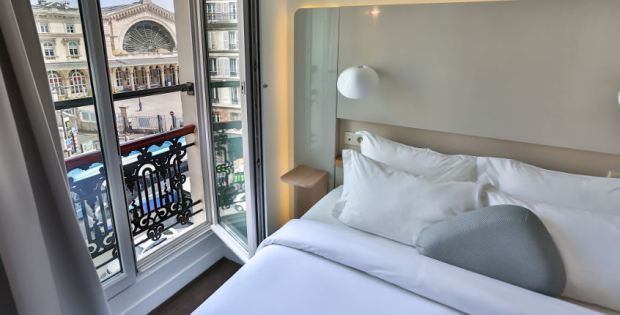
I trotted reasonably swiftly through Vol. 1, largely because I had already read it in English, and because I was reading it in conjunction with a friend and fellow student – but things then slowed down rather dramatically. Finally, a couple of days ago, I reached the final sentence of the final volume. Fittingly, I had made some splendid progress whilst staying in the Hotel le Marcel, in one of their Chambres St Loup, after long walks through the streets of Paris.
I’m normally a fast reader. But not in French. In English, I can see large chunks of text and absorb them easily, but in French I have to read each word, and I cannot be sure I have the meaning of a sentence until I get to the end of it – and with Proust that full stop could be several pages away. So my reading speed slows down dramatically whenever I’m reading in my second language. That’s not all of it, however. Roger Shattuck acknowledges (reassuringly) that:
both in translation and in the original, Proust slows most readers down. His sentences move through long spirals that will not be hastened and deserve to be savoured. He offers few paragraph breaks to declare the steps and stages of his thought. In contrast to most nineteenth-century novelists, he does not construct out of short chapters that divide the story into conveinent mental mouthfuls. One simply cannot force one’s speed and hope to register the prose.
But there were certainly times when I thought I might pack it all in, were it not for the fact that my original rationale was still valid – how can I study Butor without having read Proust? – and a certain bloody-minded stubbornness that those who know me will recognise. I said I was going to read all of Proust in French and I would do so. Even if it was the last thing I did. Thankfully it didn’t quite come to that.
Ten years of reading – albeit with some rather long gaps. Was it worth it? Emphatically yes. It’s an extraordinary work and its influence is so enormous, not only on the French writers who came after Proust, but on literature across the world. I expected that, however. What was unexpected (apart from the fact that it was a great deal funnier than I’d anticipated) was that in many ways it did not work as a novel, because it’s not, or not just, a novel.


Earlier this year, I read Clive James’ wonderful Cultural Amnesia, a collection of short essays on writers, film makers, musicians, political thinkers and philosophers, chosen on the basis that they interest him rather than, necessarily, that he admires or loves them. It’s a book that makes you feel desperately un-well-read, but rather than that being alienating, you feel at the same time that any steps you can take towards being the kind of reader that James is – including simply having a bash at reading in languages in which you are far from fluent – are eminently worth taking. His piece on Proust, which I read before I’d finished Vol. 7 because spoilers aren’t really that much of an issue here, is particularly enlightening.
A commonplace book in the classic sense, it is, itself, a set of annotations to all the works of art that Proust has read, looked at, listened to or otherwise enjoyed, and to everything he knows about nature, natural science, love, sex and the workings of the mind.
A la recherche du temps perdu is never done with, because it keeps growing while you are reading it. Like no other book in the world, Proust’s book leads everywhere: a building made of corridors, and the walls of the corridors are made of doors.
There are people who read Proust just for the clothes. But those of us who read Proust for his remarks about life will always be wondering whether A la recherche du temps perdu is really a work of art at all. A work of imagination: yes, of course, and supremely. But is it a novel? Isn’t it a book of collected critical essays, with the occasional fictional character wandering in and out of it?
These qualities of non-fiction are useful to remember when we realize how many qualities of fiction the longest of all novels does not possess. It has, for example, no structure worth speaking of, and probably would not have attained to one even if Proust had been given another ten years to work on it. Characters would still have shown up twenty years too young at the last party, or twenty years too old, or simply still alive when they should have been dead.
Bloody brilliant. I rather wish I’d read this at the start of my project, rather than as I approached its final stages. There were so many moments when I was frustrated by the pages of rumination, distractedly wondering when something was going to actually HAPPEN, rather than realising that the rumination was what was happening. what mattered, what the book was about. (In this context I could not help but recall Monty Python’s All England Summarise Proust competition…) And I wouldn’t have wasted any energy trying to work out how much temps had actually passé, when it really wasn’t about chronology at all.
Readers and critics of Proust reach for comparisons and metaphors, as James does. Roger Shattuck says that ‘Reading Proust bears many resemblances to visiting a zoo’. It’s commonly referred to as a roman-fleuve, a river that flows on relentlessly and the only way to read the roman is to abandon oneself to that flow (though I note that it also has a more critical connotation – a discours-fleuve is an ‘interminable’ speech…). It’s a web (Malcolm Bowie uses this metaphor), in which everything/everyone is connected to everything/everyone else.

It’s an unfinished cathedral (this draws on a passage from the final pages of Le temps retrouvé) – but James suggests that it is instead ‘a sandcastle that the tide reached before its obsessed constructor could finish it; but he knew that would happen, otherwise why build it on a beach?’. For me, it is a labyrinth, a labyrinth in time and space.
Reading the final pages, I wished that my memory of the earlier volumes was clearer. I want to see how the threads relating to the nature of time and to the Dreyfus affair, and so many more, run through the whole tapestry (another metaphor…).
I could always go back now, and start again at the beginning…


Malcolm Bowie, Proust among the Stars (Fontana, 1998)
Clive James, Cultural Amnesia: Notes in the Margin of My Time (Picador, 2012)
Roger Shattuck, Proust’s Way: A Field Guide to In Search of Lost Time (W W Norton, 2000)
Posted by cathannabel in French 20th century history, Second World War, W G Sebald on April 21, 2017
W G Sebald’s novels tend to begin with someone setting out on a journey. His protagonists are almost always in transit, and if they do settle somewhere it is not likely to be long-term. There are always exceptions, of course, and Max Ferber (The Emigrants) is the exception in relation to the latter trait – once he finds himself in Manchester he feels he cannot, must not leave. But Jacques Austerlitz is the archetypal Sebaldian wanderer.
We (via the narrator, who both is and is not Sebald) meet Austerlitz first in Antwerp, then in Liege, Brussels and Zeebrugge, before finding out that he is based in London. At this stage his restless quests are related to his academic interests in architecture, particularly public architecture, as he explores railway stations, prisons and fortresses, courtrooms and museums. After a two year hiatus in their relationship, the narrator and Austerlitz encounter one another again, in London, in a railway station bar. Only now do we begin to find out about his early life. Until his teenage years he had believed himself to be Dafydd Elias, growing up in Bala in Wales. Only after the death of his foster mother and the mental breakdown of his foster father does he discover that his name is Jacques Austerlitz, but he knows nothing more. The name itself signals a kind of multiple identity – a French first name and a Czech place name (which, as a surname, was shared with Fred Astaire and which, because of the Napoleonic era battle which took place there, is also the name of one of Paris’s major railway stations).
Austerlitz finds himself obsessively walking the streets of London in the early hours, and is drawn back repeatedly to Liverpool Street Station where he has a kind of vision of himself as a small child, meeting for the first time the foster parents who had been assigned to him. He feels ‘something rending’ within himself and is in a state of mental torment until he hears, by chance, a radio broadcast about the Kindertransport. This begins to trigger memories of his childhood journey, and when he hears the name of the ship, ‘SS Prague’, he determines to go to that city and find out about where it began.

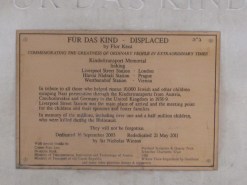
Austerlitz’s quest is now to find out who his parents were, and what happened to them. He discovers, or believes he has discovered, his mother’s fate. She was deported to Terezin, from whence she was taken, we understand, ‘east’. Whilst there are uncertainties about this narrative, there are far more surrounding his father, who had left for France before the deportations from Prague began.
And so to Paris. Alongside my mission to photograph all of the memorial plaques relating to WWII that we passed as we walked its streets, I wanted to find, if I could, some of the locations described in Sebald’s novel. Sebald sometimes describes real places with absolute precision, sometimes alters or relocates them. Of course, whilst major public buildings were easy to find, I was unsure whether, given that the narrator and protagonist are both fictional constructs, the specific addresses provided would be as straightforward. But they were all there, even the bistro on boulevard Auguste Blanqui.
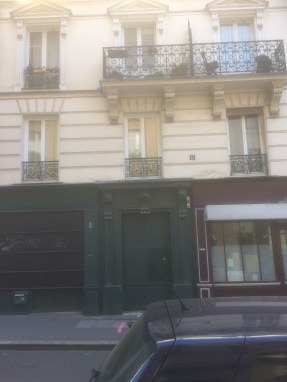
I received a postcard from Austerlitz giving me his new address (6 rue des cinq Diamants), in the thirteenth arrondissement. (p. 354)
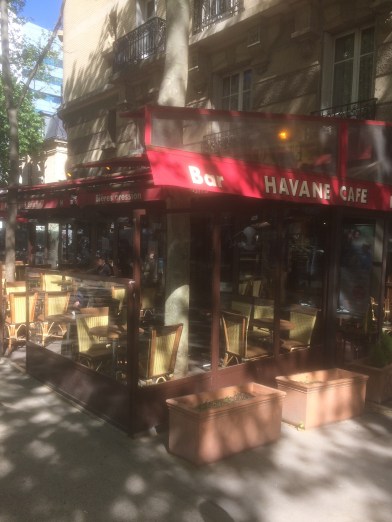
I met Austerlitz, as agreed, on the day after my arrival, in the Le Havane bistro bar on the boulevard Auguste Blanqui, not far from the Glaciere Metro station. (p. 355)
The rue Barrault is said to be the last known address of Maximilian Aychenwald. Austerlitz speculates about whether his father had been caught up in one of the round-ups of Jews:
I kept wondering whether he had been interned in the half-built housing estate out at Drancy after the first police raid in Paris in August 1941, or not until July of the following year, when a whole army of French gendarmes took thirteen thousand of their Jewish fellow citizens from their homes, in what was called the grande rafle, during which over a hundred of their victims jumped out of the windows in desperation or found some other way of committing suicide. I sometimes thought I saw the window-less police cars racing through a city frozen with terror, the crowd of detainees camping out in the open in the Vélodrome d’Hiver, and the trains on which they were soon transported from Drancy and Bobigny; I pictured their journey through the Greater German Reich, I saw my father still in his good suit and his black velour hat, calm and upright among all the frightened people. (pp. 358-359)
During an earlier period in Paris, before the search for his father began, Austerlitz had had another episode of nervous collapse, and had been admitted to the Salpêtrière Hospital.
I did not return to my senses until I was in the Salpêtrière, to which I had been taken and where I was now lying in one of the men’s wards … somewhere in that gigantic complex of buildings where the borders between hospital and penitentiary have always been blurred, and which seems to have grown and spread of its own volition over the centuries until it now forms a universe of its own between the Jardin des Plantes and the Gare d’Austerlitz. (pp. 375-376)


This is the hospital at which, in the late 19th century, Charcot developed his diagnosis of ‘hysterical epilepsy’, and the phenomenon of the ‘fugueur‘ was first identified and researched. Austerlitz can remember nothing about himself or his history, but someone finds the address of his friend Marie de Verneuil and contacts her at 7 place des Vosges.

When I met Austerlitz again for morning coffee on the boulevard Auguste Blanqui, … he told me that the previous day he had heard, from one of the staff at the records centre in the rue Geoffroy l’Asnier, that Maximilian Aychenwald had been interned during the latter part of 1942 in the camp at Gurs, a place in the Pyrennean foothills … Curiously enough, said Austerlitz, a few hours after our last meeting, when he had come back from the Bibliothèque Nationale and changed trains at the Gare d’Austerlitz, he had felt a premonition that he was coming closer to his father. As I might know, he said, part of the railway network had been paralysed by a strike last Wednesday, and in the unusual silence which, as a consequence, had descended on the Gare d’Austerlitz, an idea came to him of his father’s leaving Paris from this station … I imagined, said Austerlitz, that I saw him leaning out of the window … After that I wandered round the deserted station half dazed, through the labyrinthine underpasses, over foot-bridges, up flights of steps on one side and down on the other. That station, said Austerlitz, has always seemed to me the most mysterious of all the railway terminals of Paris. … I was particularly fascinated by the way the Metro trains coming from the Bastille, having crossed the Seine, roll over the iron viaduct into the station’s upper storey, quite as if the façade were swallowing them up. And I also remember that I felt an uneasiness induced by the hall behind this façade, filled with a feeble light and almost entirely empty, where on a platform roughly assembled out of beams and boards, there stood a scaffolding reminiscent of a gallows … an impression forced itself upon me of being on the scene of some unexpiated crime. (pp. 404-407)


The records centre in the rue Geoffrey l’Asnier is now the Mémorial de la Shoah. Amongst the many records kept here, there is a room full of boxes of index cards, relating to the various internment camps and those who were imprisoned there.

I don’t know, said Austerlitz, what all this means, and so I am going to continue looking for my father, and for Marie de Verneuil as well. (p. 408)
We will never know the outcome, although it seems most likely that his parents’ journeys ended in the same, terrible place, a place with which Austerlitz’s name has resonated, whether we have been conscious of it or not, from the beginning. As James Wood points out:
And throughout the novel, present but never spoken, never written – it is the best act of Sebald’s withholding – is the other historical name that shadows the name Austerlitz, the name that begins and ends with the same letters, the name which we sometimes misread Austerlitz as, the place that Agata Austerlitz was almost certainly ‘sent east’ to in 1944, and the place that Maximilian Aychenwald was almost certainly sent to in 1942 from the French camp in Gurs: Auschwitz.
(James Wood, ‘Sent East’, London Review of Books, 6 October 2011)
Austerlitz himself will continue to wander, and it seems that his travels are not merely in space, but also in time. The small Czech boy separated from his parents, the troubled Welsh schoolboy, the London academic, and the driven man travelling through some of the most haunted places in Europe – all are one. Always in transit, in temporary or liminal spaces, descending into the underworld/labyrinth to keep the appointment he has made with his own past.
He had quite often found himself in the grip of dangerous and entirely incomprehensible currents of emotion in the Parisian railway stations, which, he said, he regarded as places marked by both blissful happiness and profound misfortune. (p. 45)
I have always resisted the power of time out of some internal compulsion which I myself have never understood, keeping myself apart from so-called current events in the hope, as I now think, said Austerlitz, that time will not pass away, has not passed away, that I can turn back and go behind it, and there I shall find everything as it once was, or more precisely I shall find that all moments of time have co-existed simultaneously, in which case none of what history tells us would be true, past events have not yet occurred but are waiting to do so at the moment when we think of them. (p.144)
I felt, … said Austerlitz, as if my father were still in Paris and just waiting, so to speak, for a good opportunity to reveal himself. Such ideas infallibly come to me in places which have more of the past about them then the present. For instance, if I am walking through the city and look into one of those quiet courtyards where nothing has changed for decades, I feel, almost physically, the current of time slowing down in the gravitational field of oblivion. It seems to me then as if all the moments of our life occupy the same space, as if future events already existed and were only waiting for us to find out way to them at last. … And might it not be, continued Austerlitz, that we also have appointments to keep in the past, in what has gone before and is for the most part extinguished, and must go there in search of places and people who have some connection with us on the far side of time, so to speak? (pp. 359-360)


