On the walls of Paris
Posted by cathannabel in French 20th century history, Genocide, Second World War on April 19, 2017
First time I went to Paris, I started noticing the plaques. I expected them to be the equivalent of our blue plaques, famous bloke (or occasionally woman) was born/lived/died/did something famous here. Instead they were, as often as not, recording the fact that someone whose name is not otherwise known fell here, during the Liberation of the city from its Nazi occupiers. Or that someone whose name is not otherwise known lived here until they were deported by the French police and handed over to the Nazi occupiers, because they were Jewish. I became mildly obsessed. Without a camera phone at that time (it was that long ago) and having gone out unarmed with notebooks, I searched when we got home for information and found an amazing website which aimed to record all such plaques, with a photograph and a brief note about the person or event commemorated. Sadly, that has disappeared now.
So when we went back, I set myself the task of photographing every WWII related plaque that we passed on our travels, and finding out what I could about the background. What follows is an account of what we found – it captures only so very few of the commemorative markers, only those which happened to be on the routes we chose for our walks, those which we spotted, unobscured by scaffolding or parked vans, those which I could get close enough to photograph.
But even so, they tell a rich and fascinating story.
Day 1
10th arrondissement

Ecole élémentaire Récollets, 19 passage des Récollets
The plaque is generic, one of many installed in the early 2000s at schools some of whose pupils had been deported during the Occupation. It makes specific reference to the number of schoolchildren deported from the 10th arrondissement, but nothing about this school in particular. These plaques represent the sea change that took place following President Jacques Chirac’s public recognition in 1995 of France’s responsibility for deporting thousands of Jews to Nazi death camps during the German occupation in World War II. The photograph was taken on the day that Marine le Pen made a press statement denying that responsibility. More of that anon.
Day 2
6th arrondissement
Starting at the rue de Sevres, in search of the childhood residence of Michel Butor, we found instead the plaque commemorating Marc Bloch, noted French historian.

Bloch joined the Resistance in 1942, was captured in Lyon by Vichy police in 1944 and turned over to the Gestapo. He was tortured and interrogated by Klaus Barbie. Ten days after D Day, he was taken with around 28 Resistance prisoners to a meadow near Saint Didier de Formans, where they were executed by firing squad.
5th arrondissement

62 blvd St Michel
Pierre Bounin was a member of one of the independent cavalry brigades, known as Spahi (from the Turkish word for horseman), which saw active service in France in 1940 and one of which subsequently joined forces with the Free French. This mechanised regiment served in Egypt, Libya and Tunisia, and was part of the French forces that liberated Paris in August 1944. This area saw intense fighting to liberate the city, and Bounin is just one of the combattants commemorated.
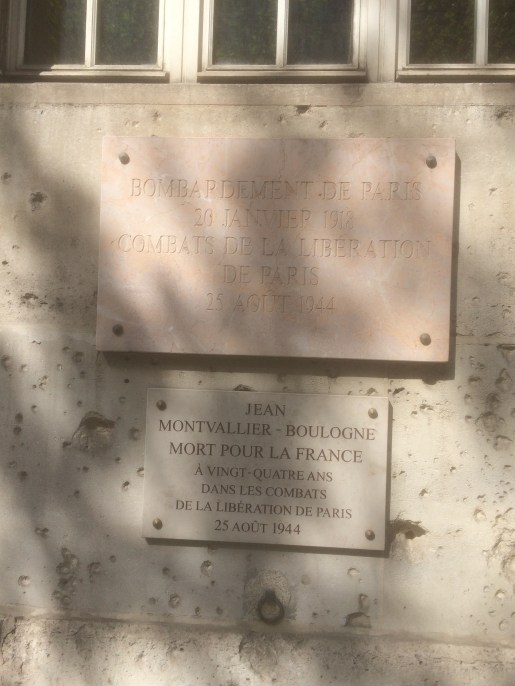
At 60 blvd St Michel, 24 year old Jean Montvallier-Boulogne was killed, on the same day as Bounin. The wall behind his plaque is pitted with bullet holes from the bombardment of the city in 1918, and from the fighting in 1944.
On rue St Jacques, another generic school plaque:

On to the Pont des Arts:

Jacques Lecompte-Boinet was a Compagnon de la Liberation Fondateur and headed the movement Ceux de la Resistance. The Pont des Arts was the location for clandestine meetings with comrades who, like him, risked torture and death. Here Vercors passed on to him publications from the Editions de minuit, intended for General de Gaulle.
Lecompte-Boinet initially joined the Mouvement de Liberation Nationale, which became Combat. Subsequently he set up Ceux de la Résistance with Pierre Arrighi. He was involved in the first meeting of the Conseil national de la Résistance (CNR), 27 May 1943, then left for London in October, from where he travelled to Algiers, returning to France in February 1944. He had a distinguished diplomatic career after the war, and died in November 1974.

Just round the corner is the plaque commemorating Vercors himself – real name Jean Bruller – who wrote Le Silence de la mer, one of the key texts of the literary resistance. It was written in 1941 and published secretly in 1942, the first publication of the Editions de minuit, which Bruller co-founded. Their publications were distributed via clandestine networks, hand to hand. Along with Vercors, they published works by Francois Mauriac, Paul Eluard and Louis Aragon, and after the war established a reputation for publishing new writers such as Michel Butor.
7th arrondissement
Further along the banks of the Seine, the role of the former Gare d’Orsay (now the Musée d’Orsay), as a reception point for those who had escaped or been liberated from concentration camps and forced labour camps is commemorated.

The other major reception point was the Hotel Lutetia, which had been the HQ of the Abwehr during the Occupation, and here the photographs of those who had been deported were displayed, as family members waited in hope of finding those they had lost, and returning deportees waited in hope of finding that someone was looking for them. The survivors of the death camps took longer to come home, often requiring months of medical treatment before they were fit to travel. Their reception was traumatic, for them and for those waiting for them.
Day 3
13th arrondissement
Another railway station, this time the Gare d’Austerlitz.

This was not a place of welcome but a place of despatch. From here, cattle trucks took men, women and children rounded up in Paris to the internment camps of Pithiviers and Beane-la-Rolande, from where most of them were subsequently transported to Auschwitz.
Francois Mauriac, in his clandestine Editions de minuit publication under the pseudonym Forez, Le Cahier noir (1943), wrote of what his wife saw here:
At what other moment in history have the gates of the prison camps closed on so many innocents, at what other epoque have children been dragged away from their mothers and crammed into cattle trucks, as witnessed one sombre morning at the Gare d’Austerlitz?
We were here not only for this bit of history, but for the links to W G Sebald’s novel Austerlitz, the topic of a separate blog.

On the avenue des Gobelins, the deportations from the 13th arrondissement following the Vel d’Hiv round-ups are specifically commemorated. This is quite clear – the round-ups were carried out by ‘la police de l’état francais’. When the Armistice was signed, and Marshall Pétain took on the role of head of state, the vast majority of the French, however much they mourned the defeat, accepted that this was now France. Private citizens and public institutions treated it as such, with at least initially only a small number refusing to accept the authority of the Vichy regime and throwing in their lot with de Gaulle and/or the nascent Resistance. When it came to anti-semitic legislation, Vichy was ahead of its new masters, and as far as the round-ups of Jews are concerned, whilst the Nazis are responsible for the ultimate destination, Auschwitz, those arrested on 16 July 1942 saw only French police until they were on the way to extermination. French police drew up the lists, French police organised the buses and blocked the ends of the streets where their targets lived. French police hammered on the doors in the early hours, and forced the residents to pack swiftly and abandon their homes and most of what they owned. French police transported single adults straight to the internment camps, and families to the stadium, the Velodrome d’hiver. French police guarded them there until they in turn were transferred to the internment camps, and guarded them there too, separating men from women and parents from children until the trucks took them away.
So, inevitably, to Marine le Pen. Her entirely cynical denial of French responsibility is shameful. Le Monde‘s editorial is a perfectly balanced and crystal clear response:
In affirming on Sunday 9 April … that ‘France was not responsible for the Vel d’Hiv’, Marine le Pen has crossed a line: that of the national consensus on the reading of some of the most painful episodes in the history of France, the deportation of French Jews under the German occupation. …
In declaring, at the 1995 commemoration of the event, that ‘France, on that day, did something irreparable’, Jacques Chirac, then President of the Republic, marked a definitive new reading of the deportation of the Jews. The moment had come to recognise clearly the responsiblity of the collaborationist French state … First ministers Lionel Jospin and Jean Pierre Raffarin confirmed his judgement. President Sarkozy judged that there was ‘nothing to retract and nothing to add to this fine statement’. Later, President Francois Hollande, in turn, denounced ‘a crime commited in France for France’.
In rejecting this consensus, Marine le Pen claims to be following in the footsteps of General de Gaulle. On Sunday, to justify her statement, she referred to a ruling from August 1944, published in Algiers by de Gaulle’s provisional government and intended to remove all legality from the Vichy regime. But we are no longer in 1944, nor even in 1981, and Marine le Pen is not Charles de Gaulle, whose heritage was embodied far better by Chirac than by her. We are in 2017. Nearly 3/4 of a century has passed since the Liberation, at least three generations, tens of thousands of pages of history have been written, debated, analysed and taught. The ‘national story’ which [le Pen] wants to promote is anachronistic and sickening. It is based not on a refusal to repent, but on a refusal to recognise an indispensable truth about the nation’s history. Incidentally, Mme le Pen jeopardises (but that’s her problem) years of trying to de-demonise her party, which led her to exclude her own father, unfortunately famous as the man who called the gas chambers a ‘detail’.
Marine le Pen affirmed that ‘France is mentally abused’ by those who teach this critical view. No, Mme le Pen, what abuses France is a version of history which leads it back to the denial of the post-war period. In 1995, Jacques Chirac called for ‘vigilance’. The FN candidate shows that he was right.
At 137 blvd de l’Hopital, previous inhabitants are commemorated; ten of whom (ranging in age from 9 months to 58) were deported and murdered because they were Jews, and another who was shot as a resistant in 1944:

3rd arrondissement. We’re now in Le Marais.
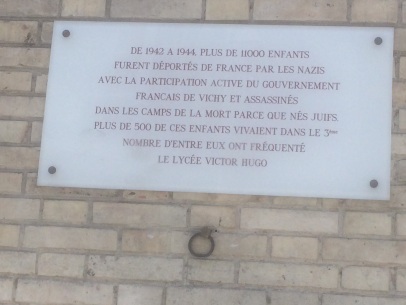
Two more school plaques, commemorating over 500 children from the 3rd, many of whom attended the Lycée Victor Hugo or the Ecole de filles de la rue de Sévigné (now the Atelier des Beaux-arts).

On the rue Perrée, two plaques commemorate members of the union of merchants of the Carreau du Temple who died for France.


Day 4
7th arrondissement
After visiting the Musée de l’Ordre de la Liberation, housed within the Musée de l’Armée, which tells the story of occupation, deportation, resistance and finally liberation, we paid our respects at avenue Elysée Reclus, near the Eiffel Tower, home of Hélène Berr. I’ve written often about Hélène, whose journal, not published until 2008, is one of the most powerful documents of the Occupation.

In my 2012 Holocaust Memorial Day blog, I wrote this:
She was 20 when Paris was occupied, from a thoroughly assimilated French Jewish family, a student at the Sorbonne. She was 21 when she started the journal in which, at first, the war and the Nazi persecution are almost background noise. She was almost 23 when she was arrested, a few months before Paris was liberated, and then deported to Auschwitz on one of the convoys from Drancy. It was her 23rd birthday when she was moved from Auschwitz to Bergen Belsen. She was 24 when she died, in Bergen Belsen, 5 days before the camp was liberated. Her journal, kept by surviving members of her family after the war, was finally published in 2008 and when I read it I loved her, and I grieved for the fate I already knew would be hers. Another voice that wasn’t quite silenced, after all.


Near the Champ de Mars, on avenue de la Bourdonnais, the place where the ‘national insurrection’ of 19-25 August 1944 was planned.

Jean Alexandre Melchior de Vogüé (Vaillant), Alfred Antoine Malleret (Joinville), Raymond Massiet (Dufresne). All three survived the war.
Day 5
4th arrondissement
We began at the Mémorial de la Shoah. I had braced myself for this, knowing the terrible history that would be illustrated there. Nonetheless, seeing the Wall of Names, I felt the air being sucked from my lungs, realising that I was seeing in that moment only a fragment, only some of the names from only one of the years.

Further in, another sharp intake of breath, another moment where the experience of seeing what I knew I was going to see, the photographs of some of the children deported to extermination camps, overwhelmed me.


The Memorial is a powerful experience. It cannot but move you. And in order that one does not give in to despair about humanity, one leaves the Memorial for the Allée des Justes, and another list of names, this time of those who have been recognised for their actions during those dark years, actions which jeopardised their own lives in order to help Jewish friends, colleagues, neighbours and total strangers.
At 23 rue des Ecouffes, in the heart of the Jewish quarter, a family memorial.

This family could be a symbol of the French Resistance. Jewish and Communist, they paid a heavy price.
Rosalie Engros was arrested in August 1942, and deported a month later, to Auschwitz. She was 51. Isaac Engros was murdered at Auschwitz in February 1944, aged 54. They had three sons. Marcel, arrested on 6 May 1942 and shot at Mont Valerien, aged 25. Lucien, arrested and tortured in May 1942, shot 22 August 1942, aged 22, along with a dozen other resistants. Andre, part of the FTP-MOI group of young Jewish resistants, arrested July 1943, tortured and shot 1 October 1943 at Mont-Valerien, aged 16.
3rd arrondissement:

Another school plaque, this time for the Lycée Turgot, on the rue de Turbigo.
On to the rue Meslay, where Yves Toudic is commemorated. He was shot by the Brigade Speciale, a French police unit specialising in tracking down “internal enemies” (i.e. resistants), dissidents, escaped prisoners, Jews and those evading the STO. They worked in direct collaboration with the German civil, secret and military police.
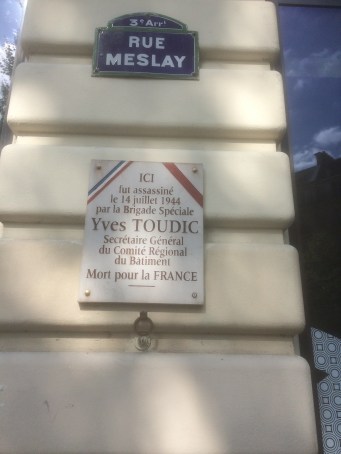
Toudic was 43 when he was killed. Son of a labourer, he was a militant communist and resistant. From September 1940 he was in charge of the Comités populaires du Batiment for the Paris region, and continued in that role until he was shot by the Brigade Speciale, at the time of the 14 July demonstration in the place de la République, which he helped to organise.
10th arrondissement:

Rue René Boulanger. Another young resistant shot down during the battles to liberate the city. I can find nothing about Jean Sulpice, partly because he has a contemporary namesake, a chef. He was 25 when he died.
On the facade of the Bourse du travail, 3 rue du Château-d’Eau, a plaque commemorates the recapturing of the building by ‘the workers of Paris’.

I missed so many. And there is so much more I want to know about those whose names appear here, for posterity. There’s not only the history of the occupation engraved on the walls of Paris, but the history of how it was understood and interpreted and communicated. From the stone plaques marking the spots where resisters fell, installed soon after the liberation, to the much more recent black marble plaques acknowledging how Jewish children disappeared from Paris schools, as they and their families were rounded up and deported.
Paris has of course a rich history outside of those four dark and terrible years. We saw some of it, beautiful buildings and great art. But it seems ever more pertinent to explore what happened in one of the most sophisticated, cosmopolitan and cultured cities of Europe when an occupying power tapped into and found a rich spring of anti-semitism and more generalised xenophobia, and found willing, even enthusiastic partners in their great project to wipe out the Jewish race. Most of those who participated did not know (at least, not for sure) what would be the fate of those they helped to deport. It seems, though, that they didn’t actually care – once the Jews were no longer France’s problem, they had no interest in what would happen to them. We dwell on this not to bad-mouth the French – this happened not only in France but across Europe, and it can happen anywhere, if the right conditions prevail.
We must remember, we must understand, and we must be vigilant.
Easter in the vicarage.
Posted by cathannabel in Refugees on April 16, 2017
An Easter message from Phil Davis of Hope Projects, who blogs about refugees and asylum seekers.

Happy Easter! I wake this sunny, Easter Sunday morning to a sermon from the Prime Minister. It’shere. You may not be able to get to the end, so here is a summary in quotes courtesy of the Telegraph.
The Prime Minister described Easter as “a moment to reflect and an important time for Christians and others to gather together with families and friends”.
She said: “I think of those values that we share – values that I learnt in my own childhood, growing up in a vicarage. Values of compassion, community, citizenship. The sense of obligation we have to one another.
“These are values we all hold in common – and values that are visibly lived out every day by Christians – as well as by people of other faiths or none.”
And who could argue with that? Well as it happens I live in a vicarage. And…
View original post 256 more words
From Sheffield to Zaatari – 24 hours of inspiration
Posted by cathannabel in Events, Personal on April 5, 2017

We started this year’s 24 Hour Inspire with a celebration of the city of Sheffield. City of beer, art and music – and all three were on offer over the course of the event (albeit the beer only in very restrained quantities). This remarkable and moving video summed it up:
Straight into Sheffield music, from the Vivacity choir.
 We crossed all sorts of boundaries – those between the academic disciplines, for a start. ‘Unweaving the rainbow’ brought together scientists exploring colour in physics and biology with a contemporary artist and with poets – and audiences could also explore an abstract virtual reality colour environment, and make their own contributions to a colour wheel.
We heard from a physicist at Durham University, talking about his family history in Poland, during the Nazi occupation, and from a physicist here at Sheffield, talking about Elizabethan/Jacobean revenge tragedy.
All in all, there were 45…
View original post 1,501 more words
Triggering Article 50: a historic moment of delusional madness and national self-harm
Posted by cathannabel in Brexit, Politics on March 29, 2017
I am bereft of words on the day our ‘divorce’ from the EU is triggered. Thankfully Gerry has found some powerful and effective words for me.

‘This is a historic moment from which there will be no turning back,’ crowed Theresa May in her completely mad speech to the Commons this lunchtime. Yet in her speech and in the Article 50 letter to Donald Tusk, she reminded us of the value of what we are losing. ‘Europe’s security is more fragile today than at any time since the end of the cold war’, she intoned; yet the whole point of European integration has been to help maintain the peace in postwar Europe.
And after informing Tusk and the assembled MPs that the UK would not seek to remain in the world’s largest single market, she went on: ‘At a time when the growth of global trade is slowing, and there are signs that protectionist instincts are on the rise in many parts of the world, Europe has a responsibility to stand up for free trade in…
View original post 1,532 more words
Buffy – 20th anniversary (Guest post from Arthur Annabel)
Posted by cathannabel in Television on March 18, 2017
Last weekend Buffy the Vampire Slayer got more attention online than I can ever remember. It’s the 20th anniversary of the show’s first air date and my week was emphatically improved by reading so many love letters to a show that means everything to me. Seeing article after article from authors who adored the show and revelling in the fact that quite often it was something entirely different that drew them to it has inevitably led me to start yet another binge watching session. These articles have done better justice to the cultural importance of the show than I could, so I’ll focus on the personal instead.
I’ve tried to write about Buffy many times. I usually end up losing myself in the rabbit hole of how to explain why this show matters without feeling like I’m straying a long way off of the reservation. How do I write about a show like Buffy without losing my flimsy grip on objectivity? For as long as I’ve been obsessing over essentially unanswerable questions, two of my old favourites to return to are these: Can a TV show/film/song change your life? And if so, could it ever be argued it saved it?
Even with an honorary PhD in hyperbole and a tendency to overthink things, the question of where to draw the line on the influence of media on a (my) life has always fascinated me above and beyond any other.
There are individual films that make a strong argument that it can happen but it’s the form as a whole that I struggle to imagine life without. When I look at music there are stronger arguments for life changing interventions, with Frank Turner responsible for getting me through more days than most, but that’s a separate argument for another blog. I also owe more of my degree from De Montfort University to Whitney Houston’s “I Wanna Dance With Somebody” than I’m entirely comfortable with.
TV has offered me plenty of great options and probably consumed more of my time than either of the two former media. However while I frequently crumble into a bumbling mess when asked what my favourite band or film is, if the same question is posed about television there’s only one answer: Buffy the Vampire Slayer.
Reading a lot of the responses to the anniversary I’ve been struck by a whole bunch of thoughts.
Many describe the show as a feminist awakening for them. That’d be a stretch for me, but it was certainly an essential part of my education. A strong woman kicking every arse that had the temerity to do anything other than respect her was perhaps less revelatory to me than some simply because I had the utterly blind luck to be raised in a household where strength and influence weren’t framed by gender. My mum was always the primary bread winner, my go to guide for how to face the world and as I grew up a continuous reminder of how utterly fucked so many of the default structures of our society are. My dad might argue over whether he is a feminist (mostly because he’s never been presented with a claim he won’t try and dispute for the sheer joy he experiences from being on the opposite side of an argument) but I learnt from him how to be a man utterly un-reliant on outdated stereotypes. I was introduced to the show by them both and we still regularly end up talking about it. In honour of the anniversary we watched “Once More With Feeling” together.
Buffy may not have taught me something entirely new but it delivered the most emphatic argument for my budding and formative world view I could have hoped for. The central female characters were my heroes (and, let’s be honest, crushes) for what they represented. Buffy and her vulnerable strength. Willow and her genius. Joyce and her compassion and aspiration. Faith’s ferocity and self-reliance. Cordelia’s willingness to fight the entire world if it got in her way. Anya’s ability to embrace the changes in her life. Tara’s integrity. And as crazy as she was, even Drusilla had two of the most powerful characters in the show wrapped around her little finger most of the time.
This was the company I spent my teenage years with and one of the main reasons I tried my best to surround myself with female friends. I’d already been insanely lucky with the circle of friends I had, but the idea of forming my own wonderfully diverse Scooby gang was inevitably part of my thinking as I went through my A-Levels and tried to work out what on earth I was doing with my life.
In amongst the multitude of angry male leads (and for balance I loved 24 far more than my lefty politics should have let me) not just Buffy herself, but the entire cast provided expression for dozens of different concepts of strength, whether it was individual or collective, selfish or selfless, calm or angry.
Staring out at the world with perhaps even more uncertainty than the average teenager, I was constantly aware of one of the abiding messages of BTVS: the family you choose is as important as the one you’re born with. So I surrounded myself with the best and the brightest, the kindest and the most fascinating people I could, both during 6th form and Uni. It’s not an overstatement to say I owe an awful lot of my happiest memories from that time to the influence of Buffy and Joss.
I don’t know if I’d have believed that a constantly awkward and self-doubt filled teenager could befriend the kind of people I did without having grown up on a diet of Buffy.
And I don’t know if I’d have made it through the days when that support network couldn’t offset my depression anymore without a few key moments that kept echoing around in my head long after most rational arguments had retreated in the face of the stubborn self-destructiveness that defines those utterly bleak days.
Buffy was a show that managed to combine wit, drama and a hefty emotional punch, always reluctant to sacrifice any of the above to the other. Its most heartbreaking episodes have some great one liners (other than “The Body” in season 5 which is an exquisite exploration of grief and you should never watch it expecting anything other than a rush in demand for tissues). It did a better job of capturing the joys, traumas and uncertainties of being a teenager and trying to become an adult better than most “grounded” dramas I’d seen. It is also a show that revels in language to a degree few other shows manage, no small factor in my enduring love for it.
It was a show about defiance. About accepting who you are and fighting every single day to try and make the world a little bit better. It’s a twin message I frequently fall short of both halves of but keep coming back to. On shitty nights when I’m starting to wallow in my self-pity I can escape into an episode that never shames a character for feeling lost but reminds you of how essential it is that they fight. On good nights where I want that elusive boost to keep me going there are episodes to fire me up with righteous passion that the world can be better if you have the will to fight for it.
It’s been difficult to write this piece without throwing out too many spoilers, but it’s a challenge that is now two decades old. How do you get reluctant audiences past a silly sounding name and concept without giving the game away? How do you hint at how much this show can mean without taking the joy out of its highs and stings out of its lows? I might write a separate, spoiler heavy, piece soon about my favourite moments from the series, but for now I’ll draw to a close.
I was always going to want to finish this post with a quote from the show. There’s plenty to choose from, but there was one that maybe comes closest to providing an answer to the question I posed earlier: Can a TV show save your life?
It would be a stretch to say Buffy saved my life, but not a sizable one. Without the constant reminder of what I could be, of what the fight can be worth or of why fighting for lost causes is worth more than fighting for a thousand sure things, I can’t guarantee I’d be sitting here writing this.
Of all the quotes I could have chosen, all the words Joss put on scripts that shaped the majority of my life, there is one line I keep coming back to. A line that has echoed around my head in the darkest of hours and fired me up in those all too rare moments of defiance, a line that to a neutral observer I suspect might seem lightweight and innocuous.
It’s not possible to give the full context for the line without straying into spoilers, but I’ll frame it as well as I can. Faced with moving on from an almost unbearable sacrifice by a loved one, they reflect on the final words of the fallen. It’s a line I return to over and over again. A line that I rely on to remind myself that no matter how dark it gets there is always hope, so long as you accept that everything in this life that is worth having is worth fighting for. A sentiment that has become even more relevant in the face of recent political developments. A line that works whether I’m just barely holding on or facing a day head on. In good times and bad, Buffy has been there for me and I suspect it still will be when the 40th anniversary rolls around.
“The hardest thing in this world is to live in it. Be brave. Live.”
A slight apocalypse
Posted by cathannabel in Television on March 10, 2017
Buffy is 20 years old today. That is, for those to whom those words are meaningless (where have you been?? what is wrong with you??), it is now twenty years since the first episode of TV series Buffy the Vampire Slayer was broadcast.
Twenty years ago I was far too old for a show with a daft name like that. So I caught it more or less accidentally, and realised that the daft name belied a drama with depth, intelligence, wit and invention. A few years back, pondering more generally on why I care about fantasy as a genre, I wrote this about Buffy:
It all goes back to Buffy. Not, for me, to Dracula, or the George Romero zombie films, or Hammer Horror. Joss Whedon‘s show overwhelmed all of the assumptions I’d made on the basis of a silly title (Sabrina the Teenage Witch, anyone?) – just as The Stand disposed of my prejudices against Stephen King. Buffy had some seriously naff special effects, but it was never about that. The scripts were so sharp, so funny, so packed with layers of references that throwaway lines are often key to a more weighty subtext and the characters never lose their plausibility however bonkers the storyline. Through the medium of this fantasy with vampires, demons and all kinds of inhuman creatures, we’re exploring human relationships – teenagers and parents, sibling rivalries, sexual discovery and betrayal, bereavement and loss – in a fantastic context that allows these things to be explored in fresh and unexpected ways, that jolt us with their familiarity whilst we accept a narrative involving an ensouled vampire or a mayor turning into a giant snake. For all the scary stuff (and there are some real shiver down the spine moments) the things that stay with you are the human elements – what Heritage calls ‘the fat streak of humanity’.
I quote Buffy all the time. In daily life, and in this blog. When I write about death, and how we deal with it, I go back again and again to this:
Which takes me back to Buffy, and the extraordinary words that Joss Whedon puts into the mouth of Anya (she’s a thousand-year-old vengeance demon, but don’t worry about that, the point is that she says the stuff that we feel, and think, but don’t say):
“I don’t understand how this all happens. How we go through this. I mean, I knew her, and then she’s – There’s just a body, and I don’t understand why she just can’t get back in it and not be dead anymore. It’s stupid. It’s mortal and stupid. And – and Xander’s crying and not talking, and – and I was having fruit punch, and I thought, well, Joyce will never have any more fruit punch ever, and she’ll never have eggs, or yawn or brush her hair, not ever, and no one will explain to me why.” (‘The Body’, season 5)
And there are other moments that come back to me, inspire me.
There’s a cracking body-swap episode where Buffy and Faith swap places. Faith, as Buffy, begins by mocking what she sees as Buffy’s humourless puritanism, practising in front of the mirror saying ‘Because it’s wrong’, po-facedly. And then later, confronted with the reality of evil, and knowing that she could walk away, instead asserts that she will stop that evil from killing its intended victims, ‘Because it’s wrong’.
And then there’s the finale.
MONTAGE
| EXT. BASEBALL DIAMOND – DAY A young woman stands at the plate staring at the pitcher, waiting to bat. She looks a little nervous. |
BUFFY (V.O.) From now on, every girl in the world who might be a slayer… |
|
| INT. HIGH SCHOOL HALLWAY – DAY A young woman breathes heavily as she leans on her locker for support. |
will be a slayer. | |
| INT. LIVING ROOM – DAY A young woman is lying across the floor, having fallen out of her chair. |
Every girl who could have the power… | |
| INT. DINING ROOM – DAY In a Japanese-style dining room, a young woman stands up at family dinner. |
will have the power… can stand up, | |
| INT. BASEMENT – DAY A young woman grabs the wrist of a man who’s trying to slap her face, preventing him. |
will stand up. | |
| EXT. BASEBALL DIAMOND – DAY The girl at the plate changes from nervous to confident, smiling as she waits for the pitch. |
Slayers… every one of us. Make your choice. Are you ready to be strong? |
That montage was really important to me. I wrote this, a couple of years back:
That bit where the potentials become actuals – that beautiful sequence of young women taking that power on, without understanding it but knowing that its theirs, and standing up, literally or figuratively… Lord, that moves me so much, I can’t even speak about it without choking up. Over the last, very tough, year, it has played in my head at so many moments when I’ve felt powerless and defeated, and made me stand up straighter too.
Buffy fans will argue endlessly about which episode or which series is best, or worst. Each series has its advocates, even if there’s a pretty powerful consensus about episodes (‘Beer Bad’ is unlikely to feature as anyone’s favourite, though I could be proved wrong…) – any ‘best of’ list would have to include ‘The Body’, cited above. And ‘Hush’, and ‘Once More with Feeling’. And those three episodes illustrate the sheer variety of the series.


The first is a viscerally powerful portrayal of death and grief. It nods briefly to the vampire slayer role but fundamentally it’s about humanity, and mortality. It’s known as ‘the one without music’. ‘Once More with Feeling’ is of course the one with music, and ‘Hush’ is the one without dialogue (virtually). In ‘The Body’ the ‘big bad’ is death itself. In ‘Once More…’ and ‘Hush’ both the compulsion to sing and dance, and the inability to speak, are demonic, but their outworkings emphasise humanity – our failure to communicate, the way in which our fear of losing those we love leads us to hide part of ourselves from them.
And whilst Series 7 is not many people’s favourite, I think that one of the reasons why it stays with me, has become part of me, that it allows us to see these characters that we’ve followed through multiple apocalypses, many of whom we love, so damaged and scarred. Not bouncing back with a merry quip, not any more. We used to mock so many TV series in the 70s in which, whatever happened in the episode, whatever traumas, terrors, dangers and disasters were visited upon the characters, at the end they got to go home and have tea, and have a bit of a chuckle. Buffy never did that – if there was a gag at the end it was tightly tied in with the preceding narrative, and had a bit of a kick to it, or a poignancy that stopped it being trite. But here over a whole series (and going back to S6) we see these battered veterans, hanging on as best they can to their loyalties and loves and to whatever humour they can find, but unable to be what they were, carrying the weight of so many losses. It’s right we left them there, but I’m glad we got to go that far.
There are so many aspects to Buffy that I haven’t even touched upon. Cos what I really want to do right now is to dust down those DVDs and go back to Series 1, Episode 1. Back to the Hellmouth.
Buffy – the best bits: Harvest, Innocence, The Wish, Doppelgangland, Hush, The Body, The Gift, Tabula Rasa, Once More with Feeling, Chosen.
International Women’s Day 2017
Posted by cathannabel in Events, Feminism on March 8, 2017
20th century women – three generations in my family exploring what it means to be a woman. My mum, who believed that it was for men to lead and inspire, but who led and inspired, nonetheless, despite herself. I grew up wondering why I was so crap at being a girl (the endless Christmas and birthday gifts of cookery books and embroidery sets and dolls, all rebuking me for my ineptitude and lack of interest), but finding a way to be the kind of woman I wanted to be without the trappings that irritated and puzzled me. My daughter managing to be so good at being a girl (all that pink, the Barbies and Bratz, the make-up and handbags) and being a fierce and clever and brave woman at the same time.
I thought of us all whilst watching the film 20th Century Women. Annette Bening’s Dorothea was my age in the film, but Mum’s generation. Dorothea died in 1999, five years after my Mum. Their lives and experiences were so very different but there was something about her – the fact that she gathered around her people who needed shelter, nurture, companionship, the way she invited anyone she encountered to come to dinner, her desire and real effort to understand what mattered to her son and the younger women who were part of her life.
I managed not to weep, until the very end. When Jamie says that he can’t explain his mother to his son, that’s when it got me. Because I would have loved to see my Mum, watching my children grow up, and to see them turning to her for the love and pride and support that would have always been theirs. And all I can do is to tell them about her.
If the women in 20th Century Women are all white, straight and comfortably situated, the young women in Girlhood (Bande de filles) certainly are not. They inhabit the banlieue, their home lives are chaotic, their choices limited (by economics, by expectations). The opening sequence is possibly the most powerful cinematic expression of the challenges so many young women face that I can recall – a girls’ American football team on the pitch, physically powerful and fearless, jubilant in victory, they pour out of the stadium a babble of raised voices, laughter, solidarity and shared experience. And then they approach the apartment blocks, with the young men almost seeming to be on guard there, in ones and twos, and their voices are quietened. One by one they slip away from the group and into their own lives. But whilst the film gives us no cosy reassurances about what they face, it gives us along the way other moments of joyous girlhood – for example as they dance and pose and mime (in shoplifted frocks) in a hotel room to Rihanna’s ‘Diamonds’:
So shine bright tonight,
You and I
We’re beautiful like diamonds in the sky
Eye to eye,
So alive
We’re beautiful like diamonds in the skyShine bright like a diamond
Shine bright like a diamond
Shining bright like a diamond
We’re beautiful like diamonds in the sky
And they do shine, they are so alive, they are beautiful.
We’re half the world. We’re all races and religions, all shapes and sizes, all political persuasions. We have disabilities and we have none, we are healthy and we suffer pain and indignity, we are independent and we need help to get by. We have money to burn and nothing at all. We are mothers and we are daughters and sisters, we are friends and wives and lovers. We are gay, straight, bi, trans, and every variant or combination of the above. We are feminists, and we are ‘I’m not a feminist but…’ and we are most decidedly not feminists. We believe in our right to choose, and we believe that women’s fertility should be controlled by the state, by the church, by men. We wear pussy hats, and ‘Make America Great Again’ hats.
I can’t speak for Women. I’m middle aged (at least…), straight, cis-gendered, without disabilities, white, university educated, comfortably off. I am as baffled and dismayed by what many other women believe and fight for as I am about what many men believe and fight for. I can’t claim to have experienced direct discrimination, I’ve never experienced sexual violence or domestic violence. Everyday sexism, yes, of course, over the years I’ve clocked up a fair number of examples of that, in the workplace, on public transport, on the streets. But the fact that, say, FGM doesn’t affect me or mine doesn’t mean I don’t give a damn about it, or that I shouldn’t campaign about it. The fact that my career has encountered no overt obstacles due to my gender, that I live in a society with laws to protect my rights to equal pay and equal treatment, doesn’t mean I have nothing to say about the women around the world for whom this is not true. I can’t speak for Women, but I can and do and will speak about the experiences, the threats, the challenges, the obstacles that so many women share (even if I haven’t and don’t).
I check my privilege, I acknowledge it, but it doesn’t have to limit what or who I care about. And I know that in most countries, most of the time, women have to face a whole lot of extra crap that men don’t – they share the burdens of poverty, persecution and oppression, natural and man-made hazards and disasters but with the additional burdens that arise from the way they are viewed in too many societies, by too many men. That their choices are deemed irrelevant, their aspirations ridiculous, their personal integrity always violable. Whether these oppressions are enforced by law or merely by convention, they do oppress, and it takes immense courage to challenge them.


To all those who do, thank you.
And to my Mum, who would never have called herself a feminist, but who inspired me in that aspect of my life, as in so many others, thank you.
https://www.theguardian.com/commentisfree/2017/mar/08/feminist-battle-women-activists-campaigns
The 24 Hour Inspire 2017
Posted by cathannabel in Events, Inspiration for Life on March 7, 2017
This year will be our fifth 24 Hour Inspire. I would never have believed, if anyone had told me back in 2012 when we were planning the first one, that we could achieve anything like this. We really had no idea what we were doing, and it’s thanks to the support of colleagues at the University who did know what they were doing when it came to events management that the first lecture marathon went so smoothly, and gave us the confidence to carry on.
The basic format hasn’t changed – 24 hours of talks on everything under the sun, all pitched at non-specialist audiences. Each year there’s more in the way of fringe activities – art, poetry, music and more – and we have a pop-up radio station broadcasting throughout.


Of course, most people won’t do the full 24 hours. If you’re in the vicinity, dip in and out, come for just one talk, or as many as you wish. If you’re not, listen in to the radio station (there’s a taster here: https://www.mixcloud.com/24HrInspire/24-hour-inspire-warm-up/)
As you’ll hear in the podcast, the 24 Hour Inspire is supporting the University’s We are International campaign.

It’s at the heart of what a University is about – the sharing of knowledge, ideas, and expertise, regardless of borders and nationalities and across all of the barriers of language, religion and politics. Our speakers, the MCs who will introduce them, the volunteers who will sell the tickets and the coffee, come from all over the world. And many of those who are from the UK have spent part of their working lives overseas.
Not only that, but some of our talks reflect those international values – Paul Collini’s lecture on TB in the 21st century is based on work he undertook in Ghana. Kate Shaw, who did her doctorate in Sheffield, is now based in Italy and works for Physics without Boundaries, and will be talking about their work in Nepal. And whilst we start with a celebration of Sheffield (city of art, beer and music), our closing talk will take us to the Zaatari refugee camp in Jordan.


Over the last few years, this event has raised significant funds for a number of cancer charities. This year the beneficiaries will be Weston Park Hospital Cancer Charity and Teenage Cancer Trust. Most of the funds are raised on the day, through sales of wristbands and refreshments, but you can also donate by texting INSP24 £10 (or whatever you wish to donate) to 70070.
It’s been called ‘the Glastonbury of lecturing’…

and it’s a joy. If you can, be there. If not, do follow what we’re doing on social media, and on Radio Inspire (broadcasting from around 15.00 on 30 March), help us raise lots of funds for our chosen charities .
Be inspired.


How can life go on?
Posted by cathannabel in Genocide on January 26, 2017

Every year, on the anniversary of the liberation of Auschwitz by Red Army troops, we honour those murdered in the Holocaust. But not just The Holocaust. It takes nothing from the unique place that event holds in our history to honour too those murdered in genocides in Rwanda, Cambodia, Bosnia, Darfur, Armenia. The Holocaust Memorial Day Trust does this – and it draws upon the testimonies of survivors of some of the more recent genocides to bring home to us that the pious utterance ‘never again’ has been little more than a pious utterance.
If in my own writing about genocide I focus on the Holocaust, there are a number of reasons for that. Firstly, my areas of research relate to the Shoah, most particularly in France. Secondly, because of where and when the Holocaust took place, because of its long build-up and its duration, we have vast volumes of testimony, not only from survivors (and from those who did not survive but left behind diaries nonetheless) but from perpretrators and bystanders. We have diaries and letters, but also memos and legal documents and reports and photographs and films. There is thus a vast archive of material on which we can draw in our ongoing attempts to understand what happened, how and why, far more than in any of the other genocides of the last century.
If it takes nothing from the Shoah to talk also about these other genocides, it takes nothing from those other genocides to talk about the Shoah.
The theme for Holocaust Memorial Day this year is, ‘How can life go on?’.
These days we have a better understanding of how, long after a traumatic event is apparently concluded, it is present and ongoing in the person who suffered it. It’s become a cliché – the offer of a help line, the parachuting in of counselling services after a ‘major incident’. That doesn’t mean that the help is provided when and where it’s most needed, or that it is always effective.
The late Jill Saward, talking about how she was able to rebuild her life after rape, said that you have to ‘bury it dead’. But that in order to do so you have to talk it out, for as long as it takes. If you don’t, then it may be buried, but not buried dead.
Many of those returning from the liberated camps found that their accounts were not believed, or not listened to. Anne Sebba’s fascinating book, Les Parisiennes, has some shocking accounts of these reactions.
Ravensbruck returnee, Michele Agniel, recounted how since she could barely stand, she was given a permit to jump the queues for rationed food.
“But when I did, a man complained, so I said I had just come back from a concentration camp. He said, ‘Mais quand même, they know how to queue in concentration camps, don’t they?’”
Denise Dufournier was regularly told that ‘they had had a jolly tough time in [Paris]’ when she tried to speak about her experiences. Some found that family members were shocked, not by the brutality of the camps but by the fact that survivors had had to steal in order to stay alive, or that they were mainly concerned to know if their daughters had been raped, or were still marriageable.
Perhaps we should not be too quick to condemn those who failed to recognise the sufferings – past and continuing – of the deportees. After all, anyone who has been bereaved or suffered a purely personal trauma will find that some of those who they counted as friends are too paralysed by the fear of saying the wrong thing to say anything at all. And this was horror on a scale that few could easily imagine – the evidence was there, had been for years, but people baulked at believing it. They still do.

At the gare de l’Est in April and May 1945, many of the survivors arrived home. There were plenty of people to greet them, with flowers. But the gesture suddenly seemed inappropriate, even ridiculous.
The deportees, these living shadows, these walking skeletons, with that distant, lost look in their hollow eyes, their air of being from a different world, when one saw them appear, one dared not offer flowers. (Levy & Tilly, p. 229)


At the Hotel Lutétia, families waiting and hoping posted photographs and personal details, and deportees too gathered, hoping to find that someone was waiting for them. The photographs bore little resemblance to the people who returned, and some failed to recognise the people whose return they had awaited for so long. For many of the Jewish survivors, no one was waiting because no one was left.
There was a gulf between the survivors of the genocide and those who, with whatever privations, had escaped arrest, across which few even attempted to reach. By 1947, publishers no longer accepted manuscripts from the deportees, many of whom had been advised quite explicitly to desist from attempting to tell their stories. Not all tried, of course, some took refuge in silence for years, or decades, or for ever.
But those who spoke were not heard.
There were people who understood, people who had been there too. And so some of the deportees found solace in each other, and not only that but practical support with the painful process of resuming a life that could not simply be picked up again, as if it had just briefly been put to one side, as if you were the same person as you had been Before.
In France the Association Nationale des Anciennes Deportées et Internées de la Resistance brought together women who had been imprisoned for resistance activity. This focus meant that although Jewish women who had been active in the Resistance and arrested for these activities could join, those who had been arrested simply for being Jewish could not. There was thus a separate organisation, the Service Central des Deportés Israélites. They worked to help reunite returning deportees with family members, including with children who had been hidden with non-Jewish families, and in some cases were too young to have any sense of their original identity or to easily readjust to their real families.
The separation of the returnees according to the reason for their arrest takes some interpretation. Firstly, around half of those deported for resistance activities returned. Of the 76,000 Jews deported from France, only 2,500 came home. The prominence given to the former group was therefore partly numerical. However, it was more complex than that. In the post-Liberation settling of scores, whereby collaborators of various types were exposed and punished (officially or unofficially, justly or unjustly), those who had been deported for resistance activities were unassailable. No one could question their patriotism or heroism. The Jews who returned were not part of this myth of ‘resistancialisme’, as Henry Rousso called it, because they could be said to have fallen into German hands as victims. Not only that, but their very survival raised questions of how, if the Nazi goal was to exterminate them, they had managed to return (mirroring in many cases their own questions, their own survivors’ guilt). And of course their accounts of their ordeals shone an unwelcome light on the anti-semitism which had been there before the Occupation, and was still there after it, the anti-semitism which had in many cases led to Jews being betrayed and denounced and which now poisoned the reaction to the returnees.
How could life go on, when the enormity of what they had faced, the physical and mental tortures, the sights and sounds that could not be unseen and unheard, was unacknowledged and buried, not dead, but deep? The survivors of genocide not only had to recover physically from the effects of starvation, exposure, brutal labour and torture, but also from the horror of knowing that they had been condemned to this not for any crime but because of their race. They had lost so many of the people they loved. Not only this, but those who returned home returned to the place where their neighbours and colleagues had watched them be rounded up, or beaten up, or had denounced or betrayed them, and where their apartments and belongings had long since been appropriated either by the occupying forces, or by those neighbours and colleagues. And often they were faced with the indifference, lack of understanding or even hostility of those around them.
The suicide rate amongst Holocaust survivors is reckoned to be almost three times that of the general population. Jean Améry (who had changed his name from Hanns Mayer after the war, to dissociate himself from German culture), only began writing about his experiences in the camps in 1964. He had been initially arrested for resistance activity, but was then ‘demoted’ from political prisoner to Jew, and was imprisoned at Auschwitz, Buchenwald and Bergen Belsen. In 1976 Améry published the book On Suicide: A Discourse on Voluntary Death. He took his own life by overdose of sleeping pills in 1978.


Whilst the official verdict on Primo Levi’s death as being a suicide has been disputed, that the effects of what had been done to him and what he had witnessed had continued to haunt and damage him is undisputed. Elie Wiesel said that “Primo Levi died at Auschwitz forty years later”.
When life does go on, how is the fact of what happened in the camps accommodated within everyday existence? The children and grandchildren of survivors have been part of this process too, often discovering only in adulthood, and little by little, what their parents or grandparents experienced. Eva Hoffman heard, as an adult, how her father’s sister had been betrayed by another Jew, who had hoped by that act to make themselves safe.
‘Let’s not talk about these things’, he says lowering his head, and I want to stop too, right now. All this time I’ve done my father the injustice of not knowing this story, and now I can hardly bear to hear it. This is no longer a frightening fairy tale, as it would have been in childhood. … Indecent not to say anything to my parents, indecent to say anything at all: pity is too small for this. … There’s no way to get this part of the story in proportion. It could overshadow everything else, put the light of the world right out. I need seven-league boots to travel from this to where I live. And yet, this is what I must do. A writer of my parents’ generation who was himself in a concentration camp once told me that the Holocaust is the standard by which we should judge the world. But I think that the paradoxical task of my generation, caught within this awful story, is to get adjusted to the ordinary world in which we actually live, to acknowledge the reality given to us. (Hoffman, pp. 252-3)
And Göran Rosenberg, both of whose parents had survived the camps, wrote A Brief Stop on the Road from Auschwitz, to tell their story, and that of the shadows they lived with in the years after.
It’s impossible to think you’ve all survived in order for the world to forget what it’s just been through and to go on as if nothing has happened. There must be some point to the fact that you’ve survived, since the main point of the event you’ve survived was that none of you were supposed to survive, that you were all supposed to be annihilated without a trace, without leaving even a splinter of bone behind, still less a name on a death list or a death certificate. So initially you all survive with the assurance that you are the traces that weren’t supposed to exist, and that this is your survival’s particular point. … Why me and not the others? Naturally it’s … an unbearable thought, which has to be pushed aside sooner or later if surviving is to turn into living. So I think it’s initially pushed aside by the assurance that you haven’t survived for yourselves only but for the others, too; that you’re the traces that must not be eradicated, and that you therefore owe a particular duty to the life you’ve been granted, against all the odds and beyond any notion of fairness, and that through this life you must justify the fact that you’re alive while the others are dead. (Rosenberg, pp. 278-9)
‘If surviving is to turn into living’ – that’s the heart of it. Not all managed that transformation.
But as the survivors of the Holocaust, those who spoke and those who remain silent, slip away from us, it becomes ever more urgent to hear, and tell, and re-tell their stories. They weren’t meant to be here, they weren’t meant to bear witness.
There are other survivors too. On Holocaust Memorial Day we do not only remember those who emerged from the darkness of the Nazi genocide, but those who against the odds still live to speak about what happened in Cambodia, in Rwanda, in Srebenica, in Darfur.
They are ‘the traces that must not be eradicated’, for the sake of the dead, for the sake of the living, for the sake of their children and ours, for the sake of the generations to come.
Jean Amery – At the Mind’s Limits (1966)
Eva Hoffman – Lost in Translation (1989)
Claude Levy & Paul Tillard – La Grande Rafle du Vel d’Hiv (2010)
Göran Rosenberg – A Brief Stop on the Road from Auschwitz (2012)
Anne Sebba – Les Parisiennes (2016)
‘Drifting towards great catastrophes’: premonitions from the 1930s
Posted by cathannabel in Genocide, Politics on January 25, 2017
For Holocaust Memorial Day, reblogged from That’s How the Light Gets In
In the years of optimism we would read books and puzzle over why, in the heart of civilized Europe, people had happily abandoned democracy, believed fantastical lies, and stood by or enthusiastically joined in as those deemed to blame for the nation’s ills were murdered in their millions. In these dark days, and on this Holocaust Memorial Day, understanding is beginning to gnaw at our bones like an ague.
In times like these, the message of certain books I have read recently seems to illuminate a simple truth: that authoritarianism insinuates itself into peoples lives without drama, but with a kind of quotidinian ordinariness that slowly dispenses with facts.
View original post 5,200 more words

