60 Books in 60 Days: Reading Challenge, days 43-56
Posted by cathannabel in Africa, Literature, USA on September 24, 2017
Well, someone forced me to do it. In so far as they challenged me to do it. Or rather, they told me that someone else who’d just arrived at their sixtieth birthday had taken this challenge on. Same difference really. Anyway, I have one default response to a challenge – as long as it involves a literary or cultural feat rather than anything physical:
Challenge Accepted.
So, 60 books in 60 days, starting on 31 July, finishing on 28 September. This is the penultimate instalment of my reading diary, with the final one to follow on 24 September. I will, of course, endeavour to avoid spoilers.
Rules? To summarise:
- No re-reads unless the original read was at least 40 years ago.
- Series: e.g. a trilogy will count as 3 books if it has been published as 3 separate books even if it has later appeared in a one-volume edition.
- Books can be fiction (all genres, including childrens/YA) and non-fiction (other than reference books and instruction manuals), playscripts, a volume of poetry, or a collection of short stories (in the latter two cases, I must read all the poems or stories).
- I’ve added one further rule, on reflection – no two books by the same author. That will stop me meeting my target by devouring a whole raft of Kate Atkinsons or whatever, which would be fun but not really in the spirit of the challenge. So, sixty books, by sixty writers.
11 September. Day 43 Finished Aminatta Forna’s The Devil that Danced on the Water. Brilliant, fascinating, moving. The narrative was labyrinthine, moving around from Before (before her father was arrested) to After (what happened to the rest of the family after his arrest) but only towards the final pages coming to that terrible truth at the heart of it all – what happened to him and ultimately how and why he died. Extraordinary.
On to Livi Michael’s Succession. I have read most of her adult novels (Inheritance, All the Dark Air, Their Angel Reach) and read to my daughter at least one of her stories about an intrepid and resourceful hamster called Frank. This one is historical fiction, the first in a trilogy set during the Wars of the Roses.

As a child and a teenager I devoured historical novels. Rosemary Sutcliff, Henry Treece, Geoffrey Trease, Leon Garfield – each of them in my memory evokes a particular period of history. Later on I read Margaret Irwin, Edith Sitwell’s books on Elizabeth I (Fanfare for Elizabeth and The Queens and the Hive), and Rosemary Hawley Jarman’s We Speak no Treason.


This last is particularly relevant to the Livi Michael trilogy, and I’m quite excited about reawakening my earlier fascination with this period of history, and rediscovering a writer who I know through novels with a very contemporary setting.
I’m also about to start on Philip Roth’s The Plot against America. From fictionalised real history to an ‘alternative’ history, in which Roosevelt is defeated in 1940 and Lindbergh becomes President. Intriguingly, it’s an alternative personal history too – the history of the Roth family had events turned out in this way. I think my first encounter with alternative history was in Joan Aiken’s terrific, gothic children’s book, The Wolves of Willoughby Chase, set in the reign of James III, when a channel tunnel has been built, via which wolves have migrated into Britain in large numbers. Probably the majority of works in this genre, however, have taken World War II as their setting, positing some crucial moment at which everything changed, allowing a Nazi victory in Europe (and beyond). The more one knows of the ‘real’ history, the more fascinating (and potentially contentious) this is.


Also on my reading pile (though probably not as part of this project) is Sinclair Lewis’ It Can’t Happen Here, written in 1935, and positing the rise of a far-right demagogue to the Presidency… That title was echoed in a film I dimly recall watching, and being horribly chilled by, It Happened Here, subtitled ‘the story of Hitler’s England’.


The Plot… will also, as it happens, be my first Roth.

Caitlin Moran’s piece ‘Reading is Fierce‘ seems especially pertinent in light of this project.* I allowed myself an unseemly moment of hubris when she mentioned the ‘challenge’ of reading fifty-nine books in five months as a judge on the Baileys Prize (ha! Try sixty books in under three months, you lightweight!). But then, there’s this.
And so to read is, in truth, to be in the constant act of creation. That old lady on the bus with her Orwell; the businessman on the Tube with Patricia Cornwell; the teenager roaring through Capote – they are not engaged in idle pleasure. Their heads are on fire. Their hearts are flooding. With a book, you are the landscape, the sets, the snow, the hero, the kiss – you are the mathematical calculation that plots the trajectory of the blazing, crashing Zeppelin. You – pale, punchable reader – are terraforming whole worlds in your head, which will remain with you till the day you die. These books are as much a part of you as your guts and your bone. And when your guts fail and your bones break, Narnia, or Jamaica Inn, or Gormenghast will still be there: as pin-sharp and bright as the day you first imagined them – hiding under the bedclothes, sitting on a bus.
That’s my life she’s writing about, my life with my head in a book, from a four-year-old just graduating from Janet & John to real stories (never ‘just a story’, stories matter, stories can make you fly), to a sixty-year-old powering through novels and memoirs and poems for some daft challenge, reading on buses, in waiting rooms, last thing at night and first thing in the morning. Singing that ‘unseen, life-changing duet’ with each writer I encounter. Glorious.
Oh, and I can’t ever ever read Moran’s piece ‘To Teenage Girls on the Edge’ without having quite a big cry. It’s everything I wanted to, tried to, meant to say to my own teenage girl when she was in that place, but said so much better than I ever could.
Ooh, this Livi Michael is good.
12 September. Day 44
A difficult day but in what free time there was, I progressed mightily with Succession. Once one has got one’s head round the Dukes of This and Earls of That (another disadvantage with a Kindle, BTW – Livi Michael kindly provides a cast list at the front of the book, but it’s far more faff to refer to it in an electronic book than in a real one) the narrative is compelling, the characters fascinating (especially the two Margarets) and the writing beautiful.
I’ve always taken the view that any hierarchy of literary merit must ignore the notion of ‘genre fiction’. There’s good writing, and there’s bad. There are literary prize winners that are unreadable, ‘classics’ that are turgid and dull, and crime or horror or historical novels that are written with such power and depth that they stay in the mind and the heart long after the last page is turned. Of course many novels refuse to be categorised, but there are fine writers who are not only unashamed to be part of a genre, but also exploit and transcend the constraints of that genre. Historical fiction as a genre includes plenty of dross, some of which I read (and quickly tired of) in my teens – but there’s plenty of excellent writing too, and this is a great example.
13 September. Day 45 – Finished Succession. Obviously given my self-imposed rule about not reading more than one book by the same writer, I can’t go straight on to the next title in the trilogy, but I will look forward to it immensely once this challenge is complete. Michael tells her story through a number of different voices, those of major players in the events and those of very minor players, mentioned but unnamed in the chronicles. And she threads the accounts in the actual chronicles through her fictional narrative, so we read of the events in the words of writers who lived at that time, and then she takes us into the thoughts and feelings of her protagonists so that they live and breathe for us.
The Plot against America is splendid. And chilling. Roth shows how the Lindbergh presidency allows prejudices – primarily anti-semitism in this context – which had previously been whispered or shared only with those of like mind to be spoken clearly and loudly and without shame. We’ve seen that very recently on the streets of the USA.
On now to another writer who I’ve loved for many years, and who very sadly died only a few months ago, far far too young, Helen Dunmore. It’s another historical novel, but much more recent history. The Betrayal is the sequel to The Siege, set in Leningrad after the Second World War, and I’m looking forward to it, and glad that there are still a few of her novels – and all of her poetry – for me to enjoy.

14 September. Day 46 – The Betrayal takes us into the world of Stalin’s oppressive dictatorship, where everyone has learned to speak quietly because there’s always someone listening, where everyone lives in fear of a denunciation or just of coming to the notice of the powers that be, for good or bad reasons. It reminds me in that respect of another recent read, Simon Sebag Montefiore’s One Night in Winter which evokes this atmosphere very powerfully.
15 September. Day 47 – Finished The Betrayal. Brilliant, beautiful and sad. It really does evoke that world where ‘they’ can do whatever they want, regardless of truth, regardless of sense, regardless even of self-interest, and you – the ordinary citizen, even the Party official, should the wind change direction – can do nothing to prevent it. The central characters (who carry over from The Siege) are (as one of the reviews pointed out) perhaps unrealistically beyond reproach. However, they are vividly and sympathetically drawn, and what Dunmore shows is how their integrity, their courage, their dignity is of so little use to them in the face of paranoid tyranny. It shows also how hope survives, just. They told themselves after the siege was over that things would get better. And despite the betrayal of that hope, there is still a glimmer at the end of the novel.
Next up, from Stalin’s USSR to present-day Turkey, for Elif Shafak’s Three Daughters of Eve.

Also finished The Plot against America. A couple of the reviews give a spoiler-free flavour of the book:
I called the book ‘astonishing’, but what astonishes is not this wild counter-history – it is presented too plausibly for that – or any fireworks in the prose, which is uncommonly sober, though always elegant. What’s astonishing is the way Roth puts together the stories of the shaken Jewish family and an America that can’t see what’s happening to it, that isn’t shaken enough. ‘They live in a dream,’ Philip’s father says, ‘and we live in a nightmare.’ (Michael Wood, London Review of Books)
Roth … dramatizes two vast and contradictory principles simultaneously: on the one hand, the susceptibility of American individualism to the cult of celebrity, and of American faith in democracy to a tyranny of the majority, leading to a particular vulnerability to unscrupulous politicians who win widespread popular support and gain a grip on the three branches of government; and, on the other, the distinctively American sense of freedom, stiffening the will to resist such political depravities, a will that’s integral to the country’s values, heritage, and history. The novel’s great tragic power lies precisely in the clash between the two. (Richard Brody, The New Yorker)
The New Yorker piece, notably, is recent (February 2017, whilst the book was actually published in 2004). It valiantly avoids spelling out the all-too-evident contemporary parallels (particularly given that the current incumbent of the White House drew explicitly on America First rhetoric in his campaign and in his inaugural speech).
16 September. Day 48 – Started two new books. Three Daughters of Eve has already captivated me. Its protagonist, Peri, is engaging and fascinating. We meet her first in the present day, a woman in middle age, attempting to hang on to her self-confidence in the face of an eye-rolling teenage daughter. Yes, I think we can identify… But the narrative gets very dark, very quickly. The setting is not familiar to me – of course I know a little of Turkey’s history and recent events, but not enough, and I look forward to deepening my understanding.
The second new one is The Loney, by Andrew Michael Hurley. That’s been sitting on my ‘to read’ pile for ages, and I’m still not 100% convinced it’s ideal bedtime reading, so if it gives me nightmares I might have to swap. So far, so undefinably creepy. We know things are off, but not quite how, let alone why. Not yet scared but definitely uneasy… It comes with a ringing endorsement from Stephen King who is the master of unease (he also does full-on gross-out grue, of course, but it’s the unease, the uncanny, the sense of a place being just a bit wrong, that I think he does best).

17 September. Day 49 – Finished Three Daughters of Eve. Whilst it’s not short on action, it is preoccupied with questions of spirituality and faith (not only religious conviction but feminism), exploring them through Peri’s ill-matched parents, and through her encounters as a student at Oxford, where she becomes one of the eponymous ‘three daughters’. Peri is introspective and constantly questioning – she characterises herself as ‘confused’ because she cannot resolve the contradictions she has either inherited or acquired. Shafak weaves the philosophical debates into personal and political crises as she moves between the different time frames – the present day, unfolding almost real time at a posh Istanbul dinner party, childhood, and student days. Fascinating.
Treating myself to the new Lesley Glaister, The Squeeze. Another writer who I’ve enjoyed enormously over the years (along with Livi Michael, Glaister was involved with the MA Creative Writing at Sheffield Hallam University, during the period when I worked there).
18 September. Day 50 – Lesley Glaister has never been afraid of going to dark places – often there is a strong element of the gothic, often there is murder and always there are terrible secrets.
Glaister’s territory is suburban Gothic, but unlike Angela Carter or Margaret Atwood, she’s not interested in folkloric excursions into fairy tale forests or the thornier thickets of feminist irony. Her stories, couched in humour and social observation, are firmly rooted in the domestic and mundane. Babies are dropped on floors, young women locked in attics and fathers murdered in their beds, but they are usually polishing off a Pot Noodle in between last breaths.
This novel is no exception. It begins with two lives which would seem to have no possible connection – a teenager in Romania, dreams of University abandoned, struggling to provide for her family, and a married, Norwegian businessman. But connect they do.

Excellent as always, and makes me want to revisit her earlier novels.
Off to Ghana now, where I spent some of my childhood. Nii Ayikwei Parkes’ Tail of the Blue Bird is a whodunnit, set in ‘the Ghanaian hinterland’, where old and new worlds clash. So this one ticks two boxes, one for genre and one for setting.

And it’s a delight. The storytelling is shared between Kayo, the young forensic pathologist armed with all of the science stuff, and Opanyin Poku, the old hunter who is armed with proverbs and stories. Parkes trusts his story and its tellers to communicate with readers even though they may know nothing of Ghana, its languages and its legends. He’s a poet and that shines through on every page. He makes you see the colours, taste the food and the palm wine.
19 September. Day 51 – Finished The Loney. The word that comes to mind is bleak – the bleakness of the landscape, the bleakness of a faith that focuses inexorably on sin, punishment and damnation, and the bleakness of the loss of faith. There is evil, and its pull is as relentless as that of the deadly tides. Is it a horror novel? It shares some tropes with that genre but there is an entirely deliberate ambiguity in the narrative:
“you knew something had happened, but quite what it was or why, you weren’t entirely sure.”
Hurley suspends the story in a limbo between the supernatural and the merely strange: it is not clear whether the fantastic has occurred, or whether characters are mad, or which of these would be worse.
https://www.theguardian.com/books/2015/aug/28/the-loney-andrew-michael-hurley-review-gothic-novel
Now reading The Silent Wife, by A S A Harrison. This is a psychological thriller, and it’s both Harrison’s debut and her final novel as she died before completing her second. It was greeted by the inevitable, tiresome cries of ‘this year’s Gone Girl/Girl on the Train‘ – I enjoyed both of those enormously but it’s irritating that we need to pigeonhole everything so that Amazon can tell us that, if we liked x, we will like y. Not necessarily so. Anyway, so far it has drawn me in very neatly, so that although I don’t exactly like either of the main characters, I do very much want to know how (as we’re told from the start will happen) Jodi becomes a killer.

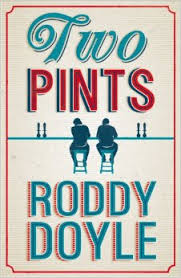
Also reading Roddy Doyle’s Two Pints. The origins of this collection of short dialogues are interesting, as all of the entries appeared on Facebook before being gathered together in a book. Doyle ‘used the social network as a home for a series of conversations between two middle-aged men, perched at a bar, analysing the news of the day and attempting to make sense of it.’
20 September. Day 52 – Finished The Silent Wife. I didn’t end up liking either Joni or Todd any more by the end of the book than I had at the beginning but contrary to popular wisdom that isn’t essential (did anyone like either of the protagonists in Gone Girl? Really?), though I was certainly rooting for her rather than him. Unlike Gone Girl, this isn’t a narrative that depends upon twists – rather it builds its characters and its plot little by little, and whilst both narrators are unreliable, they’re only unreliable in the way that anyone is in recounting their own life. It’s a very clever, subtle portrayal – we see, little by little, below the beautifully arranged surface of their lives, see the fault lines in their relationship, and in their own pasts, fault lines which open up and engulf them. Susan Harrison only ventured into fiction in her 60s. She died of cancer, aged 65, just before her debut novel was published.
Just started another debut novel, Caryl Phillips’ The Final Passage. Published in 1985, it’s set in the late 50s, and tells the story of one family who made the journey from the West Indies to the UK in the hope of a better life. It’s similar territory to that explored by Andrea Levy in Small Island, published twenty years later, though her immigrants arrived here in the immediate postwar period, rather than the late 50s.

Finished Two Pints. Wickedly funny, very rude and sweary, and surreal (check out young Damien’s scientific researches…). The two drinkers talk about all the things that two blokes in a pub might talk about. The missis, the kids, the football, politics, religion, sex – and they mark the passing of various notable people who’ve just died, in ways that manage to be funny, rude and sweary, and often very poignant. I’ve read lots of his more recent ‘obits’, and I particularly remember the Two Pints tribute to Bowie…
-I remember once, I was havin’ me breakfast. An’ I saw me da starin’ at me. So, I said, ‘Wha’?’ An’ he says, ‘Are yeh goin’ to work lookin’ like tha’?’ I still servin’ me time and, like, I was wearin’ me work clothes. An’ me overalls were in me bag. So I didn’t know what he was on abou’. ‘Get up an’ look at yourself in the fuckin’ mirror,’ he says. I was still wearin’ me Aladdin Sane paint. Across me face, like.
-You were ou’ the night before.
-Not really. Only down the road. Sittin’ on the wall beside the chipper, with the lads. Sneerin’ at the fuckin’ world. But that was what it was like. Bowie was our God.
Off to Italy now for a spot of crime and detection, with Inspector Montalbano. Andrea Camilleri’s August Heat will be my first Montalbano (and I haven’t seen the TV series either), so I’m looking forward to discovering another new crime writer.

21 September. Day 53 – Enjoying The Final Passage. I keep having to remind myself how young Leila is, when I get frustrated with her for getting entangled with Michael who is so so obviously a wrong ‘un, feckless, faithless and by and large useless. But she’s hardly more than a child herself, and girls and even grown women who should be old enough to know better do fall for feckless, faithless and useless men. I dare say the reverse is true but surely to a lesser extent – there’s a whole culture of women standing by their men, when the sensible thing would clearly be to kick him out or walk away. It’s rarely that simple and in many situations – particularly where there’s a child involved – neither of those options may seem possible. Of course the relationship between Leila and Michael is only one aspect of the novel – the passage from Jamaica to England is what drives it, and that’s powerfully done. The contrasts are both obvious – from heat and humidity that saps the energy to cold that gets into the bones – and less so. Even though they come from what we would see as poverty, the squalor of living conditions in London horrifies them, the dirt and the broken things that no-one bothers to mend. It’s a desperately sad account, and hard to see much hope for the future, given where the narrative leaves Leila, so profoundly alone in a strange land.
22 September. Day 54 – Montalbano is delightful. Despite the heinous nature of the crime being investigated, there’s a great deal of humour in the characterisation and the dialogue. But there’s another thread running through it, of political commentary:
How had Papa Dante put it?
Ah, servile Italy, you are sorrow’s hostel,
a ship without helmsman in terrible storms,
lady not of the provinces, but of a brothel!
Italy was still servile, obeying at least two masters, America and the Church, and the storms had become a daily occurrence, thanks to a helmsman whom she would have been better off without.
Montalbano cares about justice. And meantime he spends much of this particular novel stripped to his underwear in the office, with only a small hand-held fan to keep him cool as he navigates witness testimonies, police bureaucracy, corruption and protection rackets.
Two new books to start now: Flannery O’Connor’s Wise Blood, and Ali Smith’s Hotel World.


23 September. Day 55 – Neither O’Connor nor Smith is totally new to me. I’ve read A Good Man is Hard to Find, and The Whole Story and other Stories – strangely both collections of short stories, which I tend not to favour. O’Connor is fascinating – Southern Gothic if one has to pigeonhole her, but she herself responded to those who called her writing cynical or brutal that:
The stories are hard but they are hard because there is nothing harder or less sentimental than Christian realism. …When I see these stories described as horror stories I am always amused because the reviewer always has hold of the wrong horror.
Smith’s short story collection was terrific, and I’ve wanted to read one of her novels for some time (especially since hearing and falling rather in love with her on Desert Island Discs a while back). And Hotel World is glorious. It’s clever (a Guardian reviewer said that ‘I have never seen the tenets of recent literary theory … so cleverly insinuated into a novel’), but it never felt to me that it was ‘look at me! look at me!’ cleverness, just virtuoso writing with heart and humour and humanity. She reminds me in a way of Jon McGregor, whose work I love. Note to self: read more Smith, and read McGregor’s latest, Reservoir 13.


24 September. Day 56 – Just finished Fay Musselwhite’s Contraflow. I’ve taken my time over it – each poem needs to be savoured, not just consumed and then on to the next. There are some astonishing moments here:
From ‘Firewood’:
then we rouse in it
a thing with breath to rage against dim,
to syncopate our undertones, rid the roomscape
of straight edge and flickered repeat.
Or this from ‘Last night’:
mist rolled in –
a settlement of pale net layered itself
on the hillside opposite, and sagged
into gardens and lanes, bleared terraces
of gable-ends, nestling in to stifle all
but its own rumour, letting only the pin-glow
of street and window lights poke through.
It flattened valleys, lagged farm and woodland,
swallowed Dark Peak and Bradfield’s mound
into a sky white with it, tasted our tongues
as we talked of it, beaded our hair and lashes
Finished Flannery O’Connor’s Wise Blood. Billed as ‘A Searching Novel of Sin and Redemption’, it’s also a comic novel, as O’Connor herself insisted, adding ‘and as such, very serious, for all comic novels must be about matters of life and death’ … It is certainly very dark comedy, violent and bizarre. I’m not sure that I would want to immerse myself too often in that world view but it’s brilliant, strange and fascinating.
Just starting two new books, Christopher Hitchens’ Mortality, a collection of pieces he wrote after being diagnosed with terminal cancer, and Per Petterson’s Out Stealing Horses, described in a Guardian review as ‘a minor masterpiece of death and delusion in a Nordic land’. Hmmm, neither would seem to offer much prospect of cheeriness. Will have to ensure that my final tranche of reading includes some lighter fare.


My final reading challenge blog will probably appear a week today, to allow me to reflect on the project, and on what I’ve read (and to catch up on sleep/eating/other activities which may have to be postponed whilst I read the last few books…).
I can’t believe the end is quite so nigh. I read 15 books this fortnight, which would obviously be fine if I’d done that well in the previous few weeks, but I fell behind and haven’t fully caught up. My total now stands at 52, so in the next four days I need to read 8 books. Of course I can do that. No worries. Piece of cake.
* See also this: https://www.brainpickings.org/2016/11/02/mary-oliver-upstream-staying-alive-reading/ and this: https://www.brainpickings.org/2014/10/13/rebecca-solnit-faraway-nearby-reading-writing/)
60 Books in 60 Days: Reading Challenge, days 29-42
Posted by cathannabel in Africa, Literature on September 10, 2017
Well, someone forced me to do it. In so far as they challenged me to do it. Or rather, they told me that someone else who’d just arrived at their sixtieth birthday had taken this challenge on. Same difference really. Anyway, I have one default response to a challenge – as long as it involves a literary or cultural feat rather than anything physical:
Challenge Accepted.
So, 60 books in 60 days, starting on 31 July, finishing on 28 September. This is the third instalment of my reading diary, with the fourth to follow on 24 September. I will, of course, endeavour to avoid spoilers.
Rules? To summarise:
- No re-reads unless the original read was at least 40 years ago.
- Series: e.g. a trilogy will count as 3 books if it has been published as 3 separate books even if it has later appeared in a one-volume edition.
- Books can be fiction (all genres, including childrens/YA) and non-fiction (other than reference books and instruction manuals), playscripts, a volume of poetry, or a collection of short stories (in the latter two cases, I must read all the poems or stories).
- I’ve added one further rule, on reflection – no two books by the same author. That will stop me meeting my target by devouring a whole raft of Kate Atkinsons or whatever, which would be fun but not really in the spirit of the challenge. So, sixty books, by sixty writers.
28 August. Day 29 – just started these two:


Rose Tremain is an author I’ve loved previously (I have read The Way I Found Her, Restoration and The Road Home, all of which are excellent). I’m not far into The Gustav Sonata but it is utterly compelling and beguiling, subtle and beautifully written.
I haven’t previously read anything by Tom Rob Smith, though we did watch and enjoy London Spy. So far, so intriguing.
29 August. Day 30 – I’m halfway through! And more or less on target.
Finished The Gustav Sonata, which is wonderful. I can’t say too much – except to urge everyone to read it – but this quote, which comes towards the end, gives nothing away of the plot:
We have to become the people we always should have been.
The novel shows us, subtly and movingly, all the ways in which we fail to be the people we should be, fail or are prevented, by our own flaws or by circumstances or by other people. And gives us along the way some hope.
The Farm is compelling stuff. The question the reader is asked from the first page onwards, is who to believe. Now, for me, this is complicated because we are hearing the voice of a woman whose husband has tried to have her committed, a woman with a disturbing story to tell and who people seem to be trying to silence. I’m programmed to believe her, given the tragic history of women who have been silenced, or who people have attempted to silence, using claims that they are ‘mad’, gaslighting techniques. But maybe it’s not that straightforward – if one transposed elements of that narrative to a male voice I would be much more likely to read it as evidence of paranoid delusion.
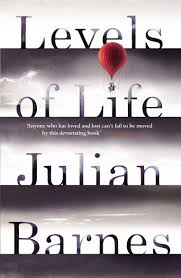
Started Julian Barnes’ Levels of Life, in which he ‘discusses ballooning, photography, love and grief; about putting two things and two people together, and about tearing them apart.’

30 August. Day 31 – I must admit that I went for the Barnes because it was the shortest book within arms’ reach. I’d read his A History of the World in 10½ Chapters, which I enjoyed rather than loved, and so I wasn’t eager for this one in the way that I have been to read something new by an author that I’d really fallen for already. But I’m so glad I read this, and I will read it again, and again, I think. It’s about the death of Barnes’ wife, the literary agent Pat Kavanagh, and it’s beautiful and quietly devastating.
The Farm was excellent. A story about stories, and about secrets. Read it and be repeatedly wrongfooted, as one narrative is undermined and another established, until in turn that too is shown to be unreliable…
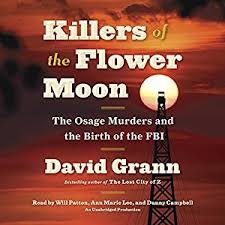
Just started David Grann’s Killers of the Flower Moon, a historical investigation into the systematic murder of Osage Native Americans in Oklahoma. Kate Atkinson called it ‘a fiercely entertaining mystery story and a wrenching exploration of evil’.
31 August. Day 32 – just started reading Caitlin Moran’s Moranifesto – ideal to read at night when I’m getting tired and concentration dips. V v v funny as always, whilst being clear-sighted and righteous.

More laughs are promised in The Rosie Project. Now, the words ‘romantic’ and ‘heartwarming’ are usually guaranteed turn-offs for me but the reviews make this one sound worth pursuing, and so many of my other reads have been dark and/or sad.

1 September. Day 33 – Enjoying The Rosie Project. The protagonist has a touch of the Sheldon Coopers, it must be said. It’s odd that, having spent so many years working with physicists and mathematicians, I have met so few full-on Sheldons in real life. Most of those I have worked with have had bags of humour, self awareness and social skills, not to mention creativity (a remarkable number of musicians, artists, writers). Nonetheless, Don (the protagonist and narrator) is engaging and the interactions with the decidedly unsuitable Rosie are delightfully funny.
Meantime, Killers of the Flower Moon is as compelling as the best detective novel, and indeed one might be inclined to think the plot a bit overwrought were it not a true story. And a shocking one, even when one is fairly knowledgeable about US history.
2 September. Day 34 – Caitlin Moran in full-on righteous indignation mode is magnificent. And still extremely funny. Just been reading her pieces on media treatment of benefits claimants, in the context of Benefits Street, and of the Mick Philpott case. It might seem incongruous that these pieces originally appeared in The Times, but actually that is absolutely right since her point is that she – as someone who grew up in a family that relied on benefits to get by – is an anomaly in the circles in which she now moves, and in the media to which she now has access, and that most media coverage treats benefits claimants as ‘other’ , whether it is vilifying or pitying them.
3 September. Day 35 – Finished The Rosie Project. It was delightful – very funny, and touching. Most of its reviewers were entirely won over but the Daily Telegraph demurred:
For those unaware of Asperger’s syndrome and its foibles, The Rosie Project could serve as a gentle and funny introduction. Those who already understand the condition may object to the moral that mental difference can and must be erased.
Thing is, I don’t think that was the moral. The moral, surely, was that both parties in a relationship need to accept the other for who they are, quirks and all. And this was supported by a couple of reviews from knowledgeable sources. Cees Kan, a Dutch psychiatrist specialising in ADHD and Autism Spectrum Disorders in adulthood, said that:
The great value of this book is its positive message about the possibility of experiencing romantic love despite of autism. Of course it is a challenge to overcome the autistic difficulties, which requires a willingness to think out of the box about how it is still possible to intimately relate to one another. However, I am convinced that it can be done, as I have met many couples that have shown me that they had managed to do so. Patients and their partners often tell me that in treatments too much emphasis is being put on the negative aspects of autism spectrum disorders, while they actually feel more supported and helped by messages which provide them with a positive perspective on their potential possibilities.
And Benison O’Reilly, the co-author of The Australian Autism Handbook, concurred. She acknowledges several points in the narrative where she was concerned that the reality of Aspergers would be sanitised or erased, but believes that Simsion avoids these pitfalls.
I loved it. And for my money, Rosie was at least as annoying as Don.
Have found a Hilary Mantel that I never got round to reading. No idea why, since I’ve never read a Mantel that I haven’t enjoyed. Anyway, The Giant, O’Brien is up next.

4 September. Day 36 – Can’t think why I left an unread Mantel to gather dust on my shelf. Only just started it but am already captured.
As I was, entirely, by David Grann’s extraordinary account of the Reign of Terror visited upon the Osage people in the 1920s by those who wanted access to their oil wealth. Shocking, and moving.
Just started an Australian crime thriller, Jane Harper’s debut novel, The Dry.

5 September. Day 37 – The Dry was a terrific read. The parched landscape, the oppressive heat, the constant awareness of danger from the natural world, and from the inhabitants of the small town, tested almost to destruction by the drought, all are vividly evoked. The initial explanation of the crime recalls Dylan’s ‘Ballad of Hollis Brown’ but that’s only the first attempt to unravel what happened, and Harper gives her readers lots of twists and turns, memories recovered, clues uncovered, and a heart-in-mouth finale.
A change of location now, from the Australian outback to Sierra Leone for Aminatta Forna’s The Devil that Danced on the Water. It’s a memoir of her West African childhood, and of the murder of her dissident father.

6 September. Day 38 – Finished The Giant, O’Brien. It’s a fictionalised account of historical characters from the late 18th century: the eponymous giant (a poet, a teller of tales, who towers over his contemporaries but spends his life crammed into spaces too small to hold him) and surgeon John Hunter (an experimental scientist who finds his profession and its legal and ethical constraints too small to hold him too), and how their paths converge. John Mullan described this as ‘something more like a fable than a conventional historical novel. The Age of Reason is a time of monsters.’ Mantel’s use of language is extraordinary – from lyrical to brutal in a sentence’s length.
About to start on a permitted re-read (see The Rules, above). Hemingway’s A Farewell to Arms, which I think I read in sixth-form.


7 September. Day 39 – I was sure I’d read A Farewell to Arms, albeit several decades ago. Yet it rings no bells (oblique reference to another Hemingway, which I’m even more sure I’ve read). Anyway, I am reading it as if for the first time, coming to it afresh. It’s a powerful depiction of the futility and brutality of war, told in a spare prose and with an immediacy and directness that does not manipulatively demand an emotional response from the reader but is all the more devastating for that. I admit to a degree of prejudice about Hemingway because I’ve read so much about him being a bit of a dick, but that obviously doesn’t preclude him being a splendid writer!
Meantime am captivated by Aminatta Forna’s memoir. It triggers so many of my own memories of a West African childhood whilst telling a compelling story of corruption and state oppression.
8 September. Day 40 – I’ve always felt slightly awkward about ‘claiming’ Ghana as part of my heritage. But it feels as if it is part of me, that childhood spent in Kumasi, and I hope that in using my Ashanti day name, Abena, as part of my Facebook name, I am honouring rather than appropriating that early encounter with a rich culture and history, and a beautiful land and people. It’s the little details that are the most powerful in my memory. Aromas, colours, sounds. The rain hammering on the corrugated iron roof, the red dust of the laterite roads, the ant lions creating their whirlwinds in the sand, the sound of highlife music wafting over from the student residences near our home.

Forna’s memoir keeps bringing these details back to me. It’s a lot more than that, of course, but I get emotionally derailed by these madeleine moments. None more so than Aminatta’s encounter with a fawn, rescued when its mother was killed, which her father brings home. It was beautiful, and it died. As was ours, and as did ours, a Duiker.
9 September. Day 41 – The personal connections with The Devil that Danced on the Water extend to the political context too. We arrived in Ghana early on in Nkrumah’s presidency, and left around the time that his growing paranoia and authoritarianism led to opposition and his overthrow. Our new home was in Northern Nigeria, where coups and counter-coups led to pogroms and ultimately civil war. Like Forna, we were too young to understand what it all meant, and have pieced together the history of those turbulent times, seeing our childhood fragments of memory differently in that wider context, understanding things that were baffling at the time. Of course, I’m not suggesting a true equivalence of experience. We, as expats in that time and place, were not ourselves at risk. Forna’s father and his political allies were targets, and he and thus the children too were in real danger.
10 September. Day 42 – Having a(nother) rubbish night’s sleep had the benefit of giving me a bit more reading time this morning, so I finished the Hemingway. The ending broke me a bit, even though I knew what was coming. And this bit:
I was always embarrassed by the words sacred, glorious, and sacrifice and the expression in vain. We had heard them, sometimes standing in the rain almost out of earshot, so that only the shouted words came through, and had read them, on proclamations that were slapped up by bill posters over other proclamations, now for a long time, and I had seen nothing sacred, and the things that were glorious had no glory and the sacrifices were like the stockyards at Chicago if nothing was done with the meat except to bury it. There were many words that you could not stand to hear and finally only the names of places had dignity. Certain numbers were the same way and certain dates and these with the names of the places were all you could say and have them mean anything.
Weeks 5-6 I’ve only completed 8 books this fortnight. I’m still partway through The Battle for Spain, Contraflow, Moranifesto, and The Devil that Dances on the Water. I am thus falling behind on the project – largely due to the necessity of spending significant portions of each day travelling and/or hospital visiting, time when I cannot read. Things may get easier from now on, and if all else fails I will forego sleep altogether for the last few days and just read, read, read. I’ve accepted this challenge and I will succeed.
My next bulletin will be on 24 September, covering days 43-56.
Onwards!
60 Books in 60 Days: Reading Challenge, days 15-28
Posted by cathannabel in Literature on August 27, 2017
Well, someone forced me to do it. In so far as they challenged me to do it. Or rather, they told me that someone else who’d just arrived at their sixtieth birthday had taken this challenge on. Same difference really. Anyway, I have one default response to a challenge – as long as it involves a literary or cultural feat rather than anything physical:
Challenge Accepted.
So, 60 books in 60 days, starting on 31 July, finishing on 28 September. This is the second instalment of my reading diary, with the third to follow on 10 September. I will, of course, endeavour to avoid spoilers.
Rules? To summarise:
- No re-reads unless the original read was at least 40 years ago.
- Series: e.g. a trilogy will count as 3 books if it has been published as 3 separate books even if it has later appeared in a one-volume edition.
- Books can be fiction (all genres, including childrens/YA) and non-fiction (other than reference books and instruction manuals), playscripts, a volume of poetry, or a collection of short stories (in the latter two cases, I must read all the poems or stories).
- I’ve added one further rule, on reflection – no two books by the same author. That will stop me meeting my target by devouring a whole raft of Kate Atkinsons or whatever, which would be fun but not really in the spirit of the challenge. So, sixty books, by sixty writers.
The list will include all brows, high to low, but everything I read will, I hope, have real merit and will bring real pleasure, over and above the satisfaction of achieving the challenge.
14 August. Day 15 – reading Kate Atkinson is, as always, a delight. My 2016 books blog said:
And my novel of the year is Kate Atkinson’s Life after Life. I knew several of her other novels, but this one was just dizzying, overwhelming, enthralling. I read it twice, I had to, and will read it again. Its sequel, A God in Ruins, was a different experience and a troubling one, about which I can say nothing except to urge you to read on because somehow it all comes together in a most remarkable way.
Case Histories is obviously different, it’s crime fiction if one has to pin a genre on it, featuring Jackson Brodie (PI) who was played by Jason Isaacs in a TV version a few years back. Not sure why I’ve never read Atkinson’s detective fiction since I’ve loved her other books and – as must be fairly obvious – I love crime/detective fiction. OK, it wasn’t strictly necessary to illustrate this with the DVD cover but, well, Jason Isaacs.

The Le Carré memoir is fascinating. It’s years since I read any of his books, but I have read a lot of them (and watched the recent adaptation of The Night Manager). Le Carré introduces The Pigeon Tunnel with a caveat:
These are true stories told from memory – to which you are entitled to ask, what is truth, and what is memory to a creative writer in what we may delicately call the evening of his life?
But he says that nothing is consciously falsified – merely disguised where necessary.

His account of his friendship with Yvette Pierpaoli (the inspiration for Tessa in The Constant Gardener) is a highlight – an extraordinary woman who lived and died in the pursuit of a mission to help people who needed it, in particular refugees, in war zones around the world. Coincidentally, le Carré’s (or more accurately Cornwell’s) world overlapped with Alan Bennett’s (anecdotes about Alec Guinness, and Lindsay Anderson, for example). And another coincidence – Cornwell senior was a fairly monstrous (if sometimes pathetic) figure, a crook and a swindler, and monstrous fathers have cropped up a number of times in the books I’ve read so far.
Now reading Jane Casey’s The Last Girl, her third Maeve Kerrigan thriller.

I’ve read the previous two, and Casey’s stand-alone novel, The Missing, all of which I’ve enjoyed very much. I might have slipped up, however, in reading two crime novels concurrently – will try to avoid that in future, so I don’t get my corpses mixed up…
15 August. Day 16 – I think the occasional sense of familiarity I’m getting from Case Histories must be déjà vu rather than déjà lu. There are multiple narrative threads – too early to see if/how they come together – but not all of them evoke that feeling, which is probably because the TV series simplified things and some story-lines and/or characters were excised. As always, I revel in Atkinson’s writing. She can set you up to find a character ridiculous or unlikeable and then suddenly, wham, you’re weeping or cheering for them.
The Last Girl was thoroughly enjoyable. Maeve Kerrigan is a convincing and intriguing protagonist, and there is a host of persuasive characters – colleagues, suspects, victims – with whom she interacts. Her two key relationships – with her partner, Derwent, and her boyfriend, Rob – have layers of ambivalence, insecurity and uncertainty which make them interesting. This wasn’t my favourite Casey – it’s a wee bit talky, and a bit baggy in the middle, perhaps. Nothing that stopped it being a grand read, nor will it deter me from devouring the rest of the Maeve Kerrigan series.
Something a bit different now, Michelle Paver’s Thin Air.

Finished Case Studies. Right to the end, it was funny, and terribly sad and utterly engaging. Did I mention I love Kate Atkinson?
16 August. Day 17 – alongside the Michelle Paver (which is gripping stuff), I’m about to start Margaret Atwood’s The Handmaid’s Tale. Here I anticipate incredulity and outrage – what do I mean, I’ve never read this? How can I possibly claim any credibility as a feminist and a booklover and a leftie and, well, anything else, if I haven’t read it? Well, I don’t know, I just somehow never got round to it. I did read a couple of hers many years back, The Edible Woman, for sure, and possibly Cat’s Eye. But not this one. I have seen the TV series, which was outstanding, powerful, extraordinary and harrowing. Time I read the book then.
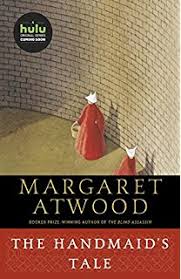
17 August. Day 18 – if I was concerned that having seen the TV adaptation so recently, reading The Handmaid’s Tale would be a let down, I need not have been. The TV series does, I know, depart significantly from the book in plot terms later on (there are already aspects which are interestingly different and I will be fascinated to see how they pan out). But the book can do things that the TV series cannot, even with June/Offred’s narration to help us out, in the description of places and things that go so far beyond the literal and the visual. It’s been said that the best books make the worst screen adaptations, and there are many I’ve seen that would bear that out, although plenty also to disprove it – in this case both the book and the TV adaptation are immense, and horrifyingly pertinent, and will stay in the mind and the heart long after they have been read or watched.
Thin Air is an excellent read – it’s about an ascent, some time between the two world wars, of Kanchenjunga. I don’t know the historical basis for it, and will (by a considerable and commendable effort of will) not Wikipedia it. It’s billed as a ghost story, and so far, so atmospheric.
Finished Thin Air. It’s an old-fashioned sort of ghost story – partly that’s created by the narrator’s voice, he’s very much a man of his time and class, partly because there is always a degree of ambiguity about the haunting, whether it is the product of fear, guilt, altitude sickness – or whether there really is something terribly wrong on Kanchenjunga’s south-west face. There’s a chill in the air, in every sense.
Now reading Ben Macintyre’s Agent Zigzag, the true story of Second World War double agent Eddie Chapman. A fascinating character, Eddie. And the story is told with a dry humour that promises well:
Which is how Eddie Chapman came to be pounding down a Jersey beach, leaving in his wake two plain-clothes policemen, a distraught young woman, and half a sherry trifle.

18 August. Day 19 – The Handmaid’s Tale is astonishing. I am trying not to focus too much on the differences between the book and the TV series, just to take in the book for what it is. What strikes me is the sense of time stretching out for these women, whose lives have been essentially reduced to one function, waiting for the moments when they have to perform, waiting each month to see whether they will be able to fulfil that function, or whether some other, worse, future threatens. The other thing is the sheer physicality of the descriptions. As the Handmaids have been reduced to their biological function their bodies become paramount, the sensations of their (modest and hygienic) clothing on their skin, their memories of desire and of a loved person’s arms around them, or a child in their arms. The other thing of course is that the book is entirely from June/Offred’s point of view – we know only what she knows, whereas the TV series tells the stories of some of the other characters, showing events which June did not witness or learn about. This makes the book even more brutal and gives huge power to her statement about why she is setting down her account, why she is bearing witness, without knowing that that there is anyone to bear witness to:
It hurts me to tell it over, over again. Once was enough: wasn’t once enough for me at the time? But I keep on going with this sad and hungry and sordid, this limping and mutilated story because after all I want you to hear it, as I will hear yours too if I ever get the chance, if I meet you or if you escape, in the future or in Heaven or in prison or underground, some other place. What they have in common is that they’re not here. By telling you anything at all I’m at least believing in you, I believe you’re there, I believe you into being. Because I’m telling you this story I will your existence. I tell, therefore you are.
Just finished The Handmaid. I fear I’ve rushed it, which was always going to be a risk with this exercise, but I will look forward to a re-read at some later point, when I can savour it properly.
Agent Zigzag often seems a less plausible tale than Atwood’s dystopian fantasy. As with so many books I’ve read about espionage and counter-espionage in WWII, what strikes one quite often is that the Allies’ success is due to a mix of brilliance (breaking codes, turning German agents), the incompetence of the Abwehr (sending agents who could barely speak English and/or were utterly unfamiliar with the culture – for example the one who tried to pay for a pint with £10 and 6 shillings, when he’d been charged 10 & 6 ….), and sheer luck.
On now to M L Stedman’s The Light between Oceans. I haven’t seen the film (the trailer looked a bit maudlin for my taste), but the book got some good reviews, and has been recommended by my daughter.

19 August. Day 20 – Finished the extraordinary story of Agent Zigzag. Brilliantly told by Ben Macintyre, who sees his subject clearly and without sentimentality, but with justifiable respect and warmth.
About to start Sarah Moss’s Cold Earth. Billed as an ‘apocalyptic chiller’ – I haven’t yet read anything by Sarah Moss but seem to have several stored up on the Kindle so will be interested to try this one.

20 August. Day 21 – Cold Earth gets off to a thoroughly intriguing start. Set in Greenland on an archaeological dig, Moss juxtaposes the narrator’s voice (Nina, who travels a lot but hates being anywhere she’s not within walking distance of bookshops and good fairtrade coffee, and who worries about everything) and another darker voice from a distant past, along with hints of something bad happening back at home … No idea how this will play out but can’t wait to read on.
21 August. Day 22 – Finished Cold Earth. Interesting how it links in with two of the other books I’ve read as part of this challenge – All the Little Children, and Thin Air. I can’t think of any way of fully explaining what I mean by this, without risking major spoilers, so will limit myself to saying that there are elements of (possible/threatened) apocalypse in common with the first, and of hauntings (possible/imagined) with the second. And they share a prickly unease, a sense of the uncanny, and of growing dread. I mentioned the narrator as being Nina, who gets the first section of the book to herself, but in fact each of the protagonists is given their own voice, so each sets the events, and the other people, in a different light.
Also finished The Light between Oceans. This was emotionally gripping, not so much the story of a moral dilemma, but of a moment when a choice was made – the wrong choice – and events unfolded inexorably such that ‘putting things right’ meant making everything wrong. This could have been a specious exercise in manipulation – it is much better than that, because the characters are beautifully drawn, and the setting too. We are drawn in to the life on the island and the responsibilities of the lighthouse keeper, so that we understand how that terribly wrong choice was made. Yes, it’s melodramatic, at points, and yes it is a weepie. Nothing wrong with that, if it’s well written. It sounds as though the film may tip things over into an excess of heart and tear-duct wringing, though….
22 August. Day 23 – on to a sci-fi classic now, H G Wells’ The Island of Dr Moreau. It’s of particular interest since this 1896 novel inspired the brilliant TV series, Orphan Black (whose final series we are currently watching). This edition has an intro by Margaret Atwood which is heralded with spoiler warnings so I will read it after rather than before I read the story.


In parallel with H G, I’m reading a thriller which is very much of the moment. Startlingly so. Sam Bourne’s To Kill the President is not about past conspiracy theories (no grassy knolls here). It’s about what happens when the unthinkable happens, and the man with his finger on the nuclear trigger is a ‘volatile demagogue’, an ‘increasingly crazed would-be tyrant’:
When a war of words with the North Korean regime spirals out of control and the President comes perilously close to launching a nuclear attack, it’s clear someone has to act, or the world will be reduced to ashes.

Obviously any resemblance to real persons or situations is entirely uncoincidental… It was written, presumably, during the election campaign, but must have been finished by or very shortly after the inauguration. It’s right now, in other words. Sam Bourne is the pseudonym of Guardian journalist Jonathan Freedland, who’s always worth reading anyway, and this thriller really does thrill.
The Island of Dr Moreau is fascinating – it sits in a way with Frankenstein as a study of man taking on the role of god, in the context of Darwinian theory and with elements of social satire. It’s uncomfortable, in its depiction of white men manipulating and dominating the humanoid creatures who are in the main black or brown, and are described as brutes and savages (however, this is not simplistically a reflection of the racial views of the time, but is justified – to a degree – within the narrative in terms of what defines humanity.
Crikey, To Kill the President was a cracking read. If I’d read it before last November, I would have dismissed it as implausible, but now…. Some of what it talks about has certainly happened, some has nearly happened, and some, well, who knows but it seems an awful lot less fanciful than a few months ago. The crucial thing is that the ethos of the current White House comes across so powerfully – the very question that causes us libtard /snowflake/antifa/alt-lefties so much puzzlement, which is how this administration, this President, can lie, and lie, and lie, without its supporters losing faith, feeling betrayed and fooled, how anyone can look at him and his cronies and not feel revulsion and fear at what they may be capable of. I can’t say reading this made me feel better about what’s happening over there and its potential implications for not only the US but the rest of us, but it was exhilarating nonetheless and we have to believe that there are people like the good guys in the book still working for peace and democracy within the institutions of the State, as well as on the streets of Charlottesville and Boston and so forth.
From a (slightly) fictionalised portrayal of a politician without political convictions or a moral compass, to the autobiography of one of the few Tory politicians I can stand (and not only because he’s a Forest supporter), Ken Clarke.

Finished off the day with a few poems from Fay Musselwhite’s debut collection, Contraflow, published by the estimable Longbarrow Press, whose books are always things of beauty and whose customer service is second to none. These poems are all inspired by the Rivelin Valley, which we can see from our dining room windows, and have often walked in over the years.
The tales that rivers tell have tangled with our own for millennia: before, through, and after the industrial age. Humans’ rapid migration to towns, often along the course of these waterways, has left many of us bewildered and ill-equipped in an environment at odds with the natural world we depend on. Rivers, bringing the relief of nature to the centres of cities they grew, confront us with forces bare-faced and ancient, seemingly unmoved by our regard. Malleable in their youth, prone to messing about before finding their groove, many were harnessed for mill-work as they matured, and then, like us, after centuries of valuable industry, were abandoned, left to lick their wounds.
All these tales converge in the Rivelin, which rises from peat moorland north-west of Sheffield, and descends 80 metres as it approaches the city. This fast-flowing river, and the valley it etched out, is the setting for many of the poems in Fay Musselwhite’s first collection. Contraflow harnesses these energies to carve its own rugged course, with its bottlenecks, bends and counter-currents: tales that slant, swell and spill.

23 August. Day 24 – also reading T C Boyle’s Talk Talk, a thriller about identity theft. It’s intense, all the more so because one of the three main protagonists is deaf, and her struggles with both hearing and speaking, in her attempts to find out who has appropriated her identity and to set things right, are compelling. Very hard also not to feel a twinge of paranoia and the need to check and re-check one’s bank statements rather carefully, whilst reading about this sort of crime.

Ken Clarke’s memoir is packed with detail (perhaps a tad too packed) but fascinating to read his insights into the Heath and Thatcher governments, the EU referendum (the 70s one, though I think I know where he stands on the recent one too), and many of the political controversies and upheavals with which I am familiar but not from a Tory POV. (One does gain the distinct impression that most MPs were at least mildly pissed most of the time during the 60s and 70s.) Also fascinating to read of his Nottinghamshire childhood and education (he was a Nottingham High School boy, as was my husband a few years later). Every chapter borrows its title from a jazz number, another reason for my fondness for Ken.
24 August. Day 25 – Talk Talk was excellent. It’s billed as a thriller but there’s no neat resolution, and it’s about – obviously – identity, but even more than that, about communication and the gaps and dislocations on which relationships and one’s sense of who one is can founder. Another writer who’s new to me but who I will read more of anon.
Ken continues to entertain. I’m up to the John Major government now, Black Wednesday looming. Fascinating to read his perspective on Thatcher: as a longstanding ‘wet’, ‘not one of us’, and a passionate European, he was never an uncritical supporter but he portrays her, not so much sympathetically on a personal level, but somewhat positively in some respects on a political one, at least until her hubris and the sycophancy of her inner circle brought her down.
25 August. Day 26 – Just about to start Patrick Gale’s The Whole Day Through. I’ve read several of Gale’s novels, and loved them, so I’m looking forward to this one.

Very little progress today. Mother in law in hospital after a fall at home, all is reasonably ok but a day spent waiting around (for consultants, paperwork etc) without access to reading matter.
26 August. Day 27 – The Patrick Gale is every bit as engaging as I hoped it would be. I was interested to note that amongst his top ten books, along with Proust (yes!), Middlemarch (obv) and Persuasion (my favourite Austen, as it happens), was Anne Tyler’s Dinner at the Homesick Restaurant – there’s something in common I think between Gale and Tyler, who I’ve always loved (I think my favourite Tyler would be Saint Maybe, or Breathing Lessons, but Homesick Restaurant is fab too).
Managed to read a few pages of the Ken Clarke autobiog whilst doing hospital visiting (Mum had nodded off, so I wasn’t really neglecting my duties…).
27 August. Day 28 – Finished The Whole Day Through. Gale’s protagonists are both engaging and infuriating, they want and try to do the right thing, but they’re flawed and awkward and muddled. One of his other novels is called A Perfectly Good Man, which is a brilliant title because the man in question is quite explicitly not perfect, not in the Aristotelian sense that his goodness is complete, could not be better, and has attained its purpose. These perfectly good people could always be better, and their goodness often fails to attain its purpose, thwarted by their own flaws. In a way the title reminds me of the way we say ‘its perfectly OK’ which is an odd phrase, but is used to reassure, where ‘OK’ alone could seem grudging.
Also finished Ken Clarke’s autobiography. Of course I disagree profoundly with him about many things, but he does seem to me to be a man of integrity and sense, and his passionate commitment to Europe gives us substantial common ground. One of the really interesting things to emerge is the way in which, from John Major onwards, PMs and Cabinets were in hock to the media, desperately trying to play the (mainly right-wing) press. Ken was persuaded to hold a meeting with Rebekah Brooks at one point and was quite withering about the notion that he, as a lawyer and one of the most experienced government ministers in that Parliament, should listen to and take seriously policy suggestions from an unelected newspaper editor, whose grasp of ethics was decidedly shaky.
About to start Rose Tremain’s The Gustav Sonata. I’ve read several of her novels, and have enjoyed them all.

Weeks 3-4
So, where am I up to now? I completed 13 books this fortnight, and am midway through 2 (Musselwhite and Beevor). Total completed at the end of the fourth week is 25.5 (allowing the Andrea Levy I read in the first tranche as only 0.5 as it was a short story).
I have been somewhat stymied by events, but am pleased to be as close as this to the target. Allons-y!
Charlottesville
Posted by cathannabel in Politics, USA on August 16, 2017
If we needed a demonstration that the current President of the USA has no moral compass, it has been amply provided by his response to the events of last weekend in Charlottesville, VA. After initially offering a (typically incoherent) statement referring to an ‘egregious display of hatred, bigotry and violence on many sides, on many sides’, which was roundly condemned, he came back with something a little less equivocal:
To anyone who acted criminally in this weekend’s racist violence, you will be held fully accountable. Justice will be delivered. […] Racism is evil. And those who cause violence in its name are criminals and thugs, including the K.K.K., neo-Nazis, white supremacists and other hate groups that are repugnant to everything we hold dear as Americans.
only to backtrack the following day:
You had a group on one side that was bad, and you had a group on the other side that was also very violent, and nobody wants to say that, but I’ll say that right now. You had a group on the other side that came charging in without a permit, and they were very, very violent. … Not all of those people were neo-Nazis, believe me, not all of those people were white supremacists. … You had some bad people in that group, but you also had very fine people on both sides.
Some of those ‘very fine people’ can be seen on this report from Vice News:
The interviewees here are not random marchers but the organisers and instigators of the Unite the Right event. The purpose of the marches is explicit – to bring together the various white nationalist/white supremacist organisations who they say currently lack the cohesion and ‘camaraderie’ of the left, and to strengthen the movement to the point that they can clear the streets of the ‘degenerate filth’ which they identify primarily as Jews, blacks, Communists.

There is no real pretence here that they are not Nazis. If you want to claim that you are not a Nazi, you don’t (at least in public) use Nazi slogans such as ‘blood and soil’, you don’t use the Nazi salute, you don’t call your website The Daily Stormer, and you don’t march around with ginormous swastika flags.


It doesn’t neutralise any of this if some of the ‘antifa’ protestors were violent. It doesn’t create the kind of moral equivalence for which Trump seems to be arguing. Because the sole purpose of the events in Charlottesville were to propagate a Nazi ideology of racial superiority and hatred. As Simon Schama put it on Twitter, to attempt that equivalence is ‘like looking at Kristallnacht and blaming Jews and Brownshirts equally’.


This is open and clear and unequivocal, and the condemnation should have been unequivocal too. Trump is too much in hock to the far right to risk that. There were ‘Make America Great Again’ hats amongst the fascist flags and slogans. David Duke of the KKK objected even to Trump’s initial statement, saying that Trump should “take a good look in the mirror and remember it was White Americans who put you in the presidency, not radical leftists”. The Stormer editorial meanwhile interpreted it as tacit approval.
What has not yet been mentioned, of course, is the murder of Heather Heyer, a 32 year old legal assistant and civil rights activist.

She was mown down by a car deliberately driven at speed into groups of anti-fascist protestors. The organisers variously claimed that this was an accident, that the car was driven by an ‘antifa’, that it was self defence, and that the driver was nothing to do with them. None of these claims stand up and indeed once that was evident, a truer response emerged, one of jubilation.
This is racism.
This is domestic terrorism.
This is religious extremism.
This is bigotry.
It is blind hatred of the most vile kind.
It doesn’t represent America.
It doesn’t represent Jesus.
It doesn’t speak for the majority of white Americans.
It’s a cancerous, terrible, putrid sickness that represents the absolute worst of who we are.
Against the vicious, sickening rhetoric of these contemporary Nazis we have to set the courage of the small groups of young people at the Friday night torchlight march, surrounded but resolute, the unity of citizens of all faiths and none


and the vision of Heather Heyer, whose last online words should ring out across the world.


If you’re not outraged, you’re not paying attention.
Meet the Horde of Neo-Nazis, Klansmen, and Other Extremist Leaders Endorsing Donald Trump
60 Books in 60 Days: Reading Challenge, days 1-14
Posted by cathannabel in Literature on August 13, 2017
Well, someone forced me to do it. In so far as they challenged me to do it. Or rather, they told me that someone else who’d just arrived at their sixtieth birthday had taken this challenge on. Same difference really. Anyway, I have one default response to a challenge – as long as it involves a literary or cultural feat rather than anything physical:
Challenge Accepted.
So, 60 books in 60 days.
Starting on 31 July, finishing on 28 September. I originally thought I’d just do one mammoth post at the end of the challenge, but judging by the length of this first entry, it seems more sensible (and kinder to my reader(s)) to post every 14 days.
Rules? Well, I’m making these up, obviously, since there is as far as I am aware no national or international case law relating to such things. But I think I have to exclude any re-reads unless the original read was at least 40 years ago. For practical purposes I’m favouring short (obviously), relatively straightforward in narrative terms (nothing too Proustian) and in English as my reading speed in French is far too slow for this exercise. Series: e.g. a trilogy will count as 3 books if it has been published as 3 separate books even if it has later appeared in a one-volume edition. I’m including fiction (all genres, including childrens/YA) and non-fiction (other than reference books and instruction manuals), and there’s no reason I can think of to exclude playscripts, or a volume of poetry, as long as I read all of the poems and don’t just dip in, or a collection of short stories. That raises a question though. I have on my Kindle some books that are described as short stories – are they too short to count? How short is too short? The list will include all brows, high to low, but everything I read will, I hope, have real merit and will bring real pleasure, over and above the satisfaction of achieving the challenge.
31 July. Day 1 – already underway: Anthony Beevor’s The Battle for Spain, and David Boyle’s Dunkirk: A Miracle of Deliverance. Started today, Peter Lovesey’s The Last Detective.


1 August. Day 2 – finished The Last Detective. That was my first Lovesey, I don’t think it will be my last, not groundbreaking but thoroughly entertaining. Started and finished today, Jo Furniss – All the Little Children, a bow drawn at a venture, a freebie from Amazon Prime, which turned out to be a cracking thriller (her debut – will watch out for her next book). Meantime continuing with Beevor. Fascinating, but so dense with names and facts and places and dates that it’s not going to be a quick read.

2 August. Day 3 – finished the Dunkirk book. This was background reading for the brilliant Christopher Nolan film, which gives the audience an immersive experience of survival on the beaches, at sea and in the air, but quite deliberately no context in terms of the strategy or the politics of it all.
Quite a change of pace, style, genre – everything really – for my next read, Frank Cottrell Boyce’s The Unforgotten Coat. A lovely, quirky, funny and sad children’s/YA book, with mysterious Polaroid illustrations that aren’t at all what they first appear to be. I’m familiar with some of FCB’s work, of course – Brookie, 2012 Olympics opening ceremony, 24 Hour Party People, Who (what variety is displayed there!) but hadn’t come across this one. A delight.

Started on Shirley Jackson’s We Have Always Lived in the Castle. Years ago I read The Haunting of Hill House, which Stephen King regards as one of the most important horror novels of the 20th century, and this one is apparently reckoned to be her masterpiece.

3 August. Day 4 – finished We Have Always Lived in the Castle. That was brilliant! Gothic and charming and deeply disquieting at the same time. Must read more Shirley Jackson.
Next up is The Reluctant Fundamentalist, by Mohsin Hamid.

4 August. Day 5 – just finished The Reluctant Fundamentalist. Fascinating, ambiguous, with a compelling narrative voice. I’ve been faffing about since finishing that one, trying to find the next thing to go for, and opening one after another without being convinced. Finally decided on Helen Fitzgerald’s The Cry.
 .
.
Wow, that was powerful. A psychological thriller, where the tension and the anguish build up and up, where you want to scream at the protagonists not to make the mistakes they seem to be inevitably about to make, but where you (at least I) could identify intensely with the female protagonists. I felt almost physically that hot, awful sense of panicky stress that comes with trying to manage a screaming baby on public transport. Not going to say any more for fear of spoilers.
5 August. Day 6 – having been recommended to read something by Andrea Levy, I found Uriah’s War already on my Kindle. It’s described as a short story though – hmmm. I might have to work out a rule of thumb and count something as a fraction of a book. This was written for the WWI commemorations, inspired by Levy’s discovery that her grandfather fought at the Somme.

This was indeed a short story. A good one, albeit not unfamiliar territory if one has read or watched anything about the role of colonial troops in either World War. I thought in particular of Rachid Bouchareb’s Les Indigenes (Days of Glory) which tells the story of a group of North African soldiers in the latter days of WWII.
On to Alan Bennett’s Untold Stories, a collection of personal memoirs. The first part is a delightful, funny, and often very moving account of his Mam and Dad and the wider family. His is such a distinctive voice that one can hear it as one reads, and his famed ear for dialogue brings the various family members to vivid life.

6-7 August. Day 7-8 – Oh no, I’m falling behind! 7.5 books (counting the Levy as .5) at the close of Day 8. Will have to up my game…
8 August. Day 9 – Still reading the Alan Bennett. It must be a big book! One of the perils of the Kindle, of course, is not being able to weigh the book in your hand, flick through the pages, and judge how long it might take to read. I’m loving it, anyway. Still also reading The Battle for Spain but I think I must put that to one side if I’m to have any chance of meeting this ridiculous challenge.
9 August. Day 10 – I found at my mother-in-law’s house the other day a Daphne du Maurier novel that I’d never heard of, let alone read. I thought I’d read the lot, obsessively and repeatedly, as a teenager. This one, Julius, had escaped my notice completely. I’ve liberated it from Mum’s bookshelves and just started it this morning.

10 August. Day 11 – finally, that’s Alan Bennett sorted. I seemed to be making such slow progress, despite enjoying it enormously, but the reason became clear when all of a sudden I’d finished the book, with about 25% still to go, the remainder being illustrations (delightful) and index etc. I thoroughly approve of indexes (indices? or is that something different?) and would ideally like every book to have one, along with a thorough bibliography, but it’s another way in which the Kindle is inferior to the ‘real’ book, in that it’s very clunky to actually make use of such things when you can’t (easily) flick back and forth to check things. Anyway, the first memoir, focusing on his parents and aunties, was the best bit of the collection but there was a lot more to enjoy, even if ‘enjoy’ seems somewhat the wrong word in relation to his account of being beaten up in Italy, or of treatment for cancer. And the word ‘splother’, to describe a lot of fuss and to-do-ment, is now firmly a part of my vocab, thanks to Alan’s Dad.
Beginning to get properly into the du Maurier. I begin also to see one possible reason why this is so much less well known than her other works, which I will probably comment further upon when I’ve finished the book.
Donal Ryan’s The Thing about December was a grand read. The writing is beautiful and there’s humour and tragedy and ambiguity in Johnsey’s view of the world, lonely and naive, trying to work out how to be a man, how to be a good person, how to connect with the world and the people in it, who may be genuine or duplicitous or a mixture of the two.

11 August. Day 12 – Valentina Giambanco’s first Alice Madison thriller, The Gift of Darkness.

12 August. Day 13 – continuing with Julius – a decidedly uncomfortable read, whilst sharing with du Maurier’s better known work a compelling narrative style. More anon.
The Giambanco is a cracking police procedural and I shall be adding her to my list of favourite current crime writers. Her protagonist is Alice Madison, who herself now joins my list of favourite current fictional female cops and PIs (Laura Lipmann’s Tess Monaghan, Sarah Hilary’s Marnie Rome, Cath Staincliffe’s Sal Kilkenny, Jane Casey’s Maeve Kerrigan, and Susie Steiner’s Manon Bradshaw). Alice has a quality of stillness and steeliness that I love, and there are passages of vivid and economical writing that made me think of Chandler (without being pastichy).
13 August. Day 14 – finished Julius. It’s the portrait of a monster, a man who has to own and control and would rather destroy something than let it get away from him. Someone who has power but doesn’t understand love, friendship and affection. Someone who likes to cause pain but doesn’t understand it. What makes the book so problematic though is not that Julius is a monster – du Maurier has created other monsters, male and female, and her work is never mere bosom-heaving romance but dark, brooding, ambiguous and even nightmarish. The problem is that Julius is a Jew. This isn’t mere incidental detail, his Jewishness is referred to on page after page after page. In so far as he is capable of feeling any real connection with others, it is with other Jews, and at least at moments in the synagogue. Thus Julie Myerson in her introduction to this edition argues that his monstrosity and his Jewishness are not linked, that ‘if Julius has a benign side, a sensitive side, there’s no doubt that it’s the Jewish side’. That is so, but I can’t quite buy her statement that du Maurier ‘always avoids the easy racist cliche’. Julius becomes immensely wealthy – through hard work but also through manipulation and exploitation of others. He’s not, at the beginning, ostentatious in his wealth and remains careful with his fortune, always in control, always pulling the strings. Nina Auerbach in her study of du Maurier’s work (Daphne du Maurier: Haunted Heiress, Pennsylvania UP, 2000), describes him as ‘unsavory (and unpleasantly stereotyped)’, as radiating ‘hunger and hate’. Julius was written in 1931 (published in ’33), and it’s not uncommon in reading work from this era to find language about and treatment of Jewish characters that grates horribly (not only Jewish, of course, but other racial groups). Du Maurier evidently came under some pressure later in her career to revise the book and tone down or take out some of the references to Julius’s Jewishness. Ultimately, however, nothing in the book feeds into the most dangerous narrative, gathering strength and toxicity even as she was writing, of the Jewish race as loyal only to each other, as subverting and undermining the nations that they inhabit, as preying on the gentile community. Though Julius feels some tug of humanity in relation to his Jewishness it is not enough – his ‘own’ people find him as strange and troubling as everyone else, as impossible to comprehend. So it is possible to read it as the portrait of an individual, shaped by a brutal early life, driven and consumed and consuming. Possible, but not easy, and not comfortable.
Also finished The Gift of Darkness, and have already got hold of the second in the Alice Madison series. Will save that for later though, and start on Kate Atkinson’s Case Histories, and Jarlath Gregory’s The Organised Criminal.


.
The Organised Criminal is darkly (very darkly) funny, as well as kind of bleak, but with glimmers of hope in friendship – family is a lot more problematic in this exploration of morality, complicity and masculinity.
On to John le Carré’s ‘memoir’, or stories from his life, The Pigeon Tunnel.
That’s my first fortnight. I’ve read 12.5 books in 14 days (if the Andrea Levy counts as 0.5) so technically I’m slightly behind. However, I’ve also read a significant chunk of the Anthony Beevor, and made a start on the John le Carré, so it’s not a bad start. Onwards!
“Change, my dear… and it seems not a moment too soon.”
Posted by cathannabel in Feminism, Television on July 20, 2017

Master: Is the future going to be all girl?
Doctor: We can only hope.
With hindsight it was obvious this regeneration was going to be the one. The one that brought us a woman Doctor.
We’d seen it established that Time Lord regenerations can involve a change of gender as well as of height, hair colour, apparent age and so on. We’d engaged with the Master/Missy conundrum.

DOCTOR: She was my first friend, always so brilliant, from the first day at the Academy. So fast, so funny. She was my man crush.
BILL: I’m sorry?
DOCTOR: Yeah, I think she was a man back then. I’m fairly sure that I was, too. It was a long time ago, though.
BILL: So, the Time Lords, bit flexible on the whole man-woman thing, then, yeah?
DOCTOR: We’re the most civilised civilisation in the universe. We’re billions of years beyond your petty human obsession with gender and its associated stereotypes.
BILL: But you still call yourselves Time Lords?
DOCTOR: Yeah. Shut up.
BILL: Okay.
With lines like the above, we were being set up to welcome (or not) a woman to the role. Still, at some level, at least until a couple of days before the announcement, I really thought they might row back from that and say no, not yet, not this time. I really wasn’t sure they had the bottle to do this.
There’s been a lot of rather predictable frothing at the mouth, harrumphing and incipient apoplexy, with claims that this is the BBC surrendering to some mysterious all-powerful Political Correctness lobby (‘Murdered a part of our culture for feminazi political correctness ideology!’ ‘Doctor Who … didn’t die nobly as you might expect. He was murdered by Political Correctness’). That’s best ignored, by and large. I fear that Jodie Whitaker will have to contend with worse than that, and with personalised unpleasantness, but I’m sure she’s well aware and will be ready for the haters.
Not everyone who dislikes the change is of this breed, of course. There has to be a core of Doctorness with each regeneration, and some feel that maleness is a part of that. I disagree, but I suspect that many of those people, if they genuinely love the programme, will continue to watch and will be won over. Another response was that whilst of course boys have far more heroic role models in popular culture to emulate and be inspired by than girls do, the Doctor is different, and valuable because of the ways in which he is different. I do see the need for boys to have role models who aren’t all about action and fighting (even fighting for Good against Evil), but part of what makes the Doctor different, for me, is that gender roles and stereotypes simply aren’t (or shouldn’t be) relevant.
A plethora of girls and women have regarded the Doctor as a role model, and identified with him, over Doctor Who’s 50 year span, whilst he’s regenerated, repeatedly, as a man. The Doctor is still, no doubt, going to be the Doctor as portrayed by Jodie Whittaker – alien, two hearts, both of gold, funny, witty, snarky, capricious, kind, adventurous. (Juniper Fish, Doctor Who Forum)
The Doctor can and should be a role model for both boys and girls, in a way that Captain America or Batman can’t quite be – and probably Wonder Woman and Buffy can’t quite be role models for boys either. So, the Doctor can continue to inspire boys whilst giving girls and women a whole new image of how to be wise, and brave, how to save the world, to do what’s right, to be kind. Girls need to develop the confidence to take the lead roles, not to assume that a hero/a protector is by default male.
Who I am is where I stand. Where I stand, is where I fall. Stand with me. These people are terrified. Maybe we can help, a little. Why not, just at the end, just be kind?
Funnily enough, whilst the Outraged/Betrayed/Will Never Watch Again lobby were as loud and silly as one might have expected, overall what I found on Twitter was a mix of sheer delight, excited anticipation – and a different kind of silliness. See the #TardisFullOfBras hashtag, for example – someone took a hostile Daily Mail comment and turned it around, so that it’s full of fan art and daft jokes (and bras). That’s the way to go, I think.
There’s little point in trying to engage with someone who throws ‘feminazi’ into the conversation simply because someone gives a job to a woman that has been previously held by a man. There’s little point in trying to unpack the hotchpotch of false analogies and fake news and mythology that is evoked whenever the term ‘political correctness’ is used. And if someone believes that ‘social justice warrior’ is an insult, we don’t really have a lot to talk about.
What matters here, to me, is the delight that this news has brought to so many of us. It’s only a story, but stories are the most powerful things in the world.
Stories can make us fly.
We need stories, and we need heroes. And if we can’t immediately see around us the heroes we need, we build them. It seems that we are having a real moment here.

When I wrote about Wonder Woman, only a week or so ago, I did not know – though I hoped – that the 13th Doctor would be a woman. They’re quite different of course, but what is so glorious is that now, right now, there are two more in the pantheon of women who can, women who can stand up, will stand up. We have a woman (OK, a demi-god) who uses superhuman physical strength, courage and a fierce sense of what is right, in the service of humanity, and another (OK, a Gallifreyan Time Lord) who uses the wisdom of centuries and galaxies, wit and invention and intellect, courage and a fierce sense of what is right, in the service of humanity.
without hope, without reward, without witness
I felt when I was watching Wonder Woman like punching the air and having a bit of a cry at the same time, and when I think about the Doctor’s next regeneration, I feel much the same. Of course it is vital that the stories are well written, that the wit and humour is there, as well as the thrills and chills. Of course it is vital that the gender thing is dealt with intelligently, that stereotypes are undermined or dismissed with humour and that the Doctor is and remains Doctorly, demonstrating both difference and continuity as each new incumbent has done over the last 50 years.
It is perhaps even more vital that the stories are strong because there are those who (even though they may have vowed never to watch it again) will be waiting for it to fail, wanting to say that they told us so, that it could never work, that the Doctor can’t be a woman. If Jodie kicks it out of the park, as we hope and believe she will, then each regen that follows can be whoever seems right at the time and whoever takes it on will be critiqued for their ability and not for their gender.
Meantime, we’re loving this moment. Loving it for ourselves and for our daughters, nieces, granddaughters, all the young women who can now enjoy Doctor Who in a different way, who can take on the lead role in playground games. Not just companions or assistants but The Doctor.
My love for Doctor Who is, I realise, a bit ridiculous but I don’t bloody care because we all need escapism sometimes and, as my often tested loyalty to lost causes show, my love is nothing if not tenacious. At primary school I distinctly remember the humiliation of a school assembly where some of us were asked to share our pictures of what we wanted to be when we grew up. A Timelord was not an appropriate aspiration for a girl apparently and the piss was duly ripped. Not the first, worst or only time youngling (or indeed “grown-up” me) encountered sexism and ridiculous gender stereotypes but, because as a troubled kid my fantasy life was a refuge and a solace, one of the hardest stings. Anyway, fuck that nonsense because anything can happen with a Tardis and hooray for progress and little girls being allowed imaginations. And no, that does not come at the expense of little boys at all, and yes, I am really sorry Capaldi and Bill are gone because when they got the scripts they were brilliant and that, actually, is the heart of what I want. Good writing, please, please, please (and obviously for me to get a ride in there somewhere with them, because what is the Doctor if not an intergalactic anarcho-flaneuse who needs a bit more glitter?) (Morag Rose)
Doctor Who is a different sort of hero. The Doctor solves problems not by being the strongest, the fastest or the one with the biggest army, but by outthinking everyone else in the room. Far too many female characters are two-dimensional. I’m ready for one that can travel in four. I’m ready to watch a woman save the world again and again by being very, very clever and very, very moral, without having to have a man sort anything out or come and save her. I’m ready for a woman hero who’s older than recorded history and weirder than a three-day bender in the BBC props cupboard. I’m ready for a female super nerd. And so is the rest of the world. (Laurie Penny, The New Statesman)

http://doctorwhogeneral.wikia.com/wiki/Times_Doctor_Who_Was_Ruined_Forever
Wonder Woman – the Man who Can
Posted by cathannabel in Feminism, Film on July 8, 2017
MASTER: Is the future going to be all girl?
DOCTOR: We can only hope.
Steve: “This war is a great big mess, and there’s not a whole lot you and I can do about that. I mean, we can get back to London and try to get to the men who can.”
Diana: “I am the man who can.”
NB What follows contains some spoilers… Caveat lector.
It mattered a great deal that Wonder Woman was, well, wonderful. I can cope with Batman v Superman being a bit meh, or the odd entry in the Avengers cycle being less than stellar. But she needed to kick it out of the damn park.
And she did.
It’s not that she’s the first or the only. She herself has been around since 1941, and there have, of course, been other women superheroes (and supervillains) in the comics and on TV and in the movies. But it’s very rare for the one who carries the whole movie, the centre and focus, the one on whom everything depends, to be a woman.


And as much as I love the current Marvel series, a lot of the time they are really quite blokey. The blokes are great – funny and noble (mostly) and gorgeous, so I’m not complaining, not really. But there’s not enough of Black Widow and Scarlet Witch to balance things out. There’s a fine tradition of women heroes – think Ripley, Sarah Connor, Katniss Everdene – human, but with outstanding courage and strength. And there’s always and forever Buffy.


Wonder Woman is different. First off, she’s a half-god. Not an alien, or an inhuman, not technically enhanced, but a straight-up, bona fide, god-almighty daughter of a god. Second, her upbringing on Themyscira sets her in a context where women are powerful, strong, brave, not exceptionally but as a norm.


The opening sequences of Amazonian women training, and then fighting on the beach made me want to weep and cheer at the same time. Don’t get me wrong, I’m a bit of a pacifist on the whole, but the simple fact that this small army was comprised of glorious women was somehow very moving.
 Of course all these women are beautiful. But they’re beautiful athletes, not beautiful models. They’re magnificent in the way that Serena and Venus Williams are magnificent. Their bodies are toned and lean and powerful and they are in control of them.
Gal Gadot herself is mesmerisingly gorgeous. That Chris Pine spends much of the movie just gazing at her in awe is perfectly understandable – when she is on screen one would need a damn good reason to look elsewhere. (Of course, the men in the movie also spend a lot of time saying variants of ‘just wait here’, ‘leave it to us’ and so on, and Diana doesn’t bother to argue, she just gives them a bit of a look and then does what she has to do. The phrase ‘nevertheless she persisted‘ came inevitably to mind.)
She’s presented, in some ways, as naive. That’s justified by what we know of her origins – what she’s been told, and not told, about the world beyond Themyscira. That doesn’t diminish her – she is rocked by the realisation that things are not as straightforwardly binary as she’d believed, but she recovers from that, regroups her forces and fights on.
“I used to want to save the world. To end war and bring peace to mankind. But then, I glimpsed the darkness that lives within their light. And I learned that inside every one of them, there will always be both. A choice each must make for themselves. Something no hero will ever defeat. And now I know, that only love can truly save the world. So I stay, I fight, and I give, for the world I know can be.”
I wrote a while ago about the Marvel universe and why I love it so:
It’s the flawed and fragile beauty of humanity that the Avengers fight for:
“Humans are odd. They think order and chaos are somehow opposites and try to control what won’t be. But there is grace in their failings. … A thing isn’t beautiful because it lasts. It is a privilege to be among them.”
Echoes of the Doctor there, I think. Amongst all of the forces that see the weakness of human beings and want to destroy, some stand with us. The Doctor said that in 900 years of space and time he’d never met anyone who wasn’t important. He tells us again and again that we are in our very ordinariness extraordinary, in our bloody-minded going where angels fear to tread, our curiosity and our moments of courage.
Diana Prince, like the Doctor, like Captain America and all the other heroes, does what’s right because it’s right.
without hope, without reward, without witness
What we see in the movie is her first encounter with the world beyond Themyscira. It baffles her (to comic effect as she struggles to comprehend why a woman should tolerate clothing that hobbles and constrains her), and it troubles her as she begins to realise that the people she encounters cannot be divided simply into ‘good’ and ‘bad’. She is not yet weary as Buffy is, so often, saving the world yet again. She has not yet lost battles, has not got centuries, aeons, of attempting to protect humanity from the forces that would destroy it. But nonetheless she would understand the Doctor.
Winning? Is that what you think it’s about? I’m not trying to win. I’m not doing this because I want to beat someone, or because I hate someone, or because, because I want to blame someone. It’s not because it’s fun and God knows it’s not because it’s easy. It’s not even because it works, because it hardly ever does. I do what I do, because it’s right! Because it’s decent! And above all, it’s kind. It’s just that. Just kind. If I run away today, good people will die. If I stand and fight, some of them might live. Maybe not many, maybe not for long. Hey, you know, maybe there’s no point in any of this at all, but it’s the best I can do, so I’m going to do it. And I will stand here doing it till it kills me. You’re going to die too, some day. How will that be? Have you thought about it? What would you die for? Who I am is where I stand. Where I stand, is where I fall. Stand with me. These people are terrified. Maybe we can help, a little. Why not, just at the end, just be kind?
I was surprised at first at the choice to set Diana’s first encounter with the messy, murky world of humans in the first, rather than the second World War. But I think actually that’s right. The second is too simply a confrontation with evil, with the absolute worst that human beings could be. The first portrays more effectively the messiness and murkiness of it all – the moral questions about who started it and why, who joined in when and why are complex and still generate heated debate today (as was seen in the recent centenaries of the start of that war and of the Battle of the Somme). So the great evil that Diana confronts is not the Kaiser’s forces but war itself. Steve refers to ‘the war to end all wars’ but that description acquires layers of ambiguity, as it becomes clear that it is potentially also the war that never ends.
Interestingly, whilst the humans who represent that evil – chemical weapons scientist Isabel Maru (aka Doctor Poison), and General Ludendorff – are on the German side, the God of War himself is introduced to us as Sir Patrick Morgan, a British politician who is, it appears, attempting to negotiate an armistice. Murky, messy, or what…
We need Diana’s fierce kindness, her innocent clarity, to cut through all of this. We can’t aspire to her physical perfection, her power and strength. But we can be inspired by her moral strength. That kind of integrity is easy to dismiss as naive or po-faced – Captain America is its embodiment in the Avengers, and of course he is mocked by Iron Man, who himself embodies a more complex and troubled morality (Rick Blaine to Cap’s Victor Laszlo?).
But the simple fact that it is a woman who represents all of this – physical power, moral integrity, compassion – takes us to different places. That those men looking both for direction and guidance and for the power to follow through look to a woman still rocks our world a little bit. We’ve come a long way, baby, but not far enough, not so far that we can see the Amazons fighting on Themyscira, and Diana taking on the patriarchy and the God of War without a thrill, a shiver down the spine, a lump in the throat.
And whilst we cannot aspire to Amazonian strength, we can still draw strength from the Amazons. From Diana, Buffy, Katniss, Ripley, and all of the women who stand up when it’s right to stand up.
From now on, every girl in the world who might be a slayer will be a slayer. Every girl who could have the power will have the power … can stand up, will stand up. … Are you ready to be strong?


Refugee Week 2017 – reflections
Posted by cathannabel in Refugees on June 25, 2017
We’re living in strange times. Last year’s Refugee Week took place in the aftermath of Jo Cox’s murder, and midway through, we found out the outcome of the EU referendum, which for so many of us, perhaps falsely reassured by the predominance of Remain sympathies in our social media bubbles, was profoundly shocking, as well as filling us with dismay and fear about the future. Our world was further shaken in November by the outcome of the US election – again, we were unprepared for a Trump victory, and fearful of the impact it would have – we still are, although straightforward incompetence and inefficiency seem to have mitigated some of the potential harm so far.
This week Refugee Week takes place in the aftermath of terrorist attacks which have claimed innocent lives in Manchester, on Westminster and London bridges, in Borough Market and Finsbury Park. And then there’s Grenfell Tower, a human tragedy of unbearable proportions. That’s not even to mention a General Election and the start of the Brexit talks.
This time last year I wrote these words, which are still pertinent:
I said a week ago when I started my annual Refugee Week blogathon that it felt different this year. As Refugee Week draws to a close it feels unimaginably different again. We are in, as so many people said during the long hours as the result of the referendum emerged, uncharted territory. We are in uncertain times.
For refugees and asylum seekers there is no charted territory, there are no certain times. But as anecdotal evidence mounts of racism and xenophobia seemingly legitimised and emboldened by the vote to leave the EU, as we wait for those who would lead us into this brave new world to give us a clue as to what it will be like, I know I am not alone in being afraid. … But many of us do share the belief that how we treat people who seek sanctuary from war, persecution and starvation is a measure of what kind of country we are, what kind of people we are. And many of us do believe that generosity, empathy, compassion are qualities that represent the best that we can be, individually and collectively.
So as this Refugee Week ends we will be continuing to say that refugees are welcome, saying it louder if we need to, if the voices against us are more numerous or more vociferous.
I’ve returned this year to some of the themes I regularly write about. I’ve revisited the work of Cara with at-risk academics, for example, prompted by my own University’s engagement with their current campaigns and its funding of scholarships and fellowships for refugee academics and students. I’ve talked again about child refugees – remembering the Kindertransport in light of this government’s shameful reneging on the Dubs amendment.
I’ve tried to celebrate the work of so many superb organisations, large and small, who are working to support refugees around the world and here in the UK, addressing the politics and the practicalities, making a huge difference against the odds.
Each year I approach this entirely self-imposed task – to post every day during Refugee Week about some aspect of the crisis faced by so many millions of people forced to flee their homes – with a certain amount of trepidation. Who do I think I am, really, to speak about these things? I’m no expert, I’m merely a keyboard activist, I have no direct personal experience of the things I write about. And who am I writing for? Preaching to the choir, surely, given that my readers, my social media contacts, by and large are people who share my world view.
But as much as I berate myself for hubris in taking the task on, I cannot relinquish it. I write, that’s what I do. I use this blog to talk to whoever might be listening – and if I change no one’s mind, perhaps the information and ideas and links that I gather for each piece will be useful to someone else, somewhere along that chain of communication that we build as we share and retweet – about the things I care about and the things that trouble and grieve me. And this issue is something I care about, passionately.
Perhaps it is personal, after all. My first Refugee Week blogathon recalled events which, even though I cannot claim to have directly witnessed them, or even to truly remember them, still shaped me:
Nigeria, 1966
During the series of coups and counter coups leading up to the secession of Biafra and the Nigerian Civil War, thousands of Igbo people were killed in the northern territories of Nigeria. Many more fled to escape the massacres. Chimamanda Ngozi Adichie‘s Half of a Yellow Sun gives a harrowing account both of the pogroms and of that flight, from a number of perspectives – the Igbo heroine, in Kano as violence explodes, who escapes on a train along with many others, traumatised, lost and bereaved; the Englishman who finds himself at Kano airport as Igbo staff and travellers are identified and killed; the people meeting the trains as they arrived, searching for their own friends and family afraid to find them and not to find them.
As I read her account, I found myself shaking and weeping. I lived in the north of Nigeria at this time. I was a young child, 9 years old, and my parents shielded me and my younger siblings from as much as they could. But I knew that people were being killed because of their ethnicity. I saw the mob which approached our home looking for Igbos, knew that my father and a friend had gone out to speak to them, to try to calm them and deter them but without success. I knew of westerners arriving at Kano airport, to witness scenes of horror, some of whom got back on the plane as Richard does in the novel. I learned later of the people who my parents found hiding in the unoccupied house across the road from us, who my father took in the back of our car, covered with blankets, to the army compound where others had taken refuge, and of the train organised by another expatriate to take them all to safety but which was ambushed, its passengers dragged out and killed.


As a teenager I pieced these stories together, from the recollections that my parents were finally willing to share without holding back, and the fragmentary memories that I did have suddenly made sense. And I’ve been piecing it together ever since, as I see the people who fled from the town I lived in over and over again, in the faces of those seeking refuge from war and persecution today, as I see them in the faces of those who fled war and persecution generations ago.
And once you do that, you become aware of the connections, of the way in which everything that is happening around the world is interlinked.
As Daesh suffer military defeats and the loss of their territory, they increase their terrorist attacks in the west but far more often in the Middle East and Africa, killing ‘Crusaders’ but far more often Muslims who happen to be the wrong sort of Muslim. And as one of the major forces creating refugees, they are also used as a reason to mistrust those very refugees. Because, so they say, they could have pretended to be refugees, paid a fortune to traffickers, risked drowning in the Med, lived on minimal rations in a refugee camp, simply in order to launch attacks in European cities… The uncomfortable truth, that attacks in European cities have been carried out by long-term residents of those cities, isn’t allowed to disturb the anti-refugee narrative, and the call in the wake of every attack for borders to be closed, etc.
The first officially confirmed casualty of the Grenfell Tower disaster was Mohammad Alhajali, a refugee from Syria, who had survived civil war and the perilous journey to the UK, only to die in his own home as a result of an accidental fire and the criminal neglect of fire safety in social housing.

And we learned that one reason for the difficulty and delays in identifying the dead, or even coming up with a reliable total of those who perished, was that there may well have been people living in Grenfell Tower who were ‘off the radar’, worried about their immigration status, unable to afford their own accommodation and so unofficially staying with friends or family but not on any list of tenants. People like asylum seekers (those waiting for a decision, and those who have been refused), and those newly granted refugee status who have not yet got the paperwork together to get a place of their own. Grenfell Tower sheds a harsh light on so many aspects of our society – the calls for a ‘bonfire of red tape’, the mockery of ‘health & safety gone mad’, the contempt of the wealthy and privileged for those on the margins – the culture of ‘us and them’.
I think of this, from a rather wonderful Twitter account:
“I am a citizen of the world.““Citizen of nowhere. You must pick an ‘us’ to be.”“I did.”“All humanity? Nonsense. That leaves no ‘them’.”

There is no us and them. It’s us and us. It’s all us.

That really is the heart of it all. We can refuse the ‘us and them’, we can assert that it’s all us. It’s the only way to be human, really.


Behind the Razor Wire – the Refugee Crisis in Art
Posted by cathannabel in Refugees, Visual Art on June 24, 2017


Tamara de Lempicka, The Refugees (1937)/Felix Nussbaum, The Refugee (1939)
The refugee crises which have characterised our age (as if there has ever been a time when people were not forced by war, persecution or natural disaster to leave their homes and seek safety in strange lands) have inspired artists throughout the generations to attempt, through different media and in different styles, to portray the plight of the refugee.
Tamara de Lempicka portrays two women refugees from the fighting in Spain, in something of a departure from her normal high society subject matter. Felix Nussbaum painted The Refugee drawing on his own experience. As a German Jew, Nussbaum was studying in Rome when the Nazis came to power, and spent the next ten years in exile in Belgium, going into hiding during the Occupation. He and his wife were arrested in 1944 and were murdered in Auschwitz. His painting powerfully depicts the desolation of exile, and the sense of a world of potential freedom and safety (the globe and the open window) that is visible but out of reach.
In much more recent times, we can see the work of Syrian women refugees, working with visual artists Aglaia Haritz from Switzerland and Abdelaziz Zerrou from Morocco, on a project Embroiderers of Actuality. They asked women in different locations to create embroidery, which they then use as inspiration and/or material for their own images and sculptures.


One of the images exhibited by the Refugee Art Project is Alwy Fadhel’s instant coffee painting, Endurance, by Alwy Fadhel.
The technique of painting with instant coffee powder diluted with water was started by an Iraqi refugee in Australian immigration detention who enjoyed painting and used the resources available in detention to do so. He taught the technique to fellow detainee Alwy Fadhel, who became the principal coffee artist and contributed to making the technique a tradition inside the detention center where he was held.
Syrian artist, Abdalla Al Omari, who has refugee status in Belgium, has re-imagined US President Donald Trump and 10 other world leaders as refugees in a series of paintings (The Vulnerability Series) currently on display in Dubai. The images draw on his own experience with displacement.


Giles Duley, a photojournalist, has recorded some of the stories of the refugees travelling from the Middle East to Europe in 2015.
The UNHCR gave me the greatest brief ever given to a photographer – just follow your heart. So, rather than try to cover the whole crisis, I tried to cover a few stories within it and that was how I kept my focus. There is no such thing as truth in photography, which is why the book has the title I Can Only Tell You What My Eyes See. As soon as I go to one beach and choose one person to photograph, I’ve made a decision and I’ve ruled out thousands of other stories. Politicians and the media often try to simplify the narrative, but the fact is, if you have a million people crossing into Europe, you have a million different stories. … I’ve worked in Angola, Afghanistan, Iraq, and have seen some of the worst of humanity, and yet I found myself standing on those beaches in floods of tears. It was hard initially to work out what was different. What was it I was seeing that I hadn’t seen before? I’ve seen a lot of refugee camps, but they are generally static places. What I’ve never seen is people moving en masse like that, putting their lives on the line, risking everything for freedom, for safety. To see the fear on their faces, but also the relief that they’d finally made it, was completely overwhelming.
https://www.theguardian.com/world/2017/jun/03/giles-duley-photographs-syrian-refugees-lesbos

Alketa Xhafa Mripa was living in the UK and studying Art at Central Saint Martins when the war in Kosovo broke out in 1998.
As a result, she had no choice but to seek refugee status in the UK. While Alketa didn’t flee her country, she faced the very real issue of being removed from her home. This fostered her fascination with the themes of identity, history and memory, with a unique focus on women’s issues. Her most recent project, Fancy a tea with a refugee?, is a mobile installation that tours the country, inviting people to share their stories and thoughts about migrants, refugees and displacement.

And under the sea, a powerful image of the fate of so many refugees attempting the dangerous Mediterranean crossing, in Jason deCaires Taylor’s sculpture The Raft of the Lampedusa, a sculpted boat carrying the figures of 13 refugees. It’s part of an underwater museum, Museo Atlantico, in Lanzarote.

From painting to sculpture, embroidery to installation, and finally (in this brief and inadequate review of the refugee crisis in art), to the graphic novel.
French author and illustrator double act Bessora and Barroux share their new graphic novel Alpha, the story of a migrant desperately searching for his family.

And Karrie Fransman was commissioned to tell the story of Ebrahim, a refugee from Iran, in comic form. When the result, Over Under Sideways Down has been shown to people from around the world
one man – another refugee – said to us, ‘This is my story.’ With comics, people can project their own experiences on to these simple drawings and make them their own.

https://www.artsy.net/article/artsy-editorial-how-the-global-refugee-crisis-is-impacting-art
Zaatari
Posted by cathannabel in Refugees on June 23, 2017

Home to 80,000 people. Intended as a temporary, transitory place, but evolving in to a long-term home for so many displaced by war. It’s Jordan’s fourth biggest city. Seen from above, as it is often is, to emphasise its sprawling scale, it’s easy to forget that in that city, as in any city, people are living their lives.

We use the refugee camp as a symbol of the challenge of mass migration, and of the desperate needs of those who live there. The people who did, once, lead lives very much like our own, until war drove them out. They were farmers, teachers, lawyers, engineers, nurses and builders. They still can be.
Within the camp, babies are born, children grow up, people get sick, women have periods, all of the normal events of life take place here too. All of these things present greater challenges when you’re living in a place that wasn’t intended to be a city, that was only meant to house you for a short time, until you could safely go home, or until some other place was found for you to move on to.
And so those agencies working within the camp are trying to address these everyday problems, to provide for health and education, to ensure access to basic facilities. But this isn’t a one-way process. Because to solve the everyday problems in the camp they are working with, and not just for, the people in the camp.
Obviously not everyone living there has the kind of skills that can be pressed into service to help build the resources that the communities need, and not everyone is well and strong enough after the physical and mental traumas of flight to contribute in this way. But as a transit camp becomes a city the people living there can become again the people they were at home, can be part of the process of building and healing and problem-solving.


That’s what researchers from the University of Sheffield have found. The Grantham Centre for Sustainable Futures is an ambitious and innovative collaboration between the University of Sheffield and the Grantham Foundation for the Protection of the Environment. Their sustainability research creates knowledge and connects it to policy debates on how to build a fairer world and save natural resources for future generations.
And under the auspices of the Grantham Centre, innovative solutions to everyday problems are being developed, in collaboration with the people of Zaatari. Tony Ryan, the Director of the Centre, has been working with Helen Storey from the London College of Fashion, on resource use and repurposing in conflict zones, and on specific questions from the UNHCR about the design and manufacture of all kinds of things that we take for granted, like sanitary ware, make-up and bicycles. Resources are scarce in the camp, where 80,000 people share 6 sq km of space, and nothing is left to waste.

One farmer collected pots of the salty local soil and washed it repeatedly till the salt crystals were cleared away, so that he could use it to grow herbs. And polymer foams from old mattresses are being developed for use as artificial soil to grow crops.


Make no mistake, the people who end up in these camps face daily struggles that many of us cannot imagine. But those I met embodied values that are often forgotten by those of us in more privileged parts of the world: an adaptable approach to solving problems, an aversion to waste, a sense of community. As hard as we must fight to live in a world where no one is forced to flee their home, there is much we can learn from Syria’s refugees.
Tony Ryan, Director of the Grantham Centre for Sustainable Futures, University of Sheffield.
https://www.oxfam.org/en/crisis-syria/life-zaatari-refugee-camp-jordans-fourth-biggest-city
https://www.rescue.org/article/syrian-familys-overwhelming-struggle-survive-zaatari-camp