Free to be me
Posted by cathannabel in Refugees on June 19, 2018


One of my first Refugee Week blogs, back in 2012, explored the double jeopardy experienced by people who were seeking sanctuary because their sexuality put them at risk of violence, imprisonment or murder in their homeland.
So, if the gay asylum seeker conforms to the norms of mainstream society, they may not convince officialdom that they are genuinely in need of asylum because of their sexuality. If they conform to officialdom’s expectations of gay identity, they put themselves in even greater danger should their claim fail and they be deported, and they expose themselves to prejudice and aggression here – most poignantly, the communities which for many asylum seekers provide a vital support network, their compatriots in exile, may be the most hostile. Double jeopardy.
It would seem that, not only have things not significantly improved for gay asylum-seekers in the last six years, but that they have worsened. The culture of disbelief is such that even those who are ‘out’ here may have their claim doubted because, for example, back home they married and had children. The level of risk that they might face back home is trivialised (they used to be told that they just had to be ‘discreet’ – maybe they still are…). And the fact that being ‘out’ here, being part of LGBT activism and campaigning, means that not only will they be at risk from the family members and neighbours who drove them out in the first place, but from anyone who knows from social media or the press about their case, is disregarded. Nonetheless:
According to Home Office figures released last year, of 3,535 asylum claims related to sexuality over a two-year period, a staggering two-thirds were rejected.
Things may have progressed here in a way that would have been unimaginable when I was a teenager in the 70s. That’s true, and wonderful. But LGBT people are still subject to random violence and public hostility, as this recent blog by Justin Myers pointed out:
So it is back, the self-consciousness of my youth, the reluctance to be myself, because being myself is not enough for some and not allowed by others. I can be visible, sure, but I can never be effervescent, or extra, or take up too much space, make too much noise. In a world where you can be abused in a pub for just being, what hope do we have?
And this is the fear I fear the most, because it’s the most powerful, merciless and controlling. When you take away my feeling of comfort and safety, I have nothing.
Imagine how that is amplified if you’re black, if you’re far from home, if your accent or your unfamiliarity with the language and culture here betrays your foreignness every time you venture out. Imagine living with that fear, if the only alternative you have is to go back to a place where violence and hostility are not just a risk but a certainty.
Owen Jones‘ piece in the Guardian is powerful and essential:
The architects of the British empire helped construct anti-gay laws across the globe that still endure today. The victims of such persecution need our support. Instead, they are being terrorised. It is a national scandal – and the silence over it must end.
https://www.weforum.org/agenda/2018/01/forgotten-twice-lgbt-refugees/
Refugee World Cup, Monday 18 June
Posted by cathannabel in Refugees on June 18, 2018
Playing today: Sweden, South Korea, Belgium, Panama, Tunisia, England


Panama hosts thousands of refugees seeking asylum from nearby countries such as Nicaragua and Venezuela. However, the majority of refugees in Panama come from Colombia. Over more than 50 years of drug-related conflict, 6.6 million Colombians have been forced to leave their homes. An estimated 370,000 Colombian refugees live in countries near their own, and Panama is a major hub.

Sweden has a reputation for generosity when it comes to asylum. But, as with many European countries, the mood is now less welcoming, and a recent poll suggested that 60% of voters want the country to take in fewer refugees. The most populous country in northern Europe, Sweden received 22k asylum seekers in 2017, and granted protection to 26.8k. Its reputation as a place of sanctuary goes back to World War II, when as an officially neutral nation which in various ways worked with both sides, it became a place of refuge for many who were fleeing Nazi persecution. Nearly all of Denmark’s 8,000 Jews were brought to Sweden as were Jews from Norway and Finland.


The Korean War caused a massive displacement of people in both North and South that left many thousands of Koreans in need of new homes. The close military, political, and economic ties between the United States and South Korea’s government during and after the war facilitated the immigration of large numbers of Korean war refugees, war brides, and war orphans to America.

South Korea is currently one of the few countries in Asia to be a party to the 1951 UN Refugee Convention and its 1967 Protocol. However, it continues to reject the vast majority of non-North Korean asylum seekers entering the country.
Since 1994, the government granted refugee status to approximately 2.5 percent of non-North Korean asylum applicants it screened. Between January and October 2017, 7,291 applied for refugee status; the government accepted just 96 cases, or approximately 1.31 percent of applications. North Koreans do not apply for asylum through this process, they are granted South Koran citizenship through the Promotion and Resettlement Support Act for North Korean Refugees.
The number of North Koreans arriving in South Korea has decreased significantly, because of heightened security on both sides of the border. Some arrive in the South via China or Mongolia. 85% of North Korean refugees are women. Upon arrival all North Korean refugees have to go through lengthy interrogation. Many are traumatised, and find the process of integration painful and difficult.
Tunisia has seen the number of refugees increase greatly since 2011, and then decrease to a much smaller number today. The country’s location attracts both migrants and refugees. It has promised to adopt a national asylum law soon, which will take the burden away from the UNHCR as the sole entity conducting refugee interviews.

Belgium
After the invasion of Belgium in the First World War, somewhere between 225,000 and 265,000 refugees fled to Britain. They received substantial popular support, in part due to the reports (in part true, in part exaggerated for propaganda purposes) of atrocities by the invading German army. Fewer civilian refugees made it the UK in WWII (around 15000) and public opinion had shifted. Rather than ‘plucky little Belgium’, the country was now seen as having betrayed the Allies by surrendering. In 1960, as what had been the Belgian Congo gained its independence, around 80,000 Belgians were evacuated as tensions and violence escalated.


At present, Belgium, like other European countries, has seen an influx of refugees primarily from Syria. Whilst the numbers are much smaller than in many other parts of Europe, the response has been, in some quarters at least, hostile.
The mayor of a swanky beach resort near the port city of Zeebrugge called for a “camp like Guantanamo” to house them. And on February 1, Carl Decaluwé, governor of the Province West-Flanders, urged Belgians not to feed refugees “otherwise more will come.”
On the other hand:
Volunteer Ronny Blomme, who has been helping migrants by giving them food, drinks, sleeping bags and warm clothes at the church since they began arriving in November, says he is wants to make up for the failure of officials to deal with the problem humanely.
“Trying to scare these people is useless — they traveled 8,000 kilometers [4,970 miles] to get here and they have already lost everything,” he said. “What we need is a humanitarian solution.”

Twenty years of Refugee Week
Posted by cathannabel in Refugees on June 18, 2018
If we think that the notion of a ‘refugee crisis’ is recent, it’s salutary to look back over the last twenty years since Refugee Week has been a thing. The twentieth century was designated the Century of Refugees – as if there was the remotest possibility that mass forced migration would be something the twenty-first century would escape.
What follows is the tiniest fragment of the overall picture of forced migration around the world. These are examples which, I hope, will illustrate not only the geographical scope but the multiplicity of reasons why people leave their homes and everything they know for an uncertain future in a strange land.
In 1998 refugees fled from Lesotho after rebel conflicts with the South African army. There were attacks by the Myanmar army on Thai border refugee camps housing Karen people. And the aftermath of the Rwandan genocide continued to have a major impact in central Africa, as the conflict and genocide in the former Yugoslavian territories did in Europe. A national emergency was declared in June as a result of the Kosovo War. Over 250,000 Albanians had been displaced from their homes, and many were without warm clothing or shelter as winter approached.
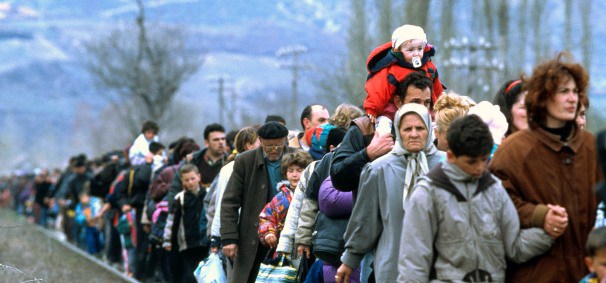
In 1999 the Kosovan exodus continued. As the civil war (1975-2002) continued, Angolans fled into Zambia.

And a new civil war in Liberia forced thousands into Ghana, where the Buduburam camp was set up to accommodate them. It’s still there, one of a number of refugee camps which have become permanent settlements, and is home to 42,000 people.
In 2000, the so-called Century of Refugees came to an end.
You don’t see them run, because they aren’t on the nightly news shows. But in the last few weeks, tens of thousands of hungry Afghans have been moving toward Herat, near the border of Iran, driven by civil war, bad government, winter and the worst drought in decades.
They aren’t alone. A continent away, renewed fighting in the Congo has people on the run again, this time into Zambia, where Angolans are also seeking shelter. In West Africa, the small nation of Guinea, with three million people, is being overwhelmed by hundreds of thousands of people fleeing a cruel government in Liberia and a civil war in Sierra Leone.
In 2001 Afghanistan became one of the major sources of refugees. Many fled the harsh rule of the Taliban, but more were displaced after the US invasion, prompted by the attack on the World Trade Centre. Many went to Pakistan which had received its first wave of Afghan refugees during the Soviet war in the late 1970s. By the end of 2001, there were over four million.
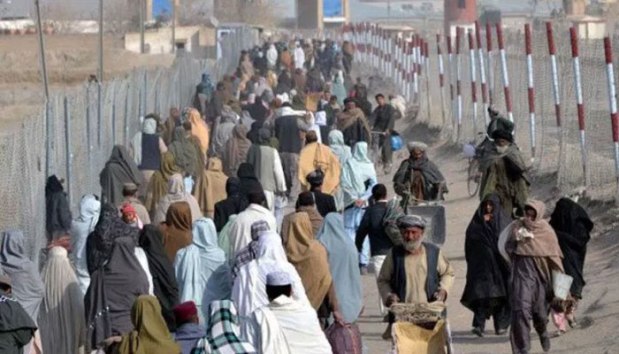
In 2002, Afghans continued to seek refuge, in Pakistan and in Iran.
In 2003, Human Rights Watch reported on the difficulties facing Serb refugees in Croatia, and the obstacles to their return home. The Central African Republic experienced the latest in a long line of coups and uprisings, resulting in around 42,000 refugees fleeing to neighbouring Chad, as well as 200,000 being internally displaced.
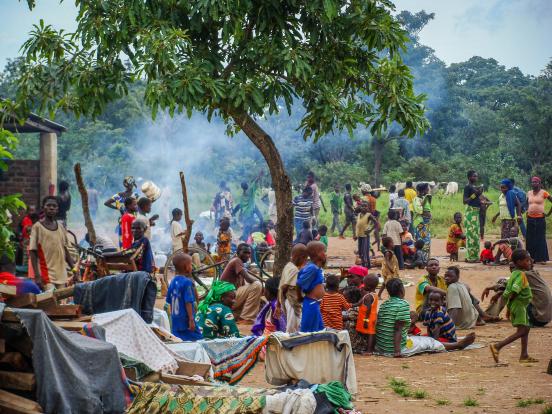
In 2004, MSF appealed for aid as around 110,000 refugees from Darfur crossed the border into Chad. North Korean refugees fled to Mongolia, which was trying hard to maintain good relations with both North and South Korea, and resisting opening a UN-administered refugee processing camp.
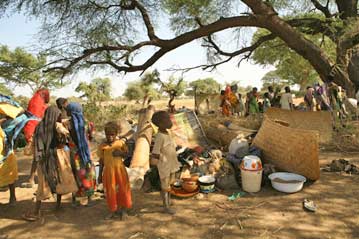
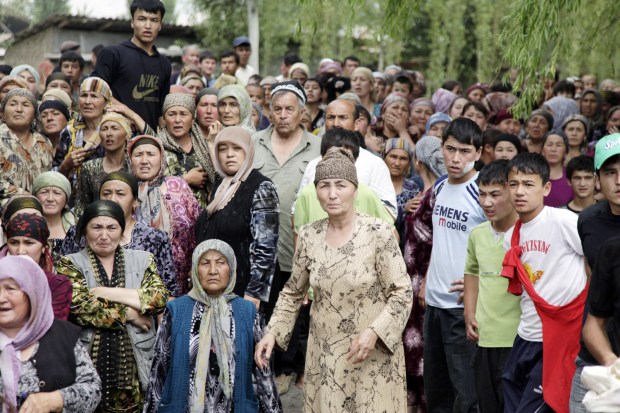
In 2005, whilst the Bosnian war had been over for more than three years, the vast majority of refugees had not returned home. The crisis in Kosovo had created around 1.5 m refugees and displaced persons. More than 400 Uzbek citizens sought asylum in neighbouring Kyrgyzstan following the 13 May 2005 uprising in the Uzbek town of Andijan. They remain in refugee camps in southern Kyrgyzstan awaiting a decision on their future. Around 38,000 refugees fled Togo to Benin and Ghana after political violence triggered by a disputed presidential election.
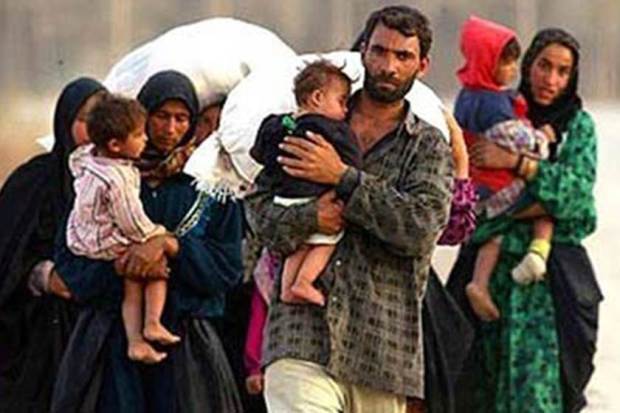
In 2006, the UNHCR resumed its voluntary repatriation programme for Congolese refugees in Tanzania. As many as 50,000 refugees from Lebanon crossed into Syria at one single border point, to escape Israeli airstrikes. Syrian authorities report more than 140,000 people have entered their country from Lebanon since the crisis started. Iran was the largest refugee haven, mainly for Iraqis and Afghans.
In 2007, nearly 2 million Iraqis – about 8 percent of the prewar population – fled the country, mostly to Jordan, Syria and Lebanon. The refugees included large numbers of doctors, academics and other professionals vital for Iraq’s recovery. Another 1.7 million had been forced to move to safer towns and villages inside Iraq, and as many as 50,000 Iraqis a month were fleeing their homes.
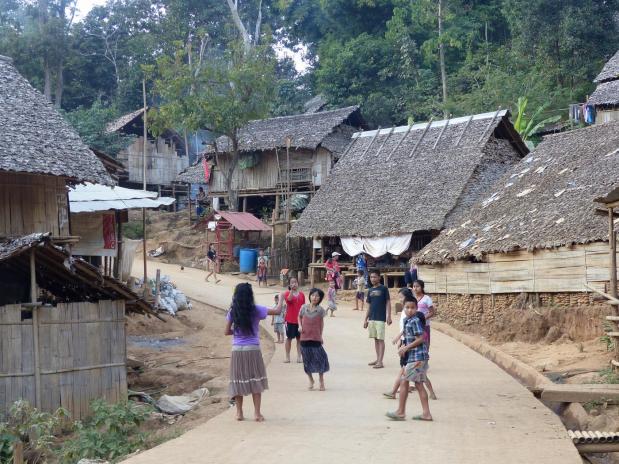
In 2008, nine refugee camps stretched along western Thailand’s border with Myanmar, with the largest, Mae La, housing 43,000 people from the Karen ethnic group who had fled their homes due to violence in Myanmar (military attacks by the Myanmar army, forced labor, destruction of homes and food crops, and enslavement). Another of Myanmar’s ethnic groups, the Chin, fled into neighbouring India and settled in the Mizoram hills.
In 2009, returning Afghan refugees found the country’s institutions ill-equipped to meet their needs. The UNHCR faced mounting pressure from Iran and Pakistan, the main refugee hosting states, to maintain high repatriation figures. The prolonged refugee presence and the persistence of unchecked cross-border movements increased Pakistan’s and Iran’s leverage over their neighbour.
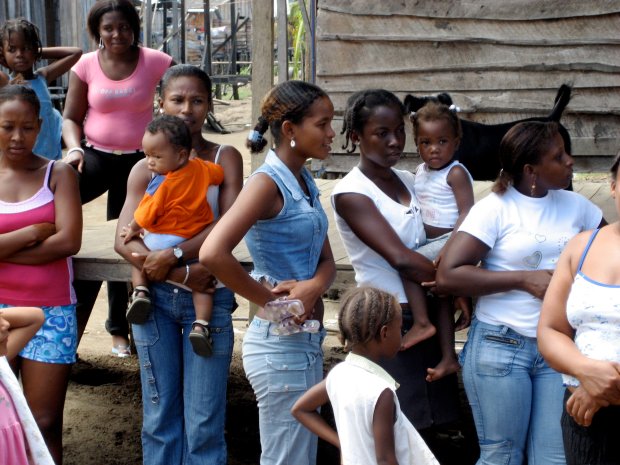
In 2010, Brazil hosted refugees from 72 nationalities, including Angola and Colombia, whilst Ecuador housed 300,000 Colombian refugees.
Iraqi refugees were proving reluctant to register with the UNHCR, often because they feared being repatriated.
The reasons are mixed, but clearly include the deep reluctance of refugees to envisage returning to a society profoundly marked by war, insecurity, civil conflict and economic uncertainty. Some Iraqis say they fear involuntary repatriation to Iraq if they formally register with the UN agency (while only 273 Iraqi families returned to Iraqi in 2010 under the UNHCR’s voluntary-repatriation programme). Many, with greater reason, are reluctant to go back to a country no longer characterised by mixed religious and ethnic communities and the legacy of Ottoman tolerance for ethno-religious differences. The emergent Iraqi state is clearly an “unmixed” one under which many Sunni Muslims are uncomfortableand Christian communities endangered and in flight.
https://www.opendemocracy.net/dawn-chatty/iraqi-refugees-problems-and-prospects
In 2011, Colombia had around 3.5m internally displaced people, with 500-700k seeking refuge in neighbouring countries. It was the seventh largest refugee population in the world. Colombia has been torn apart by conflict for over 40 years. The war between the government, guerilla groups such as the FARC and ELN, paramilitaries, and narco-traffickers has killed up to 200,000 people and has displaced millions of others.
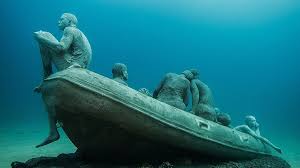
The island of Lampedusa, part of Italy but closer to North Africa than to Europe, had long been the first port of call for migrants from North Africa. This escalated with the events of the Arab Spring, the collapse of the regime in Tunisia, and conflict in Libya. The UN estimated that in 2011 around 1,500 died trying to make the crossing. In good weather, the island may see up to ten boats a day, bringing in over 1,000 refugees.
In 2012:
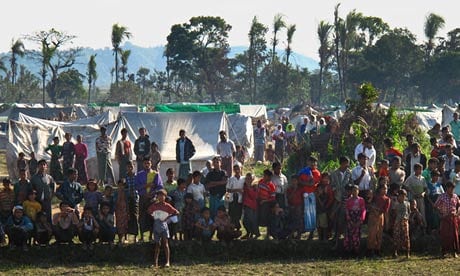
Here at Pauktaw refugee camp in Rakhine state – home to the inhabitants of five Rohingya Muslim villages who fled intercommunal conflict in western Burma this year – there are no schools, no work and no fields to cultivate – because no one is allowed to leave. When a helicopter lands, they hope it will bring either more supplies or some end to a way of life that has been unchanged for six months. Since June Rakhine state, on the border with Bangladesh, has been ripped apart by violence between the majority Rakhine Buddhists and minority Rohingya Muslims, sparked by the rape and murder of a Buddhist woman. Thousands of homes have been destroyed, 200 people have been killed and more than 115,000 displaced. Communities that once co-existed peacefully have been sent to segregated refugee camps all around the state, the majority of them filled with Rohingya – a population of roughly 800,000 who claim to be rightful citizens of Burma but whom the Burmese government widely calls “Bengali immigrants”, denying them citizenship and placing restrictions on their rights to travel, attend higher education and even marry.
https://www.theguardian.com/world/2012/dec/20/burma-rohingya-muslim-refugee-camps
In 2013:
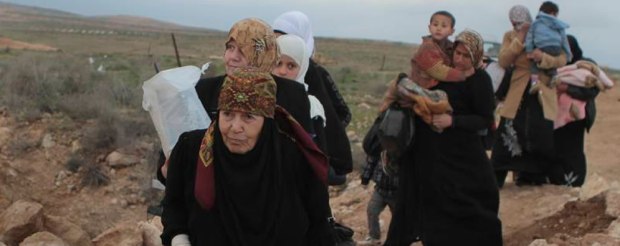
It started with thousands of people on the streets. It has resulted in millions of people on the move. Syria’s civil war has generated the world’s gravest refugee crisis in a generation, with close to 2 million people fleeing the country and perhaps twice that number uprooted and homeless within Syria itself.
By the end of this year, there will be one Syrian in Jordan for every six Jordanians. This stark figure is just one example of the impact the civil war in Syria is having on neighbouring countries, where an estimated 1.7 million Syrians have fled, with more seeking safety every day. It is a figure that should spur the international community into action.
The 26-year civil war in Sri Lanka created many thousands of refugees. But whilst it ended in 2009, four years later, people were continuing to seek asylum in Australia.
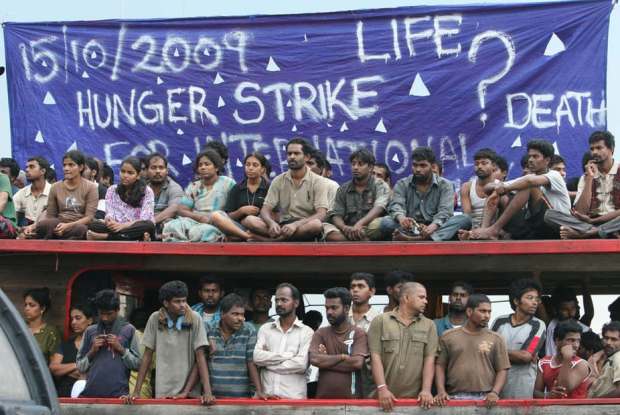
In fact, the flow of refugees commonly increases, not decreases, after the end of a conflict. This happened after the wars in Vietnam and Bosnia-Herzegovina, after conflicts across Africa and South America, and even after the First and Second World Wars. The million or so people who left South-east Asia after the wars in Vietnam, Cambodia and Laos were not fleeing straightforward oppression: they were leaving behind sites of trauma and despair that had become too painful. The flight of Sri Lankan citizens — Tamil, Sinhala and Muslim — after the conclusion of the recent civil war largely fits this pattern. The alleged autocratic nature of the regime, continuing human rights abuses and threats to democratic processes, the freedom of the press and the independence of the judiciary may well exist, but they are not the reasons why thousands of people are prepared to risk their lives to leave their homeland. They do not see a future for themselves there. They are leaving because their hope, depleted by decades of conflict, has not been restored by the cessation of hostilities and the restoration of some level of material wealth.
In 2014, as Syria‘s civil war continued, the UN was struggling to support more than 9m displaced people, a third of whom had left the country. Lebanon was taking significantly more Syrian refugees than any other country, with more than 1.1m refugees – almost one in four people are now refugees from Syria. Outside of the region, most countries were reluctant to formally resettle any significant number of Syrian refugees. Germany, however, had already accepted 6,000 Syrian refugees and has pledged to take up to 20,000.
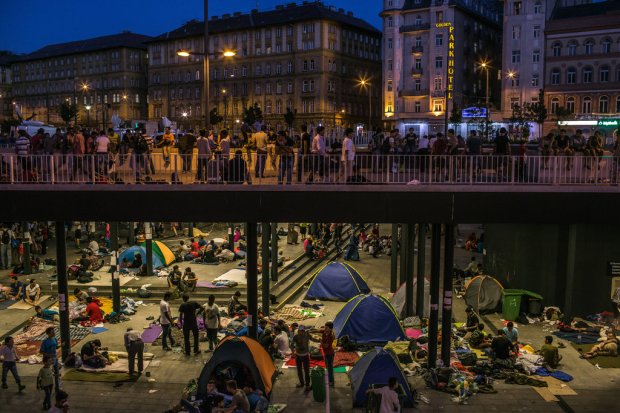
In 2015, the front page photograph of a small boy called Alan or Aylan Kurdi brought the latest phase of the refugee crisis to world attention, prompting a massive volunteering effort to provide support and resources for refugees in Europe, and to help the refugees who were risking their lives on unseaworthy boats across the Mediterranean. Some refugees found themselves at Keleti railway station in Hungary:
After days of squalid limbo, the refugees of Keleti station square, armed only with desperation, forced the hand of a government they saw as jailers. Despairing of ever escaping the increasingly squalid station, barred from boarding trains and buses without papers, they simply set off to Austria on foot, a 125-mile journey that seemed better than staying put. … Ever larger crowds of desperate, penniless, homeless people milled around, unable to go on to the countries they dreamt of, unwilling to go back to the countries they had fled, trying to hang on to dignity and hope. It was not easy, as a refugee camp took shocking shape in the heart of a European capital. Hundreds were camping out on a metro underpass and a small plaza in front of its entrance. Among them were many children, cut and bruised, hungry and frightened.
https://www.theguardian.com/world/2015/sep/06/refugees-budapest-life-stories-europe-keleti-station
In 2016:
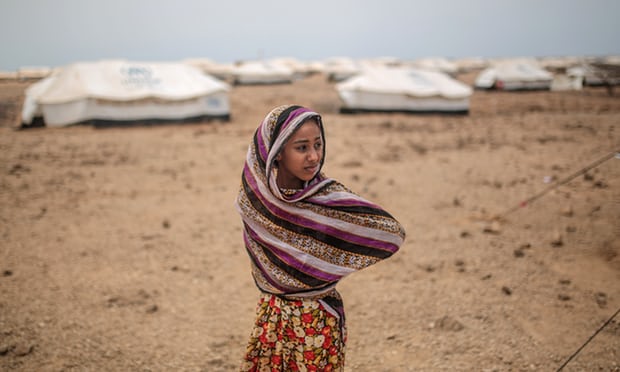
Yemeni refugees fleeing the Saudi bombings fled to Djibouti.
Nearly 35,000 people have made the journey southwards across the [Bab-el-Mandeb] strait (which translates as Gate of Tears) [from Yemen] to the tiny authoritarian state of Djibouti since March 2015, when Houthi Shia rebels overthrew the Yemeni government and Saudi Arabia responded with a relentless bombing campaign. Just over half are Yemeni. According to the regional mixed migration secretariat (RMMS), which monitors movements between the Horn of Africa and Yemen, the rest are Somali refugees, Djiboutian returnees and other nationalities.
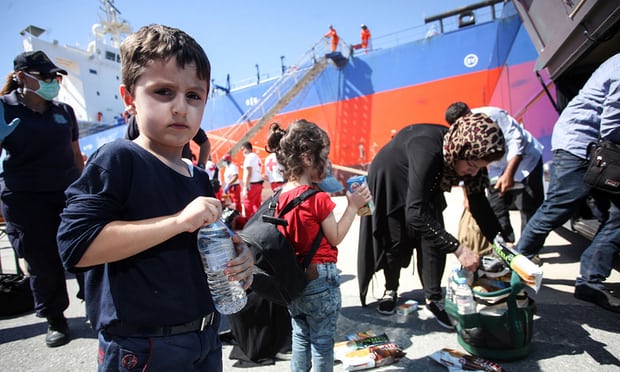
In 2017, the numbers entering Europe had dropped since the peak of 2015,
but a new question has arisen. They are here now, so what do we do with them?
The answer may lie on the tiny Greek island of Tilos, close to Turkey. Tilos has a population of only about 500, but it is now hosting over 50 refugees, 100 over the course of this year so far – 20% of the population. And, thanks to a few simple initiatives, the refugees have not only been integrated but enabled. They are making a positive social and financial contribution to the island. …. Tilos can teach us several things: above all, that integration, even on a large scale relative to population, is possible; and that refugees can be a boon not a burden. The key is inclusion. More money needs to be given to similar programmes, not to funding large camps that do nothing but mire their occupants in a squalid limbo. For integration to adequately happen, NGOs and the private sector must take the lead: government alone – overly bureaucratic, risk-averse, fickle and unwieldy – is not up to the task. As it stands the UK and European governments are catastrophically failing to deal with refugees, with many saying it’s simply not possible. This tiny Greek island shows us that it is. We must learn from Tilos’s example.
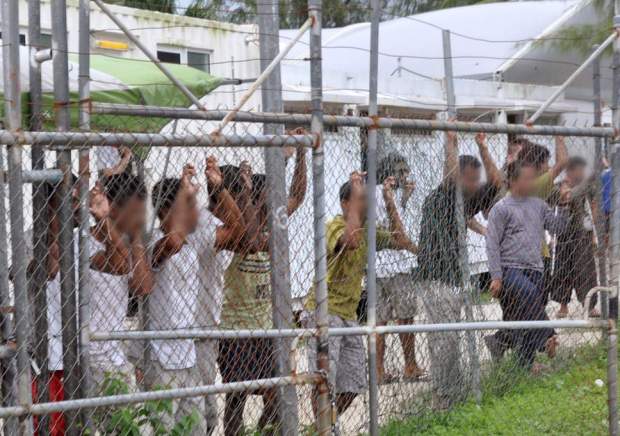
Rallies took place across Australia protesting at the treatment of asylum seekers and refugees on Manus Island. Papua New Guinea authorities had closed the detention centre and forcibly removed the remaining refugees, who were refusing to leave, fearing for their safety and wellbeing. Médecins Sans Frontières was denied access to the refugees, despite having been granted approval earlier in the week.
In 2018, we are now witnessing the highest levels of displacement on record. An unprecedented 65.6 million people around the world have been forced from home. Among them are nearly 22.5 million refugees, over half of whom are under the age of 18. There are also 10 million stateless people who have been denied a nationality and access to basic rights such as education, healthcare, employment and freedom of movement.
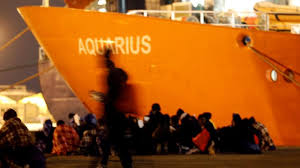
Three ships, the Aquarius, operated by the charities SOS Méditerranée and Médecins Sans Frontières (MSF), an Italian naval ship and an Italian coastguard vessel arrived in Valencia, carrying 629 weak and exhausted refugees, including pregnant women and over 100 unaccompanied minors. They had been refused harbour in Italy and Malta.
Spain’s foreign minister has described his government’s decision to take in the hundreds of refugees and migrants aboard the Aquarius rescue ship as a “highly symbolic act” intended to jolt Europe out of its “ostrich politics” on the issue of migration. The 629 people … were rescued by the French NGO SOS Méditerranée from waters off the coast of Libya on Saturday, and the Aquarius was caught in a standoff over the weekend in which both Italy and Malta refused to allow it to dock. Spain’s new prime minister, Pedro Sánchez, stepped in on Monday and said the ship would be welcome in the port of Valencia, insisting his country had a duty to help avert “a humanitarian catastrophe”.
Outside the warehouse hung a huge banner, reading, “Welcome home” in Valencian, Spanish, English, French and Arabic. Staff from the UN refugee agency, UNHCR, will be present to help passengers fleeing war or persecution claim asylum, while 400 interpreters will be on hand to ensure proper communication. The operation is being overseen by Valencia’s regional government. It also emerged on Saturday afternoon that the French government had offered to take in any of the Aquarius passengers who wished to settle in the country once the necessary procedures had been followed. Spain’s decision to accept the migrants and refugees comes amid rising tensions within the EU and calls for a fundamental reappraisal of the current migrations system.
Refugee Week 2018
Posted by cathannabel in Refugees on June 17, 2018

Refugee Week celebrates its twentieth birthday this year. Twenty years of reminding us all that refugees are people – people like us in circumstances that some of us can barely imagine. Twenty years of celebrating the contribution that those refugees have made to the communities in which they have found sanctuary. Twenty years of drawing our attention to the needs of desperate people who have been forced from their homes by war, famine, persecution.


I’ve been blogging for Refugee Week only for six years. When I look back at what I’ve published previously, it can be discouraging. Has anything really changed (for the better)? Can we hope that things will, in the next six, or the next twenty years, change for the better, given the shift to the right, to nationalism and nativism and xenophobia, across Europe and across the Atlantic?
In a sense it doesn’t matter whether we think there are glimmers of hope. We have to carry on saying what needs to be said, whether or not. We have to carry on arguing, campaigning, telling the stories that need to be told, whether or not.
So this year for Refugee Week I will as usual be posting something every day. I’ll be revisiting some topics I’ve written about before – the particular hazards, indignities and injustices faced by LGBT refugees, the story of the Kindertransport and its messages for our times, the life of the refugee camp (Goma, or Zaatari). It also happens to be the year of the World Cup, and (as I did in 2014) I’ll be looking at the countries who are competing this year, at the people to whom they give refuge and at the people who seek refuge from them.


This Refugee Week, if you are in the vicinity of Sheffield, don’t miss the wonderful Migration Matters Festival. Kicking off on 19 June, it’s a five day celebration of migration, belonging, sanctuary and community, featuring performance, film, workshops, music, food and much more. Check out the website for the full programme and book your tickets in advance.


Ten Albums
Posted by cathannabel in Music on May 29, 2018
So, I was challenged to post on Facebook ten albums that have significance, in no particular order. Albums that really made an impact and are still on my rotation list. Post the cover, no need to explain.
Well, I can’t resist this kind of thing. But I do want to explain. So here they are.
NB these are not the ten best albums I’ve ever heard. Not my ten favourite albums. Just ten albums that have somehow or other stayed with me, that I’m always delighted to hear, that led me on to other things, or took me back to somewhere special.
- Steely Dan – Pretzel Logic (1974)
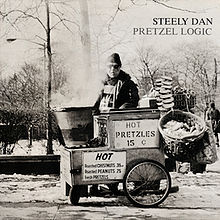 Marshall Hall student residences, Sheffield City College of Education, 1975-77. My first encounter with the Dan, pretty much. And still my favourite ever Dan album. Infused with jazz, explicitly in the Ellington cover, ‘East St Louis Toodle-oo’, and ‘Parker’s Band’, less overtly in the Horace Silver bass pattern on ‘Ricki Don’t Lose that Number’. At the same time, superlative pop/rock, ‘complete musical statements within the narrow borders of the three-minute pop-song format’, according to Rolling Stone. Impenetrable, ambiguous lyrics, which still deliver a hell of a kick. Fave track? ‘Any Major Dude‘.
Any major dude with half a heart surely will tell you my friend
Any minor world that breaks apart falls together again
When the demon is at your door
In the morning it won’t be there no more
Any major dude will tell you
2. Osibisa (1971)
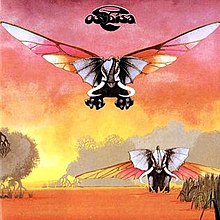 Criss-cross rhythms that explode with happiness. For me, hearing this some time in the early 70s was connecting with part of my own past, my childhood in West Africa. Living pretty much on the campus of the Kwame Nkrumah University of Science & Technology, where my father taught, we heard the highlife music wafting over from the student residences. A blend of Latin and African sounds, made for dancing, it was infectious stuff. But I’d forgotten those sounds until Osibisa. They weren’t all Ghanaians but their roots were in a highlife band, The Star Gazers, featuring Teddy Osei (sax), Sol Amarfio (drums) and Mac Tontoh (trumpet) who went on to form Osibisa in London in 1969. Joining them were band members from Grenada, Trinidad, Antigua, Nigeria, and another couple of Ghanaians. It wasn’t ‘authentic’ but then neither was highlife. Music can’t be kept pristine and pure, it is promiscuous, one form instinctively bonding with another to create something new. And it’s portable – the music of Africa crossed the Atlantic on the slave ships and interacted with the music that it found there. Osibisa brought the music of Ghana back to me and today, all these years later, one track especially brings back not just those early years but our family home in Nottinghamshire. Our house was called Akwaaba – ‘welcome’, in Twi which is the official dialect of Kumasi, the capital of the Ashanti region of Ghana.
3. Kirsty MacColl – Kite (1989)
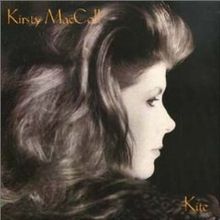 Whenever I post anything about Kirsty I get such an outpouring of love in the comments. From people I knew adored her, and people I had no idea would feel that way. It’s more than the music – we respond to a sense of who she was, that she wasn’t and couldn’t be ‘plastic’. Before Kite I’d heard, obviously, ‘Chip Shop’ and her cover of ‘Days’ and although I’d liked her voice, I wasn’t expecting something this powerful from her. Apart from ‘Days’, there aren’t any covers here, it’s all her. She managed to attract brilliant musicians to work with her – and everyone who did seems to have loved her to bits. Even Morrissey, in all of his petulant and quarrelsome – and lengthy – autobiography doesn’t have a bad word for her. I always loved the story of her making music with Keith Richards and telling him he was playing something wrong. She was tough and vulnerable at the same time, her voice was sweet and strong, her words were funny and heartbreaking. If I have to pick one track from this, it will always be ‘Free World‘.
4. King Crimson – Red (1974)
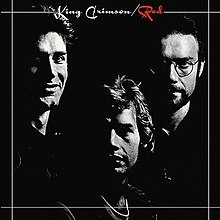 This is seriously heavy. It’s said to be one of Kurt Cobain’s favourite albums, which kind of makes sense. Whilst Crimson are obviously prog, they transcend the stereotypes of the genre, and this album in particular is grungy, particularly on One More Red Nightmare. Crimson was a constantly mutating ensemble, in which the only constant was Robert Fripp. This particular band comprised Fripp on guitar and mellotron, Bill Bruford on drums and Jon Wetton on bass and vocals, plus Crimson alumni David Cross (violin), Mel Collins (soprano sax) and Ian McDonald (alto sax). This was to be the last Crimson album for seven years. Next up was Discipline in 1981, with Fripp (obv) and Bruford plus Adrian Belew and Tony Levin. Top track – ‘Starless‘. It’s bleak and beautiful and kind of terrifying.
5. Motown Chartbusters Volume 3
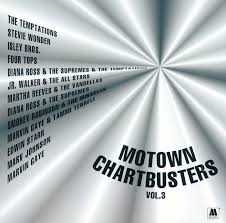 I bought this for pennies from someone in my class at school. A great big hefty slice of vinyl, already a bit crackly. Packed with classic Motown tunes, by their greatest songwriters (HDH, Whitfield & Strong, Smokey, Marvin, Stevie, Ashford & Simpson amongst others) and their finest artists (Temps, Four Tops, Marvin, Smokey, Stevie, Supremes, Isleys and more). I know and love every note on this album and always will. But in the end there’s one that just floors me every time, Diana Ross & the Supremes – Love Child. This is a classic story song, a story not so far from the real lives of many of the Motown stars, poverty, single parenthood, and the shame of being both poor and illegitimate. Diana may not have been the best singer on Motown’s roster but her voice could burn and yearn nonetheless. Where I lose it is the coda. Diana soars with ‘I will always love you’, whilst the backing singers (apparently not Cindy and Mary on the recording) provide an urgent counterpoint with ‘wait/wait won’t you wait now/hold on/wait/just a little bit longer.’ It’s pretty much damn perfect.
6. Flobots – Fight with Tools (2007)
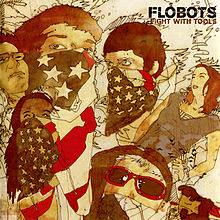 The first thing I heard from the Flobots was ‘Handlebars’. I can still remember how it affected me, the lyrics and the instrumentation – not just the usual guitar, bass and drums, but viola, cello and trumpet. It gave me goosebumps. In the years when I was running regularly, Flobots were my ideal soundtrack. No matter how tired I was, how daunted by the distance still to go and the steepness of the hill ahead of me, the combination of passionately political lyrics and tight urgent rhythms powered me onwards. There’s always a sense of hope in the words of their songs, a sense that however crappy things are (and lord knows they’ve got crappier since 2007) there is and always will be resistance, people who will man the barricades, who will refuse to shut up.
We are building up a new world
Do not sit idly by
Do not remain neutral
Do not rely on this broadcast, alone
We are only as strong as our signal
There is a war going on for your mind
If you are thinking, you are winning
I’m picking ‘Anne Braden‘. This epitomises their politics, I think. It celebrates a white woman, from the Deep South, who always knew that there was something wrong, and who threw in her lot not with her ‘own people’, but with the oppressed. She was tirelessly active in the civil rights movement and anti-racist politics throughout her life, facing arrest and the constant threat of violence. She believed that there was ‘another America’, and we have to hang on to the belief that she was right.
7. Le Mystere des voix Bulgares (1975)
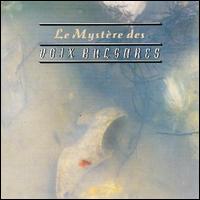
This was originally released in 1975 on a small record label, and might well have been forgotten, had Ivo Watts of 4AD not heard an audio cassette of the recording and tracked it down. It was re-released in 1986 and had a tremendous impact. From the Bulgarian State Television Female Vocal Choir, who contributed the most to the album, the Trio Bulgarka emerged, and worked with Kate Bush on her Sensual World album in 1989. She said that ‘it was something strange to feel this very strong female energy in the studio. It was interesting to see the way the men in the studio reacted… Instead of just one female, there was a very strong female presence.’ What struck me so forcibly when I first heard it was the harmonies. A cappella vocals can always tingle my spine whether it’s The Sixteen doing Allegri’s ‘Misereri’ or The Four Freshmen doing ‘Their Hearts were full of Spring’, but these are not just spinetingling but weird and unsettling. Especially “Sableyalo Mi Agontze” (Заблеяло ми агънце) [The Bleating Lamb].
8. Songhoy Blues – Soubour
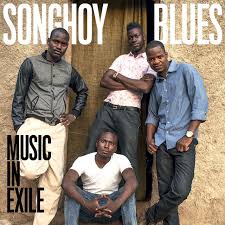
I’ve written often about my love for the music of Mali. It’s the birthplace of the blues, and its music never fails to move me, emotionally and physically. These young musicians grew up not only with the astonishing legacy of Malian music – the genius of Salif Keita, Toumani Diabate, Ali Farka Toure – but also the music that had emerged across the Atlantic, Muddy Waters and Jimi Hendrix, inheritors and interpreters of the sounds that generations of Africans had taken with them on the slave ships. Their music has also been shaped by the threat posed by IS affiliates to that incredibly rich culture – see the documentary They will have to kill us first, and Abderrahmane Sissako’s 2014 film, Timbuktu. Hard to pick one track, but for today at least, I’ll pick ‘Petit metier‘.
9. Alice Cooper – School’s Out (1972)
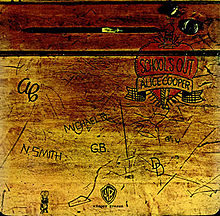
Summer of ’72, my French penfriend, Catherine, was visiting. She brought with her the sound of Claude Francois and Michel Sardou, and went home with singles from Hawkwind and Alice Cooper. I’m somewhat surprised I was allowed over to see her the following year… Not everything that I loved back in the summer of ’72 has stood the test of time, but this one has. And particularly Alice’s appropriation of Leonard Bernstein’s West Side Story in ‘Gutter Cat vs the Jets‘. The Alice image never appealed to me especially, but the music did and does. If I was asked to pick ten musicians Alice would never make the cut (soz Alice) but every time I hear this album I’m reminded of how it galvanised me back then. It also reminds me of the polarisation of music back then. Of my school friends, most listened to Motown, Northern Soul, Ska and reggae. Others listened to Deep Purple, Zep and Alice. I never quite got the hang of which gang I was supposed to be in, because I loved all of the above. Still do.
10. David Bowie – Aladdin Sane (1973)
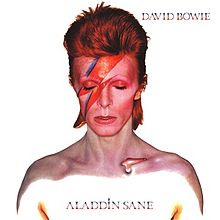 Well, obviously there would be Bowie. I could have picked ten albums just from his lifetime’s output. But them’s the rules. Aladdin Sane is an album that surprises me every time I hear it, there are details that I didn’t recall from so many previous listenings. And there’s Mike Garson’s fabulous piano on the title track, amongst others. When Bowie died I reminisced about ‘Time’, and how when we played this album at home we had to ensure we were within arm’s reach of the volume control in case of sudden parental proximity when Bowie got to the v v rude bit of the lyrics. Tough to pick just one track from this album, but I’ve settled on ‘Lady Grinning Soul‘, which is another that features Garson.
Ten albums, from the thousands that have found their way on to our record player/CD player/cassette deck over the years. They’re weighted towards the 1970s, which I guess is inevitable. My teenage years, when my musical tastes were forming, freeing themselves both from parental influence and from the tribalism of my peers, trying things out and finding out what moved my feet, my hips, my mind and my heart. That process has never stopped, but it was at its most intense then. I carry with me the earliest music I heard – a kind of mash-up of the Goldberg Variations with E T Mensah & The Tempos, probably – and there was a gradual immersion in the world of pop and rock when we returned home from West Africa in the late 60s. All of those sounds are still part of my listening world, and I’ve added music from all around the world, and ‘classical’ music that my parents weren’t into (late 20th century stuff, and opera), and jazz and, well, a bit of everything really. And there’s a world of music out there that I don’t know, and that I might love if I get the chance to listen. So ten albums is daft and arbitrary but if you made it 100 albums it still wouldn’t be adequate.
“The world without music? It would be like a prison, right?” (Garba Touré, Songhoy Blues)
Right.
Beyond the Bechdel Test: seeing ourselves on screen
Posted by cathannabel in Feminism, Film, Television on April 20, 2018
Women in Hollywood. Women wearing black to the Golden Globes and the BAFTAs, wearing Time’s Up badges, white flowers at the Grammys, standing up at the Oscars, women saying #MeToo.
 Much has been said about the way in which the voices of women, silenced for a long time by fear of retaliation or of lawsuits, of humiliation and denigration, of career suicide, are now being raised, and amplified, and the way in which this has given courage to women in other professions and environments, to speak up not only for themselves but for women who have even more to lose.
I’m not going to be directly addressing these events. But I am talking about the culture of Hollywood – a culture in which women are marginalised and isolated on screen as they are off-screen. And it’s all connected.
I’m going to look at ways in which we can assess the movies we watch, and analyse their portrayal of women, and think about what change might look like on the screen. I will touch on other aspects of diversity but I can’t do justice to it all!
The Bechdel Test has been around since 1985. But the essential idea actually goes back a lot further than that:
All these relationships between women, I thought, rapidly recalling the splendid gallery of fictitious women, are too simple. … And I tried to remember any case in the course of my reading where two women are represented as friends. … They are now and then mothers and daughters. But almost without exception they are shown in their relation to men. It was strange to think that all the great women of fiction were, until Jane Austen’s day, not only seen by the other sex, but seen only in relation to the other sex. And how small a part of a woman’s life is that … (Virginia Woolf, A Room of One’s Own, 1929)
There are actually only three requirements for passing the test:
.
(Alison Bechdel’s comic strip Dykes To Watch Out For)
It’s been developed slightly since then, and the usual formulation now is that the film must:
- feature at least two named women
- who talk to each other
- about something other than a man.
The first thing to say about these criteria is that they set the bar pretty damn low. (Just think for a moment about how many films would fail if you reversed the genders here. Er, no, me neither). Indeed, Alison Bechdel never intended the test to do anything other than to draw attention ‘to the severity of the problem by showing how low you could set the bar and still watch Hollywood executives trip over it’. Because an awful lot of films still fail, and a surprising number only scrape through with a bit of special pleading.
Does this matter? Well, yes it really does. When we – girls and women – go to the cinema, do we see ourselves on screen? Do we see the kind of women we are, and that we work and live with, that we encounter in all aspects of our lives – women who make decisions and have opinions, women who act and change things in their lives and in the world around them? If we don’t, that doesn’t stop us being that kind of woman, but it makes it harder, given that it’s already hard, to keep on keeping on in the face of everyday sexism.
Given the howls of horror from some men when a rare film does feature lots of women doing stuff, or when the Ghostbusters or Doctor Who are reimagined as women, it’s clear that the status quo is comforting to those men who would much rather we didn’t make decisions and have opinions, that we didn’t act and change things in our lives and the world around us. And it is very relevant to note that when we get one – ONE – superhero movie with an overwhelmingly black cast, there are trolls on Twitter ready to call it racist. Dear lord, one could so easily despair. But one won’t.
If I ever doubted that it’s powerful to see ourselves on screen, I had two reminders last year. Firstly, I went to see Wonder Woman.

It passes the test. It’s a while before we see a bloke at all, and when we do, he needs rescuing. By a woman. I’d underestimated how intensely exhilarating and moving it would be to see those scenes of the Amazonian women on Themyscira, and to see Diana Prince sorting out all the blokes who tried to tell her to ‘just wait there’. I wanted to weep and punch the air.
And then, not long after, we heard that the Doctor would be a woman, and at Christmas I watched as he regenerated into she, and she said, oh, brilliant. And it was.

But back to the test. It’s important to recognise that passing the test doesn’t make a film a good film, or a feminist film. Elle passes the test, as does Fifty Shades of Grey, apparently, but both are intensely problematic in their sexual politics. And Dunkirk unequivocally fails but is a brilliant film that would not have been enhanced in any way by shoehorning in some Bechdel-conforming female characters to supplement the unnamed WRENs and nurses.
It’s also important to remember that – once you’ve achieved the ‘two named women’ criterion – it’s not primarily about how many women there are on screen. If there are only one or two significant female characters, then the female characters may have to carry the burden of representing their whole gender, something male characters are rarely required to do. But the most important thing is not the number of women but, as Neda Ulaby put it, ‘the depth of their stories, and the range of their concerns’, women as characters rather than as cliches. If there are loads of women on screen but they say very little (an analysis of Oscar winning films shows that men have the vast majority of words, even in films that pass the Bechdel test) then we cannot really see and hear them as rounded characters. And if the women that are there on screen, however well-written they are individually, are disconnected from one another, connected only to the men, we’re still not getting what we need.
I had a look at the films that I’ve seen over the last year or so, to see how they measure up.
FAIL – Baby Driver, Thor: Ragnarok, War for the Planet of the Apes, Dunkirk
Maybe just about scrape a pass if you’re very indulgent – Spiderman: Homecoming, Logan, Rogue One, It. (NB my inclusion of Rogue One in this category is disputed…)
PASS – Star Wars: The Last Jedi, Wonder Woman, Twentieth-Century Women, Hidden Figures, La La Land, Elle, Guardians of the Galaxy 2, Black Panther, Lady Bird, Annihilation
Now, obviously my movie list is a personal one and reflects my particular preferences. Nonetheless, the balance isn’t so far out of kilter with wider ranging surveys. A recent analysis showed that one-third of 50 movies from 2016 failed. Between a quarter and a half of my list fail.
However, of those that pass, several pass gloriously.
I’ve already spoken about Wonder Woman. And The Last Jedi features
a scene … that’s both revolutionary and dead simple: a circle of women, soldiers and warriors all, … handily discussing how they’re going to tackle their latest military offensive. While Star Wars has always featured strong women … Johnson’s film integrates them into all aspects of the story.

Twentieth Century Women lives up to its title, with women front and centre in the movie and on the poster. Hidden Figures similarly features three women at the forefront – and those women are black.


Hidden Figures is a reminder that the Bechdel test addresses only one aspect of diversity. Which is one of the reasons that a variety of alternative or supplementary tests have been proposed.
Some of these look behind the camera to the involvement of women (currently around 18%) and/or people of colour in the writing, direction, production of the film. Clearly this is crucial. When the vast, overwhelming majority of films are written and directed by white men, this will skew the presentation of women. Not necessarily through conscious sexism, but because a male writer will inevitably identify more with the characters on screen who are most like him (the I-guys, as Stephen King calls them), and will then think of the other characters in relation to the I guy. They may well not even notice that the women are under-represented, under-developed, under-used.
There are tests that directly address ethnicity AND gender. If white women find it difficult to see themselves on screen, it’s so much more the case for women of colour. One test asks that a film features a black women who’s in a position of power and is in a healthy relationship. Another that there is a non-white, female-identifying person in the film who speaks in five or more scenes and speaks English. Against the first of these, most films fail. The second does better. We could apply the same kind of methodology to the portrayal of gay characters, transgender characters, disabled characters. But I suspect we know what the outcome would be (and we’d have to address the issue of straight actors playing gay, cis actors playing trans, actors without disabilities playing disabled).
A more qualitative approach is to focus on how women are portrayed on screen. Do films show
women as characters who have needs and desires and who take actions stemming from those desires over the course of the film. (You know, they act like real people.) A surprising number of films fail to do even that much basic character development work with women. Often, women are reduced to stereotypes or tropes as soon as they’re introduced and then don’t get developed any further. And female characters frequently serve little purpose beyond causing plot problems for male protagonists, or having a baby with a male protagonist, or dying to raise the stakes for a male protagonist.
Some of these tests are quite subjective. Whether we can identify and empathise with a character on screen may vary according to our own experiences, our age, ethnicity, sexuality, etc etc. But whilst these more complex tests may not be as easy to apply, they reflect what we’re actually responding to. That niggling dissatisfaction we feel may well be because the women we are watching don’t have needs and desires that they pursue through dramatic action, because we see them as stereotypes, because what they do matters only in relation to the male protagonists.
Another way of looking at it is the proportion of women in supporting roles or even in crowd scenes. What if half of all one-scene roles go to women, if the first crowd scene features at least 50 per cent women (currently it averages 17%), and/or the supporting cast is 50 per cent women?
You’ll note that none of the tests involve counting the number of ‘strong women’ on screen. Not all women are strong, and no women are strong all of the time. As Helen Lewis put it, ‘nowadays the princesses all know kung fu, and yet they’re still the same princesses’. You can’t solve the problems of the representation of women just by inserting a strong woman into the plot and thinking, there, job done. We want women characters who are rounded human beings, fallible and flawed, but not dependent on men to make decisions or to solve problems. Some of these women may indeed kick ass, but they don’t all have to. We want a variety of women characters – not all beautiful, not all clever, not all strong, but, well, like real people. Just imagine!
Actually we don’t have to just imagine because if you watch TV these days things are very different. It’s fairly unusual to see a crime drama without a woman in a lead role (e.g. Spiral, Scott & Bailey, The Bridge, No Offence, Unforgotten, Marcella, Line of Duty, Broadchurch, Witnesses, Fargo, Vera). And in the realm of fantasy, just think of Orphan Black, Agents of Shield, Star Trek: Discovery, The Walking Dead and, of course, Doctor Who. These shows smash the Bechdel test, and many of the alternative tests noted above, without apparent effort.
TV’s not perfect, obviously, but writers for that medium don’t seem to have been getting the message that aspiring screenwriters in Hollywood were not very long ago.
I had to understand that the audience only wanted white, straight, male leads. …“The audience doesn’t want to listen to a bunch of women talking about whatever it is women talk about.” … According to Hollywood, if two women came on screen and started talking, the target male audience’s brain would glaze over and assume the women were talking about nail polish or shoes or something that didn’t pertain to the story. Only if they heard the name of a man in the story would they tune back in. By having women talk to each other about something other than men, I was “losing the audience.
https://thehathorlegacy.com/why-film-schools-teach-screenwriters-not-to-pass-the-bechdel-test/
- Oscar-nominated films with a woman in the starring role are more profitable than their male-led counterparts.
- Female-led films (defined as films where the female actor had the first starring name on Internet Movie Database) earn higher box office returns – despite usually lower production budgets, according to BBC analysis.
- On average, every dollar invested in a female-led film earns back $2.12 (£1.53). For male-led films this figure is $1.59 (£1.15).
- Just 28% of films nominated for an Oscar since 2013 have had an actress taking top billing.
The film walks into the multiplex like it’s insane that it hasn’t been allowed in there all along. And it is. For one thing, an entire subset of younger cinema-goers are only just about to experience the dizzy uplift of watching a title character in a superhero movie who looks like them under the costume.
I should say, not all films have to be about women, or even to include women. It would be entirely unreasonable to demand that every film carry the burden of representing the diversity of the human race. For example, there is no reason on earth why a film should not be set in an environment where, for given reasons of historical accuracy or realism there are no, or almost no women present (I refer you again to Dunkirk). It’s just that when no such reasons apply, we should expect to see ourselves on screen, in the crowd scenes, in supporting roles, AND in key speaking roles that play a part in the action and that relate to each other as well as to men.
It is particularly disappointing when realism is ditched in favour of a science fiction/fantasy universe, but things don’t change as much as they could have done. Why be constrained by gender and racial stereotypes when you could tear the whole thing up and start again? I suspect that one reason is that this genre is traditionally assumed to be the white boys’ province. You create whole new universes, and want to run them all? Well, I don’t think much to that.
Things are changing. We’ve got Wonder Woman and Black Widow and Scarlet Witch and Captain Marvel and Valkyrie and Gamora and Nebula and the Doctor. And in Black Panther alone we’ve got Shuri and Okoye and Nakia and, as The Daily Telegraph (yes, really, again), says:
Black Panther seems to overcome the genre’s long-standing neuroses around creating rounded, exciting roles for women by just getting on with it.
And Frances McDormand (my hero!) had two words for us at the Oscars. Inclusion rider
This refers to a proposal by Stacy Smith, director of USC Annenberg’s Media, Diversity & Social Change Initiative:
“What if A-list actors amended every contract with an equity rider? The clause would state that tertiary speaking characters should match the gender distribution of the setting for the film, as long as it’s sensible for the plot,” Smith wrote. “If notable actors working across 25 top films in 2013 had made this change to their contracts, the proportion of balanced films (about half-female) would have jumped from 16 percent to 41 percent. Imagine the possibilities if a few actors exercised their power contractually on behalf of women and girls. It wouldn’t necessarily mean more lead roles for females, but it would create a diverse onscreen demography reflecting a population comprised of 50 percent women and girls. In other words, reality.”
I may be being naive, but it seems to me this could be huge. Already, Brie Larson, Michael B Jordan and John Boyega, among others, have said they’ll use this as a way to bring about change, on and off screen. Let’s hope.
We’re half the human race. We’re all races and religions, all shapes and sizes, all political persuasions. We have disabilities and we have none, we are healthy and we suffer pain and indignity, we are independent and we need help to get by. We have money to burn and we have nothing at all. We are mothers and we are daughters and sisters, we are friends and wives and lovers. We are beautiful and we are ordinary. We are gay, straight, bi, cis, trans, and every variant or combination of the above. We are feminists, and we are ‘I’m not a feminist but…’ and we are most decidedly not feminists. We believe in our right to choose, and we believe that women’s fertility should be controlled by the state, by the church, by men. We wear pussy hats, and ‘Make America Great Again’ hats.
That should provide the screenwriters of Hollywood plenty of scope.
And just to make the point, that I don’t, I really don’t, want to see nothing but white middle-aged middle-class short bespectacled women when I go to the movies, I had the same emotional response to Black Panther as I did to Wonder Woman. I wanted to weep, and to punch the air.

Because ultimately, it’s not Me me I want to see there. It’s all of us. The human race in all its wild and ridiculous and glorious diversity. And if some straight white guys have to hutch up a bit to make room, well, Time’s Up, dudes.

24 hours of inspiration
Posted by cathannabel in Events, Inspiration for Life on April 13, 2018

Only six days to go. Then, for considerably more than 24 straight hours, I’ll be not only awake, but busy setting up ticket and book stalls and coordinating volunteers, interviewing a friend and colleague about her desert island choice of records on our pop-up radio station, and then at 17.00 on Thursday 19 April welcoming audiences to the first talk of the 24 hour marathon. And then I’ll be buzzing around, keeping an eye on everything, looking after our speakers, MCs and volunteers, taking a few photos, tweeting, listening to as many of the talks as I can and listening into the radio when I can, changing into my PJs at around 11.30, giving a talk myself at 2.00 am on Friday 20 April, introducing the Goth slot at 3.00 am, changing back into daywear at around 6.00 am, doing a radio show with Mike about places and music that mean something to us at 11.00 am, and then, after Tony Ryan brings the talk programme to a close, saying some possibly incoherent, unavoidably emotional words to thank everyone for their contributions, and to send our audiences, speakers and volunteers safely on their way home. My family will scoop me up, pop me in a taxi and get me home, where I will almost certainly be asleep over a pint of beer by around 8.00 pm.
It does regularly occur to me during the course of this event that it is pretty incredible. During the night shift especially. It might seem a bit like one of those anxiety dreams – you’re in a lecture theatre in a University (a fairly normal setting, for many of us), but it’s 2.00 in the morning, and you’re in your jimjams. But unlike those dreams, it’s not uncomfortable, far from it, because you’re not the only one – many of the volunteers will have slipped into panda onesies or whatever, and the speakers, however eminent, have all been advised of the dress code, however they choose to interpret it.

But it’s not just the uncanny nature of the night shift, it’s the whole event. It’s the fact that each year I send out invitations to colleagues at all levels asking them to give a half hour talk on any topic they like, at some point over a 24 hour period, accessible to non-specialist audiences. And before I know it, the programme is full, and I’m turning people away. Some people come back, year after year, but usually around half of the speakers are new to the event. And each year we recruit student volunteers from across the University and all around the world, who throw themselves into the event with enthusiasm and creativity and energy. Each year people offer more than we’ve asked of them, wanting to be involved.


Initially this was down to the Tim factor. That first year, our student volunteers had all been taught by him, and inspired by him, and they all loved him and missed him terribly. Most of the speakers had worked with him – one flew over from Lausanne, another came up from Oxford, just to be part of it. It was inevitably, at least in part, a memorial to someone who had played a vital role in the University, in the Physics department, and in the academic life of generations of students. Obviously, five years on, the undergrads at least never knew Tim and the majority of speakers probably didn’t either. But his story still touches people and in any case, almost all of us have our own cancer stories.
Almost all of us have lost someone who we loved, someone who inspired us. Each year I think not only of Tim and Victoria, but of my mum and her mum who I never knew, of Jos and Dorrie and Anne. I think of the survivors too, of Lorna and Sarah and Linda and Bev, amongst others. Each year names are added to the list. This year I will think of Maryam having treatment in the US for ovarian cancer, Jennie about to go into round 2 of chemo for acute myeloid leukaemia. I think of Jonathan and of Sheena.
Tim’s story is of course not just a story about cancer. It’s the story of a teacher who connected with his students, who encouraged and inspired them, who made complicated ideas accessible and who was passionate about not only teaching but learning as a lifelong activity. And that’s the other reason why this event goes on, from strength to strength. Because the University is a place dedicated to teaching and learning, full of people who are passionate about teaching and learning. Because we get a buzz out of encountering stuff we don’t know, didn’t know might be interesting, didn’t know we might be able to at least begin to understand.
24 hours of inspiration.

If you’re in the neighbourhood, do pop in. For however much time you can spare, for as long as you like. It’s not just talks, there’s 24 hour boardgaming too, if that’s your thing. And live music too.
And if you’re not in the neighbourhood, you can listen in to Radio Inspire, which will be broadcasting a mix of music, interviews, spoken word, quizzes, and more music throughout the event.

Everything we raise, through selling tickets and cups of tea and buns, goes to this year’s two charities, Rotherham Hospice and Impact Living. What we do in that 24 hours makes a difference to the charities we support and this year it will help to provide end of life care in people’s homes, and to support vulnerable young people with cancer.
Come along if you can, listen in when you can – and if you can, please donate.
Nevertheless, she persisted #IWD2018
Posted by cathannabel in Feminism on March 8, 2018


She was warned. She was given an explanation. Nevertheless, she persisted.
I’ve just finished reading Hannah Jewell’s 100 Nasty Women of History and that phrase came to mind pretty much on every page. Just as women around the world have turned Senator McConnell’s rebuke to Senator Warren into a rallying cry, so Jewell turns Donald Trump’s insult to Hillary Clinton around, and uses it to celebrate women in history who were ‘brilliant, badass and absolutely fearless’, and in many cases, pretty much unknown.
Some of these nasty women were indeed pretty nasty. None of this is about saying that women are good, or do good (#notallwomen). It’s saying that women can’t, won’t, never did, never will, fit into the restrictive little boxes that centuries of patriarchy have tried to confine them to.
Men keep on warning us. They keep on explaining why we need to leave things to them, to stop being so pushy, so strident. And nevertheless we persist.
We always have. The women that Jewell celebrates all had to deal with men telling them that they couldn’t do things simply because they were women, because their brains weren’t sharp enough, they weren’t rational enough, they were too emotional, too fluffy, because trying to be otherwise would make them poorly, shrivel their ovaries or something, stop them getting a man, or being able to bear children. We’ve been told we’re too pushy or not ambitious enough to succeed, too plain or too pretty to be taken seriously, that our choices are all wrong (have babies/not have babies, go back to work/stay at home).
And nevertheless we persist.
Women throughout the centuries, across the continents. In cultures far more restrictive than our own women have nevertheless become warriors, monarchs, visionaries, writers, leaders, artists, scientists, inventors. And we go on, pushing at the barriers, cracking the glass ceilings. We carry on speaking out when they interrupt or talk over us. We carry on campaigning in the face of internet abuse and threats, or worse.
We’re half the human race. We’re all races and religions, all shapes and sizes, all political persuasions. We have disabilities and we have none, we are healthy and we suffer pain and indignity, we are independent and we need help to get by. We have money to burn and we have nothing at all. We are mothers and we are daughters and sisters, we are friends and wives and lovers. We are beautiful and we are ordinary. We are gay, straight, bi, cis, trans, and every variant or combination of the above. We are feminists, and we are ‘I’m not a feminist but…’ and we are most decidedly not feminists. We believe in our right to choose, and we believe that women’s fertility should be controlled by the state, by the church, by men. We wear pussy hats, and ‘Make America Great Again’ hats.
We don’t agree with each other, we don’t always understand each other. There’s no unifying glorious, supportive and empowering sisterhood – how could there be, when we’re half the human race? But we can choose to support each other, to celebrate achievements that otherwise might be dismissed or forgotten, to amplify voices that might not otherwise be heard, to bring into the light wrongs that otherwise might be hidden.
We’ve come a long way, baby, but not yet far enough, no way. We still lack anything resembling proportionate power, resources, influence. We still face horrific violence, on the streets and in our homes. We still carry disproportionate burdens when it comes to feeding and raising our families.
But we will persist.


PS – Oh, and BTW, International Men’s Day is on 19 November. Just in case anyone was about to ask. Richard Herring is doing a sterling job on Twitter (@Herring1967) for what he calls International “When’s International Men’s Day?” Day, encouraging anyone who asks the question (and each of them seems to think they’re the first person to do so. Bless.) to contribute to Refuge.

Time to Talk
Posted by cathannabel in mental health, Personal on February 1, 2018
A few years back I took the step of talking publicly about my experience of depression, as part of Time to Talk Day:
a chance for all of us to be more open about mental health – to talk, to listen, to change lives.
The responses I received to that blog post were uniformly supportive and understanding, and reinforced the message of Time to Talk Day, that so many people are struggling with issues of mental health – their own or that of people they are close to – and are grateful and reassured to find that they are not as alone as they might feel.
Since I wrote that blog post it hasn’t been plain sailing. I didn’t really think it would be.
It’s a part of me, I think, that propensity to slip into the pit. I stay out of it mainly by being busy enough, with lots of things I care about and that bring me joy, but not so busy that I succumb to anxiety and sleepless nights and feelings of panic. I know the signs now, and can usually take preventative steps before I start to slip.
That holds true – but I was overwhelmed for a while, not long after writing that piece, and needed a lot of help (not just self-help) to get through. I was lucky to find a wonderful counsellor who worked with me for almost a year to help me to develop strategies to relax, to allay panic, to feel more confident when I went into what I knew would be difficult situations. Some of those strategies were physical – putting my arms on the table rather than crossed defensively, with my hands open rather than clenched, and popping into the Ladies and standing, feet a little bit apart, hands on hips, shoulders back. A little bit like…

Body language affects how others see us, but it may also change how we see ourselves. Social psychologist Amy Cuddy argues that “power posing” — standing in a posture of confidence, even when we don’t feel confident — can boost feelings of confidence, and might have an impact on our chances for success.
I can vouch for this. When you feel under attack your instincts are to drop your shoulders, to make yourself small (less of a target), to protect yourself physically, which stops you breathing so freely, which in turn creates or increases a sense of anxiety. If you stand like Wonder Woman you’re changing your breathing – it’s an expansive posture. Now, no one is suggesting that you swan into whatever situation it is that you’re dreading, and take up that stance. That’s a hell of a sassy stance, and it might be counter-productive. But a few minutes, in private, standing, and breathing, can help you get through what follows.
I used these approaches as survival techniques in an ongoing crisis rather than as a long-term strategy to enhance my confidence. To be honest, outside of that situation, I didn’t lack confidence in the workplace – I knew I was knowledgeable, experienced, capable, intelligent and a good communicator. I just didn’t know it right then.
That situation is long over, and I have had no serious brushes with depression since it was resolved. But it contributed to my decision to retire from work, rather earlier than I might otherwise have done, and it’s made it harder for me to look back with pride and pleasure at my achievements throughout my career.
I can live with that. I’m doing other things, things that I am unequivocally proud of.
What is becoming a bit of an issue is anxiety. I’m more or less continuously anxious these days. For me it’s a physical sensation, a tightness in my chest and throat, there most of the time with particularly strong twinges at seemingly random moments. And of course at 3 am – or 5 am – things look ‘worse and worse and worse’…
Fleur Adcock – Things
There are worse things than having behaved foolishly in public.
There are worse things than these miniature betrayals,
committed or endured or suspected; there are worse things
than not being able to sleep for thinking about them.
It is 5 a.m. All the worse things come stalking in
and stand icily about the bed looking worse and worse and worse.
The tightness becomes almost painful, there’s a weight on me that’s affecting my breathing. I can feel my heart thudding, racing, skipping beats.
The uselessness of it is infuriating. Of the things that are on my mind, there are some about which I can take sensible action – but not at 3 am. And often it’s a carousel of worries, round and round, from one to another, from real things that I might be right to be concerned about, to general forebodings, to things that any sensible person would not waste a moment’s panic about, round and round, on and on…
I’ve tried my usual ‘how to get back to sleep when the thoughts come crowding in’ techniques but they aren’t really working at the moment. I have yet to meet a relaxation tape which hasn’t made me want to throw it across the room and then stamp on it very hard indeed. Right now, the one thing I’m trying which is working – at least in the daytime – is to visualise the particular worry that’s constricting my breathing right now as a thread that I can let go of and watch it float away.
I know I’m not alone with this struggle. But I also know I need to get better at coping with it, because anxiety at this level – and the sleepless nights that go with it – can push me into the depression that I dread. It can also stop me doing things that I need and want to do.
Why am I sharing this? Because I know I’m not alone, and you need to know that too. Because we can maybe share our experiences, share the strategies that have worked for us, give each other a virtual or a real hug when we meet, remind each other that this too shall pass.
I know that my depression and my anxiety are minor irritants compared to what so many people have to deal with. But the walking wounded, those who probably aren’t on medication, or using mental health services, may be missing out on so much joy, on the possibility of pleasurable rather than dread-filled anticipation. And the world is missing out too, on the energy and passion and talent that we can give in so many fields, or could, if we weren’t lying awake every night with a heavy weight of anxiety pinning us down and sapping our strength.
The simplest and most important thing of all: the world is difficult, and we are all breakable. So just be kind.Caitlin Moran – How to Build a Girl
We need to remember that, and this:
As you look around you, in a lecture or a meeting, at a party or a gig, there will be people there, talking and laughing and making decisions and relating to those around them, who are or have been in the grip of depression or anxiety, who are struggling with or have struggled with obsessive compulsive behaviour or eating disorders, who are experiencing or have known the intense highs and lows of bipolar disorder. You’ll never know, unless they dare to share it with you.
It’s time for change. It’s time to talk.


https://www.rethink.org/about-us/our-mental-health-advice
The Power of Words: Holocaust Memorial Day 2018
Posted by cathannabel in Genocide, Second World War on January 27, 2018
In my first HMD blog, six years ago, I talked about how, in preparation for genocide, the power of words is used to dehumanise the intended victims:
The perpetrators of genocide don’t start by taking lives. First they take everything else – name, livelihood, home, dignity, humanity. For it to be possible for society to collude in this, the victims have to become less than human – cockroaches, perhaps, or lice. Or less, even, than that – one of the most powerful Holocaust documents is a memo, addressing technical problems with vehicle stability. As one reads it, it takes a while before the nature of the destabilising ‘load’ becomes apparent: this load has a tendency to rush towards the light, which causes problems in getting the doors closed. This load may also scream.
That’s why we must call out such language when it is applied to refugees, immigrants, or any group of ‘others’, whenever we hear it and whoever is using it.
“How many Romanians are in? How many Polish are in?” she splutters in the midst of a diatribe about the NHS, over-crowded prisons and illegal immigration. “They are congregating like cockroaches into our major city centres, which are unable to deal with the crime that they bring.”
This quote featured in a 2007 interview with a well-known television writer. The interviewer, who herself was Polish, didn’t challenge her, partly, I suspect, through shock. Much more recently (in 2015) a notorious ‘newspaper’ columnist, speaking of the deaths of up to 700 migrants in a Mediterranean shipwreck, said:
“These migrants are like cockroaches. They might look a bit ‘Bob Geldof’s Ethiopia circa 1984’, but they are built to survive a nuclear bomb.”
This characterisation of people as less than human, as vermin, as a “virus” (as she did elsewhere in the article) irresistibly recalls the darkest events in history. It is eerily reminiscent of the Rwandan media of 1994, when the radio went from statements such as “You have to kill the Tutsis, they’re cockroaches” to, shortly afterwards, instructions on how to do so, and what knives to use. (Zoe Williams, The Guardian)
Perhaps neither the TV writer nor the notorious columnist was familiar with the use of the term ‘cockroaches’ in the 1994 Rwandan genocide. I don’t know. But surely anyone, however ill-informed, should baulk at describing other human beings in such terms?
It is no joke when people start talking like this. We are not “giving her what she wants” when we make manifest our disgust. It is not a free speech issue. I’m not saying gag her: I’m saying fight her. Articulate the fellowship, the human empathy, that makes these deaths important. Stop talking about how many children were among the dead, as though only children matter. Start talking about everybody’s life as cherishable, irrespective of anything they might produce.(Zoe Williams, The Guardian)
For the sake of the future, we have to oppose, vocally and vociferously, those who use the language of genocide whether through ignorance or with deliberation.
But it’s equally important, as Zoe Williams says, to articulate human empathy, to talk about the lives of others as cherishable. And that includes those who are lost to us, who were murdered because they were seen as less than human.
I have reservations about fictionalising the Holocaust, when there are so very many first-hand stories yet to be told, and when there are still – always – those who claim that the whole thing is a fiction. But then I recall the TV series Holocaust, broadcast in the late 1970s.
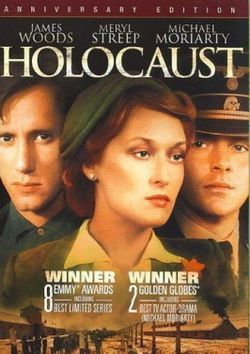
For all its faults – and it had many – and for all the opprobrium that it attracted, from critics and from Holocaust survivors such as Elie Wiesel, it served a tremendously important function. For many viewers it was a shock – it was for me, and I thought I was well-informed – and in Germany especially so. Despite all of the efforts post-war to educate and inform, it was this fictionalised account, not the documentary footage of the liberation of the camps, that really made many people understand. They saw people like themselves, living lives not unlike theirs, and then they saw what was done to them. In the course of the Holocaust mini-series, the Weiss family experienced Kristallnacht, Aktion T4, the Warsaw Ghetto, Theresienstadt, Babi Yar, Auschwitz and Sobibor. Wiesel argued that this was a mistake, that ‘the story of one child, the destiny of one victim, the reverberations of one outcry would be more effective’.
What then is the answer? How is one to tell a tale that cannot be—but must be—told? How is one to protect the memory of the victims? How are we to oppose the killers’ hopes and their accomplices’ endeavors to kill the dead for the second time? What will happen when the last survivor is gone? I don’t know. All I know is that the witness does not recognize himself in this film.
The Holocaust must be remembered. But not as a show
Clive James was more positive, although he acknowledged that no character existed except to make a point, or to illustrate a particular aspect of Holocaust history, and that (crucially) the script was clunky (‘the use of language was never better than adequate. As in all hack writing, the dialogue showed no sense of period. Prodigies of set-dressing were undone by a phrase’). However, he concluded:
There is no hope that the boundless horror of Nazi Germany can be transmitted entire to the generations that will succeed us. There is a limit to what we can absorb of other people’s experience. There is also a limit to how guilty we should feel about being unable to remember. Santayana was probably wrong when he said that those who forget the past are condemned to relive it. Those who remember are condemned to relive it too. Besides, freedoms are not guaranteed by historians and philosophers, but by a broad consent among the common people about what constitutes decent behaviour. Decency means nothing if it is not vulgarised. Nor can the truth be passed on without being simplified. The most we can hope for is that it shall not be travestied. Holocaust avoided that.
If Wiesel is right, and it is both impossible and vital to tell these stories, it is a task to be undertaken with trepidation. There are so few survivors now, so few still here and able to give their own accounts. But the way we tell their stories must honour the witnesses, the living and those who did not survive. It must be truthful, not just in terms of getting the facts right (details matter, when those details are disputed by those who would wish to assign the Holocaust to the category of fiction or myth), but in terms of creating people who ‘ring true’, and enabling us to invest in their lives and in their fate.
In Louise Doughty’s devastating and powerful novel of the Roma Holocaust, Fires in the Dark, she draws us in to the world of the Coppersmith Roma in 1920s Bohemia, into their rich and complex culture, into the lives of one family, Josef and Anna, their new son Emil, and the kumpania to which they belong. We see even then the beginning of the assault upon their culture, with the introduction of laws that require them to be registered and fingerprinted and to inform the authorities of their routes and destinations. And if we know anything at all of European 20th century history, we know this will not be the end of it.


Much later, Josef, dying of a fever in a camp, reflects on the nature of loss:
How strange a thing it is, he thought, the way you comfort yourself when it comes to loss. You turn away from it, show it your back, face and embrace what you still have. When we had to sell our gold I thought, ah well, we can always buy more gold, as long as we have the wagon and the horses and can still travel, then we will be fine. Then they stopped us travelling and burnt our wagon and I thought, well, we still have one horse and we can build a cart, and we have a roof over our heads. Then we had to flee our roof and I thought, we still have good clothes and boots, so many people don’t have boots any more. Then they took the bundles from us as we stood in line on Registration Day and I thought, well, we have the clothes we stand up in. When we got here, they took those. They even took the hair from my head. I thought, at least we are together in the same camp. So many people have been separated from their families. Now my family are kept from me, even though they are a few metres away . … It is just me, just my body and my soul and that is all that I have. … If I cannot even move my limbs, let alone raise my body to relieve myself with dignity, then I cannot really call my body my own either. All I have left are my thoughts – and breath, each small breath that comes so shallow and strange into my lungs. (Fires in the Dark, pp. 311-312)
We do not need to share Josef’s (or Louise Doughty’s) Roma heritage to feel empathy, to recognise the humanity here. Within this one passage we follow and feel that inexorable progress from a bureaucratic attack on the Roma way of life (‘The implementation of Law 117 … to curb the nuisance caused by so-called Gypsies and other Travelling Persons and Vagabonds’) to the man alone and reduced to ‘the next small breath’.

There are many first-hand accounts of the Holocaust, from those who survived and from those who did not, but very few from its Roma victims. The destruction of whole communities, and with them of customs, and dialects, and names and histories, means that creative works of imagination are vital, to bring them back to life for us. And so what Louise Doughty does here is of profound value. Richard Rorty, in a passage which Doughty quotes at the beginning of her novel, talks about how human solidarity might be achieved:
It is to be achieved not by inquiry but by imagination, the imaginative ability to see strange people as fellow sufferers. Solidarity is not discovered by reflection but created. It is created by increasing our sensitivity to the particular details of the pain and humiliation of other, unfamiliar sorts of people. Such increased sensitivity makes it more difficult to marginalize people different from ourselves by thinking, “They do not feel it as we would,” or “There must always be suffering, so why not let them suffer?” This process of coming to see other human beings as “one of us” rather than as “them” is a matter of detailed description of what unfamiliar people are like and of redescription of what we ourselves are like. This is a task not for theory but for genres such as ethnography, the journalist’s report, the comic book, the docudrama, and, especially, the novel. (Richard Rorty, Contingency, Irony, and Solidarity (Cambridge UP, 1989), p. xiv)
The power of words, used to increase sensitivity to others, to extend our sympathies, as George Eliot put it.
“Words: So innocent and powerless as they are, as standing in a dictionary, how potent for good and evil they become in the hands of one who knows how to combine them.” (Nathaniel Hawthorne – The American Notebooks)
Words have immense power to hurt or to heal, to damn or to save. And when we say of a novel or a play that it’s ‘only a story’ we are forgetting that. Those that have the skill to create or recreate a world, to draw people in whom we can believe, to give those people words to move and engage us, their ‘stories’ can shake us from our facile assumptions and prejudices, and can arm us against those who want to make us hate ‘them’.
We need those words, now more than ever.
Reflect on the fact that this has happened:
These words I commend to you:
Inscribe them on your heart(Primo Levi, If this is a Man)

