Posts Tagged Tramlines
Music Nights 2025
Posted by cathannabel in Music on December 23, 2025
My year in live music – opera, jazz, chamber music, indie, folk, all sorts – and forays into the CD/vinyl collections. Four years of listening to music without M, and I still feel it’s somehow a shared thing. I don’t spookily ‘sense his presence’ but what I listen to and how I listen to it is still – and probably always -connected to the way we listened together. That includes embracing new stuff, resisting the tendency to get stuck in a genre or decade, and listening as an active process, not as an ignorable background to whatever else one is doing. This year’s music has been full of moments when I wanted to turn to him and say ‘hey, listen to this bit!’, or ‘doesn’t that remind you of x?’ or just ‘wow!’.
I had a feeling I’d been to more gigs this year than last, and so it proved when I totted them up – 41, plus Tramlines, as against 25 plus Tramlines the previous year. More different venues as well, 17 this year as against 14 last. I decided to list them chronologically rather than grouping them by genre or such like.
The only problem with going to so many gigs is that it’s hard to come up with something to say about each (I find it harder in any case to write about music, other than to splurge a lot of superlatives onto the page, than about books or film or TV). So I’ve commented where there was something particularly notable about the gig or the context, and have hinted at what some of my top gigs were this year, but both the musical genres and the experience of hearing them are so diverse that it makes any kind of Top 3 or Top 10 a bit arbitrary, so I haven’t done that (I make the rules).
Some of these concerts – probably most of the Music in the Round ones – I went to on my own. Somehow sitting in the Crucible Playhouse or in the pews at the Upper Chapel on one’s own seems much less odd than being solo at Crookes Social Club when it’s got cabaret seating, or even at a standing gig. I was and am determined not to miss out on live music just because I can’t find someone to go with, but there is, I acknowledge, a whole other dimension when one is sharing the experience. I shared the opera with Ruth; the Unthanks in Elmet with Ruth and Aidan; The Midnight Bell with Claire; Sheffield Jazz gigs with Adi, Jennie and Michael; Tramlines with Arthur, Sam, Jane and Richard; Bach solo violin, Schubert & Janacek, and Nigel Kennedy with Arthur and Gabi; various Under the Stars bands with colleagues and participants; Songhoy Blues with Jane, Richard, Jennie & Michael; Gong with Aidan; and Shostakovich and Messiaen with Liz.
January:
Tommy Smith & Gwilym Simcock, Sheffield Jazz (Crucible Playhouse). Smith is a top-notch sax player, and here he was performing with a top-notch pianist, for what the programme described as ‘an acoustic night of intensely musical duets and dazzling improvisation’, bringing together two generations of jazz mastery for ‘an evening of intimate musical brilliance’. Absolutely.
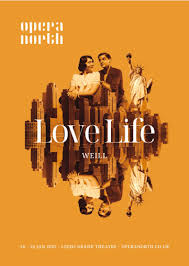
Kurt Weill – Love Life, Opera North (Leeds Grand Theatre) – an opera we didn’t know at all, and which is only rarely performed, for some reason. It opened in 1948, and has been revived a couple of times since, most notably in this production. It’s a product of the study Weill made of American popular song after he arrived in the US as an exile from Nazi Germany, with vaudeville numbers that provide a commentary on the narrative. The story itself is of a married couple who we first meet in 1791, and whose lives we follow through to 1948 – they don’t age but the world changes around them and thus changes them and the nature of their relationship. We loved the concept, the performances, the staging, and above all the songs.
February:
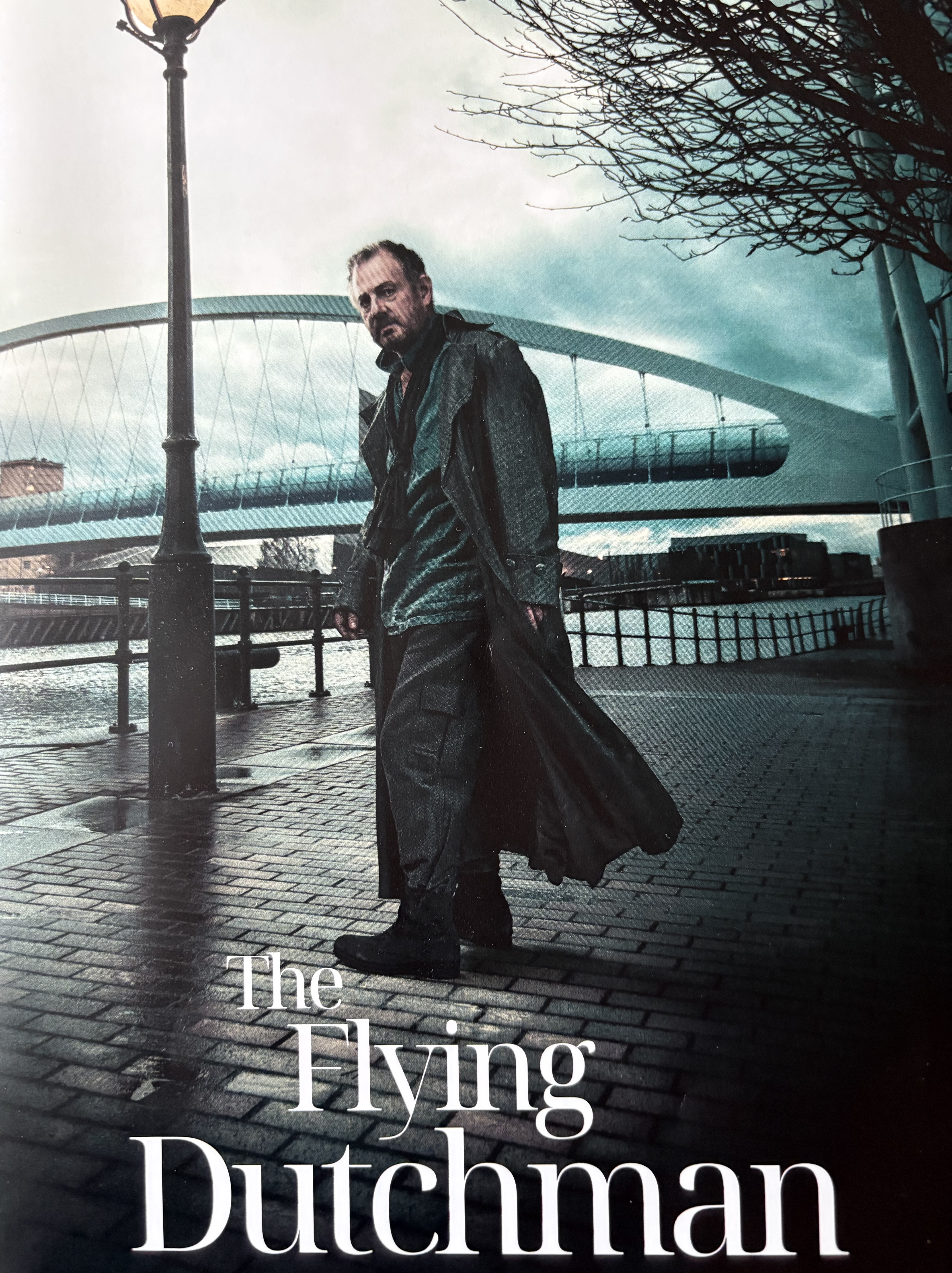
Richard Wagner – The Flying Dutchman, Opera North (Leeds Grand Theatre) – a rare occasion (I think the only one, actually) when we weren’t persuaded by the setting or the concept behind the production. The idea was to link the myth of the Flying Dutchman, constantly moving on, unable to find a home anywhere, with the story of the refugee – certainly an interesting concept, but the narrative of the opera couldn’t really be shoehorned into this without many jarring moments, and some loss of comprehensibility. The music, of course, was magnificent.
Benjamin Nabarro – Bach for Solo Violin: Sonata No. 1 in G minor/Partita No. 1 in B minor, Music in the Round (Upper Chapel). Superb performances from Ben, the lead violinist in Ensemble 360.
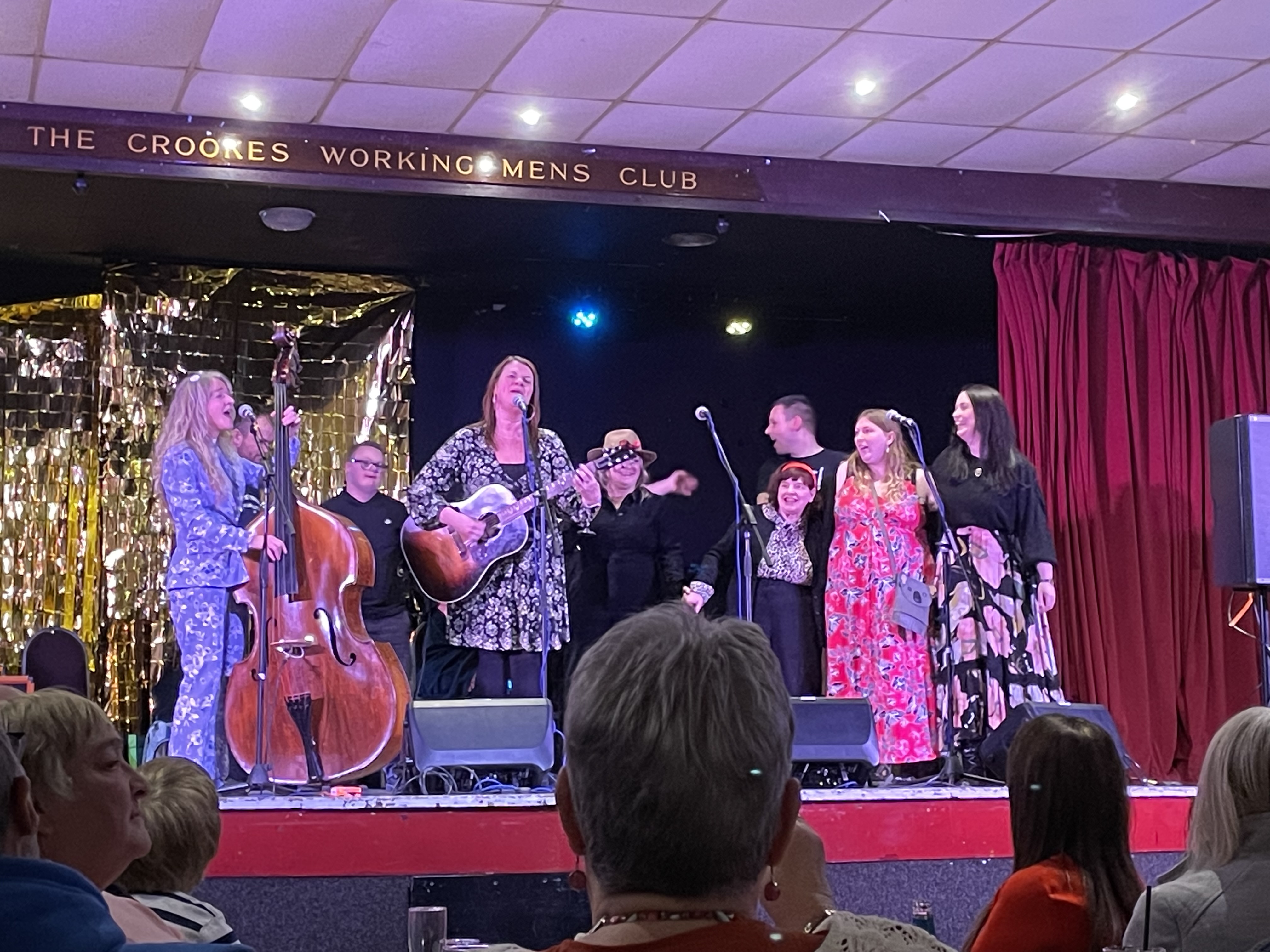
Valentine’s Voices – Daisy Daisy, Julian Jones, Sparkle Sistaz, Rye Sisters, PLUC, December Flowers, Banjo Jen, Clubland Detectives (Crookes Social Club – fundraiser for Under the Stars). Sparkle Sistaz and Clubland Detectives are two of the bands formed in the music workshops that Under the Stars run for adults with learning disabilities and/or autism. This event was a brilliant collaboration between our own artists and various local bands and solo performers.
March:
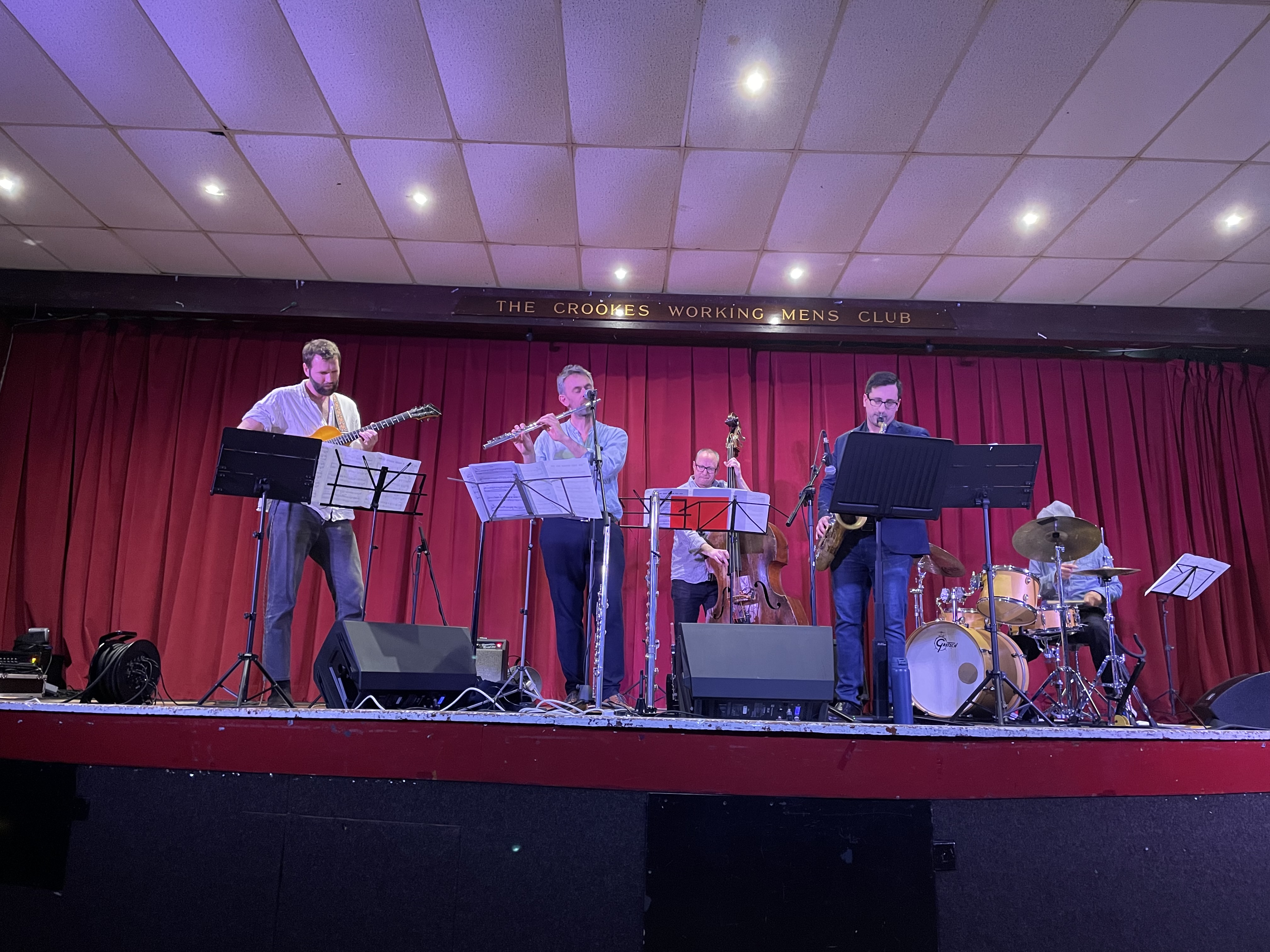
Gareth Lockrane Quintet, Sheffield Jazz (Crookes Social Club). Superb fluting from Lockrane who, according to the publicity material, ‘plays all the flutes’ – he certainly played quite a few over the course of the evening. The other quintet members were Nadim Teimoori on tenor sax, Nick Costley-White on guitar, Oli Hayhurst on bass, and Gene Calderazzo on drums.
Power: Shostakovich (Ensemble 360): Piano Trio No.2 Op.67/Piano Quintet Op.57 (Firth Hall). This was preceded by a fascinating talk about Shostakovich’s precarious position in Stalinist Russia. The music was just stunning.
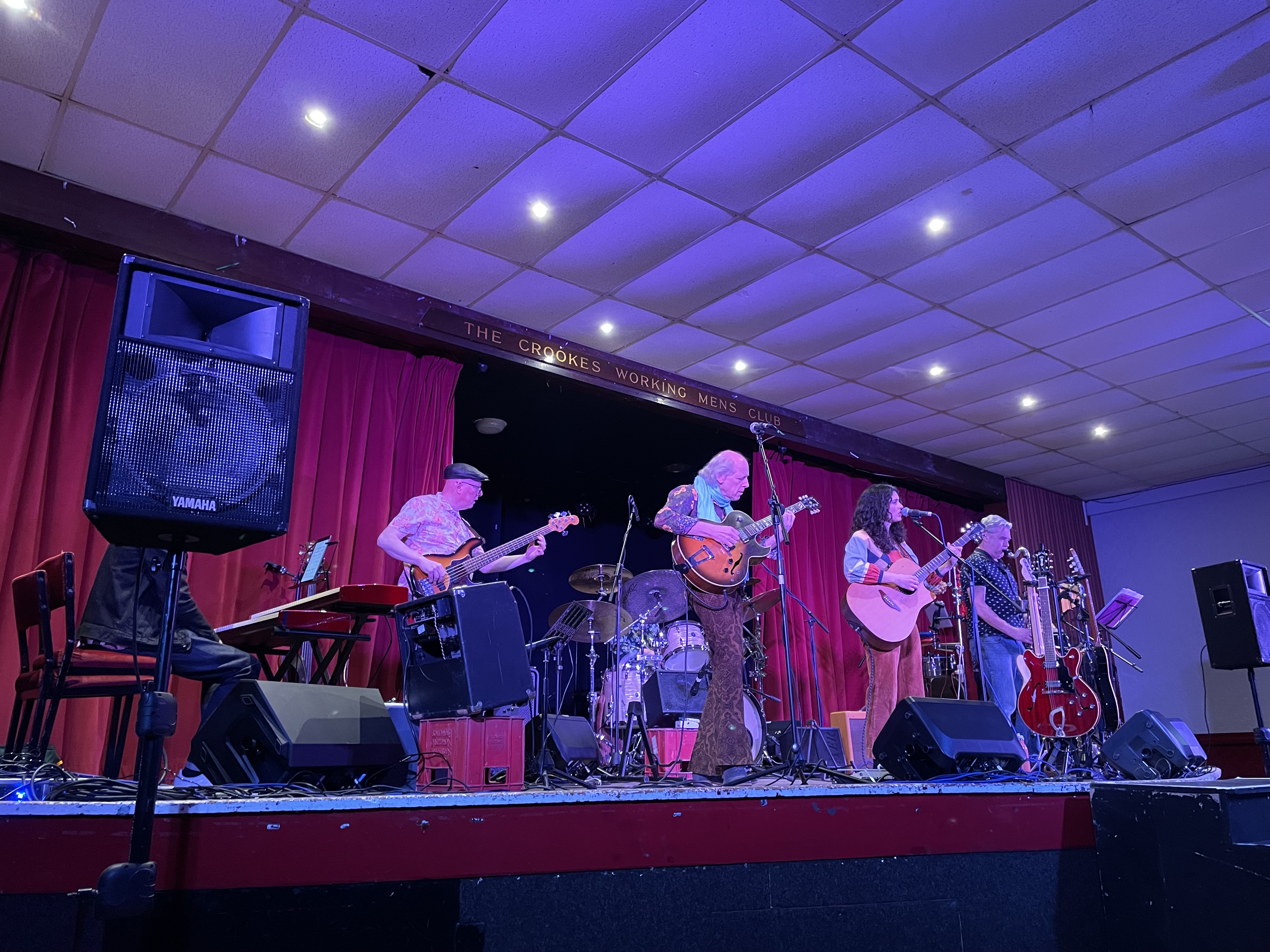
Hejira, Sheffield Jazz (Crookes Social Club). Hejira perform Joni Mitchell songs – it could just be a top-notch tribute band but it feels like more, they are interpreting the songs rather than trying to replicate Mitchell’s performances. Brilliant.
Classical Sheffield Weekend:
- Ensemble 360 – Beethoven for Flute: Flute Sonata in B flat/Trio for piano, flute and bassoon (Upper Chapel)
- Sounds of Heaven – Sheffield Chamber Choir, Steel City Choristers, Sterndale Singers and Sheffield Chorale, each getting their own spots to perform, with music by Will Todd, Sarah MacDonald, Eriks Esenvalds, Palestrina, Grieg, Parry, Part, Purcell, Rheinberger, Macdonald, arrangements by Vaughan Williams, Donald Cashmore, and Shena Fraser, and then all coming together for a spine-tingling Tavener’s ‘God is with us’. (St Marie’s Cathedral)
- Sheffield Philharmonic Chorus – Fauré – Requiem, Finzi – Lo, the Full, Final Sacrifice, Stephen Johnson – The Miracle Tree/To Wed again/This Going Hence, Thomas Stearn – for music like the sea (Curlew at Redmires) (St Marie’s Cathedral)

April:
Giuseppe Verdi – Simon Boccanegra, Opera North (St George’s Hall, Bradford). Brilliantly stripped-down staging, and the music was wonderful.
May:
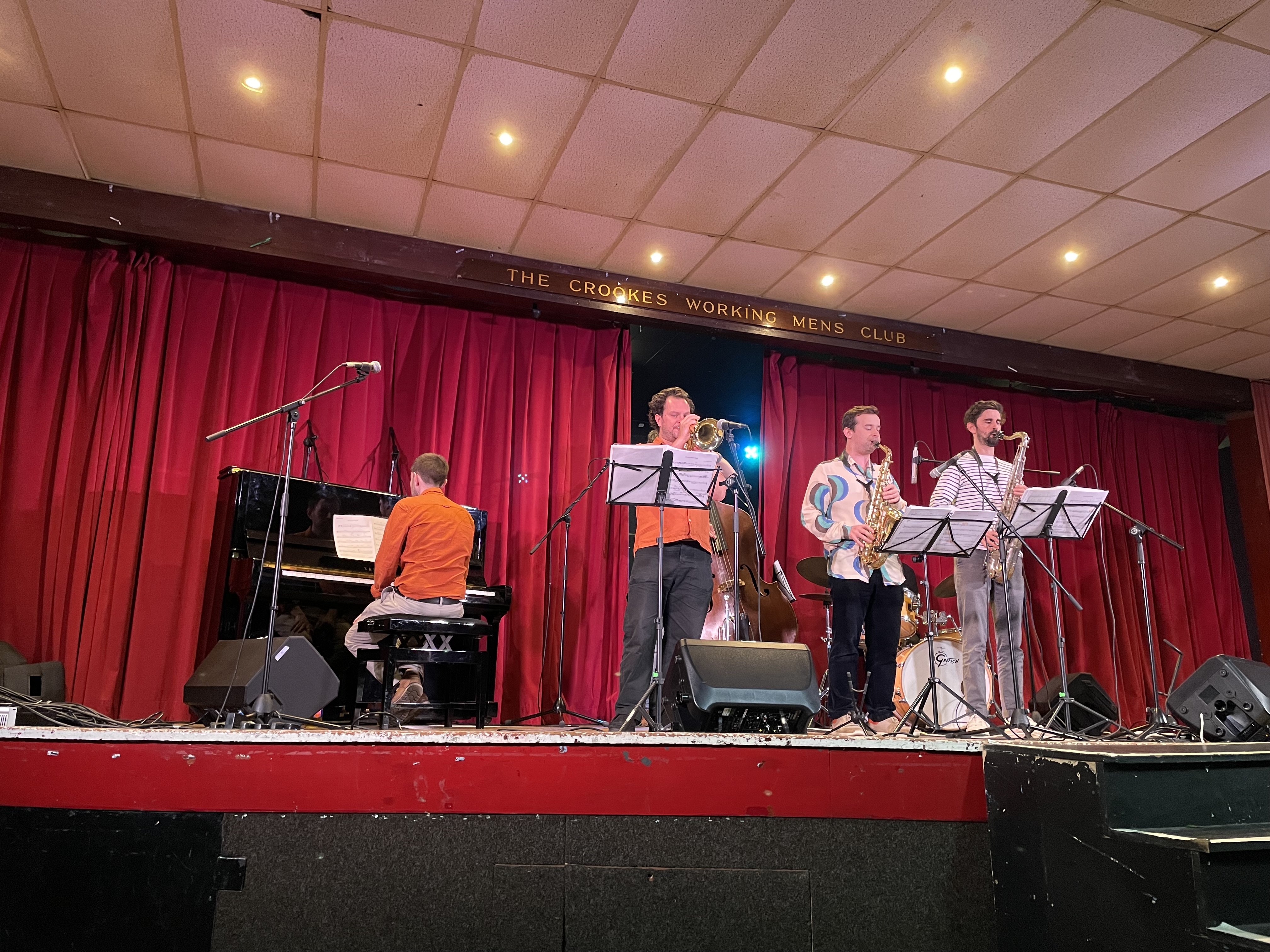
Misha Mullov-Abbado, Sheffield Jazz (Crookes Social Club). Lovely stuff – the music was from their new album Effra, very varied and beautifully played by Misha Mullov-Abbado on bass with James Davison: trumpet & flugelhorn, Tom Smith: alto sax, Sam Rapley: tenor sax, Liam Dunachie: piano and Scott Chapman: drums.
Chamber Music Festival, Music in the Round. This year’s festival was curated by Ensemble 360 to celebrate their 20th birthday, and I wish I could have gone to more than the five gigs I managed. (all in Crucible Playhouse unless stated otherwise):
- Festival Launch: Huw Watkins – Broken Consort, Aileen Sweeney – Equinox, Schubert – Octet. A great start to the Festival – Aileen Sweeney’s premiere of Equinox was lovely and I want to hear more of her work, and the Schubert Octet is a piece I’ve heard a couple of times from Ensemble 360 and is an absolute joy every time.
- Intimate Letters: Schubert – Quintet in C Major, Janacek – String Quartet no. 2. The Janacek featured an actor reading extracts from the composer’s ‘intimate letters’ to a woman with whom he was obsessed for many years – it gave a whole new dimension to the music, and sometimes a troubling one.
- The Nostalgic Utopian Future Distance: Kaija Saariaho – Petals, Boulez – Dialogue de l’ombre double, Luigi Nono – La lontanaza nostalgica utopica futura (Firth Hall). Ensemble 360 musicians duetting with electronic sounds. Never easy but always fascinating and compelling.
- Sinfonietta: Knussen – Cantata, Ravel – Piano Trio in A Minor, VW – Piano Quintet in C Minor, Britten – Sinfonietta
- Finale: Mozart – Flute Qtet in D, Beethoven – Quintet for Piano & Wind, Elgar – Piano Quintet
Peggy Seeger – First Farewell Tour (Cubley Hall). She’s 90 so took a while to get on and off the stage (assisted by her sons), and the voice is more fragile than it once was, but she’s still got it. She sang ‘The First Time…’ (of course) and told the story of how Ewan MacColl had written it for her (‘at least’, she added wryly, ‘that’s what he told me’).
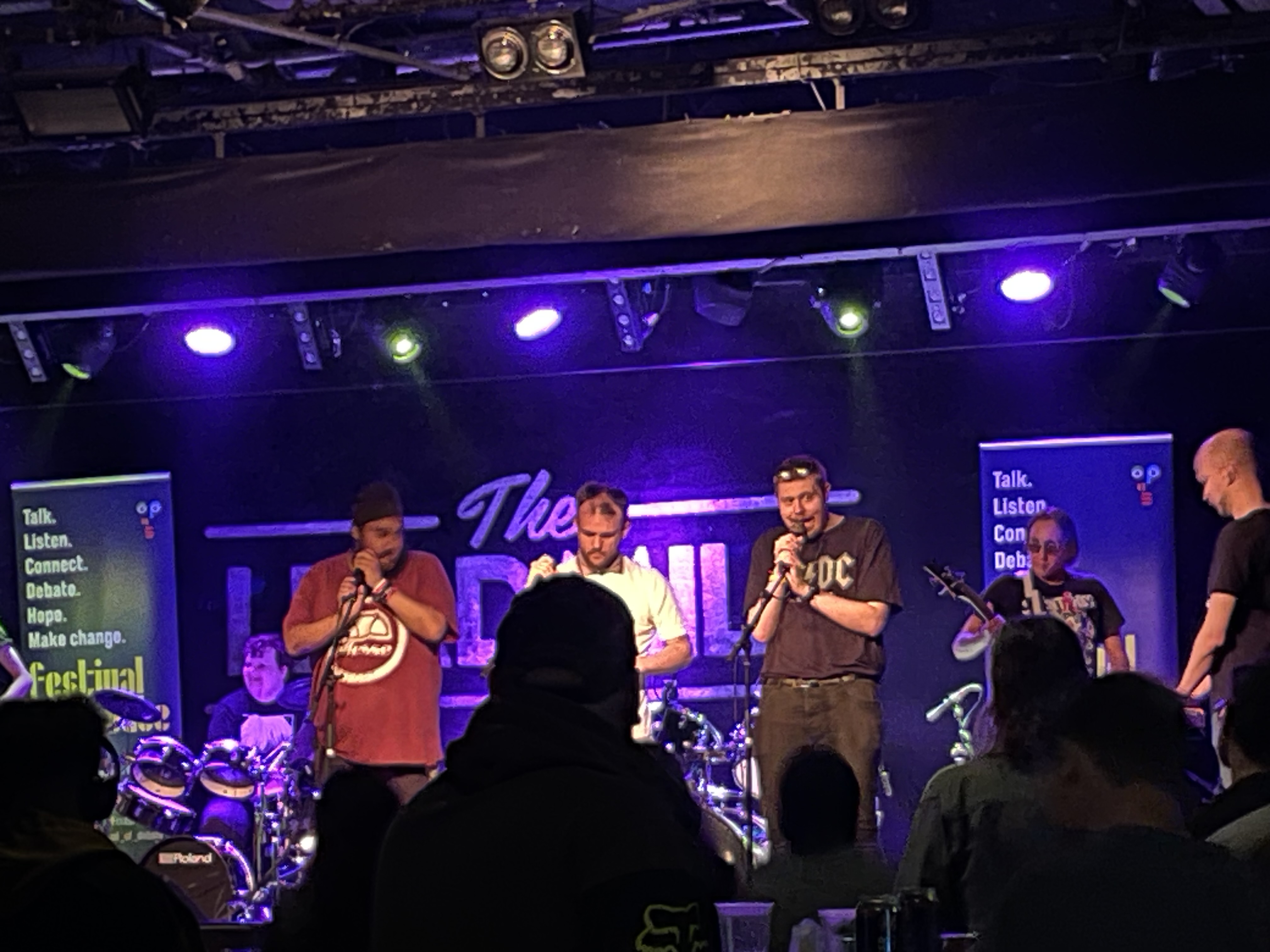
All the People Festival of Debate. Sparkle Sistaz/Clubland Detectives – (Leadmill). Two Under the Stars groups performed at this event which was all about inclusion and hearing the voices that are so often ignored.
June:
Songhoy Blues (Sidney & Matilda). I’ve loved these guys ever since we saw them at Tramlines ten years or so ago. This was a very electric – and totally exhilarating – rendition of their latest album, Héritage, which uses a lot more traditional instrumentation. Support was from the very engaging Nfamady Kouyate on balafon.
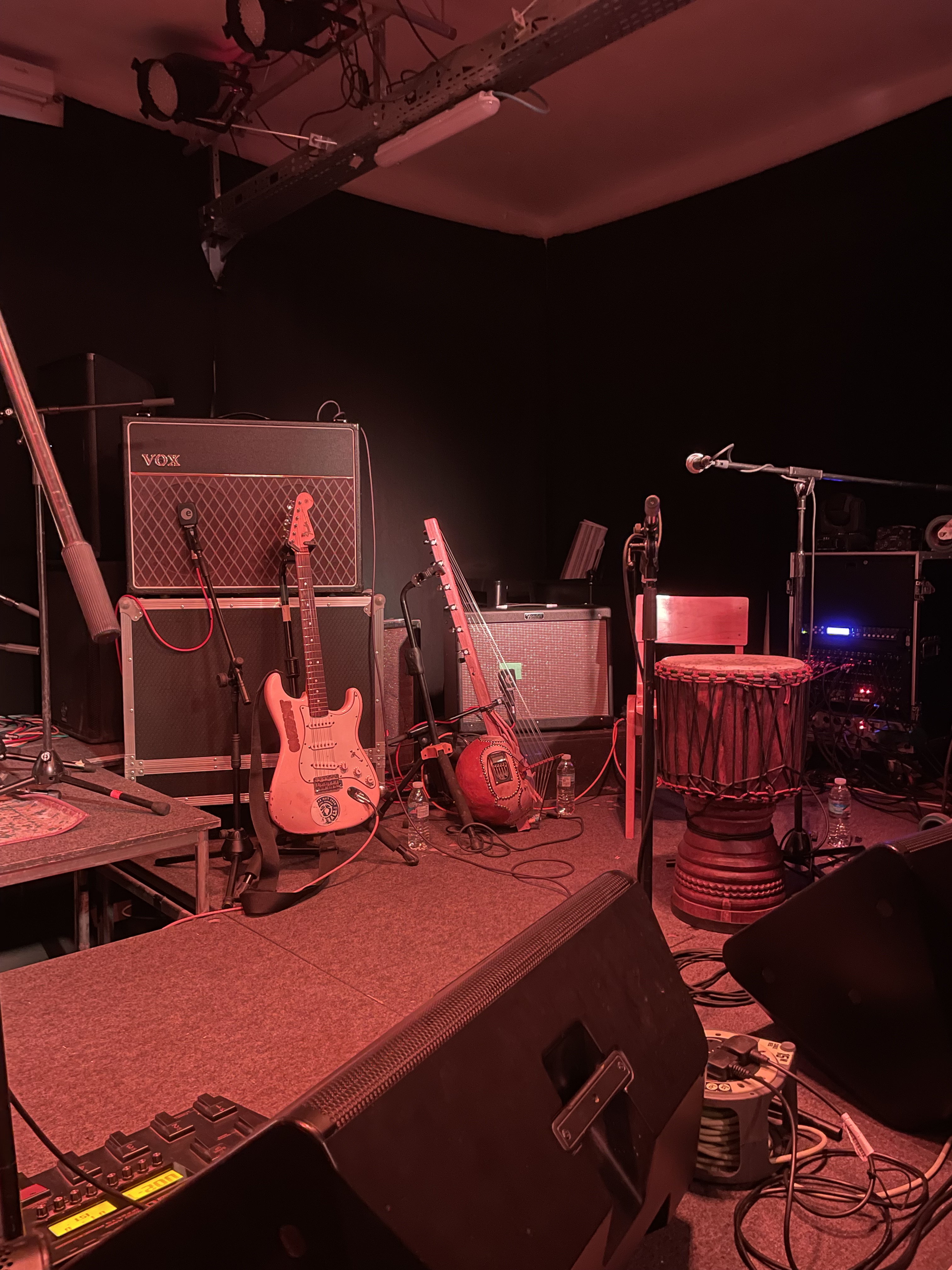
Dungworth Singers (Old Bandroom, Dungworth). Really interesting repertoire, everything from ‘Wayfaring Stranger’ to ‘A Nightingale Sang in Berkeley Square’ (my two favourites I think) and in between, lots of songs that I’d never heard or heard of, many from Yorkshire, but also from the the Sacred Harp tradition of choral sacred music in the US.


July:
Crosspool Festival: Dungworth Singers (Tapton Hill Congregational Church), Sheffield Folk Chorale (Benty Lane Methodist Church)
Sparkle Sistaz – Sistarz (Crucible Playhouse). A brief, tantalising preview of a musical they’re working on at present, which we hope to see in full next year.
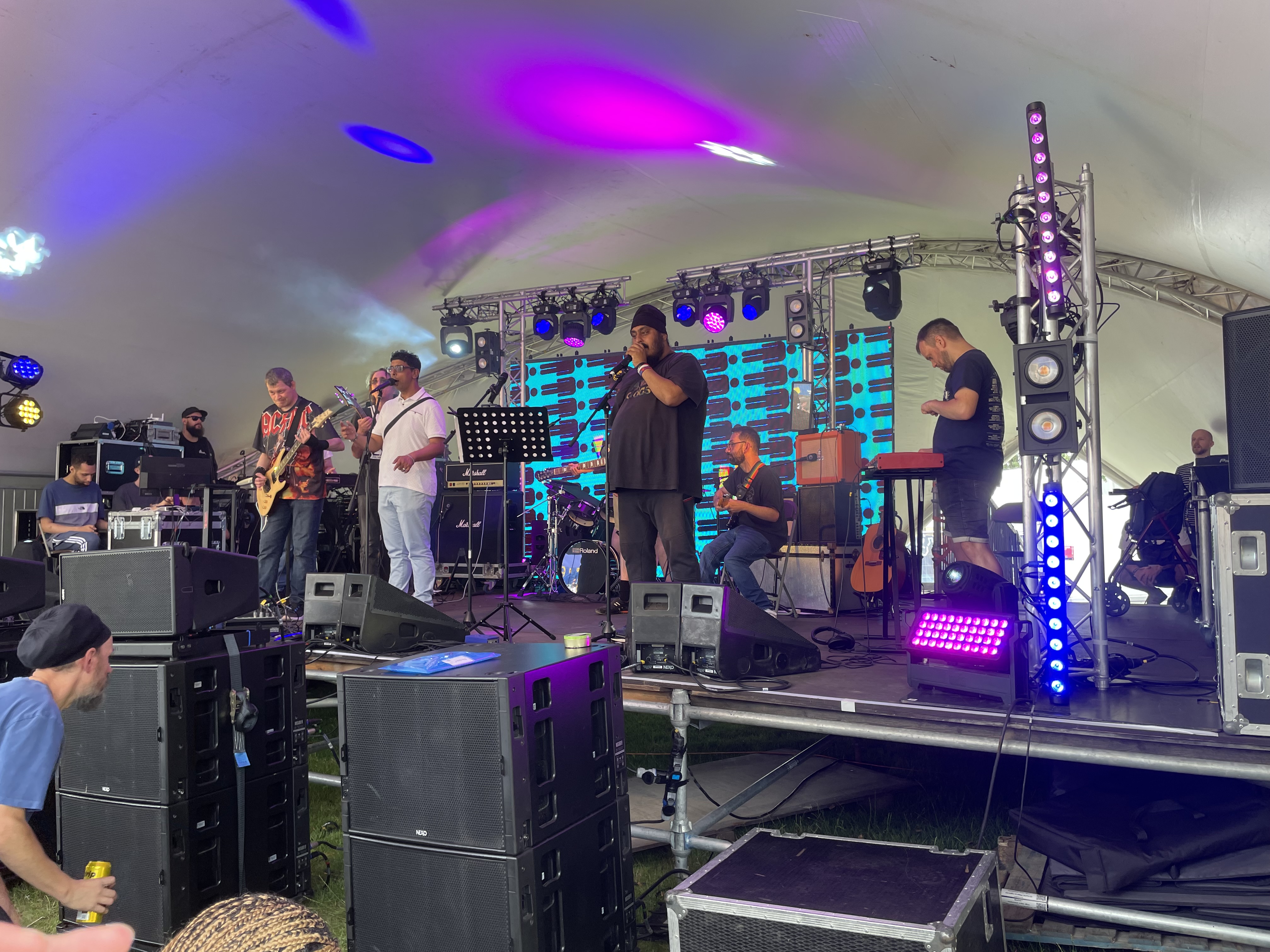
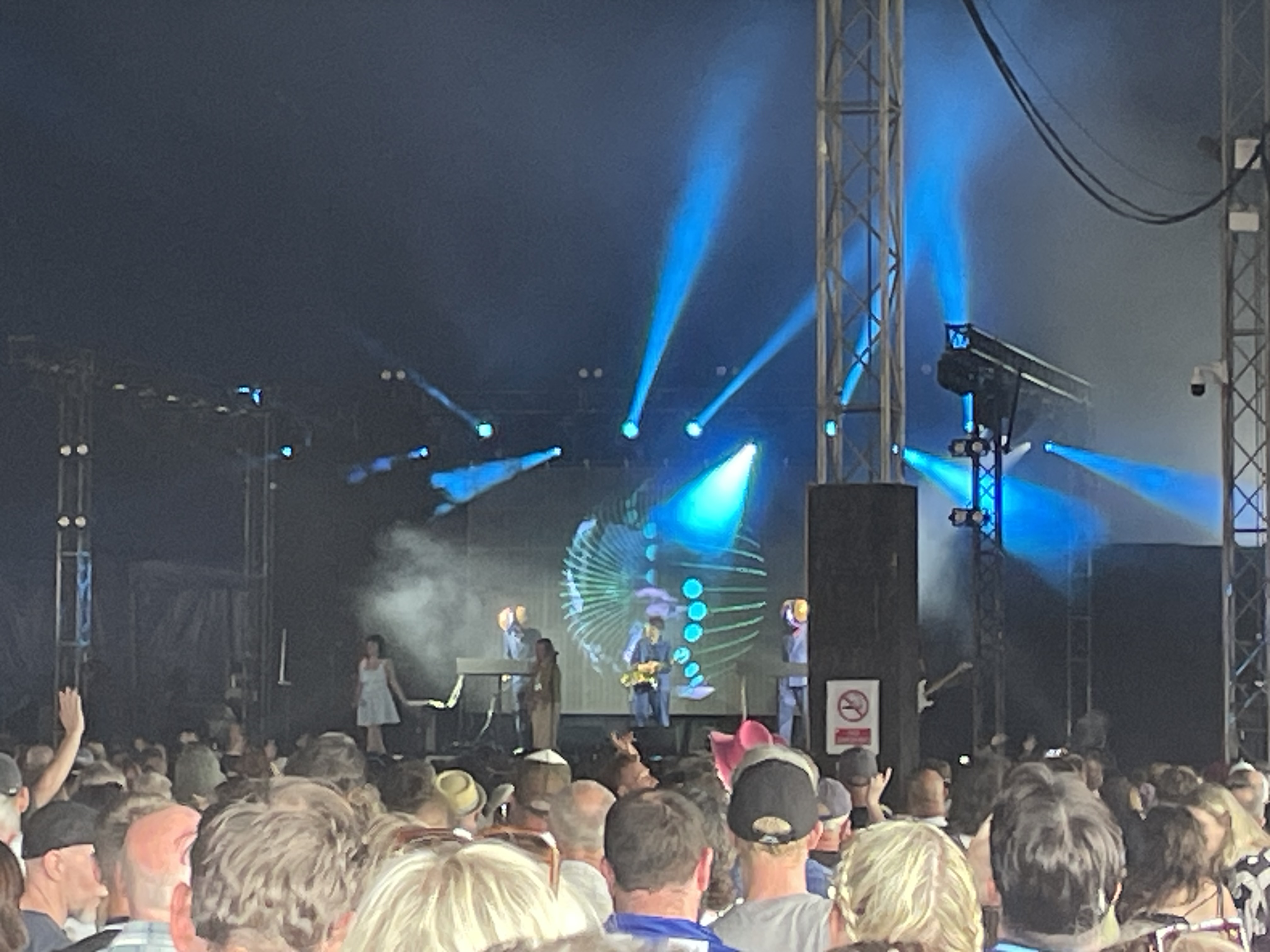
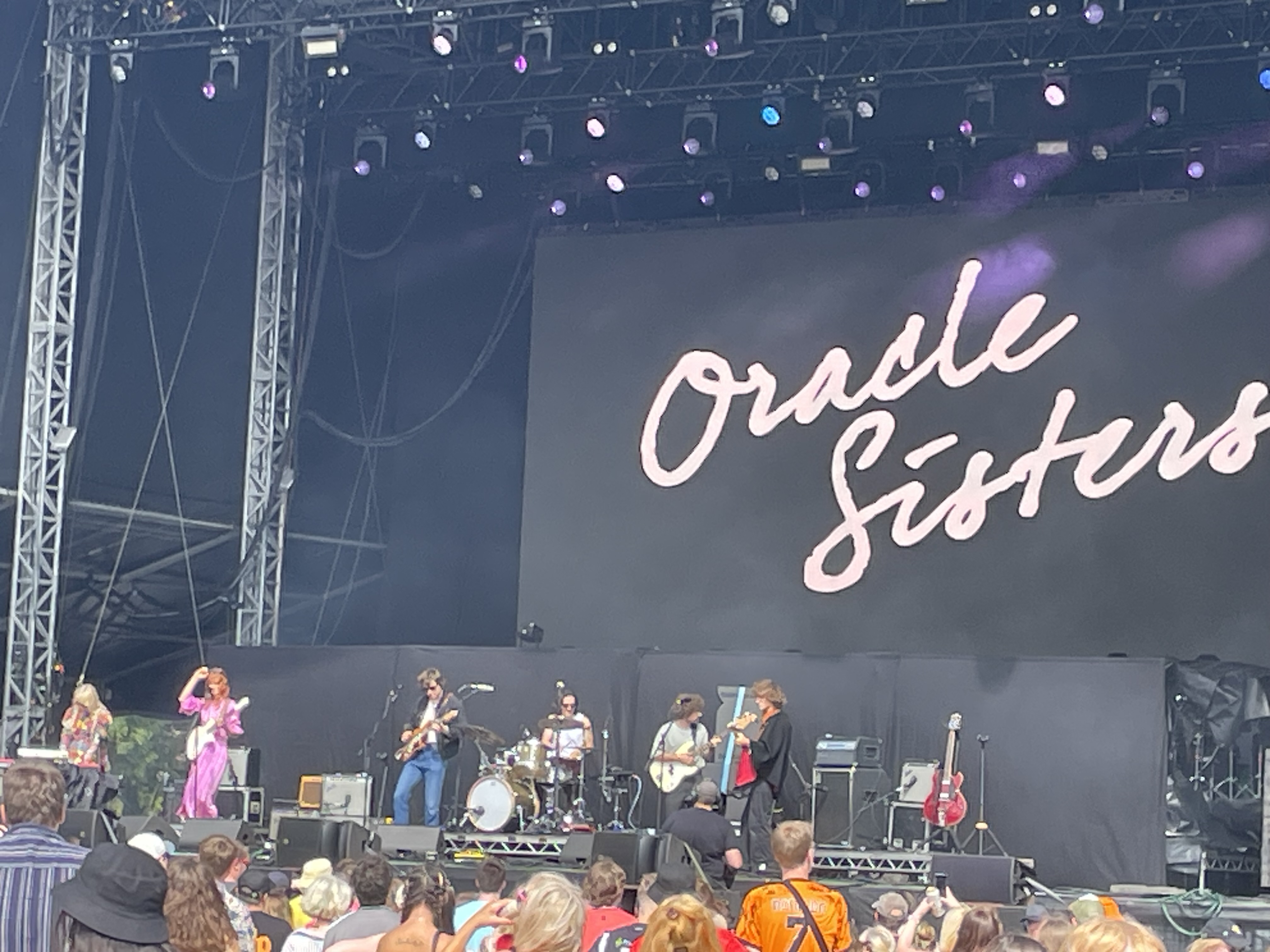
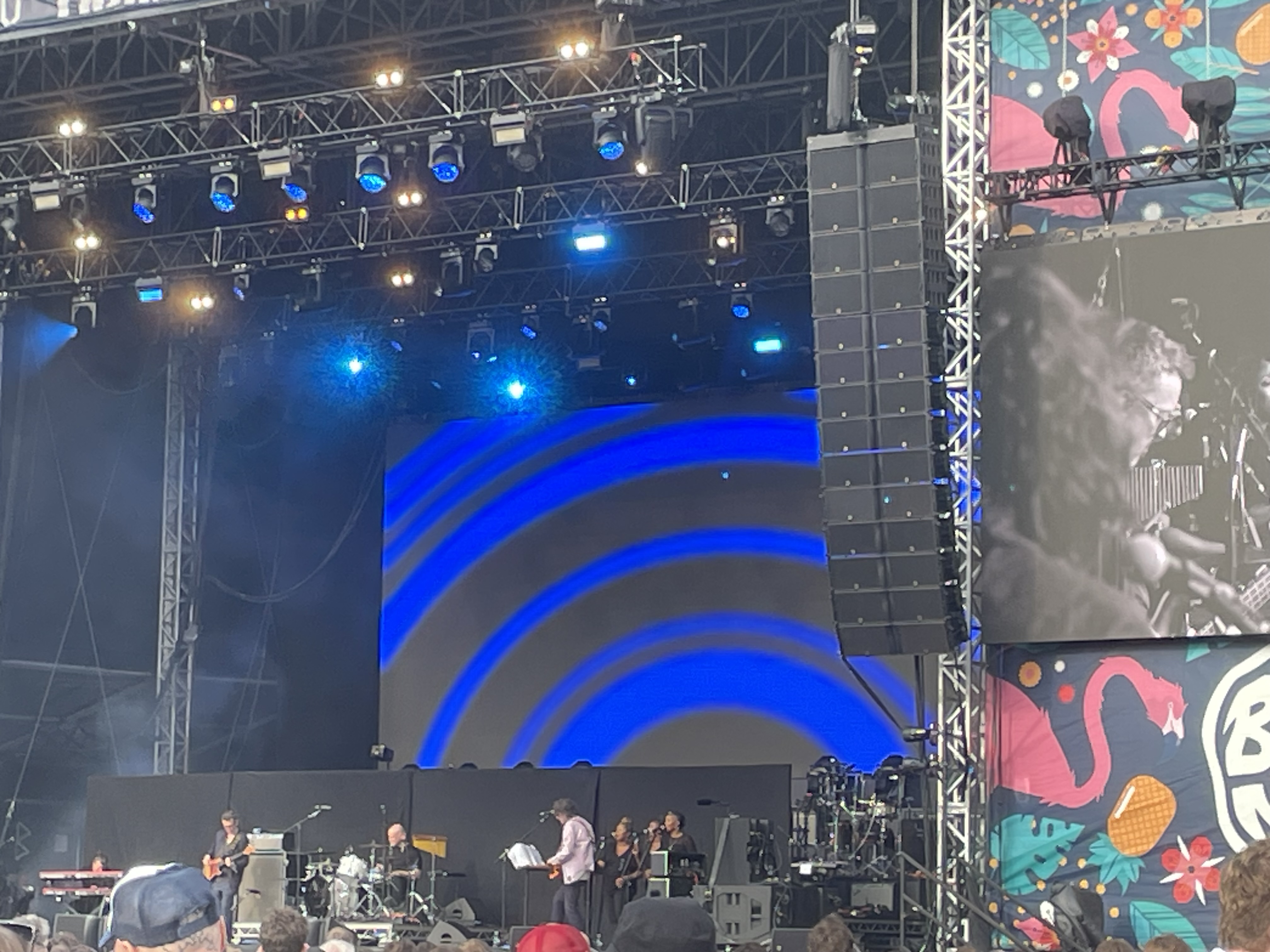
Tramlines (Hillsborough Park): We saw/heard: Natasha Bedingfield, Cliffords, Cloud Canyons, Franz Ferdinand, John Grant, I Monster, Mackenzie, Oracle Sisters, Pulp, Pia Rose, The Second World War, Sherlocks, Heather Small, Spiritualised, Stars Band. Truth be told, being of short stature I did not literally see all of the bands listed above – where they performed on the Main Stage I did at least see the screens either side of the stage – but I heard them, and occasionally managed to manoeuvre myself into a gap that allowed me to glimpse the band for a while. Pulp were the highlight, no question, playing all the tracks you’d expect, and a lot of their fab new album. But I also rated John Grant, I Monster, and Cliffords very highly, and Heather Small’s set was just (as someone behind me in the audience said), made of sunshine. I increasingly have to pace myself very carefully to ensure that I haven’t exhausted my capacity for standing before the bands I most passionately want to see. So I’d been looking forward to Spiritualised, but missed some of their set in order to have a sit down before Pulp. Each year I go I ask myself, is this the last time, but it’s still worth it, even if I don’t clock up quite as many different bands as I used to. I’ve already bought the tickets for next time in any case…


September:
Matthew Bourne – The Midnight Bell (Lyceum Theatre). My first time with Matthew Bourne’s modern ballet, and it will not be my last. The music here is not taken from the ballet repertoire – the soundtrack, by Terry Davies, is modern, quite minimalist, interspersed with songs from the ‘30s (the setting for the piece) to which the performers mime (very Pennies from Heaven). Davies’ music is in contrast to the archive songs, conveying the inner life of the characters, as against the romantic lyrics of the songs.
October:
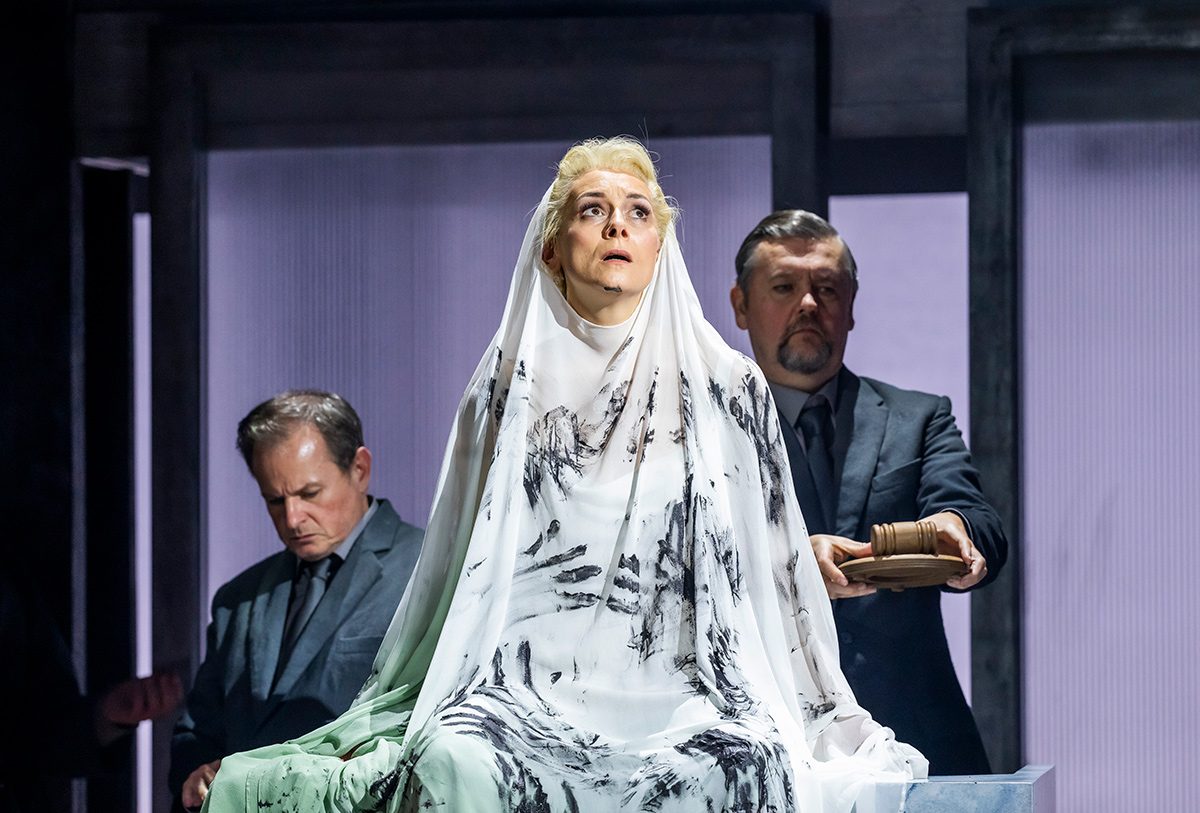
George Frideric Handel – Susanna, Opera North (Leeds Grand Theatre). Only my second Handel opera (I saw Giulio Cesare with M back before the pandemic). The production is excellent, very powerful, and the singers weave around and are woven around by dancers from the Phoenix Dance Theatre, whose modern dance moves provide telling contrast to the mellifluously formal Handel score.
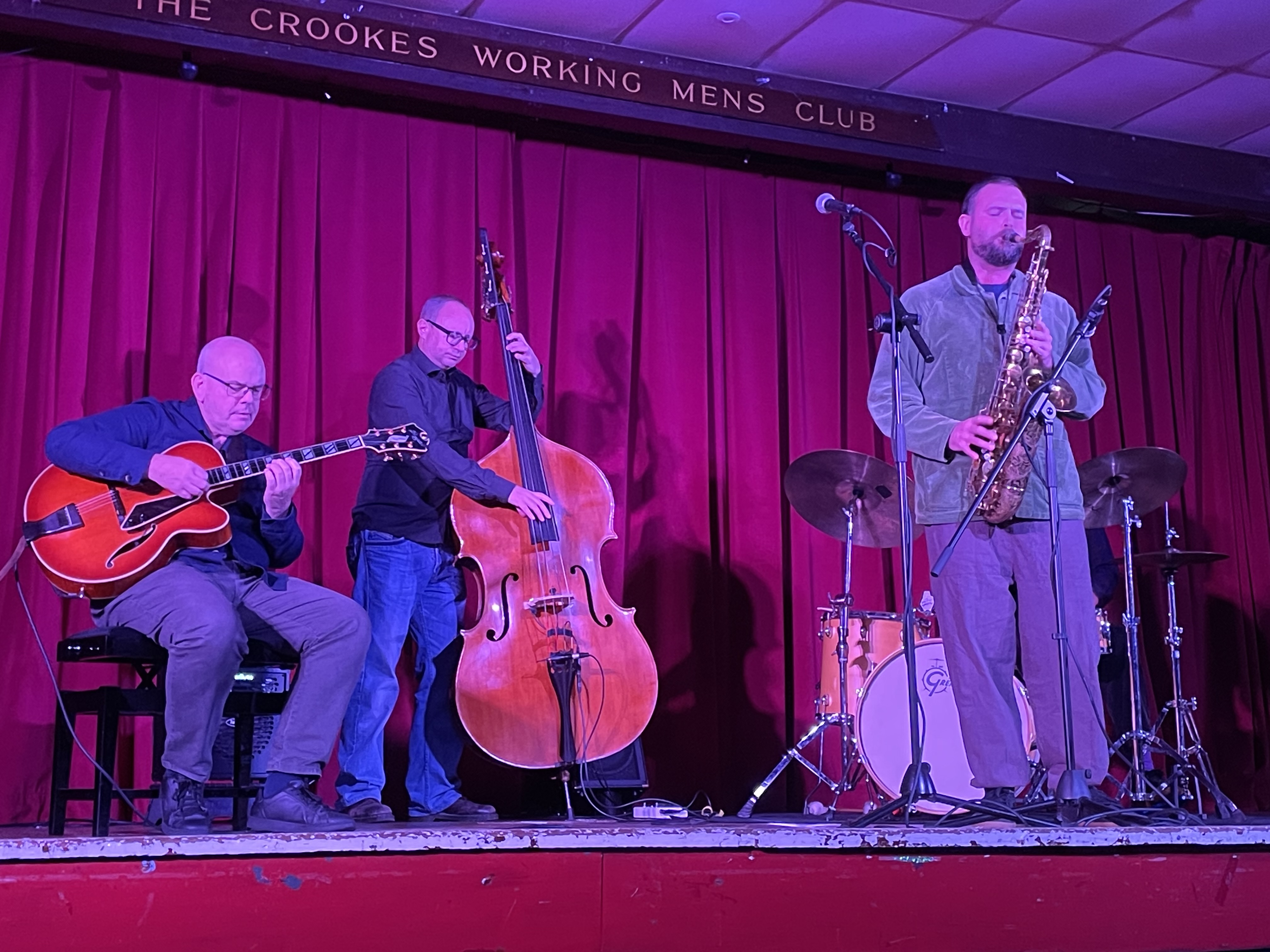
James Allsopp Quartet, Sheffield Jazz (Crookes Social Club) – tribute to Stan Getz, ranging across his oeuvre, a lovely, warm sound and some gorgeous tunes.
The Pocket Ellington, Sheffield Jazz (Crucible Theatre). The first half was Alex Webb’s arrangement of Ellington big band compositions for four horns and a rhythm section (Alan Barnes baritone & alto sax, clarinet; Robert Fowler tenor sax, Simon Finch trumpet, David Lalljee trombone, Alex Webb piano/MD, Dave Green bass, and Alfonso Vitale drums.) Absolutely fab. See here for Richard Williams’ review of the project and of a performance, with a slightly different line-up, at Soho’s Pizza Express.
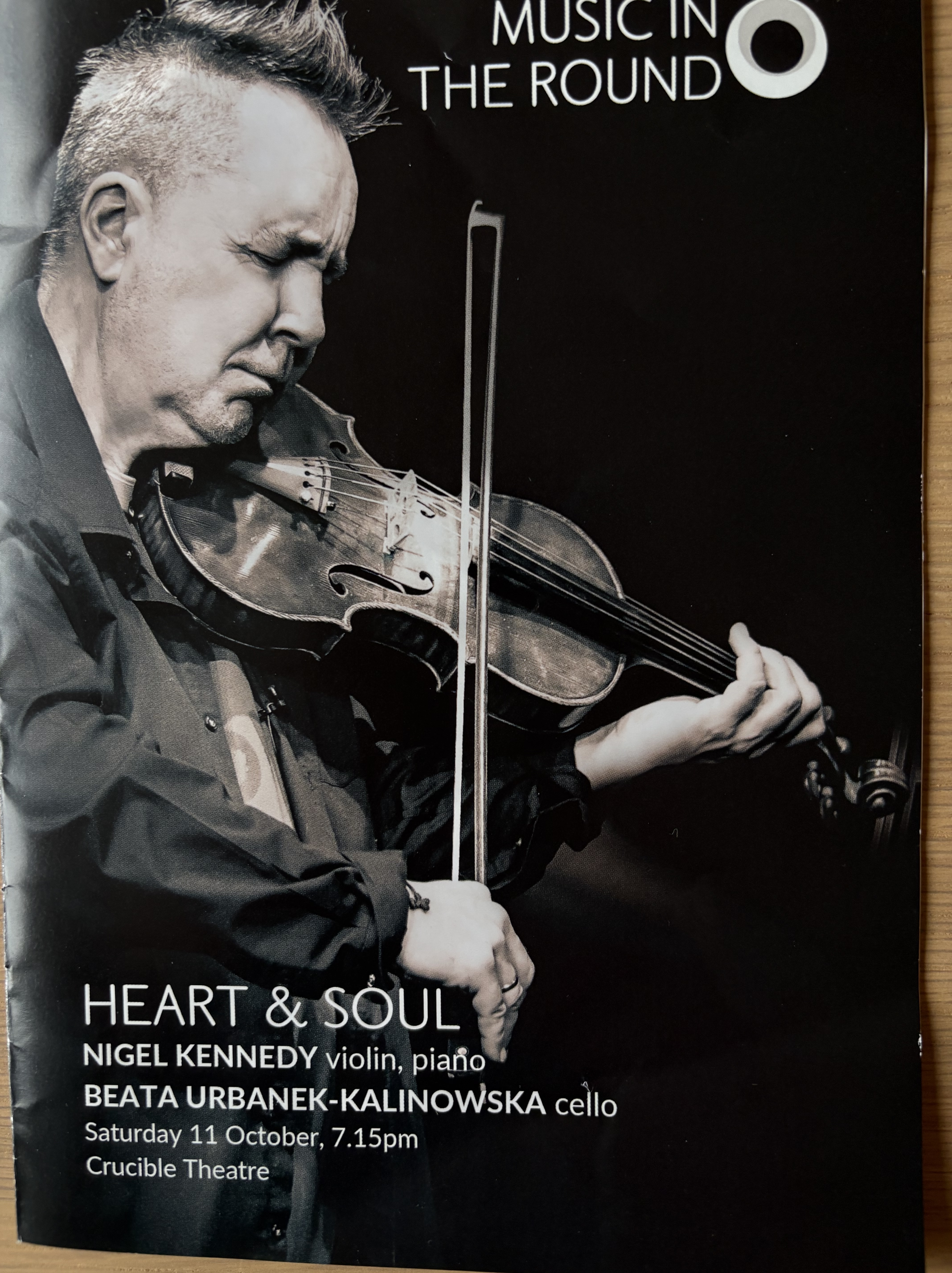
Nigel Kennedy: Heart & Soul, with Beata Urbanek-Kalinowksa (cello) – Kennedy, Komeda, Yellow Magic Orchestra Sakamoto, Bach (Crucible Theatre). Nigel is as always irrepressible and impossible to tie down, even to a set list. He borrowed a programme from someone on the front row and said ‘Oh no, it’ll be nothing like that’. In fact it was quite a bit like that, but some of the tracks on the programme never materialised, and others took their place, and there was another violinist on a couple of tracks whose name I never quite caught, a young woman who is clearly massively talented and who I’m sure we will hear of again.
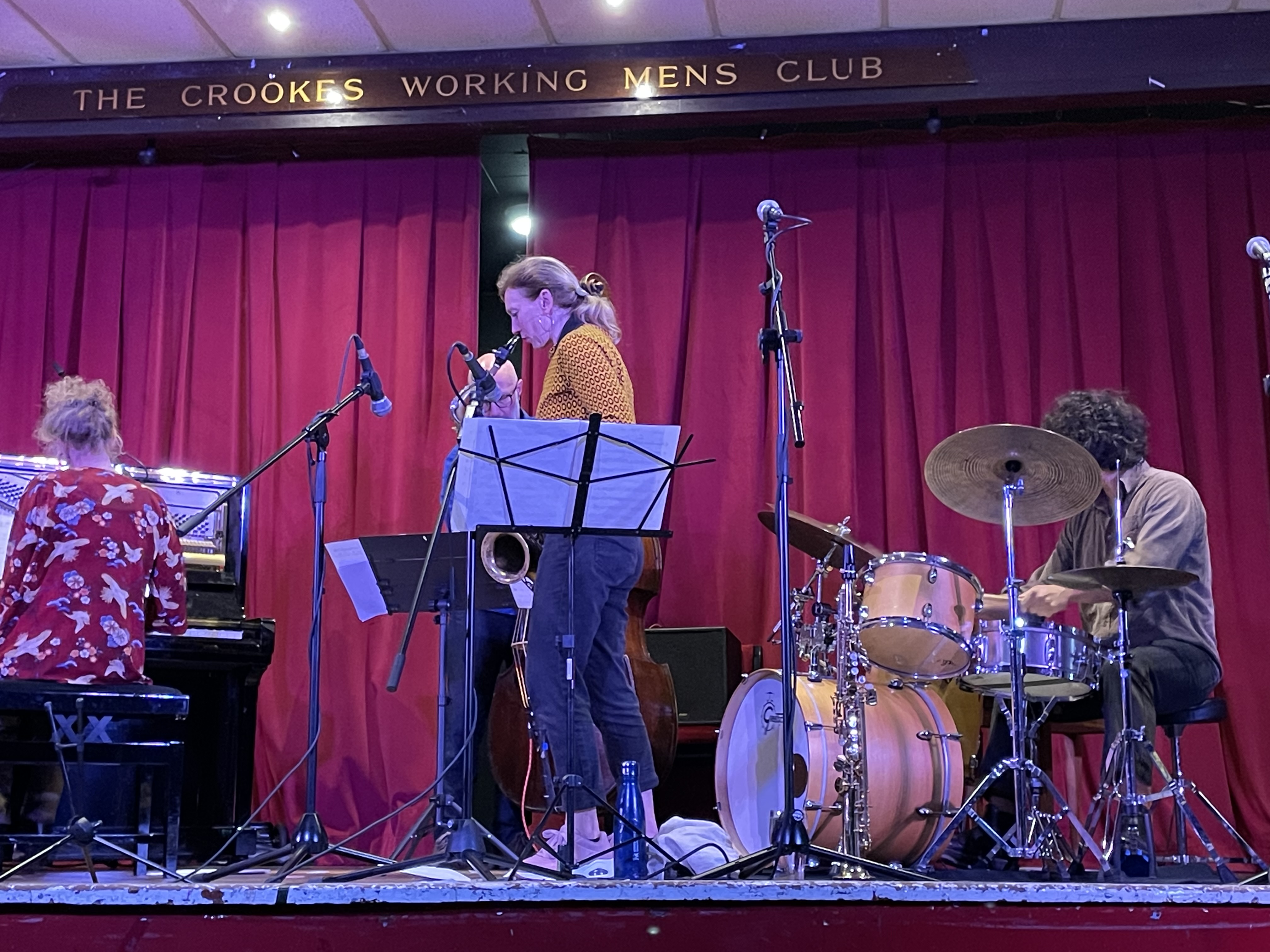
Josephine Davies’ Satori, Sheffield Jazz (Crookes Social Club). Davies on sax, and Alcyona Mick on piano. The material in the first half was from her latest album, Weatherwards, inspired by the landscapes of the Shetlands where she was born, and the sound is quite different from her earlier material which was, I suppose, more immediately accessible. But the new material is definitely worth another listen.
Giacomo Puccini – La Bohème, Opera North (Leeds Grand Theatre). This is the same production that I’d seen twice before but with different casts each time. I felt Rodolfo had been a tad under-powered the second time I’d seen it, but no such problems here, and I found myself more moved by the ending than I’ve ever been before. Of course, that may be because since I last saw it, I’ve lost my brother, my husband, my dad…
The Unthanks, Elmet (Bradford, The Loading Bay). The wonderful Unthanks were performing live as part of this drama premiere for Bradford 2025, a dark and brooding play by Bradford writer/director Javaad Alipoor, about ‘family, revenge and the ultimate price of freedom’.
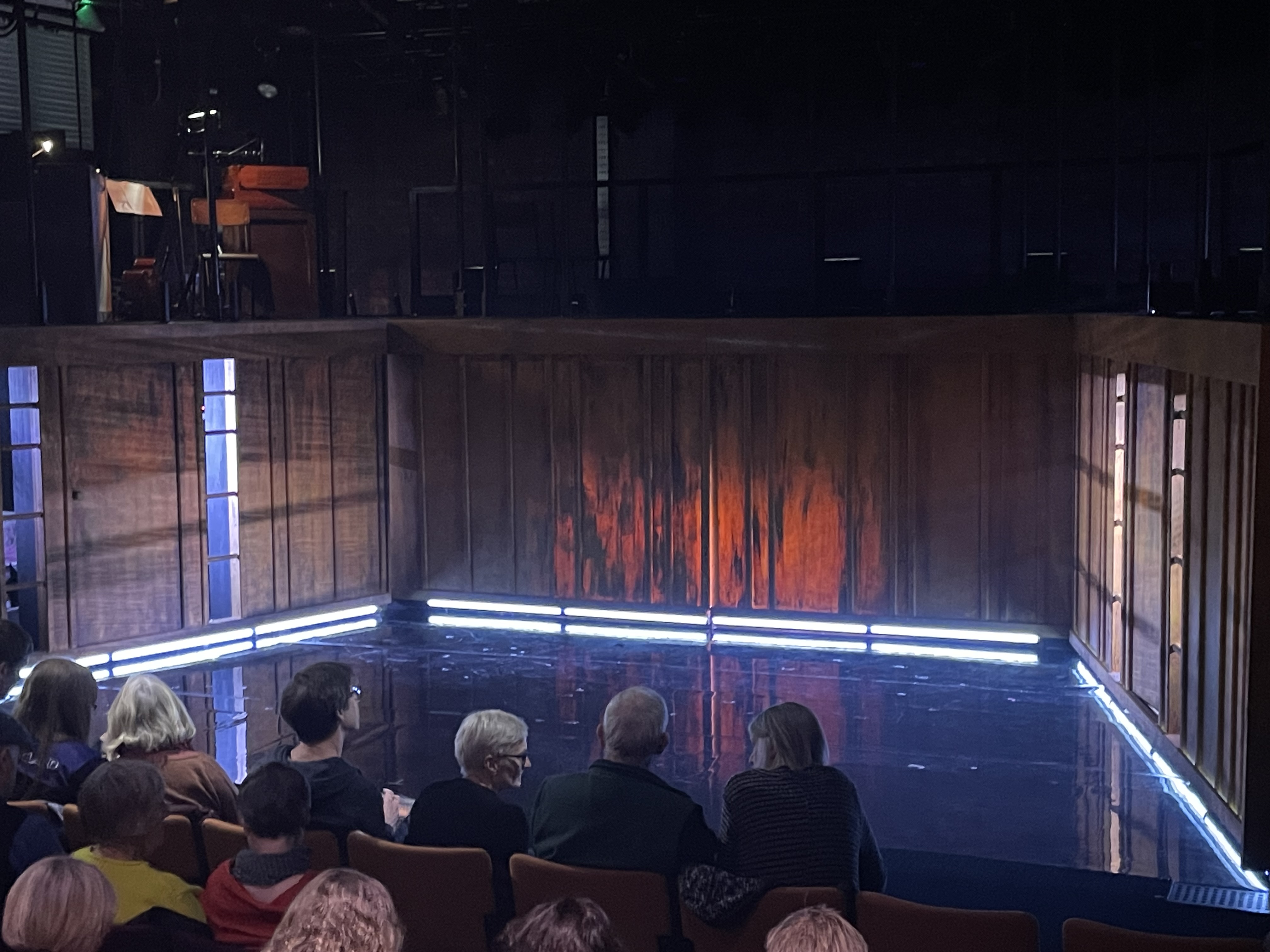
Bach & the American Minimalists – Shani Diluka: J S Bach, C P E Bach, Philip Glass, Keith Jarrett, John Cage, Bill Evans, Moondog, Meredith Monk (Crucible Playhouse). This was a brilliant concept, beautifully performed and presented by Diluka on piano. The programme interspersed pieces by Bach(s) with pieces by various minimalist composers, following on from one another so that we heard and felt the resonances between them.

November:
Quartet for the End of Time – Ensemble 360: Gideon Klein – String Trio, Leo Smit – Trio for Clarinet, Viola & Piano, Messiaen – Quartet for the End of Time (Crucible Playhouse). I can’t hear the Messiaen too often – it never feels familiar, and never fails to compel absolute attention. The story of the first performance is unforgettable too – a freezing January night in a POW camp in 1941, with the score scribbled on scrap paper scrounged from a friendly guard, and with instruments that were poor to begin with and hadn’t been looked after. And yet, and yet, the extraordinary music was extraordinary even in those circumstances. The Klein and Smit pieces are both small victories over Nazi brutality – their composers were murdered, and so we were deprived of all the music they would have written (Klein, especially, who was only 25 when they killed him), but we have these pieces, which weren’t meant to survive. But here they are.
Julian Jones (Cerrones). A nice deal: lunch at Cerrones (Italian restaurant), followed by a gig from Julian, playing guitar and keyboards, performing almost exclusively his own compositions apart from two covers (James Taylor and Neil Young).
Ravel & Glass: Cinematic Quartets – Piatti Quartet: Bernard Hermann – Suite from Psycho, Jonny Greenwood – The Prospector’s Quartet, Philip Glass – String Quartet no. 3 ‘Mishima’, Maurice Ravel, Quartet in F Major (Crucible Playhouse). A fascinating selection of pieces. Hermann’s Psycho Suite is stunning, absolutely riveting, and I was convinced when I heard the Ravel that he might have been influenced by it – can’t prove it, obviously, but I relistened to both at home a few days later, and felt the same, so that’s my theory that is mine.
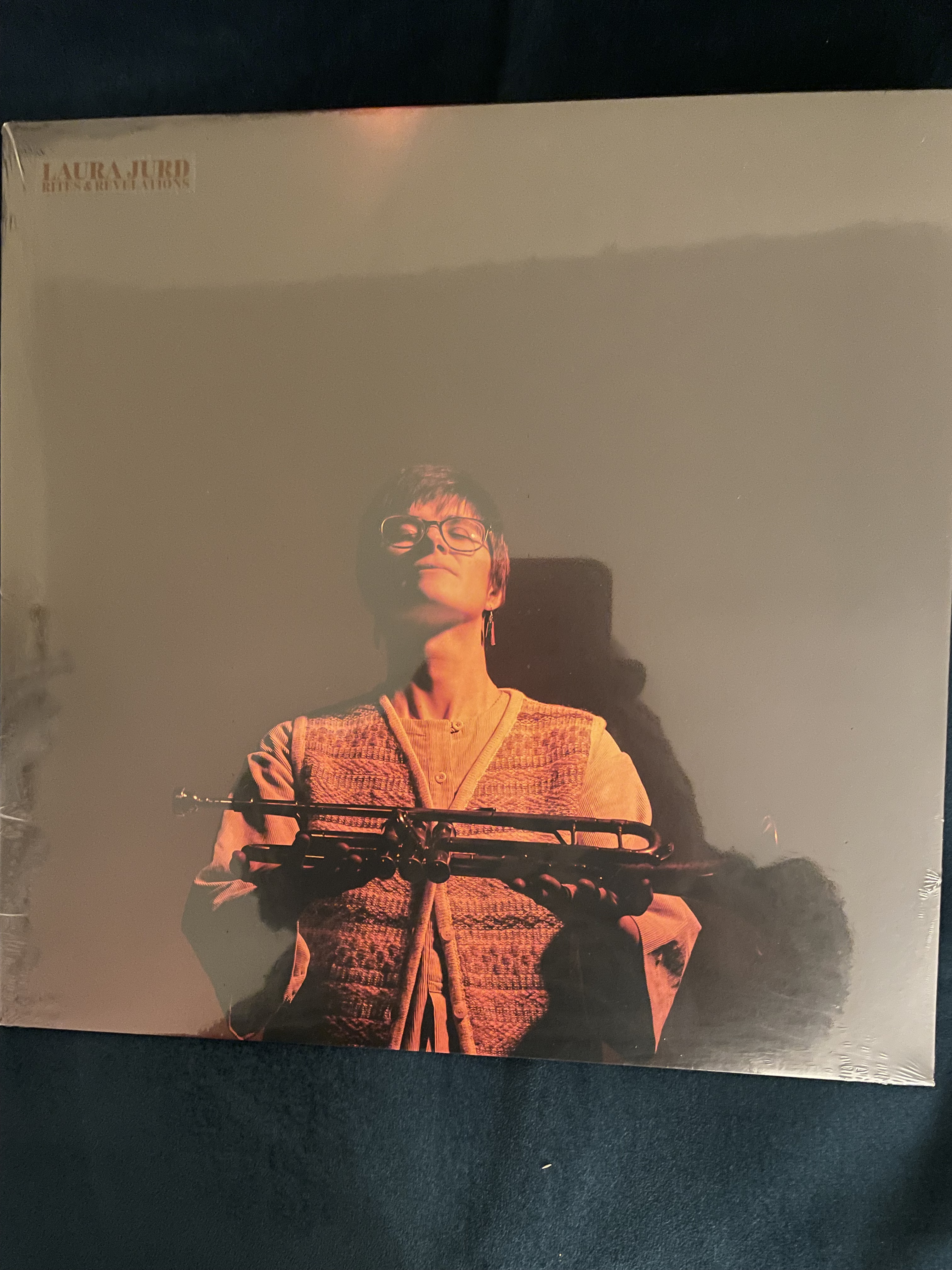
Laura Jurd Quintet, Sheffield Jazz (Crookes Social Club). The gig of the year from Sheffield Jazz, and one of the top few overall. An intriguing line-up – Laura on trumpet, obviously, and Corrie Dick on percussion, plus Ultan O’Brien on viola, Martin Green on accordion and Ruth Goller on electric bass. O’Brien and Green gave the music a folky feel, with a strong klezmer element at times, and I felt very strong Third Ear Band vibes. The Quintet were performing material from the latest album, Rites & Revelations, which I bought on vinyl after the gig, as I was so blown away by the music.
Gong (Crookes Social Club) – Gong are still here, undiminished in spirit if not in terms of the personnel who made those early albums. A lot of this is down to Kavus Torabi, who Daevid Allen specifically proposed as his successor to lead the band, and who makes a charming and charismatic front man, and a fine musician. (I already knew of Torabi through the delightful book he co-wrote with Steve Davies (yes, the snooker player), Medical Grade Music.) Long live Gong.
Death & the Maiden – Dudok Quartet: Saariaho – Terra Memoria, Gesualdo – Moro, lasso al mio diolo, Mussorgsky – Songs & Dances of Death, Liszt – Via Crucis, Schubert – Death & the Maiden (Upper Chapel). The Gesualdo, Mussorgsky and Liszt pieces were arranged for string quartet by the Dudoks. An uplifting evening of music about mortality. One of the musicians said at the start, that when we write or talk about death, we’re always really talking about life, and that makes sense to me. Certainly these pieces were poignant, moving, but never just heavy or dark – there was light, always light.
December:
Viennese Masterworks – Tim Horton: Haydn – Piano Sonata in E flat, Brahms – Four Ballades, Schoenberg – Suite Op. 25, Beethoven – Piano Sonata in D (Crucible Playhouse). This concert is part of a series that explores the connections between the First Viennese School (e.g. Haydn & Beethoven) and the Second (most notably Schoenberg, but also Berg & Webern). Here Brahms forms a kind of bridge between the two Schools. Schoenberg’s Suite is a Baroque suite, with a Brahmsian Intermezzo – clearly, as Tim pointed out in his pre-gig talk, the creation of twelve tone/serialism was not some scorched earth iconoclasm, but a development of this great musical history.
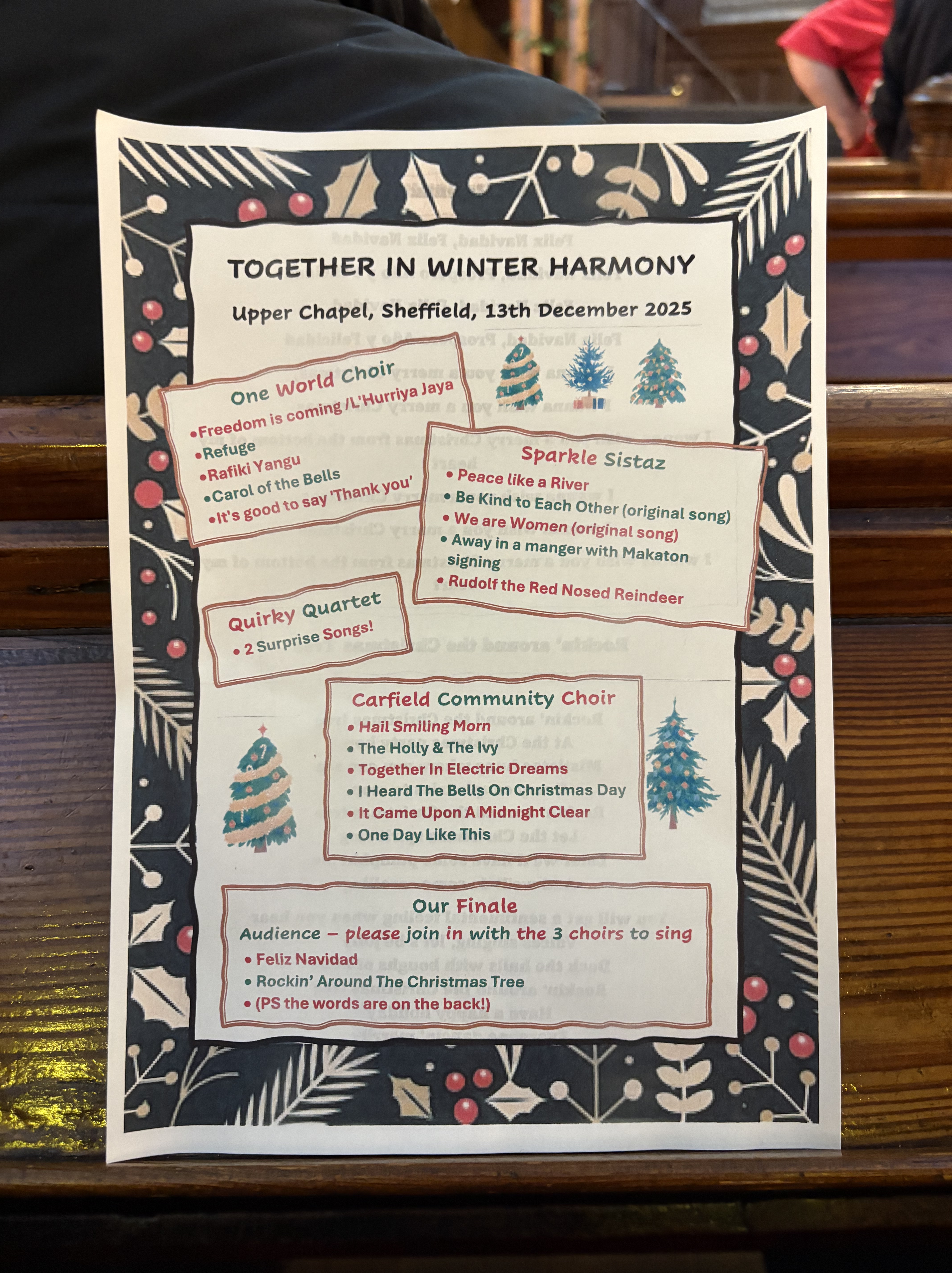
Together in Winter Harmony – Carfield Community Choir, One World Choir, Sparkle Sistaz (Upper Chapel)
Lovely festive choral concert. One World Choir brought us songs in various languages, Arabic, Ukrainian and a number of African languages, some explicitly Christmassy, others more tangential but uplifting. I was there primarily for the Sparkle Sistaz, who were magnificent, doing two of their own songs (I noted they didn’t do ‘the one about people who piss us off’ or ‘Bad Boyfriend’ which was probably for the best, as they’re feisty rather than festive) and some standards – notably a rambunctious version of Rudolf the Red Nosed Reindeer (a song all about difference, bullying and inclusion, is it not?), and performed with their usual sass and panache, and got a rapturous response.
Pass the Spoon – Opera North (Howard Assembly Room)
Absolutely bonkers comic sort-of-opera set on a TV cookery show, created by artist David Shrigley with music by David Fennessy (using lots of percussion, a nod to Bernard Herrmann’s Psycho score, and a quick burst of Für Elise, amongst other musical references). I wasn’t sure at first how much I was going to enjoy it, but it got darker and funnier and more and more bonkers as it went on – surreal, scatological and unhinged. Excellent fun.

Radio
I’m a Radio 3 sort of a chap. I know other radio stations are available, and always mean to put on Radio 6, but somehow haven’t got round to it. I know it’s an old person thing to grumble about schedule changes but I do still miss Saturday afternoons on R3, with Sound of Cinema, Music Planet, and Jess Gillam’s This Classical Life taking us nicely into the evening. Only the first of those is still on in the mid-afternoon slot and so despite best intentions (see above) I find I don’t catch up on Sounds with the other programmes very often. Similarly, the demise of J to Z has lessened my listening to jazz on R3, since its replacement is ‘Round Midnight which is on, as one might expect, around midnight, and thus way past my bedtime. I do have Jazz Record Requests on a Sunday afternoon and remain a loyal listener – there are always some tracks by artists I know and love, and some by artists I don’t know yet and would like to. And, each year since 2021, Alyn Shipton has played a request in memory of M (so far, Miles, Mingus, Holiday, Cobham, Peterson & Young for me, and John Marshall for M’s brother).
An innovation this year is my discovery of Radio 3 Unwind which, played through a pillow speaker, has been remarkably helpful in allowing me to get off to sleep and, particularly, to get back to sleep more easily if I wake during the night. M was always a bit scathing about the use of music to relax (he used to rant about Classic FM’s emphasis on this role for music), and he could not use music as background (thus on long drives he preferred R4, because he could more easily filter words out than music, whilst I’m the other way around). For me, the mix of ambient sounds, the shipping forecast and tranquil music allows me to filter out the endless whittling and catastrophising that my brain insists on, especially at 3 a.m. It works, anyway, and I’m most grateful for it.
Music Nights
As usual, what I choose to grab from the collection is either random, or prompted by something I hear or read. This year, I also had a batch of vinyl rescued from obscurity and mould in the cellar, amongst which were many things that we’d never replaced with CD and which I was hearing for the first time in more than 40 years.
Those departed artists who were honoured through inclusion in my music nights include Brian Wilson, Gilson Lavis (Squeeze), Jack DeJohnette, Terry Reid, Ozzie Osbourne, Rick Buckler (Jam), Cleo Laine, Danny Thompson, Garth Hudson (The Band), Mani (Stone Roses), Steve Cropper (Booker T & the MGs) and Dave Ball (Soft Cell). And I marked the 25th anniversary of the death of the marvellous Kirsty MacColl with an evening of her music.
I post about what I’m listening to on BlueSky these days (I still have a look on X but I don’t feel I want to engage there, other than with Radio 3 and particularly Jazz Record Requests, who are still using the Musk place) and sometimes on Instagram/Facebook too. This makes me feel less like I’m listening alone. It is rare that someone doesn’t like and/or comment on my music posts – thank you to all who do so. I’m sharing the music I’ve chosen and it’s lovely to find that someone somewhere is nodding or smiling at my choices, or suggesting other things I might like, or reminiscing about what that track or album means to them. The other reason I share it is that M taught me to listen mindfully (though he wouldn’t have used that word) – not just to passively let the music play but to be aware of it, focus on it, think about what it’s doing and how. I found it hard at first to do that without him, but I’m getting the hang of things now.
I’ve also got some pretty hefty Spotify playlists, most notably the 13+ hour selection we put together for M’s wake, which features at least a smattering of the music we listened to together over 47 years. I play that one on our wedding anniversary, on the anniversary of his death, on his birthday, or whenever, really, because the music is absolutely bloody marvellous. It’s not ‘wallowing in misery’ when, even if one track makes me cry, the next makes me smile or forces me to have a bit of an awkward dance around the living room. It’s honouring him and our life together, triggering so many memories, and reminding me of other music I want to hear again, including new music that I’ve discovered or acquired since he died. There’s another playlist for Christmas (as free as possible of the usual suspects), and one for New Year featuring a selection of tracks that have some connection to events in the year, the one I made for my Dad’s funeral that never got played at the reception because I was having a massive dizzy spell just when I should have been loading up Spotify, and the one I made for a reunion with people who were at college with M that didn’t work on the night…
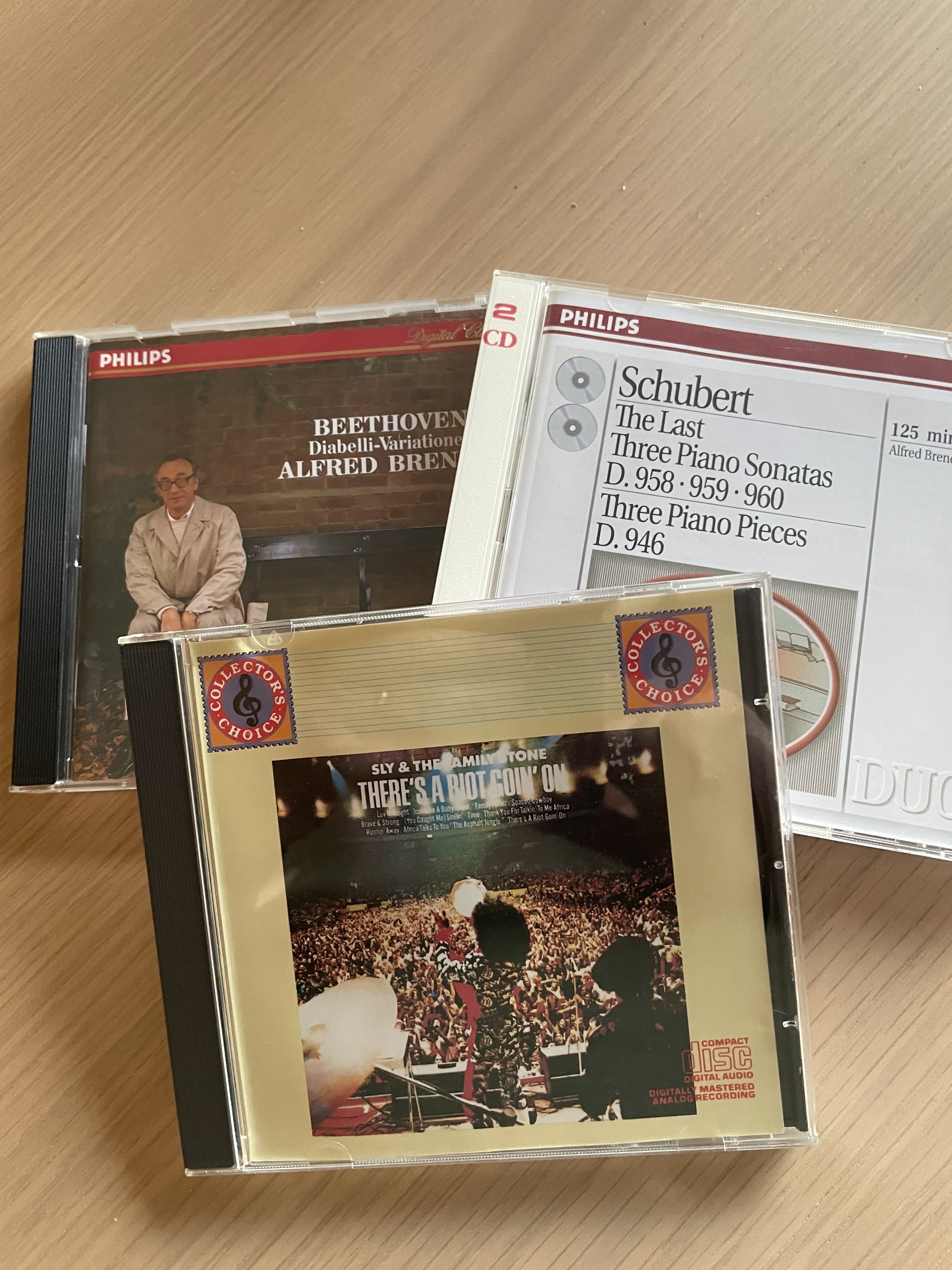
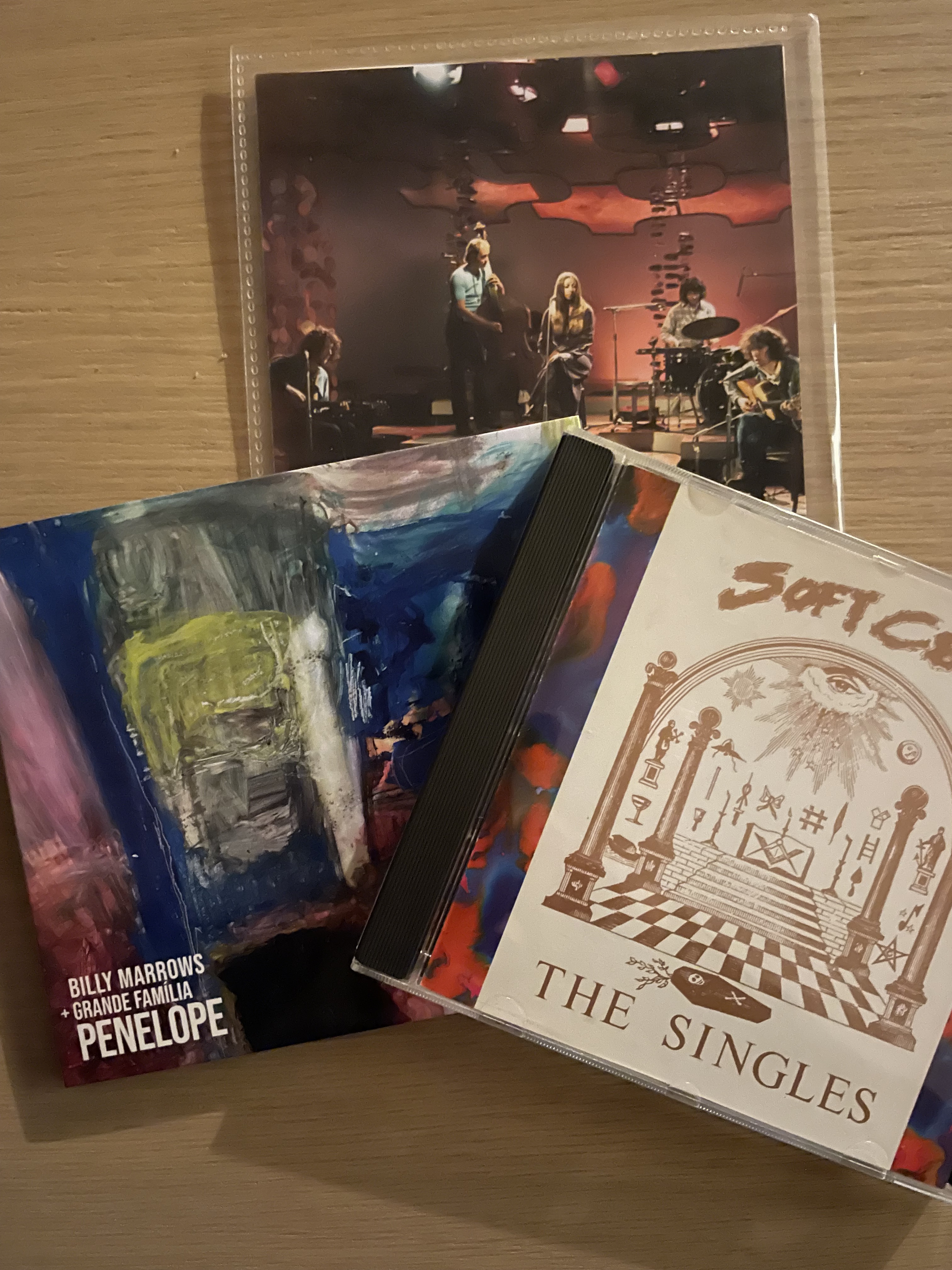
All of the artists below found their way on to my CD player or turntable, or I watched them live on TV, or listened on Spotify (but inclusion means that it was more than one or two random tracks).
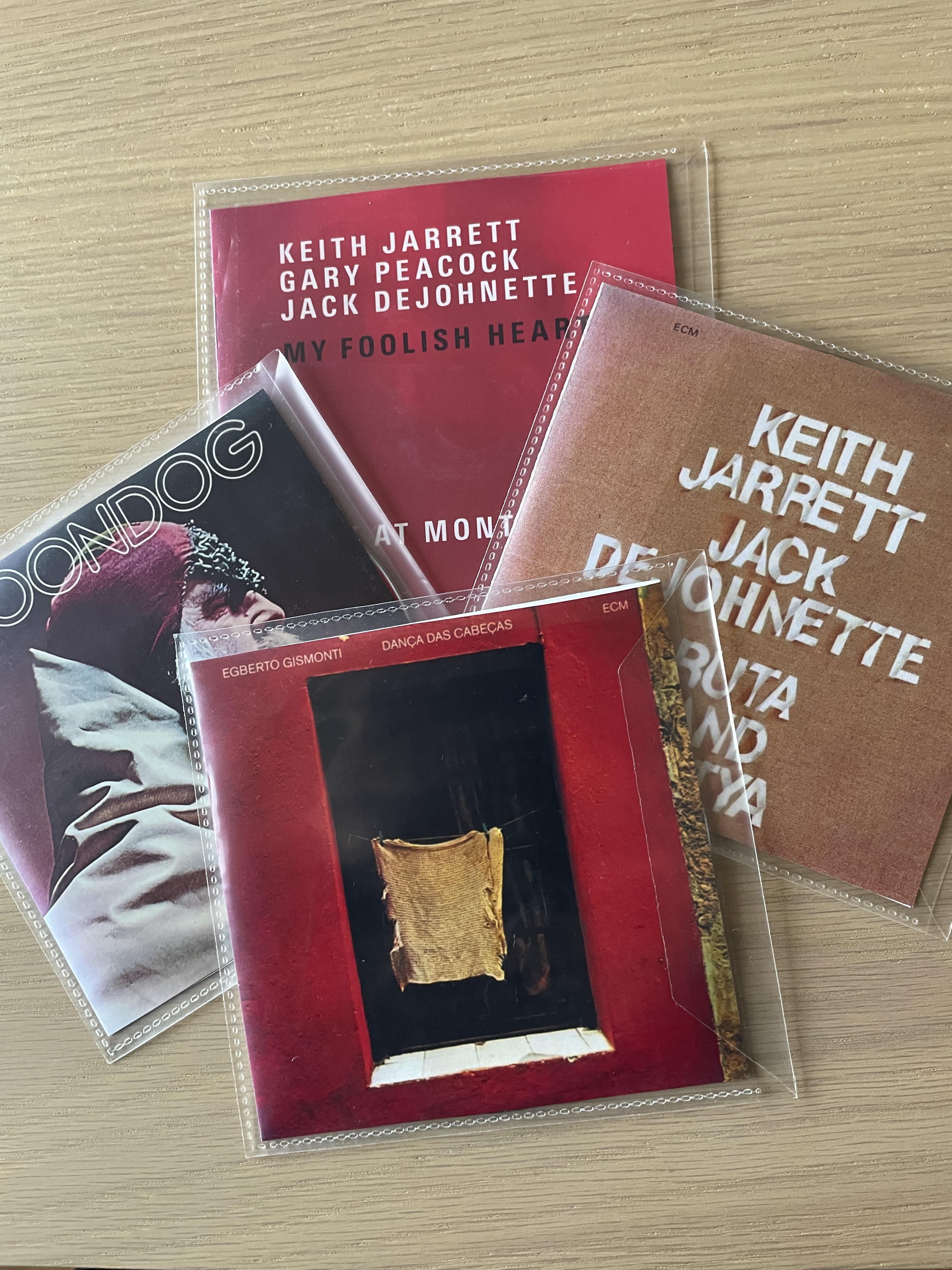
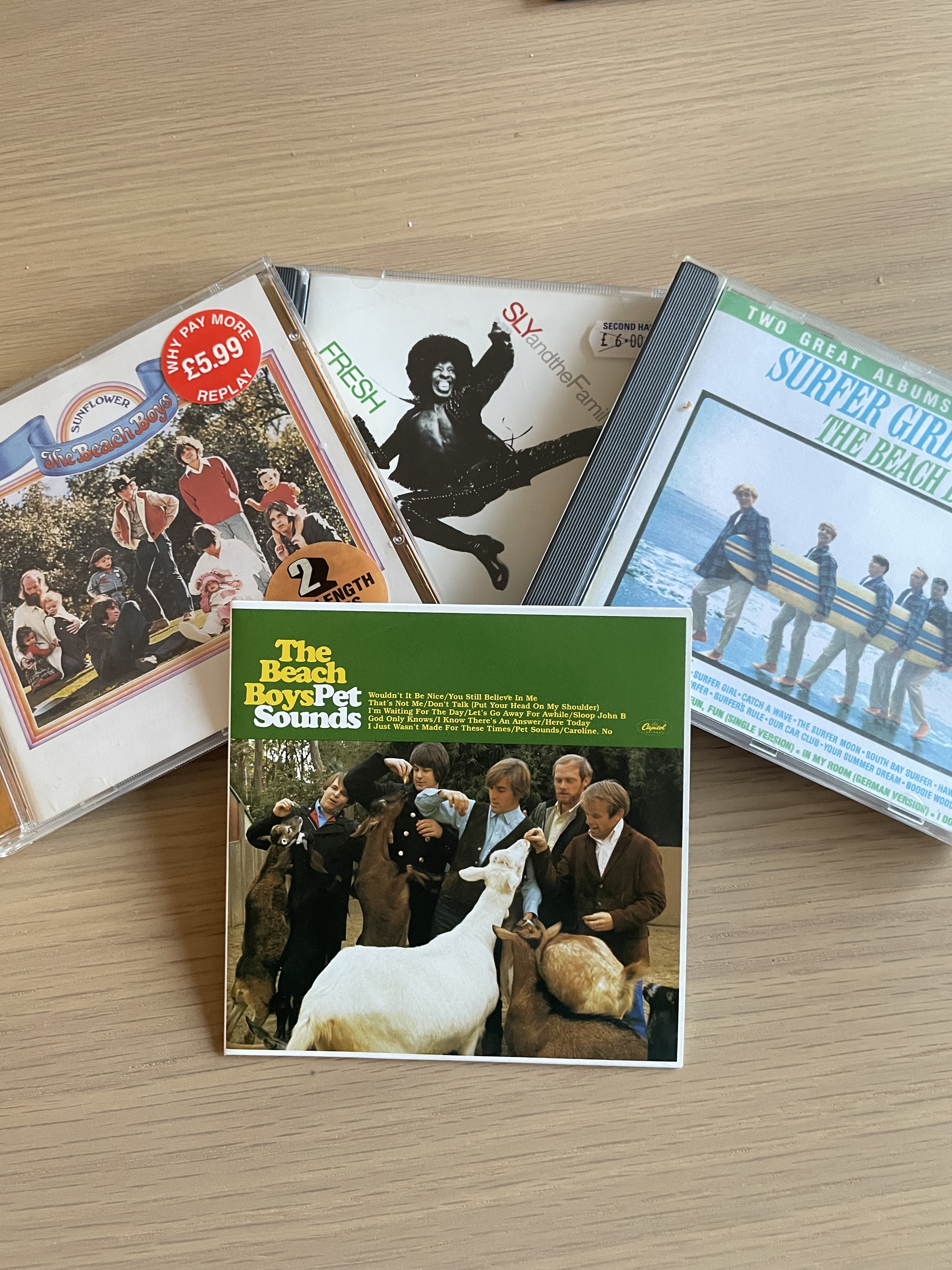
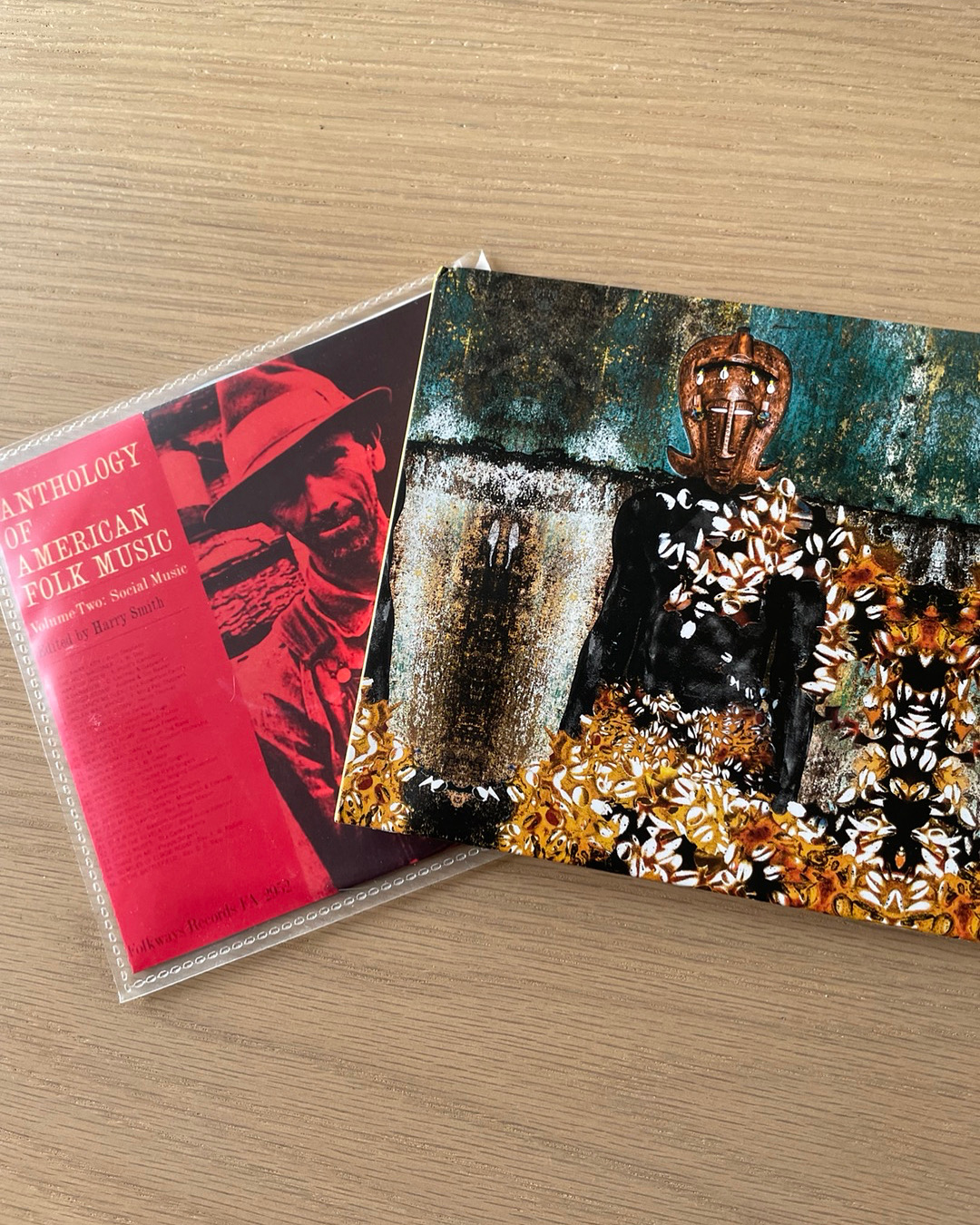
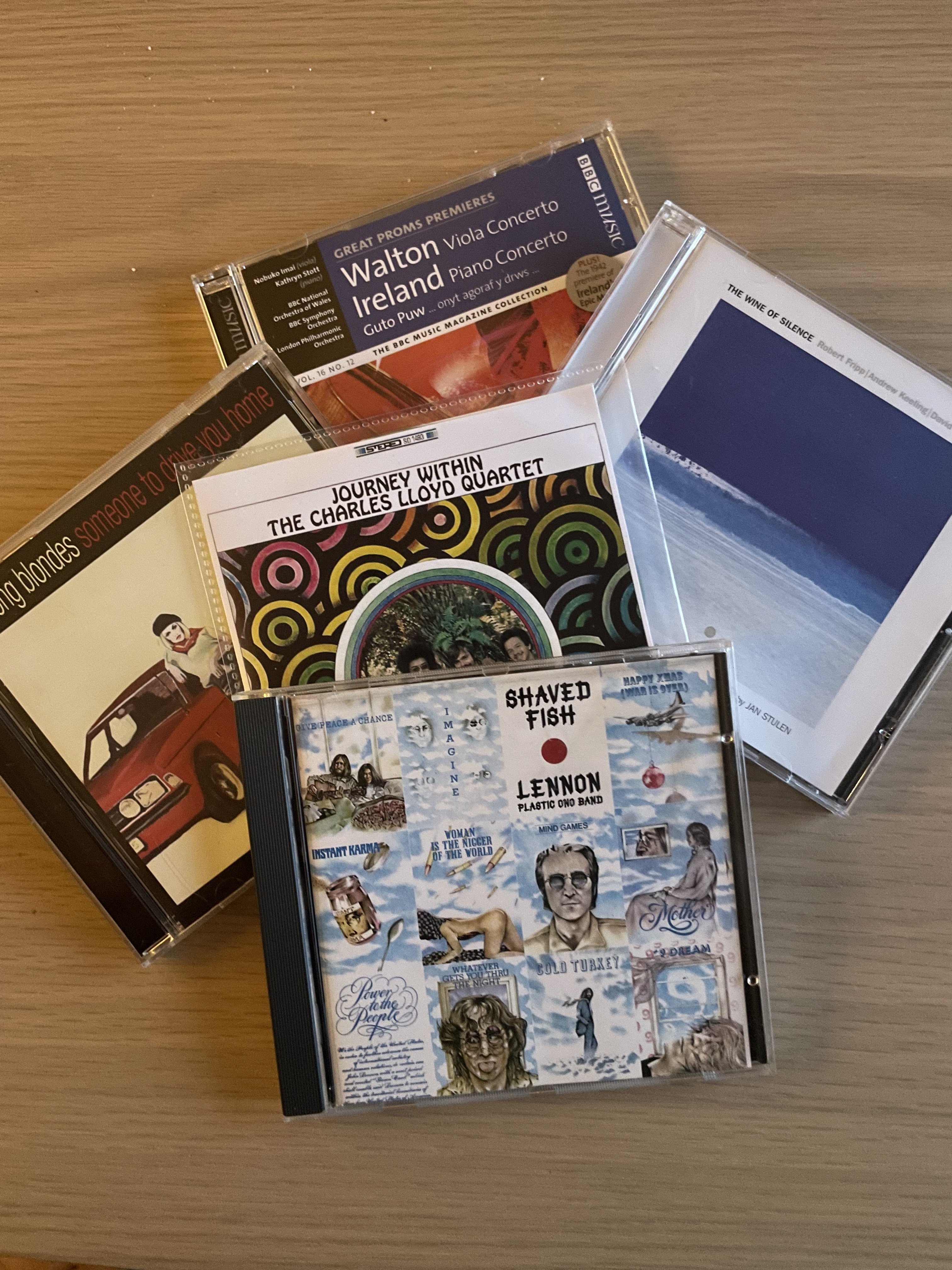
Yazz Ahmed, Jan Akkerman, Allegri, Amadou & Maryam, Amaarae, Multatu Astatke, J S Bach, Badfinger, Chet Baker, the Band, Bartok, Beababadoobee, Beach Boys, Beatles, Beethoven, Black Sabbath, Black Uhuru, Booker T & the MGs, Bowie, Brahms, Bruch, Kate Bush, David Byrne, Camel, Brandi Carlisle, Chakra, Chitinous Ensemble, Chopin, Gary Clark Jr, Coltrane & Duke, Corelli, Cymande, Delius, Corrie Dick, Elgar, Ellington, Empirical, En Vogue, Ezra Collective, Donald Fagen, de Falla, George Fenton, Ibrahim Ferrer, Ella Fitzgerald, Fripp Keeling & Singleton, Gateway, The Gentlemen, Stan Getz, Egberto Gismonti, Philip Glass, Global Village Trucking Company, Gong, Grande Familia, John Grant, Stephane Grappelli, Grieg, Haim, Handel, Hatfield & the North, Haydn, Hendrix, Henry Cow, Bernard Herrmann, Highlife, Steve Hillage, Zakir Hussain, Indigo Girls, John Ireland, The Jam, Etta James, Keith Jarrett & Jack DeJohnette, Keith Jarrett Trio, Laura Jurd, Villem Kapp, Seckou Keita & Catrin Finch, Graham Kendrick, Nigel Kennedy & the Kroke Band, King Crimson, Tony Kofi & Alina Bzhezhinska, Cleo Laine, Led Zeppelin, Michel Legrand, Jon Leifs, Libertines, Charles Lloyd, The Long Blondes, Baaba Maal, Kirsty MacColl, Madness, Manhattan Brothers, Bob Marley, Winton Marsalis, Mendelssohn, E T Mensah, Mingus, Joni Mitchell, Monochrome Set, Moondog, Christy Moore, Alanis Morissette, Mozart, Jalen N’dongo, Youssou N’dour, New Jazz Orchestra, New York Dolls, Newstead Abbey Singers, Paganini, Palestrina, Part, Pentangle, Esther Phillips, Plastic Ono Band, Pulp, Guto Puw, Ravel, Raye, Terry Reid, Django Reinhardt, Max Roach, Rodgers & Hammerstein, St Vincent, Satie, Schoenberg, Schubert, Schumann, Scissor Sisters, Self Esteem, Shaboozey, Caroline Shaw, Shostakovich, Sly & the Family Stone, Soft Cell, Songhoy Blues, Fela Sowande, Springsteen, Sprints, Squeeze, Steel Pulse, Stone Roses, Sugababes, Summers & Fripp, Swingle Singers, Tchaikovsky, Troubadours du roi Baudouin, Eduard Tubin, Vaughan Williams, Vivaldi, Walton, Marcin Wasilewski Trio, Debbie Wiseman, Working Week, Robert Wyatt, Neil Young
Music Nights 2024
Posted by cathannabel in Music on December 18, 2024
Last year I tried for the first time to write about the part that music has played in my life, the way in which that is bound up with my relationship with my late husband, and how I struggled with finding ways of listening alone. It will never, of course, be the same, not even close. But I have prioritised listening to music from our collection, as well as listening to Radio 3 as we used to, and have added some new bands, composers and music programmes to my repertoire. I’m proud of that – it wasn’t as easy as it might sound.
Not long into 2024, my hi-fi was dismantled, and my CDs packed into boxes and stored in the garage, ahead of a major redecoration of the living/dining room. It all took a long time, and only now, as the year draws to a close, do I have full access both to the CD collection and to the means of playing them. Now, I do know about streaming and am aware that playing actual CDs marks me out as very old school indeed – and as the list below shows, I did carry on regardless. But I like to hear the whole album, the tracks that the artist decided to record, in the order that they wanted them to appear. And so many of these CDs were acquired and listened to with M, and, as I said in my music blog a year ago, it’s very important to me that this tradition – of evenings devoted to listening to CDs, chosen semi-randomly from the vast collection – is part of my life now.
Music Nights (or mornings, or afternoons, but mainly nights) – the methodology is as described in last year’s blog. During the week if I think of something I’d like to play (it might be suggested by something I’ve read, an anniversary or obituary, or just a memory) I put it on a pile by the CD player, and on the night I add to that pile random choices – whatever came up when I threw the dice and counted the shelves – so that I don’t stay too firmly within familiar territory, or within any one era or genre. This does include music on TV or DVD and tracks that I accessed via Spotify as well as via the collection, but in general inclusion indicates that I listened to more than just a single track, even if not a full album.
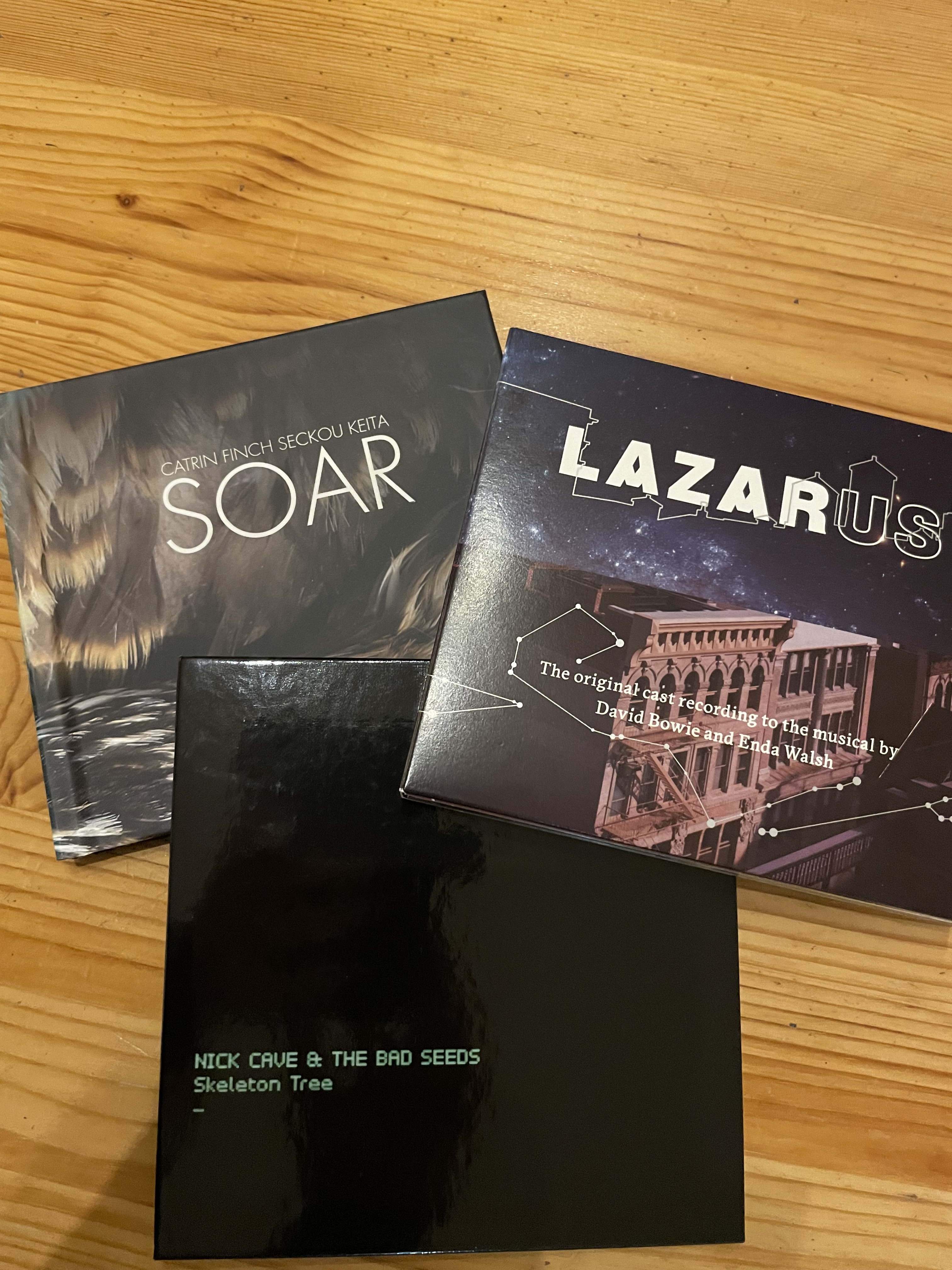
This year I listened to music by: Beethoven, Berlioz, black midi, Bombay Bicycle Club, Bowie, Brahms, Britten, Brubeck, Bruckner, R D Burman, Byrd, Alina Bzhezhinska, Camel, Can, Nick Cave, Terri Lynne Carrington, Hariprasad Chaurasia, Chopin, Billy Cobham, Leonard Cohen, Alice Coltrane, John Coltrane, Costello, Kim Cypher, Miles Davis, Olivia Dean, Delarue, Bryce Dessner, Corrie Dick, Marlene Dietrich, The Last Dinner Party, Dinosaur, Dreamliners, Dukas, Dylan, Earth Wind and Fire, Elgar, Ella, Ellington, ELP, Eno, Fairport Convention, Fakear, Fauré, Reinhard Fek, Catrin Finch & Seckou Keita, Graham Fitkin, Fleet Foxes, Flobots, Frankie goes to Hollywood, Marvin Gaye, Gilgamesh, Gomez, Pavel Haas, Charlie Haden & Egberto GIsmonti, Matthew Halsall, Gavin Harrison & O5Ric, P J Harvey, Lianne la Havas, Dashiell Hedayat, Hendrix, Bernard Herrmann, Hindemith, Zakir Hussain, Keith Jarrett, Johann Johannson, Quincy Jones, Quincy Jones & Miles Davis, King Crimson, Michael Kiwanuke, Gideon Klein, Gladys Knight, Korngold, Last Shadow Puppets, Bill Laswell, Ant Law & Alex Hitchcock, Léonin, Los Campesinos, Yo-Yo Ma, Kirsty MacColl, James MacMillan, Mancini, Bob Marley, Maximo Park, Curtis Mayfield, Fanny Mendelssohn, Felix Mendelssohn, Pat Metheny, Lin-Manuel Miranda, Monk, Mozart, Mulligan & Monk, Nick Mulvey, Meshell Ndegeocello, Yoko Ono, Pérotin, Iggy Pop, Psi Vojaci, Rachmaninov, Emma Radicz, Radiohead, Ravel, Red Rum Club, Martha Reeves, Max Richter, Rodrigo y Gabriela, SBB, Ryiuchi Sakamoto, Schoenberg, Schubert, Schumann (Robert & Clara), Semer Ensemble, Shangri-las, Sharp Little Bones, Shostakovich, Sibelius, Silk Road Ensemble, Horace Silver, Nina Simone, Roni Size & Reprazent, Smetana, Sam Smith, Snarky Puppy, Katie Spencer, Spiritualized, Candi Staton, Steely Dan, Max Steiner, Richard Strauss, Karl Svenk, Taylor Swift, Sylvian & Fripp, Tallis, Tangerine Dream, Carlo Taube, Michael Tippett, Peter Tosh, Ali Farka Toure, Travis & Fripp, Martina Trchova, Unthanks, Vaughan Williams, Verdi, Kevin Volans, Weather Report, Yiddish tango




Live Music
Music nights are almost always solitary now. But live music is also vital to me, and for that I often especially value company. So thank you to Ruth, Peter, Adi, Jennie & Michael, Arthur, Jane & Richard, Amanda, Liz and Under the Stars colleagues for sharing some of these musical experiences with me.
Opera
For a few years, I reviewed Opera North productions for The Culture Vulture, a Leeds-based online journal, which was fabulous – I got free tickets to all of the productions. All this came to an end for me even before lockdown, as my youngest brother, who had terminal cancer, approached the end of his life, and I knew I could not commit to attending or to turning a review around within a day. When lockdown ended, I was looking forward to starting again and was due to see Carmen on 9 October 2021. That morning, M died. It was not until my sister-in-law, who had got me started on this whole opera thing, moved back to Leeds from Rome last year that I went back to the Grand Theatre (not as a reviewer, just a regular audience member).
At Leeds Grand we saw two marvellously magical productions, Mozart’s bonkers The Magic Flute, and Britten’s A Midsummer Night’s Dream, both of which were delightful, imaginatively staged and beautifully sung. Before that, we saw Britten’s Albert Herring at the Howard Assembly Rooms, a lovely, funny production.
West Yorkshire Playhouse’s revival of My Fair Lady drew on Opera North talents too, with lovely performances in the lead roles, including John Hopkins (a former sidekick of Midsomer Murders’ DI Barnaby) as Henry Higgins, and Katie Bird, who we saw in The Merry Widow back in 2018 at the Grand, as Eliza. It has tricky moments – not so much Higgins’ sexism, given that this is not endorsed by the script or by the production, but the off-hand references to domestic violence, the normality of black eyes and broken bones as part of married life. I can’t recall if these are in the Shaw, or only in the libretto. Despite that it was a gorgeous, funny production and it’s packed with glorious tunes, beautifully sung.
Sheffield City Hall – Legend: The Music of Bob Marley. Excellent tribute band – the lead singer in particular was superb. I wondered about the audience when I saw a lot of white folks wearing knitted hats with knitted dreadlocks attached, but it was clear they were passionate enthusiasts for the music, knew all the lyrics, and kept a respectful silence when asked to do so in memory of Aston ‘Family Man’ Barrett. An exuberant evening of fantastic songs.
Manchester Palace Theatre – Hamilton. I’d seen it on Disney+ but live is so much better. Spinetinglingly, exhilaratingly great songs and singers, superb choreography, a compelling story. It probably shouldn’t work but it absolutely does and I loved every moment.


Since I got involved with Under the Stars, first as a trustee, now as Chair, I aim to get to as many of their gigs and drama performances as I can. It’s always a joy. This year, Sparkle Sistaz played the Octagon Centre at Sheffield University as part of a Street Choirs event and went down a storm (they were followed by the excellent Young ‘Uns, who recognised they had a damn hard act to follow). The Stars Band played at Yellow Arch and at Tramlines, and Clubland Detectives launched their new EP with a gig at the Greystones Pub.


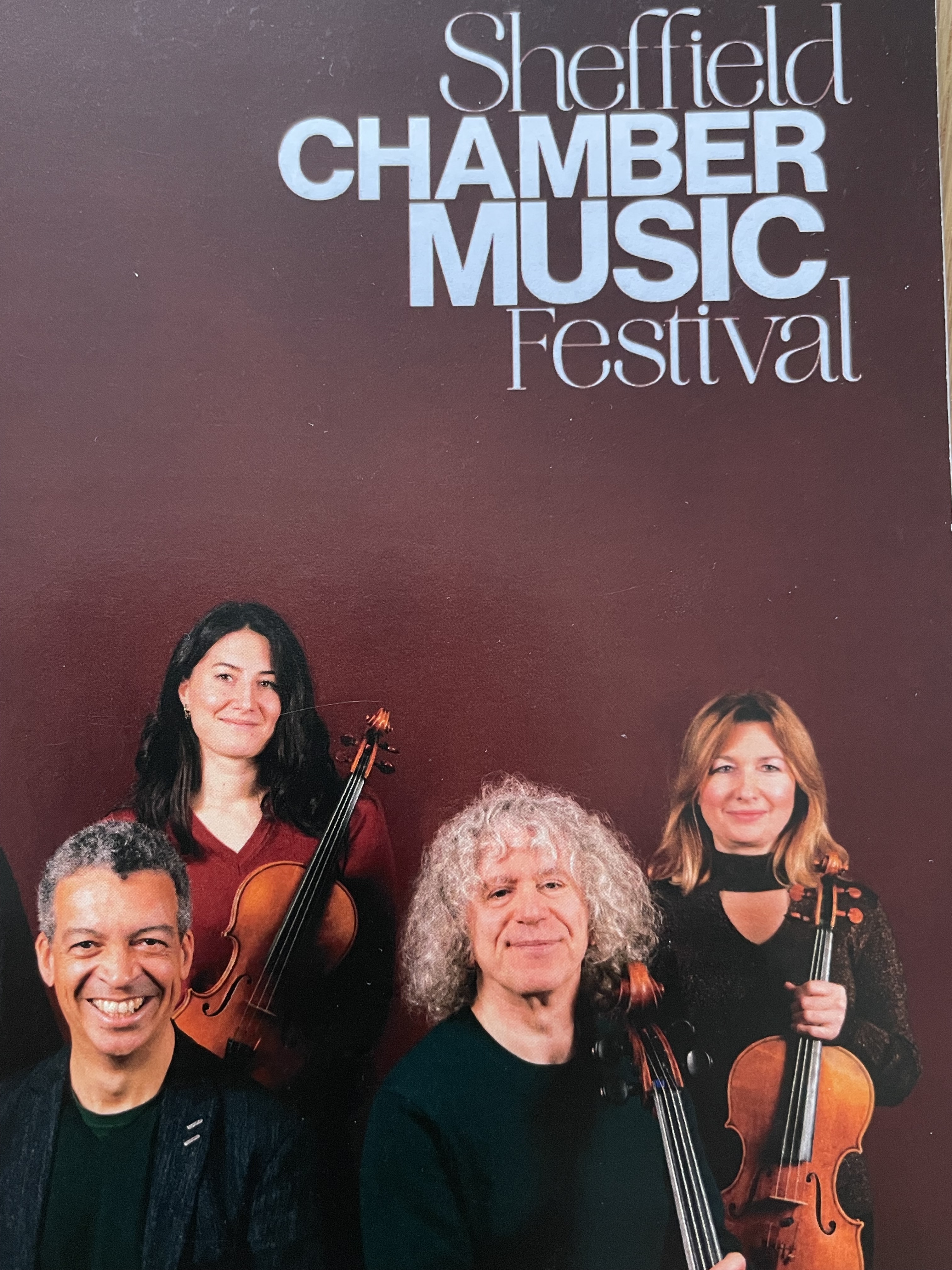
Music in the Round is always a huge part of my musical year. It started off with a concert in the Upper Chapel (Koechlin, Tomasi, Lutoslawski, Poulenc) and then the Steven Isserlis curated Chamber Music Festival in mid-May celebrated Fauré’s centenary with a packed week of gigs, mainly at the Crucible Playhouse. I got to five of the concerts, and heard music by Ades, Bach, Farrenc, Faure, Franck, Holmes, Messager, Onslow, Ravel, Saint Saens and Tchaikovsky, performed by Ensemble 360, with Isserlis, Peter Hill, Abbeydale Singers, Ella Taylor and Anna Huntley. And then Kathy Stott launched the autumn season with a performance of short pieces by Bach, Boulanger, Ravel, Piazzola, Shostakovich, Rodgers & Hammerstein, Chopin, Fitkin, Shaw, Vine, Grainger, and Grieg. This was part of her farewell tour, with a programme of short pieces – it was wonderfully eclectic and delightful.


We were at the Crookes Social Club for Sheffield Jazz gigs from the Clark Tracy Quintet, Corrie Dick Sun Swells, Hannah Horton Quartet, Adam Glasser, and Soft Machine, the Crucible Playhouse for Empirical with Jason Rebello, Firth Hall for Fergus McCreadie, and the main Crucible Theatre for their 50th anniversary gig, with the Emma Rawicz Quartet and the Tony Kofi Quartet. All were excellent but standouts were Corrie Dicks, Soft Machine and Tony Kofi.


This year’s Tramlines was dry and sunny, for which we were very thankful after last year’s downpour and resulting quagmire. The stand-out performances were from Maximo Park, Dylan John Thomas, The Human League, Sprints and Stars Band. We also saw Bombay Bicycle Club, Coach Party, Example, Flowerovlove, Darla Jade, Jazzy, Miles Kane, Otis Mensah, Harriet Rose, Mitch Santiago, Rumbi Tauro and The View plus brief snippets of The Charlatans, Cucamaras and Paolo Nutini.


And then a new feature on Sheffield’s musical calendar, Richard Hawley’s Rock & Roll Circus – we only went to one of the three nights, but enjoyed Gilbert O’Sullivan, The Coral, The Divine Comedy and Richard Hawley himself. O’Sullivan I remember fondly from the 1970s, when he had a run of hits, all of which he performed here and most of whose lyrics I could recall. His voice is still there (not always the case with performers whose heyday was 40+ years ago) and it was an enjoyable set, if not one that made me want to seek out his newer material. I fell in love with The Coral years ago – that Mersey/Motown blend is joyous and I love them live (I saw them at Tramlines 2022). I was much less familiar with The Divine Comedy’s output (I knew ‘National Express’ of course but little else) but was inspired to listen to more. And Hawley, in his home town, was electrifying, performing songs that featured in the musical Standing on the Sky’s Edge, which played to rapturous full houses here in Sheffield, and less inevitably, replicated that success in the West End.


And a concert at the tiniest venue I know, Café 9. Pre-booking is essential, and reserving seats helpful as one can end up practically knee to knee with the performers – but it’s a gorgeous space, which I discovered last year, and went to three gigs there in fairly quick succession. Just one this year, from Katie Spencer, whose songs draw on her upbringing on ‘the edge of the land’, as one of her songs puts it, on the East Yorkshire coast. She’s a great songwriter, guitar player and singer. She was supported by Gerard Frain, an excellent South Yorkshire singer-songwriter.


For next year I’m checking out the Sheffield Jazz programme and the 2025 Sheffield Chamber Music Festival programme, I’m already booked to see two operas (Weill and Verdi), and we have our tickets for Tramlines in July. And whatever else the year brings, I know it will be full of music.
2010-2019 – the best bits… and some of the other bits
Posted by cathannabel in Events, Film, Literature, Music, Personal, Television on December 19, 2019
I honestly hadn’t thought about it being the end of a decade until I saw the first few ‘best of’ lists appearing.
On a personal level, it’s been quite momentous. We both retired, midway through the decade, a decision which we haven’t regretted for a nano-second. I finished my (second) undergrad degree before I left work, and then went straight on to study for a PhD, which I hope to complete early in the next decade. Each of our children graduated twice (four different Universities, three different cities) and found permanent, rewarding employment.
I lost a good friend and colleague to cancer and helped to set up and then chair a charity as his legacy, raising around £30k since 2013 for cancer charities, through a fabulous fundraising event, the 24 Hour Inspire, and other ventures.
I started this blog in January 2012, and whilst I’ve had periods of writer’s block this year it’s given me a way of being creative, having spent most of my life denying that I am or could be. I was also offered the chance to go to the opera for free with a friend, and write reviews of the productions, which has been an absolute delight.
We put lots of things on hold for a while as my mother in law’s dementia worsened, and her care needs became urgent. She died last Christmas. My brother was diagnosed with terminal cancer in 2018 and the chemo he’s been on is no longer working. We go into the New Year with heavy hearts.
Politically it’s been a nightmarish decade. The Tories back in power, first in coalition, then in their own right, albeit for a while as a minority government. The EU Referendum and the government’s complete inability to approach the negotiations in good faith and with understanding and intelligence. Obama replaced in the White House by someone so utterly unfit for any kind of high office that I still wonder whether we slipped into some parallel universe at about the halfway point of the decade, after which nothing made any kind of sense.
Should have realised, when I woke one morning in early January 2016 to learn that Bowie had left us. Should have known it was a portent.
So since looking forward is a mug’s game at present, I’ll look back, to the books, films and TV programmes that have sustained me during the last ten years.
Books of the Decade
Some of these titles feature in my already published Books of the Year and Books of the Century lists, as one might expect. I’ll indicate those that do, or that are reviewed in my 60 Books challenge series, so as not to repeat myself too much (and have time to also do the full panoply of decade and year lists that I am somehow compelled to do).
Ben Aaronovitch – Moon over Soho (Books of the Century)
Ferdinand Addis – Rome: The Eternal City was a birthday gift from the Roman branch of our family, following a recent visit to the city, which had made me realise just how fragmented and unreliable my sense of its history was. A hotch-potch of Shakespeare, the New Testament, Robert Graves and Robert Harris, I really needed to get a grip on it all. Addis’s tome is just the thing. It’s very entertainingly written, it takes key events and explains how they came to pass and what followed, and it takes us from Romulus & Remus to Federico Fellini.
Chimamanda Adichie – Americanah. Her Half of a Yellow Sun is one of the top three books of the century (according to me). Adichie’s protagonist here goes off to University in the States, and we follow her struggles to acclimatise and to understand what race means in America, as well as her feelings for her lover back in Lagos. It’s often very funny, and always very sharp and perceptive. The Guardian said that ‘It is ostensibly a love story – the tale of childhood sweethearts at school in Nigeria whose lives take different paths when they seek their fortunes in America and England – but it is also a brilliant dissection of modern attitudes to race, spanning three continents and touching on issues of identity, loss and loneliness.’
Viv Albertine – Clothes, Clothes, Clothes. Music, Music, Music. Boys, Boys, Boys (Books of the Century)
Naomi Alderman – The Power (Books of the Century)
Lynne Alexander – The Sister illuminates a life lived in the shadows: Alice James was sister to the more famous Henry and William, prevented by ill health and the constraints of Victorian society from expressing her own creativity. Alexander doesn’t hammer this message home simplistically but brings Alice to sympathetic life. ‘A furious volcano of thoughts and desires trapped within a carapace of pain, Alice is a feminist cipher but, more movingly, a beautifully drawn and memorable individual, brave, vulnerable and fiercely intelligent.’ (The Guardian)
Darran Anderson – Imaginary Cities is an exuberant and wildly eclectic tour of cities in Western civilisation drawing on books, films, architecture, myth, visual arts. Totally my cup of tea. Described as ‘an exhaustive, engaging book’ which generates ‘sheer joy for the curious reader’. It certainly did for this curious reader.
Anne Applebaum – Iron Curtain: The Crushing of Eastern Europe 1944-56 is a fascinating study of Poland, the GDR and Hungary after the end of the Second World War. The Telegraph said that she takes ‘a dense and complex subject, replete with communist acronyms and impenetrable jargon, and make it not only informative but enjoyable – and even occasionally witty. In that respect alone, it is a true masterpiece’. (Books of the Year)
Kate Atkinson – Life after Life (Books of the Century)
Margaret Atwood – The Testaments is the long-awaited sequel to The Handmaid’s Tale. It does take the action forward – we get to see some of what happened after that book’s final page, but perhaps more significantly, we see Gilead from perspectives other than that of June/Offred, and so we understand more about how Gilead works, and about, in particular the role of the Aunts. It’s completely compelling, and very disturbing. (Books of the Year)



Julian Barnes – The Levels of Life (Books of the Century)
Linda Buckley-Archer – The Many Lives of John Stone. Buckley-Archer began her literary career with the YA Timequake trilogy. This is beautifully written, interweaving a vivid historical narrative with the present day. There’s no time travel, or supernatural/paranormal elements – it just uses a hypothetical genetic characteristic as the basis for the plot. It’s engaging, gripping and ultimately very moving.
James Lee Burke – Robicheaux (Books of the Century)
Jane Casey – Cruel Acts (Books of the Year, and Century)
Jonathan Coe – Middle England. I picked The Rotter’s Club for my books of the century, and this is the third part of that trilogy. This made me laugh a lot. Made me weep a bit. Reminded me of music I love (Hatfield & the North, Vaughan Williams) and of lyrics that always move me: Billy Bragg’s ‘Between the Wars’. (Not mentioned in Coe’s book, but I kept on thinking of the line ‘Sweet moderation, heart of our nation’). It’s rueful and wistful and, I think, hopeful… (Books of the Year)
Suzanne Collins – Mockingjay is the final part of The Hunger Games trilogy. Another series aimed at a young adult readership, this one is pretty dark (not that YA reading should be sugar-coated or cosy, it should challenge and disrupt if it’s doing its job). Vivid and exciting, with a splendid hero in Katniss Everdene, and resists too neat an ending – after so much tragedy and trauma, that would have jarred horribly.
Stevie Davies – Awakening (Books of the Century)
Edmund de Waal – Hare with the Amber Eyes (Books of the Century)
Emma Donoghue – Room (Books of the Century)
Helen Dunmore – Birdcage Walk. Sadly the last novel from Dunmore, who died of cancer in 2018. I picked The Siege as one of my Books of the Century, and read The Betrayal as part of my 60 books challenge – her novels are very varied but always beautifully and powerfully written. The Guardian describes her writing as ‘hazardously human’. It’s particularly poignant to note that the fictional Julia Fawkes ‘lies buried with the inscription “Her words remain our inheritance.” Julia may have disappeared from the record, but Dunmore’s words remain.
Sue Eckstein – Interpreters (Books of the Century)
Reni Eddo-Lodge – Why I’m no longer talking to White People about Race (Books of the Century)
Esi Edugyan – Half-Blood Blues (Books of the Century)
Elif Shafak – Three Daughters of Eve (60 Books)
Lara Feigel – The Bitter Taste of Victory (Books of the Century)
Will Ferguson – 419 (Books of the Century)
Gillian Flynn – Gone Girl (Books of the Century)
Karen Joy Fowler – We are all Completely Beside Ourselves is particularly difficult to write about without revealing a vital twist, so I will avoid any discussion of the plot. Read it anyway, just avoid the reviews (so no link to the Guardian, which called It an ‘achingly funny, deeply serious heart-breaker … a moral comedy to shout from the rooftops’.) (Books of the Year)
Tana French – Broken Harbour (Books of the Year and Century)
Esther Freud – Mr Mac and Me reminded me of Helen Dunmore’s Zennor in Darkness. A writer/artist (D H Lawrence for Dunmore, Charles Rennie Mackintosh for Freud) finds themselves in a rural community at the start of the First World War, and is regarded with suspicion by the locals due to their unconventional behaviour). Mackintosh is seen through the eyes of a fourteen year old boy, intoxicated by the glimpses of a wider world, of art and beauty, that Mackintosh brings.




Jo Furniss – All the Little Children (60 Books)
Robert Galbraith – The Cuckoo’s Calling (Books of the Century)
Patrick Gale – Notes from an Exhibition (Books of the Century)
Alan Garner – Boneland (Books of the Century)
Nicci Gerrard – What Dementia Teaches us about Love (Books of the Century)
Valentina Giambanco – The Gift of Darkness (Books of the Century)
Elizabeth Gilbert – The Signature of all Things. I wouldn’t have expected to enjoy Elizabeth Gilbert’s writing, having a deep-rooted suspicion of the whole Eat, Pray, Love thing. But I really did. Gilbert’s fictional protagonist, Alma Whittaker, is brilliant, lonely, not pretty. She’s a scientist, a naturalist, in the wrong era (she’s born in 1800) to have any chance of fulfilling her ambitions, or her desires. She’s remarkable, utterly believable, her openness and imagination endearing and fascinating. It’s an ambitious novel, that fully succeeds in its ambitions.
Robert Gildea – Fighters in the Shadows: A New History of the French Resistance. Gildea brings out of the shadows the Resistance that was marginalised for decades – women, Communists, foreigners. It’s much more complicated than the myth that de Gaulle propagated at the Liberation, and more interesting.
Lesley Glaister – The Squeeze (Books of the Century)
David Grann – Killers of the Flower Moon (Books of the Century)
Jarlath Gregory – The Organised Criminal (60 Books)
Elly Griffiths – The Stone Circle (Books of the Year and Century)
Thomas Harding – The House by the Lake (Books of the Year and Century)
Jane Harper – The Lost Man (Books of the Year and Century)
Robert Harris – An Officer and a Spy (Books of the Century)
John Harvey – Darkness, Darkness – the final part of the series of novels featuring Nottingham detective Charlie Resnick.
Noah Hawley – Before the Fall is an excellent thriller, about truth and lies, fame and reality, from the writer of the TV version of Fargo
Emma Healey – Elizabeth is Missing (Books of the Century)
Sarah Helm – If this is a Woman (Books of the Century)
Sarah Hilary – Never be Broken (Books of the Year and Century)
Susan Hill – The Comforts of Home is the most recent (that I’ve read) of the Simon Serrailler series. (Books of the Year. The Various Haunts of Men was one of my Books of the Century).
Christopher Hitchen – Mortality (Books of the Century)
Andrew Michael Hurley – The Loney (Books of the Century)
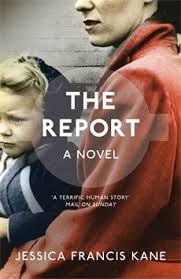
Jessica Frances Kane – The Report is absolutely fascinating. At the heart of the novel is a little known wartime tragedy, in which no bombs fell, but 173 civilians died. I had never heard about the Bethnal Green disaster when I came across this book, and it set off many trains of thought.



Philip Kerr – Prague Fatale. Kerr’s series of novels featuring Berlin detective Bernie Gunther blend crime fiction with World War II European history. They span from the immediate pre-war period to the long aftermath of the war, and Bernie has been part of it all. He’s a survivor, who’s done bad things and seen worse ones, but somehow retained his humanity, a dry humour, and at least some of his integrity.
Stephen King – The Institute. King’s latest references a number of his previous novels (Firestarter, The Shining, Carrie…) but does something a bit different with these themes. In a way, he’s setting two version of America against each other: the corporate world of the Institute, ‘the cogs and wheels of bureaucratic evil, run by ‘a bunch of middle-management automatons’, against small-town America (the good and the bad thereof). It’s proper cancel all other activities including meals and sleep till the last page King. (Books of the Year)
Otto Dov Kulka – Landscapes of the Metropolis of Death (Books of the Century)
John le Carre – Pigeon Tunnel (60 Books)
Harper Lee – Go Set a Watchman (Books of the Century)
Laura Lipmann – Sunburn (Books of the Year and Century)
Kenan Malik – Quest for a Moral Compass (Books of the Century)
Hilary Mantel – Bring up the Bodies. We’re still eagerly awaiting the third part of Mantel’s Cromwell trilogy. (Wolf Hall was one of my Books of the Century).
Helen Mathers – Patron Saint of Prostitutes is a fascinating biography of Josephine Butler, the remarkable Victorian campaigner who challenged all of the conventions about how a pious and respectable woman should behave by working with prostitutes, and challenging publicly the way in which they were brutalised and abused in the name of public morals.
Jon McGregor – Reservoir 13 (Books of the Century)
Dervla McTiernan – The Ruin (Books of the Century)
Livi Michael – Succession (Books of the Century)
Denise Mina – The Long Drop (Books of the Century)
Wendy Mitchell – Someone I Used to Know is an account by someone diagnosed with early onset dementia. She’s frank and fearless about explaining how the condition affects her as it progresses, but uses her energies to campaign for awareness and understanding, and for practical support. Her blog is funny, sad and enlightening, and it is so rare and refreshing to hear about dementia from someone who is actually experiencing it.
Caitlin Moran – How to be a Woman (Books of the Century)
Sarah Moss – Bodies of Light (Books of the Year and Century)
Thomas Mullen – Darktown (Books of the Century)
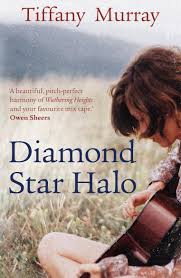
Tiffany Murray – Diamond Star Halo rocks. It’s set on a fictionalised version of the residential recording facility at Rockfield Farm, Murray’s childhood home, itself the locus of much rock music mythology. It’s gloriously funny, but has plenty of heart, and the music is part of every line of the text – I could hear the soundtrack in my head, even the music that was imagined and not real. And I often think of protagonist Halo’s night-time prayer, a litany of rock stars gone forever…


Maggie O’Farrell – The Hand that First Held Mine (Books of the Century)
Chinelo Okparanta – Under the Udala Trees movingly explores the Biafran war, sexuality and love across the ethnic and religious divides, class and status in Nigerian society.
David Olusoga – Black and British (Books of the Century)
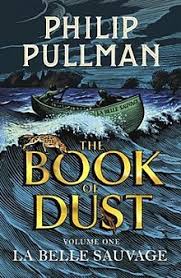
Philip Pullman – La Belle Sauvage (The Book of Dust, Book 1). I won’t say too much about this as I don’t want to risk giving any spoilers. But it is sheer delight to be back in this world and to re-experience the sheer power, the subtlety, the glorious imagination of Pullman’s writing.
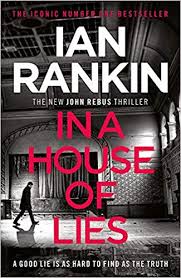
Ian Rankin – In a House of Lies, the most recent Rebus. He’s retired now, and battling with COPD and the lifestyle changes that has forced on him. Does any of that stop him getting involved in the solving of a crime, and getting under the feet of the cops? Have you met Rebus? (Books of the Year)
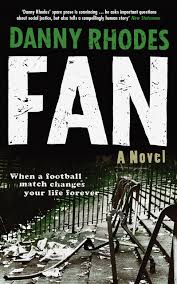
Danny Rhodes – Fan is about football and football culture, about supporting Nottingham Forest, and, inexorably, about Hillsborough. It’s powerful and harrowing.
Sally Rooney – Normal People (Books of the Year and Century)
Liz Rosenberg – Indigo Hill (Books of the Year and Century)
Donal Ryan – From a Low and Quiet Sea (Books of the Year and Century)
Philippe Sands – East-West Street (Books of the Century)
Noo Saro-wiwa – Looking for Transwonderland (Books of the Century)
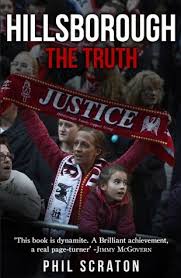
Phil Scraton – Hillsborough: The Truth. When Scraton published this 2016 edition of his authoritative, rigorous, and personal account of the disaster, he would not have imagined the news that broke in December 2019, that Duckenfield had been found not guilty. Again, the families who have endured so much – lies, betrayal, vilification, dismissal – for so long, are in pain, and again, it seems no one will be held accountable for 96 entirely avoidable deaths.
Anne Sebba – Les Parisiennes (Books of the Century)
Taiye Selasi – Ghana Must Go (Books of the Century)
Lynn Shepherd – Tom All-Alone’s (Books of the Century)
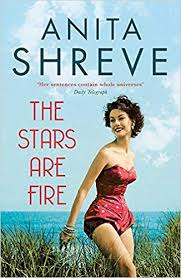
Anita Shreve – The Stars are Fire was Shreve’s last book. Her protagonist, Grace, has a life that is limited by societal convention and tight family budgets but she thinks it’s fine, mostly, until she loses almost everything, in the terrible fires that swept Maine in 1947. The disaster is described with visceral power and horror, but Shreve is just as interested in its aftermath, as Grace tries to find a way to start again.

Rebecca Skloot – The Immortal Life of Henrietta Lacks (Books of the Century)
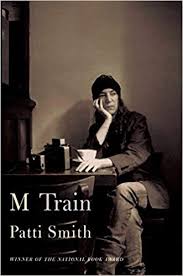
Patti Smith – M Train. I picked Just Kids for my Books of the Century, but could just as well have chosen this. With the humour, self-deprecation and warmth that characterised her earlier memoir, she talks about her marriage to Fred ‘Sonic’ Smith, of the series of terrible losses that she experienced, of her music. And, unexpectedly, of her obsession with Midsomer Murders.
Timothy Snyder – Bloodlands: Europe between Hitler and Stalin. I’ve spent a lot of time studying the Occupation of France, and I’m well versed in its horrors. I know better than to minimise the brutality – but the majority of the murders of French citizens and those who were in France during the Occupation took place not on French soil but in what Snyder calls the Bloodlands. ‘Both tyrants identified this luckless strip of Europe as the place where, above all, they must impose their will or see their gigantic visions falter… The figures are so huge and so awful that grief could grow numb. But Snyder, who is a noble writer as well as a great researcher, knows that. He asks us not to think in those round numbers. … The Nazi and Soviet regimes turned people into numbers. “It is for us as humanists to turn the numbers back into people.”
Rebecca Solnit – Hope in the Dark (Books of the Century)
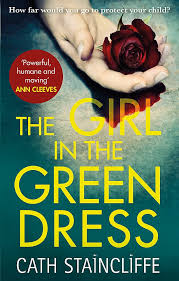
Cath Staincliffe – The Girl in the Green Dress. I was torn when I did the list of books of the century, and chose The Silence between Breaths. So I’m making recompense now. What Staincliffe does so well is to focus not just on the crime (though there is a strong police procedural element to this one, unlike some of her stand-alone novels) but on the ripples created by the crime, on the families of victim and perpetrators, on the police officers themselves. This one will break your heart.
Susie Steiner – Missing, Presumed (Books of the Century)
Adrian Tempany – And the Sun Shines Now (Books of the Century)
Rose Tremain – The Gustav Sonata (Books of the Century)
Elizabeth Wein – Code Name Verity is a brilliant and moving YA novel about young women undercover in Occupied France in WWII. It’s so very cleverly structured – things that don’t seem to quite make sense suddenly become clear in the second half, when the narrator changes. The plot is utterly gripping and the ending made me weep. A lot.
Louise Welsh – A Lovely Way to Burn. This is part 1 of the Plague Times trilogy, a dystopian future where plague wipes out large swathes of the population. We’ve been here, or hereabouts, before of course – Day of the Triffids, The Walking Dead, 28 Days Later, The Stand… Welsh makes it work though, she gives weight to the moral issues as well as giving us suspense, action, horror, and everything we’d expect from the post-apocalypse.



Colson Whitehead – Underground Railroad (Books of the Century)
Jeanette Winterson – Why be Happy when you could be Normal? (Books of the Century)
Farewell to those writers listed above who we lost during the decade: Helen Dunmore, Sue Eckstein, Philip Kerr, Harper Lee and Anita Shreve. Thank you all.
Films of the Decade
I’ve highlighted in bold my favourite films in each of these categories. Many of them I’ve written about already elsewhere, so again I’m not attempting to review or even comment on each one.
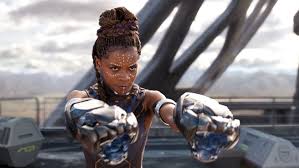
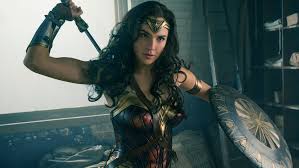
Scifi and Superheroes: A brilliant decade both for the superhero genre and – IMHO – Marvel specifically, and for other sci-fi franchises: Star Trek had Beyond, and Star Wars fielded The Last Jedi and Rogue One. My pick from the MCU: Avengers Assemble, Captain America: Civil War, Black Panther, Captain Marvel, Spiderman: Into the Spiderverse, Guardians of the Galaxy I, Thor: Ragnarok. And outside this particular arc, from the X Men, the elegiac Logan. And though I don’t generally do DC, I have to have Wonder Woman.
Best of the bunch: Not dissing Endgame, but Assemble is when I fell in love with Marvel (and with Captain America, TBH). And Black Panther had a significance beyond its place in the Avengers story, and was exhilarating not just for people of colour in the audience, but for anyone who cares about seeing the rich diversity of humanity on screen, as heroes and as villains.
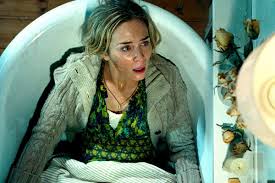
We had Inception and Interstellar, Her and Ex Machina, Looper and Mad Max: Fury Road, The Martian and Gravity, Monsters and Dawn of the Planet of the Apes, A Quiet Place and Source Code.
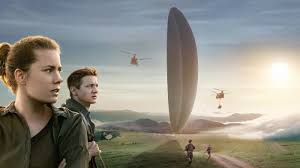
And the two best SF films of the decade: Annihilation, and Arrival. Visually stunning, intelligent sci-fi. Of the two, Arrival, with its emotionally devastating twist, and its fascinating exploration of language, edges it.


Thrills, Crimes & Heists: Baby Driver and Drive, Bad Times at the El Royale, Skyfall, Gone Girl and Widows. I’m torn on which to pick. With caveats, to do with the film’s failure to meet the low bar of the Bechdel test, I’d pick Baby Driver, which was beautifully described by Empire as: ‘not a film just set to music. But a film meticulously, ambitiously laid over the bones of carefully chosen tracks. It’s as close to a car-chase opera as you’ll ever see on screen.’ Even if the narrative arc (young man in debt to gangster does ‘one last job’ and finds out there’s no such thing) is traditional enough, the choreography, the seamless blend between diegetic and exegetic music, make it entirely original and massively enjoyable.
War: Anthropoid (the assassination of Heydrich), Childhood of a Leader (a more allegorical account of the birth of fascism), Lore (a German teenager in the aftermath of the war). And the best one: Dunkirk – I was overwhelmed, by that intense focus, by the score which built and built the tension until it was almost unbearable (and the use of the Elgar Nimrod as the first of the little ships appeared reduced me, predictably enough, to sobs), and by the non-linear structure which forced one to concentrate, to hold those strands together even as the direction teased them apart.
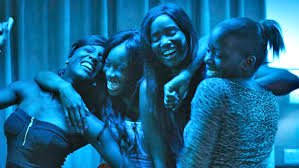
French films: Michael Haneke’s Amour, Xavier Giannoli’s Marguerite (a French take on the Florence Foster Jenkins story), Olivier Assayas’s Double Vies (Non-Fiction), Mia Hansen-Løve’s L’Avenir (Things to Come), Denis Villeneuve’s Incendies. Varda by Agnes and Bertrand Tavernier’s Journey through French Cinema. My favourites: Celine Sciamma’s Bande de Filles (so much in this movie, but just watch that opening sequence, with the young women leaving hockey match and returning to their homes in the banlieues, and a gorgeous sequence as they dance in shoplifted dresses to Rihanna’s ‘Diamonds’) , Abderrahmane Sissako’s Timbuktu (a stunning Malian film, beautiful and shattering, but with unexpected moments of humour too).
Horror: Cabin in the Woods, What we do in the Shadows. Get Out and Us. A Girl Walks Home Alone at Night, The Girl with all the Gifts. Under the Skin.




History/Biography: First Man and Hidden Figures, Lincoln, Selma and BlackKKlansman. Love and Mercy (biopic of Brian Wilson).
Comedy: Booksmart and Lady Bird. Death of Stalin and Four Lions. Hunt for the Wilderpeople and Moonrise Kingdom. Sorry to Bother You. World’s End and Submarine. The Muppets, and Paddington.
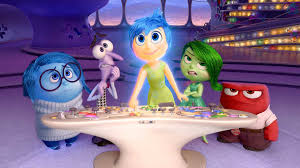
Animation: Inside Out, Tangled, Toy Story 3.



Adaptations: Macbeth (Fassbender and Cotillard) and Joss Whedon’s Much Ado about Nothing.
Documentaries: I Believe in Miracles (Johnny Owen’s account of the glory years at Nottingham Forest), Night will Fall and They Shall Not Grow Old, Nine Muses, They will have to Kill us First.
Drama: Captain Fantastic and Leave No Trace. Dallas Buyers Club and Pride. Grand Budapest Hotel and The Great Beauty. The Farewell and Short-term 12. Twentieth-century Women and Three Billboards outside Ebbing, Missouri. Winter’s Bone and Room. We Need to Talk about Kevin and If Beale Street Could Talk. Life, above all and Cold War.



Music: La la Land
Farewell and thank you to Marvel man Stan Lee, to Emmanuelle Riva (star of Haneke’s Amour, and long before that, of Hiroshima mon amour), to Agnes Varda, and to Michael Bond, creator of Paddington.
TV of the Decade
Subtitled Crime/Thrillers: Dicte, Follow the Money, Greyzone, Rough Justice, Spiral, The Team, Trapped, Wallander, Witnesses, Beck, Before we Die, Blue Eyes, The Bridge, Deutschland 83/86. Plus the bilingual English/Welsh productions, Hidden and Hinterland. Best of the bunch – Spiral (a master-class in French profanity, and a compelling if infuriating bunch of characters, dealing with grim and gritty crime on the streets of Paris.
Brit Crime/Thrillers: Endeavour, The Fall, Foyle’s War, Happy Valley, , Informer, Killing Eve, Kiri, Lewis, Line of Duty, Little Drummer Girl, London Spy, The Lost Honour of Christopher Jenkins, Midsomer Murders, The Missing, No Offence, River, Scott and Bailey, Sherlock, Shetland, Southcliffe, Strike, Suspects, The Suspicions of Mr Whicher, Unforgotten, Vera, Wallander, Bodyguard, Broadchurch, DCI Banks, Black Earth Rising, Ashes to Ashes. Best of the bunch – Endeavour for beautiful, subtle writing for all the lead characters; Killing Eve for deranged, delicious wickedness, Line of Duty for twisty turny plotting, and stunning, forget-to-breathe set pieces in the interview room, Unforgotten for the warmth and humanity of the two leads, the clever subtlety of the writing, and the emotional complexity of cold case investigation.
Other Crime/Thrillers: Fargo, Homeland, Mystery Road, Southland, The Americans. Best of the bunch – Fargo. Bonkers, funny and very very dark.


Sci-fi/Fantasy: Agent Carter, Agents of Shield, The Walking Dead, Doctor Who, The Fades, Utopia, The Handmaid’s Tale, Humans, Misfits, Orphan Black, The Returned, Star Trek: Discovery, True Blood, Being Human. Best of the bunch – Agents of Shield for daring plotting and terrific writing. Doctor Who for bringing us not only Doctors 11, 12 and 13, but the War Doctor and the reappearance of the very first Doctor, River Song and a whole raft of new companions, new and old foes… And Who, as always, through this decade, has given us a hero who thinks, who cares, who values kindness above all things, who isn’t human but somehow reflects back to us the best of humanity. Orphan Black for Tatiana Maslany’s virtuoso performance as most of the key characters. The Returned for a spooky, troubling, atmospheric take on the notion of the revenant.
Comedy: Big Bang Theory, Community, Derry Girls, Doc Martin, Fleabag, The Good Place, How I Met Your Mother, Modern Family, Raised by Wolves, The Thick of It, W1A, Young Sheldon. Best of the bunch – Derry Girls
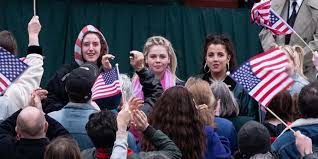


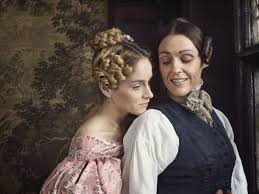
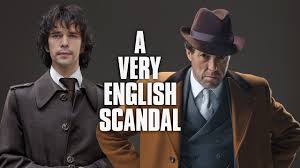
History/Biography: A Very English Scandal, Brexit: An Uncivil War, Cilla, Gentleman Jack, Mo, Poldark, Resistance, To Walk Invisible, Wolf Hall, Summer of Rockets, World on Fire, War and Peace. A Very English Scandal was a startlingly funny and somehow touching take on a scandal that I recall from my early teenage years (the newspaper coverage at the time was highly educational!). I wrote about Gentleman Jack in my review of the year. And Resistance was a powerful – and historically sound, whilst using the device of a fictional central character who could link to all of the key resistance groups and events – account of Occupied Paris, a subject that I find endlessly fascinating.
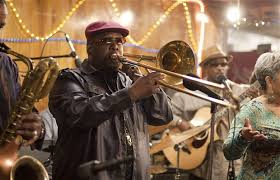
Drama: The Casual Vacancy, Desperate Housewives, Doctor Foster, Spin, This is England, Treme, Years and Years. This is England (the TV series) was so powerful that I haven’t rewatched it. It broke me – particularly TiE88. Treme was a joy – it drew its characters with so much love and understanding, that we ended up loving them too. The cast was brilliant, as was the music (it’s the only drama of the decade that has led us to seek out a whole raft of CDs). And Years and Years was timely, moving and let us hope not overly prescient…



Music
This was the decade that I really got into opera. Having the chance to see (and latterly to review) Opera North productions at Leeds Grand Theatre and Town Hall has been not only a delight but an education. I’ve seen productions from across the centuries, and not only has the singing been glorious, but the stagings have been wonderfully inventive. You can find my reviews of the titles in bold elsewhere on this site.
- Cole Porter’s Kiss me Kate
- Purcell’s Dido & Aeneas
- Poulenc’s La Voix humaine
- Puccini’s La Boheme, Gianni Schicchi, Il Tabarro, Suor Angelica, Tosca, Madama Butterfly and Turandot
- Britten’s Death in Venice and Peter Grimes
- Ravel’s L’Enfant et ses sortileges
- Verdi’s Aida and Un ballo in Maschero
- Falla’s La Vida Breva
- Gilbert & Sullivan’s Trial by Jury
- Bernstein’s Trouble in Tahiti
- Giordano’s Andrea Chenier
- Kevin Puts’s Silent Night
- Handel’s Giulio Cesare
- Martinu’s The Greek Passion
- Strauss’s Salome
- Wagner’s The Flying Dutchman
- Lehar’s The Merry Widow
- Janacek’s Jenufa, Osud and Katya Kabanaova
- Monteverdi’s The Coronation of Poppeia
- Mozart’s Don Giovanni and The Magic Flute
- Rimsky Korsakov’s The Snow Maiden
- Leoncavallo’s I Pagliacci
- Mascagni’s Cavalleria Rusticana
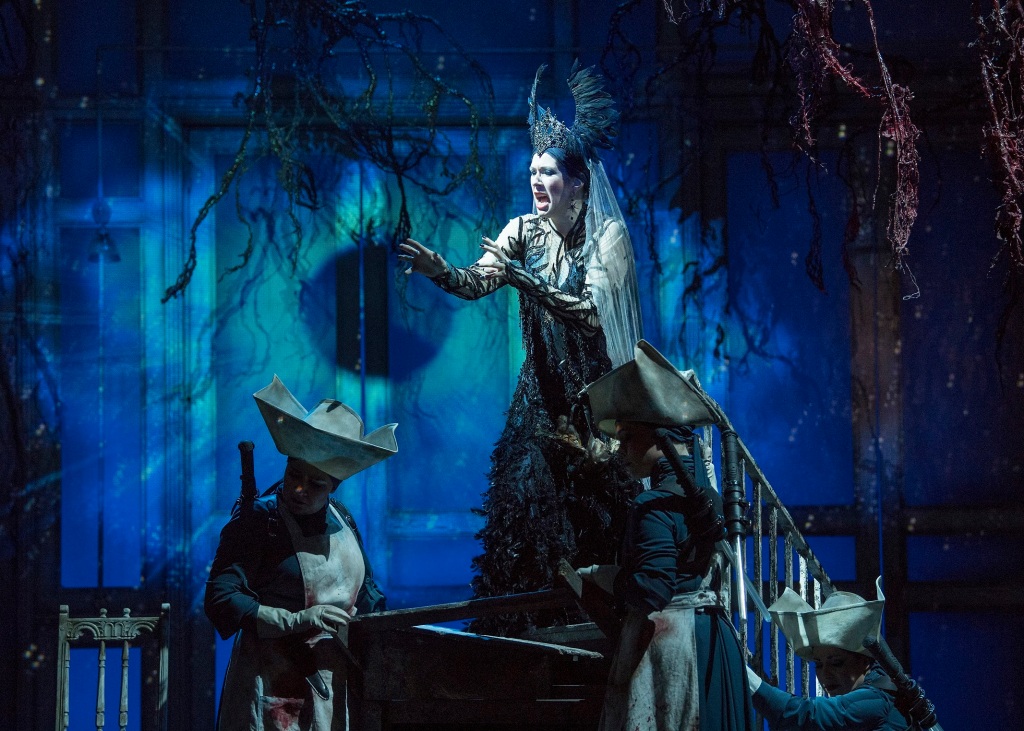
As always, we have listened to a LOT of music. And over the course of the decade, more and more of it has been jazz. That’s partly thanks to Radio 3, with Jazz Record Requests and J to Z bringing us artists we weren’t familiar with along with lots of stuff from long-term favourites (Monk, Miles, Mingus et al). We’ve seen some live jazz too, from the Kofi-Barnes Aggregation, Arnie Somogyi’s Scenes from the City, and the Stan Tracey Octet.
For several years of this decade, Tramlines was where we went, one weekend a year, for live music. Music in pubs and clubs, in parks, in the art gallery, the Cathedral… It’s changed now, and it’s more a conventional music festival, which doesn’t suit us as well (though it’s a great success and a huge achievement for the city) – what we loved was just wandering around the city centre, from one venue to another, catching bands we’d never heard of as well as a few big names. It was bloody brilliant. And it was where we first saw Songhoy Blues, one of my bands of the decade. These young Malian musicians made me dance, made me smile like an idiot, made me cry a little, when Aliou Toure spoke about his country, his continent, and what the music stood for – peace, love, unity.
We’re privileged in Sheffield too to have Music in the Round – chamber music in the Crucible Studio from the house band, Ensemble 360, and a host of guest musicians. As the name suggests, the audience sits around the performers, so you’re guaranteed a good view, and it gives an intimate feel to the event. I could not begin to list the concerts we’ve attended there. Not just classical either – some of the jazz concerts referred to above were in the Crucible Studio, as was a wonderful gig from the Unthanks.
There have been other venues too – a remarkable performance of Terry Riley’s In C, in the Arts Tower paternoster lifts, and a programme of Reich, Adams, Zorn and others at the Leadmill, from the Ligeti Quartet.
So, another decade bites the dust. These have been some of the best bits. Love and thanks to all of the people who’ve shared these cultural delights with me, to all of the people who’ve created and performed these cultural delights for me, and to all of those who’ve passed on their own enthusiasms to me over the years.
Onwards. Whatever the next decade brings, let’s ensure it’s full of wonderful books, films, TV and music. Let’s hang on to the hope that things can and will get better…
2016 in TV, theatre and music
Posted by cathannabel in Music, Television, Theatre on December 13, 2016
I’m very conscious that I’ve watched very few of the series which are getting the Best Of accolades from the quality press. Some of them are sitting on our BT Vision box waiting to be watched, others we didn’t catch on to until they were underway and so are now waiting for the repeats.
Some of what we did watch was old stuff, the crime series that circulate on the Drama channel or ITV3, of which the best was undoubtedly Foyle’s War, for its meticulous attention to historical detail and the wonderful, understated central performance by Michael Kitchen.
We came late to the Scandi party, having missed The Killing altogether, and caught up with the Bridge only on the most recent series, but did enjoy Follow the Money (financial shenanigans), Blue Eyes (politics and right-wing terrorism), Trapped (murder, human trafficking and a heck of a lot of snow). And whilst we wait for Spiral to return, we saw its late lamented Pierre being an unmitigated shit in Spin.
We enjoyed the latest series of Scott & Bailey, Shetland and Endeavour. But the prize here goes (again) to Line of Duty. Vicky McClure and Keeley Hawes were both formidable and the tension brilliantly ramped up.


The Returned returned. Series 2 was as full of mystery and atmosphere as Series 1 and thankfully did not feel the need to offer tidy solutions. It left loose ends, but in a way that suggested the cyclical nature of events rather than anything that could be resolved by a third series.
Orphan Black’s penultimate series was as always thrilling and funny and complicated, with Tatiana Maslany triumphantly playing multiple roles, with such confidence and subtlety that I still occasionally forget that it’s all just her.
The Walking Dead ended its last season on a horrific cliffhanger, and the opener was pretty grim as well. I have doubts about the series – it is inevitably repetitive: our group finds what looks like a haven, the haven is compromised/invaded, a few of our lot are offed, a few new bods tag along, and on they go to the next apparent haven. The big shift is that as the series have progressed, the greatest danger is no longer from the walkers, since their behaviour is predictable and the survivors have developed effective tactics for defence and despatch, but from other more ruthless survivors. This is interesting territory (the walkers themselves are pretty dull, after all), but I’m not convinced by the way the writers are handling the current storyline. And they’ve shown a worrying tendency to make people act out of character, to do utterly stupid things that they know are utterly stupid, in order to move the story along. So, the jury is out, but I will be watching, whatever.


We also thrilled to The Night Manager, London Spy and Deutschland 83, and to the latest adaptations of War and Peace, and Conrad’s The Secret Agent.


The A Word was wonderful – I know that parents of autistic children had some quibbles, particularly about the way in which children who are ‘on the spectrum’ so often are shown as having special abilities, like Joe with his encyclopaedic knowledge of 80s pop, which is not always the case. But this was the story of one child, and his extended family. The performances were superb, the writing subtle and nuanced, and the image of Joe marching down the road, earphones on, singing ‘World Shut Your Mouth’ or ‘Mardy Bum’, will stay with me for a long time.
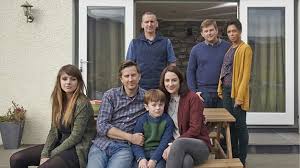
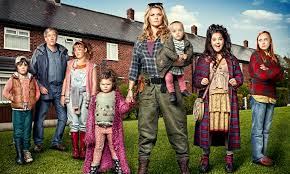
Raised by Wolves had a splendid new series, and then was inexplicably and inexcusably cancelled. Still hoping that Caitlin Moran’s crowdfunding project gets sufficient support to bring it back.
Normally my TV of the year would include Doctor Who, but we’ve had a hiatus this year, and will have to wait till Christmas Day for the special, and then 2017 for a new series (and a new companion). Meanwhile there was Class, on BBC3, which got off to a promising start, but as I’ve only seen 3 episodes so far, all comment and judgement is reserved until we’ve caught up.


At the theatre this year we saw two Stage on Screen performances at the Showroom – the Donmar Warehouse production of Liaisons Dangereuses, with Dominic West and Janet McTeer, and Anthony Sher’s magnificent and heartbreaking Lear.


Patrick Stewart and Ian McKellen at the Lyceum Theatre in Pinter’s No Man’s Land were deeply unsettling as well as darkly funny.
And we saw a glorious reimagining of The Duchess of Malfi, transported to West Africa, as Iyalode of Eti.


Opera North at Leeds Grand Theatre – Andrea Chenier, Giordano’s French Revolution tale of loyalty and revenge and love. And a glorious Puccini double bill – Il Tabarro, and Suor Angelica.


Of course there was Tramlines, about which I have rambled euphorically already. There was also Songhoy Blues in a Talking Gig, performing (and talking) after a showing of the remarkable documentary They will have to Kill us First, about the repression of music in Mali by Islamist extremists. Malian music is something else I have rambled euphorically about, and Songhoy Blues in particular.


Two gigs in the Crucible Studio, the first under the auspices of Sheffield Jazz – The Kofi Barnes Aggregation, a collaboration between two splendid, but very different, saxophonists. And the Unthanks were as spinetingly and goosebumpy and lump in the throaty as I could have imagined, whilst being, in person, down to earth and funny and delightful.


Of course the year began with, in the space of just a couple of days, hearing the new CD from a musician whose music has been part of my life since I was a teenager, and then learning of his death. David Bowie is far from being the only important musical figure to pass away this year – indeed, that great gig in the sky is looking pretty crowded now, with Prince, Leonard Cohen, Keith Emerson and Greg Lake, Sharon Jones, Mose Allison, Pete Burns, Prince Buster, Gilli Smyth, Alan Vega, Dave Swarbrick and George Martin, to name but a few, rocking up over the course of the year. But Bowie was the one who meant the most to me.


It was Heaven
Posted by cathannabel in Events, Music on July 26, 2016
Tramlines. A concentration of musical joy into one exhausting, exhilarating weekend.
We saw 18 bands – could have fitted in a few more, perhaps, and certainly there were so many more that we wished we could have seen. But heavens above, what we did see…
The sheer variety is one thing. Even limiting ourselves to a cluster of City centre venues, we went from indie pop to instrumental jazz to hypnotic electronic trance to grunge to ska to bluesy soul.
Only two bands were known to us, and both of those only through previous Tramlines. Nordic Giants‘ visceral post-rock with accompanying films left us stunned last time and no less so this year – we stumbled out of the City Hall ballroom and took refuge in the Cathedral for Beaty Heart’s psychedelic drum pop.


And we went back for more from Allusondrugs, having been blown away by their urgent psych-grunge with accompanying manic leaping about and flailing of locks a couple of years back. Still just as potent, and the venue enabled the more fearless members of the audience to hurl themselves about with abandon too, joyfully thudding into one another, and screaming out the words. The bass player – and his bass – surfed the crowd too at one point.


Saturday afternoon means the World Stage, in the Peace Gardens. The sun shone for us all and the music was infectious and energetic. Steel City Rhythm‘s reggae fusion featured mad ska dancing and we all danced too, albeit with rather less energy and agility. And Danish band Whiskeyordnen turned up in dapper suits (jackets were soon discarded) and delivered what they variously describe as Worldtheaterjazzfunkrock, Chaoslounge, Fusion, Technojazz, instrumentally tight and delightfully engaging.


Sheffield Cathedral has always been one of our favourite Tramlines venues. It’s not just the deliciously transgressive feeling of sitting on the floor of the Cathedral drinking Moonshine (this year sitting just behind a dude in a Antichrist Bootcamp t-shirt…), it’s that, with the right band, the acoustics become part of the performance. Most bands playing there for the first time are very powerfully aware of the nature of the place, the associations it has and the atmosphere that its architecture creates. This year the music seemed especially well fitted to the venue.


Mt. Wolf, Meilyr Jones, Beaty Heart, Dan Mangan, King Capisce all played with it in various ways, allowing subtle or soaring vocals to resonate, rhythms to echo, and harmonies to multiply. Meilyr Jones at one point abandoned the stage to swim across the stone floor, still singing. And Dan Mangan too left the stage and the amps and performed for us as we sat on the floor around them. The finale was Moon Duo, whose space-rock sounds were accompanied by a light show playing hypnotically across the Cathedral stone work.
What I’ve found myself unable to do this year is to pick one absolute, no real contest, stand-out moment. We didn’t see a duff band this year, and that wasn’t achieved by playing safe. With the two exceptions noted above, we knew nothing about the bands we chose to see, other than the brief (and often enigmatic) blurb in the programme. We took a punt on them, and were rewarded with performances that were at the very least enjoyable and engaging, and at best exhilarating, engrossing, moving and intoxicating.
Throughout the weekend, the city was suffused with music. It seemed to be spilling out from every doorway, every venue packed, the vibes, or so it seemed to us, joyous, positive and inclusive. There’s lots to be anxious about just now. We know that the city is not as united as it seemed to be, as we flitted between gigs and street food emporia. We know too that the aftermath, a sea of cans and bottles and general debris, will not look so lovely and will take a heck of a lot of clearing up. But if we can be united in music for a weekend, dancing together in the sun, that gives me hope. We walk back to the road, unchained.
The children of the summer’s end
Gathered in the dampened grass
We played our songs and felt the Yorkshire sky
Resting on our hands
It was God’s land
It was ragged and naive
It was heavenTouch, we touched the very soul
Of holding each and every life
We claimed the very source of joy ran through
It didn’t, but it seemed that way
I kissed a lot of people that dayOh, to capture just one drop of all the ecstasy that swept that afternoon
To paint that love
upon a white balloon
And fly it from
the topest top of all the tops
That man has pushed beyond his brain
Satori must be something
just the sameWe scanned the skies with rainbow eyes and saw machines of every shape and size
We talked with tall Venusians passing through
And Peter tried to climb aboard but the Captain shook his head
And away they soared
Climbing through
the ivory vibrant cloud
Someone passed some bliss among the crowd
And we walked back to the road, unchained“The Sun Machine is Coming Down, and We’re Gonna Have a Party
The Sun Machine is Coming Down, and We’re Gonna Have a Party
The Sun Machine is Coming Down, and We’re Gonna Have a Party
The Sun Machine is Coming Down, and We’re Gonna Have a Party
The Sun Machine is Coming Down, and We’re Gonna Have a Party.”(David Bowie, Memories of a Free Festival)
Our Tramlines 2016 was:
Friday 22 July
Leadmill: Northern Adolescence, Gramercy Park; Cathedral: Mt Wolf, Meilyr Jones
Saturday 23 July
Peace Gardens: The Unscene, Steel City Rhythm, Bell Hagg Orkestar, Whiskey Ordnen; Cathedral: Dan Mangan; City Hall: Nordic Giants; Cathedral: Beaty Heart
Sunday 24 July
Crystal: Starkins, Allusondrugs; Peace Gardens: Sushi; Leadmill: Reflektor, Hot Soles; Cathedral: King Capisce, Moon Duo
PS Early Bird Weekend tickets for Tramlines 2017? Sorted.
2015 – the best bits
Posted by cathannabel in Events, Film, Music, Personal, Television, Theatre on December 30, 2015
This was the year we threw off the shackles of paid employment. Martyn first, in March, and me at the very close of 2015. It feels terrifying and liberating all at once.
For me, this new freedom will give me more time to do the things I care most about. My PhD, which I hope I will now be able to do justice to. And Inspiration for Life, in particular the 24 Hour Inspire. Of all the things I’ve done over the years, this is what I’m proudest of.
And I hope of course to have more time to do the other things I love, more time to read, write, listen to music, go to gigs, go to the cinema/theatre, meet up with friends, travel, watch some of the box sets which are gathering dust by our DVD player…
Below are some of the cultural highlights of 2015. I’ve been lucky to have access to Ensemble 360, Opera North, Tramlines, Sheffield Jazz etc, and to have wonderful friends and family to share these experiences with.
Film
The best of the year, without a doubt, was Timbuktu. Abderrahmane Sissako’s film is both beautiful and harrowing, a passionate cry from the heart about the threat posed by fundamentalist jihadists to the people, the culture and the music of Mali.
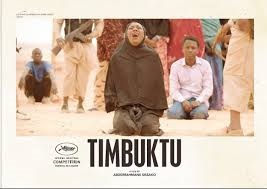


I won’t rank my other favourites, but they are:
Inside Out – Pixar at its very, very best. Clever, imaginative, daring, funny and moving. As the Guardian review said, ‘In the film’s wildest moment, the wanderers enter a zone of abstract thought, where they are zapped into a series of increasingly simplified geometric shapes, as they – and the film itself – dizzyingly self-deconstruct (“Oh no, we’re non-figurative!”)’.
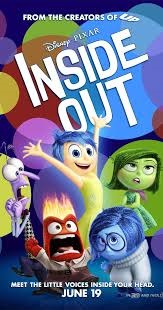
A Girl Walks Home Alone at Night – Ana Lily Amirpour’s film has been tagged as ‘the first Iranian vampire Western’. Atmospheric and full of unexpected touches (including a skateboarding vampire), and a powerful feminist narrative. Sheila Vand has a fascinating face that can look very young and somehow ageless at different moments.


Love and Mercy – biopic of Brian Wilson, portrayed both in the Beach Boy years and in later life, by Paul Dano and John Cusack respectively. Cusack’s portrayal is fascinating – seeing the clip of the real Brian Wilson at the end of the movie, I realised just how perfectly he had captured him, despite the lack of obvious physical resemblance.
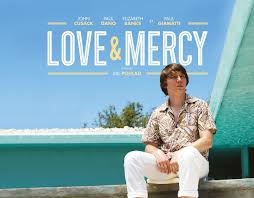
I Believe in Miracles – the story of Nottingham Forest’s astonishing European Cup success. A joy from beginning to end. And featuring a couple of brief glimpses of my kid brother who was a ball boy at one of those games, as well as glorious clips of my all-time footballing hero John Robertson at his best. And funny and poignant anecdotes from the players, and clips of Clough running rings around interviewers.
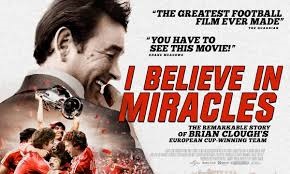
Mad Max: Fury Road – just a blast, possibly the best action movie I’ve seen, with a powerful female lead in Charlize Theron’s Furiosa (an action movie that passes the Bechdel test!), visually almost overwhelming and with an awesome soundtrack. And the Doof Warrior.
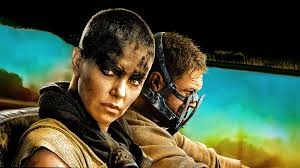
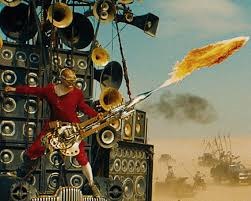
Avengers: Age of Ultron. I’ve written previously about how much I love the Marvel films. This was a joy, thanks in large part to Joss Whedon’s crackling dialogue (the script is often where costs are cut in big budget movies, but thankfully not here).


TV
Lots of Marvel here too, with Agent Carter, Daredevil and Agents of Shield all delivering in spades. Daredevil was the darkest of the three, but the others had their moments and all had humour, well-drawn characters and moments of poignancy as well as action. In other sci-fi/fantasy telly, Tatiana Maslany continued to be astonishing in Orphan Black, The Walking Dead continued to ramp up the tension till it was almost unbearable, and left us at mid-season break with everyone we care about in mortal peril – again. The latter also spawned a prequel (Fear the Walking Dead) which showed the start of the crisis – the bit we missed as Rick Grimes was in a coma in hospital whilst society crumbled in the face of the undead onslaught. And Humans was a thought-provoking and engaging take on issues around AI and what makes us human.


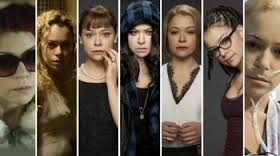
As always we watched a lot of detectives. Two French series – old favourite Spiral was back (we missed you, Laure, Gilou, Tintin et al), and a new drama, Witnesses, was complex and compelling with an intriguing female lead (Marie Dompnier). River was something else – Stellan Skarsgaard’s broody Nordic cop haunted by ‘manifests’ of his dead partner amongst others. Nicola Walker was stunning in this, as was Adeel Akhtar as River’s actual living partner. Walker also caused considerable potential confusion by simultaneously leading in Unforgotten, which made one forget the implausibility of an entire police team investigating a very cold case (and nothing else, apparently) by the subtle and compassionate portrayal of the various suspects as their past actions resurfaced to disturb the lives and relationships they had built. No Offence was refreshing too (though we felt uneasy with some particular plot developments in the later part of the series) with Joanna Scanlan’s DI being startlingly rude, but also funny, forceful and warm, and a fab supporting cast.




This is England 1990
This is England deserves a much more in-depth consideration than I can give it here – one would need to re-view the whole series from the film to this final (if it is indeed that) instalment. But there’s no denying – they can be a tough watch, as brilliantly funny as they often are. It’s not just the moments of horrifying violence, I think the hardest thing would be to have to go through again with Lol her descent into despair in TiE 88. Vicky McClure’s performance was intense without any histrionics and all the more devastating for that. This final part had moments too, relating to Kelly, and to Combo, which stay in the mind. And whilst the ending was upbeat, with that long-postponed wedding and Kelly’s return to the fold, Milky’s separation from the group and the reasons for it, and the likelihood that Kelly’s recovery will not be as straightforward as all that, mean that the darkness is not far away. It’s been a hell of a series, with superb writing and direction and equally superb performances.
Raised by Wolves
When it comes to comedy I can be a hard woman to please. Not that I don’t like a laugh, GSOH, that’s me. But I’ve given up on so many sitcoms because they’ve made me cringe more than they’ve made me chuckle. However, despite feeling slightly neutral about the pilot, I did get into Raised by Wolves, and fell rather in love with the magnificent Della (Rebekah Staton) as well as with the writing, which as expected from Caitlin Moran (and sister Caroline) was rude and exuberantly funny.
Roseanne
We watched this back in the day (88-97) and rewatching it now is punctuated by cries of ‘OMG that’s George Clooney’, or spotting Big Bang Theory cast members (Sheldon’s mum and Lesley Winkle, with Leonard still to show). But what we also realised was how much of our approach to parenting came from this show, where family life is chaotic, temperamental, combative but always loving. And ‘our’ tradition of summoning family members to the meal table with a loud cry of ‘FOOOD’ appears to have been inspired by the Conners as well. As I recall, things went seriously off kilter in later series, but so far, so funny. Joss Whedon had a hand (probably just a fingertip in some eps) in the early series, which can’t ever be a bad thing.
Résistance
French drama focusing on the activities of various Resistance groups in Occupied France – this was obviously a must-watch for me. I hadn’t expected it to be as close to real events as it was, which was a mixed blessing, as I quickly realised who was doomed and who might survive… The central female character, Lili, was a fictional construct, which seems to have annoyed some viewers, but I felt it was a valid way of providing a thread to link the early activity of the Musée de l’Homme group with the Maison de la Chimie and the Combat and Manouchian groups, taking us all the way through to the Liberation. It was a powerful, well constructed drama. And the renditions of the Marseillaise, ringing out in prison cells and in the face of firing squads, came back to us so intensely in November when that spirit of defiance was called upon once again.
Fargo
If the idea of series 1 seemed in principle a bit odd, a second series was all the more so. But if anything, series 2 is even better, even madder, even wittier than the first. The film had Frances McDormand, who is always a very good thing, and series 1 had Allison Tolman, who filled those shoes admirably. In series 2 we root for her dad, Lou (we’ve gone back in time) and grandad Hank (played by Ted Danson), and her mother Betsy (I would like some time to see Cristin Milioti NOT dying of cancer, if that’s OK). And we do kind of root for Peggy too, with her passion for self-actualisation and ‘being the best me I can be’, even if it proves somewhat dangerous for those around her.
Honourable mentions to Homeland, Doctor Foster (Suranne Jones magnificent as a woman scorned), and Jonathan Strange & Mr Norrell.
And of course there was Doctor Who. This year’s Who was top notch. Capaldi really found his voice, the plots were rich and complex without being merely baffling, and the climactic episodes were powerful and moving. I will be writing more about Who in due course.
Theatre
On the Crucible main stage, we saw Arthur Miller’s Playing for Time, with a stunning performance from Sian Phillips, and Romeo & Juliet, with Freddie Fox and Morfydd Clark as the lovers. The Miller play seemed stagey at times (an odd criticism, in a way, for a stage play) but the performances carried it and I reflected afterwards on the way in which the Nazi death machine was itself stagey, whether the intention was to terrify and subjugate, or to deceive. Romeo & Juliet was terrific, but reminded me of how bloody annoying those two are, and it’s no disrespect to the actors that I wanted to give them both a good slap.


Music
Operatic outings this year included a fabulous Kiss me Kate, a powerful Jenufa, and a magnificent Flying Dutchman, all from Opera North.


I’ve written previously about the splendid Bassekou Kouyate gig at the University’s Firth Hall.
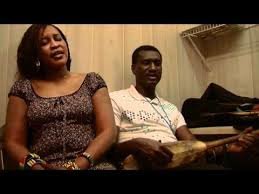
At the Crucible Studio, Ensemble 360 treated us to performances of Mendelssohn, Ives, Janacek, Watkins, Brahms, Berg, Boulez, Kurtag, Mozart and Bartok, amongst others. Such fantastic musicians, and particularly delighted to have had the chance to hear so much 20th century music this year. Same venue, different ensemble – Chris Biscoe’s Profiles of Mingus feat. Tony Kofi on sax (we’d heard him playing Mingus last year, with Arnie Somogyi’s Profiles of Mingus). More jazz, courtesy of Leeds Jazz Orchestra (feat. one Aidan Hallett) in Leeds Golden Acre Park.


And then there was Tramlines. Nothing much to add to what I said at the time, except that I can’t wait for the 2016 festival.
So, thanks to those who shared these highlights with me. I look forward to lots more in 2016.
I hope to blog more in 2016, of course. I managed a post most months in 2015, and the overall total looks more impressive thanks to eight in Refugee Week and a few reblogs from That’s How the Light Gets In and Nowt Much to Say. I blogged for Holocaust Memorial Day, wrote about the Hillsborough inquests, the 24 Hour Inspire, Marvel films, Tramlines, the phenomenon of the ‘fugueur’, the music of Mali, the ‘refugee crisis’, and the murderous attacks by Daesh in Paris and elsewhere. I also blogged for Inspiration for Life, and on the aftermath of the May General Election. Thanks to all who have read, liked, reblogged, commented, etc.
And for 2016, which may seem to hold so much threat and so little hope, I cannot do better than to quote this poem, by Sheenagh Pugh. Apparently she doesn’t rate it – scribbled it in a hurry on a card for a friend going through a tough time. I beg to differ.
Sometimes things don’t go, after all,
from bad to worse. Some years, muscadel
faces down frost; green thrives; the crops don’t fail,
sometimes a man aims high, and all goes well.A people sometimes will step back from war;
elect an honest man, decide they care
enough, that they can’t leave some stranger poor.
Some men become what they were born for.Sometimes our best efforts do not go
amiss, sometimes we do as we meant to.
The sun will sometimes melt a field of sorrow
that seemed hard frozen: may it happen for you.
May it happen for you, may it happen for all of us.
Ears still ringing
Posted by cathannabel in Music on July 30, 2015

That’s what Billy Bragg tweeted, after his set at the Leadmill, which brought [my] 2015 Tramlines to an inspiring and emotional close. Mine too. It was bloody brilliant.
 For me, Tramlines isn’t about the headliners – we didn’t get to the Ponderosa this year, not because there weren’t some great bands on, but because what we love is stumbling across and being delighted by bands we’ve never heard of, and enjoying the music in the multiplicity of venues around the city centre. To go from dancing to ska and afrobeat in the Peace Gardens to drinking Moonshine in the Cathedral (how deliciously transgressive is that) whilst listening to ‘experimental finger-style’ acoustic guitar, or rocking our socks off in the City Hall ballroom – that’s Tramlines.
I don’t know what the total numbers were, but the crowds around town were astonishing. So many performers, looking out at us all from the various stages, seemed genuinely stunned by how many of us there were, and by our enthusiasm, our willingness to jump about, dance and cheer. Maybe I’m naive, maybe I only see the best because I love my city and I love this festival, but there didn’t seem to be, despite the crowds and the fact that there had, most certainly, been drink taken, the level of ugliness that one might normally see on a Saturday night in town. I saw no aggression, only people being communal, enjoying the music together, being excellent to one another, and partying on.
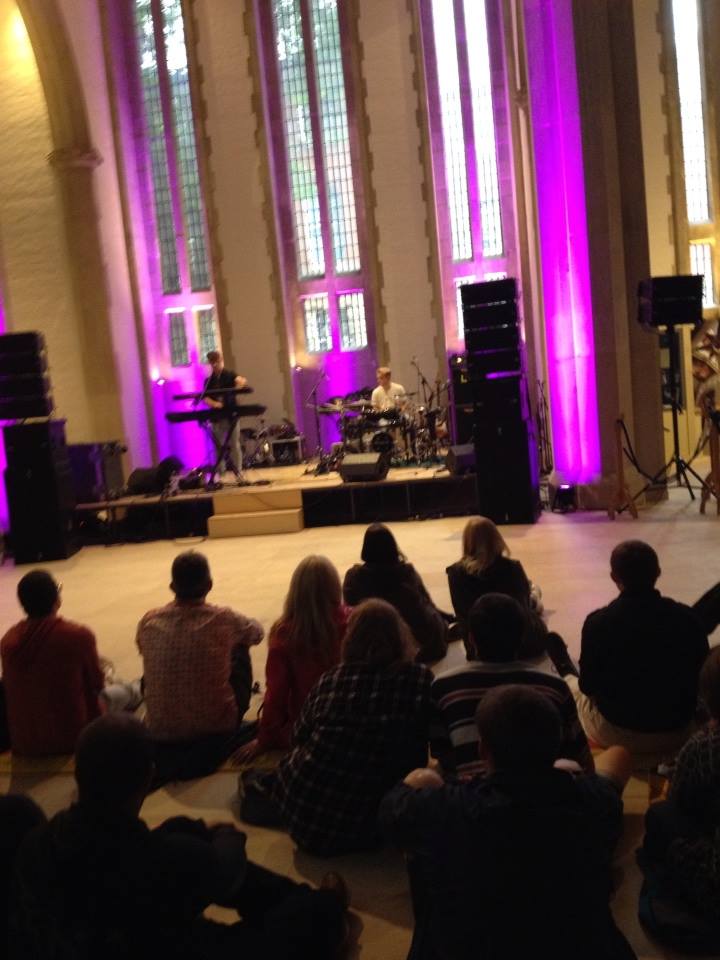

My Tramlines this year was:
- Friday night: Awooga, Lone Wolf (City Hall); Rawshack, Beth Frisby (Millennium Gallery)
- Saturday: Bongo & the Soul Jars, Soulcrates Syndicate (Peace Gardens); Jim Ghedi (Cathedral); Smiling Ivy. Hot Diamond Aces (Cathedral); Blessa, Slow Club (Devonshire Green); Ultimate Painting (Cathedral)
- Sunday: Chris Cooper Band, Downtown Roots (City Hall); Lewrey, Blossomer (Cathedral); Stealing Sheep, Billy Bragg (Leadmill)
Not a bad weekend’s worth of music and I reckon I got my weekend ticket’s worth by the time we headed home on Friday.
Best bits? Beth Frisby was fab. The various ska/afrobeat bands in the (sunny) Peace Gardens were ace, joyous beats making us all dance. Downtown Roots were a blast, channelling Hendrix and Muddy Waters. Stealing Sheep stole my heart. And then there was Billy.
It was late, I was tired, my (wet) feet hurt. But I went home that night not sure whether to laugh, or cry, because Billy made me do both. He was everything I’d hoped for – he was funny, passionate, ranty, utterly professional (didn’t miss a beat when the lights went out on stage during one song, and dealt well with the odd minor heckle), and gave us – again – that weekend ticket’s worth singlehanded. I got right to the front, thanks to the nice bloke who let me through. And the young lads who’d been obliviously hemming me in and blocking my view earlier? Contrary to the grumpy views being expressed by some of those whose view they were blocking, they were there for Billy, they knew all the words, they were singing their little hearts out. He gave us the love songs, the quirky, funny, self deprecating love songs. He gave us Levi Stubbs’ tears, and mine flowed. He gave us the protest songs – and lord, they are as pertinent today as when they were written. He gave us A New England. And he gave us Between the Wars and I cried again and someone in the crowd gave me a hug, just because.
Billy said that the enemy is not doubt, or scepticism. It’s cynicism. Cynicism stops us believing that we can change things, that it’s worth bothering to try. Cynicism stops us believing the best in other people, or the potential in ourselves. There wasn’t much cynicism in evidence last weekend, and especially not at the Leadmill on Sunday night.
To quote Caitlin Moran (in How to Build a Girl), ‘Cynicism is, ultimately, fear. Cynicism makes contact with your skin, and a thick black carapace begins to grow – like insect armour. This armour will protect your heart, from disappointment – but it leaves you almost unable to walk. You cannot dance, in this armour.’ If we want to dance, to laugh and love and share, let alone if we want to change the world, we have to shed that armour and risk being disappointed, risk being disillusioned and let down.
Billy said that we, in the People’s Republic of South Yorkshire, had ‘recharged his activism’. I am damn certain he did the same for us.
Tramlines, Sheffield, thank you for last weekend, and I can’t wait for next time. Early Bird weekend tickets for 2016 on sale now, you say? Hell, yes.
http://www.billybragg.co.uk/index.php
Memories of a (nearly) free festival – Tramlines 2014
Posted by cathannabel in Events, Music on August 1, 2014
Once a year, for the last four years, my city has been taken over by music. In the parks, the pubs, the squares, the cafes, the galleries, even the Cathedral, bands known and unknown have played, and Sheffield people – and visitors from further afield – have listened, cheered, and danced.
I love this city anyway, for its hills, its green places, the way in which it manages to be not just a metropolis but a collection of villages grouped around a vibrant cultural centre. Fill it with music and I am besotted.
It used to be free, and it couldn’t stay that way, sadly. But lots of it still is, and I paid £15 for the privilege of seeing 18 bands last weekend, constrained only by my own stamina, the necessity of spending a little time on boring necessities such as shopping and laundry, and the logistics of getting from one venue to another to see everyone I might have wanted to see.
The sunshine helped of course, and the mood, wherever we went, seemed to be as sunny as the weather. The police reported – well, nothing really. There were grumbles from people who’d bought tickets and didn’t get in to see the big names on Devonshire Green – but if you buy a Glasto ticket (at a somewhat greater cost), does that guarantee you’ll see the headliners? I don’t think so. And there were some late timetable changes which inevitably meant disappointments too. But it was a blast, and a thoroughly joyous weekend.
And the best of it? Unquestionably Malian band Songhoy Blues, playing in the Millennium Gallery on Saturday night. I’d resisted the calls from most bands I’d seen to tell them if I was having a good time, or if I was ready, or to clap along. But when Aliou Toure asked us all ‘You like?’, we told him in no uncertain terms that yes, we did, we liked.
West African music moves me so deeply partly because of my childhood in Ghana, and later in Nigeria. As a small child living near the University campus in Kumasi, we heard the highlife music drifting over from the student residences, a hypnotic blend of Latin sounds and indigenous Ghanaian rhythms. And in Northern Nigeria at the end of Ramadan I watched Tuareg horsemen in blue robes and headdresses charging down the main drag, magnificent and unforgettable.
Over the years I’ve listened to music from all over that continent – many years back I saw the Bhundhu Boys from Zimbabwe and S E Rogie from Sierra Leone live at the Leadmill, and the CD collection (and my iPod running selection) includes King Sunny Ade, Youssou n’Dour, Baaba Maal, Salif Keita, Habib Koite, Tinariwen, Ali Farka Toure and others.
More than any other African music, I come back to the sounds of Mali. Partly it’s because I love the blues, and in Malian music you hear that, the source of the blues, its DNA (as Martin Scorsese put it). There’s immense variety in the music of Mali, the soul of Salif Keita, desert blues from Tinariwen, hints of flamenco in Habib Koite or Toumani Diabete – rich in influences from and on other musical traditions, but always clearly Mali.
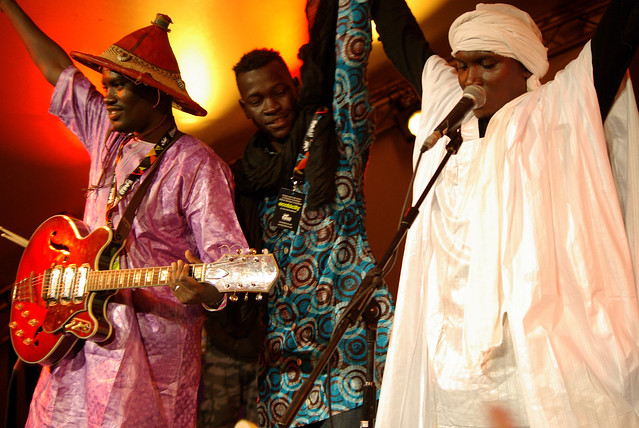
This sublime musical culture has been threatened in recent years but on the evidence of last weekend it is strong, gorgeous, joyous. Songhoy Blues made me dance, made me smile like an idiot, made me cry a little, when Aliou Toure spoke about his country, his continent, and what the music stood for – peace, love, unity.
http://www.theguardian.com/music/2013/dec/04/songhoy-blues-mali-africa-express
http://www.musicfilmweb.com/2014/07/songhoy-blues-mali-music-documentary/
http://www.bostonphoenix.com/boston/music/other_stories/documents/02438282.htm
Toumani and Sidiki Diabate: latest of 71 generations of Malian griots in Liverpool
My Tramlines 2014 was:
Friday 25 July – Shy Nature (Sheffield Cathedral), Allusondrugs (Millennium Gallery), The Wedding Present (Leadmill)


Saturday 26 July – Nordic Giants (City Hall), John T Angle & the Spirit Levels, Laurel Canyons (Cathedral), The Indecision, KOG (Peace Gardens), Juffage, Songhoy Blues (Millennium Gallery)

Sunday 27 July – Max Restraino, Kane’d, Dresden Saints, Broken Saints (Western Park), Woman’s Hour (Cathedral), Blossomer, Neil McSweeney, TOY (Leadmill)
To all of the musicians, and to everyone who made it happen,

2013 – the best bits. And some of the other bits.
Posted by cathannabel in Events, Film, Literature, Music, Personal, Television, Theatre on December 31, 2013
It has been a funny old year. Funny peculiar, though not without the odd moment of mirth and merriment along the way.
I came back from one secondment to my regular job in January, and went off on the next secondment in December. This new one is a major change – working for HEFCE, based at home when not attending meetings in various exotic parts of the UK (oh, OK then, Croydon, Birmingham, Manchester, Dorking…). It’s a fantastic opportunity, and challenges the way I organise my life as well as requiring me to acquire new knowledge and new skills.
I graduated, again. Did the whole gown and mortar board thing which I hadn’t been fussed about when I was 21 and graduating for the first time. And then, with barely a pause, on to the doctorate. Studying part-time, it’s going to be a long haul, with who knows what possibilities at the end of it, but I’m loving it.
In February, a beloved friend and colleague died, and we – his family, friends, colleagues, students – grieved but also worked together to put on an amazing event in his honour, the 24 Hour Inspire. We raised money for local cancer charities, and have raised more since, through an art exhibition, plant and cake sales and various 10k runs/marathon bike rides, etc. And we’re now planning the 24 Hour Inspire 2014, and the publication of Tim’s diary. He will continue to inspire.
Culturally, my high points in 2013 have been:
- Chimamanda Ngozi Adichie at the Showroom, talking about Americanah, and Half of a Yellow Sun
- Peter Hill premiering newly discovered/completed Messiaen at the Upper Chapel (and playing Bach, Berg and Schoenberg too)
- Arnie Somogyi’s Scenes in the City, playing Mingus at Sheffield Jazz
- Tramlines – the Enid in the City Hall, Soukous Revelation in the Peace Gardens, Jim Jones Revue and Selecter at Devonshire Green. (And more, but those were the absolute top bits).
- The 24 Hour Inspire – 24 hours of lectures on life, the universe and everything, including Ed Daw’s blues piano, Rachel Falconer on poetry and birds, Jenny Saul on implicit bias, Claire McGourlay on the Innocence Project, and personal narratives from Brendan Stone and Elena Rodriguez-Falcon. Plus John Cockburn’s rendition of (What’s so Funny ’bout) Peace Love and Understanding, and my favourite Beatles B-side, Things we Said Today, and more busking from Mike Weir, Graham McElearney and Eugenia Chung. And more, lots more.
- Fabulous Beethoven quartets/quintet from the Elias at the Upper Chapel
- A magical Winter’s Tale at the Crucible
- Two awesome Britten operas (Peter Grimes and Death in Venice) from Opera North at Leeds Grand
- New (to me) authors enjoyed this year: Maggie O’Farrell, Louise Doughty, Lucy Caldwell, C J Sansom, Alison Moore, Edward St Aubyn, Rebecca Solnit, Wilkie Collins, Jonathan Franzen
- Wonderful new books from authors I’ve enjoyed before: Stephen King’s Dr Sleep and Joyland, Lynn Shepherd’s A Treacherous Likeness, Jon McGregor‘s This isn’t the Sort of Thing…., Robert Harris’s An Officer and a Spy
- Finally finished Proust’s Sodome et Gomorrhe. Allons-y, to La Prisonniere!
- I’ve learned to love Marvel superheroes (Avengers Assemble! Thor! Iron Man! Agents of Shield!), and have thrilled to The Walking Dead, Orphan Black (virtuoso performance(s) from Tatiana Maslany), Utopia and, of course, Dr Who.
- Speaking of which, not only an absolutely stonking 50th anniversary episode, but also a fascinating and very touching drama about the show’s early days, with David Bradley as William Hartnell, the sweet and funny The Five-ish Doctors, with Peter Davison, Sylvester McCoy and Colin Baker sending themselves and everyone else up with great affection, and Matthew Sweet’s Culture Show special. And the Christmas episode…
- Other cracking telly – Broadchurch, Homeland, Misfits, The Fall, Southcliffe, The Guilty, The Americans… And from across the Channel, not only another masterclass in French profanity from Spiral, but the wonderful The Returned
- And other top films – Joss Whedon’s Much Ado, Lore, The Hobbit Pts 1 & 2, Lincoln, and Patience (after Sebald).
About the blog itself. It’s been less focused on my areas of research recently, and that will continue to be the case, as I’m working on the PhD. The odd digression will find its place here – as Tim used to say, tangents are there to be gone off on, and the blog is a good way of nailing those (to mix my metaphors somewhat) and stopping them from distracting me for too long. I shall be continuing to go on about all sorts of other things that pique my interest. In particular the blog will continue to be a place where refugee stories are foregrounded, as a riposte to the mean and dishonest coverage which those stories tend to receive.
Over the last year, my posting has been somewhat erratic. I note that I didn’t write anything between March and June (I made up for it in June, however, with a Refugee Week blog-blitz, as well as a piece about Last Year at Marienbad which I still intend to follow up. That hiatus may have had something to do with being in the final stages of my degree – finishing off my dissertation, and a last batch of essays and presentations.
There are so many fantastic bloggers out there, too many to do justice to. We lost one this year, as the great Norman Geras passed away. But I’ll continue to enjoy, and to share/reblog That’s How the Light Gets In, Nowt Much to Say, and Futile Democracy, amongst others. For my research interests, I will no doubt continue to find lots to think about and follow up in blogs from Decayetude and Vertigo.
So, thanks to the aforementioned bloggers, to the various people with whom I’ve shared the cultural delights enumerated above, to friends and family who’ve supported me in my ventures and refrained (mostly) from telling me I’m mad to try to do so many things.
Thing is, I have a history of depression. I know that the best way for me to fight that, to avoid sliding back into that dark pit, is to do lots of stuff I care about. So, not just the job – which I care about, passionately – and my wonderful family, but research, writing, ensuring that we do Tim proud via the charity, and so on. I am very aware that there’s a tipping point, that if I do too much stuff I care about, given that I also have to do stuff that I have to do, just because I have to do it, the anxiety of having so much going on can itself lead to sleepless nights, which make me less able to cope, thus leading to more worrying and so on and on… It’s all about balance, and about having support when I need it. So, to all of you who, whether you know it or not, provide that support, and help me to keep that balance, a heartfelt thanks.
In particular, over this last year, I’d like to thank:
For unstinting support and encouragement through the part-time degree and especially as I reached the final stages – tutors Sophie Belot and Annie Rouxeville, and classmate Liz Perry. And a special thanks to Chris Turgoose for ensuring that my graduation gown stayed put via an ingenious arrangement of string and safety pins.
For support and encouragement to go on to the PhD – the aforementioned Sophie, Annie, and Liz, plus Rachel Falconer, Helen Finch, and my supervisors Amanda Crawley Jackson and Richard Steadman-Jones
For their contributions to the work of Inspiration for Life, and the 24 Hour Inspire, and their support in commemorating and celebrating Tim – Tracy Hilton, Ruth Arnold, Vanessa Toulmin, Chris Sexton, John Cockburn, Lee Thompson, Matt Mears and David Mowbray
My family, of course, without whom…
And, finally, Tim. I’d have loved to share this year’s triumphs and tribulations with him.
Have a wonderful 2014 all of you.

 Passing Time