Butor at Belle Vue
Posted by cathannabel in Events, Michel Butor on March 8, 2014
The long history of Belle Vue Gardens in Manchester is being celebrated this month, and it seems timely to note its appearance, under the name of Pleasance Gardens, in Michel Butor’s Manchester-inspired 1956 novel L’Emploi du temps (Passing Time).
Butor’s view of Manchester (Bleston in the novel) was, it must be admitted, largely negative. He loathed the climate, and the food, and seems to have been deeply unhappy in the city, where he arrived to take up the post of lecteur in the French department at the University in 1952.
He seems to have taken to Belle Vue, however. Pleasance Gardens, along with the various peripatetic fairs which rotated around the periphery of the city, on the areas of waste land, represent a mobile and open element in a closed, even carceral city, and a window on different kinds of community than those indigenous to Bleston. The narrator sees the friends he knows in a different light in these places, which may be in Bleston but are not fully part of it and don’t share its malaise.
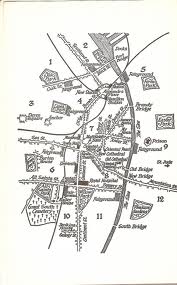

Pleasance Gardens appears on the frontispiece map, in the bottom left-hand corner, its shape not dissimilar to that of the real Belle Vue. Butor took from the real city of Manchester the geography and architecture that interested him and that fitted with his narrative preoccupations, and ignored or altered the rest. The descriptions include a great deal of precision and detail – however, the historians of Belle Vue will have to judge where the fictional version departs from its model.
He describes the entrance to the Gardens:
The monumental entrance-gates whose two square towers, adorned with grimy stucco, are crowned … with two enormous yellow half-moons fixed to lightning conductors, and are joined by two iron rods bearing an inscription in red-painted letters beaded with electric bulbs then gleaming softly pink: ‘Pleasance Gardens’.
The big folding door which is armoured as if to protect a safe, and only opens on great occasions and for important processions, whereas we, the daily crowd, have to make our way in by one of the six wicket-gates on the right (those on the left are for the way out) with their turnstiles and ticket collectors’
The earthenware topped table which displayed, on a larger scale and in greater detail, with fresh colours and crude lettering, that green quarter circle with its apex pointing towards the town centre…
The tickets themselves are described in detail:
the slip of grey cardboard covered with printed lettering: On one side in tall capitals PLEASANCE GARDENS, and then in smaller letters: Valid for one visitor, Sunday, December 2nd. And on the other side: REMEMBER that this garden is intended for recreation, not for disorderly behaviour; please keep your dignity in all circumstances’
On this winter visit:
There was scarcely anybody in the big, cheap restaurants or in the billiard-rooms; avenues, all round, bore black and white arrows directing one to the bear-pit, the stadium, the switch-back, the aviaries, the exit and the monkey-house.
We walked in silence past roundabouts with metal aeroplanes and wooden horses, … and past the station for the miniature railway where three children sat shivering in an open truck waiting to start; and past the lake, which was empty because its concrete bottom was being cleaned’.
Posters everywhere echoed: ‘Come back for the New Year, come and see the fireworks’.
A later visit, in summer, followed one of the fires that feature so frequently in the novel. Belle Vue was devastated by fire in 1958, and whether this account was inspired by a real event I do not know – it may well be that whilst Manchester was plagued by an unusually large number of arson attacks over the period that Butor was there, he extrapolated from that to a fire at Pleasance Gardens, purely for narrative purposes.
In the open air cafe that is set up there in summer in the middle of the zoological section, among the wolves’ and foxes’ cages and the ragged-winged cranes’ enclosure, the duck-ponds and the seals’ basins with their white-painted concrete islands. I could see, above the stationary booths of this mammoth fairground, eerily outlined in the faint luminous haze, the tops of the calcined posts of the Scenic Railway, with a few beams still fixed to them like gibbets or like the branch-stumps that project from the peeled trunks of trees struck by lightning; and I listened to the noise of the demolition-workers’ axes’
If Butor generally warmed to the Gardens, his portrayal of the animals in the Zoo is less enthusiastic – he speaks of the cries of the animals and birds mingling with the noise of demolition, of melancholy zebras and wretched wild beasts, and of their howls during the firework display. Perhaps their imprisonment chimed uncomfortably with his own sense of being trapped in the city.
http://www.manchestereveningnews.co.uk/news/nostalgia/way-were-belle-vue—1209695
Time to Talk
Posted by cathannabel in Personal on February 6, 2014

I’m supporting this campaign by Rethink, to encourage people to talk about mental health. Because it’s hard to speak about it publicly, because there is a stigma attached to mental illness which does not apply to most physical illnesses, because it feels like a weakness, because you think you’re the only one, because you’re afraid (of what you’re experiencing, and of how other people will react).
I wish I could say that ‘coming out’ in this context is always met with outpourings of support and love and help. There’s a lot of that.
But there’s also – telling your boss you’re having treatment (medication and counselling) for depression, and her (a) telling other colleagues to keep an eye on you, (b) telling the management board that you have mental health problems and (c) generally treating you from there on in as a problem, not a colleague who’s having a problem. That was about ten years back – would it be different now? It depends on the workplace, on the boss. It’s risky, and if now I would (and do) say things publicly it’s because in the time since that dark episode I’ve gained in strength and confidence and because what happened to me then made me angry and determined to challenge those attitudes.
Of course there’s also the whole ‘pull yourself together’ thing that will surface, explicitly or implicitly. Especially if your life circumstances don’t ‘justify’ your depression. If bad things have happened to you, and your illness seems to be a result of that, the sympathy will probably be more straightforward. If your life is outwardly fine, then some people – including kind, loving people – will feel that you should be able to sort yourself out.
But a lot of the stuff that deters one from talking openly is internal, not external. No one told me I didn’t have a right to feel depressed because I was physically healthy, employed, solvent and had people who loved me. I told myself that. No one told me I was a failure and a mess, because, since I left the house every day washed, appropriately dressed and apparently functioning, only I knew (for the most part) that I was a failure and a mess. No one told me I couldn’t be really depressed because I kept leaving the house every day washed appropriately dressed and apparently functioning – that was me, telling myself that – as I read account after account of depression, hoping to see myself in there – I obviously didn’t have a serious problem and should be able to sort myself out.
How do you measure the seriousness of depression? I was never hospitalised, I had very little time off work, I was never unable to get up and go through the motions of life. But for a long time I had that nasty little mantra in my mind throughout my conscious day and every time I woke during the night, and for a long time I only smiled when people could see me. For a long time I saw my life as trudging on, up hill all the way, fog and gloom all around me so that I couldn’t see where I was heading, or even see that I wasn’t alone on the path. I wrote a poem along those lines, a very bad poem, long since deleted, but at the time it helped to write it down. People who didn’t know me really well didn’t know – but they sensed something, or perhaps the lack of something, a spark . I had a few job interviews during this period and the feedback suggested a lack of enthusiasm or interest in the post, a lack of dynamism and energy.
Partly, you realise how bad it’s been when it starts to get better. When the mantra stopped. When my smile stayed on my face after I’d shut the door, when no one but me was there. When the fog cleared and I could see that however far I still had to trudge on uphill there was a beautiful view from where I was, and there were people alongside me.
I’m talking about this now – more publicly than I ever have before – because I’m prompted by the Rethink campaign to share my story. And because I know that some people who know me will be surprised, and may think I’m ‘not the type’, but may therefore rethink their assumptions. As you look around you, in a lecture or a meeting, at a party or a gig, there will be people there, talking and laughing and making decisions and relating to those around them, who are or have been in the grip of depression or anxiety, who are struggling with or have struggled with obsessive compulsive behaviour or eating disorders, who are experiencing or have known the intense highs and lows of bipolar disorder. You’ll never know, unless they dare to share it with you.
It’s a part of me, I think, that propensity to slip into the pit. I stay out of it mainly by being busy enough, with lots of things I care about and that bring me joy, but not so busy that I succumb to anxiety and sleepless nights and feelings of panic. I know the signs now, and can usually take preventative steps before I start to slip. Once you’re in there, it’s hard to get out, as Alyssa Day’s blog vividly and powerfully describes.
It shouldn’t be so hard to talk about this stuff. It is, still, and I will press Publish on this post with more trepidation than for anything else I’ve sent out into the blogosphere.
But it really is time to talk.
http://alyssaday.blogspot.co.uk/2014/01/on-one-writer-and-depression-aka-life.html?m=1
http://www.rethink.org/?utm_source=email&utm_medium=informz&utm_campaign=blank
Journeys – Holocaust Memorial Day 2014
Posted by cathannabel in French 20th century history, Genocide, Second World War on January 26, 2014
The journey that we most associate with the Holocaust is the one that ends at those gates.
Our imagination cannot go beyond that point, no matter how many accounts we read from those who survived. Our imagination baulks at the journey to the gates, not just at its ending – the cattle trucks from all corners of occupied Europe filled with people who not so long before had lives, loves, professions and occupations, and had all of those things gradually stripped from them till all that was left was a name on a list.
But for many of those individuals, the Holocaust journey began long before the cattle truck to Auschwitz. The Plus qu’un nom dans une liste project has put together many stories of individuals and families deported from France, and I’ve selected just a couple, to show what happened to them once their homes were no longer safe for them.
The Taussig family left Vienna in June 1939, having obtained a ‘Reisepass’, and left Reich territory the same month via the frontier post of Arnoldstein in Carinthia, where nowadays the three borders of Austria, Italy and Slovenia meet. Rudolf and his wife Leonie, both 56, and their son Hans, 29, crossed into Italy through the Friuli province.


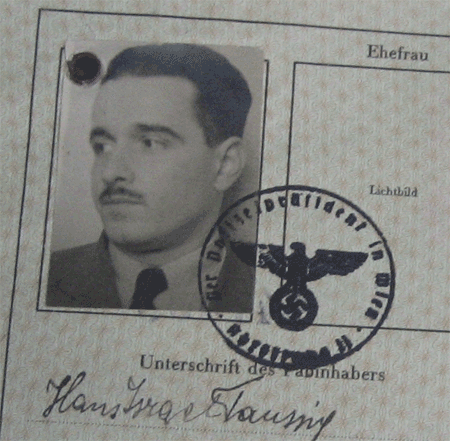
Italy had stopped allowing foreign Jews into its territory by this time, and the authorities probably escorted the family to the Italian Riviera. On 9 July the Taussigs arrived at Roquebrune-Cap-Martin on the Cote d’Azur. The gendarmes had been alerted by phone that a group of refugees were waiting on the beach for the people to whom they’d paid money for safe passage, and arrested them and took them to Menton.
Those arrested that night were:
- Léonie Taussig, born 29/3/1885 in Vienna; daughter of Joseph Bondy and Bertha Donath
- Rudolf Taussig, born 26/5/1883 in Chrudim, Czechoslovakia, son of Adolf Taussig and Louisette Teveles
- Hans Taussig, born 28/6/1910 in Vienna, son of Rudolf and Léonie
- James Landau, born 21/08/1895 in Breslau, son of Wilhem and Henriette Kehlmann
- Bruno Kulka, born 30/12/1894 in Prerou (Moravia), son of Jean and Emma Herzka.
On 11 July Rudolf and family were transferred to Lyon, where he and Hans were interned. Rudolf was freed in January 1940, and Hans on 21 February. On 23 April 1940 Rudolf obtained a refugee worker permit for work as a metallurgist which was extended till 15 July 1941. However, the tribunal in Nice judged them in their absence for having entered France illegally, and condemned them to a month in prison and a fine of 100 francs. Rudolf and Hans served their sentence at the prison St Paul de Lyon and were freed in September 1941. They requested emigration to the USA, where their daughter Alice had already settled – she and her husband had managed to leave France for Portugal, where they got a visa in Lisbon in March 1940.
The Taussig family were arrested during the round-ups in the southern zone in the summer of 1942, interned at Drancy and all three deported to Auschwitz in September 1942 on convoy 27.
The Taussigs’ journey – Vienna to Arnoldstein to Friuli to Roquebrune Cap Martin to Menton to Lyon to Drancy to Auschwitz
Gisela Spira fled Berlin early in 1939 with her mother and elder sister Toni. The three women arrived in Brussels on 31 January, where father Herzel and brother Siegmund were already waiting for them. The youngest brother, Felix, had already been placed by the Comité d’Assistance at the house of the curate of Wezembeek, east of Brussels.
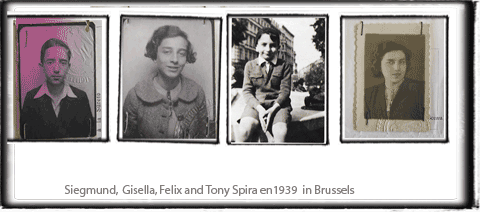
After May 1940, round-ups of German and Austrians in Belgium as enemy aliens prompted the Spira family to go into exile again, and they crossed clandestinely into France. They were interned there almost immediately, at Bram, in the Aude. They were freed on 30 June, and found somewhere to live in Salleles d’Aude, where Gisela met Bertold Linder, ten years older than her, who she married in January 1942.
On 26 August 1942, the Spira family was arrested, apart from Siegmund and Gisela who had moved to Lamalou les Bains, and then to St Martin Vésubie, near the Italian border. Herzel, Rosa, Toni and Felix were deported on Convoy 31 to Auschwitz where they were murdered.
On 25 December 1942, Gisela gave birth to a son, Roland.
Hundreds of Jewish refugees had been forced to settle in St Martin by the Italian administration. Many tried to cross the mountains, hoping to meet up with the Allied army. In August/September 1943, a new danger appeared, as the Wehrmacht occupied the old Italian zone, and on the 10th, the Gestapo arrived in Nice.
At St Martin, the local refugee organisations told families to pack their suitcases as quickly as possible, and to follow the retreating Italian army. Siegmund, Frieda and Roland, and around 1,200 men, women and children then tried to escape across the Alps, a biblical exodus which took place between 9 and 13 September. 328 people were intercepted and escorted to the Borgo San Dalmazzo camp in Italy, under the guard of Italian soldiers until the SS arrived. Two months later, on 21 November, the camp was evacuated, and its inhabitants transported to Nice, where they were interrogated by the Gestapo.
Gisela, her son, brother and husband were deported from Nice to Drancy. On 7 December 1943, they left Drancy on Convoy 64. On 12 December, 13 days after Roland’s first birthday, on disembarking from the cattle trucks, Gisela and her son were gassed at Auschwitz.
Siegmund alone survived. His journey continued from Auschwitz to Bergen-Belsen, where he was liberated. He settled in the USA.
Gisela’s journey – Berlin to Brussels to Bram to Salleles d’Aude to Lamalou les Bains to Saint Martin Vesubie to Borgo San Dalmazzo to Nice to Drancy to Auschwitz
What’s striking is not just how those journeys ended – it’s that process of seeking safety, finding it illusory, moving on in the hopes that the next place will be different. Taking their old lives with them as they went from one apparent haven to the next. In any of the convoys from Drancy there would be those who had sought refuge in France from persecution over the previous half-century from all over Europe, and those whose families had lived in France for generations. There would be workers and bosses, Communists and conservatives, believers and non-believers. Some of their journeys were long and convoluted, like those outlined above, with many apparent reprieves along the way until that final denial of their right to live. Others had been rounded up on French streets where they had spent all their lives, and like Helene Berr, made only a short journey from Paris to Drancy before the terrible journey from Drancy to annihilation.
Those who destroyed them saw them as one thing only. That’s the nature of genocide, nothing matters except that one defining characteristic – you are a Jew, a Tutsi, and therefore you have to die. That’s why we have to make them, wherever we can, more than a name on a list. Gisela Spira, Rudolf Taussig, Helene Berr, deserve their own stories, so that we glimpse the people they were, the people they might have been.
And if we can enter imaginatively into their journeys, can we not also think of them when we hear of those in our own time who are driven from their homes by war and persecution, seeking safety where they can and often finding further perils instead?
Transformation of Sounds
Posted by cathannabel in Genocide, Music, Second World War, W G Sebald on January 25, 2014
W G Sebald describes, in his extraordinary novel Austerlitz, a recording of a film made at the Terezin concentration camp, as part of the effort to present it as a humane and civilised place to visitors from the Red Cross (overcrowding in the camp was reduced before the visit by wholesale deportations to Auschwitz, and once the visitors had left, remaining inmates were summarily despatched too).
In Austerlitz’s search for a glimpse of his mother, who had been interned there before her death, he slows the film down to give him a greater chance of spotting her fleeting image. This creates many strange effects, the inmates now move wearily, not quite touching the ground, blurring and dissolving. But:
‘Strangest of all, however, said Austerlitz, was the transformation of sounds in this slow motion version. In a brief sequence at the very beginning, … the merry polka by some Austrian operetta composer on the soundtrack … had become a funeral march dragging along at a grotesquely sluggish pace, and the rest of the musical pieces accompanying the film, among which I could identify only the can-can from La Vie Parisienne and the scherzo from Mendelssohn’s Midsummer Night’s Dream, also moved in a kind of subterranean world, through the most nightmarish depths, said Austerlitz, to which no human voice has ever descended’. (Austerlitz, pp. 348-9)
The deception that the film sought to achieve is exposed.
The association between Terezin and music has another dimension, however. A remarkable number of inmates were Czech composers, musicians and conductors, and this, combined with the Nazi attempt to make the camp appear to be a model community with a rich cultural life, gave opportunities for music to be created and performed here. There is no easy comfort in this fact, when one knows that most of those who played, composed and conducted died here, or at Auschwitz, and that the moments of escape into this other world were few, and may in some ways have made the contrast with the brutality and barbarism of the regime even harder to bear.
The music of Terezin, however, now reaches new audiences through performance and recordings. Each time we hear the voices of those the Nazis sought to silence, that is a small victory.


Czech conductor Rafael Schachter – transported to Terezin in 1941, organised a performance of Smetana’s The Bartered Bride and finally of Verdi’s Requiem, performed for the last time just a few weeks before his transfer to Auschwitz in October 1944
Jazz musician and arranger Fritz Weiss – arrived in Terezin in 1941, set up a dixieland band called the Ghetto Swingers. Fritz was sent to Auschwitz in 1944, with his father, and was killed there on his 25th birthday.
Viktor Ullmann – Silesian/Austrian composer, pupil of Schoenberg, was transported to Terezin in 1942. He composed many works there, all but thirteen of which have been lost, before being transported to Auschwitz in 1944, where he was killed.
Gideon Klein – Czech pianist and composer, who like Ullmann composed many works in the camp as well as performing regularly in recitals. Just after completing his final string trio, he was sent to Auschwitz and from there to Furstengrube, where he died during the liquidation of the camp.
Pavel Haas – Czech composer, exponent of Janacek’s school of composition, who used elements of folk and jazz in his work. He was transferred to Auschwitz after the propaganda film was completed, and was murdered there.
Hans Krasa wrote the children’s opera Brundibar in 1938, and it was first performed in the Jewish orphanage in Prague. After Krasa and many of his cast were sent to Terezin, he reconstructed the score from memory, and the opera was performed there regularly, culminating in a performance for the propaganda film. Krasa and his performers were sent to Auschwitz as soon as the filming was finished, and were gassed there.

Not all of the musicians of Terezin were killed. Alice Herz-Sommer survived, along with her son. Now 110, Alice sees life as miraculous and beautiful, she has chosen hope over hate.
“The world is wonderful, it’s full of beauty and full of miracles. Our brain, the memory, how does it work? Not to speak of art and music … It is a miracle.”
http://www.terezinmusic.org/mission-history.html
http://www.theguardian.com/music/video/2013/apr/04/holocaust-music-terezin-camp-video
http://holocaustmusic.ort.org/places/theresienstadt/
http://www.theguardian.com/music/2006/dec/13/classicalmusicandopera.secondworldwar
http://www.haaretz.com/weekend/week-s-end/i-look-at-the-good-1.261878
http://claude.torres1.perso.sfr.fr/Terezin/index.html
http://www.musicologie.org/publirem/petit_elise_musique_religion.html
2013 – the best bits. And some of the other bits.
Posted by cathannabel in Events, Film, Literature, Music, Personal, Television, Theatre on December 31, 2013
It has been a funny old year. Funny peculiar, though not without the odd moment of mirth and merriment along the way.
I came back from one secondment to my regular job in January, and went off on the next secondment in December. This new one is a major change – working for HEFCE, based at home when not attending meetings in various exotic parts of the UK (oh, OK then, Croydon, Birmingham, Manchester, Dorking…). It’s a fantastic opportunity, and challenges the way I organise my life as well as requiring me to acquire new knowledge and new skills.
I graduated, again. Did the whole gown and mortar board thing which I hadn’t been fussed about when I was 21 and graduating for the first time. And then, with barely a pause, on to the doctorate. Studying part-time, it’s going to be a long haul, with who knows what possibilities at the end of it, but I’m loving it.
In February, a beloved friend and colleague died, and we – his family, friends, colleagues, students – grieved but also worked together to put on an amazing event in his honour, the 24 Hour Inspire. We raised money for local cancer charities, and have raised more since, through an art exhibition, plant and cake sales and various 10k runs/marathon bike rides, etc. And we’re now planning the 24 Hour Inspire 2014, and the publication of Tim’s diary. He will continue to inspire.
Culturally, my high points in 2013 have been:
- Chimamanda Ngozi Adichie at the Showroom, talking about Americanah, and Half of a Yellow Sun
- Peter Hill premiering newly discovered/completed Messiaen at the Upper Chapel (and playing Bach, Berg and Schoenberg too)
- Arnie Somogyi’s Scenes in the City, playing Mingus at Sheffield Jazz
- Tramlines – the Enid in the City Hall, Soukous Revelation in the Peace Gardens, Jim Jones Revue and Selecter at Devonshire Green. (And more, but those were the absolute top bits).
- The 24 Hour Inspire – 24 hours of lectures on life, the universe and everything, including Ed Daw’s blues piano, Rachel Falconer on poetry and birds, Jenny Saul on implicit bias, Claire McGourlay on the Innocence Project, and personal narratives from Brendan Stone and Elena Rodriguez-Falcon. Plus John Cockburn’s rendition of (What’s so Funny ’bout) Peace Love and Understanding, and my favourite Beatles B-side, Things we Said Today, and more busking from Mike Weir, Graham McElearney and Eugenia Chung. And more, lots more.
- Fabulous Beethoven quartets/quintet from the Elias at the Upper Chapel
- A magical Winter’s Tale at the Crucible
- Two awesome Britten operas (Peter Grimes and Death in Venice) from Opera North at Leeds Grand
- New (to me) authors enjoyed this year: Maggie O’Farrell, Louise Doughty, Lucy Caldwell, C J Sansom, Alison Moore, Edward St Aubyn, Rebecca Solnit, Wilkie Collins, Jonathan Franzen
- Wonderful new books from authors I’ve enjoyed before: Stephen King’s Dr Sleep and Joyland, Lynn Shepherd’s A Treacherous Likeness, Jon McGregor‘s This isn’t the Sort of Thing…., Robert Harris’s An Officer and a Spy
- Finally finished Proust’s Sodome et Gomorrhe. Allons-y, to La Prisonniere!
- I’ve learned to love Marvel superheroes (Avengers Assemble! Thor! Iron Man! Agents of Shield!), and have thrilled to The Walking Dead, Orphan Black (virtuoso performance(s) from Tatiana Maslany), Utopia and, of course, Dr Who.
- Speaking of which, not only an absolutely stonking 50th anniversary episode, but also a fascinating and very touching drama about the show’s early days, with David Bradley as William Hartnell, the sweet and funny The Five-ish Doctors, with Peter Davison, Sylvester McCoy and Colin Baker sending themselves and everyone else up with great affection, and Matthew Sweet’s Culture Show special. And the Christmas episode…
- Other cracking telly – Broadchurch, Homeland, Misfits, The Fall, Southcliffe, The Guilty, The Americans… And from across the Channel, not only another masterclass in French profanity from Spiral, but the wonderful The Returned
- And other top films – Joss Whedon’s Much Ado, Lore, The Hobbit Pts 1 & 2, Lincoln, and Patience (after Sebald).
About the blog itself. It’s been less focused on my areas of research recently, and that will continue to be the case, as I’m working on the PhD. The odd digression will find its place here – as Tim used to say, tangents are there to be gone off on, and the blog is a good way of nailing those (to mix my metaphors somewhat) and stopping them from distracting me for too long. I shall be continuing to go on about all sorts of other things that pique my interest. In particular the blog will continue to be a place where refugee stories are foregrounded, as a riposte to the mean and dishonest coverage which those stories tend to receive.
Over the last year, my posting has been somewhat erratic. I note that I didn’t write anything between March and June (I made up for it in June, however, with a Refugee Week blog-blitz, as well as a piece about Last Year at Marienbad which I still intend to follow up. That hiatus may have had something to do with being in the final stages of my degree – finishing off my dissertation, and a last batch of essays and presentations.
There are so many fantastic bloggers out there, too many to do justice to. We lost one this year, as the great Norman Geras passed away. But I’ll continue to enjoy, and to share/reblog That’s How the Light Gets In, Nowt Much to Say, and Futile Democracy, amongst others. For my research interests, I will no doubt continue to find lots to think about and follow up in blogs from Decayetude and Vertigo.
So, thanks to the aforementioned bloggers, to the various people with whom I’ve shared the cultural delights enumerated above, to friends and family who’ve supported me in my ventures and refrained (mostly) from telling me I’m mad to try to do so many things.
Thing is, I have a history of depression. I know that the best way for me to fight that, to avoid sliding back into that dark pit, is to do lots of stuff I care about. So, not just the job – which I care about, passionately – and my wonderful family, but research, writing, ensuring that we do Tim proud via the charity, and so on. I am very aware that there’s a tipping point, that if I do too much stuff I care about, given that I also have to do stuff that I have to do, just because I have to do it, the anxiety of having so much going on can itself lead to sleepless nights, which make me less able to cope, thus leading to more worrying and so on and on… It’s all about balance, and about having support when I need it. So, to all of you who, whether you know it or not, provide that support, and help me to keep that balance, a heartfelt thanks.
In particular, over this last year, I’d like to thank:
For unstinting support and encouragement through the part-time degree and especially as I reached the final stages – tutors Sophie Belot and Annie Rouxeville, and classmate Liz Perry. And a special thanks to Chris Turgoose for ensuring that my graduation gown stayed put via an ingenious arrangement of string and safety pins.
For support and encouragement to go on to the PhD – the aforementioned Sophie, Annie, and Liz, plus Rachel Falconer, Helen Finch, and my supervisors Amanda Crawley Jackson and Richard Steadman-Jones
For their contributions to the work of Inspiration for Life, and the 24 Hour Inspire, and their support in commemorating and celebrating Tim – Tracy Hilton, Ruth Arnold, Vanessa Toulmin, Chris Sexton, John Cockburn, Lee Thompson, Matt Mears and David Mowbray
My family, of course, without whom…
And, finally, Tim. I’d have loved to share this year’s triumphs and tribulations with him.
Have a wonderful 2014 all of you.

Letting it get to you: Doctor Who and George Bailey
Posted by cathannabel in Film, Television on December 29, 2013
Once there was a planet much like any other. And unimportant. This planet sent the universe a message. A bell, tolling among the stars, ringing out to all the dark corners of creation. And everybody came to see. Although no one understood the message, everyone who heard it found themselves afraid. Except one man. The man who stayed for Christmas. (Doctor Who Christmas Special 2013, The Time of the Doctor)
So, this is the story of a man who got stuck somewhere. ‘Everyone gets stuck somewhere eventually, Clara. Everything ends.’ He could have left, but no one else could have protected that small town as he did, from the forces that were besieging it, and from the war that could have burned it and all around it.

A town called Christmas, blanketed in snow. A town where truth prevails, and people greet each other warmly, and take care of each other, but constantly under threat, with enemies ready to take advantage of any weakness, and the citizens are all potential collateral damage.
If Stephen Moffat wasn’t consciously evoking Bedford Falls in those snowy scenes, I’ll eat my fez. Bedford Falls – the town where another good man got stuck, protecting his family and his community. Where he grew older, his own life on hold whilst he saved other people. Where he kept his promises, and watched his chances slipping away. The enemy from whom he protected people was rampant capitalistic greed, rather than alien races bent on world domination, of course, but it nearly drove him to his death, nonetheless.
George Bailey was a man who dreamed of lassoing the moon, of travelling the world, and who ended up stuck in a small town. The Doctor of course had done more than dream. He had travelled the universe, and time itself, but to quote a contributor to the Doctor Who Forum, Matt Smith’s valedictory episode saw him ‘trying to do something small … spend the remainder of his life protecting the people of one town.’
With every victory, the town celebrated. In time, the Doctor seemed to forget he lived any other life. And the people of the town came to love the man who stayed for Christmas.
But the man who stayed did not do so without argument, without at least an internal struggle. We see George Bailey’s anger and frustration at so many moments in the narrative, even as he does what he knows is right, he rages against what it’s costing him. The Doctor too has that fight between the promise he must keep and the life he wants to live.
Clara: What about your life? Just for once, after all of this time, have you not earned the right to think about that? Sorry. Wrong thing to say. We shouldn’t be having an argument.
The Doctor: Clara, I’ve been having that argument for the last three hundred years. All by myself.
Clara: But you didn’t have your TARDIS.
The Doctor: Ah, yes, well that made it easier to stay. True.
The absence of the Tardis may have made it easier, but we can be pretty sure that he would have found a way to leave, if he’d made the decision to do so. I was reminded here not only of IAWL, but of Albert Camus’ doctor, Rieux, in plague-ridden Oran (referencing Nazi-occupied Paris), knowing he must stay even when he is offered a chance to leave, because he has to save lives:
“I have no idea what’s awaiting me, or what will happen when this all ends. For the moment I know this: there are sick people and they need curing.” (The Plague)
Or as the Doctor said, ‘Every life I save is a victory. Every single one’.
Doctor Who is not ‘a kid’s show’ in any sense that reduces its value, its quality or its depth. But it is a fantasy, and one that is aimed at family audiences, in this case, gathered around a Christmas tree, replete with turkey and pud, and possibly still wearing, slightly askew, their paper hats. So we don’t expect the kind of ending that Camus was prepared to give us. We know that the Doctor will not be destroyed. The end that he speaks of is the end of THIS Doctor, not of THE Doctor – though he may not know this as he says it.
Emma: What’s wrong?
Clara: I just saw something I wish I hadn’t.
Emma: What did you see?
Clara: That everything ends.
Emma: No, not everything. Not love. Not always. (from ‘Hide’)
We’ve often been invited to contemplate what the world would be like without the Doctor. But that’s too terrible to do more than glance at and then look away. A world without the sound of the Tardis bringing hope, without the Doctor to bring protection and healing? No thanks. None of us would sleep at night if that was what we were confronted with, on a Saturday afternoon, let alone on Christmas Day.
But we are increasingly, in the more recent series of Dr Who, asked to deal with some much more grown-up themes. Maybe this reflects the changing audience. When Who launched, it was clearly aimed at children, and adults watched with their offspring, to remind them afterwards that it was only a story (only a story? As if there could be anything more important than stories) and that they could sleep safe in their beds. As those children grew up they stayed with the Doctor, and watched with their own children. Some of those parents too, I suspect, stayed with it long after their children needed them there for reassurance, and so we now have several generations for whom it is precious and important.
Someone said to me the other day, who hadn’t seen Who since they were a kid (we reminisced about the terrifying Autons and the Cybermen and the Yeti…) that whilst they could remember being scared, they couldn’t imagine being moved to tears by it. And yet these days more often than not, I am moved to tears. This is not just because my tear ducts are on a hair-trigger now – it’s because in Who since the reboot we’ve faced grief and loss, loneliness, ageing, choices made and chances missed, the possibility and threat of change. The recurring theme of memory has a poignancy now that it would not have had years ago, now that there’s so much more to remember, and the fear that those memories will start to be engulfed in fog. It gets harder to ‘remember all the people that you used to be’, whether you’re a Time Lord or not. The young me would not have been as devastated by ‘The Girl Who Waited’ as the middle-aged me was, nor as haunted by the question ‘Are you my mummy?’. And the young me would not have felt George Bailey’s despair, or the Doctor’s, as keenly. If you’re old enough to have lost people, to have had to make hard choices, to have got some of them wrong, and to have missed chances that will not come round again – then you can feel for George Bailey, and you can feel for the Doctor too.
Who and IAWL also share a humanistic perspective. IAWL of course starts with prayers, ‘ringing out to all the dark corners of creation’, and an angel. George prays too, though he’s not a praying man, and Clarence (AS2) is the answer. But all that Clarence does is to give George a glimpse of how, and how much, he matters. The miracle is wrought by human action, by people moved to generosity to help the man who’s been so generous to them. Remember ‘The Wedding of River Song’?
The sky is full of a million million voices saying, “Yes, of course we’ll help.” You’ve touched so many lives, saved so many people, did you think when your time came you’d really have to do more than just ask? You’ve decided that the universe is better off without you. But the universe doesn’t agree.
It’s people, for good and bad, who make Bedford Falls, or Pottersville. In Who too, whilst our hero is more than human he is no superhero, nor yet a god. His judgement is often flawed, his personality too. He’s prone to grumpiness, to vanity, to arrogance. He does the right thing but often is prompted or inspired by his own guardian angel, the companion/associate who shows him a truth he’s not able to see, or who intervenes for him when he cannot or will not plead for himself.
As Liam Whitton recently wrote in Humanist Life:
It’s one of the most humanist television shows of all time. In fact, at practically every turn up to now it has presented the philosophy of its title character, the Doctor, as an emphatically humanist one. If there’s one thing the Doctor values, it’s human life, and if there’s one thing he consistently stands in awe of, it’s human potential. He abhors superstition; he scorns pointless prejudices; he believes fervently in reason; he is sympathetic to the beliefs of others, but will not kowtow to them when a fundamental liberty is under threat.
Steven Spielberg once said that ‘ It’s a Wonderful Life shows that every human being on this Earth matters – and that’s a very powerful message.” It’s also a message reiterated over and over again by Who. Capra offers us hope based in human nature. ‘Goodness, simplicity, dis-interestedness: these in his hands become fighting qualities’ (Graham Greene, reviewing Mr Deeds Goes to Town, The Spectator, August 28 1936).
If you believe that humanity is all there is, that makes it so much more vital that we care for each other, because we’re all we’ve got, and these years we have on the planet is all we’ve got. I believe in Doctor Who. I believe in George Bailey. Call me idealistic, naive, if you like, but bear in mind that my academic research interests find me often mired in the history of the most appalling acts that humanity is capable of. So I do know that we don’t all live in a town called Christmas, or Bedford Falls, and that very often no one comes to save and to heal. But that humanistic vision is vitally important to me. Joss Whedon said it well, as he so often does, in Angel:
If there’s no great glorious end to all this, if … nothing we do matters … then all that matters is what we do. ‘Cause that’s all there is. What we do. Now. Today. … All I want to do is help. I want to help because I don’t think people should suffer as they do, because if there’s no bigger meaning, then the smallest act of kindness is the greatest thing in the world.
But it’s only right and proper that I leave the last words to the Doctor:
Letting it get to you. You know what that’s called? Being alive. Best thing there is. (The Doctor’s Wife)
You are now in Bedford Falls
Posted by cathannabel in Film on December 23, 2013

It’s a Wonderful Life. Often described as ‘heartwarming’, which I usually interpret as a warning, a euphemism for cloying and sentimental. It’s a family Christmas film, yes, but so much more. It breaks my heart each time I watch it, and at the same time it heals me. It speaks to the disappointments, the failures, the wrong choices, that are part of everyone who’s been around for a while. It speaks to the idealism, the sense of values that aren’t monetary, that are part of everyone who gives a damn, whether it’s their turn or not.
It earns that ending, that wonderful, ridiculous ending. Because we feel George’s despair, and we feel his frustration and anger at the irreconcilable conflict between what he wants his life to be and what it has to be. He does the right thing, because he can’t not do the right thing, but we see what it costs him. On an individual human level, we identify with George because he really isn’t OK with the failure of his plans and dreams, he’s not at peace. And we admire him because nonetheless he will always do what is right. (Indeed, if it seems frivolous to link him to Mandela and Picquart, the heroes of my last two blogs, so be it.)
But the film is not just about an individual, it’s also about a community. George’s choices made Bedford Falls what it is. But this wasn’t because he did it all himself. He inspired other people, gave them the courage to do the right thing, to be as generous as he was. The direct impact – the lives he saved through direct intervention – are only part of it. People who in Pottersville were mean and fearful weren’t born that way, they learned to be mean and fearful because their lives had taught them that other people couldn’t be trusted, that everyone was out for themselves, that mistakes and misfortunes would be punished. In Bedford Falls, they saw generosity and kindness, and mistakes and misfortunes met with sympathy and support, and they learned to be generous and kind themselves.
It’s so easy to despair, when we see so many examples of meanness, prejudice, callousness to others’ misery. We’re encouraged to be xenophobic and suspicious. Watch out! In January we will literally be unable to move for Romanians and Bulgarians every single one of whom will be coming here to take our livelihoods. Watch out! That neighbour who you haven’t seen leaving for work recently is probably spending all day on the sofa in a onesie watching Jeremy Kyle and scrounging huge amounts in benefits.
We can choose instead to live in Bedford Falls. Why would we do otherwise? The Potters of our world will continue to spin their scurvy little webs, but we don’t have to acquiesce. So, for 2014, my mantra will be ‘You are now in Bedford Falls’, and whenever I encounter stories that show how communities can work together, support each other, reach out to those who need help, across the boundaries that might be expected to divide us, I’ll share them, with that hashtag. There are a couple below, for starters.
I don’t believe that humanity is a lost cause. I do believe that humanity is all there is, and that makes it so much more vital that we care for each other, because we’re all we’ve got, and these years we have on the planet is all we’ve got. Joss Whedon said it well, in Angel:
If there’s no great glorious end to all this, if … nothing we do matters … then all that matters is what we do. ‘Cause that’s all there is. What we do. Now. Today. … All I want to do is help. I want to help because I don’t think people should suffer as they do, because if there’s no bigger meaning, then the smallest act of kindness is the greatest thing in the world.
Postscript
This year, in particular, these words from It’s a Wonderful Life have greater poignancy and resonance than ever:
Strange, isn’t it? Each man’s life touches so many other lives. When he isn’t around he leaves an awful hole, doesn’t he?
Because we got to find out what an awful hole was left when Tim Richardson died, in February. The memorial blog we set up for him tells so many stories of how his life touched those of others, and how much he is missed. And in his honour, we held the 24 Hour Inspire event, a community coming together to celebrate his life, his influence and his inspiration. It was a joyous occasion. And it was a glimpse of life in Bedford Falls.
http://www.theguardian.com/uk-news/2013/dec/20/bradford-synagogue-saved-muslims-jews
A tale of two villages: it could be a wonderful life
Posted by cathannabel in Refugees on December 18, 2013
I wanted to blog something for International Migrants Day. Not for the first time, Gerry’s wonderfulThat’s How the Light Gets In blog has done that better than I could. An inspiring piece, referencing the best film ever.


The path to utopia
Politicians and media whipping up anti-immigrant hysteria. Savage welfare cuts while the super-rich live high on the hog. Deepening inequality and zero-hours contracts. Rapacious banks and untamed corporations. Corporate greed gouging the common weal. In these austere times, like George Bailey in It’s a Wonderful Life, one can easily become discouraged. The joyous cacophony of community life in Bedford Falls can seem like a distant dream of the silver screen.
But wait: here’s a tale of two villages. Real places, inhabited by real people who have taken a stand against profit and materialism, racism and fear. Two villages.
One….
Spain has been one of the countries hit hardest by the banking crash. At around 26%, Spain’s unemployment rate is the highest in the EU (and youth unemployment is nearly double that figure). In the wake of Spain’s property crash, hundreds of thousands of homes have been…
View original post 1,669 more words
‘That is not right’ Pt 2
Posted by cathannabel in French 20th century history, Politics on December 14, 2013
It was sheer coincidence that in the week that Nelson Mandela died, and having been musing on integrity and courage, I read Robert Harris’s An Officer and a Spy. No obvious connection, one might think, between the death of a South African leader and a historical novel set in France at the end of the last century. Wrong.
An Officer and a Spy is the story of Georges Picquart, one of the key players in the fight to win the freedom of Alfred Dreyfus, falsely accused of treason, and who suffered humiliation, disgrace and imprisonment himself along the way. The fascinating thing about this story, and where it differs most profoundly from that of Mandela, is that whereas Mandela, as a young black man in apartheid South Africa, was aware every hour of every day of the injustice that he confronted, Picquart was an establishment man, an army man, who trusted the chain of command and was trusted by it. But he reached a point when he said, ‘that is not right’, and from that point on, he did not stop, even when it appeared he might lose everything.

Picquart did not start by believing in the innocence of Dreyfus. He had no predisposition to see conspiracy, or prejudice, at work. He became uneasy, as he discovered tiny details which didn’t quite fit with the established version of events, but his crusade began when he realised not only that Dreyfus was innocent, but that the establishment knew this, and had no intention of doing anything about it, but would allow him to continue to suffer on Devil’s Island, whilst the real guilty party (also known to the powers that be) retained his freedom, his army post, his salary.
Picquart wasn’t motivated either by personal fondness for Dreyfus (he knew him, and didn’t like him particularly), nor out of lifelong principled opposition to the anti-semitism which allowed Dreyfus to be made a scapegoat and his guilt to be so easily believed (he shared the low-level anti-semitic assumptions of his era and his class, assuming that Jews put loyalty to their own kind above loyalty to the country they lived in). His heroism lies precisely in those facts. Once he suspected that an injustice had been done he had to know, and once he knew, he had to act. He was demoted, sent abroad to high risk postings, kept under surveillance, his mail opened and his family and friends investigated. He was himself accused and imprisoned, only vindicated when Dreyfus himself was freed. He never faltered.
I won’t reprise the story of the Dreyfus affair here, because (a) it’s complicated and (b) you’ll have far more fun reading the account in Robert Harris’s novel.
My own interest in it resides partly in its place in French history and culture. Two of my favourite writers played a part in the story – Emile Zola of course produced the famous article ‘J’accuse’, in defence of Dreyfus, and was convicted of libel and removed from the Legion d’Honneur as a result. 
And reading Proust made me aware for the first time how one’s take on Dreyfus’s innocence or guilt defined one, and divided society – dreyfusard or anti-dreyfusard, pretty much all of his characters are self-declared as one or the other. As Boyd Tonkin wrote recently in The Independent:
In many ways, the Dreyfus Affair lends In Search of Lost Time its moral spine. For Proust the Dreyfusard, who organised a petition in support of the tormented prisoner on Devil’s Island and avidly attended the 1898 trial of Émile Zola for criminal libel after he published his famous denunciation “J’Accuse”, attitudes to Dreyfus not only split the social milieu he depicts down the middle. They test and define the mettle of his main characters. To the Proust scholar Malcolm Bowie, the case gave Proust his “great experimental laboratory”. It runs like a live wire through those seven volumes.
It clearly also is a fascinating episode in the history of prejudice and anti-semitism. The case played its part in the founding of Zionism as a political force, as Theodor Herzl said:
“if France – bastion of emancipation, progress and universal socialism – [can] get caught up in a maelstrom of antisemitism and let the Parisian crowd chant ‘Kill the Jews!’ Where can they be safe once again – if not in their own country? Assimilation does not solve the problem because the Gentile world will not allow it as the Dreyfus affair has so clearly demonstrated”
Herzl was proved right in the case of France, as only 36 years after Dreyfus was finally pardoned, and 7 years after his death, Jews were being rounded up on the streets of Paris, herded into transit camps and then into cattle trucks before being deported to Auschwitz. Then, as there had been during the Dreyfus affair, there were people who were driven by hatred, people who colluded in injustice out of fear or complacency but also, throughout that dark time, people like Picquart, who were unable to be passive in the face of such injustice and evil, and who risked everything to stand against it.
Robert Harris – An Officer and a Spy (Hutchinson, 2013)
Related articles
- dreyfus still an affair (3quarksdaily.com)
‘That is not right’
Posted by cathannabel in Politics on December 7, 2013
It seems that everyone had something good to say about Mandela, the day that his light finally went out. Everyone admires, respects, venerates the man. It’s easy to forget that it wasn’t always this way.
There was a time when you would not have found politicians of all stripes queuing up to contribute their eulogies. There was a time when the evil, brutal apartheid system had its defenders outside of the extreme fringes of white suprematism. There was a time when some world leaders saw white South Africa as a bastion against Marxism, and opposed sanctions aimed at undermining the apartheid regime. There was a time when the public schoolboys in the FCS produced t-shirts saying Hang Nelson Mandela. (Some of them are in government today, paying their respects, and hoping that those past statements and actions don’t surface.)
There was a time when it seemed hopeless, impossible that South Africa could ever be a place where the black majority and the white minority could live together, without bloodshed. For all the problems it has today, there are generations who are and will be born free, and for that Mandela must be thanked, because he was probably the one man who de Klerk could deal with, a man forged by his long imprisonment, who had mastered his anger and bitterness and who was prepared to risk the accusations that he had ‘sold out’ in order to win freedom for his people.
For all the reasons to despair – and there are many – we have to recall how far we’ve come, in my lifetime. I would not have believed, in my twenties, anyone who told me that, before I reached old age, we would have a black President in a democratic South Africa, where there had been no bloody civil war. That there would be a black President in the White House. That the Berlin Wall would have fallen. That gay men and women would be free to marry, in so many parts of the world and, soon, here. These things haven’t come about through violent revolution but through the Mandelas of the world, some well known but many quite anonymous, against the odds, in the face of the haters and the threats, insisting on justice. As Richard Stengel’s Time tribute to Mandela says:
deep in his bones was a basic sense of fairness: he simply could not abide injustice. If he, Nelson Mandela, the son of a chief, tall, handsome and educated, could be treated as subhuman, then what about the millions who had nothing like his advantages? “That is not right,” he would sometimes say to me about something as mundane as a plane flight’s being canceled or as large as a world leader’s policies, but that simple phrase — that is not right — underlay everything he did, everything he sacrificed for and everything he accomplished.


