Boat People
Posted by cathannabel in Refugees on June 16, 2015
The first time I was aware of this phrase was in the late 1970s. The boat people then were fleeing from Vietnam, in the bitter aftermath of that long war. Others fled from Cambodia and Laos as repressive governments took over in those countries, and those who couldn’t afford to buy a safer passage by bribing government officials to give them the necessary papers took to the boats, as so many others have done in the decades since.

 The mass influx of refugees caused problems then to the countries on whose shores they landed. But there was a concerted, international effort, to spread the load, to share the responsibility. Various memorials in western countries pay tribute not only to the boat people who didn’t survive that perilous voyage, but to the nations who took them in, supported them in making a new life. Some of this was down to guilt – in the US in particular, who had lost a war and left those they had fought for and with to the mercy of the victors. Even so, this benign response didn’t last. Soon enough, the argument was made that many of those seeking refuge were not asylum seekers but people seeking a better life (sound familiar?), and therefore found themselves in detention centres whilst their claims were examined. If they were unsuccessful they faced deportation.
  In more recent years, people continue to risk their lives on the sea. Rohingya people fleeing persecution in Myanmar (Burma), refugees from conflict in Eritrea, Syria, Afghanistan and elsewhere. So many lives have been lost – the vessels barely seaworthy and overloaded with desperate humanity, and apparently all too often a world prepared to look on and judge that these people are not worth the cost of rescue.
 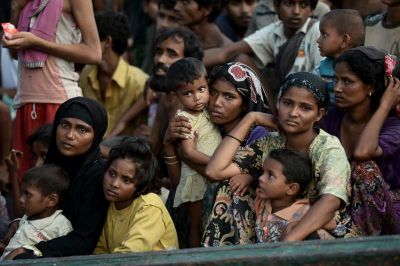 Just the other week, David Cameron claimed that the ‘vast majority’ of those who set sail across the Med are not asylum seekers but ‘ people seeking a better life’. He makes it sound a bit like someone who emigrates to Australia for the climate or a better paid job, or who moves out of the big city for a more peaceful life in the countryside. Actually, the better life they seek is a life free from fear of bombs, guns, starvation. As Somali British poet Warsan Shire says, “No one puts their children in a boat unless the water is safer than the land.”
Some commentators have shown a quite remarkable ability to scan the faces in the boats and judge where all of these people are from and therefore the validity of their claim. Abdallah’s story suggests why this is nonsensical – he is originally from Darfur, but fled after his village was destroyed, his father killed and his sisters raped, on to South Sudan straight into another civil war, a punishing journey across the Sahara which killed his cousin and brother, and then to Libya. And his third civil war. He saw the risk of the Mediterranean voyage as no greater than the risk of staying – and going home as not even a possibility. 

The other thing that is ignored by those who want to categorise these boat people as ‘economic migrants’ is that whilst they may indeed have left their homes to take up jobs elsewhere – and then somewhere along the line their employers take their passports, and essentially treat them as slave labour. If they protest, they risk being reported to the police. And if they leave entirely, they risk being arrested as an illegal migrant. So they can’t go home, even if home is not itself a dangerous and hostile place, because they have no papers. The traffickers will take them.
People talk as if these are people who have choices. As if they can plan a journey to the nearest country where they won’t actually starve or be killed. It’s really not like that. They say we need to focus on stopping the traffickers – sure, but as well as rescuing the people they traffic, not instead. It’s been suggested that if we stop rescuing them they will stop coming. No, if we stop rescuing them they will keep on coming and they will keep on drowning.
http://www.bbc.co.uk/news/world-europe-24521614
html http://www.unhcr.org.uk/news-and-views/news-list/news-detail/article/mediterranean-crossings-in-2015-already-top-100000.html
REFUGEE WEEK 2015 #RefugeesContribute
Posted by cathannabel in Refugees on June 15, 2015
You only have to look around you to see that refugees have contributed, historically. Your knickers may well come from Marks & Spencers. Your pantry may well stock the odd pack of Tilda rice or Patak’s curry paste. Your CD collection may well include something by MIA or Arnold Schoenberg, Wyclif Jean or Bela Bartok. Your bookshelves may well include works by Thomas Mann or Nabokov, your children’s bookshelves those of Judith Kerr or Jan Pienkowski. And that’s before you consider the contributions of the scientists, the philosophers, the painters, the film directors, the sportsmen and women who, at some point in their lives, had to leave their homes to find safety somewhere else.
Of course most refugees won’t turn out to be another Einstein, Marx or Freud. And those who arrive with nothing but the clothes they stand up in, and who live in near destitution, and in fear of deportation back to the peril that they risked everything to escape, will struggle to do much more than survive. But if they are given the chance to be who they can be, free of the threat of starvation, violence and persecution, if they are given the chance to use the skills and qualifications they already have, or to acquire skills that can be used to earn a living and pay taxes, who knows?
If we had not welcomed the children from the Kindertransport in 1939, we would never have known the contribution of impresario Bill Graham, entrepreneur Steve Shirley, film director Karel Reisz, Nobel Laureates Walter Kohn, Arno Penzias and Jack Steinberger.
If CARA had not enabled Jewish academics to take up posts in UK Universities in the 1930s, when they were unable to work in their home countries, we might never have known the contributions of Ernst Gombrich, Nikolaus Pevsner, Karl Popper, Max Born or Hans Krebs. Those individuals might well have been swallowed up in the barbarity. Anne Frank and Helene Berr left only their extraordinary diaries to suggest what might have been. Gideon Klein, Pavel Haas, Viktor Ullmann and Hans Krasa left only tantalising fragments of the musical oeuvre that they could have achieved. Walter Benjamin, Marc Bloch, Irene Nemirovsky, Max Jacob, Dietrich Bonhoeffer- all left a substantial legacy, but could have gone on, could have continued to influence and inspire.


If you really look at the photos above, what do you see? I see weariness and bewilderment, but also a fragile hope, the beginnings of belief in a future that isn’t all about fear and a desperate struggle to survive. I see people like us who had everything they’d relied upon taken away from them, and who have no choice but to trust to the kindness of strangers. We’ll never know the potential of the lives that are lost in the warzones and killing fields of the world, unless we help people in desperate straits to get out, and make a new life in safety.
They won’t all change the world – but they could change us. Our communities, fearful as they are, can gain from hearing the voices of people who have endured more than most of us could possibly imagine, and understanding that it’s all rather more complicated, and at the same time rather less threatening, than the rhetoric of the ‘send them all back – Britain is full’ brigade suggests.They can give us the chance to see things differently, to broaden our horizons as we open our eyes, our ears, our hearts, our homes.
http://www.unhcr-centraleurope.org/en/about-us/unhcr-people/prominent-refugees.html?start=9
http://blogs.redcross.org.uk/refugeesservices/2015/05/i-am-the-neighbour-youve-never-met/
http://blogs.redcross.org.uk/uk/2014/06/we-want-to-thank-the-public-for-letting-refugees-come-here/
Refugee Week 2015
Posted by cathannabel in Refugees on June 14, 2015
I started this blog in 2012, and when Refugee Week came around that year, I decided to try to publish something every day, either my own writing or a reblog of something interesting I’d found online, about refugees. I’ve done that each year since. It’s a self-imposed challenge that I get anxious about in advance – will I be able to find the time to write, will I find things to write about, will anyone be interested? But once I get started, each year the stories have found me, stories of tragedy and of hope from around the world.
So, this year, I kicked off with an appreciation of Judith Kerr, just because it’s her birthday, and because this year’s theme is #RefugeesContribute. There are other posts brewing. But if you read this and think of a story I should be telling, let me know.
A couple of brief notes, ahead of the next substantial piece:
Michael Grade in the current Radio Times talks about his upcoming Radio 4 programme, where he interviews Kolbassia Haoussou, a refugee from Chad, and now spokesperson for Freedom from Torture. He speaks of his paternal grandparents who left the Ukraine in 1910 and undertook a remarkable, dangerous journey to England, where they built new lives, and where their children, and grandchildren achieved great success . Grade says ‘When I see pictures of boatloads of migrants heading to Europe from North Africa, I think how desperate they must be to risk everything, putting their lives in the hands of the traffickers and their deathtrap boats. I think about how they must be driven to the only option that remotely offers trhe prospect of release from the wars and the militancy and the savagery that goes on in some of these countries. …. So let’s welcome the risk-takers, wherever they may come from. It’s what a bold society does. We have much more to gain than lose’. (Michael Grade, ‘Taking a Chance’, Radio Times 13-19 June 2015).
And yesterday a group of writers, artists and musicians set off on a new pilgrimage, The Refugee Tales will be a unique walk, on paths taken by travellers over the centuries along the North Downs Way from Dover to Crawley via Canterbury, while reflecting on the long and dangerous journeys that many refugees make fleeing war and persecution, seeking a safe place to live. The organisation behind this is the Gatwick Detainees Welfare Group
I’ll keep writing. If you like it, share, follow, like, retweet, reblog…
#Refugees Contribute – Judith Kerr
Posted by cathannabel in Literature, Refugees on June 14, 2015
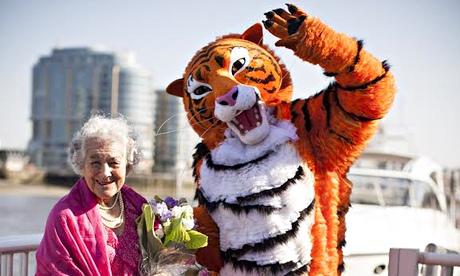
Serendipitously, the start of Refugee Week 2015, with its theme of the contribution that refugees make to the communities in which they make their new homes, coincides with the 92nd birthday of Judith Kerr.
Her books were not part of my own childhood – I was too old by 1968 to enjoy The Tiger Who Came To Tea, and certainly by 1970 when the first Mog book appeared. But I read those books – again and again and again – to my own children. And unlike some books which I read to them again and again and again, which irritated me more with every rendition, it was always a joy to read anything by Kerr.
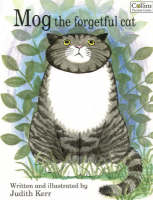
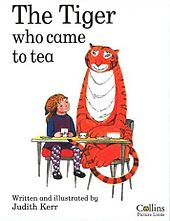
If pressed, I could probably still recite part of The Tiger, and certainly odd phrases from the Mog series (the cat who ‘forgot she had a catflap’, and who got an egg AND a medal after unwittingly foiling a burglary) have passed into our family language.
Nothing in the world depicted in these delightful stories suggests the circumstances in which Judith Kerr arrived in the UK. They’re not cloyingly cosy – after all, the final Mog book says a final goodbye to that forgetful cat. But one wouldn’t guess that her family had to leave their Berlin home suddenly in 1933, when the Nazis came to power, because her father had been openly critical of the party. He left first, having been tipped off that he was at risk, and her mother and the two children followed not long afterwards, travelling initially to Sweden and then to France, before applying for and being granted British citizenship. They could not have known in 1933 the full extent of the danger that they, as Jews, would have faced had they stayed, and they left France before that country ceased to be a safe haven, but as the war went on, Judith’s parents carried suicide pills with them, in case of a Nazi invasion.
Michael Rosen has suggested that the Tiger, who comes to tea and eats everything in the house, drinks all Daddy’s beer and all the water in the taps, was suggested at some subconscious level by the childhood awareness of an unexplained threat, that your home could be invaded, everything you have could be taken, without warning. That may be, and it’s certainly part of the unsettling charm of the book that we never forget that the Tiger is a tiger, that if not placated with all the food and drink he demands he could be dangerous. But at the same time, the willingness of the family to allow this unexpected visitor to empty their pantry conveys generosity and hospitality, along with imperturbability, rather than fear. It could be that this reflects the way in which parents maintain a calm unflappable air in order not to frighten children too young to understand real danger. But of course the Tiger leaves, of his own accord, and never comes back.
Kerr did write directly about her past, in three autobiographical novels collectively titled ‘Out of the Hitler Time’. She’s very conscious of her own good fortune, not only in that, unlike so many other families, they lost no one, but that they found a safe home and a welcome, and the chance to build new lives.
‘People here were so good to us in the war. It must have been awful for my parents, but when you consider what happened to the others who stayed behind, nothing bad happened to us. We didn’t lose anyone. All our family got out: my grandparents, uncles, aunts, they all got out. Nobody died. We had a terrible time with money, but so did lots of people, and people were very good to us wherever we went.’ (http://www.booktrust.org.uk/books/children/illustrators/interviews/104)
Happy birthday Judith Kerr, and thank you.
S’marvellous
Posted by cathannabel in Film on May 20, 2015
Occasionally people seem surprised at my enthusiasm, my geeky love, for the world of Marvel on the big and small screen. I read Proust, I love enigmatic French arthouse movies where nothing happens, very stylishly, for hours on end. I have argued elsewhere that one can love Proust AND Stephen King, and I see no reason why one cannot also love Alain Resnais or Michael Hanecke’s Caché, AND Thor, or Captain America. Who would want to be limited to just one brow?
In any case, it’s an open secret that I’m a Buffy obsessive and a Whovian, so no one should really have to reach for the smelling salts when I get giddy about heading off to Cineworld to see Avengers Age of Ultron in 3D.
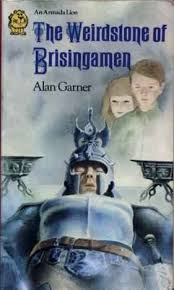
It seems to me that there’s a direct line from a lot of what I read during my bookworm childhood to these more recent passions. As soon as I could make the squiggles on the page into words in my head, I read everything I could reach. I read children’s classics (Nesbit, Lewis, Tolkien, Alcott, Burnett), grown-up classics (Dickens, Malory, Bronte, Shakespeare), newer children’s writers (Garner, Sutcliffe, Garfield, Treece). And in many of these I found ways into other worlds.
Tolkien and Garner both drew on Norse and Celtic mythology, one to create his own world, the other to imbue ours with magic. Lewis led his child protagonists through mundane portals into his alternative world where they became heroes and battled with evil. Malory, Sutcliffe and Garner gave me different takes on the ultimate British hero, the once and future King, a medieval knight or a celtic warlord, or a sleeper under Alderley Edge waiting for our hour of need to awake. And in Roger Lancelyn Green’s vivid retellings I got to know the tales of Greek heroes.
The notion that our everyday world can slip its mask and reveal another reality, darker or brighter, bigger and badder, invading and intervening as the gods of old always have done, is often terrifying, always compelling. That’s why my greatest fondness is for those narratives which start with the world we already know. Think of how a certain episode of Doctor Who has rendered statuary decidedly uncanny – the familiar become strange and scary. Think of how Buffy subverted the teen high school movie, so that being grounded really was potentially the end of the world. Think of how Stephen King’s It showed the adult world oblivious to the terrors that the children had to face unprotected.
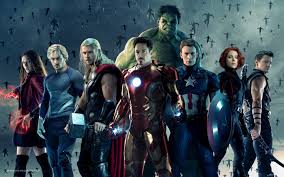
Marvel movies are bigger and noisier than the above. They’re sillier, perhaps. But they’re tapping into those old, deep stories, and reinventing, representing them in bright and shiny ways, with (particularly where Joss Whedon has a hand in the script) wit and humour. They’re not scary, but they’re exciting, exhilarating. In the Avengers ensemble movies, in one glorious superhero binge, we have elements drawn from an eclectic range of sources – from myth and legend, from Robert Louis Stevenson and Mary Shelley, even an American King Arthur, woken from sleep to defend the world in its hour of need.
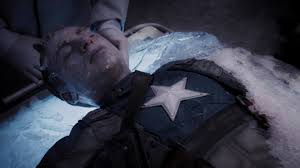
I’m not arguing for the Marvel movies as the most profound examinations of moral questions, or of the human psyche. But neither are they devoid of interest on those planes. They are never quite as simplistic as one might expect, with all the exploding and the fighting. The very daftness of the idea of these very disparate characters coming together is part of its charm. The humour, and sometimes poignancy too, often comes from their disparity, whether it is the cynicism of Iron Man playing against the moral uprightness of Captain America, or the straightforward warrior sensibility of Thor against the conflicted, tortured Banner/Hulk.
Thor: The gates of Hel are filled with the screams of his victims!
[Natasha glares at him while Bruce groans and puts his head in his hands]
Thor: But not the screams of the dead, of course. No, no… wounded screams… mainly whimpering, a great deal of complaining and tales of sprained deltoids and… gout.
And once one has suspended one’s disbelief and accepted the premise, that humour and poignancy makes you care about the outcome, root for the good guys, not just for their victory but for their wellbeing. Their superhumanity comes from different sources – technology, programming, divinity – but there’s always humanity there too. And it’s the flawed and fragile beauty of humanity that the Avengers fight for:
Humans are odd. They think order and chaos are somehow opposites and try to control what won’t be. But there is grace in their failings. … A thing isn’t beautiful because it lasts. It is a privilege to be among them.
Echoes of the Doctor there, I think. Amongst all of the forces that see the weakness of human beings and want to destroy, some stand with us. The Doctor said that in 900 years of space and time he’d never met anyone who wasn’t important. He tells us again and again that we are in our very ordinariness extraordinary, in our bloody-minded going where angels fear to tread, our curiosity and our moments of courage.
These stories, these new/old stories may not change the world. But stories are vital. Stories are the way we’ve always tried to make sense of the inexplicable and the unbearable, and to infuse the everyday with magical possibilities. Marvel’s gloriously epic and gloriously daft stories give us moments of startling beauty and poignancy (we are Groot), massive explosions and battles, deadpan humour and heroes we can root for. Pretty damn marvellous.
24 Hour Inspire, 16-17 April 2015 – Programme
Posted by cathannabel in Events, Inspiration for Life, Personal on April 4, 2015
If anyone had told me a few years back that I’d be organising anything like the 24 Hour Inspire, I’d have thought they were delusional. But we’re about to hold the third such event – 24 hours of non-stop lectures on all sorts of topics – and it’s one of the things I’m proudest of in my professional life. It’s not just the funds we raise, though I’m delighted to be part of raising money for charities like the ones we’re supporting this year, who provide end of life care for cancer patients or support young people with cancer. It’s the way that the event makes connections across and beyond the University which is my alma mater (twice) and my workplace, the community in which I feel so much at home. It’s the way that it taps into such a deep seam of goodwill, that people respond with such enthusiasm and generosity to our requests for help, often offering more than we ask for. It’s the way in which not only the task group who have been meeting for the last few months to plan and organise the event, but a much wider group of people want it to work, and do whatever it takes to make it work.
I get slightly nervous, of course. There are so many things that potentially could go wrong with an event on this scale. But that nervousness is always offset by the recollection that every time something has threatened to unravel, someone has sorted it out. A speaker drops out at the last minute – a quick tweet to say that we need a replacement, and half an hour later we have one. It’s a collective effort, and that’s why it’s such a joy.
It emerged of course out of great grief and loss. But in those 24 hours I believe we’re doing something special, we’re living intensely and revelling in learning, in making connections, in broadening our horizons, and in collaborating. Twelve sleeps to go now. I can’t wait.
Come along if you can, for some or all of it. If you can’t, but wish you could, you can still tweet about it using the hashtag #24HrInspire, and you can donate here: https://mydonate.bt.com/events/24hourinspire2015


| Catherine Annabel | Inspiration for Life | Introduction and welcome | |
| 17:00:00 | Professor John Flint | Town & Regional Planning | Victoria Henshaw – a tribute |
| 17:30:00 | Dr Nate Adams | Molecular Biology & Biotechnology | Throwing spanners at nanobots |
| 18:00:00 | Dr Victoria Williamson | Music | Music for wellbeing: possibilities and promise |
| 18:30:00 | Professor Paul White | Geography | Global population growth – the good news and the bad news |
| 19:00:00 | Professor Rowland Atkinson | Town & Regional Planning | Ecology of sound: the sonic order of urban space |
| 19:30:00 | Morag Rose | Town & Regional Planning | Loitering with intent: psychogeography the Mancunian Way |
| 20:00:00 | Professor Claire McGourlay | Law | Legal aid – what legal aid? |
| 20:30:00 | Dr Amanda Crawley Jackson | French | Post-traumatic landscapes |
| 21:00:00 | Professor Davide Costanzo | Physics & Astronomy | Anatomy of the ATLAS particle detector |
| 21:30:00 | Dr Tim Shephard | Music | Machiavellian sounds: how to rule a Renaissance state with music |
| 22:00:00 | Dr Catherine Fletcher | History | The insider’s guide to Wolf Hall |
| 22:30:00 |
View original post 547 more words
Hillsborough – the simple truth
Posted by cathannabel in Football on March 20, 2015
On 14 April 2012, marking the anniversary of the Hillsborough disaster, I wrote this:
…the awful truth is that no matter how many of those fans were drunk and how many were there without tickets, if there had been stewards in front of the entrances to the Leppings Lane pens, directing fans away from the already crowded central pen, then no one would have died. No one. It’s horrifically, tragically, simple.
Earlier this week, at the inquests in Warrington, David Duckenfield who was the police commander in charge on the day of the match, acknowledged, at last, at long last, that ‘his failure to close a tunnel that led to the overcrowded Leppings Lane terrace pens directly caused the deaths of 96 people.’
The truth about the tragedy was always known. It was always that simple. But the lies that were spun and spread were so effective that it’s taken us 26 years to have that truth stated so starkly, in public. So to the tragedy of 96 lives lost, and so many more injured and traumatised, so many families devastated by grief, was added the bitterness of the contempt that the dead and their families received, the scandalous lies, the fabrication of blame.
It is unforgiveable.
And yet I find myself pitying Duckenfield. Forgiveness isn’t for me to offer, and whether, if I were a family member I could ever have the courage and the grace to forgive I don’t know. I do not, cannot, sympathise, let alone empathise with him. I can imagine myself, briefly and inadequately, on those terraces, or in the homes where people waited and hoped and then despaired. I cannot, however, imagine covering up catastrophic failure and living, for 26 years, with the knowledge of what my failure had done not just to 96 people but to all the others who loved them. That is beyond my comprehension.
It’s not that I find it so impossible to imagine finding myself out of my depth, being expected to make huge decisions and realising that I haven’t got the knowledge to do so, freezing like a rabbit caught in the headlights of a car, lying on the spur of the moment to try and cover up a catastrophically wrong decision. There but for the grace of God, as they say.
But faced with that aftermath, not just the bodies, the grieving families but the tabloids full of lies, to remain silent? As Taylor and Stuart Smith inquired and scrutinised, through the private prosecutions and the Independent Panel, he remained silent, acknowledging only what he had no choice but to acknowledge, that he had lied about the opening of the gate. I can’t understand, I can’t sympathise let alone empathise, and it is not for me to forgive.
But I felt pity for him this week, for the first time in 26 years. That he suffered from depression and PTSD in the aftermath of the disaster is hardly surprising. That he, as a middle-aged Yorkshire bloke, was ashamed of that diagnosis, saw it as weakness, and attempted to hide it, is not unexpected. Locked in his own shame and misery, he could not see, he says he did not see until so recently, what his failure to acknowledge what he did to the 96 was doing to the survivors and the families of the 96.
I’m not letting him off the hook – not at all. From his blunder and the knee-jerk attempt to blame someone, anyone, for the unfolding disaster rather than to take responsibility for it, flowed everything else that happened that day. And from his failure to speak out in the days, weeks, years that followed, flowed the persistent stream of misinformation, the inevitable rejoinders to every article or statement supporting the families. The S*n would not (or so they say) have published that most scurrilous and vicious of reports had they not heard the allegations from the apparently impeccable source of a Tory MP and a police commander. And inevitably what he says now causes yet more pain. For the families to hear of his PTSD after their years of agony, to hear him say that failing to foresee the consequences of opening exit gates at the ground was “arguably one of the biggest regrets” of his life – arguably? ‘one of’?? – must have been extraordinarily difficult, and little wonder that some had to leave the courtroom.
But he’s said it now, and it stands there, that crucial admission, after all these years of denials and lies. Too late, of course, but it cannot be unsaid. And I cannot help but pity a man who has carried so much guilt, the responsibility for 96 deaths and for prolonging and intensifying the misery of the families, who has had that weight to carry all these years. I cannot help but pity a man who has known all along what was right, and been unable to do it. I do not say that I hope he finds peace now. Peace is what is owed to the families and the survivors – it’s not for him. I do, however, hope that he finds some way to channel the guilt and shame that has festered in him for 26 years into doing something good now, something right.
RIP the 96. Massive respect to the families. You’ll never walk alone.

Night will fall – Holocaust Memorial Day 2015
Posted by cathannabel in Film, Genocide on January 30, 2015
Grainy, blurry black and white footage, shot by soldiers newly equipped with cameras and told to record everything they see. Long, panning shots, taking in the corpses, barely recognisable as human, in the ditch, and the dignitaries on the bank, impassive. Negative footage from Dachau turning the unimaginable into something even further beyond our reach. All of this went into the documentary, German Concentration Camps Factual Survey, made by Sidney Bernstein in the immediate aftermath of the liberation of the camps by Allied troops (and using some of the footage from Russian units at Majdanek and Auschwitz). The title tells us a great deal about why this film was made, its purpose to give us irrefutable evidence of what happened, anticipating both the denials of the German population, including the camps’ near neighbours, and the denials of subsequent generations.
Night will Fall is a film about this film. Sections of the original are interspersed with interviews with those who made it – Bernstein, Hitchcock, some of the soldiers – and with survivors who found their own faces amongst the images of the gaunt, desperate yet joyous throng. The survivors speak more easily than the soldiers of the scenes that were recorded there. Their experience of horror was complete, the moment of filming for them was a moment of almost unbelievable hope, of life when all that they had expected was death. As for the soldiers, their experience of war did not prepare them, not in the least. These men try to tell their story, but again and again, words fail. Sorry, sorry, they say, I just can’t…
The original film has languished in the archives since it was completed. The mood changed so quickly – if Bernstein had completed his work just a little earlier, then maybe it would have had the audiences it was intended for, and deserved. But by the time this huge task was done the need to confront the German people with the actions of their leaders, the need to tell the world what could happen when a civilised nation abandoned civilisation, were seen not only as less pressing, but as potentially counter-productive. Not only did we need the Germans as our allies against the strength of the Soviet Union, but we did not want public sympathy for the Jews to force our hand in terms of giving sanctuary to large numbers of refugees.
Bernstein and his collaborators wanted to take a stand against those who would deny or minimise the genocide. What they had recorded was almost impossible to comprehend, and so easy to disbelieve. There had been reports of the process of extermination of the Jews in occupied Europe, as early as 1942. Szmul Zygielbojm, Jan Karski and others risked so much to tell the Allies what was happening. But somehow, even when published in the Daily Telegraph (25 June 1942), people seemed not to grasp it.

Was this failure to respond down to prejudice, or simply that the facts were unbelievable and so people chose not to believe? To look away and hope that when they looked back, the nightmare vision would have vanished? At the end of the war, again, the news from the Russian troops who were liberating the extermination camps in the East was treated with scepticism, until the Allied troops entered the German concentration camps themselves and knew.
If it was only human to baulk at that reality, to not want to accept that other humans could do this, not just a handful of monsters but many, many people, the revisionists who came later were of a different stripe, and unperturbed by personal testimony, documentary footage or other evidence. Somehow they manage to say both that Hitler did not plan and order genocide of the Jews and that the Jews deserved their treatment, brought it, indeed, upon themselves. They both immerse themselves in technical details to ‘prove’ that what was described and shown could not have happened, and dismiss or treat as mendacious all evidence that it did. Bernstein’s film would probably not have changed the minds of any of those – nothing else has.
The documentary, a unique record not only of the scenes from hell that the liberating troops encountered, but of the efforts thereafter to help and to heal, will only ever be seen by small numbers. The Imperial War Museum believes that its images, without the contextual commentary and interviews provided by Night will Fall, are too stark in their portrayal of the dehumanised state not only of the dead but of the (barely) living. This baffles me, particularly because the film does also show the liberated prisoners talking animatedly to their saviours, being treated for disease, trying on clothes and shoes. It shows them, in other words, taking on their humanity again. As if it had never been stolen from them entirely, merely put to one side as hindrance rather than help in that brutal world. And of course, it is not as if we cannot see, if we choose, such images on YouTube or in other documentaries, often using this very footage.
As Jean Cayrol wrote, in the script used by Alain Resnais for his film Night and Fog:
There are those reluctant to believe
Or believing from time to time.
There are those who look at these ruins today
As though the monster were dead and buried beneath them.
Those who take hope again as the image fades
As though there were a cure for the scourge of these camps.
Those who pretend all this happened only once,
At a certain time and in a certain place.
Those who refuse to look around them,
Deaf to the endless cry.
Bernstein’s documentary ends with the words: “Unless the world learns the lessons these pictures teach, night will fall. But, by God’s grace, we who live will learn.” We haven’t. And night has fallen for so many. It’s to be hoped that the film will have the wider audience it deserved and still deserves today. The lesson still needs to be taught and we have to hope it’s not too late to learn.
Jean Cayrol, Nuit et brouillard (Mille et une nuit, 1997)
http://variety.com/2014/film/global/holocaust-doc-night-will-fall-gets-global-broadcast-1201362494/
The Heaviest Weight of All – Holocaust Memorial Day 2015
Posted by cathannabel in Genocide on January 24, 2015
The heaviest weight of all: to see
that no one needs me,
to know, to think,
I’ll fade into nothingness like smoke
The young woman who wrote these words was seventeen. So it would be easy to read their intensity as being a teenage thing, a bit over dramatic. But this was December 1941, in Czernowitz, now in the Ukraine. Selma Meerbaum-Eisinger was writing for her boyfriend, Leiser Fichman, who had been taken to a forced labour camp. Three months after she wrote this poem, she was interned with her parents in the ghetto and then deported to Transnistria and forced on an exhausting march to the Michailowka labour camp, where Selma died of typhus on 16 December 1942. Leiser kept the poems with him, and then sent them to Selma’s friend Else in 1944. He died when the clandestine immigrant vessel he had boarded, heading for Israel, sank in the Black Sea – he never knew that Selma had died.

Those words – to fade into nothingness like smoke – take on a terrible symbolism in the post-Auschwitz world. And of course, they describe very well the intent. Not enough to drive the undesirables from your territory, not enough to render them powerless and penniless. The last traces of them have to be eradicated, it has to become as if they never were.
As the last survivors of the Nazi holocaust leave us, the need to keep their memory alive becomes ever more pressing, and the difficulty of doing so ever greater. The machine that devoured so many left such chaos behind that there are those whose fate will never be definitively known, and where whole families perished there was perhaps no one to remember. Whilst there was a flurry of survivor memoirs immediately after the end of the war, there was then a reaction against it, born from the overwhelming desire to forget, to say, ‘that was a nightmare, but we’ve woken up now and everything is back to normal’, but also from fear. For many who survived, there was a strong instinct, reinforced in some cases by advice by Jewish organisations, to keep a low profile, to do nothing to reawaken the hatred. And the trauma of what they had seen and experienced left many unable to speak, ever, or for many years.
But, as Walter Benjamin said, to live means to leave traces. Selma’s poems, Hélène Berr’s journal, Gideon Klein’s chamber music, the children’s paintings from Terezin – all of these speak to us down the decades, and deny the Nazis their ultimate goal. And more and more, those ordinary people, who kept no journals, who composed no sonatas, who wrote no poetry, are being given back their names.

Serge Klarsfeld has painstakingly documented the child occupants of the trains that left France for destinations in the East. Not all of them can be identified with certainty – some, separated from their parents and too young to give their names and addresses, remain nameless. Some have photographs, capturing them in solemn family portraits or holiday snapshots:

These three sisters were all deported from Paris in August 1942. The oldest sister, Esther Adamowicz, was born in Poland, her younger sisters, Myriam and Sarah-Cécile, in Paris. They lived at 46 rue Notre-Dame de Nazareth in Paris (3rd arr.).They were 12, 6 and 4 respectively when they were killed.
The Jewish Traces project, Plus qu’un nom dans une liste, tells us of Marianne Epstein, a little younger than Selma, whose family fled Germany after Kristallnacht, initially for the Netherlands and then for France.
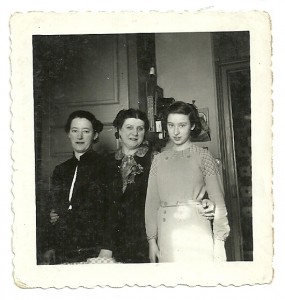
After the fall of France they headed south, and settled in St Léonard de Noblat in the Haute Vienne department, until they were rounded up with thousands of other foreign Jews in August 1942. They were taken to Nexon, then to Drancy, and from there to Auschwitz.
The Solpersteine project (literally, ‘stumbling stones’), is commemorating Holocaust victims with the installation of a brass plaque in the pavement, in front of their last home. Artist Gunter Demnig has now placed such stones in over 610 locations in Germany, and in many other countries occupied by the Nazis. He quotes the Talmud: “a person is only forgotten when his or her name is forgotten” and so the stones each tell us of one name, one person, beginning with ‘Here lived…’.

These projects are not just about saying ‘Never again’. They are about keeping the memories alive. We may not have known Selma, or Marianne, Anna, Helene or Esther. We know their names, where they lived, and so we can piece together something of their story. We may know what they looked like, we may hear their voices through their words, treasured by friends or family and shared with the world.
This matters, it really does. When serial killers strike, we remember their names, but the names of those whose lives they took soon fade – we can’t remember all of them, the teenagers shot down at Utøya, the children of Dunblane. When thousands, or millions are killed we can only grasp the enormity through the detail. The horror is not in the total numbers, it is in these entries in the logs for Convoy 23 and 26, August 1942:
| (UN ENFANT) | BEAUNE | Sans identité n° 122 – | ||
| (UN ENFANT) | BEAUNE | Sans identité n° 146 | ||
| (Petit Garçon) | 01.01.39 | CAMPS-LOIRET | ||
| (Petite Fille) | CAMPS-LOIRET | Portant plaque n° 237 – | ||
| (Petite Fille) | CAMPS-LOIRET | Portant plaque n° 36 – |
Just ponder on this for a moment. These small children had already known fear and abandonment. And on their last journey they had no one with them who knew their name. We can hope there was someone to hold their hand, to cuddle them, to sing to them. But they had no one who knew their name.
Ponder on this too. Human beings, like us, took them from their homes, separated them from their parents and older siblings, pushed them into the railway trucks. And then, perhaps, went home to their own children, bathed them and told them a story, tucked them into bed, kissed them on the forehead and said goodnight.
Genocide doesn’t start with killing. It starts by taking away the things that make you who you are, and reducing you to Jew, Tutsi, Moslem, Igbo. It tells everyone you lived next door to, went to school with, worked for or with, that Jew/Tutsi/Moslem/Igbo is less than they are, not just inferior but dangerous. And when you’re isolated, displaced and friendless, then you can be eradicated, no trace left behind.
It’s up to us to find the traces. To remember the people we never knew, to ensure that they do not ‘fade into nothingness like smoke’.
http://www.yadvashem.org/yv/en/exhibitions/spots_of_light
http://ghettospuren.de/aktuelles/
http://www.holocaust-history.org/klarsfeld/French Children
http://jewishtraces.org/plus-quun-nom-dans-une-liste
http://www.stolpersteine.eu/en/
http://holocaustmusic.ort.org/people/
Berr, Hélène, Journal, 1942-1944 (Paris: Tallandier, 2008)
2014 – some of the best bits
Some of the cultural highlights of my year – a year of working at home, long train journeys to long meetings which gave me more time to read, less time to go to the cinema or the theatre. However, I did manage a few outings…
- Twelfth Night at the Crucible – a real delight. I’d been disappointed that we weren’t getting a tragedy or one of the problem plays, rather than a comedy that I’d seen on stage before, but that feeling evaporated very quickly indeed. The performances were excellent, the staging imaginative and suggestive of darker undercurrents (the cast appearing at windows almost like the undead, the showers of rose petals – see also Poppeia).
- Brilliant opera at Leeds Grand – La Boheme, and The Coronation of Poppeia. And another Boheme, this time in Graves Gallery, from Opera on Location.


- Tramlines!
- Music in the Round – I’d pick out the Schubert octet, Tim Horton’s bravura performance of the Prokofiev Piano Sonata no. 7 (described by the Guardian as ‘ferocious’), Charlie Piper‘s WWI suite, The Dark Hour; works by Schulhoff & Haas, and consort of viols, Fretwork.
- Once again we celebrated Tim Richardson’s life and passion for learning and teaching with the 24 Hour Inspire – 24 hours of lectures on a host of topics, from WWI poets to insect sex, from biogeography to Mozart, from underground science to fairground history – ok, you get the picture. Once again a host of people stepped up to help, everything ran smoothly, and we were able to donate to Rotherham Hospice and Impact Young Heroes. We’ll be doing it again on 16-17 April 2015. Tim’s charity, Inspiration for Life, goes from strength to strength.
- I revisited the City Ground after far too many years, for the first home game of the season, and Stuart Pearce’s first game as manager. That was a great game. We’re in a slump at the moment, and that early euphoria has dissipated. If it was anyone but Psycho in charge I suspect the calls to sack the manager would be ringing out right now, but few Forest fans would want to deny him the chance to turn things around. I hope he can. I really, really, hope he can.
Top TV of 2014
No attempt at ranking. How could one decide on the relative merits of a gritty cop drama and a comic book fantasy? So, what do all of these shows have in common? First, excellent writing, and great performances. Essential to have both. So many big budget dramas skimp on the former and blow the budget on the latter, but even the best actors can only do so much with a script that clunks. Second, great female characters. All of these programmes basically kick the Bechdel test out of the park. It’s not just about having ‘strong’ women. Not all women are strong, and no women are strong all of the time. It’s about having women characters who are rounded human beings, fallible and flawed, but not dependent on men to make decisions or to solve problems. Some of these women do indeed kick ass, but they don’t all have to. So, to Nazanin Boniadi, Alison Brie, Yvette Nicole Brown, Amelia Bullmore, Lauren Cohan, Clare Danes, Siobhan Finneran, Danai Gurira, Keeley Hawes, Elizabeth Henstridge, Gillian Jacobs, Suranne Jones, Nimrat Kaur, Sarah Lancashire, Melissa McBride, Vicky McClure, Tatiana Maslany, Lesley Sharp, Allison Tolmin, Ming-Na Wen and the rest – cheers, and thanks for giving us images of women that are as diverse and complicated as actual real live women are.


- Fargo – I was decidedly unconvinced beforehand, but it turned out to be funny, gruesome, and touching, with one of my favourite women cops in Allison Tolmin’s Molly (not just a re-run of Frances McDormand’s marvellous Marge from the film, but a character in her own right), Billy Bob Thornton as a grimly hilarious killer and Martin Freeman as a weaselly one, and a wealth of other characters, some of whom we came to care about so much that at tense moments there was much yelling at the screen as we thought they might be in danger.
- Line of Duty – I wasn’t convinced about this one either, mainly because the first series had been superb, and I wondered if they could match it. They did, and it was Keeley Hawes’ performance that clinched it. Whilst I’d watch Vicky McClure in anything, Keeley wasn’t in that category for me, despite Ashes to Ashes. But in this she was riveting, absolutely mesmerising. The rest of the cast was superb too.
- Happy Valley was perhaps the most ironically titled programme of the year. This valley was pretty damned grim. But Sarah Lancashire as cop Catherine Cawood was wonderful, and the story was compelling and moving.
- Scott & Bailey maintained its form in series 4. The three central women (count them! three central women!) are all convincingly real, sometimes infuriatingly so.
- The Walking Dead opened series 5 with an episode so gripping that I really could neither breathe normally nor speak for quite some time. It’s maintained that tension (more or less) whilst varying the format, to focus on different subsets of the characters, and different locations. Carol has been central to this season’s episodes so far, and her character is one of those that has been allowed to develop and deepen throughout. There’s no shortage of other interesting characters, and the plot allows for philosophical, political and ethical speculation as well as for gory shocks and suspense.
- Agents of Shield got past a slightly wobbly first series and got its pace and tone just right. It fits right into the Marvelverse, but stands alone perfectly well. And it features girl-geek Simmons, a Sheffield lass, and there’s just a hint of South Yorkshire in her accent from time to time.
- Community made me laugh more than anything else this year. Just when you think it is as bonkers as it could be, it ups its game, to be even more meta, and even more daft.
- Doctor Who I have spoken of elsewhere. I have a deep love for this programme, and whilst this regeneration has been unsettling at times, uncertain in tone perhaps, I have great hopes for Capaldi and Coleman in series 9 next year.
- Homeland redeemed itself. Gripping stuff, with Clare Danes acting her socks off and getting us deeper into what makes Carrie tick.
- Orphan Black is one of the most criminally underrated programmes of this (and last) year. Tatiana Maslany inhabits each of the characters she plays so well that I forget – disbelieve almost – that there is just the one actress involved. And when she’s playing one of them pretending to be one of the others…. Cracking plot too.
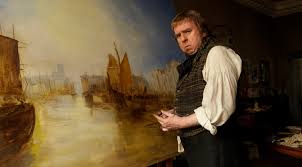
Films of the year – I leave the in-depth cinematic reviews to Arthur Annabel who promises an extensive blog on this topic soon. I simply note these as films which have delighted and/or moved me, in no particular order. Worth noting that whilst the programmes on my TV list get A* on the Bechdel test, the films are considerably weaker on that front. Nonetheless, some fine performances, and Nicole Perlman was the first woman with a writing credit on a Marvel movie (Guardians of the Galaxy).




Women of the year:
Jack Monroe – for enlivening my repertoire of meals to feed the family, and campaigning about food poverty
Professor Monica Grady – for being emotionally, exuberantly passionate about science
 Kate Bush – for doing it her way, as always
 Fahma Mohamed – for telling men three times her age what they needed to be told about FGM and how to protect young women in the UK
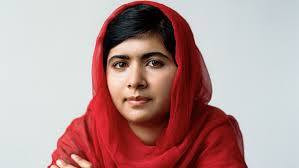 Malala Yousafzai – it’s all been said really. A young woman of remarkable maturity and dignity, as well as courage.
 Dr Ameyo Adadevoh – helped to curb the spread of Ebola by quarantining a patient in the face of pressure from his government, but succumbed to the disease herself
 Laura Bates – her Everyday Sexism project helped to give women a voice, to tell their stories, to shout back.
In 2014 I’ve blogged about refugees, genocide, football, W G Sebald and Michel Butor, Kazuo Ishiguro, everyday sexism, Tramlines, Josephine Butler and Doctor Who. I got a bit personal on the subject of depression, and was inspired by Caitlin Moran’s How to Build a Girl to present my manifesto – a plea to just be kind. And my blog about reading the last of the Resnick series of detective stories won the approval of the author, John Harvey, who linked to it on his own blog, and republished my jazz playlist!
Amongst the blogs I’ve followed, or at least tried to keep up with, I would particularly note Searching for Albion. This is the record of Dan Taylor’s four month cycling trip across the British Isles, talking to people he meets, by plan or by chance. A fascinating project, beautifully documented.
To all of those who’ve shared some of the above events, obsessions and enthusiasms with me, who’ve given me support when I’ve needed it, who I’ve learned from and with, thank you. I don’t know what to expect from 2015 – but see you there!

