
Always after attacks like these some rush to help and some rush to hate. The helpers try to contain the blast, the haters help to spread it.
Refugee Week 2017 – Different Pasts, Shared Futures
Posted by cathannabel in Refugees on June 18, 2017

Since I started this blog, back in 2012, I’ve given myself the challenge to publish something every day during Refugee Week addressing some aspect of the refugee crisis past and present, in all parts of the world. There are so many stories, and no matter how many Refugee Weeks come around, there seems little prospect that one year I will find there is nothing to say.
This year’s theme sets me a different kind of challenge, however. Many of my posts over the years have focused on the past – specifically on the refugees escaping Nazi genocide, whether through the Kindertransport or the activities of the AAC, or through the actions of individuals such as Varian Fry or communities such as Le Chambon sur Lignon. Which is fine, and I will be revisiting some of those topics this week. But the theme is ‘our shared future’, and I don’t want to neglect that.
There are as always many examples of generosity and hospitality being shown to refugees, by organisations and individuals.
In Edinburgh, Dr Amer Masri and Nadin Akta, both refugees from Syria who came here in 2011, have worked with the University’s Chaplain and student volunteers to support newly-arrived Syrian teenagers. The Teenage Syrian Refugee Tutoring pilot project aims to help with the disorientation and sense of isolation that the new arrivals will experience. The programme is focused specifically on the needs of young people, fitting in to school, making decisions about their futures and facing the kinds of challenge that are common to their age group but with the added pressure of cultural and language barriers and the trauma of their past experiences.


Meanwhile in Madrid, a project linking refugees with local mentors has been overwhelmed with volunteers. Rescate ‘s befriending programme again helps to address the disorientation and isolation that refugees face, as well as working with them to solve practical problems about housing and education, finding their way through the system to access the help they need.
But it is not just a one-way process.
Liverpool-based rapper Farhood fled his home country Iran after facing persecution as a result of his political activism. He will play M.I.A.’s Meltdown festival at Southbank Centre, London, 9-18 June, and launch Refugee Week on 18 June.

Across the world there are thousands of people who are displaced and seen as just migrants, not people with skills, abilities, talents and stories. I want to help change this situation. I want to help change the way we think and talk about this global crisis. Whose crisis is it anyway? Crises for Europe and the developed world which needs to ‘cope’ with refugees? Refugees in the UK are facing harder times now, with issues like Brexit and racism, and I want to show them hope in the face of depression, which I experience myself. … It shows that a refugee can make a transition, from being unheard in a prison in the UK to a point where I can talk about the problems in Iran and the UK to the world. I can be a voice for the voiceless.
Online magazine Vice has just published an issue edited by young refugees from across Europe. They’re not talking about being refugees, or at least not just that.
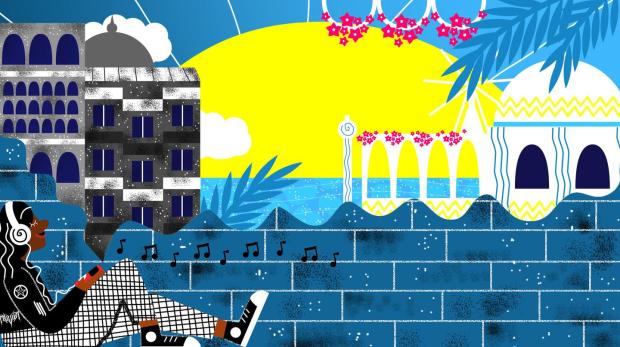 Vice’s editor says:
We wanted to show that just like all our writers and every single neighbour you’ve ever had, these young people have multifaceted personalities that cannot be defined merely by them being refugees.
The result is a collection of 16 articles that today we are publishing simultaneously in 12 languages and 14 European territories, in collaboration with UNHCR. Highlights include How to Be Fashionable on a Budget, All the Gaffes I’ve Made Since Arriving to the UK and A Playlist of the Songs I Listened to While Trying to Get from Syria to Europe.
And poet Malka Al-Haddad is crowd-funding publication of a collection of her work which she hopes will raise funds for Baobab Women’s Project in Birmingham, Leicester City of Sanctuary and East Lindsey Area of Sanctuary.

She says:
I know that there are many people that need help and this what they do. Therefore I’m willing to support them. I would like to help people as much as I can, that is my love, it makes me feel like a better person, I want to help the community in some way …. When I was in Iraq I was working very hard to get good salary to support disadvantaged people and protect women’s rights. I am now in the UK but I can not earn money or have job because I have not been recognised as a refugee. I’m glad that I have written a poetry book that, I hope, will go on to raise some funding to these small charities/organisation that support refugees and asylum seekers. They aim to make individuals’ participation positive and help people be themselves again after they lost hope and their home land.
Once we see refugees not as ‘other’, but as people like us, ordinary people (if there is such a thing) whose circumstances happen to be extraordinary and traumatic, we should not be surprised when they are not only refugees but also poets, musicians, artists, engineers, lawyers, writers, footballers, nurses, teachers and so on. Whilst they are in flight, it may be impossible to be anything other than a refugee, but what people will hope for, long for, is the chance to be those other things, to find others in their new home with whom they can share their interests and skills. As Malka says, to be themselves again.
That way, we all win.
Dark Tower
Posted by cathannabel in Politics on June 16, 2017

We don’t know how many. We don’t know who. We don’t know why.
In this vacuum of information, anger is building.
Some of this anger will be misdirected, as people lash out in their pain and grief. That’s inevitable. Since the early hours of Wednesday morning, those living near Grenfell Tower, those who escaped from it, those who have friends and family unaccounted for, will not have slept, will have been obsessively checking phones and ringing hospitals and begging for answers, at the same time as they figure out how to cope without their most basic possessions, how to deal with the practicalities of life in this new chaos. Under that intolerable pressure, those we have heard speak have shown remarkable dignity and calm.
That may not hold. Even if the bigger questions cannot be answered immediately, there needs to be a more coordinated, coherent response to the desperate need to know the fate of those still unaccounted for, and to the practical questions about rehousing and resources for those left homeless. And even if those are the most urgent questions, the community needs to be convinced that the bigger questions – what caused the fire? why did it spread so quickly? why was the material used for the cladding in the recent refurb of a standard that is currently banned in the US and Germany because of its flammability? – will be answered without obfuscation.
Answers need to come, and come swiftly. And with them, practical help. Voluntary generosity has been overwhelming, and almost unmanageable – it must now be matched by an ‘official’ response. That official response must be generous, if it is to defuse the tension, the gut feeling that had the inhabitants of Grenfell Tower been white, been wealthy, the building would have been designed to be safe, and any refurbishments would have made it even safer.
We have in the last few weeks alone logged so many unnecessary deaths. The murders of (mainly) young people attending Ariane Grande’s concert in Manchester, and (mainly) young people in Borough Market and on London Bridge. And now unknown numbers of all ages, dead because a fire that started accidentally (as far as we know) spread with unimaginable speed through a high rise block of flats.
What those of us who have tried to honour the dead by recording their names and something of their story quickly discovered was that there is no such thing as an ordinary person. The three names that have officially been released from Grenfell Tower confirm that.

Khadija Saye was 24. A remarkable artist, her work is currently exhibited at the Diaspora Pavilion during the 57th Venice Biennale. Her death has been confirmed; her mother is missing, presumed dead.

Mohammed Alhajali was 23, and had been living on the 14th floor with his brother Omar. He came to the UK in 2014 and was studying civil engineering. Syria Solidarity Campaign said: “[He] undertook a dangerous journey to flee war and death in Syria, only to meet it here in the UK, in his own home.” The brothers had been due to join the Syria Solidarity Campaign on Saturday to take part in The Great Get Together, celebrating the life of murdered MP Jo Cox and marking Refugee Week.

Of the third confirmed fatality, what can we say? He was five years old. Isaac Shawo has been described by his mother as a “beautiful boy”. He was a pupil at Saint Francis of Assisi Catholic Primary School and lived on the 18th floor of Grenfell Tower with his parents and three year old brother Luca, all of whom have survived. He gazes out from this photograph, and one can read so many possibilities into that gaze. Possibilities that will never be realised.
Only three stories so far. There will be so many more. Their deaths are as arbitrary as those of the Manchester and London terrorist murders, even if no individual or group is as directly culpable. They should not have died, they need not have died.
We have to change, we cannot continue to value property over humanity, to dismiss ‘health and safety’ which has saved the lives of so many as ‘red tape’, to denigrate the poor, the unemployed, benefit claimants and asylum seekers as scroungers and skivers. We have to change.
David Lammy MP: “For your middle-class viewers, this is about whether the welfare state is just schools and hospitals or whether it’s about having a safety net. I get quite emotional as I say that. We need to live in a society where we care for the poorest and the vulnerable. And that means housing. It means somewhere decent to live. It was a noble idea that we built… and it’s falling apart around our eyes. That’s what it’s about.
You can’t contract out everything to the private sector; the private sector do some wonderful things, but they have for-profit motives, they cut corners. If you haven’t got the officers to check on the enforcement of buildings, don’t expect it to be done.
You know… are there fire extinguishers? Where are the fire extinguishers on every corridor? Where are the hoses? Are the fire doors really working? Where are the sprinklers? If you want to build these buildings, then let them at least be as good as the luxury penthouse buildings that are also being built.
But these buildings aren’t …. So you either demolish them and house people in a different way, or you absolutely refurbish them to the best quality that we can do.”
Jackie Long: “Do you think this says anything about the value that is placed on the life of people who cannot afford to buy their own property; to live in some of the nicer bits of Britain?”
David Lammy MP: “This is a tale of two cities. This is what Dickens was writing about in the century before the last, and it’s still here in 2017. It’s the face of the poorest and the most vulnerable. My friend who lost her life was a talented artist, but she was a young, black woman making her way in this country and she absolutely had no power, or locus, or agency. She had not yet achieved that in her life. She’d done amazing things: gone to university, the best in her life. But she’s died with her mother on the 22nd floor of a building. And it breaks my heart that that’s happening in Britain in 2017. Breaks my heart.
Lammy refers here to Dickens. A tale of two cities, a tale of two tower blocks. Different worlds, existing cheek by jowl, not recognising or understanding each other. In Kensington, some of the wealthiest people in our land live alongside some of the most deprived. The top quarter earn at least £41 per hour, three and a half times the level of the lowest quarter at £12 per hour or less. Within the smallest borough in London, and the second smallest in England, we can see starkly and uncompromisingly the divisions in our society.
These words are from perhaps Dickens’ finest novel, Bleak House, as he marks the death of a nobody, a boy called Jo.
Is there any light a comin?”
“It is coming fast, Jo.”
Fast. The cart is shaken all to pieces, and the rugged road is very near its end.
“Jo, my poor fellow!”
“I hear you, sir, in the dark, but I’m a gropin — a gropin — let me catch hold of your hand.”
“Jo, can you say what I say?”
“I’ll say anythink as you say, sir, for I knows it’s good.”
“OUR FATHER.”
“Our Father! — Yes, that’s wery good, sir.”
“WHICH ART IN HEAVEN.”
“Art in Heaven — is the light a comin, sir?”
“It is close at hand. HALLOWED BE THY NAME!”
“Hallowed be — thy—”
The light is come upon the dark benighted way. Dead!
Dead, your Majesty. Dead, my lords and gentlemen. Dead, Right Reverends and Wrong Reverends of every order. Dead, men and women, born with Heavenly compassion in your hearts. And dying thus around us, every day.
I do not pray. At times like this I almost wish I could. But my faith is not in any god but in humanity. In the kindness of strangers, the coming together of communities in a crisis, the refusal to tolerate those who want to use such a crisis to disseminate hatred and suspicion. I don’t pray, but I hope, I hang on to my hope. And my heart hurts for the people of Grenfell Tower.
It was fifty years ago today….
Posted by cathannabel in Music on June 1, 2017
The release of Sgt Pepper’s Hearts Club Band, fifty years ago today, is one of those moments in musical history. So much has been written about the album over the years since. But this personal account, from Mike Press, is for me the perfect tribute to Pepper, to what it meant and what it means, and to the power of music. Thanks, Mike, for letting me share this.
============================================================================
My Mum, my Dad, Sgt Pepper and me – Mike Press
Unusually, I remember exactly what I was doing 50 years ago today at around 6 pm.
It all began with She Loves You.
My Dad ordered it in advance of its release and picked it up from the Record Room in St Albans on his way home from work on the day it came out. And he did the same with every Beatles’ release up to the White Album. It was a family ritual. Part of this same ritual was that we would play the new record over and over at least six times as soon as he got home (to be honest, it was six with a single and at least twice with an album). She Loves You was a revelation, in part because after we’d played it half a dozen times he says “right, shall we play the B side now?”. THERE’S A B SIDE??? You mean they actually give you another song for free? I was stunned with both the concept and the clear generosity of the recording industry, which was perhaps one reason that I gave them so much money in return over my extended adolescence. In this case the B side was even better than the A side.
Thursday the First of June 1967 was just another school day at Fleetville Junior Mixed Infants. We were coasting down towards the end of our primary schooling with the first year of Grammar School just a few months away. Dad and I had been Beatles fans since their first hit. He bought all the records, which we played relentlessly the day they came out, and every so often he’d say “fancy a Beatles’ session?” and we’d play the whole lot in one go. These sessions often drove my Mum to distraction. Mind you, she had a far better grasp of the interpretation of the lyrics than either of us did. When she first suggested that Ticket to Ride was about the Isle of Wight ferry I remember us firmly dismissing this as the overly literal interpretation of a geographer. When John Lennon was asked some years later what the song was about he replied that it was about a friend who ran away to the Isle of Wight.
He drove home from London and stopped by the Record Room, a small shop on Chequer Street run by Mark Greene. Donovan, The Zombies and others reckoned that his was the best record shop outside London. Back then we didn’t have chain stores, we just had people who loved music who simply wanted to share it, and make an honest profit in the process. He knew his music, did Mark, and over the years a fair bit of my pocket money went over his counter. He sold records, and around the corner his brother Sol ran the town’s drapery business, both playing up their Jewishness to give their shops a real character and passion for what they sold. Mark had a humour that was so deadpan that you often weren’t sure if he was quipping or just naive. Like the time a couple of years later I went in to buy John and Yoko’s first album. He scoured the shelves, went down to the cellar, was clearly rattled that somehow it had been misfiled, and then shouted over to his assistant “Mac, I can’t seem to lay my hands on Two Virgins.”
So the old man got home from Mark’s shop with a record in a brown paper bag.
I distinctly remember taking the record out of the bag. It was the most beautiful and wonderful object I had ever held. This was no album cover. As you opened the then unique gatefold sleeve, it suggested opening a door into something unearthly and wonderful. A front cover which immediately engaged my Mum and Dad into a competition on who they could recognise, a back cover with – again uniquely – all their lyrics, and the inner gatefold with the fabs in all their acid drenched glory. Then there was the insert of cutouts, and the inner sleeve, normally white, which was presented in washes of pink.
My Dad took out the record, placed it on the platter, lowered the needle and we listened.
Well it was twenty years ago today…
I simply cannot describe the sense of wonder, of illumination that I experienced as we listened. The next week Kenneth Tynan in The Times described it as the high water mark of human civilisation. At the time people suggested that he was perhaps over egging it a bit, but in retrospect I think we can probably all agree that he’s broadly right. It’s up there with the Mona Lisa and the the Brandenburg Concertos – if not actually just a wee bit better. The sixties were a rollercoaster for all of us, but especially when you were a child. From She Loves You to A Day in The Life. Four years. Culture has never moved with such a frenetic pace or passion.
It was a record that was liberally peppered with wonderful characters, all vividly portrayed. There was Billy Shears, the Sergeant’s bandmates, Rita being tempted with tea, the girl meeting a man from the motor trade, the poor guy who didn’t notice that the lights had changed. And to this very day every time I meet somebody called Henderson I have to bite my lip not to ask how Pablo Fanque is.
I remember my dad saying many years after that first listening that Day In The Life was the best song of the century – and he was a Sinatra fan. Phil Collins said that the song helped him to learn how to drum, because of Ringo’s complex fills – so there is a downside to the album after all. But my first listening of it I remember as a surreal, cinematic experience.
We got to the end (and of course the enigmatic final groove). He didn’t need to ask. Flip over, and back to the start. And again.
That record taught a ten year old to always push the boundaries, to break rules, to take people on journeys, to turn people on, to try to be the best you can be. And with the encouragement of my folks that’s all I’ve ever tried to do.
Nothing musically has ever bettered that evening with my Mum, my Dad, Sergeant Pepper and me.
Oh boy.

Containing the blast
Posted by cathannabel in Politics on May 23, 2017
Today I woke to more news of horror. So close to home – just across the Pennines, a city where I’ve worked, where I have friends, a city whose history and culture I have studied for years now. And as I saw the first reports I wept, for the children who have been murdered and hurt and terrified, for the parents who are still desperately waiting to find out what has happened to their kids, or who are lost in unimaginable grief. My heart hurts.
Manchester is resilient. It has had to be. We all have to be in this dangerous world, if we’re to hold on to what really matters, if we’re to love and hope and laugh, if we’re to bring children into this world and bring them up to love and hope and laugh.
 Whilst the usual suspects have been swift to inject their poison into social media, to encourage hate and violence in response to hate and violence, many more are trying to do the opposite.
Ian Dunt, on the politics.co.uk website:
Our response will be to try to contain the blast, by showing that the overwhelming majority of people remain kind, decent, and big-hearted. This is not a platitude. It is a political response.
But of course we feel anger. Of course we feel scared. Of course we feel loathing for the person who hated life so much that he could go into an arena full of happy, excited kids and commit mass murder.
The point is, what do we do?
If we let that anger be channeled into hostility to anyone other than the perpetrator and whichever group he claims to represent, they win.
If we let fear prevent us from living our lives to the full, or push us to allow our freedoms and the freedoms of others to be curtailed, they win.
Terrorists, of whatever political or religious persuasion, want to provoke fear and anger. As the UN defines terrorism, it is ‘intended to cause death or serious bodily harm to civilians or non-combatants with the purpose of intimidating a population or compelling a government or an international organization to do or abstain from doing any act’.
In other words, whatever anger and fear we feel, however desperately sad we feel, we must not be compelled by their actions to do anything that is not in itself just, fair and right, nor to abstain from doing what is in itself just, fair and right.
When we (those of us who argue in this way, as well as expressing our solidarity via social media with the victims) are berated for just waiting for the next atrocity, I wonder what it is that we (or our governments) should be doing instead. What form should our rage take, that could make us and our children safer?
The voices of hate were quick to speak up, as always. They claim to be fuelled by righteous anger, but in their words there’s a hideous kind of glee. They call for action, but what they have in mind is closing the borders, or worse. The responses which would, of course, be exactly what the terrorists hope for, and would make us less rather than more safe.
I do understand that changing one’s profile pic, claiming that ‘je suis wherever’, and all that, seems useless and inadequate. Of course those things in themselves do not change the situation. They’re easy to ridicule and dismiss. But as Stig Abell says:
It is easy to dismiss the commonplaces, the impossibility in using words to deplore the lack of words. But the very fact of reaching for words – of trying to talk about it – is an appropriate response. And, at moments of crisis and trauma, the use of comprehensible and familiar phrasing is itself a sign of something important: it is a bid for connection. Cliché demonstrates community, our intention to understand one another. It does not matter that “standing in solidarity” has no practical import, or that prayers may be just so much shouting into a void. It does not matter that there is unresolved tragedy in a violent world that makes consolation a commonplace.
Because by using cliché, we are trying to employ common currency, we are grasping for tokens – however smoothed by over-use – that we all recognise, we all can handle and share. We are using language to be inclusive. …
So we should abandon any knee-jerk response … to hashtags and platitudes, to prayers and placards. There are always words, even over-familiar and trite ones. And they tell us something about our desire to connect and collect ourselves, to take the time to try at least to “think of the victims and the families”. That desire is a good thing. Clichés are good things when pressed into the service of communication in the aftermath of the incomprehensible and the traumatic. They often reveal the good intentions we share, and they are more valuable than ever.
So I refuse to be embarrassed about the inadequacy of my own words. I believe that however feeble they are in the immediate aftermath of something which hurts my heart as much as this does, I can and must keep saying what I believe.
Daesh divide the world into Crusaders (that this definition includes pre-teen girls at a pop concert tells you all you need to know) and the Caliphate. George Bush used similar rhetoric after 9/11, telling us that we were either with the US or with the terrorists. I’m not proposing any equivalence of those two approaches, other than that this polarisation, this reduction of the complexity and diversity of life into two opposing absolutes, has done and continues to do immeasurable harm.
In the wake of the November 2015 Paris attacks, Jonathan Freedland wrote about Daesh’s onslaught against the ‘grey zone‘ :
The grey zone is where I want to live. Islamic State hates it, that place between black and white, where nothing is ever either/or and everything is a bit of both. Those who have studied the organisation tell us “the grey zone” – Isis’s phrase – is high on the would-be warriors’ to-eradicate list, along with all those other aspects of our world that so terrify them: women, statues of the past, the pleasures of the present.
Specifically, the grey zone refers to the sphere of coexistence where Muslim and non-Muslim might live together. That’s anathema to the frightened young men of Isis, who yearn for a world divided on binary lines, with room for only two categories – them and the infidel. Such a world would be as clean and neat as computer code, with Isis the ones and the rest of us reduced to zeros.
I made my own contribution on this blog. Looking back now, I am not certain that my interpretation of the grey zone was correct. It may be that it should properly be defined as the place inhabited by Muslims who have not signed up for the caliphate and for jihad. For Daesh it is a state of hypocrisy, and their hatred of it explains why the vast majority of their victims are Muslims – the wrong sort of Muslims. So whilst their murderous attacks in Kabul, Baghdad, Ankara and so many other locations are attacks on the grey zone, Paris and Manchester, Brussels and Nice, were attacks on the Crusaders.
But we don’t have to accept any of their twisted, hateful definitions. The grey zone for me is where people of all faiths and none meet, talk, share music and food and laughter. It’s where in the wake of tragedy people of all faiths and none offer whatever they can – a free taxi ride, somewhere to stay, a blood donation. We must defend it.
We have to refuse to be bystanders when anyone – on social media, on the street, in the workplace – demonises or harasses Muslims or those who look as if they might be Muslims. We have to have conversations across the various divides of age, ethnic background, religion, politics – find out what other people think, share what we think, find the common ground. We have to counter and debunk the lies that are routinely told about refugees, immigrants, Muslims, and the propaganda that xenophobic political movements such as the Front National, EDL/Britain First etc. and their equivalents across Europe will make of the Paris atrocities.
None of this will stop Daesh. I’m not sure what will. How do you stop someone with an explosive belt and a Kalashnikov, who cares nothing for the lives of the people they will mow down, and nothing for their own life, indeed who is ‘seeking to be killed’ in order to gain martyrdom? Perhaps we cannot afford to be pacifists in any absolute sense. These are the moral quandaries that face us and perplex us, and we cannot take refuge in absolutes, because absolutes are a huge part of the problem.
We’re all looking for a ‘magic bullet’ to use against this big bad. There may be political and/or military solutions (just as likely, I’m afraid, there will be political and/or military reactions that will hurt Daesh’s victims more than they hurt Daesh itself).
For myself, what I want to do most of all is to fight – not with Kalashnikovs but with words and the way I live my life – for the grey zone.
Because the last thing the grey zone is, is grey. It’s every colour under the sun. And it’s beautiful.
Enjoy your life.
Make it count.
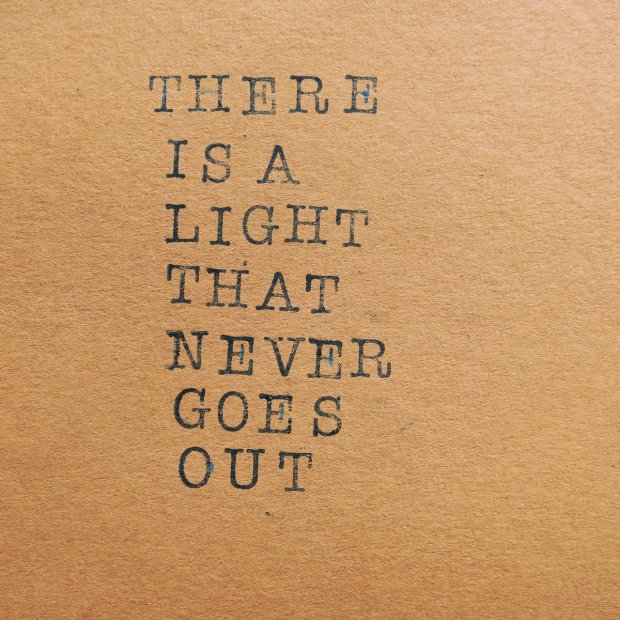
And don’t let the murderers win.
https://www.thejc.com/comment/comment/manchester-a-city-united-1.439057
The Proust Project
Posted by cathannabel in Literature on April 22, 2017
Around ten years ago, I decided that it was simply not on to be a student of 20th century French literature and to have read only the first volume of A la recherche… and that only in English translation.
And so it began.
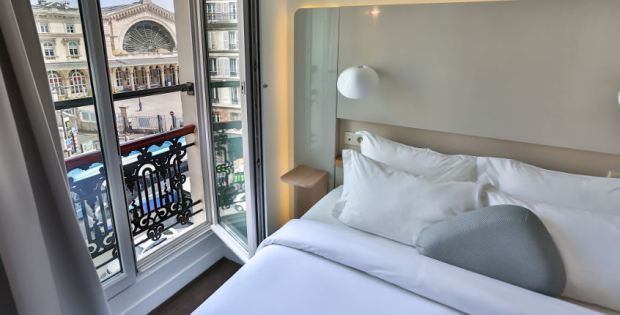
I trotted reasonably swiftly through Vol. 1, largely because I had already read it in English, and because I was reading it in conjunction with a friend and fellow student – but things then slowed down rather dramatically. Finally, a couple of days ago, I reached the final sentence of the final volume. Fittingly, I had made some splendid progress whilst staying in the Hotel le Marcel, in one of their Chambres St Loup, after long walks through the streets of Paris.
I’m normally a fast reader. But not in French. In English, I can see large chunks of text and absorb them easily, but in French I have to read each word, and I cannot be sure I have the meaning of a sentence until I get to the end of it – and with Proust that full stop could be several pages away. So my reading speed slows down dramatically whenever I’m reading in my second language. That’s not all of it, however. Roger Shattuck acknowledges (reassuringly) that:
both in translation and in the original, Proust slows most readers down. His sentences move through long spirals that will not be hastened and deserve to be savoured. He offers few paragraph breaks to declare the steps and stages of his thought. In contrast to most nineteenth-century novelists, he does not construct out of short chapters that divide the story into conveinent mental mouthfuls. One simply cannot force one’s speed and hope to register the prose.
But there were certainly times when I thought I might pack it all in, were it not for the fact that my original rationale was still valid – how can I study Butor without having read Proust? – and a certain bloody-minded stubbornness that those who know me will recognise. I said I was going to read all of Proust in French and I would do so. Even if it was the last thing I did. Thankfully it didn’t quite come to that.
Ten years of reading – albeit with some rather long gaps. Was it worth it? Emphatically yes. It’s an extraordinary work and its influence is so enormous, not only on the French writers who came after Proust, but on literature across the world. I expected that, however. What was unexpected (apart from the fact that it was a great deal funnier than I’d anticipated) was that in many ways it did not work as a novel, because it’s not, or not just, a novel.


Earlier this year, I read Clive James’ wonderful Cultural Amnesia, a collection of short essays on writers, film makers, musicians, political thinkers and philosophers, chosen on the basis that they interest him rather than, necessarily, that he admires or loves them. It’s a book that makes you feel desperately un-well-read, but rather than that being alienating, you feel at the same time that any steps you can take towards being the kind of reader that James is – including simply having a bash at reading in languages in which you are far from fluent – are eminently worth taking. His piece on Proust, which I read before I’d finished Vol. 7 because spoilers aren’t really that much of an issue here, is particularly enlightening.
A commonplace book in the classic sense, it is, itself, a set of annotations to all the works of art that Proust has read, looked at, listened to or otherwise enjoyed, and to everything he knows about nature, natural science, love, sex and the workings of the mind.
A la recherche du temps perdu is never done with, because it keeps growing while you are reading it. Like no other book in the world, Proust’s book leads everywhere: a building made of corridors, and the walls of the corridors are made of doors.
There are people who read Proust just for the clothes. But those of us who read Proust for his remarks about life will always be wondering whether A la recherche du temps perdu is really a work of art at all. A work of imagination: yes, of course, and supremely. But is it a novel? Isn’t it a book of collected critical essays, with the occasional fictional character wandering in and out of it?
These qualities of non-fiction are useful to remember when we realize how many qualities of fiction the longest of all novels does not possess. It has, for example, no structure worth speaking of, and probably would not have attained to one even if Proust had been given another ten years to work on it. Characters would still have shown up twenty years too young at the last party, or twenty years too old, or simply still alive when they should have been dead.
Bloody brilliant. I rather wish I’d read this at the start of my project, rather than as I approached its final stages. There were so many moments when I was frustrated by the pages of rumination, distractedly wondering when something was going to actually HAPPEN, rather than realising that the rumination was what was happening. what mattered, what the book was about. (In this context I could not help but recall Monty Python’s All England Summarise Proust competition…) And I wouldn’t have wasted any energy trying to work out how much temps had actually passé, when it really wasn’t about chronology at all.
Readers and critics of Proust reach for comparisons and metaphors, as James does. Roger Shattuck says that ‘Reading Proust bears many resemblances to visiting a zoo’. It’s commonly referred to as a roman-fleuve, a river that flows on relentlessly and the only way to read the roman is to abandon oneself to that flow (though I note that it also has a more critical connotation – a discours-fleuve is an ‘interminable’ speech…). It’s a web (Malcolm Bowie uses this metaphor), in which everything/everyone is connected to everything/everyone else.

It’s an unfinished cathedral (this draws on a passage from the final pages of Le temps retrouvé) – but James suggests that it is instead ‘a sandcastle that the tide reached before its obsessed constructor could finish it; but he knew that would happen, otherwise why build it on a beach?’. For me, it is a labyrinth, a labyrinth in time and space.
Reading the final pages, I wished that my memory of the earlier volumes was clearer. I want to see how the threads relating to the nature of time and to the Dreyfus affair, and so many more, run through the whole tapestry (another metaphor…).
I could always go back now, and start again at the beginning…


Malcolm Bowie, Proust among the Stars (Fontana, 1998)
Clive James, Cultural Amnesia: Notes in the Margin of My Time (Picador, 2012)
Roger Shattuck, Proust’s Way: A Field Guide to In Search of Lost Time (W W Norton, 2000)
Austerlitz in Paris
Posted by cathannabel in French 20th century history, Second World War, W G Sebald on April 21, 2017
W G Sebald’s novels tend to begin with someone setting out on a journey. His protagonists are almost always in transit, and if they do settle somewhere it is not likely to be long-term. There are always exceptions, of course, and Max Ferber (The Emigrants) is the exception in relation to the latter trait – once he finds himself in Manchester he feels he cannot, must not leave. But Jacques Austerlitz is the archetypal Sebaldian wanderer.
We (via the narrator, who both is and is not Sebald) meet Austerlitz first in Antwerp, then in Liege, Brussels and Zeebrugge, before finding out that he is based in London. At this stage his restless quests are related to his academic interests in architecture, particularly public architecture, as he explores railway stations, prisons and fortresses, courtrooms and museums. After a two year hiatus in their relationship, the narrator and Austerlitz encounter one another again, in London, in a railway station bar. Only now do we begin to find out about his early life. Until his teenage years he had believed himself to be Dafydd Elias, growing up in Bala in Wales. Only after the death of his foster mother and the mental breakdown of his foster father does he discover that his name is Jacques Austerlitz, but he knows nothing more. The name itself signals a kind of multiple identity – a French first name and a Czech place name (which, as a surname, was shared with Fred Astaire and which, because of the Napoleonic era battle which took place there, is also the name of one of Paris’s major railway stations).
Austerlitz finds himself obsessively walking the streets of London in the early hours, and is drawn back repeatedly to Liverpool Street Station where he has a kind of vision of himself as a small child, meeting for the first time the foster parents who had been assigned to him. He feels ‘something rending’ within himself and is in a state of mental torment until he hears, by chance, a radio broadcast about the Kindertransport. This begins to trigger memories of his childhood journey, and when he hears the name of the ship, ‘SS Prague’, he determines to go to that city and find out about where it began.

Austerlitz’s quest is now to find out who his parents were, and what happened to them. He discovers, or believes he has discovered, his mother’s fate. She was deported to Terezin, from whence she was taken, we understand, ‘east’. Whilst there are uncertainties about this narrative, there are far more surrounding his father, who had left for France before the deportations from Prague began.
And so to Paris. Alongside my mission to photograph all of the memorial plaques relating to WWII that we passed as we walked its streets, I wanted to find, if I could, some of the locations described in Sebald’s novel. Sebald sometimes describes real places with absolute precision, sometimes alters or relocates them. Of course, whilst major public buildings were easy to find, I was unsure whether, given that the narrator and protagonist are both fictional constructs, the specific addresses provided would be as straightforward. But they were all there, even the bistro on boulevard Auguste Blanqui.
I received a postcard from Austerlitz giving me his new address (6 rue des cinq Diamants), in the thirteenth arrondissement. (p. 354)
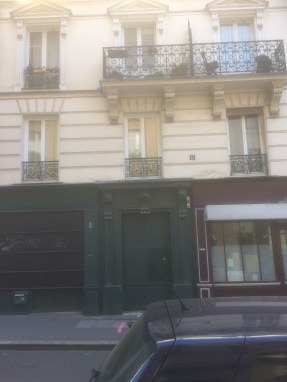
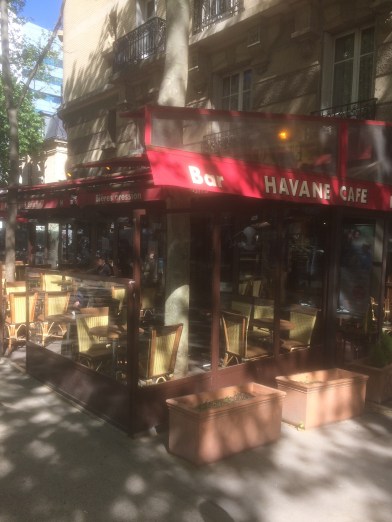
I met Austerlitz, as agreed, on the day after my arrival, in the Le Havane bistro bar on the boulevard Auguste Blanqui, not far from the Glaciere Metro station. (p. 355)
The rue Barrault is said to be the last known address of Maximilian Aychenwald. Austerlitz speculates about whether his father had been caught up in one of the round-ups of Jews:
I kept wondering whether he had been interned in the half-built housing estate out at Drancy after the first police raid in Paris in August 1941, or not until July of the following year, when a whole army of French gendarmes took thirteen thousand of their Jewish fellow citizens from their homes, in what was called the grande rafle, during which over a hundred of their victims jumped out of the windows in desperation or found some other way of committing suicide. I sometimes thought I saw the window-less police cars racing through a city frozen with terror, the crowd of detainees camping out in the open in the Vélodrome d’Hiver, and the trains on which they were soon transported from Drancy and Bobigny; I pictured their journey through the Greater German Reich, I saw my father still in his good suit and his black velour hat, calm and upright among all the frightened people. (pp. 358-359)
During an earlier period in Paris, before the search for his father began, Austerlitz had had another episode of nervous collapse, and had been admitted to the Salpêtrière Hospital.
I did not return to my senses until I was in the Salpêtrière, to which I had been taken and where I was now lying in one of the men’s wards … somewhere in that gigantic complex of buildings where the borders between hospital and penitentiary have always been blurred, and which seems to have grown and spread of its own volition over the centuries until it now forms a universe of its own between the Jardin des Plantes and the Gare d’Austerlitz. (pp. 375-376)


This is the hospital at which, in the late 19th century, Charcot developed his diagnosis of ‘hysterical epilepsy’, and the phenomenon of the ‘fugueur‘ was first identified and researched. Austerlitz can remember nothing about himself or his history, but someone finds the address of his friend Marie de Verneuil and contacts her at 7 place des Vosges.

When I met Austerlitz again for morning coffee on the boulevard Auguste Blanqui, … he told me that the previous day he had heard, from one of the staff at the records centre in the rue Geoffroy l’Asnier, that Maximilian Aychenwald had been interned during the latter part of 1942 in the camp at Gurs, a place in the Pyrennean foothills … Curiously enough, said Austerlitz, a few hours after our last meeting, when he had come back from the Bibliothèque Nationale and changed trains at the Gare d’Austerlitz, he had felt a premonition that he was coming closer to his father. As I might know, he said, part of the railway network had been paralysed by a strike last Wednesday, and in the unusual silence which, as a consequence, had descended on the Gare d’Austerlitz, an idea came to him of his father’s leaving Paris from this station … I imagined, said Austerlitz, that I saw him leaning out of the window … After that I wandered round the deserted station half dazed, through the labyrinthine underpasses, over foot-bridges, up flights of steps on one side and down on the other. That station, said Austerlitz, has always seemed to me the most mysterious of all the railway terminals of Paris. … I was particularly fascinated by the way the Metro trains coming from the Bastille, having crossed the Seine, roll over the iron viaduct into the station’s upper storey, quite as if the façade were swallowing them up. And I also remember that I felt an uneasiness induced by the hall behind this façade, filled with a feeble light and almost entirely empty, where on a platform roughly assembled out of beams and boards, there stood a scaffolding reminiscent of a gallows … an impression forced itself upon me of being on the scene of some unexpiated crime. (pp. 404-407)


The records centre in the rue Geoffrey l’Asnier is now the Mémorial de la Shoah. Amongst the many records kept here, there is a room full of boxes of index cards, relating to the various internment camps and those who were imprisoned there.

I don’t know, said Austerlitz, what all this means, and so I am going to continue looking for my father, and for Marie de Verneuil as well. (p. 408)
We will never know the outcome, although it seems most likely that his parents’ journeys ended in the same, terrible place, a place with which Austerlitz’s name has resonated, whether we have been conscious of it or not, from the beginning. As James Wood points out:
And throughout the novel, present but never spoken, never written – it is the best act of Sebald’s withholding – is the other historical name that shadows the name Austerlitz, the name that begins and ends with the same letters, the name which we sometimes misread Austerlitz as, the place that Agata Austerlitz was almost certainly ‘sent east’ to in 1944, and the place that Maximilian Aychenwald was almost certainly sent to in 1942 from the French camp in Gurs: Auschwitz.
(James Wood, ‘Sent East’, London Review of Books, 6 October 2011)
Austerlitz himself will continue to wander, and it seems that his travels are not merely in space, but also in time. The small Czech boy separated from his parents, the troubled Welsh schoolboy, the London academic, and the driven man travelling through some of the most haunted places in Europe – all are one. Always in transit, in temporary or liminal spaces, descending into the underworld/labyrinth to keep the appointment he has made with his own past.
He had quite often found himself in the grip of dangerous and entirely incomprehensible currents of emotion in the Parisian railway stations, which, he said, he regarded as places marked by both blissful happiness and profound misfortune. (p. 45)
I have always resisted the power of time out of some internal compulsion which I myself have never understood, keeping myself apart from so-called current events in the hope, as I now think, said Austerlitz, that time will not pass away, has not passed away, that I can turn back and go behind it, and there I shall find everything as it once was, or more precisely I shall find that all moments of time have co-existed simultaneously, in which case none of what history tells us would be true, past events have not yet occurred but are waiting to do so at the moment when we think of them. (p.144)
I felt, … said Austerlitz, as if my father were still in Paris and just waiting, so to speak, for a good opportunity to reveal himself. Such ideas infallibly come to me in places which have more of the past about them then the present. For instance, if I am walking through the city and look into one of those quiet courtyards where nothing has changed for decades, I feel, almost physically, the current of time slowing down in the gravitational field of oblivion. It seems to me then as if all the moments of our life occupy the same space, as if future events already existed and were only waiting for us to find out way to them at last. … And might it not be, continued Austerlitz, that we also have appointments to keep in the past, in what has gone before and is for the most part extinguished, and must go there in search of places and people who have some connection with us on the far side of time, so to speak? (pp. 359-360)

On the walls of Paris
Posted by cathannabel in French 20th century history, Genocide, Second World War on April 19, 2017
First time I went to Paris, I started noticing the plaques. I expected them to be the equivalent of our blue plaques, famous bloke (or occasionally woman) was born/lived/died/did something famous here. Instead they were, as often as not, recording the fact that someone whose name is not otherwise known fell here, during the Liberation of the city from its Nazi occupiers. Or that someone whose name is not otherwise known lived here until they were deported by the French police and handed over to the Nazi occupiers, because they were Jewish. I became mildly obsessed. Without a camera phone at that time (it was that long ago) and having gone out unarmed with notebooks, I searched when we got home for information and found an amazing website which aimed to record all such plaques, with a photograph and a brief note about the person or event commemorated. Sadly, that has disappeared now.
So when we went back, I set myself the task of photographing every WWII related plaque that we passed on our travels, and finding out what I could about the background. What follows is an account of what we found – it captures only so very few of the commemorative markers, only those which happened to be on the routes we chose for our walks, those which we spotted, unobscured by scaffolding or parked vans, those which I could get close enough to photograph.
But even so, they tell a rich and fascinating story.
Day 1
10th arrondissement

Ecole élémentaire Récollets, 19 passage des Récollets
The plaque is generic, one of many installed in the early 2000s at schools some of whose pupils had been deported during the Occupation. It makes specific reference to the number of schoolchildren deported from the 10th arrondissement, but nothing about this school in particular. These plaques represent the sea change that took place following President Jacques Chirac’s public recognition in 1995 of France’s responsibility for deporting thousands of Jews to Nazi death camps during the German occupation in World War II. The photograph was taken on the day that Marine le Pen made a press statement denying that responsibility. More of that anon.
Day 2
6th arrondissement
Starting at the rue de Sevres, in search of the childhood residence of Michel Butor, we found instead the plaque commemorating Marc Bloch, noted French historian.

Bloch joined the Resistance in 1942, was captured in Lyon by Vichy police in 1944 and turned over to the Gestapo. He was tortured and interrogated by Klaus Barbie. Ten days after D Day, he was taken with around 28 Resistance prisoners to a meadow near Saint Didier de Formans, where they were executed by firing squad.
5th arrondissement

62 blvd St Michel
Pierre Bounin was a member of one of the independent cavalry brigades, known as Spahi (from the Turkish word for horseman), which saw active service in France in 1940 and one of which subsequently joined forces with the Free French. This mechanised regiment served in Egypt, Libya and Tunisia, and was part of the French forces that liberated Paris in August 1944. This area saw intense fighting to liberate the city, and Bounin is just one of the combattants commemorated.
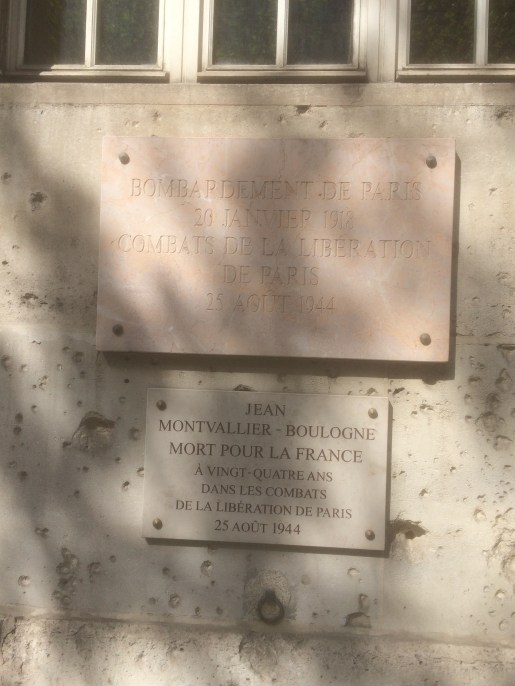
At 60 blvd St Michel, 24 year old Jean Montvallier-Boulogne was killed, on the same day as Bounin. The wall behind his plaque is pitted with bullet holes from the bombardment of the city in 1918, and from the fighting in 1944.
On rue St Jacques, another generic school plaque:

On to the Pont des Arts:

Jacques Lecompte-Boinet was a Compagnon de la Liberation Fondateur and headed the movement Ceux de la Resistance. The Pont des Arts was the location for clandestine meetings with comrades who, like him, risked torture and death. Here Vercors passed on to him publications from the Editions de minuit, intended for General de Gaulle.
Lecompte-Boinet initially joined the Mouvement de Liberation Nationale, which became Combat. Subsequently he set up Ceux de la Résistance with Pierre Arrighi. He was involved in the first meeting of the Conseil national de la Résistance (CNR), 27 May 1943, then left for London in October, from where he travelled to Algiers, returning to France in February 1944. He had a distinguished diplomatic career after the war, and died in November 1974.

Just round the corner is the plaque commemorating Vercors himself – real name Jean Bruller – who wrote Le Silence de la mer, one of the key texts of the literary resistance. It was written in 1941 and published secretly in 1942, the first publication of the Editions de minuit, which Bruller co-founded. Their publications were distributed via clandestine networks, hand to hand. Along with Vercors, they published works by Francois Mauriac, Paul Eluard and Louis Aragon, and after the war established a reputation for publishing new writers such as Michel Butor.
7th arrondissement
Further along the banks of the Seine, the role of the former Gare d’Orsay (now the Musée d’Orsay), as a reception point for those who had escaped or been liberated from concentration camps and forced labour camps is commemorated.

The other major reception point was the Hotel Lutetia, which had been the HQ of the Abwehr during the Occupation, and here the photographs of those who had been deported were displayed, as family members waited in hope of finding those they had lost, and returning deportees waited in hope of finding that someone was looking for them. The survivors of the death camps took longer to come home, often requiring months of medical treatment before they were fit to travel. Their reception was traumatic, for them and for those waiting for them.
Day 3
13th arrondissement
Another railway station, this time the Gare d’Austerlitz.

This was not a place of welcome but a place of despatch. From here, cattle trucks took men, women and children rounded up in Paris to the internment camps of Pithiviers and Beane-la-Rolande, from where most of them were subsequently transported to Auschwitz.
Francois Mauriac, in his clandestine Editions de minuit publication under the pseudonym Forez, Le Cahier noir (1943), wrote of what his wife saw here:
At what other moment in history have the gates of the prison camps closed on so many innocents, at what other epoque have children been dragged away from their mothers and crammed into cattle trucks, as witnessed one sombre morning at the Gare d’Austerlitz?
We were here not only for this bit of history, but for the links to W G Sebald’s novel Austerlitz, the topic of a separate blog.

On the avenue des Gobelins, the deportations from the 13th arrondissement following the Vel d’Hiv round-ups are specifically commemorated. This is quite clear – the round-ups were carried out by ‘la police de l’état francais’. When the Armistice was signed, and Marshall Pétain took on the role of head of state, the vast majority of the French, however much they mourned the defeat, accepted that this was now France. Private citizens and public institutions treated it as such, with at least initially only a small number refusing to accept the authority of the Vichy regime and throwing in their lot with de Gaulle and/or the nascent Resistance. When it came to anti-semitic legislation, Vichy was ahead of its new masters, and as far as the round-ups of Jews are concerned, whilst the Nazis are responsible for the ultimate destination, Auschwitz, those arrested on 16 July 1942 saw only French police until they were on the way to extermination. French police drew up the lists, French police organised the buses and blocked the ends of the streets where their targets lived. French police hammered on the doors in the early hours, and forced the residents to pack swiftly and abandon their homes and most of what they owned. French police transported single adults straight to the internment camps, and families to the stadium, the Velodrome d’hiver. French police guarded them there until they in turn were transferred to the internment camps, and guarded them there too, separating men from women and parents from children until the trucks took them away.
So, inevitably, to Marine le Pen. Her entirely cynical denial of French responsibility is shameful. Le Monde‘s editorial is a perfectly balanced and crystal clear response:
In affirming on Sunday 9 April … that ‘France was not responsible for the Vel d’Hiv’, Marine le Pen has crossed a line: that of the national consensus on the reading of some of the most painful episodes in the history of France, the deportation of French Jews under the German occupation. …
In declaring, at the 1995 commemoration of the event, that ‘France, on that day, did something irreparable’, Jacques Chirac, then President of the Republic, marked a definitive new reading of the deportation of the Jews. The moment had come to recognise clearly the responsiblity of the collaborationist French state … First ministers Lionel Jospin and Jean Pierre Raffarin confirmed his judgement. President Sarkozy judged that there was ‘nothing to retract and nothing to add to this fine statement’. Later, President Francois Hollande, in turn, denounced ‘a crime commited in France for France’.
In rejecting this consensus, Marine le Pen claims to be following in the footsteps of General de Gaulle. On Sunday, to justify her statement, she referred to a ruling from August 1944, published in Algiers by de Gaulle’s provisional government and intended to remove all legality from the Vichy regime. But we are no longer in 1944, nor even in 1981, and Marine le Pen is not Charles de Gaulle, whose heritage was embodied far better by Chirac than by her. We are in 2017. Nearly 3/4 of a century has passed since the Liberation, at least three generations, tens of thousands of pages of history have been written, debated, analysed and taught. The ‘national story’ which [le Pen] wants to promote is anachronistic and sickening. It is based not on a refusal to repent, but on a refusal to recognise an indispensable truth about the nation’s history. Incidentally, Mme le Pen jeopardises (but that’s her problem) years of trying to de-demonise her party, which led her to exclude her own father, unfortunately famous as the man who called the gas chambers a ‘detail’.
Marine le Pen affirmed that ‘France is mentally abused’ by those who teach this critical view. No, Mme le Pen, what abuses France is a version of history which leads it back to the denial of the post-war period. In 1995, Jacques Chirac called for ‘vigilance’. The FN candidate shows that he was right.
At 137 blvd de l’Hopital, previous inhabitants are commemorated; ten of whom (ranging in age from 9 months to 58) were deported and murdered because they were Jews, and another who was shot as a resistant in 1944:

3rd arrondissement. We’re now in Le Marais.
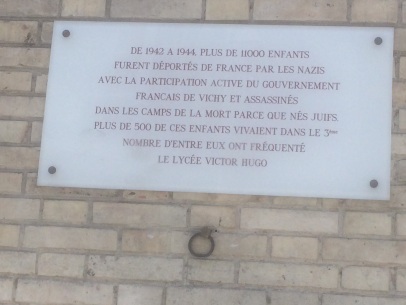
Two more school plaques, commemorating over 500 children from the 3rd, many of whom attended the Lycée Victor Hugo or the Ecole de filles de la rue de Sévigné (now the Atelier des Beaux-arts).

On the rue Perrée, two plaques commemorate members of the union of merchants of the Carreau du Temple who died for France.


Day 4
7th arrondissement
After visiting the Musée de l’Ordre de la Liberation, housed within the Musée de l’Armée, which tells the story of occupation, deportation, resistance and finally liberation, we paid our respects at avenue Elysée Reclus, near the Eiffel Tower, home of Hélène Berr. I’ve written often about Hélène, whose journal, not published until 2008, is one of the most powerful documents of the Occupation.

In my 2012 Holocaust Memorial Day blog, I wrote this:
She was 20 when Paris was occupied, from a thoroughly assimilated French Jewish family, a student at the Sorbonne. She was 21 when she started the journal in which, at first, the war and the Nazi persecution are almost background noise. She was almost 23 when she was arrested, a few months before Paris was liberated, and then deported to Auschwitz on one of the convoys from Drancy. It was her 23rd birthday when she was moved from Auschwitz to Bergen Belsen. She was 24 when she died, in Bergen Belsen, 5 days before the camp was liberated. Her journal, kept by surviving members of her family after the war, was finally published in 2008 and when I read it I loved her, and I grieved for the fate I already knew would be hers. Another voice that wasn’t quite silenced, after all.


Near the Champ de Mars, on avenue de la Bourdonnais, the place where the ‘national insurrection’ of 19-25 August 1944 was planned.

Jean Alexandre Melchior de Vogüé (Vaillant), Alfred Antoine Malleret (Joinville), Raymond Massiet (Dufresne). All three survived the war.
Day 5
4th arrondissement
We began at the Mémorial de la Shoah. I had braced myself for this, knowing the terrible history that would be illustrated there. Nonetheless, seeing the Wall of Names, I felt the air being sucked from my lungs, realising that I was seeing in that moment only a fragment, only some of the names from only one of the years.

Further in, another sharp intake of breath, another moment where the experience of seeing what I knew I was going to see, the photographs of some of the children deported to extermination camps, overwhelmed me.


The Memorial is a powerful experience. It cannot but move you. And in order that one does not give in to despair about humanity, one leaves the Memorial for the Allée des Justes, and another list of names, this time of those who have been recognised for their actions during those dark years, actions which jeopardised their own lives in order to help Jewish friends, colleagues, neighbours and total strangers.
At 23 rue des Ecouffes, in the heart of the Jewish quarter, a family memorial.

This family could be a symbol of the French Resistance. Jewish and Communist, they paid a heavy price.
Rosalie Engros was arrested in August 1942, and deported a month later, to Auschwitz. She was 51. Isaac Engros was murdered at Auschwitz in February 1944, aged 54. They had three sons. Marcel, arrested on 6 May 1942 and shot at Mont Valerien, aged 25. Lucien, arrested and tortured in May 1942, shot 22 August 1942, aged 22, along with a dozen other resistants. Andre, part of the FTP-MOI group of young Jewish resistants, arrested July 1943, tortured and shot 1 October 1943 at Mont-Valerien, aged 16.
3rd arrondissement:

Another school plaque, this time for the Lycée Turgot, on the rue de Turbigo.
On to the rue Meslay, where Yves Toudic is commemorated. He was shot by the Brigade Speciale, a French police unit specialising in tracking down “internal enemies” (i.e. resistants), dissidents, escaped prisoners, Jews and those evading the STO. They worked in direct collaboration with the German civil, secret and military police.
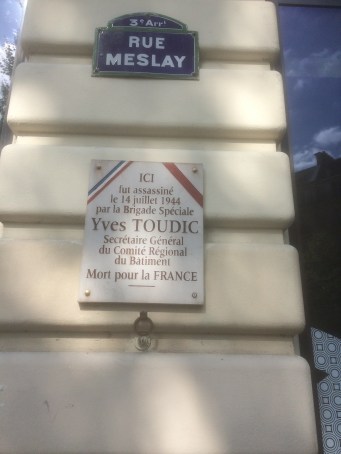
Toudic was 43 when he was killed. Son of a labourer, he was a militant communist and resistant. From September 1940 he was in charge of the Comités populaires du Batiment for the Paris region, and continued in that role until he was shot by the Brigade Speciale, at the time of the 14 July demonstration in the place de la République, which he helped to organise.
10th arrondissement:

Rue René Boulanger. Another young resistant shot down during the battles to liberate the city. I can find nothing about Jean Sulpice, partly because he has a contemporary namesake, a chef. He was 25 when he died.
On the facade of the Bourse du travail, 3 rue du Château-d’Eau, a plaque commemorates the recapturing of the building by ‘the workers of Paris’.

I missed so many. And there is so much more I want to know about those whose names appear here, for posterity. There’s not only the history of the occupation engraved on the walls of Paris, but the history of how it was understood and interpreted and communicated. From the stone plaques marking the spots where resisters fell, installed soon after the liberation, to the much more recent black marble plaques acknowledging how Jewish children disappeared from Paris schools, as they and their families were rounded up and deported.
Paris has of course a rich history outside of those four dark and terrible years. We saw some of it, beautiful buildings and great art. But it seems ever more pertinent to explore what happened in one of the most sophisticated, cosmopolitan and cultured cities of Europe when an occupying power tapped into and found a rich spring of anti-semitism and more generalised xenophobia, and found willing, even enthusiastic partners in their great project to wipe out the Jewish race. Most of those who participated did not know (at least, not for sure) what would be the fate of those they helped to deport. It seems, though, that they didn’t actually care – once the Jews were no longer France’s problem, they had no interest in what would happen to them. We dwell on this not to bad-mouth the French – this happened not only in France but across Europe, and it can happen anywhere, if the right conditions prevail.
We must remember, we must understand, and we must be vigilant.
Easter in the vicarage.
Posted by cathannabel in Refugees on April 16, 2017
An Easter message from Phil Davis of Hope Projects, who blogs about refugees and asylum seekers.

Happy Easter! I wake this sunny, Easter Sunday morning to a sermon from the Prime Minister. It’shere. You may not be able to get to the end, so here is a summary in quotes courtesy of the Telegraph.
The Prime Minister described Easter as “a moment to reflect and an important time for Christians and others to gather together with families and friends”.
She said: “I think of those values that we share – values that I learnt in my own childhood, growing up in a vicarage. Values of compassion, community, citizenship. The sense of obligation we have to one another.
“These are values we all hold in common – and values that are visibly lived out every day by Christians – as well as by people of other faiths or none.”
And who could argue with that? Well as it happens I live in a vicarage. And…
View original post 256 more words
From Sheffield to Zaatari – 24 hours of inspiration
Posted by cathannabel in Events, Personal on April 5, 2017

We started this year’s 24 Hour Inspire with a celebration of the city of Sheffield. City of beer, art and music – and all three were on offer over the course of the event (albeit the beer only in very restrained quantities). This remarkable and moving video summed it up:
Straight into Sheffield music, from the Vivacity choir.
 We crossed all sorts of boundaries – those between the academic disciplines, for a start. ‘Unweaving the rainbow’ brought together scientists exploring colour in physics and biology with a contemporary artist and with poets – and audiences could also explore an abstract virtual reality colour environment, and make their own contributions to a colour wheel.
We heard from a physicist at Durham University, talking about his family history in Poland, during the Nazi occupation, and from a physicist here at Sheffield, talking about Elizabethan/Jacobean revenge tragedy.
All in all, there were 45…
View original post 1,501 more words
Triggering Article 50: a historic moment of delusional madness and national self-harm
Posted by cathannabel in Brexit, Politics on March 29, 2017
I am bereft of words on the day our ‘divorce’ from the EU is triggered. Thankfully Gerry has found some powerful and effective words for me.

‘This is a historic moment from which there will be no turning back,’ crowed Theresa May in her completely mad speech to the Commons this lunchtime. Yet in her speech and in the Article 50 letter to Donald Tusk, she reminded us of the value of what we are losing. ‘Europe’s security is more fragile today than at any time since the end of the cold war’, she intoned; yet the whole point of European integration has been to help maintain the peace in postwar Europe.
And after informing Tusk and the assembled MPs that the UK would not seek to remain in the world’s largest single market, she went on: ‘At a time when the growth of global trade is slowing, and there are signs that protectionist instincts are on the rise in many parts of the world, Europe has a responsibility to stand up for free trade in…
View original post 1,532 more words
 Passing Time