Archive for category Literature
The Proust Project
Posted by cathannabel in Literature on April 22, 2017
Around ten years ago, I decided that it was simply not on to be a student of 20th century French literature and to have read only the first volume of A la recherche… and that only in English translation.
And so it began.
I trotted reasonably swiftly through Vol. 1, largely because I had already read it in English, and because I was reading it in conjunction with a friend and fellow student – but things then slowed down rather dramatically. Finally, a couple of days ago, I reached the final sentence of the final volume. Fittingly, I had made some splendid progress whilst staying in the Hotel le Marcel, in one of their Chambres St Loup, after long walks through the streets of Paris.

I’m normally a fast reader. But not in French. In English, I can see large chunks of text and absorb them easily, but in French I have to read each word, and I cannot be sure I have the meaning of a sentence until I get to the end of it – and with Proust that full stop could be several pages away. So my reading speed slows down dramatically whenever I’m reading in my second language. That’s not all of it, however. Roger Shattuck acknowledges (reassuringly) that:
both in translation and in the original, Proust slows most readers down. His sentences move through long spirals that will not be hastened and deserve to be savoured. He offers few paragraph breaks to declare the steps and stages of his thought. In contrast to most nineteenth-century novelists, he does not construct out of short chapters that divide the story into conveinent mental mouthfuls. One simply cannot force one’s speed and hope to register the prose.
But there were certainly times when I thought I might pack it all in, were it not for the fact that my original rationale was still valid – how can I study Butor without having read Proust? – and a certain bloody-minded stubbornness that those who know me will recognise. I said I was going to read all of Proust in French and I would do so. Even if it was the last thing I did. Thankfully it didn’t quite come to that.
Ten years of reading – albeit with some rather long gaps. Was it worth it? Emphatically yes. It’s an extraordinary work and its influence is so enormous, not only on the French writers who came after Proust, but on literature across the world. I expected that, however. What was unexpected (apart from the fact that it was a great deal funnier than I’d anticipated) was that in many ways it did not work as a novel, because it’s not, or not just, a novel.


Earlier this year, I read Clive James’ wonderful Cultural Amnesia, a collection of short essays on writers, film makers, musicians, political thinkers and philosophers, chosen on the basis that they interest him rather than, necessarily, that he admires or loves them. It’s a book that makes you feel desperately un-well-read, but rather than that being alienating, you feel at the same time that any steps you can take towards being the kind of reader that James is – including simply having a bash at reading in languages in which you are far from fluent – are eminently worth taking. His piece on Proust, which I read before I’d finished Vol. 7 because spoilers aren’t really that much of an issue here, is particularly enlightening.
A commonplace book in the classic sense, it is, itself, a set of annotations to all the works of art that Proust has read, looked at, listened to or otherwise enjoyed, and to everything he knows about nature, natural science, love, sex and the workings of the mind.
A la recherche du temps perdu is never done with, because it keeps growing while you are reading it. Like no other book in the world, Proust’s book leads everywhere: a building made of corridors, and the walls of the corridors are made of doors.
There are people who read Proust just for the clothes. But those of us who read Proust for his remarks about life will always be wondering whether A la recherche du temps perdu is really a work of art at all. A work of imagination: yes, of course, and supremely. But is it a novel? Isn’t it a book of collected critical essays, with the occasional fictional character wandering in and out of it?
These qualities of non-fiction are useful to remember when we realize how many qualities of fiction the longest of all novels does not possess. It has, for example, no structure worth speaking of, and probably would not have attained to one even if Proust had been given another ten years to work on it. Characters would still have shown up twenty years too young at the last party, or twenty years too old, or simply still alive when they should have been dead.
Bloody brilliant. I rather wish I’d read this at the start of my project, rather than as I approached its final stages. There were so many moments when I was frustrated by the pages of rumination, distractedly wondering when something was going to actually HAPPEN, rather than realising that the rumination was what was happening. what mattered, what the book was about. (In this context I could not help but recall Monty Python’s All England Summarise Proust competition…) And I wouldn’t have wasted any energy trying to work out how much temps had actually passé, when it really wasn’t about chronology at all.
Readers and critics of Proust reach for comparisons and metaphors, as James does. Roger Shattuck says that ‘Reading Proust bears many resemblances to visiting a zoo’. It’s commonly referred to as a roman-fleuve, a river that flows on relentlessly and the only way to read the roman is to abandon oneself to that flow (though I note that it also has a more critical connotation – a discours-fleuve is an ‘interminable’ speech…). It’s a web (Malcolm Bowie uses this metaphor), in which everything/everyone is connected to everything/everyone else.

It’s an unfinished cathedral (this draws on a passage from the final pages of Le temps retrouvé) – but James suggests that it is instead ‘a sandcastle that the tide reached before its obsessed constructor could finish it; but he knew that would happen, otherwise why build it on a beach?’. For me, it is a labyrinth, a labyrinth in time and space.
Reading the final pages, I wished that my memory of the earlier volumes was clearer. I want to see how the threads relating to the nature of time and to the Dreyfus affair, and so many more, run through the whole tapestry (another metaphor…).
I could always go back now, and start again at the beginning…


Malcolm Bowie, Proust among the Stars (Fontana, 1998)
Clive James, Cultural Amnesia: Notes in the Margin of My Time (Picador, 2012)
Roger Shattuck, Proust’s Way: A Field Guide to In Search of Lost Time (W W Norton, 2000)
Austerlitz in Paris
Posted by cathannabel in French 20th century history, Second World War, W G Sebald on April 21, 2017
W G Sebald’s novels tend to begin with someone setting out on a journey. His protagonists are almost always in transit, and if they do settle somewhere it is not likely to be long-term. There are always exceptions, of course, and Max Ferber (The Emigrants) is the exception in relation to the latter trait – once he finds himself in Manchester he feels he cannot, must not leave. But Jacques Austerlitz is the archetypal Sebaldian wanderer.
We (via the narrator, who both is and is not Sebald) meet Austerlitz first in Antwerp, then in Liege, Brussels and Zeebrugge, before finding out that he is based in London. At this stage his restless quests are related to his academic interests in architecture, particularly public architecture, as he explores railway stations, prisons and fortresses, courtrooms and museums. After a two year hiatus in their relationship, the narrator and Austerlitz encounter one another again, in London, in a railway station bar. Only now do we begin to find out about his early life. Until his teenage years he had believed himself to be Dafydd Elias, growing up in Bala in Wales. Only after the death of his foster mother and the mental breakdown of his foster father does he discover that his name is Jacques Austerlitz, but he knows nothing more. The name itself signals a kind of multiple identity – a French first name and a Czech place name (which, as a surname, was shared with Fred Astaire and which, because of the Napoleonic era battle which took place there, is also the name of one of Paris’s major railway stations).
Austerlitz finds himself obsessively walking the streets of London in the early hours, and is drawn back repeatedly to Liverpool Street Station where he has a kind of vision of himself as a small child, meeting for the first time the foster parents who had been assigned to him. He feels ‘something rending’ within himself and is in a state of mental torment until he hears, by chance, a radio broadcast about the Kindertransport. This begins to trigger memories of his childhood journey, and when he hears the name of the ship, ‘SS Prague’, he determines to go to that city and find out about where it began.


Austerlitz’s quest is now to find out who his parents were, and what happened to them. He discovers, or believes he has discovered, his mother’s fate. She was deported to Terezin, from whence she was taken, we understand, ‘east’. Whilst there are uncertainties about this narrative, there are far more surrounding his father, who had left for France before the deportations from Prague began.
And so to Paris. Alongside my mission to photograph all of the memorial plaques relating to WWII that we passed as we walked its streets, I wanted to find, if I could, some of the locations described in Sebald’s novel. Sebald sometimes describes real places with absolute precision, sometimes alters or relocates them. Of course, whilst major public buildings were easy to find, I was unsure whether, given that the narrator and protagonist are both fictional constructs, the specific addresses provided would be as straightforward. But they were all there, even the bistro on boulevard Auguste Blanqui.
I received a postcard from Austerlitz giving me his new address (6 rue des cinq Diamants), in the thirteenth arrondissement. (p. 354)
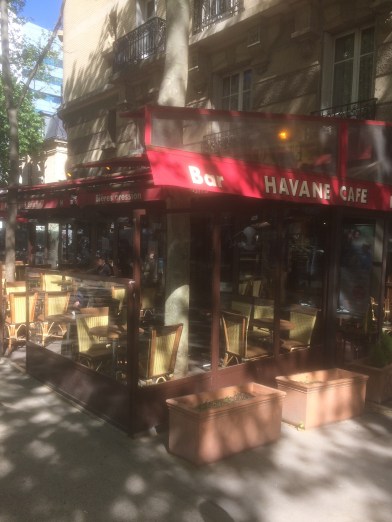
I met Austerlitz, as agreed, on the day after my arrival, in the Le Havane bistro bar on the boulevard Auguste Blanqui, not far from the Glaciere Metro station. (p. 355)
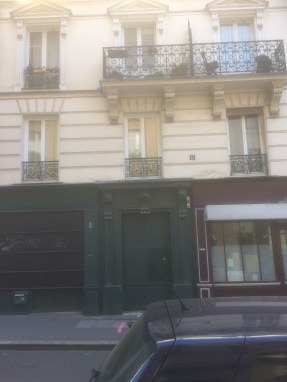
The rue Barrault is said to be the last known address of Maximilian Aychenwald. Austerlitz speculates about whether his father had been caught up in one of the round-ups of Jews:
I kept wondering whether he had been interned in the half-built housing estate out at Drancy after the first police raid in Paris in August 1941, or not until July of the following year, when a whole army of French gendarmes took thirteen thousand of their Jewish fellow citizens from their homes, in what was called the grande rafle, during which over a hundred of their victims jumped out of the windows in desperation or found some other way of committing suicide. I sometimes thought I saw the window-less police cars racing through a city frozen with terror, the crowd of detainees camping out in the open in the Vélodrome d’Hiver, and the trains on which they were soon transported from Drancy and Bobigny; I pictured their journey through the Greater German Reich, I saw my father still in his good suit and his black velour hat, calm and upright among all the frightened people. (pp. 358-359)
During an earlier period in Paris, before the search for his father began, Austerlitz had had another episode of nervous collapse, and had been admitted to the Salpêtrière Hospital.
I did not return to my senses until I was in the Salpêtrière, to which I had been taken and where I was now lying in one of the men’s wards … somewhere in that gigantic complex of buildings where the borders between hospital and penitentiary have always been blurred, and which seems to have grown and spread of its own volition over the centuries until it now forms a universe of its own between the Jardin des Plantes and the Gare d’Austerlitz. (pp. 375-376)


This is the hospital at which, in the late 19th century, Charcot developed his diagnosis of ‘hysterical epilepsy’, and the phenomenon of the ‘fugueur‘ was first identified and researched. Austerlitz can remember nothing about himself or his history, but someone finds the address of his friend Marie de Verneuil and contacts her at 7 place des Vosges.

When I met Austerlitz again for morning coffee on the boulevard Auguste Blanqui, … he told me that the previous day he had heard, from one of the staff at the records centre in the rue Geoffroy l’Asnier, that Maximilian Aychenwald had been interned during the latter part of 1942 in the camp at Gurs, a place in the Pyrennean foothills … Curiously enough, said Austerlitz, a few hours after our last meeting, when he had come back from the Bibliothèque Nationale and changed trains at the Gare d’Austerlitz, he had felt a premonition that he was coming closer to his father. As I might know, he said, part of the railway network had been paralysed by a strike last Wednesday, and in the unusual silence which, as a consequence, had descended on the Gare d’Austerlitz, an idea came to him of his father’s leaving Paris from this station … I imagined, said Austerlitz, that I saw him leaning out of the window … After that I wandered round the deserted station half dazed, through the labyrinthine underpasses, over foot-bridges, up flights of steps on one side and down on the other. That station, said Austerlitz, has always seemed to me the most mysterious of all the railway terminals of Paris. … I was particularly fascinated by the way the Metro trains coming from the Bastille, having crossed the Seine, roll over the iron viaduct into the station’s upper storey, quite as if the façade were swallowing them up. And I also remember that I felt an uneasiness induced by the hall behind this façade, filled with a feeble light and almost entirely empty, where on a platform roughly assembled out of beams and boards, there stood a scaffolding reminiscent of a gallows … an impression forced itself upon me of being on the scene of some unexpiated crime. (pp. 404-407)


The records centre in the rue Geoffrey l’Asnier is now the Mémorial de la Shoah. Amongst the many records kept here, there is a room full of boxes of index cards, relating to the various internment camps and those who were imprisoned there.

I don’t know, said Austerlitz, what all this means, and so I am going to continue looking for my father, and for Marie de Verneuil as well. (p. 408)
We will never know the outcome, although it seems most likely that his parents’ journeys ended in the same, terrible place, a place with which Austerlitz’s name has resonated, whether we have been conscious of it or not, from the beginning. As James Wood points out:
And throughout the novel, present but never spoken, never written – it is the best act of Sebald’s withholding – is the other historical name that shadows the name Austerlitz, the name that begins and ends with the same letters, the name which we sometimes misread Austerlitz as, the place that Agata Austerlitz was almost certainly ‘sent east’ to in 1944, and the place that Maximilian Aychenwald was almost certainly sent to in 1942 from the French camp in Gurs: Auschwitz.
(James Wood, ‘Sent East’, London Review of Books, 6 October 2011)
Austerlitz himself will continue to wander, and it seems that his travels are not merely in space, but also in time. The small Czech boy separated from his parents, the troubled Welsh schoolboy, the London academic, and the driven man travelling through some of the most haunted places in Europe – all are one. Always in transit, in temporary or liminal spaces, descending into the underworld/labyrinth to keep the appointment he has made with his own past.
He had quite often found himself in the grip of dangerous and entirely incomprehensible currents of emotion in the Parisian railway stations, which, he said, he regarded as places marked by both blissful happiness and profound misfortune. (p. 45)
I have always resisted the power of time out of some internal compulsion which I myself have never understood, keeping myself apart from so-called current events in the hope, as I now think, said Austerlitz, that time will not pass away, has not passed away, that I can turn back and go behind it, and there I shall find everything as it once was, or more precisely I shall find that all moments of time have co-existed simultaneously, in which case none of what history tells us would be true, past events have not yet occurred but are waiting to do so at the moment when we think of them. (p.144)
I felt, … said Austerlitz, as if my father were still in Paris and just waiting, so to speak, for a good opportunity to reveal himself. Such ideas infallibly come to me in places which have more of the past about them then the present. For instance, if I am walking through the city and look into one of those quiet courtyards where nothing has changed for decades, I feel, almost physically, the current of time slowing down in the gravitational field of oblivion. It seems to me then as if all the moments of our life occupy the same space, as if future events already existed and were only waiting for us to find out way to them at last. … And might it not be, continued Austerlitz, that we also have appointments to keep in the past, in what has gone before and is for the most part extinguished, and must go there in search of places and people who have some connection with us on the far side of time, so to speak? (pp. 359-360)

In the dark times will there also be singing?
Posted by cathannabel in Literature on December 31, 2016
Thanks – yet again – to Gerry’s That’s How the Light Gets In blog, which so often inspires and moves me, for this selection of words that speak to us about this year, and our hopes and fears for the next.

In the dark times
Will there also be singing?
Yes, there will also be singing
About the dark times.
– Bertolt Brecht, motto to Svendborg Poems, 1939
In an essay called ‘Undefeated Despair’, John Berger wrote of ‘Despair without fear, without resignation, without a sense of defeat.’ ‘However you look at it’, the Guardian editorialised a few days ago, ‘2017 offers a fearful prospect for America and the world.’ In the words of Paul Simon’s ‘American Tune’, I don’t have a friend who feels at ease when weighing the prospects for the year ahead. In the spirit that some solace may be found in poetry in these dark times, I offer a selection of poems or brief extracts – some have which have appeared in posts here before – which seem to offer meaning and hope; they may reflect Berger’s stance of undefeated despair, offering not ‘a promise, or a consolation, or an oath…
View original post 1,467 more words
Books of the Year 2016
Posted by cathannabel in Literature on December 9, 2016
With the luxury of retirement, I’ve done a lot of reading. These days, though, I’m more likely to put a book to one side, temporarily (if I know it’s good but I just can’t quite get into it right now) or permanently, if the writing is clunky and/or clichéd. The pile of ‘to read’ books by my bed seems never to be dented by my voracious reading, and that doesn’t even take account of what’s stored on my Kindle. Life is simply too short to read bad books. Not when there are so many good books waiting to be read – by which I emphatically do not mean just serious, literary books, let alone ‘improving’ books, but books that expand the reader’s sympathies, take them to other places, make them care, compel them to read on and read more.
My policy with this annual blog – eagerly awaited, I know, by my loyal readers – is to make no reference at all to the bad books. I want to recommend, to share my enthusiasms, not to knock anyone’s work.
So these are the books that I loved this year.
In non-fiction two titles on current politics stand out. The first is Jason Burke’s The New Threat from Islamic Militancy. Not an encouraging read, but immensely informative and enlightening, and it seems to me that we need to understand the nature of that new threat, if we are to have a chance of defeating it. The second is Rebecca Solnit’s Hope in Dark Times, recommended to me via the That’s Where the Light Gets In blog, and a real tonic at a time when it almost seems that the battle is not worth joining, that there is nothing we could do in the face of the tide of unreason and prejudice.


I discovered Paddy Ashdown’s WW2 histories, thoroughly researched and thrillingly written. Game of Spies told the extraordinary story of a spy triangle in wartime Bordeaux, involving a secret agent, a right wing Resistance leader, and a Nazi officer, whilst Cruel Victory was a very human story of the Resistance uprising on the Vercors plateau after the D Day landings.


I found myself without any particular plan to do so, reading a succession of accounts of long walks. Really, really long walks. Poet Simon Armitage walked the Pennine Way in reverse, Nicholas Crane undertook a seventeen-month journey along the chain of mountains which stretches across Europe from Cape Finisterre to Istanbul, and Cheryl Strayed walked the eleven-hundred miles of the west coast of America alone. None of them were entirely well prepared or equipped for their journeys, all of them were at times injured, miserable, lost. All three write compellingly and with both poetry and humour about the landscapes and the people they encountered. Much as I loved reading about their journeys, I did not feel moved to emulate any of them.


Another book about wandering came from the Fife Psychogeographical Society, whose blog has delighted me for a long time. From Hill to Sea describes various meanderings around Fife and further afield, with poetry and photographs and even a playlist of the music that accompanied the walks. This wasn’t about walking as a challenge, clocking up the miles or the peaks, but about detours and details, spotting the anomalous, the unexplained.
From the countryside to the city, and Darran Anderson’s Imaginary Cities. This is ‘creative non-fiction’, which draws upon a vast range of texts and cultural artefacts to explore ‘the metropolis and the imagination, … mapping cities of sound, melancholia and the afterlife, where time runs backwards or which float among the clouds.‘ An exhilarating read.


Ian Clayton’s Bringing it all Back Home talks about music the way I think about music. How the music you love becomes woven into your life, your loves and losses, the places you live in, encounter and remember. It’s moving and funny throughout, but the coda will break your heart.
And First Light, an anthology of articles in tribute to Alan Garner, whose books have been part of my life since I first read The Weirdstone of Brisingamen as a child of probably 7 or 8 and it scared the living daylights out of me. Garner’s writing is spare and stark and beautiful. Philip Pullman says of him that he explores ‘the mysterious subterranean links between the present and the past, between psychology and landscape, between the real and the dream. If the rocks, caves, lakes, fens, bogs and dens of the land of Britain had a voice, it would sound like Alan Garner telling a story.’ This collection brings together celebrations of his work from writers/readers including Margaret Atwood, Susan Cooper, Neil Gaiman, David Almond and Helen Dunmore.


In fiction this year I finally got round to some classics that I’d either never read before, or had read so long ago that I could come to them afresh. My reading of Conrad’s The Secret Agent was prompted by the TV adaptation, and of The Tenant of Wildfell Hall by Sam Baker’s excellent modern take on the narrative. Anne Bronte led me to Elizabeth Gaskell’s biography of Charlotte, a story familiar in broad outline but rich in unexpected detail, even if reading it now one cannot help but be aware of the things that could not then be said.


And two French classics, Les Liaisons dangereuses, and Vercors’ Le Silence du mer.
The former is an 18th century epistolary novel, and an extraordinary one. Where this literary device was usually used to give the sense that one is being admitted to the protagonist’s innermost thoughts, here we find each writer presenting radically different versions of events and motivations depending on who they are writing to. These are highly unreliable narrators, and it is up to the reader to try to tease out the truth, if indeed it is there to be found. Are they immoral, embracing transgression for its own sake, or amoral, indifferent to everything except the games they play?
Le Silence was published clandestinely in 1942, during the Nazi Occupation of France. Jean Bruller’s novel, published under the pseudonym Vercors, is a call to mental resistance to the enemy, written before much organised armed resistance was underway. It describes a household forced to take in a German officer, where the father and daughter maintain silence in the face of the officer’s attempts to communicate with them, and to show them that he is a cultured and civilised man.


In contemporary fiction, I enjoyed new work by writers who feature most years in my ‘best of’ lists.
Stephen King completed his Mr Mercedes trilogy with the excellent End of Watch, and also produced a selection of short stories (as always with King’s collections, they’re of mixed merit, but there are some crackers in there).
Cath Staincliffe’s The Silence between Breaths was one of the tensest narratives I’ve read all year. Read it. Just perhaps don’t read it as I did whilst on a train.


I’d read some of Louise Doughty’s books before (Apple Tree Yard and Whatever You Love) and thoroughly enjoyed them. Fires in the Dark was something else again. The narrative takes us from the late ‘20s in Bohemia to the final days of WW2 in Prague, through the lives of a Romany family. Doughty inducts us into their rich culture as well as drawing compelling and complex characters, so that as the darkness of oppression gathers around them and little by little everything is taken from them, we feel it. Harrowing and very moving, and immensely enriching. Her other Roma novel, Stone Cradle tells the story of a family in Britain, through the changes and challenges of the twentieth century, focusing on the lives of two remarkable women.


I found myself drawn to re-read Chris Mullins’ A Very British Coup, which I knew from the TV adaptation years ago with Ray McAnally. Quite unnerving, sometimes the text could be ripped from today’s papers, but in other respects (the risk of a left-wing Labour leader becoming PM, for example) it seems incredible…


New writers to me –
Deborah Levy’s unsettling Swimming Home
Lynn Alexander’s The Sister, based on the life of diarist Alice, sister of Henry and William James
Walter Kempowski’s account of the chaotic days of the end of WW2, through the eyes of a German family, All for Nothing
Elizabeth Wein’s Codename Verity and Rose Under Fire were powerful and moving YA novels of WW2, with female protagonists, not shrinking from horror but focusing on friendship, courage and love
In Patrick Gale’s wonderful Notes from an Exhibition the notes, part of an imagined posthumous exhibition of an artist’s work, build her story and that of her family, non-sequentially, a bit like a patchwork or kaleidoscope.
Glenn Patterson’s The International is a novel about the Troubles that ends before the Troubles begin, but sets the scene vividly and with black humour


And as always, there’s been a fair amount of murder.
Some old favourites (Rebus, Wallander, Dalziel & Pascoe, Ann Cleeve’s Shetland series), more from some more recent discoveries (Laura Lippman’s Tess Monaghan, Sarah Hilary’s Marnie Rome, and Allan Massie’s Bordeaux novels set in WW2).
I’ll be following up on Jane Casey’s Maeve Kerrigan series, which I discovered after reading her stand-alone novel, The Missing. Another discovery was Michel Bussi, whose Maman a tort was a satisfyingly complex and compelling psychological thriller. And finally, W H Clark’s An End to a Silence was a riveting read, whose sequels I look forward to immensely.


And my novel of the year is Kate Atkinson’s Life after Life. I knew several of her other novels, but this one was just dizzying, overwhelming, enthralling. I read it twice, I had to, and will read it again. Its sequel, A God in Ruins, was a different experience and a troubling one, about which I can say nothing except to urge you to read on because somehow it all comes together in a most remarkable way.

A notable omission. I’m stuck on Proust – about an eighth of the way into the penultimate novel of A la Recherche. So my objective for next year, as well as making at least a dent in the ‘to read’ pile, and discovering lots of wonderful new writers, and re-reading some of my favourites, is to bloody well finish Proust…
Lynne Alexander – The Sister
Darran Anderson – Imaginary Cities
Simon Armitage – Walking Home
Paddy Ashdown – Game of Spies, The Cruel Victory
Kate Atkinson – Life after Life, A God in Ruins
Sam Baker – The Woman Who Ran
Anne Bronte – The Tenant of Wildfell Hall
Jason Burke – The New Threat from Islamic State
Michel Bussi – Maman a tort
Ian Carlton – Bringing it all Back Home
Jane Casey – The Missing, The Burning, The Reckoning
W H Clark – An End to a Silence
Joseph Conrad – The Secret Agent
Nicholas Crane – Clear Water Rising
Louise Doughty – Fires in the Dark, Stone Cradle
Fife Psychogeographical Society – From Hill to Sea
Patrick Gale – Notes from an Exhibition
Elizabeth Gaskell – Life of Charlotte Bronte
Sarah Hilary – Tastes like Fear
Walter Kempowski – All for Nothing
Stephen King – Bazaar of Bad Dreams, End of Watch
Choderlos de Laclos – Les Liaisons dangereuses
Deborah Levy – Swimming Home
Laura Lippman – Hush Hush
Allan Massie – Endgames in Bordeaux
Chris Mullins – A Very British Coup
Glenn Patterson – The International
Rebecca Solnit – Hope in the Dark
Cath Staincliffe – The Silence Between Breaths
Cheryl Strayed – Wild
Vercors – Le Silence de la mer
Erica Wagner (ed.) – First Light
Elizabeth Wein – Codename Verity, Rose Under Fire
Tears of Rage
Posted by cathannabel in Literature, Music on October 21, 2016

I’ve been listening to a lot of Dylan lately. Early stuff – Witmark demos, basement tapes, that sort of thing. Raw and rough, but with such immense power.
Do his lyrics constitute poetry? I’ve often considered this question, and argued with others about it, not just in relation to Dylan but to other songwriters whose lyrics are held up as shining examples of the art. I don’t think there is any absolute answer.
Many brilliant song lyrics absolutely only work when they are sung. On the page they might seem flat and clumsy, but when you hear them they take wings and fly and soar and take your heart with them. To be a great songwriter does not require one to be a poet – Lennon & McCartney rarely achieve the kind of lyrical brilliance that I would want to defend as poetry; for the most part there are moments, rather than whole songs, as sublime as those moments are. The brilliance of Holland, Dozier & Holland does not lie in their lyrics, and whilst Smokey’s are witty and clever, and less prone to ‘confusion/illusion’, ‘burning/yearning’ cliches, I can think of no individual songs that I would want to present as poems. R Dean Taylor’s wonderful ‘Love Child’ works because of the way the lead vocal and backing vocals are woven together, especially in the coda where Diana Ross’s voice takes the melody with ‘I’ll always love you’, with the urgent rhythms of the backing singers pleading with the lover to wait, and hold on. On the page though, all that is lost.
So do I believe that Dylan is a worthy recipient of the Nobel Prize for Literature? Yes, yes I do, despite all of the caveats that so often apply.
Firstly, the lyrics are quite clearly the driving force of his songs. Not accompaniments to the music, nor a vehicle for the voice (indeed the voice divides opinion considerably more than the lyrics), rather the reverse. Secondly, the immense variety of his work deserves recognition. Even just considering his earlier work, which is what I know best, you have the pared down, desperate simplicity of ‘Hollis Brown’, the jaunty viciousness of ‘Don’t Think Twice’, the surreal imagery of ‘Hard Rain’… Thirdly, these are words of visceral power that stay with you and whose portent transcends the time of their writing and the specific concerns that inspired them.

Take ‘Hollis Brown’. The relentless rhythm is matched by the relentless words, the repetition hammering home the hopelessness
You looked for work and money
And you walked a rugged mile
You looked for work and money
And you walked a rugged mile
This kind of repetition is a feature of many folksongs, presumably to help with their transmission in an oral tradition, but here it’s more than that. Hollis Brown walks his rugged mile, walks the floor and wonders why, and his babies’ cries pound on his brain, on and on until he can see no way out other than to spend his last lone dollar on those shotgun shells.


Critic David Horowitz has said of this song:
-
Technically speaking, “Hollis Brown” is a tour de force. For a ballad is normally a form which puts one at a distance from its tale. This ballad, however, is told in the second person, present tense, so that not only is a bond forged immediately between the listener and the figure of the tale, but there is the ironic fact that the only ones who know of Hollis Brown’s plight, the only ones who care, are the hearers who are helpless to help, cut off from him, even as we in a mass society are cut off from each other….
On the same album as Hollis Brown, there’s ‘Only a Pawn in their Game’.
He’s taught in his school
From the start by the rule
That the laws are with him
To protect his white skin
To keep up his hate
So he never thinks straight
‘Bout the shape that he’s in
But it ain’t him to blame
He’s only a pawn in their game

The invocation of Medgar Evers’ name and brutal death set up expectations which are undercut at the end of the first verse as Dylan asserts ‘He can’t be blamed’. And the final verse contrasts Evers’ burial, lowered down as a king, with the unanmed assailant’s future death and his epitaph plain, only a pawn in their game. I know I was not the only person who found those words circling in my mind after the murder of Jo Cox, and again after the upsurge in racist harassment and attacks post-referendum.
Then there’s ‘Hattie Carroll’. That killer final verse:
In the courtroom of honor, the judge pounded his gavel
To show that all’s equal and that the courts are on the level
…
And that the ladder of law has no top and no bottom,
Stared at the person who killed for no reason
Who just happened to be feelin’ that way without warning
And he spoke through his cloak, most deep and distinguished,
And handed out strongly, for penalty and repentance,
William Zanzinger with a six month sentence…
Oh, but you who philosophise disgrace and criticise all fears
Bury the rag deep in your face
For now’s the time for your tears
If that weren’t enough the album also includes ‘With God on Our Side’, ‘The Times they are a Changing’, ‘North Country Blues’ – and from the viscerally political to the personal and the melancholy of ‘One Too Many Mornings’.
You’re right from your side
I’m right from mine
We’re both just too many mornings
And a thousand miles behind
which reminds me of Kirsty MacColl’s ‘You and Me Baby’
Except for you and me baby
This is journey’s end
And I try to hang on to all those precious smiles
But I’m tired of walking and it must be miles
That’s just one album, by a man in his early twenties. And this intensely productive period had given us the satire of ‘Talking John Birch Paranoid Blues’, ‘Hard Rain’ and, in real contrast to the melancholy and reflective farewell expressed in ‘One Too Many Mornings’, this:
I aint saying you treated me unkind
You could have done better but I don’t mind
You just kinda wasted my precious time
But don’t think twice, it’s all right
Ouch.
A much less well known song than some of those above, one which I might not have come across had Jimi Hendrix not covered it, is ‘Tears of Rage’.
We carried you in our arms
On Independence Day,
And now you’d throw us all aside
And put us on our way.
Oh what dear daughter ‘neath the sun
Would treat a father so,
To wait upon him hand and foot
And always tell him, ‘No’?
Tears of rage, tears of grief,
Why must I always be the thief?
Come to me now, you know
We’re so alone
And life is brief
Andy Gill, in his 1998 book, Classic Bob Dylan: My Back Pages, suggests a link to King Lear:
Wracked with bitterness and regret, its narrator reflects upon promises broken and truths ignored, on how greed has poisoned the well of best intentions’, and how even daughters can deny their father’s wishes.
and to the Vietnam war:
In its narrowest and most contemporaneous interpretation, the song could be the first to register the pain of betrayal felt by many of America’s Vietnam war veterans. … In a wider interpretation [it] harks back to what anti-war protesters and critics of American materialism in general felt was a more fundamental betrayal of the American Declaration of Independence and the Bill of Rights.
Sid Griffin in his Million Dollar Bash: Bob Dylan, the Band, and the Basement Tapes, noted the strong Biblical theme running through the song, particularly the ‘life is brief’ motif which links to Psalms and Isaiah, and Greil Marcus wrote that
in Dylan’s singing—an ache from deep in the chest, a voice thick with care in the first recording of the song—the song is from the start a sermon and an elegy, a Kaddish.
So should we worry that this prize is the thin end of the wedge, that, as some BTL commentators have claimed, this means the next Nobel Prize for Literature could go to Lady Gaga or Elton John, or whoever. Seriously? The prize has been awarded “for having created new poetic expressions within the great American song tradition”. Who could really dispute that Dylan has done that? His influence on other musicians has been extraordinary and creative – Sam Cooke wrote ‘A Change is Gonna Come’ in direct response to hearing ‘Blowing in the Wind’; Jimi Hendrix drew on Dylan’s work to create his innovative take on the blues; John Lennon’s songwriting was challenged by Dylan’s songs to become rougher and edgier and to go beyond the teen romance preoccupations of the Beatles’ early ’60s output; Bowie parodied Bob Dylan’s 1962 homage to Woody Guthrie, “Song to Woody”, addressing Dylan by his ‘real’ name: “Hear this, Robert Zimmerman, I wrote a song for you”.
And undisputed poet Simon Armitage has talked about the impact of Dylan’s songwriting on his poetry:
1984 was also the year I started writing poetry. I wouldn’t claim that there’s any connection, that listening to Dylan made me want to write, or that his songs influenced my writing style. But I do think his lyrics alerted me to the potential of storytelling and black humour as devices for communicating more serious information. And to the idea that without an audience, there is no message, no art. His language also said to me that an individual’s personal vocabulary, or idiolect, is their most precious possession – and a free gift at that. Maybe in Dylan I recognised an attitude as well, not more than a sideways glance, really, or a turn of phrase, that gave me the confidence to begin and has given me the conviction to keep going.
Of course Dylan resisted being ‘the spokesman for a generation’ – who would want that pressure, that endless demand? In the past, too, he’s demurred at being described as a poet, calling himself ‘only a song-and-dance man‘. He’s been said to have chosen his nom de plume in tribute to Dylan Thomas, but has (at least sometimes) denied that. Indeed Dylan has given us many different narratives – that’s how he has defied definition, alternating between telling us stories about himself, often contradicting the previous story he told, and telling us nothing at all.
As is the case right now. From Dylan himself, on the subject of his award, not a word from this man of powerful words. An acknowledgement appeared on his website, and then disappeared again.
So who knows? And who, in any case, would want it to be any different?
https://www.theguardian.com/music/2016/oct/13/bob-dylan-deserves-to-win-nobel-prize-literature
https://www.theguardian.com/music/2016/oct/16/women-artists-on-bob-dylan-nobel-prize
Butor in Manchester
Posted by cathannabel in Michel Butor, W G Sebald on August 29, 2016

Since the announcement of Michel Butor’s death a few days ago, obituaries, hommages, appreciations and recollections have appeared in the quality press across Europe . But not here in the UK. Not a word.
It wasn’t always thus. In 1956, Butor’s second novel, L’Emploi du temps, was published, with an English translation appearing in 1960 (Passing Time). The setting was immediately recognisable to British readers – a northern English city, rain drenched and fog bound, grimy and sooty, where you can’t get a drink until evening, and you can’t get a decent meal anywhere, at any time.


This was Manchester, where Butor, fresh from teaching in Egypt and ‘inundated with sun’, came for a two-year stint as a lecteur at the University. Manchester, masquerading as Bleston, where Revel, a young Frenchman, came for a one year contract translating documents for a shipping company.
It’s not the city’s landmarks that make it so recognisable. Butor keeps some features but plays fast and loose with their relative positions, adds a second Cathedral, and configures the railway stations in a kind of noose around the city centre. He transforms Belle Vue into Plaisance Gardens. His street names mingle the authentically Mancunian (Chorley) and the generic (New Bridge, Birch Street) with odd-sounding names such as Continents, Mountains or Geology.

Anyone trying to use the frontispiece map as a guide to Manchester would very soon get as lost as Revel did – quite apart from the liberties Butor has taken with the real city, the map shows only those streets and landmarks which play a part in the narrative. Manchester’s Strangeways prison does, however, retain its distinctive shape and is a brooding presence at the heart of the novel.

Manchester’s rain and fog, the smoke from its chimneys, the days without daylight, the sprawl of the city in which one could walk for hours and not reach the countryside, the black water of the canal – these are both the reality of 1950s Manchester and its myth.

And the novel draws you in with its opening chapter, which blends poetry
Suddenly there were a lot of lights. … I gradually struggled free of drowsiness, sitting there alone in the corner of the compartment, facing the engine, beside the dark window-pane covered on the outside with raindrops, a myriad tiny mirrors each reflecting a quivering particle of the feeble light that drizzled down from the grimy ceiling
with the mundane miseries of travel
this was not the fast through train which I ought to have taken and on which I was to have been met; I had missed that by a few minutes at Euston, which was why I’d had to wait indefinitely at some junction for this mail-train
and foreshadowing, of the mundane miseries still to come, and of the darker and deeper threat to be faced:
I remember standing up and smoothing out the creases in my raincoat, which was then still sand-coloured. ….For my vision was still like clear water; since then, every day has clouded it further with a sprinkling of ash
It’s reasonably clear at this stage that the narrator is writing in May about the events of the previous October. As the time scheme for the novel becomes more complex, the darker undertones become more prominent, and the reader will either be mesmerised, as caught up in the threads as the narrator himself, or merely mystified and frustrated.
Poet Allen Fisher was in the former category, and that tantalising opening section inspired his own poem, ‘Butor. Passing Time again’:
1.
Drowsiness
window-pane covered on the
rainside
litdrops, a myriad
mirrors
restring parcel of
feeble light
drizzled down from the grimy
sealing a thin blanket of noises
enfold me begin to thin
Philosopher Richard Wollheim’s 1969 novel A Family Romance uses a diary format to chronicle a man’s plans to poison his wife. The protagonist is reading L’Emploi du temps and ruminates on the notion of murder and argues – seemingly with Butor but more accurately with Revel – about the way in which the diary records events, looping backwards and looking ahead – but ultimately coming to a realisation that ‘a man might change his mind’.
the hero, a young Frenchman, … picks up a crime story called ‘The Murder of Bleston’, Le Meurtre de Bleston. … He wants to murder Bleston and wishes someone actually would. (p. 15) … The author of the book I’m reading attributes to an author within the book an interesting theory about the book he’s writing. He – the author within the book – is a writer of detective stories, and his theory is that every detective story is constructed around, we might say is a string stretched between two murders: the murder committed by the assassin upon the victim, and the murder committed by the detective … upon the assassin (p. 55)
As against the author of L’Emploi du temps I invoke a notion of completeness which insists, not that everything is in, nothing out, but rather that any signle thing that is in should bear upon it the marks of every other thing, in or out. … If my criticism of Butor is justified, what he ignores – namely, that addition alters what is added to – is something that is not a necessary feature of all writing but is a feature of, and a defect in, his writing (p. 122)
I have argued … that the later entries [in Revel’s diary] are either disruptive or superfluous. Disruptive, that needs no explanation: superflueous, in that if the later entries do not nollify the earlier ones, then they have been anticipated by them, everythng that they have to say is buried in the earlier ones if only we dig deep enough. Alternatively, if Butor really felt he still had something to say, why did he not rewrite the diary as a totality? (pp. 161-2)
It gave better than any other book I’ve ever read the feeling of how where one is affects who or how one is. … perhaps it’s not so much a matter of what a place does to one as what one does to the place or rather what one can’t do to the place, ‘the intractability of Bleston'(p. 229)
In criticising L’Emploi du temps, what I never appreciated is that a man might change his mind (p. 236)


For artist Steve Hawley the novel seemed to anticipate interative fiction, and it inspired his film, Yarn:
a “recombinant narrative” or generative cinema DVD video installation, using archive footage of Manchester of the 1950s, and a voiceover spoken by a computer programme, which uses the capacity of the DVD medium to present different scenes and spoken text so that the narrative never repeats itself.
The experience is like the 1001 nights, in that the story has no beginning and no end, but rather an immersion in a narrative world where fact and fiction are blended.
I have explored elsewhere the response of W G Sebald, who came to Manchester 15 years after Butor, to L’Emploi du temps. This is evidenced in his long poem, ‘Bleston: a Mancunian Cantical’, published in English translation in 2011. The darkness of Bleston fed into his state of melancholy, his alienation from his birthplace and his preoccupation with the landscape of trauma.

So, different readers will find different ways of reading this complex novel. In doing so they echo Revel’s own efforts to make sense of what is happening to him, of what Bleston is doing to him, or what he can or can’t do to it. As he reads the detective novel Le Meurtre de Bleston he extrapolates from the hints and clues in the text and conversations with friends, coming to believe that the novel is a fictionalised exposé of a real murder and thus that his revelation of the pseudonymous author’s real identity threatens his safety, and ultimately that a road accident which befalls him is an attempted murder. He casts himself as the detective, just as he casts himself as Theseus once he discovers the series of tapestries telling that story. He casts the city as a sorcerer, as a Hydra, as the Minotaur within the labyrinth of its streets, and himself as embattled, attempting to resist its power.
There are so many threads that one can follow through the labyrinth of the text. But given its capacity to draw in British readers in particular through the fascination of seeing ourselves through others’ eyes, and through the dry humour of the portrayal of a 1950s northern city, it is sad that Jean Stewart’s English translation is currently only available at prices that would deter all but the most dedicated readers. Perhaps, when the British press gets around to noticing Butor’s passing and commemorating it appropriately, some enterprising publisher will take a punt on reissuing it, and giving a new generation of readers the chance to explore those rainy streets and lose themselves in Bleston.
Meantime, his Portrait of the Artist as a Young Ape can be found in translation at quite a reasonable price, if you feel inclined to explore its Gothic mysteries…
http://www.scoop.it/t/michel-butor
Allen Fisher, ‘Butor. Passing Time Again’, in Gravity (Salt, 2004)
Steve Hawley, ‘Locative Narrative and an IPhone App: Manchester as a Mythical City’ http://www.stevehawley.info/writing.html
W G Sebald, ‘Bleston: A Mancunian Cantical’, in Across the Land and the Water: Selected Poems, 1964-2001, translated by Iain Galbraith (Hamish Hamilton, 2011)
Richard Wollheim, A Family Romance (Farrar, Strauss & Giroux, 1969)
Michel Butor, 14 September 1926-24 August 2016
Posted by cathannabel in Michel Butor on August 25, 2016


A writer more written about than read, perhaps. A demanding writer, ‘difficile et crypté’, yes. And impossible to sum up, as obituarists are doubtless realising right now, as the news of his death crosses the globe.
All the tributes will make the obligatory reference to the ‘nouveau roman’, despite Butor’s insistence that he was never really a part of this group, despite the fact that it was never really a group anyway. All the tributes will mention La Modification (though the French Minister of Culture has apparently referred to it today as La Consolidation…), his best known work. But a glance along the shelves of even a modest Butor collection such as mine will show the diversity of his oeuvre.

Four novels, all from the 1950s, including the aforementioned La Modification, as well as the novel which has obsessed me for the last 10+ years, L’Emploi du temps. Mobile, an ‘étude’ on the US, a sort of road movie in poetic form.


Portrait de l’artiste en jeune singe (Portrait of the Artist as a Young Ape), which plays with autobiographical elements and Gothic horror tropes: ‘history, fact, illusion, myth, dreams, legends, black magic and memory become indistinguishable’. The series Genie du lieu (Spirit of Place), meditations on the places he lived, worked in and visited, from Egypt to Australia, and back (again and again) to Paris with whom he had a love-hate relationship throughout his life. Another series of meditations, on dreams, Matière de rêves, as well as Histoire extraordinaire: Essai sur un rêve de Baudelaire. Essays on literature, and Illustrations, texts to accompany imaginary images. Dialogues with Beethoven’s Diabelli Variations and with Stravinsky’s Concerto for Two Pianos. And collaborations – with composers such as Henri Pousseur, and with visual artists with whom he produced ‘artists’ books’, where his text worked with/alongside/as part of the piece. Poems by the hundred, some few collected in the Anthologie Nomade.
Butor was born in a suburb of Lille, third in a family of seven children. His father worked for the railways, but was also an artist. They moved to Paris in 1929, where they remained apart from a spell in Evreux during the ‘phony war’. After studying at Lycée Louis le Grand and the Sorbonne, Michel taught in Egypt, then took up a two-year post as lecteur at Manchester University (‘a difficult change of climate’). He published his four novels with Editions de Minuit, and they gained considerable critical acclaim, winning prestigious literary prizes. He married Marie-Jo, had four daughters, travelled and taught around the world, his last academic post being at the University of Geneva. Retired since 1991, he continued to write, particularly in collaboration with other writers and artists, but the loss of Marie-Jo in 2010 meant that ‘the powerful creative spirit, the enthusiasm for reaching new frontiers of understanding and knowledge, and the appetite for travelling, all were less intense’.
Attempting to sum him up might be a lost cause. His Complete Works (which was acknowledged to be far from complete) ran to 12 hefty volumes. A ‘perpetual innovator’, he was preoccupied with crossing and blurring borders and boundaries, between countries, between people, between creative genres. He was a poet, a philosopher, an academic, a specialist in music, painting and literature, and a great traveller, and he built a body of work that was unclassifiable and complex.
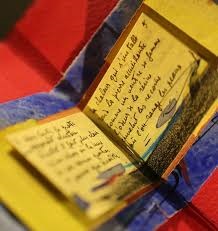
He saw art in its broadest sense as a ‘ gigantic weaving, with a profusion of individual strands and threads’, to which all the arts and all artists contribute. There is no such thing as an individual work, no such thing as a completed work. The boundaries between text and music and painting are not fixed, they are ‘three faces of the same enterprise’, this ‘immense cultural weaving’.
And while readers and critics acknowledge that his works make strenuous demands upon them, what is also acknowledged is that he was a man with ambition but without arrogance or ego. He believed in the importance of his own work as part of this cultural fabric, but not in his personal importance. He was no austere ascetic, but loved wine, and jazz, and detective novels. He was generous and warm, as his many interviewers have invariably noted.
He was also idealistic. He believed that art could change the world, that it was vital. Poets to him were the researchers and the technicians of language, and it was through working on and with language that they could change the world. His adolescence in Paris during the Occupation, when violence and the thread of violence were ever present, when words were dangerous and silence could be resistance or collaboration, when knowledge was rationed and ideas a clandestine currency, haunted his work and fired his beliefs in art and freedom. He didn’t write to sell books, he wrote to find a unity in his life, writing was a ‘spinal column’.
Butor’s writing does not lend itself generally to uplifting quotations. But today one does spring to mind.
Every word written is a victory over death.
He wins.
Bibliography (incomplete…)
Passage de Milan (Paris: Editions de Minuit, 1954)
L’Emploi du temps (Paris: Editions de Minuit, 1956), translated as Passing Time, by Jean Stewart (London: Faber, 1965)
La Modification (Paris: Editions de Minuit, 1957)
Le Génie du lieu (Paris: Grasset, 1958)
Essais sur les modernes (Paris: Gallimard, 1960)
Histoire extraordinaire: Essai sur un rêve de Baudelaire (Paris: NRF Gallimard, 1961)
Mobile: Etude pour une représentation des États-Unis (Paris: Gallimard, 1962)
Description de San Marco (Paris: Gallimard, 1963)
6 810 000 litres d’eau par seconde: Etude stéréophonique (Paris: Gallimard, 1966)
Portrait de l’artiste en jeune singe: Capriccio (Paris: Gallimard, 1967)
Dialogue avec 33 variations de Ludwig van Beethoven sur une valse de Diabelli (Paris: Gallimard, 1971)
Où: Le Génie du lieu II (Paris: Gallimard, 1971)
Matière de rêves (Paris: Gallimard, 1975)
Boomerang: Le Génie du lieu III (Paris: Gallimard, 1978)
Improvisations sur Michel Butor: L’Ecriture en transformation (Paris: La Différence, 1993)
Stravinsky au piano (Paris: Actes Sud, 1995)
L’Utilité poétique (Saulxures: Circé, 1995)
Anthologie nomade, ed. Frederic-Yves Jeannet (Paris: Gallimard, 2004)
This new Hades
Posted by cathannabel in Michel Butor, The City, W G Sebald on July 1, 2016

(This is an edited version of a talk given at the ‘Everywhere & Nowhere’ postgraduate symposium of the Landscape, Space & Place group at the University of Nottingham, on 20 June 2016)
It might seem odd to posit the city of Manchester as an imagined place. However, from the beginnings of its rapid growth in the early years of the Industrial Revolution, the real city was mythologised by the many from around these islands and beyond them who came to see the miracle or shock city of the age. Manchester in the Industrial Revolution became an archetype of both shock and wonder, awesome and awful at the same time. As it grew, with remarkable speed and with no discernible plan, it attracted comparisons both with the greatest of human and divine achievements, and with the works of the devil.
For Disraeli it was ‘as great a human exploit as Athens’, for Carlyle, ‘every whit as wonderful, as fearful, as unimaginable, as the oldest Salem or prophetic city’. Many accounts, alongside these exalted descriptions, acknowledge the dichotomy – for example this from the Chambers Edinburgh Journal of 1858:
Manchester streets may be irregular, and its trading inscriptions pretentious, its smoke may be dense and its mud ultra-muddy, but not any or all of these things can prevent the image of a great city rising before us as the very symbol of civilisation, foremost in the march of improvement, a grand incarnation of progress.
Alexis de Tocqueville too was able to recognise both extremes. In Manchester ‘the greatest stream of human industry flows out to fertilise the whole world. From this filthy sewer pure gold flows. Here humanity attains its most complete development, and its most brutish; here civilisation works its miracles, and civilized man is turned back almost into a savage.’
Overall though the majority came down on the ‘awful’ side of the divide. Even Mrs Gaskell, who was a local, described the impression of the men working in the factories as ‘demons’. For others it was ‘a Babel in brick’, a ‘revolting labyrinth’, and its river was ‘the Styx of this new Hades’.
There were particular aspects of Manchester that inspired these reactions. De Tocqueville said that:
Everything in the external appearance of the city attests the individual powers of man; nothing the directing power of society. At every turn, human liberty shows its capricious force.
Whereas some cities’ growth can be illustrated by an expanding grid, or like Paris by the addition of layer upon layer of suburbs, Manchester grew organically, cramming factories and workers’ housing into whatever space was available, without much consideration of the living conditions that would result, minor things such as sanitation, for example, and the outcomes were grim.


Manchester was thus characterised as ‘a vast unknowable chaos’, illustrated by the invocation of Erebus, in Greek mythology the personification of darkness, born of Chaos, who inhabits a place of darkness between Earth and Hades. So we have descriptions of chimneys ‘belching forth clouds of Erebean darkness and dirt, as if they had a dispensation from the devil’.
Hippolyte Taine records that ‘in the city’s main hotel, the gas had to be lit for five days: at midday one could not see clearly enough to write.’ The darkness was noted well into the 1950s. There were two factors here, not only the constant smoke from the chimneys but the moist air and relatively flat terrain, which meant that ‘the acid and other impurities become dissolved in the moisture, and the black parts of the smoke become wet and heavy’. This combination created the ‘terrifying Manchester fogs … when the phenomenon of temperature-inversion produced near darkness and zero visibility around the clock for days on end’.
The pollution had other effects. Sir James Crichton Browne (1902) rather marvellously described how ‘A sable incubus embarrasses your breathing, a hideous scum settles on your skin and clothes, a swart awning offends your vision, [and] a sullen cloud oppresses your spirits’.
There is a kind of trope of ‘first view of Manchester’ which strengthens the sense of an archetype, a mythical place. For example:
Alexis de Tocqueville – Voyages en Angleterre, Irlande, Suisse et Algerie (1835): A sort of black smoke covers the city. The sun seen through it is a disc without rays. Under this half daylight, 300000 human beings are ceaselessly at work. A thousand noises disturb this damp, dark, labyrinth.
Hugh Miller – First Impressions of England and its People (1847): One receives one’s first intimation of its existence from the lurid gloom that overhangs it. There is a murky blot in one section of the sky which broadens and heightens as we approach, until at length it seems spread over half the firmament. And now the innumerable chimneys come in view, tall and dim in the dun haze, each bearing atop its own troubled pennon of darkness.
Mrs Gaskell – North & South (1855): For several miles before they reached Milton, they saw a deep, lead-coloured cloud hanging over the horizon in the direction in which it lay.
Hippolyte Taine – Notes sur l’Angleterre (1874): We approach Manchester. In the copper sky of the sunset, a strangely shaped cloud hangs over the plain; beneath this immobile cover, the high chimneys, like obelisks, bristle in their hundreds; one can distinguish an enormous dark mass, the vague rows of buildings, and we enter the Babel of brick.
W G Sebald, The Emigrants (1992)
Max Ferber’s arrival in 1945: From a last bluff he had had a bird’s eye view of the city spread out before him … Over the flatland to the west, a curiously shaped cloud extended to the horizon, and the last rays of sunlight were blazing past its edges, and for a while lit up the entire panorama as if by firelight or Bengal flares. Not until this illumination died … did his eye roam, taking in the crammed and interlinked rows of houses, the textile mills and dying works, the gasometers, chemical plants and factories of every kind, as far as what he took to be the centre of the city, where all seemed one solid mass of utter blackness, bereft of any further distinguishing features.
The narrator’s arrival in 1966: By now, we should have been able to make out the sprawling mass of Manchester, yet one could see nothing but a faint glimmer, as if from a fire almost suffocated in ash. A blanket of fog that had risen out of the marshy plains that reached as far as the Irish Sea had covered the city, a city that spread across a thousand square kilometres, built of countless bricks and inhabited by millions of souls, dead and alive.
What strikes the observer in each case is that where they should be able to see the city, instead they see a pall of black smoke, a ‘murky blot’ in one part of the sky, a strangely shaped cloud that hangs over it. Coming closer they see the chimneys, each with its ‘troubled pennon of darkness’ and closer still the mass of buildings, the black river, the sombre brickwork. It’s also worth noting the striking similarity between Sebald’s description of Max Ferber’s first view of the city, and Hippolyte Taine’s.


Another feature attributed to Manchester which led to associations with hell or at least a cursed place was the absence of native flora and fauna. Birdlife was largely absent at the height of industrial activity, and much restricted later, until the Clean Air act created a more hospitable environment. And attempts to create parks, to give the inhabitants a taste of the countryside were doomed as trees and shrubs and blooms were poisoned by the fumes.
These conditions were not unique to Manchester. The industrial cities of the North East inspired John Martin’s apocalyptic paintings, and those of the Black Country Tolkien’s vision of Mordor.


And there’s an intriguing apocalyptic story published in the Idler magazine in 1893 about the doom of London, resulting from a seven day fog, with no wind to clear it, suffocating all of the inhabitants. But Manchester seemed to exert a particular fascination – the scale and the extremity of the conditions in the city drew visitors from across the country and from Europe. As Tristram Hunt says, in his study of the Victorian city, ‘in Manchester it was always worse’.
By the 1950s some of the most notorious slums had disappeared, and proper sanitation had long since removed the threat of cholera and typhus. But the fogs were still extreme, the air still heavy with smoke and metallic tasting vapours, the rain still a near-constant. In addition to the effects of pollution, there were areas of wasteland, bomb sites from the war, not yet redeveloped.
Michel Butor’s novel L’Emploi du temps, published 60 years ago, transformed Manchester into Bleston, and used its mythology to imbue its rain-drenched streets with a sense of dread and danger. Taking elements of the real city he subverts its mundane reality so that Manchester becomes Babel, Babylon, Daedalus’ labyrinth, a Circe or a Hydra. It also becomes Paris under Nazi occupation.
Michel Butor arrived in Manchester in 1951, straight from a spell teaching in Egypt. He was, as he described it, inundated with sun, and then plunged into Mancunian darkness. It was a climatic shock, and the very features of the city which had inspired earlier writers to flights of heightened prose and invocations of hell were to influence his response.
Darkness, fog, mud and soot, rain. These elements feature on almost every page of his novel, L’Emploi du temps (Passing Time), in which the city is renamed Bleston. So far, so realistic. But from very early on they begin to be associated with something beyond the combination of natural and manmade phenomena which Butor was observing.
The fog makes it difficult to find one’s way in the city – masking its shape so that the unwary find themselves going in circles, losing all sense of direction. It stifles, engulfs and sedates, oppressing the spirits. Bleston/Manchester, is a labyrinth, eluding navigation, confounding any attempt to grasp its totality, the narrator, Jacques Revel, says that ‘it grows and alters even while I explore it’. As in Andre Gide’s version of the Cretan labyrinth in his novel Thésée, the ‘narcotic fumes’ sap the will so that those within the labyrinth lose the desire to escape, forget that escape is even possible. On the walls near Bleston’s station, posters illustrate holiday destinations, but the narrator comments sardonically ‘as if it was really possible to get away’. His one attempt to get to countryside is doomed – the best the city can offer, it seems, is some nice parks. Thus the city is a prison, as it was effectively for so many of its past inhabitants.
Butor commented that ‘it is easy to see how the French capital hides beneath the mask of Bleston’. On the face of it, it’s far from easy. Paris is the city of light, a cosmopolitan centre of culture – Bleston/Manchester is characterised by darkness, dirt and narrowness of vision (literally and metaphorically). But something in the constant smell of smoke in the air, the darkness of evening when everything was closed, the way the inhabitants hunched their shoulders against the rain and scurried home ‘as if there were only a few minutes left before some rigid curfew’ triggered memories for Butor of a very different Paris.
Those who fled Paris in 1940 and then returned after the armistice found it uncanny, familiar yet profoundly different. There was a curfew, the clocks had been changed so that it got dark an hour earlier, and a pall of smoke hung over the city from the burning of tanks of oil as the German army advanced, which poisoned the air and drove its birdlife away.
This was the Paris of Butor’s adolescence. He lived near the Hotel Lutetia, HQ of the Abwehr (and after Liberation, the meeting point for returning deportees), near the prison du Cherche Midi where many resistance members were imprisoned, and he walked to school through streets where now plaques commemorate those who were killed during the Occupation and the liberation of the city. At his school both pupils and staff disappeared, some deported or imprisoned, some choosing a clandestine life in the Resistance. Butor described the sense that nothing was happening but that this nothing was bloody. The carceral menace of everyday life, as Debarati Sanyal put it.
Thus in Bleston the fog and the darkness are metaphorical as well as literal, creating not only confusion but fear. There is a constant sense of menace, and the city itself is the source. Personified as a sorcerer, as a Hydra, as both labyrinth and Minotaur, Bleston is at war with Revel, and he with it. But it’s also at war with itself, consuming itself in fire (prosaically a series of arson attacks on various premises encircling the city). The recurring motif of Cain and Abel is a reminder of the divisions between those who collaborated and those who resisted, as well as between occupier and occupied.
The novel is no allegory of the Occupation. This is one reading of a book that defies categorisation, a many-layered text. But my argument is that something in the extremity of Manchester, where it’s always worse, prompted memories of those dark years in Butor, and those memories created the tension in the novel, between the mundane events and the dark, violent interpretations of those events, between the humorous realism of the grim up north descriptions of rain and atrocious food and the sense of dread and danger on every page.
Around ten years after L’Emploi du temps was published, another young European, W G Sebald, arrived in the city, read Butor’s book, and began to write about his own Manchester, in The Emigrants and After Nature, transforming the landscape of industrial decay into a melancholic landscape of loss and trauma.
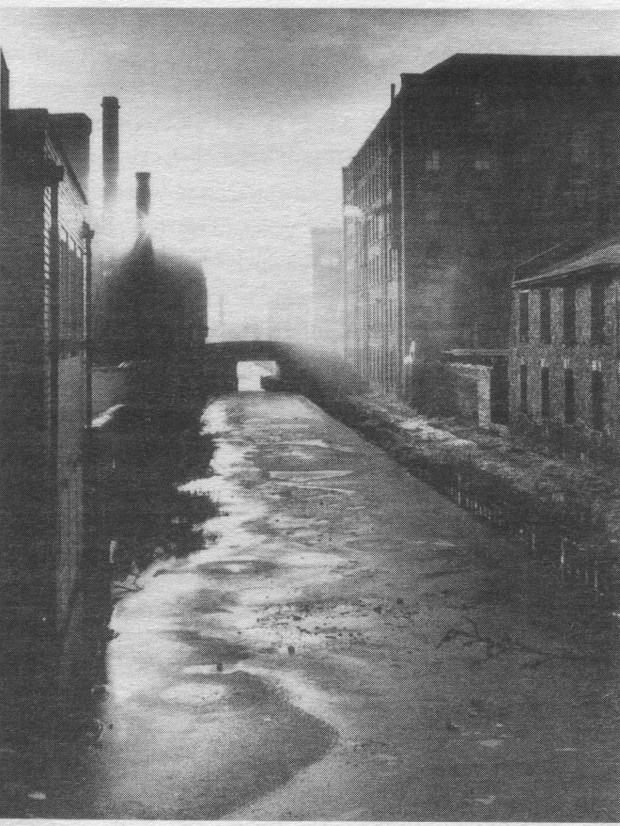
Like Butor, W G Sebald encountered a significant culture shock on arriving in Manchester, after teaching in Switzerland. Sebald was profoundly alienated from his home country of Germany. His sense of isolation ‘could not have been helped by his wanderings through scenes of slum clearance and urban decay.’
Objectively those areas were disappearing so one might surmise that Sebald sought them out, was drawn to their melancholy which reflected and intensified his own. It’s true that the Manchester Development Plan approved in 1961 (although not fully implemented, as I’ll mention later), and the implementation of smokeless zones were making significant improvements in the atmosphere and cleanliness of the city, even if children growing up in the city in the 60s still had plenty of bombsites to play on. However, Sebald’s ‘melancholy at alienation, and exile in a strange land’ found its correlative in the ‘desolate leftovers of nineteenth century Manchester’. It is also suggested that Sebald’s reading of L’Emploi du temps enhanced his melancholy but again it is likely that he was drawn to the novel because it resonated with his own mood and response to Manchester.
Thus the picture painted in The Emigrants of Manchester as ‘a city of ruins, dust, deserted streets, blocked canals, a city in terminal decline’ is probably a distortion. However, the narrative is only in part about the Manchester that Sebald encountered in 1966-7. ‘Manchester … fades into insignificance in relation to another important geographical, phantasmic and persistent presence, which is Germany’.
Sebald gives us more than one Manchester. We see the city first of all through the eyes of the narrator (who both is and isn’t Sebald) arriving in the 1960s, and then through the eyes of the titular Emigrant, Max Ferber, who arrives in 1945, having been sent on the Kindertransport in 1938 from Munich, and finally the narrator’s return in the 1990s, finding that a further cycle of improvement and decay has taken place in the interim.
For Ferber, Manchester triggers memories of Germany. This is partly due to its immigrant communities, the Jewish quarters with their names evoking a European past. But as Thomas Mann, exiled in the US, said, ‘Where I am, is Germany’. There’s another connotation. Manchester’s ‘night and fog’, its fire buried in ash, its chimneys, evoke a past that he escaped, thanks to his parents’ foresight, but which they did not.
Ernestine Schlant describes this aspect of Sebald’s writing as ‘“dense” time – a time in which past and present intersect, commingle, and overlap. This commingling destroys sequence and evokes the sense of a labyrinth with no exit‘. She was speaking specifically of Sebald’s writing, but it would equally be a powerful description of Butor’s novel, where Bleston’s past as Roman temple of war, divided Reformation city and industrial machine are threaded with Butor’s memories of Paris at war.
A brief postscript – I mentioned the Manchester Development Plan, published in 1961. This as it turns out is another imaginary Manchester – not drawing upon the myths of the past but upon a vision of the future.


Plans were drawn up in 1945, but budgetary constraints and building regulations meant that they were largely put on hold. By the time they were revisited, technological advances had opened up hitherto unimaginable possibilities for the city, with moving pavements, heliports and monorails. Once again, the economic climate changed before the plans could be realised and they stand now as a memorial to that other unrealised Manchester.
So in this very real city we can glimpse Engels’ hell on earth, Butor’s city at war, Sebald’s post-Holocaust landscape, the idealistic vision of the 1960s planners. The features that made Manchester the shock city of the 19th century are no longer readily visible. Manchester now is arguably just one of our major cities, unlikely to inspire comparisons with Athens or with Hades. But the past in all its various forms, as well as the unrealised visions of the future are there to be stumbled over, bubbling up between the paving stones. Unmemorialised, their presence is still felt.
Bibliography
Michel Butor, L’Emploi du temps (Minuit, 1956); English translation (by Jean Stewart), Passing Time (Faber, 1965)
W G Sebald, Die Ausgewanderten (Fischer, 1992); English translation (by Michael Hulse), The Emigrants (Vintage, 2002)
__, Nach der Natur (Fischer, 1995); English translation (by Michael Hamburger), After Nature (Hamish Hamilton, 2002)
Robert Barr, The Doom of London, The Idler (1893)
Charles Dickens, Hard Times (1854)
Benjamin Disraeli, Coningsby (1844)
Friedrich Engels, The Condition of the Working Class in England (1840)
Leon Faucher, Manchester in 1844
Elizabeth Gaskell, Mary Barton (1848), North and South (1855)
Andre Gide, Thésée (1946)
James Phillips Kay, The Moral and Physical Condition of the Working Classes Employed in the Cotton Manufacture in Manchester (1832)
Hugh Miller, First Impressions of England and its People (1869)
Hippolyte Taine, Notes sur l’Angleterre (1874)
Alexis de Tocqueville, Voyages en Angleterre, Irlande, Suisse et Algérie (1835)
Asa Briggs, Victorian Cities (Penguin, 1990)
Mireille Calle-Gruber, La Ville dans L’Emploi du temps de Michel Butor (Nizet, 1995)
Jo Catling and Richard Hibbitt (eds), Saturn’s Moons: W G Sebald – a Handbook (Legenda, 2011)
Mark Crinson, Urban Memory (Routledge, 2005)
J B Howitt, Michel Butor and Manchester, Nottingham French Studies, 12, 2 (1973)
Tristram Hunt, Building Jerusalem: The Rise and Fall of the Victorian City (Phoenix, 2005)
Michael Kennedy, Portrait of Manchester (Hale, 1970)
Alan J Kidd, Manchester (Keele UP, 1996)
Gary S Messinger, Manchester in the Victorian Age (MUP, 1985)
Stephen Mosley, The Chimney of the World (Routledge, 2008)
Terry Pitts, La Catastrophe muette: Sebald à Manchester, Ligeia, 105-8 (2011)
Peter Preston and Paul Simpson-Housley (eds), Writing the City: Eden, Babylon and the New Jerusalem (Routledge, 1994)
Natalie Rudd, Fabrications : New Art and Urban Memory in Manchester (UMiM, 2002)
Debarati Sanyal, The French War, in Cambridge Companion to the Literature of WWII (CUP, 2009)
Ernestine Schlant, The Language of Silence (Routledge, 1999)
Janet Wolff, Max Ferber and the Persistence of Pre-Memory in Mancunian Exile, Melilah, 2 (2012)
29 February
Posted by cathannabel in Michel Butor on February 29, 2016
‘and I haven’t even time to set down something that happened on the evening of February 29th, something that seemed very important and that I shall forget as I move farther away from you, Bleston, as you lie dying, Bleston, whose dying embers I have fanned, for now the long minute hand stands upright and my departure closes this last sentence’ (Michel Butor, Passing Time, p. 288)
What happened on that Leap Day we will never know. We have some details of some of the events and developments of that month – the diarist, Jacques Revel, dines with the Bailey family for the first time (whilst noting that he was spending less time with their elder daughter, Ann, as his affections begin to drift towards her sister Rose), and meets George Burton for the first time, not knowing at that stage that he is the author of the detective novel which plays an important role in events. He buys a second copy of The Bleston Murder, having lent the first to Ann.
None of this suggests that February 29 would turn out to be an especially significant date. Of course, February 29 is always going to seem significant, by virtue of its rarity. It’s a day that only exists once every four years, and thus one that can be, in effect, hidden for three out of four years. Almost a ‘jour fantome’.
Is it the centre of the labyrinth that is the narrative of Passing Time? Some have said so – describing the date as the ‘geometrical centre’ of Revel’s year in Bleston. If you do the sums, it’s one month short of the halfway point of Revel’s year in Bleston. However, his final month is a month of tying up loose ends and saying his ‘adieux’ – with the announcement of Ann’s engagement to his friend and colleague James (her sister Rose has already become engaged to his friend and compatriot Lucien) he is merely passing time in Bleston until the pre-ordained departure date. Indeed, he feels himself reduced to a ghost, a Sunday-afternoon ghost, revisiting the places he has known during his life in Bleston.
Revel’s diary is an attempt to master the city which has bamboozled and disoriented him from the moment of his arrival, by creating with his own narrative the Ariadne’s thread to guide him through the labyrinth. In doing so, he creates his own labyrinth, as what is initially a straightforwardly linear account twists and turns, as he reflects on more immediate events, reminds himself as he records the events of one day of the later developments that they foreshadow, and so on.
So his failure to record what happened on 29 February is, firstly, indicative of the failure of this enterprise. The time of writing and the time written about will never be reconciled and this gap is the evidence of that disjunction. It’s a blank space, an empty centre, an enigma. The final page is a record of other failures. He notes that he ‘had not even been able to visit the old church of St Jude’s on the other side of the Slee’, St Jude the patron saint of desperate cases and lost causes. St Jude’s is close to a small synagogue, which Revel has also failed to visit (having forgotten that he’d wanted to do so), and to the sinister prison, itself described as ‘a sort of hole’ within the tissue of the city.

He describes ‘those sinister days in February’ when his longing to leave the city is at its most intense, but which he would prefer not to think about, ‘but which on the contrary I ought to be able to pick out from among the tangle of my winter memories with strong supple pincers of language, which I ought to keep firmly before my eyes’ (p. 286). So rather than being unable to recall what happened on 29 February, perhaps Revel chooses not to.
It’s not just a generalised recognition that he ran out of time to fill in the gap, it’s a deliberate blank, which draws our attention to a significant absence. Like the blank space on the back of the detective novel, where the author’s photograph should sit, like the missing pieces in the sequence of stained glass windows, the blank spaces on the frontispiece map, the ‘terrain vague’ on the outskirts of the town, the incomplete New Cathedral building… ‘an incomplete alphabet of which I know one letter is missing, a keyboard of which I know one note is missing, a Tarot pack of which I know one card is missing’. That the missing day is the one that only occurs every four years (it occurred in 1952, during Butor’s first year in Manchester) obviously draws even more attention to it.
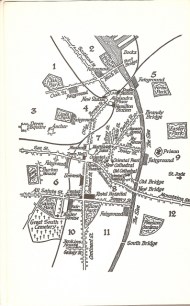
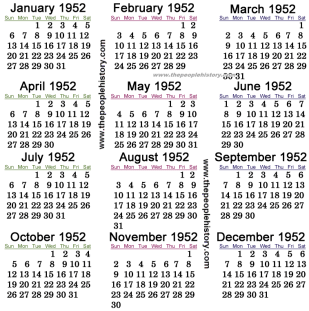
That we cannot know what happened is part of the fascination of the book. It is at the same time an entirely closed narrative structure – we have no knowledge of anything that happened prior to Revel’s arrival in Bleston, nor what he will do or where he will go next – and an open one which tantalises us with the many mysteries of the text, drawing us back in to wander the rain-drenched streets again in search of answers. The disparity between the mundane events which Revel records and the intensity of the language in which he describes them suggests that the gaps – the things that aren’t said – are of deep significance, that all is not as it initially seems, that maybe we aren’t (just) in a fictionalised version of Manchester after all…
What I Read in 2015 – the best bits
Posted by cathannabel in Literature on December 28, 2015
Once again I have been denied the chance to share with the readership of the quality newspapers my pick of this year’s reading. Ah well, the discerning audience that appreciates my blog will, I am sure, be grateful that I share it with them instead. You’re so very welcome.
Because my default response to a challenge (unless it involves serious physical activity) is ‘challenge accepted’, I aimed to read 80 books this year (as set by Penguin Books for some reason). That’s 80 properly read, cover to cover or the electronic equivalent, not mined for relevant info for the PhD. Of course I exceeded this arbitrary target, and enjoyed doing so. I’ve picked out some of the books that meant the most to me in 2015.
Fiction
The Bear Comes Home – Ravi Zabor. Hard to explain this book – it sounds bonkers and indeed it is, but gloriously so, and it is some of the best writing about music I’ve come across, so vivid that, as Annie Proulx, who was on the panel of judges that gave it the PEN/Faulkner award said, ”Rafi Zabor somehow makes the reader hear music”. Yes, there is a bear. He plays alto sax. That’s all I can say really – as one of Zabor’s editors said, ‘you have to read it to get it’.


The City and the City – China Mieville. I should have read Mieville earlier, but having loved this one, I am looking forward to Perdido Street Station. It’s a detective novel, but with a kind of sci-fi premise, which I won’t explain in case anyone hasn’t read it and would like to. It’s a fiercely intelligent novel which works brilliantly as crime fiction as well as sci fi.
Two novels dealing with Alzheimer’s gripped, in different ways. Emma Healey’s Elizabeth is Missing is a tour de force by a young debut novelist, with a protagonist who is in the grip of dementia and gradually losing touch with the world around her. Because of her condition, her conviction that her friend Elizabeth is missing is dismissed by everyone – meanwhile another mystery from much longer ago keeps on surfacing and demanding answers. We see things from Maud’s perspective, so we share her confusion. This is quite exceptionally skilled writing. Elizabeth… manages to be funny, without one ever laughing at Maud’s confusion and muddle, because even without a functioning memory, she is a fully rounded character with a sometimes acerbic and sometimes bizarre take on people and events. Lisa Genova’s Still Alice was a heart-breaking read – again our perspective is that of the person with dementia although in this case when we first hear Alice’s voice she is still very much herself, before the first ambiguous signs of the disease occur. Whereas in Healey’s novel the dementia is context and sub-text, here it is the text itself, the narrative following the process of the disease as it robs Alice of so much more than her memory.


Memory was a theme too in Linda Buckley-Archer’s The Many Lives of John Stone. Again, it would be unfair to give too much away – it’s beautifully written, interweaving a vivid historical narrative with the present day. There’s no time travel, or supernatural/paranormal elements – it just uses a hypothetical genetic characteristic as the basis for the plot. It’s engaging, gripping and ultimately very moving.

Other highlights:
Emma Freud’s Mr Mac and Me, about Charles Rennie Mackintosh’s time in Suffolk during WWI (reminiscent of Helen Dunmore’s Zennor in Darkness, about D H Lawrence in Cornwall)
Elizabeth Gilbert’s The Signature of All Things, a hugely ambitious historical novel with an utterly compelling central character, 19th century botanist Alma Whittaker. It’s completely absorbing.
Owen Sheers’ Resistance is a cracking alternative history, where the Allies lost WWII, set in the Welsh valleys. It evokes something of Vercors’ Le Silence de la mer, or Irene Nemirovsky’s Suite Française in the portrayal of the interaction between occupying troops and the local population, but is also firmly rooted in the particular landscape and history of its setting.
Steven Alcock’s Blood Relatives evoked very different and more recent années noires, in the city of Leeds during the Yorkshire Ripper years. But the Ripper is not the subject, but part of the background. He’s what people are talking about, but the protagonist is more concerned, as most teenagers would be, with himself and Alcock exuberantly captures the tensions and the textures of this life in full on Yorkshire.
And Cath Staincliffe, primarily known as a crime writer (the Sal Kilkenny series, Blue Murder, and novelisations of Scott & Bailey) made me sob my socks off with Trio, which follows the lives of three young women who give up babies for adoption in the 1960s, the families who took those babies in, and the children themselves as they grow to adulthood.


I also enjoyed a heap of Laura Lippmann’s terrific novels featuring Baltimore PI Tess Monaghan, discovered a new series by Sarah Hilary with DI Marnie Rome, J K Rowling’s Robert Galbraith novels, and Peter May’s Lewis trilogy.
Non-Fiction
Viv Albertine’s fab memoir Clothes, Clothes, Clothes. Music, Music, Music. Boys, Boys, Boys was fascinating and heart-breaking and funny. Peter Piot’s life battling Ebola, AIDs and the bureaucracy and politics which gets in the way of tackling those challenges was an inspiration. And – to return to the theme of Alzheimer’s – Andrea Gillies’ Keeper told the story of caring for her mother-in-law whilst attempting to run a B&B, and how the dementia gradually took over all of their lives and thoughts. It’s honest, sometimes brutally so, but there’s black humour too, and poignancy.


Oh, and I finally finished Proust’s La Prisonnière. Two more to go…
I also read and recommend:
Fiction: Iain Banks – Whit, Ann Cleeves – various Shetland and Vera crime novels, Teju Cole – Open City, Michel Faber – Under the Skin, Will Ferguson – 419, Richard Flanagan – Wanting, Andre Gide – Thesee, Paula Hawkins – Girl on the Train, Anne Holt – The Blind Goddess, Kazuo Ishiguro – Nocturnes, Susanna Jones – When Nights were Cold, Han Kang – The Vegetarian, Philip Kerr – Berlin Noir trilogy, Stephen King – Finders Keepers, Tiffany Murray – Happy Accidents, Catherine O’Flynn – What was Lost, Edward St Aubyn – Never Mind, Jim Shephard – The Book of Aron, Louise Welsh – Plague Times vols 1 and 2 (hurry up with 3!!), Markus Zusak – The Book Thief
Non-fiction: John Bayley – Iris, Alan Bennett – The Lady in the Van, Charles Dickens – Selected Letters, Robert Gildea – Fighters in the Shadows, Iain Hacking – Mad Travelers, Sarah Helm – If This is a Woman, Caroline Moorhead – A Train in Winter, Vladimir Nabokov – Speak Memory, Wladyslaw Szpilman – The Pianist
 Passing Time