Posts Tagged Refugee Week
Refugee Week 2015
Posted by cathannabel in Refugees on June 14, 2015
I started this blog in 2012, and when Refugee Week came around that year, I decided to try to publish something every day, either my own writing or a reblog of something interesting I’d found online, about refugees. I’ve done that each year since. It’s a self-imposed challenge that I get anxious about in advance – will I be able to find the time to write, will I find things to write about, will anyone be interested? But once I get started, each year the stories have found me, stories of tragedy and of hope from around the world.
So, this year, I kicked off with an appreciation of Judith Kerr, just because it’s her birthday, and because this year’s theme is #RefugeesContribute. There are other posts brewing. But if you read this and think of a story I should be telling, let me know.
A couple of brief notes, ahead of the next substantial piece:
Michael Grade in the current Radio Times talks about his upcoming Radio 4 programme, where he interviews Kolbassia Haoussou, a refugee from Chad, and now spokesperson for Freedom from Torture. He speaks of his paternal grandparents who left the Ukraine in 1910 and undertook a remarkable, dangerous journey to England, where they built new lives, and where their children, and grandchildren achieved great success . Grade says ‘When I see pictures of boatloads of migrants heading to Europe from North Africa, I think how desperate they must be to risk everything, putting their lives in the hands of the traffickers and their deathtrap boats. I think about how they must be driven to the only option that remotely offers trhe prospect of release from the wars and the militancy and the savagery that goes on in some of these countries. …. So let’s welcome the risk-takers, wherever they may come from. It’s what a bold society does. We have much more to gain than lose’. (Michael Grade, ‘Taking a Chance’, Radio Times 13-19 June 2015).
And yesterday a group of writers, artists and musicians set off on a new pilgrimage, The Refugee Tales will be a unique walk, on paths taken by travellers over the centuries along the North Downs Way from Dover to Crawley via Canterbury, while reflecting on the long and dangerous journeys that many refugees make fleeing war and persecution, seeking a safe place to live. The organisation behind this is the Gatwick Detainees Welfare Group
I’ll keep writing. If you like it, share, follow, like, retweet, reblog…
#Refugees Contribute – Judith Kerr
Posted by cathannabel in Literature, Refugees on June 14, 2015
Serendipitously, the start of Refugee Week 2015, with its theme of the contribution that refugees make to the communities in which they make their new homes, coincides with the 92nd birthday of Judith Kerr.
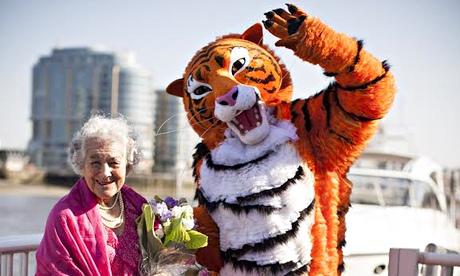
Her books were not part of my own childhood – I was too old by 1968 to enjoy The Tiger Who Came To Tea, and certainly by 1970 when the first Mog book appeared. But I read those books – again and again and again – to my own children. And unlike some books which I read to them again and again and again, which irritated me more with every rendition, it was always a joy to read anything by Kerr.


If pressed, I could probably still recite part of The Tiger, and certainly odd phrases from the Mog series (the cat who ‘forgot she had a catflap’, and who got an egg AND a medal after unwittingly foiling a burglary) have passed into our family language.
Nothing in the world depicted in these delightful stories suggests the circumstances in which Judith Kerr arrived in the UK. They’re not cloyingly cosy – after all, the final Mog book says a final goodbye to that forgetful cat. But one wouldn’t guess that her family had to leave their Berlin home suddenly in 1933, when the Nazis came to power, because her father had been openly critical of the party. He left first, having been tipped off that he was at risk, and her mother and the two children followed not long afterwards, travelling initially to Sweden and then to France, before applying for and being granted British citizenship. They could not have known in 1933 the full extent of the danger that they, as Jews, would have faced had they stayed, and they left France before that country ceased to be a safe haven, but as the war went on, Judith’s parents carried suicide pills with them, in case of a Nazi invasion.
Michael Rosen has suggested that the Tiger, who comes to tea and eats everything in the house, drinks all Daddy’s beer and all the water in the taps, was suggested at some subconscious level by the childhood awareness of an unexplained threat, that your home could be invaded, everything you have could be taken, without warning. That may be, and it’s certainly part of the unsettling charm of the book that we never forget that the Tiger is a tiger, that if not placated with all the food and drink he demands he could be dangerous. But at the same time, the willingness of the family to allow this unexpected visitor to empty their pantry conveys generosity and hospitality, along with imperturbability, rather than fear. It could be that this reflects the way in which parents maintain a calm unflappable air in order not to frighten children too young to understand real danger. But of course the Tiger leaves, of his own accord, and never comes back.
Kerr did write directly about her past, in three autobiographical novels collectively titled ‘Out of the Hitler Time’. She’s very conscious of her own good fortune, not only in that, unlike so many other families, they lost no one, but that they found a safe home and a welcome, and the chance to build new lives.
‘People here were so good to us in the war. It must have been awful for my parents, but when you consider what happened to the others who stayed behind, nothing bad happened to us. We didn’t lose anyone. All our family got out: my grandparents, uncles, aunts, they all got out. Nobody died. We had a terrible time with money, but so did lots of people, and people were very good to us wherever we went.’ (http://www.booktrust.org.uk/books/children/illustrators/interviews/104)
Happy birthday Judith Kerr, and thank you.
Refugee Week 2014
Posted by cathannabel in Refugees on June 22, 2014
As this year’s Refugee Week draws to a close, I’m reflecting on what effect the experience of displacement has on the children who have been the focus of this year’s event, children who have lost so much that is familiar and reassuring in their lives, had to face hunger, physical danger, separation from family. The photos of children in refugee camps, smiling for the camera, like children anywhere, should not lull us into believing they are and will be fine. They are safe, for now at least, they will be fed, and have access to medical attention, maybe even some chances to learn.


http://stories.unhcr.org/refugees/featured-refugees
But what about their future?
Children are resilient, they’re tougher than you’d think, as all parents remind themselves on a regular basis. But how do those early experiences, that exposure to death and danger and horror, affect them as they grow?
We can draw upon the stories of an earlier generation of children whose parents entrusted them to strangers, to be transported across Europe and to be taken into the homes of other strangers, to be kept safe, in the hope of a reunion that for many was never to happen. We know of the confusion that many of them felt, about their past, their identity (not all Jewish children were fostered in Jewish homes); and of the trauma of separation from parents and family, and in so many cases, of the discovery post-war that parents and family had been swallowed up in the barbarity and were lost to them for ever.
Some of the children wrote and talked about their experiences, e.g. Lore Segal’s Other People’s Houses (1964) fictionalised her experience growing up in five different English households, from the wealthy Orthodox Jewish Levines to the working-class Hoopers. There are a number of collections of memoirs, e.g. Into the Arms of Strangers: Stories of the Kindertransport (2008, Bloomsbury/St Martins, New York & London) (edited by the daughter of a Kindertransport child). A collection of personal accounts can be found at the website at www.quaker.org.uk/kinder.
The artist Gustav Metzger’s work responded directly to the experience that would have been his, had he not escaped in 1939 – in 1961 when he was on trial for civil disobedience, he made an unusually personal statement:
I came to this country from Germany when 12 years old, my parents being Polish Jews, and I am grateful to the government for bringing me over. My parents disappeared in 1943 and I would have shared their fate. But the situation is now far more barbaric than Buchenwald, for there can be absolute obliteration at any moment. I have no other choice than to assert my right to live, and we have chosen, in this committee, a method of fighting which is the opposite of war – the principle of total non-violence.
Alison Jones’ introduction to his auto-destructive art, and particularly his Historic Photograph series, makes the link very clearly:
In 1961 on the South Bank in London he painted hydrochloric acid onto nylon canvasses wearing a gas mask and protective clothing, so that eventually the canvas disintegrated South Bank Demonstration. The demonstration was of an artwork being simultaneously created and destroyed. His second manifesto on Auto-Destructive Art stated ‘Auto-destructive art re-enacts the obsession with destruction, the pummelling to which individuals and masses are subjected…Auto-destructive art mirrors the compulsive perfectionism of arms manufacture – polishing to destruction point.’ (3)
The language and metaphors Metzger uses clearly have reference to the military machinery of the capitalist state. Writing about Metzger’s performance, Kristine Stiles describes the temporal structuring and timing of ‘South Bank Demonstration’ as symbolic of the artist’s personal relationship to the Nazi gas chambers.
Metzger formulated his theory precisely 20 years after he was sent to England as a child of 12 in 1939, following his family’s arrest by the Gestapo in Nuremburg. 20 seconds then is a temporal analog for the time it took to destroy his personal world by killing his family; 20 years, the time of gestation in his own auto-transformation.
Metzger has also been stateless since the 1940s, another clear political response to what was done to his family, first by removing their rights as citizens, and forcing them from their home, him to safety in England, his parents to death in Poland.
Stephanie (Steve) Shirley’s philanthropic activity – as a highly successful businesswoman, she used her money to fund pioneering work on autism, and her influence to counter sexism – is something she explicitly relates to her experience as an unaccompanied child refugee, which she says ‘gave me the drive to prove that my life had been worth saving’.
Writing about the ‘One Thousand Children‘ initiative, the American equivalent of the Kindertransport, Iris Posner comments that they have been ‘inordinately successful’. Perhaps the combination of the challenge of those early experiences and the sense of debt that Steve Shirley speaks about, have led such children to have a greater drive to succeed, and to give something back.
However, the Kindertransport and OTC children were lucky not just in being saved from destruction. They came to affluent, safe countries where they had access to the best medical care, the best educational opportunities and employment prospects. Many of their contemporaries, displaced in the chaos and brutality of wartime and postwar Europe, were not to have those chances. Like many of today’s child refugees, they lost everything.
Even those who are most cynical, who believe the lies and distortions disseminated almost daily it seems by sections of our national press, would surely see that the fate of these children must be a collective responsibility. UNHCR report that:
Almost half of the world’s forcibly displaced people are children and many spend their entire childhood far from home. Whether they are refugees, internally displaced, asylum-seekers or stateless, children are at a greater risk of abuse, neglect, violence, exploitation, trafficking or forced military recruitment. They may also have witnessed or experienced violent acts and/or been separated from their families.
It’s a huge task, so daunting that one could throw up one’s hands and say, what can we do?
There are many organisations, around the world, who are doing what they can. Working in war zones and refugee camps, working to support children wherever they are re-settled, trying to give them the chance of a life.
To quote Sir Nicholas Winton, who himself was responsible for saving around 700 children from Nazi Europe, ‘If it’s not impossible, there must be a way to do it’.
With the resources we have, collectively, it’s not impossible. It can’t be.

The Refugee World Cup – Saturday 21 June
Posted by cathannabel in Football, Refugees on June 21, 2014
Playing today – Argentina, Bosnia
Fittingly for the last of my series of World Cup linked refugee stories, both of today’s have a football theme.
Argentina
Bayan Mahmud fled ethnic violence in the north of Ghana, stowing away on a ship leaving Cape Coast, and ending up in Argentina. He was lucky, finding kindness from a member of the ship’s crew, and then from strangers who helped him get to Buenos Aires, and to get refugee status. Now, he’s on the Boca Juniors youth football team and hopes to one day be the first black player in the Argentine national team. Maybe next time…
Bosnia & Hercegovina
Dejan Cokorilo’s story of leaving Sarajevo for safety in Sweden – ‘The Civil War kidnapped our childhood. Our city was under siege, but somehow my parents found a way out. We found peace and freedom in a new country, far away from home.’
Meanwhile the Bosnian national team includes a number of players who at least temporarily fled their homes during the war – amongst them Miralem Pjanic, Edin Dzeko, Asmir Begović, Senad Lulic, Haris Medunjanin.
There’s an actual Refugee World Cup, in Manchester later this month. Details here:
and another took place in Sweden just before Rio as well:
http://frenchfootballweekly.com/2014/06/11/forget-brazil-2014-the-alternative-world-cup/
The Refugee World Cup – Friday 20 June
Posted by cathannabel in Football, Refugees on June 20, 2014
Playing today: Italy, Costa Rica, Honduras, Ecuador, Switzerland, France
Italy
The Italian island of Lampedusa is best known for being the primary European entry point for migrants, mainly coming from Africa. Last autumn, around 36o migrants died in the seas around the island, and over 30 000 have been rescued by Mare Nostrum. And the boats keep on setting sail, crammed with desperate people.
http://www.theguardian.com/world/2014/jun/02/europe-refugee-crisis-un-africa-processing-centres
Costa Rica
One of the most peaceful and stable countries in the region, Costa Rica hosts many refugees, mainly from Colombia and Nicaragua. Costa Rica took in many refugees from a range of other Latin American countries fleeing civil wars and dictatorships during the 1970s and 1980s.
Honduras
In recent years, growing numbers of people have sought asylum in Mexico, Canada and the United States, citing the threat of gang violence and forced recruitment in countries such as Guatemala, El Salvador and Honduras.
‘A 17-year-old boy who fled Honduras said, “My grandmother is the one who told me to leave. She said: ‘If you don’t join, the gang will shoot you. If you do, the rival gang will shoot you, or the cops. But if you leave, no one will shoot you.'”‘
Ecuador
Jason Tanner reports on a photographic assignment for UNHCR on the Ecuador-Colombia border:
‘Over the course of four weeks I would be ferried, often at short notice and sometimes covertly, to meet with and photograph refugees fleeing persecution and violence from neighbouring Colombia. This fearful frontier town in Ecuador is often the first stepping off point for refugees seeking safety and security. Unfortunately, for many refugees, the reach of those responsible for the violence often extends deep beyond the porous borders of Latin America.’
Switzerland
Switzerland’s cherished neutrality during the Second World War was in part protected by rigorous border controls. Many refugees were turned back, including at least 20 000 Jews. Those who helped people to cross the border were subject to criminal proceedings, and it is only very recently that some of the sentences handed out to people who challenged the restrictions to smuggle desperate people across the frontier have been given pardons. See Aimée Stitelmann’s story here.
France
In September 1940, plans were being developed to enable Jewish children to get special visas to leave for the US. The plan was intended for children under 13, but older children (up to 16) were eligible to accompany their younger brothers and sisters. In March 1941, the OSE (Oeuvre de Secours aux Enfants) at Montpellier sent a list of 500 children held in camps who were candidates for emigration. These children were released from the camps, and brought by OSE to await emigration, along with children who had been helped by the Rothschild Foundation, Secours Suisse and the AFSC. The first convoy of 101 children left Marseille in May 1941. The train stopped briefly at Oloron station, just by the Gurs camp, so that children could say goodbye to their parents. This was traumatic for all, and OSE did not continue with this practice. From France, the children travelled through Spain to Portugal, stayed for around a week whilst they received medical care and were vaccinated. At Lisbon, they boarded the SS Mouzinho, which took to the sea on 10 June 1941. They disembarked in New York where they were met and looked after by the U.S. Committee for the Care of European Children. The OSE went on to organise an underground network to smuggle children out of France.
Rio Mavuba, a member of the French World Cup squad, was born on board a boat in international waters during the Angolan Civil War, and later stated that his birth certificate did not have a nationality on it, reading only “born at sea”. He received French nationality in September 2004.
The Refugee World Cup – Thursday 19 June
Posted by cathannabel in Football, Refugees on June 19, 2014
Colombia, Ivory Coast, Uruguay, England, Japan, Greece
Colombia has one of the world’s largest populations of displaced people – somewhere between 2.6 and 4.3 million – due to ongoing armed conflict in the region.
See here for information on the photo project, Land of Light, undertaken by UNHCR Colombia and the Colombian photographer Santiago Escobar Jaramillo, which was realized through a series of workshops with displaced communities.
Ivory Coast
Bere Tassoumane’s journey from stateless person to state official.
Some who left Liberia for safety in Ivory Coast during its civil war later returned the hospitality when Ivory Coast went through the same terrible trauma. “During the Liberian war, refugees who left from Liberia to Ivory Coast stopped with people who also fled this Ivorian war,” Kolubah added. “So those who were hosted as Liberian refugees in Ivory Coast do not want their host to go to the camp. They want them to stay with them no matter what it is.”
Uruguay
Uruguay’s president has agreed to take 100 Syrian child refugees. The complexities of refugee politics are clear from this article – both in terms of the contribution relative to that of other nations, and to the problem as a whole, but also in terms of the way domestic politicians respond to even this ‘drop in the ocean’.
England
Refugee Action tells the stories of some of the refugees they work with, and the struggles they face in the UK.
I am, probably, more critical of my own country’s response on refugee and asylum issues, than of most others. I expect more, I hope for more. And there is so much to be disappointed, or angry, about. I had to make a mental readjustment, however, talking to a taxi driver yesterday – father from Djibouti, mother from Britain, born in Dubai, and in no doubt at all that this was the place to be, a generous and welcoming society. I found myself giving ground, acknowledging, I hope not too grudgingly, that it was good, even if I believed it could be better. He’d have passed Tebbitt’s cricket test too, with a higher score than me…
Japan
Even a wealthy, peaceful nation, which tends not to persecute its citizens, can encounter a refugee crisis as the result of natural disaster. The tsunami in 2011 left many homeless and facing desperate conditions. ‘Freezing winds, hail storms and thick snow are the latest threats to 430,000 beleaguered survivors of northern Japan‘s week-long cascade of disasters. After a massive earthquake, devastating tsunami and nuclear crisis, many people made homeless are now facing icy weather, with temperatures forecast to plunge to –5C (23F).’ (Guardian, March 2011).
Greece
Syrian refugee Hussein finds safety in Greece.
In 1923, Greeks from Asia Minor were evacuated or relocated in Greece following the Convention Concerning the Exchange of Greek and Turkish Populations signed in Lausanne. This followed a period of brutal massacres and ‘ethnic cleansing’ instigated by the government of the Ottoman Empire. The first census after the evacuations showed the number of Greeks of Asia Minor origin to be 1,164,267. Descendants of the refugees took part in the great Greek migrations of the interwar period, as well as the large immigrations to the United States, Australia and Germany in the 1960s-1970s. Today, about 40% of the population of Greece claims full or partial descent from the Asia Minor refugees; as does an almost equal percentage of diasporan Greeks.
The Refugee World Cup – Wednesday 18 June
Posted by cathannabel in Football, Refugees on June 18, 2014
Playing today: Australia, Netherlands, Spain, Chile, Cameroon, Croatia
Australia
In December 2010, a flimsy boat was wrecked by a storm on the cliffs of Christmas Island. 50 of the 89 men, women and children aboard, all asylum seekers, predominantly from Iran and Iraq, died.
Netherlands
In the mid-16th century, many Protestant Walloons and Flemings came to England to escape warfare and religious persecution, arriving in England through the Channel ports, many initially settling in Sandwich, until the numbers became too great. Subsequently, the Walloons were permitted to move to Canterbury, and were welcomed by the city. ‘The strangers (as they were called), were allowed to gather for worship at the church of St Alphege, opposite the Archbishop’s Palace, and later in the western crypt of the Cathedral. Most of the refugees were engaged in the weaving trade, and provided local employment, and a flourishing trade in finished cloth for sale in London or abroad.
Spain
In 1937, during the Spanish civil war, a group of almost 4,000 children was evacuated from Bilbao in the Basque region of Spain. They embarked from Santurce, Bilbao, on the ‘Habana’ on Friday 21st May and dropped anchor at Fawley, at the entrance to Southampton Water, on Saturday evening. The following morning, Sunday 23rd, they docked at Southampton. Initially accommodated in a large camp at North Stoneham, Eastleigh, they were eventually dispersed to many ‘colonies’ throughout the country.
Chile – Julio Parrado tells the story of his arrest and torture after the overthrow of the Allende government in Chile, and how he found sanctuary in Sweden.
Cameroon
A few weeks ago photographer Frederic Noy went to Cameroon with UNHRC to photograph the arrival of Central African refugees fleeing the violence in their country.
The UN Refugee Agency is recommending that the process of ceasing refugee status of refugees displaced from Croatia in the 1990s begins. Almost 20 years after the conflict in the former Yugoslavia ended, the circumstances that triggered displacement have fundamentally changed. Regional cooperation has intensified, voluntary returns have taken place, different ethnic groups have proven able to peacefully co-exist and economic and political progress is increasingly visible. Meanwhile, Bosnia and Herzegovina, Croatia, Montenegro and Serbia continue their efforts to find sustainable housing solutions for some 74,000 vulnerable refugees, returnees and IDPs from the 1991-1995 conflicts.
The Refugee World Cup – Tuesday 17 June
Posted by cathannabel in Football, Refugees on June 17, 2014
Playing today – Brazil, Belgium, Mexico, Algeria, Russia and South Korea
Belgium‘s invasion in two successive World Wars led to an influx of refugees into the UK. A local newspaper reported in 1916 on the celebration in Manchester of the Belgian Day of Independence,when ‘over 700 refugees were entertained by the Co-operative Wholesale Society. They had come from various parts of Manchester and the surrounding industrial towns’. The Bishop of Salford ‘alluded to the trials through which the refugees had passed, and remarked that that day they had shown to the British race how strongly united they were. He assured them that the feelings of the English people for what the Belgians had done in the great European struggle would be always as they were to-day’.
Algeria is ‘home’ to a significant number of Sahwari refugees from Western Sahara. Fadala was born in the refugee camps there and now works as a community outreach officer, particularly with young people in the camps:
I am working with Solidaridad Internacional as a community outreach worker. I am in charge of awareness raising efforts about the use of water. When I arrived here, it was almost a cultural shock. The situation in the camps is extremely difficult. Especially for the youth. There are no opportunities here. If there were no NGOs here, many youths would be out of jobs and would not be able to support their families.
If I did not find this job, I would have been at home. We cannot keep on waiting to receive humanitarian assistance without doing anything. Until when? The humanitarian assistance will not last forever.
I am very concerned about the dependency of Sahrawis to foreign aid and I would like to be a motor for a change in my community. My dream is to work one day as a journalist, to be able to convey the difficult life conditions my people are going through.
Brazil was the first country in Latin America to offer humanitarian visas to Syrian refugees.
Mexico – Martin Gottwald, UNHCR Deputy Representative in Colombia, shares his story for World Refugee Day here.
Russia – after the Revolution, from 1917-22, more than a million people left Russia. Refugees moved eastward to Manchuria and China, via Vladivostok to Canada and the US, and westward, via the Balkans and the Baltic states, to Western Europe, particularly France. Irene Nemirovsky and her family were amongst those who took refuge in France. Irene, who became a highly successful writer, was still there when France was occupied by the Nazis. As a Jew, she was deported to Auschwitz where she was murdered, along with her husband, in 1942. Her final, unfinished book, Suite Francaise, was published in 2006, after her surviving children read the manuscript and realised its importance.
South Korea – Hungarian journalist Csaba Lukács tells his story of Soon-Sil Lee, a North Korean refugee
Refugee Week 2014 – Different pasts, shared future
Posted by cathannabel in Refugees on June 15, 2014

Across the globe, as populations are dispersed by war, famine and persecution, as families are separated in the chaos, around half of those displaced are children. Over a thousand arrive in the UK every year, unaccompanied.
In Syria, in Iraq, in CAR, for example, families fleeing violence find themselves in transit with all of the accompanying hazards, or in camps where facilities are strained to the limit as people keep arriving. How can parents keep their children safe, fed, and physically healthy, let alone attend to their education, and their mental wellbeing? How can we, comfortable and safe as we are in comparison, imagine the choices that those parents have to make? How would we weigh the risks of remaining, against those of abandoning home and community? Could we, should we, send children to safety without us, as many parents in Europe did in 1938-9, knowing that we might never see them again, and not knowing what future they will face in a strange country?
And when they arrive in the UK, after whatever trials and hazards they have encountered on the journey, there are new difficulties to face. Our asylum system leaves many refugee families in destitution while their cases are considered, and parents are unable to work. They cannot choose where to settle, and so education and friendships are disrupted by frequent moves, as well as made more difficult by language and cultural barriers. And at any time, there may be a knock on the door, and a removal to detention, awaiting deportation back to the horrors that they fled.
Just a look through the papers over the last few days indicates what children in so many parts of the world are facing right now.
Vehicles crammed with men, woman and children who are fleeing the threat of violence, kidnapping and rape, were queuing at checkpoints at the frontier of Iraq’s Kurdish region yesterday. The refugees were among about half-a-million people who have fled their homes since Monday (Independent)
Thousands cross the southern U.S. border illegally each year in hopes of better lives. But now the problem has reached epic proportions, with children … fleeing the Central American countries of El Salvador, Honduras and Guatemala. And they are arriving in the United States alone — without a parent or guardian. (CNN)
Over a million Syrian refugees have arrived in Lebanon, fleeing the conflict in their country. Syrians now make up a quarter of the population of this tiny Mediterranean country. Many were forced to leave with only what they could carry, and are living in desperate poverty. Finding work is difficult, and many families are forced to send their children out to work to make ends meet. (Guardian)
The day after the army attack in Minova, 130 rape victims arrived at Masika’s displaced women’s camp. Seventeen of the girls were under 18. The youngest was 11. (Independent)
Meanwhile Unicef report that six months since intense fighting reached Central African Republic’s capital, Bangui, scores of children have been killed, hundreds have been maimed and thousands have been displaced.
The theme of Refugee Week 2014 is refugee children, ‘different pasts, shared future’. It’s also a shared responsibility. The reasons why people become refugees are many and various, but for the most part, they stem from adult actions which rebound most severely upon the smallest, the most vulnerable, the most helpless. So, over the next week I will be giving my blog space over to refugee stories, past and present, highlighting the work that’s being done by refugee organisations nationally and internationally – those who help refugees to survive, and those who help them to live once they have found a place of safety. Also check out my Refugee Week blogs from 2012 and 2013 via the archive.
Help for heroes
Posted by cathannabel in Football, Refugees on June 13, 2014
Launching this year’s Refugee Week with a contribution (suitably football related) from Nowt much to say’s excellent blog. More from me to follow.

 I followed Iran during the 2006 World Cup in Germany. Working as a volunteer English tutor at the Refugee Education & Employment Programme in Sheffield, I’d recently met a lad from a Persian speaking part of Afghanistan that has close links to Iran. Me and Hossein (not his real name) chatted about life in Sheffield and football. He loved football and was supporting Iran in the World Cup. His eyes lit up when he recalled how the Iranians had beaten the USA in France ’98. “We win, we win…” he said punching the air. I tried to throw my own love of FC United of Manchester into our conversations but my English skills weren’t up to it. He preferred Liverpool when it came to English football.
REEP offered free English lessons to asylum seekers and refugees in the city and I was one of the volunteer tutors who worked on…
View original post 854 more words
 Passing Time