Posts Tagged Drama
2026 on Screen: The First Half
Posted by cathannabel in Film, Television on June 23, 2026
FILM
I saw One Battle, The Stranger and Sinners at the cinema, the rest on the smaller screen. There are a number of women directors in the films listed: Sam Taylor-Johnson (Back to Black), Christine Molloy (co-director credit on Baltimore), Frances O’Connor (Emily, her debut), Celine Song (Past Lives, her debut), Antonia Bird (Priest), Hettie Macdonald (Harold Fry) and Maura Delpero (Vermiglio). Sinners is notable for its black director and leading roles (and, sadly, for the furore at the BAFTA ceremony, which reflects badly on both BAFTA and the BBC). Films in this list are quite a mixed bag in terms of genre: biopic, thriller, comedy, historical, war, fantasy… There’s no correlation between the length of the review and the excellence of the film, as a longer review may simply mean that I’m having an extended rant about something prompted by the film. I always try to avoid spoilers but you take your chances, especially if you click on to a linked review.
As for the best of the bunch, I’d pick One Battle, Sinners and The Stranger.
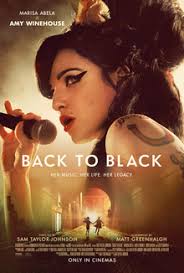
Back to Black
I should know better than to watch yet another musical biopic. It could have been a lot worse, but it shouldn’t really have been attempted. A life that was complicated and messy gets simplified and played for tears, the voice imitated well enough but still not The Voice. Remind me next time.
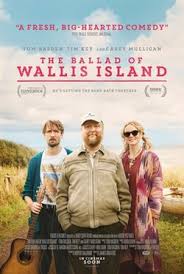
The Ballad of Wallis Island
A truly lovely, funny, touching film. Tim Keys is wonderful as the islander who gets two estranged musicians/partners to come back for one last gig, and Carey Mulligan and Tom Basden are great as the musicians. It steers clear of mere soppiness, and its treatment of grief and loss is beautifully judged – the link between music and memory is a very precious one for me.
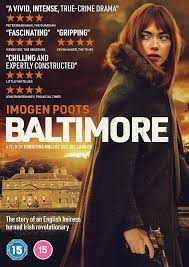
Baltimore
I assumed we’d be in Wire country, but the title actually refers to a village in Cork. It’s the story of Rose Dugdale, heiress turned IRA member, who served prison time for an art heist aimed at getting IRA prisoners released. Imogen Poots plays Dugdale and is excellent at conveying the intensity and volatility of her political convictions. It’s quite an impressionistic, almost hallucinogenic take on the events, sometimes seen through Dugdale’s dreams or fantasies.
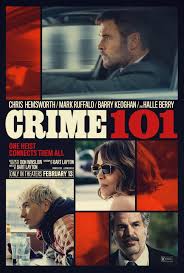
Crime 101
Excellent thriller, with a brilliant cast – Chris Hemsworth, Mark Ruffalo, Halle Berry, Nick Nolte, Barry Keoghan, Monica Barbaro – tightly plotted and with each of the protagonists given just enough depth and back story to make one care, without slowing the pace of it down. Ruffalo channels Columbo, and Berry strikes back against a sexist/ageist boss.
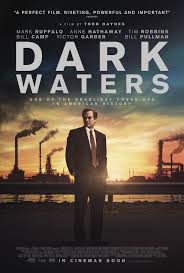
Dark Waters
This is excellent – Mark Ruffalo is great in the lead, dogged and weary. The only problem I have is that essentially this film follows so many of the same narrative twists and turns as every other film about someone taking on a powerful corporation. The arrival of the documents legally requested through ‘discovery’, which turn out to be unimaginably vast numbers of boxes, I remember from a TV series about the opioid scandal (Painkillers, I think). The point when they think no one is going to join in the class action and then are overwhelmed by the response, is straight out of Mr Bates vs the Post Office or Toxic Town. I’m not suggesting any plagiarism here, merely that my response to this film, as good and as powerful as it is, was perhaps dulled a little by familiarity with the tropes.
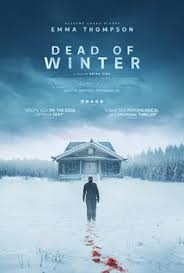
Dead of Winter
Emma Thompson as action hero. Kind of. She plays an older woman, a widow, who’s just trying to honour her husband’s wishes about where his ashes should be scattered when she gets in the way of a very nasty kidnapping. It was filmed in Finland, doubling here as Minnesota, so we’re definitely in Fargo country, and Thompson is definitely channelling Marge Gunderson. Most enjoyable.
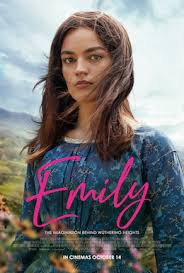
Emily
I loved a lot of things about this, especially Emma Mackey’s performance as Emily Bronte. It does distort events though, suggesting that Emily was the first of the sisters to get published whereas in fact Jane Eyre appeared just before Wuthering Heights, and Agnes Grey very shortly afterwards, and also showing Emily receiving a copy of Wuthering Heights with her name on the cover, which didn’t happen in her lifetime, sadly. Those things annoyed me a little – I was less troubled by the fictional love affair, since the most we can say is that we don’t know that Emily did ever have a lover, that there is no evidence for it, which is practically an invitation to invent.
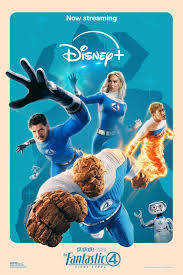
The Fantastic Four
Marvel superheroes for me went off the boil somewhat after Endgame – I have enjoyed the films that have come since, but I recall the anticipation and the excitement of that sequence of films in particular, and that’s not been recaptured, quite. This one has a light touch, with the depiction of a domestic setting peopled by superheroes (seeing three superheroes struggling to fit a baby car seat was a particular joy), and delightfully played by Pedro Pascal, Vanessa Kirby, Joseph Quinn and Ebon Moss-Bachrach (that last unrecognisable as The Thing). It remains to be seen how/whether this and other recent films will develop the Marvel arc but I’d happily watch this lot again.
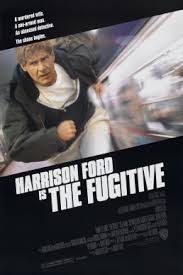
The Fugitive
A classic of its genre, and Harrison Ford is excellent as the man framed for his wife’s murder who escapes from custody and tries to clear his name. The plausibility wouldn’t hold up to very intense scrutiny but in the moment it’s the last thing we’re thinking about as we follow Kimble’s attempts to keep one step ahead of the law.
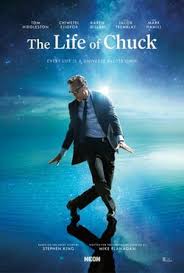
The Life of Chuck
A very faithful adaptation of one of Stephen King’s best short stories (from the volume If It Bleeds), with Tom Hiddleston as Chuck. I won’t say much more because you have to watch it and let light gradually dawn (as it did for me when I read the story). But it’s lovely, beautiful and very moving.
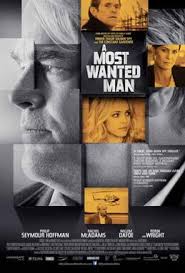
A Most Wanted Man
A John le Carré adaptation, and one of Philip Hoffman Seymour’s last films. It’s typically nuanced, and downbeat. The Independent reviewer found it ‘strangely muted and low-key’, another found the style cold and distant. I didn’t get that – it seemed to me to be classic le Carré, in its ending in particular.
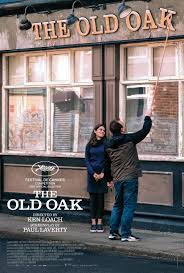
The Old Oak
Ken Loach film set in a depressed and deprived former mining community in the north-east, where a publican’s encounter with Syrian refugees provides a sense of purpose. It’s sometimes a tad predictable, but very touching.
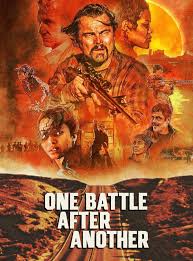
One Battle after Another
Violent, funny, tense, with great performances all round. I don’t know how deep it is, but it’s a wild and enjoyable ride. Di Caprio is lovely as the erstwhile revolutionary who gets very stressed when called upon to remember the passwords and security questions that he’d been trained on years ago (we all know that feeling, even if we haven’t spent the intervening years in an alcohol/weed haze). There’s a brilliant car chase – even if you think you’ve seen every variation on the car chase, this one is special. And Sean Penn is mesmerizingly horrifying as Lockjaw.
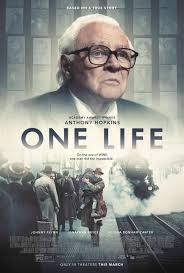
One Life
Of course it builds up to the That’s Life moment, where Nicholas Winton realises he is surrounded by the people he helped to save through the Kindertransport from Prague. Fair enough, and it earns the inevitable tears by acknowledging the grief that Winton feels for the children on the last train who didn’t get away, most of whom were murdered. The script didn’t seem to make it quite clear enough that the reason these children were in danger was because they were Jewish. The rescue effort wasn’t just prompted by the desire to remove children from a generally violent and dangerous situation, but to remove children who would be specifically targeted. I found it odd that this salient fact didn’t come through until a later stage in the narrative.
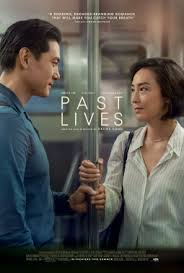
Past Lives
Wonderful, low key, subtle Korean/US drama about a relationship over 24 years, more of which was spent a long way from each other than together. It doesn’t go for easy plot resolutions, and I found John Magaro as the husband particularly touching.
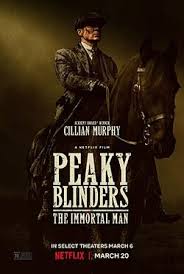
Peaky Blinders: The Immortal Man
It may not have been entirely necessary, but it provides a satisfying coda to the series. Cillian Murphy is as brilliantly compelling as ever, as is Barry Keoghan as his son and heir.
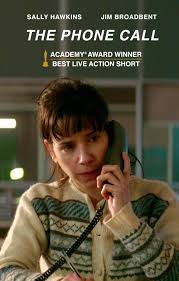
The Phone Call
Oscar winning short film starring Sally Hawkins and (unseen) Jim Broadbent. She’s covering the phone in a crisis helpline, he’s struggling after the death of his wife. It hits hard, and it doesn’t give the viewer false comfort, but it’s somehow uplifting, nonetheless.
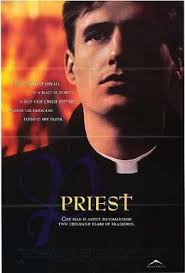
Priest
This one, directed by Antonia Bird from a Jimmy McGovern script, got an absolutely scathing review from Roger Ebert, with which I disagree strongly. I don’t see the film as having a clear agenda; the whole point is that the Church deals in absolutes, in right and wrong, sin and virtue, while human beings are much more chaotic than that, and the attempt to live by those absolutes can take a toll. The film is a depiction of the pain caused when desire, loneliness and love are in conflict with a chosen vocation rather than being, as Ebert would have it, ‘an attack on the vow of celibacy, preferring sexuality of any sort to the notion that men should, could or would live chastely’. The film has a slightly dated feel about it (it’s from 1994) but it’s a passionate, occasionally preachy, but ultimately intelligent and insightful study of faith and doubt.
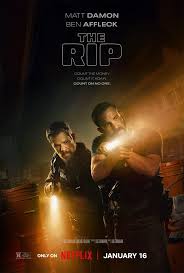
The Rip
Excellent action thriller, starring Affleck and Damon as cops, which builds up real tension as we try to figure out who is deceiving whom.
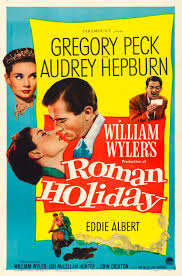
Roman Holiday
A rewatch for the pleasure of seeing Rome and Gregory Peck at their most gorgeous (oh and that Hepburn lass isn’t half bad either) in a film that is just pure delight, sweet and funny.
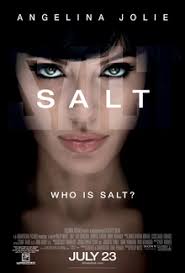
Salt
Silly. Monumentally silly. Not worth pointing out the plot holes or the ludicrously improbable stunts. It passed the time moderately enjoyably.
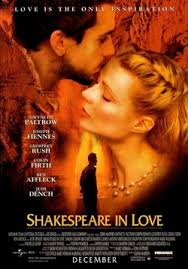
Shakespeare in Love
I’d somehow never seen this before and was reminded to watch it by reading the Stoppard obits and realising the screenplay was his. It is indeed brilliant, the dialogue is so richly intertextual, but somehow the whole thing is light and lovely rather than being weighed down by cleverness.
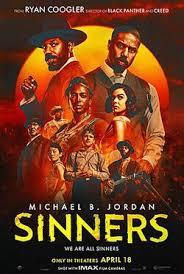
Sinners
The latest from Ryan Coogler, who directed the Black Panther films, and Judas & the Black Messiah, all of which I loved. And I loved every minute of this except perhaps the minutes when I was wishing desperately that I hadn’t gone to an evening showing at the cinema on my own, and with no hand to grab hold of when things got really scary. The soundtrack is glorious, the performances too (I loved Wunmi Mosaku especially) & if it isn’t an academically sound history of the blues, or an entirely coherent allegory about music and roots, I’m not sure that I mind that much. There are layers there, and nuance, and terror and joy and magic, and that’s more than enough. I look forward to rewatching it at home, with the doors securely locked and all the lights on, and/or with someone whose hand I can grab hold of when things get really scary…
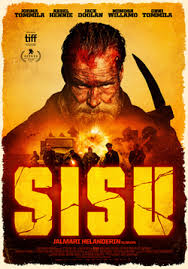
Sisu
If you have a weakness for action movies that don’t bother too much about logic or plausibility, but have a single focus motivation for the violence, Sisu might be for you. Empire’s reviewer says that ‘this is a film about one mad bastard [Aatami Korpi] killing a gazillion Nazis. It’s almost impossible not to love it’. My ostensible reason for watching is the setting – Finland (specifically Lapland) as the Nazi army retreats leaving scorched earth and Finn corpses behind them. I’ve been reading a bit about WWII Finland in preparation for a visit to Helsinki (see also Unknown Soldiers, book and film). I wasn’t really expecting this though. The lorry load of young women prisoners that the Nazis are taking with them reminded me of Mad Max: Fury Road, and the ability of our hero to survive explosions, a plane crash, gunshots and myriad other threats to life could not help but invoke the Black Knight (‘Tis but a scratch’). Anyway, I don’t think I learned much Finnish history but maybe got a sense of Finnish myth, and the meaning of ‘Sisu’. This is basically an absolute bloody-minded refusal to give up whatever the odds, as exemplified by our hero, and by the huge icebreakers moored in Helsinki harbour which were pointed out to us on our tour, one of which was called Sisu.
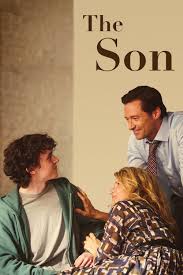
The Son
By the same director as The Father, which was a brilliant study of dementia from the perspective of the person who is progressively losing their hold on reality, time, memory and sense of self. This doesn’t really match it. It’s an often affecting account of the impact of teenage depression on a family, but whilst the actors are top notch, the tone often veers into shouty melodrama. It’s easy to take against Hugh Jackman’s Peter, given his self-regarding diatribe to his son, and his failure to recognise that his own behaviour (echoing that of his father in turn) is part of what is triggering the son’s depression. The ending is signalled a bit too clearly with one of the most obvious instances of Chekhov’s famous principle that I can recall.
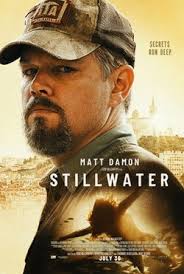
Stillwater
A rather problematic thriller based (rather loosely and controversially) on the Amanda Knox case. It’s Damon’s film, as he plays the redneck, baseball-cap-wearing dad who’s desperate to prove his daughter’s innocence, and he does it well. But even he – and Abigail Breslin, who plays the daughter – can’t get over the weak plotting and the many implausibilities (not least of which is Damon’s romance with Camille Colin). It also pissed Knox off a great deal, understandably, since it uses the general circumstances of her case in a way that could be seen to cast doubt on her innocence.
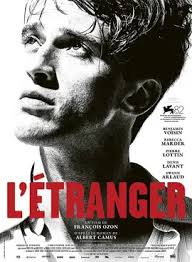
The Stranger
Francois Ozon’s beautiful monochrome adaptation of the Camus novella is a faithful rendition of the book, although of course we can’t inhabit Meursault’s head as the book does, so we’re observing him observing the world and other people as an outsider, trying to work out how he is expected to behave, what he is supposed to feel. Memorable and troubling – and it ends, brilliantly, with the Cure’s song ‘Killing an Arab’ playing over the credits.
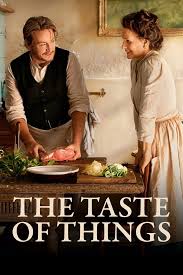
The Taste of Things
Another for my list of slow, quiet films (Perfect Days is perhaps the ultimate, but see also The Straight Story and The Quiet Girl). It’s the antithesis of what I’ve often thought of as the archetypal French film where people talk about philosophy whilst having affairs with each other’s spouses. There’s not a lot of talk here, and what there is is all about food, the growing, the cooking and the eating of food, and the creation of new dishes and menus. It’s really very lovely.
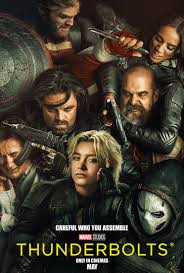
The Thunderbolts*
Another new Marvel, and this one has a lot of promise. I’m definitely there for Florence Pugh (in anything but especially here as Yelena), and Lewis Pullman as Bob. And the Void is a Big Bad that anyone with experience of depression can connect with. * is part of the title of the film, as you’ll understand if you watch it.
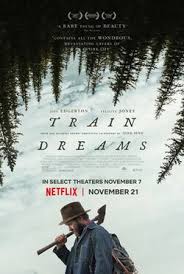
Train Dreams
This almost qualifies for my ‘slow, quiet’ list except that it’s bleak rather than melancholy, and without much to set against the bleakness. I liked it a lot – I saw some reviews that said it didn’t do justice to the original novella, which may be so, but I can’t judge that; on its own merits I found it quietly powerful and moving. Joel Edgerton, who I think I last saw in Loving, is again a man of few words but deep feelings.
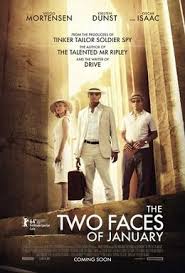
Two Faces of January
Thriller based on a Patricia Highsmith novel, looks gorgeous, well-acted by Oscar Isaac, Kirsten Dunst and Viggo Mortensen, ticks all the boxes and is enjoyable without offering any real depth.
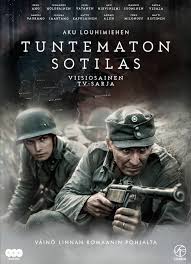
The Unknown Soldier (aka Unknown Soldiers)
An adaptation of Finland’s classic war novel, by Väinö Linna, who himself fought in the so-called Continuation War between Finland and the USSR (1941-44). Like the book (see my Books blog), the film moves around between a number of characters rather than having one main protagonist, and we can have no confidence that any of the people we’re investing in will not be unceremoniously despatched at any moment. Just like real war, I guess. We go from tense battle scenes to vignettes of the soldiers’ lives on the front line, with their side hustles of ring making or furniture making, and the brewing of some very potent bootleg booze, and to vignettes of their life at home during their brief leaves.
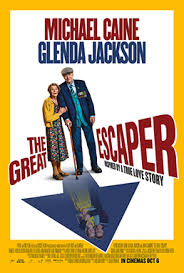
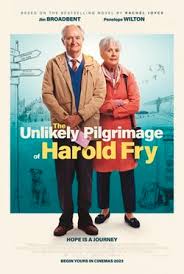
The Unlikely Pilgrimage of Harold Fry/The Great Escaper
Jim Broadbent and Penelope Wilton are marvellous as Harold and Maureen, but the film stretches credulity beyond breaking point as the former sets off to walk from South Devon to Berwick-on-Tweed on some kind of mission to save a friend of his from dying. Frankly, Harold, having led a rather sedentary life, wearing unsuitable shoes and being a pensioner would have carked it on the first leg of this marathon, not got by with a few nasty blisters. I guess we’re not supposed to think about whether a 500-mile walk would even be possible in the time frame suggested. It had its moments, particularly when it focused not on Harold but on Maureen, who feels (is) abandoned, and in effect bereaved, and who gradually reveals more about their marriage and the loss of their son to drug abuse and suicide.
The Great Escaper features Glenda Jackson’s last film performance, and she is superb – I love seeing her at this age (see also Elizabeth is Missing) and Michael Caine is great too (I’m not a massive Caine fan but this is an understated performance, in which a lot of conflicting emotions are conveyed with a minimum of drama).
I’m putting these two films together as they have so much structurally in common – in both an elderly man (Bernie is 90, Harold in the book was 65 which, to be fair, barely counts as elderly from my perspective) embark on an impulsive journey (Bernie to get to the 70th anniversary commemoration of the D Day landings, Harold to ‘save’ an old friend in a hospice). Both leave their wives behind, though Bernie does so with her agreement. Both become briefly media sensations, but are puzzled and troubled by the appropriation of their quest. Both find the end of the quest is not what they expected (Harold realises his old friend is beyond help, Bernie finds the headstone of a young soldier who he had encouraged during the landings and then seen die). Both are affected by trauma – Harold sees his dead son at various points on his journey, Bernie is haunted by memories of the carnage at the landing.
Both were touching, sometimes moving. Ultimately, I felt that Harold engaged in a bit too much whimsy and an almost magical approach to his achievement of his quest. And because of the vagueness about Harold and Maureen’s age, I was irritated by the way they were portrayed – even the names are not those of people (like me) in their mid-sixties now, they are of my parent’s generation. Bernie and Irene are old, they look their age, and move accordingly. These days I find myself quite frequently distracted and irritated by portrayals of older people (see The Thursday Murder Club, for example, where Celia Imrie dresses exactly like my Gran (b. 1901) did). I guess it’s inevitable – as a teenager I raged against television portrayals of my age group, and heading into middle age I often couldn’t see myself in the middle-aged women I saw on screen.
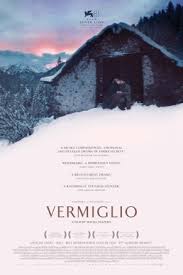
Vermiglio
Beautiful, slow, subtle Italian film. As the Ebert site review says, ‘The movie has the feeling of a tale passed down through generations. A lot of the time we don’t know why characters make particular choices, only that they make them. Sometimes a silent glance is all it takes to communicate that a change is about to occur, or happened offscreen.’ We have to read what we see on the screen, most of the major developments aren’t shown to us directly and there is limited dialogue to fill in the gaps. The film asks us to concentrate, to allow ourselves to be absorbed into this world and this community. If we can do that, it’s a rewarding experience.
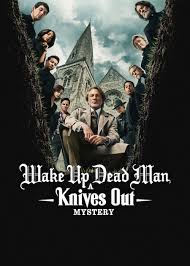
Wake up Dead Man
I didn’t like this quite as much as its predecessors (Knives Out/Glass Onion) but it had a great deal to commend it: excellent performances (Josh O’Connor especially) and a thoughtful script which touched on questions of faith and guilt.
TELEVISION
As always, I haven’t reviewed everything, only those programmes that impinged on my consciousness after the credits rolled, for good reasons or bad. There is as always a preponderance of crime/thrillers, and only a little comedy, although the comedy that does appear here made me laugh a great deal.
Picking the best of is always a tough call. But I think Waiting for the Out, Tip Toe and Small Prophets were the ones that not only gripped me (in their very different ways), but surprised me and made me think about them long after the credits rolled.
Drama
Believe Me
This is a grim tale. It’s the stories of the women who John Worboys drugged and raped, and was able to continue committing these crimes over a long period of time, simply because the women who reported him were not believed. If they had drunk alcohol before getting into his cab, that meant their testimony was not taken seriously – and the very fact that the man they were accusing was driving a black cab led to incredulity on the part of the police. That incredulity led not only to cases not being logged as crimes, but to carelessness with evidence and a total failure to connect the cases with each other, which allowed Worboys to continue unchecked. The drama focuses on the women who decided to challenge the police and to challenge the decision to grant him parole and their rage is at the heart of the drama..
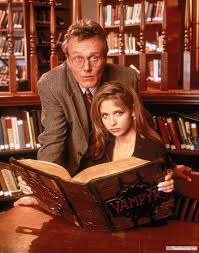
Buffy the Vampire Slayer
I’ve been meaning to rewatch Buffy for a while. Not all of it – I don’t think I will ever rewatch ‘The Body’ because it was harrowing enough before I had to do chest compressions on my husband whilst waiting for the paramedics, and there are other episodes that just haven’t worn so well. But I have been deterred by the Whedon problem. The last time I watched these, I still thought of him as wise and witty and feminist. Hearing the voices in recent years of women who worked on this series with him, I felt that I’d been tricked, made a fool of. But ultimately, what Whedon helped to create is more than him, and as anyone who loves Wagner’s music (for example) knows, a person can be pretty vile and still create beauty. Anyway, my mind was made up by a series of losses – last year Michelle Trachtenberg died, aged 39, this year Nicholas Brendon died, aged 54. And then Anthony Head, who played Giles, the lovely librarian and demon hunter, buttoned up and British, but also a father figure, a hero. He was always my hero (I was too old when I first watched the series to legitimately have crushes on any of the supposed romantic leads, although Spike’s cheekbones did lead me astray for a while). Head was 72 which might not be as heartbreakingly young as Brendon and Trachtenberg but is still far, far too young. So I re-watched ‘Once More with Feeling’, the musical episode, and then went back to the beginning and watched the first two episodes of the whole thing, and then ‘Band Candy’ in which Giles relives his edgier past and plays Cream’s ‘Tales of Brave Ulysses’ turned up loud. I’ll pick some other Giles-heavy episodes to watch. Just not ‘The Body’.
Chernobyl
I read Midnight at Chernobyl (see my 2026 Reading blog) and remembered that there had been a highly regarded TV series about it which I’d missed at the time it was broadcast (I think it went out while M was still with me, and he had a limited appetite for grim so probably vetoed it…). It was a tough watch, but pretty true to the events as far as I could judge, and very well done. Great cast – Jessie Buckley and Barry Keoghan pop up in minor roles, as well as other familiar faces. It manages to maintain just the right balance between focusing on individual tragedy and seeing the bigger picture – how the Soviet government (under Gorbachev at the time) reflexively denied, dismissed and covered up the truth until they no longer had any choice, and the part these events played in the fall of the Iron Curtain.
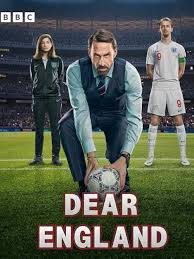
Dear England
I saw the National Theatre Stage on Screen production a couple of years back, which was superb, so I wasn’t sure what might be gained from a four-episode television version. I suppose I’m still not sure, but I enjoyed it, and was moved all over again by Southgate’s determination to address the malaise that had affected the national team, and his care for his young players. I remember feeling that something had changed when I watched his England team play. And I remember that cold feeling which had to do with so much more than losing a football match when three young black players failed to score penalties. The abuse they received was so ugly – but the response to that abuse was more powerful. The TV version takes us through to the 2024 Euros final and Southgate’s subsequent resignation, with a brief glimpse of Thomas Tuchel…
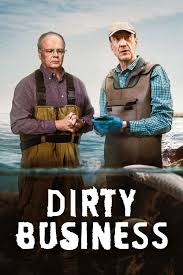
Dirty Business
Jason Watkins and David Threlfall as the Mr Bates equivalents in the true story of ordinary blokes on a mission to expose the persistent pollution of rivers and beaches with untreated sewage, and the risk not only to marine but to human life that this represents. In the Post Office corner, not only the water companies, but the Environment Agency, which comes off very badly indeed, lacking the will and the courage to challenge the big businesses that actually run the water companies.
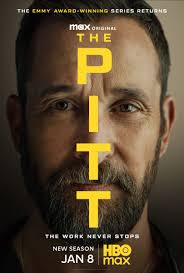
ER/The Pitt
The entirety of ER, on Netflix! I used to love this, and turns out I still do. The blend of soap opera and medical drama is usually perfectly done, only rarely tipping in the wrong direction (the wrong direction – for me – being too much soap and not enough bradying down, asystoles and Foleys and all that marvellous medical jargon). It’s also a window on to the world back then (it starts in the mid-90s), with AIDS still a major concern, although it’s acknowledged by the time we’re into the mid-2000s that this has changed dramatically. And in urban America, not just MVCs but GSWs arriving through the doors every day. In contrast to Casualty, where we always used to start with people going about their day, whilst the viewer calculates which of them will come to grief and how, usually (and I prefer it this way) in ER we know only as much about the people on the gurneys and in chairs as the docs do. It’s not perfect, of course. Binging it as I have, the ramping up of the melodrama is very noticeable, sometimes with (inadvertent?) comic effects (Romano v helicopter – twice – for example). But despite this, and the occasional bouts of soppiness, especially in the Christmas episodes, it is superb. A random thought – a poster saying Cure Autism appears on various walls throughout the first decade of the show, which surprised and troubled me – was it really thought until the mid-2000s that autism was something that could be and needed to be cured?
Having had all the ER that there is, obviously I headed up to Pittsburgh for The Pitt. It’s inhabiting very much the same territory. Both interweave the stories of the patients with those of the medics, addressing the same challenges of hospital bureaucracy and funding vs patient care and staff safety, of treating people who cannot pay for medication, of identifying ‘drug-seekers’ and abuse victims, of getting the balance between optimum treatment and being, as we are often reminded in both series, a teaching hospital. There are new issues of course – whilst the anxiety of undocumented migrants in seeking medical help was regularly covered in ER, in the final episode of The Pitt series 2 we see masked ICE officers dragging away a patient, and arresting a medic who tried to defend her.
Where the two series differ most is in the structure of each episode. ER experimented with that over the years, with varying levels of success, but The Pitt is very simple: each episode covers one hour of a shift. So across the whole series we have witnessed that whole shift, which allows for us to get much more deeply into each of the cases that come through the door (and the concerns of those who treat them). It took me a while to get to grips with it, to grasp that if Dr Robbie was desperate for a piss in episode 1, he was even more desperate in episode 2. We get so used to time jumps of anything from minutes to hours that we don’t expect that degree of continuity. But it’s compelling, even stressful to watch, and the structure means we get a powerful sense of the relentless pace of the ER. I can’t wait for series 3.
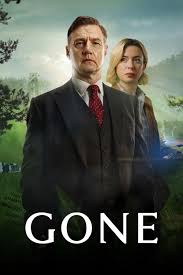
Gone
Much better than average crime series, partly thanks to the performances – David Morrissey in particular is marvellous as the buttoned-up headmaster whose wife disappears. It doesn’t twist for the sake of twisting, and the dénouement makes emotional as well as logistical sense.
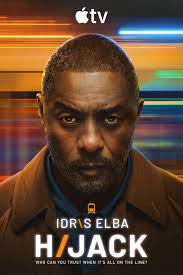
Hijack
I watched both series. The first was genuinely heart in mouth, and whilst I couldn’t swear that the plot entirely made sense, it was exciting enough to not mind. Series 2 was less compelling, and the plot more convoluted, but it was exciting enough to not switch off.
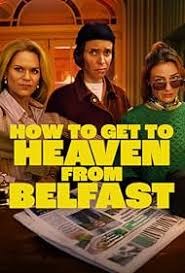
How to Get to Heaven from Belfast
From the creator of the absolutely wonderful Derry Girls, a very funny, very sweary mystery. The Guardian’s review says that it has all of the ‘verve, acuity and havoc dancing on top of the immaculate plotting that you find in McGee’s masterwork’. It’s a wild ride.
Lead Children
There is common ground between this gripping drama (based on a true story) and Chernobyl (see above), in the culture of denial that anything could be wrong with the great Soviet industrial machine, even as the evidence mounts up to show that children living near a smelting works in Silesia in Poland, are being poisoned by lead fumes from the works. That evidence is painstakingly accumulated and stubbornly presented by Dr Jolanta Wadowska-Krol (played by the superb Joanna Kulig, who I last saw in Cold War), who comes up against the system’s resistance at every step.
This is ‘the true story of a group of ordinary men and women recruited from the rank and file of Her Majesty’s Customs in the early 90s, given three weeks’ training and sent undercover to infiltrate and bring down two massive drug cartels that were filling Britain’s streets with heroin and really pissing Mrs Thatcher – head of the party of law and order, don’t you know – off’. I was wondering why this reminded me of The Gold, until I realised both series are created by Neil Forsyth. This one has a great cast – inc. Tom Burke, Hayley Squires, Steve Coogan – and it’s a great watch.
Lynley
I never got into the much earlier dramatisation of these novels (or the novels) and I’m not sure I will bother with another series, should there be one. It’s yet another odd couple pairing – this time posh bloke with blunt working-class woman – but there’s only so much mileage you can get out of that, and the plots are pretty much run of the mill. One might hope that writers of crime series would get tired of that trope – it became tiresome quite quickly in the recent Cooper & Fry series, which I reviewed last time.
Missed Call
An impressive cast (Joanna Scanlan, Rupert Graves) but there were too many plot holes, too many things not adequately explained, and the usual mad mess of a final episode which strained credulity beyond breaking point.
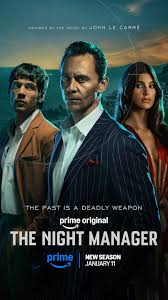
The Night Manager
This was an excellent, unexpected sequel to the le Carré original, with lots of peril, twists and turns that left me shouting at the telly, and great performances from all concerned. I feel there must be another series in the offing and I’m up for it.
The Other Bennet Sister
Everyone urged me to watch, and I eventually complied and found that yes, it was every bit as lovely as they all said, a complete delight and a balm for the soul in troubled times. Wonderful.
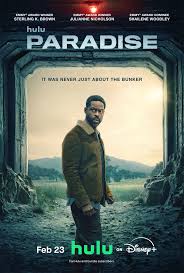
Paradise
Excellent sequel to one of the best things I watched last year. It’s very different, in that a lot of the action is now outside of the bunker, and the sequel’s trajectory is bringing those two worlds together – we are left on a massive cliffhanger so I’m hoping for a season 3. Very well written, and great performances.
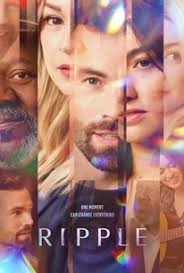
Ripple
Highly addictive – the series introduces us to four people whose lives intersect, some only briefly but in ways that have significance, others whose lives remain connected. The concept is that some seemingly trivial incident has ripples that impact in unforeseeable ways on the lives of others. It’s sometimes soppy, and sometimes a bit contrived, but most enjoyable.
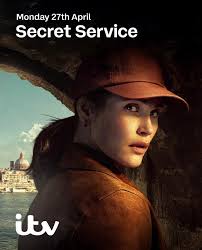
Secret Service
Cut above the average spy thriller, with a great cast – Roger Allum, Alex Kingston, Rafe Spall, Gemma Arterton – tight plotting and a good script. Looking forward to season 2.
Small Prophets
As good as everybody told me it was (I was late to the party as I so often am). Decidedly odd, funny, touching, rather beautiful. And with Michael Palin. I will not say more because spoilers. Just watch it if you haven’t already, you’ll thank me later.
Steal
Well done heist drama where pretty much nothing is as it appears in episode 1. The ending could suggest that there will be a sequel, but I don’t think one is needed.
Stranger Things
When a series is as loved as this one, the ending is almost bound to disappoint at least some of its fans. But for me it drew the threads together beautifully in this final series and left enough questions hanging in the air about which we can make our own minds up – or choose to leave them unmade up. There were some lovely touches (I loved Dustin’s valedictory speech at the school graduation event, which, with its own incidental reminders of Buffy, paid tribute to the late and much-lamented Eddie by being as subversive, disrespectful and inappropriate as Eddie had promised to be). There was, on the other hand, an excess of exposition, none of which was particularly enlightening (sometimes it’s best to just leave it as what one of the Buffy writers called ‘Phlebotinum’). Also not enough Joyce, from my POV – not that there ever has been – though she got her Molly Weasley moment. But the flaws are probably inevitable – the long gap meant that viewers had the choice of either rewatching four previous series to remind themselves of who/what/where/why, or just leaping into the final season and hoping they could figure it all out. And, inevitably, the very final episode crammed too much in, particularly as it needed to give each of the characters a satisfying last act, as well as to resolve as many as possible of the plot threads. There’s also the problem that the more you love a series the harder it is to let it go, for it to be all wrapped up with nowhere to go and nothing more to do. It had to finish, and for me, it did so as well, as bravely, as it could, honouring the things that were best about it over the full nine years.
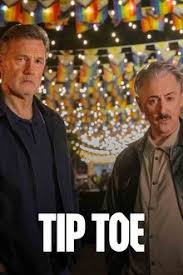
Tip Toe
Bloody hell. We are shown at the very start where all of this is going to end – in violence and horror. And as we build up to that we are beset on all sides with foreboding, with the dark predictions of how the gains for LGBTQ people are vulnerable. Melba says that whereas they used to come into a room with a ‘Ta da!!’, now they go on tiptoe. If at points I wondered if this was getting a bit melodramatic, the final episode made the descent into hell entirely plausible (and real-life events in Belfast and Southampton, whilst prompted by xenophobia rather than homophobia only added to the sense that Melba was right). Alan Cummings and David Morrissey are both superb, and Morrissey is terrifying.
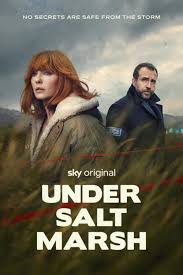
Under Salt Marsh
A cut above the average crime thriller. It has other themes than the investigation of murder, though that’s part of it – it’s concerned with community and how resilience and independence can become problematic in the face of environmental crisis and family trauma. Excellent performances, and although it does provide twists, they’re grounded in the story, not just the desire to keep the viewer guessing.
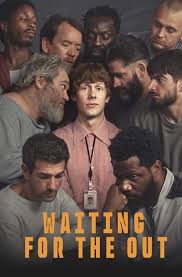
Waiting for the Out
Based on Andy West’s The Life Inside (see my books blog), this is a brilliant, sometimes funny, often gutwrenchingly sad drama about a young man with plenty of issues of his own, teaching philosophy in prisons. Josh Finan is outstanding as Dan, and the supporting cast are all beautifully drawn, with clichés and stereotypes swerved and/or undermined. As the Guardian reviewer said, ‘With a mixture of exquisite lightness and overwhelming heaviness,Waiting for the Out suggests that it’s never too late. We can still write our own stories’.
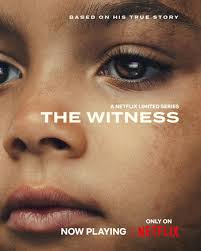
The Witness
The murder of Rachel Nickell on Wimbledon Common and the failure for 16 years to find the perpetrator, along with the use of an undercover officer to set a ‘honeytrap’ to encourage the police’s preferred suspect to incriminate himself, are fairly well-explored territory. This drama, however, focuses on Nickell’s partner and her son, who was with her when she was murdered As Alexander (aged 2 at the time of the murder) was the only eyewitness, there was pressure to find a way to get more information from him that might lead to an arrest. That process is hard to watch, as is the child’s father André’s frustration and distress whilst it is happening and anxiety about how it will affect Alex. The police come out of this pretty badly, but perhaps the most repugnant element is the behaviour of the press, who pursued André and Alex relentlessly, going through their bins, goading André to try to get him to lose control, besieging them in their home, first in the UK and subsequently in France and Spain where they had fled. It’s a powerful drama, and an honest one, not painting André and Alex as heroes or saints, but as any of us might be in those circumstances, flawed human beings trying to survive something utterly traumatic.
Documentary
The Assembly
The Assembly is a panel of autistic, neurodivergent and/or learning-disabled interviewers who can be relied upon to ask the questions no one else would dare ask, or would even dream up. The various celebrities who are at their mercy are all fully briefed and respond with humour and humility, even if they can’t quite believe what they’ve just been asked. And these interviewers will absolutely go for the heart – asking Nicola Sargent about her miscarriage, Stephen Fry about his suicide attempts… It’s rare that the interviewees don’t end up in tears at some point, and I always do.
Bobby Kennedy for President
Fascinating documentary series. I vividly remember seeing the news of Bobby K’s assassination – I was 10, nearly 11, and we just got in from an evening out and my parents put the news on, and before they realised what we were going to see, there was the blurry footage of Kennedy falling. I didn’t know much about him then, unlike MLK, about whom I knew enough to know why he was so important, but my parents were devastated by RFK’s death too, and this series shows both why he meant so much to so many people, and the flaws that might have become more evident and problematic had he achieved the presidency.
The Titanic Sinks Tonight
A minute-by-minute account of the sinking, with segments of actors portraying some of the passengers, sailors, engineers etc aboard the ship. I knew the bones of the story, of course, but there was a lot here that I had no idea about, and the individual stories were both engaging and very moving. I have visited the excellent Titanic exhibition in Belfast since watching this, and it was fascinating to see the history of the ship from initial design through to the recent rediscovery of the sunken wreck.

2024 on Screen – half-time report
Posted by cathannabel in Film, Television on June 23, 2024
The Big Screen
Some superb films on my list this half-year. Most were actually seen on the smaller screen, but I did go to the cinema for The Zone of Interest, Furiosa, Dune 2, Dear England, and Rome: Open City (of those, Furiosa and Dune 2 were on the very very big screen, deservedly so). Even more than usual, I find it impossible to pick ‘the best’ or even ‘my favourite’ but I have asterisked a few that seemed to be head and shoulders above the rest. I’ve included some re-watches but not all, and I’ve missed out any film that I started and just CBA’d to continue (clearly that is a judgement, but not a judgement that I can necessarily defend, as it might have got heaps better after I switched off…). Some of my watching was to prepare me to visit Vienna, Prague and Berlin (see also my books blog, and there will be a full blog about the trip in due course). Quite a bit of it, as always, was WWII related (the trip and my watching through the last six months). But I’ve also explored other pasts, and futures…
About Time
Classic Curtis – cute, funny, with some very problematic elements (all the men in the family have a secret power that they keep secret from all the women in their lives and use to manipulate said women into liking them more). We enjoyed it enormously, despite the problematic elements. Until the narrative took a turn that we weren’t expecting and one that left my daughter and I clinging to each other and weeping.
Aftersun*
Melancholic, often sweet and funny, portrayal of a father and (just) teenage daughter on a holiday that he probably can’t really afford, their interactions showing both of their vulnerabilities and foreshadowing a future that we glimpse, intercut with the scenes from the holiday. Mescal is brilliant, Frankie Corio as his daughter extraordinary.
Ali
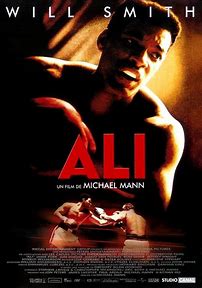
Will Smith is excellent, but somehow the film doesn’t quite work. So many aspects of Ali’s life seemed to be touched on (particularly his friendship with Malcolm X and loyalty to Elijah Mohammed) and then left to one side. It’s not quite hagiography but it does gloss over Ali’s affairs and their impact on his wives, and it doesn’t ask the hard questions, of Ali as a man or as a boxer. One review calls it ‘flat, curiously muted’ and notes issues with the pacing, and I think I agree on both points.
All of Us Strangers*
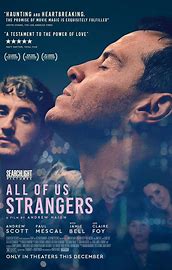
Devastating. The Guardian described it as ‘a raw and potent piece of storytelling that grabs you by the heart and doesn’t let go.’ I’d read reviews before watching but I wasn’t ready for the way the film handled Adam’s visits to his parents, let alone for the ending. I can’t actually talk about the film, I can’t hear Frankie’s ‘The Power of Love’ without choking up, I can’t think about certain key moments or even about why this film reduced me not just to tears (that’s not so unusual) but to sobs that actually physically hurt. It’s beautiful and unbearably sad and I might have to watch it again some day to appreciate just how it’s done, but it will be quite some time before I’m ready.
Allied
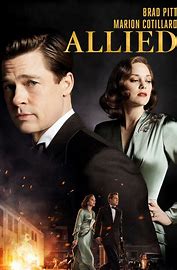
Well, this was entertaining and exciting enough, I guess. I just didn’t believe it. And I found Brad Pitt really rather wooden… Marion Cotillard deserved a better co-star.
American Fiction*
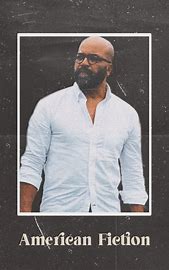
Very funny, even if painfully so. As a white reader who has consciously tried to read more by writers of colour, to hear more black voices, etc., I winced while I laughed. I wish it had explored more the interaction between Jeffrey Wright’s Paul, and Issa Rae as the author of We’s Lives in da Ghetto – I would have happily sat through an extended version of their conversation.
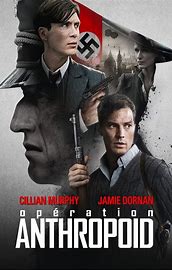
Anthropoid
Gripping account of the assassination of Heydrich in Prague in 1942, from the perspective of the Czech resistance. We saw this when it first came out, but I re-watched because it was filmed in Prague (the second city on our European trip) and I knew we would be visiting some of the locations. As it turned out, my son made the pilgrimage to the Cathedral of sv Cyril and Metodej (Heydrich Martyrs Memorial) without me, as Prague’s cobbled streets had temporarily done for me after several days of clocking up record numbers of steps. See my forthcoming blog about the trip for more.
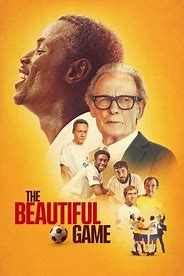
The Beautiful Game
A football drama – set at the Homeless World Cup in Rome – where the usual problem (actors playing top level sportspeople) doesn’t apply because the footballers in this tournament are not there because they’re the best in their country. Micheal Ward (who was wonderful in Empire of Light) is brilliant here. It occasionally lacks subtlety, and I normally react badly to the word ‘heartwarming’, frequently used to describe this film – but what the hey, my heart was undeniably warmed. It’s funny and touching and it’s about football and I loved it.
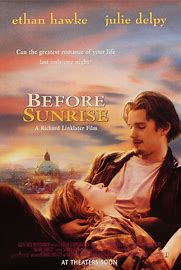
Before Sunrise
This was a taster for a short stay in Vienna (we were there a bit longer than the characters in the film) and we did spot a few of the locations as we wandered around the city. Absolutely charming, sweet and funny.
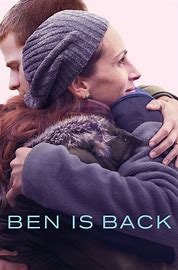
Ben is Back
Julia Roberts and Lucas Hedges make this work with wonderfully nuanced performances. Roberts as the mother of an addict is torn between loving him, wanting to believe in him, and knowing that addicts lie and steal and that she can’t risk too much trust. And Hedges makes us believe, despite the way in which his story unravels, that he wants to be clean, that he loves his family. That’s the film, really, that relationship, and the tensions that ripple out from it to the rest of the family.
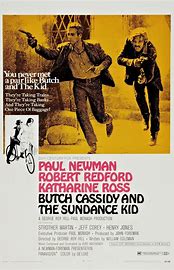
Butch Cassidy and the Sundance Kid
I saw this at the cinema when it came out, and settled down for a re-watch one afternoon when I needed something familiar and a guaranteed pleasure. I was in love with both Newman and Redford when I first saw it (heck, I still am), though had I been forced to choose one, it would have been Newman (still is). The film stands up remarkably well – Katharine Ross’s Etta Place has plenty of agency (despite that scene where she undresses at gunpoint) and character, when she might well have been a mere passive hanger on. It’s funny and touching and a delight.
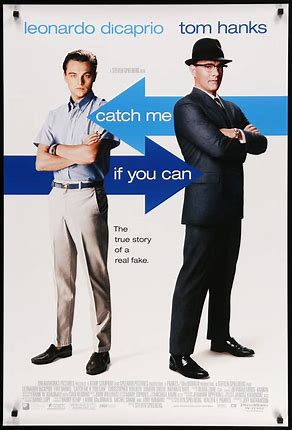
Catch Me if you Can
Very entertaining. If it doesn’t explicitly portray the real damage (financial and emotional) that Frank Abagnale Jr did through his lies and scams, Tom Hanks’ FBI agent provides the balance with his relentless pursuit, so that as charming as Frank is, we never truly want him to get away with it, we just want the cat and mouse game to be fun, as it is.
Chevalier
There has been a huge amount of effort to re-establish in the musical repertoire composers of colour who had been sidelined or forgotten altogether – Florence Price and Samuel Coleridge-Taylor, for example, are now regularly featured on programmes of orchestral or chamber music. This guy, Joseph Bologne AKA Chevalier de Saint-Georges, was earlier than either of those, and his life is as remarkable as his music. Whether all of the events depicted here happened quite as shown doesn’t matter terribly – Kelvin Harrison Jr persuades us that he was brilliant, charming, bold and confident, and the music on the soundtrack confirms he deserves this starring role.
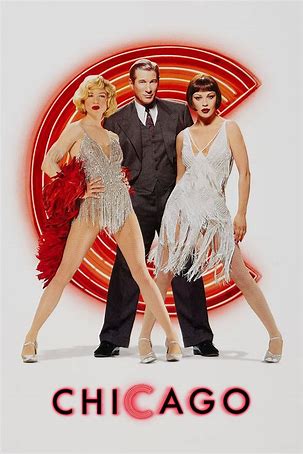
Chicago
This was fun, but I never felt entirely engaged either by the music or the plot – it was all very well done, entertaining, diverting, and the production was imaginative. Just somehow left me a bit neutral.
Collateral
Cracking thriller. I enjoyed Cruise as a baddie, and Foxx’s taxi driver/dreamer is a wonderful foil for him. OK, the final showdown (especially the subway sequence) could be said to be hackneyed but by that time I was sufficiently invested not to be quibbling about anything, just to enjoy the ride.
The Commitments
Funny, exuberant and with a nice balance between the hopes and dreams of the musical big time and the cynicism born of everyday experience. The sequence with the auditionees queueing up at Jimmy Rabbite’s door is glorious, as is the music. If the story seems to fizzle out a little at the end, well, that’s life…
Daphne
Biopic about du Maurier, focusing on her passionate relationships with women. One reviewer complained about this, but as it doesn’t claim to be the definitive exhaustive biography, and as these relationships are well documented but not well known, it seems perfectly valid to me. Geraldine Somerville’s du Maurier remains quite an enigma but is always fascinating.
Dear England
An NT Stage on Screen production. Loved every minute of it. Joseph Fiennes was perfect as Southgate, and I ended up a great deal fonder of Harry Kane through his portrayal by Will Close than I ever was before. Funny, touching, giving due recognition to mental health and to racism, without allowing either of those to overwhelm the narrative.
Decision to Leave
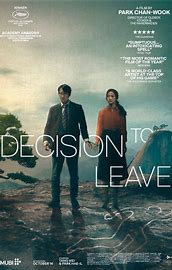
A truly intriguing and compelling Korean thriller, a story of obsession, of a cop with insomnia and problems with his vision (obviously metaphorical as well as literal), and a fascinating suspect in a baffling murder case.
Dune 2*
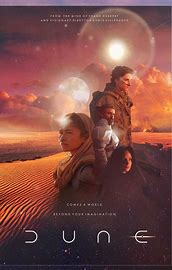
Loved the book (and several of its sequels) in the 70s, thanks to my husband who was a keen reader of science fiction (and who would have loved the Villeneuve adaptations). Saw but didn’t like the David Lynch movie version from 1984. I was blown away by the first film, despite only seeing it on a TV screen. We saw the sequel on Imax, and it was stunning. It is, to the best of my recollection, a pretty faithful adaptation of the book, which is complex and multi-layered, and reflects Herbert’s interest in ecology, messianic religion and mycology (some elements of the book were apparently inspired by his experiments with psilocybin).
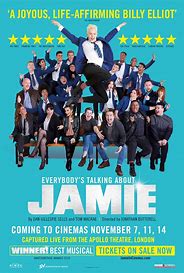
Everybody’s Talking about Jamie
It took me a long time to get round to this – I’ve still never seen the stage version on any of its periodic returns to the Crucible theatre. It was hugely enjoyable, although I can’t say that any of the tunes stuck in my head at all. Obviously, I tried to spot Sheffield locations (without much success), though I already knew the social club scene was filmed at Crookes Social Club (erstwhile Working Men’s Club), where I go regularly to see Sheffield Jazz gigs. We were shopping in Crookes one day when we saw two coaches struggling to negotiate the narrow, car-lined streets, and then saw them disgorge a large number of passengers, who made their way to the Club to act as extras.
The Falling
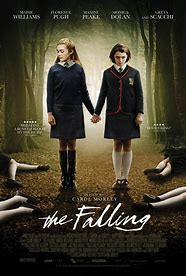
Dark but often quite funny account of an epidemic of fainting at a girls’ school – wonderful performances from Maisie Williams and Florence Pugh (her debut) in particular amongst the girls, and Greta Scacchi and the always brilliant Monica Dolan amongst the teachers. Maxine Peake is brittle and damaged as the mother, Joe Cole charming and dangerous as the brother (in one of only two male roles in the film). And Tracey Thorn provides the perfect soundtrack of woozy, dreamy songs.
Flight
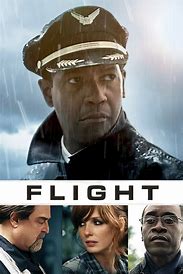
Denzel Washington as a pilot whose personal habits come under scrutiny after a crash landing. He’s excellent, of course, giving the role depth and complexity. And the scene of the crash is one of the more terrifying air disaster sequences I’ve seen.
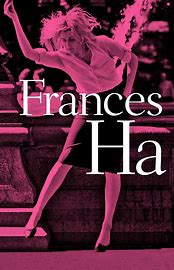
Frances Ha
Gerwig is utterly beguiling (though Frances would no doubt be infuriating in real life), and the film is warm and funny with moments of poignancy. The whole thing has a Nouvelle Vague feel to it, accentuated by the score, which includes some of Georges Delarue’s music for Le Mépris.
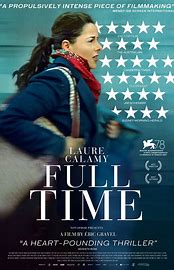
Full Time
Excellent French drama, starring, Laure Calamy, Noémie in Dix pour cent (Call my Agent) as a single parent, running (literally and metaphorically) to keep up with the various elements of her life (childcare, job, chasing her feckless ex for maintenance, commuting in the midst of strikes). It ramps up the tension to an almost unbearable level (particularly if one has ever had to juggle in this way and knows that feeling of utter panic).
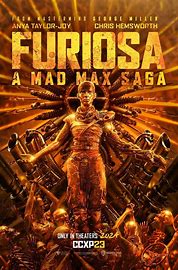
Furiosa
Thoroughly entertaining, visually brilliant, with great performances from both Anya Taylor Joy and Alyla Browne as the even younger Furiosa. Chris Hemsworth is virtually unrecognisable thanks to wig and prosthetic nose in his role as the bonkers war leader Dementus. Tom Burke is arguably somewhat wasted in a very taciturn action role as Praetorian Jack, which requires him to exchange smouldering looks with Furiosa but gives him little other opportunity to flesh out his character. I enjoyed it all hugely, but it does suffer from that inevitable prequel problem – we know where it all must end up. The film even segues into the early part of Fury Road, and the end credits include brief snippets of both films. So, whilst the action along the way is thrilling, we are waiting for what we know must happen rather than genuinely wondering what will happen.
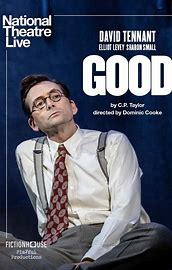
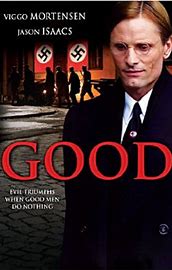
Good
I saw this twice, firstly in the film version starring Viggo Mortensen, and again in the NT production with David Tennant. It was a great deal more effective as theatre than film – the movie version filled out bits of plot that were perhaps better left ambiguous, and the device where the protagonist hears music at key moments worked much better in the very stylised theatre version. The use of actors to play multiple roles worked, for the most part, although it required some concentration, particularly in relation to Sharon Small (playing the wife, the mistress/second wife, the mother and an SS colleague) to be sure who was who. Both Mortensen and Tennant were superb in the lead roles. The play asks how a ‘good’ person could collaborate with evil, a perennial question about the Nazi era, and C P Taylor shows how the protagonist – an ordinarily decent person, if lacking in empathy, compromises his values gradually, tiny step by tiny step until he is fully identified with the regime.
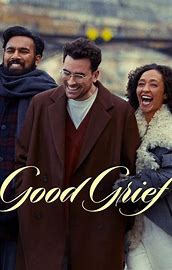
Good Grief
A charming but not awfully deep study of the aftermath of a sudden bereavement. I had a lump in my throat once or twice, but I couldn’t entirely identify with these people and their world. Still, it had its moments.
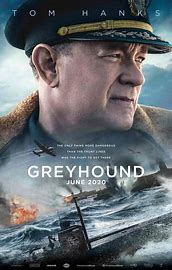
Greyhound
Hanks being an ordinary hero again, this time shepherding his escort destroyer group as it protects an Allied convoy against U-boats during the Battle of the Atlantic. Not a remarkable film or performance, but good, solid stuff.
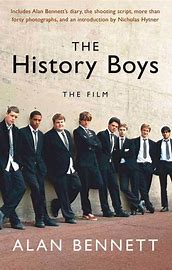
The History Boys
Alan Bennett’s script is brilliant, waspish, funny but with undertones of real melancholy. Excellent performances from the ‘boys’ too. But it felt weird that the issue of sexual molestation, however mild, by a teacher is treated so lightly, so benevolently, both by those on the receiving end and by the film itself, which doesn’t really question their reactions.
The Hours
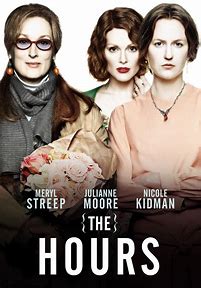
I wasn’t totally convinced by Nicole Kidman’s take on Virginia Woolf – I’m not sure if it was the nose, or rather the knowledge that it wasn’t Kidman’s, though Bradley Cooper’s prosthesis, whilst being more controversial, didn’t get in the way of his performance in Maestro. I expected Woolf to be fiercer, perhaps. Julianne Moore and Meryl Streep are both superb, and the interlinking narratives, with Mrs Dalloway as the connecting thread, are moving and powerful. And the film reminds me that I must read Mrs Dalloway….
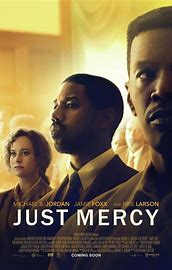
Just Mercy
Powerful fact-based drama about justice and race in the US. Michael B Jordan and Jamie Foxx are great as the lawyer and accused man respectively. The film’s main weakness lies in the treatment of their opponents: as the Guardian reviewer says, ‘It distracts from the reality of the case and of ongoing cases such as this, turning racists into pantomime bad guys rather than presenting them far more chillingly as real people who have normalised their hatred’.
Kidnapped
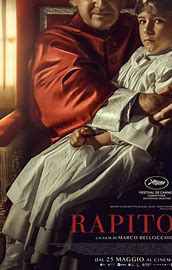
Fascinating historical drama from Italy about the 1851 kidnapping of a Jewish child after a maid in the household secretly baptises him on what she thinks may be his deathbed. It’s based on a real case, features a compelling performance by Barbara Ronchi as the child’s mother, and superb work by Aidan Hallett, in a non-speaking role, as one of the Pope’s servants.
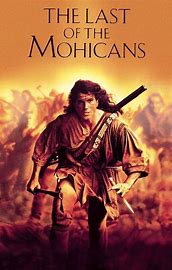
The Last of the Mohicans
What a film. I remember loving it when I first saw it, but it blew me away all over again. From that opening sequence, with Day-Lewis running through the woods, to the dramatic clifftop climax, it’s tense, violent, incredibly romantic and completely absorbing. I’ll be honest, DDL usually inspires more admiration than adoration from me, but here I was with Cora all the way.
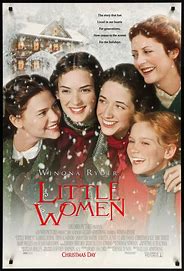
Little Women
The 1991 version, with Wynona Ryder as Jo. Pretty good, until the end when Jo goes a bit too girly over the Prof. I think I’ve been spoiled for other versions by Gerwig’s, which is now one of my annual Xmas watch and have a bit of a cry films, and whose rearrangement of the chronology (it seemed blasphemous at first, not to open with ‘Christmas won’t be Christmas without any presents’) brings such depth and nuance, without taking anything away from the narrative or the characters.
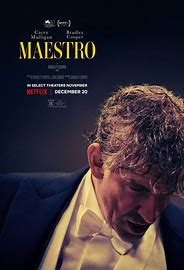
Maestro
Another film (see Oppenheimer) that raises the issue about non-Jewish actors taking Jewish roles. It did strike me, watching Oppenheimer, that you had on screen three of the most prominent Jewish scientists of the twentieth century (Einstein, Bohr and Oppenheimer), played by Conti, Branagh and Murphy respectively, and here one of the most prominent Jewish composers/conductors, played (with a prosthetic extension to his nose) by Bradley Cooper. At a time when we would simply not accept ‘blackface’ or ‘yellowface’ and it’s actually very difficult to watch older films in which those horrors were perpetrated (I switched off Breakfast at Tiffany’s when Mickey Rooney came on, and have never gone back to it), should we be as absolute about ‘Jewface’? I don’t know. But watching Cooper as Bernstein I forgot very quickly that the nose was fake because the performance was extraordinary, as was Carey Mulligan’s. And the music, of course, was sublime.
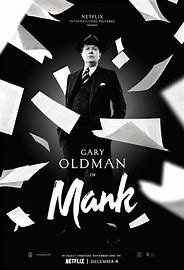
Mank
And right on cue, here we have Gary Oldman playing the Jewish Herman J Mankiewicz. I was occasionally reminded of Oldman’s more recent TV stint as Jackson Lamb, e.g. in the scene where he drunkenly disrupts a gala dinner… It’s a bravura performance (Mank, as well as Lamb), and backed up by Tom Burke as Orson Welles and Amanda Seyfried as Marion Davis. Fascinating, particularly if one has an interest in the movie industry of that era.
The Mist
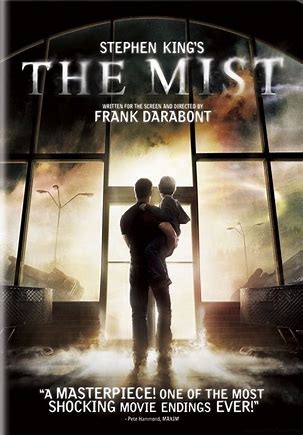
Excellent adaptation of the Stephen King novella. Pretty much what you’d expect – until the ending. My God, that is one of the bleakest things I’ve seen in a film and my watching tends to the bleak and the grim. It’s not what King wrote, but King endorsed it (and as he tends to bottle his endings, I can imagine he rather admired what Darabont did with this). I didn’t like the leading man especially – where do they find all these square jawed types? – and, until that ending, I didn’t quite believe in him.
Moonlight*
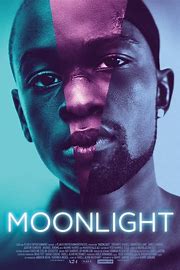
A wonderful film, beautiful and melancholy. Brian Tallerico’s review describes it as ‘both lyrical and deeply grounded in its character work, a balancing act that’s breathtaking to behold. … it’s one of those rare movies that just doesn’t take a wrong step’.
Napoleon
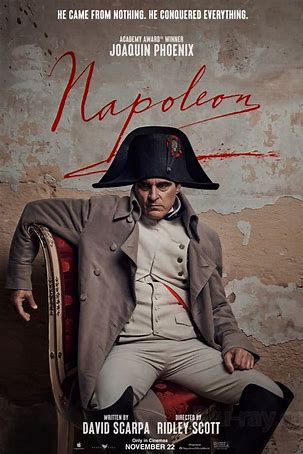
I was disappointed in this – I wanted to enjoy it but found it deeply frustrating. Not because of historical inaccuracies, but somehow it was tonally all over the place – some moments were funny, but I wasn’t entirely sure all of them were intended to be. The best bits by far are the battles, which were viscerally exciting and did convey the problematic greatness of the man.
Nomadland*
A beautiful film, warm and generous, with Frances McDormand’s marvellous performance at its heart as a woman who becomes ‘houseless’ after losing first her job and then her husband, and who in the wake of those losses feels the need to keep moving, to make only temporary connections (mainly with other nomads).

Official Competition
Penelope Cruz, Antonio Banderas and Oscar Martinez are a director and two actors rehearsing for a film. That’s it really, but it’s clever, brilliantly funny and with superb performances from all three.
Official Secrets
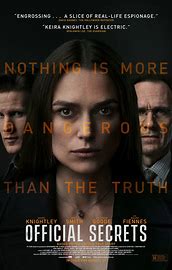
Good, solid drama based on the true story of Katherine Gunn (Keira Knightley), who passed on information she received in the course of her work at GCHQ and was prosecuted for it. It works all the better because Gunn clearly isn’t grandstanding, she doesn’t set out to be a martyr, she just sees something that seems to her to be so clearly wrong that she has to do something about it. She’s shown to be a bit naive, in not anticipating what the consequences might be, for her or her family, but in a way she is, as the Guardian put it, a ‘classic whistleblower. She has an idealism, work ethic and professionalism that made her an excellent intelligence operative in the first place, and yet it is precisely these things that made her rebel. Most importantly of all, she is young.’ Knightley is excellent in the role.
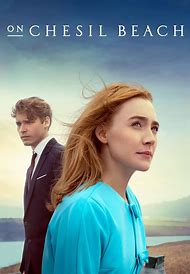
On Chesil Beach
This was exquisitely done. Until the final act when it messed things up rather badly. We didn’t need that clichéd scene in the record shop, and we certainly didn’t need the final scene at the concert. I wondered briefly whether these scenes would turn out to all be in Edward’s imagination, but if we were meant to think that, it wasn’t signalled – I’m not sure it would have worked anyway, it would have been rather Atonement-lite. And why was the old age make-up so awful? Surely we can do better than that these days? Such a shame, because the scenes with Florence and Edward awkwardly trying to negotiate the tricky territory of sexual intimacy, without prior experience and with only minimal knowledge, were agonising but brilliant.
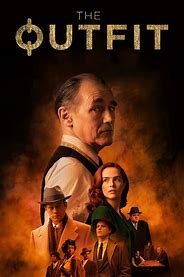
The Outfit
This is an odd little film, which keeps on overturning our understanding of what’s going on. It’s full of suspense, but we as the audience are somewhat at a remove from the characters. Mark Rylance in the central role is calm, tightly buttoned, and seemingly preoccupied with his business, cutting out cloth for suits – he’s a cutter, not a tailor, as he informs people several times. There are gangsters, there are guns, and there’s a clever McGuffiny plot, and it’s all very entertaining.
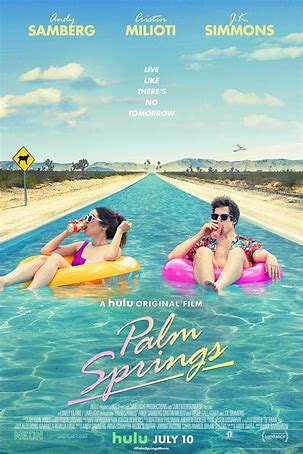
Palm Springs
I do love a time loop, and this is funny and clever and very entertaining. Andy Samberg, Cristin Milioti and J K Simmons are brilliant and give us some actual real emotional weight along with the comedy.
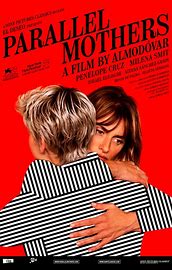
Parallel Mothers*
Gorgeous and moving film. The plot might sound improbable but it carries absolute conviction, with the message that ‘the personal is the political and that history, the future and the present are as one’.

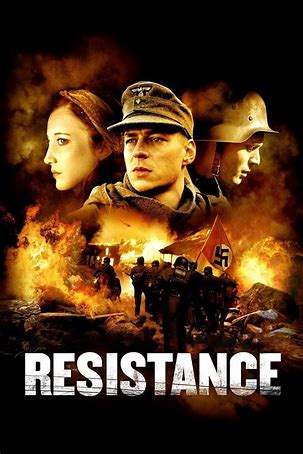
Resistance
This is an adaptation of Owen Sheers’ alt-history novel, where England is under Nazi occupation, and the men of a Welsh valley disappear one night, leaving the women to manage the farms, and the occupiers. Slow and atmospheric rather than action packed.
The Resistance
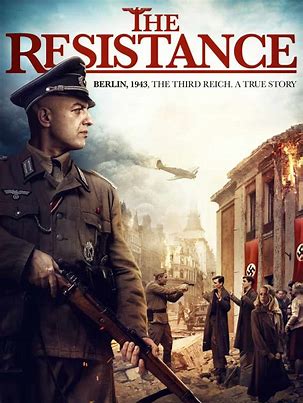
Not to be confused with Resistance (see above). This is an account of some of the Jews who hid out in Berlin through the duration of the war, living precarious lives, figuring out who to trust. Well done, and these are not familiar narratives – I had no idea that so many managed to survive in this way.
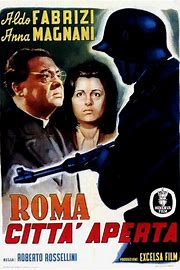
Rome: Open City
Fascinating and powerful. Rossellini filmed this in 1945/45, in the very immediate aftermath of the liberation of the city (the ‘open’ in the film’s title is ironic, as it portrays the period when Rome was occupied by the Nazis). The narrative is absolutely compelling, and the action brutal, but never gratuitous. The film has been on my ‘really want to see this’ list for ever but has only just been re-released into cinemas (it didn’t do very well when it was first released in 1945, as people didn’t want to see the horrors that they had only just escaped portrayed on screen).
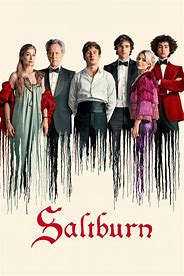
Saltburn
Heavily intertextual, the class clash is familiar territory (Brideshead, Ripley) and Emerald Fennell isn’t saying anything particularly new or insightful. It’s ‘deliciously, wickedly mean—seductive and often surreal—with lush production values and lacerating performances’, but it would have felt stronger if it had left a bit more to the imagination at the end (and I’m not talking about the dancing).
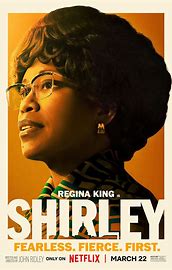
Shirley
Like last year’s Rustin, this is a good, solid biopic, with a wonderful central performance (here from Regina King) of a key black player in American politics. Shirley Chisholm was the first woman to run for US President, and what is particularly fascinating is how her presidential bid plays out in terms of support from fellow Democrats, and fellow feminists. It is, perhaps, again like Rustin, a bit worthy. But these films pave the way for other, maybe more nuanced explorations of these hugely important people, and others like them who have been somewhat neglected.
Society of the Snow
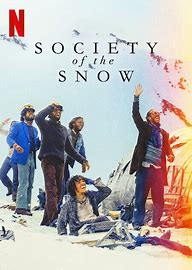
Eschews sensationalism for a subtler approach, without swerving the ‘cannibalism’ issue. Powerful and moving, it excels both at the shocking violence of the crash and subsequent avalanche, and at conveying the long, agonising wait for rescue and the physical and mental torment of trying to survive.
Still Alice
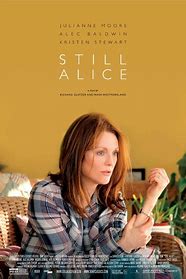
Julianne Moore is quite outstanding, and heartbreaking, as the academic with early onset dementia. Although my own experiences (vicarious) with dementia have been with much older people in whom the condition is seen as par for the course, Moore’s performance rings true, whether she’s portraying Alice’s bewilderment and fear, or her absence. And the choice to write about early onset gives opportunities as well, as both Alice and her family have to accommodate something that is both unexpected and profoundly unfair, and their interactions, entirely convincingly, do shed light.
The Talented Mr Ripley
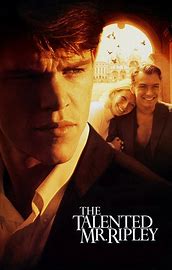
Another re-watch, prompted in part by Saltburn’s homage, and interesting to compare with the new Andrew Scott version (see below). It’s sunlit and glossy, rather than shadowy and noir, which takes nothing away from the brutality of the murders. Damon, Law and Paltrow are excellent.
Ten Things I Hate about You
Taming of the Shrew, US high school style. It shares some of the problems of the source material – is it even possible to avoid them? – and there are moments which haven’t aged terribly well, but it’s a lot of fun along the way, and the leads are a delight. Oh, and BTW, Heath Ledger’s character was, I’m sure, the inspiration for Eddie Munson (as played by Joseph Quinn) in Stranger Things.
The Third Man
Rewatched after many years in prep for the Vienna trip (see also Before Sunrise). Aside from it being a brilliant film, with stunning cinematography, it reminded me that Vienna, which likes to give the impression of having been untouched by the centuries, was in the immediate aftermath of the war very much marked by bombing and by the Red Army’s battle to liberate the city – not reduced to rubble like Berlin, but still battered. One would not know it today.
Trumbo
Bryan Cranston is superb as the screenwriter who fell foul of the Red scare in the 50s and could only get his work on to the screen by using pseudonyms or getting others to put their names to the scripts. It’s not a super deep examination of the phenomenon, but it does convey the terrible pressure on those who saw their livelihoods taken away from them. Helen Mirren is the appalling Hedda Hopper who says out loud the quiet bit about the Red scare – its antisemitic roots.
Wil
A very dark and bleak narrative of young police officers in occupied Antwerp. In some ways it chimes with Good – how do you continue to think of yourself as a good person, to be a good person, when the rules are made by an evil regime, and enforced by brutal men? It’s an extremely tough watch.
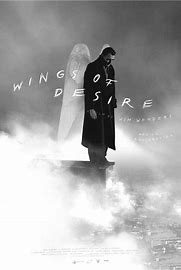
Wings of Desire
Prep for Berlin, the third city on our European trip. Released in 1988, the film is set in the still divided city, where angels literally watch over its inhabitants, observing and only occasionally connecting with them. There’s not a lot in the way of plot, but it’s an extraordinary and bewitching film. ‘Wings of Desire … creates a mood of sadness and isolation, of yearning, of the transience of earthly things. If the human being is the only animal that knows it lives in time, the movie is about that knowledge.’
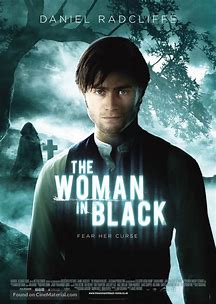
The Woman in Black
I was underwhelmed by the book, TBH, despite having loved a number of Susan Hill’s previous novels (In the Springtime of the Year, Strange Meeting, and others), and subsequently loved her crime series. The film had some nice jump scares, and plenty of atmosphere, but it didn’t really amount to very much, I didn’t quite believe the lead character, and I rather disliked the ending.
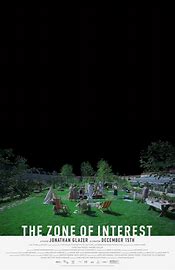
The Zone of Interest*
Extraordinarily powerful. I am not sure how well I can yet articulate what the film did, and how – that might take another watching, which I’m in no hurry for, not really. I have watched many films about aspects of the Holocaust, have read histories, first-hand accounts, fictionalised accounts, watched documentaries, seen footage from the liberation of the camps. This was as shocking as anything I’ve seen, despite showing nothing. The moment when I realised that I had filtered out the sounds from the other side of the wall, as one does with traffic noise when it’s always there, was shocking in itself. I didn’t weep until the scene at the end, in the present day, as cleaners at Auschwitz polish the cabinets with the shoes and the spectacles. But I really didn’t want to talk to anybody afterwards so was glad I’d gone on my own – I didn’t want to talk about the film, but nor did I want to talk about the banalities of everyday life – not after that.
Small Screen
There’s a lot of the usual stuff here. Crime drama features very heavily, and there’s a sprinkling of SF/fantasy, as well as some superb dramas that don’t fit as easily into a genre. I haven’t covered ongoing series, however much I’ve enjoyed them (thinking of you, Vera, Vigil, Wisting) unless there’s something significant to be said about this particular series, and as with the movies I haven’t covered things that I abandoned (so what remains I watched all of, whatever its flaws). I’d pick out Blue Lights as the best of the crime, The 3 Body Problem as the best SF/fantasy, and share the honours otherwise between Mr Bates vs the Post Office and Masters of the Air.
Drama
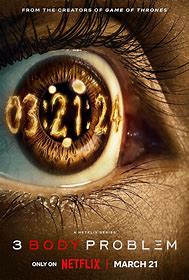
3 Body Problem
Brilliant, brilliant stuff. This has everything – it is clever, inventive, visually stunning and has a hell of a lot of heart too. It kept me guessing throughout but was never merely clever for the sake of it. There will be a second series, I’m delighted to say (I do worry these days, as too many good, inventive TV series get dumped – Lazarus Project being the most recent example).
After the Flood
Jolly good thriller, set in a Yorkshire village, with perhaps an over-abundance of twists, but all well done and a good solid cast.
The Americans
We watched the first couple of series of this, and then it switched to one of the streaming services that we didn’t then have access to, but we always wanted to see how things played out for Philip and Elizabeth. Now it’s on Disney and so I’ve picked it up again, taking a bit of a guess as to where we’d got to, but starting again at series 3 felt about right and I binged it through to the end. The constant peril of their double life makes even the most mundane domestic scenes tense and anxious, and there’s a lot of proper spy thriller action, with a pretty high body count. The BBC documentary series Secrets & Spies (see below) proved to be a very relevant factual counterpoint to the drama. (I do have issues with Philip’s wigs though, and find the sex scenes quite disturbing as I worry about wig displacement in the throes of passion). But wigs aside, the series is superbly acted, and confronts us constantly with moral questions, about loyalty, about deception in all its forms, about what means can be justified if one believes absolutely in the end – and we might think we know the answers to those questions but as we identify with Philip and Elizabeth that starts to seem less straightforward. The final series is a masterclass – ramping up the tension, but also laden with sadness and a foreshadowing of loss.
Blue Lights
Series 2 was as good as the first series, which is saying something. Real edge of the seat stuff, and with emotional heft too. It does all of the things that regular cop dramas do, but does them better than most, and the Belfast setting provides extra layers of complexity to the interplay between cops, criminals and community. Exemplary.
Breathtaking
A fictionalised version of Rachel Clarke’s raging, heartbreaking account of the early days of Covid, from the perspective of an NHS doctor. Intercut with Government briefings and news reports, to ramp up the rage, but always focusing back on the people – staff and patients (and occasionally staff who are patients) who were on that particular frontline.
Coma
Jason Watkins’ mild everyman in an ever more complex and deadly tangle after an encounter with a young thug – my only quibble would be that the ending felt a tad unrealistic and anti-climactic (though maybe there’ll be a series 2?)
Criminal Record
Very, very noir. Capaldi and Jumbo are superb. I keep thinking about the ending, and wondering. And that theme song – I had to track it down, it’s ‘Me and You’, by the Dreamliners,
Criminal UK/France/Germany/Spain
All four series follow the same format, and use the same set – an interview room, with a viewing room alongside it, and essentially that’s it. Each episode features one interview, with a suspect/witness, and it’s very Line of Duty, though less likely to end with a urgent extraction and a shoot-out.
The Cuckoo
One of those psychological thrillers that compels you to keep watching even though in your head you’re constantly saying ‘Really? Seriously?’ and predicting with reasonable accuracy where the plot is going. Tosh, but quite well done.
Doctor Who
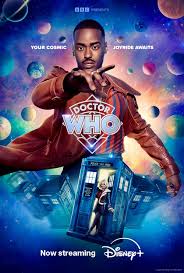
Ncuti Gatwa is a joy. And he is, indisputably, the Doctor. The episodes seem to me to have got better and better, which suggests that some of this is cumulative, the result of an overarching plan for the series which allows each episode to carry with it some of the ideas and the emotional import of the previous ones. It’s been much commented on that Gatwa hasn’t been front and centre of all these episodes (because he was still filming Sex Education), but that’s allowed some very inventive writing, and when he’s there, there never seems a very good reason to look away from him. The BTL comments in the Guardian cover the usual range of responses. There’s the old familiar: ‘this isn’t proper Doctor Who any more, I’m never watching it again’, from those who’ve been saying that ever since there was a line for people to comment below, and who will be back next week to say it again. Some of the detractors find it too woke, which is hardly worth arguing with. But there’s also a lot of excitement from people like me who have loved this programme through its highs and its lows. Jodie Whitaker’s tenure could have been so much more exciting – she was great, but saddled with far too many ‘meh’ scripts (and some that were worse than meh) and that’s a real shame. But, as another Doctor would say, allons-y! This is pretty bloody marvellous.
It would be remiss of me not to mark here the passing of one of the very first Doctor Who companions, William Russell, who played teacher Ian Chesterton alongside William Hartnell’s Doctor. Russell was 99, and appeared in the final Jodie Whitaker episode, The Power of the Doctor, in a rather lovely scene at a companions’ support group.
The Durrells
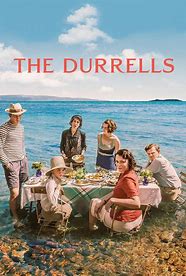
Given my tendency to go for the grim, I need at least one series in my life at any given time that offers essentially warm-hearted, humorous, not too dramatic dramas, which can be guaranteed not to swerve into anything too traumatic, but which aren’t merely cosy. All Creatures Great and Small fills this place to a T – it doesn’t sidestep the harshness of the lives of the farmers, or individual heartbreak, but we know, really, that everything is going to be alright and that the grumpy or mean person probably is unhappy rather than evil. The Durrells does a similar job. I read Gerald’s books about his family life on Corfu and about his wildlife expeditions as a child – they’re hugely entertaining, and are already somewhat fictionalised accounts, so that the programme takes further liberties is probably OK. The humour is broad and often slapstick, but the writing is usually subtle enough that it isn’t wholly reliant on pratfalls and comic misunderstandings and allows some real emotional connection. That emotional connection centres on Keeley Hawes’ Louisa – Hawes is superb and if you aren’t rather in love with Louisa within the first episode or so, then I don’t know what to say to you, I really don’t.
Echo
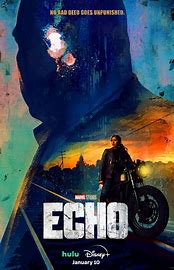
I enjoyed this less than I thought I would (though more than Secret Invasion) but there’s lots about it that I did like, including the lead, powerfully played by Alaqua Cox, and her family/community, the Choctaw heritage that is the source of her powers. The Kingpin storyline, picked up from Hawkeye, and linking in with Daredevil, had/has the potential to be powerful, and perhaps now that the exposition is all out of the way and we know who Echo is, and why, that will work better.
Fool me Once/Safe
I’ve bracketed these together because these Harlan Coben series are all rather similar (I’ve read a few of the books and it’s true of them too). I find it hard once the series is over to recall anything very much about the plot or the characters, but whilst watching I am entertained and mildly involved, even though they tend to feature a preponderance of the square-jawed male lead, who I tend to find rather annoying, and impossible to identify with.
The French Case
A dramatised account of the investigation of the death of Grégory Villemin, an incredibly murky case, involving poison pen letters and family feuds, which seems no closer to being solved now than it was when Grégory was murdered in 1984. The drama is toughest on the media, and at least some of the investigators, and perhaps most of all on Marguerite Duras, who bizarrely was brought in to consult on the case, and proceeded to pronounce, without any actual evidence or direct contact with the parents, that it was the mother who had killed the child. Intriguing but frustrating.
The Gone
Atmospheric New Zealand set crime series, with an Irish detective (a man with a secret, natch) over there to look into a disappearance, and its connection with a major Irish crime family. This could all be quite clichéd – the ‘odd couple’ pairing of said detective with his Māori counterpart, who has her own personal tragedies and conflicts – but the characters are well drawn and played and the wider issues that the crime raises turn out to be more interesting than the original premiss suggests.
Hidden Assets
More Irish crime, this time centred on the team who track down proceeds of crime, and here the Irish officers are working with their counterparts in Belgium. There are two series, with different leads in each case, but linked stories. Good solid stuff.
Kafka
It seemed appropriate to watch this after being in Prague, which reminded me that I should read more Kafka. Full disclosure, I have read The Castle and a number of short stories but nothing more (yes, OK, shame on me, and all that). It’s a quirky and often darkly funny take on Kafka’s life, his romantic attachments and his friends (especially Max Brod without whom Kafka would probably be pretty much forgotten).
Masters of the Air
Band of Brothers and Pacific were both so very, very good that this came with rather high expectations attached, and it lived up to them. I have had a particular interest in the air war, ever since my father, who during the war was an avid aeroplane spotter, and then went on to an apprenticeship with de Havillands, taught me to identify planes when I was still in my pram. This latter may be slightly apocryphal – I cannot on oath assert that I was able to lisp ‘Dragon Rapide, Daddy’ as one flew overhead to the small airfield near our home, but by the time I went with my brother to see Battle of Britain at the cinema I knew my Messerschmitt from my Hurricane. Masters of the Air is solidly researched so that even where fictional characters are created, or where real events and real people are combined for dramatic effect (i.e., this happened, but not necessarily to this person), it is absolutely credible. None of which would make it one of my top watches of the year so far if it weren’t emotionally powerful and credible too, but the performances are great, the tension of the battle scenes is incredible – I found myself watching literally sitting on the edge of my seat and not breathing – particularly as it was clear early on that none of these characters, however well known the actor playing them, was guaranteed to survive. As with Band of Brothers, the drama touches only briefly on the Holocaust but the equivalent scenes to the former’s liberation of Landsberg are done with the same intelligence and care, and they enrich the drama.
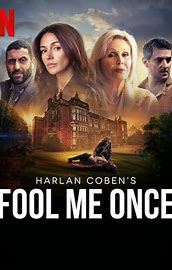
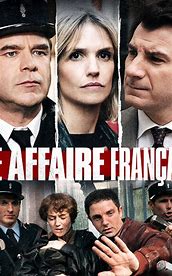
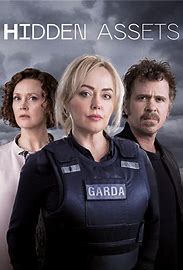
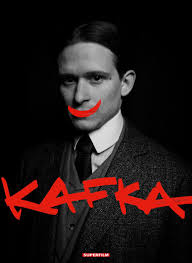
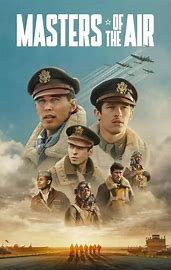
Mr and Mrs Smith
These two, played with oodles of charm, heart and humour by Donald Glover and Maya Erskine, bicker their way through a series of missions, none of which go entirely to plan, and all of which involve a startlingly high body count. Thoroughly entertaining. Apparently there will be a series 2, but not with Glover and Erskine, which is a shame, but on the other hand, makes that series 1 ending more realistic (not that realism is entirely the thing here).
Mr Bates vs the Post Office
Obviously this has been a hugely important drama not just because of its quality but because of its impact on the sub-postmasters’ claims against the Post Office, and the enquiry into how the false prosecutions came about and continued for so long in the face of what was already known about the vulnerability of the Horizon system. Toby Jones, Monica Dolan and others make this all profoundly human, so that the drama, like Breathtaking, is not only heartbreaking but rage-inducing. I thought often as I watched it of the Hillsborough families, particularly when the accountant says to Mr Bates, ‘I don’t know how you people are still standing’, but since this was broadcast, there has been renewed and reinvigorated coverage of other scandals – contaminated blood, carer’s allowances and Grenfell – and it seems that Mr – sorry – Sir Alan Bates in his own understated way is something of a beacon to other victims of injustice and cover-ups.
Mrs America
Fascinating drama about the fight for and against the ERA in the US. Excellent performances from Cate Blanchett as the monstrous Phyllis Schlaffler, Rose Byrne as Gloria Steinem, Tracey Ullmann as Betty Friedan, and more, plus a handful of fictional characters invented to convey some of the tensions in both movements. Often very funny, full of surprises, and with a cracking 70s soundtrack.
Mrs Wilson
Ruth Wilson plays her own grandmother in this drama of deception, centred on but going beyond the purely domestic sphere. The focus is very much on the wives betrayed and deceived, rather than on the deceiver, whose motivation neither we nor they ever really uncover – it’s stronger for that, as the deceiver can so easily be played as a charming rogue (since clearly he was rather good at being charming) and the damage he left in his wake underplayed.
Murder is Easy
The latest Christie adaptation – this was one I remember particularly vividly, the quote beginning ‘why do you walk through the fields in gloves’ and the strength of the murderer’s hands. As with all of the recent dramatisations, it’s been tinkered with, in ways that might well get the GB News types a bit agitated (a black protagonist! Lawks a mercy) but it retains the strengths of the novel.
A Perfect Spy
Excellent le Carré adaptation from 1987 (one of a number of dramas from the archives which have been broadcast lately, to mark the anniversary of BBC2) , based on one of the best of his books.
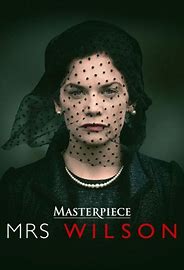
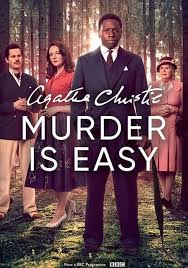
Prisoner
Bleak Scandi drama about corruption in a prison – it’s brutal but also thoughtful and not too simplistic. Not an easy watch but worth it.
Rebus
A new take on Rebus, introducing us to him as a younger man, earlier in his career, but already instantly recognisable as the Rebus we know and love and are infuriated with. I never felt that John Hannah was quite the right man to play him, and Ken Stott was very much the older, battered version, but Richard Rankin (no relation, apparently) is just right. It’s the same trick that Young Wallander tried, setting the younger version not in his own past but in the present, which allows a different take on some aspects of the established Rebus pre-history. Rebus is kind of the archetype of the rogue/maverick cop, never knowingly toeing the line, leaving a trail of wreckage (personal and professional) in his wake, so this series – and Rankin – will have to fight a bit harder in a crowded field to establish his individuality (mind you, if the competition is that execrable Crime series with Dougray Scott it shouldn’t be too difficult).
The Responder
If Prisoner was bleak, this is bleaker. Ye gods, it is relentless, Martin Freeman’s Chris is trapped and every way he turns there is merely another trap waiting for him (and the same is true for many of the other characters). Whilst he does make (many) questionable decisions he remains sympathetic, because he’s actually trying to be a good man, to do the right thing. He’s brilliant in the role, and it is brilliantly done (the late Bernard Hill is excellent too, as Chris’s father, in what presumably was his last TV role). I find I need to watch an episode of The Durrells, or something daft like Taskmaster after each episode or it’s just too much.
Ripley
This is much closer to the novel than the Damon/Law/Paltrow film (see above), except in the age of the lead protagonist – the book suggests that Ripley and Greenleaf are in their early 30s whilst Scott is in his late 40s. That does change the tone. Damon seems, if anything, younger than the character he’s playing, and that gives him a kind of naivety which might make one – at least until he starts with the bludgeoning – a bit more forgiving of what he’s up to. Scott’s Ripley is a darker character from the outset (and not just because of the b/w film noir cinematography). But it certainly works. The pace is slow, with masses of detail, motifs that recur (the cat, the ‘nice pen’, the stairs, the Caravaggios) and whereas some found that frustrating, I found it seductive and the moments of violence all the more startling. And the slow pace extends even to those moments – this makes killing look like bloody hard work, and the cleaning up afterwards even more so.
Shardlake
I’ve thoroughly enjoyed the late C J Sansom’s Tudor detective series and hope that this is just the first of the adaptations. Arthur Hughes is great as Shardlake, and it’s good to have an actor with a disability playing the role, and Sean Bean is an excellent Cromwell (it will be interesting to compare with Mark Rylance in that role when the final Wolf Hall series is out). Very moodily atmospheric, rather Gothic (mad monks and all that), and whilst I’d read the book, I had entirely forgotten who did what to whom so I enjoyed the puzzle all over again.
Shogun
This was beautifully done, often brutal, sometimes hard to follow, but absorbing and fascinating. It’s incredibly rich in detail, from the costumes to the customs, the dialogue to the action, and the cultural tensions between the Englishman and his Japanese ‘hosts’ are drawn with subtlety and without condescension.
Shoulder to Shoulder
This drama series about the Suffragette movement was first broadcast in 1974 and I thought at first I was going to find it a bit slow and stagey, going by the first episode. But it caught fire – Georgia Brown’s portrayal of Annie Kenney is great, and the episodes showing the force-feeding in prison of those women who went on hunger strike are graphic and still genuinely shocking.
Small Island
Excellent adaptation (from 2009) of Andrea Levy’s novel about young people from the Caribbean trying to build new lives in London in the 1950s. A stellar cast – David Oyelowo, Naomie Harris, Ruth Wilson amongst others – and a hard-hitting plot, with tenderness and humour.
The Tourist
A cracking thriller (two series thereof) with Jamie Dornan as the amnesiac whose forgotten past keeps catching up rather brutally with him. It’s gory and violent and very funny, and the relationship between Dornan’s ‘Elliott Stanley’ and Danielle MacDonald as police officer Helen Chambers is a delight. I have to say how much joy it brought to me that Dornan’s character is shown to fancy MacDonald, who would generally be described as a slightly larger woman, like mad, and to fall in love with her. Clearly a lot has changed since the days when plump women not only never got the man (let alone a man of Dornan’s looks and charisma) but were all too often shown as being dim and lazy and a bit of a joke.
Traces
Series 2 of this Dundee set forensic science thriller. The structure of the series goes weirdly off kilter as the first couple of episodes focus on the continuation of the plot from series 1, but that is then completely abandoned as the key characters in that strand up and leave, and the remainder of the series concerns itself with the race to catch the Dundee bomber before he blows up the V&A or Broughty Ferry. It’s almost as if the producers/writers were taken by surprise by the departure of key cast members – from a viewer’s point of view it would have been better either for that previous plot strand not to have been foregrounded initially, or for further references to it to be woven into the bomber plotline. As it was, it seemed as if the remaining cast members had simply erased all memories of those events and people – very odd. Nonetheless, it was exciting stuff (and there’s a particular frisson when one is familiar with some of the locations).
Truelove
A thriller that starts off exploiting an instinctive sympathy with the idea of assisted dying and then undermines it horribly – it doesn’t change my view that we must be able to find a way to enable the terminally ill to choose when and how they end their lives rather than lingering on in increasing misery, but it is a reminder both that the safeguards need to be carefully thought through and robust, and that palliative terminal care needs to be better, and available to everyone. (See below for my thoughts on Liz Carr’s documentary, Better off Dead.) The plot has a few implausibilities, but the lead roles are all superb – aside from Lindsay Duncan and Clarke Peters who carry the weight of the drama, Sue Johnstone in particular stands out, as does Kiran Sonia Sawar as the dogged copper who susses that something isn’t quite right.
Unbelievable
A harrowing account of a real case where a young woman alleging rape was persuaded/badgered into saying that she’d lied, and how that injustice was eventually overturned, thanks to the determination of two female detectives following the trail of the rapist. Kathlyn Dever (wonderfully funny in Booksmart, heartbreaking in Dopesick) is superb here, showing her character’s vulnerability and wilfulness, and the trauma she carries with her from a chaotic early life.
Under the Banner of Heaven
Fascinating and horrifying true crime drama based in a Mormon community, with Andrew Garfield as the massively conflicted cop leading the case.
The Way
I really, really wanted to like this. But I’m afraid it was an incoherent mess, way too many clichés, underdeveloped ideas and characters. Sorry.
We are Lady Parts
Season 2, and it’s as warm and funny and touching and clever as ever. And the music is great (both the Lady Parts originals, and their Britney cover)! Whilst Amina (the ever wonderful Anjana Vasan) is ‘the I guy’ (to use a Stephen King term), all of the band members – and their families – are given depth and breadth, and take centre stage at some point in the series. Bisma’s rendition of ‘Please Don’t Let me be Misunderstood’ – having literally put her family on pause in the midst of a row – was powerful and really rather moving, as well as beautifully sung by Faith Omole.
Documentary
Better off Dead
Liz Carr is passionately opposed to the legalisation of Assisted Dying ( or, as she calls it, Assisted Suicide) and it is impossible to simply dismiss her views, as she is someone who has been told many times that it would be better if she were dead than to live on with her level of disabilities. She rightly fears the potential for coercion, for emotional pressure on those who might see themselves (or be seen) as a burden on society and/or on their families, and the widening scope of the legislation in Canada does seem dangerous. I would still argue that there must be a way in which those who are suffering unbearably can be allowed to choose the time and manner of their death, without asking their loved ones to undertake criminal acts on their behalf. But Carr’s arguments must be listened to if any future legislation is to adequately protect people from being, even gently and kindly, shepherded into this course of action.
Can I Tell You a Secret
Documentary about online stalking and how the perpetrator was exposed. The courage of the victims is remarkable, but the production was annoyingly gimmicky – the voicing of some of the emails was confusing, and the actors speaking the lines seemed to have been told to camp it all up rather, which didn’t match the seriousness of the topic.
D-Day: The Unheard Tapes
Hearing the voices of the eyewitnesses lip synched by actors could have been clunky but it is direct and very powerful. We hear not only from the soldiers who landed on the beaches or behind the lines but the German soldiers who were there to stop them, French civilians who found themselves suddenly on the frontline and members of the French Resistance who had been waiting for the invasion to launch their own attacks. There are re-enacted sequences, featuring those actors, but the heart of the programme is the interviews, made at various times and in various places over the years since the war. Hearing those voices is a remarkable experience. If we’d just had the actors reading their characters’ words, we would wonder whether that catch in the throat was ‘acting’ or that the man speaking really couldn’t speak of that moment without choking up a bit. Fascinating and very moving.
Defiance: Fighting the Far Right
Superb, powerful documentary about how Asian communities in London, Bradford and elsewhere organised their own defence against National Front and other fascist thugs in the 70s.
The 50 Years’ War: Israel and the Arabs
The overwhelming feeling from watching this is of the intractability of the situation. The programme dates from 1998, but whilst obviously a lot has happened since then, the core of the conflict is fundamentally unchanged and so the analysis here seems as relevant as when it was first broadcast. The more one understands the history, the more one (or at least I) finds it hard to see a way forward. It’s easy, in contrast, to see what could have been done differently, both before and in the immediate aftermath of WWII, but it seems that every time there has been a glimmer of a chance of doing right both by the Jewish/Israeli population and by the Palestinians, that chance has been sabotaged by one or both sides. And things have perhaps never been more polarised than they are now, when to express horror at the 7 October attack is to be seen (by some) as a Netanyahu supporter, and to express horror at the onslaught on Gaza is to be seen (by some) as an antisemite… At least my sense of despair is based on a more informed understanding of history, thanks to this series.
Have You Got It Yet? The Story of Syd Barrett and Pink Floyd
Excellent documentary, drawing on the accounts not only of the other members of Floyd but of others who knew Barrett before and during his period of fame, and in its aftermath.
The Jury: Murder Trial
Reality TV with a more serious purpose than anointing a new Star Baker or marrying people at first sight – here a real murder case is re-presented to two juries made up of the usual mix of people who might be called up for jury service, and at the end each jury has to arrive at a verdict on which they all agree. The fact that they come up with different verdicts is obviously a cause for concern, but the process by which they arrive at that is more deeply worrying, in particular the ease with which one or two dominant personalities can skew things. Is there an alternative? I think at the very least the way in which the jury system works seems to be in need of an overhaul.
Michael Palin in Nigeria
This most amiable of world travellers makes his way from the hubbub of Lagos north to Kano and back south to Benin City. In only three episodes the series can’t hope to capture the complexity of this huge country, particularly as there are swathes of the north (including Zaria, where my family lived in 1966-67) where it was seen as too dangerous for Palin and the film crew to travel. But along the way we do get a sense of at least some aspects of the country, and of some of the more contentious issues – the legacy of slavery and colonialism, the British Museum’s determination to hold on to treasures looted from Nigeria during the colonial era, and the ecocide in the Niger Delta.
The Miners’ Strike: A Frontline Story/Miners’ Strike 1984: The Battle for Britain
Two powerful documentaries marking the fortieth anniversary of the miners’ strike. The BBC’s offering is not dissimilar in style to Once Upon a Time in Northern Ireland, which was a remarkable and unforgettable account of the Troubles, telling the story and drawing out the details through the words of people who were directly involved. It works equally well here. Channel 4’s series also draws very heavily on first-hand testimony, but focuses in each of the three episodes on a particular place or aspect of the battle. Its third episode investigates some of the machinations behind the scenes, and whilst it is of interest it lacks the immediacy of those first-hand accounts.
Royal Kill List
A documentary with (quite well done) dramatised interludes. Charles II’s vendetta against anyone who had supported his father’s execution (explored in Robert Harris’s Act of Oblivion) might be understandable on an emotional level, but combined with his absolute conviction that, as Sellar & Yeatman put it, ‘He was King and that was right. Kings were divine and that was right. Kings were right and that was right’, this led to appalling brutality, treachery and injustice. I concluded that the Royalists were not only Wrong but Wrepulsive. Which doesn’t mean the other lot were right. Obviously.
Sarah Everard: The Search for Justice
A rage-inducing account of how the police force failed to notice that amongst their ranks was a man whose behaviour (multiple sexual offences) should have automatically precluded them from police work, and how that man used his position, his badge and his authority, to kidnap a young woman on her way home, and then to rape and murder her.
The Secret Army
If someone had told me that early on in the Troubles an American film team would have been able to make a documentary film including footage of an IRA team heading off to plant a bomb, and a tutorial on weapons, I would have thought that highly improbable. But it happened. The film was made, processed in London, where MI5 had full access to it, and never shown. It’s all utterly bizarre, and the intentions of the film maker, and of the IRA top brass who approved the project, are very hard to comprehend.

South to Black Power
Isabel Wilkerson’s The Warmth of Other Suns told the story of the Great Migration, the mass movement over several decades of African Americans from the South to northern cities, in flight from the Jim Crow laws and accompanying relentless racial violence. Here writer Charles Blow makes the case for a reverse process, boosting the black population in parts of the south (areas where it is already a very significant minority) such that it might reach a tipping point of political power.
Turning Point: The Bomb and the Cold War/Secrets and Spies
It seemed almost rather too timely to be revisiting some of the scariest moments of the Cold War, when we came closest to the unthinkable. The Turning Point series was excellent (there was a previous series about 9/11 and what followed which was also exceptionally well done), with lots that I didn’t know and much richer detail and context on the bits of the story that were more familiar to me. Secrets and Spies focused in more closely on the Reagan years, and on some of the individual stories and it provided an intriguing counterpoint to The Americans, as well as reminding me of Deutschland 83 in its coverage of the Able Archer training exercise (also, obviously, featured in Turning Point) that nearly triggered disaster…
When Bob Marley Came to Britain
This was lovely. Marley playing footie in the park, doing an acoustic gig in the gym of Peckham primary school and generally connecting with the black Britons he met in a way that still, clearly, means the whole world to them today. And of course there’s the wonderful music too.
 Passing Time