Archive for category The City
Three Cities – Vienna, Prague, Berlin
Posted by cathannabel in History, Personal, Second World War, The City, Visual Art on August 4, 2024
For most of my life, I’ve been fascinated by cities. My teenage years were spent in a rather ordinary dormitory village but I headed regularly for the nearest proper city (Nottingham) for shopping and football, and the annual Goose Fair. I’d previously lived in Kumasi (Ghana’s second city), and Zaria in the north of Nigeria. When I went off to University I settled in Sheffield where I still live, despite a few years commuting to Manchester, and a very brief period commuting to Leicester. My PhD thesis explored ideas about the city, about navigating and failing to navigate it, about the city as labyrinth, looking particularly at Manchester and Paris. And my idea of a really good holiday would be less likely to involve a beach (though a city that happened to have a beach would be quite appealing), but would definitely involve a lot of walking around in a city with heaps of history and culture.
A few years ago, I started to formulate an idea for such a holiday, encompassing two or three European cities, with as much as possible of the travel being by train. The idea never got very far when everything shut down, and we were barely starting to think again about travelling when M died, very suddenly, early one morning in October 2021. In the shock and grief that followed, I wasn’t really thinking about holidays in any practical way, but it did occur to me early on that they would be a challenge.
I can’t see myself travelling alone for any other than the simplest journeys. I take the train up to Dundee a couple of times a year to stay with friends, but always pick the direct trains, and I know I’ll be met at the station, and I went to Rome alone in December 2022, but was met at the airport, and had family to stay with. My biggest challenge in travelling alone is my highly deficient sense of direction. I got lost in Amsterdam on what should have been at most a ten-minute walk from my hotel to the conference venue – heck, I got lost in Leeds (with a similarly deficient friend) trying to get from the Trinity centre to the Grand Theatre. So the thought of a city break on my own is just too intimidating to contemplate – and of course the idea of getting lost in an unfamiliar city alone is something that triggers the hardwired caution that comes from growing up female. Add to this the fact that I am short and not particularly strong, and struggle with any case larger than a weekend holdall, so often have to rely on the kindness of strangers to get luggage on and off trains.
More than this, the pleasure of such a trip would be so diminished if I had no one to share it with. I’d need a travelling companion, and it would have to be a travelling companion who was (a) taller than me – not a major difficulty, most grown-ups are, (b) gifted with a good sense of direction, and (c) interested in the same sorts of things that I am, including with a high tolerance for WW2 history.
I said something about this dilemma one afternoon, sitting with my offspring, not long after M died. At which point the solution became obvious – my son A is (a) taller than me, (b) has an almost supernatural sense of direction and (c) is as much of a history geek as I am, with a similar interest in WW2. I started turning over in my mind what my ideal destinations would be, and Vienna, Prague and Berlin seemed to present the perfect mix of art, architecture and history, with a lot of WW2 and Holocaust sites to visit.
We started planning in earnest, once I’d checked with him that he wasn’t merely being kind when he agreed to go, but actually liked the idea, and worked out timings, and a wish list of places to go and things to see.
I decided, fairly early on in the planning, that whilst sites associated with the Jewish populations of those cities, and museums and memorials recording the destruction of those populations, were high on my list of places to visit, there would be no concentration camps. If I go back to Prague with more time, I will perhaps take a trip out to Terezín, but it was not a priority on this trip. A had visited Sachsenhausen on an earlier trip to Berlin (with school) but had no desire to go back again. This was the right decision – the history of those Jewish communities was less familiar to me than the history of the camps, and what I wanted was to honour the Jewish history of all three cities, and to see the people behind the statistics, in the Stolpersteine on the pavements, in the names on the battered suitcases from Theresienstadt, in the names painted on the walls of the synagogue.
This is a Holocaust heavy trip. I have been reading about and studying the Holocaust since I first encountered Anne Frank when I was probably around the same age as her, and I believe that if we do not understand it, or at least attempt to, we restrict and distort our understanding of post-war politics, history, art, literature and music, even of humanity. It was a significant thread in my PhD thesis, not just the Holocaust itself but how it can be written about, and I have often wrestled with the question of how – indeed, whether – fiction about the Holocaust can shed light. So, whilst I do totally understand why people would choose not to go to these sites, not to read those books or watch the documentaries, it is important to me to do so, to continue doing so. All that I have read, all that I know, has never desensitised me to its horror and it will never do so – the names and photographs, the individual stories, can and do still punch me in the gut. But I don’t go to these sites to get that gut punch, I go to continue to build my knowledge and understanding – and to pay my respects.
Part of my interest in visiting these three cities was to reflect on how they differ, and in particular how they approach their own WW2 history. Austria has described itself as Hitler’s first victim, but it is of course not quite that simple – there was enormous support for the Nazi party, and a long history of virulent antisemitism in Vienna, that ran alongside the major Jewish influence in culture and the arts as well as in business and politics. Czechoslovakia was, entirely straightforwardly, a victim of Nazi aggression, and Prague’s Holocaust memorial takes the form, most powerfully, of the names of the dead, painted on the walls of a synagogue. Berlin deals with its past – both the Nazi era and the injustices and brutalities of the DDR – with candour and without excuses, and its memorial is not about the Jews of Berlin or of Germany, but all of the murdered Jews of Europe.
This blog isn’t a guide to or a history of any of these cities. It’s an attempt to capture the experience, and my reflections on the experience, to help me remember it in all its richness. And I’ve included some of the research I did after we returned home, to find out, where possible, the stories behind the names on the Stolpersteine and other plaques, because for me this was a vital part of the trip. It is an entirely personal mix of anecdote, history, images and quotations and as such may not be a reliable source for anyone else’s city wandering…
Note: for clarity, I have used Terezín as the name of the Czech town, and Theresienstadt as the name of the Nazi ghetto/concentration camp which was created there. I have tried to be consistent with spellings, but Czech names are often to be found in multiple variants, so some inconsistencies may have slipped through.
VIENNA
We arrived on Monday evening, flew in from Manchester and got a train from the airport to the Hauptbahnhof, from where we just had to cross the road to get to our lovely hotel, Mooons (comfortable and welcoming – we were tired and a bit stressed after we’d checked in, having had a slightly less straightforward journey from the airport than we’d anticipated, and Sven the barman sorted out food and beers for us so we started to chill out and enjoy planning our time). We made the most of our two full days in the city – though there is plenty we didn’t see, buildings that we saw from the outside but didn’t go round, for example – I clocked up 59k steps, 40.5 kms. We managed to find some proper Viennese food – e.g. schnitzel and goulash, and good beer (I went for the darker beers, less lagery).
Tuesday:
From our very modern hotel, we were only a few minutes from the beautiful Belvedere Palace – we walked through the gardens which for me had strong Marienbad vibes (as in Alain Resnais’ French new wave masterpiece, Last Year in Marienbad, a film which has fascinated and haunted me for many years, and which I’ve previously blogged about on this site).
On to the Stadtpark, where we found a rather blingy statue of Strauss, and more tasteful ones of Bruckner and Schubert.


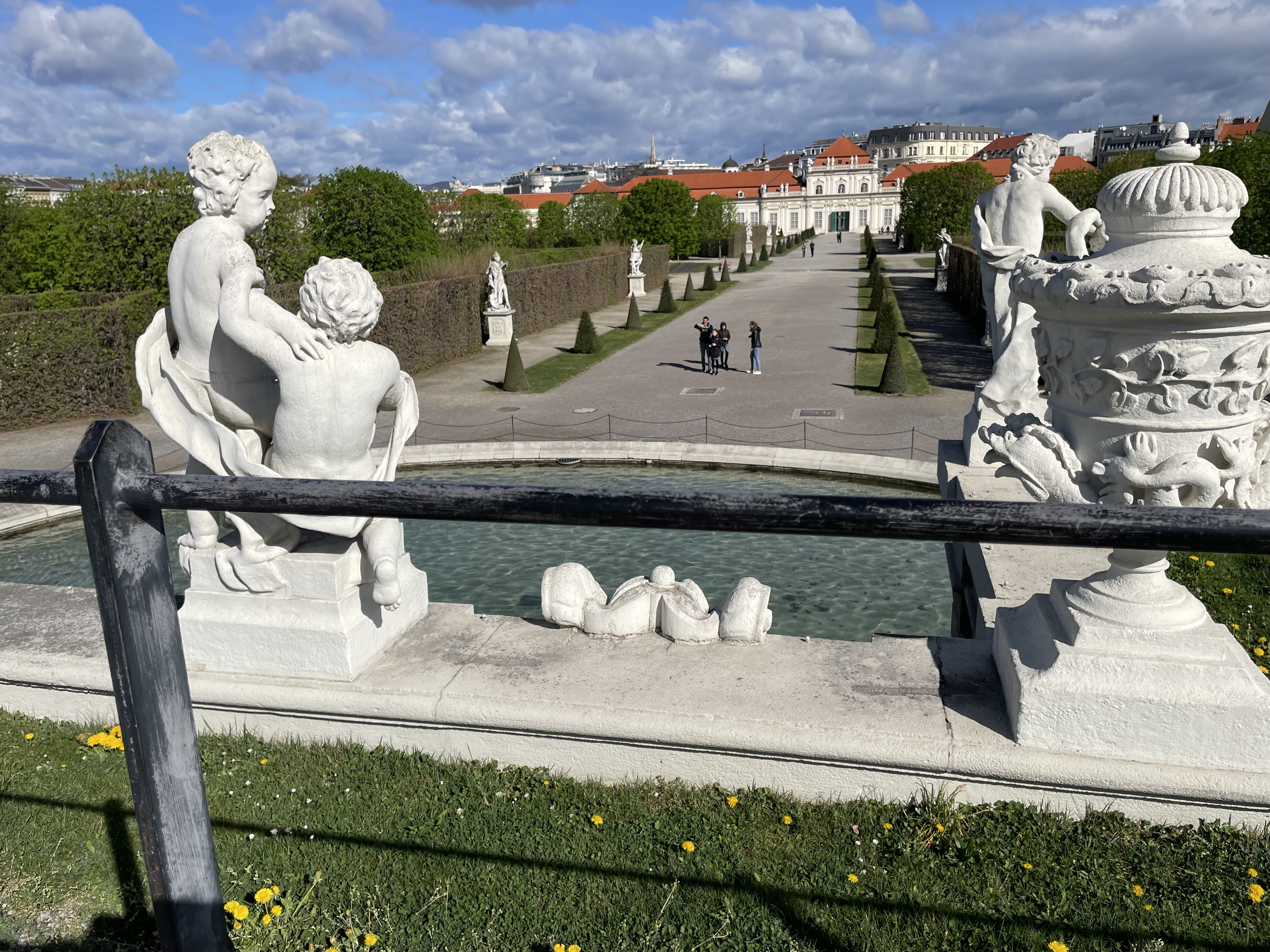
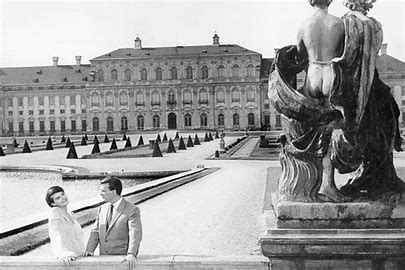

Clockwise: Mooons Hotel, Belvedere Palace, gardens and fountains, Last Year in Marienbad, Strauss statue in the Stadtpark.
Walking by the Danube – here there was graffiti, a lot of it political, e.g. re climate change. In general in Vienna, there was no litter, and an orderliness evident in what happened at pedestrian crossings, where no one walked until they were told to walk. It felt a lot safer than, say, crossing a road in Rome, where one feels as if the only way to ever get across is to walk and hope one isn’t immediately mowed down. (A told me of waiting in vain for the right moment at a crossing point in Rome, and another tourist facing the same dilemma saying cheerily, ‘OK, when in Rome…’ and launching himself into the traffic. The cars and bikes do weave around you but it never even starts to feel safe.)
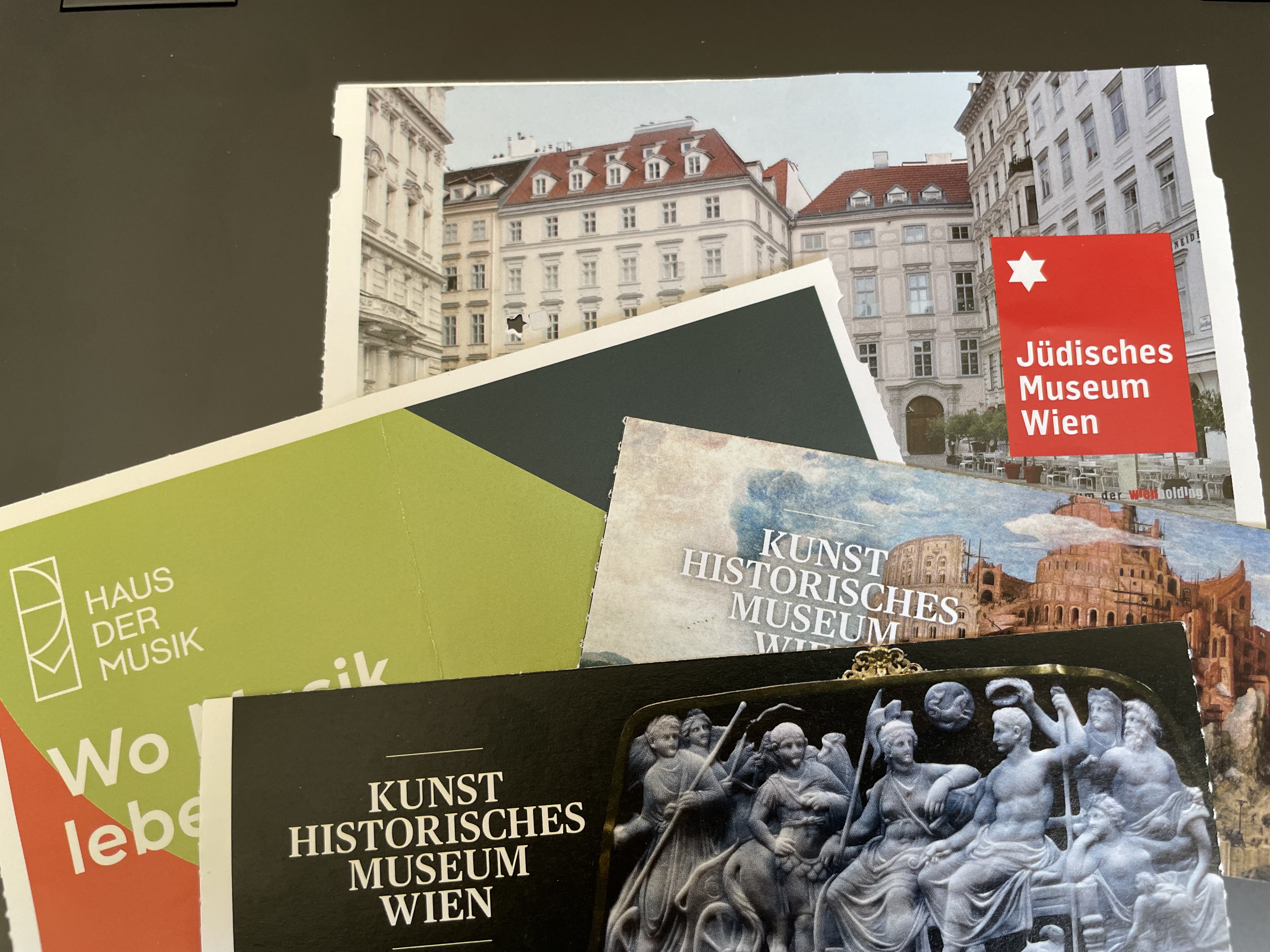
There are two Jewish museums in Vienna. First up was the Museum Judenplatz, built around the excavated remains of the earliest synagogue in Vienna, destroyed in 1421 by order of Duke Albrecht V. It has a fascinating collection building up a picture of that early Jewish community, and of the exploration of the remains. The Jüdisches Museum nearby continues the story of Vienna’s Jewish population through the centuries. But there is a strange sense of a hiatus – not that the Holocaust is omitted but compared to Prague and Berlin, it is arguably underplayed, the job left to the bleak Whiteread memorial in the Judenplatz. This is a bunker, whose walls are made up of books with spines facing inwards to represent the victims whose names and stories are lost, 65,000 Austrian Jews. The names of the camps and other locations where they were murdered are inscribed around the memorial.
Stolpersteine (Schwedenplatz): Here there are three individual stones, and a plaque in memory of 15 unnamed Jewish women and men who lived here before they were deported and murdered (no details given) by the Nazis. The Stolpersteine commemorate Anna Klein, b. 14 Jan 1885, Josefine Steinhaus, b. 21 May 1884, Helene Steinhaus b. 3 August 1885. Deported to Maly Trostinec 27 May 42, killed 1 June 42. Maly Trostinec/Trostinets, a village near Minsk in Belarus, was not a location I was familiar with. Throughout 1942, Jews from Austria, Germany, the Netherlands, Poland, and the Protectorate of Bohemia and Moravia were taken there by train and then shot or gassed in mobile vans. According to Yad Vashem, 65,000 Jews were murdered in one of the nearby pine forests, mostly by shooting, but some estimates are much higher, up to 200,000.
Vienna State Opera (Staatsoper) We’d decided against trying to get tickets for any performance here because (a) cost, (b) I haven’t managed to entirely convert A to opera and (c) we didn’t want to commit an evening. That was the right choice – we walked for miles (see above), and in the evenings just wanted time to chill with some nice Austrian beers and talk over what we’d seen and make our plans for the following day. But the building itself is obviously magnificent. And we had seen inside anyway, in Mission Impossible: Rogue Nation…


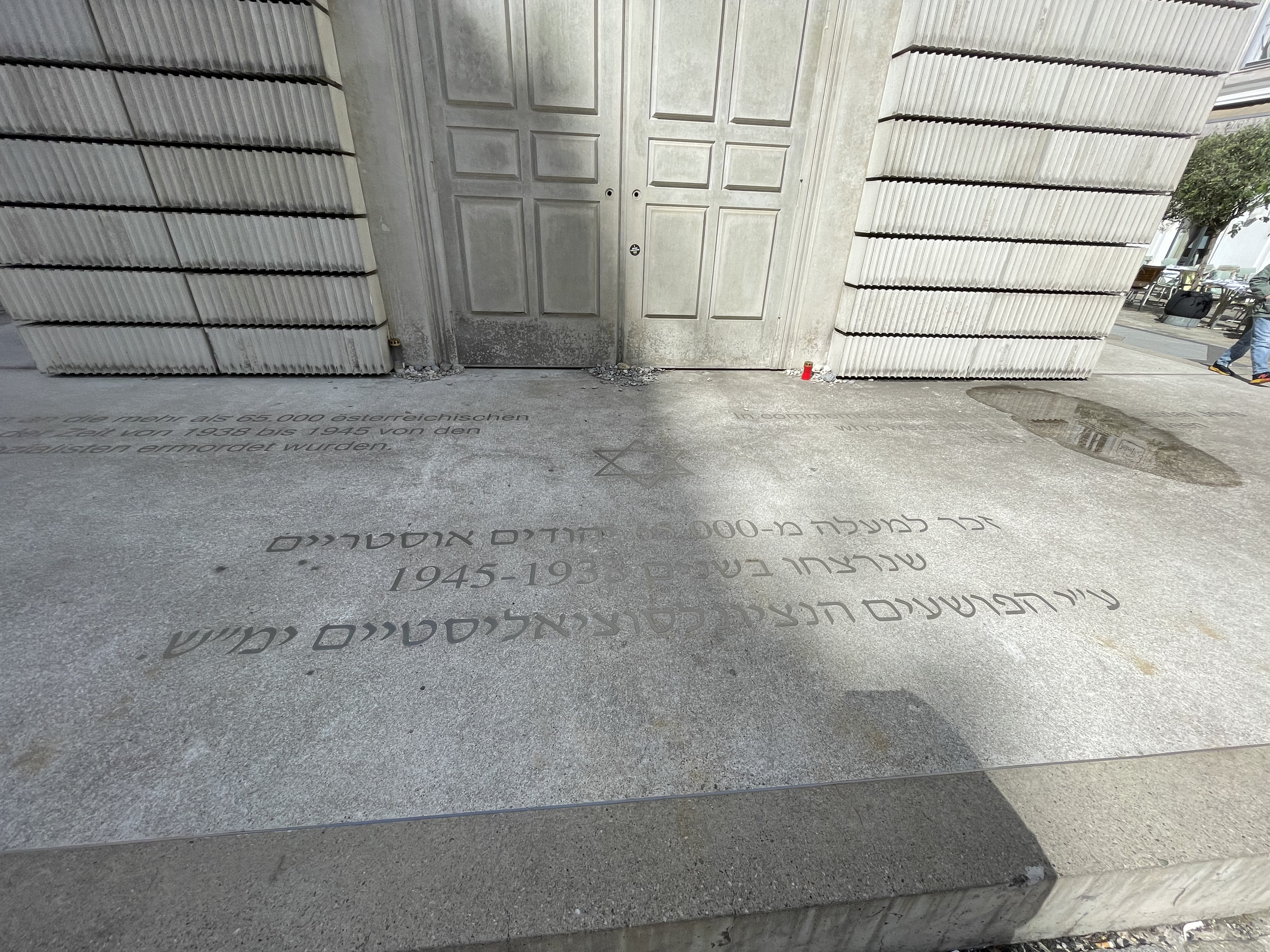


Clockwise: Stolpersteine, graffiti by the Danube, Judenplatz, Whiteread Holocaust memorial, the Opera house and nearby street
St Stephen’s Cathedral (Stephansdom). As in Paris, the survival of this and other fine buildings was achieved by a refusal to carry out orders. The City Commandant had ordered the Cathedral to be reduced to rubble, but this was not carried out – unfortunately, as the Red Army entered the city, looters set fire to shops nearby, which spread and damaged the roof and destroyed the 15th century choir stalls. Much was saved, however, and reconstruction began immediately after the war, with a full reopening in April 1952.
Watching The Third Man makes one realise just how badly Vienna was damaged during the war – not devastated like Berlin, Hamburg, Dresden, but, as Elisabeth de Waal puts it, ‘desultory bombing by over-zealous Americans on the verge of victory, and the vindictive shelling by desperate Germans in the throes of defeat’ had resulted in ‘the gaps in the familiar streets, the heaps of rubble where some well-remembered building had stood’ (The Exiles Return, p. 57). One would not know it now. Clearly, given the fear that rebuilding would destroy the character of the city, the choice was made to rebuild it as it had been, as far as possible. Which gives Vienna that feeling of being preserved in aspic, a slight unreality.
We went a bit further afield, out to Schonbrunn Palace. We didn’t go round the palace itself, preferring to explore the gardens, and head up the hill to the Neptunbrunnen and the Gloriette, to enjoy the view, which was indeed glorious.

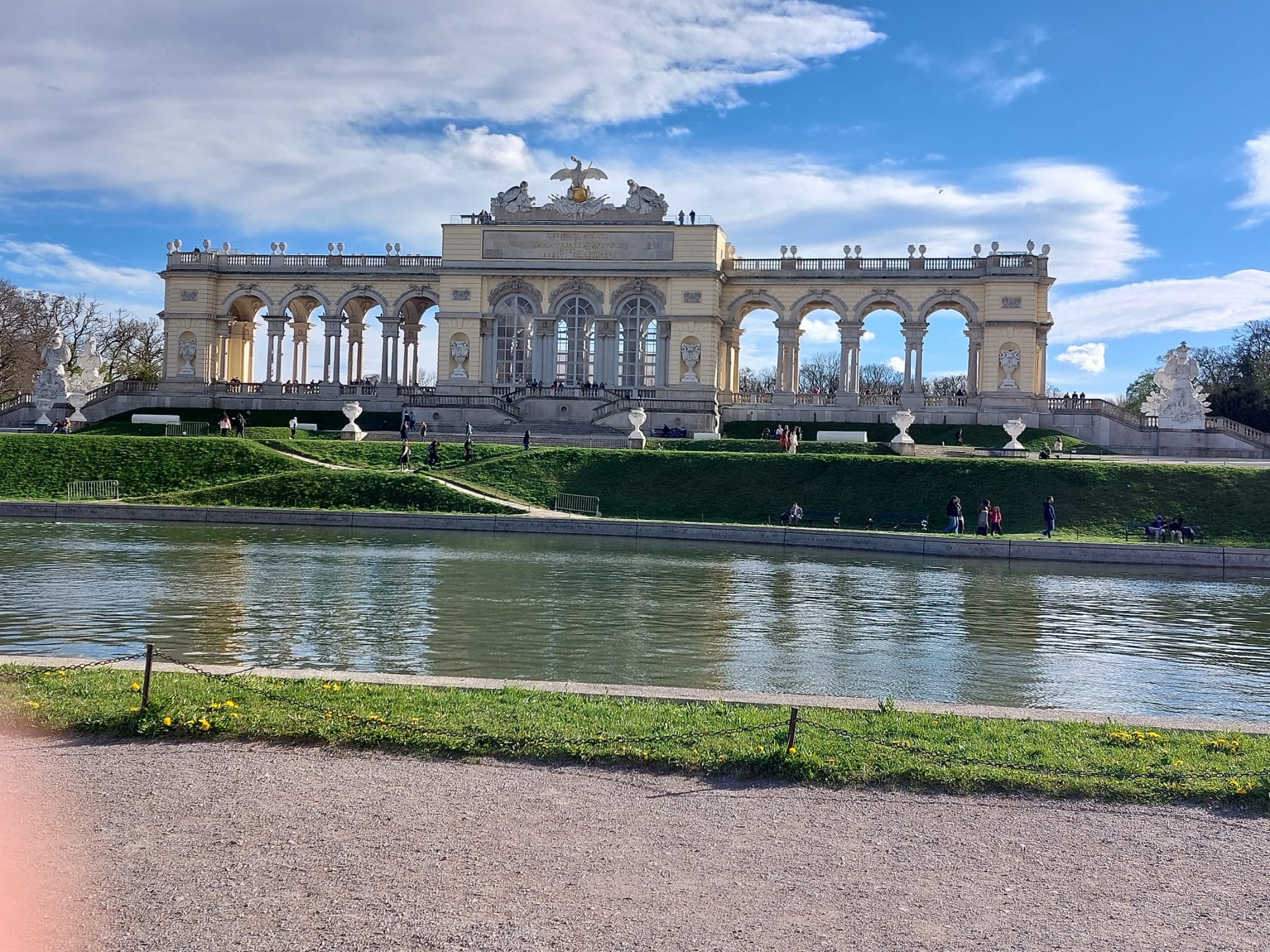

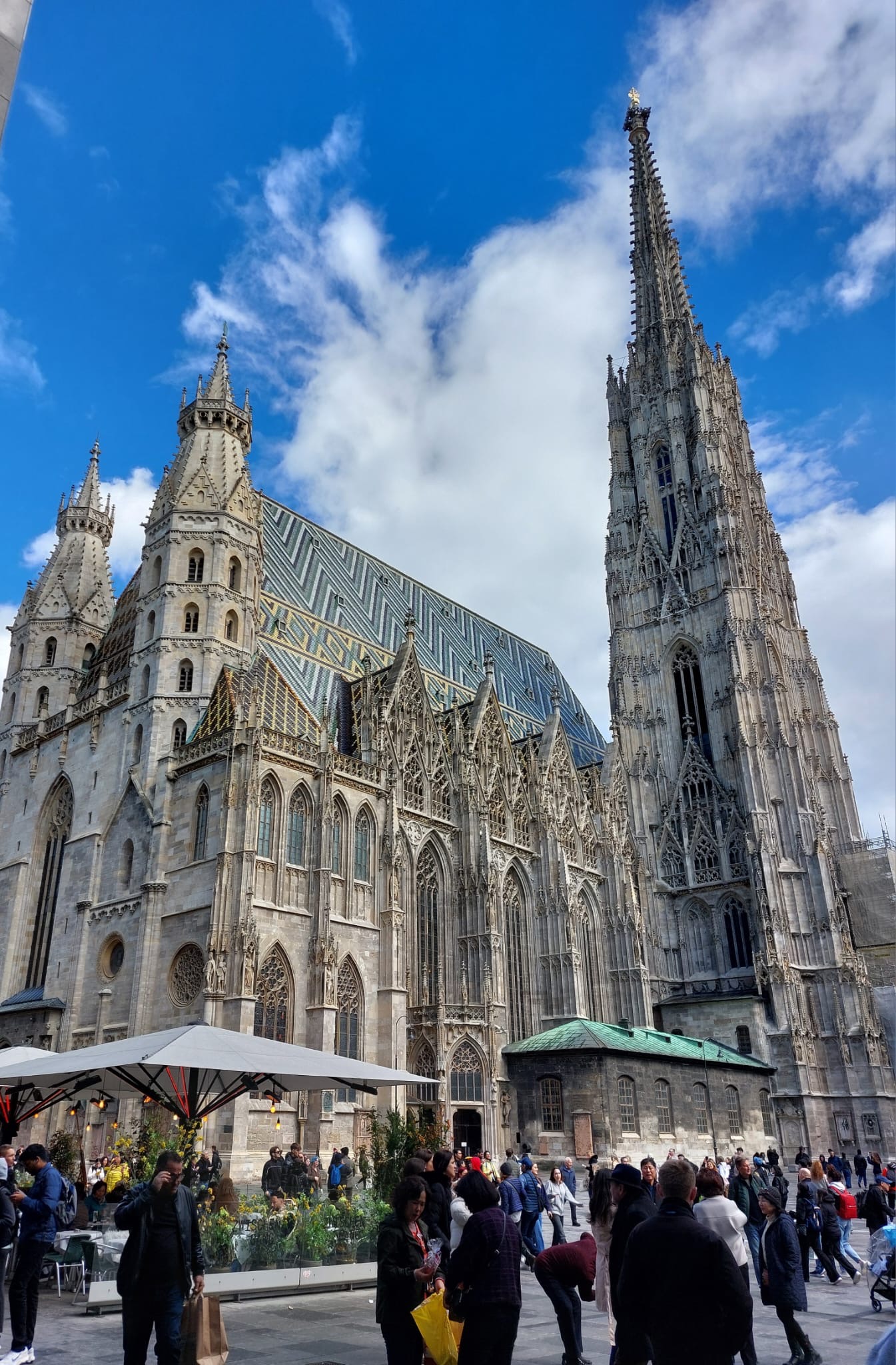


Clockwise: Schonbrunn Palace, Gloriette and Neptune fountain; Stephansdom
Maria am Gestade church – one of the oldest churches here, built 1394-1414
Memorial to liberating Soviet soldiers (Heldendenkmal der Roten Armee/Heroes’ Monument of the Red Army), in Schwarzenbergplatz, featuring a twelve-metre figure of a Soviet soldier. This was unveiled in 1945. It seemed to me remarkable that it was built so soon after the war ended, but then I hadn’t realised either that Vienna was liberated by the Red Army, or that in the hiatus before the other Allied Forces arrived, there was a real possibility of Stalin occupying all of Vienna. The memorial is about heroism in battle, not about the violence, particularly sexual violence, inflicted on civilians during and after the battle, and has been controversial and subject to vandalism over the years, including very recently in response to the invasion of the Ukraine.
Wednesday:
Stolpersteine: Paula Wilhelm (née. Mandl), born 6 April 1887, deported 29 April 44 to Auschwitz; and Dr Max Neustadtl who fled to France but was deported on 25.3.43 to the Sobibor extermination camp and murdered.
Vienna’s second Jewish Museum focuses on the later Jewish communities, covering the period of Nazi rule, but not dealing in great depth or detail with the Holocaust.
One fascinating display here is part of the collection of netsuke whose story is told in Edmund de Waal’s The Hare with the Amber Eyes. These are the Japanese miniature sculptures which belonged to the Ephrussi family, and which were kept out of the hands of the Nazis, unlike most of the contents of the Palais Ephrussi. Six weeks after the Anschluss, the family servant, Anna, was required to pack away the belongings of her former employers. There were lists, of course, to ensure that everything was accounted for. But each time that Anna was in the Baroness’s dressing room, she slipped a few of the netsuke into her apron pocket, and hid them in her room. In December 1945, Anna gave Elisabeth de Waal 264 Japanese netsuke.
‘Each one of these netsuke for Anna is a resistance to the sapping of memory. Each one carried out is a resistance against the news, a story recalled, a future held on to.’ (Edmund de Waal – The Hare with the Amber Eyes, pp. 277-83)


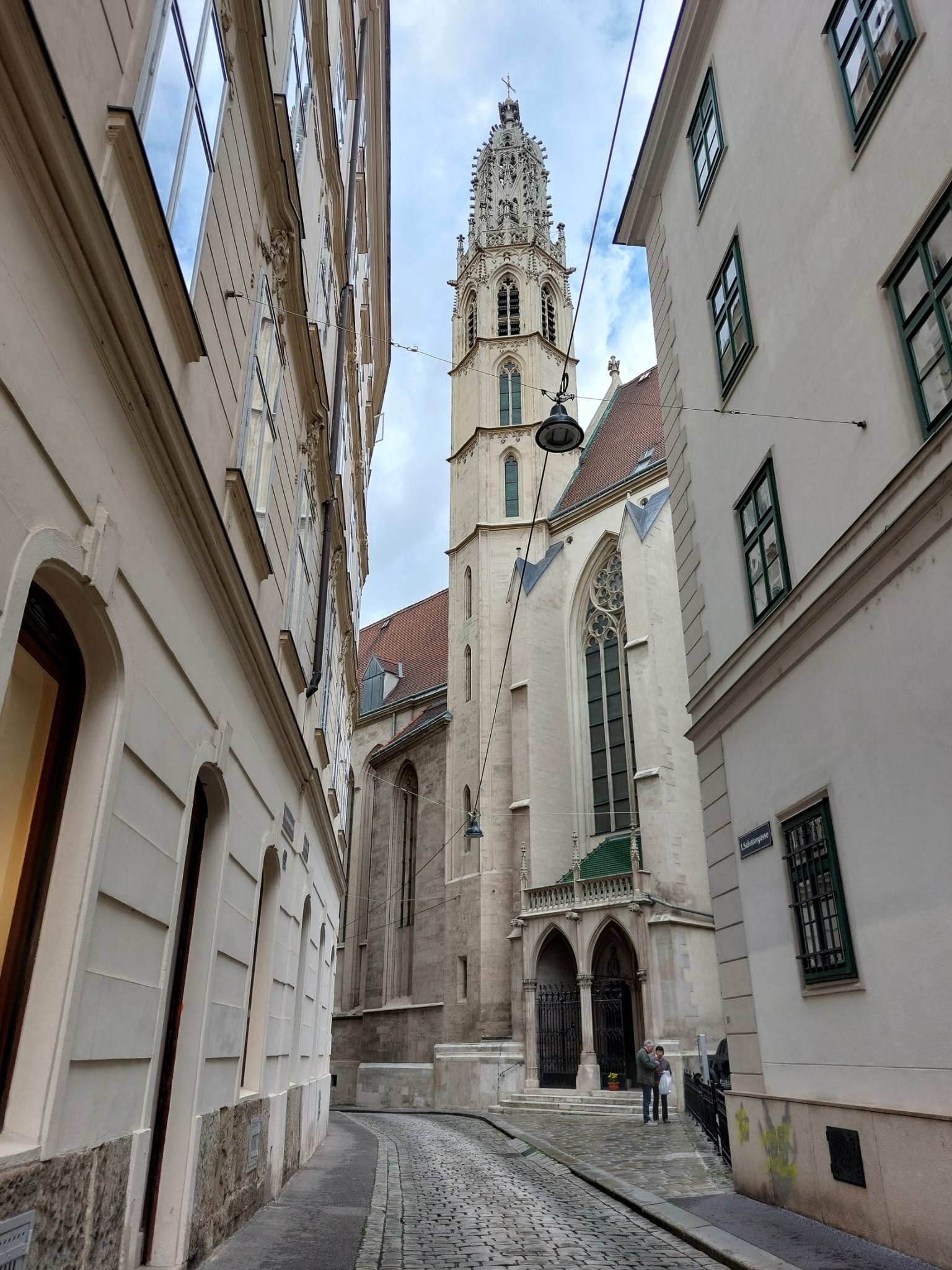

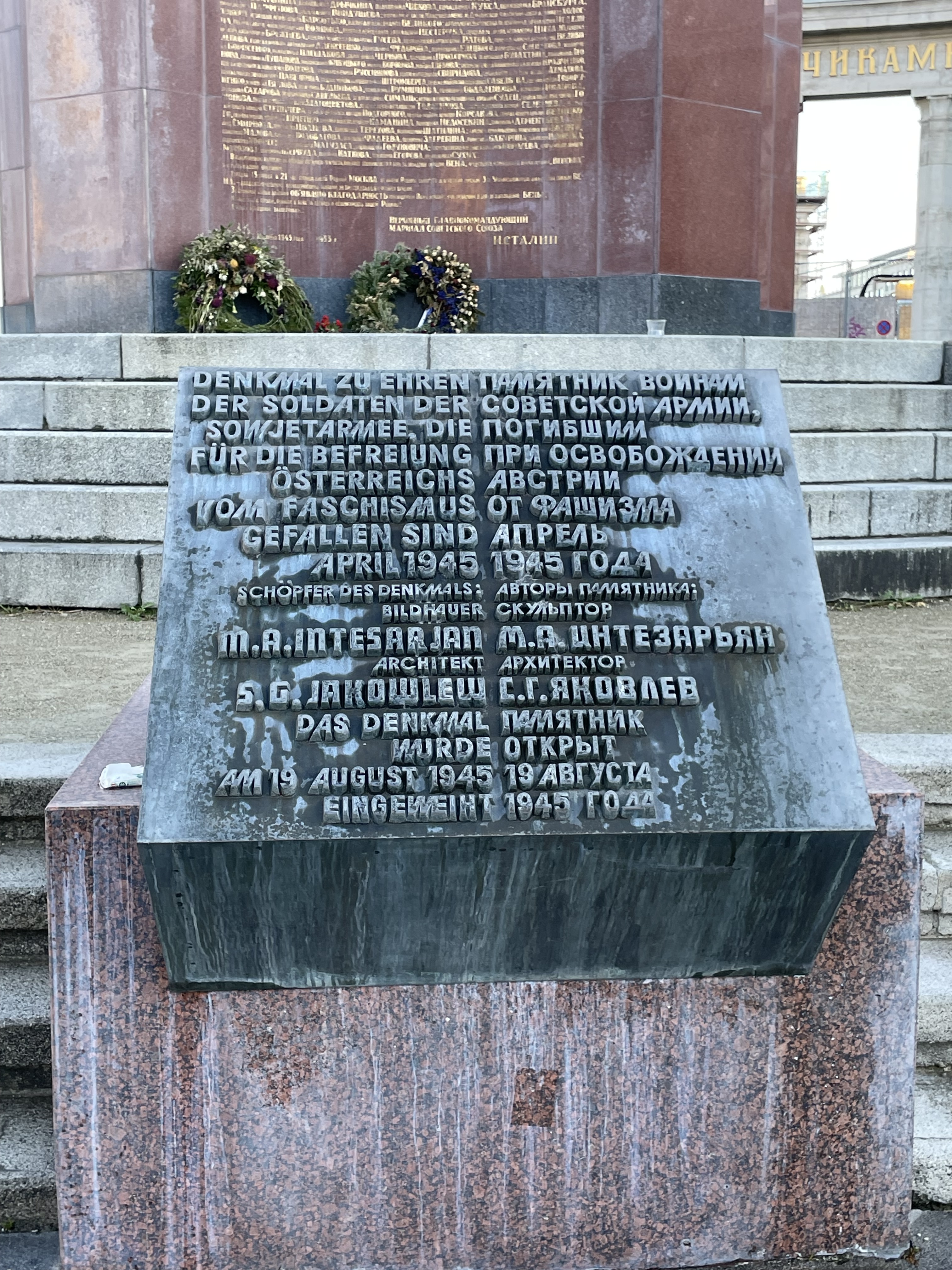
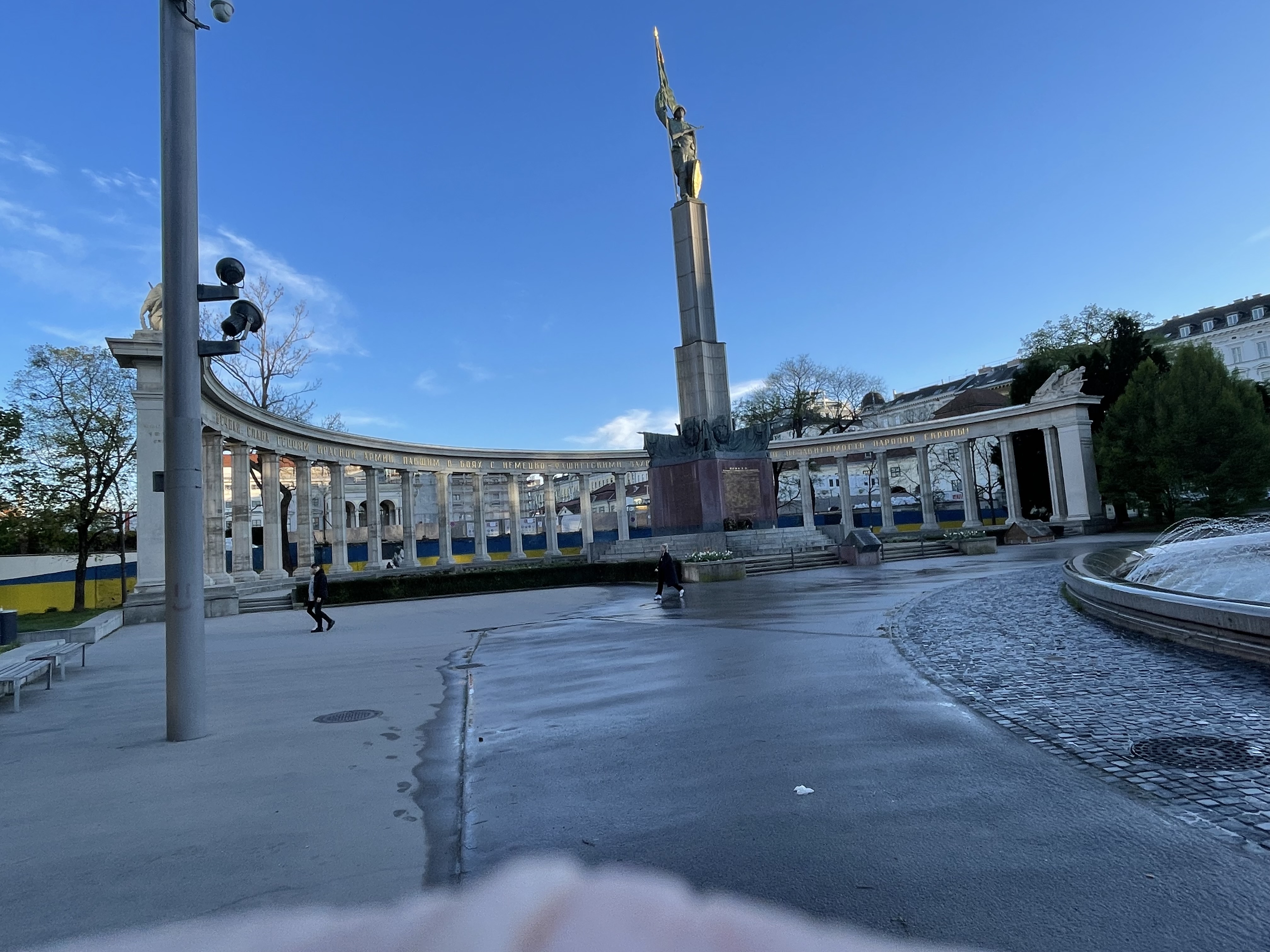
Clockwise: Stolperstein for Max Neustadtl, netsuke in the Jewish museum, Maria am Gestade church, stolperstein for Paula Wilhelm, Heroes Monument of the Red Army
A plaque on Herminengasse gives the names of Jews who lived here, in what was once part of the Jewish ghetto. Many Viennese Jews were forced to live here, until they were deported to various killing sites. Several were killed in Izbica (a town in Eastern Poland, which was turned into a ghetto) – all show the same date of death, 5 December 1942, when the inhabitants of the ghetto (Polish Jews, and those deported from Germany and Austria) were murdered. Those who escaped this massacre were deported again, to Treblinka, Maly Trostinec, Łódź Ghetto, Riga Ghetto, Theresienstadt, Sobibor, Stutthof. I know nothing about these people, other than their age, and where they were killed. But I can see that Oskar Koritschoner was only 20 years old when he committed suicide. Maly Trostinec was the place where 13-year-old Regine Frimet and 3-year-old Ernst Elias Sandor were murdered. And Josef Weitzmann, the last of these to die, was killed in Stutthof concentration camp, in 1944, just after the facilities for mass murder had been set up there. He was 18.
We found the Palais Ephrussi, on the Ringstrasse (see, again, The Hare with the Amber Eyes). I had had an insight into the efforts to trace the plundered contents of the Palais, from Veronika Rudorfer who I met in December 2019 at a conference, when she gave a talk on that project, and subsequently, very generously, sent me a copy of her beautiful book about the Palais itself.
The Burg Theatre – Sarah Gainham’s excellent novel Night Falls on the City has a lot of the action taking place at the Burg theatre, as her protagonist is one of its leading actors. One wouldn’t know that this building was largely destroyed in bombing raids during WW2, and then by a fire subsequently, and has been rebuilt.
Votivkirche (Votive Church) is a gorgeous, somehow delicate looking church, one of the most beautiful in a city of beautiful churches. It is in a neo-Gothic style and was built to thank God for the Emperor Franz Joseph’s survival of an assassination attempt in 1853.


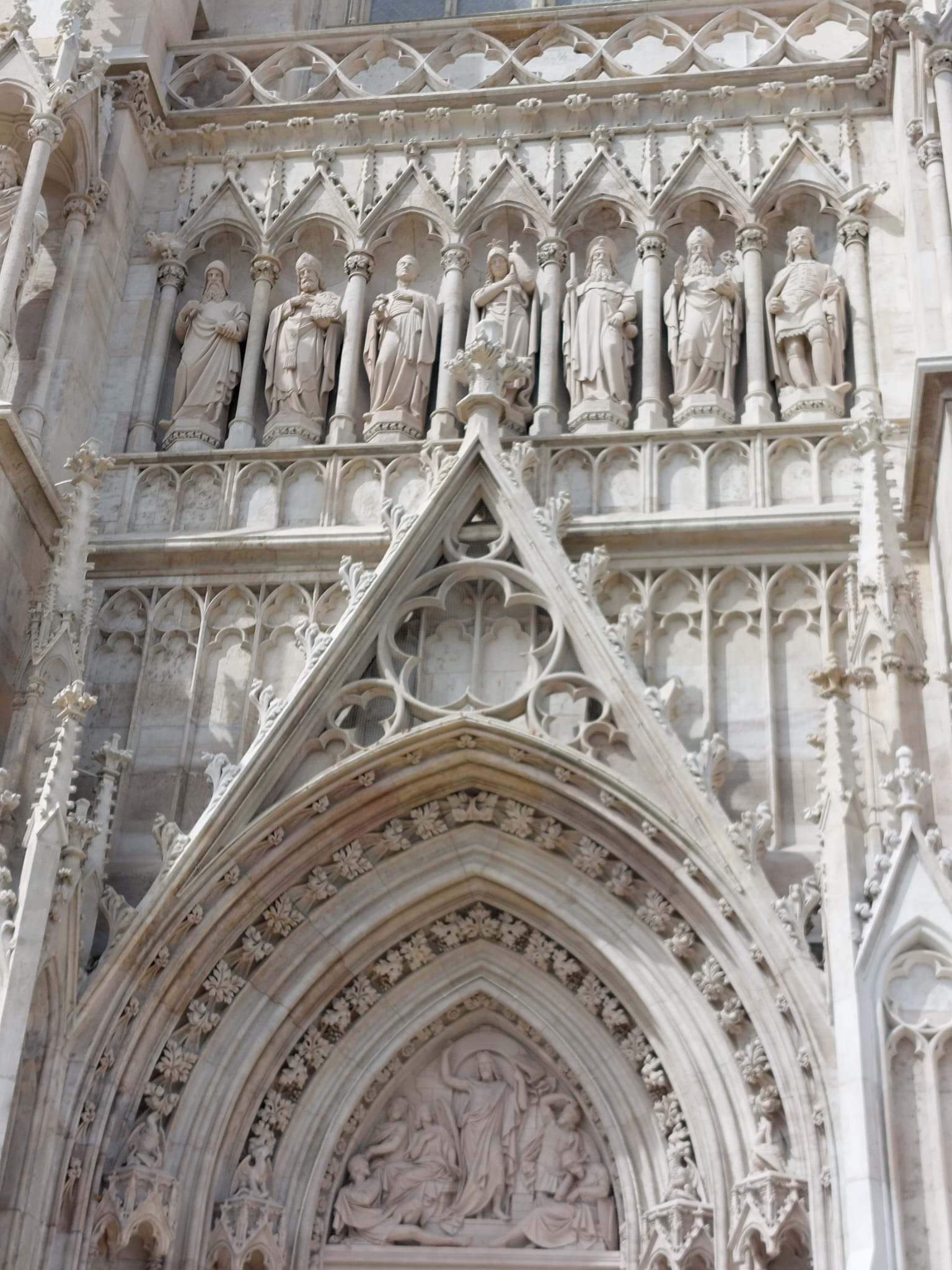

Clockwise: Burg Theatre, Herminengasse plaque, Palais Ephrussi, Votivkirche
We saw the Rathaus – Vienna City Hall – and walked through the Burggarten where we found a statue of Mozart. Then the Resselpark (Karlsplatz), where we saw Sarah Ortmeyer and Karl Kolbitz’s 2023 memorial for homosexuals persecuted by the Nazis: ‘Arcus – Shadow of a Rainbow’, the colours of the rainbow changed to grey, combining grief and hope. There’s also a Brahms statue here, which I like very much.
On to Heldenplatz (Heroes Square), in front of the Hofburg Palace.
‘The two over lifesize equestrian statues on high pedestals are what give it its name, two great military commanders on rearing horses with flowing manes and tails in the Baroque style, one carrying Prince Eugene of Savoy and the other the Archduke Charles, brother of the first Emperor Francis who, in one victorious battle, had stemmed for a while Napoleon’s advance on Vienna. … And yet, with all their panache, there is so little boastfulness in this square. What first meets the eye and impresses the mind are the broad avenues of chestnut trees lining it on three sides … They give the square its peaceful, almost countrified look; they are conducive to slow perambulation and quiet contemplation.’ (Elisabeth de Waal – The Exiles Return, p. 227)
In sharp contrast to the above description, this is where Hitler made his announcement of the Anschluss after his triumphant arrival in the city.

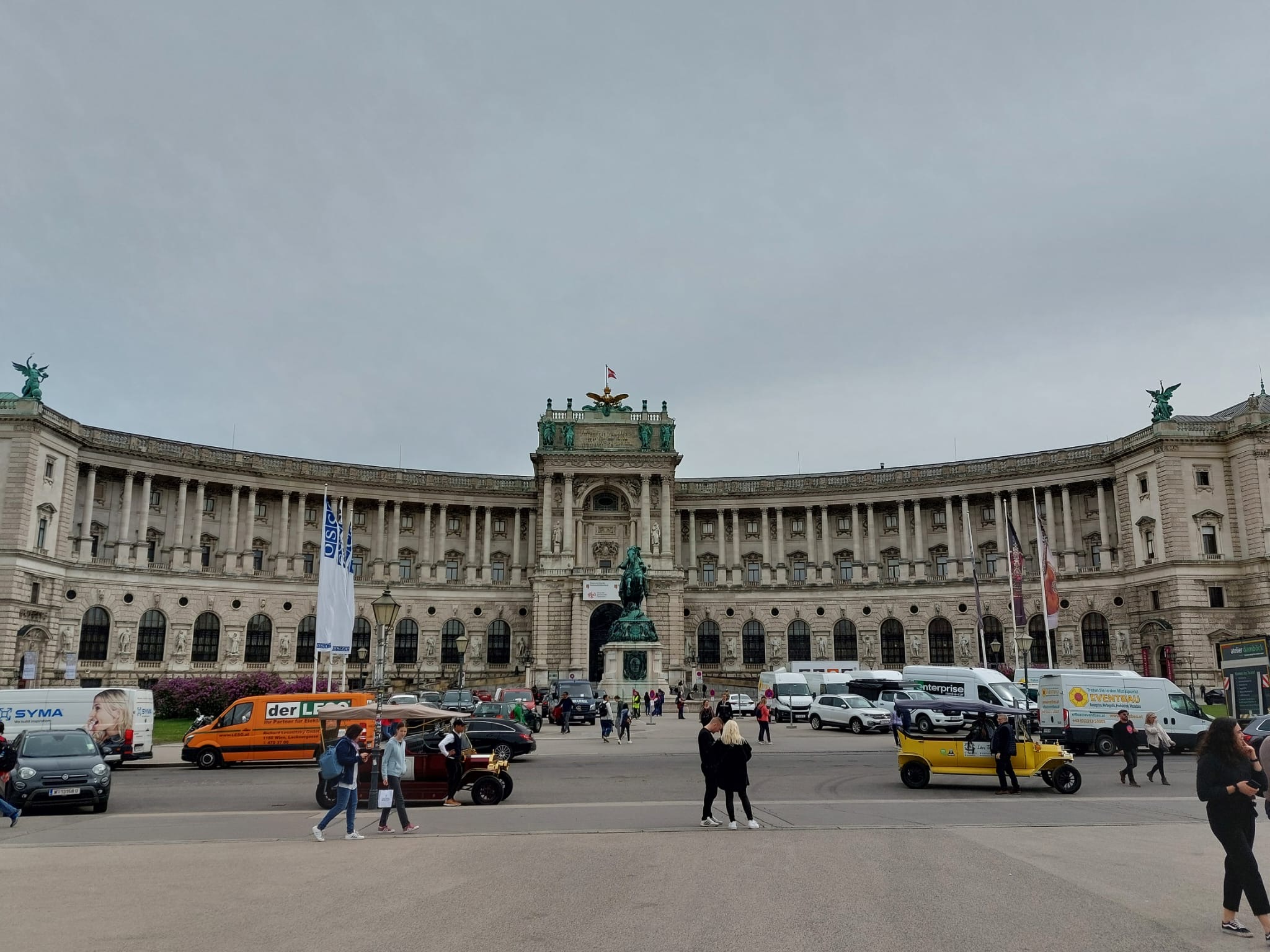


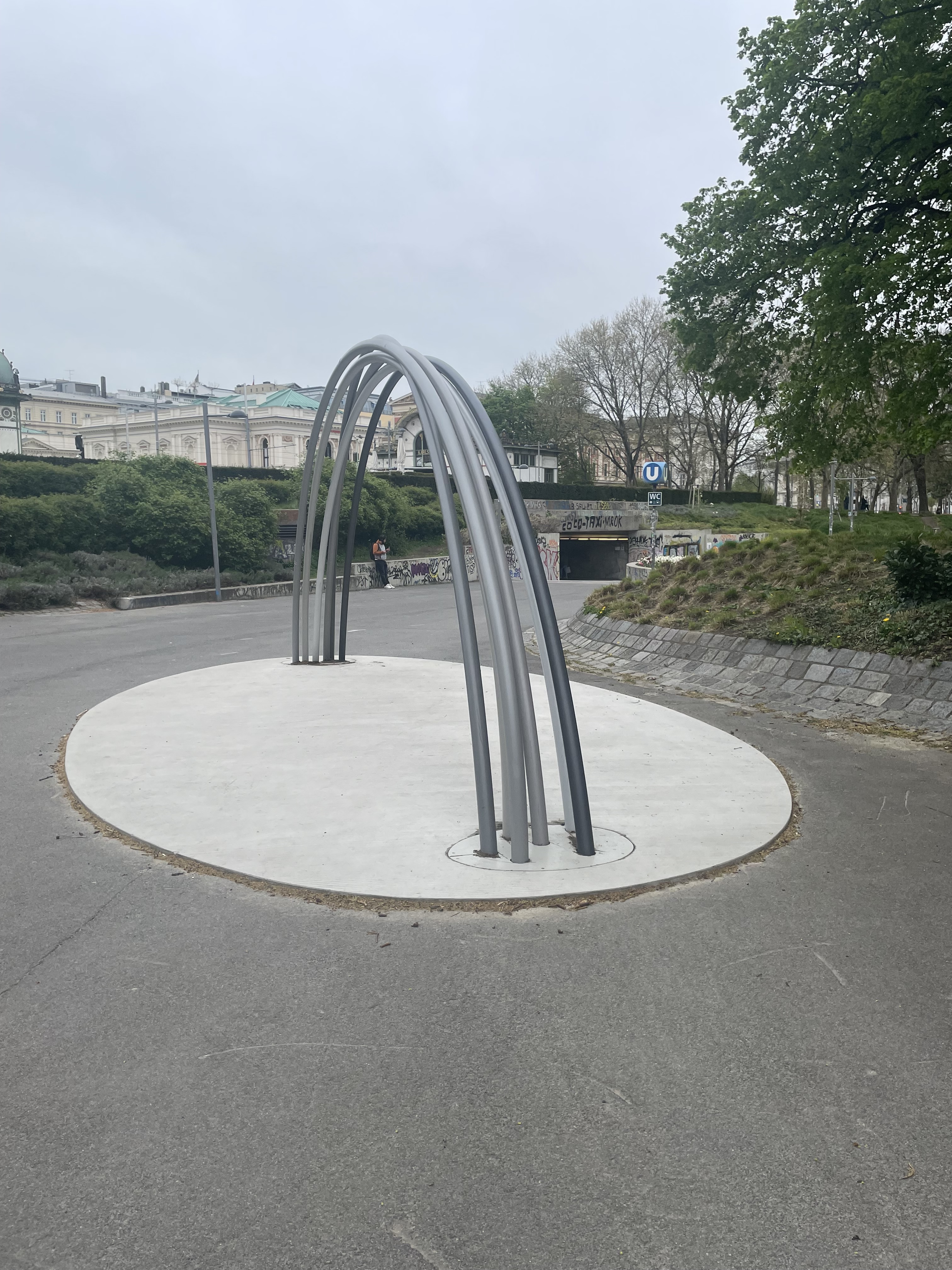
Clockwise: Brahms statue in Resselpark, Heldenplatz, Mozart statue, Rathaus, Arcus memorial in Resselpark
Parliament Building – another building that was seriously damaged in WW2 and the restored to its former glory. In front of it is the Pallas Athene Fountain – apart from Athene (statuary in Vienna is often Graeco-Roman in subject matter and style) it represents the four major rivers, the Danube, Inn, Elbe and Vltava (Moldau in German).
Hofburg Imperial Palace – the official residence and workplace of the President.
Schwarzenberg Monument, commemorating Karl Philipp, Prince of Schwarzenberg’s victory at the battle of Leipzig in 1813. Yet another equestrian statue (I cannot help it if the Bonzo Dog Doodah Band come to mind when I see these).
Here comes the Equestrian Statue
Prancing up and down the square
Little old ladies stop ‘n’ say
“Well, I declare!”Once a month on a Friday there’s a man
With a mop and bucket in his hand
To him it’s just another working day
So he whistles as he rubs and scrubs away(hooray)
(Bonzo Dog Doodah Band, ‘The Equestrian Statue’ (N. Innes), Gorilla, 1967)
Haus der Musik (Klangmuseum – museum of music and sound) is in the Palace of Archduke Charles, where the founder of the Vienna Phil lived around 150 years ago. The focus is on composers for whom Vienna was significant, with interesting material on Beethoven, Schubert, Mozart, Mahler, Schoenberg and others (not just biographical), as well as fun stuff about the science of music, my first encounter with a virtual reality headset (I didn’t do very well).


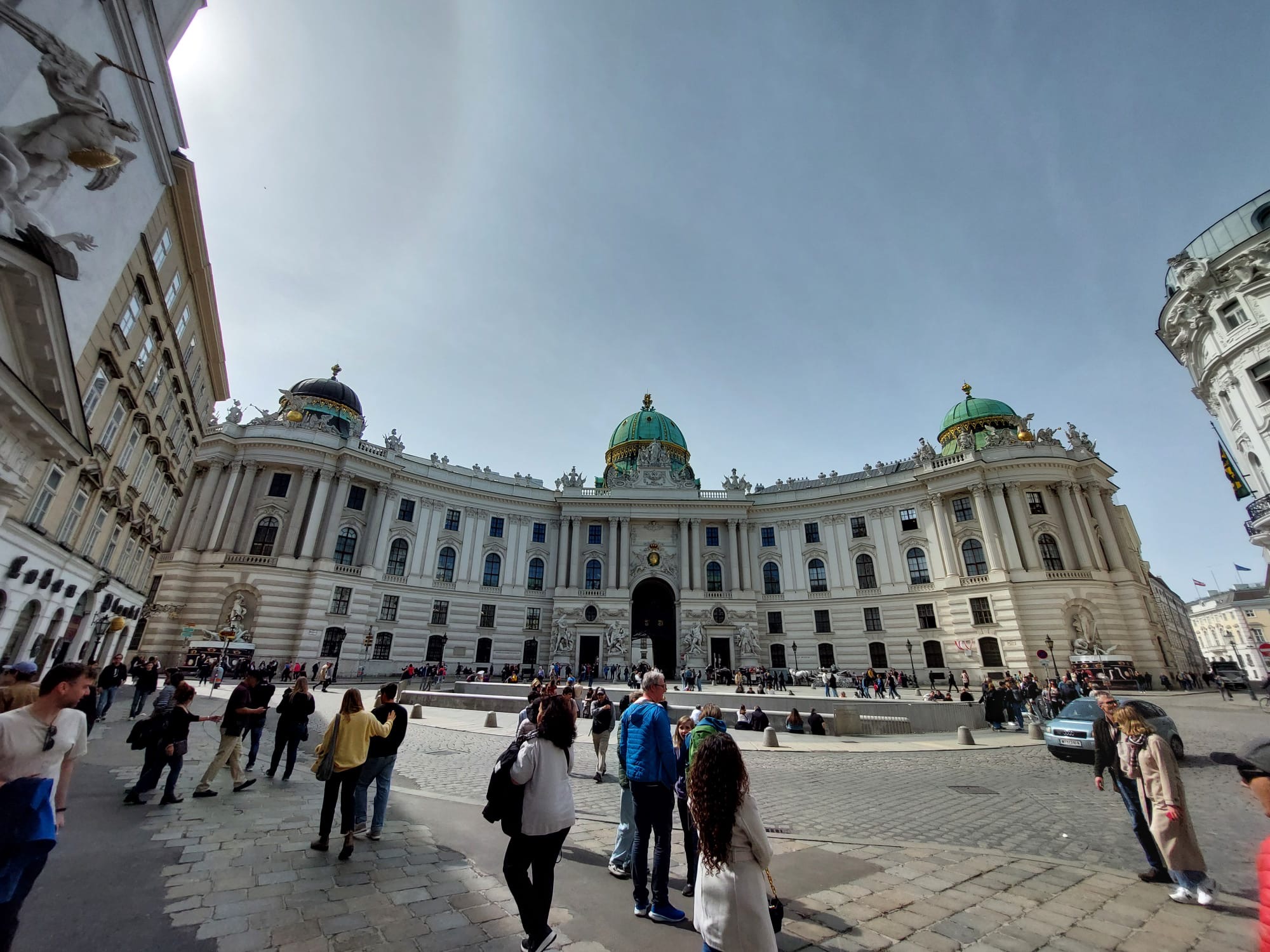
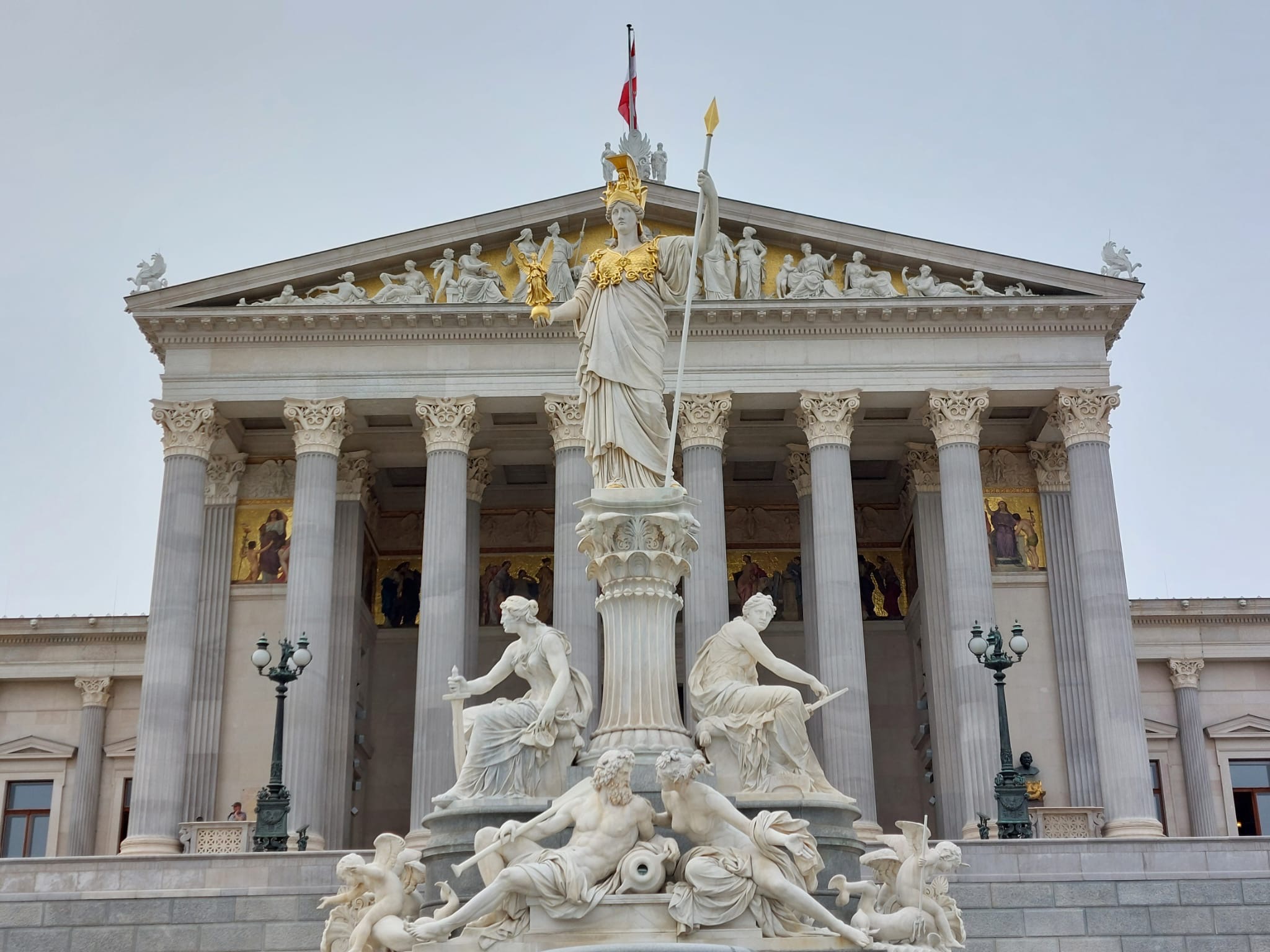
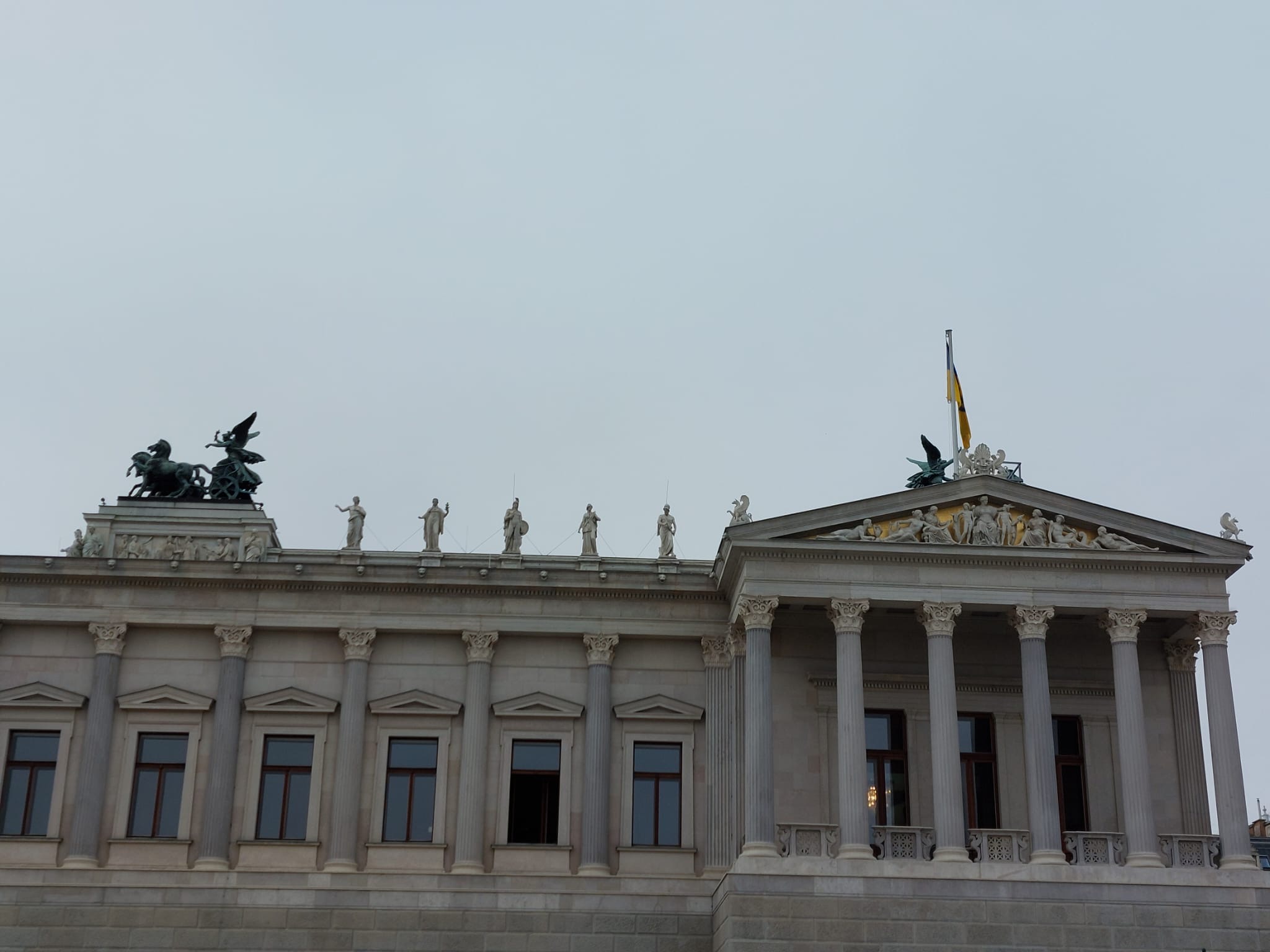

Clockwise: Haus der Musik, Archduke Charles monument, Hofburg palace (official residence and workplace of the President), Pallas Athene fountain, Parliament Building, Schwarzenberg monument
Kunsthistorisches Museum – in a palace (of course), purpose built by Emperor Franz Joseph 1 to house the rooms full of antiquities, sculpture and decorative arts. But the highlight was the picture galleries, and especially the Breughels, an absolute joy to see ‘Hunters in the Snow’ etc close up. Also paintings by van Eyck, Raphael, Durer, Holbein, Titian, Caravaggio…
What did we miss? Well, if I went back, I’d go to see the Klimts in the Belvedere gallery, I’d book a tour of the Opera House, and the Parliament building. Might even go on the Riesenrad (I think given the particular form my vertigo takes – see below – I would be OK with it, after all, I was fine on the London Eye).
Vienna Reading: Fiction: Sarah Gainham – Night Falls on the City/Private Worlds; Elisabeth de Waal – The Exiles Return. Non-fiction: Clive James – ‘Vienna’, in Cultural Amnesia; Edmund de Waal – The Hare with the Amber Eyes; Claudio Magris – Danube; Stefan Zweig – The World of Yesterday
Vienna on Film: The Third Man; Before Sunrise; Vienna Blood (TV detective series set in turn of the century (19th-20th) Vienna)
Vienna Music: Too much to mention – the city played such a key role in the lives and careers of so many great composers and musicians. Beethoven, Mozart, Schoenberg, Schubert, Brahms, Webern, Korngold… I did my best to avoid hearing ‘The Blue Danube’, a piece I heartily dislike, whilst in Vienna, but didn’t quite manage it (it’s a bit like trying to avoid hearing Wham at Christmas)
One lesser-known name, who I researched on our return. Marcel Tyberg was born and studied in Vienna but moved to Italy (present day Croatia) in 1927, when he was in his thirties. His mother followed the rules once the area was under Nazi occupation, and registered her Jewish great-grandfather. She died of natural causes, but Tyberg was arrested and deported, first to San Sabba camp in northern Italy, and then to Auschwitz, where he was murdered in December 1944. I listened to the Piano Trio in F major (1935-1936).
PRAGUE
Thursday:
We set off early to catch the train to Prague. Not the most scenic of journeys but travelling by train makes the journey part of the holiday and is generally less stressful. That is, once I was on board – the ‘mind the gap’ warnings do not adequately convey the hideous gulf between the train and the platform which involves one stepping out into said gulf and on to a narrow step before reaching the safety of the train. I realised this at Vienna Airport station but had vainly hoped that this wasn’t going to be the case with all the trains we caught… Fortunately A is both capable and caring, and so he grabbed the bags, put them into the train and then held my arms and made me look at him, not at the gulf, and step in. Same procedure in reverse when we got off the train, of course.
A slightly longer walk from the station to our hotel, the Majestic, near Wenceslas Square. A more old-fashioned looking hotel than Mooons but very comfortable. Having deposited our bags we set off for the Old Town. What I hadn’t anticipated is how much harder on the feet and the joints the cobbled streets in Prague would be – both of my days in the city had to be curtailed slightly early because on that first day there I crocked myself a bit. I still managed to clock up 17k steps (not bad for a half day), and 20k the following day, a total of 25.5km in the city.
Walking around Prague felt very different to walking around Vienna (and not just because of the cobbles). It is a city to wander in, to stroll down random streets, look around random corners, and be beguiled and intrigued by buildings that are a jumble of styles and eras, shapes and sizes. The terms ‘new’ and ‘old’ in Prague tend to mean ‘old’ and ‘really, really old’.


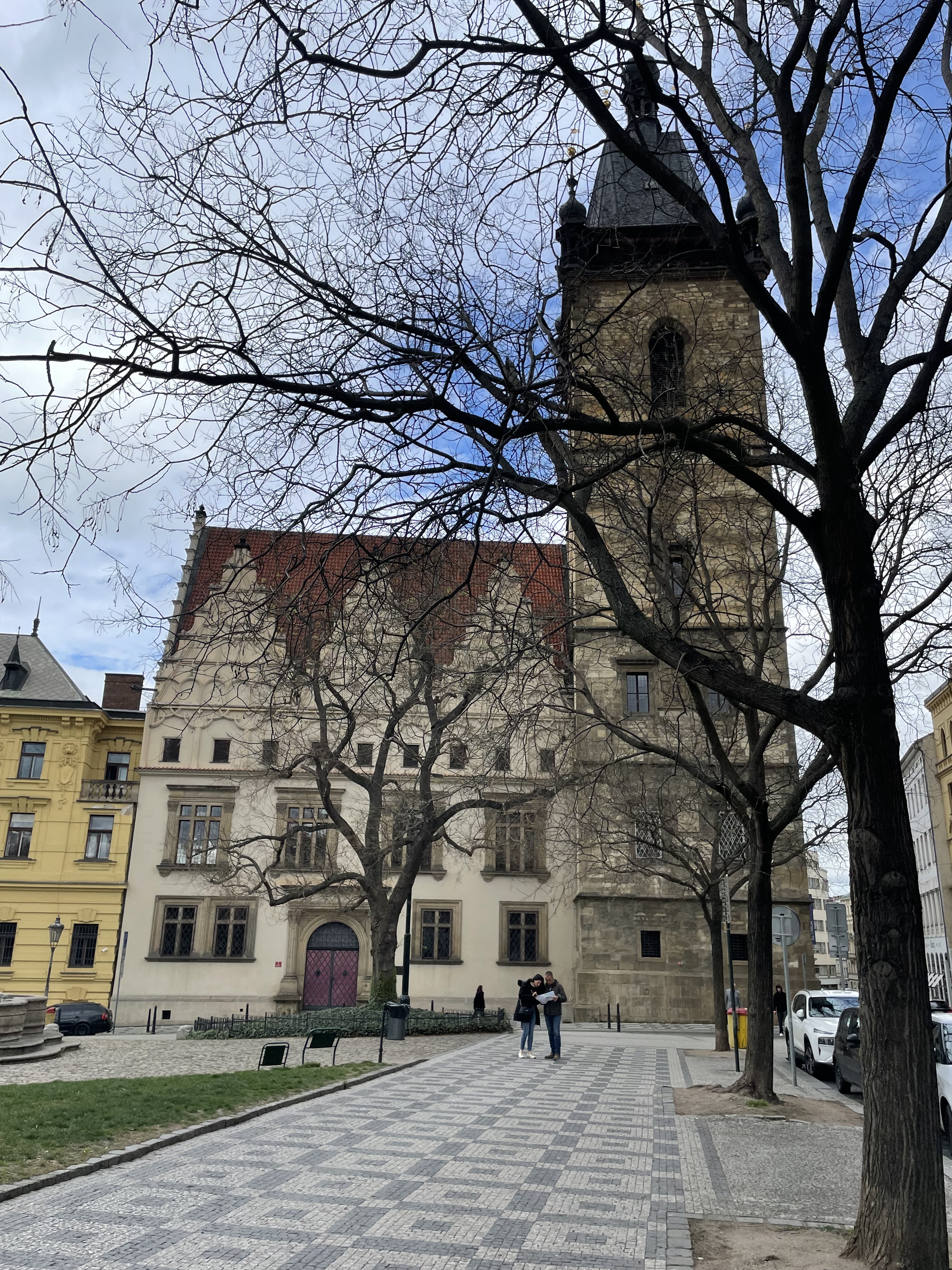
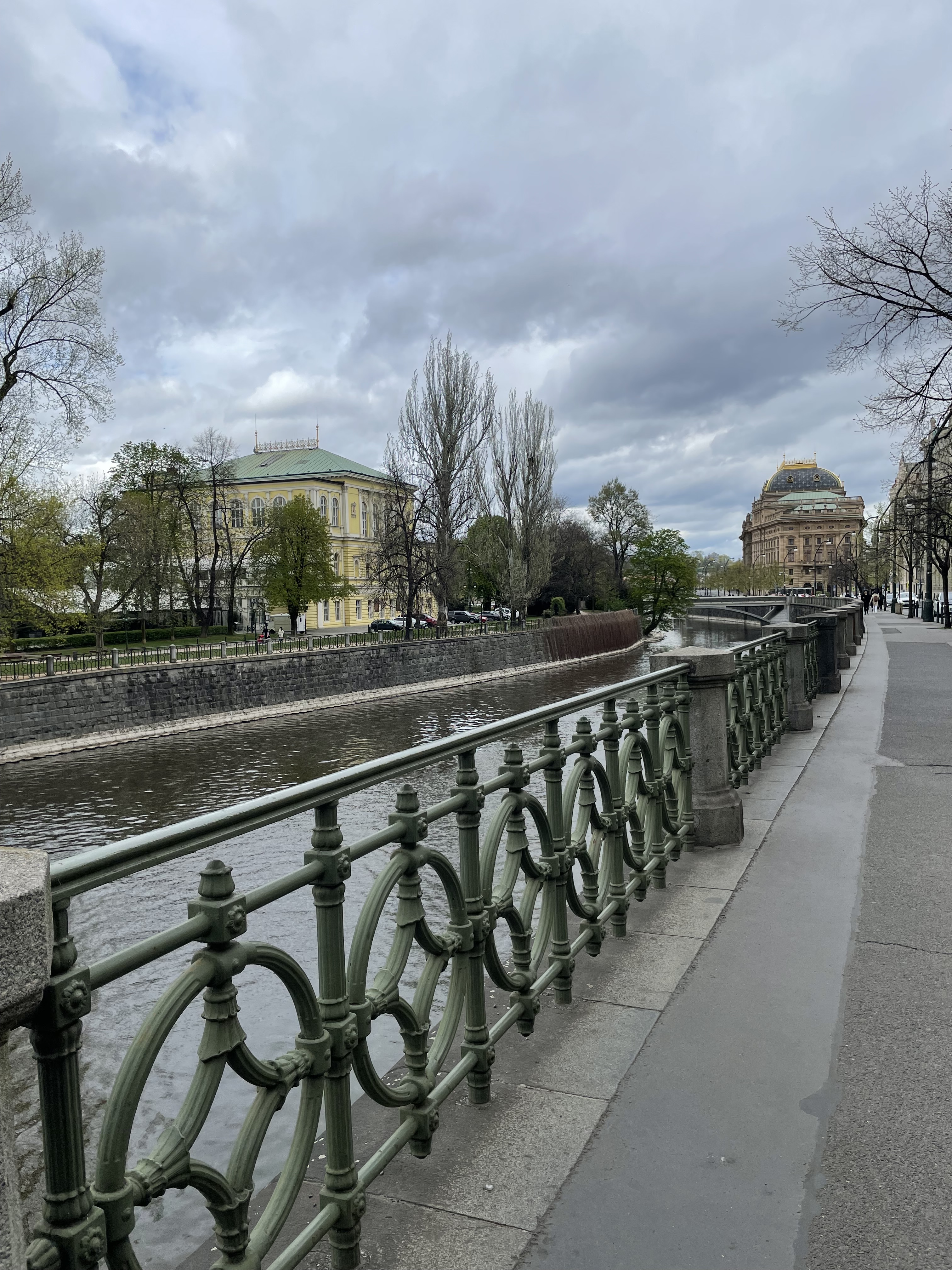

Clockwise: Charles Square, St Adalbert’s Church, Hotel Majestic, New Town Hall, view of the Zofín palace, a mysterious and ominous sign across the Vltava
Charles Bridge is always rammed with tourists – it is probably the most photographed site in the city, understandably enough. We got glimpses of it from the New Town side on Day 1, and the Prague Castle side on Day 2, when we did go part of the way across.
Jan Palach memorial, Wenceslas Square. I was 10, going on 11 at the time of the Prague Spring. I remember the news reports, and my parents’ distress (they vividly remembered the events in Hungary in 1956), and I remember hearing of Jan Palach’s suicide. A couple of years later, the English teacher at my school, an eccentric chap called Mr Pepper, mentioned this (I cannot recall in what context) and said that in a few years, no one would remember Jan Palach’s name. I decided that I would. And I did.
The Jewish Museum in Prague, based in the old Jewish quarter, comprises a number of locations – we didn’t see everything, but what we did see was unforgettable. It comprised four synagogues, the ceremonial hall, the old Jewish cemetery (and a gallery which was closed when we visited).
Pinkas synagogue – I knew what I was going to see. But that didn’t make it any easier. I wrote back in 2017 about a visit to the Mémorial de la Shoah in Paris: ‘I had braced myself for this, knowing the terrible history that would be illustrated there. Nonetheless, seeing the Wall of Names, I felt the air being sucked from my lungs, realising that I was seeing in that moment only a fragment, only some of the names from only one of the years’. That’s how I felt in the Pinkas synagogue, where the Memorial to the Victims of the Shoah from the Czech Lands comprises their names on wall after wall after wall. The names are painted on, which gives them a certain fragility, that they could fade away, unlike the stones in the Paris memorial. They mustn’t, obviously. They need to be there for generation after generation, to see wall after wall of names, each a person with a story, with a life, with a potential future.
‘The storm is within, a blizzard that stings the eyes and batters on the mind. Not snow or sleet but names. Names everywhere, names on the walls, names on the arches and the alcoves, ranks of names like figures drawn up on some featureless Appellplatz. Names and dates: given names and dates in black, surnames in blood. Dates of birth and dates of death. Seventy-seven thousand seven hundred and ninety-seven of them, names so crowded that they appear to merge one into the other and become just one name, which is the name of an entire people – all the Jews of Bohemia and Moravia who died in the camps.’ (Simon Mawer – Prague Spring, pp. 218-19)
From the Pinkas synagogue to the old Jewish cemetery, in use from the first half of the 15th century till 1786 – the oldest gravestone is from 1439. It’s the ‘Prague Cemetery’ which gives Umberto Eco’s novel its name (a book that is now on my To Read list). (We didn’t visit the New Jewish cemetery to pay our respects to Kafka – maybe next time, especially if I manage to read a few more of his works before then). We saw the Jewish ceremonial hall, and the Klausen synagogue but didn’t go in. But we couldn’t miss the ornate gorgeousness of the Spanish synagogue, whose decoration imitates the Alhambra.
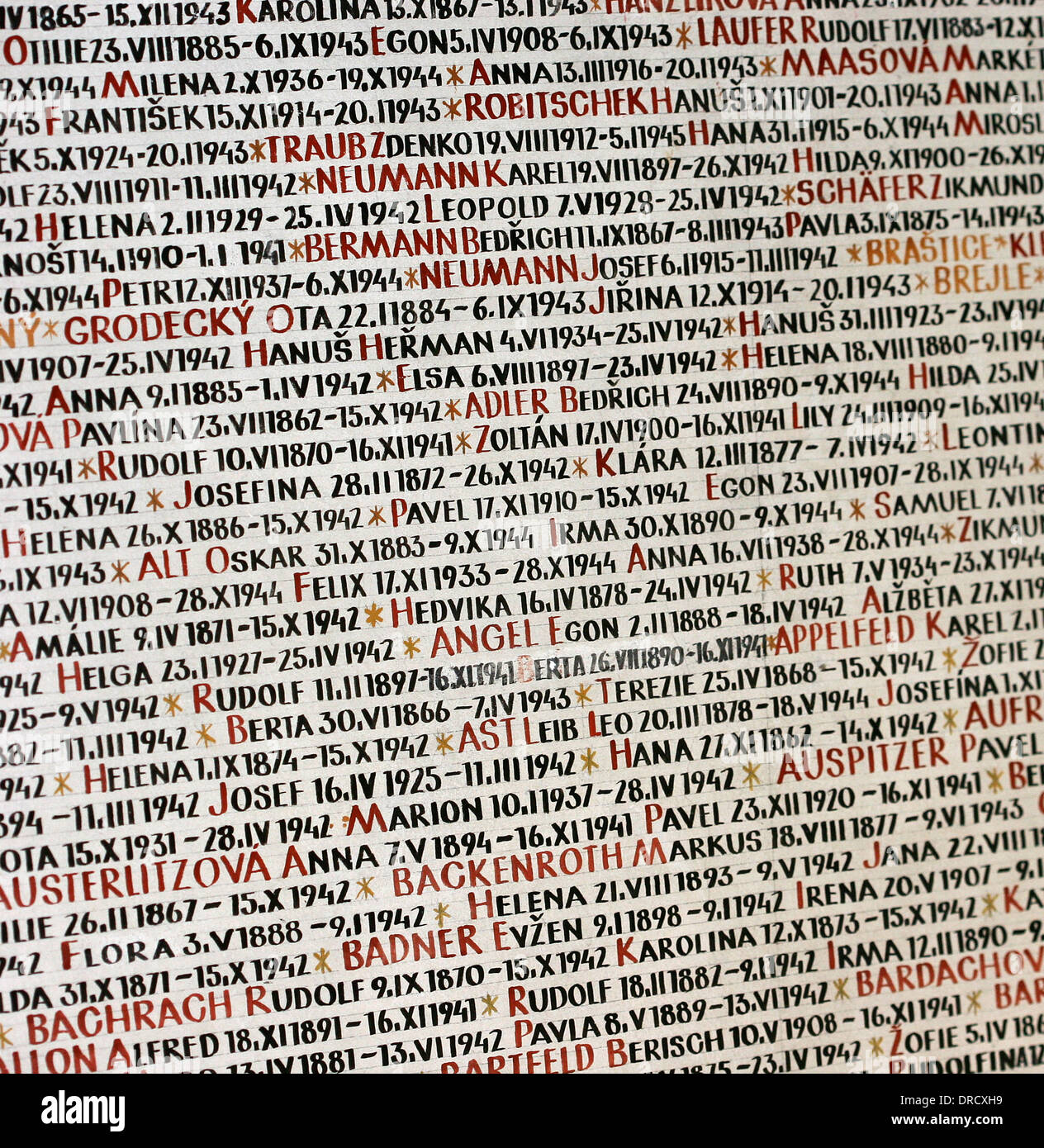

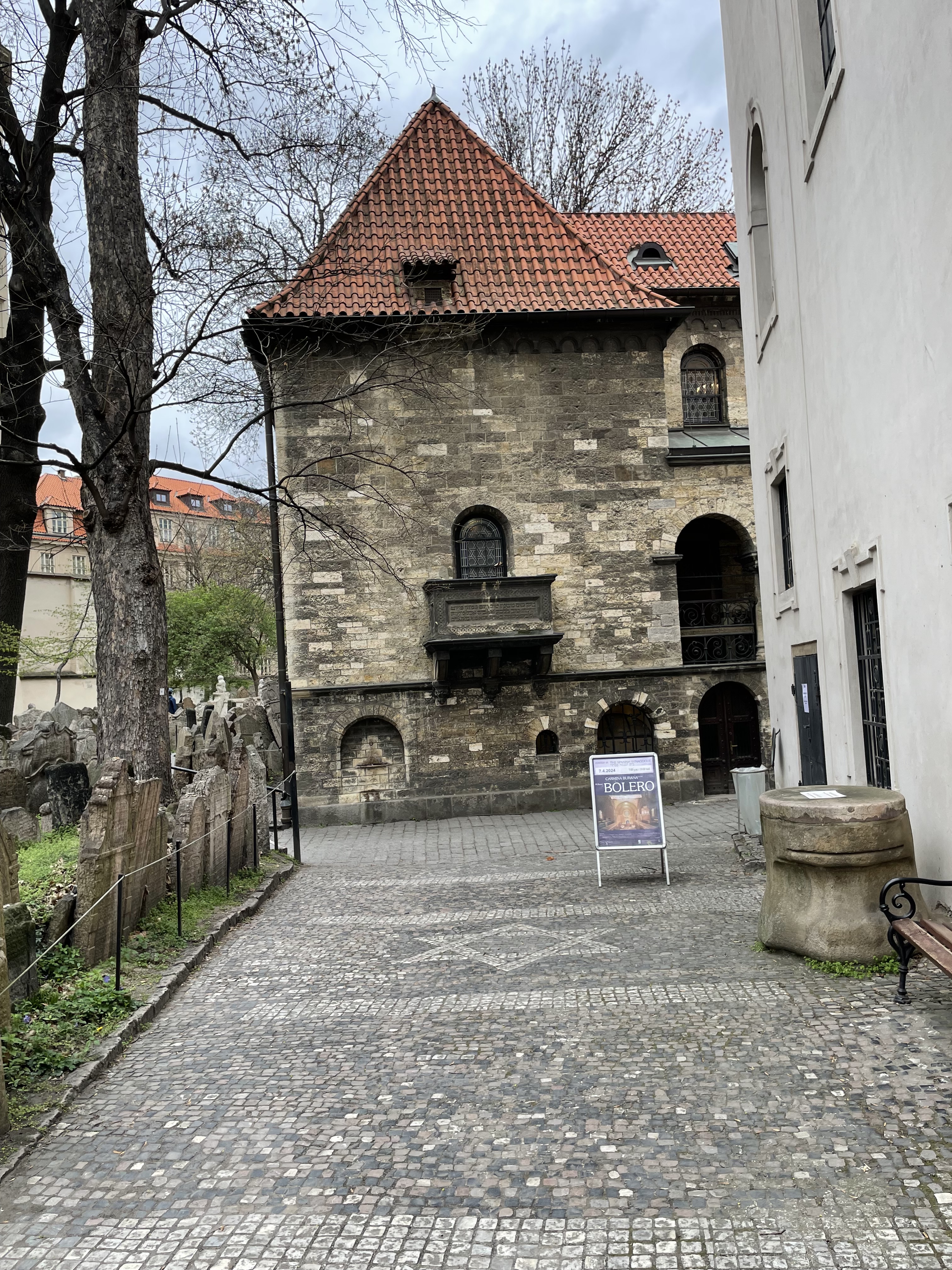


Clockwise: Pinkas Synagogue, Jan Palach memorial, Jewish ceremonial hall, Old Jewish cemetery, Spanish synagogue
The Old Town Hall is actually a medley of a number of buildings of various sizes and ages, stitched together (if I may mix my metaphors) over the centuries. At various times, bits of it were demolished/rebuilt/amended in various ways. In 1945 during the uprising in the city, a couple of wings were destroyed by fire. On another visit, I would be very intrigued to look around this properly.
The Town Hall’s most famous feature is the rather marvellous 15th century Astronomical Clock. We missed its most marvellous moment though as we failed to be there at the right time to see the apostles emerge.
Stolpersteine (Nové Město): four members of the Gotz family. Rudolf was 49, and his wife Marie 48 when they were deported from Prague to Theresienstadt; two years later both were transported to Auschwitz where they were murdered. Their sons Raoul and Harry made the same journeys at slightly different times than their parents. They were 21 and 16 respectively when they were deported, four months before their parents, to Theresienstadt, and then in September 1943, a year before their parents, to Auschwitz.
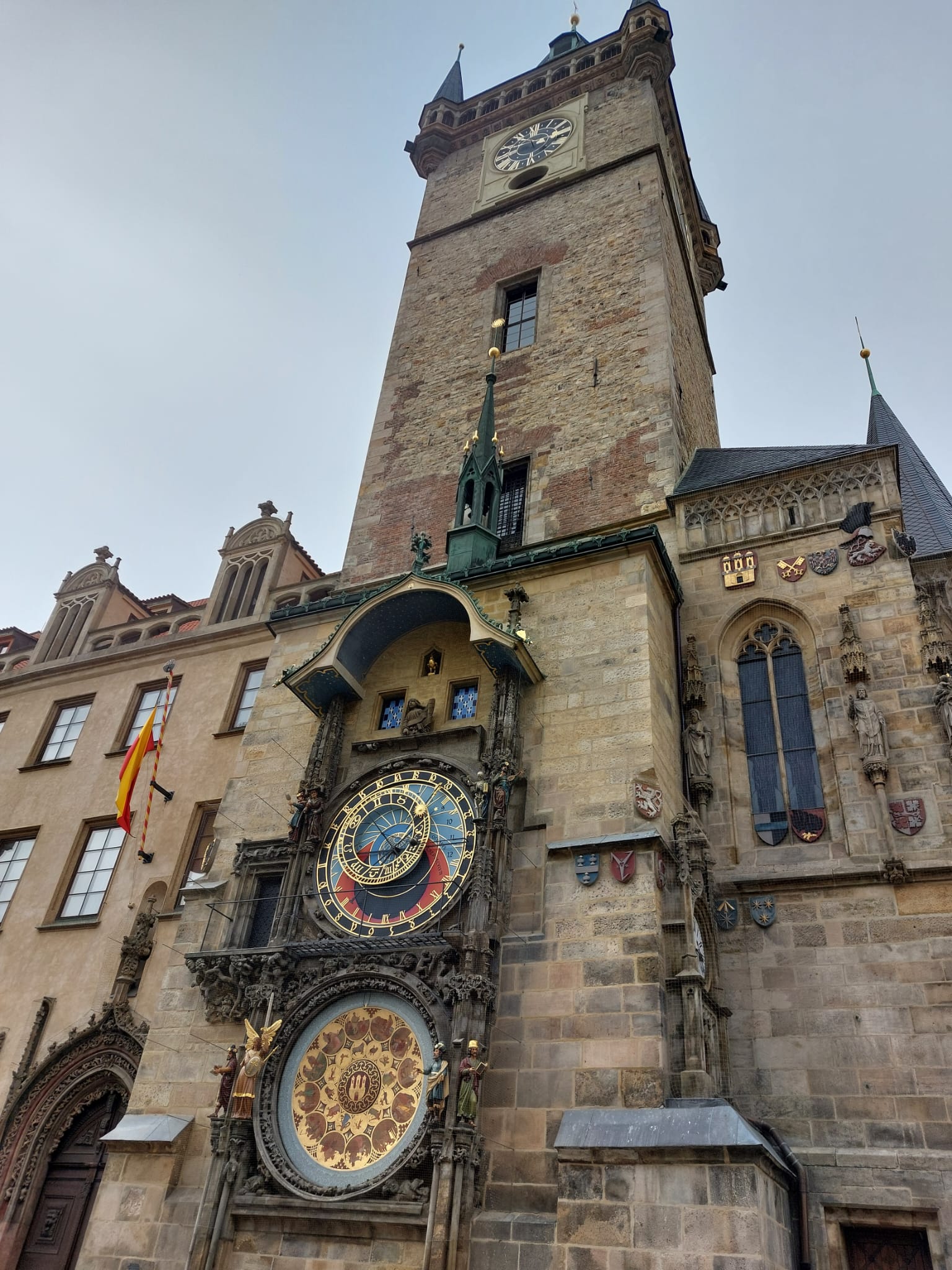


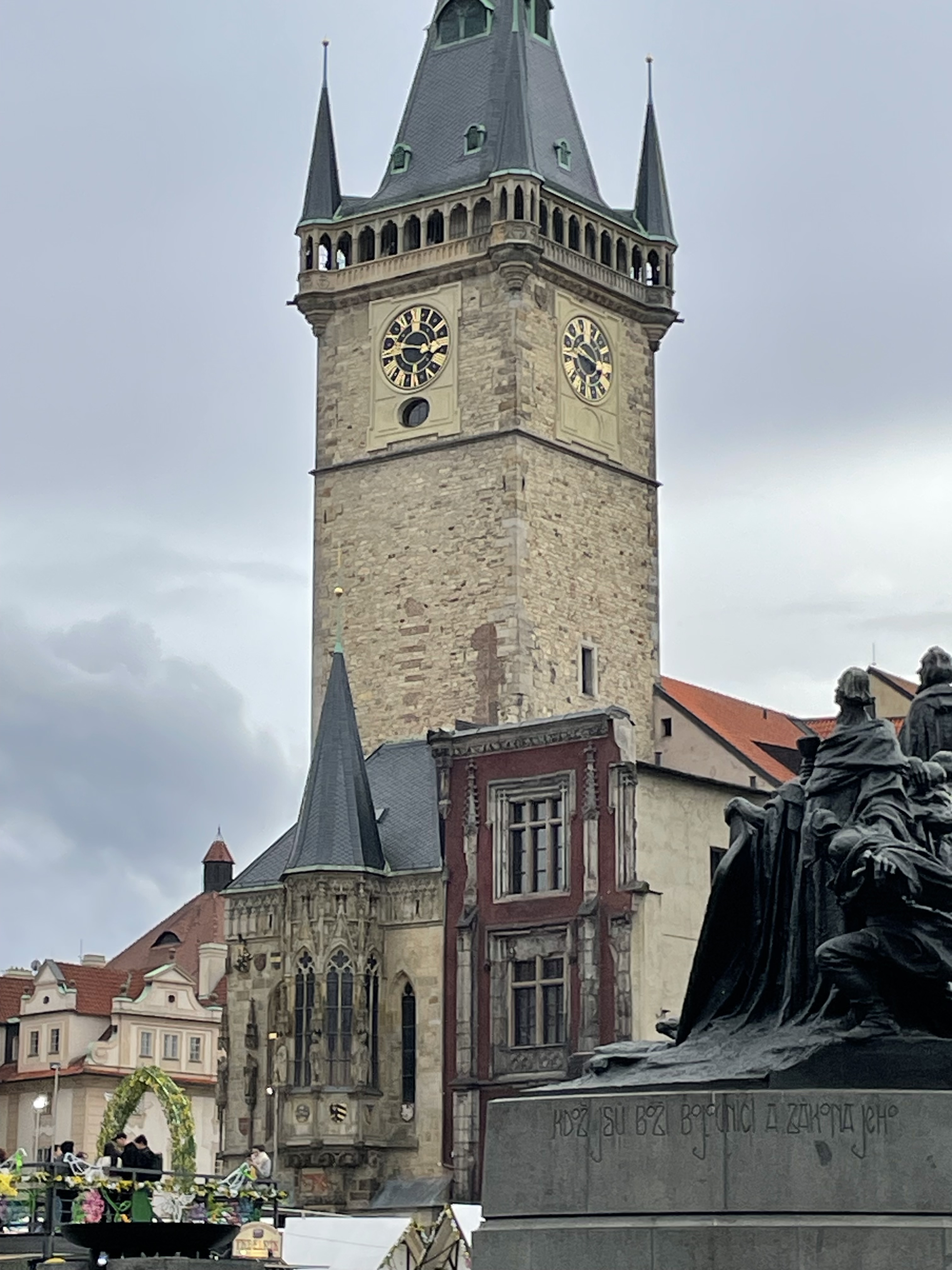
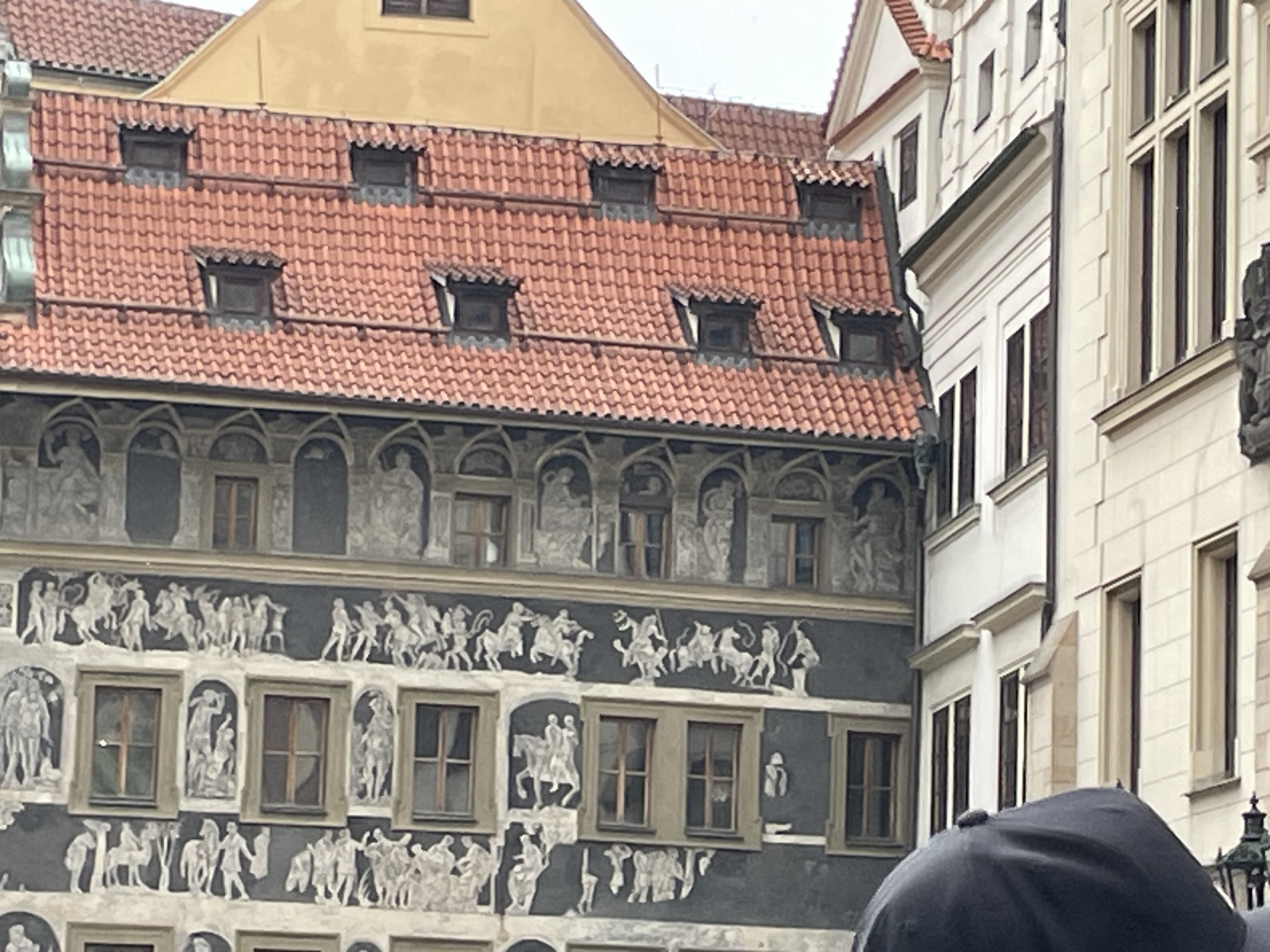
Clockwise: Astronomical Clock, Church of St Nicholas, stolpersteine for the Gotz family, Kranner’s Fountain (monument to Emperor Francis 1 of Austria), the Old Town Hall, Old Town Square
At this point, I consented to return to the hotel and put my feet up, whilst A headed off to the Prague Museum.
Friday:
Day 2 – with my feet properly blister-plastered, and a comfier pair of shoes, we headed (via the tram) to the Prague Castle complex. There’s a lot to see here, and the views of the city are stunning.
We walked through the Royal Gardens, with beautiful buildings around them, including Queen Anne’s Summer Palace. We saw a red squirrel here – I’m honestly not sure that I’ve seen one before, but we then saw another in Berlin.
St Vitus Cathedral – this took nearly 600 years to complete, 1344-1929. One of the final stages involved the installation of the beautiful stained glass. Czech art nouveau painter Alfons Mucha decorated the windows in the north part of the nave, František Kysela the rose window. Even though half of the cathedral is a neo-Gothic addition, much of the 15th century design was incorporated in the restoration.
Going up the Great South Tower was an optional extra which I unhesitatingly declined. I have been frozen with fear on spiral staircases in many of the ancient buildings of Britain, and in the Arc de Triomphe (with a posse of French schoolkids behind me helpfully going ‘Allez! Allez!’). So I let A go up the tower – there were a lot of steps, and it was indeed a spiral, but worth it (he tells me) for the view from the top.
The Basilica of St George is the oldest church building on the castle site, dating from 920.

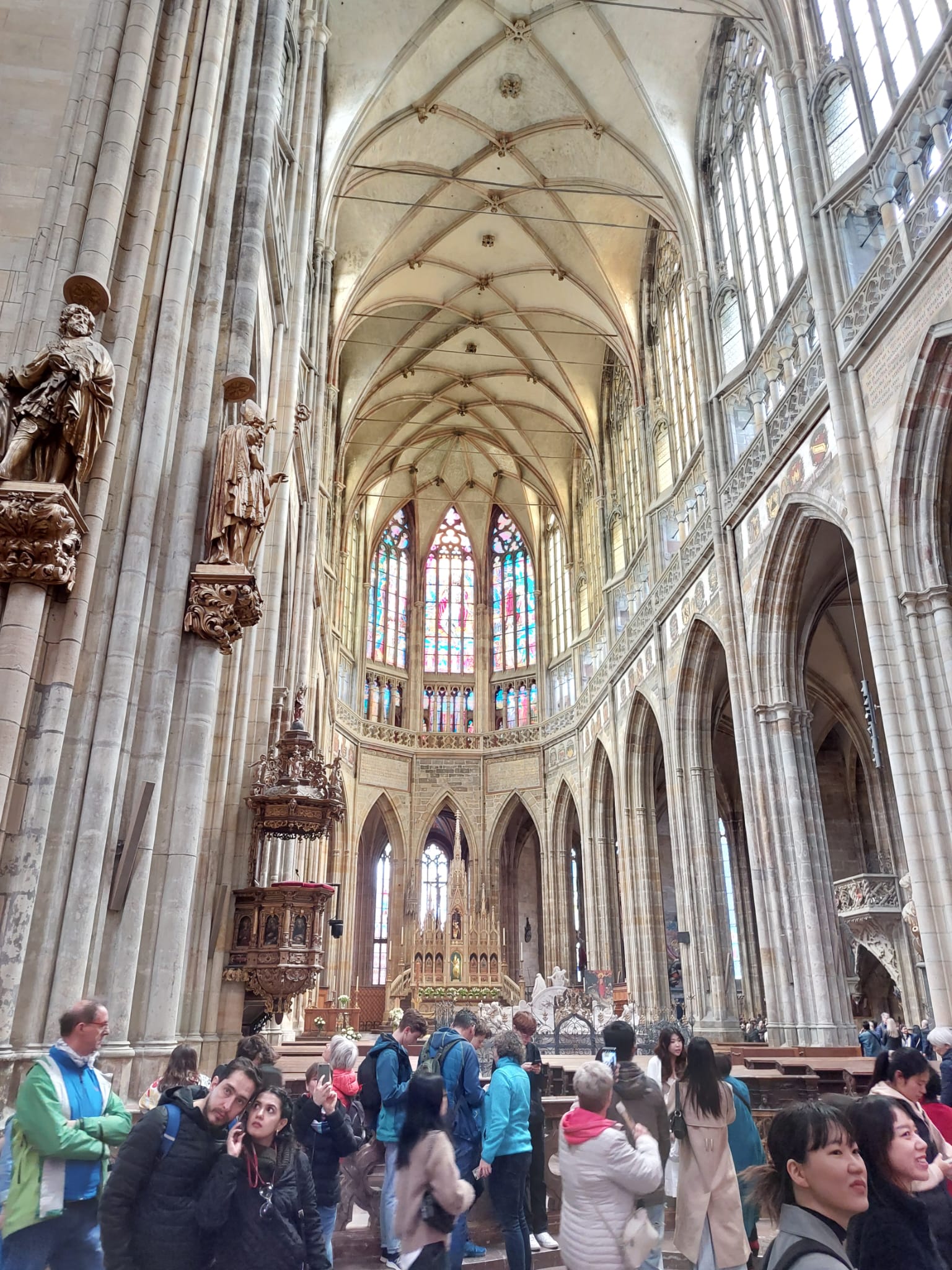


Clockwise: Basilica, Cathedral interior, Cathedral, Great South Tower, Royal Gardens, stained glass in the Cathedral, Chapel of the Holy Cross, Castle interior, Queen Anne’s Summer Palace
Golden Lane is a pretty alleyway of tiny, brightly coloured cottages. These were built for the members of Rudolf II’s castle guard and takes its name from the goldsmiths who later occupied the cottages. Kafka came here in the evenings to write, during the winter of 1916.
12 Šporkova is the building where W G Sebald’s Austerlitz found the apartment that his parents had occupied. The fictional Jacques Austerlitz left Prague in 1938 to come to the UK as part of the Kindertransport. He was brought up without knowing anything of his origins but becomes haunted by the absence of his past and starts to search for information about his parents.
‘The register of inhabitants for 1938 said that Agáta Austerlitz had been living at Number 12 in that year… As I walked through the labyrinth of alleyways, thoroughfares and courtyards between the Vlašská and Nerudova, and still more so when I felt the uneven paving of the Šporkova underfoot as step by step I climbed up hill, it was as if I had already been this way before and memories were revealing themselves to me not by means of any mental effort but through my senses, so long numbed and now coming back to life.’ (W G Sebald, Austerlitz, pp. 212-13)
Austerlitz finds his old neighbour, and learns that his mother was deported to Theresienstadt, and from there to Auschwitz. His father had already left for France before his own escape, and by the end of the book Austerlitz is still searching for information about whether he survived (or how he died).
We didn’t knock to try to go in and see if the hallway and stairs are as Sebald described – in any event, I don’t know whether Sebald himself ever did so. There are a couple of photographs embedded in the text but as always with Sebald, we can’t assume that their positioning tells us what they are. Sebald visited Prague in April 1991, and again in April 1999, at a time when he would have been writing Austerlitz, and it seems likely that he at least did as we did and wandered down Šporkova and looked at the doorway. But did he choose this location arbitrarily, or did he have some information about its past that encouraged him to link it to his fictional protagonist? As always, Sebald mingles fact and fiction in a most fascinating, infuriating, and sometimes highly problematic way (see my PhD thesis for (much, much) more on this topic!).
Estates Theatre – another Sebald connection: Austerlitz’s mother was an actress who performed at the Estates Theatre. It dates from the 1780s, and saw the premieres of Don Giovanni and La Clemenza di Tito, as well as the first performance of the Czech national anthem. It can also be seen in the film of Amadeus during the concert scenes, standing in for Vienna, as it is one of the few opera houses in Europe still intact from Mozart’s time.
I didn’t see the extraordinary Dancing House myself – on day 2 in Prague I again had to bail early (those bloody cobbles), and so A went on alone, to see this building which had intrigued him from the guidebook. The Dancing House, or Ginger and Fred, was designed by architects Vlado Milunić and Frank Gehry on a vacant riverfront plot in 1992 and completed in 1996.



Clockwise: 12 Šporkova, the Dancing House, Estates Theatre, Golden Lane, Prague Museum, Morzin and Thun palaces.
A also visited the Ss Cyril & Methodius Cathedral, site of the last stand of seven members of a Czech resistance group including Jozef Gabčík and Jan Kubiš, who had assassinated Heydrich. They were betrayed, and the church was surrounded by 750 SS soldiers, water pumped into the crypt to try to force them out, until all were killed or had committed suicide. We were both familiar with their story from the film Anthropoid – I’d also read Laurent Binet’s HHhH, and seen the film adaptation of that, The Man with the Iron Heart.
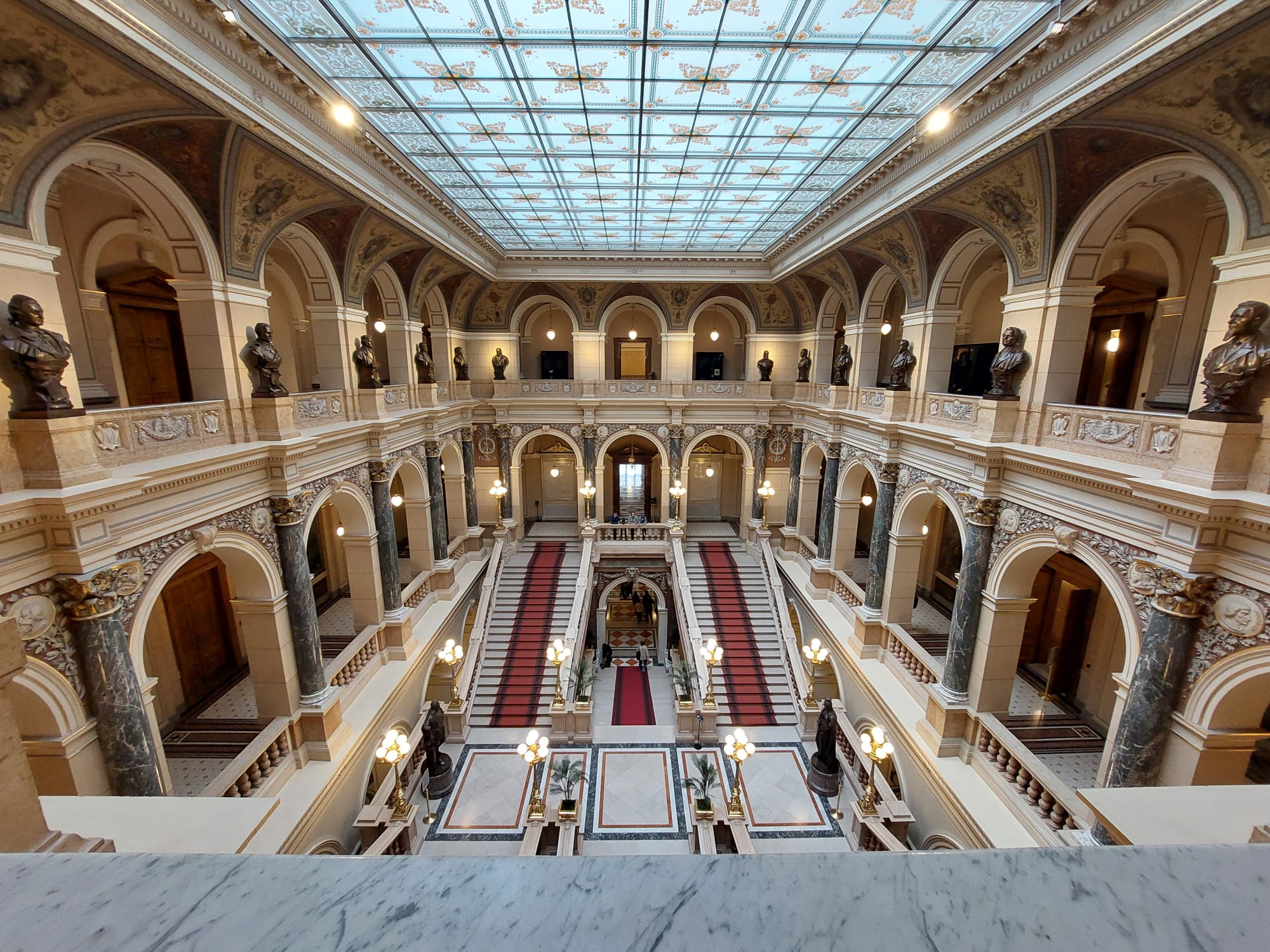
Wenceslas Square, near our hotel. The site of celebrations and demonstrations, and home of the statue of St Wenceslas (this isn’t the original one – that was moved elsewhere in 1879, this one dates from 1912). The National Museum, which A visited on Day 1, is at the top of the square.

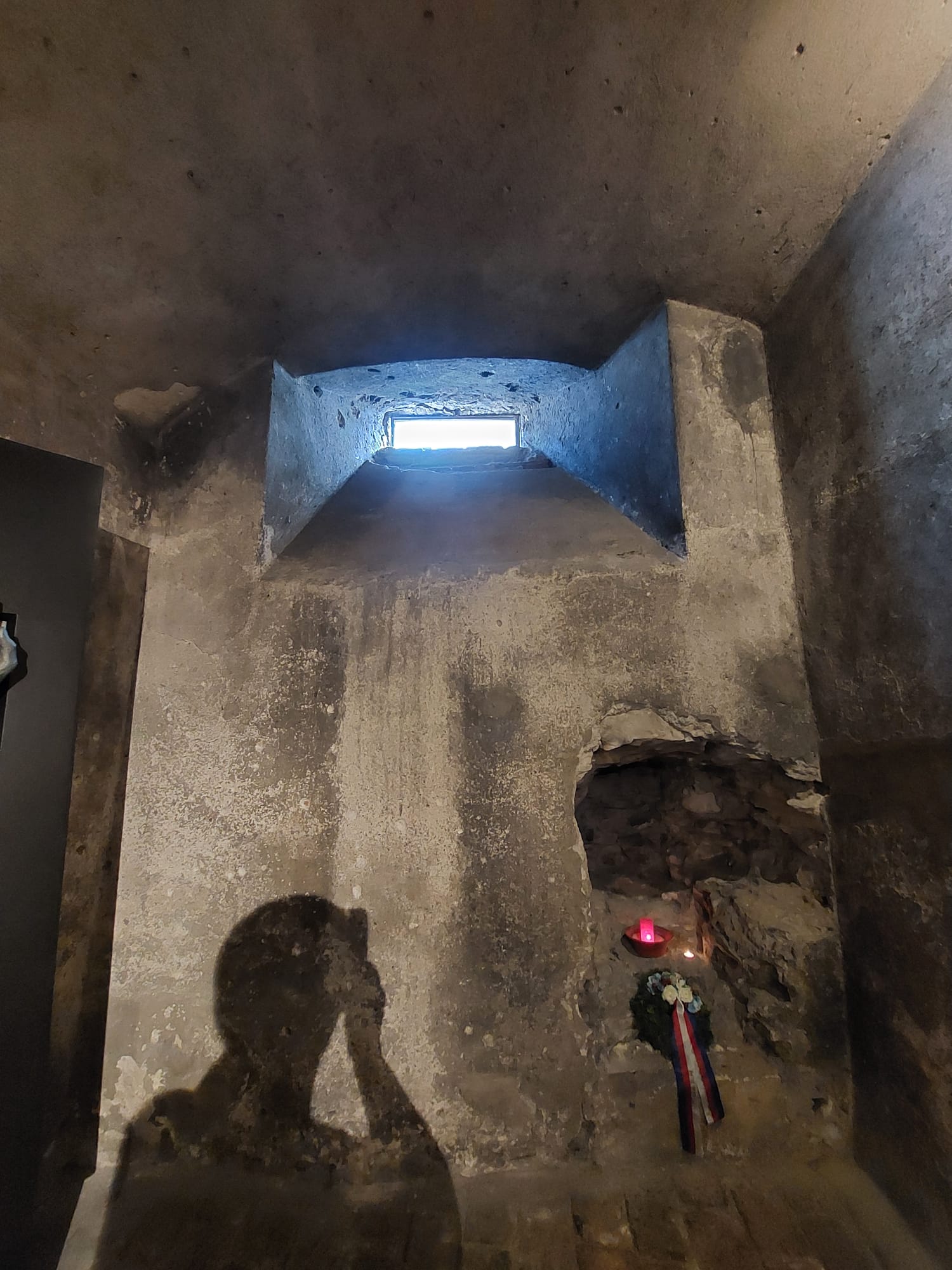
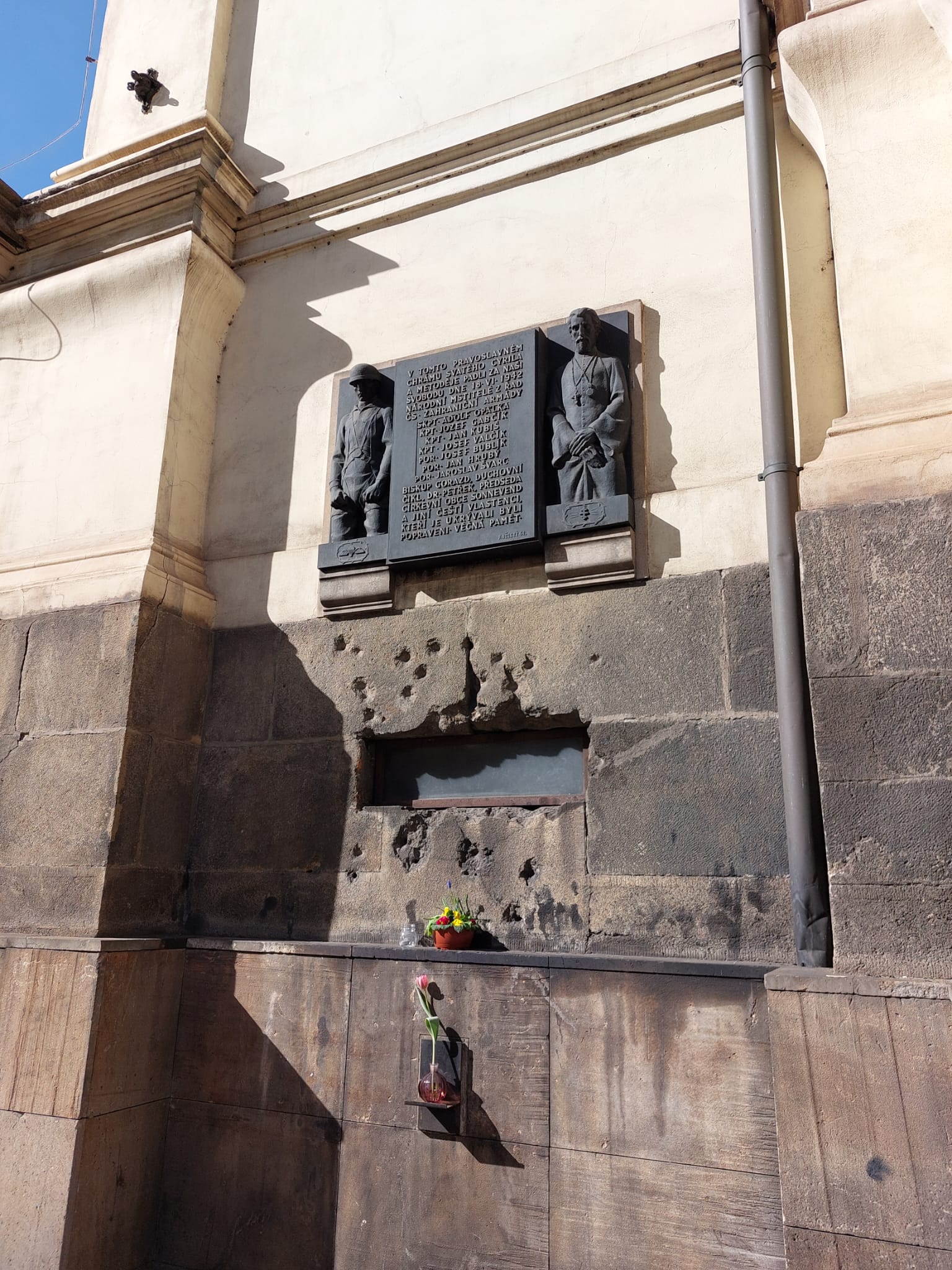


Clockwise: Charles Bridge, the crypt of Ss Cyril & Methodius Cathedral, Memorial to the Czech resistance, Ss Cyril & Methodius, Wenceslas Square, Prague viewed from the Castle
What did we miss? We only saw the modern part of Prague station, not the older building, nor the Kindertransport memorials there. We didn’t get to Petrin, and the funicular railway, the observatory, mirror maze or the mini Eiffel Tower (Rozhledna). But if we come back, we’d probably just spend more time wandering, I think, because there’s something to see around every corner here, not necessarily something grand like in Vienna, but something intriguing, something beautiful, something memorable.
Prague Reading:
Fiction: Lauren Binet – HHhH (a fictionalised account of the assassination of Heydrich); Franz Kakfa – The Castle (it’s not really about Prague Castle but still…); Simon Mawer – Prague Spring; W G Sebald – Austerlitz; Philip Kerr – Prague Fatale; Heda Margolius Kovaly – Innocence (a Prague-set detective noir). Non-Fiction: Anna Hajkova – The Last Ghetto: An Everyday History of Theresienstadt; Heda Margolius Kovaly – Under a Cruel Star (also published as Prague Farewell), her autobiography, covering imprisonment in the Łódź ghetto and Auschwitz, her return to Prague and the judicial murder of her husband during the Slansky show trials, finally leaving after the failure of the Prague Spring; Alfred Thomas – Prague Palimpsest: Writing, Memory and the City (especially Ch. 5 which deals with Sebald’s Austerlitz).
Prague on Film: Anthropoid; The Man with the Iron Heart; Kafka (TV series)
Prague Music: Smetana – ‘Ma Vlast’ is the obvious piece, and a wonderful one, whether one is looking out over the Vltava whilst listening or not and Janacek and Dvorak are composers who have been part of my musical life for so many decades. It’s also important to recognise the work of a number of composers who were deported to Theresienstadt, and who composed and performed music in the ghetto, before being transported to Auschwitz and murdered, notably Gideon Klein, Hans Krása, Viktor Ullmann and Pavel Haas. Inevitably much of the music is lost but what has been recovered can be found on various collections and compilations, as well as on Spotify. I also rather like Martina Trchová, a Prague-born folky singer-songwriter.
BERLIN
Onwards to Berlin. Another train, this one with old-fashioned compartments. A more scenic route than the one between Vienna and Prague (and I’m definitely not talking about the man who emerged from a shrubbery alongside the rail track, naked apart from a beanie hat).
Our hotel was immediately opposite the Hauptbahnhof, but we weren’t able to check in straight away, so we deposited our bags and headed out into the city.
Saturday:
We headed out, noting some striking pieces of political art in Kreuzberg, and the EU project, Path of Visionaries, in Friedrichstrasse, where a floor plaque bearing a quote from someone inspiring is in place for each EU member state, plus UNESCO. I didn’t check whether we had a floor plaque, but when the project was launched in 2006, we were still in the EU…
Berlin’s Jewish Museum is a powerful place to visit, both in terms of its design and its content. We particularly noted the Garden of Exile and Emigration, described here by blogger Gerry Condon:
’49 columns filled with earth are arranged in rows traversed by uneven pathways. The stelae are built on sloping land and rise at an angle, leading to a sense of disorientation similar to that felt inside the museum building. Out of each column grows an Oleaster, an Olive Willow, perhaps symbolizing rebirth. The experience of walking in this structure is comparable to that of being in the Memorial to the Murdered Jews of Europe, but though the Garden of Exile and Emigration is more modest, I think I found it more effective.’ (Gerry Condon, ‘Living with History: A Berlin City Centre Walk’, How the Light Gets In, 25/06/15)
We hadn’t at this point seen the Memorial to the Murdered Jews of Europe, but certainly the Garden was disorienting; I stumbled as soon as I went in and felt off balance whilst I was in there. But there was beauty too, sunlight, and growth.
The corridors in the Museum itself are intersecting and slanting ‘Axes’, and there are a number of voids. We looked down into the Memory Void but didn’t find our way to go into it (it’s the only one of the voids that one can enter), bamboozled by the labyrinth. But from our vantage point we could just see the ‘Fallen Leaves’ (designed by Israeli artist Menashe Kadishman), each with a face punched out of steel and covering the floor of the void so that visitors have to walk over them.
The permanent exhibition is of Jewish past and present in Germany, but there are displays that recognise the diaspora, and the continuity of Jewish life and traditions in the many nations where exiles found a home. We were very struck by the display showing, in a series of long hanging posters, covered in small print, the many, many laws implemented by the Nazi party as soon as they had power, laws covering every conceivable aspect of life for Jews. It didn’t, as we know, start with gas chambers, or even with deportations. It started with minutiae, with things that people initially may have felt they could cope with, and little by little these restrictions isolated the Jewish population from Aryan neighbours, colleagues, classmates, so that they were exposed, without allies (or only those brave enough to take a stand), when everything was finally taken from them.
We also saw an exhibit about Regina Jonas, the first woman Rabbi, born in Berlin and ordained in 1935, an inauspicious year. I hoped initially that she had perhaps been able to leave before it was too late, but a moment’s googling told me what I kind of knew in my bones, that she stayed. She was arrested in 1942 and deported to Theresienstadt, where she continued to work as a rabbi, helped with a crisis intervention service to support newcomers to the camp, and was involved in cultural and educational activities. In October 1944 she was deported to Auschwitz, where she was murdered either on arrival or two months later, aged 42.
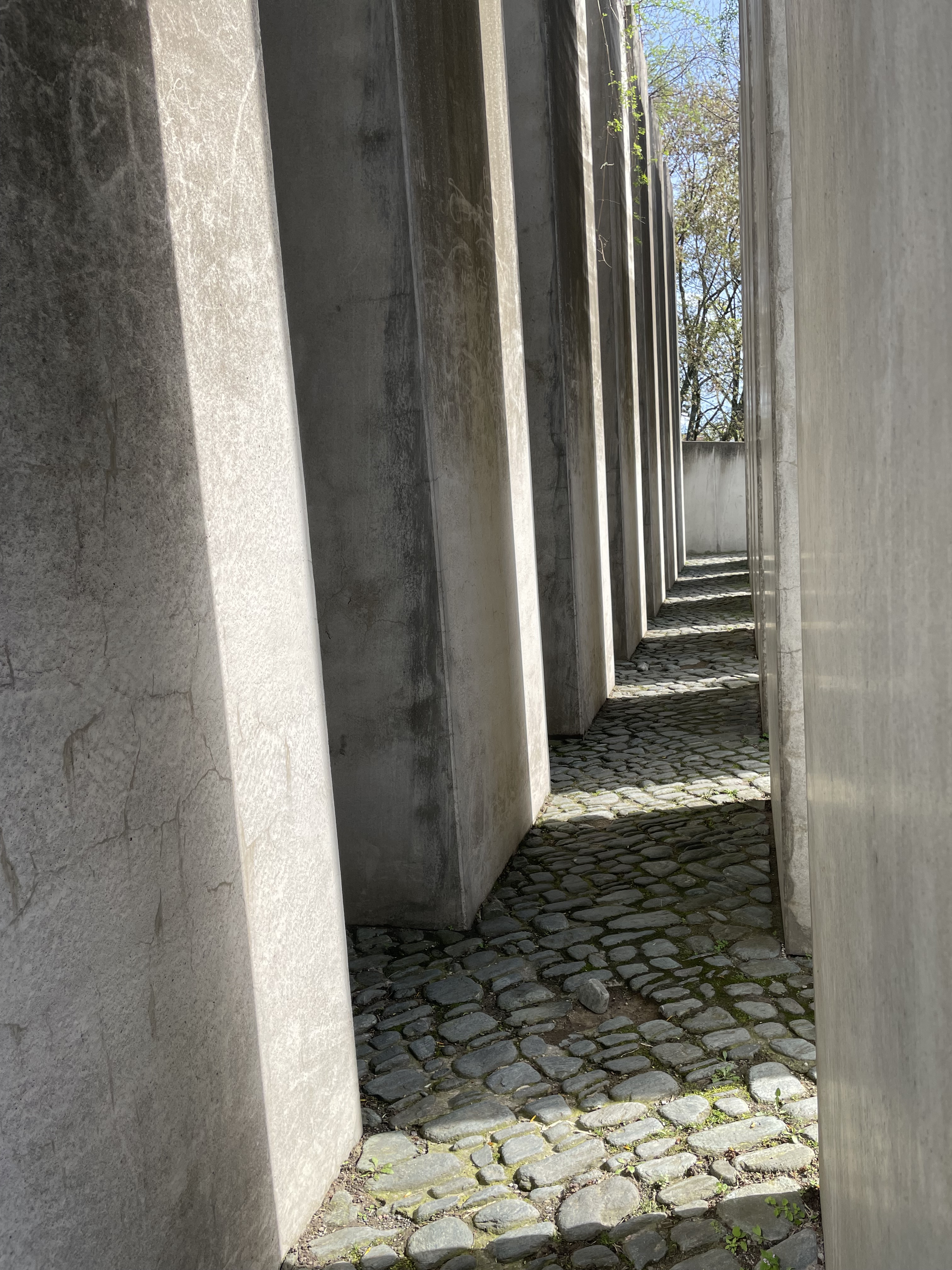


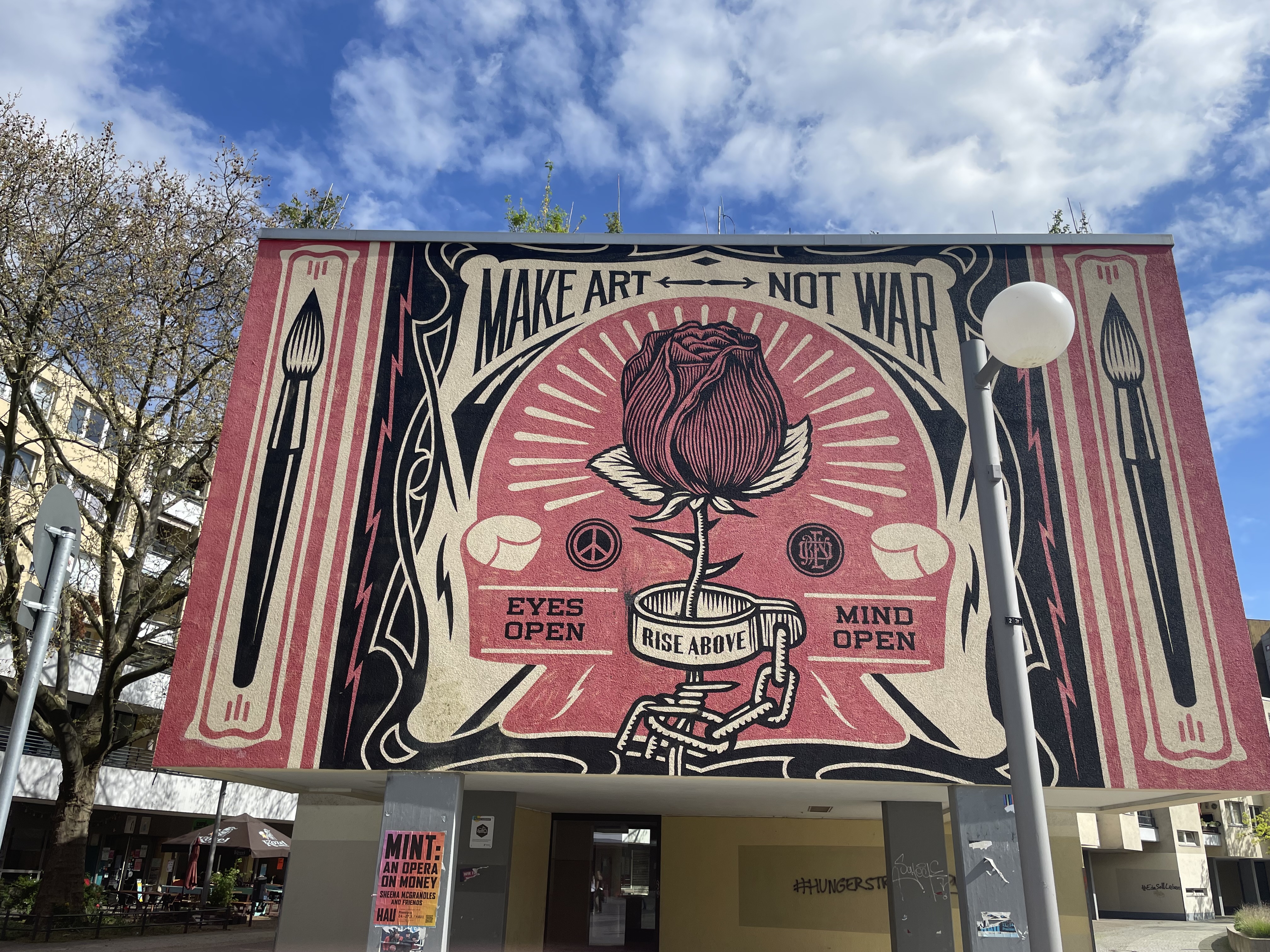
Clockwise: Garden of Exile and Emigration (Jewish Museum), Hotel Amano, Nuremberg laws (Jewish Museum), Path of Visionaries, Regina Jonas, street art
Stolpersteine (Luisenstadt): Hirsch Neumann died 30 Oct 1940, Max Neumann, Rosa Reha Neumann, killed Riga Jan 42; Nathan Moritz Carlé, Charlotte Carlé, Margarete Carlé, Alice Carlé, Theresienstadt, Auschwitz. I was unable to find more information about Hirsch, Max and Rosa Neumann, but the story of the Carlé family is worth recounting:
Nathan and Margarete Carlé lived in Frankfurt when they first married, and their first child, Hans, was born there. They then moved to Berlin in 1900, where their daughters Charlotte and Alice were born. They moved around a fair bit in Berlin as their economic circumstances waxed and waned. In 1942, Margarete and Nathan were deported to Theresienstadt, where Nathan died on 11 October (reportedly of a heart defect). Margarete died of a stroke four months later. Whilst Theresienstadt was neither a death camp nor a work camp, conditions – massive overcrowding, malnourishment, and the spread of disease – killed many of its inhabitants, especially those who were older or otherwise vulnerable, before they could be deported to Auschwitz. Alice, their younger daughter lived with her partner Eva Siewert, until Eva was denounced in 1942 for having made anti-fascist jokes and sentenced to nine months in prison. Alice and her sister Charlotte lodged with Elsbeth Raatz, until threats of denunciation forced them to leave – Raatz, however, gave them false passports. In August 1943, they were arrested by the Gestapo and deported to Auschwitz a few weeks later. Of the 54 people in this transport, only nine women were registered as new arrivals (i.e. selected for work rather than immediate death). We don’t know their names, so we don’t know whether Alice and/or Charlotte were amongst those or had been murdered on arrival in the camp. Alice’s lover Eva survived, and worked as a journalist in Berlin after 1945. Hans Carlé had left Germany in autumn 1933, initially for the Netherlands, and then emigrated to Palestine, where he married. He lived a fairly precarious life in Tel Aviv, and died of a heart condition in 1950, aged 51.
Fernsehturm – we did not go up on this visit (A had already done so on his previous trip to Berlin), but we saw it – obviously, since it is the ultimate photobomber, popping up in almost every photo taken in the centre of Berlin.
We saw but did not go into the Berlin Palace, on Spree Island. A building that would have barely been noticeable in Vienna, where palaces are around every corner, it’s very striking here. But it’s actually a reconstruction. It was damaged by Allied bombers but actually demolished by the DDR government in 1950. In its place was the modernist Palace of the Republic, the DDR Parliament building. After reunification, and after long and arduous debate, the DDR building itself was demolished and most of the Berlin Palace’s exterior was reconstructed. It now houses the Humboldt Forum museum.
Berlin Cathedral, built in the late 19th century, damaged by Allied bombing and subsequently restored.


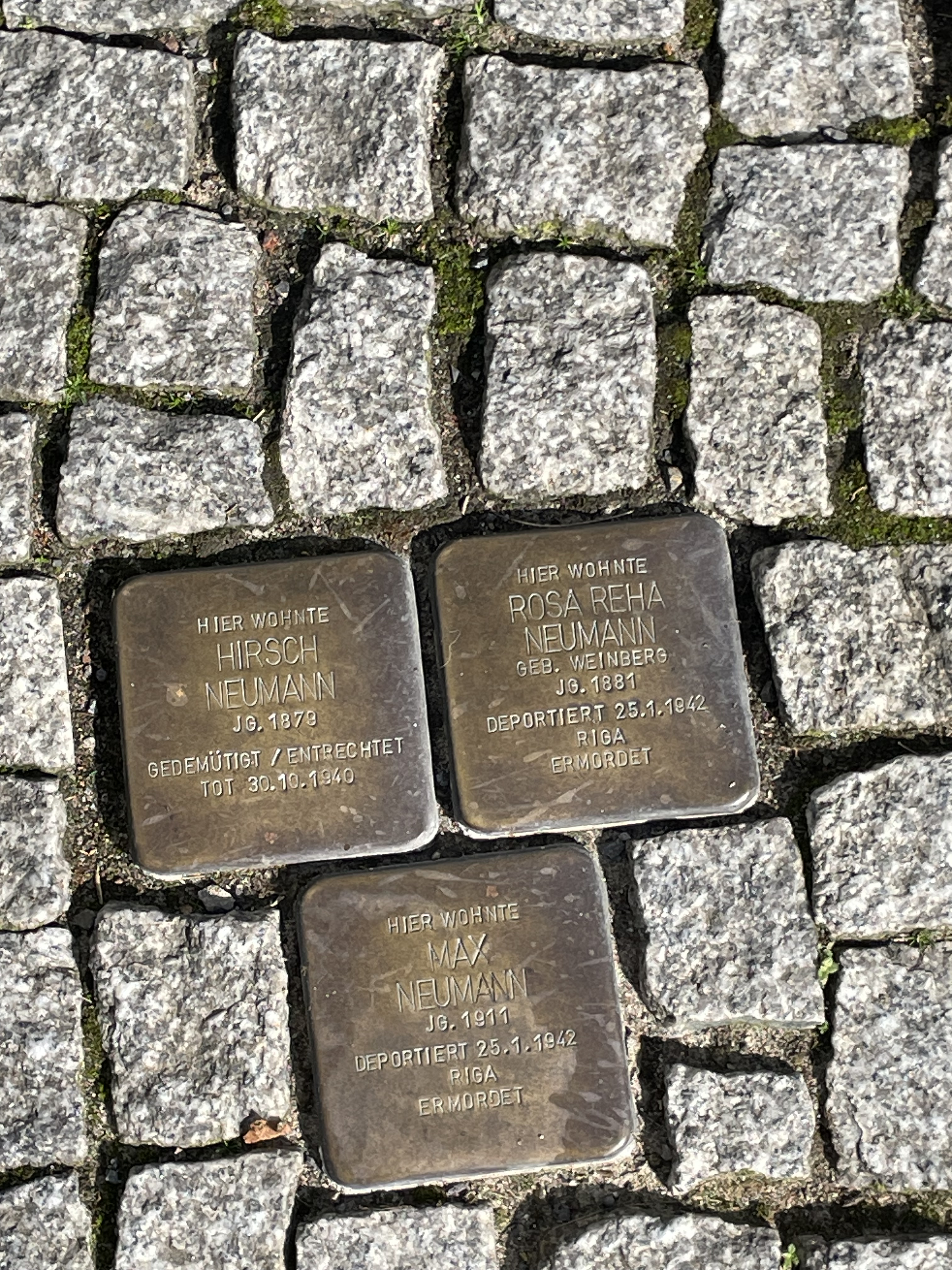
Clockwise: Berlin Cathedral, Berlin Palace, Stolpersteine: Carlé family, Fernsehturm, Humboldt Hafen (the canal harbour), Stolpersteine: Neumann family
Rotes Rathaus, Berlin’s town hall. It was the town hall for East Berlin, and the name ‘red town hall’ indicated not only the colour of the stones, but also the political colour. Mid-19th century, heavily damaged by Allied bombing, and rebuilt.
When we finally got into our room that evening (we’d decided to share, for economy), we were somewhat discomfited to discover that whilst there was, thankfully, a proper door on the toilet, the shower cubicle was all glass, and with a clear view through from the bedroom area, enhanced by the enormous mirror on the wall opposite the shower, just to make sure that the showerer would be visible from almost all points in the room, in all their glory. We devised a plan whereby the showerer would give a warning that clothes were about to be shed and the non-showerer would settle at the furthest top corner of the bed, facing the wall, and focusing intently on their phone or Kindle until the all-clear was sounded. We have since learned that this sort of thing is dismayingly common in modern hotels, in parts of Europe at least, and we don’t think much to it…
Sunday:
We headed for the Tiergarten but hadn’t fully realised the impact of the Berlin Half Marathon, which was taking place that morning. Our original route was quite impossible, so we only got a brief stroll through the Tiergarten before having to exit.
Reichstag – we’d tried to book a tour, but had evidently left it too late, or tours were unavailable due to the half marathon. Another time.
Marie Elisabeth Lüders House (Scientific dept of German govt) – On the banks of the Spree are memorials to people killed trying to cross to the West. This new building, inaugurated in 2003, owes its name to social politician and women’s rights campaigner Marie Elisabeth Lüders. Parts of the Berlin Wall have been rebuilt here to commemorate the division of the city along the former route of the Wall.
We failed to do justice to Museum Island but did go round the Alte Nationalgalerie. The problem with galleries is that once one has been through a number of rooms of paintings, it’s hard to remember exactly what one has seen, and to keep in mind the things that one particularly enjoyed and I really wish I’d made some notes. As far as I can recall, we rather liked the Romantics and the Impressionists, and I think Arnold Bocklin and Caspar David Friedrich stood out.
Solidarność wall – a section of brick wall from the shipyard at Gdansk commemorating the struggle for democracy in Poland through the Solidarity movement. I cannot find any information online about this, oddly. It’s adjacent to the Reichstag building.


Clockwise: Altenationale Gallery, Altes Museum, Reichstag, Rotes Rathaus, Solidarity wall, memorial to those killed attempting to cross from East Berlin (Marie Elisabeth Lüders House)
The Brandenburger Tor was the finishing line for the Half Marathon, and our arrival coincided with the first runners crossing the line, so we stayed and cheered for a while. Of course it is one of those sites that is iconic (a much over-used word, but here I mean that as an image it stands for Berlin in the same way that the Eiffel Tower stands for Paris), and I’ve seen it a lot recently, in coverage of the Euros. What seems remarkable is that it survived the final stages of the war, damaged but still standing, whilst so much of Berlin was reduced to rubble. Also remarkable is that shortly after the war, East and West Berlin cooperated in repairing some of the damage. Thereafter it was obstructed by the Wall and became a symbol of the city’s division – and then of its reunification after the Wall came down.
We had lunch with my friend Veronika, which was a brilliant opportunity to talk about all three of the cities we’d visited – she’d grown up and then worked in Vienna, now works in Berlin, and had visited Prague often, so it was fascinating to get her perspective on our experiences and to catch up on what had been happening since we met in December 2019.
After lunch, on to the Memorial to the Murdered Jews of Europe:
‘Two thousand seven hundred eleven concrete rectangles, as if a field of chiselled coffins of varying heights stand in formation, separated by just enough space for people to walk between them and contemplate their meaning. The stones undulate and dip towards the centre, where the ground hollows out, so that when a visitor reaches the interior, the traffic noise dies away, the air grows still, and you are trapped in shadow, isolated with the magnitude of what the stones represent. This is the memorial to the Murdered Jews of Europe who perished during the Holocaust. There is no sign, no gate, no fence, no list of the 6 million. The stones are as regimented as the Nazis and as anonymous as the captives shorn of identity in the concentration camps.’ (Isabel Wilkerson – Caste, pp. 343-4)
Opinions, as one might expect, differ about this memorial, about its purpose and the form it takes. I was surprised how similar that form was to the Garden in the Jewish Museum, although it is bleaker, somehow. But whatever form the memorialisation of the Holocaust takes, some will find it does not speak to them, or will question its location or how it presents itself (of course some will question the need for such memorials, but that question seems to me obscene in its ignorance). I did find it effective and oppressive, and the scale is very striking (the Garden does not attempt to convey that), and I applaud the use of the term ‘murdered’ here. When we speak of people dying in the Holocaust, or being killed, we diminish what was done. One might die of anything; one might be killed in a car crash. Whether through bullets or gas, disease or starvation, these deaths were planned and intentional, they were murder on an unimaginable scale.
Topography of Terror Museum, on the site of the Gestapo/SS headquarters, and one of the longest extant sections of the Wall. We didn’t exhaust this because we (or at least I) were, frankly exhausted. But we saw the open-air part of the museum, and the remains of some of the walls of the buildings once occupied by the Gestapo. It was an excellent display – much that I did not know or had not understood in context.
‘Had to get the train
From Potsdamer Platz
You never knew that
That I could do that
Just walking the dead’ (David Bowie – ‘Where Are we Now’, The Next Day, 2013)

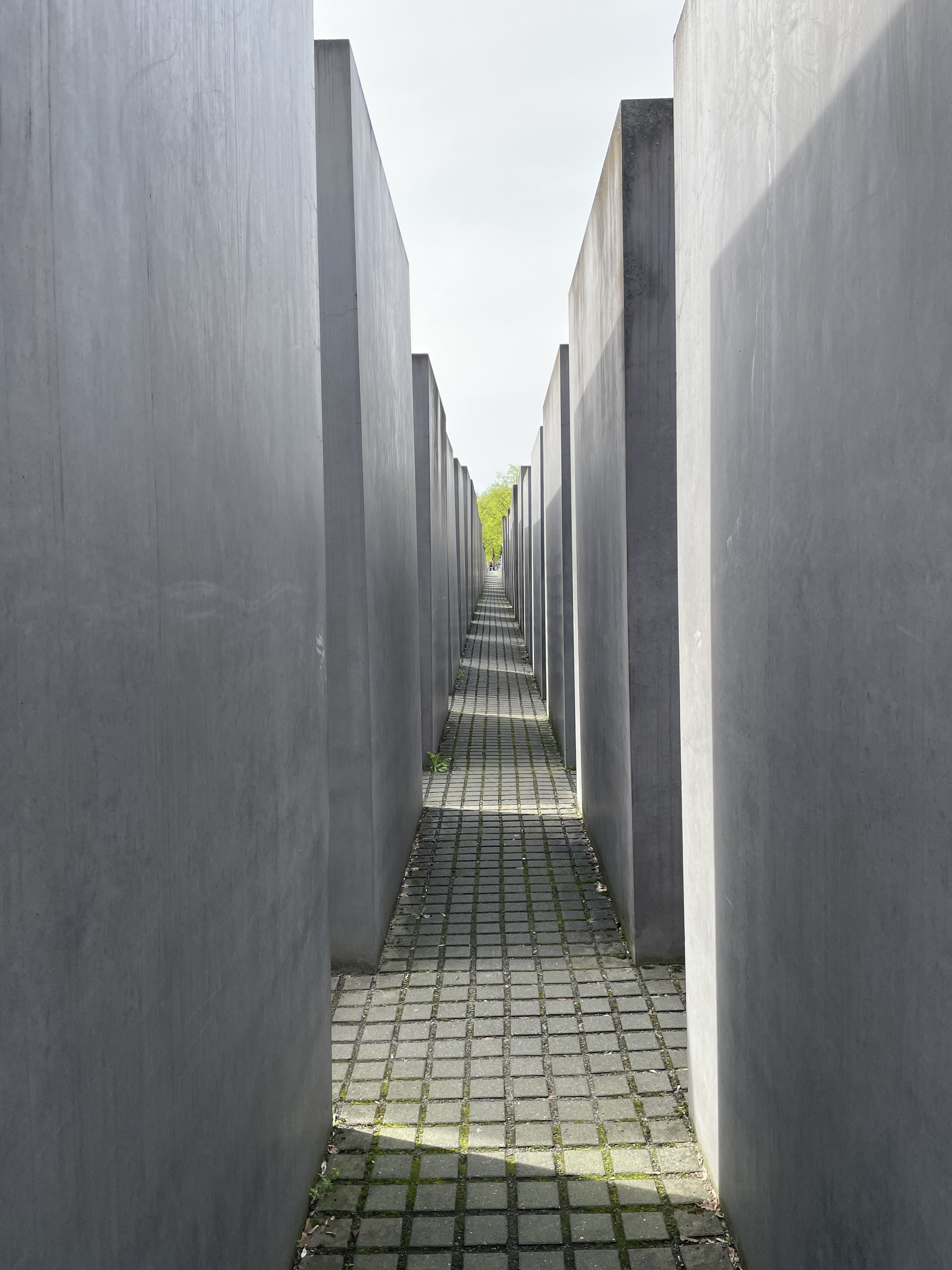


Clockwise: Brandenburg Gate, Memorial to the Murdered Jews of Europe, Potsdamer Platz, Tiergarten, Topography of Terror
What did we miss? More here than elsewhere, partly because there’s more to see, but also because our planned route for Sunday was disrupted by the Half Marathon, and to be honest, because we were knackered. If/when I go back, there are several museums to see, and I’d particularly like to focus more on the post-war DDR history – the Wall, the Stasi, etc – as well as doing the Reichstag tour, and going up the Fernsehturm for the sake of the view.
Berlin Reading:
Fiction: Christopher Isherwood – Goodbye to Berlin; Philip Kerr – Berlin Noir trilogy; John le Carré – The Spy Who Came in from the Cold. Non-fiction: Walter Benjamin – Berlin Chronicle; Sinclair McKay – Berlin: Life and Loss in the City that Shaped the Century
Berlin on Film: Wings of Desire; The Resistance; The Lives of Others; Cabaret
Berlin Music: Obviously, there is plenty of ‘classical’ music from composers who were born in or who studied in Berlin. But the soundtrack in my head was made up of the voices of Marlene Dietrich, Lotte Lenya, and David Bowie.
Final thoughts
Seeing three cities in six days invites one to make direct comparisons.
Vienna was grand, and beautiful, seemingly fixed in the nineteenth century, before all of that mid-twentieth-century unpleasantness. My response to the city was coloured by a conversation with a neighbour whose father, it turned out, had grown up there, but had had to leave, along with his family – of those who remained, many were murdered. She felt it was a soulless place, cold and hostile to her which, in a fundamental way it was – had her father not escaped it, she would probably not have existed. Another friend, who grew up in Vienna much more recently, spoke of it as claustrophobic, particularly for a teenager. So we admired its beauty but did not fall in love.
Prague is older, more of a muddle of labyrinthine streets and architectural styles, but just as beautiful in its own, less grand, way. And in the Jewish quarter of the city it acknowledges both the long history of that community, and how that was destroyed, in a simple and moving way, through the names and what that list of names conveys, rather than anything monumental. Prague took our hearts.
Berlin has, of course, a lot more to acknowledge, and it does so in various powerful ways. It leaves gaps, it leaves fragments.
‘Berlin is a naked city. It openly displays its wounds and scars. It wants you to see. The stone and the bricks along countless streets are pitted and pocked and scorched; bullet memories. These disfigurements are echoes of a vast, bloody trauma of which, for many years, Berliners were reluctant to speak openly. … The city itself is long healed, but those injuries are still stark.’ (Sinclair McKay, Berlin, p. xvii)
Its history is so complex and reflects not just one nation but two in the one city, as well as reflecting upon not just Germany (one or both) but what was done to so many in the name of that nation. There are layers upon layers to explore – and we inevitably did scant justice to that.
But we knew that seeing three cities in six days – three cities chosen because of their complex and fascinating history, their beauty and tragedy – was going to leave us with almost as long a list of things that we missed as our original list of things we wanted to see. Some of those omissions were choices – we favoured wandering around the streets over excursions that would take too big a chunk of our time, and I’m glad we did. I missed some things because I reached the end of my capacity for walking rather sooner than A did, and decided to conserve energy for the following day by a strategic withdrawal to the hotel room a little earlier than we’d intended. And there are things that we hadn’t even added to our list, that we’d include next time.
But we saw a heck of a lot, we walked for 57 miles, and I clocked up 135k steps, and we saw museums and art galleries, cathedrals, churches and synagogues, a cemetery, palaces, memorials, statues and fountains, parks and government buildings, paintings and stained glass windows, stolpersteine and commemorative plaques, three great rivers (the Danube, Vltava and Spree), street art, theatres and opera houses, bridges… We sampled the local culinary specialities (schnitzel, apfelstrudel, goulash, pork knuckle, various forms of sausage) and the local beers.
It was a trip that I dreamed up and I was afraid it wouldn’t live up to that dream, but it did, it was everything that I had hoped it would be. When we got home, it almost seemed dream-like – had we really seen and done all of that? Hence this epic blog – I needed to capture it all before memories got too hazy. I could not have done it without A and his company was not only practically essential, but also a joy. I am hugely grateful to him for making that dream a reality.
This new Hades
Posted by cathannabel in Michel Butor, The City, W G Sebald on July 1, 2016
(This is an edited version of a talk given at the ‘Everywhere & Nowhere’ postgraduate symposium of the Landscape, Space & Place group at the University of Nottingham, on 20 June 2016)
It might seem odd to posit the city of Manchester as an imagined place. However, from the beginnings of its rapid growth in the early years of the Industrial Revolution, the real city was mythologised by the many from around these islands and beyond them who came to see the miracle or shock city of the age. Manchester in the Industrial Revolution became an archetype of both shock and wonder, awesome and awful at the same time. As it grew, with remarkable speed and with no discernible plan, it attracted comparisons both with the greatest of human and divine achievements, and with the works of the devil.
For Disraeli it was ‘as great a human exploit as Athens’, for Carlyle, ‘every whit as wonderful, as fearful, as unimaginable, as the oldest Salem or prophetic city’. Many accounts, alongside these exalted descriptions, acknowledge the dichotomy – for example this from the Chambers Edinburgh Journal of 1858:
Manchester streets may be irregular, and its trading inscriptions pretentious, its smoke may be dense and its mud ultra-muddy, but not any or all of these things can prevent the image of a great city rising before us as the very symbol of civilisation, foremost in the march of improvement, a grand incarnation of progress.
Alexis de Tocqueville too was able to recognise both extremes. In Manchester ‘the greatest stream of human industry flows out to fertilise the whole world. From this filthy sewer pure gold flows. Here humanity attains its most complete development, and its most brutish; here civilisation works its miracles, and civilized man is turned back almost into a savage.’
Overall though the majority came down on the ‘awful’ side of the divide. Even Mrs Gaskell, who was a local, described the impression of the men working in the factories as ‘demons’. For others it was ‘a Babel in brick’, a ‘revolting labyrinth’, and its river was ‘the Styx of this new Hades’.
There were particular aspects of Manchester that inspired these reactions. De Tocqueville said that:
Everything in the external appearance of the city attests the individual powers of man; nothing the directing power of society. At every turn, human liberty shows its capricious force.
Whereas some cities’ growth can be illustrated by an expanding grid, or like Paris by the addition of layer upon layer of suburbs, Manchester grew organically, cramming factories and workers’ housing into whatever space was available, without much consideration of the living conditions that would result, minor things such as sanitation, for example, and the outcomes were grim.


Manchester was thus characterised as ‘a vast unknowable chaos’, illustrated by the invocation of Erebus, in Greek mythology the personification of darkness, born of Chaos, who inhabits a place of darkness between Earth and Hades. So we have descriptions of chimneys ‘belching forth clouds of Erebean darkness and dirt, as if they had a dispensation from the devil’.
Hippolyte Taine records that ‘in the city’s main hotel, the gas had to be lit for five days: at midday one could not see clearly enough to write.’ The darkness was noted well into the 1950s. There were two factors here, not only the constant smoke from the chimneys but the moist air and relatively flat terrain, which meant that ‘the acid and other impurities become dissolved in the moisture, and the black parts of the smoke become wet and heavy’. This combination created the ‘terrifying Manchester fogs … when the phenomenon of temperature-inversion produced near darkness and zero visibility around the clock for days on end’.
The pollution had other effects. Sir James Crichton Browne (1902) rather marvellously described how ‘A sable incubus embarrasses your breathing, a hideous scum settles on your skin and clothes, a swart awning offends your vision, [and] a sullen cloud oppresses your spirits’.
There is a kind of trope of ‘first view of Manchester’ which strengthens the sense of an archetype, a mythical place. For example:
Alexis de Tocqueville – Voyages en Angleterre, Irlande, Suisse et Algerie (1835): A sort of black smoke covers the city. The sun seen through it is a disc without rays. Under this half daylight, 300000 human beings are ceaselessly at work. A thousand noises disturb this damp, dark, labyrinth.
Hugh Miller – First Impressions of England and its People (1847): One receives one’s first intimation of its existence from the lurid gloom that overhangs it. There is a murky blot in one section of the sky which broadens and heightens as we approach, until at length it seems spread over half the firmament. And now the innumerable chimneys come in view, tall and dim in the dun haze, each bearing atop its own troubled pennon of darkness.
Mrs Gaskell – North & South (1855): For several miles before they reached Milton, they saw a deep, lead-coloured cloud hanging over the horizon in the direction in which it lay.
Hippolyte Taine – Notes sur l’Angleterre (1874): We approach Manchester. In the copper sky of the sunset, a strangely shaped cloud hangs over the plain; beneath this immobile cover, the high chimneys, like obelisks, bristle in their hundreds; one can distinguish an enormous dark mass, the vague rows of buildings, and we enter the Babel of brick.
W G Sebald, The Emigrants (1992)
Max Ferber’s arrival in 1945: From a last bluff he had had a bird’s eye view of the city spread out before him … Over the flatland to the west, a curiously shaped cloud extended to the horizon, and the last rays of sunlight were blazing past its edges, and for a while lit up the entire panorama as if by firelight or Bengal flares. Not until this illumination died … did his eye roam, taking in the crammed and interlinked rows of houses, the textile mills and dying works, the gasometers, chemical plants and factories of every kind, as far as what he took to be the centre of the city, where all seemed one solid mass of utter blackness, bereft of any further distinguishing features.
The narrator’s arrival in 1966: By now, we should have been able to make out the sprawling mass of Manchester, yet one could see nothing but a faint glimmer, as if from a fire almost suffocated in ash. A blanket of fog that had risen out of the marshy plains that reached as far as the Irish Sea had covered the city, a city that spread across a thousand square kilometres, built of countless bricks and inhabited by millions of souls, dead and alive.
What strikes the observer in each case is that where they should be able to see the city, instead they see a pall of black smoke, a ‘murky blot’ in one part of the sky, a strangely shaped cloud that hangs over it. Coming closer they see the chimneys, each with its ‘troubled pennon of darkness’ and closer still the mass of buildings, the black river, the sombre brickwork. It’s also worth noting the striking similarity between Sebald’s description of Max Ferber’s first view of the city, and Hippolyte Taine’s.


Another feature attributed to Manchester which led to associations with hell or at least a cursed place was the absence of native flora and fauna. Birdlife was largely absent at the height of industrial activity, and much restricted later, until the Clean Air act created a more hospitable environment. And attempts to create parks, to give the inhabitants a taste of the countryside were doomed as trees and shrubs and blooms were poisoned by the fumes.
These conditions were not unique to Manchester. The industrial cities of the North East inspired John Martin’s apocalyptic paintings, and those of the Black Country Tolkien’s vision of Mordor.


And there’s an intriguing apocalyptic story published in the Idler magazine in 1893 about the doom of London, resulting from a seven day fog, with no wind to clear it, suffocating all of the inhabitants. But Manchester seemed to exert a particular fascination – the scale and the extremity of the conditions in the city drew visitors from across the country and from Europe. As Tristram Hunt says, in his study of the Victorian city, ‘in Manchester it was always worse’.
By the 1950s some of the most notorious slums had disappeared, and proper sanitation had long since removed the threat of cholera and typhus. But the fogs were still extreme, the air still heavy with smoke and metallic tasting vapours, the rain still a near-constant. In addition to the effects of pollution, there were areas of wasteland, bomb sites from the war, not yet redeveloped.
Michel Butor’s novel L’Emploi du temps, published 60 years ago, transformed Manchester into Bleston, and used its mythology to imbue its rain-drenched streets with a sense of dread and danger. Taking elements of the real city he subverts its mundane reality so that Manchester becomes Babel, Babylon, Daedalus’ labyrinth, a Circe or a Hydra. It also becomes Paris under Nazi occupation.
Michel Butor arrived in Manchester in 1951, straight from a spell teaching in Egypt. He was, as he described it, inundated with sun, and then plunged into Mancunian darkness. It was a climatic shock, and the very features of the city which had inspired earlier writers to flights of heightened prose and invocations of hell were to influence his response.
Darkness, fog, mud and soot, rain. These elements feature on almost every page of his novel, L’Emploi du temps (Passing Time), in which the city is renamed Bleston. So far, so realistic. But from very early on they begin to be associated with something beyond the combination of natural and manmade phenomena which Butor was observing.
The fog makes it difficult to find one’s way in the city – masking its shape so that the unwary find themselves going in circles, losing all sense of direction. It stifles, engulfs and sedates, oppressing the spirits. Bleston/Manchester, is a labyrinth, eluding navigation, confounding any attempt to grasp its totality, the narrator, Jacques Revel, says that ‘it grows and alters even while I explore it’. As in Andre Gide’s version of the Cretan labyrinth in his novel Thésée, the ‘narcotic fumes’ sap the will so that those within the labyrinth lose the desire to escape, forget that escape is even possible. On the walls near Bleston’s station, posters illustrate holiday destinations, but the narrator comments sardonically ‘as if it was really possible to get away’. His one attempt to get to countryside is doomed – the best the city can offer, it seems, is some nice parks. Thus the city is a prison, as it was effectively for so many of its past inhabitants.
Butor commented that ‘it is easy to see how the French capital hides beneath the mask of Bleston’. On the face of it, it’s far from easy. Paris is the city of light, a cosmopolitan centre of culture – Bleston/Manchester is characterised by darkness, dirt and narrowness of vision (literally and metaphorically). But something in the constant smell of smoke in the air, the darkness of evening when everything was closed, the way the inhabitants hunched their shoulders against the rain and scurried home ‘as if there were only a few minutes left before some rigid curfew’ triggered memories for Butor of a very different Paris.
Those who fled Paris in 1940 and then returned after the armistice found it uncanny, familiar yet profoundly different. There was a curfew, the clocks had been changed so that it got dark an hour earlier, and a pall of smoke hung over the city from the burning of tanks of oil as the German army advanced, which poisoned the air and drove its birdlife away.
This was the Paris of Butor’s adolescence. He lived near the Hotel Lutetia, HQ of the Abwehr (and after Liberation, the meeting point for returning deportees), near the prison du Cherche Midi where many resistance members were imprisoned, and he walked to school through streets where now plaques commemorate those who were killed during the Occupation and the liberation of the city. At his school both pupils and staff disappeared, some deported or imprisoned, some choosing a clandestine life in the Resistance. Butor described the sense that nothing was happening but that this nothing was bloody. The carceral menace of everyday life, as Debarati Sanyal put it.
Thus in Bleston the fog and the darkness are metaphorical as well as literal, creating not only confusion but fear. There is a constant sense of menace, and the city itself is the source. Personified as a sorcerer, as a Hydra, as both labyrinth and Minotaur, Bleston is at war with Revel, and he with it. But it’s also at war with itself, consuming itself in fire (prosaically a series of arson attacks on various premises encircling the city). The recurring motif of Cain and Abel is a reminder of the divisions between those who collaborated and those who resisted, as well as between occupier and occupied.
The novel is no allegory of the Occupation. This is one reading of a book that defies categorisation, a many-layered text. But my argument is that something in the extremity of Manchester, where it’s always worse, prompted memories of those dark years in Butor, and those memories created the tension in the novel, between the mundane events and the dark, violent interpretations of those events, between the humorous realism of the grim up north descriptions of rain and atrocious food and the sense of dread and danger on every page.
Around ten years after L’Emploi du temps was published, another young European, W G Sebald, arrived in the city, read Butor’s book, and began to write about his own Manchester, in The Emigrants and After Nature, transforming the landscape of industrial decay into a melancholic landscape of loss and trauma.
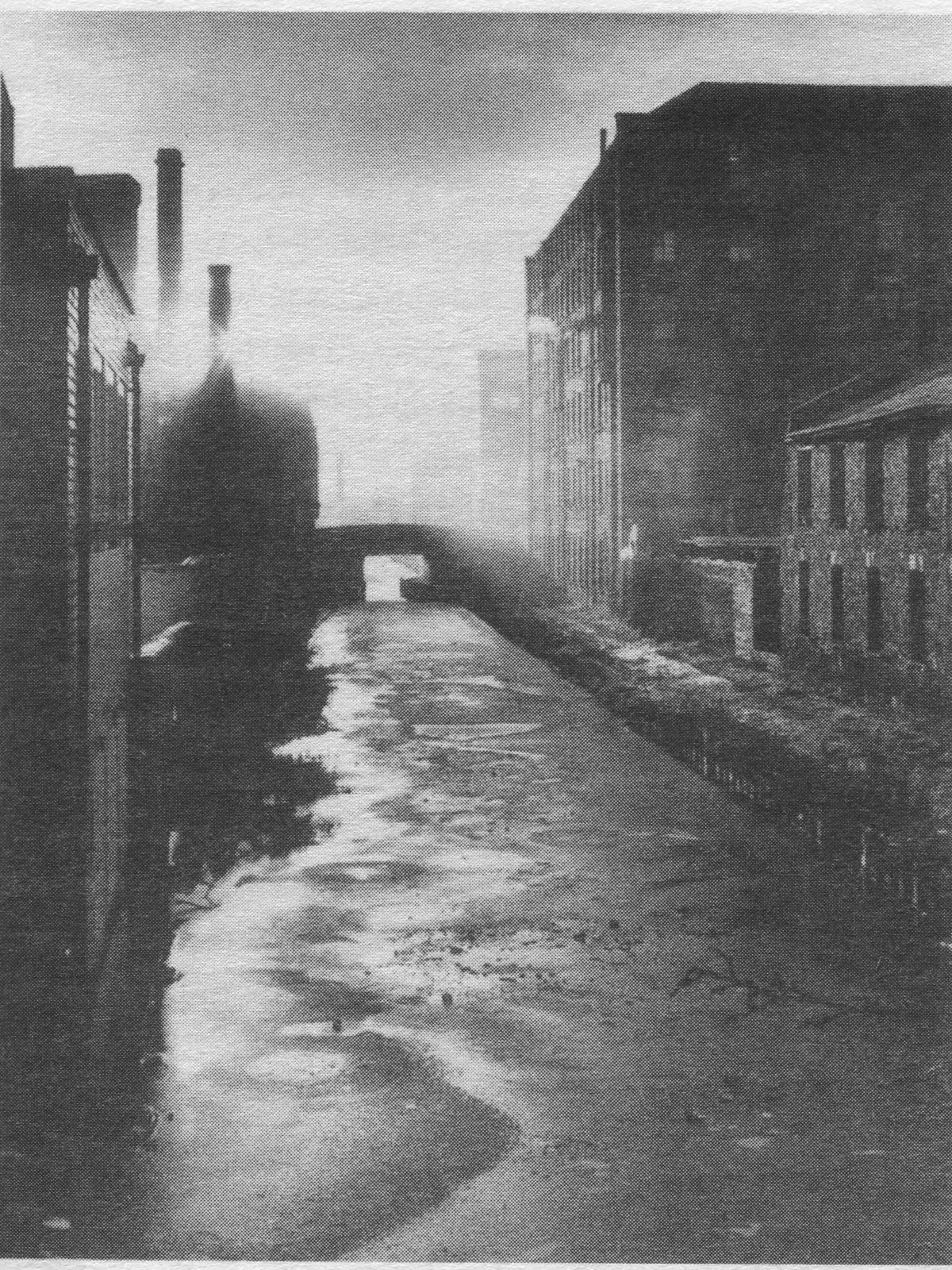
Like Butor, W G Sebald encountered a significant culture shock on arriving in Manchester, after teaching in Switzerland. Sebald was profoundly alienated from his home country of Germany. His sense of isolation ‘could not have been helped by his wanderings through scenes of slum clearance and urban decay.’
Objectively those areas were disappearing so one might surmise that Sebald sought them out, was drawn to their melancholy which reflected and intensified his own. It’s true that the Manchester Development Plan approved in 1961 (although not fully implemented, as I’ll mention later), and the implementation of smokeless zones were making significant improvements in the atmosphere and cleanliness of the city, even if children growing up in the city in the 60s still had plenty of bombsites to play on. However, Sebald’s ‘melancholy at alienation, and exile in a strange land’ found its correlative in the ‘desolate leftovers of nineteenth century Manchester’. It is also suggested that Sebald’s reading of L’Emploi du temps enhanced his melancholy but again it is likely that he was drawn to the novel because it resonated with his own mood and response to Manchester.
Thus the picture painted in The Emigrants of Manchester as ‘a city of ruins, dust, deserted streets, blocked canals, a city in terminal decline’ is probably a distortion. However, the narrative is only in part about the Manchester that Sebald encountered in 1966-7. ‘Manchester … fades into insignificance in relation to another important geographical, phantasmic and persistent presence, which is Germany’.
Sebald gives us more than one Manchester. We see the city first of all through the eyes of the narrator (who both is and isn’t Sebald) arriving in the 1960s, and then through the eyes of the titular Emigrant, Max Ferber, who arrives in 1945, having been sent on the Kindertransport in 1938 from Munich, and finally the narrator’s return in the 1990s, finding that a further cycle of improvement and decay has taken place in the interim.
For Ferber, Manchester triggers memories of Germany. This is partly due to its immigrant communities, the Jewish quarters with their names evoking a European past. But as Thomas Mann, exiled in the US, said, ‘Where I am, is Germany’. There’s another connotation. Manchester’s ‘night and fog’, its fire buried in ash, its chimneys, evoke a past that he escaped, thanks to his parents’ foresight, but which they did not.
Ernestine Schlant describes this aspect of Sebald’s writing as ‘“dense” time – a time in which past and present intersect, commingle, and overlap. This commingling destroys sequence and evokes the sense of a labyrinth with no exit‘. She was speaking specifically of Sebald’s writing, but it would equally be a powerful description of Butor’s novel, where Bleston’s past as Roman temple of war, divided Reformation city and industrial machine are threaded with Butor’s memories of Paris at war.
A brief postscript – I mentioned the Manchester Development Plan, published in 1961. This as it turns out is another imaginary Manchester – not drawing upon the myths of the past but upon a vision of the future.


Plans were drawn up in 1945, but budgetary constraints and building regulations meant that they were largely put on hold. By the time they were revisited, technological advances had opened up hitherto unimaginable possibilities for the city, with moving pavements, heliports and monorails. Once again, the economic climate changed before the plans could be realised and they stand now as a memorial to that other unrealised Manchester.
So in this very real city we can glimpse Engels’ hell on earth, Butor’s city at war, Sebald’s post-Holocaust landscape, the idealistic vision of the 1960s planners. The features that made Manchester the shock city of the 19th century are no longer readily visible. Manchester now is arguably just one of our major cities, unlikely to inspire comparisons with Athens or with Hades. But the past in all its various forms, as well as the unrealised visions of the future are there to be stumbled over, bubbling up between the paving stones. Unmemorialised, their presence is still felt.
Bibliography
Michel Butor, L’Emploi du temps (Minuit, 1956); English translation (by Jean Stewart), Passing Time (Faber, 1965)
W G Sebald, Die Ausgewanderten (Fischer, 1992); English translation (by Michael Hulse), The Emigrants (Vintage, 2002)
__, Nach der Natur (Fischer, 1995); English translation (by Michael Hamburger), After Nature (Hamish Hamilton, 2002)
Robert Barr, The Doom of London, The Idler (1893)
Charles Dickens, Hard Times (1854)
Benjamin Disraeli, Coningsby (1844)
Friedrich Engels, The Condition of the Working Class in England (1840)
Leon Faucher, Manchester in 1844
Elizabeth Gaskell, Mary Barton (1848), North and South (1855)
Andre Gide, Thésée (1946)
James Phillips Kay, The Moral and Physical Condition of the Working Classes Employed in the Cotton Manufacture in Manchester (1832)
Hugh Miller, First Impressions of England and its People (1869)
Hippolyte Taine, Notes sur l’Angleterre (1874)
Alexis de Tocqueville, Voyages en Angleterre, Irlande, Suisse et Algérie (1835)
Asa Briggs, Victorian Cities (Penguin, 1990)
Mireille Calle-Gruber, La Ville dans L’Emploi du temps de Michel Butor (Nizet, 1995)
Jo Catling and Richard Hibbitt (eds), Saturn’s Moons: W G Sebald – a Handbook (Legenda, 2011)
Mark Crinson, Urban Memory (Routledge, 2005)
J B Howitt, Michel Butor and Manchester, Nottingham French Studies, 12, 2 (1973)
Tristram Hunt, Building Jerusalem: The Rise and Fall of the Victorian City (Phoenix, 2005)
Michael Kennedy, Portrait of Manchester (Hale, 1970)
Alan J Kidd, Manchester (Keele UP, 1996)
Gary S Messinger, Manchester in the Victorian Age (MUP, 1985)
Stephen Mosley, The Chimney of the World (Routledge, 2008)
Terry Pitts, La Catastrophe muette: Sebald à Manchester, Ligeia, 105-8 (2011)
Peter Preston and Paul Simpson-Housley (eds), Writing the City: Eden, Babylon and the New Jerusalem (Routledge, 1994)
Natalie Rudd, Fabrications : New Art and Urban Memory in Manchester (UMiM, 2002)
Debarati Sanyal, The French War, in Cambridge Companion to the Literature of WWII (CUP, 2009)
Ernestine Schlant, The Language of Silence (Routledge, 1999)
Janet Wolff, Max Ferber and the Persistence of Pre-Memory in Mancunian Exile, Melilah, 2 (2012)
Mad Travellers
Posted by cathannabel in Literature, Michel Butor, Refugees, The City, W G Sebald on July 4, 2015
(adapted from a paper given at ‘There & Back Again’, a postgraduate conference at the University of Nottingham, organised by the Landscape, Space, Place Research Group. The title is taken from Iain Hacking’s fascinating study of the fugueur phenomenon)
The idea of wandering, of travelling without constraints, without a humdrum practical purpose, is perennially appealing to most of us, even if, for most of us, the drawbacks come to mind pretty speedily if we start to entertain the notion. Some do it anyway – seize the moment when the obstacles are not insuperable – but generally it’s something to enjoy vicariously, or to indulge in short bursts, taking time out of a holiday schedule to just have a stroll around foreign streets.
Throughout myth and literature there are many wanderers who cross seas, continents and centuries. For some it’s a pastime, a means of avoiding commitments or encumbrance:
I’m the type of guy that likes to roam around
I’m never in one place, I roam from town to town
And when I find myself fallin’ for some girl
I hop right into that car of mine and ride around the world (Dion, The Wanderer, 1961)
Everyday in the week I’m in a different city
If I stay too long people try to pull me down
Hendrix suggests that the prejudices of the cities in which he finds himself push him to leave, as well as, like Dion, that if he does sometimes feel his heart ‘kinda gettin’ hot’ for some woman, he moves on before he gets caught. For some, wandering is a subversive practice (not using the city streets in the prescribed way), for others it’s a compulsion, even a curse.
The flâneur is one of those archetypal wanderers. This classic definition is by Baudelaire, writing in 1863 in his ‘Le Peintre de la vie moderne’.
The crowd is his element, as the air is that of birds and water of fishes. His passion and his profession are to become one flesh with the crowd. For the perfect flâneur, for the passionate spectator, it is an immense joy to set up house in the heart of the multitude, amid the ebb and flow of movement, in the midst of the fugitive and the infinite. To be away from home and yet to feel oneself everywhere at home; to see the world, to be at the centre of the world, and yet to remain hidden from the world—impartial natures which the tongue can but clumsily define. The spectator is a prince who everywhere rejoices in his incognito. The lover of life makes the whole world his family, just like the lover of the fair sex who builds up his family from all the beautiful women that he has ever found, or that are or are not—to be found; or the lover of pictures who lives in a magical society of dreams painted on canvas. Thus the lover of universal life enters into the crowd as though it were an immense reservoir of electrical energy. Or we might liken him to a mirror as vast as the crowd itself; or to a kaleidoscope gifted with consciousness, responding to each one of its movements and reproducing the multiplicity of life and the flickering grace of all the elements of life.
 He – and I use the masculine pronoun entirely deliberately – is ‘observateur, flâneur, philosophe, appelez-le comme vous voudrez’.
He is a perfect stroller, a passionate spectator, an erudite wanderer. He walks the streets, probably alone, with no map or itinerary, with the confidence that comes from being male, well-educated and wealthy. His milieu is the city, and quintessentially Paris. One might think that the boulevards and arcades of Haussmann’s Paris lent themselves to strolling so much better than the labyrinthine streets of the old city, but it was that old city that defined the flâneur, allowing (in Edmund White’s words) ‘a passive surrender to the aleatory flux of the innumerable and surprising streets’.
The flâneur is a prototype detective, his apparent indolence masking intense watchfulness. This recalls Edgar Allen Poe’s story, ‘The Man of the Crowd’ (which was translated by Baudelaire), in which a man recovering from illness sits in a London coffee shop, watching the passers-by, and engaging in Holmesian deductions about their occupation and character. His attention is drawn by an old man who he is unable to read, and he feels compelled by insatiable curiosity to follow him, for a night and a day, as the man moves unceasingly through the city: he is the man of the crowd – not only hiding within it, but unable to exist outside it.
Walter Benjamin in his 1935 study of Baudelaire suggests that Baudelaire identifies the old man as a flâneur. This must be a misreading on Benjamin’s part, since the old man is as manic as the flâneur is composed. The flâneur may ‘set up house’ in the heart of the crowd, becoming part of ‘the ebb and flow of movement’, but he remains separate, above the mass. He is, like Baudelaire and Benjamin, at the same time engaged with and alienated by the city.

Poe’s story does give us a flâneur, however, in the person of the narrator, who can and does choose to abandon his pursuit, stepping aside to resume his life, and a different kind of wanderer, in the person of the man of the crowd. Steven Fink argues persuasively that the man of the crowd is the mythological figure of the Wandering Jew, condemned to wander endlessly as punishment for a terrible crime. (He has a number of counterparts, including, amongst others, Cain, the Flying Dutchman, and the Ancient Mariner.) Certainly this description by Benjamin’s contemporary, Siegfried Krakauer, is remarkably close to Poe’s description of the old man:
‘there arose confusedly and paradoxically within my mind, the ideas of vast mental power, of caution, of penuriousness, of avarice, of coolness, of malice, of bloodthirstiness, of triumph, of merriment, of excessive terror, of intense – of supreme despair … How wild a history … is written within that bosom!’. (Edgar Allen Poe, ‘The Man of the Crowd’)
Imagine [his face] to be many faces, each reflecting one of the periods which he traversed and all of them combining into ever new patterns as he restlessly and vainly tries on his wanderings to reconstruct out of the times that shaped him the one time he is doomed to incarnate. It is a terrible face, ‘assembled from the many faces of the dead’. (Siegfried Krakauer – History, the Last Things Before the Last (OUP, 1969))
If the man of the crowd is no flâneur, he does bear a stronger resemblance to the fugueur, a lesser-known (and shorter-lived) phenomenon which emerged in the 1880s. Bordeaux medical student Philippe Tissié and neurologist Jean-Martin Charcot at the Salpêtrière hospital in Paris documented a number of cases of men undertaking strange and unexpected trips, in states of obscured consciousness.  They were subject to hallucinations, and often dominated by ideas of persecution. Their conduct during the episode appeared normal, but they were unconscious of what they were doing, and had no memory of it afterwards – in a state of dissociative fugue. A fugue state is defined as involving selective memory loss, the inability to recall specific – perhaps traumatic – events. This may be accompanied by wandering and travelling, in an attempt to recover memory/identity, or perhaps in a flight from it – the etymological paradox of flight/pursuit.
The fugueur is quite distinct from the flâneur whose journeying is deliberately aimless and random, an end in itself. His itinerary may defy linear logic but nonetheless is purposeful, even if that purpose can be discovered only retrospectively. The flâneur, in his fine clothes, walked the streets as if he owned them because, wealthy and well-educated, he could. The fugueur, in his state of obscured consciousness, was likely to be mistaken, instead, for a vagrant. Albert Dadas, ‘patient zero’ in the mini-epidemic of ‘mad travelling’, was repeatedly arrested for vagabondage. The fugueurs were generally of more modest means than the flâneurs – tradesmen, craftsmen or clerks – and their travels took them much further afield.  If someone spoke of a city or a country Albert was seized by the need to go there, and did so, often then finding himself in difficulties due to lack of funds.
One of Charcot’s patients was a young Hungarian Jew named Klein, who was ‘constantly driven by an irresistible need to change his surroundings, to travel, without being able to settle down anywhere’. This particular patient prompted a link with the then prevailing view that Jews were more prone than other races to various forms of neurasthenia and that this particular manifestation was ‘in the character of their race’. Thus the Wandering Jew was, according to Henri Meige’s thesis, ‘only a sort of prototype of neurotic Israelites journeying throughout the world’. Even at the time it was pointed out, fairly acerbically, that if the Jews had a tendency to move from place to place, this was in generally externally rather than internally driven, as persecution and prejudice made it necessary to leave one home in search of another.
Charcot’s diagnosis, and his use of the term ‘hystero-epilepsy’ in particular, fell out of favour, largely due to the failure to identify a common cause that would account for a collection of rather disparate individual cases. In the twentieth century the two types of wanderer seem often to merge, as trauma and exile create a more melancholy and more driven wanderer. One can trace a line from Baudelaire’s flâneur to the Surrealists, via Walter Benjamin’s description of flânerie as a dream state in which ‘The city as a mnemonic for the lonely walker [: it] conjures up more than his childhood and youth, more than its own history’, to Guy Debord’s dérive as subversive practice, and on to today’s psychogeographers. Rather than being a disaffected and detached observer, the flâneur in the late 20th and 21st century may be in flight from memory, from identity, at home nowhere, an exile who feels no connection, or only a highly problematic one, to homeland or origins.
Michel Butor’s 1956 novel, L’Emploi du temps is set in a northern English industrial city, called Bleston but clearly inspired by Manchester, where Butor had worked a few years earlier. It takes the form of a diary kept by his protagonist, Jacques Revel, in the city for a one-year placement. We know nothing of Revel’s life before his arrival in Bleston, or of what he will do after he leaves. He speaks of his year there as a prison sentence – he is unable to leave the city during that period, and compelled to leave it on a specific date. He is certainly not at home in Bleston, but he seems entirely rootless, without any connection elsewhere. In his restless wanderings through the streets, he seems to be searching – mostly fruitlessly – for lodgings, for someone whose name he does not know who he met on an earlier walk, for the elusive countryside. But ultimately his quest is to master the city by walking its streets, grasping the reality which seems to be changing around him as he walks – it is a phantasmagorical city, whose heavily polluted atmosphere creates a narcotic dream-like state, distorting his perceptions and leaving him disorientated.
Butor’s novel had a significant influence on W G Sebald, who came to Manchester about 15 years later. Sebald read L’Emploi du temps when he first arrived, and it inspired a poem, ‘Bleston: A Mancunian Cantical’, as well as having a wider impact on his work.
In Sebald’s novels, the narrator (who may or may not be, to some extent, Sebald) invariably begins by describing a journey. He is precise about when, and where, although the layering of timeframes and locations means that we can lose these certainties as the narrative progresses, but frequently the ‘why’ is obscure, not just to the reader but to the narrator himself. The narrator and the various protagonists are rarely, if ever, ‘at home’. They are often in transit or in provisional, interim spaces such as waiting rooms, railway stations, and transport cafes. Their journeys often induce episodes of near paralysis, physical or mental, and they end inconclusively, often with a sense that the quest will continue after the final page.
But if the Sebaldian narrator is a contemporary example of the melancholy flâneur, Jacques Austerlitz connects us directly with the fugueur, and with wandering as a response to trauma and loss. As a child, Austerlitz arrived in England on the Kindertransport, where his foster parents gave him a new life, and a new name, telling him nothing of his past, or the fate of his parents, until, as a sixth former, he learns that he is not Dafydd Elias.
For many years he avoids any topic or image which might shed light on or raise questions about his origins. But, increasingly isolated, and with his life ‘clouded by unrelieved despair’, tormented by insomnia, he undertakes nocturnal wanderings through London, alone, outwards into the suburbs, and then back at dawn with the commuters into the city. These excursions begin to trigger hallucinations, visions from the past, for example, the impression that ‘the noises of the city were dying down around me and the traffic was flowing silently down the street, or as if someone had plucked me by the sleeve. And I would hear people behind my back speaking in a foreign tongue …’. He is irresistibly drawn to Liverpool Street Station, a place full of ghosts, built as it is on the remains of Bedlam hospital, and, in the disused Ladies’ Waiting Room, encounters the ghosts of his foster parents and the small boy he once was.

Thus his obsessive wanderings appear to have had a sub-conscious purpose, taking him back to the point of rupture between one life and another. He embarks upon a new phase of wandering, driven by the need to find his home and his parents. Overhearing a radio documentary about the Kindertransport, and the reference to a ship named The Prague, like Albert Dadas, the original fugueur: ‘the mere mention of the city’s name in the present context was enough to convince me that I would have to go there’.
Austerlitz’s quest remains incomplete at the end of the novel. In the course of his wanderings he has, he believes, discovered his former home in Prague and traced his mother to Teresienstadt and his father to the Gurs concentration camp in France in 1942. Beyond that he knows only that his mother ‘was sent east’ in 1944. He does not know where, when, or even whether they died.

His quest, and his confrontation with the losses that defined his life, leads to ‘several fainting fits … temporary but complete loss of memory, a condition described in psychiatric textbooks … as hysterical epilepsy’. He is taken, significantly, to the Salpêtrière, where Charcot established this diagnosis almost a century earlier. This diagnosis would only be included in psychiatric textbooks as a historical footnote – an example of Sebald’s dense or layered time – we know precisely where we are, but the ‘when’ is not so straightforward.
Thus we’ve come full circle. And I want to make another tentative, perhaps fanciful connection. Sebald invites us to make all sorts of links with the name Austerlitz – the battle, the Parisian railway station, even Fred Astaire. And there’s always the echo of another name, the likely final destination of both of his parents, unspoken here except in a reference to the Auschowitz Springs near Marienbad. One more then – Ahasuerus, the name often given to the mythological Wandering Jew.
Baudelaire’s description of the flâneur – ‘être hors de chez soi, et pourtant se sentir partout chez soi (away from home and yet at home everywhere)’ has echoed through the twentieth century and into our own, accumulating more and more melancholy baggage. That this phrase has darker undertones than Baudelaire will have intended is brought home by a speech made by Hitler in 1933, in which he described the Jewish people, the ‘small, rootless international clique’, as ‘the people who are at home both nowhere and everywhere’.
In our time then, rather than someone at ease wherever he finds himself, we are likely to think of the refugee and the exile, adapting without putting down roots, unable to return but unable fully to belong, always sub-consciously ready to move on or even keeping a bag permanently packed, just in case. For the original flâneur this characteristic was an affectation, a chosen detachment and rootlessness. For the fugueur, driven by trauma or crisis of identity, it is a curse, to have to wander, and never to find answers, or find home.

Anderson, George K, The Legend of the Wandering Jew (Hanover/London: Brown UP, 1991)
Benjamin, Walter, ed. Michael W Jennings, The Writer of Modern Life: Essays on Charles Baudelaire (Cambridge, MA/London: Belknap Press of Harvard UP, 2006)
Brunel, Pierre (ed), translated by Wendy Allatson et al, Companion to Literary Myths, Heroes and Archetypes (NY/London: Routledge, 1996)
Coverley, Merlin, Psychogeography (Harpenden: Pocket Essentials, 2006)
Fink, Steven, ‘Who is Poe’s Man of the Crowd?’, Poe Studies, 44, 2011 (17-38)
Gilloch, Graeme, Myth and Metropolis: Walter Benjamin and the City (Cam.: Polity, 1996)
Goldstein, Jan, ‘The Wandering Jew and the Problem of Psychiatric Anti-Semitism in Fin-de-Siècle France’, Journal of Contemporary History, 20, 4(October 1985), 521-52
Hacking, Ian, ‘Automatisme Ambulatoire: Fugue, Hysteria and Gender at the Turn of the Century’, Modernism/Modernity, 32 (1996), 31-43
__, ‘Les Alienés voyageurs: How Fugue Became a Medical Entity, History of Psychiatry, 7, 3 (September 1996), 425-49
__, Mad Travellers: Reflections on the Reality of Transient Mental Illnesses (Free Association Books, 1998)
Kuo, Michelle and Albert Wu, ‘Imperfect Strollers: Teju Cole, Ben Lerner, W G Sebald and the Alienated Cosmopolitan’, Los Angeles Review of Books, 2 February 2013
Lauster, Martina, ‘Walter Benjamin’s Myth of the Flâneur’, Modern Language Review, 102, 1 (January 2007), 139-56
McDonough, Tom, ‘The Crimes of the Flâneur’, October, 102 (2002), 101-22
Micale, Mark S, In the Mind of Modernism: Medicine, Psychology and the Cultural Arts in Europe and American, 1880-1940 (Stanford UP, 2004)
Seal, Bobby, ‘Baudelaire, Benjamin and the Birth of the Flâneur’, Psychogeographic Review, 14 November 2013
White, Edmund, The Flaneur: A Stroll through the Paradoxes of Paris (Bloomsbury, 2008)
www.artslant.com/la/articles/show/42145
http://www.thelemming.com/lemming/dissertation-web/home/flaneur.html
http://www.othervoices.org/1.1/gpeaker/Flaneur.php
http://imaginarymuseum.org/LPG/debordpsychogeo.jpg
http://www.paris-art.com/agenda-culturel-paris/Le%20Premier%20fugueur/Furaker-Johan/11840.html
http://www.karenstuke.de/?page_id=1192
https://dianajhale.wordpress.com/2013/11/01/tracing-sebald-and-austerlitz-in-londons-east-end/
Furnace Park // an introduction on the cusp of an opening
Posted by cathannabel in The City, Visual Art on August 16, 2013
Reblogged from Occursus – Amanda Crawley Jackson’s account of the Furnace Park project.

In summer 2012, occursus – a loose collective of artists, writers, researchers and students that coalesced around a weekly reading group I had set up with Laurence Piercy from the School of English at the University of Sheffield – organised a series of Sunday-morning walks along unplanned routes in Shalesmoor, Kelham Island and Neepsend. As we looped through the chaotic mix of derelict Victorian works, flat-pack-quick-build apartment blocks, converted factories and student residences, sharing stories and sometimes, quite simply, wondering what on earth we were doing there, without umbrellas, in the rain, we came across the acre and a half of brownfield scrubland we’ve named Furnace Park. In collaboration with Matt Cheeseman (from the University of Sheffield’s School of English), Nathan Adams (a research scientist working in the Hunter Laboratory at the University of Sheffield), Ivan Rabodzeenko and Katja Porohina (founders of SKINN – the Shalesmoor, Kelham Island and Neepsend…
View original post 1,859 more words
From contribution to collaboration: Refugee Week and the value of seeing like a city
Posted by cathannabel in Refugees, The City on June 17, 2013
A fascinating and challenging contribution to Refugee Week – from cities@manchester

by Jonathan Darling, Geography, University of Manchester
Today sees the start of Refugee Week 2013, an annual celebration of the contribution of refugees to the UK that seeks to promote better understanding of why people seek sanctuary. Refugee Week has been held annually since 1998 as a response to negative perceptions of refugees and asylum seekers and hostile media coverage of asylum in particular (Refugee Week 2013). Refugee Week promotes a series of events across the UK, from football tournaments and theatre productions to exhibitions and film screenings, all designed to promote understanding between different communities.
Whilst Refugee Week is a national event it finds expression in local activities organised in a range of cities. In part, this is in response to the dispersal of asylum seekers across the UK, meaning that refugees and asylum seekers have been increasing visible in a range of towns and cities over the…
View original post 2,345 more words
The rebuilding of Paris and its reflection in works by Zola, Verne and Hugo
Posted by cathannabel in Literature, The City on April 27, 2013
Décombres de l’avenir et projets rudéraux : les métamorphoses de Paris chez Verne, Hugo et Zola
Claudia Bouliane’s recently published MA dissertation is available online as a PDF.
The abstract is as follows :
Between 1853 and 1870, many areas of the French capital are torn down to allow the establishment of new avenues by Baron Haussmann, Paris’ prefect under Napoleon III. These major urban projects have struck the social imaginary and became an object of fascination for literature. This essay is located on the grounds of sociocriticism and seeks to understand how Verne’s, Hugo’s and Zola’s texts interpret the Paris’ new urban conformation. In Paris au XXe siècle (1863) Jules Verne is planning future destructions and, in turn, imagines the strange constructiveness of residual past. Although in exile, Victor Hugo is very aware of urban and social changes under way. In Paris (1867) his writing works to make compatible…
View original post 94 more words
Michel BUTOR; l’espace entre 2 villes
Posted by cathannabel in Michel Butor, The City on April 25, 2013
Ajoutez votre grain de sel personnel… (facultatif)

On n’est pas le même partout. L’équilibre entre 2 villes ; deux pôles ; et ce qui les relie : un fil de la vierge léger léger : le trajet en train. Il y a longtemps que cette vieille édition rose de 1994 (achetée sur conseil : “tu aimes le train, c’est un roman à lire dans le train, d’autant que tu prends souvent cette ligne” (fut un temps avec arrêt à Firenze, ville non mentionnée il me semble dans le roman)) passe d’étagère en étagère. Donc près de 20 ans après – laissé mûrir le livre, commencé une fois à l’époque, prêté plusieurs fois depuis – la litanie des gares, l’aller pour Rome.
car s’il est maintenant certain que vous n’aimez véritablement Cécile que dans la mesure où elle est pour vous le visage de Rome, sa voix et son invitation, que vous ne l’aimez pas sans Rome et…
View original post 440 more words
The Original Modern
Posted by cathannabel in Michel Butor, The City, W G Sebald on April 3, 2013
cities@manchester on Manchester, the original shock city
by Brian Rosa, PhD candidate in Geography
Manchester is a city of superlatives: it was the prototypical “shock city” of the Industrial Revolution, Friedrich Engels and Karl Marx’s model for everything that was abhorrent in the industrial capitalist city, and one of the birthplaces of the labor and women’s suffrage movements. In its heyday, Manchester was depicted in literature of Engels, Alexis de Toqueville and later the paintings of L.S. Lowry, as an uninterrupted, chaotic anti-landscape of chimneys and smoke, strewn across a featureless topography. Its unprecedented configuration invoked equal parts awe and dread, moral panic, and tempestuous visions of the future. In 1833, Toqueville described the crowded conditions, poorly constructed housing, hulking factories, and environmental degradation of Manchester: “From the foul drain the great stream of human industry flows out to fertilize the whole world. From this filthy sewer pure gold flows. Here humanity attains its most complete…
View original post 1,086 more words
Pierre Alechinsky et les plans de Paris
Posted by cathannabel in Michel Butor, The City, Visual Art on March 15, 2013
Alechinsky is one of many visual artists with whom Michel Butor has worked since the 1960s.
Comme je me renseigne sur Alechinsky, sa vie son œuvre, je finis par trouver des dessins sur plans – de Paris (ça me revient : “tu sais Alechinsky, il a utilisé des cartes comme support, ça devrait t’intéresser”). Je sélectionne ici les arrondissements que je connais mieux.
L’arrondissement de ma naissance.

L’arrondissement du Lycée.

L’arrondissement de l’université.

Je trouve aussi ces impressions de Cherbourg. Petit résumé en 7 vignettes.

Butor and Sebald – brief further thoughts
Posted by cathannabel in Michel Butor, The City, W G Sebald on January 19, 2013
I’ve written previously about the relationship between Bleston and Manchester, and about the links between Butor and Sebald, and I’ve just been exploring the fascinating collection of essays on Sebald in Melilah, the Manchester Journal of Jewish Studies, alerted by Helen Finch’s recent blog about Sebald’s Manchester. It’s good to see the link with Butor explored a bit more, but I would have to take issue in some respects with Janet Wolff’s article, ‘Max Ferber and the Persistence of Pre-Memory in Mancunian Exile’, which I think fails to fully identify the deeper connections between the two writers.
I would agree that Passing Time is not about Manchester in a straightforward way but I think Wolff takes that too far when she says that ‘none of this is about an actual city’, and that Revel’s diatribes against Bleston are ‘the ravings of a neurasthenic, whose debilitated psychological state produces monsters in the environment’. (p. 52) This is not a new charge – reviewers have in the past diagnosed Revel with depression or schizophrenia. But I’d argue that rather than alerting us to an unreliable narrator, the mismatch reminds us that Bleston is not just Manchester, not just any particular city. It contains many cities, real and fantastical.
But it is based more upon Manchester in its physical reality than on any other city, and contrary to Wolff’s statement that ‘there are no physical descriptions at all (quite unlike the Manchester of ‘Max Ferber’)’, there are many descriptions of Manchester landmarks, as J B Howitt has shown (in his article ‘Michel Butor and Manchester’, even though Butor takes and uses those features which are relevant to him, and changes or ignores those that are not.
What interests me most, however, is Wolff’s argument that the Manchester of The Emigrants fades into insignificance in relation to ‘another geographical, phantasmic and persistent presence’.
My studies of Butor are concerned precisely with identifying that presence in Passing Time. More anon.
- Janet Wolff, ‘Max Ferber and the Persistence of Pre-Memory in Mancunian Exile’, in Melilah, 2012 Supplement 2, Memory, Traces and the Holocaust in the Writings of W.G. Sebald. (Guest editors: Jean-Marc Dreyfus and Janet Wolff)
- http://helenfinch.wordpress.com/2013/01/13/the-roman-road-under-the-casino-lost-manchester/
- J B Howitt, ‘Michel Butor and Manchester’, Nottm French Studies, 12 (1973), 74-85
 Passing Time