Archive for category Personal
Love is in the noticing – thoughts on 2025
Posted by cathannabel in Personal on December 31, 2025

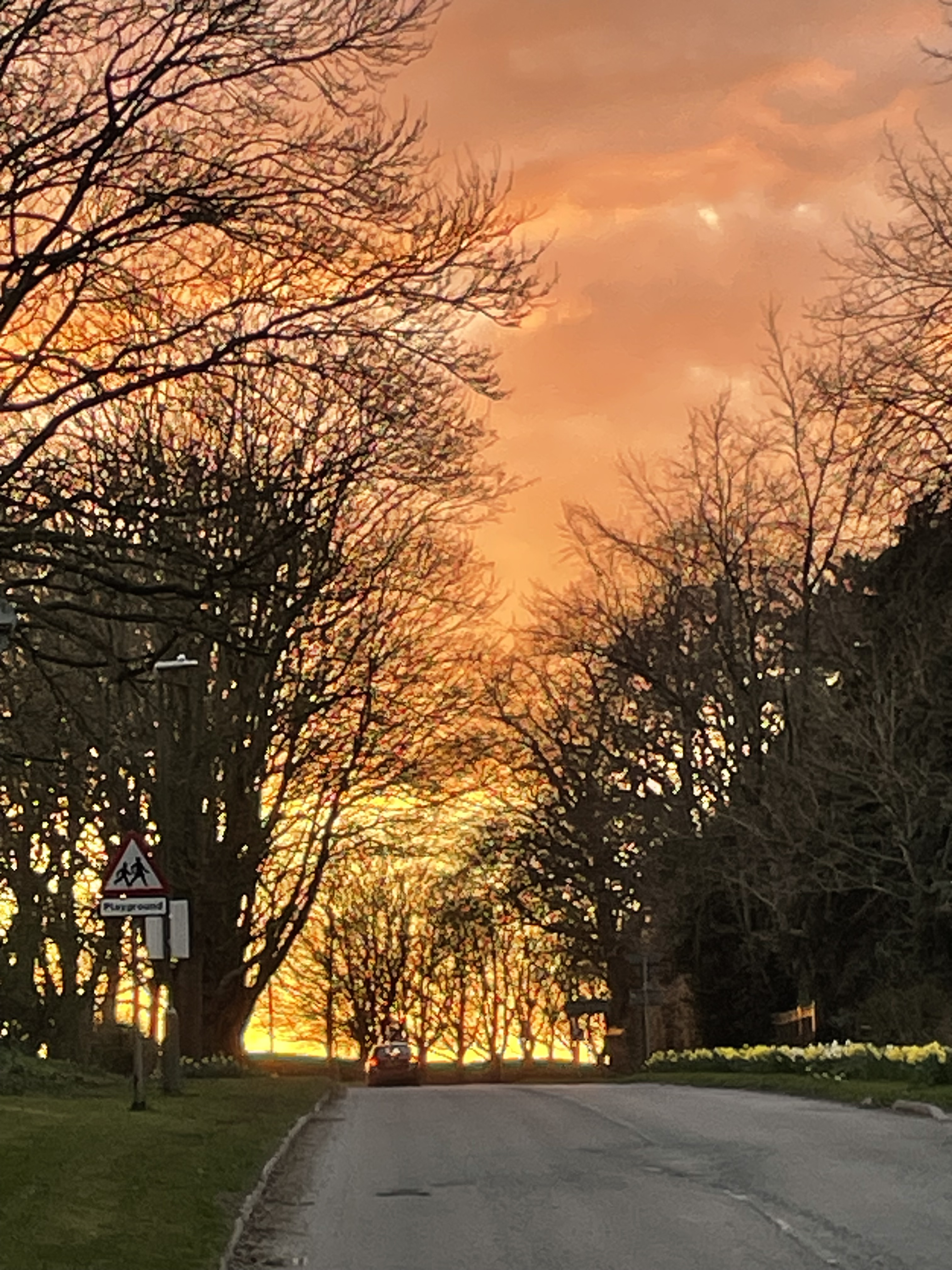
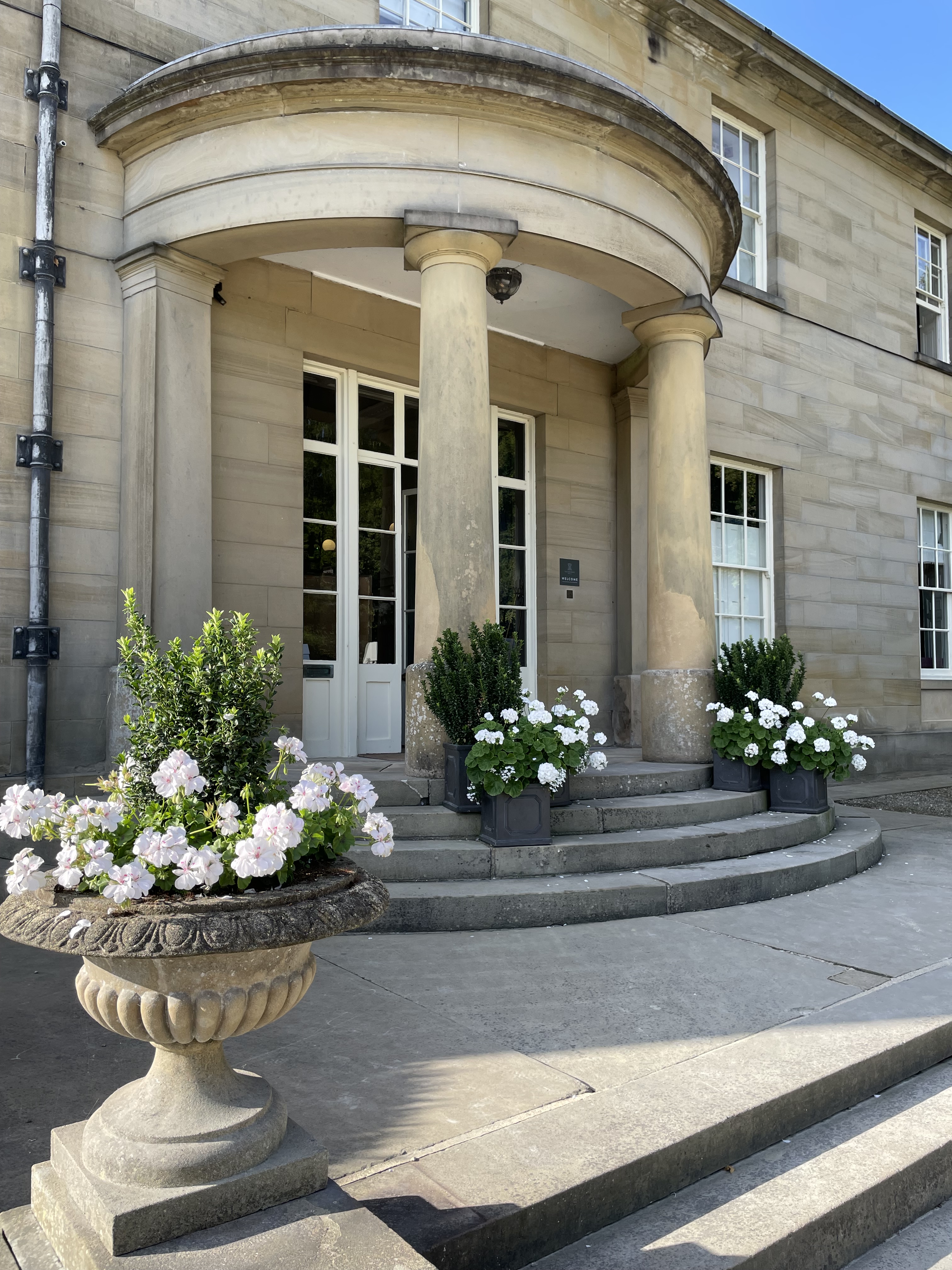
This is a purely personal take on 2025. I cannot bear to bring to mind, let alone attempt to write about, what this year has been in terms of world events and politics at home. This is cowardly, I know, but there are better minds than mine grappling with the state of things, and all I could do would be to repeat uselessly how absolutely bloody awful everything is, and how hard it is to see any glimpses of hope, as the handcart in which we are going to hell appears to gather speed. So, I will talk about my little world instead.
2025 – the year when my father’s hold on life finally slipped, after 97 years and the erosion of his mind and memory by dementia. I reflected on his life here. Writing about him, on this site and on the Guardian’s Other Lives obituary section, was my way of honouring who he was, before.
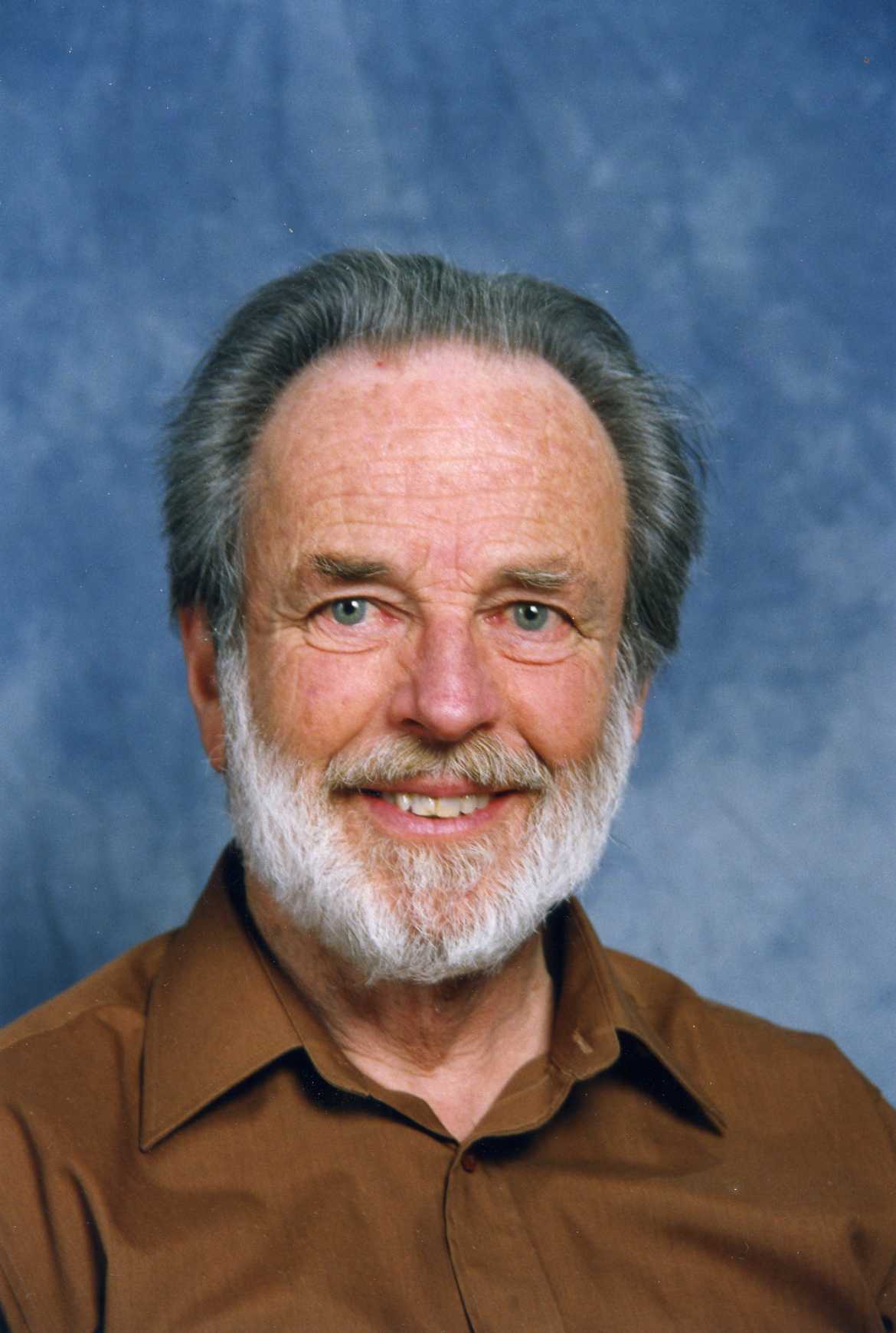
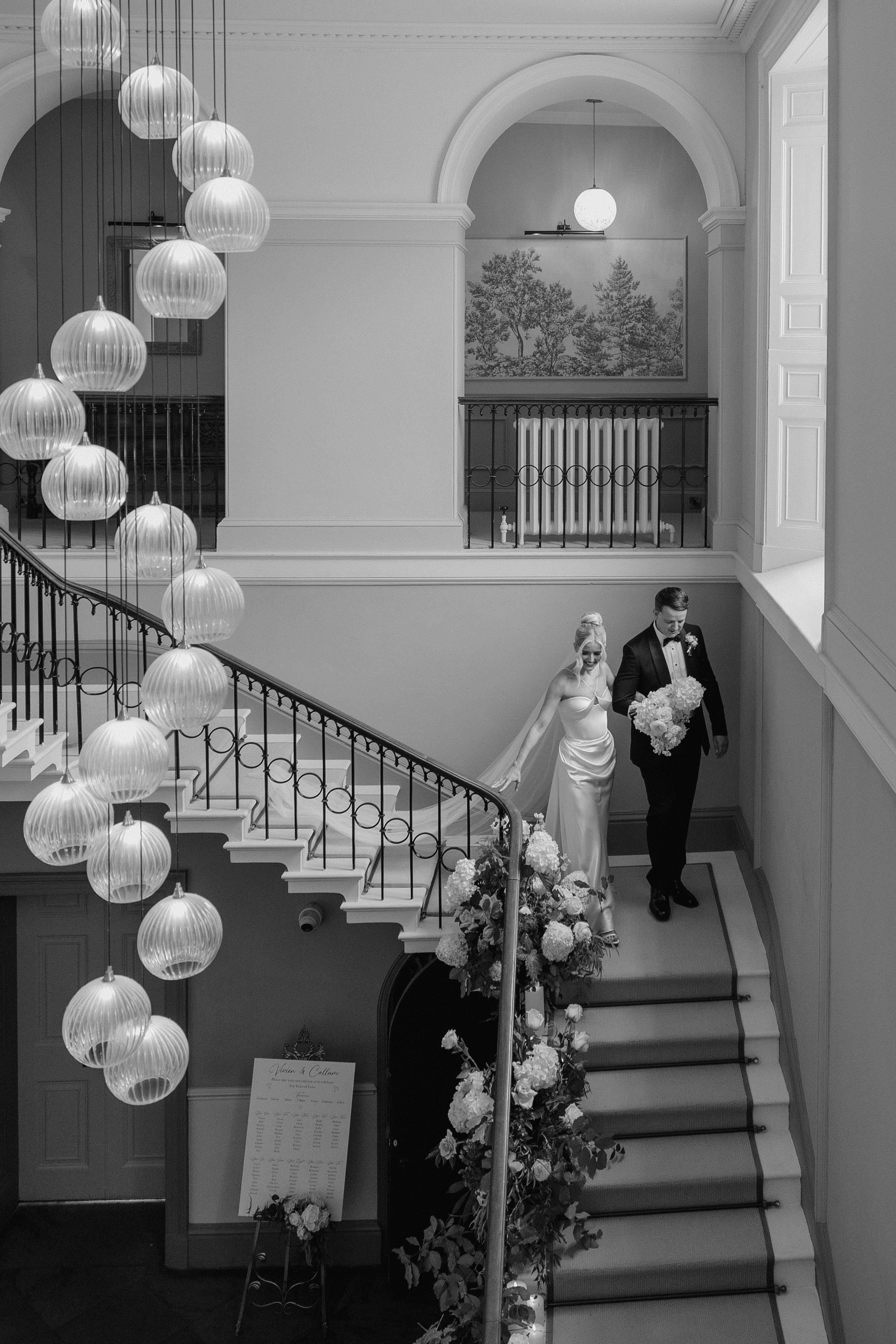
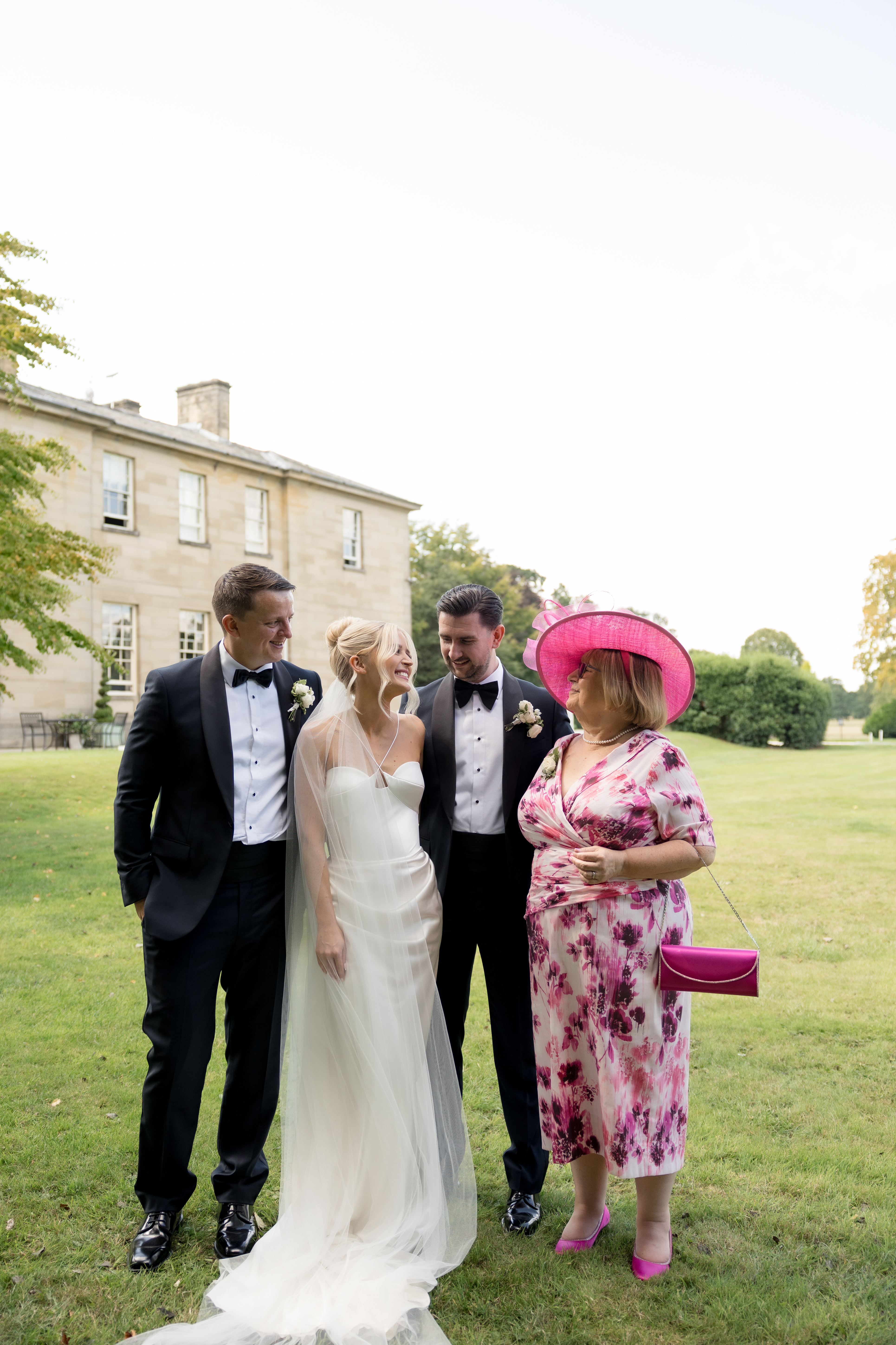
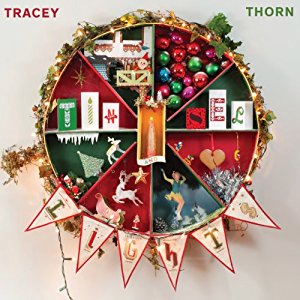
And it was a year when we celebrated love, companionship and family as my daughter married her partner of ten years – a purely joyful day, as the sincerity and seriousness of their commitment was expressed joyfully, as everyone there shared in their joy. Of course we were conscious of the people who should have been there but, as Tracy Thorn puts it in her song ‘Joy’, ‘because of the dark, we see the beauty in the spark’. It was a deeper thing than just happiness or contentment, and that’s because we were aware, we could not be unaware, of mortality and of the fragility of life but at the same time, daring to rejoice in the couple’s commitment to their shared future.

A year when I decided to take my health seriously, something I just couldn’t put my mind to for a while after M died. It had to be sustainable change, anything else is simply demoralising. I changed my diet (I didn’t ‘go on a diet’, I’ve been there, done that, and it is always miserable and always short-lived), and I stopped drinking alone (I’d been kidding myself it was making evenings on my own feel better, but it really wasn’t, and in the early hours of the morning, it felt a lot worse). And having discovered that Pilates is a form of physical exercise that I actually enjoy (who knew there was such a thing?) I added two live on-line classes to my weekly studio class, and found myself really making progress. Now, I didn’t do any of this with the intention of losing weight, which is a good thing, because I have lost not one ounce or one inch. But because I had other goals than that, I can be philosophical about the weight thing, rather than seeing it as a failure. I’m healthier, physically and mentally, and that’s enough. (By the way, if you feel moved after reading this to send me links to miraculous weight-loss techniques, please note that they will be deleted unread and you will be blocked. Cheers!)
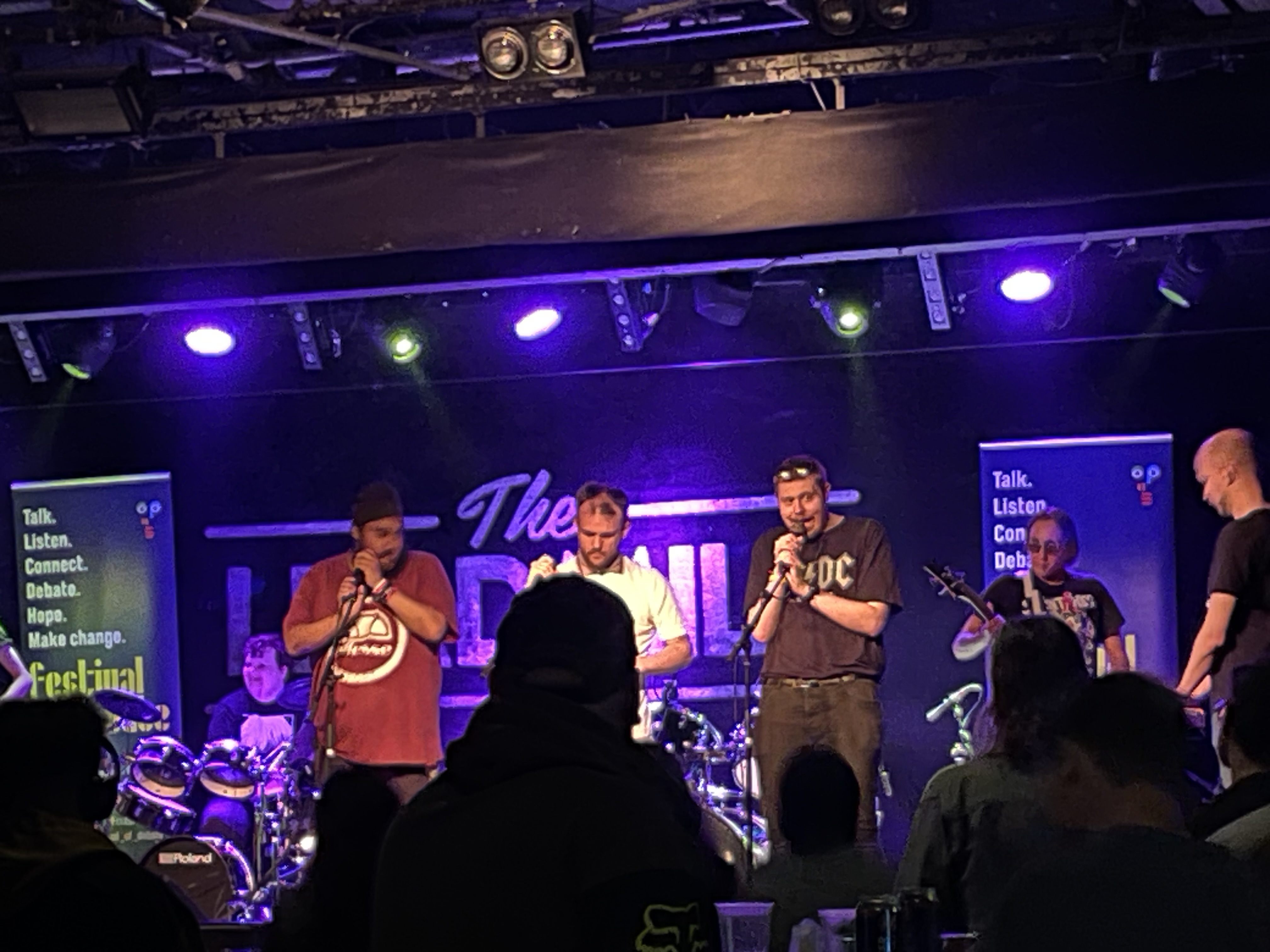
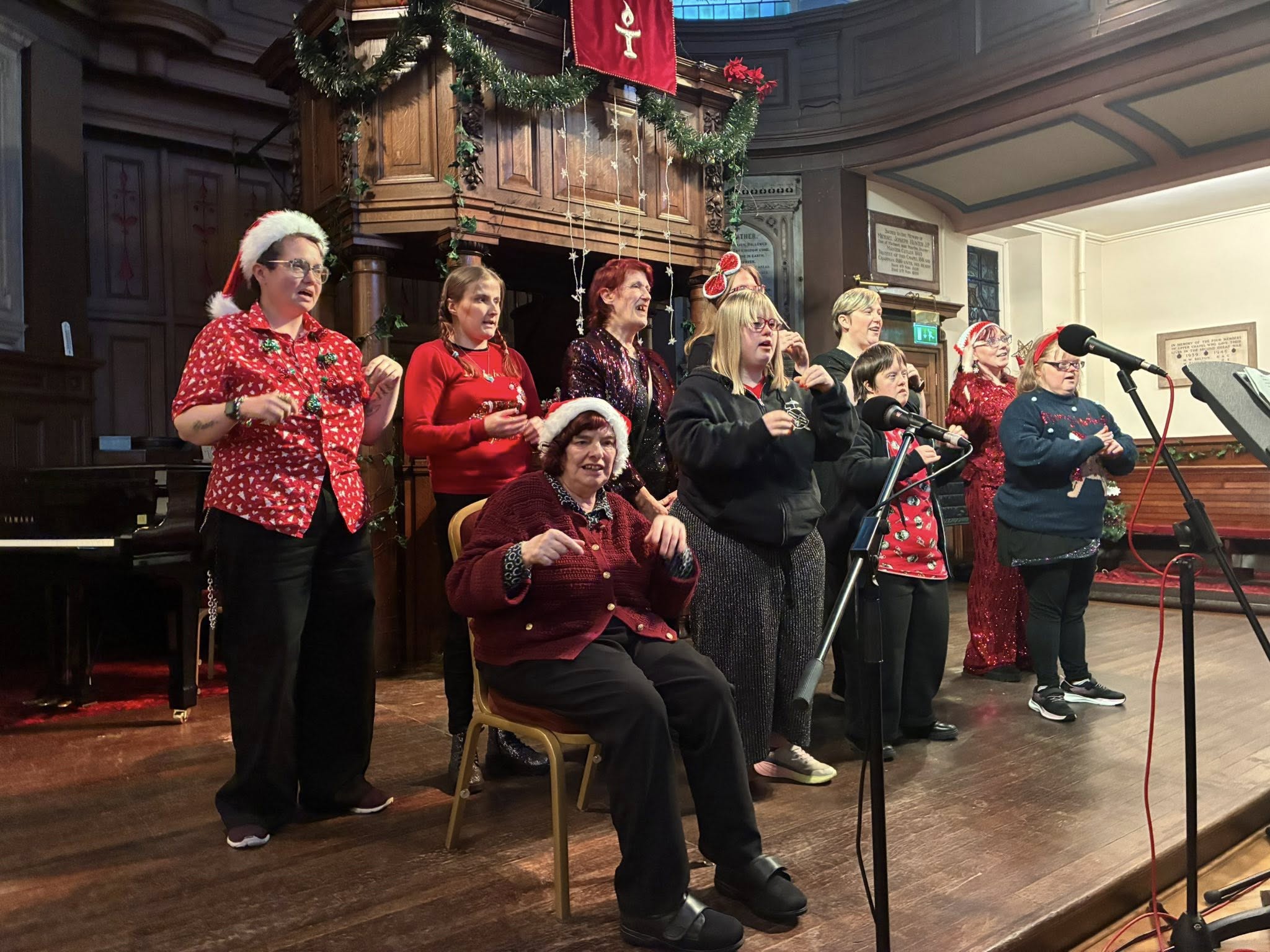
Late last year I took on the role of Chair of the Under the Stars Board of Trustees. One of my best decisions ever was to join them as a trustee in 2023, and to be part of the incredible work they do. I feel privileged to be able to support the staff and the CEO in particular, and to see our participants finding joy in performing on the Crucible stage, at the Tramlines festival, and a variety of other venues. Stephen Unwin’s book Beautiful Lives, which traces the history of attitudes to people with learning disabilities and looks at how we can do better, was my non-fiction read of the year (see my books blog). It’s heartbreaking and horrifying – not just the murder of ‘useless mouths’ during the Nazi era but the denial of agency and dignity for so long to so many. But it’s also hopeful, and personal, and it moved me a great deal. This year I was cheering on Ellie Goldstein, who has Down’s Syndrome, as a competitor on Strictly Come Dancing. She gave the lie to any idea that ‘learning disability’ means inability to learn, as she grasped complex sequences of tricky dance moves that I would never be able to hold on to – whenever I was at a disco in my younger years I used to head for the loo or the bar when some kind of Macarena/Timewarpy thing got going (I can just about do the Conga). And this year Nnena Kalu, an artist with learning disabilities, was awarded the Turner Prize. If we stop putting all those with LD in a box together, and start listening to them as individuals, finding out what they can do, what they love doing, what hurts them and what gives them confidence, they will achieve more, and they will have a shot at finding joy. I’ve seen it, and I’ve found joy in it myself.
One of my big projects for 2025 has not yet come to fruition – finding a publisher for The Thesis. But I have a better sense of how it needs to be revised and reshaped to make that more likely and, too, a better sense of how much I can realistically do/am willing to do. It’s easier to do that kind of work when you’re within the context of a University, with full access to physical and electronic resources and to people who know stuff. But it’s not just that – I’m older than when I did the PhD, and I’m on my own now, and I don’t have the energy I had ten years ago. So I’m going to update the thesis, taking account of material published since I submitted it, and adapt it to address a wider readership rather than an external examiner. I want it to intrigue and interest readers rather than to prove myself as a scholar. I think that’s feasible, and so I’m not giving up on my dream of seeing the piece of work that absorbed and fascinated me for so long as a published book.
It’s now over four years since M died. The process continues. I’ve adapted lots of my domestic routines of course, and changed a lot of things around the house to make it fit me better. I’ve taken big decisions where I had to (the knee replacement surgery, getting rid of the car), and squillions of smaller decisions as I re-evaluate what I do and how I do it. My big decision for 2026 (so far) is that I will be going on an ‘escorted tour’ taking in Helsinki, Tallinn and Riga, three cities I have never visited and know only a little about. It may turn out that it’s not the sort of holiday that works for me, but if it is, it opens up so many possible ways of travelling and seeing new places. It’s a bit scary – I’m an introvert, and am fairly crap at small talk, and the trip will inevitably involve talking to strangers – but going on an organised tour makes some things a lot easier to contemplate as a solo traveller (see my blog about my previous city break with my son for all the reasons why it might make me rather anxious).
I suppose at some point ‘widow’ will cease to be a defining word for me, but at this stage in the process, it still feels deeply significant. I am still conscious all the time of his absence and it still feels strange – only recently I’ve had the sensation sometimes when I half-wake in the night that I’m not on my own and then the realisation that of course I am. I don’t mean I sense his presence, just that, whilst I’m fully awake I am used to the strangeness of solitude, but in those drowsy moments it puzzles me. I talk about him a lot, to family and friends who knew him, and to people who never knew him, because I can’t talk about my life without talking about him. I switch between ‘I’ and ‘we’ constantly and probably not consistently, because my adult life comprises a ‘before’ and an ‘after’. It’s not that ‘I’ was subsumed in ‘we’, just that our lives were so tangled up together ‘before’.
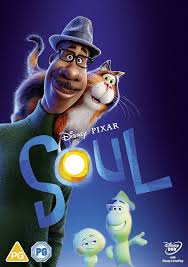
The title for this post is a quote from the Pixar film Soul, which I used in my speech at my daughter’s wedding last August:
“Life isn’t about one big moment. It’s the little things: walking with someone you love, sharing a laugh, watching the light hit their face just right. Love is in the noticing. The ordinary days that turn out to be everything. And maybe the whole point isn’t to chase the grand purpose, but to love deeply, and really live, right where you are.”
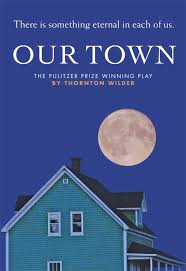
I don’t know whether the writers of Soul were consciously echoing Thornton Wilder’s play Our Town, but it’s not too much of a stretch to think that they were, given how popular the play is in the US. I recently read Ann Patchett’s stunning novel, Tom Lake, in which the play is the thread that runs through the narrative, and was so struck by it that I sought out and watched on YouTube the televised stage version with Paul Newman. And this, in the final act, jumped out at me:
EMILY: ‘Live people don’t understand, do they?’
MRS GIBBS: No dear – not every much.
EMILY: They’re sort of shut up in little boxes, aren’t they? … I didn’t realise. So all that was going on and we never noticed. … Oh, earth, you’re too wonderful for anybody to realise you. Do any human beings ever realise life while they live it? – every, every minute?
STAGE MANAGER: No. [Pause] The saints and poets, maybe – they do some.
Maybe that’s right, we can’t realise or notice every minute, we’re too busy living them, but we can try – to notice and to treasure. There are two strands of thought here for me. One is that the ordinary days ‘turn out to be everything’, a theme that I explored in my eulogy for M, focusing on the day before he died, about which I would remember hardly anything except that it was the last ordinary day, and thus extraordinary. The other is that joy is something we hope for rather than being able to predict or plan for, but that finding it depends on us noticing, noticing the people who we love and who love us, the beauty in music, in words, in the landscape or skyscape. And it depends on us realising that there’s a kind of defiance in joy, that it faces down the dark, the loss and grief, not denying them but just saying ‘there is also this, and this is marvellous and wonderful’, throwing the joy in those marvellous ordinary days in the face of whatever the year might bring.
I look back at 2025 with gratitude to all the people who made it good. Wonderful family and friends, sharing each other’s joys and sorrows. The care home staff who looked after Dad, treated him always with affection and respect, and held his hand as he slipped away. The Under the Stars team and our participants. The musicians who stirred my soul, my mind and my feet. The writers whose words allowed me to cross continents and centuries and to see into other people’s hearts and minds.
So as we move from one year into another, let’s ‘gather up our fears/And face down all the coming years’. Let’s hang on to our hats, hang on to our hope, let’s keep on keeping on. See you on the other side…
Tracy Thorn, ‘Joy’, from Tinsel & Lights, 2012
When someone very dear
Calls you with the words “everything’s all clear “
That’s what you want to hear
But you know it might be different in the New Year
That’s why, that’s why we hang the lights so high
Joy, Joy, Joy, Joy,
You loved it as a kid, and now you need it more than you ever did
It’s because of the dark; we see the beauty in the spark
That’s why, that’s why the carols make you cry
Joy, Joy, Joy, Joy Joy, Joy, Joy, Joy
Tinsel on the tree, yes I see
The holly on the door, like before
The candles in the gloom, light the room
the Sally Army band, yes I understand
So light the winds of fire,
and watch as the flames grow higher
we’ll gather up our fears
And face down all the coming years
All that they destroy
And in their face we throw our
Joy, Joy, Joy, Joy
It’s why, we hang the lights so high
And gaze at the glow of silver birches in the snow
Because of the dark, we see the beauty in the spark
We must be alright, if we could make up Christmas night.
Dad
Posted by cathannabel in Personal on June 16, 2025

John Hallett, 26 December 1927 – 30 March 2025
Trying to sum up anyone’s 97 years of life in a not unreadably long blog post is a challenge. In the case of my Dad, John Hallett, who died on 30 March, it’s impossible. As a friend put it, at the celebration we held for his life, he packed at least two lifetimes into those 97 years. And each time I talk or write about him, someone reminds me of some other project, activity or passion that I’d forgotten, or never even known about. He set the bar very high for us all – whatever I’ve achieved in my life seems small beer in comparison – and he wasn’t always very good at telling us how proud he was of us (this was a generational thing, and certainly learned from his parents), though we know he said it to others. My niece had the poignant experience of hearing her grandad, who no longer recognised her, telling her about his lovely granddaughter and great-grandson and how proud he was of them. Most importantly, we knew, always, that we were loved, and that our parents’ love was not conditional upon us achieving things, and that gave us the freedom to be who we wanted to be, who we were meant to be.
John’s early life was pretty conventional – his father was a civil servant who’d fought in the first war, and was an active member of the Home Guard in the second. They lived in Thornton Heath, where Dad was born in 1927, and then moved to North Harrow with his two younger siblings. As a young teenager during the War, he enjoyed the excitement of spotting aircraft and watching the searchlights to cheer as German planes were shot down, until one of his schoolfriends was killed along with their family during the Blitz – a sobering experience. This did not, however, dampen his enthusiasm for aircraft, and the first stage of his career was in aircraft design.
John took up an apprenticeship at de Havillands, leaving school against the wishes of his father, who had wanted his eldest son to follow him into a stable career in the civil service, and he stayed there for four years after the apprenticeship, working in the Design Office.
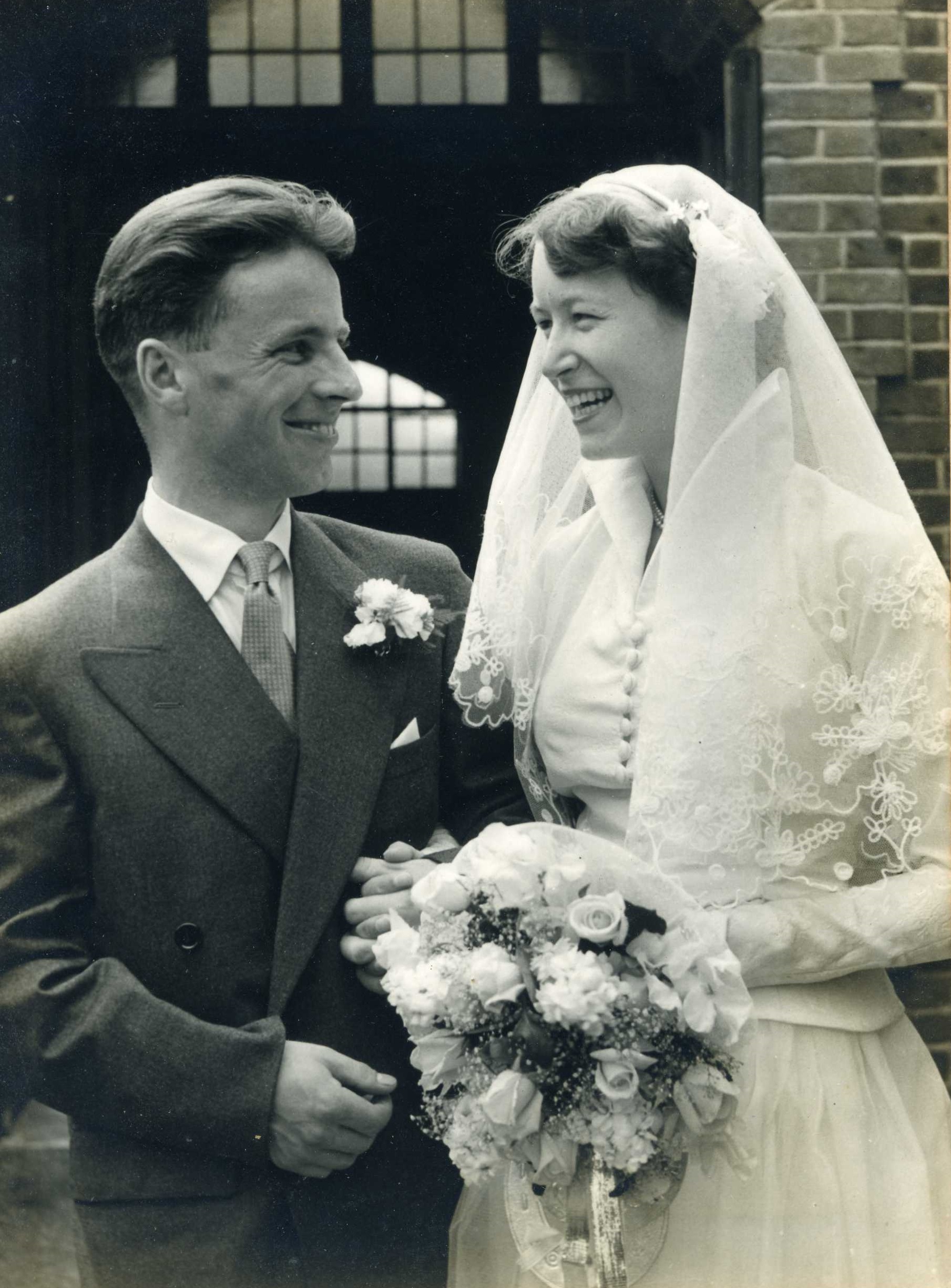
He left de Havillands because, as a Christian pacifist, he could not countenance working on military projects, and he had begun to think of a future as a teacher, inspired by people he knew and admired. He trained at Westminster College, and then took up his first teaching post at Chatham Technical College (teaching technical drawing, maths, and RE). By then he was married to Cecily, who was to be his strength and his stay until her death in 1995. They’d known each other for a long time, through church, but only gradually came to realise that their friendship was blossoming into love. They lived at 24 Blaker Avenue, in Rochester, Kent. I was born in a Chatham hospital in 1957, Aidan and Claire were born at home in 1958 and 1960 respectively.
The faith that he and Cecily shared was fundamental to their lives, and whilst I do not share their faith, I do share so many of their values, their political beliefs and their approach to what is important about life. They were pacifists, members of the Fellowship of Reconciliation. They were passionately anti-apartheid (many of their ‘expatriate’ colleagues in West Africa at least considered moving on to South Africa or Rhodesia when Nigeria imploded into civil war, but that idea was anathema to them). I learned from a very early age about the slave trade, visiting forts along the Ghanaian coast where slaves had been held before being transported across the Atlantic, and was aware of civil rights struggles in the US and anti-apartheid activism in South Africa and Rhodesia – political issues of the day were a staple of discussion around the dining table each evening. They were socialists, staunch Labour voters. And they were concerned about the environment long before it was the norm.
They both became interested in the idea of working in West Africa, in one of the newly independent nations, but realised that John would need a University degree to teach there. So he did A levels at a local technical college and then enrolled at City University in London, on a scheme designed for those who had been unable to study to degree level during the war years, and obtained a First in Physics and Maths. John was studying part-time alongside his teaching post, whilst Cecily managed the home in Rochester, and brought up the children. John’s father Dennis, a deeply conservative man, never came to terms with the plan to work in West Africa (or ‘darkest Africa’, as he consistently called it), and when we returned home on leave, John had to wait until his father had left the room before talking to his mother about our experiences there.
The family flew out to Ghana in 1960 (with three children, of whom I am the eldest, then aged 3), and a new home on Asuogya Road, on the campus of Kwame Nkrumah University of Science & Technology in Kumasi. Their fourth child, Greg, was born in Kumasi in 1962. John hadn’t had a conventional route to University teaching, and used to comment that he’d arrived as a lecturer having never attended University before – he also often felt that he was only one lecture ahead of his students.
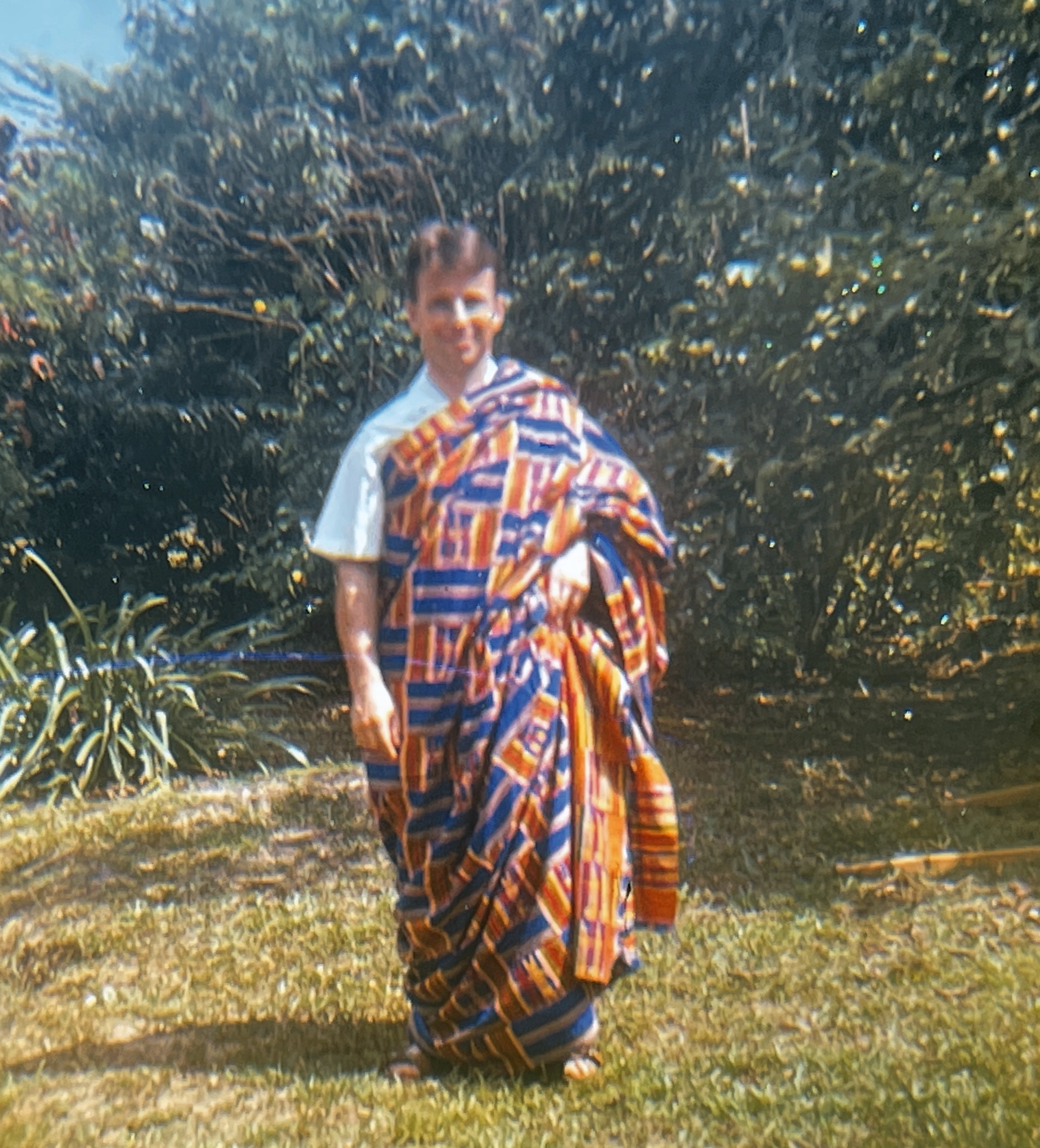
Both John and Cecily became involved in the life of the University, particularly in chamber music concerts. Cecily was an accomplished pianist, and Arthur Humphrey, a colleague, friend and honorary grandparent, played the spinet and recorders. They also held more informal musical evenings, which John’s colleagues and students from the University regularly attended. John preached regularly (both he and Cecily were Methodist lay preachers) at small village churches outside Kumasi, one of which presented (and robed) him in a splendid kente cloth on his last visit. We still have the cloth, somewhat faded and a little damaged after all these years, but still a beautiful reminder of the life we had in Ghana.
He taught Physics and Maths at KNUST but became increasingly interested in pedagogy, rather than in the research aspect of his subjects (despite pressure from his Head of Department – he resisted the idea of, as he put it, knowing more and more about less and less), and was an examiner for the West African Exam Council, and Chief Examiner for O level (the latter involved him designing practical tests which could be carried out in any school, and visiting schools to assess whether they had the necessary apparatus). He was involved with the Ghana Association of Science Teachers, and wrote a Physics O level textbook tailored to the resources available in West African schools and to the experiences of the students, which remained in print for many years.


This growing interest in education per se led him to take up a post at Ahmadu Bello University in Zaria, Northern Nigeria and the family moved there in January 1966. I don’t recall the first part of our journey (by sea from Tema to Lagos) but vividly remember the 600 mile train ride from Lagos to Zaria. The timing of our move turned out to be most inauspicious, as a series of coups and counter-coups rocked the region, and massacres of Igbo people took place in May and September of that year in the area where we lived. We were not in danger at this stage – the violence was very precisely targeted at Igbo people – but of course it was traumatic for the adults to witness what was happening, often to people they knew, and they kept as much of this from us as possible.
The only incident that I recall was when a group of men approached our house, and Cecily and a neighbour took all of the children upstairs and put a record of children’s songs on, whilst John and the neighbour’s husband went outside to speak to them. Strangely, in my memory the men were carrying sticks, but in reality, as I discovered much later, they had machetes. They turned away from our house, but went on to kill a number of people nearby.
I remember being aware of conversations between the adults that stopped abruptly when they realised I was within earshot, but it was not until my teenage years when I pieced together the fragments to understand what had been happening, and this was formative. There is one particularly powerful story that I discovered from talking to my parents and visitors who had been in Nigeria with us. Opposite our house was an unoccupied bungalow, in which we used to play sometimes. I recall being forbidden to do so – snakes were mentioned and I needed no other deterrent. In reality, John had discovered a couple of young Igbo men hiding there. He got them into the family car, covered in blankets, and drove them to the army base, where it was hoped they would be safe. Meanwhile a friend who worked for the railways commandeered a train to take Igbo refugees south to safety, and these two young men joined that group. Tragically, the train was deliberately derailed, and they and others who were fleeing the pogroms were murdered. On both of these occasions, John felt that he had to at least try to intervene. I have often wondered how he felt as he approached the armed men outside our house, and how Cecily felt, knowing what he was doing. And how he felt as he drove those young men to what he hoped might be sanctuary, knowing that if the car was stopped and searched, they would be killed, and he might be in danger too. I don’t know, because he never spoke of these events in personal terms. I believe he felt that he had no choice but to act as he did, whatever the risk.
As I learned about these events, which had happened around me, without my knowledge or understanding, I found I needed to understand the wider issues, and this lead me to read widely about Partition, the Holocaust and the Rwandan genocide.
The family returned home on leave in the summer of 1967, but the worsening situation meant that Cecily and the children could not return, and John travelled back to Zaria alone, to complete his contract, returning to the UK in Easter 1968. We did visit him at Christmas, a rather nervy visit given the volatility of the situation and the presence of armed (but barely trained) soldiers around the city.
Someone once asked me if I blamed my parents for taking us to West Africa, a question that utterly baffled me. On the contrary, I’m in awe of their courage in taking that step, and very grateful for it too. We gained so much – on our return to the UK our horizons were so much wider than those of our contemporaries, and whilst that meant we had a lot of catching up to do on popular culture and so on, it gave us a different perspective, and I think a more generous one. Certainly those years – and the culture of talking about politics and ethics and religion in our home – informed each of us in our developing views about all of those things as we grew older. We would not be the people we are, had our childhood been spent in England.
Cecily and the children were living in the family house in Rochester, and places were found for us at the local primary schools, but on John’s return he took up a post in the Education department at Trent Polytechnic, where he would remain until his retirement. He and I found a temporary home with one of his old friends (a fellow member of the ‘Brew Club’ at Westminster College), so that he could start at Trent, and I could start at Queen Elizabeth’s Girls’ Grammar School in Mansfield. The rest of the family moved up to Nottinghamshire once our new home in Ravenshead was completed.
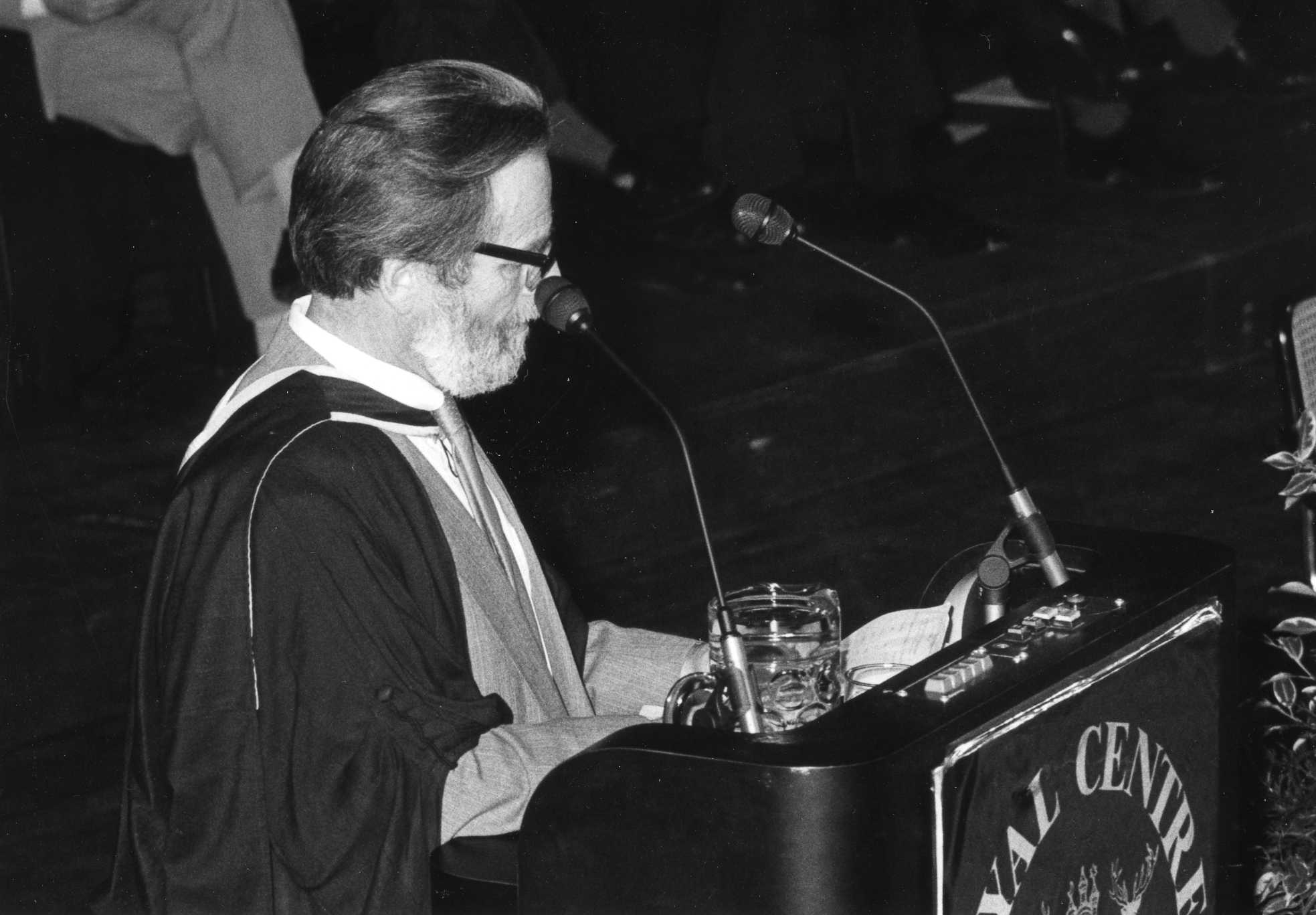
Whilst at Trent, John was involved in innovative initiatives such as the generalist Education degree and the Anglesey project, worked with VSO to train volunteers for their overseas service, and also took up every opportunity to travel with the British Council or under the auspices of the Polytechnic to visit schools and educational projects in Nepal, Kenya, and the USA. In addition, John was very concerned with the environment, and published, with Brian Harvey, an economist, a well-received textbook on Environment and Society in 1977.

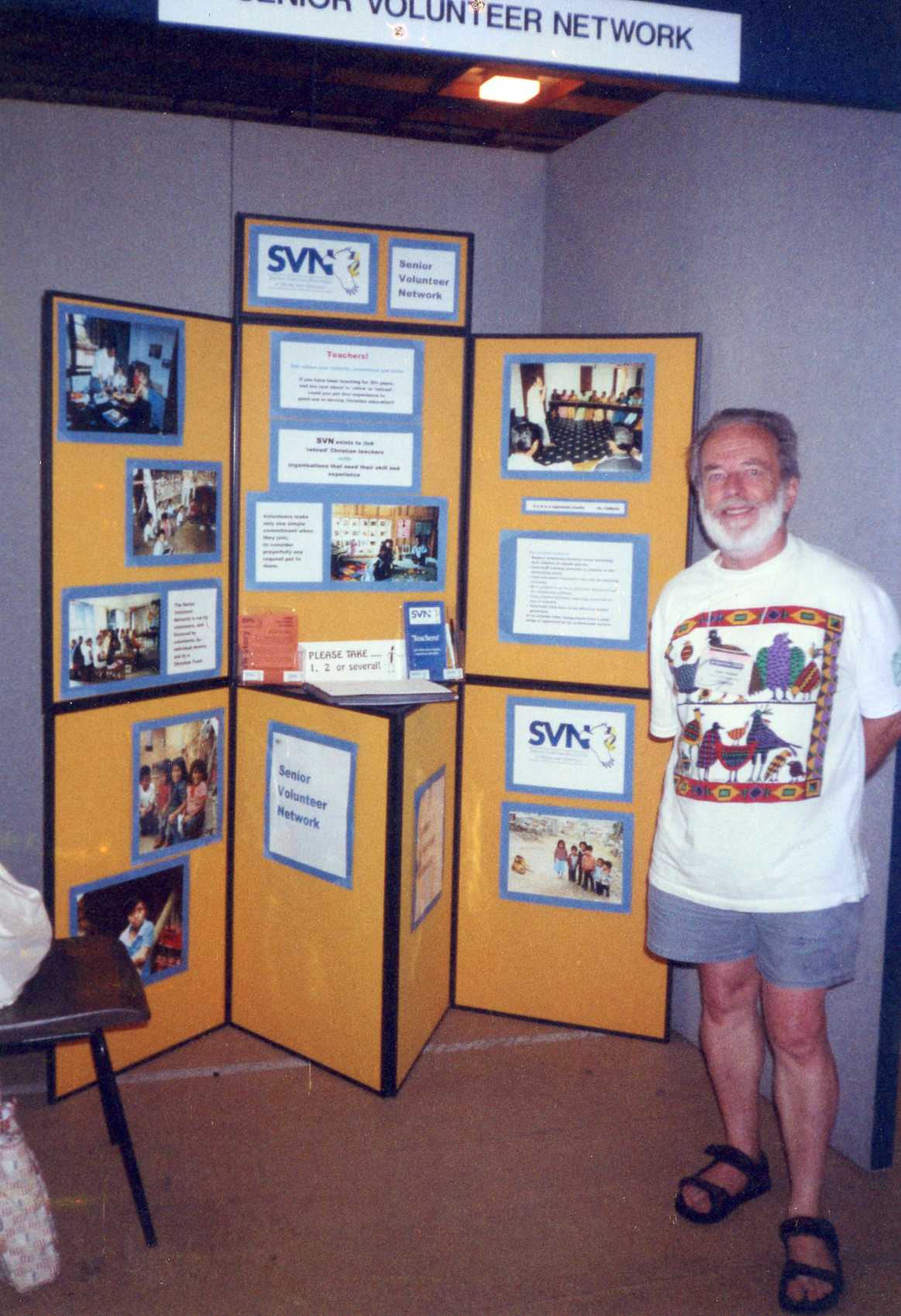

He retired (by then he was Head of the Education Department) in 1987, aged 60, but rather than leading a quieter life, he had a vision for a charity, Senior Volunteer Network, which would put retired teachers/head teachers and other education specialists into projects worldwide, and began to turn this into a reality.
He and Cecily made the most of the freedoms of his retirement (she had retired from primary school teaching some years previously). They both became involved in leadership of the Ravenshead Christian fellowship, which later became Ashwood Church (now based in Kirkby in Ashfield). In the early days of the Fellowship, we met in members’ homes or in the Village Hall. John and Cecily held open house on Sunday afternoons for young people in the village (50 years on, people still talk about how the house was full, every seat taken, and every window ledge and the stairs too) – their home in Ravenshead was called Akwaaba, which in the Twi language spoken in the part of Ghana where we had lived, means ‘welcome’. Part of our parents’ joint legacy to us is the idea of family as an open, welcoming place that embraces new members, whether related by blood, law or none of the above. In West Africa we were a long way from our aunts, uncles and grandparents, and so we accumulated a number of aunts and uncles, friends of my parents who visited regularly, and who I still think of as ‘Aunty Betty’ (with whom I still exchange Christmas cards), ‘Uncle Arthur’, or ‘Uncle Rex’. And in Ravenshead that took the form of opening our doors to random teenagers, some of whom became part of the church (and still are), others who never did, but had reason to be grateful for our parents’ warmth and support, as well as for the Sunday afternoon tea.
As keen walkers, John and Cecily led youth hostelling expeditions to the Lake District, one of which memorably involved Cecily’s group of walkers requiring the Mountain Rescue Service, after getting lost on Great Gable in driving rain and mist. John’s group had taken what was expected to be the more challenging route, only to find when they got to the hostel that we had not yet arrived. They called at the Mountain Rescue centre, at roughly the time that two of Cecily’s party arrived, having been sent out as envoys whilst we huddled behind a rock for (minimal) shelter, and gave their account to the team, enabling them to find their way straight to us.
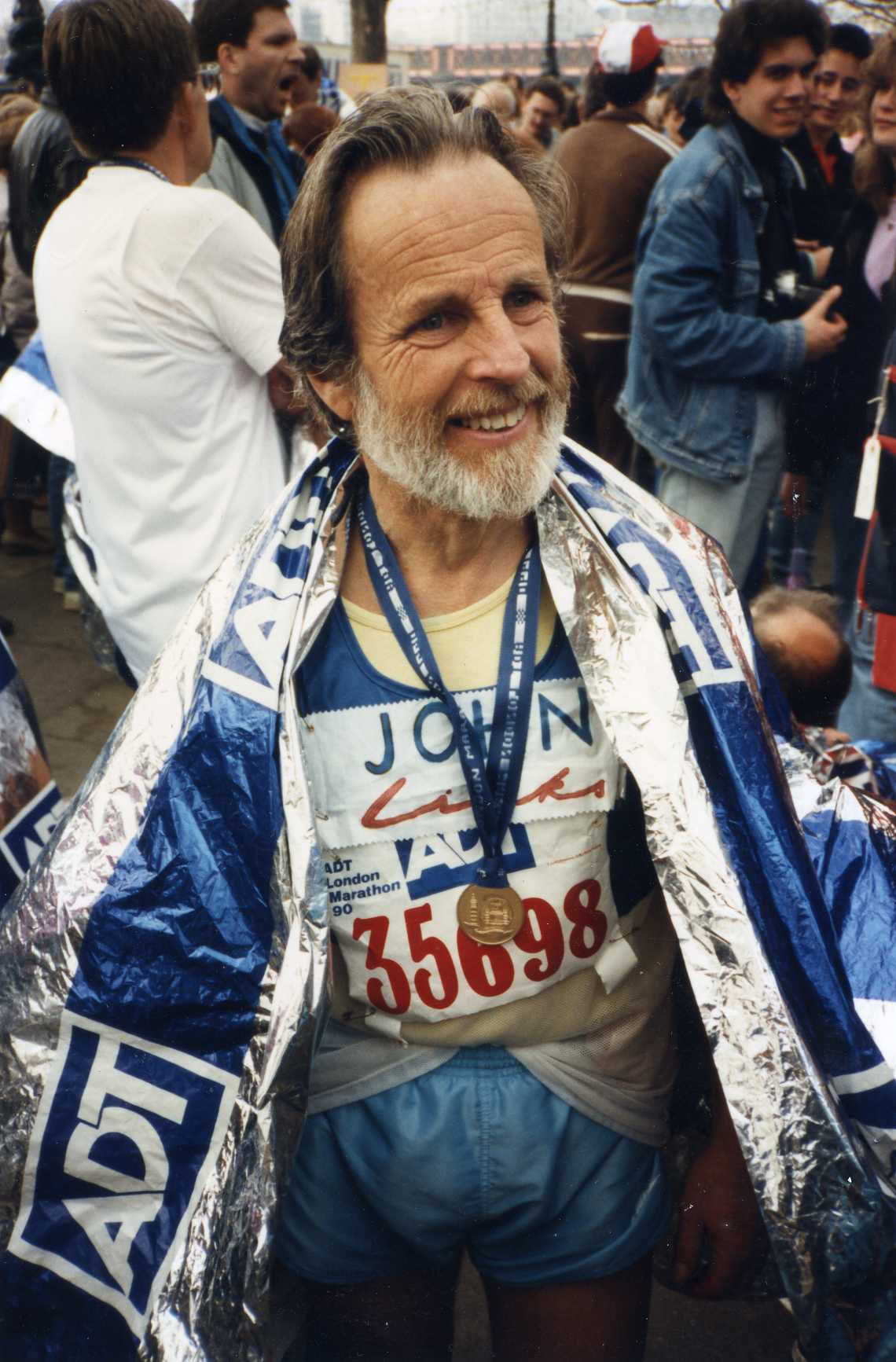
John was a governor at a number of local schools, volunteered with Mansfield Samaritans (Cecily was a founder member of this branch), and was involved in local politics. He ran regularly, and completed the London Marathon, aged 63, in 1990 – he’d been a keen runner as a young man (plenty of stamina, less speed, due to his short stature), which had taken its toll on his knees and he had to have two knee replacements later in life. He undertook many walks with Cecily (and their dog, Corrie) after his retirement, including the Coast to Coast Walk, and along the Northumbrian coast. Having visited Nepal during his work with Trent Polytechnic, he returned to Everest to climb as far as the snow line, fulfilling his dream to stand on its slopes.


In 1995 Cecily died of pancreatic cancer, aged 65, only a matter of weeks after the diagnosis. It was a huge shock, and an incalculable loss to John and to the family – and to so many more people, as we all discovered from the messages that flooded in after her death. She saw herself as an accompanist – in musical terms this means that she wasn’t there to do the virtuoso solo stuff, but to enhance the performance of other musicians – but she did far more than that, and could have done so much more (at the time of her death she was gaining qualifications in counselling, and working with a Nottingham homeless charity). At the events celebrating Dad’s life, so many people talked not just about John but about ‘John and Cec’. They had different, and complementary strengths, they were a partnership in every sense, and their legacy is a shared one, for us and for the many other people with whom they worked and worshipped.
When Cecily died, SVN was still an idea rather than a reality, and in the aftermath he threw himself into setting up and leading the network, sending volunteers around the world, and travelling himself until his eyesight began to fail due to macular degeneration. SVN still thrives, and the family still has links with it, through Claire who is now a trustee.
John remained active until his 90s, undertaking a skydive to celebrate his 90th birthday, but his sight loss was by then significantly restricting his activities as he could no longer drive, or use the computer. The pandemic shrank his horizons significantly, particularly since he could not easily compensate for the loss of face-to-face social activity with on-line due to his deteriorating sight. In 2020, just before the first lockdown, his youngest son Greg died of bowel cancer, a desperately heavy blow. The death of my husband Martyn in 2021 was also a major shock to him. In 2022 he was formally diagnosed with Alzheimer’s disease and the decline from that point on was fairly rapid. He was cared for at home by Claire until he needed residential care, and moved into Lound Hall Care Home, near Retford, in 2023.

During those last years, as the fog engulfed him and he became more dependent on others, it was sometimes hard to remember the man he had been. He was a man of bold decisions – leaving school to work at de Havillands, against his father’s wishes, leaving de Havillands on a matter of principle, training as a teacher and undertaking a part-time degree whilst working, taking his young family to West Africa (again, a decision of which his father profoundly disapproved), and then changing direction again to focus on education, and finally setting up SVN in his retirement and travelling to often remote and dangerous places to work on educational projects. He was a leader, from his days as a Cub and Scout where he progressed from ‘Sixer’ to Assistant Scout Master, to his final post as Head of the Education Department at Trent and his role in the church. We all remember family walking holidays when Dad would lead the way so confidently that we all had to rush to keep up, as he was the one with the maps and the refreshments… At the care home, he often, when we visited in the early days, told us that he was there to conduct a review or an investigation, or that we were all at a conference that he had organised. That lifetime of leadership kept a hold even when so much else had been lost.
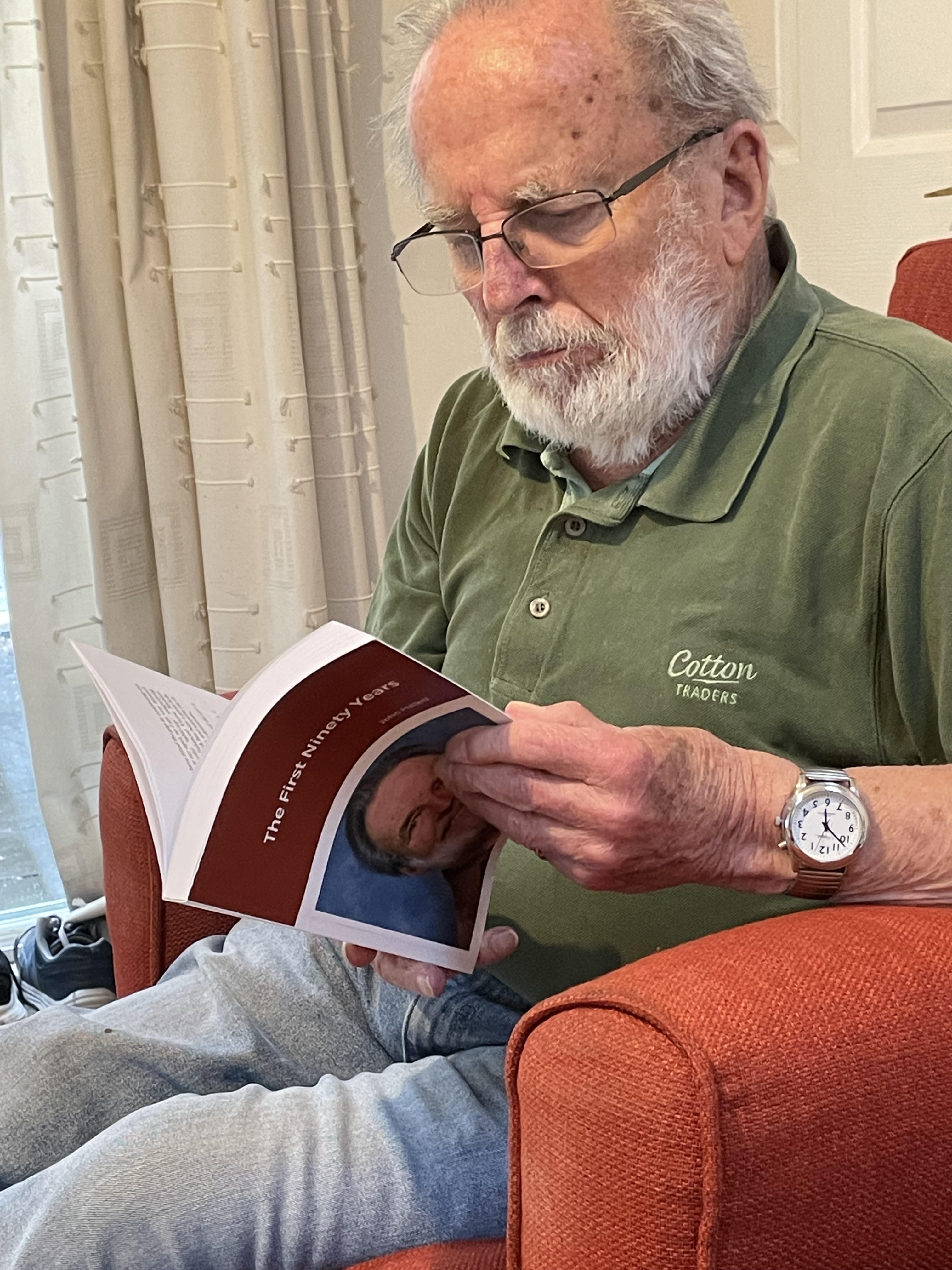
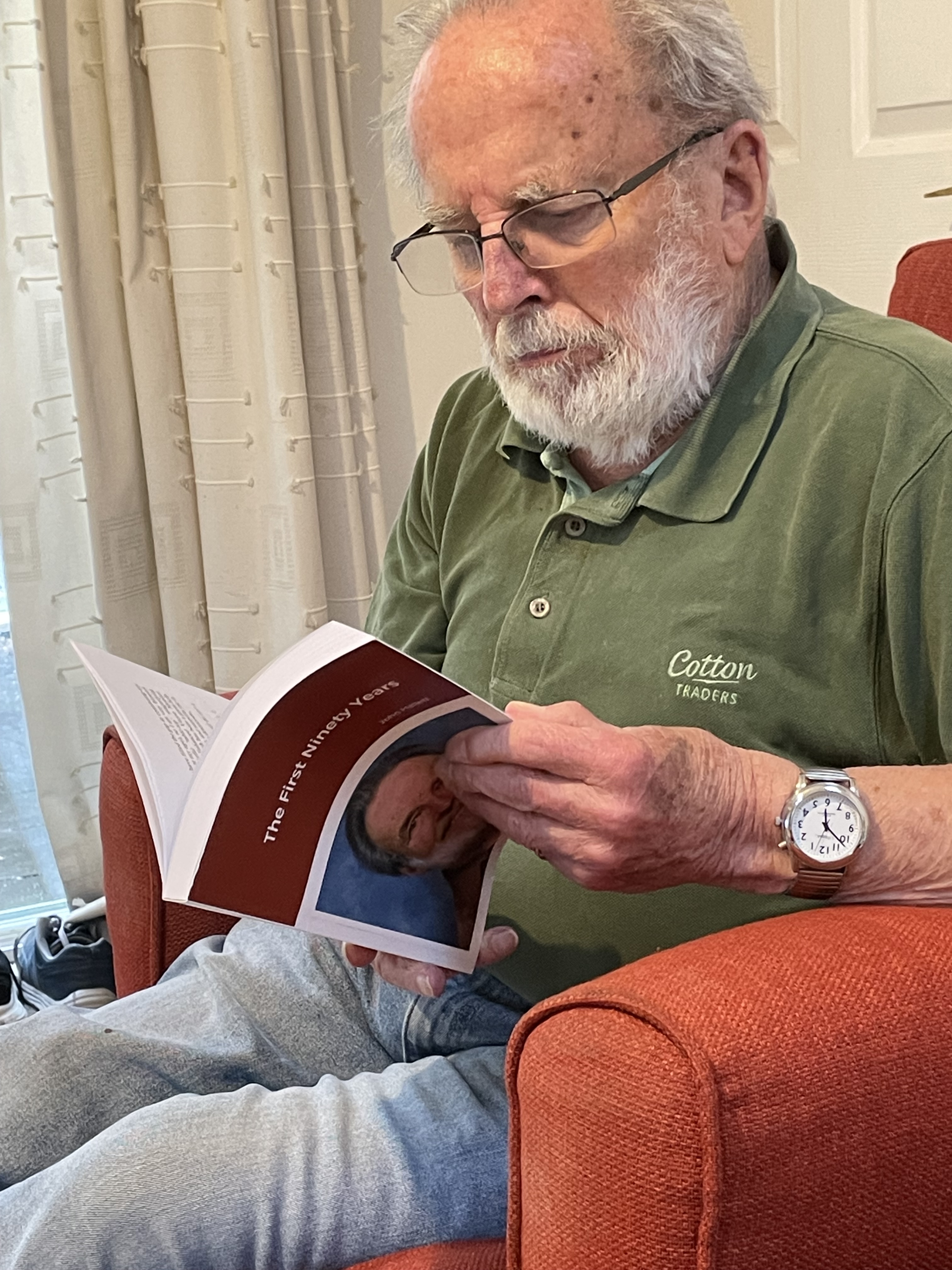
He had, from a young age, a sense of purpose, and one of his frustrations as his eyesight began to fail was that so many projects – travel abroad, or even ambitious UK walks like the ones that he and Cecily had done years before – were no longer practical or safe. For a while, writing his memoirs became his purpose, although in the final stages of the project dementia had begun to rob him not only of his memories but of understanding, and so I edited the document and arranged publication so that a copy could be placed into his hands whilst he could still recognise it as The Book, his own work.
John was fascinated by the natural world, greatly enjoying finding out about the flora and fauna – particularly the birds – of the parts of West Africa where we lived, and David Attenborough’s documentaries were a source of pleasure and interest in his last years. He read widely, and not only for professional purposes, and turned to audio-books after his sight loss, through which he enjoyed re-‘reading’ Dickens, Trollope, le Carré, Graham Greene and others, as well as discovering new writers (he was particularly enthralled by The Book Thief). He greatly admired the work of C P Snow, a scientist as well as a writer, who explored the idea of the two cultures, science and the arts (Snow’s novels were sadly not available in audio form). He loved music – as a young man he listened to jazz (New Orleans, and Django Reinhardt, not swing, as he told me firmly), but then was converted wholeheartedly to classical music after hearing Bach’s Brandenburg Concertos. Even in the very last stages of his illness he seemed to find calm in listening to Bach and Mozart in particular.
Just over a year ago, I wrote about Dad’s dementia, and specifically about Dad’s ‘raging against the loss of dignity, the loss of control over where he is and what happens to him, against the loss – even if he can no longer articulate it – of the things that made him him, against the slow dying of the light.’ And I expressed our heartfelt wish that his last days should not be spent ‘burning and raving at close of day’. In the end, at the very end, he did ‘go gentle into that good night’, with staff from his wonderful care home taking turns to sit through the night with him. We’re grateful for that, and that we each had the chance to say goodbye, to kiss him on his forehead and tell him that we loved him.
John is survived by his children Catherine, Aidan and Claire (youngest son Greg died of cancer in 2020), daughters-in-law Julie and Ruth, grandchildren Matthew, Arthur, Jordan, Melanie, Vivien and Dominic, step-grandson Tom, and great-grandchildren Jackson, Jesse and Eliza. He will be remembered with love by all of us.



2024 – Finding Joy and Hope
Posted by cathannabel in Personal on December 31, 2024
Since 2019 I have posted every week on Facebook a summary of the good things I’ve found over the previous seven days. This is always prefaced by an acknowledgement that these good things will most likely be small and personal, and that they will be outweighed in the grand scheme of things by all of the huge absolutely bloody awful things that are going on in the world. We can’t and mustn’t shut our eyes to the latter, even when for the most part they are things about which we can do very little. But if we’re going to get up each morning and wash and dress and face the world, or our little bit of it, it’s those small, personal good things that will give us the strength, day after day, to keep on keeping on.
In some ways the Good Things project is an odd one for me. I’m not a strenuously cheery person. If I am a ‘glass half-full’ person it’s an act of will because my brain is almost always in ‘what could possibly go wrong’ mode, and thus even much looked forward to events and experiences always have an element of anxiety attached. M used to say he was ‘glass half-full but really, really cross that it was only half full’. My late brother Greg was ‘glass overflowing’. So I suppose I’m ‘glass half-full but really quite worried I might tip it over and end up with glass empty’… Optimism is, as James Baldwin says, an act of will. It’s also, as Angela Davis put it, an ‘absolute necessity’. We might look at the world and see little reason for it – that’s what she called ‘pessimism of the intellect’ – but being alive, really living, requires optimism of the will. (My friend Mike Press reminded me of the Angela Davis quote, in a lovely piece he wrote about ‘reflection, renewal and optimism’.)
When I started my Good Things, my brother was dying of cancer. Then there was Covid and lockdown, and then, in October 2021, my husband Martyn died very suddenly of a heart attack. I could hardly have been more aware over these past few years that life wasn’t simply full of good things, even just on a personal level, and that wishing it wouldn’t make it so. But it helped me to have that discipline, that at the end of each week I had committed to finding something to write about, something that had brought me joy or comfort, something that had given me strength, something good. And I have always found something, even at the worst times.
In 2024 the huge absolutely bloody awfulness of what’s going on in the world is utterly daunting. When M was alive, we always watched the 10 o’clock news, but now, on my own, I find I rarely do. To watch together, and then head for bed and sleep with the comfort of each other’s company was one thing, to watch alone and then head for bed and sleep alone, with my mind full of Gaza and Trump and Ukraine and climate change and all of the other horrors is quite another. (I do read the papers every morning, I don’t shut my eyes to it all.) It’s hard to find good things out there, although I know that in any and every horror there are brave, good people who do whatever they can, at whatever risk to themselves, to mitigate that horror for others. We may not know who they are, but whilst history is very good at telling us of the evil that humans are capable of, it does also, if we look more deeply, tell us of those who stand against that evil. I try to hold on to that.
The word ‘joy’ keeps on cropping up at the moment. I recently watched the film with that title, about the first ‘test-tube baby’, whose second name was Joy, given to her by the surgeon who carried out the procedure. The film didn’t gloss over the wretchedness of infertility, and the people that the IVF process couldn’t help, but it acknowledged very movingly the joy that arrival brought, not only to her parents but to the team that had worked so long for that moment – and all of the people since who have had their chance at parenthood. And then the Doctor Who Christmas special this year was entitled ‘Joy to the World’, and it dealt with loneliness, loss and regret, but ended with light, and joy and hope. It seems to me that to have joy (as distinct from happiness, or contentment), one must know sadness, loss, pain as well, just as to be optimistic (as opposed to merely delusional) one must recognise it as an act of will, in the face of all the reasons for pessimism.
So where has the joy been, in 2024?
As always, in reading marvellous books, watching brilliant films and TV series, listening to wonderful music. There are lots of things that I enjoy, that pass the time pleasurably, but some that do more than that, that lift and move me more deeply. Hard to pick out just a few things, but, for example, Wim Wenders’ film Perfect Days, Paul Besley’s book The Search, choral music at St Mark’s Church, Chris McCausland dancing to ‘Instant Karma’ on Strictly…
Travelling with my son, for an amazing holiday, a three-city break in Vienna, Prague and Berlin, seeing the beauty of all three cities, and in each of them the tragedy of their wartime history.
Working with Under the Stars, a charity that works with adults with learning disabilities and autism through music and drama, seeing their music groups perform at Tramlines festival, at Yellow Arch Studios, at the Greystones pub and the Octagon Centre, and deejay/veejay at the Leadmill. It’s exhilarating and inspiring – their joy in performance is infectious.
Nottingham Forest. A change of manager – this time last year I wrote that ‘I’m hopeful that the new guy will enable us to stay up again this year’, but it turned out to mean a transformation that finds us at the end of 2024 second from top of the Premier League, and dreaming of possibilities in 2025…
Family – a wedding, an engagement, and lots of ordinary special times spent with the people I love most, watching football, watching Strictly, trips to the cinema, opera or theatre, going around the galleries in town, wine-tasting, meals out, meals at home. Boxing Day shared with the future in-laws for the first time.
Friends – meeting for coffee or lunch, sharing music, talking about families and plans, hopes and anxieties, meeting via Zoom when we can’t be together in person.
So this New Year’s Eve, as for the last approx. 40 years, will be shared with very dear friends. We’ll eat and drink and watch Jools’ Hootenanny and complain about his choice of guests, and on New Year’s Day we’ll eat more and find an undemanding film to watch before going forth into 2025. My first New Year’s Day without M was bleak, almost unbearably so. I faced the first year since I was 16 years old in which he would not be by my side. I expect there will be moments this New Year too, when it hits me, but three years on I am accustomed to being without him. It’s not that the grief and loss is less, rather that one adjusts around it, accommodates it, and it becomes a part of one. I know I will cope because I have coped already with so much, and because the people who’ve enabled me to cope will be with me.
And for 2025 we hope, of course we hope. We hope for cease-fires, for wars to end, for freedoms to be restored, for care for our planet to be prioritised over profit, for vital public services to be protected and rebuilt for those who need them. We hope for good things for ourselves and the people we love. We hope for the strength to cope when bad things happen, the strength that comes from other people’s love and support as well as our own.
I come back to this poem every new year. That word ‘sometimes’ has some heavy lifting to do here, but of course, sometimes, these things will be, and that’s what we have to hang on to.
Sheenagh Pugh – Sometimes
Sometimes things don’t go, after all,
from bad to worse. Some years, muscadel
faces down frost; green thrives; the crops don’t fail,
sometimes a man aims high, and all goes well.
A people sometimes will step back from war,
elect an honest man, decide they care
enough, that they can’t leave some stranger poor.
Some men become what they were born for.
Sometimes our best efforts do not go
amiss; sometimes we do as we meant to.
The sun will sometimes melt a field of sorrow
that seemed hard frozen: may it happen for you.

Hang on to your hat. Hang on to your hope. And wind the clock, for tomorrow is another day (E. B. White)
Three Cities – Vienna, Prague, Berlin
Posted by cathannabel in History, Personal, Second World War, The City, Visual Art on August 4, 2024
For most of my life, I’ve been fascinated by cities. My teenage years were spent in a rather ordinary dormitory village but I headed regularly for the nearest proper city (Nottingham) for shopping and football, and the annual Goose Fair. I’d previously lived in Kumasi (Ghana’s second city), and Zaria in the north of Nigeria. When I went off to University I settled in Sheffield where I still live, despite a few years commuting to Manchester, and a very brief period commuting to Leicester. My PhD thesis explored ideas about the city, about navigating and failing to navigate it, about the city as labyrinth, looking particularly at Manchester and Paris. And my idea of a really good holiday would be less likely to involve a beach (though a city that happened to have a beach would be quite appealing), but would definitely involve a lot of walking around in a city with heaps of history and culture.
A few years ago, I started to formulate an idea for such a holiday, encompassing two or three European cities, with as much as possible of the travel being by train. The idea never got very far when everything shut down, and we were barely starting to think again about travelling when M died, very suddenly, early one morning in October 2021. In the shock and grief that followed, I wasn’t really thinking about holidays in any practical way, but it did occur to me early on that they would be a challenge.
I can’t see myself travelling alone for any other than the simplest journeys. I take the train up to Dundee a couple of times a year to stay with friends, but always pick the direct trains, and I know I’ll be met at the station, and I went to Rome alone in December 2022, but was met at the airport, and had family to stay with. My biggest challenge in travelling alone is my highly deficient sense of direction. I got lost in Amsterdam on what should have been at most a ten-minute walk from my hotel to the conference venue – heck, I got lost in Leeds (with a similarly deficient friend) trying to get from the Trinity centre to the Grand Theatre. So the thought of a city break on my own is just too intimidating to contemplate – and of course the idea of getting lost in an unfamiliar city alone is something that triggers the hardwired caution that comes from growing up female. Add to this the fact that I am short and not particularly strong, and struggle with any case larger than a weekend holdall, so often have to rely on the kindness of strangers to get luggage on and off trains.
More than this, the pleasure of such a trip would be so diminished if I had no one to share it with. I’d need a travelling companion, and it would have to be a travelling companion who was (a) taller than me – not a major difficulty, most grown-ups are, (b) gifted with a good sense of direction, and (c) interested in the same sorts of things that I am, including with a high tolerance for WW2 history.
I said something about this dilemma one afternoon, sitting with my offspring, not long after M died. At which point the solution became obvious – my son A is (a) taller than me, (b) has an almost supernatural sense of direction and (c) is as much of a history geek as I am, with a similar interest in WW2. I started turning over in my mind what my ideal destinations would be, and Vienna, Prague and Berlin seemed to present the perfect mix of art, architecture and history, with a lot of WW2 and Holocaust sites to visit.
We started planning in earnest, once I’d checked with him that he wasn’t merely being kind when he agreed to go, but actually liked the idea, and worked out timings, and a wish list of places to go and things to see.
I decided, fairly early on in the planning, that whilst sites associated with the Jewish populations of those cities, and museums and memorials recording the destruction of those populations, were high on my list of places to visit, there would be no concentration camps. If I go back to Prague with more time, I will perhaps take a trip out to Terezín, but it was not a priority on this trip. A had visited Sachsenhausen on an earlier trip to Berlin (with school) but had no desire to go back again. This was the right decision – the history of those Jewish communities was less familiar to me than the history of the camps, and what I wanted was to honour the Jewish history of all three cities, and to see the people behind the statistics, in the Stolpersteine on the pavements, in the names on the battered suitcases from Theresienstadt, in the names painted on the walls of the synagogue.
This is a Holocaust heavy trip. I have been reading about and studying the Holocaust since I first encountered Anne Frank when I was probably around the same age as her, and I believe that if we do not understand it, or at least attempt to, we restrict and distort our understanding of post-war politics, history, art, literature and music, even of humanity. It was a significant thread in my PhD thesis, not just the Holocaust itself but how it can be written about, and I have often wrestled with the question of how – indeed, whether – fiction about the Holocaust can shed light. So, whilst I do totally understand why people would choose not to go to these sites, not to read those books or watch the documentaries, it is important to me to do so, to continue doing so. All that I have read, all that I know, has never desensitised me to its horror and it will never do so – the names and photographs, the individual stories, can and do still punch me in the gut. But I don’t go to these sites to get that gut punch, I go to continue to build my knowledge and understanding – and to pay my respects.
Part of my interest in visiting these three cities was to reflect on how they differ, and in particular how they approach their own WW2 history. Austria has described itself as Hitler’s first victim, but it is of course not quite that simple – there was enormous support for the Nazi party, and a long history of virulent antisemitism in Vienna, that ran alongside the major Jewish influence in culture and the arts as well as in business and politics. Czechoslovakia was, entirely straightforwardly, a victim of Nazi aggression, and Prague’s Holocaust memorial takes the form, most powerfully, of the names of the dead, painted on the walls of a synagogue. Berlin deals with its past – both the Nazi era and the injustices and brutalities of the DDR – with candour and without excuses, and its memorial is not about the Jews of Berlin or of Germany, but all of the murdered Jews of Europe.
This blog isn’t a guide to or a history of any of these cities. It’s an attempt to capture the experience, and my reflections on the experience, to help me remember it in all its richness. And I’ve included some of the research I did after we returned home, to find out, where possible, the stories behind the names on the Stolpersteine and other plaques, because for me this was a vital part of the trip. It is an entirely personal mix of anecdote, history, images and quotations and as such may not be a reliable source for anyone else’s city wandering…
Note: for clarity, I have used Terezín as the name of the Czech town, and Theresienstadt as the name of the Nazi ghetto/concentration camp which was created there. I have tried to be consistent with spellings, but Czech names are often to be found in multiple variants, so some inconsistencies may have slipped through.
VIENNA
We arrived on Monday evening, flew in from Manchester and got a train from the airport to the Hauptbahnhof, from where we just had to cross the road to get to our lovely hotel, Mooons (comfortable and welcoming – we were tired and a bit stressed after we’d checked in, having had a slightly less straightforward journey from the airport than we’d anticipated, and Sven the barman sorted out food and beers for us so we started to chill out and enjoy planning our time). We made the most of our two full days in the city – though there is plenty we didn’t see, buildings that we saw from the outside but didn’t go round, for example – I clocked up 59k steps, 40.5 kms. We managed to find some proper Viennese food – e.g. schnitzel and goulash, and good beer (I went for the darker beers, less lagery).
Tuesday:
From our very modern hotel, we were only a few minutes from the beautiful Belvedere Palace – we walked through the gardens which for me had strong Marienbad vibes (as in Alain Resnais’ French new wave masterpiece, Last Year in Marienbad, a film which has fascinated and haunted me for many years, and which I’ve previously blogged about on this site).
On to the Stadtpark, where we found a rather blingy statue of Strauss, and more tasteful ones of Bruckner and Schubert.


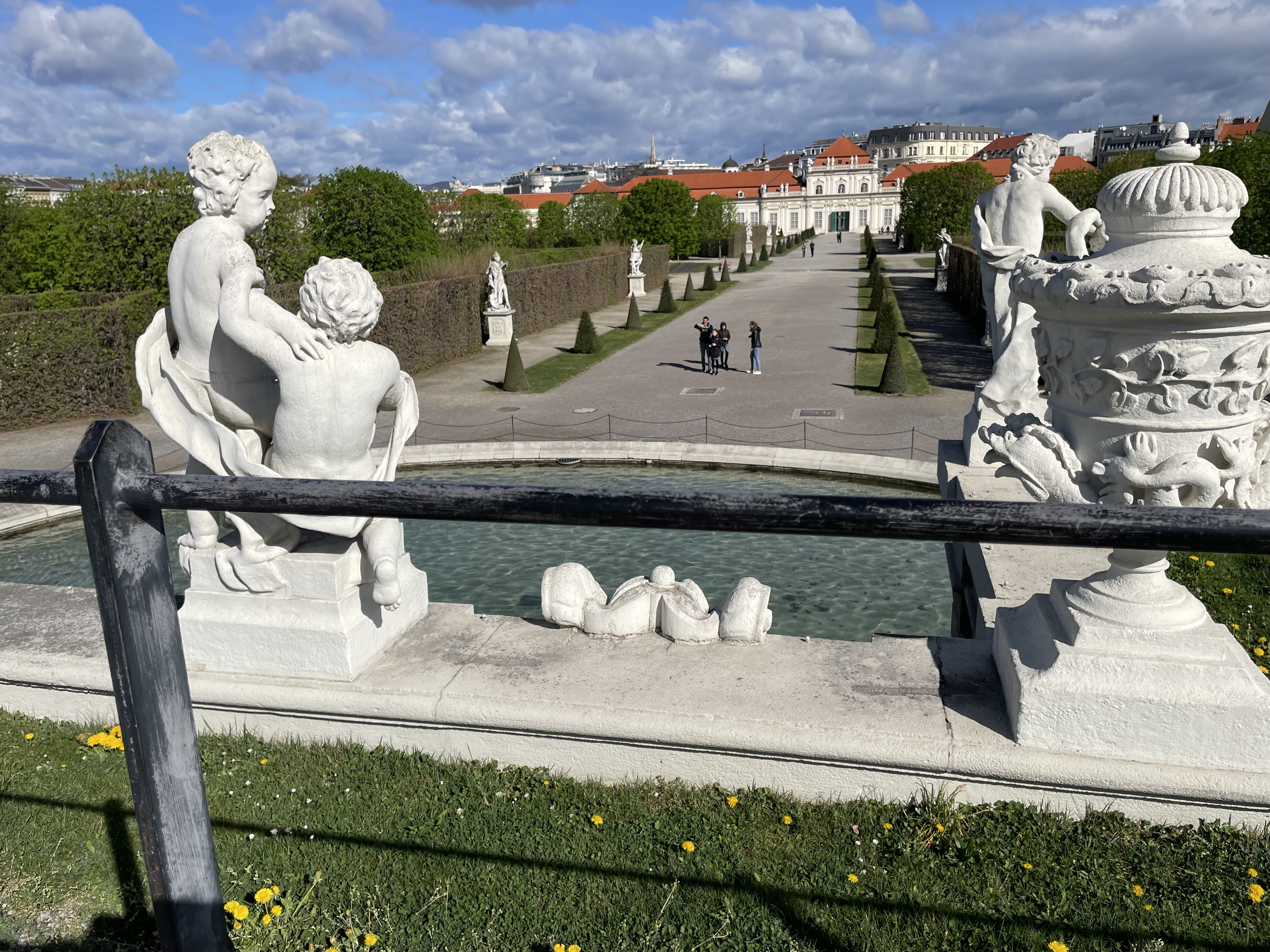
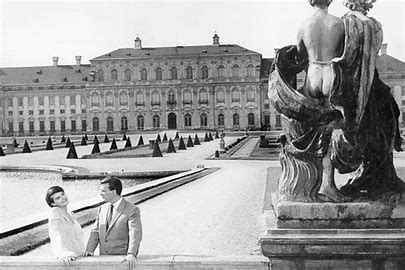

Clockwise: Mooons Hotel, Belvedere Palace, gardens and fountains, Last Year in Marienbad, Strauss statue in the Stadtpark.
Walking by the Danube – here there was graffiti, a lot of it political, e.g. re climate change. In general in Vienna, there was no litter, and an orderliness evident in what happened at pedestrian crossings, where no one walked until they were told to walk. It felt a lot safer than, say, crossing a road in Rome, where one feels as if the only way to ever get across is to walk and hope one isn’t immediately mowed down. (A told me of waiting in vain for the right moment at a crossing point in Rome, and another tourist facing the same dilemma saying cheerily, ‘OK, when in Rome…’ and launching himself into the traffic. The cars and bikes do weave around you but it never even starts to feel safe.)
There are two Jewish museums in Vienna. First up was the Museum Judenplatz, built around the excavated remains of the earliest synagogue in Vienna, destroyed in 1421 by order of Duke Albrecht V. It has a fascinating collection building up a picture of that early Jewish community, and of the exploration of the remains. The Jüdisches Museum nearby continues the story of Vienna’s Jewish population through the centuries. But there is a strange sense of a hiatus – not that the Holocaust is omitted but compared to Prague and Berlin, it is arguably underplayed, the job left to the bleak Whiteread memorial in the Judenplatz. This is a bunker, whose walls are made up of books with spines facing inwards to represent the victims whose names and stories are lost, 65,000 Austrian Jews. The names of the camps and other locations where they were murdered are inscribed around the memorial.
Stolpersteine (Schwedenplatz): Here there are three individual stones, and a plaque in memory of 15 unnamed Jewish women and men who lived here before they were deported and murdered (no details given) by the Nazis. The Stolpersteine commemorate Anna Klein, b. 14 Jan 1885, Josefine Steinhaus, b. 21 May 1884, Helene Steinhaus b. 3 August 1885. Deported to Maly Trostinec 27 May 42, killed 1 June 42. Maly Trostinec/Trostinets, a village near Minsk in Belarus, was not a location I was familiar with. Throughout 1942, Jews from Austria, Germany, the Netherlands, Poland, and the Protectorate of Bohemia and Moravia were taken there by train and then shot or gassed in mobile vans. According to Yad Vashem, 65,000 Jews were murdered in one of the nearby pine forests, mostly by shooting, but some estimates are much higher, up to 200,000.
Vienna State Opera (Staatsoper) We’d decided against trying to get tickets for any performance here because (a) cost, (b) I haven’t managed to entirely convert A to opera and (c) we didn’t want to commit an evening. That was the right choice – we walked for miles (see above), and in the evenings just wanted time to chill with some nice Austrian beers and talk over what we’d seen and make our plans for the following day. But the building itself is obviously magnificent. And we had seen inside anyway, in Mission Impossible: Rogue Nation…


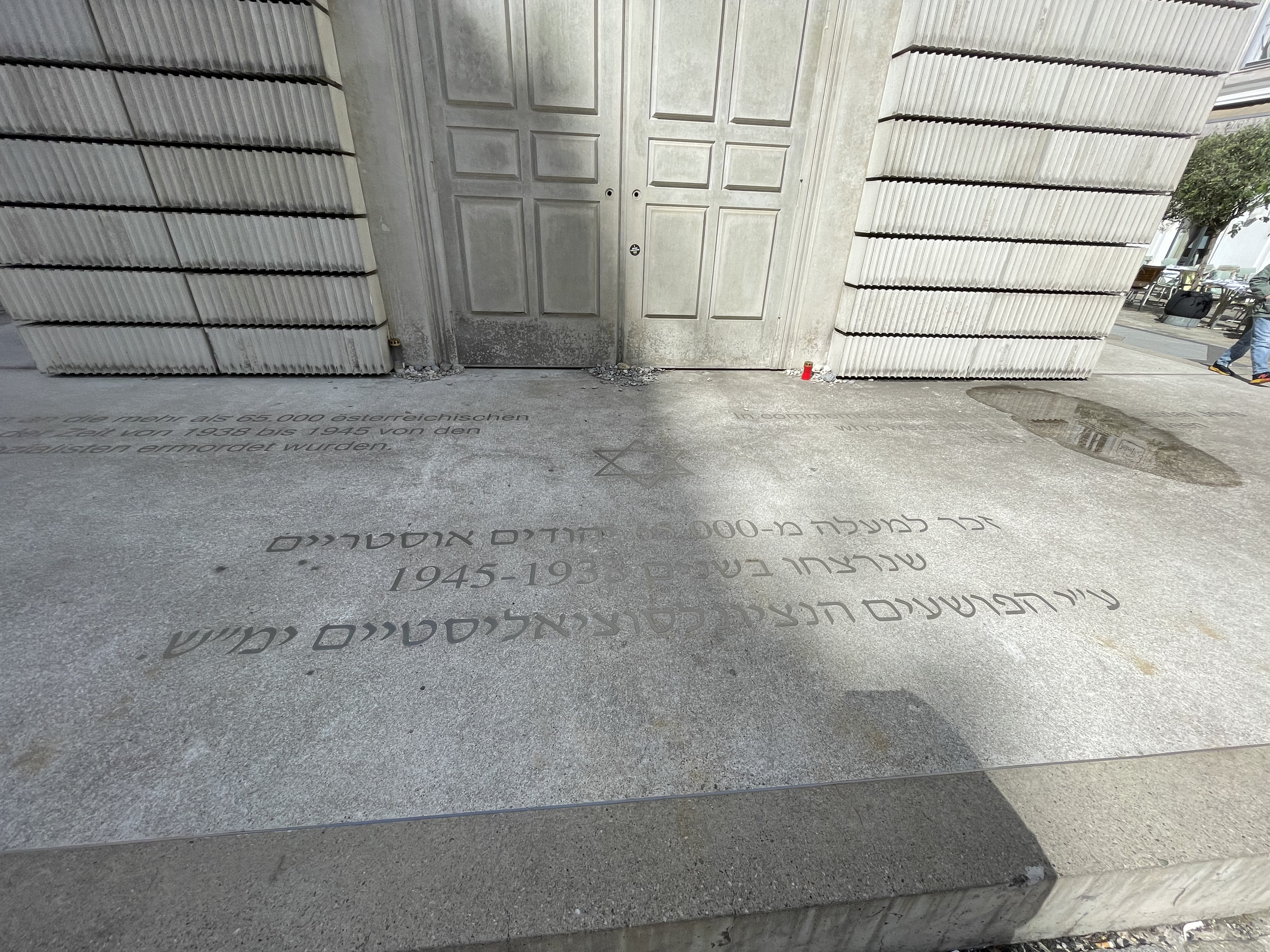


Clockwise: Stolpersteine, graffiti by the Danube, Judenplatz, Whiteread Holocaust memorial, the Opera house and nearby street
St Stephen’s Cathedral (Stephansdom). As in Paris, the survival of this and other fine buildings was achieved by a refusal to carry out orders. The City Commandant had ordered the Cathedral to be reduced to rubble, but this was not carried out – unfortunately, as the Red Army entered the city, looters set fire to shops nearby, which spread and damaged the roof and destroyed the 15th century choir stalls. Much was saved, however, and reconstruction began immediately after the war, with a full reopening in April 1952.
Watching The Third Man makes one realise just how badly Vienna was damaged during the war – not devastated like Berlin, Hamburg, Dresden, but, as Elisabeth de Waal puts it, ‘desultory bombing by over-zealous Americans on the verge of victory, and the vindictive shelling by desperate Germans in the throes of defeat’ had resulted in ‘the gaps in the familiar streets, the heaps of rubble where some well-remembered building had stood’ (The Exiles Return, p. 57). One would not know it now. Clearly, given the fear that rebuilding would destroy the character of the city, the choice was made to rebuild it as it had been, as far as possible. Which gives Vienna that feeling of being preserved in aspic, a slight unreality.
We went a bit further afield, out to Schonbrunn Palace. We didn’t go round the palace itself, preferring to explore the gardens, and head up the hill to the Neptunbrunnen and the Gloriette, to enjoy the view, which was indeed glorious.

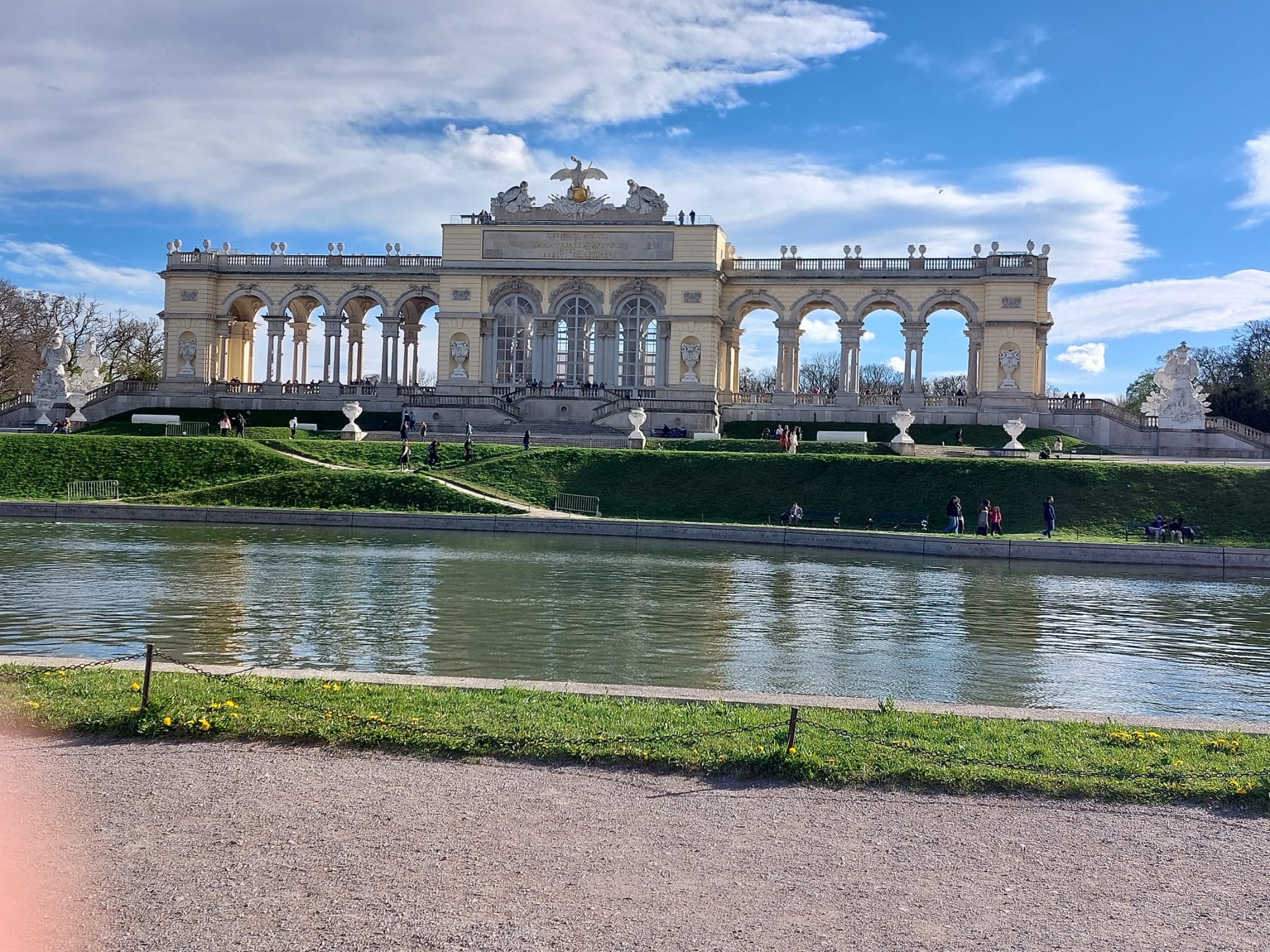

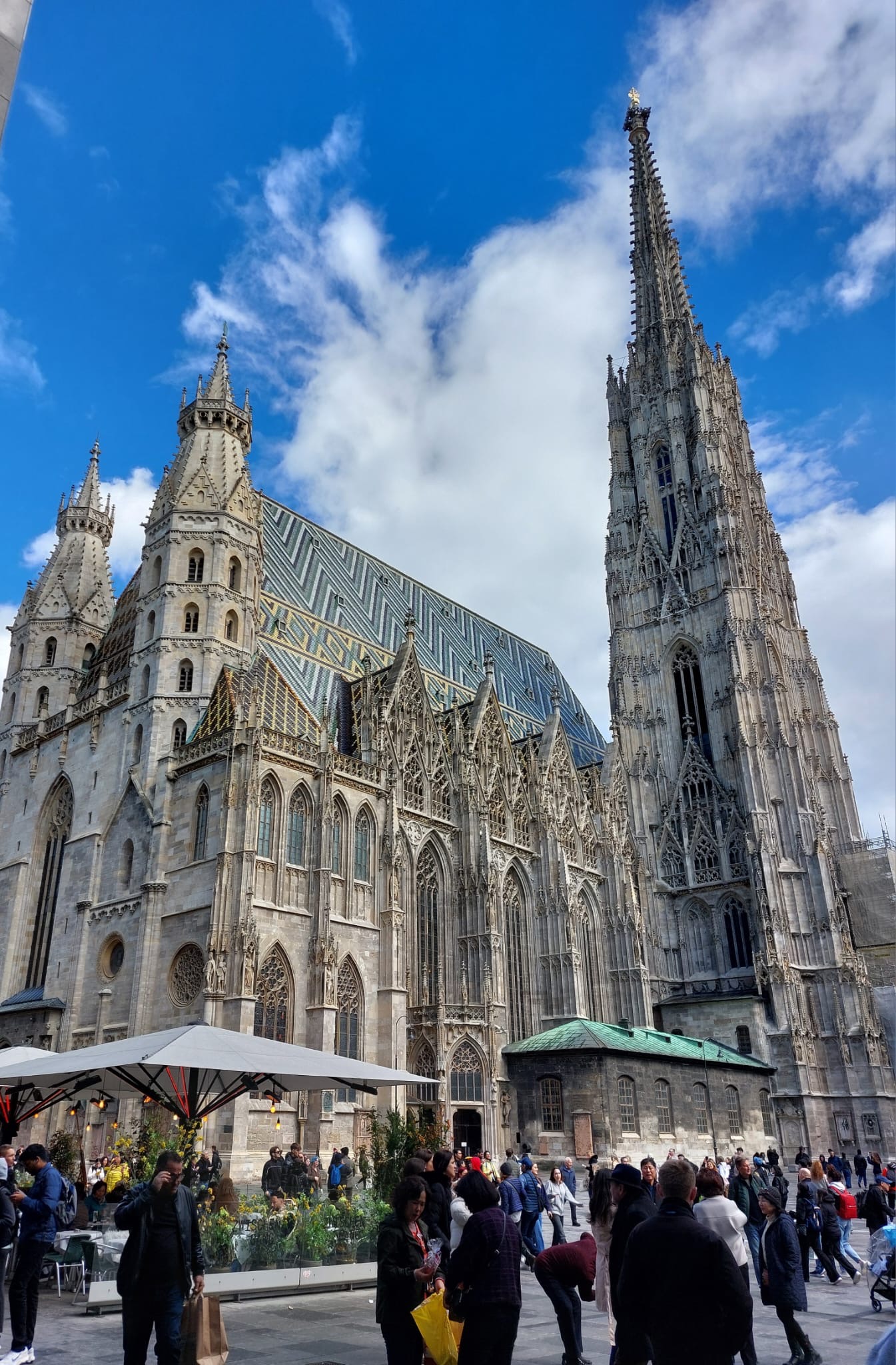


Clockwise: Schonbrunn Palace, Gloriette and Neptune fountain; Stephansdom
Maria am Gestade church – one of the oldest churches here, built 1394-1414
Memorial to liberating Soviet soldiers (Heldendenkmal der Roten Armee/Heroes’ Monument of the Red Army), in Schwarzenbergplatz, featuring a twelve-metre figure of a Soviet soldier. This was unveiled in 1945. It seemed to me remarkable that it was built so soon after the war ended, but then I hadn’t realised either that Vienna was liberated by the Red Army, or that in the hiatus before the other Allied Forces arrived, there was a real possibility of Stalin occupying all of Vienna. The memorial is about heroism in battle, not about the violence, particularly sexual violence, inflicted on civilians during and after the battle, and has been controversial and subject to vandalism over the years, including very recently in response to the invasion of the Ukraine.
Wednesday:
Stolpersteine: Paula Wilhelm (née. Mandl), born 6 April 1887, deported 29 April 44 to Auschwitz; and Dr Max Neustadtl who fled to France but was deported on 25.3.43 to the Sobibor extermination camp and murdered.
Vienna’s second Jewish Museum focuses on the later Jewish communities, covering the period of Nazi rule, but not dealing in great depth or detail with the Holocaust.
One fascinating display here is part of the collection of netsuke whose story is told in Edmund de Waal’s The Hare with the Amber Eyes. These are the Japanese miniature sculptures which belonged to the Ephrussi family, and which were kept out of the hands of the Nazis, unlike most of the contents of the Palais Ephrussi. Six weeks after the Anschluss, the family servant, Anna, was required to pack away the belongings of her former employers. There were lists, of course, to ensure that everything was accounted for. But each time that Anna was in the Baroness’s dressing room, she slipped a few of the netsuke into her apron pocket, and hid them in her room. In December 1945, Anna gave Elisabeth de Waal 264 Japanese netsuke.
‘Each one of these netsuke for Anna is a resistance to the sapping of memory. Each one carried out is a resistance against the news, a story recalled, a future held on to.’ (Edmund de Waal – The Hare with the Amber Eyes, pp. 277-83)


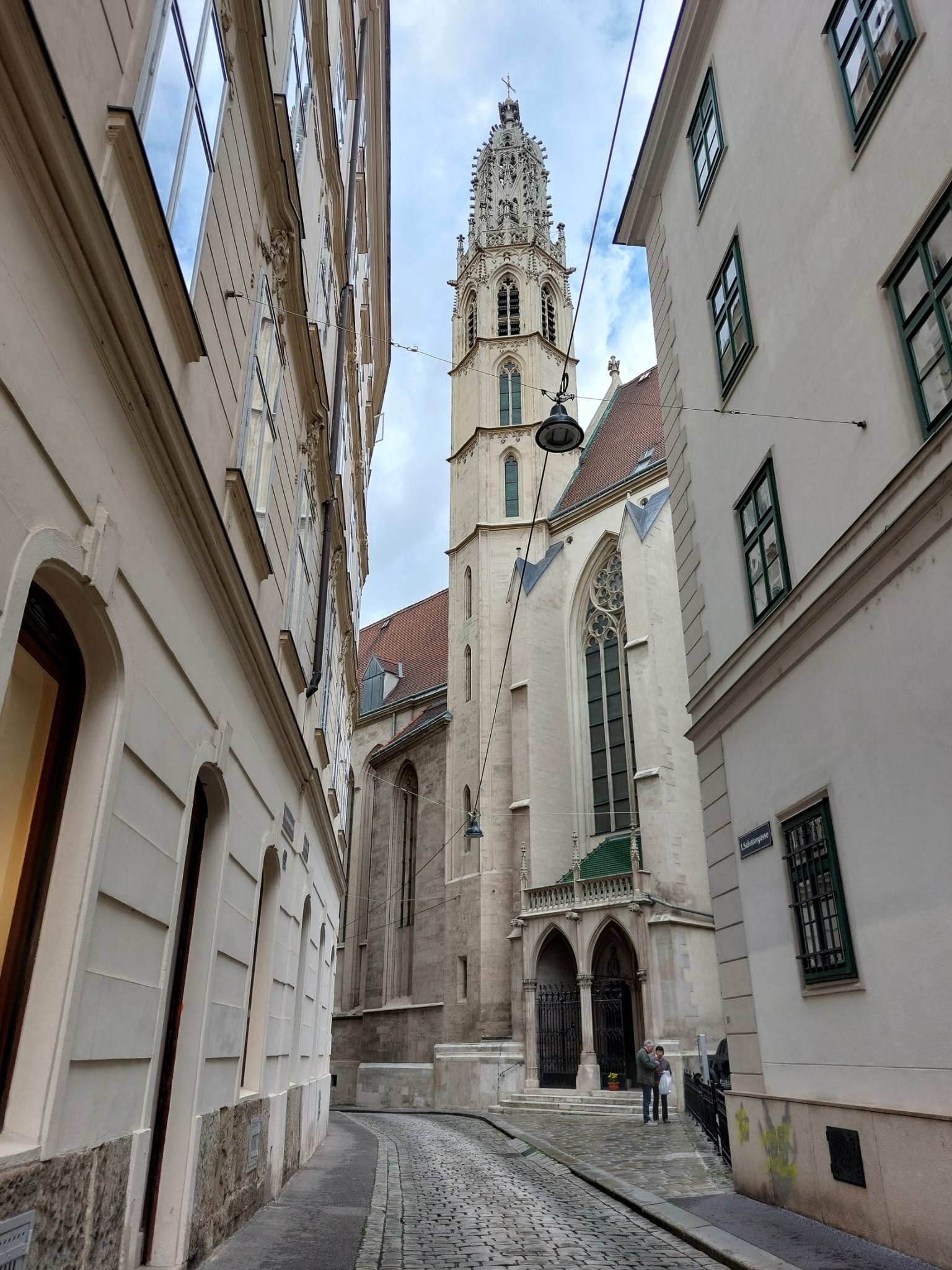

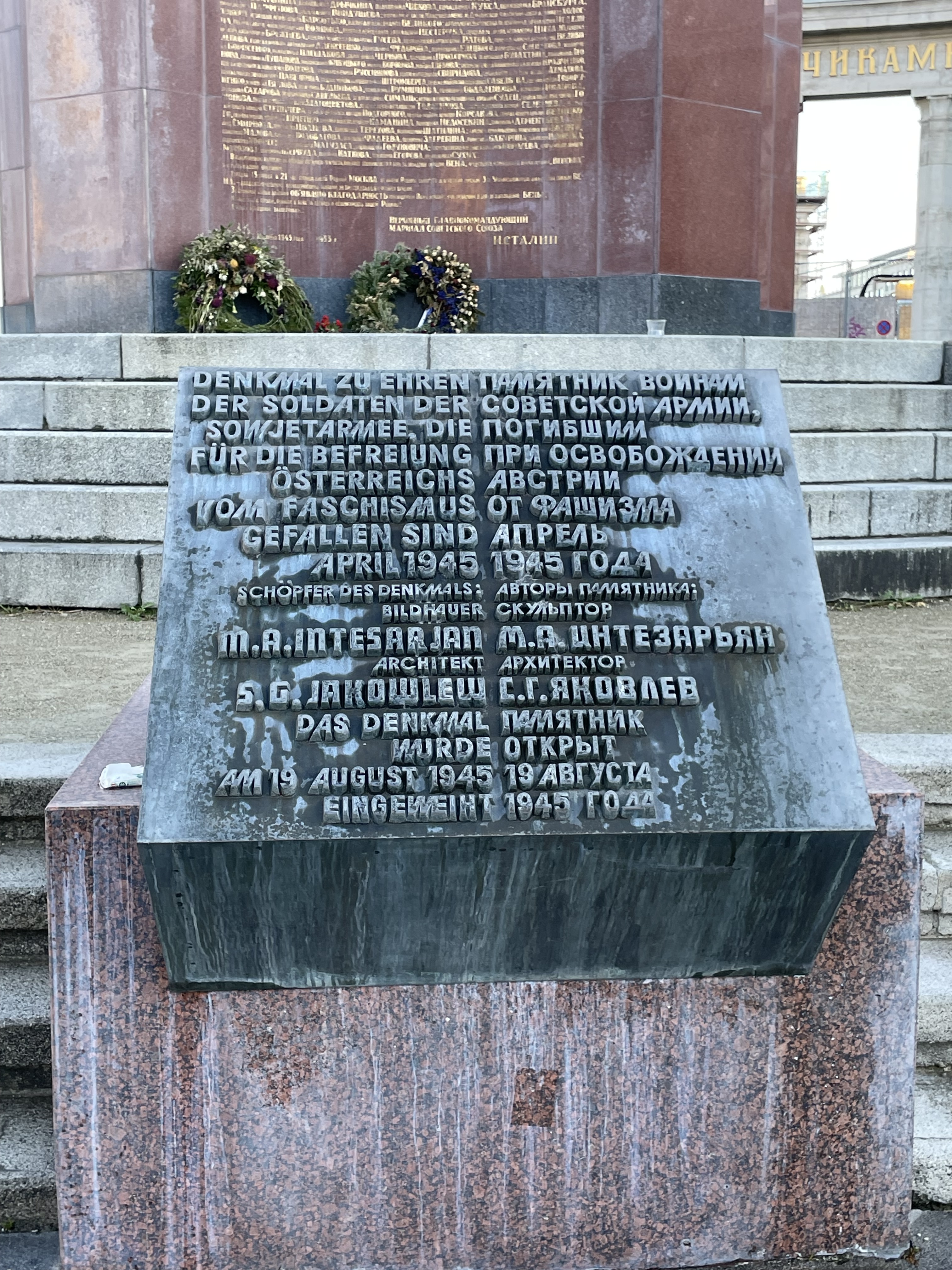
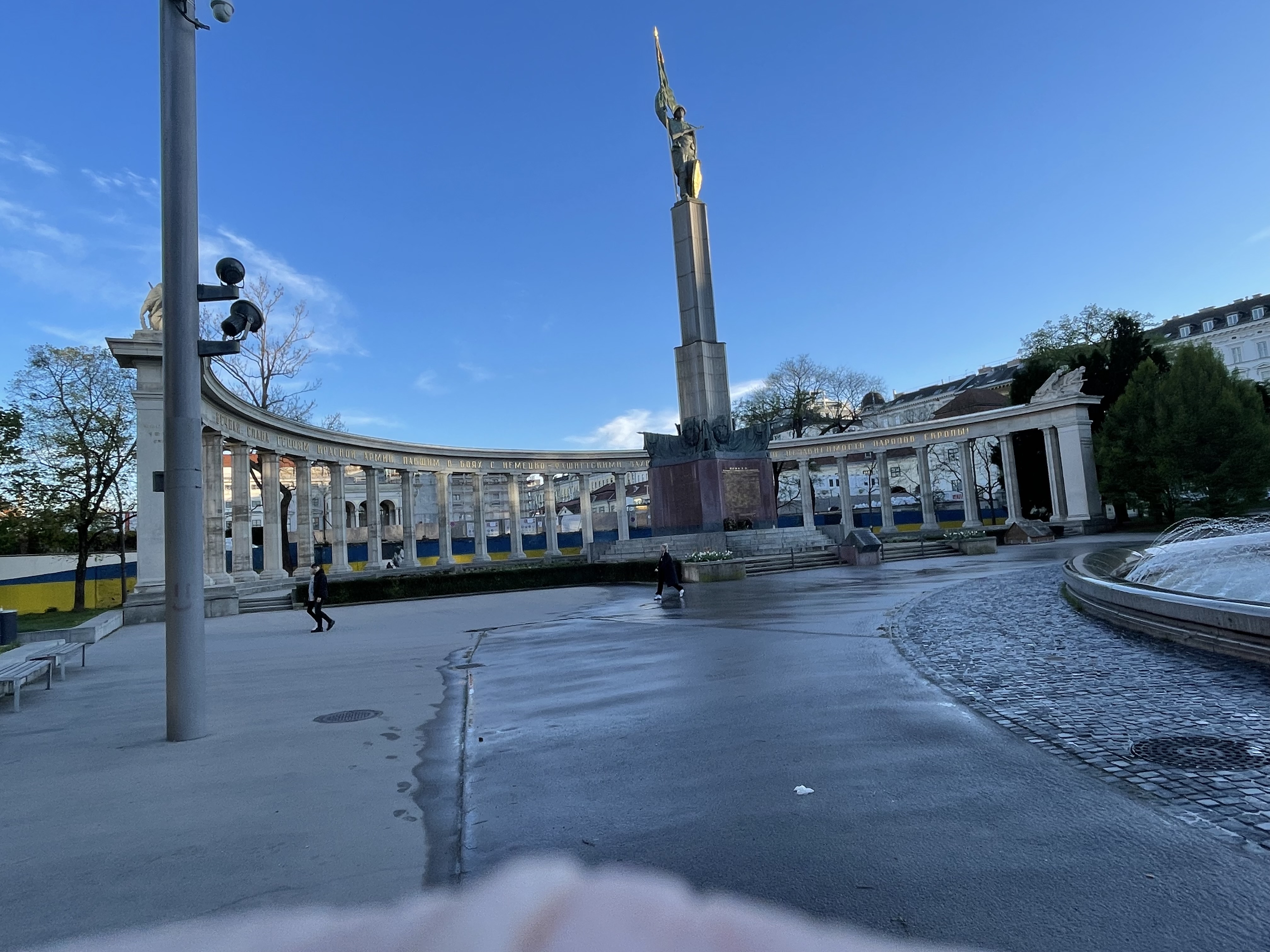
Clockwise: Stolperstein for Max Neustadtl, netsuke in the Jewish museum, Maria am Gestade church, stolperstein for Paula Wilhelm, Heroes Monument of the Red Army
A plaque on Herminengasse gives the names of Jews who lived here, in what was once part of the Jewish ghetto. Many Viennese Jews were forced to live here, until they were deported to various killing sites. Several were killed in Izbica (a town in Eastern Poland, which was turned into a ghetto) – all show the same date of death, 5 December 1942, when the inhabitants of the ghetto (Polish Jews, and those deported from Germany and Austria) were murdered. Those who escaped this massacre were deported again, to Treblinka, Maly Trostinec, Łódź Ghetto, Riga Ghetto, Theresienstadt, Sobibor, Stutthof. I know nothing about these people, other than their age, and where they were killed. But I can see that Oskar Koritschoner was only 20 years old when he committed suicide. Maly Trostinec was the place where 13-year-old Regine Frimet and 3-year-old Ernst Elias Sandor were murdered. And Josef Weitzmann, the last of these to die, was killed in Stutthof concentration camp, in 1944, just after the facilities for mass murder had been set up there. He was 18.
We found the Palais Ephrussi, on the Ringstrasse (see, again, The Hare with the Amber Eyes). I had had an insight into the efforts to trace the plundered contents of the Palais, from Veronika Rudorfer who I met in December 2019 at a conference, when she gave a talk on that project, and subsequently, very generously, sent me a copy of her beautiful book about the Palais itself.
The Burg Theatre – Sarah Gainham’s excellent novel Night Falls on the City has a lot of the action taking place at the Burg theatre, as her protagonist is one of its leading actors. One wouldn’t know that this building was largely destroyed in bombing raids during WW2, and then by a fire subsequently, and has been rebuilt.
Votivkirche (Votive Church) is a gorgeous, somehow delicate looking church, one of the most beautiful in a city of beautiful churches. It is in a neo-Gothic style and was built to thank God for the Emperor Franz Joseph’s survival of an assassination attempt in 1853.


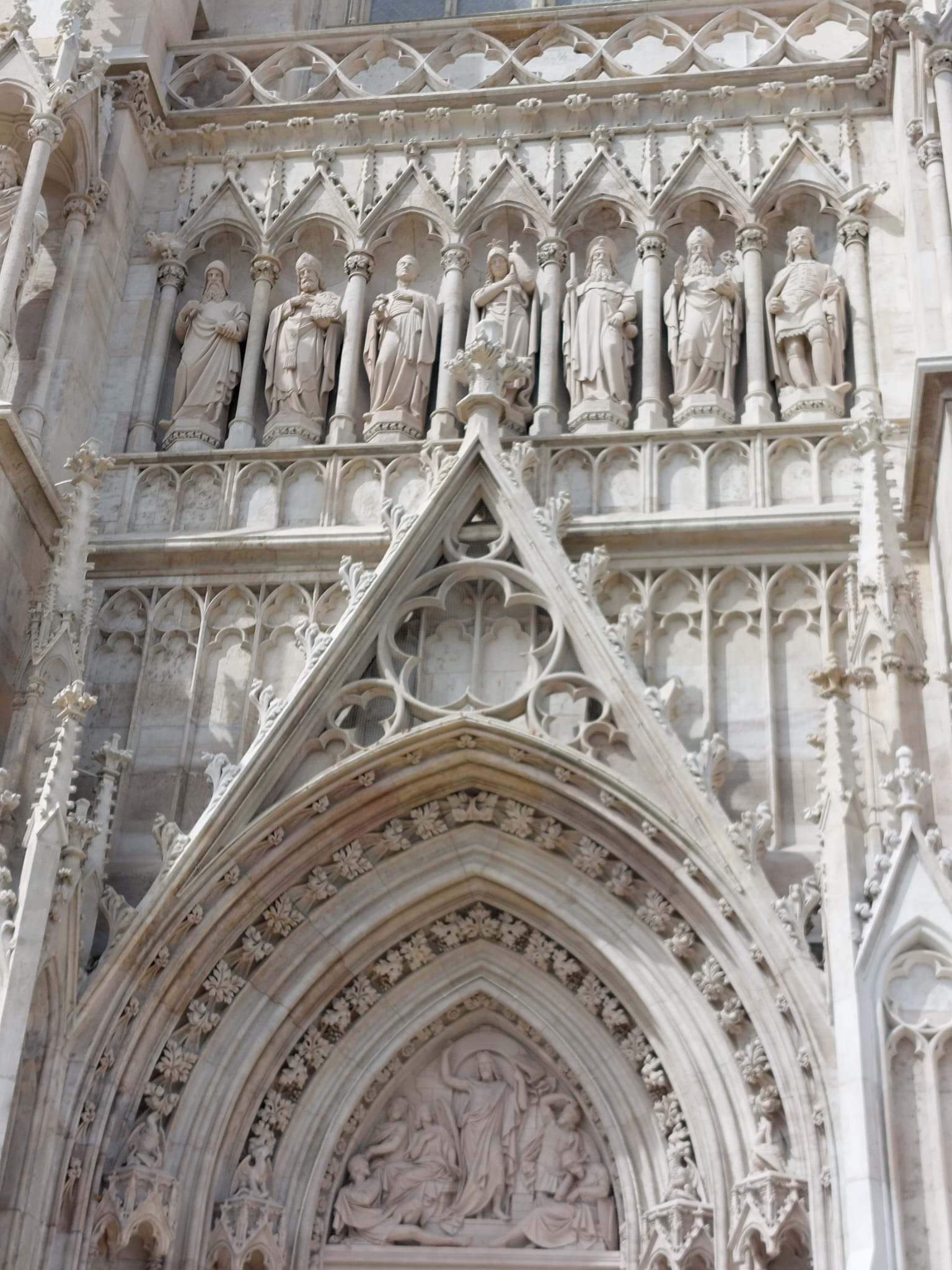

Clockwise: Burg Theatre, Herminengasse plaque, Palais Ephrussi, Votivkirche
We saw the Rathaus – Vienna City Hall – and walked through the Burggarten where we found a statue of Mozart. Then the Resselpark (Karlsplatz), where we saw Sarah Ortmeyer and Karl Kolbitz’s 2023 memorial for homosexuals persecuted by the Nazis: ‘Arcus – Shadow of a Rainbow’, the colours of the rainbow changed to grey, combining grief and hope. There’s also a Brahms statue here, which I like very much.
On to Heldenplatz (Heroes Square), in front of the Hofburg Palace.
‘The two over lifesize equestrian statues on high pedestals are what give it its name, two great military commanders on rearing horses with flowing manes and tails in the Baroque style, one carrying Prince Eugene of Savoy and the other the Archduke Charles, brother of the first Emperor Francis who, in one victorious battle, had stemmed for a while Napoleon’s advance on Vienna. … And yet, with all their panache, there is so little boastfulness in this square. What first meets the eye and impresses the mind are the broad avenues of chestnut trees lining it on three sides … They give the square its peaceful, almost countrified look; they are conducive to slow perambulation and quiet contemplation.’ (Elisabeth de Waal – The Exiles Return, p. 227)
In sharp contrast to the above description, this is where Hitler made his announcement of the Anschluss after his triumphant arrival in the city.

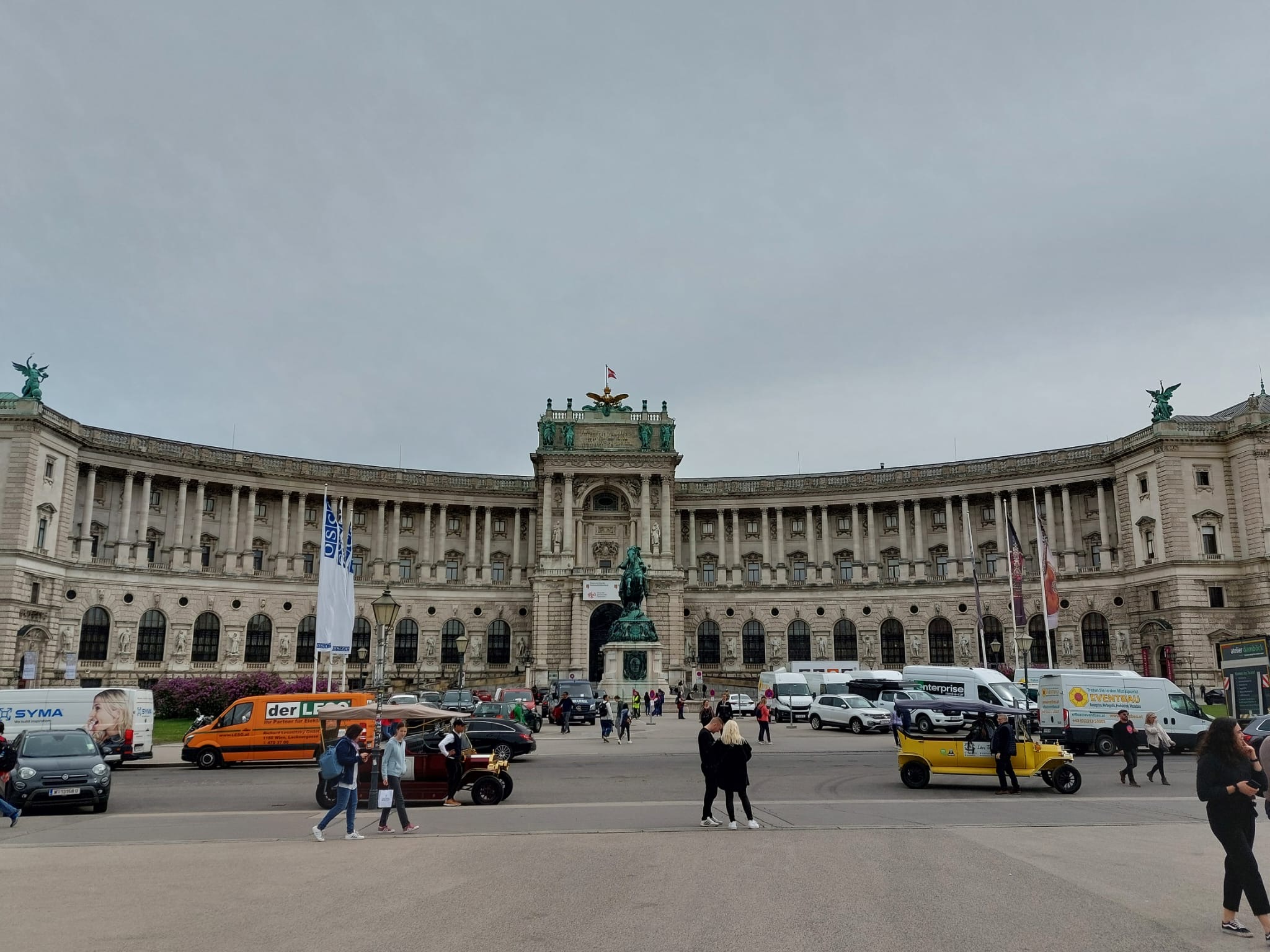


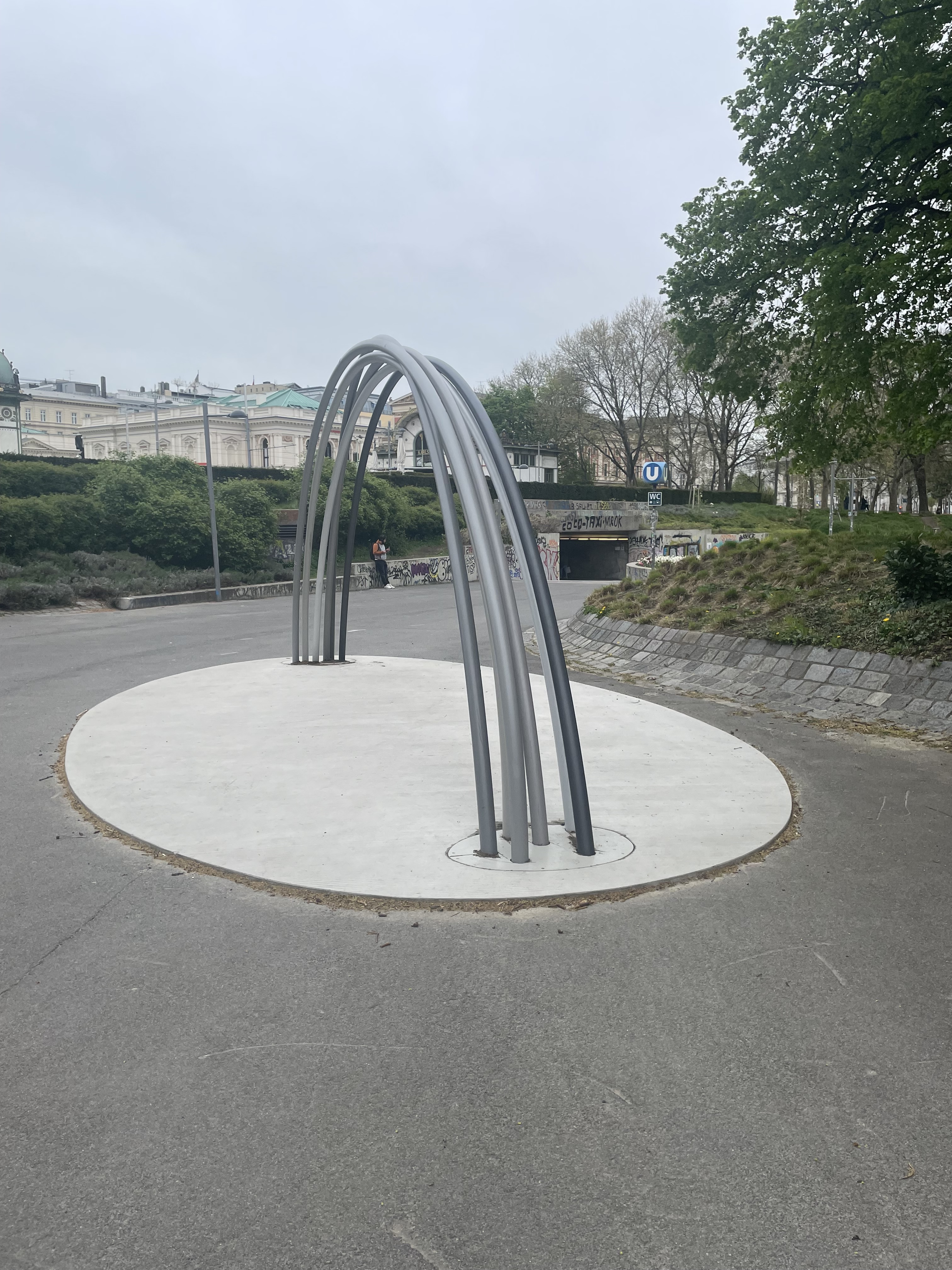
Clockwise: Brahms statue in Resselpark, Heldenplatz, Mozart statue, Rathaus, Arcus memorial in Resselpark
Parliament Building – another building that was seriously damaged in WW2 and the restored to its former glory. In front of it is the Pallas Athene Fountain – apart from Athene (statuary in Vienna is often Graeco-Roman in subject matter and style) it represents the four major rivers, the Danube, Inn, Elbe and Vltava (Moldau in German).
Hofburg Imperial Palace – the official residence and workplace of the President.
Schwarzenberg Monument, commemorating Karl Philipp, Prince of Schwarzenberg’s victory at the battle of Leipzig in 1813. Yet another equestrian statue (I cannot help it if the Bonzo Dog Doodah Band come to mind when I see these).
Here comes the Equestrian Statue
Prancing up and down the square
Little old ladies stop ‘n’ say
“Well, I declare!”Once a month on a Friday there’s a man
With a mop and bucket in his hand
To him it’s just another working day
So he whistles as he rubs and scrubs away(hooray)
(Bonzo Dog Doodah Band, ‘The Equestrian Statue’ (N. Innes), Gorilla, 1967)
Haus der Musik (Klangmuseum – museum of music and sound) is in the Palace of Archduke Charles, where the founder of the Vienna Phil lived around 150 years ago. The focus is on composers for whom Vienna was significant, with interesting material on Beethoven, Schubert, Mozart, Mahler, Schoenberg and others (not just biographical), as well as fun stuff about the science of music, my first encounter with a virtual reality headset (I didn’t do very well).


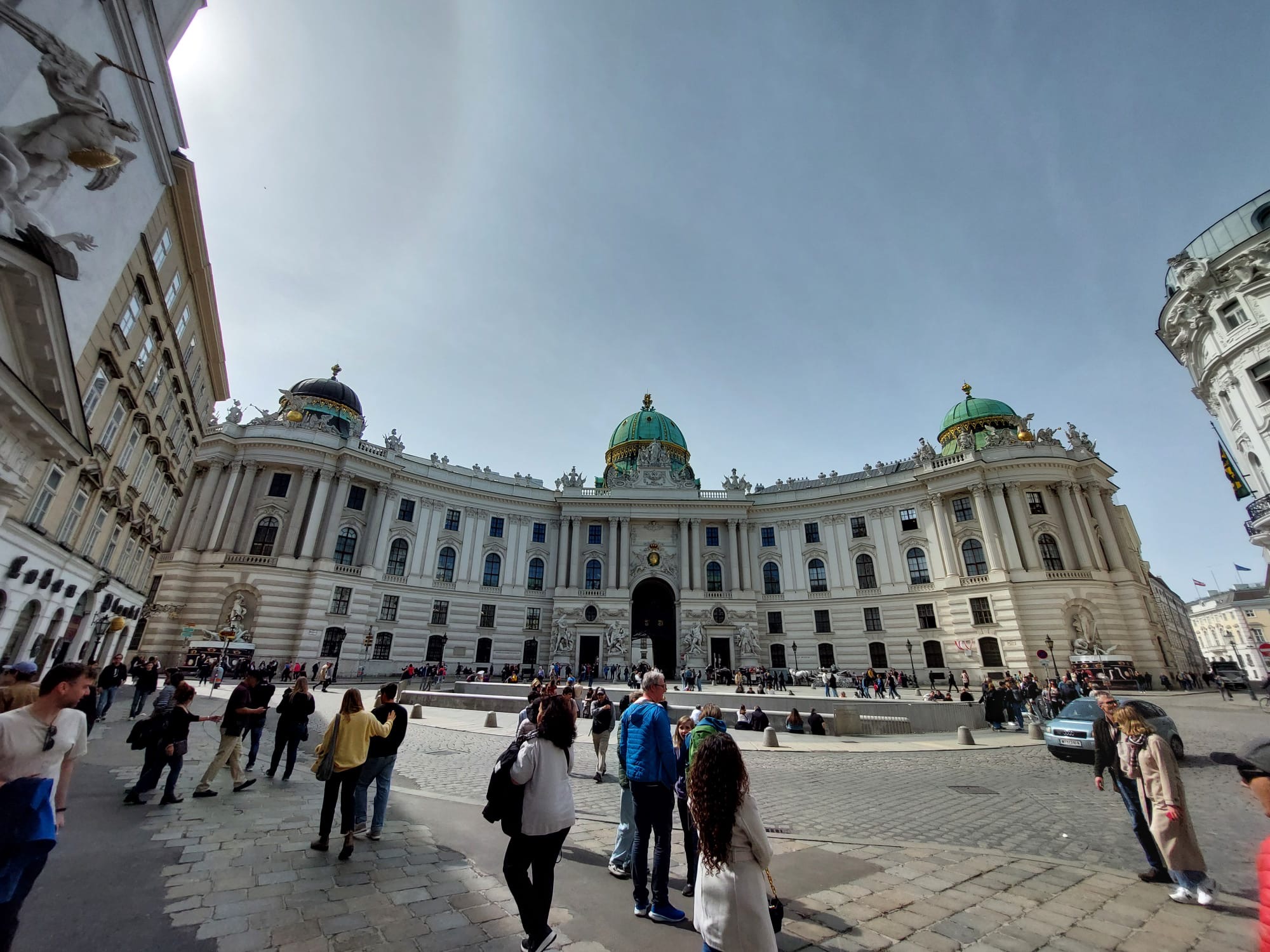
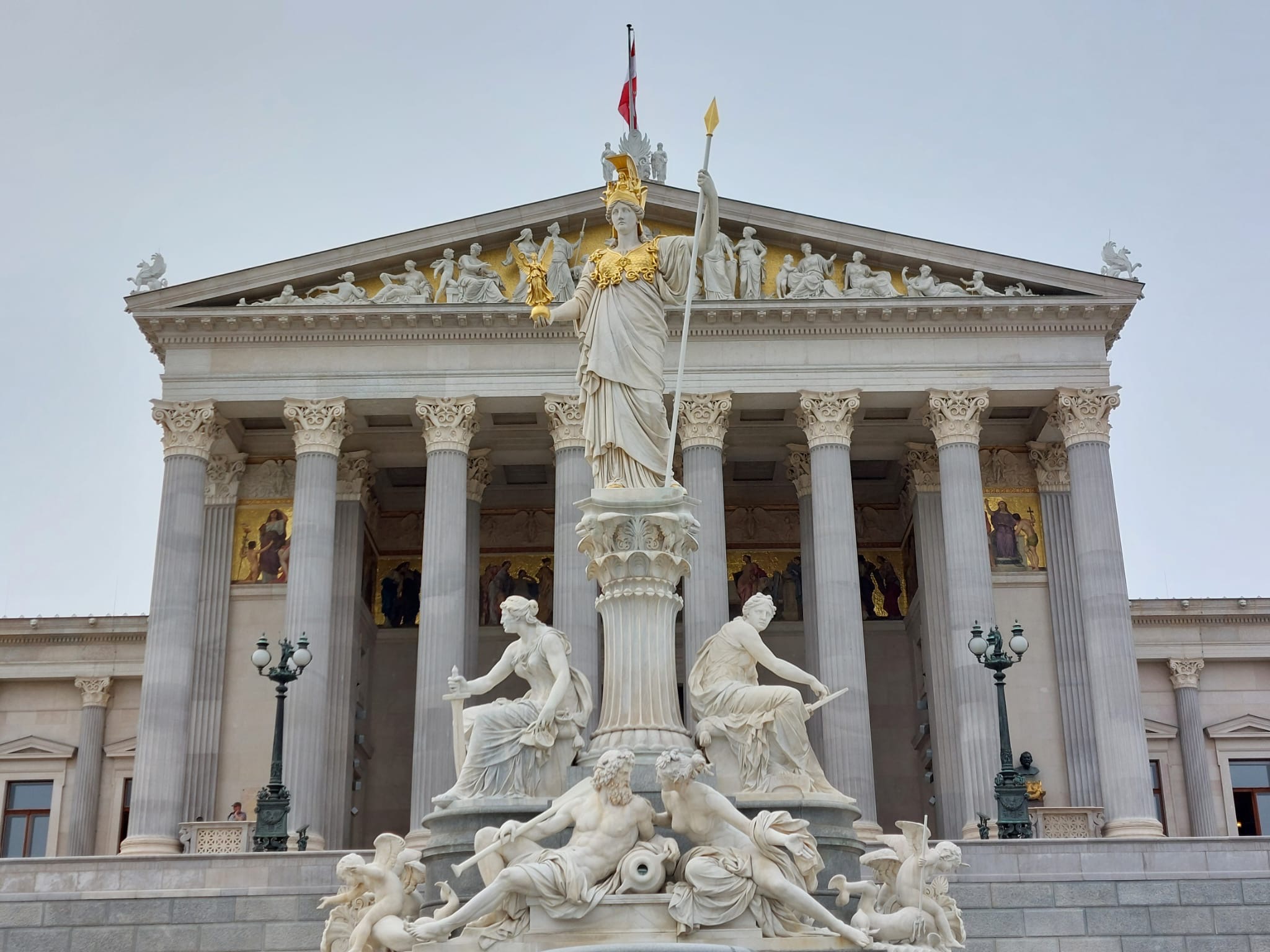
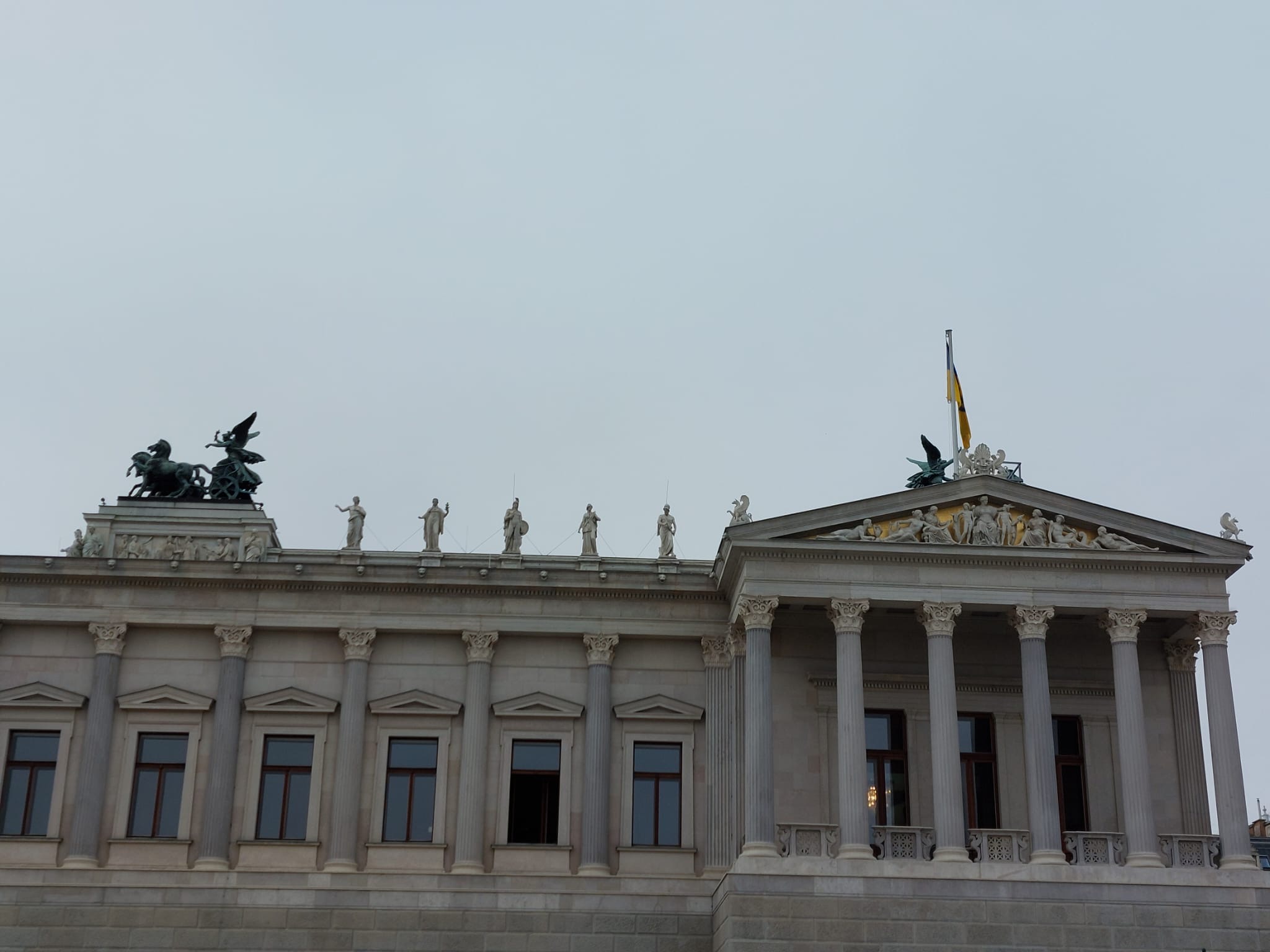

Clockwise: Haus der Musik, Archduke Charles monument, Hofburg palace (official residence and workplace of the President), Pallas Athene fountain, Parliament Building, Schwarzenberg monument
Kunsthistorisches Museum – in a palace (of course), purpose built by Emperor Franz Joseph 1 to house the rooms full of antiquities, sculpture and decorative arts. But the highlight was the picture galleries, and especially the Breughels, an absolute joy to see ‘Hunters in the Snow’ etc close up. Also paintings by van Eyck, Raphael, Durer, Holbein, Titian, Caravaggio…
What did we miss? Well, if I went back, I’d go to see the Klimts in the Belvedere gallery, I’d book a tour of the Opera House, and the Parliament building. Might even go on the Riesenrad (I think given the particular form my vertigo takes – see below – I would be OK with it, after all, I was fine on the London Eye).
Vienna Reading: Fiction: Sarah Gainham – Night Falls on the City/Private Worlds; Elisabeth de Waal – The Exiles Return. Non-fiction: Clive James – ‘Vienna’, in Cultural Amnesia; Edmund de Waal – The Hare with the Amber Eyes; Claudio Magris – Danube; Stefan Zweig – The World of Yesterday
Vienna on Film: The Third Man; Before Sunrise; Vienna Blood (TV detective series set in turn of the century (19th-20th) Vienna)
Vienna Music: Too much to mention – the city played such a key role in the lives and careers of so many great composers and musicians. Beethoven, Mozart, Schoenberg, Schubert, Brahms, Webern, Korngold… I did my best to avoid hearing ‘The Blue Danube’, a piece I heartily dislike, whilst in Vienna, but didn’t quite manage it (it’s a bit like trying to avoid hearing Wham at Christmas)
One lesser-known name, who I researched on our return. Marcel Tyberg was born and studied in Vienna but moved to Italy (present day Croatia) in 1927, when he was in his thirties. His mother followed the rules once the area was under Nazi occupation, and registered her Jewish great-grandfather. She died of natural causes, but Tyberg was arrested and deported, first to San Sabba camp in northern Italy, and then to Auschwitz, where he was murdered in December 1944. I listened to the Piano Trio in F major (1935-1936).
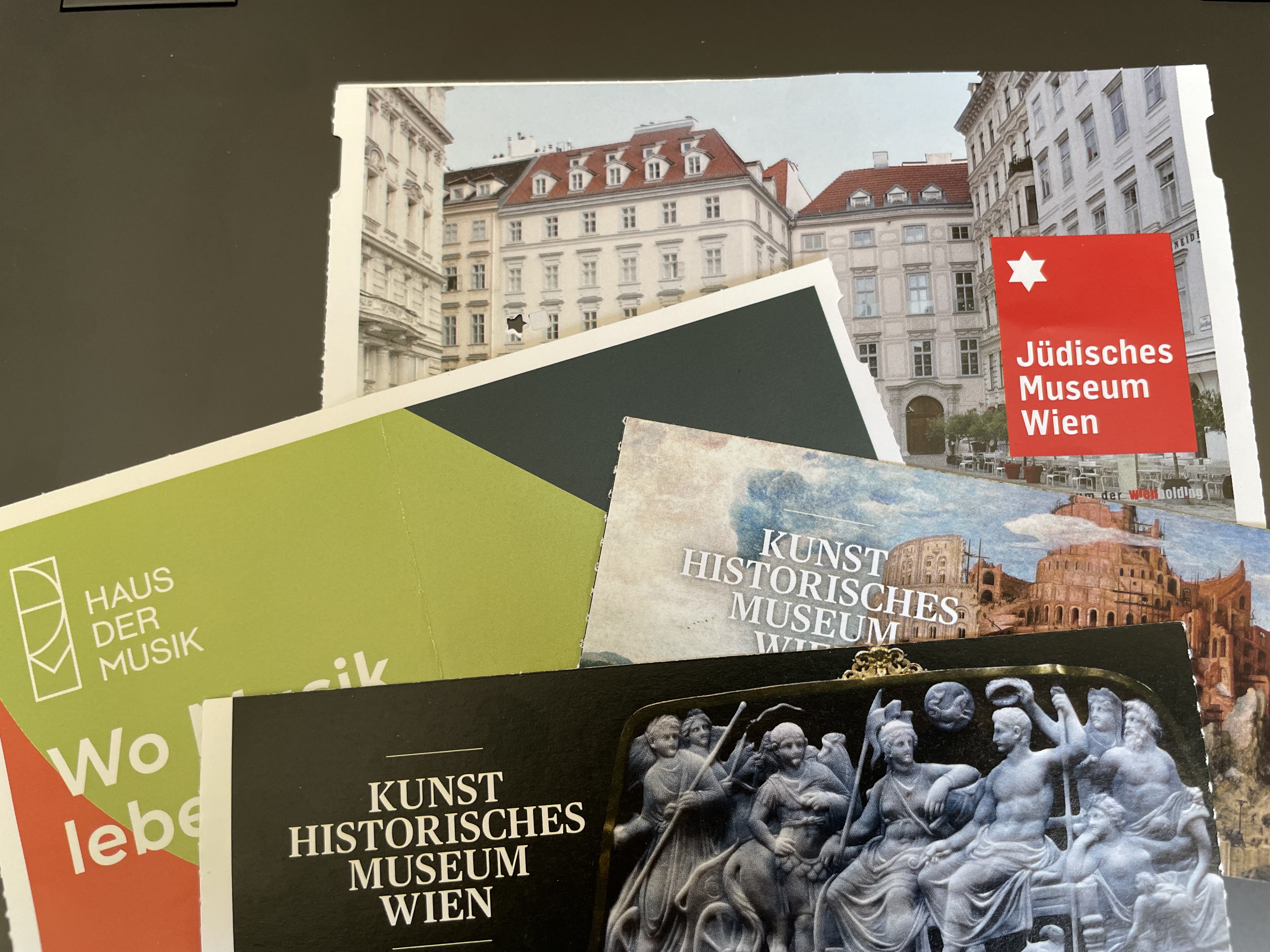
PRAGUE
Thursday:
We set off early to catch the train to Prague. Not the most scenic of journeys but travelling by train makes the journey part of the holiday and is generally less stressful. That is, once I was on board – the ‘mind the gap’ warnings do not adequately convey the hideous gulf between the train and the platform which involves one stepping out into said gulf and on to a narrow step before reaching the safety of the train. I realised this at Vienna Airport station but had vainly hoped that this wasn’t going to be the case with all the trains we caught… Fortunately A is both capable and caring, and so he grabbed the bags, put them into the train and then held my arms and made me look at him, not at the gulf, and step in. Same procedure in reverse when we got off the train, of course.
A slightly longer walk from the station to our hotel, the Majestic, near Wenceslas Square. A more old-fashioned looking hotel than Mooons but very comfortable. Having deposited our bags we set off for the Old Town. What I hadn’t anticipated is how much harder on the feet and the joints the cobbled streets in Prague would be – both of my days in the city had to be curtailed slightly early because on that first day there I crocked myself a bit. I still managed to clock up 17k steps (not bad for a half day), and 20k the following day, a total of 25.5km in the city.
Walking around Prague felt very different to walking around Vienna (and not just because of the cobbles). It is a city to wander in, to stroll down random streets, look around random corners, and be beguiled and intrigued by buildings that are a jumble of styles and eras, shapes and sizes. The terms ‘new’ and ‘old’ in Prague tend to mean ‘old’ and ‘really, really old’.


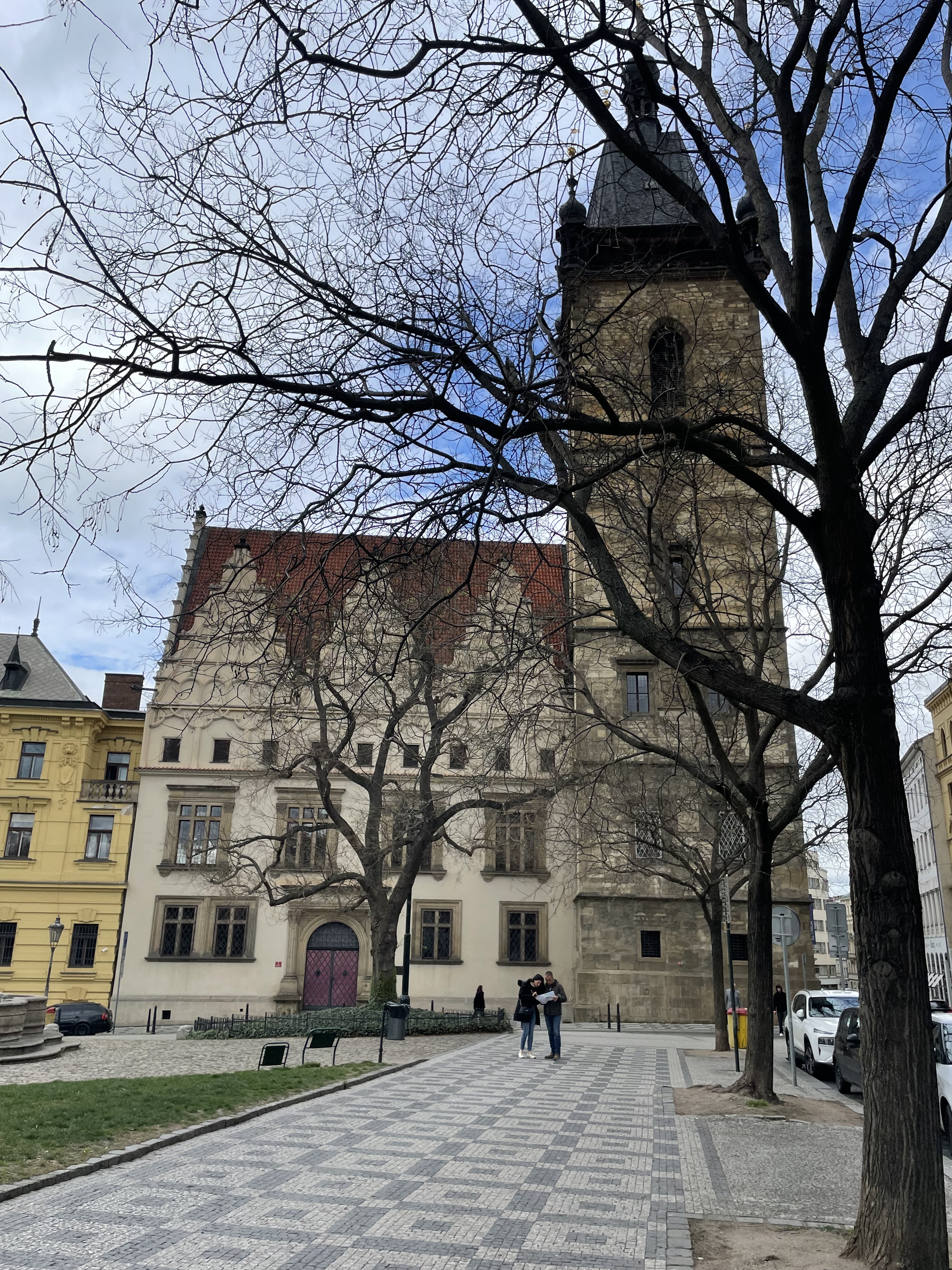
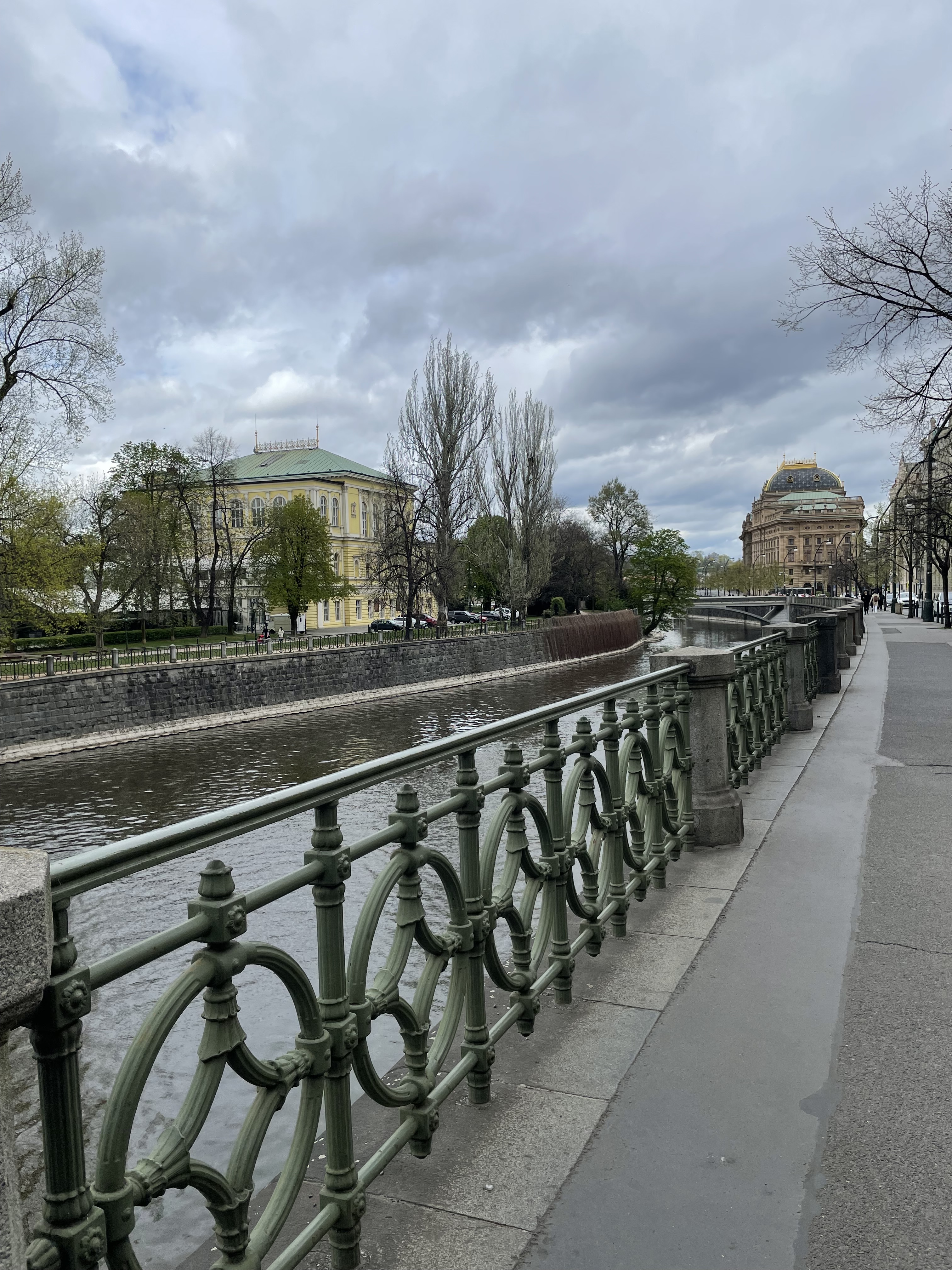

Clockwise: Charles Square, St Adalbert’s Church, Hotel Majestic, New Town Hall, view of the Zofín palace, a mysterious and ominous sign across the Vltava
Charles Bridge is always rammed with tourists – it is probably the most photographed site in the city, understandably enough. We got glimpses of it from the New Town side on Day 1, and the Prague Castle side on Day 2, when we did go part of the way across.
Jan Palach memorial, Wenceslas Square. I was 10, going on 11 at the time of the Prague Spring. I remember the news reports, and my parents’ distress (they vividly remembered the events in Hungary in 1956), and I remember hearing of Jan Palach’s suicide. A couple of years later, the English teacher at my school, an eccentric chap called Mr Pepper, mentioned this (I cannot recall in what context) and said that in a few years, no one would remember Jan Palach’s name. I decided that I would. And I did.
The Jewish Museum in Prague, based in the old Jewish quarter, comprises a number of locations – we didn’t see everything, but what we did see was unforgettable. It comprised four synagogues, the ceremonial hall, the old Jewish cemetery (and a gallery which was closed when we visited).
Pinkas synagogue – I knew what I was going to see. But that didn’t make it any easier. I wrote back in 2017 about a visit to the Mémorial de la Shoah in Paris: ‘I had braced myself for this, knowing the terrible history that would be illustrated there. Nonetheless, seeing the Wall of Names, I felt the air being sucked from my lungs, realising that I was seeing in that moment only a fragment, only some of the names from only one of the years’. That’s how I felt in the Pinkas synagogue, where the Memorial to the Victims of the Shoah from the Czech Lands comprises their names on wall after wall after wall. The names are painted on, which gives them a certain fragility, that they could fade away, unlike the stones in the Paris memorial. They mustn’t, obviously. They need to be there for generation after generation, to see wall after wall of names, each a person with a story, with a life, with a potential future.
‘The storm is within, a blizzard that stings the eyes and batters on the mind. Not snow or sleet but names. Names everywhere, names on the walls, names on the arches and the alcoves, ranks of names like figures drawn up on some featureless Appellplatz. Names and dates: given names and dates in black, surnames in blood. Dates of birth and dates of death. Seventy-seven thousand seven hundred and ninety-seven of them, names so crowded that they appear to merge one into the other and become just one name, which is the name of an entire people – all the Jews of Bohemia and Moravia who died in the camps.’ (Simon Mawer – Prague Spring, pp. 218-19)
From the Pinkas synagogue to the old Jewish cemetery, in use from the first half of the 15th century till 1786 – the oldest gravestone is from 1439. It’s the ‘Prague Cemetery’ which gives Umberto Eco’s novel its name (a book that is now on my To Read list). (We didn’t visit the New Jewish cemetery to pay our respects to Kafka – maybe next time, especially if I manage to read a few more of his works before then). We saw the Jewish ceremonial hall, and the Klausen synagogue but didn’t go in. But we couldn’t miss the ornate gorgeousness of the Spanish synagogue, whose decoration imitates the Alhambra.
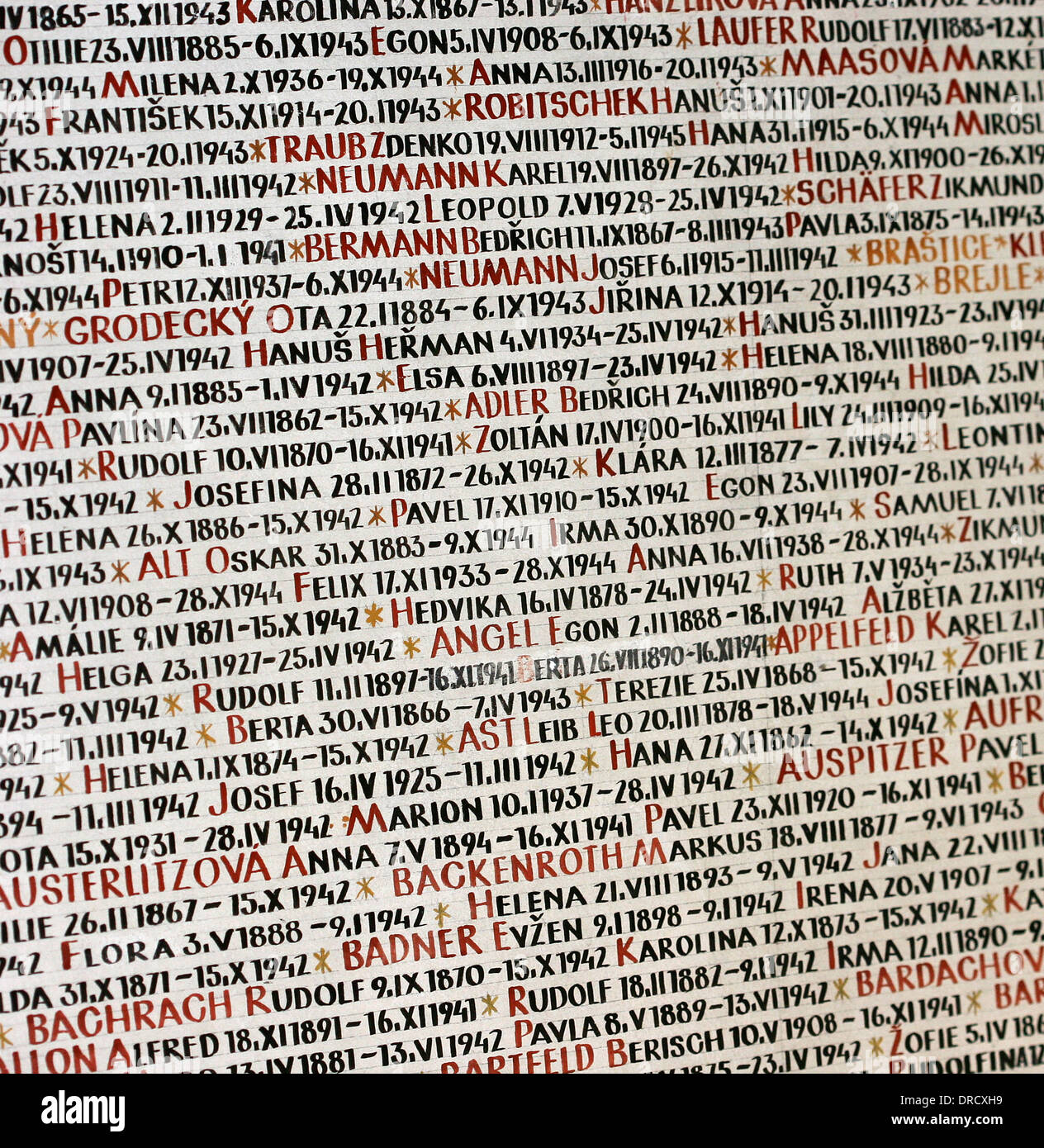

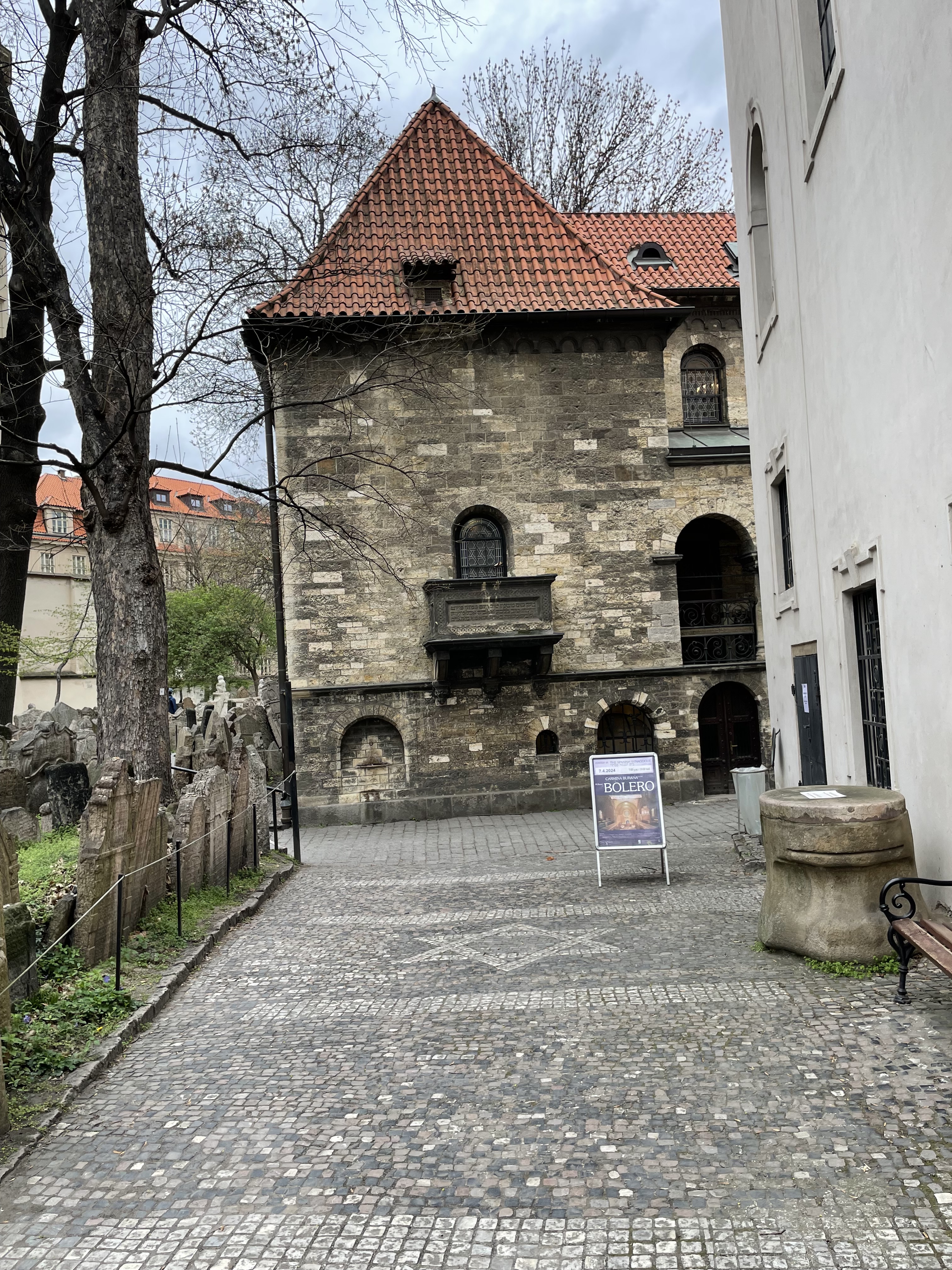


Clockwise: Pinkas Synagogue, Jan Palach memorial, Jewish ceremonial hall, Old Jewish cemetery, Spanish synagogue
The Old Town Hall is actually a medley of a number of buildings of various sizes and ages, stitched together (if I may mix my metaphors) over the centuries. At various times, bits of it were demolished/rebuilt/amended in various ways. In 1945 during the uprising in the city, a couple of wings were destroyed by fire. On another visit, I would be very intrigued to look around this properly.
The Town Hall’s most famous feature is the rather marvellous 15th century Astronomical Clock. We missed its most marvellous moment though as we failed to be there at the right time to see the apostles emerge.
Stolpersteine (Nové Město): four members of the Gotz family. Rudolf was 49, and his wife Marie 48 when they were deported from Prague to Theresienstadt; two years later both were transported to Auschwitz where they were murdered. Their sons Raoul and Harry made the same journeys at slightly different times than their parents. They were 21 and 16 respectively when they were deported, four months before their parents, to Theresienstadt, and then in September 1943, a year before their parents, to Auschwitz.
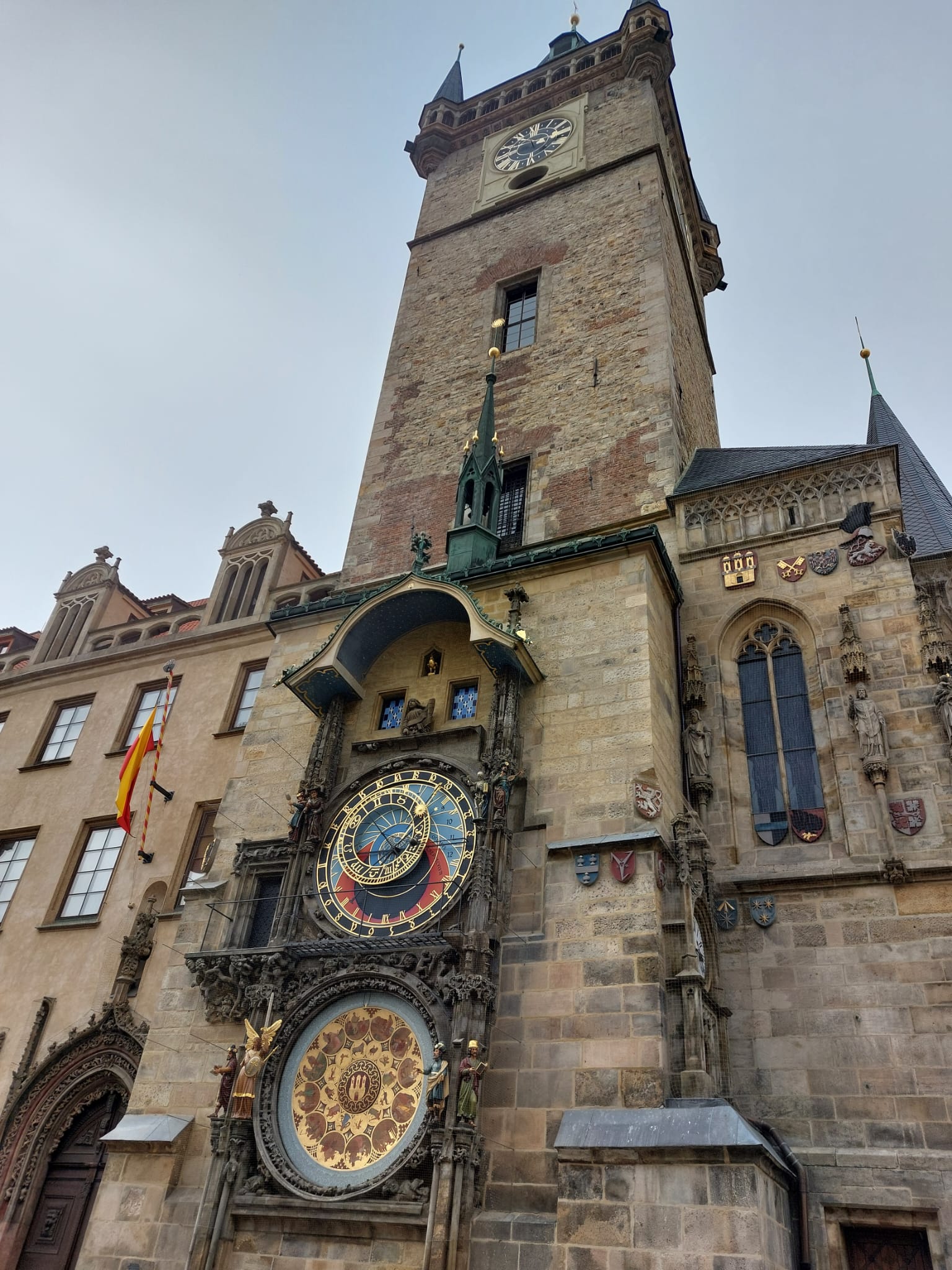


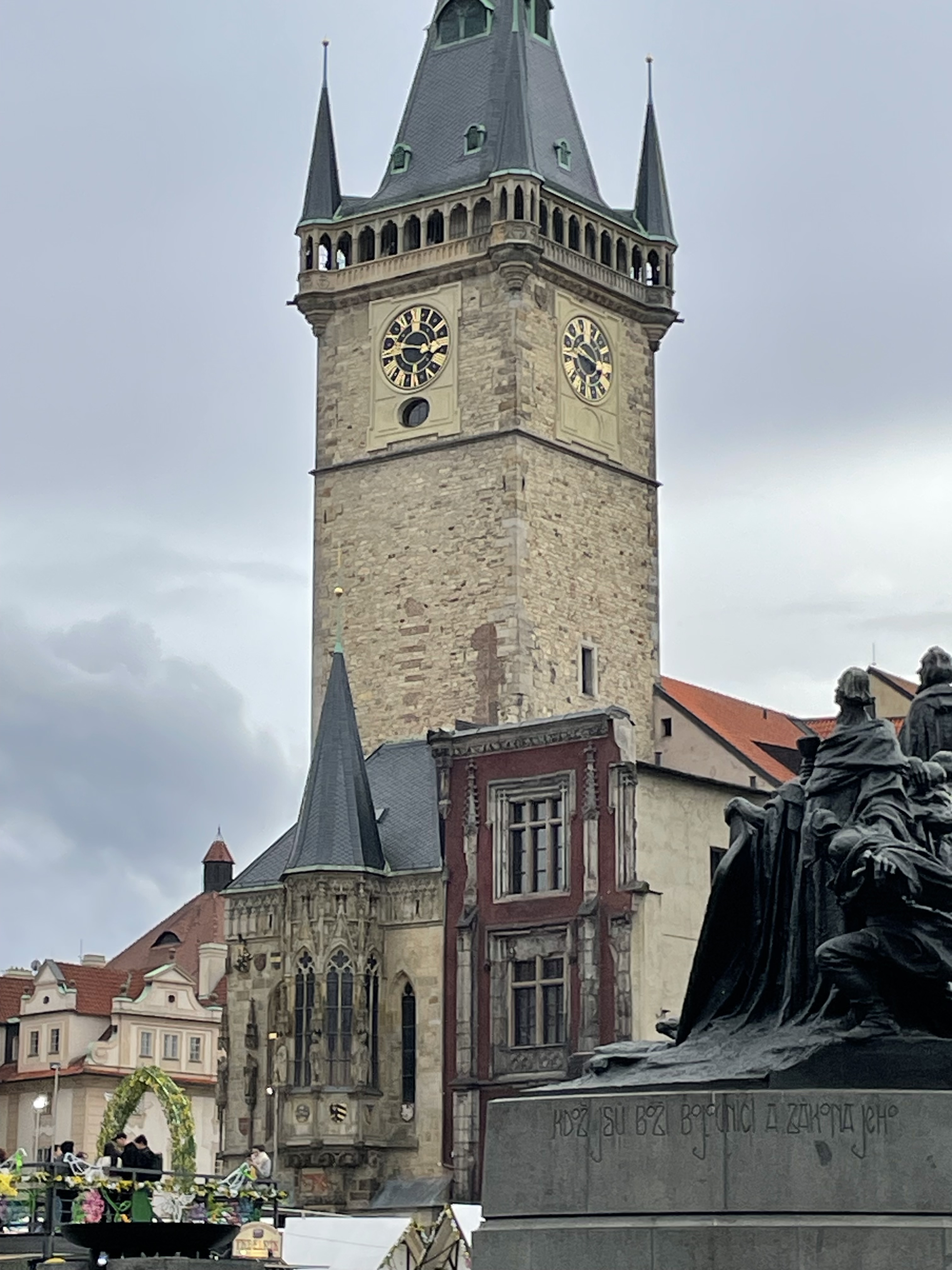
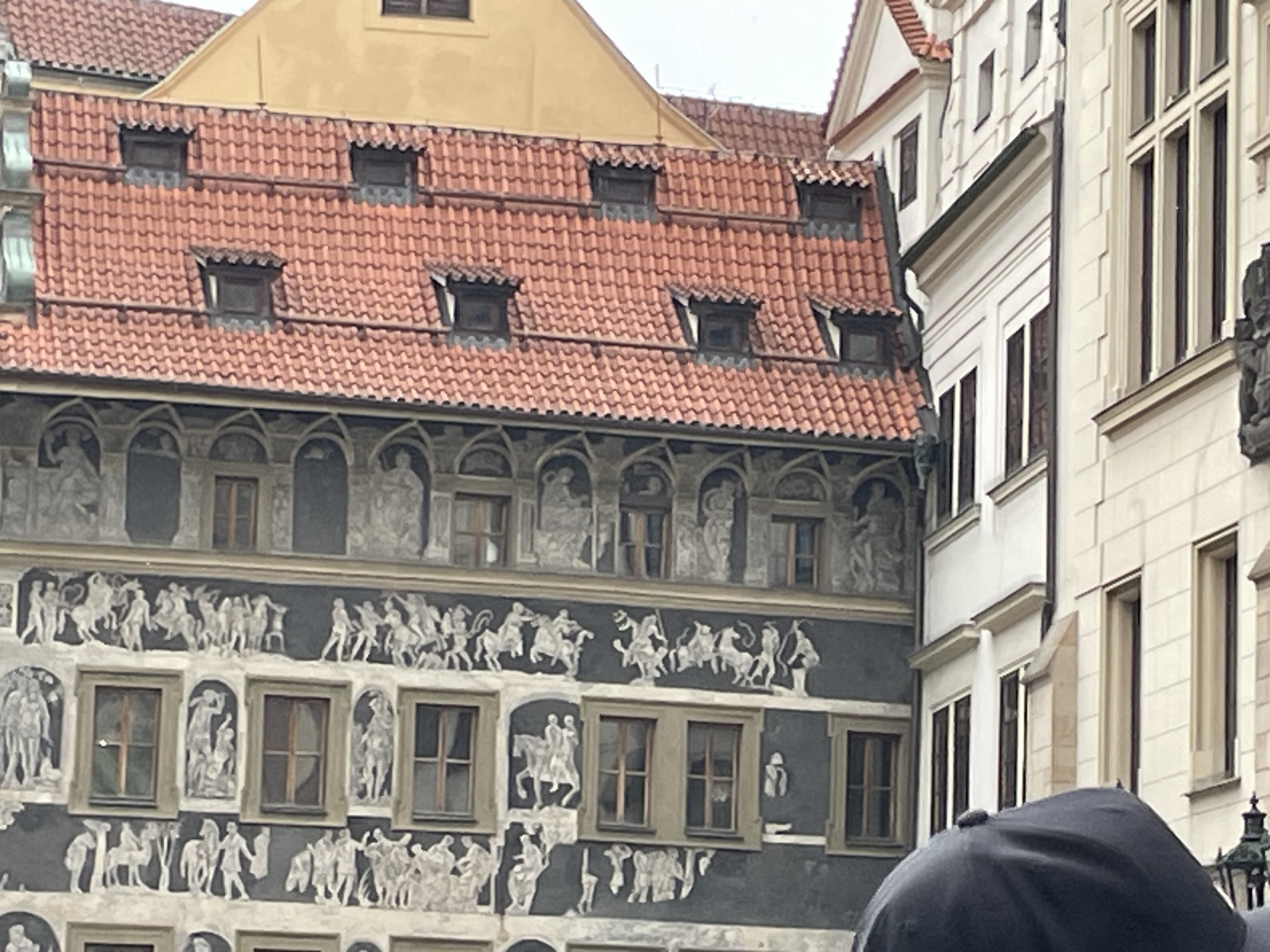
Clockwise: Astronomical Clock, Church of St Nicholas, stolpersteine for the Gotz family, Kranner’s Fountain (monument to Emperor Francis 1 of Austria), the Old Town Hall, Old Town Square
At this point, I consented to return to the hotel and put my feet up, whilst A headed off to the Prague Museum.
Friday:
Day 2 – with my feet properly blister-plastered, and a comfier pair of shoes, we headed (via the tram) to the Prague Castle complex. There’s a lot to see here, and the views of the city are stunning.
We walked through the Royal Gardens, with beautiful buildings around them, including Queen Anne’s Summer Palace. We saw a red squirrel here – I’m honestly not sure that I’ve seen one before, but we then saw another in Berlin.
St Vitus Cathedral – this took nearly 600 years to complete, 1344-1929. One of the final stages involved the installation of the beautiful stained glass. Czech art nouveau painter Alfons Mucha decorated the windows in the north part of the nave, František Kysela the rose window. Even though half of the cathedral is a neo-Gothic addition, much of the 15th century design was incorporated in the restoration.
Going up the Great South Tower was an optional extra which I unhesitatingly declined. I have been frozen with fear on spiral staircases in many of the ancient buildings of Britain, and in the Arc de Triomphe (with a posse of French schoolkids behind me helpfully going ‘Allez! Allez!’). So I let A go up the tower – there were a lot of steps, and it was indeed a spiral, but worth it (he tells me) for the view from the top.
The Basilica of St George is the oldest church building on the castle site, dating from 920.

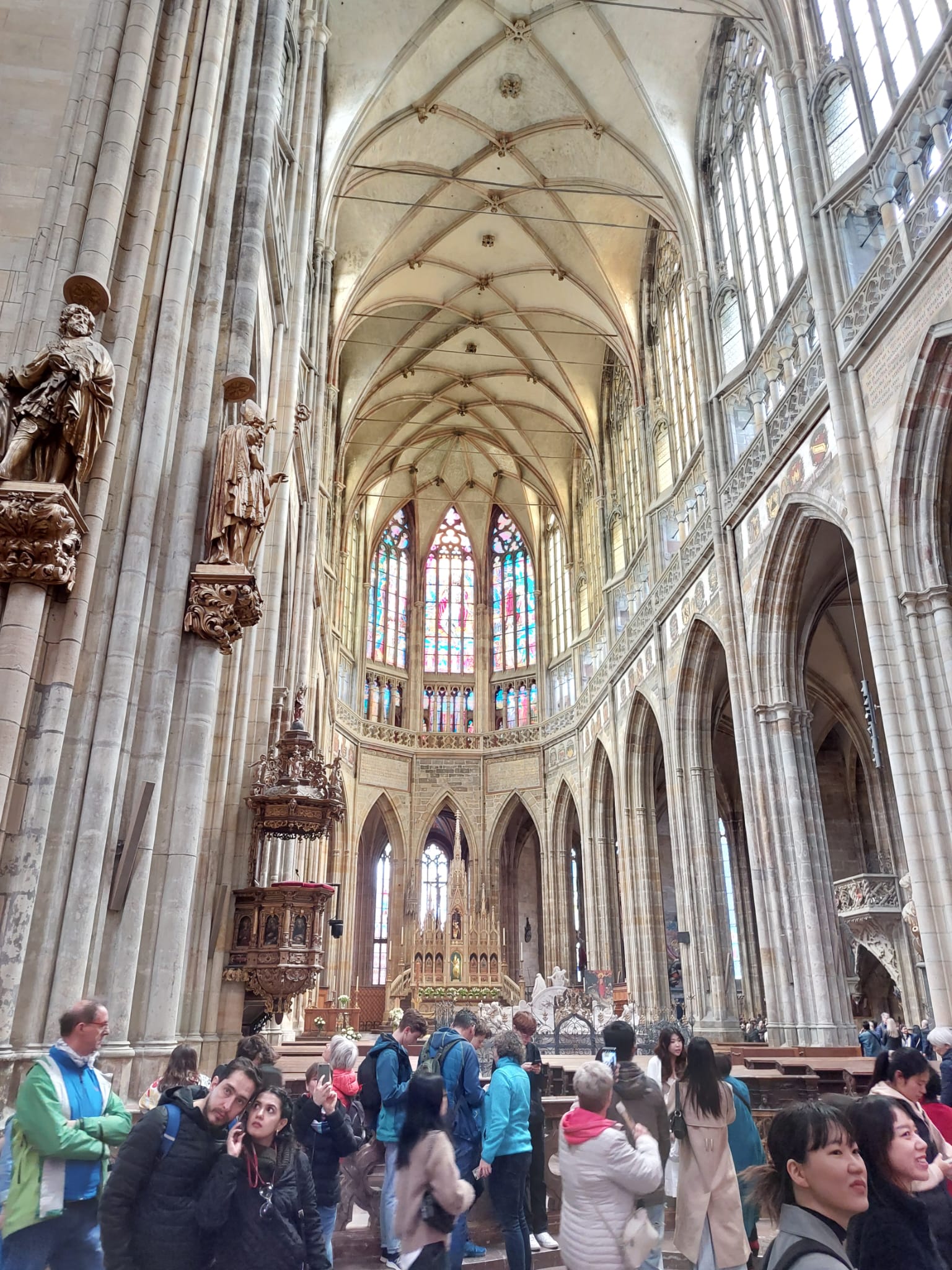


Clockwise: Basilica, Cathedral interior, Cathedral, Great South Tower, Royal Gardens, stained glass in the Cathedral, Chapel of the Holy Cross, Castle interior, Queen Anne’s Summer Palace
Golden Lane is a pretty alleyway of tiny, brightly coloured cottages. These were built for the members of Rudolf II’s castle guard and takes its name from the goldsmiths who later occupied the cottages. Kafka came here in the evenings to write, during the winter of 1916.
12 Šporkova is the building where W G Sebald’s Austerlitz found the apartment that his parents had occupied. The fictional Jacques Austerlitz left Prague in 1938 to come to the UK as part of the Kindertransport. He was brought up without knowing anything of his origins but becomes haunted by the absence of his past and starts to search for information about his parents.
‘The register of inhabitants for 1938 said that Agáta Austerlitz had been living at Number 12 in that year… As I walked through the labyrinth of alleyways, thoroughfares and courtyards between the Vlašská and Nerudova, and still more so when I felt the uneven paving of the Šporkova underfoot as step by step I climbed up hill, it was as if I had already been this way before and memories were revealing themselves to me not by means of any mental effort but through my senses, so long numbed and now coming back to life.’ (W G Sebald, Austerlitz, pp. 212-13)
Austerlitz finds his old neighbour, and learns that his mother was deported to Theresienstadt, and from there to Auschwitz. His father had already left for France before his own escape, and by the end of the book Austerlitz is still searching for information about whether he survived (or how he died).
We didn’t knock to try to go in and see if the hallway and stairs are as Sebald described – in any event, I don’t know whether Sebald himself ever did so. There are a couple of photographs embedded in the text but as always with Sebald, we can’t assume that their positioning tells us what they are. Sebald visited Prague in April 1991, and again in April 1999, at a time when he would have been writing Austerlitz, and it seems likely that he at least did as we did and wandered down Šporkova and looked at the doorway. But did he choose this location arbitrarily, or did he have some information about its past that encouraged him to link it to his fictional protagonist? As always, Sebald mingles fact and fiction in a most fascinating, infuriating, and sometimes highly problematic way (see my PhD thesis for (much, much) more on this topic!).
Estates Theatre – another Sebald connection: Austerlitz’s mother was an actress who performed at the Estates Theatre. It dates from the 1780s, and saw the premieres of Don Giovanni and La Clemenza di Tito, as well as the first performance of the Czech national anthem. It can also be seen in the film of Amadeus during the concert scenes, standing in for Vienna, as it is one of the few opera houses in Europe still intact from Mozart’s time.
I didn’t see the extraordinary Dancing House myself – on day 2 in Prague I again had to bail early (those bloody cobbles), and so A went on alone, to see this building which had intrigued him from the guidebook. The Dancing House, or Ginger and Fred, was designed by architects Vlado Milunić and Frank Gehry on a vacant riverfront plot in 1992 and completed in 1996.



Clockwise: 12 Šporkova, the Dancing House, Estates Theatre, Golden Lane, Prague Museum, Morzin and Thun palaces.
A also visited the Ss Cyril & Methodius Cathedral, site of the last stand of seven members of a Czech resistance group including Jozef Gabčík and Jan Kubiš, who had assassinated Heydrich. They were betrayed, and the church was surrounded by 750 SS soldiers, water pumped into the crypt to try to force them out, until all were killed or had committed suicide. We were both familiar with their story from the film Anthropoid – I’d also read Laurent Binet’s HHhH, and seen the film adaptation of that, The Man with the Iron Heart.
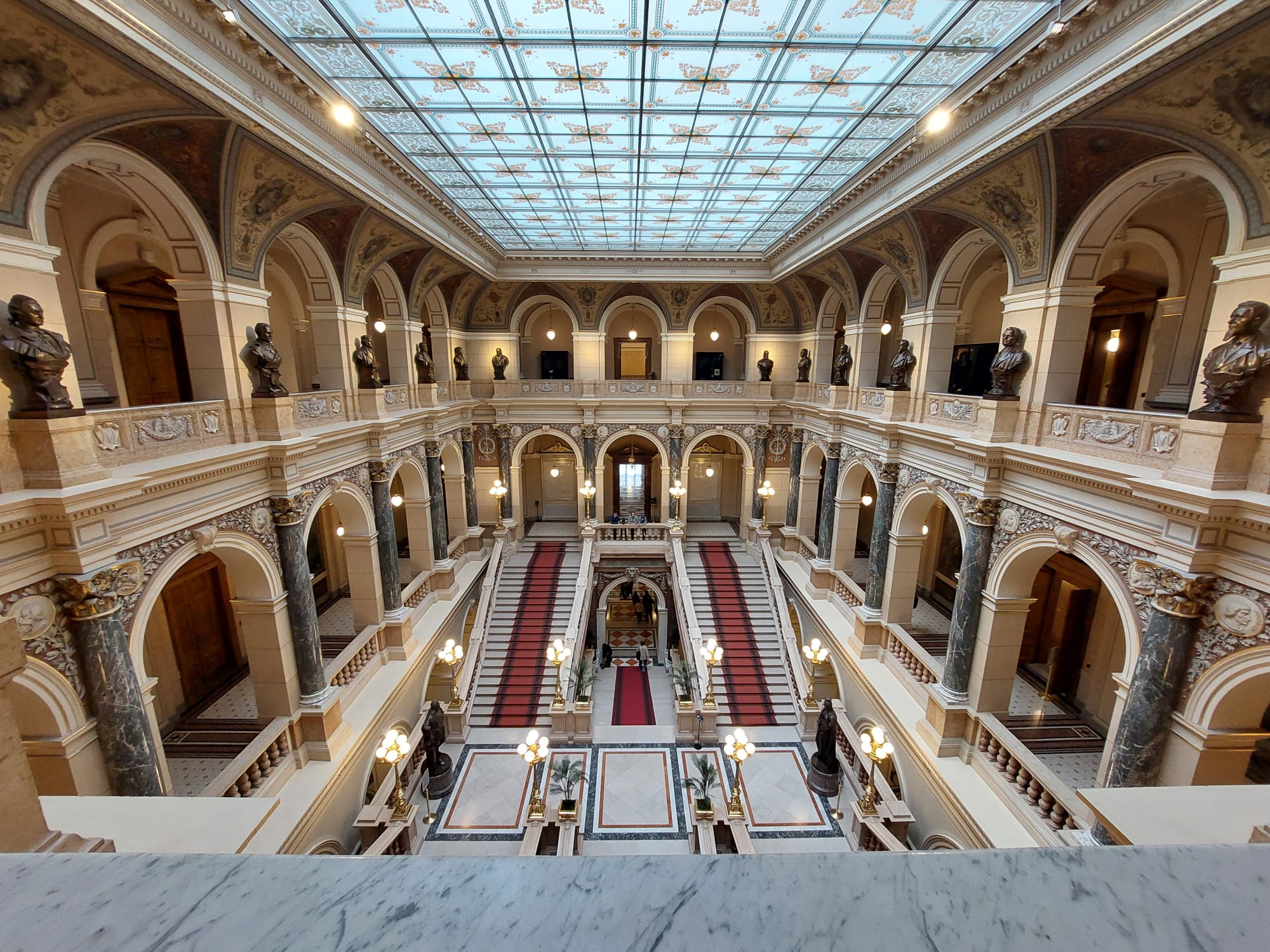
Wenceslas Square, near our hotel. The site of celebrations and demonstrations, and home of the statue of St Wenceslas (this isn’t the original one – that was moved elsewhere in 1879, this one dates from 1912). The National Museum, which A visited on Day 1, is at the top of the square.

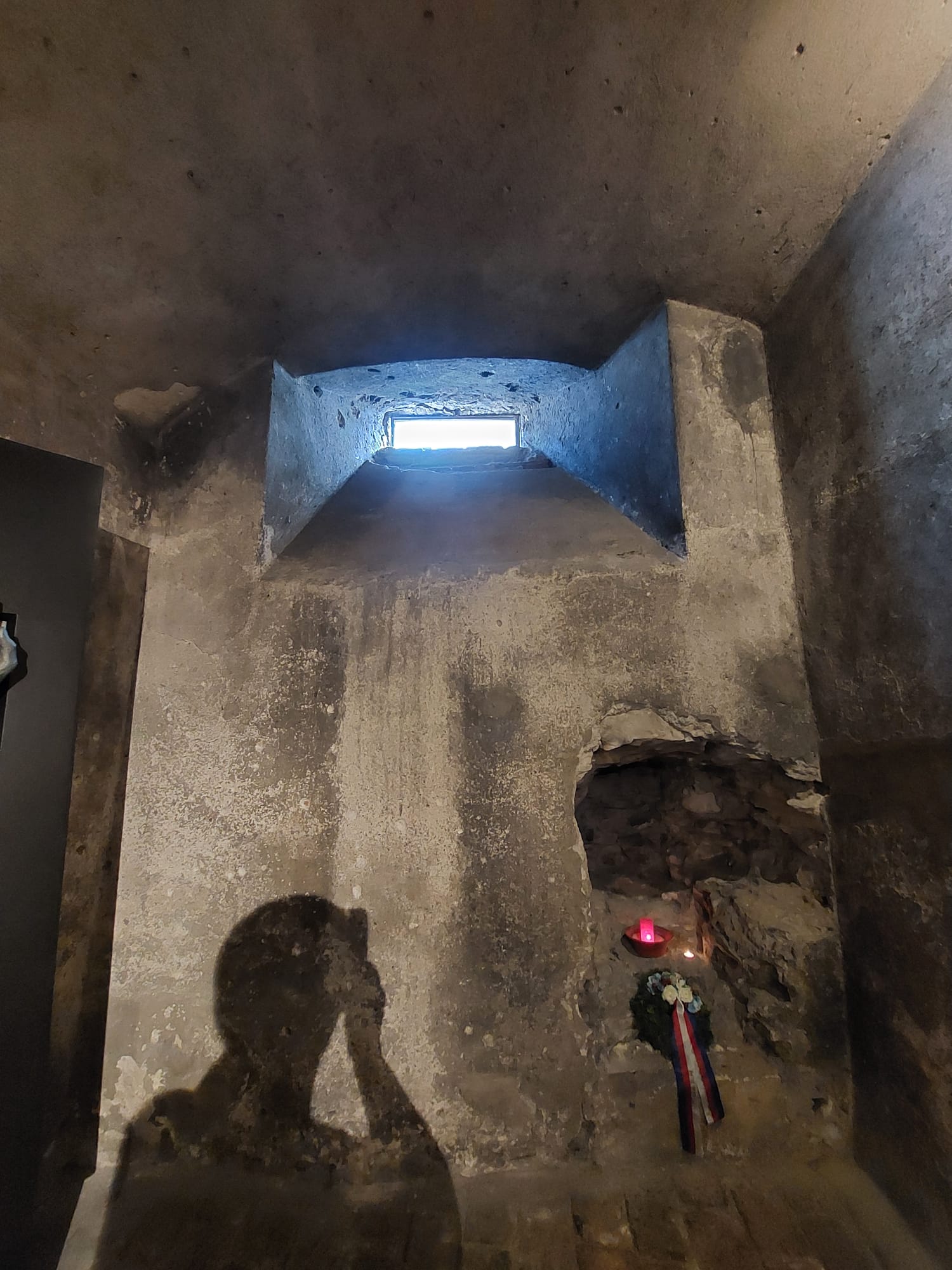
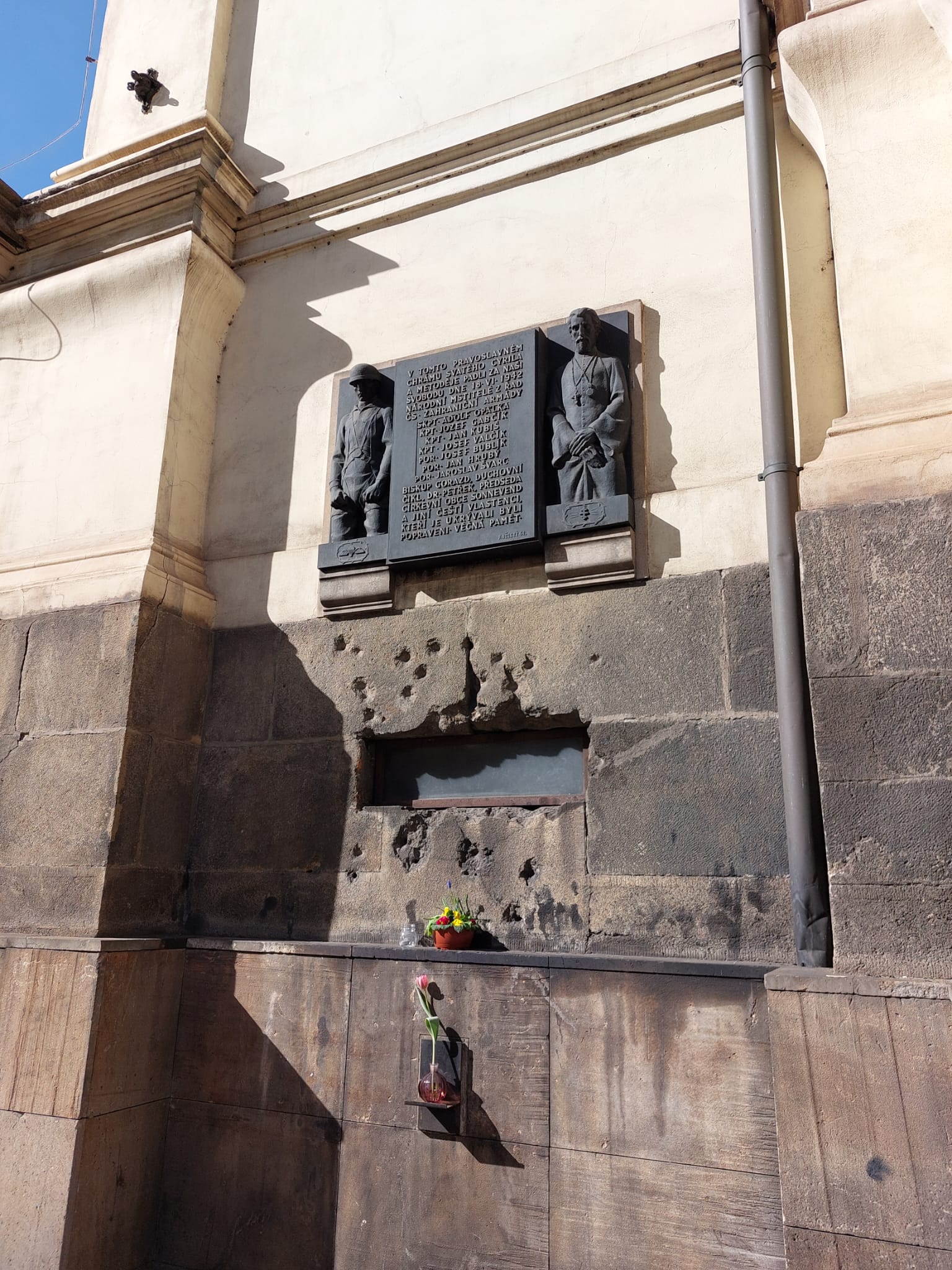


Clockwise: Charles Bridge, the crypt of Ss Cyril & Methodius Cathedral, Memorial to the Czech resistance, Ss Cyril & Methodius, Wenceslas Square, Prague viewed from the Castle
What did we miss? We only saw the modern part of Prague station, not the older building, nor the Kindertransport memorials there. We didn’t get to Petrin, and the funicular railway, the observatory, mirror maze or the mini Eiffel Tower (Rozhledna). But if we come back, we’d probably just spend more time wandering, I think, because there’s something to see around every corner here, not necessarily something grand like in Vienna, but something intriguing, something beautiful, something memorable.
Prague Reading:
Fiction: Lauren Binet – HHhH (a fictionalised account of the assassination of Heydrich); Franz Kakfa – The Castle (it’s not really about Prague Castle but still…); Simon Mawer – Prague Spring; W G Sebald – Austerlitz; Philip Kerr – Prague Fatale; Heda Margolius Kovaly – Innocence (a Prague-set detective noir). Non-Fiction: Anna Hajkova – The Last Ghetto: An Everyday History of Theresienstadt; Heda Margolius Kovaly – Under a Cruel Star (also published as Prague Farewell), her autobiography, covering imprisonment in the Łódź ghetto and Auschwitz, her return to Prague and the judicial murder of her husband during the Slansky show trials, finally leaving after the failure of the Prague Spring; Alfred Thomas – Prague Palimpsest: Writing, Memory and the City (especially Ch. 5 which deals with Sebald’s Austerlitz).
Prague on Film: Anthropoid; The Man with the Iron Heart; Kafka (TV series)
Prague Music: Smetana – ‘Ma Vlast’ is the obvious piece, and a wonderful one, whether one is looking out over the Vltava whilst listening or not and Janacek and Dvorak are composers who have been part of my musical life for so many decades. It’s also important to recognise the work of a number of composers who were deported to Theresienstadt, and who composed and performed music in the ghetto, before being transported to Auschwitz and murdered, notably Gideon Klein, Hans Krása, Viktor Ullmann and Pavel Haas. Inevitably much of the music is lost but what has been recovered can be found on various collections and compilations, as well as on Spotify. I also rather like Martina Trchová, a Prague-born folky singer-songwriter.
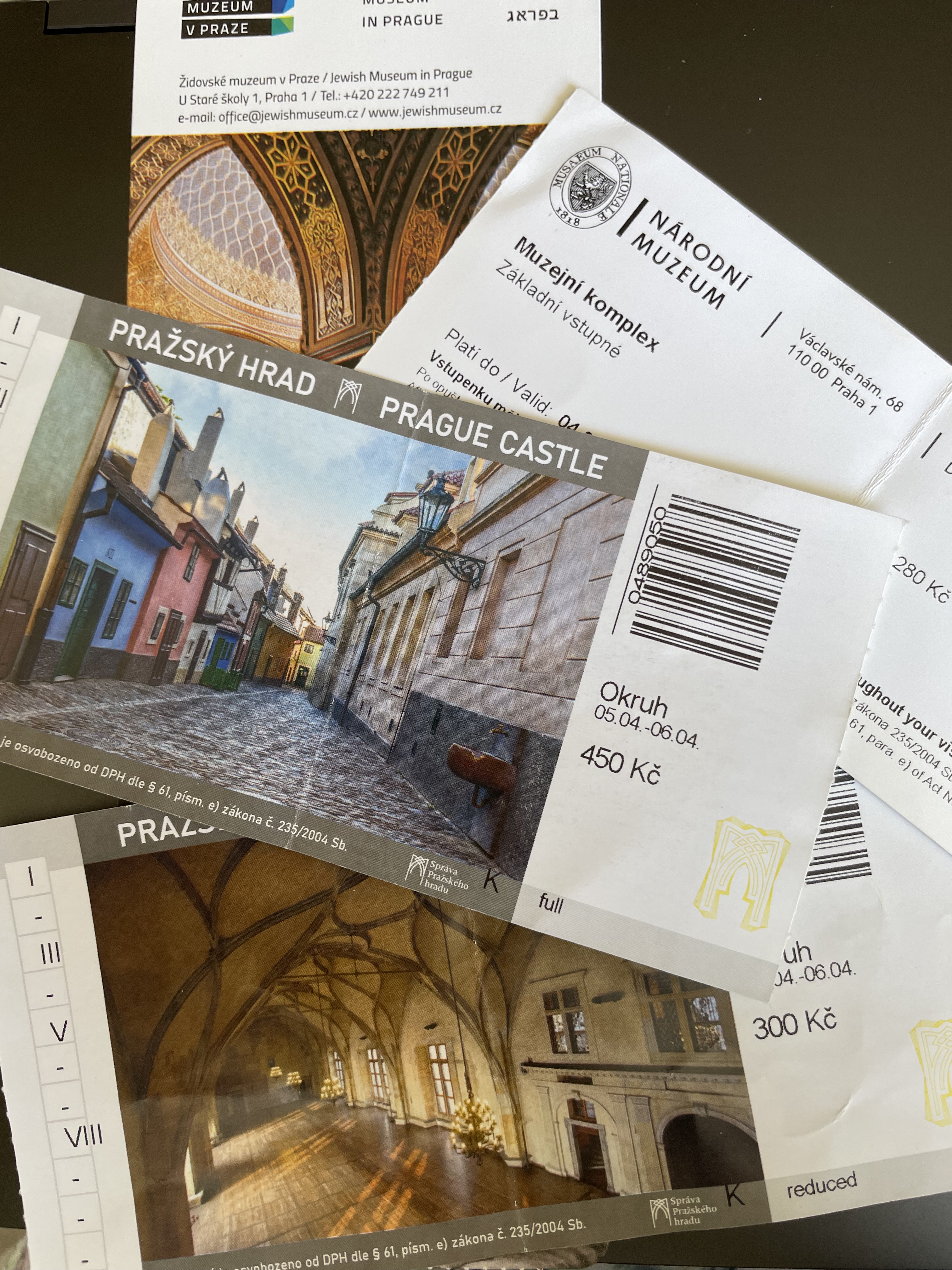
BERLIN
Onwards to Berlin. Another train, this one with old-fashioned compartments. A more scenic route than the one between Vienna and Prague (and I’m definitely not talking about the man who emerged from a shrubbery alongside the rail track, naked apart from a beanie hat).
Our hotel was immediately opposite the Hauptbahnhof, but we weren’t able to check in straight away, so we deposited our bags and headed out into the city.
Saturday:
We headed out, noting some striking pieces of political art in Kreuzberg, and the EU project, Path of Visionaries, in Friedrichstrasse, where a floor plaque bearing a quote from someone inspiring is in place for each EU member state, plus UNESCO. I didn’t check whether we had a floor plaque, but when the project was launched in 2006, we were still in the EU…
Berlin’s Jewish Museum is a powerful place to visit, both in terms of its design and its content. We particularly noted the Garden of Exile and Emigration, described here by blogger Gerry Condon:
’49 columns filled with earth are arranged in rows traversed by uneven pathways. The stelae are built on sloping land and rise at an angle, leading to a sense of disorientation similar to that felt inside the museum building. Out of each column grows an Oleaster, an Olive Willow, perhaps symbolizing rebirth. The experience of walking in this structure is comparable to that of being in the Memorial to the Murdered Jews of Europe, but though the Garden of Exile and Emigration is more modest, I think I found it more effective.’ (Gerry Condon, ‘Living with History: A Berlin City Centre Walk’, How the Light Gets In, 25/06/15)
We hadn’t at this point seen the Memorial to the Murdered Jews of Europe, but certainly the Garden was disorienting; I stumbled as soon as I went in and felt off balance whilst I was in there. But there was beauty too, sunlight, and growth.
The corridors in the Museum itself are intersecting and slanting ‘Axes’, and there are a number of voids. We looked down into the Memory Void but didn’t find our way to go into it (it’s the only one of the voids that one can enter), bamboozled by the labyrinth. But from our vantage point we could just see the ‘Fallen Leaves’ (designed by Israeli artist Menashe Kadishman), each with a face punched out of steel and covering the floor of the void so that visitors have to walk over them.
The permanent exhibition is of Jewish past and present in Germany, but there are displays that recognise the diaspora, and the continuity of Jewish life and traditions in the many nations where exiles found a home. We were very struck by the display showing, in a series of long hanging posters, covered in small print, the many, many laws implemented by the Nazi party as soon as they had power, laws covering every conceivable aspect of life for Jews. It didn’t, as we know, start with gas chambers, or even with deportations. It started with minutiae, with things that people initially may have felt they could cope with, and little by little these restrictions isolated the Jewish population from Aryan neighbours, colleagues, classmates, so that they were exposed, without allies (or only those brave enough to take a stand), when everything was finally taken from them.
We also saw an exhibit about Regina Jonas, the first woman Rabbi, born in Berlin and ordained in 1935, an inauspicious year. I hoped initially that she had perhaps been able to leave before it was too late, but a moment’s googling told me what I kind of knew in my bones, that she stayed. She was arrested in 1942 and deported to Theresienstadt, where she continued to work as a rabbi, helped with a crisis intervention service to support newcomers to the camp, and was involved in cultural and educational activities. In October 1944 she was deported to Auschwitz, where she was murdered either on arrival or two months later, aged 42.
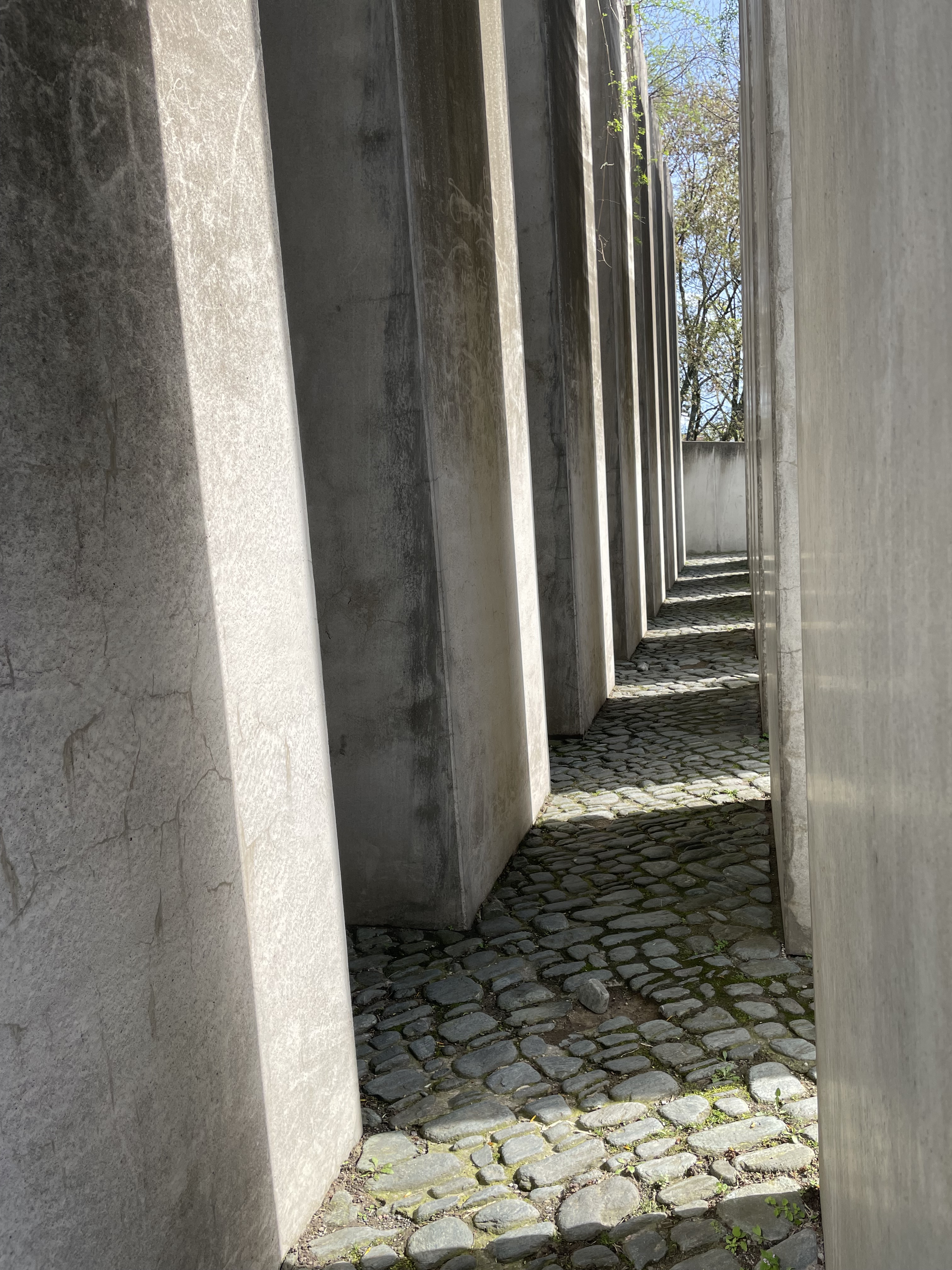


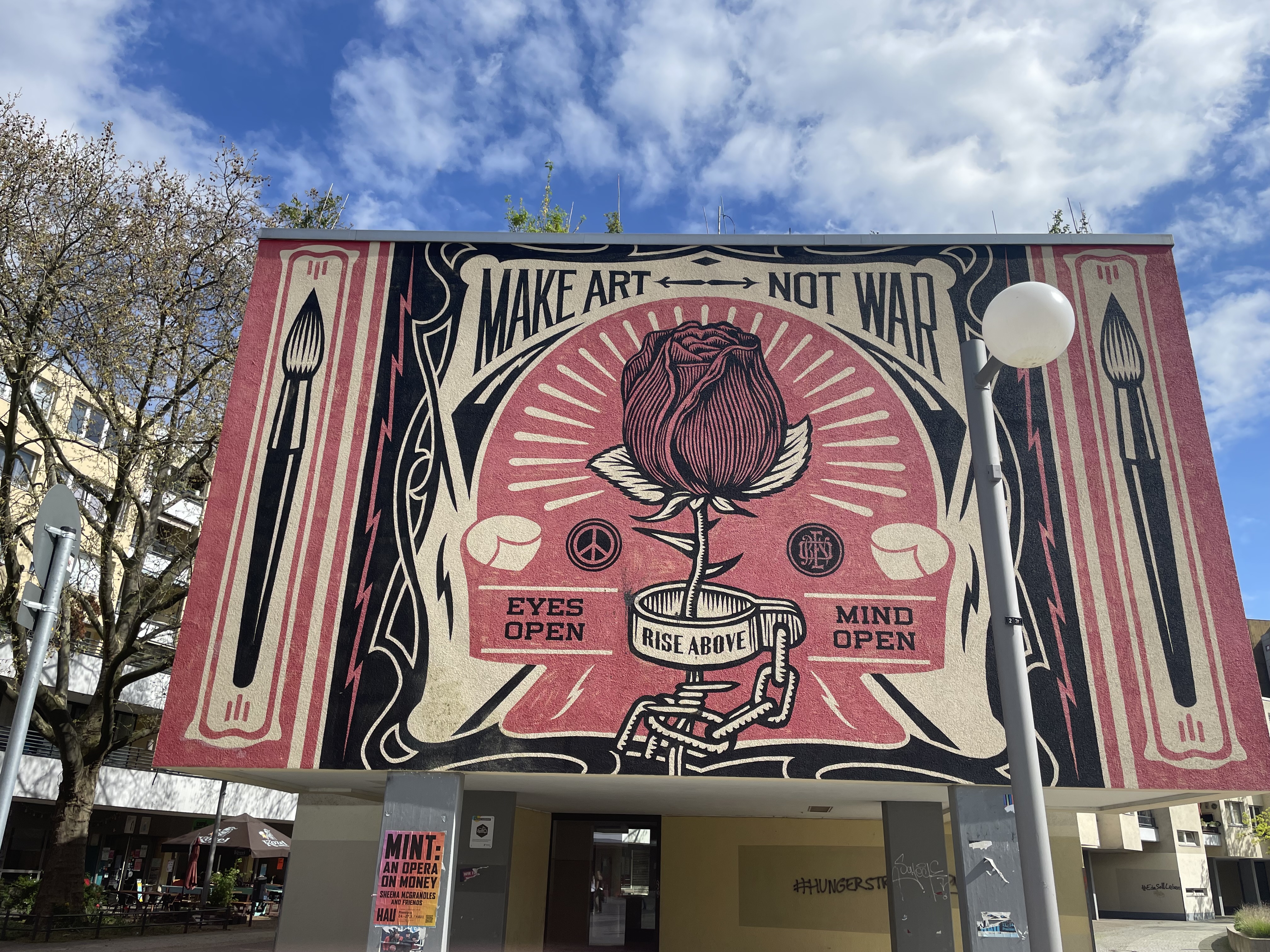
Clockwise: Garden of Exile and Emigration (Jewish Museum), Hotel Amano, Nuremberg laws (Jewish Museum), Path of Visionaries, Regina Jonas, street art
Stolpersteine (Luisenstadt): Hirsch Neumann died 30 Oct 1940, Max Neumann, Rosa Reha Neumann, killed Riga Jan 42; Nathan Moritz Carlé, Charlotte Carlé, Margarete Carlé, Alice Carlé, Theresienstadt, Auschwitz. I was unable to find more information about Hirsch, Max and Rosa Neumann, but the story of the Carlé family is worth recounting:
Nathan and Margarete Carlé lived in Frankfurt when they first married, and their first child, Hans, was born there. They then moved to Berlin in 1900, where their daughters Charlotte and Alice were born. They moved around a fair bit in Berlin as their economic circumstances waxed and waned. In 1942, Margarete and Nathan were deported to Theresienstadt, where Nathan died on 11 October (reportedly of a heart defect). Margarete died of a stroke four months later. Whilst Theresienstadt was neither a death camp nor a work camp, conditions – massive overcrowding, malnourishment, and the spread of disease – killed many of its inhabitants, especially those who were older or otherwise vulnerable, before they could be deported to Auschwitz. Alice, their younger daughter lived with her partner Eva Siewert, until Eva was denounced in 1942 for having made anti-fascist jokes and sentenced to nine months in prison. Alice and her sister Charlotte lodged with Elsbeth Raatz, until threats of denunciation forced them to leave – Raatz, however, gave them false passports. In August 1943, they were arrested by the Gestapo and deported to Auschwitz a few weeks later. Of the 54 people in this transport, only nine women were registered as new arrivals (i.e. selected for work rather than immediate death). We don’t know their names, so we don’t know whether Alice and/or Charlotte were amongst those or had been murdered on arrival in the camp. Alice’s lover Eva survived, and worked as a journalist in Berlin after 1945. Hans Carlé had left Germany in autumn 1933, initially for the Netherlands, and then emigrated to Palestine, where he married. He lived a fairly precarious life in Tel Aviv, and died of a heart condition in 1950, aged 51.
Fernsehturm – we did not go up on this visit (A had already done so on his previous trip to Berlin), but we saw it – obviously, since it is the ultimate photobomber, popping up in almost every photo taken in the centre of Berlin.
We saw but did not go into the Berlin Palace, on Spree Island. A building that would have barely been noticeable in Vienna, where palaces are around every corner, it’s very striking here. But it’s actually a reconstruction. It was damaged by Allied bombers but actually demolished by the DDR government in 1950. In its place was the modernist Palace of the Republic, the DDR Parliament building. After reunification, and after long and arduous debate, the DDR building itself was demolished and most of the Berlin Palace’s exterior was reconstructed. It now houses the Humboldt Forum museum.
Berlin Cathedral, built in the late 19th century, damaged by Allied bombing and subsequently restored.


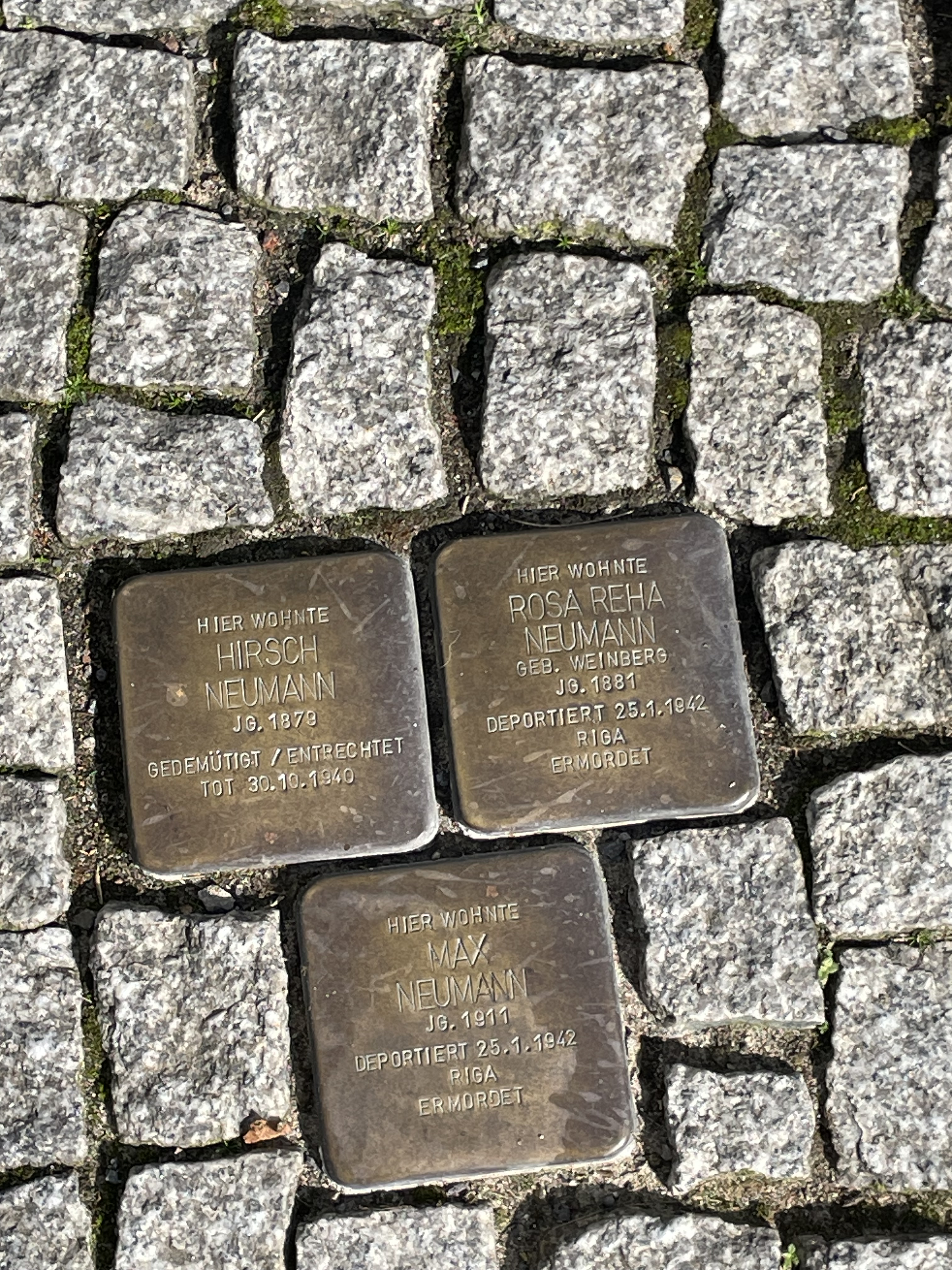
Clockwise: Berlin Cathedral, Berlin Palace, Stolpersteine: Carlé family, Fernsehturm, Humboldt Hafen (the canal harbour), Stolpersteine: Neumann family
Rotes Rathaus, Berlin’s town hall. It was the town hall for East Berlin, and the name ‘red town hall’ indicated not only the colour of the stones, but also the political colour. Mid-19th century, heavily damaged by Allied bombing, and rebuilt.
When we finally got into our room that evening (we’d decided to share, for economy), we were somewhat discomfited to discover that whilst there was, thankfully, a proper door on the toilet, the shower cubicle was all glass, and with a clear view through from the bedroom area, enhanced by the enormous mirror on the wall opposite the shower, just to make sure that the showerer would be visible from almost all points in the room, in all their glory. We devised a plan whereby the showerer would give a warning that clothes were about to be shed and the non-showerer would settle at the furthest top corner of the bed, facing the wall, and focusing intently on their phone or Kindle until the all-clear was sounded. We have since learned that this sort of thing is dismayingly common in modern hotels, in parts of Europe at least, and we don’t think much to it…
Sunday:
We headed for the Tiergarten but hadn’t fully realised the impact of the Berlin Half Marathon, which was taking place that morning. Our original route was quite impossible, so we only got a brief stroll through the Tiergarten before having to exit.
Reichstag – we’d tried to book a tour, but had evidently left it too late, or tours were unavailable due to the half marathon. Another time.
Marie Elisabeth Lüders House (Scientific dept of German govt) – On the banks of the Spree are memorials to people killed trying to cross to the West. This new building, inaugurated in 2003, owes its name to social politician and women’s rights campaigner Marie Elisabeth Lüders. Parts of the Berlin Wall have been rebuilt here to commemorate the division of the city along the former route of the Wall.
We failed to do justice to Museum Island but did go round the Alte Nationalgalerie. The problem with galleries is that once one has been through a number of rooms of paintings, it’s hard to remember exactly what one has seen, and to keep in mind the things that one particularly enjoyed and I really wish I’d made some notes. As far as I can recall, we rather liked the Romantics and the Impressionists, and I think Arnold Bocklin and Caspar David Friedrich stood out.
Solidarność wall – a section of brick wall from the shipyard at Gdansk commemorating the struggle for democracy in Poland through the Solidarity movement. I cannot find any information online about this, oddly. It’s adjacent to the Reichstag building.


Clockwise: Altenationale Gallery, Altes Museum, Reichstag, Rotes Rathaus, Solidarity wall, memorial to those killed attempting to cross from East Berlin (Marie Elisabeth Lüders House)
The Brandenburger Tor was the finishing line for the Half Marathon, and our arrival coincided with the first runners crossing the line, so we stayed and cheered for a while. Of course it is one of those sites that is iconic (a much over-used word, but here I mean that as an image it stands for Berlin in the same way that the Eiffel Tower stands for Paris), and I’ve seen it a lot recently, in coverage of the Euros. What seems remarkable is that it survived the final stages of the war, damaged but still standing, whilst so much of Berlin was reduced to rubble. Also remarkable is that shortly after the war, East and West Berlin cooperated in repairing some of the damage. Thereafter it was obstructed by the Wall and became a symbol of the city’s division – and then of its reunification after the Wall came down.
We had lunch with my friend Veronika, which was a brilliant opportunity to talk about all three of the cities we’d visited – she’d grown up and then worked in Vienna, now works in Berlin, and had visited Prague often, so it was fascinating to get her perspective on our experiences and to catch up on what had been happening since we met in December 2019.
After lunch, on to the Memorial to the Murdered Jews of Europe:
‘Two thousand seven hundred eleven concrete rectangles, as if a field of chiselled coffins of varying heights stand in formation, separated by just enough space for people to walk between them and contemplate their meaning. The stones undulate and dip towards the centre, where the ground hollows out, so that when a visitor reaches the interior, the traffic noise dies away, the air grows still, and you are trapped in shadow, isolated with the magnitude of what the stones represent. This is the memorial to the Murdered Jews of Europe who perished during the Holocaust. There is no sign, no gate, no fence, no list of the 6 million. The stones are as regimented as the Nazis and as anonymous as the captives shorn of identity in the concentration camps.’ (Isabel Wilkerson – Caste, pp. 343-4)
Opinions, as one might expect, differ about this memorial, about its purpose and the form it takes. I was surprised how similar that form was to the Garden in the Jewish Museum, although it is bleaker, somehow. But whatever form the memorialisation of the Holocaust takes, some will find it does not speak to them, or will question its location or how it presents itself (of course some will question the need for such memorials, but that question seems to me obscene in its ignorance). I did find it effective and oppressive, and the scale is very striking (the Garden does not attempt to convey that), and I applaud the use of the term ‘murdered’ here. When we speak of people dying in the Holocaust, or being killed, we diminish what was done. One might die of anything; one might be killed in a car crash. Whether through bullets or gas, disease or starvation, these deaths were planned and intentional, they were murder on an unimaginable scale.
Topography of Terror Museum, on the site of the Gestapo/SS headquarters, and one of the longest extant sections of the Wall. We didn’t exhaust this because we (or at least I) were, frankly exhausted. But we saw the open-air part of the museum, and the remains of some of the walls of the buildings once occupied by the Gestapo. It was an excellent display – much that I did not know or had not understood in context.
‘Had to get the train
From Potsdamer Platz
You never knew that
That I could do that
Just walking the dead’ (David Bowie – ‘Where Are we Now’, The Next Day, 2013)

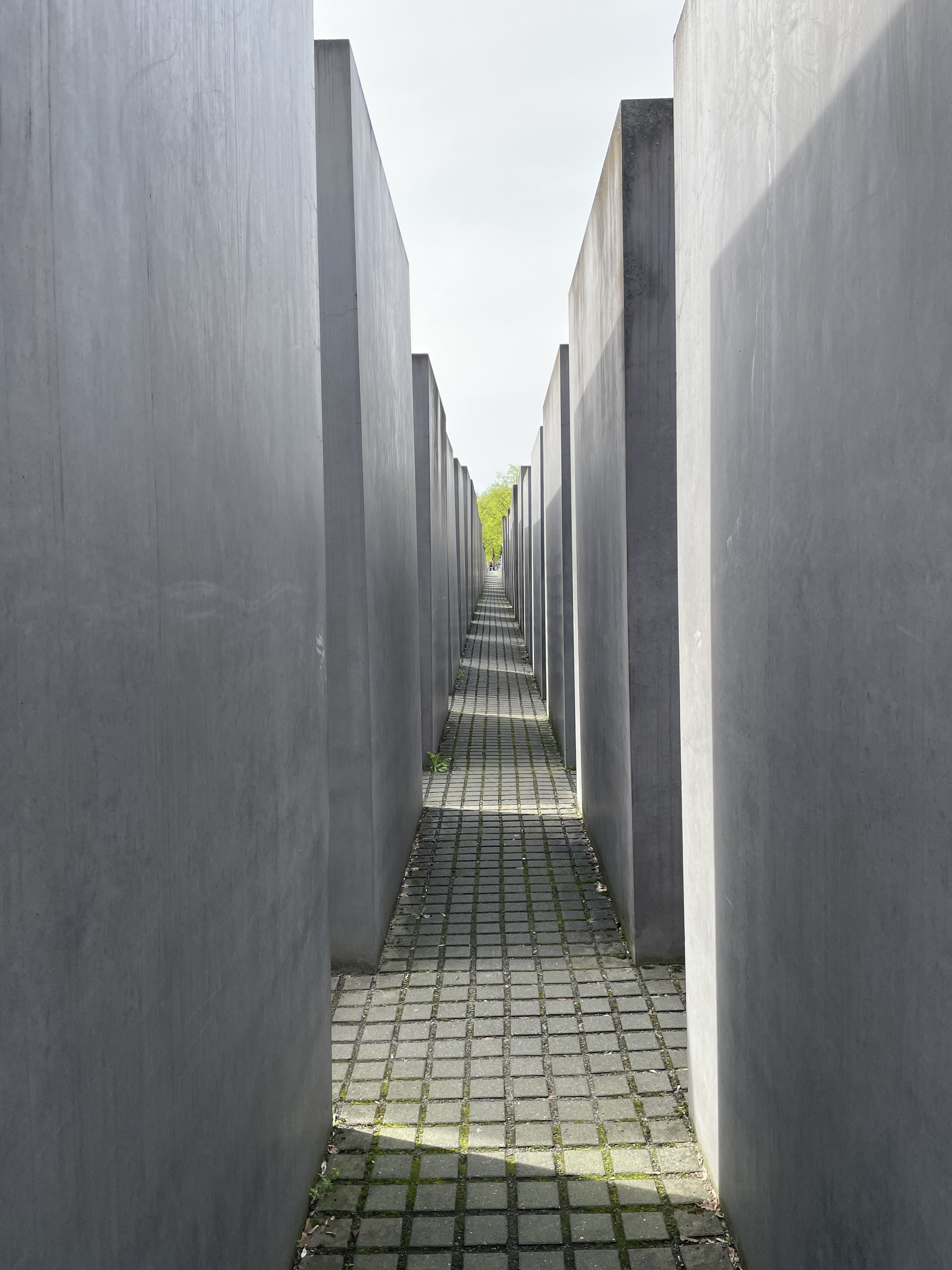


Clockwise: Brandenburg Gate, Memorial to the Murdered Jews of Europe, Potsdamer Platz, Tiergarten, Topography of Terror
What did we miss? More here than elsewhere, partly because there’s more to see, but also because our planned route for Sunday was disrupted by the Half Marathon, and to be honest, because we were knackered. If/when I go back, there are several museums to see, and I’d particularly like to focus more on the post-war DDR history – the Wall, the Stasi, etc – as well as doing the Reichstag tour, and going up the Fernsehturm for the sake of the view.
Berlin Reading:
Fiction: Christopher Isherwood – Goodbye to Berlin; Philip Kerr – Berlin Noir trilogy; John le Carré – The Spy Who Came in from the Cold. Non-fiction: Walter Benjamin – Berlin Chronicle; Sinclair McKay – Berlin: Life and Loss in the City that Shaped the Century
Berlin on Film: Wings of Desire; The Resistance; The Lives of Others; Cabaret
Berlin Music: Obviously, there is plenty of ‘classical’ music from composers who were born in or who studied in Berlin. But the soundtrack in my head was made up of the voices of Marlene Dietrich, Lotte Lenya, and David Bowie.
Final thoughts
Seeing three cities in six days invites one to make direct comparisons.
Vienna was grand, and beautiful, seemingly fixed in the nineteenth century, before all of that mid-twentieth-century unpleasantness. My response to the city was coloured by a conversation with a neighbour whose father, it turned out, had grown up there, but had had to leave, along with his family – of those who remained, many were murdered. She felt it was a soulless place, cold and hostile to her which, in a fundamental way it was – had her father not escaped it, she would probably not have existed. Another friend, who grew up in Vienna much more recently, spoke of it as claustrophobic, particularly for a teenager. So we admired its beauty but did not fall in love.
Prague is older, more of a muddle of labyrinthine streets and architectural styles, but just as beautiful in its own, less grand, way. And in the Jewish quarter of the city it acknowledges both the long history of that community, and how that was destroyed, in a simple and moving way, through the names and what that list of names conveys, rather than anything monumental. Prague took our hearts.
Berlin has, of course, a lot more to acknowledge, and it does so in various powerful ways. It leaves gaps, it leaves fragments.
‘Berlin is a naked city. It openly displays its wounds and scars. It wants you to see. The stone and the bricks along countless streets are pitted and pocked and scorched; bullet memories. These disfigurements are echoes of a vast, bloody trauma of which, for many years, Berliners were reluctant to speak openly. … The city itself is long healed, but those injuries are still stark.’ (Sinclair McKay, Berlin, p. xvii)
Its history is so complex and reflects not just one nation but two in the one city, as well as reflecting upon not just Germany (one or both) but what was done to so many in the name of that nation. There are layers upon layers to explore – and we inevitably did scant justice to that.
But we knew that seeing three cities in six days – three cities chosen because of their complex and fascinating history, their beauty and tragedy – was going to leave us with almost as long a list of things that we missed as our original list of things we wanted to see. Some of those omissions were choices – we favoured wandering around the streets over excursions that would take too big a chunk of our time, and I’m glad we did. I missed some things because I reached the end of my capacity for walking rather sooner than A did, and decided to conserve energy for the following day by a strategic withdrawal to the hotel room a little earlier than we’d intended. And there are things that we hadn’t even added to our list, that we’d include next time.
But we saw a heck of a lot, we walked for 57 miles, and I clocked up 135k steps, and we saw museums and art galleries, cathedrals, churches and synagogues, a cemetery, palaces, memorials, statues and fountains, parks and government buildings, paintings and stained glass windows, stolpersteine and commemorative plaques, three great rivers (the Danube, Vltava and Spree), street art, theatres and opera houses, bridges… We sampled the local culinary specialities (schnitzel, apfelstrudel, goulash, pork knuckle, various forms of sausage) and the local beers.
It was a trip that I dreamed up and I was afraid it wouldn’t live up to that dream, but it did, it was everything that I had hoped it would be. When we got home, it almost seemed dream-like – had we really seen and done all of that? Hence this epic blog – I needed to capture it all before memories got too hazy. I could not have done it without A and his company was not only practically essential, but also a joy. I am hugely grateful to him for making that dream a reality.
Disintegration Loops #2
Posted by cathannabel in Personal on March 13, 2024
In early 2019 I wrote this, a reflection on dementia, and on our experience of caring for my mother-in-law as the disease gradually took from her everything that made her her. Everyone I know seems either to have or to have had a parent (at least one) with dementia – it is so terrifyingly common that it starts to seem inevitable. And now my father is in a nursing home with the same condition.
He made it to 94 before diagnosis. Initially it had seemed that whilst his memory was deteriorating, his cognitive abilities were not impaired. And we had attributed some of his confusion to his sight loss – he had macular degeneration which by that time had taken all but a bit of peripheral vision. But there we were – he announced the diagnosis confidently, and without any evident distress. Things moved fairly rapidly – I have read since that (a) the later the diagnosis the faster the progress of the disease, which makes sense, and (b) that those who fend it off by keeping mentally active, by learning new stuff, challenging their brains, when they do succumb, find that dementia takes hold fast. It also seems to us that the pandemic, as it closed down so many social opportunities for him, just at the point when he could no longer use his computer to keep in touch, due to his sight loss, may have triggered a decline. And that the death of his youngest son to cancer in 2020, and the sudden death of my husband in 2021 may also have contributed – he had become accustomed to losing friends and relatives of his own generation, but these were shocking losses.
My sister, who lived with him before sight loss and dementia, took care of his practical needs, but these ramped up, and in the course of 2023 we realised that it was no longer possible for him to be kept safe at home (going ‘for a walk around the village’, making himself a coffee, getting himself into his armchair – all hazardous due to sight loss, lack of spatial awareness and general confusion). And as his dependency increased, so did his occasional bursts of anger at being manhandled and managed. This was verbal rather than physical aggression, but no less distressing when it was coming from one’s Dad. He no longer recognised the house where he had lived for 18 years, asking where his bedroom was, and when he would be returning home. He no longer reliably recognised me as his daughter, asking me about my family, and where I had lived, and found it difficult to accept my assurances of who I was, let alone to hold on to that information for more than moments.
As the dementia progressed, I was editing his memoirs. He’d started the process years before, but by the time we started to try to stitch the different sections (written or dictated via voice recognition software) together, we realised we were up against it, as his memory was becoming less and less reliable. Some later sections had to be discarded, or heavily edited after consultation between us to try to determine what had happened, when, or in what order. The process was frustrating, given that we could no longer check with him about details of his life before our own arrivals, and tricky, given that we wanted it to be very clearly his voice, but some rigorous editing and rewording was nonetheless necessary. Thankfully, we were able to put a copy into his hands whilst he was still able to recognise that this was The Book which had been his project and purpose for such a long time.
But now that the book is done, it means more to me than I’d expected. It is the record of a life well lived, a life of service and of leadership, of travel and adventure. And it’s the voice of a man who was always ready to take on challenges, to chair committees, to lead projects, and who was often asked to do so, a man who made bold decisions (to go into the aircraft industry rather than his father’s choice of the civil service, to then leave that industry because of his pacifist convictions, to move into education, and then to relocate his family to West Africa…). We still hear that voice occasionally – sometimes when we visit he is in conference mode, and asks us whether we’re booked in for the keynote talk, and whether we’ve got accommodation sorted out, or believes himself to be present in the home in some professional capacity. No wonder he resists sometimes when told to use his zimmer frame, or when carers want to shower or dress him. There’s no alternative – the mismatch between who he, some of the time, believes he is, and what he is actually able to do now is irreconcilable. But in his memoir he is still present.
Wendy Mitchell, whose books and blogs about her early onset dementia have given fascinating insight into the condition, decided that she was not willing to go on beyond the point when she was no longer Wendy, not willing to reach the point when she might not recognise her daughters, the point when dementia had stripped away everything that brought her joy. No one reading her books – and in particular her last book, One Last Thing, a passionate argument for assisted dying, and for provision to be made for people with dementia to have that choice too – could doubt that she had the capacity to make that decision and to take the necessary steps. Her final blog entry, posted after her death, explains, with her usual honesty, clarity and courage – and even humour – why and how she did so.
“If assisted dying was available in this country, I would have chosen it in a heartbeat, but it isn’t. I didn’t want dementia to take me into the later stages; that stage where I’m reliant on others for my daily needs; others deciding for me when I shower or maybe insisting I had a bath, which I hate; or when and what I eat and drink. Or what they believe to be ‘entertainment’. Yes, I may be happy but that’s irrelevant. The Wendy that was didn’t want to be the Wendy dementia will dictate for me. I wouldn’t want my daughters to see the Wendy I’d become either.”
https://whichmeamitoday.wordpress.com/blog/
That paragraph resonated so much with me. I remember my mother-in-law, who in general raged less than Dad about the indignities of her life, stubbornly removing her feeding tube whilst she was recovering from bronchitis, trying (and sometimes succeeding) in removing her neck brace after a fall, and saying to us, ‘oh, just put me in the bin’. Dad, until recently, was determined to live to be 100. These days he does not know how old he is – we think he sees himself as a much younger man, one reason why he cannot recognise us as his children – and I don’t think he would understand the question if we asked him whether he wanted to go on. Neither of them had or have the capacity to go through that rigorous thought process – not just whether, but when and how – and then carry it out. So the most we can hope for whilst Dad lives is that he is, as his care home notes often put it, ‘on average, content’. We know the trajectory of this disease is relentlessly downward, and all we can do is to work with his carers to ensure that he is as safe as possible, as comfortable as possible, as content as possible.
I don’t see any solution to this. I strongly support assisted dying legislation – it should not be beyond any sophisticated legislative system to put in place sufficient safeguards to ensure that no one is coerced or cajoled into ending their life earlier than they would wish – but I cannot see any way of that helping dementia patients. And so, as Wendy Mitchell says, it can’t be a case of assisted dying OR gold standard palliative care. Both are needed, so that people who would not be willing to choose the first option can be cared for such that their last years/months/days/hours are as peaceful, as pain-free, as possible, and so that people who lose the capacity to choose are kept safe, as content as possible, with as much dignity as possible. And that means carers and family working together.
When we read in those care notes that Dad has been raging – hurting himself and his carers, hitting out, shouting – it distresses us, of course. The care home staff take it in their stride (‘bless him’, they say as they recount the latest incident). They have a repertoire of things to try – bring in a new face, try to distract – but with the prime aim to prevent harm (to him or to them). Medication is part of this repertoire, and whilst the image of care home residents being doped into placidity is deeply troubling, the impression we have is that when the medication is working Dad can be more himself, not at the mercy of his frustration and anger, his distress eased, at least for a while so that he can enjoy his food, and chatting to the carers or to visitors.
I thought the other day of Dylan Thomas’s most famous poem, ‘Do Not Go Gentle’. I’ve always thought that the dying of the light is death, and the raging is heroic, courage in the face of the inevitable. But as I get older, my feelings about that have changed. To rage against the very idea of mortality is irrational but at the same time profoundly human – death makes no sense, that someone can be totally there and then in a moment totally, irrevocably not there. And we so often use the language of war when talking about terminal illness – so and so died ‘after a long battle with cancer’. To fight to hang on to life for as long as possible, to be with the people we love for as long as possible is, again, profoundly human. But it is also human to seek the most peaceful path, to, as a friend with terminal cancer once put it, negotiate with mortality, in order that the time remaining can be spent as richly as possible, without expending all of one’s energy in a battle against an unbeatable enemy. She found ways to enjoy those last months of life, spending as much time as possible in the countryside she loved and with the people she loved, refusing to waste that precious time on things that brought her no joy, or brought her additional pain. That isn’t always possible, but I found her approach inspiring.
Dementia is a kind of long, drawn out death, as the person is engulfed and extinguished, not all at once but little by little. Wendy Mitchell talked of ‘playing games with this adversary of mine to try and stay one step ahead’, and she did this for as long as she could, making her decision when she realised that it would soon be impossible, and taking that one last step before the disease could take it for her. For Dad, the time for attempting to outwit his dementia is long gone, and he is effectively at its mercy. There’s nothing for him to fight, and the more he fights the more he loses.
Reading the poem again now, I think of Dad’s raging, against the loss of dignity, the loss of control over where he is and what happens to him, against the loss – even if he can no longer articulate it – of the things that made him him, against the slow dying of the light. Even into his nineties, and even after his diagnosis, he talked about his ‘purpose’, questioning what it was now, how he could rediscover it. We felt, though it would not have helped to say, and he would never have accepted, that his purpose now could surely be to rest from all that striving, from leading, from driving forward. That’s gone now, except for an occasional echo in one of his circular monologues, but its loss is part of what he is so viscerally resisting.
We understand his rage, we really do. Ah, but we cannot truly wish for his last months or years to be spent burning and raving at close of day. Please, Dad, go gentle.
Do not go gentle into that good night,
Old age should burn and rave at close of day;
Rage, rage against the dying of the light.
Though wise men at their end know dark is right,
Because their words had forked no lightning they
Do not go gentle into that good night.
Good men, the last wave by, crying how bright
Their frail deeds might have danced in a green bay,
Rage, rage against the dying of the light.
Wild men who caught and sang the sun in flight,
And learn, too late, they grieved it on its way,
Do not go gentle into that good night.
Grave men, near death, who see with blinding sight
Blind eyes could blaze like meteors and be gay,
Rage, rage against the dying of the light.
And you, my father, there on the sad height,
Curse, bless, me now with your fierce tears, I pray.
Do not go gentle into that good night.
Rage, rage against the dying of the light.
(Dylan Thomas, 1947)

2024 – Here’s Hoping…
Posted by cathannabel in Personal on December 31, 2023
Hoping for peace, as unlikely a prospect as that might seem, in Israel and Palestine. Hoping in the short-term for ceasefire, for safety for the people of Gaza. And in the longer term, hoping for people, Israeli and Palestinian, with the vision to see a way forward and the courage to take it. Hoping for the Russian forces in Ukraine to withdraw, for those in Russia who are able to see both the moral obscenity and the cost of the invasion to prevail.
Hoping for a general election (well, OK, that’s going to happen barring a coup d’état) that decimates the Tory Party, that humiliates the Reform/Brexit/UKIP and that brings us a government with integrity, compassion, courage and competence. It’s hard to imagine after the last 13 years what that would be like, but hey, it would be bloody brilliant, wouldn’t it.
Hoping for action on climate change, action that really starts to make a difference. Hoping that the voices of those who care about the future of our planet more than they care about the profits of industry will prevail.
Hoping that the forces of hatred that create violence against refugees, against women, against LGBTQ people, against black and brown people, against Jews, will be shamed and marginalised, that those who enable and encourage those forces will be defeated, that instead we will find ways to open our lives and hearts to each other without fear.
And for me personally, I’m hoping that I can continue to hold on to the three words that I took away from the Fire & Rain widows’ retreat: clarity (this blog is one of the ways I find clarity, by writing about the process of grieving and of making this new life), creativity (again this blog is vital to me, but I’m hoping for other writing projects over the next year), connections (I’m still talking regularly to the women with whom I shared that retreat, and I am so fortunate in my friends and family, who have supported me so wonderfully).
For my Dad, lost in the fog of Alzheimers, and so often troubled, restless, angry and fearful, I’m hoping for peace and calm. The fog won’t lift again, we know that. But if his new home can help him to be not only safe but also at peace, we will all be deeply relieved and grateful.
It might seem frivolous (but it matters, if you understand, you’ll understand) to add that I’m hoping too that Forest will continue to climb away from the relegation zone, and ensure that in 2024 they will continue to be Premier League.
And I’m hoping for lots more of the things that enrich my life. More music in 2024 – more great gigs, at Crookes Social Club, the Crucible Studio, Tramlines and other venues, as well as music nights at home. More great films, for theatre and opera outings. For my new book-lined study to be a place of contemplation, of losing myself in good books.
Hoping for another good year for Under the Stars, and that I can contribute to their inspiring and vital work in useful ways.
I don’t make resolutions, but I hope to find the willpower to walk more, to be braver in going out on my own, to take better care of my health.
For the people I love, I hope for good things, for love and companionship, for good health and a bit of good luck. And I hope to spend time with them during the course of the year.
And for all of us, some thoughts on hope:
Sheenagh Pugh – Sometimes
Sometimes things don’t go, after all,
from bad to worse. Some years, muscadel
faces down frost; green thrives; the crops don’t fail,
sometimes a man aims high, and all goes well.
A people sometimes will step back from war,
elect an honest man, decide they care
enough, that they can’t leave some stranger poor.
Some men become what they were born for.
Sometimes our best efforts do not go
amiss; sometimes we do as we meant to.
The sun will sometimes melt a field of sorrow
that seemed hard frozen: may it happen for you.
Hang on to your hat. Hang on to your hope. And wind the clock, for tomorrow is another day (E. B. White)

Closer to Fine?
Posted by cathannabel in Personal on October 9, 2023
The second year is harder than the first – that’s the received wisdom. But in that first year, you’ve had to get through the sheer shock, to deal with the grim grind of bereavement admin, to make some of the vital decisions about what you do now, how you live now, and you’ve probably got to the point where you’re functioning, more or less. The first year is so bloody hard that one might be forgiven for thinking that surely, surely, it will get easier. Well… it gets different.
I wrote about this last year, how after that first anniversary, you’ve got a whole year of being without your person, a whole new set of memories, obviously marked and shaped by their absence, but new, at any rate, and maybe some of them are good memories in their own right (not just good, considering). But the price of that is the knowledge that this is now it. This is your life, and it’s not the one you thought it would be, let alone would ever have chosen, but you have to go on, and on. That is a whole new kind of hard.
And somewhere along the way, you may start to drift. When you’ve lost the person with whom you navigated life, the person who anchored you when you needed it, and with whom you looked ahead and planned and anticipated and hoped, it is perilously easy to drift.
You’re driftwood, floating underwater
‘Driftwood’, Travis
Breaking into pieces, pieces, pieces
Just driftwood, hollow and of no use
Waterfalls will find you, bind you, grind you
I hadn’t consciously thought about this, but it was part of the reason I took quite a bold step this last year, and booked myself on to a widows’ retreat. I’d seen a brief clip about Fire & Rain on Rev. Richard Coles’ TV programme, Good Grief, and felt that it might be something good, something healing. So in April, I headed up to Lower Largo, in Fife, and met up with five other widows, and with the organisers, at a beautiful house just by the beach. I was deeply apprehensive. What if we (the widows) didn’t get on – what if the one huge thing that we had in common wasn’t enough to overcome our differences? What if they didn’t like me, or I them? What if I couldn’t get on with the more spiritual side of the retreat, given my resilient absence of faith in anything beyond this physical world?
By bedtime on the first day, all that was gone. We’d shared our stories, we’d wept together (a lot) but we’d also laughed, and we’d given each other an insight into our lives, before and after, and into who we were, before and after. And we didn’t have to buy into any particular spiritual beliefs or practices, just to take what we found useful and nurturing, and to build it into our lives if it worked for us. For five days we talked a lot, wept a lot, laughed a fair bit, walked, sat on the terrace looking out at the sea, did relaxation and breathing exercises, did some creative stuff. Of course when I got back to my new reality I crashed quite badly. But not for too long.


I haven’t made dramatic changes since those five days with Fire & Rain, but it did shift something in me, and gave me ways to hold on, to navigate, to be anchored. We are all learning to be our own compass, as one of our group put it. All of us are doing so in different ways – we’re very different people – and the crucial thing is that we find our own way. One of the themes of the week was being honest about where we are and how we feel. Some people – people who’ve never been in our situation – may expect that by one year/two years/six years we’ll be ‘over it’, we’ll have moved on, and there’s an expectation that when you’re asked, you’ll say, I’m fine, thanks. None of us is ****** fine. None of us has moved on. None of us, ever, will be ‘over it’. How could we be, when the nature of our loss is that our lives were tangled up with them, when everything in our lives had and has something to do with them? We can’t untangle it all, nor would we want to – that rich tapestry is made up of their threads as well as ours.
I can’t imagine that I won’t in years to come still be having conversations in my head with him, still be talking about him – after all, even if I live to be 100 (not that I aspire to that), I will still have spent more years with him than without. His absence will still, I’m sure, make me sad, as I accumulate experiences (both the lovely ones and the heartbreaking ones) that I would/should have shared with him. But I am, and will be, OK. We don’t move on from our person, we move forward, taking them with us, but finding our own way, shaping our own futures, regaining our balance, finding our clarity. It will always be a crooked line, but we press on in the hope that we are getting, maybe, closer to fine.
I went to the doctor, I went to the mountains
I looked to the children, I drank from the fountains
We go to the doctor, we go to the mountains
We look to the children, we drink from the fountain
Yeah, we go to the Bible, we go through the workout
We read up on revival, we stand up for the lookoutThere’s more than one answer to these questions
‘Closer to Fine’, Indigo Girls
Pointing me in a crooked line
And the less I seek my source for some definitive
(The less I seek my source)
Closer I am to fine
To Ute and Sarah, thank you for guiding us through the week, so gently and sensitively, and for giving us space and time and resources to go forward.
And to A, M, D, P and N, I will treasure those days in Lower Largo with you. Thank you for your honesty and courage, your friendship, your solidarity.


Thank you always and most of all to our children, who support and take care of me so very lovingly and who, of course, are dealing with their own grief and loss. And to all of those who have been part of our support network of family and friends over this last two years. You know who you are, I hope.
And thank you to M, for all the days.

Ring out the old, ring in the new
Posted by cathannabel in Events, Music, Personal, Theatre on December 31, 2022
Every week, for the last three and a half years, I’ve posted on Facebook about ‘Good Things’. This isn’t a ‘let’s not talk about the bad stuff’ exercise – it acknowledges, explicitly, that the reason I’m doing it is because there is a lot of bad stuff, globally and personally, and it is thus important sometimes to home in on and hold on to the good that is there, even if that good stuff seems rather small and trivial in comparison to war and climate change and poverty and everything. It’s not ‘always look on the bright side’ so much as ‘always look for the bright moments’. Older readers might think of the 1913 children’s book Pollyanna, whose central character is known for being relentlessly cheery at all times. Whilst this can be rather cloying, and I would refute the notion that there is something good to be found in every situation, the idea that it is healthy to remind oneself that there are good things is a valid one. Which is why I’ve kept those posts going, and why they invariably get likes and comments, and people urging me to continue.
It’s certainly not as if the period during which I’ve been doing this (and there were sporadic efforts before, my ‘reasons to be cheerful’) lent itself particularly to optimism, on any front. The world has been going to hell in a handcart faster than ever, it would seem. And on a personal level, when I posted my first ‘Good Things’ my youngest brother was terminally ill with cancer. He died the following February, just before the pandemic deprived us of so many of the things that might normally bring us comfort in hard times. Then, of course, in October 2021, I lost my husband. He died less than 24 hours after I’d posted that week’s Good Things, and when I re-read it I realised that despite the horror of what had happened, I stood by everything I’d said. Those good things were real and true and not invalidated by the huge Bad Thing that had engulfed us. So I’ve carried on.
It’s hard to find much on the national or global scale to celebrate – at most, some things didn’t turn out quite as badly as we feared (the US mid-terms, notably). Our government was incompetent and corrupt, chaotic and callous, as we’ve come to expect, and the usual people are suffering as a result – don’t be poor, don’t be disabled, don’t be old, don’t be sick, and for heaven’s sake, don’t be a refugee… Conspiracy theories, whether about climate change or vaccines or anything else one can think of, seem to be multiplying and spreading more rapidly each year, not helped by the takeover of Twitter, already an excellent breeding ground, by a leading conspiracy theory enabler and exponent. Ukraine is still suffering under – and fighting back against – the Russian invasion. Women in Afghanistan are shut out of the universities. It is easy to despair.
Of course there are always good people standing up for the vulnerable. The RNLI will carry on risking their members’ lives to save those whose dinghies are capsizing in the Channel. Food banks will continue handing out essentials to families who can’t make ends meet. Individuals and organisations will continue to provide safety nets, to challenge bigotry, to tell the truth and to shame (or at least try to shame) the powerful into using their power for good, and the brave will stand up anyway, in Iran and Afghanistan as in so many other places, whatever the risk.
In my own life, despite the sadness, I’ve had good things.
I got a new knee in February and (after a short but tough period of recovery) that gave me the confidence to be braver and more adventurous than I would have done otherwise. I went to Wembley to the Championship Playoff final, with my son. (The football has actually been a Good Thing in 2022, the first year for decades when I could have said that.) I went to Progfest with my brother in law and to the Tramlines music festival, with my son and with friends. I travelled to Rome, on my own (but was met by my brother, with whom I stayed). I would have done none of those things without the op, I would have been too scared, not only of the pain, but of my knee suddenly refusing to bear my weight, or of falling. That fear nearly paralysed me when he died – I could see myself so easily becoming virtually housebound, dependent entirely on others to get around, and that hasn’t happened.


I have needed more help this year, especially without a car or someone to drive it, and I’ve always found the help that I’ve needed, sometimes by asking very directly for it (anyone taller than me – i.e. most adults – entering the house is likely to be greeted on the doorstep with a request to change a light bulb or lift something down off a high shelf), at other times because some nice young man or woman has seen me struggling with a suitcase or whatever and has offered assistance. I’ve also found someone to help me with the cleaning, someone to help me with the garden, a handyman and a decorator.
I finished the PhD, submitting just over a week before he died, and had my viva in May. I’m very proud of the thesis, and I absolutely could not have done it without his support, in big ways and small – so many times I was writing away, lost in my work, only to realise that he had snuck in, delivered a hot cup of tea or coffee and snuck out again, without breaking my train of thought.
I’ve been to the theatre, to a stunning production of Much Ado, by Ramps on the Moon which used its cast of (mainly) deaf and disabled actors inventively and boldly, and tweaked the text accordingly. Much Ado works or doesn’t depending on Beatrice and Benedick, and here both were outstanding and unforgettable. The Guardian reviewer described Daneka Etchell (who is autistic) as ‘the most compelling Beatrice you might ever see’, and she was responsible for an extraordinary scene, when, in her distress at the injustice being inflicted on Hero, she starts stimming. Both her anguish and Benedick’s tenderness in trying to help calm her were very moving.
We very much enjoyed a performance by Under the Stars, an organisation who we supported with Martyn’s memorial fundraiser, who are an arts and events charity for people with learning disabilities and/or autism, running music and drama workshops and nightclubs. The play was The Many Journeys of Maria Rossini and it used words, music and dance, exuberantly and engagingly, to tell the story. Under the Stars band also performed at Tramlines.
Final theatre outing of the year was to Richard Hawley’s musical Standing at the Sky’s Edge, which we’d somehow missed when it was first produced at the Crucible in 2019. We loved it. The musical weaves together the stories of some of the inhabitants of Sheffield’s Park Hill flats, over five decades, telling those stories through some of Hawley’s songs. The action is beautifully choreographed, the singing is marvellous, and it builds to a very moving climax. Obviously this piece has special relevance and resonance for Sheffielders, but it goes beyond that – every major city has communities like Park Hill.
I’ve done my usual summaries of what I’ve read and watched over the year. As far as listening to music at home goes, I’ve tried to develop my own approach to music nights, which were so much about our shared enjoyment of music that initially I couldn’t see at all how I would do it. Now, I pick a few things over the course of the week, prompted by someone mentioning an artist or a band, by an artist’s death, or some other kind of event, just so that I don’t get paralysed by the vast choice when I look at our CD wall. I listen when I can to the Radio 3 weekend programmes we used to love, to Inside Music, Sound of Cinema, Music Planet, J to Z, Jazz Record Requests, and these also often suggest what I listen to from our collection.
Highlights amongst the music that I’ve heard live this year:
- Beethoven String Quartets plus a piece by Caroline Shaw (‘Entr’acte’), in a Music in the Round concert which I sponsored in Martyn’s memory, at the Crucible in May
- Focus, the highlight of the Progfest in April. Still led by Thijs van Leer, who may not be able to reach all the high notes these days but is still a great performer, and the band (which included Pierre van der Linden, another veteran) was great and of course the music brought back so many memories of listening with Martyn.
- Jazz Sheffield gigs from Laura Jurd, Zoe Rahman and the Espen Ericksen Trio with Andy Shephard, all excellent.
- Tramlines highlights: my old favourite, the Coral, and new favourite, Self Esteem.
- A rare orchestral concert, at a great venue, the Auditorium in Rome: Gershwin, Bernstein and Stravinsky.


Last New Year’s Day was one of the hardest to wake up to in all of the days since he died. Knowing that I was about to start on a year without him, the first year without him since 1973… It was bleak. Perhaps, whilst this NYE/NYD will acknowledge the sadness, it may be easier. I hope it will be less bleak, less raw.
So, allons-y to 2023. I will formally graduate (for the last time, definitely, categorically) on 11 January, and my next project will be to look for a publisher for a version of the thesis. I’ll have chapters published in two forthcoming books, both on W G Sebald. I’ll travel, to see friends in Scotland, to see family in various parts of the country, maybe a city break in Europe. I’ll go to two family weddings. I’ll finish phase 2 of the decorating, maybe even phase 3. I’ll carry on sharing the cultural riches of Sheffield with friends and family.
Without being Pollyanna-ish, I do know how very lucky I am, to be surrounded by people who want to and do help me, emotionally and practically. I am thankful for them, every day.
For you, I wish for health and strength, for peace and comfort, for love and support.
In 2023 I wish, of course, for a world without war, a world where people are not persecuted for their beliefs, or simply for who they are, a world where women can be safe on the streets and in their homes. I wish for action on climate change, before it’s too late. That’s a lot, I know.
But as we go into another new year I think, as always, of this poem, which gives me hope.
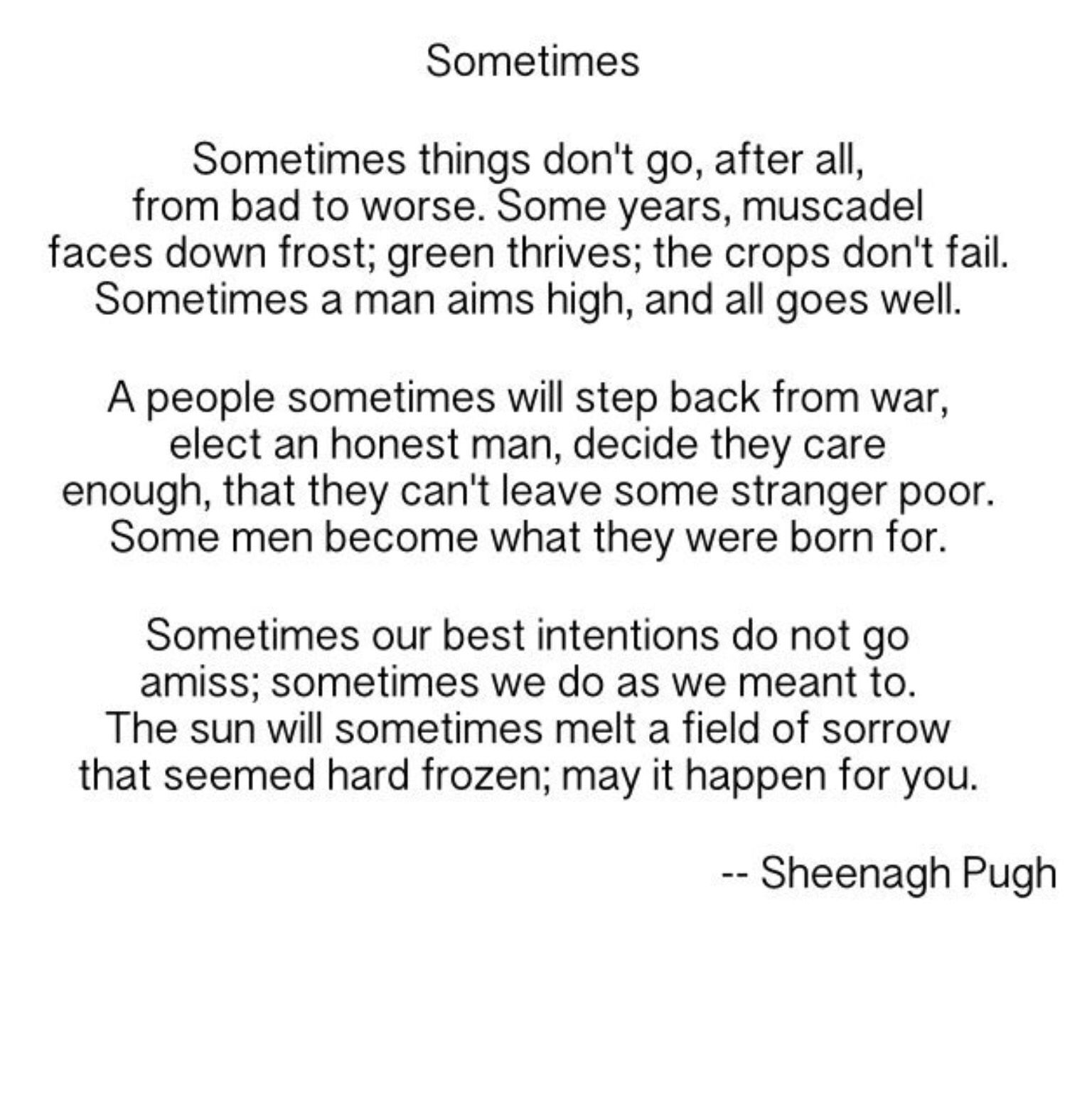
2022 Reading: Full-time Report
Posted by cathannabel in History, Literature, Personal, Second World War on December 16, 2022
I’m still not reading as much as I used to. It’s the silence that’s the problem. Lord knows I used to tut sometimes when I was reading and he broke my train of thought with his own train of thought, but Lord knows I would love to have him do that now. So I turn to the TV sometimes when in the past I would have turned to a book, just to break the silence. Nonetheless, I’ve still normally got two or three books on the go – one on the Kindle and a couple of physical books, usually one fiction and one non, and nonetheless it’s still quite an eclectic list. As always, I haven’t listed absolutely everything – I want to share my enthusiasms rather than my disappointments – and as always I have tried to avoid spoilers but make no guarantees. Top reads this half-year? Jan Carson’s The Raptures, Abdulrazak Gurnah’s Afterlives, David Park’s Travelling in a Strange Land. From the first half of the year, I’d pick out Alan Garner’s Treacle Walker, J L Carr’s A Month in the Country, and Sarah Moss’s The Fell. Since I make the rules for this blog, I shan’t require myself to choose amongst those six titles.
Fiction
Pat Barker – The Silence of the Girls
This, and its sequel The Women of Troy (which I have yet to read) tell the familiar story (familiar not only from Homer but from countless retellings – in my case the first encounter was with Roger Lancelyn Green’s Tales of the Greeks and Trojans and The Luck of Troy) with the focus shifted to the women. In this one, the central role is that of Briseis, handed over to Achilles, appropriated by Agamemnon and retrieved by Achilles, all as part of the spoils of war. It’s a grim tale, beautifully told.
Thomas Bernhard – The Loser
Sebald and Bernhard are often linked, and I figured it was about time I gave the latter a go. The choice of book was a foregone conclusion once I discovered that The Loser was about (in part) Glenn Gould, who fascinates me. There are elements of the style that certainly recall Sebald (any influence was from Bernhard on Sebald) – the novel, like Austerlitz, is one unbroken paragraph, and the narrator’s voice constantly makes it explicit that these are his thoughts, and when he was thinking them (‘I thought, as I entered the inn’, ‘I thought in the inn’ , ‘he said, I thought’, etc) which reminded me again of Austerlitz.
Frances Hodgson Burnett – The Shuttle
I adored The Little Princess and The Secret Garden as a child (never read Fauntleroy, as far as I can recall) and this adult novel was a delight too. It’s quite Gothic in places, but punctured with humour, and with a hero (Bettina) who shines from the pages. The theme is intermarriage between British aristos (broke, with run-down country estates to maintain) and wealthy American heiresses but it’s also a very perceptive (based on first-hand experience) account of coercive control.
Jan Carson – The Raptures
This is stunning. I had no idea for most of it where it was heading, what the answers to the questions were going to be, and indeed ultimately there were no firm answers. But it grips on every page, its characters live and breathe, even when they’re no longer living and breathing. It’s a supernatural mystery, a who (or what) dunit, an allegory about plague and pandemic, a coming of age narrative, a portrait of a small Protestant Northern Irish community. Never mind all that, just read it.
Ann Cleeves – The Rising Tide
A new Vera! I wasn’t sure Cleeves was still writing Veras. Anyway, very pleased to get this and it’s as enjoyable as ever.
Robert Galbraith – Ink Black Heart
Oh dear. I have enjoyed all of the Cormoran Strike books so far, although few of them need to be the length they are. But this one desperately needed an editor to tell her to slash great chunks of the book so that it’s coherent, and particularly to cut back the use of verbatim online conversations (three columns of different conversations, going over several pages) which are incredibly hard to read and to follow. There’s also the issue of the subject matter – online abuse – and its proximity to the author’s life on Twitter and other social media over recent years. I think it’s too close for her to be able to examine that world with any objectivity and the book is a mess.


Elizabeth Gilbert – City of Girls
I read The Signature of All Things a few years back and loved it. Still haven’t read Eat Love Pray or whatever it’s called, fairly sure that would not be my cup of tea. But she’s a lovely writer – City of Girls is captivating, and very witty, it sparkles like one of those screwball comedies from the era in which the book is set. And then the tone shifts, and whilst it’s every bit as witty it’s also darker and deeper and very moving.
Graham Greene – The Quiet American
I honestly thought I’d read all of Greene, many years ago (he was a favourite of my mum’s). But this one had eluded me and it’s a fine example of his style and of his preoccupations.
Elly Griffiths – Bleeding Heart Yard
This is Griffiths’ third novel featuring detective Harbinder Kaur, now relocated in that London, and it is hugely enjoyable. As always with Griffiths, the characters are drawn with humour and affection (mostly), and with compassion and insight.
Abdulrazak Gurnah – After Lives
Gurnah was awarded the Nobel Prize for Literature in 2021 but his name had never registered with me. I shall put that right now and read his other books, because this one was excellent. Set in what is now Tanzania, in the early 20th century when the area was a German colony, it sweeps across that century, through the first and second world wars, the shifting boundaries and colonial rulers, but is always centred on the lives of a handful of characters who are battered, in different ways, by these forces. Despite the scale and the horror of what is unfolding, it manages to be, in relation to these people, gentle and subtle and, somehow, hopeful.
Yaa Gyasi – Transcendent Kingdom
I’d read Homegoing a couple of years ago, an epic family history that begins in Kumasi, Ghana, and crosses continents and centuries. The scale in Transcendent Kingdom is much smaller, although it still reaches back to Kumasi, but the central family is contracting rather than expanding (as the narrator says, “There used to be four of us, then three, two. When my mother goes, whether by choice or not, there will be only one”. Its concerns are philosophical, scientific even, as the central character is a neuroscientist, her research intimately connected with her family’s tragedy.
Robert Harris – Act of Oblivion
After Cromwell’s death, those who signed King Charles’ death warrant are on the run, and supporters of the new King are determined to track them down. Harris cleverly builds the tension but also gives us insight into both sides, so we as readers have to keep switching our perspective, as we are with first the regicides and then the manhunter, and we see how both are driven by the absolute certainty that they and their cause are absolutely right.


Mick Herron – Live Tigers/Spook Street
The third and fourth of the Slough House novels and they’re as sharp and funny and dark as ever. I look forward to reading the rest of the series, and to seeing the dramatisation of the second book – Gary Oldman has a marvellous time as Jackson Lamb, really letting rip, in every sense.
Tayari Jones – The Untelling
Secrets and lies and their toxic effects upon relationships are the theme here, and Jones is perceptive and subtle in her portrayal of Aria(dne) and the small circle of people who matter to her.
Stephen King – Fairy Tale
This resembles his 1984 collaboration with the late Peter Straub, The Talisman, more than it does his most recent spate of novels. That’s deliberate, I’m sure – King often makes references to his other books, sometimes in passing, sometimes to create resonant connections (see his various books set in or around Castle Rock, for example), and there are some nice echoes here. He and Straub had talked about another collaboration, although it had never got off the ground, so maybe we can take this as a tribute. It’s King on top form, in any case.
John le Carré – Silverview
Ah, the last le Carré. Edited by his son, from what was a virtually complete manuscript. It’s not the best le Carré but it’s bloody good le Carré and it has the melancholy and the anger that have characterised his work in later years.
Attica Locke – The Cutting Season
A stand-alone from Locke, after her two excellent short series of crime novels. This is crime that drags one back into the past, the slavery past, and it is tense and gripping stuff.
David Park – A Run in the Park/Travelling in a Strange Land
Beautiful writing. A Run in the Park is the gentler read, although there’s plenty of emotional heft in there. Travelling in a Strange Land goes to dark places but in both books there is always darkness and light, loss and love, grief and hope.


Sara Paretsky – Tunnel Vision
The eighth in Paretsky’s excellent detective series, featuring PI V I Warshawsky battling corporate crime and corruption. I’ve read these in random order as I got hold of them, so at some point I will try and fill in the gaps.
Ann Patchett – Bel Canto
My first Patchett – this is compelling and often moving. It’s about a terrorist attack, and the fate of the hostages, but its also about love, beauty and music.
Louise Penny – The Madness of Crowds
Inspector Gamache series, no. 17, the most recent. As with the Paretsky, I’m reading these in a totally random order, so there are references in this one to events which I don’t yet know about, but the main plot stands alone. As always with Penny, there are times when Three Pines seems just too magically cosy but she always undercuts that with the crime and its motivation, which are anything but.
Bapsi Sidwha – The Ice Candy Man
Many years ago I read Sidwha’s debut novel, The Crow Eaters, which I remember loving even if its plot has faded from my memory. The setting is Lahore, once in India, then allocated to Pakistan at the time of Partition. The Ice Candy Man (also published as Cracking India) starts in the period leading up to Partition and confronts the horrors of what happened, through the eyes of a child, who at first has no real notion that the different communities (Sikh, Parsi, Muslim, Hindu, Buddhist, Christian) are potentially a threat to one another. Indeed, her home is a place where people from these communities meet and bicker and insult one another in a largely friendly way, and when violence is predicted insist that they will stand by their friends. We see things through Lenny’s eyes, not all of which she understands, not all of which adults are prepared to explain to her. It’s unflinching, but also often funny and touching.
Zadie Smith – White Teeth
I struggle with Zadie Smith and am still trying to work out why. Her characters never quite seem to live and breathe, as if she’s at too much of a distance from them to really bring them to life. This, her debut, didn’t change my view, unfortunately.
Russ Thomas – Nightwalking/Cold Reckoning
Parts 2 and 3 of Thomas’s Sheffield-based trilogy which began with Firewatching. Excellent plotting and interesting, complicated lead characters.


Anne Tyler – Redhead at the Side of the Road
I hadn’t read any Tyler for ages, not since being so disappointed with Vinegar Girl (kind of a take on Taming of the Shrew, but it really didn’t work). But I have read most of her stuff, and I love most of her stuff (top two are Saint Maybe and Breathing Lessons, I think). This one is a lovely variation on ‘a perennial Tyler theme: the decent, mundane, settling-for-less kind of life whose uneasy decorum is suddenly exploded by the random, the uncontrolled, the latent sense of what might have been’, as The Guardian’s reviewer put it.
Non-Fiction
Molly Bell – Just the one Ice Cream?
I read this account of widowhood, by a family friend, a few years back when it was first published. Reading it again now was a remarkable experience – so many of Molly’s observations are ones that I can relate to – I kept thinking ‘Yes! Yes, that’s it!’. It’s insightful, honest and warm.
Sarah Churchwell – The Many Lives of Marilyn Monroe
Having felt rather grubby after watching Blonde I thought this would be a good antidote. It’s the story of the stories of Monroe’s life, of the clichés and stereotypes, the biographies and memoirs and attempts to uncover the ‘real’ Monroe. It’s incisive and rigorous and fascinating. It was published before the film of Blonde came out, but includes Joyce Carol Oates’ novel in her analysis, along with Norman Mailer, Arthur Miller and a host of lesser lights whose accounts have been published over the years.
Laura Cumming – On Chapel Sands: My Mother and other Missing Persons
A very intriguing memoir/detective story. Cummings gradually reveals the secrets of her mother’s early life, and at each step shows how she had to reevaluate everything she thought she knew, and her understanding of the people involved. If it were fiction it would be a great read but it gains depth through the knowledge that it is a true story – it’s deeply personal, and terribly sad.
Mike Duncan – The Storm before the Storm
The rise of the Roman Republic, as Duncan tells it, was the beginning of its fall. Fascinating, accessibly written account.
Sebastian Haffner – Defying Hitler: A Memoir
Haffner (real name Raimund Pretzel) wrote this account of Germany in the First World War, the Weimar Republic and during the rise of Nazism, in 1939, after he had emigrated to England. It was only published in 2003, having been left unfinished, as Haffner worked on his less personal account, Germany: Jekyll and Hyde, and was collated for publication by his son. It is therefore written without hindsight, at least without the knowledge of what lay inexorably at the end of the Nazi road, and thus its insights are fresh and passionate, exploring how Germans came to choose Hitler.


Sudhir Hazareesingh – Black Spartacus: The Epic Life of Toussaint Louverture
Epic is right. An extraordinary man, with an extraordinary life and achievements, which resonate to this day (as I was reminded in the cinema the other day, watching Wakanda Forever…)
Hans Jahner – Aftermath: Life in the Fallout of the Third Reich, 1945-1955
An excellent study, exploring many aspects of the post-war period, and taking the story further, beyond the bomb sites and the hunger, to recovery, and division. He draws on a number of memoirs, often from women, which shed light on daily life, on culture and politics, on work and money. It’s rigorous but entertainingly written, often with a wry humour.
Michelle Obama – Becoming
Great stuff – she writes interestingly and engagingly, about her life before she hooked up with Barack as well as showing us his presidency from her perspective and that of the family. I would have liked to hear her account of the years after his presidency ended – maybe another volume will be forthcoming…


My reading this year has taken me out of my own time and place and as always I feel enriched by it, I feel my sympathies have been extended, as George Eliot puts it. I’ve been entertained as well as educated, often at the same time, and I’ve been moved to both laughter (laughing out loud is something I do too little of these days, living alone) and tears (well, no shortage of those, nor any surprise to those who know me, even before recent losses). I am deeply grateful to all of the writers with whom I’ve shared 2022 and who, in their various ways, have helped me through it.
One Year and One Day
Posted by cathannabel in Personal on November 25, 2022
Lissa Evans’ lovely novel, Spencer’s List, talks about how grief moves into a different phase one year and a day after the death. That until that point, every day one thinks, ‘this time last year’, and recalls a world in which that person is there, in which one can reach out and speak to them, hear their voice, hold their hand. And one year and one day later, ‘this time last year’ recalls a world that they have already left. It doesn’t mean it gets easier – that realisation in itself is painful – but it is different. And it goes on becoming different, as we are different, each time we lose someone close.
https://cathannabel.blog/2020/05/29/some-fantastic-place-2/
A couple of years back when I wrote the above, I was talking about the loss of my mother and my youngest brother. I had no idea then what I would soon face, or how it would affect me. But there’s truth in that idea, that one year and one day is a staging post in the weird, convoluted journey of grief.
It’s not only that you’ve accumulated a whole year of memories of the world without them in it. You have got through the practical stuff, by and large – you’ve dealt with the bereavement admin, maybe tidied their clothes away or donated things to charity shops, figured out how to do the stuff around the house that they always dealt with (or figured out who to ask for help). You’ve got through the ‘firsts’ – first birthday, first Father’s Day, first Christmas, first wedding anniversary without them, and the new anniversaries, of the day they died, of the funeral.
And then you realise, this is it now. Which is why, I think, many people have said that the second year is tougher than the first.
During that first year, it often felt a bit as if I was part of an experiment in solo living. A friend, Molly Bell, in her warm and insightful book on living alone after her husband died, likens it to ‘those TV series, where a willing group of people are made to live as though they existed at a different point in history … for a year, perhaps, … before returning to life as it was before’. But there is no returning.
The things I’ve learned to do for the first time on my own now seem normal. Cooking a meal for one and eating it alone now seems normal. Going to sleep and waking up on my own, coming home after an evening out to an empty house, deciding on my own what and when to eat, what to watch or listen to – all normal. (Which doesn’t mean I don’t have moments when it seems ridiculous, impossible, that I’m on my own, when I still think, even after all this time, where the heck has he got to?)
Some of this is kind of OK. I can do the cooking and eating alone thing, as long as every now and again I have a meal out with friends or family, or I can cook a meal for them. It’s OK, but it’s harder to find the motivation to tackle a meal with a lot of ingredients and a lot of prep time, when it’s just for me. I go to concerts on my own, if friends aren’t free to go with me, and it’s OK. I go for walks on my own, although I am much more cautious about going off-road, if there isn’t someone with me whose arm I can grab if I wobble, and just because I generally feel more vulnerable.
Other things are much less OK. It’s quite possible to go for days without speaking out loud (other than when doing my Duolingo sessions), or hearing another person’s voice (other than via the TV or radio) in the room. It’s quite possible to go for days without laughing out loud. We were always talking – mostly nonsense, trivia or simple practical discussions, but also about what we were reading, what was going on in the news, what was going on in the lives of the people we loved. And we did laugh together, a lot. It feels odd to laugh at something when I’m sitting on my own.
I spend as much time as I can with family and friends, but at the end of the meal or the cinema trip I come home to an empty house. I am used to it – though there are odd times when it hits me all over again as if it was the first time – but I don’t suppose I will ever like it. I think it’s the starkness of the contrasts that makes it hardest, between being with other people and being completely alone. For over 44 years I was only alone at home for a few hours in a day, if that. The norm was that companionable presence, no need to talk, but he was there, and either of us could share our thoughts with the other whenever we wished. And so when I’ve been out, or the house has been full of voices and laughter, and then it’s just me and there’s silence, that abrupt, brutal contrast sometimes lays me very low. And so no matter how many more outings or visits I arrange, how much of my time I spend with other people, at home or away, at the end of that I will still feel that aloneness.
Loneliness is now normal. Sadness is normal too. It’s not a mood so much as a presence. I’m not talking about being wracked with grief, though that happens sometimes too – just about that sense of having lost, of being less, of an absence that will still be palpable in every room in the house, in every activity outside the house, whatever I do.
Those things can’t be fixed. I’m not asking anyone to suggest how I could fix them, or asking anyone to do more than they’re already doing to support me. I have to work through this process – and writing about it is part of how I do that – and believe that I will over time get a better balance, feel less bleak less often.
My experience of widowhood is, obviously, very much mine, and will not follow the same pattern as anyone else’s (if any of us are following any discernible pattern). The ‘one year’ thing is very different if the year leading up to the loss of your person was spent watching them weaken, anticipating their loss, nursing them, trying to support your children through that gradual bereavement in advance. My year up to 9 October was entirely, utterly normal. With hindsight there are events – occasions when we spent time with family or friends, for the first time since Covid – that have gained significance because they were both the first and the last time, but then, they were just lovely occasions, that we expected would and could be repeated in the years to come.
Whatever differences there are in the way we – widows – lost our person, what we share is that the person we lost is the one with whom our lives were inextricably entwined, so that there is nothing that has nothing to do with them. So the loss is inescapable. Because we share that, we can help each other. I’ve found immense comfort and strength in talking to other widows (in person or online) – not that they have answers for me, but to have someone say, yes, I know, I know what that’s like, I feel it too, and to understand that isn’t an imaginative leap on their part, but real, deep, lived knowledge.
So what has helped me through this year and a bit? Obviously, love. The love of my children, as we support each other. The love of my family and friends, which has been steadfast and sustaining. Letting myself feel what I feel – not berating myself for having weepy days, not feeling bad for not weeping as much as I ‘should’. Being practical – getting things done, getting things fixed, making plans, reminding myself that I have a future, even if it’s not the one I envisaged. Enjoying – on my own or with other people – things we used to enjoy together: music, films, TV, books, the view from our windows, local walks, good food and wine. Talking about him, reminiscing about him, never shutting him out of the life I have now. Being sentimental – the yellow roses to remind me of our wedding day, the patchwork cushions made from his old shirts, the playlist I made for the wake, wearing his old dressing gown, dedicating a track to him on Jazz Record Requests.
There is no road map, no itinerary, no timetable for any of this. I can be fine, and then ambushed by grief. I can be strong and practical and able to cope, and then whimpering in a corner because the central heating thermostat needs new batteries. I can be adventurous and bold and then want to just be here, in our home, with the familiar things that we shared around me.
And so I go on into that difficult second year, trying to be kind to myself, holding on to the many, many good things in my life, holding on to the people who’ve got me through this far. Allons-y.

 Passing Time