cathannabel

This user hasn't shared any biographical information
Homepage: https://cathannabel.wordpress.com
Nigeria, 1966/World Refugee Day, 20 June 2012
Nigeria, 1966
During the series of coups and counter coups leading up to the secession of Biafra and the Nigerian Civil War, thousands of Igbo people were killed in the northern territories of Nigeria. Many more fled to escape the massacres. Chimamanda Ngozi Adichie‘s Half of a Yellow Sun gives a harrowing account both of the pogroms and of that flight, from a number of perspectives – the Igbo heroine, in Kano as violence explodes, who escapes on a train along with many others, traumatised, lost and bereaved; the Englishman who finds himself at Kano airport as Igbo staff and travellers are identified and killed; the people meeting the trains as they arrived, searching for their own friends and family afraid to find them and not to find them.
As I read her account, I found myself shaking and weeping. I lived in the north of Nigeria at this time. I was a young child, 9 years old, and my parents shielded me and my younger siblings from as much as they could. But I knew that people were being killed because of their ethnicity. I saw the mob which approached our home looking for Igbos, knew that my father and a friend had gone out to speak to them, to try to calm them and deter them but without success. I knew of westerners arriving at Kano airport, to witness scenes of horror, some of whom got back on the plane as Richard does in the novel. I learned later of the people who my parents found hiding in the unoccupied house across the road from us, who my father took in the back of our car, covered with blankets, to the army compound where others had taken refuge, and of the train organised by another expatriate to take them all to safety but which was ambushed, its passengers dragged out and killed.
As Rob Nixon said, in the New York Times, ‘“Half of a Yellow Sun” takes us inside ordinary lives laid waste by the all too ordinary unraveling of nation states. When an acquaintance of Olanna’s turns up at a refugee camp, she notices that “he was thinner and lankier than she remembered and looked as though he would break in two if he sat down abruptly.” It’s a measure of Adichie’s mastery of small things — and of the mess the world is in — that we see that man arrive, in country after country, again and again and again.’
Chimamanda Ngozi Adichie’s literary role model is often said to be Chinua Achebe, who himself was caught up in these events. His writing having brought him to the attention of the military who suspected him of having foreknowledge of the coup, he had to send his pregnant wife and children on a squalid boat through a series of unseen creeks to the Igbo stronghold of Port Harcourt. During the civil war which followed, his family had to move repeatedly to escape the fighting, returning to their destroyed home only after the war was over. His poem, ‘Refugee Mother and Child’, reflects those experiences:
No Madonna and Child could touch
that picture of a mother’s tenderness
for a son she soon will have to forget.
The air was heavy with odors
of diarrhea of unwashed children
with washed-out ribs and dried-up
bottoms struggling in labored
steps behind blown empty bellies.
Most mothers there had long ceased
to care but not this one; she held
a ghost smile between her teeth
and in her eyes the ghost of a mother’s
pride as she combed the rust-colored
hair left on his skull and then –
singing in her eyes – began carefully
to part it… In another life
this would have been a little daily
act of no consequence before his
breakfast and school; now she
did it like putting flowers
on a tiny grave.
Chimamanda Ngozi Adichie, Half of a Yellow Sun (London: Fourth Estate, 2009)
Chinua Achebe, Collected Poems (Manchester: Carcanet, 2005)
Rob Nixon, ‘A Biafran Story’, New York Times, 1 October 2006
World Refugee Day, 20 June 2012
http://takeaction.unhcr.org/
di·lem·ma \ : a situation in which a difficult choice has to be made between two or more alternatives, especially ones that are equally undesirable.
No one chooses to be a refugee
Every minute eight people leave everything behind to escape war, persecution or terror.
If conflict threatened your family, what would you do? Stay and risk your lives? Or try to flee, and risk kidnap, rape or torture?
For many refugees the choice is between the horrific or something worse.
What would you do?

World Refugee Day was established by the United Nations to honor the courage, strength and determination of women, men and children who are forced to flee their homes under threat of persecution, conflict and violence.
Small Tragedies
Posted in Refugees on June 19, 2012
Extracts from Chris Mullin’s diaries, 2002-4
‘…The Savchenkos… were taken away on Sunday. Although we were expecting five days notice, police and immigration officers turned up at 8 am and gave them an hour to pack. They were put in a cold, windowless van. … The Savchenkos were/are (I keep thinking of them as though they are dead) such dignified, decent people. They would have made model citizens and the little chap was doing so well at school …. I can’t get them out of my mind. If only I could have saved them’ (30 April 2002, p. 284)
‘Customers at the surgery this evening included … an asylum seeker from Goma in the eastern Congo. He is half Tutsi, which, he reckons, puts his life at risk were he to be returned to Kinshasa. … The man is terrified and absolutely desperate. … These cases haunt me. We’ve grown used to watching horrors on television, and then, after a couple of minutes’ ritual sympathy, getting on with our own lives. But now the victims are no longer thousands of miles away. They do not go away when we push the ‘off’ button. They are here, wandering our streets, popping up in our lives. They can talk to us in our own language. They bleed, as we would, were we to change places. One day, who knows, we might.’ (10 May 2002, p. 287-8)
Chris Mullin, A View from the Foothills: The Diaries of Chris Mullin, ed. Ruth Winstone (London: Profile Books, 2010)
And meanwhile, in 2012:
http://www.ahmedmuststay.org.uk/
http://www.ncadc.org.uk/campaigns/index.html
http://www.stonewall.org.uk/at_home/immigration_asylum_and_international/2665.asp
You and the Refugee
Posted in Refugees, Second World War on June 18, 2012

Extracts from You and the Refugee, published 1939:
‘There are some of the saddest scenes in the world from which we British people are forever spared, and of which the keenest imagination among us could hardly form an adequate picture. … In the darkness of night, or in the grey of dawn, desperate men and women, sometimes even dragging along a pitiful child, make a dash to get through that double line [of armed police] and risk the rifle shot. Some of them, like human tennis balls, are driven backwards and forwards, time after time, across the frontier.’ (p 231)
‘Hundreds of Jews are hiding in the German woods near the Dutch frontier. Whenever they try to cross into Holland they are forced back by the Dutch gendarmes, to be arrested by the German police’ (The Times, 19 November, 1938)
‘In England, when we are aroused in the early hours of the morning by a sharp rap on the door, we think only of the milkman. But the refugee who is safely in England still finds himself starting up in bed, his heart turning sick at such a sound’ (p. 233)
Norman Angell & Dorothy Frances Buxton, You and the Refugee: the morals and economics of the problem (Harmondsworth: Penguin, 1939)
Cities of Sanctuary
Posted in Refugees, W G Sebald on June 17, 2012
It’s Refugee Week. Every year a time to consider what drives people to leave everything behind and throw themselves on the mercy of a world that is often indifferent, suspicious and hostile. Every year a time to consider what our culture has gained from those who’ve sought sanctuary here, and what it’s lost in those who never made it.

Two very different refugee stories that I came across in the last few days:
Occursus told the story of Pauline, whose family came to Sheffield from Ukraine, and were part of the Jewish community in the slums around Scotland Street. There’s a multiple loss here – of the original home in Novograd-Volynsk, of the area where the 19th century Jewish emigrants settled, and the family home on Allen Street, but also of the connections to that past, and those lost places. Pauline was discouraged from exploring her family history, and now pieces together what she can from fragments and guesses, and sensory memories – smells and sounds. And the Guardian featured Carmen Bugan‘s memories of her father, a dissident in Ceausescu’s Romania, and the family’s escape from oppression. Carmen’s memories have been enhanced in an unexpected way – by the secret police files which she’s now been able to access and which shed a weird light on the years of surveillance and suspicion, imprisonment and torture, but also gave her back a story she’d written as a child and the endorsement of her father’s love for his children in the words of an anonymous watcher.
These stories chimed for me with reflections on Storying Sheffield’s 2012 exhibition, from Matthew Cheeseman’s Einekleine blog, talking about the sensibility of loss, the fragmentary past, memory appearing as traces. He says that the work in the exhibition ‘makes one marvel at all that is not there, at all that is truly gone, erased forever.’ It offers ‘a field of stories so deep, so potentially endless, it induces vertigo, a sense of terror at what has gone before and what will be left behind. … Within this vertigo is a response to the finality of Derrida’s traces: more will come, more will happen. Traces will be replaced by traces, all dying, all corroding, but giving into others, in a protean, quantum-field of experience which is not only filled with loss but also, seemingly at least, a generative, life-affirming push. Speech and stories may be fragile and delicate, but they are replaced and revived by their own action. ‘
There are many, many lines of flight from here. Reading history in the gaps, the absences, the lacunae. Ghosts and revenants, walking the streets of our cities. Themes for future blogs – but in this specific context, a reminder of the field of stories from those who, like Pauline’s parents, and Carmen’s, left behind lives that are unrecoverable now, and made new lives in unfamiliar places. Every refugee has these two narratives – the life before and the life since. And the former interweaves itself with the latter, consciously or unconsciously – Carmen lives on the border between France and Switzerland, where her husband works at CERN: ‘I think I belong on the border. I feel safer psychologically if I have two countries, two places to go’. Another line of flight – borders, frontiers, liminal space…
The refugee story is our story too. Not just in the sense that it could be any of us, though of course it could be – but because how we, our community, our city, our homeland, respond to the strangers who turn to us for sanctuary is a compelling story too, on every level from the most personal to the global political. The refugee story told by some of our newspapers is a travesty of the truth, a mean-spirited, mendacious, xenophobic narrative of a Britain already full up, being taken for a ride by workshy foreigners with sob stories about persecution and spurious appeals to human rights. I would be fairly startled if anyone reading this blog subscribed to that set of views. But because it’s so pervasive, the counter-narrative needs to be robust, and to establish both facts (the laws around asylum, the benefits and entitlements of those seeking it, the numbers involved) and principles.
For Derrida, ‘ethics is hospitality’:
‘Hospitality is culture itself and not simply one ethic amongst others. Insofar as it has to do with the ethos, that is, the residence, one’s home, the familiar place of dwelling, inasmuch as it is a manner of being there, the manner in which we relate to ourselves and to others, to others as our own or as foreigners, ethics is hospitality’. (Cosmopolitanism & Forgiveness, p. 16-17)
He goes beyond this assertion to recognise the possibility that hospitality can entail appropriation, control and mastery, and to explore therefore the idea of cities of refuge, an idea that goes back centuries, but raises issues of state sovereignty and law which he acknowledges are obscure and difficult. There’s no simple way of enshrining that simple principle at national and international level, but without that, the fate of the exiled will always be precarious. Kwame Anthony Appiah‘s study of cosmopolitanism, subtitled ‘Ethics in a world of strangers’, defines it as ‘ universality plus difference”. Based on this, we should offer hospitality to the stranger because of the former – because what we share is more important than what we don’t. That difference may be the first thing that strikes us, and Julia Kristeva sets out a shockingly stark polarity of responses: ‘I’m at least as peculiar as this other, and so I love him/her’, says the observer , or ‘I prefer my own peculiarity, and so I kill the other’ – more recognisably, fascination or rejection. Kristeva’s analysis is complex and problematic on many levels and certainly doesn’t offer – any more than Derrida or Appiah – a programme of change. But it offers some powerful images of what it is to be a stranger – in a state of permanent transience, one’s space ‘a moving train, a plane in flight, the very transition that precludes stopping’, torn between here and elsewhere, belonging nowhere. The stranger loses their language and their place in the community – they count for no one, no one hears them.
W G Sebald’s Jacques Austerlitz came to Britain on the kindertransport. Sebald explores the “effects political persecution produces in people 50 years down the line, and the complicated workings of remembering and forgetting that go with that”. He is interested in the long-term effects on émigrés who “may appear well adapted but, especially as they move towards old age, are still suffering from having been ostracised, deprived of country, family, language. There are damages to people’s inner lives that can never be rectified.” In The Emigrants too, he explores the ‘great time lag between the infliction of injustice and when it finally overwhelms you’.
Derrida rejects the option of giving examples of individual refugees in his text, ‘for there are too many; and to cite the best known would risk sending the anonymous others back into the darkness (mal) from which they find it hard to escape’ (p. 6). There’s truth in this – but the refugee risks losing past, history, identity and language when they uproot themselves to find safety amongst strangers, and every story that can be told is precious, a little bit of light in the darkness.
Refugee Week is obviously about more than telling the stories. It’s about campaigning, to end destitution for refused asylum seekers (Still Human, Still Here), to change practice on the treatment of gay and lesbian asylum seekers, for asylum seekers to be allowed to work. It’s about fundraising to provide resources and support for refugees. It’s about raising awareness and understanding, refuting and challenging prejudices and misconceptions. There are many organisations working in this field, at the local and national level, some of which are listed below. I choose to support Refugee Action, for which my brother has worked for a number of years, and for whom I will be fundraising by participating in the Great Yorkshire Run in September.
http://www.refugeestories.org/living/
http://stillhumanstillhere.wordpress.com/
http://www.assistsheffield.org.uk/
ข้อมูลนักบอล เว็บไชต์ที่มีการรวบรวม นักเตะมากมายเหมือนตลาดนักบอล
http://www.guardian.co.uk/books/2001/sep/22/artsandhumanities.highereducation
Julia Kristeva, Etrangers a nous-memes (Paris: Gallimard, 1988)
Jacques Derrida, On Cosmopolitanism & Forgiveness (NY, Routledge, 2001)
Kwame Anthony Appiah, Cosmopolitanism: Ethics in a World of Strangers (London: Allen Lane, 2006)
Free Men: The Resistance on Film
Posted in Film, Second World War on June 10, 2012
There’s a perception that we’ve been flooded with cinematic treatments of the Nazi Occupation of France in the decades since it ended. There have been a fair few, it’s true, but what’s interesting is the way in which those treatments have changed over the years.
At the Liberation, the notion of France as a nation of resisters was a vital part of de Gaulle’s strategy to unify a country perilously close to civil war. Of course, there was a purge – women who’d collaborated horizontally were publicly shamed, and there were trials, and some executions. But a surprisingly large number of those who were complicit in the implementation of Nazi race laws and in the deportations ended up in positions of responsibility in post-war France.
All of this has been talked about a great deal, it’s true, and one might think that it’s all been said, that everyone knows now who was complicit, and how and why, as well as who did resist. But fictional and cinematic treatments of the era have gone through different phases, each adding a layer of complexity and richness to our understanding.
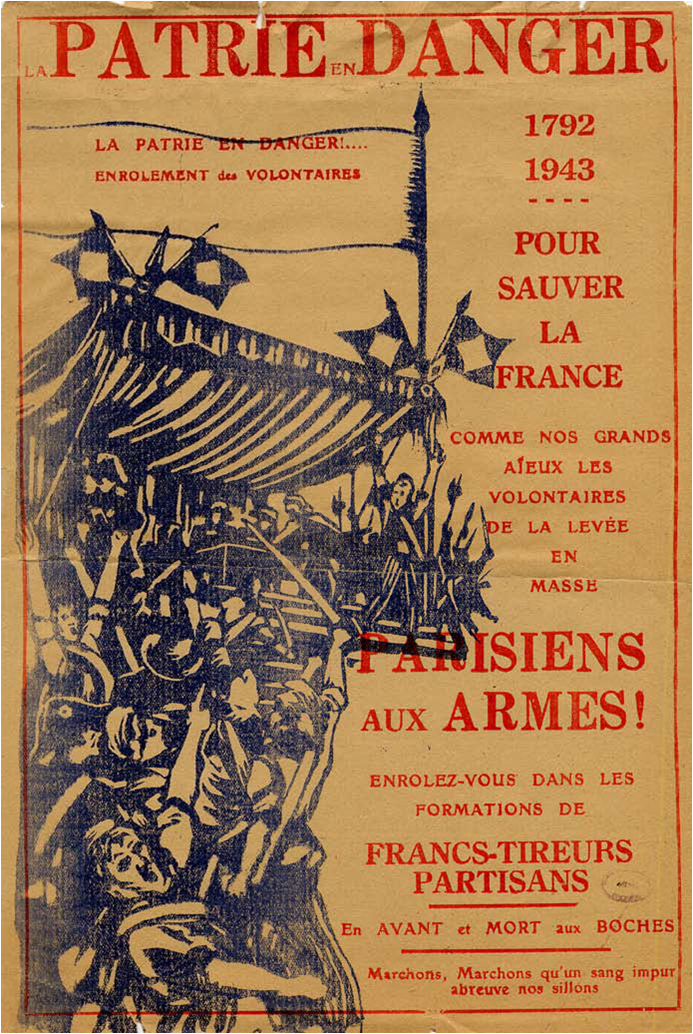
The most recent films to contribute to this process have been two about the Vel d’Hiv round up (The Round up, and Sarah’s Key), and two focusing on particular clusters of resistance activity. I’ll come back to the Vel d’Hiv in a future blog.
What’s particularly striking about the two recent films about the French Resistance is that in these cases, the resistance was not, strictly speaking, French. Robert Guediguian’s Army of Crime starts with a roll call of names, each one followed by the words ‘mort pour la France’. The names are Armenian, Polish, Italian, Spanish, Hungarian, Russian, some are difficult to pronounce, and the speaker stumbles for a moment, and goes on. We see them on their way to imprisonment, ‘trial’ and execution and then we go back to see how they became martyrs for a country to which they did not belong.
But the Army of Crime – so called after the Nazi poster which aimed to alienate the populace from the resisters by emphasising their criminal acts and their foreign origins – was made up of people who had very little to lose. From the start of the Occupation, as Jews, and/or Communists, many of them refugees from parts of Europe which had fallen earlier to the Nazis, or from other persecutions, they knew they were targets. Some of them joined the armed struggle due to some personal confrontation, others after their families were swept up in the round ups and deported. They fought and died for an idea of France, the France that they had seen as a refuge, even whilst that idea was being betrayed, as they were.

For the resisters in the new film, Free Men, it really wasn’t their war. As Moslems they risked being rounded up only if they were mistaken for Jews and could not prove otherwise, or if they were involved in communist workers groups. But the Paris Mosque was a place of refuge both for Moslems who were involved in the resistance, and for Jews. The scale of this activity is not known – estimates vary wildly – but it seems clear that the head of the mosque, Si Kaddour Ben Ghabrit, instigated and supported the production of false papers for Jews, and the use of the building itself as a hiding place, whilst maintaining outwardly amicable relations with the authorities.
It’s a story that’s even less known than that of Missak Manouchian’s Army of Crime. After all, the Nazis publicised the latter rather effectively with the poster – which far from having the effect they intended, became a focus for solidarity and protest. The clandestine publication Lettres Francaises reported in March 1944 how the ten images on the blood-red background attracted a silent crowd:
‘At length, and solemnly they saluted dead friends. In their eyes there was no morbid curiosity, just admiration, sympathy, as if they were our own. And in fact they were our own, because they were fighting alongside thousands of us for our country, because it is also the home of liberty. On one of the posters, over night, someone had written in capital letters a single word: Martyrs. That is the homage of Paris to those who’ve fought for freedom’
Louis Aragon and Paul Eluard wrote poems about L’Affiche Rouge, and there were earlier films, though one screenplay was rejected on the grounds that these foreigners gave the wrong image of the Resistance.
Free Men isn’t the only film to tell the story of the Moslem resistance – Mohamed Fekrane’s Ensemble came out this year too, though it hasn’t reached the UK yet.
Army of Crime had a very powerful resonance in the context of the anti-immigrant/anti-refugee rhetoric that is spewed out by sections of the press here and across Europe, as does the story of Moslems risking their lives to save Jewish lives. These young men from North Africa are the brothers of the Allied soldiers in Days of Glory, which told of their part in the liberation of France, and their betrayal after the war by the French government.
If Free Men had less emotional heft than Army of Crime, it’s not down to the story. It’s to do with the leading character. Manouchian and his group were from the start politically engaged, passionately committed to the struggle, with a sense of the wider European context – the Armenian genocide, the Spanish civil war. They’re articulate and charismatic. Younes at the start is a black marketeer, willing to spy (rather ineptly) on the activities at the Mosque in exchange for an official blind eye being turned to his business dealings. He’s nudged unwillingly into the resistance by his cousin, who’s already actively involved, and by his realisation of the danger faced by his friend Salim, a Jew passing as a Moslem. Little by little, he’s drawn in until he is risking his life for the cause. The problem is that as a focal point for the narrative he is somehow a bit blank, passive, lacking in real depth.
He reminded me, in fact, of Lucien – Lacombe, Lucien. Louis Malle’s ‘hero’ is an accidental collaborator – a combination of pure chance and his own naivety and vanity put him in a position where he can bring down local members of the Resistance which had rejected his bid for membership. He’s an ambivalent and ambiguous character, and his portrayal has been controversial, because Malle refused to resolve the ambiguities. When Lucien shoots a German soldier and escapes with his Jewish girlfriend, did he do so to save her from deportation, or because the German had taken something he regarded as his? If Younes had not been so powerfully drawn to Salim, would he have allowed himself to be drawn into the Resistance?
Lacombe Lucien is a powerful film because of this opacity, which prevents us from taking refuge in simplistic polarities. Malle’s film, which appeared in 1974, not long after Ophuls’ The Sorrow and the Pity, opened up the possibility of more complex narratives of the Occupation. In Free Men the really interesting characters – Salim, Leila and the Imam himself – are sketched in as we focus on Younes, who we barely know better at the end of the film than we did at the beginning.
Nonetheless, it’s a gripping film, a story that needs to be told. We’ve moved since the Liberation from the Gaullist myth of the inextinguishable flame, through the exposure of collaboration and complicity, towards a celebration of the real rich diversity of that struggle against barbarism.
G. Austin, Contemporary French Cinema: An Introduction (Manchester U.P., 1996)
H. Frey, Louis Malle (Manchester U.P., 2004)
R. J. Golsan, Vichy’s Afterlife (Nebraska U.P., 2000)
N. Greene, Landscapes of Loss (Princeton U.P., 1999)
L. D. Hewitt, Remembering the Occupation in French Film (Palgrave Macmillan, 2008)
A. Insdorf, Indelible Shadows: Film and the Holocaust (Cambridge U.P., 1989)
P. Jankowski, ‘In Defense of Fiction: Resistance, Collaboration and Lacombe, Lucien’, Jnl of Modern History, 63, 3 (1991), 457-82
P. Kael, ‘Lacombe Lucien’, http://www.criterion.com/current/posts/416-lacombe-lucien
S. Lindeperg, Les écrans de l’ombre (CNRS, 1997)
C. Nettelbeck, ‘Getting the Story Right: Narratives of World War II in Post-1968 France’ , Jnal of European Studies, 15 (1985), 77-116
C. Nettelbeck (ed), War and Identity: The French and the Second World War (Routledge, 1987)
A. Rayski, L’Affiche Rouge (Mairie de Paris, 2004)
H. Rousso, The Vichy Syndrome: History and Memory in France since 1944 (Harvard U.P., 1991)
http://www.larmeeducrime-lefilm.com/
http://playbackstl.com/movie-reviews/9939-army-of-crime-lorber-films-nr
http://www.timeout.com/film/reviews/87750/army-of-crime.html
http://television.telerama.fr/tele/films/l-armee-du-crime,13535938.php
http://www.allocine.fr/film/fichefilm_gen_cfilm=135212.html
http://www.rottentomatoes.com/m/free_men/
Related articles
- Free Men – review (guardian.co.uk)
- New film highlights remarkable story of Paris mosque director who saved hundreds of Jews from Nazis (timesofisrael.com)
Some Fantastic Place
Posted in Personal on May 29, 2012
This blog is not usually a place for very personal reflections. Today’s different, for reasons that will become evident.
A couple of weeks ago I set off for my regular half-hour pre-work run. I saw someone ahead, walking. Unusual, at just after 6.00 am – I see cars, other runners (as they zip past me) and cyclists, but rarely walkers, unless accompanied by dog. No dog in sight. The walker was slightly uncertain of gait and a couple of times strayed into the road and back. I was getting closer, and I did think of turning round and completing my run by a different route. Told myself not to be daft. As I got level with him I saw he was a black guy, perhaps in his 30s, with a raincoat and a woolen hat, no rucksack or baggage of any kind. He asked me the way to Sheffield. I told him Sheffield was back the way he’d come, and that ahead – a long, long way ahead – was Manchester. He didn’t respond, and I ran on. When I turned round to head home, he was still heading away from Sheffield, and he looked at me as I ran past as if we’d not spoken a few minutes earlier.
I didn’t do anything. I thought about it, but ringing the police seemed wrong somehow. He hadn’t done anything (to my knowledge) and in the unlikely event that they took any action, it might well be traumatic for him – a black man possibly with drug and/or mental health problems is unlikely to have had positive interactions with the police. I couldn’t think what else I could do. On the other hand, if he strayed into the road on some of the bends further ahead, particularly as the traffic got heavier towards rush hour, he could be knocked down. And if he just kept on walking?
He didn’t look like he’d been sleeping rough, he didn’t look or sound drunk. He looked lost – not just that he didn’t know he was heading away from where he wanted to be, and didn’t change direction when he was told, but more profoundly lost. He didn’t look or sound dangerous, but I was alone, and I felt vulnerable. But I have thought a lot about this encounter. To ask myself if I should/could have done something. To wonder what happened to him. And as so often I ask myself what my mother would have done – and as soon as I ask I know. She would have stopped, talked to him, tried to find out why he was walking out along that road, away from the place he said he wanted to get to. She would have tried to help him. She might not have been able to, she might have been rebuffed, she might have put herself at risk, but she would have tried.
A year or so ago I was walking to work as usual past the Children’s Hospital, as a young woman came out in pyjamas, lighting a cigarette, on her mobile – not an uncommon sight. But then she cried out, ‘She’s dead. My baby’s dead’. I stopped. And then I went on because I was afraid to intrude, to barge into a moment of such terrible private tragedy. I know that Mum would have gone to her and talked to her, and tried to help. It might have been a mistake to do so, but it would have been, somehow, a marvellous mistake.
Mum died on 29 May 1995, of pancreatic cancer. She was phenomenally intuitive, empathetic, generous of heart. She didn’t rate herself, but she ought to have done. There’s a song that sums her up, somehow, for which I thank Glenn Tilbrook & Chris Difford, a beautiful song, written about a friend who died very young. But for me, it’s about Mum – the first time I heard it after she died I was driving, and had to pull over because I suddenly couldn’t see, or breathe.
When she told me that, as she’d been diagnosed with terminal pancreatic cancer, she’d be moving to an oncology ward at another hospital, and as she put it, a ward ‘full of people like me’, she meant people with terminal cancer but my thought immediately was of a ward full of people like her, full of loving, intuitive, generous, warm, intelligent, profoundly good people. If I allow myself to riff on that thought for a while, it makes me smile – I envisage the nursing staff being brought cups of tea, being listened to, by people who prefer taking care of other people than being taken care of. I envisage the weaker, sicker patients being cared for by the stronger ones, so that no one’s need for pain relief or a drink, or just someone to talk to, goes unnoticed or unmet. Some fantastic place, indeed.
Real goodness is hard to convey without sentimentality or sanctimony. It comes down to two things, I think, integrity and empathy. If we can live in the world with those qualities we will live good lives, however numerous our failures and deficiencies. Mum had both, in abundance.
‘Her love was life and happiness and in her steps I trace
The way to live a better life
In some fantastic place’
Cecily Hallett, 8 January 1930-29 May 1995.
I miss her. Always will.
Some Fantastic Place lyrics © Kobalt Music Publishing Ltd., EMI Music Publishing
Celebrating Creativity
Posted in Visual Art on May 13, 2012
I’ve been involved in the visual arts for a long time now. First, through working at the – now largely demolished – Psalter Lane Art College site of Hallam University, and subsequently as a member of the board of trustees for S1 Artspace. I didn’t anticipate that working with physicists and astronomers would give me another, equally rewarding, chance to engage with artists and creativity.
Some years back, a colleague in the department sent an email round, asking if anyone else, like him, was doing creative things in their spare time. The result surprised us all. We’re now in our sixth year of holding an exhibition of work by staff and students – now from across the University – and each year people emerge from the shadows, often apologetically offering their work with disclaimers about being an amateur, a novice, not being sure if it’s good enough to be seen in public, but thrilled by the opportunity to take that chance. It’s an annual celebration of creativity.
It’s caused me to ponder on the gulf that often seems to yawn between the two art worlds that I am involved in. One is rooted in the art colleges’ and fine art departments’ contemporary practice, and ideas about that practice. The other is rooted in the individual discovery of the life enhancing and affirming value of creativity, with or without external validation or theoretical context. There’s no value judgement involved here, for me at any rate. But the two worlds communicate very poorly with one another. The contemporary artists often struggle to value work that has no theoretical context. The ‘amateurs’ struggle to comprehend work that requires that kind of context in order to be appreciated. Both are baffled, both lack the language to mediate their own work to the other.
I love both worlds. I’m fascinated and challenged by many contemporary artists whose work I’ve seen – many here in Sheffield at S1, Bloc or Site (Becky Bowley, James Price, Charlotte Morgan, Haroon Mirza, Richard Bartle, George Henry Longly, Jennifer West, Allie Carr, Nicolas Moulin, amongst many others). And I’m exhilarated and moved by the work that is presented to us each year, to go in display in a physics lab, by professors of physics, sociology or medieval French; researchers in electrical engineering, infection & immunity or cosmology; librarians and technicians, receptionists and administrators.
I’m awed by creativity, because I’m not capable of it myself. I envy those who are. I’ve tried – playing the guitar, writing poetry, sketching – but there’s some essential spark missing. That’s OK, this blog is my creative output now, and in connecting with artists, musicians and writers I can share in the magic. I believe utterly and passionately in the creative enterprise – Michel Butor said that ‘every word written is a victory against death’ and with Butor you know that he means not just words but sounds and images.
So this week we’ll be celebrating lots of victories.
The exhibition is open from Wednesday 16 to Friday 18 May, 10 am to 4 pm, in E32, Hicks Building, University of Sheffield, Hounsfield Road, Sheffield S3 7RH.
Michel Butor et Dirk Bouts, Lomme, le 19 mai 2012
Posted in Events, Michel Butor, Visual Art on May 7, 2012
Les éditions invenit,
avec L’Odyssée – Médiathèque de Lomme
vous invitent à rencontrer
Michel Butor autour de son livre : “Dirk Bouts, Le Chemin du ciel et La Chute des damnés” dans la collection Ekphrasis
le samedi 19 mai à 16h00
(Auditorium)
Dans le hall d’entrée de l’Odyssée, jusqu’au 19 mai,
venez découvrir une sélection de livres, d’objets et de photos liés à Michel Butor et son travail, qui montrent le poète dans son cadre quotidien de création entouré d’amis et d’artistes.
Possibilité de s’inscrire à des ateliers d’écriture autour de la peinture, dont le premier se tiendra à 15h00, avant la lecture.
Inscription obligatoire auprès de l’Odyssée, places limitées.
L’Odyssée (Auditorium) 794, avenue de Dunkerque, Lomme
03 20 17 27 40
Affective Landscapes
Posted in Events, W G Sebald on April 30, 2012
Thanks to Attic Fantasist for the following:
Info on an upcoming conference at Derby University, covering a range of topics including psychogeography, cultural politics of identity and landscapes,national identity, edgelands, landscapes of trauma and memory, theories of affect and landscape
And another link of interest to Sebaldians, this interview with the director of Patience (after Sebald).
Butor and the iPad
Posted in Michel Butor on April 28, 2012
Enjoy.
Michel Butor découvre l’iPad, une grande première à l’occasion de sa venue dans sa ville natale (Mons-en-Baroeul), une autre grande première au bout de 84 ans, le samedi 5 mars 2011. Une approche nouvelle pour cet immense écrivain et poète, créateur de livre objet.

