cathannabel

This user hasn't shared any biographical information
Homepage: https://cathannabel.wordpress.com
2023 on Screen – the second half
Posted in Film, Television on December 15, 2023
I was struck as I compiled this summary of my watching (July-December) by the number of films directed by women, and/or focused on and carried by a central performance by a woman. The Bechdel test isn’t terribly relevant in these cases, and I think that’s a good sign. Women talking to one another about a man doesn’t have to imply a romantic context. To take two very different examples, in Clemency, Alfre Woodard’s character talks primarily to men, about men, but these men are not only her husband but her colleagues and the prisoners on Death Row for whom she is responsible. In Women Talking, the women are talking to each other about men, but about the men who have controlled their lives, kept them uneducated, and raped them, and what they’re really talking about is survival, escape, freedom.
There are some breathtaking performances in the films I’ve seen this year. Alfre Woodard has already been mentioned, but then there’s Danielle Deadwyler in Till, and Lily Gladstone in Killers of the Flower Moon. On TV, seeing women in lead roles is more normalised. Stand-out performances in this year’s TV watching include Regina King in Seven Seconds, Brie Larson in Lessons in Chemistry, Bella Ramsey in Time, and Ruth Wilson in The Woman in the Wall.
I haven’t listed absolutely everything I watched – if it’s the nth season of an ongoing series I haven’t included it unless there was something major and new, and if I really had to rack my brains to think of anything worth saying about it, I have said nothing. I’ve tried to avoid spoilers, but no guarantees.
Top films? Killers of the Flower Moon, The Creator, Paris Memories. And TV – The Lazarus Project, Lessons in Chemistry, Dopesick.
FILM
Barbie (dir. Greta Gerwig)
If anyone had told me a couple of years back that this would be one of my favourite films of the year, I’d have thought they’d lost the plot completely. But of course, this was Greta Gerwig’s Barbie and it was a delight, so packed with visual gags and intertextual references that I really want to watch it all over again, to pick up the details I missed. I laughed out loud, a lot. Several (mainly male) critics have piped up solemnly to tell us not to be so silly as to think it is the most profound meditation, the last word on gender and stereotyping. I’m not sure that those critics really get the relationship that so many women and girls have with Barbie and her ilk – love, hate or a complex mixture of the two, responding to the way she is both aspirational and impossible: she can be dressed as any profession, as a president or a nurse, but she has a body that is physically impossible and that undermines those aspirations.
I never owned a Barbie, but I did have a Sindy (her British cousin), and a Tressy (distinguished by the key in her back which made her hair grow). I kind of liked but never loved them, and was quickly bored with dressing them up, but rather enjoyed getting them to parachute out of my brothers’ bedroom window along with a couple of Action Men (they were all in the French Resistance, as I recall). Which does reinforce the idea that the way a girl will play with a Barbie is not limited or dictated by the marketing. My daughter enjoyed her Barbie dolls in a much more conventional way. But both of us loved the film. I can’t, obviously, speak for all women, but like us, most women I know just revelled in its wit, its playfulness, and its mild subversiveness, laughed a lot and had a really good time (sorry guys).
Belfast
This is a love letter of a film. And its warmth and humour, its mixture of the prosaic everyday and explosive violence make it both charming and genuinely frightening and tense. It’s not without its sentimental moments, but (as with Spielberg’s The Fabelmans) I felt inclined to forgive the elements of self-indulgence, when the film is as beautiful and moving as this.
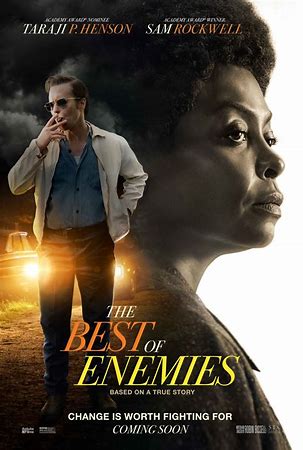
Best of Enemies
Not to be confused with Best of Enemies, the NT on Screen production based on Gore Vidal and William Buckley’s TV debates during the primaries in 1968, this one is based on the meetings set up in North Carolina to try to resolve issues about the education of black children, in which KKK leader C P Ellis (Sam Rockwell) faced off against local activist Ann Atwater (Taraji P Henson). I would have liked to know a lot more about Bill Riddick who initiated this format of collective problem solving. And I did wonder about the degree to which Ellis was humanised – not that I’m doubting his change of heart, for which there is undeniable evidence, but the film perhaps sentimentalised it a little bit, made it seem easier than it must have been, and glossed over his history somewhat. Atwater is more one-dimensional than Ellis, despite an excellent performance from Henson, because she’s given less chance to show dimensions other than righteous anger.
Brooklyn
Lovely, funny and moving. Saoirse Ronan is at her most luminous here, and from the start she has our hearts, so that some of us (me) were talking to her, telling her not to be daft, imploring her not to make the wrong choice.
Captain Phillips
Even though we know the outcome, this is super tense. And Hanks does his stoic, ordinary man in an extraordinary situation exceptionally well, with Barkhad Abdi as a compellingly charismatic opponent. Hanks lets us see behind the stoicism in the final stages of the film when his terror and trauma are powerfully portrayed.
Clemency (dir. Chinonye Chukwu)
This is bleak. A prison governor (Alfre Woodard) has to oversee executions of prisoners on death row, and it takes a toll on her mental health and her marriage. The film explores the interaction with one prisoner, who’s always declared his innocence, as his appeals run out of time. Woodard is just extraordinary – there’s a stillness to her which has nothing to do with calm, everything to do with someone holding on desperately to self-control.




The Creator
Visually fantastic, thrilling and moving, this treatment of AI goes somewhat against the current grain, which takes us to places we don’t expect. The Guardian described it as ‘ambitious, ideas-driven, expectation-subverting, man-versus-machines showdown, … one of the finest original science-fiction films of recent years’.
Detroit (dir. Kathryn Bigelow)
1967, riots in Detroit, the Algiers motel incident. It’s history, but the theme of police treatment of black suspects/bystanders is horribly present-day. It’s extraordinarily tense, and that tension keeps on building.
Empire of Light
This had very mixed reviews, but I watched anyway, and I liked so many things about it. Olivia Colman, for one (she’s always a reason to give something a go, at least, and she is outstanding in this). One of the more sympathetic reviews described it as ‘sweet, heartfelt, humane’, which I think is about right, and notes that it’s not afraid to be brutal and very dark when the story requires that.
The Favourite
Colman again, proving her remarkable virtuosity and versatility. Here she’s the borderline bonkers Queen Anne, with Rachel Weisz and Emma Stone as the two women jostling for her capricious favours.
Inside Man
A Spike Lee heist movie, with a starry cast including Washington, Ejiofor, and Jodie Foster. The plot twists and turns like a very twisty thing.
Judas and the Black Messiah
The murder of Black Panther leader Fred Hampton, brilliantly portrayed by Daniel Kaluuya who oozes charisma, with Lakeith Stanfield as the titular Judas, oozing unease. It’s thrilling, but also subtle and perceptive.


Killers of the Flower Moon
I read the book (by David Grann) a couple of years back and thought at the time that it would make a great film. Here is that great film. Superb performances from de Niro, di Caprio and, most particularly, Lily Gladstone as Molly, the beating heart of the film. It’s long, and perhaps could have been tightened up a bit at the mid-point, when one starts to wonder when the proto-FBI guy is going to show up. But on the other hand, that’s the point in the film when Molly moves to the centre of things (even when she’s off screen). There’s an intriguing final sequence when, rather than scrolling text telling us what happened to the protagonists we get a view of the studio where a radio programme is being recorded, part of a series on the history of the FBI. It raises all sorts of questions – the transformation of these horrifying events into public entertainment (Scorsese challenging himself there), and the voicing of the Osage protagonists by white folks.
Leave the World Behind
Adapted from the book by Rumaan Alam, which I read a year or so ago, this is very well done, with great work from Julia Roberts, playing a truly unpleasant human being, Ethan Hawke and Mahershala Ali in the lead roles. It builds the unease skilfully, with some brilliantly strange scenes (I particularly liked the Teslas) as the protagonists bicker and speculate, and then it leaves the protagonists, and us, in mid-air as it were, still not knowing for sure what is happening, and not knowing at all what will happen next, how/whether they can survive.
Living
When I saw the trailer for this, I said that I would wait for it to come on to TV because I feared it would be the kind of film that would trigger embarrassingly loud sobbing. I wasn’t wrong, but it took until the final sequence for ‘something in my eye’ to give way to floods of tears. The story is very British, very understated, and Nighy is perfect, as is Aimee Lou Wood. It all comes together very movingly, with a soundtrack that was guaranteed to floor me.
Marshall
Good, solid legal drama based on the career of Thurgood Marshall (Chadwick Boseman). It works as a generic courtroom drama, but with the context that the accused is a black man, charged with the rape of a white woman, and that his lawyer is black, working with a white Jewish man, in 1941, which gives it whole other layers of tension. It also reminds me how good Boseman was, and how sad a loss.
The Marvels (dir. Nia da Costa)
Hugely enjoyable, often funny, with the delight of seeing the three Marvels working together (and swapping places unpredictably). Iman Vellani, Kamila Khan aka Ms Marvel, is a tremendous source of energy and enthusiasm, bubbling and babbling in her hero worship of Captain M (‘Captain, my Captain’, as she puts it), and trying to find the right ‘made-up name’ (as one Peter Parker put it) for Captain Monica. If I had to find fault it would be that we just don’t get enough of the back story to feel the weight of Captain Marvel’s guilt and remorse, why she is called ‘The Annihilator’, and why Zawe Ashton’s Dar-Benn is raging across the universe to (as she sees it) right the wrong that was done to her people. It’s too lightly sketched in. And the significance of the rather delightful planet of Aladna, where the Captain briefly swaps her superhero combat gear for a princess dress, and where everyone sings rather than speaking, is also touched on lightly, and we don’t return there to see the consequences after the Krill steal their oceans (or some thereof). The film tries to do too much, particularly given the comparatively short running time. But we can meanwhile enjoy the Marvels, enjoy Goose and his/her progeny providing a novel solution to an escape pod problem, enjoy Kamila Khan’s parents rising to the occasion with remarkable sang froid, and in all honesty to simply enjoy the fact that this is all really, really, annoying the toxic man-boys who feel threatened by these glorious, powerful, funny, and beautiful women.
The Mitchells vs the Machines
Brilliant, animated AI themed sci-fi with masses of heart and humour. (And Olivia Colman.)


Northern Soul (dir. Elaine Constantine)
A slice of social realism, kind of old-fashioned, I suppose, in charting teenage rebellion, musical epiphany, and descent into violence and addiction. But the music! Northern Soul was the soundtrack of last summer, unexpectedly, thanks to the Northern Soul Prom, which set me off binging those glorious, exhilarating tunes. And that lifted the drama, which beautifully conveyed the oddity of these rare slices of US soul taking such hold on the lives of young working-class northern lads and lasses.
Oppenheimer
Another blooming long film (though I can’t say I was conscious of how much time was passing whilst I was watching). We watched at the IMax, being as Nolan apparently said he’d created it for that, but unlike Dunkirk, where the size of the screen enhanced the immersiveness of the soundtrack and the tension of the drama, here it is only sporadically relevant, given that long sections of the movie are set in committee rooms and court rooms, with a lot of men talking. No matter. It’s an excellent drama, Cillian Murphy is superb, as is Robert Downey Jr. Emily Blunt and Florence Pugh are great, but somewhat under-used. Oddly, the three great Jewish scientists at the heart of the drama (Einstein, Oppenheimer, and Heisenberg) are all played by non-Jews (Conti, Murphy and Branagh respectively), which begs some questions – does it matter? If it does, what do we do about it? Did the casting raise any questions for Nolan, or was it just not thought about?
I followed up the movie with a re-watch of the 1980s drama with Sam Waterston in the lead role (very good, though slow-moving and some of the American accents sounded a bit shonky to me), and a documentary about Oppenheimer’s trial.
Paris Memories (dir. Alice Winocour)
A young woman caught up in the 2015 Paris attacks (see also the documentary on those attacks, below) tries to process her memories (or lack thereof) and the trauma she suffered, physically and mentally. It’s excellent, and takes us to some unexpected places, exploring the impact of those events on the ‘sans papiers’ who worked in the bistros that came under attack. Very moving.
The Post
Excellent, solid Spielberg drama about the Washington Post’s publication of the Pentagon papers. Kind of a prequel to All the President’s Men. Hanks and Streep are predictably great.
The Remains of the Day
Another one that I really should have seen ages ago, and don’t know why I never had. I read the book, I love Kazuo Ishiguro’s work, I’m fascinated by that period just before the war and the history of appeasement, I love Emma Thompson… Anyway, I have now watched the film and it’s every bit as good as everyone says. The sense of repression of emotion, of engagement, is so strong, especially in Anthony Hopkins’ performance, it’s almost infectious.
Rustin
The film foregrounds Bayard Rustin’s role in organising the 1963 March on Washington – he has been left in the shadows compared with some of the other black leaders involved, and it’s clear why. He was gay, and didn’t pretend otherwise, which made him a target for the FBI, but also made other leaders, particularly those most strongly linked to the church, uneasy with him. It’s not a perfect film, a little bit predictable and ‘worthy’, but Colman Domingo is tremendous as Rustin (and Aml Ameen is great as MLK too, an understated and subtle performance), and it’s good to see Rustin taking the place in the spotlight that he so clearly deserved.


Sapphire
Something of a curio – a British crime film from 1959, in which the victim is a young black woman who’s been passing for white. The film takes us into black London nightlife of the time, and explores racism through of the prejudices of both the junior policeman investigating the murder, and the family of the victim’s fiancé. Features Earl Cameron, one of the first black actors to take a lead role in British films. It’s dated, of course, but bloody good for its time, and fascinating.
The Sense of an Ending
Adaptation of Julian Barnes’ novel, which I read and about which I was ambivalent (as I have been about other Barnes). But whereas the book did deliver a punch to the gut, a real sense of shock and tragedy, the film is just too polite. It’s all very well done, and one can’t fault the performances (Broadbent, Walter, Rampling in the leads), but it felt somewhat distant, detached, reserved.
The Silence of the Lambs
I’d never seen this. No idea why – I’d read the book many years ago, and there must have been opportunities to see it on TV many times since then. No matter, it was excellent, desperately tense and Hopkins and Foster were both superb. That final sequence with Foster being stalked in the dark is terrifying and horrible to watch, not least because for some of it, we’re seeing things from the killer’s point of view. One gets that less today, perhaps, which is a good thing…
Silver Dollar Road
Brilliant documentary from Raoul Peck (director of I am Not Your Negro) about a black family in North Carolina, who find their ownership of property which had been in the family’s hands for generations is challenged, and that the weight of white society is now pressing them to give up their homes (two of them were imprisoned for eight years for trespassing by not moving out of their houses). It’s depressing, but the resilience and determination of the family is very moving.
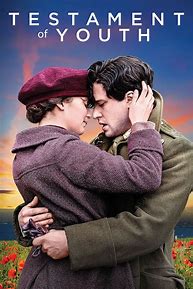
Testament of Youth
It was inevitable that I would compare this to the BBC version broadcast in 1979, which I adored. And in many ways, it stands up very well. But whilst Alicia Vikander smoulders beautifully, Cheryl Campbell blazed, and the film somehow is more polite than the TV series, even if it is unflinching in the scenes in the field hospitals, the mud and the blood and the agony. It’s visually great, including one very striking scene when Vera rounds a corner to see a field of stretchers, each bearing a seriously injured (or already dead) soldier – surely a nod to the panning shot in Gone with the Wind of the square in Atlanta filled with stretchers, but which also reminded some reviewers of the scene in Oh What a Lovely War, with the white crosses on the hillside.
There will be Blood
Daniel Day-Lewis goes over the top (way, way over) in this gripping, unhinged tale of greed and ruthless capitalist exploitation.



Till (dir. Chinonye Chukwu)
The story of the murder of Emmett Till and his mother’s battle for some kind of justice. Danielle Deadwyler is exceptional. It’s a shattering, brutal story and it unfolds with a terrible inevitability, not just because we know the outcome in this particular case but because ‘sassy black kid goes South’ at that time was never, ever going to end well. Some reviewers questioned whether we need to keep telling these stories. I think we do – I knew of Emmett Till since I was a teenager reading about the Civil Rights movement, but that doesn’t mean everyone knows. And we know all too well that progress, however hard won, can be wound back. In any case, if we’re going to tell these stories, this is the way to do it.
True History of the Kelly Gang
Excellent adaptation of Peter Carey’s book, with George Mackay (Pride, 1917) as Ned Kelly. It’s a strange, violent tale, and there are no real heroes, but it’s compelling and complicated, and if we can’t share Kelly’s distorted view of reality, we can feel pity and sorrow for his life, and his death.
Women Talking (dir. Sarah Polley)
Based on Miriam Toewes’ book, which in turn is based on the series of druggings and rapes carried out in the Mennonite settlement in Manitoba Colony, Bolivia in 2005-09. There are some powerful performances here – Claire Foy, Jessie Buckley, Frances McDormand, amongst others, and Ben Whishaw as the only man allowed to witness the women’s debates about what they are going to do, having exposed at least some of the perpetrators. It has such obvious wider resonance in its exploration of the choices they face – do you fight back, do you leave, do you forgive, and what is the cost of each of those responses? – heightened by the fact that these women have been kept uneducated and dependent, and taught that they must obey their men.


TV
Ahsoka
I’m not fully immersed in Star Wars lore, so I had to concentrate to remind myself where we were in the chronology and who some of the people were. But it’s a cracking narrative, and great to have so much of it carried by female characters (on both sides).
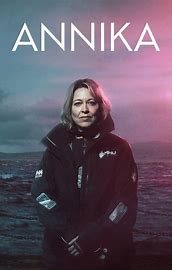
Annika
The central character is given a fair few quirks, which Nicola Walker carries off well (breaking the fourth wall, and going off on all sorts of literary/mythological tangents) and some back story which only emerges gradually. The actual crime side of it is handled well, with enough humour to avoid melodrama but without trivialising the deaths and their implications.
Bali 2002
The terrorist attacks on Bali from the point of view of some of the survivors, and of the investigators (Australian and Indonesian) working together to try to track down the perpetrators. Powerfully done, and whilst the survivors are British or Australian, we also see these events from the perspective of a young Indonesian woman whose husband is killed in the bombing.
Becoming Elizabeth
A series cut brutally short. We follow Elizabeth’s precarious life between the death of Henry VIII and the expected death of Edward VI, but apparently there will be no second season to take her through the reign of her sister Mary. That’s a shame, because as historical dramas go, this was excellent, pretty accurate, not too burdened with period-speak, and with a properly feisty performance from Alicia von Rittburg, as well as the always excellent Romola Garai as the much more tightly wound Mary.
Best Interests
This was agonising (see also There She Goes, although that had more of a leavening of humour, albeit quite dark). A family struggling with the awful decision of whether to withhold medical treatment from a child who, the medics say, is beyond benefiting from it. This is a situation we know from court cases and frenzied tabloid coverage, given depth and humanity. Martin Sheen and Sharon Horgan are excellent, torn emotionally by the horror of the dilemma, and torn apart from each other too.
Black Mirror
A mixed bag – Joan is Awful, Beyond the Sea and Demon 79 were excellent. The others, I thought, were enjoyable but a bit more predictable.



Bodies
Timey wimey crime, with Stephen Graham in the lead role. Excellent stuff – one could quibble or question some of the plot details, but no one in the history of timey wimey drama has ever done anything that couldn’t be quibbled or queried, so I can live with that. It had me completely gripped, and often unexpectedly moved.
Crime
A pretty generic crime drama that thinks it is more than that. So melodramatic that at times it almost seemed comical. There is a second series, but life’s too short for this, I’m afraid.
The Crown
This final series has attracted a lot of hate. I think the problem is that, whereas with the earlier series, we were seeing world events from an unfamiliar perspective and getting a (speculative and fictionalised) view of royal life that we hadn’t glimpsed before. Now what we see on screen is what we already know, what we have seen in other dramas (the reaction to Diana’s death notably in The Queen, by the same writer) and in the papers. It’s not, I think, bad, just lacking in freshness and surprise. I could have done without the spectral reappearances of Di and Dodi though – that was just silly.
Doctor Who
I finished my re-watch of all post-gap Who just in time for the 60th anniversary specials, and Ncuti Gatwa’s arrival on Xmas Day. Of the three specials, the first was a delight primarily because of the reunion of Doc and Donna, and the resolution of the way they had previously parted. The story was fine, but the second episode really took off. It was just Doc and Donna here, and it was absolutely nail biting stuff about which I will say nothing further. In the third, Neil Patrick Harris had an absolute blast as the Celestial Toymaker, and we were introduced to Ncuti Gatwa’s Doc, who was as charismatic, charming and funny as I knew (from Sex Ed) that he could be, and I can’t wait for Xmas Day to see him properly inhabiting the role.
Fellow Travellers/Good Night and Good Luck
I’ve put these together because they cover the same era and some of the same events, the McCarthy witchhunts. Good Night is based on the career of Ed Murrow (played by David Strathairn), whose catchphrase gives the film its title, and his attempt to navigate the dangerous waters of McCarthy generated paranoia whilst retaining his integrity. It’s powerful and moving. Fellow Travellers extends the drama over another couple of decades, and its focus is on the ‘lavender panic’ generated again by McCarthy. This led to the denunciation and arrest of many gay men and women and many others having to bolt and barricade the closet door, and make marriages of convenience to protect themselves. The main protagonist is no hero – a bit of a bastard really – but Matt Bomer gives him depth and nuance. Jonathan Bailey and Jellani Alladin are also excellent as the McCarthy staffer and the black journalist trying to survive in this hostile climate.


Good Omens
Huge fun, with Sheen and Tennant playing delightfully off each other as angel and demon respectively. Very funny but at times with a real sense of peril, and the finale of season 2 suddenly rendered me all emotional. Hope there’s more of this to come.
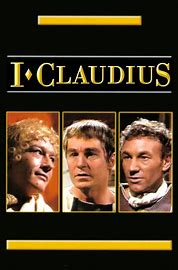
I Claudius
I remember this series so vividly from 1976. And I remember the title sequence, which I still can’t watch (I even remembered the point in the title music when it’s safe to open my eyes because the snake is gone). It wears very well indeed, with the sole exception of the ageing make-up, which looks pretty ropy when watching in HD. But the performances are fantastic, and it revels in the decadence and ruthlessness of Livia, Caligula, and the rest (including Patrick Stewart, with hair, as Sejanus).
The Lazarus Project
Excellent, complex time travel drama from the writer who gave us Giri/Haji a couple of years back. There’s plenty of action, a stratospheric body count (multiple versions of people get killed multiple times), and a willingness to embrace moral ambiguity which could leave one not rooting for anyone, but (for me) made me feel for the characters even more. There’s plenty to explore in a third series and I hope there will be one, especially since we were denied a second for Giri/Haji.
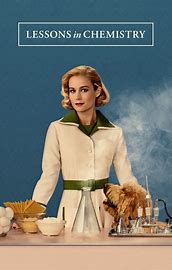
Lessons in Chemistry
I thoroughly enjoyed the book and the series, although in slightly different ways. That’s partly because it cuts back on the whimsicality of the dog expressing its thoughts on events – that aspect of the book, whilst charming in small doses, would not have worked on screen, I don’t think. The biggest change though is the complete transformation of Elizabeth’s neighbour Harriet, from an older woman, victim of domestic violence, to a woman who is in a way a mirror image of Elizabeth (young children, absent husband, ambitious in her own profession) but black. Whilst I didn’t when reading the book think about this, having the context of the civil rights movement to offset Elizabeth’s battles for women’s independence adds depth to what could otherwise be a somewhat feel-good account. It’s a risky move though. The book’s Harriet represents an individual trauma which connects potentially to all women. The TV Harriet represents the African American struggle against segregation in its overt and more underhanded forms (running the new freeway through a predominantly black residential area, for example). To do justice to that, and to adequately explore this, and Elizabeth and Calvin’s responses, needs more time than could be spared from Elizabeth and her daughter’s own stories. And I think this was apparent in the ending, which rather glossed over the outcome of the freeway campaign. But I loved so much about this, and Brie Larson was wonderful.
Loki
This latest series is overshadowed by the Majors/Kang problem. Having built He Who Remains into the whole narrative structure of the next phase of the MCU, Marvel now has to deal with Jonathan Majors as the subject of some very nasty assault charges. Do they write Kang out? Recast the role (not as problematic from an audience point of view as it might seem, given that we’ve seen multiple variants of Loki in this series)? Either would be better than continuing as they are when we don’t know what might emerge at any point, how his ‘legal problems’ might be resolved, or what impact he might have on cast and crew. If one can put that aside, however, this was a great series, and Tom Hiddleston conveyed Loki’s new-found sense of purpose without losing his spark or his humour. The interaction between him and Owen Wilson’s Mobius (when Mobius remembers who Loki is) is also a joy. We await with interest what happens next, given how we left Loki in the final scene…
The Long Shadow
This dramatization of the years when Peter Sutcliffe attacked and murdered women across Yorkshire is different from the others in that we don’t see him until very late in the drama. We don’t see any attacks either, it isn’t gory or ghoulish or salacious. What we do see is the women (a few of them, at least), as actual human beings, with actual lives, with hopes and fears and feelings. That changes things dramatically. We also see the investigation, but alongside the men (not all of whom are sexist bigots though too many of course are) we also see some of the young policewomen who worked the case and a glimpse of the impact on their lives. I thought it was excellent, with one caveat. I understand why a few characters were created for ‘dramatic purposes’, allowing us insights that we would not have had otherwise, so the invention of a young prostitute, forced back out on the streets even after someone she knew had been murdered, because she was supporting a young child, was fine. Until she herself became one of Sutcliffe’s victims, and thus displaced in that grim roll call one of his actual victims. That didn’t feel right, not at all.




The Miracle
Bonkers Italian series. A statue of the Virgin Mary, weeping blood, is found alongside the body of a crime boss, and a highly confidential investigation starts to try to work out how, why, etc. It is begging for a second series – we were left with so many questions (some but not all were just WTF??) but there’s nothing so far, and this was first broadcast in 2019. It’s compelling, bizarre, beautiful.
Mr Mercedes
An excellent Stephen King adaptation! King’s trilogy of crime novels (there are other linked novels, including his most recent, Holly) with Brendan Gleeson as retired cop Bill Hodges. There are great performances all round, and the series creates exactly the mood of unease ramping up to full on horror that is King’s speciality. It’s way too dark and disturbing to binge but it’s absolutely compelling.
One Night
A past trauma coming to light decades on, and disrupting the lives that the protagonists have built, is not exactly unexplored territory. But this is extremely well done, and doesn’t go where one might expect. Fine performances from Jodie Whitaker (see also Time), Nicole da Silva and Yael Stone. As is so often the case, the complexity builds up over five (or however many) episodes and then the final instalment feels a bit rushed, but overall it was excellent.
Painkiller/Dopesick/Pain Hustlers/Crime of the Century
I’d been aware in general terms of the opioid crisis (not least through Barbara Kingsolver’s brilliant Demon Copperhead) but hadn’t know to what extent this was created cynically and criminally by the Sackler pharma empire. Three dramas and a documentary have filled in the gaps in my knowledge. Of the dramas, Dopesick is the strongest, but Painkiller is very similar (albeit with a more confusing structure), both moving between the small communities where industrial injuries were treated with Oxycontin, which was pressed on to the local doctors with outright bribery and lies, resulting in hopeless addiction, the Sackler organisation egging its salespeople on to sell more and more pills, and the lawyers looking for ways to stop them. It’s an absolutely horrifying story, hard to believe, but the documentary makes it clear that the dramas are not overstating this at all.
Partygate
More horrifying true crime. Interweaving the stories of individuals under lockdown, separated from the people they love, trying to do the right thing, dying alone, with the Downing Street crew, with their contemptuous treatment not only of all of us who were following the rules that they solemnly propagated, but the cleaning staff who had to sort out the carnage after their endless parties. Time for this lot to be cleared out, I think.


Poker Face
Natasha Lyonne as a woman who can tell a lie when she hears it, finds herself mixed up in organised crime and on the run. It’s pretty formulaic – she rocks up in a new place, there’s a murder, she figures it all out with her inbuilt lie detector and moves on, just ahead of her pursuers. That this doesn’t get old fast is down to Lyonne’s charisma, and the humour of the script.
The Reckoning/ Russell Brand: In Plain Sight/National Treasure
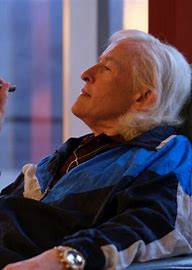
A rather queasy selection of programmes on a common theme. National Treasure is fictional, starring Robbie Coltrane as the eponymous treasure, who finds himself accused of a historic rape. It’s a tough watch, with an ambiguous ending. But not as tough a watch as the documentary on the accusations against Russell Brand, which was horrifying and nauseating. I had disliked Brand from the first time I saw him on TV, without being quite sure why, and nothing I’ve seen, in the programme or in the responses to it, makes me less hostile. Jimmy Savile, brilliantly portrayed by Steve Coogan, is perhaps more completely monstrous than Brand, if there’s any point in attempting to quantify monstrosity. As he’s dead, the programme wasn’t held back by fear of litigation, and it pulled no punches. I can’t claim prescience in Savile’s case – I thought he was irritating and weird, rather than sensing anything more sinister, but Coogan showed very cleverly and chillingly the switch from the jolly, avuncular public presentation to the callous abuser behind closed doors. Should this programme have been made? Had it not included the voices and faces of some of his victims, I’d say not. But they underpinned everything that the drama showed, and as they had been silenced for so long, this seems right and proper.
The Secret Invasion
Why was this so disappointing? I had high hopes at first, given the cast, but somehow it all went a bit meh. It isn’t down to the performances, and the central idea is great, but it needed more context, more development, more time, to build more gradually and create more depth.
Seven Seconds
Lord, this was heavy. Rightly so, given the plot (a cop accidentally kills a young black kid and a cover-up is launched). Regina King is magnificent as the boy’s mother. My caveats are that to add into an already potent mix a bunch of personal issues for the lawyer and homicide detective who are trying to get justice for the kid is all a bit clichéd, and that it ends up being a bit clunky and predictable, so that every time our guys seem to have made a breakthrough you just know that it’s going to all fall apart.
Sex Education
The final series. OK, I think it did give in to a bit more preachiness at some points, and what had seemed effortless in earlier seasons seemed more laboured, at times. The other problem is that this season’s new cast members – and there were quite a few of them – didn’t have time to really wriggle their way into our hearts as the original core cast members had. But overall, it drew the individual stories of at least some of those original cast members to a resolution in ways which respected their individual characters and their growth over the previous three series. And I was glad it didn’t do that by coupling them all up or tying up all loose ends in other overly tidy ways. It’s been a warm, funny, startlingly graphic, sometimes ridiculous but always life-affirming ride.



Silo
It’s a mark of confidence (or Jed Mercurio’s influence?) that this series could open with David Oyelowo and Rashida Jones in lead roles and then dispose of them both quite quickly (and they weren’t the last – the body count in this is pretty high). I found the pace mid-series lagged a little, it felt as though we weren’t learning much more about the silo, but then it really picked up and we hurtled to the final cliffhanger. I look forward to series 2.
The Sixth Commandment
True crime series always leave me with some mixed feelings – the necessary conflation of real and invented characters, the messing with chronology, the speculative elements. That this worked as well as it did was not down to the police procedural side of the story, but to the focus on, and the portrayal of the two victims. Both showed their vulnerability without compromising their dignity – perhaps at this stage of my life I can imagine more easily how one might be so deeply lonely that one might become prey to a manipulative conman. Timothy Spall in particular turned in an absolutely devastating, heartbreaking performance, as a man who didn’t believe he was worthy of love, and who thus took what it seemed he was being offered with gratitude and joy. As with The Long Shadow we focus on these victims, whilst the perpetrator and his accomplice remain blanks.
Strange New Worlds
This Star Trek series goes from strength to strength. It has the confidence to be funnier and more inventive than, say, Discovery (I always wanted to love Discovery more than I actually did). In this season, we’ve had a classic time travel episode, which turned out to have more emotional depth (and ongoing implications for one of the lead characters) than one might have anticipated, a cross-over with Lower Decks (an animated series) and, joy of joys, a musical episode. Like its obvious (someone actually says, ‘I have a theory’, and there is a gratuitous mention of bunnies) inspiration, Once More with Feeling (from Buffy season 6, as if you didn’t already know that), it uses the device of a compulsion to sing to force revelations from characters who have been trying to hide things from each other – here it is triggered by science rather than by a demon, of course. It is very funny (the Klingons in slightly bhangra-tinged boy band mode are a delight) and it works to move the overall narrative along.
Then You Run
I think this series has a higher body count than anything else I watched this half-year, with the possible exception of The Lazarus Project… It’s also often funny, very tense and thrilling, and often doesn’t go where you expect it to. With great performances from the quartet of young women whose post-A-level excursion to Rotterdam goes rather off-piste, including Vivien Oparah, the lead in the wonderful Rye Lane.
There She Goes
As with Best Interests, this digs deep into parenting pain which I have never had to experience. Here it is the discovery that the child has a chromosomal deficiency which means she has severe learning disabilities and autism, manifesting in extremely challenging behaviour. The series explores the tensions between the parents in trying to live with Rosie, as she grows up and the difficulties they face only change, never diminish. Excellent performances from David Tennant and Jessica Hynes.
Three Little Birds
Lenny Henry’s dramatic retelling of family stories from the 50s is a mixed bag. It pulls no punches in its portrayal of the racist reception that new arrivals from the Caribbean faced, from cold hostility to outright violence, but the drama often takes predictable turns, the humour is a bit obvious, and the central characters’ dilemmas are (apparently) solved with remarkable speed and ease in the final episode. As the Guardian’s reviewer said, it needed more grit.
Three Pines
A sadly short-lived adaptation of Louise Penny’s Inspector Gamache series of novels. Alfred Molina is absolutely Gamache, and the episodes are pretty true to the books, although developing a rather interesting sub plot. dealing with the disappearance of an young indigenous Canadian woman. I would have loved to see where it went with that, as well as enjoying the adaptations of further novels, but it came to an untimely end.


Time
I haven’t seen the first season but clearly that didn’t matter as season 2 is set in a women’s prison, with only one character overlapping. Stunning performances from Jodie Whitaker, Bella Ramsey and Tamara Lawrance.
Tokyo Trial
I saw a couple of documentary series about the aftermath of WWII in terms of justice for Nazi war criminals (see below), and this drama series complemented those very interestingly. It’s the equivalent process for Japanese war criminals and it raises the same issues of moral responsibility and grapples with the developing new concepts of crimes against humanity.
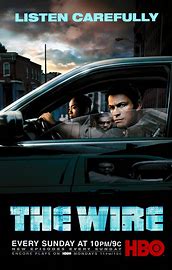
The Wire
First time I’ve returned to this series. Mainly because its impact was so huge, it towered so far above most other TV series, and it stayed in the memory so clearly. But a couple of days without internet made me rummage through my DVD box sets and I thought, yes, now is the time to go back to the mean streets of Baltimore. I wondered whether it would have lost its power, but from the very first scene on, it was everything I remembered, and more. I’m kind of dreading getting to Season 4 because I remember how utterly heartbreaking that was. But this is truly superb television.
Wolf
Blackly comic and gruesome crime drama, which leaves you guessing right to the end as to who, why and how. Sacha Dhawan and Iwan Rheon are clearly having a blast.
The Woman in the Wall
Ruth Wilson leads in this often harrowing mystery about the trauma of the Magdalen laundries. The Guardian’s reviewer said that ‘the gothic element, spilling out of Lorna’s mind and home, feels not like a bolt-on to add drama lacking elsewhere but an integral part of the story. A manifestation of the deepest possible horror, beyond reason, beyond words’.
World on Fire
A long-awaited second season for this WWII drama. As with the first, it combines a broad sweep (North Africa, Occupied France, Germany, Manchester) with individual narratives, and this works brilliantly. It does mean that we cut quickly from one scene to another, but that gives it pace and tension, and reinforces the idea that all these things are happening concurrently. It’s pretty accurate – season 1 did make me shout at the TV when a character somehow managed to make his way from occupied Poland to the beach at Dunkirk, but nothing was quite as jarring as that this time. Very much hoping there will be a season 3.


Documentaries:
Amend/13th
Two documentaries which improved my understanding of the US constitution and political structure no end. Amend is ‘a deep dive into the 14th amendment. Ratified in 1868, it gave citizenship to all those born or naturalized in the country and promised due process and equal protection for all people. Amend threads the amendment through the fabric of American history, from its origins before the American civil war to the bigoted violence of the Reconstruction and Jim Crow eras, through the tumultuous years of the civil rights and women’s liberation movements, right until today’s feverish debates over same-sex marriage and immigration’. Will Smith presents this, in a style that aims to make a heavy topic rather less so, without airbrushing away any of the horrors of Jim Crow/segregation.
13th does something similar with (obviously) the 13th amendment, but the style is harder edged (the director is Ava du Vernay, best known for Selma). ‘The film takes its title from the 13th amendment, which outlawed slavery but left a significant loophole. This clause, which allowed that involuntary servitude could be used as a punishment for crime, was exploited immediately in the aftermath of the civil war and, DuVernay argues, continues to be abused to this day.’ It’s a tough, challenging watch, and deservedly so.
Beckham
A very enjoyable four episodes, with lots of football to remind me what a wonderful player he was. I’d forgotten quite how vicious the backlash was after that foul – but how much worse would it have been had it been a black player, given the abuse directed at Rashford, Sancho and Saka after their missed penalties cost us the trophy… I rather liked David, and Victoria – considering the absolutely mad life they’ve had, they seem fairly grounded, warm and funny.
The Center will not Hold
A fascinating documentary about Joan Didion, directed by her nephew, Griffin Dunne. I only know Didion through The Year of Magical Thinking (see my books blog), but the film puts that book into context and perspective and makes me want to read a lot more of her work.
David Harewood on Blackface
A few months ago, I was at a community breakfast at my sister’s church, trying to make conversation with an older couple (my father was there too, but is beyond conversation, most of the time). Things started to go awry when the man said something about the cobbles in Mansfield market having been removed because they created problems for wheelchair users – fine, if factual, but the accompanying eye roll was something of a red flag. It got worse, when he made a hand gesture and referred to it as being ‘black and white minstrels’ and his wife chipped in with ‘you’re not allowed to say that anymore, or sing “Baa baa black sheep”’ and he muttered something about how ridiculous it was to try and change ‘our traditions’. I didn’t say anything – didn’t know where to begin with the staggering ignorance, and the staggering arrogance. Perhaps I should have tried, but it was a stressful time, and whereas I knew my father, as he used to be, would have supported my views (he and my mother hated the Black & White Minstrel Show when it was on TV at my grandparents’ home), he would not have been able to follow, let alone contribute to the discussion. Coincidentally, David Harewood’s enlightening and emotional exploration of blackface (with David Olusoga, amongst other contributors) was shown shortly after this. I don’t think I had fully grasped that the minstrel show was in its origins an overt attempt to ridicule black people, at a time when the abolitionist movement was gaining ground. Watching this made me regret not having risked causing a stir at the church breakfast by challenging them…
Evacuation
Harrowing coverage of the evacuation from Kabul, mainly from the point of view of the British troops who took part, many of whom are still very visibly traumatised by what happened, how quickly control of events was lost, and how many people who needed rescue were left behind.
Journey of an African Colony: The Making of Nigeria
A Nigerian-made documentary about this history of Nigeria, this was absolutely fascinating. Having lived briefly in Northern Nigeria (1966-67) I would have liked it to cover the years after independence, and the build up to the Civil War, but its remit was to shed light on the final decades of colonialism and how Nigeria became a nation, about which I knew almost nothing, and which does shed light on the problems that the new nation faced after the great goal of independence was achieved.


Mixed Britannia
The late, lovely George Alagiah presented this exploration of ‘mixed’ marriages in Britain, with some heartbreaking and harrowing history but also some wonderful interviews with couples who knew they would face ostracism and even violence but went ahead anyway and built lasting, loving families. It was nice to see the coverage of Peggy Cripps and Joe Appiah’s wedding in 1953, because they lived on the campus of Kwame Nkrumah University of Science and Technology at the same time that my family was there, and Peggy and my mother were friends.
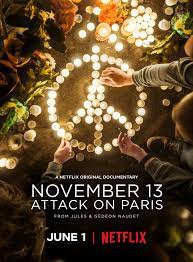
November 13: Attack on Paris
I vividly remember that evening, following what was happening via social media, and then waking the next morning to the full horror of it all. This documentary was harrowing, but the survivors who were interviewed were so insightful, and so articulate that it shed a great deal of light, particularly on the events at the Bataclan. I also saw Paris Memories (see above), a fictional account of the trauma experienced by the victims.
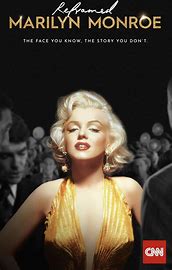
Reframed: Marilyn Monroe
Last year I watched (and regretted watching) Blonde and read as a corrective to that abomination Sarah Churchwell’s book on Monroe, which is very much where this film takes its stand, with lots of (female) talking heads on every aspect of Monroe’s life, and the movie industry.
Rise of the Nazis: Manhunt/Nuremberg/The Devil’s Confession
Various aspects of the aftermath of the end of the Third Reich, focusing on the attempts to track down Nazis who had slipped away in the chaos (with the help of various parties, including the CIA and the Vatican) and on the trials, at Nuremberg and subsequently. See also the drama series, Tokyo Trials, about the legal aftermath in Japan.
Stamped From the Beginning: The Definitive History of Racist Ideas in America
Based on the book by Ibram X Kendi, this documentary is fascinating and hard-hitting, but not without hope for the future. It’s fronted by black women academics and activists, including Angela Davis, who speak both as academics/activists but also very personally and passionately.
Ukraine: Ground Zero/Ordinary Men
Two documentaries which focus on the ‘Holocaust by bullets’, where Jews were massacred on the Eastern Front by special SS units. It’s a necessary focus, as the language of the Holocaust has come to use Auschwitz and gas chambers as a simplification of the genocide, rather than as examples of where and how.



It intrigues me to look back over the period I’m reviewing and see what patterns emerge. There’s a lot of black history, not only American (from slavery to civil rights) but also the Windrush arrivals and colonial Nigeria – both fiction and documentary. There’s a fair dollop of sci-fi and fantasy and a much larger dollop of crime, fictional and true. WW2 appears to have receded a bit, and what there is emphasises the aftermath, both in Europe and Japan. I’ve probably sated my appetite now for more about the opioid crisis, what with three dramas, one documentary and two books (over on the other blog), but that stuff is fiercely addictive so who knows…
As is usually the case, my watching tends to the dark. Terrorism, war, violence against women, racism, serial killers… Thank heavens therefore for Barbie, for Marvel, and for Who. I know that some might see these as trivial, frivolous, in the face of the world events, and I disagree. Fantasy allows us to explore dark things, the things we fear, in a different way, and to extrapolate not only from the worst that human beings can do, but from the best, to see human beings as extraordinary. I do know that there are no actual superheroes out there to save the day, and that Earth isn’t really under the protection of a Time Lord, but I also believe passionately that human beings can be better, braver, kinder, that we can work together and care for each other. We can allow ourselves through the medium of fantasy to be optimistic, we can allow ourselves to hope. We also need to laugh, even in the face of darkness.
What I read in 2023 – the second half
Posted in Literature on December 15, 2023
This half year seems to have been particularly heavy on the crime fiction. And what’s listed below is not even all of the crime I read – there were some that disappointed me, and as always I prefer to share enthusiasm rather than disappointment (although I am not uncritical of the books that I have chosen to review), and there were some that were perfectly enjoyable but about which I could say little other than that this was another cracking title in x series by y. I turn to crime (as it were) for tension and suspense along the way and a satisfying denouement. But of course the best crime writers (looking at you, Sarah Hilary, Jane Casey, Will Dean, Laura Lippman, Denise Mina, Abir Mukherjee, Mark Billingham, Anne Holt, Louise Penny, Elly Griffiths, Ian Rankin, Mick Herron, Ann Cleeves, Val McDermid, Lesley Thompson and Sara Paretsky, to name only those I’ve read this year) give you more than that – psychological, political, sociological insights into the why and who of crime (on both sides of the law).
If I had to pick the outstanding novels in this half-year (of course I don’t have to, it’s my blog and I make the rules here) I’d say Richard Powers’ The Time of Our Singing and Stuart Evers’ The Blind Light, not only because they took me over completely whilst I was reading, and moved me tremendously, but because both authors were new to me, and so I had no expectations and was bowled over. I also rate very highly Eleanor Catton’s Birnam Wood, and great new stuff from Stephen King (Holly) and Sarah Hilary (Black Thorn).
Non-fiction was heavy on autobiography (Martin Amis, Angela Davis, Joan Didion, Catherine Taylor and Terri White), and biography. Two books on the US opioid crisis which has proven rather addictive as subject matter these last six months, and some grief/bereavement reading. Best/favourites? Catherine Taylor’s The Stirrings, and Joan Didion’s The Year of Magical Thinking.
FICTION
Megan Abbott – Beware the Woman
The premiss is one which I’m sure I’ve encountered before, but it’s a fresh take on the set up – a young couple, expecting their first child, visits one of their parents, and things get a bit weird. (Get Out sprang immediately to mind, although the tensions here are not to do with race). There’s a whole lot of gaslighting going on here, the creepiness is built up gradually and cleverly, and it was all very enjoyable, but with an undercurrent that’s really rather serious.
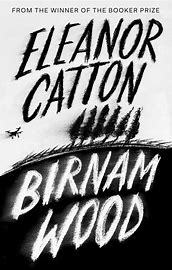
This is a complex and gripping thriller – it’s featured in a lot of end of year Best Of lists, not just mine – which delivers, generously, both intelligence and suspense. ‘Birnam Wood is a dark and brilliant novel about the violence and tawdriness of late capitalism. Its ending, though, propels it from a merely very good book into a truly great one.’
Ta-Nehisi Coates – The Water Dancer
Compelling narrative of slavery, with echoes of The Underground Railroad (like Whitehead, Coates takes the metaphorical and makes it literal), and with a leading role for Harriet Tubman. This isn’t just about slavery though, Coates looks more widely at capitalism, at the oppression of women, at the structures in society that require there to be a hierarchy and someone at the bottom of that who is powerless. Full of pain, inevitably, but of beauty too.
Will Dean – The Last Passenger
A cracking opening (and very different to Dean’s excellent Tuva Moodyson crime novels – I also read Wolf Pack in that series recently) . Caz is on holiday on an ocean liner with her partner, and wakes to find she is, apparently, alone on the ship. Dean pulls this off brilliantly, and every time we (and the protagonist) thinks they have begun to figure out what’s going on, we are blindsided with a new revelation – right up to the final page. It’s irresistible.
Bernardine Evaristo – Soul Tourists
An impromptu road trip for a slightly ill-matched couple which somehow leads to encounters with key figures from black European and Middle Eastern history. I don’t think it entirely worked; perhaps Evaristo was simply trying to do too much, and there are two novels in here, which don’t always mesh. Thoroughly entertaining nonetheless.
Stuart Evers – The Blind Light
A family saga, of lives lived in the shadow of the bomb, absolutely enthralling and moving. It sweeps across sixty years in the lives of its main protagonists, Drummond, Gwen and Carter, but always the focus is on these relationships, always intimate rather than letting the individuals become lost in the sweep of big events. One of my books of the year.



Robert Ford – The Student Conductor
Ford’s writing about music is wonderful, and really made me think about the role of the conductor. But the characters of Ziegler, the lead character’s supposed mentor, didn’t convince me (though he did remind me very strongly of J K Simmons’ character in Whiplash), nor did the oboist/love interest. Very mixed feelings about this one.
Abdulrazak Gurnah – Pilgrims Way
I read Gurnah’s brilliant Afterlives recently, set in what is now Tanzania in the early twentieth century. Pilgrims Way is closer to home, geographically and chronologically, and its scope is much narrower, dealing with one man, Daud, an immigrant whose life has not gone to plan, and who deals with his disappointment and disillusionment with sardonic humour and leaps of imagination. It’s often funny, but always dark and troubling.
Mohsin Hamid – The Last White Man
A fable in which a white man wakes up one morning and looks in the mirror to see that he’s no longer a white man. He has to navigate the world now as a black man, and everything is different. At this point it made me think of Arthur Miller’s novel, Focus, in which a man gets new spectacles, which make him look Jewish to some people, and those people conclude that he must be Jewish. But Hamid’s tale goes in a different direction and I found it beautiful.
Sarah Hilary – Black Thorn
A stand-alone from Hilary, whose Marnie Rome detective novels are amongst my favourite contemporary crime thrillers. Here the focus is not on the police, who play a more peripheral role, but on a small community of people who, we learn at the beginning, have encountered some catastrophe, and we gradually learn what, how, who, why… It’s beautifully done – incredibly tense and creepy and that tension is maintained as truths emerge.
Catherine Ryan Howard – Run Time
This is gripping stuff! Layers upon layers, super tense atmosphere, the plot revolves around the filming of a horror movie, in an actual cabin in the woods…
Clare Keegan – Foster
A novella of real delicacy, beauty and heartbreak. A child goes to stay with strangers when her mother is pregnant again, and finds herself with space and time to think and breathe, as she tries to understand her new guardians, and her own mother.


Stephen King – Holly
Holly first appeared in King’s Mr Mercedes, but he clearly loved her, because her role became increasingly important, in the other two books in that trilogy, but also in The Outsider. And here she is front and centre, as the title promises. This is King at his best, conjuring up creeping unease and tension, creating monstrous human beings and monstrous deeds, without ever letting the monstrous have it all their way, because he also creates people like Holly, who will, as she has done since Mr Mercedes, stand in its way. We love her as much as King does.
Laura Lippman – Prom Mom
Lippman’s plots are as twisty as the run of the mill psychological thrillers which bill themselves as having ‘a twist that you’d never predict’. But unlike so many of those, the twists are earned by careful plotting and, most of all, by character building. Our sympathies shift as we understand the protagonists better but understanding them is key to the twists in the narrative, rather than just upturning everything we’ve previously been told. And we do feel for these people, all of them, however weak and flawed they turn out to be.
Luke McCallin – The Man from Berlin
McCallin’s protagonist is an Abwehr officer, a former policeman, who is trying to solve brutal crimes in the context of a regime which is itself brutal and criminal. It’s similar territory to Philip Kerr’s Bernie Gunther series, and whilst I have only read one of this series so far, I will follow it up because I’m fascinated to see how Gregor Reinhardt navigates this dangerous, brutal world.
Cormac McCarthy – All the Pretty Horses
McCarthy’s prose is as rich as his dialogue is spare – sometimes the former feels just a bit too much, but at best its richness is beautiful rather than indigestible. His protagonist is a 16 year old boy who’s just been turfed off his grandfather’s ranch, and decides to try his luck in Mexico, along with his best friend, and their horses. John Grady Cole is someone we quickly learn to care about – like so many at his age, he thinks he understands the world rather better than he does, but he is in many ways an archetypal Western hero, with principles and courage and loyalty. It’s a world I don’t really understand but this is a compelling and moving novel. It’s the first in a trilogy, so I may venture on to Vol. 2 (The Crossing) at some point.
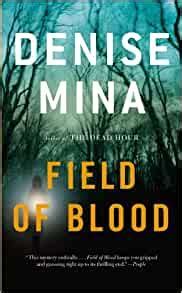
Denise Mina – Field of Blood
Mina weaves a fictionalised version of a real crime, and a real case of miscarriage of justice together with her usual skill. Paddy Meehan too finds her job (as a copyboy at a newspaper) and her personal life getting dangerously intertwined. She’s an engaging character, not perfect in judgement or actions, but I will look forward to reading the other books in which she features.
Abir Mukherjee – A Rising Man/A Necessary Evil
The first two in a crime series set in India in the early 20th century, with a British/Indian team, exploring all the tensions that creates (between the two of them, and with wider society). The context is fascinating, the writing excellent, and the voice of Wyndham, the British officer, is convincingly that of an enlightened man of his time, rather than a stand-in for a contemporary reader.



Richard Powers – The Time of our Singing
A truly immersive book, which I started off reading in short bursts until I realised that wouldn’t work. It’s a profoundly musical book – I half intend to create a playlist of all of the pieces of music that play a part in the narrative, although what I would really want would be those pieces performed by the characters in the book. It’s also brave (or foolhardy) enough to tackle race, as the protagonists are a mixed-race family (white father, black mother) in the US in the mid-twentieth century. I found it beautiful, powerful, very moving.
Anya Seton – My Theodosia
I read this, along with everything Anya Seton wrote, as a teenager, and revisited it because I was reading the biography of Alexander Hamilton (see below), who was killed in a duel by Theodosia Burr’s father. But, my god, this is an appallingly, sickeningly racist book. I wondered whether Seton was simply trying to convey the perceptions of a young woman in a society where slavery was still entrenched (although we are told that Theodosia thought slavery was wrong), but no, Seton wrote this in 1942 as a young woman in a post-slavery but pre-civil rights society, and it is impossible to escape the conclusion that these were her perceptions too. Her descriptions of any black characters are contemptuous, the n word is on every page. Of course, this is a novel of its time (and about a time when things were worse), but it made it a grim read and it was hard to care about Theodosia or her father when one had to wade through all of this. I can’t remember how I felt about the book when I first read it, but I think that, although I was more aware of racial politics than my contemporaries at school in Mansfield, having grown up in West Africa with parents who were passionately anti-apartheid, and having a keen interest in the civil rights/black power movements, I was at the same time used to encountering these attitudes and this language, unapologetically presented, in a way that we no longer are.
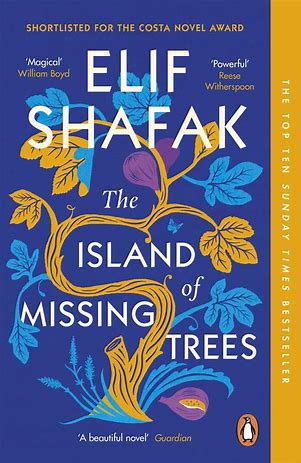
Elif Shafak – The Island of Missing Trees
I’ve enjoyed a couple of Shafak’s other books, and I liked a lot of things about this, but there was way too much whimsy for my taste. Whole sections are narrated by a fig tree, and whilst I can see how this connects with the history of the divided island of Cyprus, and with the stories of the main protagonists, I speed-read through these bits (sorry) to get back to the human characters, with whose stories I could more fully engage.
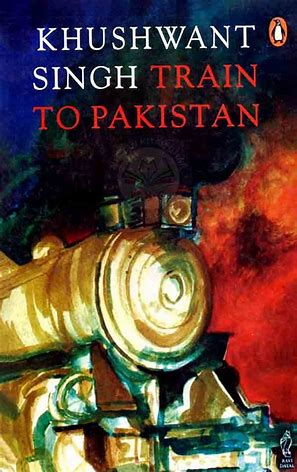
Khushwant Singh – Train to Pakistan
A novel about Partition, published in 1956, so not long after those events, set in a fictional village near the new border. Singh was a lawyer, diplomat and politician as well as a writer. His perspective here is to explore the cataclysmic events taking place across the sub-continent through a close focus on this small place, its dignitaries and officials and local ne’er do wells, who are portrayed with sharp wit and humour, even whilst the undercurrent of imminent tragedy is getting stronger.
Noel Streatfeild – Saplings
I’ve read many/most of Streatfeild’s children’s books, and her Vicarage trilogy but had no idea of this one’s existence until I spotted it in the catalogue of the brilliant Persephone Press. It’s the story of four children in wartime, of losses and betrayals and insecurity, and it’s a deep dive into ideas about attachment and loss and their effects on the young. If that makes it sound offputtingly theoretical, it isn’t – her novelist’s gift is to make us care about these children and what happens to them, and it’s very moving.
Marion Todd – See Them Run
Very enjoyable police procedural, set in the area around St Andrews, where I visit a couple of times a year (there’s always a peculiar fascination in reading thrillers set in familiar territory). Will read more.
Miriam Toewes – Women Talking
Recently made into a rather good film (see my screen review blog). This is horrifying, all the more so because the case is real. Girls and women in a Mennonite community in Bolivia were drugged and raped by members of their own community, and despite the perpetrators being exposed and some jailed, the women were left with no redress, and no protection. The book is, as the title tells us, women talking – and they talk about survival, about whether they should stay in the only place they know or leave and take their chances in what may be a hostile world. The tension – and it is very tense indeed – comes both from the disagreements amongst the women and the depths of trauma that they reveal, and from the knowledge that they could so easily be prevented from leaving, when the men return.




NON-FICTION
Martin Amis – Experience
I’ve only read one of Amis’s novels, and I hated it. Time’s Arrow was clever, but in a way that repelled me, and that put me off trying any of his other novels. So, in the aftermath of his death, I thought I might encounter him through his memoir. I liked him more here – he is self-critical, he can find his past self ridiculous and blameworthy, and he can be generous to at least some of the other people in his life. And in his writing about the disappearance and murder of his cousin Lucy Partington by Fred and Rosemary West, there is real heart, real grief. I still don’t want to read any of his novels though.
Anita Anand – Sophia: Princess, Suffragette, Revolutionary
Biography of an extraordinary woman. Daughter of a Maharajah, god-daughter to Queen Victoria, and as the book’s title tells us, suffragette and activist. Absolutely fascinating. Sophia herself remains enigmatic, but her engagement with the ‘advancement of women’, and with campaigns in support of Indian lescars, Indian troops in WWI, and the cause of Indian self-determination was bold and brave, and through her we see a varied and colourful cast of characters, both Indian and British.
Jeanine Basinger & Sam Wasson – Hollywood: An Oral History
The story of Hollywood told through interviews with people who were there – directors, actors, writers, studio bosses. The interviews, held in the American Film Archives, cover all aspects of movie-making so inevitably some sections are more interesting (to me) than others, though overall it is fascinating and enlightening, and very entertaining.
Ian Black – Enemies and Neighbours: Arabs in Jews in Palestine and Israel, 1917-2017
In the wake of the 7 October Hamas attacks, and the Israeli bombardment of Gaza, I wanted to understand more about why we are where we are and why this is such an intractable situation. I knew some of the story, of course, but I wanted a rigorous historical approach, non-partisan as far as is possible. Black’s book fits the bill. It is, of course, deeply depressing, but it is impossible when reading it to take a simplistic view of causes or possible solutions.
Ron Chernow – Alexander Hamilton/Mike Duncan – A Hero of Two Worlds: The Marquis de Lafayette in the Age of Revolution
I’ve grouped these two biographies together because their subjects were not just contemporaries but friends, and there are many parallels between them. Reading up on Hamilton is prep for going to see the musical in Manchester in February – when I watched it on TV I realised how sketchy my knowledge of that period of American history was, and whilst I dare say it’s not compulsory to do the reading before enjoying the music, it’s very much me… I had a better grasp on Lafayette’s story because my History A level covered the French Revolution and its aftermath, and I’ve read around the subject since. Both Hamilton and Lafayette were extraordinary men who achieved far more than anyone expected of them, at quite a young age, and these accounts bring them to life whilst providing a thorough, well-researched and readable historical context.


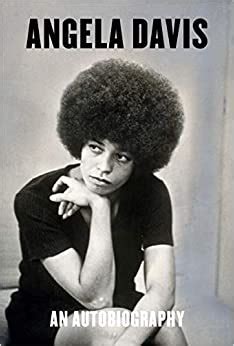
Angela Davis – An Autobiography
Davis was a hero of mine during my teens. I read a lot about the activists in the black power movement but was inevitably drawn to Davis – her charisma, her passion, her image. Women, Race and Class is brilliant, and so is this. It was originally published in 1974 and now has a series of prologues written for each successive edition, which shed light on how her perspectives have changed and how she responds to more recent events.
Joan Didion – The Year of Magical Thinking/Sarah Tarlow – The Archaeology of Loss: Life, Love and the Art of Dying
Two books that I was drawn to because they addressed how we live after the death of a partner. Didion’s book was recommended to me, with the caveat that I shouldn’t read it too soon – there are of course no rules as to how soon is too soon, and I think I got it about right. It was in places a very tough read – her description of her husband’s death had so many echoes of what happened to me – but her insights into the process she went through were profound and powerful (my copy of the book now has many sections highlighted so I can return to them when I need to). Tarlow ventures out further from her own experience to ruminations on how we (now and in the past) deal with death and loss, and it’s fascinating and often moving. It spoke to me less personally than Didion’s account because much of it is concerned with how she became her husband’s carer when he developed a terminal degenerative illness, and how that affected her and their family (my loss in contrast was shockingly sudden). It’s brutally frank and unsentimental about the cost and the loneliness of the carer’s role, and so whilst I was initially drawn to the book because it addressed bereavement, this topic is also vitally important and relevant.
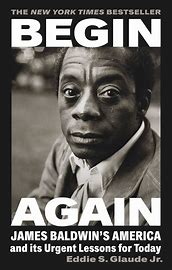
Eddie Glaude – Begin Again: James Baldwin’s America and its Urgent Lessons for our Own
I have loved Baldwin’s writing since my teens, when I read Go Tell it on the Mountain, and found his voice so compelling that I read over the subsequent years all of his other novels and essays. Glaude considers Baldwin’s evolving views on race in America, and as promised draws out lessons, and he conveys both Baldwin’s despair and the hope he held on to despite everything. It’s not a hagiography, he does not treat Baldwin as a sage, but as a passionate, deeply insightful, direct and honest writer whose insights into America are as relevant as ever.
Beth Macy – Dopesick: Dealers, Doctor and the Drug Company that addicted America/Chris McGreal – American Overdose: The Opioid Tragedy in Three Acts
See my Screen blog for the two dramas and the documentary that I watched on the topic of the US opioid crisis. I clearly became somewhat obsessed with this topic, having read Demon Copperhead and then watched the Netflix drama Painkillers… These books follow similar ground, but have a different approach. American Overdose focuses more on the politics and the perpetrators: ‘McGreal’s book reads like a white-collar The Wire, with a cast of characters determined to exact as much money as possible regardless of the human cost’. Macy foregrounds the stories of the victims and their families. Taken together they give a full and heartbreaking account that will, and should, make you angry, even whilst it breaks your heart.



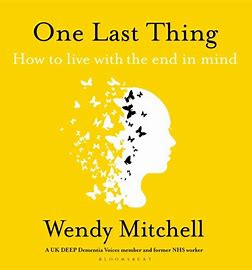
Wendy Mitchell – One Last Thing: How to Live with the End in Mind
I’ve been following Wendy Mitchell for some years now, as she navigates life with early onset dementia with humour and honesty. It’s rare to hear the voices of dementia sufferers because they are so often and so quickly unable to articulate their own experience, so Mitchell’s accounts are immensely valuable. This book is different – it looks at how we approach the end of our own life, and how that end can be made more dignified, how we can have some control over when, how, and where. This is a passionate work of advocacy for assisted dying, but Mitchell recognises that the provision that exists in a number of countries generally cannot help her and others with dementia because by the time they would want to be able to check out (the point at which, for example, they are no longer able to recognise their closest family), they will not have capacity (or not be deemed to have capacity) to make that decision. It’s a huge and heartbreaking dilemma, and Mitchell doesn’t offer solutions, but makes a vital contribution to the discussion.
Anthony Seldon & Raymond Newell – Johnson at 10: The Inside Story
‘This is an authoritative, gripping and often jaw-dropping account of the bedlam behind the black door of Number 10 and it confirms that we did not really have a government during his trashy reign. It was an anarchy presided over by a fervently frivolous, frantically floundering and deeply decadent lord of misrule.’ It’s all the more powerful because the authors are far from being anti-establishment figures. It makes it clear that the picture painted by the TV drama Partygate (see my Screen blog) is entirely plausible and consistent with the culture at Downing Street under Johnson. Incredible, and appalling.
Gitta Sereny – The German Trauma: Experiences & Reflections, 1938-2001
This collection of articles from almost forty years of writing about, thinking about and remembering the Nazi era includes much that is fascinating, some that is contentious, and inevitably a vast amount that is horrifying.
Catherine Taylor – The Stirrings: A Memoir in Northern Time
A memoir of Sheffield – of my Sheffield (Broomhill and Crosspool, the University) – was always going to interest me. Taylor is around ten years younger than me, and so she describes the Sheffield she knew as a teenager, whereas I arrived here to go to University. The shadow of Peter Sutcliffe hangs over much of her account, as it did over my life – scared to be out at night, scared even to open the back door to put the milk bottles on the window ledge, praying that Karen from next door would be on my bus so we could scurry home together along School Road, looking over our shoulders and not breathing properly until we were indoors. Taylor’s writing is brilliantly evocative, both of the place and of her own experiences and emotions. As Helen Mort puts it, this is ‘a lyrical account of what cities and their residents witness, how places shape character’.
Dorothy Whipple – The Other Day: The World of a Child
Charming, funny account of a childhood in the very early twentieth century, from a writer whose novels I’ve discovered and loved in recent years.
Terri White – Coming Undone
This is a bleak, harrowing account of how a chaotic and abusive childhood pushed White into crisis as an adult. Her honesty is unflinching. I wondered throughout just how she was managing to function (at least to some extent) in her working life, and, at the end, how she managed to turn the corner into a more stable life. I’d have liked to understand that more, but maybe that’s about me feeling less harrowed, and actually this is exactly the book that White intended and needed to write.


Closer to Fine?
Posted in Personal on October 9, 2023
The second year is harder than the first – that’s the received wisdom. But in that first year, you’ve had to get through the sheer shock, to deal with the grim grind of bereavement admin, to make some of the vital decisions about what you do now, how you live now, and you’ve probably got to the point where you’re functioning, more or less. The first year is so bloody hard that one might be forgiven for thinking that surely, surely, it will get easier. Well… it gets different.
I wrote about this last year, how after that first anniversary, you’ve got a whole year of being without your person, a whole new set of memories, obviously marked and shaped by their absence, but new, at any rate, and maybe some of them are good memories in their own right (not just good, considering). But the price of that is the knowledge that this is now it. This is your life, and it’s not the one you thought it would be, let alone would ever have chosen, but you have to go on, and on. That is a whole new kind of hard.
And somewhere along the way, you may start to drift. When you’ve lost the person with whom you navigated life, the person who anchored you when you needed it, and with whom you looked ahead and planned and anticipated and hoped, it is perilously easy to drift.
You’re driftwood, floating underwater
‘Driftwood’, Travis
Breaking into pieces, pieces, pieces
Just driftwood, hollow and of no use
Waterfalls will find you, bind you, grind you
I hadn’t consciously thought about this, but it was part of the reason I took quite a bold step this last year, and booked myself on to a widows’ retreat. I’d seen a brief clip about Fire & Rain on Rev. Richard Coles’ TV programme, Good Grief, and felt that it might be something good, something healing. So in April, I headed up to Lower Largo, in Fife, and met up with five other widows, and with the organisers, at a beautiful house just by the beach. I was deeply apprehensive. What if we (the widows) didn’t get on – what if the one huge thing that we had in common wasn’t enough to overcome our differences? What if they didn’t like me, or I them? What if I couldn’t get on with the more spiritual side of the retreat, given my resilient absence of faith in anything beyond this physical world?
By bedtime on the first day, all that was gone. We’d shared our stories, we’d wept together (a lot) but we’d also laughed, and we’d given each other an insight into our lives, before and after, and into who we were, before and after. And we didn’t have to buy into any particular spiritual beliefs or practices, just to take what we found useful and nurturing, and to build it into our lives if it worked for us. For five days we talked a lot, wept a lot, laughed a fair bit, walked, sat on the terrace looking out at the sea, did relaxation and breathing exercises, did some creative stuff. Of course when I got back to my new reality I crashed quite badly. But not for too long.


I haven’t made dramatic changes since those five days with Fire & Rain, but it did shift something in me, and gave me ways to hold on, to navigate, to be anchored. We are all learning to be our own compass, as one of our group put it. All of us are doing so in different ways – we’re very different people – and the crucial thing is that we find our own way. One of the themes of the week was being honest about where we are and how we feel. Some people – people who’ve never been in our situation – may expect that by one year/two years/six years we’ll be ‘over it’, we’ll have moved on, and there’s an expectation that when you’re asked, you’ll say, I’m fine, thanks. None of us is ****** fine. None of us has moved on. None of us, ever, will be ‘over it’. How could we be, when the nature of our loss is that our lives were tangled up with them, when everything in our lives had and has something to do with them? We can’t untangle it all, nor would we want to – that rich tapestry is made up of their threads as well as ours.
I can’t imagine that I won’t in years to come still be having conversations in my head with him, still be talking about him – after all, even if I live to be 100 (not that I aspire to that), I will still have spent more years with him than without. His absence will still, I’m sure, make me sad, as I accumulate experiences (both the lovely ones and the heartbreaking ones) that I would/should have shared with him. But I am, and will be, OK. We don’t move on from our person, we move forward, taking them with us, but finding our own way, shaping our own futures, regaining our balance, finding our clarity. It will always be a crooked line, but we press on in the hope that we are getting, maybe, closer to fine.
I went to the doctor, I went to the mountains
I looked to the children, I drank from the fountains
We go to the doctor, we go to the mountains
We look to the children, we drink from the fountain
Yeah, we go to the Bible, we go through the workout
We read up on revival, we stand up for the lookoutThere’s more than one answer to these questions
‘Closer to Fine’, Indigo Girls
Pointing me in a crooked line
And the less I seek my source for some definitive
(The less I seek my source)
Closer I am to fine
To Ute and Sarah, thank you for guiding us through the week, so gently and sensitively, and for giving us space and time and resources to go forward.
And to A, M, D, P and N, I will treasure those days in Lower Largo with you. Thank you for your honesty and courage, your friendship, your solidarity.


Thank you always and most of all to our children, who support and take care of me so very lovingly and who, of course, are dealing with their own grief and loss. And to all of those who have been part of our support network of family and friends over this last two years. You know who you are, I hope.
And thank you to M, for all the days.

Celebrating Michel Butor
Posted in Michel Butor on September 14, 2023
Today would have been Michel Butor’s 97th birthday – he died just before his 90th, in 2016. I have written elsewhere in this blog about how I discovered his work, back in 2005-06, and the impact that his novel Passing Time (L’Emploi du temps) had on me, as evidenced by my blog title, many of the pieces I’ve posted here, a PhD thesis, and a couple (soon to be three) chapters in academic books. I also have something more personal than the shelves of multiple copies of his novels and other works (in English and German, as well as French) and of critical studies of his work.
In 2008, already immersed in his work and steering my undergrad assignments in his direction wherever I could, I wrote to him, hoping to start a correspondence that might enrich my understanding of L’Emploi du temps in particular. What I received was a postcard, an image cut in two on a diagonal, and then taped back together by him, with a warm and friendly message:
He writes:
Your letter took some time to reach me as I was on holiday on the Basque coast. Thank you for your interest in my books. Don’t hesitate to ask me anything, if you think my replies might help in your work. Have a great summer! Very cordially, yours, Michel.
I did write again in 2012, in hope rather than expectation, as I worked on my undergrad dissertation, and considered a PhD proposal, but I didn’t hear back. Butor’s wife Marie-Jo had died two years earlier, and I know now, as I didn’t then, how the loss of a partner has an impact on every aspect of one’s life, from the most profound to the most mundane. I can understand that an earnest enquiry about a book he’d written over half a century previously will not have been a priority.
But the impression of Butor that the postcard gave me is confirmed by many accounts of those who knew, worked with and interviewed him, and by this fascinating documentary, unfortunately not available with subtitles, but which shows a straightforward, warm and generous man, as well as a writer who experimented with language and with narrative, and whose work is richly human, who wanted, through his work, to change the reader, and to change the reader’s view of the world.
So, I am grateful for that postcard, for the thought and for the warmth, as I am grateful for the books, especially the one that has absorbed me for so long and fuelled my writing, and my academic life. That postcard is proudly displayed on my bookshelves, alongside those multiple copies of his books, and the bound copy of my thesis, and the many academic studies of his writing.

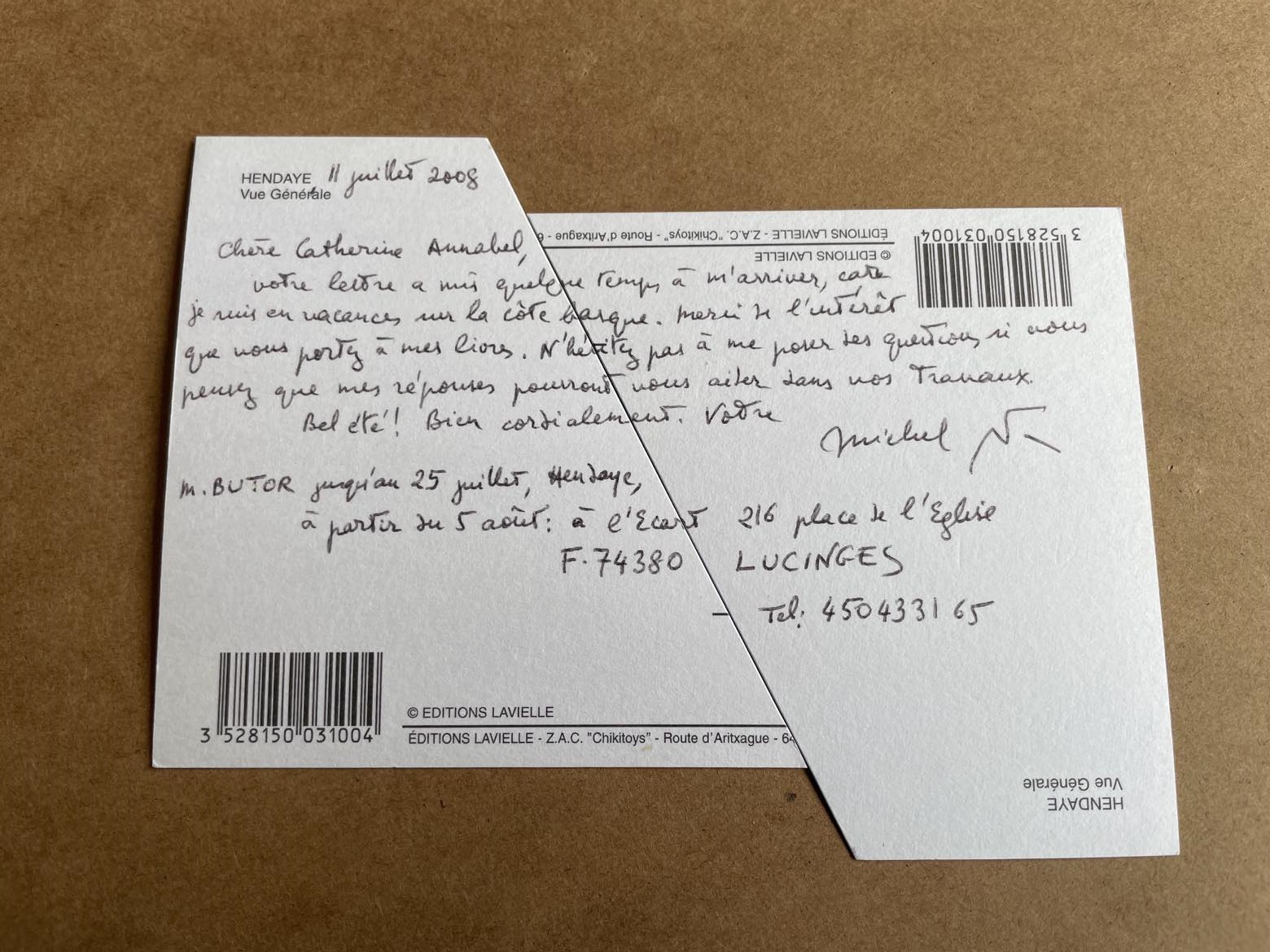
Passing Time is, of course, now available in a revised English translation, published by Pariah Press in 2021.

2023 on Screen: the first half
Posted in Film, Television on June 25, 2023
The usual mix of heavy and fun, with perhaps a bias towards the former. As usual, I note the frequency of WWII as a setting both in film and in TV series. In TV generally, the usual glut of crime drama, most a bit run of the mill but a few absolute gems. I have a problem with some of the lightweight stuff M and I used to watch together, and whilst I have given a go to Death in Paradise, Midsomer Murders, Young Sheldon and others, I simply don’t get the pleasure in watching them alone that I did when we could laugh together, and heckle, and nudge each other when things got ludicrous. (Not that there aren’t things I’ve watched that have made me laugh.) Conversely, there are things in here I would never have persuaded him to watch – I have a higher tolerance for grim than he ever did, a higher tolerance for costume drama/literary adaptations, and also (as it turns out, who knew?) the capacity to find joy in certain reality TV shows which he would have always dismissed. But so many things here are things we would have enjoyed together, and sometimes (quite often) that makes me feel sad, whilst at the same time reminding me of our companionship over all those years. I don’t talk to him, not out loud, anyway, but watching the last ever Endeavour, and the latest series of Unforgotten, for example, I thought of him a lot, and kind of nodded to him, wherever he is (my preference is to think that he’s part of the ocean, part of the universe, because when you die, ‘according to the law of the conservation of energy, not a bit of you is gone. You’re just less orderly’).
I haven’t included absolutely everything I watched – series that I abandoned or that I simply didn’t have anything to say about aren’t included, nor are rewatches, or ongoing series unless there’s something new to comment on. I’ve tried to avoid spoilers but no guarantees – proceed at your own risk.
Film
After Love
I love Joanna Scanlan, and she is superb in this. I thought I’d made a mistake watching it, given the opening scene, but it was subtly done, and whilst clearly the subject matter was emotionally intense for a still relatively new widow, it was in so many ways far enough from my own experience to be able to enjoy the writing and the performances. Many tears at the end though.
Antman and the Wasp – Quantumania (cinema)
Good things about this – Jonathan Majors, mesmerising (although, as it turns out, very problematic). Michelle Pfeiffer getting a fair crack of the whip, as she should. Visually stunning. Kathryn Newton as Cassie Lang making her presence felt. Paul Rudd always engaging. Somehow though it didn’t work as a whole, or not as well as it could have done. But it was fun.
The Banshees of Inisherin
Simultaneously very (darkly) funny, and desperately sad. Farrell, Gleeson, Condon and Keoghan all brilliant. I know people who came out of the cinema after watching it feeling deeply depressed, and I can understand why – it is bleak. But it didn’t have that effect on me, somehow. And even those who were plunged into existential despair through watching it recognised its brilliance.
Best of Enemies (cinema)
NT production filmed live, and shown at our local arthouse cinema. David Harewood as conservative US writer/political commentator William F Buckley, and Zachary Quinto as liberal writer/provocateur Gore Vidal, recreating their TV debates at the time of the primaries in 1968. Brilliantly done, excellent use of very simple set with screens at the back of the stage. Harewood was superb, very well cast, but I am intrigued by the reasons for casting a black actor in the role, when, say, James Baldwin was played by a black actor, Andy Warhol by a white actor, etc etc. It’s fine, and it worked, but I would be interested to know more about the rationale.
The Boston Strangler
An interesting change of angle on the story as I knew it, following the work of two female journalists, liberated from the ‘lifestyle’ pages to follow up the search for a serial killer.
The Debt
Nazi hunting, but not presented as straightforward heroics. Not that there’s any doubt who the bad guy is, but the good guys get into some morally complex areas whilst attempting to bring him to justice. Excellent performances from Helen Mirren and Tom Wilkinson in particular.




The Deerhunter
One of those films that is so well known that I almost thought I had seen it, I must have. But no, I saw it for the first time, and had very mixed feelings. It was relentlessly depressing, but that’s not it. Once the scene shifted to Vietnam, and our first encounter with the Vietcong I was seriously alienated. Yes, I know they were guilty of hideous atrocities, but the film portrayed them as barely human, malevolent and sadistic, with no context, not even the slightest suggestion that US troops did things just as hideous. The performances were superb, even if most of the characters remained pretty unsympathetic.
Denial
Dramatisation of the libel case brought by Holocaust denier David Irving against Deborah Lipstadt. Of course the outcome is known, so the tension lies in Irving’s testimony (Timothy Spall is brilliant) and Rachel Weisz’s conflicts with her own legal team over how their case would be portrayed.
Enola Holmes 2
Perfect New Year’s Day fare, jolly and entertaining.
Entebbe
This really didn’t quite work. The frequent interjections from the Israeli dance troupe never really added anything – not sure what they were intended to add, in fact – the performance itself was powerful and dramatic but out of place. We could have usefully spent more time exploring the motivation of the hijackers, which was only lightly sketched in. And the climactic rescue was somehow anticlimactic, over in seconds (as was the real event). Pike and Bruhl did a decent job with what they were given but this compelling story made a less than compelling film.
The Fabelmans (cinema)
Ultimate Spielberg. So many themes and motifs that are familiar from his work over the decades, but here the context is very personal. It’s a love letter to cinema, and a more troubled love letter to his parents, who enabled his passion for film, but whose marriage was fragile, as his camera inadvertently revealed. There are more cinema references (to Spielberg’s work and to the films he loved) than one could possibly list, and the details of how the young filmmaker achieved special effects with no budget and very basic kit are both fascinating and endearing. Performances are excellent – Williams and Hirsch are the most showy (in a good way) but Paul Dano is very touching as the Dad, and the two young actors who play Sammy Fabelman (Mateo Zoryon Francis-DeFord, who surely has more names than any small person needs, and then Gabriel LaBelle) are wonderful. Is it self-indulgent? Well, yes, but I think he’s earned it. And I loved it.
Glory
There’s a film still to be made, from the perspective of the black soldiers rather than their white leader, but meantime this is a solid and often moving account.


Green Book
I liked so many things about this, including both of the lead performances. But if only it could have been genuinely a two-hander. Mahershala Ali’s performance as pianist Don Shirley has depths that are never fully explored – he’s by far the more complex and interesting of the two protagonists, not only because of his rarity as a black classical musician, who isn’t pigeonholed by that definition, and how he is seen both by white people (friend and foe) and by other African-Americans, but also because of the glimpses we get of a complicated personality. That’s not to say that Tony Vallelonga isn’t also fascinating, or that Viggo Mortensen’s performance isn’t great. But a film about a black classical musician touring the American South in 1962, in which the white guy is the lead actor (in Oscar terms) is perhaps missing a trick. It was Shirley that I wanted to know better. The scenes in the South are filled with real, visceral dread, nonetheless, and the Green Book itself is something remarkable, and appalling.
The Guard
Brendan Gleeson and Don Cheadle as unlikely buddies in a cop movie, encompassing organised crime and corrupt policemen in rural Ireland. They’re both brilliant – Gleeson’s Boyle is staggeringly incorrect, offensive and unprofessional but nonetheless we back him all the way, and Cheadle is buttoned up and straitlaced, but capable of being shocked into camaraderie. It’s very, very funny.
Guardians of the Galaxy 3 (cinema)
Drawing the story of the Guardians (at least in this formation) to a close, and providing an origin story for Rocky Racoon. It mixes the elements we have come to expect from Guardians with some much darker threads, and some moving moments (not that previous films have been without those elements), and an ending which reminded me a little of the final episode of Agents of Shield, in its defiantly human and non-superheroic tone.
Hitchcock
Entertaining, but I recall watching the Toby Jones/Imelda Staunton film The Girl a while back, which was a lot stronger and much more disturbing. It’s not that this one glosses over Hitch’s predilections, nor his bullying behaviour towards his actors, but it holds back, where The Girl (which focuses on the making of The Birds, whilst Hitchcock focuses on Psycho) doesn’t. Hopkins and Mirren are great though.
The Hurt Locker
Super tense, tough, immersive. Renner in particularly is mesmerising.
In the Court of the Crimson King (cinema)
King Crimson at 50, celebrated in a film which includes interviews with most surviving members of the band’s various incarnations, but which centres, inevitably and rightly, on the one person who was part of and led all of those incarnations, Robert Fripp. Infuriating, pompous and often very funny, Fripp’s genius is also on display, and acknowledged by all of the participants. And the music, obviously, is bloody brilliant.


Judy
I do have a problem with biopics – I find it hard, however good the performance, not to see it as an impersonation, a collection of mannerisms that are meant to persuade me that this is indeed Judy, but which tend to merely persuade me that Renee Zellweger is doing a cracking job of impersonating her. Nonetheless, it is a good attempt and really rather touching.
Jumanji – Welcome to the Jungle
A lot of fun, especially Jack Black training Karen Gillan in how to flirt.
Knives Out/Glass Onion
Daniel Craig having a blast as master detective Benoit Blanc, backed in both movies by a stellar cast, all of whom are also clearly having a blast. Thoroughly enjoyable, with plots that are tricksy enough to be gripping.
Lilies of the Field
Sidney Poitier won the Best Actor Oscar for this one in 1963. It’s of its time, gentle and funny, with the culture clash between Poitier’s footloose loner and the austere East German refugee Mother Superior gaining some real poignancy – what’s more, it isn’t given an entirely cosy resolution. Racism only rears its ugly head in Homer Smith’s first encounter with the local contractor who addresses him as ‘boy’ – this is resolved, when at the end Smith is addressed as Mr Smith (that’s bound to remind one of Poitier’s much grittier (and a few years later) In The Heat of the Night, and the famous line, ‘they call me Mister Tibbs’.
Manchester by the Sea
I would have avoided this a year ago, even six months ago (a heartbreaking study in grief – ah, cheers, no thanks, not just now). But I’m glad I watched it – it’s superb, subtle, moving without ever being sentimental.
The Menu
Perhaps more style than substance, rather like the food at Ralph Fiennes’ ludicrously pretentious restaurant. But the black humour works well, although I’m not sure whether it would be as effective if one knew the premiss – one is often laughing in shock.



Mothering Sunday
Elegiac in tone, the sorrow and hurt left by the carnage of the First World War pervades everything in what appears, on one level, to be an upstairs/downstairs romantic – or at least sexual – affair. It’s about ‘love, lust, grief and doubt, lacing its central portrait of an artist in the making with an air of unresolved intrigue, lingering guilt and transformative creativity’, as the Guardian put it.
Narvik
Good, solid war drama, set during the abortive Allied campaign aimed at preventing German occupation of Norway (and protecting vital imports). It convincingly portrays the chaos and the moral ambiguity of the time through the dilemmas faced by the lead characters, its action sequences are gripping and it sheds light on a wartime episode that I, at least, knew little about (I learned more, reading Nicholas Shakespeare’s Six Minutes in May – see my books blog).
Queen of Katwe
Based on the true story of Phiona Mutesi, from the slums of Kampala, who became a chess champion. It sounds potentially sentimental but the performances (from Madina Nalwanga as Phiona, with stellar support from David Oyelowo and Lupita Nyongo) ensure that it remains true to the place and the people.
A Quiet Place 2
Inevitably some of the power of the first film is lost as the narrative opens out, and as we are fully aware from the start of the nature of the threat and of the one possible defence against it. But it maintains the tension brilliantly nonetheless. Emily Blunt is great, and Millicent Simmonds as the daughter is exceptional.
Romeo + Juliet
The characters are intensely irritating, but that’s R + J for you. They’re teenage idiots, and I prefer productions that allow them to be that than those that pretend we are really in the presence of a great and profound passion. This version is perhaps gimmicky but works pretty well, and di Caprio and Danes are a very attractive and persuasive couple of teenage idiots.
Rye Lane
Everything about this is a delight. The script zings, the two leads are funny and charming, the setting vibrates with colour and activity, and it uses the classic romcom tropes but makes them feel fresh and new. It lifted my spirits, it warmed my heart without ever being soppy or sentimental.


Spiderman: Across the Spiderverse (cinema)
This is wonderful. ‘Dizzying, dazzling’ as the Guardian reviewer put it. Asked what I thought of it afterwards I could barely come up with more than a few vowel sounds. With a bit of time to reflect, I felt that (a) I couldn’t grasp all of the threads – I’m just not sufficiently immersed in the Spiderman comics/films to get all of the references, (b) it was visually stunning, (c) I want to watch it again soon (and re-watch Into the Spiderverse in prep) and (d) I am still dizzied and dazzled.
The Thin Red Line
This falls short of being a great film, but it is great in parts, and is very effectively tense. The voice-overs provide a more philosophical, spiritual perspective on the brutal action, but are hard to connect to the soldiers that we see fighting and dying, and some of the famous faces who pop up briefly only to fight and die are a bit of a distraction. It’s not your conventional war film, anyway, and even if it doesn’t entirely work, it’s compelling stuff.
What’s Love Got to Do with It
Another biopic, see my comments above on Judy. This took enormous liberties with the details of Tina Turner’s life, although the fundamentals are all there. With those caveats, Angela Bassett and Laurence Fishburne are both brilliant.
Whiplash
A terrifying study of obsession, and of the damage a charismatic bully can do. The Guardian said that ‘Watching this film is like listening to a very extended, bravura jazz drum solo. You marvel at the flash, the crash, the technique – and finally wonder where exactly it is all going, and when and how it is going to end’. Which is probably fair, but unlike all but the best drum solos, you don’t take it as an opportunity to go and make a cup of tea or scroll through your phone. There’s an ambiguity about it – JK Simmons’ Fletcher is brutal, vicious, dangerous, but is he right about what it takes to achieve full-on musical genius? How does his approach fit with jazz as an improvisational discipline? At the very least it’s a film that holds your full attention whilst it’s playing, and gives you food for thought afterwards.
Wild
Dramatisation of Cheryl Strayed’s account of her solo 1,000 mile walk along the Pacific Crest Trail, in the aftermath of her mother’s death and the disintegration of her marriage, as a result of her own self-destructive behaviour. It’s a completely mad enterprise, undertaken with rather less rigorous planning than some of us might do before heading to the shops on a Saturday, and it really is rather remarkable that she survived both the various perils of the natural environment, and the human predators that she manages to evade along the way. It’s a non-linear account, the events of her journey interspersed with memories of childhood and of the traumas that led her to take on this challenge. The occasional lapse into self-help manual clichés grates a bit, but not enough to detract from the tension.
The Wonder
Beautifully done, slow and subtle, with great performances from Florence Pugh, Tom Burke and Kila Lord Cassidy in the lead roles. The soundtrack is excellent too. The only thing that jarred for me was the framing of the narrative with shots of a film studio and a voice-over assuring us that the characters in the film ‘believe in their stories with complete devotion’, and inviting us in turn to believe in this story. I’m not clear how creating that distance between us and the story helps us in that, but that story was compelling enough that I forgot the odd framing.




TV
Drama
The Bay
Timing is everything, and this fourth series of what has been described as a ‘serviceable’ crime drama was up against the final series of Endeavour and the first series of Unforgotten without Nicola Walker (see below). It is fine, kept me guessing, managed to not get totally bogged down in the characters’ personal lives (just), and the script and performances were fine. Better than series 1 of The Bay, which despite the presence of Morven Christie failed to convince, and I had thus skipped series 2 and 3. In fact, I might not have bothered with this if I hadn’t been (a) snowed in and (b) exercising all of my willpower to avoid binging Unforgotten…
Better
One of the better crime thrillers of the year to date. This one genuinely kept wrong-footing me and it felt fresh despite the not unusual set-up (a bent copper wants to free herself from her obligations but can’t do so without risking her family).
The Billy Plays (Too Late to talk to Billy, A Matter of Choice for Billy, A Coming to Terms for Billy)
A very young Kenneth Branagh in this trio of Belfast set plays written by Graham Reid and broadcast on Play for Today in the early 80s. The focus is on the troubled relationship between Branagh’s Billy and his father Norman (James Ellis). At the time they were seen as a ground-breaking representation of Protestant working class life during the Troubles, and they’re fascinating to watch now, though interestingly a review in the Belfast Telegraph from 2012 is pretty damning about their relevance and realism.
Blue Lights
The stand-out new crime series of the year so far. The series focuses on three probationary coppers in contemporary Belfast, and all three are put to the test and put in real peril – it’s brilliantly tense. And whilst the premiss of ordinary coppers trying to do their job coming into conflict with secret service ops warning them off organised crime activities which are under surveillance is one that very many detective dramas have dealt with, the complexities of the environment here add layers of danger and tension. Absolutely gripping. Already commissioned for a second series and I can’t wait.
Dancing on the Edge
Stephen Poliakoff’s drama, first broadcast ten years ago, is set in 1933, when a black jazz band is trying to get a secure residency at a London hotel, and avoid the attentions of the immigration department. It’s a fascinating point in history, where so many elements and heading for collision, and there are personal dramas too. Great performances, great music, great writing.
The Diplomat
Good stuff. Elements of Borgen, mixed with Bodyguard/Treason and other politically focused dramas. The script was zingy, Keri Russell as the Ambassador was great, as was Rufus Sewell as her (possibly nearly ex) husband and a man with his own ambitions. It is definitely anticipating a second series, which I hope materialises.


Endeavour
The final series. As always, the quality of the writing and of the performances lifts Endeavour well above the bulk of detective dramas, and these final episodes are elegiac and moving, with the final episode delivering some nods back to the beginning, and to what was to come afterwards. I shall rewatch the series now with great pleasure and savour my time with Bright (who Anton Lesser develops from a stuffed shirt to a hero, with such enormous subtlety), Thursday, Strange and Morse, all over again.
Extraordinary
Everyone has a superpower, randomly allocated to them when they turn 18, except Jen. This is a broad, comic take on the whole superpower notion, where some of them are scary and others are a bit of a nuisance – we went there a while ago in Misfits, where a bunch of people (but not everyone) got superpowers after some kind of an electrical storm. It’s v funny (Derry Girls meets Sex Education?).
Grace
I’ve tried, and I will probably watch it when it’s next back, but I don’t love Grace, despite my fondness for John Simm. They seem to have dropped the weird obsession with Grace seeking supernatural guidance on his cases, even though it never produces anything useful and threatens his career. But the connecting thread of the mystery of his wife’s disappearance is perhaps less interesting than the writer intended, and at least one episode leaned on ‘woman in peril’ tropes in a rather queasy way that most dramas have moved on from.
Great Expectations
Oh, this did cause an awful lot of harrumphing. The colour-blind casting, the sex and drugs, the changes to Dickens’ plot, the swearing… I rather enjoyed it. There was plenty of Dickens in there, even with the plot changes, and it made us see some of the characters in a different light. It’s so long since I read the book (with which I was once very familiar) that I’m not sure whether some plot elements were changes or just embellishments/re-interpretations, but the ending makes use of the subtle ambiguity in Dickens’ own ending (which he had to change, under pressure from his publishers) and I kind of approved. I love Dickens passionately – have been reading him since I was at junior school – but I’m not precious about how the novels are treated. I thought Iannucci’s Copperfield was wonderful, and I found his treatment of Dora (‘I don’t belong here. Write me out, Dodie’) powerfully moving. I also loved Barbara Kingsolver’s reworking of the same novel, as Demon Copperhead – see my books blog).
Happy Valley
Sarah Lancashire is magnificent. I could leave it there, but that would do a disservice to the writing, and to the other performances. Happy Valley is a pretty bleak place, and there have been times, particularly in series 2, when I just wanted it to stop being so relentlessly grim (and I have a pretty high tolerance for grim), mainly because Sally Wainwright made me care so damn much about what happened to the characters. This final series was tense as owt, right to the end, but always maintaining that dark humour, as Catherine Cawood stomps away from another encounter with dim-witted male colleagues, muttering ‘Twats’, or reports back to her sister after the final showdown with Tommy Lee Royce that she might have singed one of her crochet blankets. Brilliantly done.
His Dark Materials
Beautiful and moving. Does justice to the books, which is no small feat. Will there be a dramatization of the second (so far incomplete) trilogy? If the same team were to tackle it, I’d be very happy to see that happen, but the ending of this trilogy is perfect as it is.


Jaguar
Spanish series, focusing on a group of Nazi hunters. Unfortunately, whilst it seems to be trying to be serious, the action sequences are often ludicrous, even cartoonish, the characterisation is perfunctory and the dialogue clunky. I had to watch it all to see how it turned out, but it wasn’t exactly edifying.
The Last of Us
I’d never played the game, but I have it on expert authority that it is the best of its genre, and transcends its genre. The same could be said of the series, which is full of absolutely cracking action but then takes time out to explore much smaller stories, like that of Bill and Frank, or Ellie and girlfriend Riley, so that we are deeply invested in the people, not just rooting for them to beat the nasty infecteds. Visually brilliant, never morally simplistic, often deeply moving, and beautifully acted.
The Light in the Hall
I watched largely because it starred Joanna Scanlan, but this story of a bereaved mother seeking answers wasn’t quite fleet-footed enough to avoid the clichés, and ended up being rather less satisfying than I’d hoped, despite the performances.
Lockwood & Co
So, about 50 years ago ghosts started to make their presence felt, and whilst they can harm adults, only teenagers can sense them and fight them. Lockwood & Co are ghosthunters, combating not only the said spectres but unscrupulous forces who want to harness these supernatural powers for evil rather than good. Very entertaining, and intriguing, and, annoyingly, cancelled after one series.
Magpie Murders
A meta murder mystery, in which an editor tries to solve the murder of a crime novelist, whilst also trying to find out what happens in the final chapter of his latest/last book, with a little help from his fictional detective. It could be gimmicky but it’s clever enough to avoid that, and is a very satisfying, multi-layered exploration of the genre, in its classic form. Lesley Manville is great, as always, as are the rest of the cast, many playing dual roles.
Excellent thriller based in an A&E department. The main protagonist was – quite intentionally – abrasive and not entirely admirable, but it was brilliantly tense, and felt real, thanks to the writer, Grace Ofori-Attah, who spent 10 years as a doctor in the NHS.


Maryland
I’d watch anything with Suranne Jones in. And this one also had Eve Best, who is much less frequently on the telly but is always worth watching (we saw her as Rosalind in As You Like It at the Crucible, years ago, and she was mesmerizingly gorgeous). There are other great performances here, but essentially this drama comes down to these two, playing sisters whose relationship has become tense and distant over the years, but who find themselves dealing with a crisis on the death of their mother. There’s some nice misdirection in the opening scenes which makes one think we’re going to get a mystery, a thriller even. It’s not – it is about relationships, about family, about responsibilities and how we care for each other. And it’s excellent.
Mayflies
I loved the book. And in some ways, this dramatisation lived up to it. There are two timelines in the narrative, one where the protagonists are lairy teenagers, one twenty-something years later, when some friendships have fractured but others remain vital. It’s about male friendships and the kinds of loyalty that those can inspire, even trumping loyalty to one’s partner, in extremis. I was furious on the female partner’s behalf, but I believed in the characters and in the overwhelming desire ‘not to die like a prick’, whatever that takes. The adaptation dealt superbly, and very movingly, with the current timeline, but the earlier strand remained rather unfocused, and didn’t build as strong a foundation for the later developments as it did in the novel.
Murder on the Home Front
Rather a jolly, if dark, crime drama set during the Blitz, based on the memoirs of Molly Lefebure, secretary to pathologist Keith Simpson. One assumes that the real Molly didn’t actually go chasing serial killers down the passages of the Underground, but I haven’t read the memoir, so who knows?
Mystery Road: Origin
We’d seen all of the Mystery Road TV and film outings for outback detective Jay Swan (taciturn, with a history, doesn’t always play nicely with others) and this introduces us to his younger self, where we see some, at least, of that history. Excellent thriller which, as always with this series, addresses white Australia’s past and present dealings with its original inhabitants.
The Night Agent
Often a bit preposterous, and the leading man is a bit too boringly square-jawed for my liking, but undeniably thrilling. The ending seemed a bit abrupt, which may presage a second series. I’ll watch it.
Page Eight
David Hare wrote and directed this: Nighy and Gambon as a pair of close to retirement MI5 chaps dealing with information and misinformation, a PM who is lying to the country, and the death of an activist. Lovely performances. There are a couple of sequels, which don’t appear to be available to stream anywhere at present, unfortunately.


Picard
If Season 2 got its pacing a bit wrong, but redeemed itself on the final strait, Season 3 keeps the pace and the tension taut throughout. This is despite the potential for distraction by most of the TNG cast rocking up, along with their offspring, to help Picard fight the greatest threat the Federation has ever faced. A lot of gentle humour is made of the changes that the years have made to these characters, as well as picking up some of the tensions that were always there. I especially enjoyed Worf’s neat segue from announcing himself as the scourge of X and the destroyer of Y to offer Rafi some camomile tea. A very satisfying conclusion.
The Power
Adaption of Naomi Alderson’s brilliant scifi novel where one genetic mutation/evolutionary change – teenage girls go electric – challenges the order of things around the world. It’s intelligently done, and gets the balance right between the individual stories and the bigger picture.
Redemption
Another grieving mother seeks to uncover the truth and in so doing crosses all kinds of boundaries (common sense, legal, ethical). It’s a bit overdone as a plot (see also The Light in the Hall, Without Sin) and the only things distinguishing this one are the Belfast setting and the fact that said grieving mother is a copper. I never quite believed in her, sad to say.
The Responder
‘As fast and riveting as a thriller and as harrowing as a documentary’, according to Lucy Mangan in the Guardian. She’s not wrong. Martin Freeman is outstanding, bringing real depth, and great humanity to the role of a copper mired in despair, compromised, frustrated and angry but still, somehow, wanting to do something good.
The Rig
Ecological scifi thriller, about what happens when the earth punches back. Great cast – Martin Compston, Ian Glen, Mark Bonnar, Mark Addy, all people one is pleased to see in the cast list of any drama.
SAS Rogue Heroes
Back to WWII, in Egypt, and the formation of the SAS, a bunch of mad bastards who take on missions that no one who wasn’t a mad bastard would even dream up, let alone execute. It’s exciting, the script is witty, and the characters are drawn with enough depth that we do get a sense of why they’re the kind of chaps who would sign up for this. Connor Swindells is particularly good.


The Six Wives of Henry VIII/Lucy Worsley’s Six Wives
Lucy’s latest foray into the dressing up box isn’t quite as groundbreaking as it purports to be. She wants to show the six wives in new light, to get away from the simplifications and stereotypes. But watching her series alongside the 1970 drama series, she doesn’t seem to have anything much to tell us that wasn’t in that series… The latter holds up remarkably well – there’s the odd bit of historical drama-ese dialogue: ‘your brother, the Prince … your father, the King’, etc, but the performances are excellent and each wife is given a chance to be a rounded, complicated person, neither victim nor villain. 12-year-old me was not wrong.
A Small Light
This is outstanding. A Small Light is the story of Miep Gies, the woman who helped the Frank family into their hiding place, and kept them safe and fed for two years until the Gestapo raid that saw all of the inhabitants of the Annex deported. We only see life in the Annex as Miep saw it, so we see her interactions with the family, but not their interactions with each other. And this makes the final episodes even more devastating, somehow, as we hear, rather than see, the shouts and tears as the Gestapo burst in and order them to pack. Miep sees them troop downstairs to the waiting truck only as silhouettes passing by the office door, though we do get a last sight of them, briefly in the fresh air, via Miep’s husband Jan, who is helplessly standing by outside. What we get, which Anne’s diary cannot provide, is the context, what is happening on the streets of Amsterdam, collaboration and resistance, cold and hunger, suspicion and fear. And we see Jan’s growing involvement in active resistance. I don’t know whether it is dramatic license that he is part of the planning, if not the execution, of the attack on the Records Office. This was the focus of a recent documentary by Stephen Fry, looking at Willem Arondeus and Frieda Belinfante, both gay, whose names are little known even in the Netherlands, so whether or not Jan Gies played a very minor role (Arondeus was captured and executed), it is good that this series is giving them a moment in the spotlight. I have grown up with Anne Frank, first reading the diary (in one of the more expurgated versions) when I was round about her age. It is without doubt a remarkable piece of writing, but I find myself cringing when it is described as inspirational, or poignant. My emotion on reading it is not to discreetly mop a tear but to feel horror and rage. And whether Anne, had she survived Belsen, would have stood by her statement that people are fundamentally good at heart, we will never know. What we can take from her, though, is that anyone can be a small light in a dark room. Miep Gies, brilliantly portrayed here by Bel Powley, was just that.
A Spy amongst Friends
Excellent cast, fascinating story, somehow didn’t quite catch fire.
The Steeltown Murders
Solid reconstruction of a case left unsolved in the 1970s, which was reopened and reinvestigated in the early 2000s using DNA testing. The action flits between the two time-frames (sometimes merging from one to another as the lead copper looks in a mirror, or walks the same route as his earlier/later self), so one has to be alert to the cars, the width of lapels and the amount of smoking to ensure one keeps up. It’s about police procedure and forensics, but it’s also (see Unforgotten) about how the ramifications of a murder (in this case three murders of young girls) play out in the lives of family and friends through the decades. Philip Glenister plays the older Paul Bethell (the lead copper), and Scott Arthur his younger self (older retains the younger man’s impressive ‘70s tache). It’s slow and subtle (again, Unforgotten style) rather than nail-bitingly tense and actiony, and it was compelling viewing.
Ted Lasso
Well, this final series seems to have made some people very cross, and I’m not sure why. Was it as good as series 1? No, but not many things are, and moreover neither was series 2. Series 1 had on its side that the style and tone of the show felt fresh and surprising, as well as being warm and (not that I like the word) nice, which was kind of what we needed back then. Both series 2 and 3 had more missteps and mis-hits and series 3 perhaps a few more overtly preachy moments, but fundamentally it was the same show, with the same premiss and the same cast, the same tone and style. That’s not to say there had been no development – none of the characters were as we originally encountered them, apart from the show’s one irredeemably bad guy, who remained unredeemed. It was right to draw it to a close, but there was lots to love about this series, and even its finale (although as so often, finales cram so much in that it all ends up a bit messy).
Traitors
Not to be confused with the Claudia Winkelmann reality show. This is set at the end of the war, as tensions between the Allies ramp up, and a young civil servant finds herself drawn into espionage. It’s very well done – Keeley Hawes is magnificent and Emma Appleton as the out of her depth spy is engaging and sympathetic.



Transatlantic
Set in Marseille soon after the fall of France, when it became a hub for refugees trying desperately to get visas for somewhere safe. It’s based on the true story of Varian Fry, a member of staff at the US Embassy, who’s doing everything he can to help find safe and legal routes, but then joins forces with others to get as many people out as possible, by whatever means necessary. It takes a few liberties with the facts (which I wrote about in a blog for Refugee Week some years ago) and there are oddities in the pacing (one episode is taken up with a party at the ‘safe’ house, where a host of Jewish and other intellectuals (Chagall, Arendt, Ernst, Breton and others) dress up and lark about). But that fits with another aspect of the series, which interested me – the way in which, for Fry and his associates in one sense, and for the refugees in another, this was an interlude, not, as one character puts it, real life, an interlude where people did things they’d never have dreamed of or dared to, but which could not last.
Treason
Gripping, if improbable, espionage drama, which starts wrongfooting the viewer very early on and keeps that up for the duration. Charlie Cox (Daredevil) is the focal point of the drama – the Guardian reckoned that his charm and general cuddliness got in the way rather, which is surprising, since Daredevil showed he can brood and glower with the best. In any case, once you’ve started, you won’t want to stop, and even if, when it’s all over you think, well, that was really a load of old cobblers, you won’t mind having given it an evening or two.
Unforgotten
I’ve already mentioned this a few times a propos of other (usually slightly or much lesser) series. The tension here was in seeing how it would work without Nicola Walker aka Cassie Stuart, and how her replacement, Jessie James (oh yes), played by Sinead Keenan, would go about filling her shoes, or not. It worked very well indeed – the tension in the team was so well done, and there were believable and touching background dramas for both Sunny and Jessie. And, of course, there was a body, and there were people whose lives had intersected with the deceased and who might or might not be the perpetrator, but who had lived in some way with the ramifications of the death ever since. Beautifully written – exceptional crime drama.
Unseen
Gail Mabalane plays a Cape Town cleaner who gets caught up in underworld nastiness when she tries to find her husband. She’s excellent – as the body count ratchets up and everything spins out of control, she conveys both terror and steeliness. It’s not ground-breaking, and the idea that, as a cleaner, she can be present but unseen, is not especially profound, nor is it explored deeply, but it’s a good thriller, with an interesting setting, and it’s well worth committing a few hours to.
Why Didn’t they ask Evans
Stylish and witty, less dark than some of Christie’s work, particularly those chosen for the recent batch of dramatisations. The two leads (Will Poulter and Lucy Boynton) are funny and charming and their dialogue is reminiscent of the screwball comedies of the ‘30s. It’s all perfectly judged, perfectly delivered, and perfectly delightful.
Without Sin
Grieving mother searches for the truth about her daughter’s murder. This one has got Vicky McClure, which is always an asset, and here she’s playing opposite Johnny Harris (her abusive father in This is England). It’s solid, and as the mystery plays out, it proves a lot more complex than it at first appears. If the set-up feels a bit tired, the context (grieving mother engages with a restorative justice programme in which she encounters the man in prison for her daughter’s murder – she’s asking why, and ends up asking who) is interestingly different.
Women at War
French series, set in WWI, which seemed intriguing but became ludicrously soapy, melodramatic and unrealistic. Three women, one the wife of an industrialist who’s called up, and tries to keep his business going, one a prostitute who turns out to be trying to find her son, and one a nun, who falls for an apparently traumatised soldier who is taken in to the convent hospital for treatment. The nun story was the most irritating – whole hours (or so it seemed) were wasted on watching these two improbably and blandly gorgeous people gaze longingly at each other.


Not for the faint-hearted. And don’t sit down to watch whilst eating your dinner. Two series in and I’m still not sure what’s going on, apart from the obvious, that a plane crashes in the wilderness with a girls’ football team, and we watch them fight to survive, whilst also watching their adult counterparts live with the traumatic consequences of what that fight entailed. That doesn’t tell you half of it though. There are supernatural forces (or are there?), a huge body count, and anyone who thinks they can predict where season 3 will go is deluded. Juliette Lewis, Christina Ricci and Melanie Lynskey are fantastic.
Documentary
Once upon a Time in Northern Ireland
The Troubles, told through the words of ordinary people, Catholic and Protestant, paramilitary, police and army, alongside archive footage. Incredibly powerful.
Simon Schama’s History of Now
Schama kept inspiring me with accounts of the huge leaps we’ve taken towards equality and justice – and then devastating me with the reminder that all of those gains – all of them – are under threat. Important to remind ourselves where we were, and how far we’ve come, even if we acknowledge it’s not far enough, and that there are those who want us to go back…
Race Across the World
I never watched reality TV until my husband died. Then, that first autumn as we sat, shellshocked, unable to face too much reality, it turned out reality TV was just the thing. So we got into Strictly and Bake-Off (and, more embarrassingly, Married at First Sight Australia, Selling Sunset, and others of that ilk…). This year I’ve adored Junior Bake-Off, especially Immy, whose capacity to cover herself and the surrounding area with flour, food colourings and any other substances available was impressive as well as endearing, and the ultimate winner, Amelia, who was a remarkable, bright and funny young woman who will, whatever she chooses to do in the future, undoubtedly go far. And then there was Race Across the World which I hadn’t even heard of before, but series 3 was getting a lot of love online, so I gave it a go, and it was wonderful. I was rooting from episode one for Cathy & Tricia, the best mates who got off to a rocky start when they were unable to find their way out of the park to really start their journey, but who showed resilience, good humour, good sense, and such a strong bond of friendship, and got to the finish line first. So, respect to Cathy and Tricia, and to the other contestants, who all had their moments along the way. And as well as the competition, the scenery was absolutely staggeringly beautiful.



2023 Reading – Half-Time Report
Posted in Literature on June 25, 2023
My reading has returned, I think, to pre-bereavement patterns, both in terms of how much I read, and the range of what I read. And books have been, over the last six months as always, solace and company, escape and engagement with other worlds and lives. Perhaps different things make me cry now when I read – I’ve gained a whole lot of other triggers to add to the ones I’d already accumulated over the years. And there’s been a certain sadness whenever I’ve started a new entry in a series that M and I both enjoyed, or something new by a writer that we both loved, that we can’t bicker about who gets to read it first, and we can’t talk about it afterwards.
I’ve split the list into fiction, poetry and non-fiction. I’ve tried to avoid spoilers but reading reviews is always risky, so you takes your chances if you read on. I haven’t listed absolutely everything but everything here is a book that I finished, and that I have something to say about – mainly positives, since I do this to share my enthusiasms rather than my disappointments. However, I do sometimes have a grumble about sloppy writing. I haven’t picked a definite top three, but I have starred the books that I feel most passionate about.
Fiction
Kate Atkinson – Shrines of Gaiety*
The writing is, as always, delicious, as are the characters. The Guardian describes the novel as ‘a heady brew of crime, romance and satire set amid the sordid glitz of London nightlife in the 1920s’. There are multiple plot strands but we never lose track (for long, at least) of the young women at the heart of the narrative, and we do quickly care what happens to them. Atkinson is in total control here – it’s skilful and has real heart, and I’m going to re-read it soon, as I tended to gallop through parts of it to find out what happened, and second time around I can just savour how she did it.
Pat Barker – The Women of Troy
Follow-up to The Silence of the Girls. There’s a third part to this, which doesn’t appear to be out yet, and this novel leaves many important narrative threads dangling. It’s a bleak, brutal retelling of the story, focusing always on the women, owned, appropriated, used and abused, always vulnerable to shifts in power and favour. Powerful stuff.
Yvonne Battle-Felton – Remembered
The women at the centre of Remembered are not so different from the women of Troy. They’ve been enslaved, they are abused, they find dangerous ways to resist. The focus is on one woman, Spring, as she tells her story to her dying son. It’s often a tough read, but a rewarding and important one – we may feel we’ve heard enough of the horrors of slavery but those stories must continue to be told, and that is the real theme of the novel.
Britt Bennett – The Mothers*
Bennett’s debut – I read The Vanishing Half last year, which I loved, and this is also very fine. I love the way the older women in the community form a kind of Greek chorus, sometimes as judgemental as the stereotype of older church women suggests, but also looking back to their own youth, to their own heartaches and tragedies and mistakes.
Mark Billingham – Rabbit Hole
A stand-alone from the author of the Tom Thorne series. I hadn’t realised this so was awaiting Thorne’s appearance for quite some time… It’s a gripping plot, with a narrator who is the very definition of unreliability, and the psychiatric ward provides a powerful setting. My only quibble is that the ‘who dunnit’, when revealed, is a bit throw-away and anti-climactic. Clearly that wasn’t Billingham’s main concern, but one feels a little cheated.
Joyce Cary – Herself Surprised
One of my mum’s favourite writers, and one of her favourites of his. The portrayal of the central character is so good – her voice is idiosyncratic (she uses loads of metaphors and similes, piling them on top of one another, mostly drawing from domestic life) and honest. She’s not admirable but she wins our sympathies. The other two books in the trilogy foreground the male characters so it will be interesting to see how Cary pulls off the switch in perspective.


Jane Casey – The Close
The latest Maeve Kerrigan. Another cracking plot, which sizzles not only with the tension of the investigation, and the constant doubt as to who can be trusted, but with the tension between Maeve and her colleague Josh Derwent.
Will Dean – Bad Apples
The fourth Tuva Moodyson novel, this is creepy as hell, atmospheric and gripping.
A house on a lake, somewhere in east Germany, that passes from its Jewish owners to an architect who pays only what the Nazi law requires him to, and from him to others during the post-war era, when the property is in the GDR, and so on through the years. We learn relatively little about the people whose lives here we glimpse – we know the fate of some (the only time we leave the house on the lake), others seem to vanish, or what we are told is ambiguous and uncertain. Brilliantly constructed and powerful.
Nicci French – Secret Smile/The Unheard
These psychological thrillers are so highly rated that I read two in quick succession. This was a mistake. There’s a long gap between the publication of the two novels, so it’s maybe pure chance that I read two that had such similar plots, and identical tropes (the ‘secret smile’, the man who kisses an ex-partner too close to the lips). They’re very well written but as I read the second of the two the irritation of realising, ok, we’re going here again, overcame any other pleasures of reading. I may try another one at some point.
Bonnie Garmus – Lessons in Chemistry
Everyone seemed to be reading this, and everyone told me to read it. I thoroughly enjoyed it – it was very funny, but made me cry quite a lot, it was wittily written and, as the Guardian reviewer put it, ‘that rare beast; a polished, funny, thought-provoking story, wearing its research lightly but confidently, and with sentences so stylishly turned it’s hard to believe it’s a debut’.
Linda Grant – The Story of the Forest*
A remarkable family saga, from Latvia to Liverpool, exploring the idea of the stories that bind a family together. It ‘continues her exploration of how chance, contingency and unintended consequences intersect with history’s larger movements; how personal narratives are shaped not merely by what we think of as inescapable forces and events, but by moments of randomness and whimsy. Her characters are, as ever, mobile not only in a geographical sense, but in the way that their desires and motivations shift and adapt, influenced by memories of the past and intimations of the future’ (The Guardian).


Kate Grenville – Sarah Thornhill
I wasn’t aware when I read this that it was a sequel. It didn’t seem to matter – the plot was handled so skilfully that, although events covered in the first book (The Secret River) are crucial to the story of Sarah Thornhill, the book could stand alone (I will, however, go back and read the first). There’s a theme emerging in some of my reading this year – families and the stories they tell, and what those stories hide, and how past events resonate through the generations. Here the setting is Australia and both the convict past and the brutality meted out to the aboriginal inhabitants are powerfully depicted.
Elly Griffiths – The Last Remains
Is this the last Ruth Galloway? At least for a while? Fair enough – Griffiths has two other excellent series on the go, the Brighton mysteries and the Harbinder Kaur novels, as well as YA fiction. And, if I do treat this as the final outing for Ruth, Nelson, Cathbad and the rest, it is a very satisfying one. After all, if I want to spend more time in their company (and I will because I love them) I can always go back and start again at the beginning.
Lorraine Hansberry – Raisin in the Sun
I kept coming across Hansberry’s name, in documentaries about the civil rights movement, in James Baldwin’s writing, and elsewhere – she was the inspiration for Nina Simone’s ‘Young, Gifted and Black’. She died very young, and there isn’t a huge body of work but she knew and worked with anyone who was anyone (e.g. duBois, Belafonte, Robeson). Raisin was the first play by an African-American woman to be performed on Broadway. I haven’t seen the 1961 film, which uses the Broadway cast, but will track it down.
Robert Harris – V2
Harris’s trademark combination of meticulous and detailed research (here, into the technical challenges of the V2 rocket programme) and a gripping plot, with nuanced and complex characters (on both sides) works brilliantly again here.
Zakiya Dalila Harris – The Other Black Girl
This is a cracker. I had no idea where it was going, it kept on completely wrong-footing me. Often very funny along the way, it also conjures a powerful sense of paranoia. It’s her debut novel – I will look forward to where she goes next.
Philip Hensher – Scenes from Early Life
I read a lot about Partition last year, and in a way this is a follow-up to those narratives, dealing with the history of Bangladesh and how that nation emerged (bloodily) from what had been East Pakistan. Hensher is working with the early memories of his husband Zaved Mahmood, telling his story, or rather the stories that he himself was told (for much of the story he is a baby). Some of the peripheral characters, especially the musicians Amit and Altaf, have their own subtle, touching story to tell.


Mick Herron – London Rules
The fourth in the Slough House/Slow Horses series, and it is another cracker. Herron seduces you with gorgeous writing, and then Jackson Lamb ambles in, scratching his balls and farting prodigiously and poetry goes out of the window. But witty, sharp writing never does. The opening sequence was genuinely shocking even when one knows (sort of ) what to expect from Herron.
Anne Holt – A Memory for Murder
The third in Holt’s Selma Faelck series. Cleverly plotted, and with a fascinating protagonist, it’s a thoroughly good read.
Kazuo Ishiguro – Klara and the Sun*
Klara is an android, an ‘artificial friend’ bought to be a companion to a sick child. We have to figure out how this world works, we’re not spoon-fed explanations or context, and we see things through Klara’s eyes, as she figures out what it is to be human, and to be only nearly human. It’s beautiful, and very moving.
Paterson Joseph – Secret Diaries of Charles Ignatius Sancho
Fascinating invented diaries of the very real Sancho, escaped slave, abolitionist, composer and writer. Joseph has worked with what is known of his life (1729-1780), and acknowledges in a postscript that since completing the work he has discovered more of Sancho’s descendants. But it stands as a powerful filling out of the details, putting together of the fragments, that give us an extraordinary glimpse of an extraordinary man.
Barbara Kingsolver – Demon Copperhead*
Kingsolver takes Dickens’ David Copperfield and transposes his life to the Appalachians in our own or very recent times, where a chaotic childhood leaves the young Demon vulnerable to exploitation and abuse, constantly falling through the welfare safety net. Dickens’ characters are all here, updated/transformed. Demon’s authorial voice is brilliantly realised – self aware, honest, funny – and the tragedies of his life are powerfully felt even when we know the story and know where the various plot threads will lead us.
David Koepp – Cold Storage
Koepp is a Hollywood scriptwriter and that ability to ramp up the tension is evident in this bio/eco horror thriller. The characters aren’t given any very great depth but they’re engaging and the whole thing works brilliantly. Interesting to read this shortly before starting to watch The Last of Us, which has a related theme…


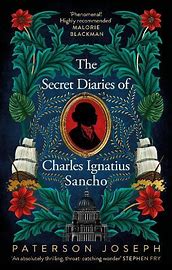


Aysin Kulin – Without a Country
The context here is fascinating – in the early days of Hitler’s regime, German Jewish scientists find opportunities in Turkey, where Ataturk is modernising the universities, through the Emergency Association of German Science Abroad, founded in Zurich in 1933 by a German emigrant, Philipp Schwartz. These German emigrés’ safe haven has indeed saved their lives, but they are not as welcome as it first appears. Kulin’s narrative takes us through the subsequent generations, as political tensions in their adopted homeland, as well as anti-semitism, challenge their sense of belonging.
Jennifer Nansubuga Makumbi – Kintu
I’ve read some other Makumbi – The First Woman, and her short story collection, Manchester Happened. Kintu was her debut, and it’s a family saga that takes us from the 21st to the 18th century and back again, through different generations of a family living with a curse. Its scale doesn’t ever get in the way of the characters living and breathing, and it’s a compelling read. It can be read as the story of a nation but fundamentally it is the story of a family, whose homeland changes shape over the centuries and whose fortunes change accordingly.
Livi Michael – Reservoir*
I’ve loved Michael’s other adult novels – most recently her War of the Roses trilogy – and this is exceptional. Much of it is set at an academic conference, but one where the various papers that are presented, of which we read substantial chunks, are gradually, directly or indirectly, exploring a mystery from the childhood of two of the delegates. The themes are responsibility – in the legal and moral sense, guilt, secrets and lies. Notwithstanding the setting, it never feels ‘academic’, rather, it is as gripping as a thriller.
Denise Mina – The Red Road
The fourth of Mina’s Alex Morrow series, and this one is particularly complex and compelling. Mina’s world is a bleak one, and as in so many of her books she fills out the lives that we often prefer not to see or think about, as well as, in this novel particularly, those in positions of influence and power. Alex herself is entirely believable – she’s encumbered not with some quirk or interesting flaw but with kids and family life – and imperfect, but hugely sympathetic.
Ann Patchett – State of Wonder
There are strong echoes of Heart of Darkness in this tale of a woman sent by her pharmaceutical company employers to track down a researcher deep in the Amazon rainforest, and find out what happened to the previous person sent on that same quest. The plot switches rapidly from the mundane misfortunes of travel (Marina’s luggage goes repeatedly AWOL) to the life-threatening hazards of that environment and some of its inhabitants, and to issues of science and ethics. It’s fascinating and engaging.
Louise Penny – A Rule against Murder/How the Light Gets In
The fourth and ninth Inspector Gamache novels, with the series’ trademark mix of (almost) cosy and very dark.


Charlotte Philby – A Double Life
One woman leading two lives, trying to keep them separate, seeing them inexorably head for collision, whilst another woman digs for the truth behind something she thought she had witnessed. Neither is heroic, nor entirely likeable, but Philby manages her plot with skill and it grips right to the final page. And yes, Philby is the daughter of one Kim Philby, who knew all about double lives…
Ian Rankin – A Heart full of Headstones
Rebus is weary and unwell, and his past dodginess (he was never bent but he did bend the rules) is catching up with him. Siobhan is tired too and not just tired of having to manage Rebus’s interventions in the cases she’s working. It feels as if the series is drawing to a close – one more book in Rankin’s deal with his publisher – which feels right and timely. There are series in which the protagonists never seem to really age, or lose heart, or get sick (looking at you, 87th precinct) and Rebus has always been far too real to go on forever, without consequences. It’s a fine addition to the series, whether or not it is the penultimate.
Jane Rogers – Conrad and Eleanor
As the Guardian puts it, ‘In its every cell this remarkable novel reproduces the dialectic of a long marriage’. There is more to it than this, with a plot (sub-plot?) relating to Conrad’s work in an animal laboratory, but it is the relationship between them (is it doomed? Dying? Or is there still something profound there?) that fascinates.
William Gardner Smith – The Stone Face*
This is a very remarkable novel, whose existence I was unaware of for a long time, and of which I was then unable to find a copy. Smith was a black American writer, based for a long time (like many others, James Baldwin in particular) in France, and this novel explores the experience of the African-American in Paris, and the nature of racism, in relation to the Algerian/North African community, culminating in an account of the 1961 massacre of demonstrators by the Paris police. That latter event has been something of an obsession of mine, ever since watching Michael Haneke’s film, Caché, in which it plays a small but very significant role. The massacre’s significance lies in part in the highly effective cover-up, so that it is only in the last few decades that it has been widely known about, and in the fact that the head of the Paris police at the time was Maurice Papon, who had been an enthusiastic collaborator during the war, helping to organise the deportation of Jews from Bordeaux. But the novel is fascinating on many levels and it’s good to see that it’s now available in paperback.
Elizabeth Strout – Amy and Isabelle
I’ve been devouring Strout’s novels for the last few years, but not in any particular order – this one is her debut and it is tremendously assured. The relationship between daughter and mother, and the crisis in Amy’s life which shakes that relationship to its foundations, are beautifully drawn.
Nicola Williams – Without Prejudice
A legal thriller by a black British lawyer, first published in 1997 and reissued now through Bernardine Evaristo’s Black Britain: Writing Back initiative. It’s a thriller in its own right, with a twisty plot that skewers corruption in the legal profession, but it’s also an account of what it is like to be a black lawyer in the British judicial system. The protagonist’s experiences (being assumed to be the defendant, for example) reminded me very much of Alexandra Wilson’s memoir, In Black and White, just in case any one was thinking that things must have massively improved in the last quarter of a century…


Poetry
Poems inspired by the death of Faber’s wife Eva, from cancer. Some were written during her illness, others after her death. These are tough to read. There’s no sentimentality here, the poems confront the brutal physicality of the illness and of death itself. That can be shocking but also a relief, in a way, to see it there on the page, not shrouded in euphemism and piety.
Samuel Fairbrother – A Promenade
The latest publication from Pariah Press, this is poetry written in direct response to music (Shostakovich’s String Quartets) and to be read alongside that music. The performance which inspired Fairbrother took place on the day that Russia invaded Ukraine, and that event is also present in the poetry and, somehow, in the music.
Non-Fiction
Peter Bradley – The Last Train: A Family History of the Final Solution
Bradley didn’t know, until his father died, that the man he’d known as Fred Bradley was/had been Fritz Brandes, and that the family story was a story of the Holocaust. Bradley charts his father’s journey to survival, and finds the traces of the family members who were murdered, setting those individual narratives in the context of what was happening to millions of others across Europe.
Sarah Churchwell – The Wrath to Come: Gone with the Wind and the Lies America Tells
A while back one might have thought that this book’s passionate arguments were a bit overwrought or unnecessary – surely we have moved on? But the Confederate myths have all resurfaced in recent years, the flag is everywhere, and those who carry it are often no longer hiding the racism that is an inescapable part of the mythology. Churchwell uses Gone with the Wind (primarily focusing on the book, though with a lot of interesting insight into how the film sanitised some of the book’s breathtaking racism) to forensically examine those myths and their contemporary impact.
Steve Davis & Kavus Torabi – Medical Grade Music
This is a delight. I always enjoy being in the company of people who are enthusiastic about music, even when I don’t share their particular passions. Both Davis and Torabi are engaging writers, and have led me back to CDs in my own collection (Henry Cow’s Legend, for one) through their infectious excitement about them.
Hanna Flint – Strong Female Character
I wasn’t quite expecting the strongly autobiographical and very personal focus of this book, but Flint uses that focus to explore how the movies deal with women’s lives, how they address sex (solo and with partners), body image, our relationship with food, working life, race, friendship and love. It’s fascinating, and with lots of unexpected insights.


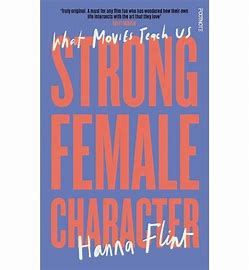
Angela Harding – Wild Light: A Printmaker’s Day and Night
One hundred illustrations – prints, drawings and photographs – illustrating, as the title says, a day and a night. Harding’s images are beautiful and the book is a joy.
Katy Hessel – The Story of Art Without Men
Beautiful, both in terms of the images, and the accounts of so very many women artists through the centuries, many of whom have never had the place they deserved in art history. As Tracy Emin said, it won’t restore the balance on its own, but ‘this is a good start’.
Jill Nalder – Love from the Pink Palace
Jill is the real-life version of her namesake from It’s A Sin. Many of her memories of the young gay men who she loved, lived with and watched – in too many cases – die, made their way into the series, along with creator Russell T Davies’ memories of the same period. The atmosphere of the time comes across incredibly vividly in Nalder’s account, which is moving, funny and horrifying.
Helen O’Hara – Women vs Hollywood: The Fall and Rise of Women in Film
Where did the women directors of the very earliest days of cinema go to? Why did they stop getting hired, or funded, and why has it taken a century to get back to anything resembling the prominence of women in the industry in those earliest days? O’Hara’s fascinating account is passionate, meticulously researched, and engagingly written.
Nicholas Shakespeare – Six Minutes in May: How Churchill Unexpectedly Became Prime Minister
One of the aspects of WWII about which I knew very little was the Norway campaign. I recently watched the film Narvik, which gave a pretty accurate portrayal of part of that campaign, which was not, really not, our finest hour. However, despite that, and despite Churchill being to a significant degree responsible for the failure of that campaign, it was instrumental in ensuring that Chamberlain resigned and Churchill became PM. Shakespeare’s book takes the reader through a day by day – and sometimes minute by minute – account of what was happening, in Norway, and in the House of Commons, informed by the recollections of his great-uncle Geoffrey, who was there (in the HoC). There was so much here that was new to me, and it was even more gripping when I realised at several points that I was reading it on the exact 83rd anniversary of those events.
Paul Thompson and John Watterson – Beware of the Bull – The Enigmatic Genius of Jake Thackray
I can’t remember how we got into Thackray – we probably saw him on TV, and then got an LP or two. I know we used to be reduced to tears of laughter by some of those songs. There’s almost always an element of melancholy though, as funny as they are, and some darkness too. This biography makes some sense of all of those elements and took me back again to the songs. It hurt a little bit though, to be laughing at ‘The Statues’ all on my own.


Thanks to all of the writers who have entertained, diverted and informed me, who have expanded my horizons, taken me to places I have never been or could never go, shown me lives very different to mine and enabled me to connect with them.
Ordinary People – Holocaust Memorial Day 2023
Posted in Genocide, History, Second World War on January 27, 2023
One of my first posts when I started this blog in 2012 was to mark Holocaust Memorial Day. Each year after that – until last year, for reasons which may be obvious from some of my other recent posts – I wrote about some aspect of the Holocaust. Looking back I can see how much research went into those posts, how hard I tried to do justice to a subject which is both impossible and imperative to write about.
I haven’t done that research this year, but the 2023 theme, Ordinary People, is reflected in a number of my past posts. I have often touched on how the complicity, indifference or obliviousness of ordinary people, the collaborators and bystanders, was essential to the achievement of the final solution, as it is to all genocides. But I’ve also talked about, and named, some of the ordinary people who died in such unthinkable numbers, in mass shootings, in gas chambers, through starvation and exhaustion, through disease, and some of those who survived. And there are others too, the ordinary people who did not stand by, who gave a damn when it wasn’t their turn and when it would certainly have been safer to look the other way.
It’s a subject to which I have returned over and over again, in my reading and my watching. It was a major theme in my doctoral research. My very first HMD post tried to explain why I have needed to keep returning, when I have no direct personal connections to those events. But leaving aside my early encounter with a different genocide, I study the Holocaust because it addresses so profoundly and in so many ways what it is to be human, and what being human might mean at its worst and its best.
This year three documentaries have brought new light to bear on those events.


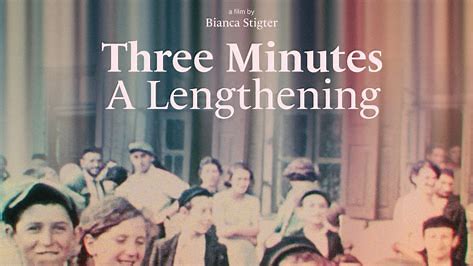
The first, The US and the Holocaust, focuses as the title would suggest on the role of the USA, and the glaring disparity between the Statue of Liberty’s claim to offer refuge to the ‘tempest-tossed’ and its refusal to help the Jews of Europe. Had the immigration quotas been waived, had more visas been offered before war broke out, before the Nazis blocked all means of escape, how many could have been saved? What is clear is that the reason for this obduracy in the face of the known facts was anti-semitism, and the fear of fuelling anti-semitism by allowing an influx of Jews. We followed the efforts of some ordinary families, with relatives already in the US, to get visas, and the fate of those who did not get out in time. This was an exemplary documentary, which made excellent use of archive footage and contemporary interviews, and balanced the institutional with the personal to moving effect.
How the Holocaust Began‘s mission was to show the chaotic and spontaneous beginnings, before the death camps, before the gas chambers. The focus on Auschwitz as the symbol of the Holocaust obscures the fact that millions were already dead before it began operation, in mass shootings at sites such as Babi Yar in Ukraine. It began even before the Einsatzgruppen, the units who had been specifically tasked with clearing the newly invaded territories of Jews and other despised categories of humanity, arrived on the scene. Clearly the local commanders knew that their actions would be approved, and were enthusiastic about what they were doing. The programme also looked at some of the research now being undertaken to identify the sites of mass graves and some of the people who were murdered. (See Wendy Lower’s book, The Ravine: A Family, a Photograph, a Holocaust Massacre Revealed, for one such project.) Ordinary people lying in those mass graves, and ordinary people who colluded or participated directly in their murder.
Three Minutes: A Lengthening embodies this year’s HMD theme in the most powerful way. It begins with three minutes of amateur film, no soundtrack, no commentary. People milling around in a town, drawn to the man with the film camera, jostling and waving and smiling for posterity. One year before that town was invaded, and its inhabitants rounded up in the square and deported to ghettos and thence to Treblinka. This bit of film was discovered, providentially, just before it would have been lost, either destroyed, or to the process of decay. The documentary shows how the location of the film was identified, Nasielsk, in Poland, and how the testimony of one survivor (Nasielsk’s pre-war population was 7,000, of whom 3,000 were Jews, and of whom only 100 survived) enabled the identification of a handful of the people we see. If we saw this clip without knowing its context, we might wonder what became of them all, but the horror of this is that we do know, they are Jews, and they are in Poland and it is 1938. The film, which we see repeatedly over the course of the programme, gives the 150 people who appear in it just over an hour, from those three minutes. Watching it is a profound experience.
As much as I have read and seen, I still feel that sense of shock. I hope I always will.
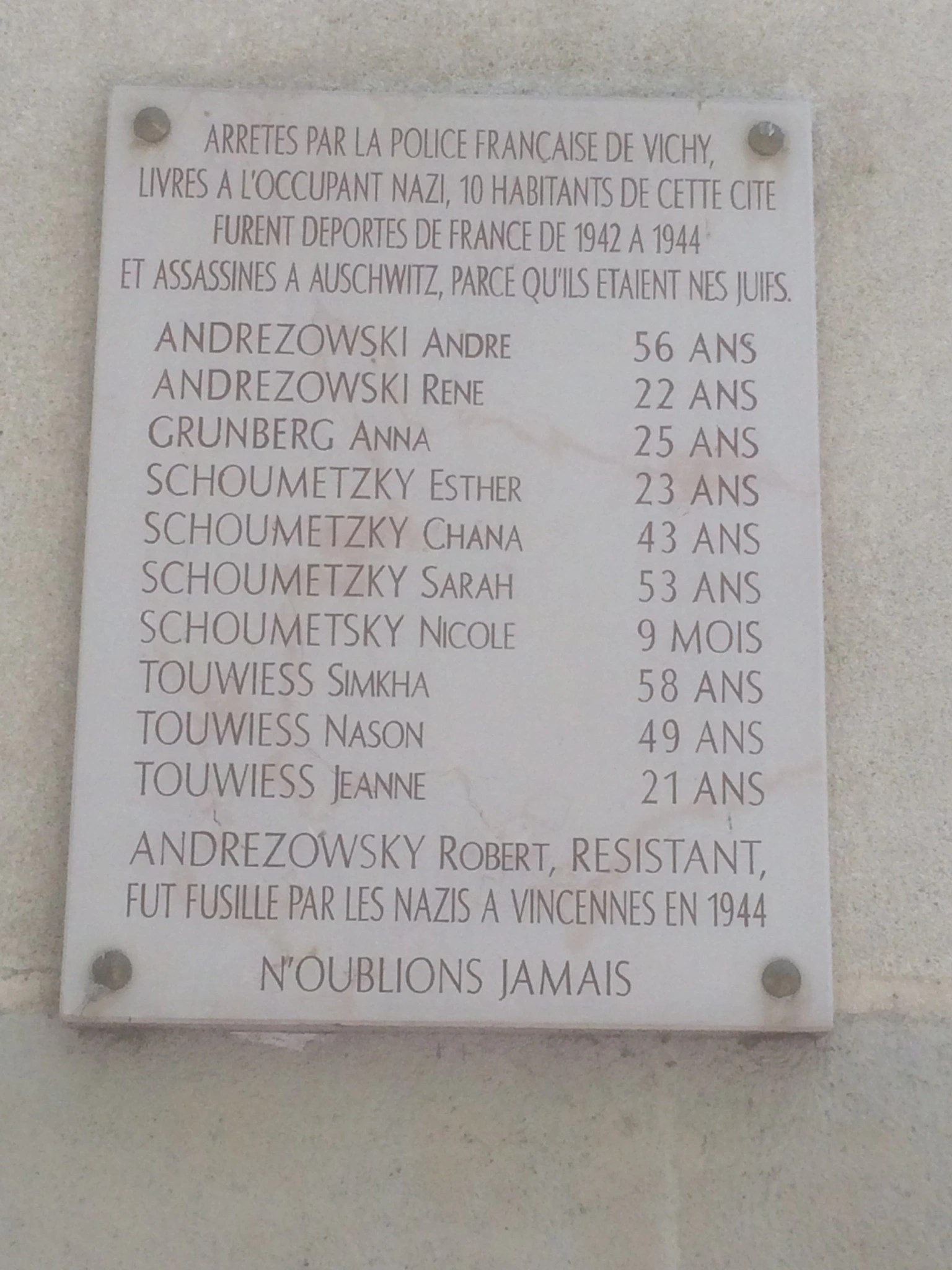


Ring out the old, ring in the new
Every week, for the last three and a half years, I’ve posted on Facebook about ‘Good Things’. This isn’t a ‘let’s not talk about the bad stuff’ exercise – it acknowledges, explicitly, that the reason I’m doing it is because there is a lot of bad stuff, globally and personally, and it is thus important sometimes to home in on and hold on to the good that is there, even if that good stuff seems rather small and trivial in comparison to war and climate change and poverty and everything. It’s not ‘always look on the bright side’ so much as ‘always look for the bright moments’. Older readers might think of the 1913 children’s book Pollyanna, whose central character is known for being relentlessly cheery at all times. Whilst this can be rather cloying, and I would refute the notion that there is something good to be found in every situation, the idea that it is healthy to remind oneself that there are good things is a valid one. Which is why I’ve kept those posts going, and why they invariably get likes and comments, and people urging me to continue.
It’s certainly not as if the period during which I’ve been doing this (and there were sporadic efforts before, my ‘reasons to be cheerful’) lent itself particularly to optimism, on any front. The world has been going to hell in a handcart faster than ever, it would seem. And on a personal level, when I posted my first ‘Good Things’ my youngest brother was terminally ill with cancer. He died the following February, just before the pandemic deprived us of so many of the things that might normally bring us comfort in hard times. Then, of course, in October 2021, I lost my husband. He died less than 24 hours after I’d posted that week’s Good Things, and when I re-read it I realised that despite the horror of what had happened, I stood by everything I’d said. Those good things were real and true and not invalidated by the huge Bad Thing that had engulfed us. So I’ve carried on.
It’s hard to find much on the national or global scale to celebrate – at most, some things didn’t turn out quite as badly as we feared (the US mid-terms, notably). Our government was incompetent and corrupt, chaotic and callous, as we’ve come to expect, and the usual people are suffering as a result – don’t be poor, don’t be disabled, don’t be old, don’t be sick, and for heaven’s sake, don’t be a refugee… Conspiracy theories, whether about climate change or vaccines or anything else one can think of, seem to be multiplying and spreading more rapidly each year, not helped by the takeover of Twitter, already an excellent breeding ground, by a leading conspiracy theory enabler and exponent. Ukraine is still suffering under – and fighting back against – the Russian invasion. Women in Afghanistan are shut out of the universities. It is easy to despair.
Of course there are always good people standing up for the vulnerable. The RNLI will carry on risking their members’ lives to save those whose dinghies are capsizing in the Channel. Food banks will continue handing out essentials to families who can’t make ends meet. Individuals and organisations will continue to provide safety nets, to challenge bigotry, to tell the truth and to shame (or at least try to shame) the powerful into using their power for good, and the brave will stand up anyway, in Iran and Afghanistan as in so many other places, whatever the risk.
In my own life, despite the sadness, I’ve had good things.
I got a new knee in February and (after a short but tough period of recovery) that gave me the confidence to be braver and more adventurous than I would have done otherwise. I went to Wembley to the Championship Playoff final, with my son. (The football has actually been a Good Thing in 2022, the first year for decades when I could have said that.) I went to Progfest with my brother in law and to the Tramlines music festival, with my son and with friends. I travelled to Rome, on my own (but was met by my brother, with whom I stayed). I would have done none of those things without the op, I would have been too scared, not only of the pain, but of my knee suddenly refusing to bear my weight, or of falling. That fear nearly paralysed me when he died – I could see myself so easily becoming virtually housebound, dependent entirely on others to get around, and that hasn’t happened.


I have needed more help this year, especially without a car or someone to drive it, and I’ve always found the help that I’ve needed, sometimes by asking very directly for it (anyone taller than me – i.e. most adults – entering the house is likely to be greeted on the doorstep with a request to change a light bulb or lift something down off a high shelf), at other times because some nice young man or woman has seen me struggling with a suitcase or whatever and has offered assistance. I’ve also found someone to help me with the cleaning, someone to help me with the garden, a handyman and a decorator.
I finished the PhD, submitting just over a week before he died, and had my viva in May. I’m very proud of the thesis, and I absolutely could not have done it without his support, in big ways and small – so many times I was writing away, lost in my work, only to realise that he had snuck in, delivered a hot cup of tea or coffee and snuck out again, without breaking my train of thought.
I’ve been to the theatre, to a stunning production of Much Ado, by Ramps on the Moon which used its cast of (mainly) deaf and disabled actors inventively and boldly, and tweaked the text accordingly. Much Ado works or doesn’t depending on Beatrice and Benedick, and here both were outstanding and unforgettable. The Guardian reviewer described Daneka Etchell (who is autistic) as ‘the most compelling Beatrice you might ever see’, and she was responsible for an extraordinary scene, when, in her distress at the injustice being inflicted on Hero, she starts stimming. Both her anguish and Benedick’s tenderness in trying to help calm her were very moving.
We very much enjoyed a performance by Under the Stars, an organisation who we supported with Martyn’s memorial fundraiser, who are an arts and events charity for people with learning disabilities and/or autism, running music and drama workshops and nightclubs. The play was The Many Journeys of Maria Rossini and it used words, music and dance, exuberantly and engagingly, to tell the story. Under the Stars band also performed at Tramlines.
Final theatre outing of the year was to Richard Hawley’s musical Standing at the Sky’s Edge, which we’d somehow missed when it was first produced at the Crucible in 2019. We loved it. The musical weaves together the stories of some of the inhabitants of Sheffield’s Park Hill flats, over five decades, telling those stories through some of Hawley’s songs. The action is beautifully choreographed, the singing is marvellous, and it builds to a very moving climax. Obviously this piece has special relevance and resonance for Sheffielders, but it goes beyond that – every major city has communities like Park Hill.
I’ve done my usual summaries of what I’ve read and watched over the year. As far as listening to music at home goes, I’ve tried to develop my own approach to music nights, which were so much about our shared enjoyment of music that initially I couldn’t see at all how I would do it. Now, I pick a few things over the course of the week, prompted by someone mentioning an artist or a band, by an artist’s death, or some other kind of event, just so that I don’t get paralysed by the vast choice when I look at our CD wall. I listen when I can to the Radio 3 weekend programmes we used to love, to Inside Music, Sound of Cinema, Music Planet, J to Z, Jazz Record Requests, and these also often suggest what I listen to from our collection.
Highlights amongst the music that I’ve heard live this year:
- Beethoven String Quartets plus a piece by Caroline Shaw (‘Entr’acte’), in a Music in the Round concert which I sponsored in Martyn’s memory, at the Crucible in May
- Focus, the highlight of the Progfest in April. Still led by Thijs van Leer, who may not be able to reach all the high notes these days but is still a great performer, and the band (which included Pierre van der Linden, another veteran) was great and of course the music brought back so many memories of listening with Martyn.
- Jazz Sheffield gigs from Laura Jurd, Zoe Rahman and the Espen Ericksen Trio with Andy Shephard, all excellent.
- Tramlines highlights: my old favourite, the Coral, and new favourite, Self Esteem.
- A rare orchestral concert, at a great venue, the Auditorium in Rome: Gershwin, Bernstein and Stravinsky.



Last New Year’s Day was one of the hardest to wake up to in all of the days since he died. Knowing that I was about to start on a year without him, the first year without him since 1973… It was bleak. Perhaps, whilst this NYE/NYD will acknowledge the sadness, it may be easier. I hope it will be less bleak, less raw.
So, allons-y to 2023. I will formally graduate (for the last time, definitely, categorically) on 11 January, and my next project will be to look for a publisher for a version of the thesis. I’ll have chapters published in two forthcoming books, both on W G Sebald. I’ll travel, to see friends in Scotland, to see family in various parts of the country, maybe a city break in Europe. I’ll go to two family weddings. I’ll finish phase 2 of the decorating, maybe even phase 3. I’ll carry on sharing the cultural riches of Sheffield with friends and family.
Without being Pollyanna-ish, I do know how very lucky I am, to be surrounded by people who want to and do help me, emotionally and practically. I am thankful for them, every day.
For you, I wish for health and strength, for peace and comfort, for love and support.
In 2023 I wish, of course, for a world without war, a world where people are not persecuted for their beliefs, or simply for who they are, a world where women can be safe on the streets and in their homes. I wish for action on climate change, before it’s too late. That’s a lot, I know.
But as we go into another new year I think, as always, of this poem, which gives me hope.
2022 Reading: Full-time Report
Posted in History, Literature, Personal, Second World War on December 16, 2022
I’m still not reading as much as I used to. It’s the silence that’s the problem. Lord knows I used to tut sometimes when I was reading and he broke my train of thought with his own train of thought, but Lord knows I would love to have him do that now. So I turn to the TV sometimes when in the past I would have turned to a book, just to break the silence. Nonetheless, I’ve still normally got two or three books on the go – one on the Kindle and a couple of physical books, usually one fiction and one non, and nonetheless it’s still quite an eclectic list. As always, I haven’t listed absolutely everything – I want to share my enthusiasms rather than my disappointments – and as always I have tried to avoid spoilers but make no guarantees. Top reads this half-year? Jan Carson’s The Raptures, Abdulrazak Gurnah’s Afterlives, David Park’s Travelling in a Strange Land. From the first half of the year, I’d pick out Alan Garner’s Treacle Walker, J L Carr’s A Month in the Country, and Sarah Moss’s The Fell. Since I make the rules for this blog, I shan’t require myself to choose amongst those six titles.
Fiction
Pat Barker – The Silence of the Girls
This, and its sequel The Women of Troy (which I have yet to read) tell the familiar story (familiar not only from Homer but from countless retellings – in my case the first encounter was with Roger Lancelyn Green’s Tales of the Greeks and Trojans and The Luck of Troy) with the focus shifted to the women. In this one, the central role is that of Briseis, handed over to Achilles, appropriated by Agamemnon and retrieved by Achilles, all as part of the spoils of war. It’s a grim tale, beautifully told.
Thomas Bernhard – The Loser
Sebald and Bernhard are often linked, and I figured it was about time I gave the latter a go. The choice of book was a foregone conclusion once I discovered that The Loser was about (in part) Glenn Gould, who fascinates me. There are elements of the style that certainly recall Sebald (any influence was from Bernhard on Sebald) – the novel, like Austerlitz, is one unbroken paragraph, and the narrator’s voice constantly makes it explicit that these are his thoughts, and when he was thinking them (‘I thought, as I entered the inn’, ‘I thought in the inn’ , ‘he said, I thought’, etc) which reminded me again of Austerlitz.
Frances Hodgson Burnett – The Shuttle
I adored The Little Princess and The Secret Garden as a child (never read Fauntleroy, as far as I can recall) and this adult novel was a delight too. It’s quite Gothic in places, but punctured with humour, and with a hero (Bettina) who shines from the pages. The theme is intermarriage between British aristos (broke, with run-down country estates to maintain) and wealthy American heiresses but it’s also a very perceptive (based on first-hand experience) account of coercive control.
Jan Carson – The Raptures
This is stunning. I had no idea for most of it where it was heading, what the answers to the questions were going to be, and indeed ultimately there were no firm answers. But it grips on every page, its characters live and breathe, even when they’re no longer living and breathing. It’s a supernatural mystery, a who (or what) dunit, an allegory about plague and pandemic, a coming of age narrative, a portrait of a small Protestant Northern Irish community. Never mind all that, just read it.
Ann Cleeves – The Rising Tide
A new Vera! I wasn’t sure Cleeves was still writing Veras. Anyway, very pleased to get this and it’s as enjoyable as ever.
Robert Galbraith – Ink Black Heart
Oh dear. I have enjoyed all of the Cormoran Strike books so far, although few of them need to be the length they are. But this one desperately needed an editor to tell her to slash great chunks of the book so that it’s coherent, and particularly to cut back the use of verbatim online conversations (three columns of different conversations, going over several pages) which are incredibly hard to read and to follow. There’s also the issue of the subject matter – online abuse – and its proximity to the author’s life on Twitter and other social media over recent years. I think it’s too close for her to be able to examine that world with any objectivity and the book is a mess.


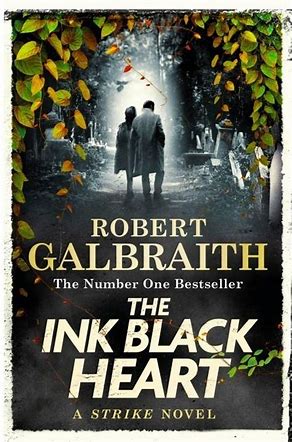
Elizabeth Gilbert – City of Girls
I read The Signature of All Things a few years back and loved it. Still haven’t read Eat Love Pray or whatever it’s called, fairly sure that would not be my cup of tea. But she’s a lovely writer – City of Girls is captivating, and very witty, it sparkles like one of those screwball comedies from the era in which the book is set. And then the tone shifts, and whilst it’s every bit as witty it’s also darker and deeper and very moving.
Graham Greene – The Quiet American
I honestly thought I’d read all of Greene, many years ago (he was a favourite of my mum’s). But this one had eluded me and it’s a fine example of his style and of his preoccupations.
Elly Griffiths – Bleeding Heart Yard
This is Griffiths’ third novel featuring detective Harbinder Kaur, now relocated in that London, and it is hugely enjoyable. As always with Griffiths, the characters are drawn with humour and affection (mostly), and with compassion and insight.
Abdulrazak Gurnah – After Lives
Gurnah was awarded the Nobel Prize for Literature in 2021 but his name had never registered with me. I shall put that right now and read his other books, because this one was excellent. Set in what is now Tanzania, in the early 20th century when the area was a German colony, it sweeps across that century, through the first and second world wars, the shifting boundaries and colonial rulers, but is always centred on the lives of a handful of characters who are battered, in different ways, by these forces. Despite the scale and the horror of what is unfolding, it manages to be, in relation to these people, gentle and subtle and, somehow, hopeful.
Yaa Gyasi – Transcendent Kingdom
I’d read Homegoing a couple of years ago, an epic family history that begins in Kumasi, Ghana, and crosses continents and centuries. The scale in Transcendent Kingdom is much smaller, although it still reaches back to Kumasi, but the central family is contracting rather than expanding (as the narrator says, “There used to be four of us, then three, two. When my mother goes, whether by choice or not, there will be only one”. Its concerns are philosophical, scientific even, as the central character is a neuroscientist, her research intimately connected with her family’s tragedy.
Robert Harris – Act of Oblivion
After Cromwell’s death, those who signed King Charles’ death warrant are on the run, and supporters of the new King are determined to track them down. Harris cleverly builds the tension but also gives us insight into both sides, so we as readers have to keep switching our perspective, as we are with first the regicides and then the manhunter, and we see how both are driven by the absolute certainty that they and their cause are absolutely right.


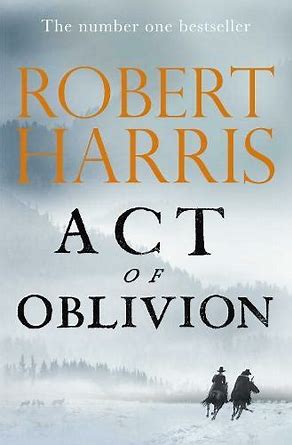
Mick Herron – Live Tigers/Spook Street
The third and fourth of the Slough House novels and they’re as sharp and funny and dark as ever. I look forward to reading the rest of the series, and to seeing the dramatisation of the second book – Gary Oldman has a marvellous time as Jackson Lamb, really letting rip, in every sense.
Tayari Jones – The Untelling
Secrets and lies and their toxic effects upon relationships are the theme here, and Jones is perceptive and subtle in her portrayal of Aria(dne) and the small circle of people who matter to her.
Stephen King – Fairy Tale
This resembles his 1984 collaboration with the late Peter Straub, The Talisman, more than it does his most recent spate of novels. That’s deliberate, I’m sure – King often makes references to his other books, sometimes in passing, sometimes to create resonant connections (see his various books set in or around Castle Rock, for example), and there are some nice echoes here. He and Straub had talked about another collaboration, although it had never got off the ground, so maybe we can take this as a tribute. It’s King on top form, in any case.
John le Carré – Silverview
Ah, the last le Carré. Edited by his son, from what was a virtually complete manuscript. It’s not the best le Carré but it’s bloody good le Carré and it has the melancholy and the anger that have characterised his work in later years.
Attica Locke – The Cutting Season
A stand-alone from Locke, after her two excellent short series of crime novels. This is crime that drags one back into the past, the slavery past, and it is tense and gripping stuff.
David Park – A Run in the Park/Travelling in a Strange Land
Beautiful writing. A Run in the Park is the gentler read, although there’s plenty of emotional heft in there. Travelling in a Strange Land goes to dark places but in both books there is always darkness and light, loss and love, grief and hope.


Sara Paretsky – Tunnel Vision
The eighth in Paretsky’s excellent detective series, featuring PI V I Warshawsky battling corporate crime and corruption. I’ve read these in random order as I got hold of them, so at some point I will try and fill in the gaps.
Ann Patchett – Bel Canto
My first Patchett – this is compelling and often moving. It’s about a terrorist attack, and the fate of the hostages, but its also about love, beauty and music.
Louise Penny – The Madness of Crowds
Inspector Gamache series, no. 17, the most recent. As with the Paretsky, I’m reading these in a totally random order, so there are references in this one to events which I don’t yet know about, but the main plot stands alone. As always with Penny, there are times when Three Pines seems just too magically cosy but she always undercuts that with the crime and its motivation, which are anything but.
Bapsi Sidwha – The Ice Candy Man
Many years ago I read Sidwha’s debut novel, The Crow Eaters, which I remember loving even if its plot has faded from my memory. The setting is Lahore, once in India, then allocated to Pakistan at the time of Partition. The Ice Candy Man (also published as Cracking India) starts in the period leading up to Partition and confronts the horrors of what happened, through the eyes of a child, who at first has no real notion that the different communities (Sikh, Parsi, Muslim, Hindu, Buddhist, Christian) are potentially a threat to one another. Indeed, her home is a place where people from these communities meet and bicker and insult one another in a largely friendly way, and when violence is predicted insist that they will stand by their friends. We see things through Lenny’s eyes, not all of which she understands, not all of which adults are prepared to explain to her. It’s unflinching, but also often funny and touching.
Zadie Smith – White Teeth
I struggle with Zadie Smith and am still trying to work out why. Her characters never quite seem to live and breathe, as if she’s at too much of a distance from them to really bring them to life. This, her debut, didn’t change my view, unfortunately.
Russ Thomas – Nightwalking/Cold Reckoning
Parts 2 and 3 of Thomas’s Sheffield-based trilogy which began with Firewatching. Excellent plotting and interesting, complicated lead characters.


Anne Tyler – Redhead at the Side of the Road
I hadn’t read any Tyler for ages, not since being so disappointed with Vinegar Girl (kind of a take on Taming of the Shrew, but it really didn’t work). But I have read most of her stuff, and I love most of her stuff (top two are Saint Maybe and Breathing Lessons, I think). This one is a lovely variation on ‘a perennial Tyler theme: the decent, mundane, settling-for-less kind of life whose uneasy decorum is suddenly exploded by the random, the uncontrolled, the latent sense of what might have been’, as The Guardian’s reviewer put it.
Non-Fiction
Molly Bell – Just the one Ice Cream?
I read this account of widowhood, by a family friend, a few years back when it was first published. Reading it again now was a remarkable experience – so many of Molly’s observations are ones that I can relate to – I kept thinking ‘Yes! Yes, that’s it!’. It’s insightful, honest and warm.
Sarah Churchwell – The Many Lives of Marilyn Monroe
Having felt rather grubby after watching Blonde I thought this would be a good antidote. It’s the story of the stories of Monroe’s life, of the clichés and stereotypes, the biographies and memoirs and attempts to uncover the ‘real’ Monroe. It’s incisive and rigorous and fascinating. It was published before the film of Blonde came out, but includes Joyce Carol Oates’ novel in her analysis, along with Norman Mailer, Arthur Miller and a host of lesser lights whose accounts have been published over the years.
Laura Cumming – On Chapel Sands: My Mother and other Missing Persons
A very intriguing memoir/detective story. Cummings gradually reveals the secrets of her mother’s early life, and at each step shows how she had to reevaluate everything she thought she knew, and her understanding of the people involved. If it were fiction it would be a great read but it gains depth through the knowledge that it is a true story – it’s deeply personal, and terribly sad.
Mike Duncan – The Storm before the Storm
The rise of the Roman Republic, as Duncan tells it, was the beginning of its fall. Fascinating, accessibly written account.
Sebastian Haffner – Defying Hitler: A Memoir
Haffner (real name Raimund Pretzel) wrote this account of Germany in the First World War, the Weimar Republic and during the rise of Nazism, in 1939, after he had emigrated to England. It was only published in 2003, having been left unfinished, as Haffner worked on his less personal account, Germany: Jekyll and Hyde, and was collated for publication by his son. It is therefore written without hindsight, at least without the knowledge of what lay inexorably at the end of the Nazi road, and thus its insights are fresh and passionate, exploring how Germans came to choose Hitler.


Sudhir Hazareesingh – Black Spartacus: The Epic Life of Toussaint Louverture
Epic is right. An extraordinary man, with an extraordinary life and achievements, which resonate to this day (as I was reminded in the cinema the other day, watching Wakanda Forever…)
Hans Jahner – Aftermath: Life in the Fallout of the Third Reich, 1945-1955
An excellent study, exploring many aspects of the post-war period, and taking the story further, beyond the bomb sites and the hunger, to recovery, and division. He draws on a number of memoirs, often from women, which shed light on daily life, on culture and politics, on work and money. It’s rigorous but entertainingly written, often with a wry humour.
Michelle Obama – Becoming
Great stuff – she writes interestingly and engagingly, about her life before she hooked up with Barack as well as showing us his presidency from her perspective and that of the family. I would have liked to hear her account of the years after his presidency ended – maybe another volume will be forthcoming…


My reading this year has taken me out of my own time and place and as always I feel enriched by it, I feel my sympathies have been extended, as George Eliot puts it. I’ve been entertained as well as educated, often at the same time, and I’ve been moved to both laughter (laughing out loud is something I do too little of these days, living alone) and tears (well, no shortage of those, nor any surprise to those who know me, even before recent losses). I am deeply grateful to all of the writers with whom I’ve shared 2022 and who, in their various ways, have helped me through it.
2022 On Screen: Full-time Report
Posted in Film, Television on December 16, 2022
The usual caveats and footnotes. I try to avoid spoilers but you take your chances if you read on. I haven’t listed things I watched that were just a bit rubbish in an uninteresting way. I’m still watching more than I ever used to before he died – the TV brings human voices into my home, which would otherwise be far too quiet much of the time. I do still read a lot too, but the balance between the two has certainly shifted, whether permanently or not it is too early to say. I haven’t included ongoing series which featured in the half-time report, unless there was something significant to add. I’ve noted which of the films I saw at the cinema rather than in my living-room via streaming services, only to mark the gradual return to the cinema over the last year or so, and in recognition of the very different experience that this represents. And I’ve asterisked the best stuff, though to pick a film or TV series of the year would be too difficult, given the range of genres and styles and brows.
Film
All Quiet on the Western Front (cinema)*
Superb remake of the Milestone milestone (and the ‘70s adaptation which seems to be largely forgotten – I haven’t seen it so can’t say whether or not that’s deserved). It is faithful to the book apart from introducing a narrative strand showing the negotiations leading up to the Armistice, which is very powerful, and there is a stunning opening sequence that is both shocking and moving.
Benediction*
This is a fine, beautiful film. I read the WWI poets at school and independently, and I also read Pat Barker’s Regeneration trilogy, which intersects with the narrative of this film about Siegfried Sassoon. Superb performances, beautiful soundtrack which intersperses the popular songs of Ivor Novello, amongst others, with the music of Butterworth, Britten and Vaughan Williams, very powerful and moving.
Black Panther: Wakanda Forever (cinema)*
How can they follow up Black Panther, without Chadwick Boseman? By acknowledging his loss in a very powerful way, letting it suffuse the film, not pulling any punches about what grief and loss can do to us. Of course those themes were going to resonate with me even more intensely this year, as the anniversary of my husband’s funeral loomed – but I was so glad that they didn’t do the fantasy/scifi/superhero thing of in some way undoing death, or de-stinging it. Tchalla died as Boseman did, of a regular common or garden mortal ailment which all of the medical brilliance in the world couldn’t fix. And that was right. The rest of the movie – well, it was grand, it packed probably too many ideas in (a common flaw) and not all of them quite worked, but it was visually lovely, and even without Boseman (except for glimpses in flashback) the cast is superb (inc. Nyongo, Bassett, Wright, Gurira).
Blonde
Don’t. Just don’t. This was a gratuitous and exploitative take on the life of Norma Jean Baker/Marilyn Monroe, which gave her no growth and no agency, and the viewer no insight into her intelligence, her wit and her convictions. I read Joyce Carol Oates’ book quite a few years ago and don’t remember feeling like this about it, so perhaps some of the problem is the difference between reading, where I can identify with Norma Jean/Marilyn, and watching, where I am forced into a voyeur’s role. But in any case, just don’t.
Bridge of Spies
Essentially, a Tom Hanks movie about an ordinaryish sort of a bloke who sticks to his guns and does what’s right even when everyone is telling him not to. Excellent, if not groundbreaking. I liked Rylance’s repeated refrain of ‘Would it help?’ when asked whether he is worried or afraid. And his characterisation of Hanks’ character (in this film and so many others) as The Standing Man, a man who gets up again every time he is knocked down.
Dreamgirls
Highly enjoyable fictionalised account of the Supremes’ rise to fame and Diana Ross’s rise to the lead role, displacing Jennifer Hudson’s Florence Ballard equivalent. The music, inevitably, is pastiche Motown, but very good pastiche Motown, and then there’s Hudson’s blockbuster number, ‘And I’m Telling You I’m Not Going’) which blows your socks off.



Everything Everywhere All at Once
Dr Strange’s Multiverse of Madness looks relatively sane compared to this. Michelle Yeoh is brilliant (when isn’t she?), as is Jamie Lee Curtis. I had no idea what was going on half the time, some of it was quite gross, a lot of it was very funny and ultimately it was rather poignant. Thoroughly enjoyable.
Eye in the Sky
Very, very tense. And doesn’t shirk the moral murkiness of warfare. Helen Mirren is excellently steely in the lead.
The Father
What possessed me to watch this, after spending a weekend with my father, who has dementia? I don’t know. It’s exceptionally good, of course, and the fact that it was, as one gradually realises, from his perspective, not from that of those caring for him, was fascinating and very moving.
Frances
An old-fashioned star biopic with added sleaze. Its relationship with the facts of Frances Farmer’s life seems to be tenuous at times, but Jessica Lange is brilliant. Interesting to compare it with Blonde – obviously the life stories of Farmer and Monroe have both similarities and profound differences – but despite the inevitable sense of voyeurism as we see Farmer suffer, she is shown, right until the final act, to have agency, to have some fight in her.
Harriet
Cynthia Erivo is superb as Harriet Tubman, hero of the Underground Railway. It’s an incredible story, but whilst the film obviously simplifies some things a little, it is faithful to the history, whilst leaving us to decide whether Tubman’s own belief that she is guided and strengthened by God in her work to escort slaves to freedom is right, or whether her ‘visions’ are the result of a head injury in childhood. The soundtrack, by Terence Blanchard who also did the soundtrack to The Woman King, is excellent too, and the film makes use of Erivo’s stunning voice as she uses gospel songs to communicate with the slaves on the plantation.
A Hidden Life*
Franz Katzenkammer’s life may have been hidden but posthumously he was beatified by his Church as a martyr, having been executed by the Nazis for refusing to swear the oath of loyalty to Hitler, so he has not been forgotten. And this film is a beautiful and subtle portrait of a man who, as heroes have done in every unjust and brutal regime, simply said no, this isn’t right, I can’t do it. It wasn’t just the refusal to fight for the Nazi regime, because even if he’d been given a medical corps option, that oath of loyalty would still have been required, and he couldn’t do it. It’s a long film and I started off wondering how on earth this fairly simple story could be spun out to three hours plus. But the pacing of the film was just right, and it was essential that we felt the pattern of his life on the farm, the seasons and the harvests, to know what he was risking and why.




I Came By
Well, Hugh Bonneville may not have convinced me as Mountbatten (see below) but he actually was quite convincingly sinister in this thriller, even if the plot was a bit creaky.
The Iron Lady
And another film about dementia. Why do I do this? I watched it not because of that, but out of curiosity to see how Streep played Thatcher, particularly having seen Gillian Anderson (The Crown) and Patricia Hodge (The Falklands Play) in the role recently. Streep is somewhere between the two – her Thatcher is not as odd as Anderson’s, nor as sympathetic as Hodge’s, though the scenes of her confusion are inevitably touching.
JFK
Lord, this was long. And turgid. And talky. I may have learned my lesson about Stone – he managed to make 9/11 tedious in World Trade Center and this is only marginally better. I don’t know the conspiracy theories all that well, but it seems from my minimal research that much of what he’s presenting here (via Jim Garrison) is dodgy and effectively discredited. And I can’t see why a judge would allow Garrison to expound on his theories at enormous length without tying it in clearly to the person who was actually on trial. No wonder the jury let him off. Enough already.
A Jazzman’s Blues
A labour of love from director Tyler Perry, this is a classic narrative of racism, escape through music, ‘passing’, so all of the elements are familiar, but it’s well done.
Lady Chatterley’s Lover
2022 adaptation, from Laure de Clermont-Tonnerre. I haven’t read the book since I was an undergrad (first time around) so I’m not sure how faithfully it follows Lawrence’s plot, but it has the feel of Lawrence, in its combination of earthiness, sensuality and reverence. Emma Corrin and Jack O’Connell are well cast and play it with conviction.
The Lives of Others*
Brilliant. Subtle and low-key, the oppressive atmosphere of Stasi surveillance and control is unnerving, and the character of Stasi Captain Gert Wiesler, beautifully portrayed by Ulrich Muhe, is ultimately very moving.


Loving
Ruth Negga and Joel Egerton are wonderful as the Loving couple whose marriage broke state laws in Virginia about interracial mixing and who fought this right up to Supreme Court level, and won.
The Man with the Iron Heart
Based on Laurent Binet’s novel HHhH, which I read last year, this account of the assassination of Heydrich in Prague in 1942 starts with the attack, then freeze frames and we return to the young Heydrich himself and follow him through his career before going back to the parachutists and the resistance in Prague. Because it takes this approach, there’s less time to develop the characters of the resistance members but it’s well done, nonetheless. Impossible not to compare with Anthropoid, which came out a year or so after this, and whose focus is on the resistance throughout. My one quibble with this version of events is that, for reasons I do not comprehend, it makes the son of the family who sheltered the parachutists a boy of, at most, 10/11, whereas in reality he was 17. This makes the scenes of his capture and interrogation even worse, of course, but we hardly need to make the Nazis’ crimes more hideous, given that we are about to see the wiping out of the population of Lidice.
Martha Marcy May Marlene
Proper unsettling. We have a potentially unreliable narrator in Elisabeth Olsen’s Martha – it’s a while before we get a glimpse of what her life had been before escaping to her sister, and we can’t be sure of everything we see. There’s a sense of threat remaining with her, which could just be the effects of trauma, but we can’t be sure of that either. Olsen is wonderful, and Sarah Paulson manages to get the balance between exasperation and incomprehension, and sympathy. John Hawkes is compelling in an awful way as the cult leader.
Moonage Daydream (cinema)*
This one got a lot of love from those who love Bowie, but also a lot of criticism from people who wanted Brett Morgen to make a different kind of film about Bowie. It was a visual and aural onslaught, sound and vision bombarding us with the music and the changing images of Bowie, interwoven with interview material. The latter is chronological, unlike the music and visuals, so that we get a sense of a man learning about himself, growing up in public, gradually finding a way to be at ease with himself, which was very moving.
Nope (cinema)
I loved Get Out and Us, and I am more ambivalent about Nope. It is more sci fi than horror, so I had to recalibrate a bit, as I was expecting something more like Peele’s first two movies. But I think possibly there are just too many ideas jostling for the audience’s attention here – I want to rewatch it to see if some of that comes more into focus. Performances are excellent, and there are many moments that have stayed with me, but I can’t quite grasp it as a whole.
October 1
Fascinating Nigerian crime thriller set in the weeks leading up to independence. It’s not a whodunnit, strictly speaking, since the perp is pretty easily identifiable early on. What we don’t know is why. But even that isn’t where all of the interest lies – that’s in the tensions that exist between the Hausa detective who’s leading the investigation, and the Igbo and Yoruba people who live in the area, along with a handful of supercilious Brits. The bit where one character ‘foresees’ that in seven years there would be civil war is a bit on the nose – by 1966 civil war was gearing up with coups, counter-coups and pogroms, and in ‘67 it was raging – but of course it was all too foreseeable, even if not with that level of precision.



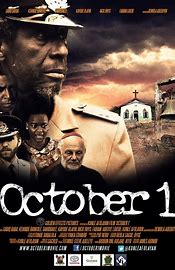
See How they Run
Highly enjoyable, very meta, Christie spoof/hommage, with an excellent odd couple pairing of cops in Sam Rockwell’s weary, boozed up Inspector, and Saoirse Ronan’s bright eyed and idealistic Constable.
Soul
Another Pixar gem. Obviously I was going to love the jazz theme, and the score, and I loved the central character (voiced by Jamie Foxx). It’s about what makes us who we are, what is the spark that animates our lives, and it’s very touching.
Spencer
The anniversary of her death meant lots of Diana-centred TV. This was very good, not a conventional or realistic biopic but a glimpse into the world of someone on the edge, who’s given up on being what her circumstances require her to be. The scenes with her and her children are very touching, and ring true. The Family are kept largely in the background (apart from a couple of scenes with the (then) PoW, played by Poldark’s Evil George, Jack Farthing). It’s interesting to compare with Elizabeth Debicki’s take in The Crown Season 5 – I think Stewart is somewhere between Debicki and Emma Corrin’s earlier version of Diana).
Thor: Love & Thunder (cinema)
Tonally all over the place – the humour is pretty broad (the goats), but the scenes with the captured children are genuinely tense and scary, and the ending packs some emotional power. Thoroughly enjoyable.
The Train
This would have passed me by entirely as I’m neither a Burt Lancaster fan, particularly, nor interested in trains, at all. However, someone on Twitter mentioned it and I am glad they did, as it confounded all of my expectations. I envisaged a straightforward early 60s action movie (Alistair MacLean, that sort of thing), but whilst there is plenty of action, there are also moral dilemmas – do we risk lives to save artworks from being removed to Germany before the Allies reach Paris? – and the tension of waiting for the Allies to arrive and how that affects the actions of the Resistance, is powerfully present (reminded me of Is Paris Burning?). Lancaster apparently learned some of the skills of a railway engineer and you can almost smell the sweat and the engine oil. Absolutely gripping, and avoids the typical war movie clichés.
Trees of Peace
A very different treatment of the Rwandan genocide. We see only what can be seen from the hiding place under the kitchen of a Hutu home, by the four women sheltered there – through a small window, which they dare not look out of for long, and through the trap door when the husband periodically brings them food supplies. It’s extremely claustrophobic, and the horror outside is powerfully conveyed through sound – gunfire, shouting, weeping, screaming. It’s a tribute to the Rwandan women who led much of the reconciliation and justice initiatives after the genocide was over.




A United Kingdom
Excellent portrayal of the marriage between the heir to the throne of Bechuanaland and an English girl, which had huge political ramifications. Oyelowo and Pike are very convincing, and Pike does a lovely job of showing her uncertainty as to how to behave when she first arrives in her new ‘kingdom’.
Viceroy’s House
Partition, a theme in this year’s watching and reading, due to the anniversary, here from the perspective of Mountbatten and his wife, arriving as the last Viceroy, and overseeing the process that carved up India and left whole populations on the wrong side of new borders, with horrific consequences. We see the violence, the queues of refugees, but also the ludicrous carving up of the Viceroy’s library (does Pakistan get Jane Austen, or the Brontes?) and the silverware (divvied up proportionally according to population size). I wasn’t entirely convinced by Hugh Bonneville as Mountbatten. But the biggest problem with the film is the Romeo & Juliet romance across the divide, which seemed manufactured, and the happy ending was both predictable and entirely improbable. It was, perhaps, a missed opportunity given that the director’s grandmother survived (barely) the events of Partition, and her real story might have been more compelling for being less romantic.
Who You Think I Am
Juliette Binoche (excellent) in a very twisty tale of false identity and internet romance. It took me a while to put the pieces together, and I’m still not sure they all fitted, but it was compelling and entertaining.
The Woman King (cinema)*
Women warriors in 18th century Dahomey (now Benin)? Sounds like my kind of movie, and indeed it was. Viola Davis was brilliant, as was Thuso Mbedu as the young recruit to her army. The film doesn’t dodge the tricky questions about slavery and about the treatment of women (even in a society which has an army of powerful women). It was filmed in South Africa but the scenes along the coast reminded me powerfully of my childhood visits to Cape Coast, where we visited the castle and its Door of No Return, from which the captured slaves were loaded onto the ships.
The Young Victoria
Enjoyable, but not massively enlightening. Emily Blunt is excellent, of course, and her Vic is pretty feisty, and the relationship with Albert is charming. It resonated often with the early series of The Crown, where Claire Foy’s Elizabeth is discovering that whilst she may be a monarch she can’t actually change anything.
TV
AIDS: The Unheard Tapes
Recorded interviews with people with AIDS, some who made it, some who didn’t. Honest and direct, these interviews take us through from the first early warnings of an epidemic to the miracle of a treatment that actually worked. All of the interviews are voiced by actors so the viewer does not know, until the final episode, who died and who survived, and that realisation – in both cases – is incredibly moving.


Andor
Prequel to Rogue One, one of my favourite latter-day Star Wars films. It takes a while to get going but once it does, it’s phenomenal. I enjoyed Mando, but this is stronger and darker, and – once it builds up the momentum – totally compelling.
Borgen
Fascinating series – here the personal is political and vice versa, as we accompany Birgitte Nyborg Christensen on her rise to power. She’s a sympathetic character, but we see her flaws, we see how she’s prepared to manipulate people (even her own family), and how ruthless she can be, whilst being fundamentally a good person. It’s intelligently done and I now understand an awful lot more about Danish politics than I ever expected to.
Call my Agent
The French original, not the remake. Very funny, often wildly OTT, with highly enjoyable turns from some of the top stars of French cinema (Binoche, Huppert, Reno and many more), sending themselves up something rotten.
The Capture
Even more than Series 1, this second series is likely to induce a degree of paranoia in any of us. Can we trust anything we see or hear? Apparently not. I have no idea how plausible it all is, but no matter, it was gripping and kept on wrongfooting me.
Crossfire
This got a critical hammering from some reviewers, but I enjoyed it – it was very tense, the lead character (Keeley Hawes, brilliant as always) was not entirely likeable (she does that very well too – see Line of Duty and It’s a Sin), but we end up rooting for her anyway, as the hotel she and her family and friends are staying in is attacked by armed men (terrorists? We don’t know who or why at first). Written by Louise Doughty, one of my favourite contemporary writers (and very versatile – best known for Apple Tree Yard, but her finest book (IMHO) is Fires in the Dark about the Roma Holocaust), which is why I decided to watch even after some rather snarky reviews, and I’m glad I did.
Daredevil
Marvel noir. We’d watched Series 1 a couple of years back but for some reason hadn’t continued with it. Series 2 was strongest when focusing on the Punisher rather than on Electra, I think, but Series 3 was the strongest, with the return of Kingpin. Daredevil himself is a bit broody (OK, he’s given plenty of reasons to brood, but it can be wearing – which is why his appearance in She Hulk was such a delight). Very enjoyable.



Descendant*
This is a remarkable documentary, about the recovery of the slave ship Clotilda, which brought slaves to Alabama after the abolition of the trade, and which was then sunk to avoid prosecution. There’s a community there who are directly descended from the Africans who were on that ship. Not only that, but Zora Neale Hurston made a film about that community, featuring the last of those Africans, Cudjo Lewis. Seeing him on screen gave me goosebumps. The descendants have had conflicted emotions about the raising of the ship, fearing that their history would be appropriated for tourism and profit by, in some cases, the descendants of the very people who had kidnapped and enslaved their own ancestors, and those who had encouraged the liberalisation of rules about heavy industry in the area, resulting in cancer clusters amongst the Africatown people. But they have allies who are determined to ensure that their history remains their history.
Doctor Who
The last time the Doctor is Jodie Whitaker. The season finale was typical of the Chibnall era, loads of stuff happening, impossible (at least on a single watching) to keep track of all the threads, but things come together very nicely at the end. Her final words included a nod to Dennis Potter’s extraordinary interview with Melvyn Bragg after he knew he was terminally ill – ‘the blossomest blossom’ – which was very moving (that interview has stayed with me ever since we watched when it was first broadcast, as a beautiful musing on mortality). There’s a lot in this finale for the Whovians, which is fine by me, especially as we’re coming up to the show’s 60th anniversary – it was rather lovely to see Docs 5, 6, 7 and 8, and 1 as portrayed by David Bradley, and to see Ace and Tegan back in the fray. And the Doctor’s companions’ support group was a delightful idea – I would have liked to listen in on a lot more of that. I’ve loved Whitaker’s Doctor, even if not all of the stories have been quite as strong as the best of RTD and Moffat, and she’s opened the door for future Doctors to be anything they damn well please. Lots to look forward to in 2023.
The English
The landscapes are stunning, the pace is varied, sometimes dreamily slow, sometimes all crackle and fire and violence. Emily Blunt and Chaske Spencer are both excellent and make a compelling duo. It’s hard to write about, but it’s exceptional TV and I will rewatch it soon, to appreciate its subtleties and its beauty.
Good Grief
Rev. Richard Coles exploring ways of working through bereavement (laughter yoga, skydiving, animal therapy, widows’ retreat). As always, his engaging, reflective, self-deprecating style was just right for the topic, and whilst it did, inevitably, make me cry a fair bit, it also made me think a lot about the process I’m going through, and how I can understand it better. Thanks, Rev.
The Good Nazi
A Nazi who saved Jews in Vilnius by employing and housing them, and who enabled at least some of them to find hiding places when the SS decided to eradicate them. I would have been interested to know a lot more about Plagge – why did someone who was a very early member of the Nazi party and rose through the ranks, suddenly become so appalled by what they were doing that he decided to risk his life to undermine it? But a lot of the programme was about the archaeological investigation in the housing blocks where the Jewish workers were living, and the search for evidence of the spaces where they hid during the last days before the Red Army arrived, and this was fascinating in itself.
Help
I couldn’t bring myself to watch this when it was first broadcast, too close to the events. I’d found the news footage from care homes particularly heartbreaking, with elderly residents unable to understand why their family members couldn’t come in to see them. The drama focuses right down on one care home, and within that one care worker (Jodie Comer) and one resident (Stephen Graham, playing a 47 year old with early onset Alzheimers). Given those two in the cast, it was always going to be powerful (and the other actors included Ian Hart, Sheila Johnston and Cathy Tyson, so the quality throughout was high). The central part, where Comer’s Sarah finds herself managing alone through a night shift with a resident dying of Covid is shot in a long take so we see her rushing from one place to another, from the phone to the critically ill resident and back again, trying to manage, trying to get help, and weeping as she does so, and it’s a stunning piece of film making. The third act didn’t convince me (or the Guardian reviewer) but up to that point it was a triumph and if you didn’t feel angry as well as heartbroken by the end you probably don’t have a soul.




High Fidelity
A gender switched version of Nick Hornby’s book, which was filmed with John Cusack in the lead role, here taken by Zoe Kravitz. I’m so up for that – when I read the book, I felt some affinity with the lead character despite him being a bit of a dick, mainly because of his obsessiveness about music, and making lists of songs, all of which I could identify with. I gather there will only be this one series which is a shame, but it was very enjoyable, and Kravitz is very engaging.
India 1947: Partition in Colour
Partition again – a documentary series using contemporary footage as well as talking heads. Very well constructed, lucid explanations, passionately expressed, of what happened and why.
Inside Man
David Tennant, Stanley Tucci, Stephen Moffat – what more could one wish for? If one wished for an entirely plausible plot one would be disappointed. However, the way it works is to create a sequence of chance events that set in motion an inexorable series of desperate and disastrous decisions that build and twist towards a desperate and disastrous outcome, all overseen, bizarrely, by Tucci’s criminologist/death row prisoner. To say more than that would risk spoilers – if you’re prepared to suspend your credulity and just enjoy the ride, as I did, go for it.
Is That Black Enough for You?
In-depth account of black Hollywood – actors, directors, producers – from the 30s to the late 70s. Fascinating stuff, though the narration is sometimes a little dry, and I would have liked it to take the story a few decades further – maybe a Part 2? The big names are here (interviewees include Belafonte, Fishburne and Samuel L Jackson) but so are many, both behind and in front of the camera, of whom I had never, or barely, heard.
Jessica Jones
This, like Daredevil, is noir, very noir. And it twists the beguiling charm of David Tennant into something terrifying and horrific, for which I may never forgive them…
Jewel in the Crown
I wondered how this series, which had a huge impact on me when first broadcast (1984) would stand up. I need not have worried – it is superb throughout. The cast is outstanding and the narrative tension is so intense – I re-watched it around the time of the anniversary of Partition so it had an added, very powerful resonance (Paul Scott’s novels were where I first learned about Partition). The final episode, the scene with the train, is imprinted so firmly in my memory after all these years that I could have said, with Ahmed, ‘It seems to be me they want’, as he stepped out of the carriage. And other moments too: Daphne Manners, saying ‘Steady the buffs’ as she walks into the darkness of the Bibaghar Gardens, or the way she lifts her chin defiantly and resolutely when she says of Hari Kumar, ‘Oh, he’s just a boy who went to Chillingborough’.


Karen Pirie
Superlative detective drama from Val McDermid. Pirie is a fine creation, entirely believable and likeable, and the writing and plotting were of a very high standard.
The Lazarus Project*
This is a cracker of a thriller, by the writer of Giri Haji, the best thriller series of 2021. That didn’t get a second series, but I am very much hoping this one will. Great cast, fascinating premiss, and the idea of a timeloop (I do love a timeloop) is explored rigorously and pitilessly.
The Long Call
An Ann Cleeves adaptation that is neither Vera nor Shetland – as always, well plotted and an interesting setting (in an extreme fundamentalist community). The lead detective could have been given a bit more character but if there are future series he might well grow on me.
Maxine
This probably shouldn’t have been done, but as it was, and as I watched it, I have to say it was done well. There was nothing voyeuristic here as far as the murders were concerned, and the portrayal of Maxine Carr was ambiguous – she is shown as clearly being in a coercive relationship but she’s far from being a mere victim, much more complicated than that.
Our Friends in the North
Another trip to the archives for this series, notable for the stellar careers it launched (Eccleston, Craig, McKee and Strong). It’s a gritty take on politics and social change from the ’60s to just before the Tories lost power in 1997. Some things don’t wear too well – the sex scenes were excruciating, and the amount of nudity required of the female characters was annoying. But it had a lot of heart, and a lot of anger, and great performances (aside from the four already mentioned, Peter Vaughan was particularly brilliant).
Passport to Freedom
Gripping Brazilian series about the staff at the consulate in Hamburg who managed to get visas for hundreds of Jews, until the point when Brazil entered the War on the Allies’ side. I had never heard of Aracy de Carvalho but she has been recognised as one of the Righteous among the Nations. I assume some of the peripheral characters and events may have been invented or enhanced for dramatic purposes, but it the core of the narrative was soundly researched, and it was all very well done.


Queer Eye
We were late coming to this delightful party, but fell hopelessly in love with all five of the Queer Eye guys. They’re funny, warm and utterly charming, and spending time in their company is most therapeutic.
Rings of Power
This looks absolutely stunning – it takes a while to build and seems quite slow at first, but it’s setting up a world, and this pays off as the series progresses. Morfydd Clark is excellent as Galadriel.
The Roads to Freedom
Another archive treasure, this is an adaptation from 1971 of Sartre’s trilogy, set in the period just before the Nazi invasion and the fall of the French army. Would anyone make something like this now? Not a lot happens, at least until the final episode, the ‘action’ is all in Matthieu’s head (Michael Bryant, superb, playing Sartre’s representative in the novels) as he constantly questions his own motivations and desires, the nature of freedom, and so on. I loved it.
Sex Education
The frankness is slightly startling at first, but one quickly gets used to it, because the tone overall is really very sweet and funny. The setting is odd – the school is straight out of Sunnydale, and it appears to be set in open countryside, which makes one wonder about its catchment area – but that gives it perhaps more universality than if we’d been able to locate it somewhere recognisable. The performances are delightful.
She-Hulk: Attorney at Law
Firstly, it’s always brilliant to see Tatiana Maslany, who pulled off a real acting coup in Orphan Black by playing multiple clones so cleverly that I more than once had to stop myself looking them up on IMdB. Secondly, it’s funny, and feminist. Thirdly, Daredevil shows up, and Tim Roth having enormous fun as Emil Blonsky.
Sidney
This documentary on Sidney Poitier is fascinating and moving. I had no idea about his early life, about how he got into acting, and it made me admire and respect him even more than I did already. For anyone interested in the civil rights movement, and in Hollywood in the 50s and 60s, this is a must-watch.


Strange New Worlds*
I enjoyed this unequivocally (in comparison to Star Trek Discovery, about which I have longstanding reservations). Anson Mount as Captain Pike is great, and I love Spock and Uhura, but all of the lead characters have a bit more spikiness to them than their Discovery opposite numbers. Some great storylines here, a nice balance of peril and humour.
The Suspect
Aidan Turner in a rather impressive beard portrays a very clever man who behaves like an idiot when he realises he’s potentially compromised in a murder investigation. It’s all very gripping and enjoyable but I didn’t really believe a word of it.
This England
This series really couldn’t decide what it was trying to do and the various elements clash horribly. There’s no need for reconstructions of the events that we all saw on the screen only a couple of years ago – it’s much more interesting, even if highly speculative, to go behind the scenes and see the private interplay between Johnson and Cummings and so forth. And these scenes are intercut with sequences in care homes and IC wards, which are relentless and powerful, genuinely hard to watch (much as the daily updates from London hospitals were at the time), which makes the indulgence of watching Boris and Carrie, or the daft dream sequences as Boris succumbs to fever, seem really quite crass. There could be several films to be made here, perhaps when a bit more time has elapsed.
Trom
Solid Nordic noir, based in the Faro Islands, and taking in police corruption, anti-whaling activism and murder.
The Undeclared War
This is in similar territory to The Capture but works rather less well, due to some dodgy plotting. What was great was the imaginative way of showing the process of cyber detective work in literal terms, rather than just endless sequences of people sitting in front of computers and pressing keys.
Vatican Girl
Documentary series about the still unsolved disappearance in 1983 of Emanuela Orlandi, who lived within the Vatican itself. The investigation takes in the attempted murder of the Pope, the rise of Solidarity in Poland, the Mafia and corruption within the Vatican. It’s compelling material, even if the programme suffers from documentary disease – repetition, gimmicky camera work and an ever-present soundtrack – as if the makers lack confidence in the story they’re telling (or have rashly committed to more episodes than the material can really sustain).


The Walk-in
Stephen Graham again, this time in the true story of Matthew Collins, the former far-right activist who now works for Hope Not Hate, and who linked up with a member of National Action who was scared and alienated by their murderous plans. What it does terrifically well is to refuse to show Robbie, the ‘walk-in’, as a reformed character, as having had the kind of Damascene conversion that Collins had. He’s still a racist, just maybe not as much of one, and not one who can contemplate the murder of an MP.
The Walking Dead
The final season. Although the many loose ends will, we assume, be picked up in one or more spin-off series – I’ll wait and see whether those look tantalising enough to watch. The final episode itself would have been better split into two, one feature length, and then a shorter coda. As it was, some of the – very gripping – action seemed compressed, with unexplained jumps in time which made some of the escapes from apparently certain death seem ridiculously easy, and one therefore resented the drawn-out reunions and farewells which had strong Return of the King vibes. But there were some brilliant sequences and not all of our guys made it (though rather more of them than we might have expected at the start, at least if we hadn’t been watching this series for as many years as we have). Overall, I’ve loved TWD, even with the Saviour-shaped slump in the middle. Along the way there have been many episodes watched from the very edge of the sofa, many great characters, many stunning set pieces, and some really inventive direction. And a lot of gore.
Wisting
Norwegian noir, Seasons 2 and 3. Good, solid crime drama that brings together the worlds of policing and investigative journalism through the lead cop, Wisting, and his daughter Line.


 Passing Time