cathannabel

This user hasn't shared any biographical information
Homepage: https://cathannabel.wordpress.com
Dad
Posted in Personal on June 16, 2025

John Hallett, 26 December 1927 – 30 March 2025
Trying to sum up anyone’s 97 years of life in a not unreadably long blog post is a challenge. In the case of my Dad, John Hallett, who died on 30 March, it’s impossible. As a friend put it, at the celebration we held for his life, he packed at least two lifetimes into those 97 years. And each time I talk or write about him, someone reminds me of some other project, activity or passion that I’d forgotten, or never even known about. He set the bar very high for us all – whatever I’ve achieved in my life seems small beer in comparison – and he wasn’t always very good at telling us how proud he was of us (this was a generational thing, and certainly learned from his parents), though we know he said it to others. My niece had the poignant experience of hearing her grandad, who no longer recognised her, telling her about his lovely granddaughter and great-grandson and how proud he was of them. Most importantly, we knew, always, that we were loved, and that our parents’ love was not conditional upon us achieving things, and that gave us the freedom to be who we wanted to be, who we were meant to be.
John’s early life was pretty conventional – his father was a civil servant who’d fought in the first war, and was an active member of the Home Guard in the second. They lived in Thornton Heath, where Dad was born in 1927, and then moved to North Harrow with his two younger siblings. As a young teenager during the War, he enjoyed the excitement of spotting aircraft and watching the searchlights to cheer as German planes were shot down, until one of his schoolfriends was killed along with their family during the Blitz – a sobering experience. This did not, however, dampen his enthusiasm for aircraft, and the first stage of his career was in aircraft design.
John took up an apprenticeship at de Havillands, leaving school against the wishes of his father, who had wanted his eldest son to follow him into a stable career in the civil service, and he stayed there for four years after the apprenticeship, working in the Design Office.
He left de Havillands because, as a Christian pacifist, he could not countenance working on military projects, and he had begun to think of a future as a teacher, inspired by people he knew and admired. He trained at Westminster College, and then took up his first teaching post at Chatham Technical College (teaching technical drawing, maths, and RE). By then he was married to Cecily, who was to be his strength and his stay until her death in 1995. They’d known each other for a long time, through church, but only gradually came to realise that their friendship was blossoming into love. They lived at 24 Blaker Avenue, in Rochester, Kent. I was born in a Chatham hospital in 1957, Aidan and Claire were born at home in 1958 and 1960 respectively.
The faith that he and Cecily shared was fundamental to their lives, and whilst I do not share their faith, I do share so many of their values, their political beliefs and their approach to what is important about life. They were pacifists, members of the Fellowship of Reconciliation. They were passionately anti-apartheid (many of their ‘expatriate’ colleagues in West Africa at least considered moving on to South Africa or Rhodesia when Nigeria imploded into civil war, but that idea was anathema to them). I learned from a very early age about the slave trade, visiting forts along the Ghanaian coast where slaves had been held before being transported across the Atlantic, and was aware of civil rights struggles in the US and anti-apartheid activism in South Africa and Rhodesia – political issues of the day were a staple of discussion around the dining table each evening. They were socialists, staunch Labour voters. And they were concerned about the environment long before it was the norm.
They both became interested in the idea of working in West Africa, in one of the newly independent nations, but realised that John would need a University degree to teach there. So he did A levels at a local technical college and then enrolled at City University in London, on a scheme designed for those who had been unable to study to degree level during the war years, and obtained a First in Physics and Maths. John was studying part-time alongside his teaching post, whilst Cecily managed the home in Rochester, and brought up the children. John’s father Dennis, a deeply conservative man, never came to terms with the plan to work in West Africa (or ‘darkest Africa’, as he consistently called it), and when we returned home on leave, John had to wait until his father had left the room before talking to his mother about our experiences there.
The family flew out to Ghana in 1960 (with three children, of whom I am the eldest, then aged 3), and a new home on Asuogya Road, on the campus of Kwame Nkrumah University of Science & Technology in Kumasi. Their fourth child, Greg, was born in Kumasi in 1962. John hadn’t had a conventional route to University teaching, and used to comment that he’d arrived as a lecturer having never attended University before – he also often felt that he was only one lecture ahead of his students.
Both John and Cecily became involved in the life of the University, particularly in chamber music concerts. Cecily was an accomplished pianist, and Arthur Humphrey, a colleague, friend and honorary grandparent, played the spinet and recorders. They also held more informal musical evenings, which John’s colleagues and students from the University regularly attended. John preached regularly (both he and Cecily were Methodist lay preachers) at small village churches outside Kumasi, one of which presented (and robed) him in a splendid kente cloth on his last visit. We still have the cloth, somewhat faded and a little damaged after all these years, but still a beautiful reminder of the life we had in Ghana.
He taught Physics and Maths at KNUST but became increasingly interested in pedagogy, rather than in the research aspect of his subjects (despite pressure from his Head of Department – he resisted the idea of, as he put it, knowing more and more about less and less), and was an examiner for the West African Exam Council, and Chief Examiner for O level (the latter involved him designing practical tests which could be carried out in any school, and visiting schools to assess whether they had the necessary apparatus). He was involved with the Ghana Association of Science Teachers, and wrote a Physics O level textbook tailored to the resources available in West African schools and to the experiences of the students, which remained in print for many years.


This growing interest in education per se led him to take up a post at Ahmadu Bello University in Zaria, Northern Nigeria and the family moved there in January 1966. I don’t recall the first part of our journey (by sea from Tema to Lagos) but vividly remember the 600 mile train ride from Lagos to Zaria. The timing of our move turned out to be most inauspicious, as a series of coups and counter-coups rocked the region, and massacres of Igbo people took place in May and September of that year in the area where we lived. We were not in danger at this stage – the violence was very precisely targeted at Igbo people – but of course it was traumatic for the adults to witness what was happening, often to people they knew, and they kept as much of this from us as possible.
The only incident that I recall was when a group of men approached our house, and Cecily and a neighbour took all of the children upstairs and put a record of children’s songs on, whilst John and the neighbour’s husband went outside to speak to them. Strangely, in my memory the men were carrying sticks, but in reality, as I discovered much later, they had machetes. They turned away from our house, but went on to kill a number of people nearby.
I remember being aware of conversations between the adults that stopped abruptly when they realised I was within earshot, but it was not until my teenage years when I pieced together the fragments to understand what had been happening, and this was formative. There is one particularly powerful story that I discovered from talking to my parents and visitors who had been in Nigeria with us. Opposite our house was an unoccupied bungalow, in which we used to play sometimes. I recall being forbidden to do so – snakes were mentioned and I needed no other deterrent. In reality, John had discovered a couple of young Igbo men hiding there. He got them into the family car, covered in blankets, and drove them to the army base, where it was hoped they would be safe. Meanwhile a friend who worked for the railways commandeered a train to take Igbo refugees south to safety, and these two young men joined that group. Tragically, the train was deliberately derailed, and they and others who were fleeing the pogroms were murdered. On both of these occasions, John felt that he had to at least try to intervene. I have often wondered how he felt as he approached the armed men outside our house, and how Cecily felt, knowing what he was doing. And how he felt as he drove those young men to what he hoped might be sanctuary, knowing that if the car was stopped and searched, they would be killed, and he might be in danger too. I don’t know, because he never spoke of these events in personal terms. I believe he felt that he had no choice but to act as he did, whatever the risk.
As I learned about these events, which had happened around me, without my knowledge or understanding, I found I needed to understand the wider issues, and this lead me to read widely about Partition, the Holocaust and the Rwandan genocide.
The family returned home on leave in the summer of 1967, but the worsening situation meant that Cecily and the children could not return, and John travelled back to Zaria alone, to complete his contract, returning to the UK in Easter 1968. We did visit him at Christmas, a rather nervy visit given the volatility of the situation and the presence of armed (but barely trained) soldiers around the city.
Someone once asked me if I blamed my parents for taking us to West Africa, a question that utterly baffled me. On the contrary, I’m in awe of their courage in taking that step, and very grateful for it too. We gained so much – on our return to the UK our horizons were so much wider than those of our contemporaries, and whilst that meant we had a lot of catching up to do on popular culture and so on, it gave us a different perspective, and I think a more generous one. Certainly those years – and the culture of talking about politics and ethics and religion in our home – informed each of us in our developing views about all of those things as we grew older. We would not be the people we are, had our childhood been spent in England.
Cecily and the children were living in the family house in Rochester, and places were found for us at the local primary schools, but on John’s return he took up a post in the Education department at Trent Polytechnic, where he would remain until his retirement. He and I found a temporary home with one of his old friends (a fellow member of the ‘Brew Club’ at Westminster College), so that he could start at Trent, and I could start at Queen Elizabeth’s Girls’ Grammar School in Mansfield. The rest of the family moved up to Nottinghamshire once our new home in Ravenshead was completed.
Whilst at Trent, John was involved in innovative initiatives such as the generalist Education degree and the Anglesey project, worked with VSO to train volunteers for their overseas service, and also took up every opportunity to travel with the British Council or under the auspices of the Polytechnic to visit schools and educational projects in Nepal, Kenya, and the USA. In addition, John was very concerned with the environment, and published, with Brian Harvey, an economist, a well-received textbook on Environment and Society in 1977.

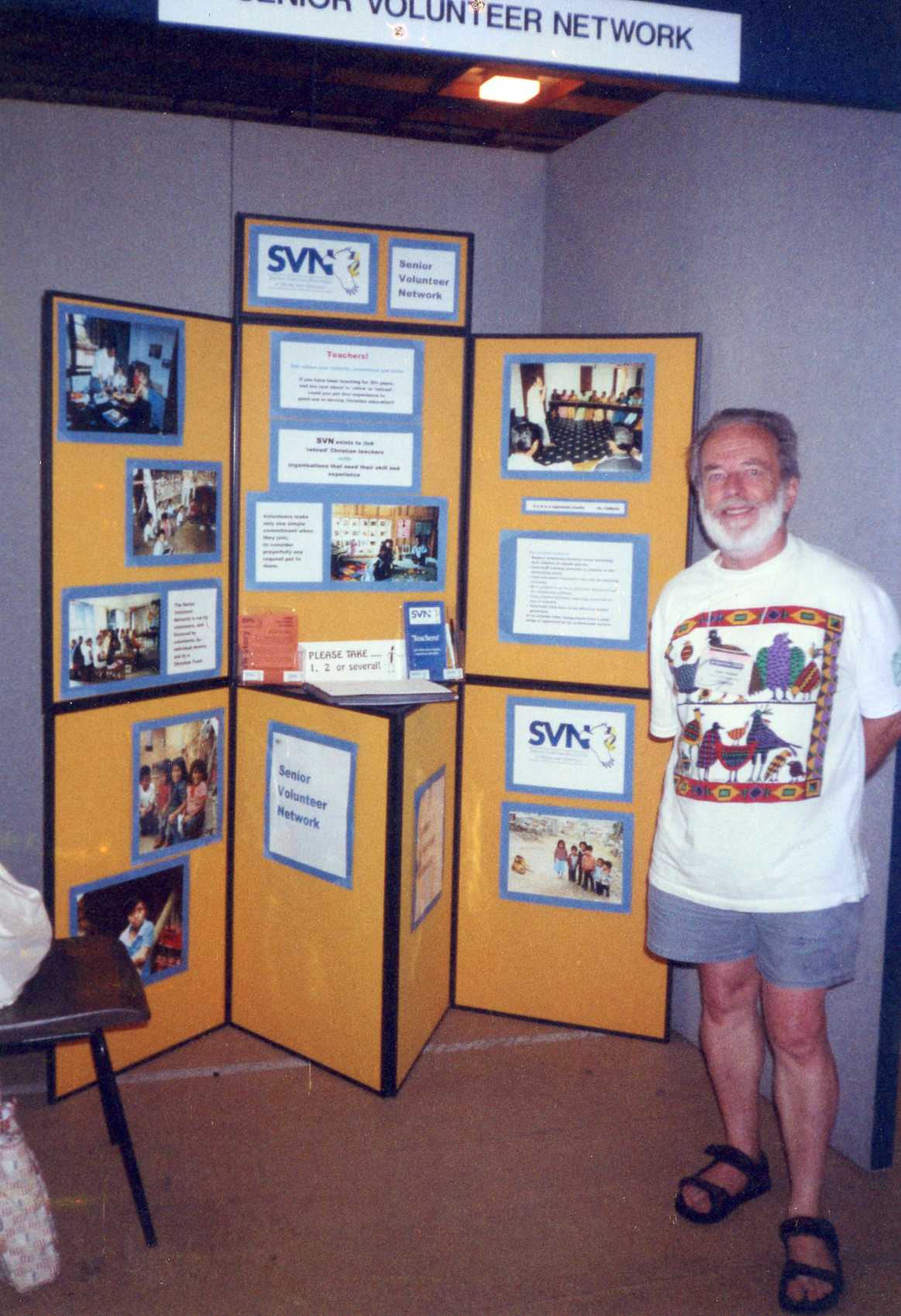

He retired (by then he was Head of the Education Department) in 1987, aged 60, but rather than leading a quieter life, he had a vision for a charity, Senior Volunteer Network, which would put retired teachers/head teachers and other education specialists into projects worldwide, and began to turn this into a reality.
He and Cecily made the most of the freedoms of his retirement (she had retired from primary school teaching some years previously). They both became involved in leadership of the Ravenshead Christian fellowship, which later became Ashwood Church (now based in Kirkby in Ashfield). In the early days of the Fellowship, we met in members’ homes or in the Village Hall. John and Cecily held open house on Sunday afternoons for young people in the village (50 years on, people still talk about how the house was full, every seat taken, and every window ledge and the stairs too) – their home in Ravenshead was called Akwaaba, which in the Twi language spoken in the part of Ghana where we had lived, means ‘welcome’. Part of our parents’ joint legacy to us is the idea of family as an open, welcoming place that embraces new members, whether related by blood, law or none of the above. In West Africa we were a long way from our aunts, uncles and grandparents, and so we accumulated a number of aunts and uncles, friends of my parents who visited regularly, and who I still think of as ‘Aunty Betty’ (with whom I still exchange Christmas cards), ‘Uncle Arthur’, or ‘Uncle Rex’. And in Ravenshead that took the form of opening our doors to random teenagers, some of whom became part of the church (and still are), others who never did, but had reason to be grateful for our parents’ warmth and support, as well as for the Sunday afternoon tea.
As keen walkers, John and Cecily led youth hostelling expeditions to the Lake District, one of which memorably involved Cecily’s group of walkers requiring the Mountain Rescue Service, after getting lost on Great Gable in driving rain and mist. John’s group had taken what was expected to be the more challenging route, only to find when they got to the hostel that we had not yet arrived. They called at the Mountain Rescue centre, at roughly the time that two of Cecily’s party arrived, having been sent out as envoys whilst we huddled behind a rock for (minimal) shelter, and gave their account to the team, enabling them to find their way straight to us.
John was a governor at a number of local schools, volunteered with Mansfield Samaritans (Cecily was a founder member of this branch), and was involved in local politics. He ran regularly, and completed the London Marathon, aged 63, in 1990 – he’d been a keen runner as a young man (plenty of stamina, less speed, due to his short stature), which had taken its toll on his knees and he had to have two knee replacements later in life. He undertook many walks with Cecily (and their dog, Corrie) after his retirement, including the Coast to Coast Walk, and along the Northumbrian coast. Having visited Nepal during his work with Trent Polytechnic, he returned to Everest to climb as far as the snow line, fulfilling his dream to stand on its slopes.


In 1995 Cecily died of pancreatic cancer, aged 65, only a matter of weeks after the diagnosis. It was a huge shock, and an incalculable loss to John and to the family – and to so many more people, as we all discovered from the messages that flooded in after her death. She saw herself as an accompanist – in musical terms this means that she wasn’t there to do the virtuoso solo stuff, but to enhance the performance of other musicians – but she did far more than that, and could have done so much more (at the time of her death she was gaining qualifications in counselling, and working with a Nottingham homeless charity). At the events celebrating Dad’s life, so many people talked not just about John but about ‘John and Cec’. They had different, and complementary strengths, they were a partnership in every sense, and their legacy is a shared one, for us and for the many other people with whom they worked and worshipped.
When Cecily died, SVN was still an idea rather than a reality, and in the aftermath he threw himself into setting up and leading the network, sending volunteers around the world, and travelling himself until his eyesight began to fail due to macular degeneration. SVN still thrives, and the family still has links with it, through Claire who is now a trustee.
John remained active until his 90s, undertaking a skydive to celebrate his 90th birthday, but his sight loss was by then significantly restricting his activities as he could no longer drive, or use the computer. The pandemic shrank his horizons significantly, particularly since he could not easily compensate for the loss of face-to-face social activity with on-line due to his deteriorating sight. In 2020, just before the first lockdown, his youngest son Greg died of bowel cancer, a desperately heavy blow. The death of my husband Martyn in 2021 was also a major shock to him. In 2022 he was formally diagnosed with Alzheimer’s disease and the decline from that point on was fairly rapid. He was cared for at home by Claire until he needed residential care, and moved into Lound Hall Care Home, near Retford, in 2023.

During those last years, as the fog engulfed him and he became more dependent on others, it was sometimes hard to remember the man he had been. He was a man of bold decisions – leaving school to work at de Havillands, against his father’s wishes, leaving de Havillands on a matter of principle, training as a teacher and undertaking a part-time degree whilst working, taking his young family to West Africa (again, a decision of which his father profoundly disapproved), and then changing direction again to focus on education, and finally setting up SVN in his retirement and travelling to often remote and dangerous places to work on educational projects. He was a leader, from his days as a Cub and Scout where he progressed from ‘Sixer’ to Assistant Scout Master, to his final post as Head of the Education Department at Trent and his role in the church. We all remember family walking holidays when Dad would lead the way so confidently that we all had to rush to keep up, as he was the one with the maps and the refreshments… At the care home, he often, when we visited in the early days, told us that he was there to conduct a review or an investigation, or that we were all at a conference that he had organised. That lifetime of leadership kept a hold even when so much else had been lost.
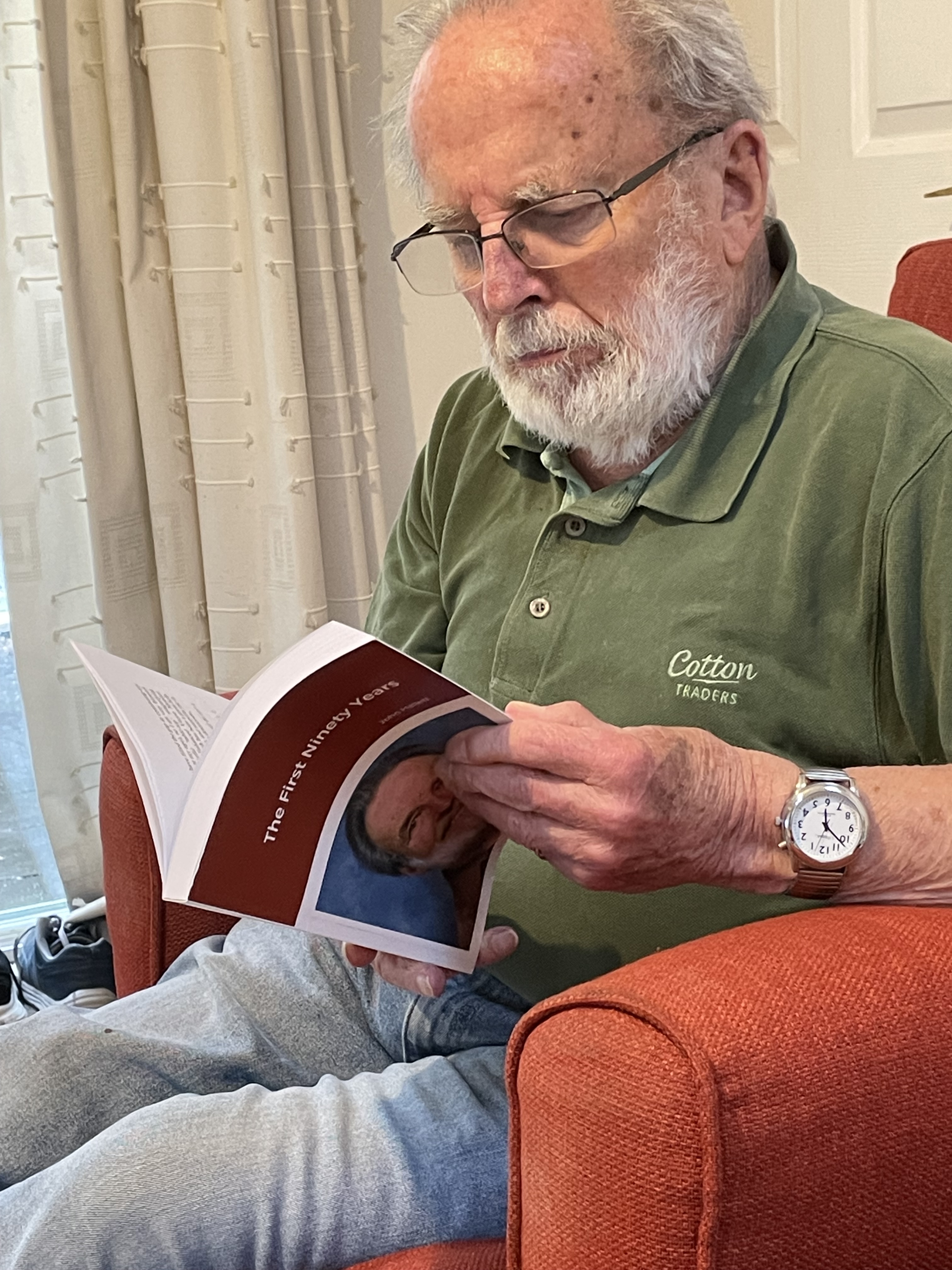
He had, from a young age, a sense of purpose, and one of his frustrations as his eyesight began to fail was that so many projects – travel abroad, or even ambitious UK walks like the ones that he and Cecily had done years before – were no longer practical or safe. For a while, writing his memoirs became his purpose, although in the final stages of the project dementia had begun to rob him not only of his memories but of understanding, and so I edited the document and arranged publication so that a copy could be placed into his hands whilst he could still recognise it as The Book, his own work.
John was fascinated by the natural world, greatly enjoying finding out about the flora and fauna – particularly the birds – of the parts of West Africa where we lived, and David Attenborough’s documentaries were a source of pleasure and interest in his last years. He read widely, and not only for professional purposes, and turned to audio-books after his sight loss, through which he enjoyed re-‘reading’ Dickens, Trollope, le Carré, Graham Greene and others, as well as discovering new writers (he was particularly enthralled by The Book Thief). He greatly admired the work of C P Snow, a scientist as well as a writer, who explored the idea of the two cultures, science and the arts (Snow’s novels were sadly not available in audio form). He loved music – as a young man he listened to jazz (New Orleans, and Django Reinhardt, not swing, as he told me firmly), but then was converted wholeheartedly to classical music after hearing Bach’s Brandenburg Concertos. Even in the very last stages of his illness he seemed to find calm in listening to Bach and Mozart in particular.
Just over a year ago, I wrote about Dad’s dementia, and specifically about Dad’s ‘raging against the loss of dignity, the loss of control over where he is and what happens to him, against the loss – even if he can no longer articulate it – of the things that made him him, against the slow dying of the light.’ And I expressed our heartfelt wish that his last days should not be spent ‘burning and raving at close of day’. In the end, at the very end, he did ‘go gentle into that good night’, with staff from his wonderful care home taking turns to sit through the night with him. We’re grateful for that, and that we each had the chance to say goodbye, to kiss him on his forehead and tell him that we loved him.
John is survived by his children Catherine, Aidan and Claire (youngest son Greg died of cancer in 2020), daughters-in-law Julie and Ruth, grandchildren Matthew, Arthur, Jordan, Melanie, Vivien and Dominic, step-grandson Tom, and great-grandchildren Jackson, Jesse and Eliza. He will be remembered with love by all of us.



2024 – Finding Joy and Hope
Posted in Personal on December 31, 2024
Since 2019 I have posted every week on Facebook a summary of the good things I’ve found over the previous seven days. This is always prefaced by an acknowledgement that these good things will most likely be small and personal, and that they will be outweighed in the grand scheme of things by all of the huge absolutely bloody awful things that are going on in the world. We can’t and mustn’t shut our eyes to the latter, even when for the most part they are things about which we can do very little. But if we’re going to get up each morning and wash and dress and face the world, or our little bit of it, it’s those small, personal good things that will give us the strength, day after day, to keep on keeping on.
In some ways the Good Things project is an odd one for me. I’m not a strenuously cheery person. If I am a ‘glass half-full’ person it’s an act of will because my brain is almost always in ‘what could possibly go wrong’ mode, and thus even much looked forward to events and experiences always have an element of anxiety attached. M used to say he was ‘glass half-full but really, really cross that it was only half full’. My late brother Greg was ‘glass overflowing’. So I suppose I’m ‘glass half-full but really quite worried I might tip it over and end up with glass empty’… Optimism is, as James Baldwin says, an act of will. It’s also, as Angela Davis put it, an ‘absolute necessity’. We might look at the world and see little reason for it – that’s what she called ‘pessimism of the intellect’ – but being alive, really living, requires optimism of the will. (My friend Mike Press reminded me of the Angela Davis quote, in a lovely piece he wrote about ‘reflection, renewal and optimism’.)
When I started my Good Things, my brother was dying of cancer. Then there was Covid and lockdown, and then, in October 2021, my husband Martyn died very suddenly of a heart attack. I could hardly have been more aware over these past few years that life wasn’t simply full of good things, even just on a personal level, and that wishing it wouldn’t make it so. But it helped me to have that discipline, that at the end of each week I had committed to finding something to write about, something that had brought me joy or comfort, something that had given me strength, something good. And I have always found something, even at the worst times.
In 2024 the huge absolutely bloody awfulness of what’s going on in the world is utterly daunting. When M was alive, we always watched the 10 o’clock news, but now, on my own, I find I rarely do. To watch together, and then head for bed and sleep with the comfort of each other’s company was one thing, to watch alone and then head for bed and sleep alone, with my mind full of Gaza and Trump and Ukraine and climate change and all of the other horrors is quite another. (I do read the papers every morning, I don’t shut my eyes to it all.) It’s hard to find good things out there, although I know that in any and every horror there are brave, good people who do whatever they can, at whatever risk to themselves, to mitigate that horror for others. We may not know who they are, but whilst history is very good at telling us of the evil that humans are capable of, it does also, if we look more deeply, tell us of those who stand against that evil. I try to hold on to that.
The word ‘joy’ keeps on cropping up at the moment. I recently watched the film with that title, about the first ‘test-tube baby’, whose second name was Joy, given to her by the surgeon who carried out the procedure. The film didn’t gloss over the wretchedness of infertility, and the people that the IVF process couldn’t help, but it acknowledged very movingly the joy that arrival brought, not only to her parents but to the team that had worked so long for that moment – and all of the people since who have had their chance at parenthood. And then the Doctor Who Christmas special this year was entitled ‘Joy to the World’, and it dealt with loneliness, loss and regret, but ended with light, and joy and hope. It seems to me that to have joy (as distinct from happiness, or contentment), one must know sadness, loss, pain as well, just as to be optimistic (as opposed to merely delusional) one must recognise it as an act of will, in the face of all the reasons for pessimism.
So where has the joy been, in 2024?
As always, in reading marvellous books, watching brilliant films and TV series, listening to wonderful music. There are lots of things that I enjoy, that pass the time pleasurably, but some that do more than that, that lift and move me more deeply. Hard to pick out just a few things, but, for example, Wim Wenders’ film Perfect Days, Paul Besley’s book The Search, choral music at St Mark’s Church, Chris McCausland dancing to ‘Instant Karma’ on Strictly…
Travelling with my son, for an amazing holiday, a three-city break in Vienna, Prague and Berlin, seeing the beauty of all three cities, and in each of them the tragedy of their wartime history.
Working with Under the Stars, a charity that works with adults with learning disabilities and autism through music and drama, seeing their music groups perform at Tramlines festival, at Yellow Arch Studios, at the Greystones pub and the Octagon Centre, and deejay/veejay at the Leadmill. It’s exhilarating and inspiring – their joy in performance is infectious.
Nottingham Forest. A change of manager – this time last year I wrote that ‘I’m hopeful that the new guy will enable us to stay up again this year’, but it turned out to mean a transformation that finds us at the end of 2024 second from top of the Premier League, and dreaming of possibilities in 2025…
Family – a wedding, an engagement, and lots of ordinary special times spent with the people I love most, watching football, watching Strictly, trips to the cinema, opera or theatre, going around the galleries in town, wine-tasting, meals out, meals at home. Boxing Day shared with the future in-laws for the first time.
Friends – meeting for coffee or lunch, sharing music, talking about families and plans, hopes and anxieties, meeting via Zoom when we can’t be together in person.
So this New Year’s Eve, as for the last approx. 40 years, will be shared with very dear friends. We’ll eat and drink and watch Jools’ Hootenanny and complain about his choice of guests, and on New Year’s Day we’ll eat more and find an undemanding film to watch before going forth into 2025. My first New Year’s Day without M was bleak, almost unbearably so. I faced the first year since I was 16 years old in which he would not be by my side. I expect there will be moments this New Year too, when it hits me, but three years on I am accustomed to being without him. It’s not that the grief and loss is less, rather that one adjusts around it, accommodates it, and it becomes a part of one. I know I will cope because I have coped already with so much, and because the people who’ve enabled me to cope will be with me.
And for 2025 we hope, of course we hope. We hope for cease-fires, for wars to end, for freedoms to be restored, for care for our planet to be prioritised over profit, for vital public services to be protected and rebuilt for those who need them. We hope for good things for ourselves and the people we love. We hope for the strength to cope when bad things happen, the strength that comes from other people’s love and support as well as our own.
I come back to this poem every new year. That word ‘sometimes’ has some heavy lifting to do here, but of course, sometimes, these things will be, and that’s what we have to hang on to.
Sheenagh Pugh – Sometimes
Sometimes things don’t go, after all,
from bad to worse. Some years, muscadel
faces down frost; green thrives; the crops don’t fail,
sometimes a man aims high, and all goes well.
A people sometimes will step back from war,
elect an honest man, decide they care
enough, that they can’t leave some stranger poor.
Some men become what they were born for.
Sometimes our best efforts do not go
amiss; sometimes we do as we meant to.
The sun will sometimes melt a field of sorrow
that seemed hard frozen: may it happen for you.

Hang on to your hat. Hang on to your hope. And wind the clock, for tomorrow is another day (E. B. White)
Music Nights 2024
Posted in Music on December 18, 2024
Last year I tried for the first time to write about the part that music has played in my life, the way in which that is bound up with my relationship with my late husband, and how I struggled with finding ways of listening alone. It will never, of course, be the same, not even close. But I have prioritised listening to music from our collection, as well as listening to Radio 3 as we used to, and have added some new bands, composers and music programmes to my repertoire. I’m proud of that – it wasn’t as easy as it might sound.
Not long into 2024, my hi-fi was dismantled, and my CDs packed into boxes and stored in the garage, ahead of a major redecoration of the living/dining room. It all took a long time, and only now, as the year draws to a close, do I have full access both to the CD collection and to the means of playing them. Now, I do know about streaming and am aware that playing actual CDs marks me out as very old school indeed – and as the list below shows, I did carry on regardless. But I like to hear the whole album, the tracks that the artist decided to record, in the order that they wanted them to appear. And so many of these CDs were acquired and listened to with M, and, as I said in my music blog a year ago, it’s very important to me that this tradition – of evenings devoted to listening to CDs, chosen semi-randomly from the vast collection – is part of my life now.
Music Nights (or mornings, or afternoons, but mainly nights) – the methodology is as described in last year’s blog. During the week if I think of something I’d like to play (it might be suggested by something I’ve read, an anniversary or obituary, or just a memory) I put it on a pile by the CD player, and on the night I add to that pile random choices – whatever came up when I threw the dice and counted the shelves – so that I don’t stay too firmly within familiar territory, or within any one era or genre. This does include music on TV or DVD and tracks that I accessed via Spotify as well as via the collection, but in general inclusion indicates that I listened to more than just a single track, even if not a full album.
This year I listened to music by: Beethoven, Berlioz, black midi, Bombay Bicycle Club, Bowie, Brahms, Britten, Brubeck, Bruckner, R D Burman, Byrd, Alina Bzhezhinska, Camel, Can, Nick Cave, Terri Lynne Carrington, Hariprasad Chaurasia, Chopin, Billy Cobham, Leonard Cohen, Alice Coltrane, John Coltrane, Costello, Kim Cypher, Miles Davis, Olivia Dean, Delarue, Bryce Dessner, Corrie Dick, Marlene Dietrich, The Last Dinner Party, Dinosaur, Dreamliners, Dukas, Dylan, Earth Wind and Fire, Elgar, Ella, Ellington, ELP, Eno, Fairport Convention, Fakear, Fauré, Reinhard Fek, Catrin Finch & Seckou Keita, Graham Fitkin, Fleet Foxes, Flobots, Frankie goes to Hollywood, Marvin Gaye, Gilgamesh, Gomez, Pavel Haas, Charlie Haden & Egberto GIsmonti, Matthew Halsall, Gavin Harrison & O5Ric, P J Harvey, Lianne la Havas, Dashiell Hedayat, Hendrix, Bernard Herrmann, Hindemith, Zakir Hussain, Keith Jarrett, Johann Johannson, Quincy Jones, Quincy Jones & Miles Davis, King Crimson, Michael Kiwanuke, Gideon Klein, Gladys Knight, Korngold, Last Shadow Puppets, Bill Laswell, Ant Law & Alex Hitchcock, Léonin, Los Campesinos, Yo-Yo Ma, Kirsty MacColl, James MacMillan, Mancini, Bob Marley, Maximo Park, Curtis Mayfield, Fanny Mendelssohn, Felix Mendelssohn, Pat Metheny, Lin-Manuel Miranda, Monk, Mozart, Mulligan & Monk, Nick Mulvey, Meshell Ndegeocello, Yoko Ono, Pérotin, Iggy Pop, Psi Vojaci, Rachmaninov, Emma Radicz, Radiohead, Ravel, Red Rum Club, Martha Reeves, Max Richter, Rodrigo y Gabriela, SBB, Ryiuchi Sakamoto, Schoenberg, Schubert, Schumann (Robert & Clara), Semer Ensemble, Shangri-las, Sharp Little Bones, Shostakovich, Sibelius, Silk Road Ensemble, Horace Silver, Nina Simone, Roni Size & Reprazent, Smetana, Sam Smith, Snarky Puppy, Katie Spencer, Spiritualized, Candi Staton, Steely Dan, Max Steiner, Richard Strauss, Karl Svenk, Taylor Swift, Sylvian & Fripp, Tallis, Tangerine Dream, Carlo Taube, Michael Tippett, Peter Tosh, Ali Farka Toure, Travis & Fripp, Martina Trchova, Unthanks, Vaughan Williams, Verdi, Kevin Volans, Weather Report, Yiddish tango





Live Music
Music nights are almost always solitary now. But live music is also vital to me, and for that I often especially value company. So thank you to Ruth, Peter, Adi, Jennie & Michael, Arthur, Jane & Richard, Amanda, Liz and Under the Stars colleagues for sharing some of these musical experiences with me.
Opera
For a few years, I reviewed Opera North productions for The Culture Vulture, a Leeds-based online journal, which was fabulous – I got free tickets to all of the productions. All this came to an end for me even before lockdown, as my youngest brother, who had terminal cancer, approached the end of his life, and I knew I could not commit to attending or to turning a review around within a day. When lockdown ended, I was looking forward to starting again and was due to see Carmen on 9 October 2021. That morning, M died. It was not until my sister-in-law, who had got me started on this whole opera thing, moved back to Leeds from Rome last year that I went back to the Grand Theatre (not as a reviewer, just a regular audience member).
At Leeds Grand we saw two marvellously magical productions, Mozart’s bonkers The Magic Flute, and Britten’s A Midsummer Night’s Dream, both of which were delightful, imaginatively staged and beautifully sung. Before that, we saw Britten’s Albert Herring at the Howard Assembly Rooms, a lovely, funny production.
West Yorkshire Playhouse’s revival of My Fair Lady drew on Opera North talents too, with lovely performances in the lead roles, including John Hopkins (a former sidekick of Midsomer Murders’ DI Barnaby) as Henry Higgins, and Katie Bird, who we saw in The Merry Widow back in 2018 at the Grand, as Eliza. It has tricky moments – not so much Higgins’ sexism, given that this is not endorsed by the script or by the production, but the off-hand references to domestic violence, the normality of black eyes and broken bones as part of married life. I can’t recall if these are in the Shaw, or only in the libretto. Despite that it was a gorgeous, funny production and it’s packed with glorious tunes, beautifully sung.
Sheffield City Hall – Legend: The Music of Bob Marley. Excellent tribute band – the lead singer in particular was superb. I wondered about the audience when I saw a lot of white folks wearing knitted hats with knitted dreadlocks attached, but it was clear they were passionate enthusiasts for the music, knew all the lyrics, and kept a respectful silence when asked to do so in memory of Aston ‘Family Man’ Barrett. An exuberant evening of fantastic songs.
Manchester Palace Theatre – Hamilton. I’d seen it on Disney+ but live is so much better. Spinetinglingly, exhilaratingly great songs and singers, superb choreography, a compelling story. It probably shouldn’t work but it absolutely does and I loved every moment.


Since I got involved with Under the Stars, first as a trustee, now as Chair, I aim to get to as many of their gigs and drama performances as I can. It’s always a joy. This year, Sparkle Sistaz played the Octagon Centre at Sheffield University as part of a Street Choirs event and went down a storm (they were followed by the excellent Young ‘Uns, who recognised they had a damn hard act to follow). The Stars Band played at Yellow Arch and at Tramlines, and Clubland Detectives launched their new EP with a gig at the Greystones Pub.


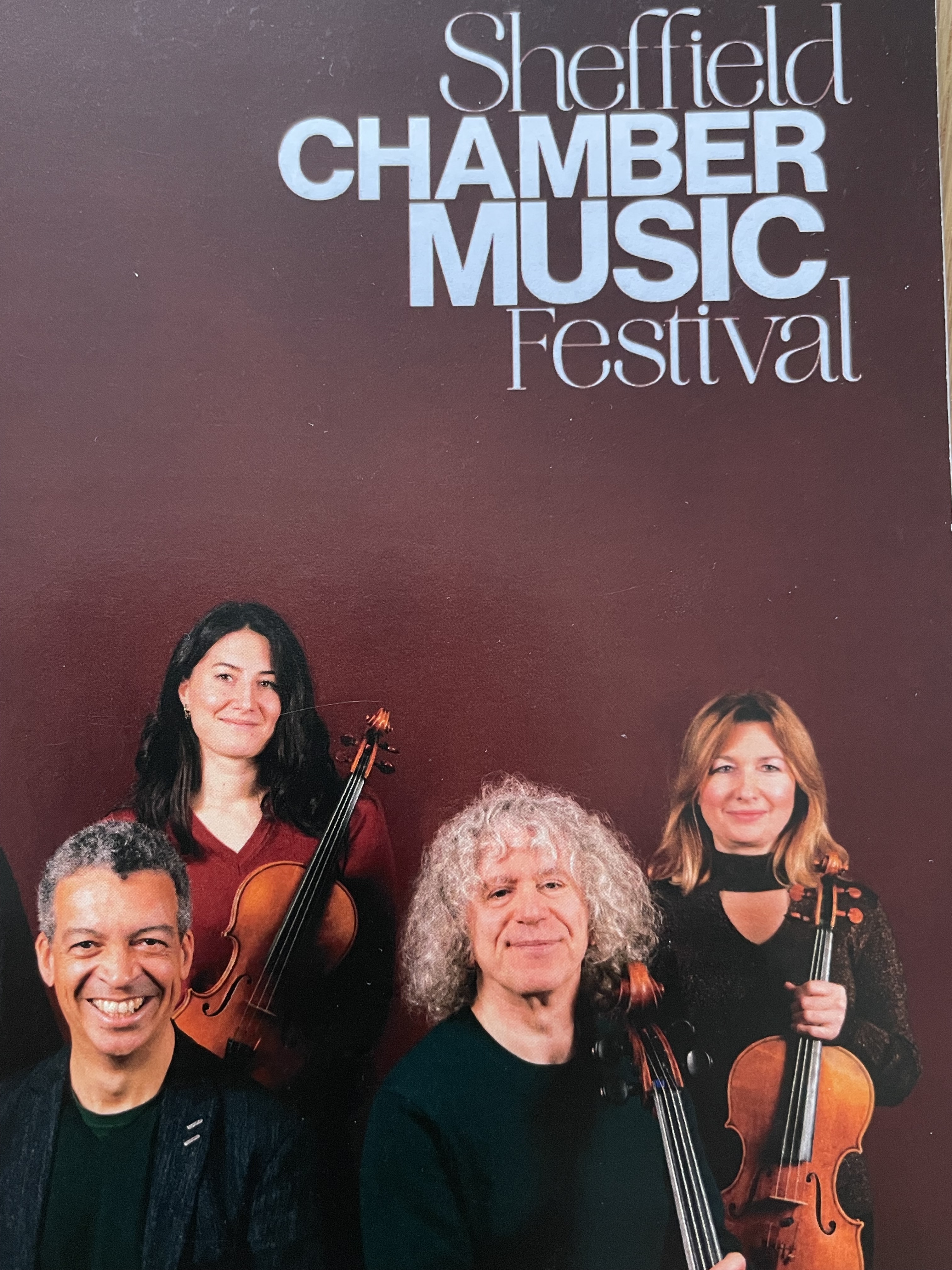
Music in the Round is always a huge part of my musical year. It started off with a concert in the Upper Chapel (Koechlin, Tomasi, Lutoslawski, Poulenc) and then the Steven Isserlis curated Chamber Music Festival in mid-May celebrated Fauré’s centenary with a packed week of gigs, mainly at the Crucible Playhouse. I got to five of the concerts, and heard music by Ades, Bach, Farrenc, Faure, Franck, Holmes, Messager, Onslow, Ravel, Saint Saens and Tchaikovsky, performed by Ensemble 360, with Isserlis, Peter Hill, Abbeydale Singers, Ella Taylor and Anna Huntley. And then Kathy Stott launched the autumn season with a performance of short pieces by Bach, Boulanger, Ravel, Piazzola, Shostakovich, Rodgers & Hammerstein, Chopin, Fitkin, Shaw, Vine, Grainger, and Grieg. This was part of her farewell tour, with a programme of short pieces – it was wonderfully eclectic and delightful.


We were at the Crookes Social Club for Sheffield Jazz gigs from the Clark Tracy Quintet, Corrie Dick Sun Swells, Hannah Horton Quartet, Adam Glasser, and Soft Machine, the Crucible Playhouse for Empirical with Jason Rebello, Firth Hall for Fergus McCreadie, and the main Crucible Theatre for their 50th anniversary gig, with the Emma Rawicz Quartet and the Tony Kofi Quartet. All were excellent but standouts were Corrie Dicks, Soft Machine and Tony Kofi.


This year’s Tramlines was dry and sunny, for which we were very thankful after last year’s downpour and resulting quagmire. The stand-out performances were from Maximo Park, Dylan John Thomas, The Human League, Sprints and Stars Band. We also saw Bombay Bicycle Club, Coach Party, Example, Flowerovlove, Darla Jade, Jazzy, Miles Kane, Otis Mensah, Harriet Rose, Mitch Santiago, Rumbi Tauro and The View plus brief snippets of The Charlatans, Cucamaras and Paolo Nutini.


And then a new feature on Sheffield’s musical calendar, Richard Hawley’s Rock & Roll Circus – we only went to one of the three nights, but enjoyed Gilbert O’Sullivan, The Coral, The Divine Comedy and Richard Hawley himself. O’Sullivan I remember fondly from the 1970s, when he had a run of hits, all of which he performed here and most of whose lyrics I could recall. His voice is still there (not always the case with performers whose heyday was 40+ years ago) and it was an enjoyable set, if not one that made me want to seek out his newer material. I fell in love with The Coral years ago – that Mersey/Motown blend is joyous and I love them live (I saw them at Tramlines 2022). I was much less familiar with The Divine Comedy’s output (I knew ‘National Express’ of course but little else) but was inspired to listen to more. And Hawley, in his home town, was electrifying, performing songs that featured in the musical Standing on the Sky’s Edge, which played to rapturous full houses here in Sheffield, and less inevitably, replicated that success in the West End.


And a concert at the tiniest venue I know, Café 9. Pre-booking is essential, and reserving seats helpful as one can end up practically knee to knee with the performers – but it’s a gorgeous space, which I discovered last year, and went to three gigs there in fairly quick succession. Just one this year, from Katie Spencer, whose songs draw on her upbringing on ‘the edge of the land’, as one of her songs puts it, on the East Yorkshire coast. She’s a great songwriter, guitar player and singer. She was supported by Gerard Frain, an excellent South Yorkshire singer-songwriter.


For next year I’m checking out the Sheffield Jazz programme and the 2025 Sheffield Chamber Music Festival programme, I’m already booked to see two operas (Weill and Verdi), and we have our tickets for Tramlines in July. And whatever else the year brings, I know it will be full of music.
2024 On Screen – the second half
Posted in Film, Television on December 10, 2024
Most of what I watched at the cinema or at home during the second half of the year is here. It still feels strange to me to be watching the TV on my own. The plus side – no one is going to veto costume drama, literary adaptations or yet another WW2 drama – is very much offset by the downsides of not having someone to talk with about what I’ve just watched, to share the experience with. I’ve found that comedy, in particular, suffers from being watched solo. A few things have overcome that this year, but I’ve abandoned quite a few comedy series because it just felt weird. I’m also less keen on scary movies, for obvious reasons. Even with all the lights on, it’s a lot harder to shake off the creepy feeling if there’s no one to have a mundane conversation or a laugh with. With all that said, film and television take me outside of my own environment and my own company, broaden my mind (at best) and horizons, and (at best) lift my spirits. I’ve omitted from the account below things that were just ‘meh’, things that I abandoned after one or two episodes, and season x of things that I’ve been watching for a few years.
Big Screen
Most of the films in this half of the year were actually seen on the smaller screen. At the cinema I saw Radical, Electric Lady Studios, Gladiator II and Conclave. And perhaps fewer of the films were truly outstanding – I think I’d had a run of really top-notch films in the first half of the year. Which doesn’t mean there aren’t some absolutely excellent ones here – Anatomy of a Fall, Blitz, Conclave and Lady Macbeth stand out but I’d pick Perfect Days as my favourite (partly because it was so unexpected).
All About Eve (1950)
I have seen this before, obviously, but not for a very long time. There was a period in my twenties (I think) when there seemed to be Bette Davis movies on every Saturday afternoon, and it was glorious. I caught the second half of her earlier film Dark Victory just before this one, and it was instructive to see how things had changed – DV was very stagey – lots of big gestures, AAE much subtler and darker (I thoroughly enjoyed both). AAE is so well known that I can’t imagine watching it without knowing what Eve is up to, but whilst there isn’t that potential element of surprise, it’s still gripping to see how it all plays out, and the performances from Davis, Anne Baxter and Celeste Holm, are superb.
Anatomy of a Fall (2023)
I saw Sandra Huller in Zone of Interest not long before I watched this – she’s remarkable in both films. In many respects this is a classic mystery – a man falls to his death, but did he jump, fall by accident or was he pushed and if so by whom? We don’t really know till the end – even then I wasn’t totally certain I had put the pieces together correctly, so it merits a re-watch. Whilst that puzzle is the plot, what makes the film great is the drawing of the characters, especially Huller’s character Sandra, and how we see them from different points of view as the investigation continues. Excellent, gripping stuff.
Belle (2013)
I wanted to love this, and I certainly liked it, but it was somehow underwhelming. I’m not sure why. The story should be compelling enough, the performances are fine, but it was perhaps too conventional in its approach, and the parallel story of the Zong massacre needed more development (not just exposition) to be as powerful as it deserved.
Black and Blue (2019)
Cracking action thriller – shades of ’71 and Assault on Precinct 13 at times – with Naomie Harris as the Afghanistan vet newly recruited to the New Orleans PD only to find herself isolated from both the black community she grew up with and her new ‘blue’ community of cops. It hints at deeper issues (race, police corruption post-Katrina) but that’s not really what we’re about here – it’s a thrilling ride, and the tension ramps up quickly and then doesn’t let go.
Blitz (2024)
McQueen weaves a number of real stories – some very specific, like those of the Nigerian ARP Warden, and Ken ‘Snake-hips’ Johnson who died at the Café de Paris, others more representative, like the criminals who profited from the Blitz by robbing bombed buildings, or the firemen struggling to get the water through their hoses with the Thames at low tide – into his tapestry of life in the East End of London at the height of the Blitz. Saoirse Ronan is wonderful, as she always is, Paul Weller is excellent in an understated role as her dad, and Elliott Heffernan outstanding as 9 year old George. In many ways, it’s quite a traditional narrative, invoking – inevitably – other treatments of the era (Atonement, very specifically). (I was puzzled though by reviews which suggested The Railway Children as a reference point – aside from the fact that Blitz features (a) trains and (b) children, I see no real relationship there.) But McQueen’s visual imagination, and the way Hans Zimmer uses sound, go beyond that traditional approach. And the thread running through it all is that we are seeing the people that the traditional narrative of the Blitz and of ‘Blitz spirit’ left out, particularly the black Londoners. (See also Lucy Worsley’s documentary, Blitz Spirit, on iPlayer, which covers some of the same territory, almost certainly through many of the same sources.)
Bombshell (2019)
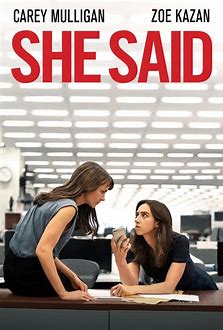
See also She Said, from 2022 – both films tell part of the #MeToo story. Bombshell is an account of how Roger Ailes, serial sexual harasser and bully at Fox, was brought down as the women started to talk, to each other and to lawyers. Whereas She Said is from the perspective of the journalists looking to uncover Harvey Weinstein’s regime of abuse, here we see things from the point of view of the women who may have prospered professionally but had to endure years of humiliation and the constant awareness that his favour was on a whim and could be withdrawn at any time. These are nuanced portraits, showing how so many women in the workplace survive by constantly masking, adapting, smiling, conforming, until they can’t do it any more. Variety‘s reviewer said that ‘Bombshell is a scalding and powerful movie about what selling, in America, has become. The film is about selling sex, selling a candidate, selling yourself, selling the truth. And about how at Fox News all those things came together’.


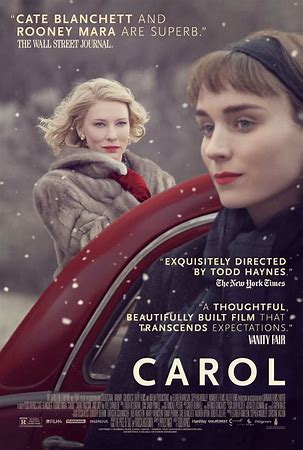
Carol (2015)
Superb. Blanchett and Mara are wonderful, both complicated, difficult to read, so that they continue to surprise us. The film always looks fabulous, but there’s a sense that we’re seeing surfaces, public personae, and that so much is hidden, as it had to be.
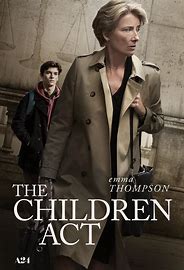
The Children Act (2017)
Good, solid adaptation of an Ian McEwan novel (one that I haven’t read). As in so many of McEwan’s books and films, the protagonists inhabit this very cultured, privileged world (everyone is a lecturer, a lawyer, a writer, with a big London house), and I do sometimes find that trying. But the ethical and philosophical questions with which Emma Thompson’s lawyer grapples are fascinating and she is excellent, as is Fionn Whitehead as the boy at the heart of that dilemma.
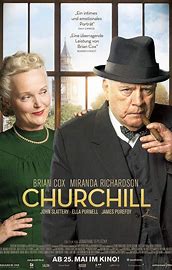
Churchill (2017)
With Brian Cox and Miranda Richardson as Winston and Clemmie, this should have been decent at least. But it wasn’t. The portrayal of Churchill was a caricature, his actions frankly unbelievable (seriously, on his knees praying for bad weather so that the D Day landings could not go ahead?) and his motivation opaque. One reviewer described it as ‘uniquely awful and tedious’. And from everything I have read, it is historical nonsense.
Coco (2017)
Top-notch Pixar. The animation is stunning, the folklore around the Day of the Dead is explained enough for the story to work, without weighing things down with exposition, the songs are great, and the ending made me weep. The notion of people dying finally when no one living still remembers them, was bound to connect with my own experiences of bereavement, and perhaps particularly with the long, slow bereavement of dementia… (Pixar’s previous excursion into the afterlife, Soul, drew on a whole different set of ideas and cultural traditions, but was also very touching, and very musical.)
Cold Comfort Farm (1995)
Gloriously funny adaptation of a gloriously funny book. A collection of superb actors, having enormous fun – Ian McKellen as the spiritual leader of the Quivering Brethren, Rufus Sewell, Eileen Atkins, Stephen Fry and more. And Kate Beckinsale is a joy as Flora Poste. I laughed out loud, quite often, which is something I find I don’t do so much these days, now I’m on my own. It felt good.
Colette (2018)
Good, solid biopic, focusing on the sexual politics of the time, with excellent performances from Keira Knightley and Dominic West.


Conclave (2024)
Based on the Robert Harris novel, this subtle, clever thriller (a thriller full of drama but largely without big dramatic incident) takes place entirely within the Conclave, the locked-down part of the Vatican where the assembled Cardinals meet to choose a new Pope. With each vote the picture changes, certainties are eroded, new threats emerge and predicting the outcome would be a fool’s game. The Guardian‘s review is very positive about the film, but its first paragraph gets in a fair few snooty put-downs for the source novel (‘easily devoured’, ‘pulpy’, ‘beach read’, ‘pot-boiler’ – yes, we get the picture, but the book is far better than that, IMO). Berger’s adaptation holds the attention throughout and touches on a whole host of questions from the world outside the Conclave that are reflected in the conflicts within it. The performances are superbly understated – Ralph Fiennes as Cardinal Lawrence, playing detective whilst wrestling with his own ambition, Stanley Tucci as liberal Cardinal Bellini, John Lithgow as the more obviously machiavellian Cardinal Tremblay and Lucian Msamati as Nigerian Cardinal Adeyemi, representing an increasingly powerful force in the Church – and then there’s the new guy, who’s appeared from nowhere. Isabella Rossellini leads the Sisters, who feed the Cardinals, but don’t get a vote. There’s a wonderfully atmospheric soundtrack, and clever use of background sound – dramas that happen off-screen and are only imperfectly overheard, even the sounds of breathing and papers rustling claim our attention in this largely still space. And, with commendable restraint, I have waited until now to mention, just in passing, that my brother is present on screen in a number of key scenes, as one of the assembled Cardinals (a non-speaking role but, I feel, crucial). With even more commendable restraint, I did not cheer or nudge the person in the next seat to say ‘look, that’s my brother’, but I was very excited.
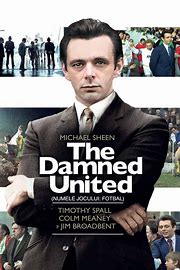
The Damned United (2009)
Martin Sheen does a superb job of playing Clough, at his most truculent and bloody-minded. Whether it is entirely accurate is another matter, but it rings true, and conveys something of the reality of 1970s football (I know, I was there. Not at Elland Road or the Baseball Ground, but at the City Ground, both before and during Clough’s reign there).
The Edge of Love (2008)
Keira again, this time with Sienna Miller as the lover and wife respectively of Matthew Rhys’s Dylan Thomas. I didn’t quite believe in this version of Thomas – somehow, despite being better to look at than the real thing, the source of his attractiveness to these two women was unclear. So this was perhaps a miscasting – Miller and Knightley on the other hand dominate the film.
Electric Lady Studio (2024)
Excellent documentary about Hendrix’s Electric Lady Studio, completed only a short while before his death but which seemed to embody his dream of a place devoted to making music. Lots of interviews from people who knew and worked with Hendrix, lots of clips that I’d never seen before (despite having been immersed in Hendrix’s music for over fifty years).
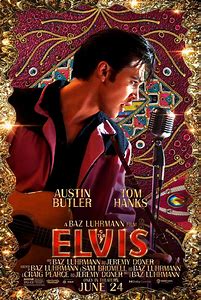
Elvis (2022)
Austin Butler’s performance is glorious, I’m less sure about Hanks, who seems to veer towards caricature, but given that the film does not aspire to straightforward biopic realism, maybe that’s what was intended. But overall, the film was hugely entertaining and whenever Butler was on screen, I was mesmerised.
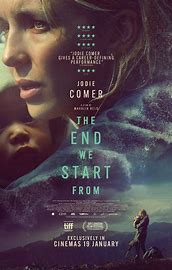
The End We Start From (2023)
The brilliant Jodie Comer in a disaster movie setting, where catastrophic flooding leaves her homeless with a new baby, negotiating a highly dangerous world to find her way to safety. My only problem was that I could not quite switch off the part of my brain that was constantly asking boring practical questions about how the baby always had clean clothes, etc, which wasn’t really the point. It was more about how quickly the infrastructure of society crumbles, and how everything that we count on becomes uncertain and perilous (see also Threads, below…), and how in the face of all that, one might survive.



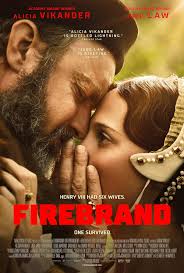
Firebrand (2024)
The film does warn viewers that history tends to leave a lot of gaps when it isn’t covering men and wars, and that those gaps may be filled with – sometimes wild – speculation… But it’s pretty plausible, for the most part, and much of what we see on screen is well-documented, and familiar from various ‘Henry & the Six Wives’ dramas on TV and film. Alicia Vikander is excellent as final and surviving wife Catherine Parr, as is Jude Law in a vanity-free portrayal of the King (those wobbly buttocks – surely not Jude’s?). I’d just finished watching the first series of Wolf Hall and what came across in both treatments was the constant fear in which one would have lived if one was close to the King – enemies constantly circling and seeking their opportunity to strike, and the King himself, mercurial and volatile, believing absolutely that he is absolutely right. This fear is written on Vikander’s face, as it was on Claire Foy’s as Anne Boleyn.
Gladiator II (2024)
I enjoyed this enormously. I’m not as passionate about the first film as some, I’ve only seen it once and that a while ago, so I wasn’t as conscious of all of the references and echoes as its true devotees would be. So it may be that I enjoyed it more for being able to take it on its own merits, rather than comparing it. I also had forgotten that in GI, Lucius is not Maximus’s son – or not known to be. Perhaps having carelessly disposed of Maximus’s actual son in GI, Ridley Scott realised he had missed a trick and retro-engineered an earlier relationship between Maximus and Lucilla that resulted in Lucius’s birth. Other than that, even with my less than total recall of GI, it was obvious that the plot of this film followed the same pattern as that of the first, and so there was a certain lack of suspense (there was never any real possibility that Acacius’ coup would succeed, or that the two armies facing each other at the end would decide to fight rather than uniting around Lucius). But the set pieces were spectacular (those baboons really spooked me and my one, terrifying encounter with a baboon on a path at a wildlife reserve in Nigeria, has been popping back into my mind rather a lot – he clearly wasn’t in the mood for ripping little girls’ throats out, so whilst I stood frozen with fear, he just ambled off), and the performances were great – Denzel Washington’s in particular, and Paul Mescal was charismatic without merely being a Russell Crowe #2.
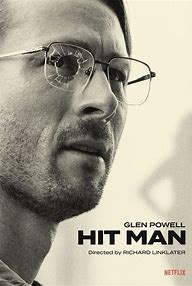
Hitman (2023)
Highly entertaining, based (loosely) on a true if improbable story. Also somewhat improbable is that the hero, as portrayed by Glen Powell, is supposed to be the kind of bloke that fades into the background…
In the Heights (2021)
Fabulous, touching, ultimately uplifting and joyous musical from Lin Manuel Miranda.
Inside Out 2 (2024)
It was never going to have quite the impact of the first film, but introducing the maelstrom that is puberty brings in a whole lot of new emotions. Anxiety, oh, how well I know you… It’s clever, witty and has a lot of heart.
Joy (2024)
The story behind the birth of the first IVF baby, Louise Brown. It’s a straightforward narrative, with nice period details, and excellent performances from Thomasin McKenzie (so good in Life after Life and Leave no Trace) as Jean Purdy, the third and until long after her death unsung member of the team, along with James Norton as the research scientist and Bill Nighy as the surgeon. It’s low-key but Purdy centres it on powerful emotions – her own and those of ‘the Ovum Club’, the women who sign up to be, essentially, experimented on in the hopes that they might become pregnant at last. Every failure in the lab is a heartbreak for one of them. But we know that one of these women will have their baby, and in that climactic scene, with the sound of Vaughan Williams’ The Lark Ascending on the gramophone, I was swept away by my own memories, and by thoughts of all the women I’ve known who had their longed-for babies thanks to this pioneering work.


Kingdom of the Planet of the Apes (2024)
Fourth in this fine series, with stunning CGI. Could be the start of a second trilogy rather than an addition to the first, given the time that has elapsed since the events of War for, and the world we’re in now presents new threats and challenges to both apes and humans.
Lady Macbeth (2016)
Florence Pugh is magnificent (when is she not?) and terrifying. Especially when she smiles, or giggles. She’s more often impassive, but behind that mask there is desire, and rage. We sympathise, a young woman effectively imprisoned in the house by her father-in-law and her husband, neither of whom is remotely interested in her well-being. And then her jailers unwisely leave her unattended for a while, and things get messy, very quickly… The Guardian‘s reviewer said that ‘As Katherine, Pugh has the vaulting ambition of Shakespeare’s character (a single line, “It is done”, pays homage to the great ancestor), also the Flaubertian yearning of the passionate woman subjected to the bourgeois tyranny of wifehood, as well as the modern noir obsession and criminal daring that begins to assume its own momentum. Katherine has cunning and a talent for survival. She starts out Madame Bovary, and winds up Mr Ripley.’
The Last Duel (2021)
Jodie Comer again, with Damon and Driver, in a story about property and law and revenge – and rape. Any film set in medieval times falls prey to the Holy Grail problem – it is impossible not to find lines from that film popping into one’s head, quite inappropriately, as one bloke in armour rides up to the castle and demands entry, or whatever. Once one has acknowledged and dismissed this as best as one can, there’s a cracking drama going on, with an absolutely fascinating view on sexual politics. It’s extraordinary, that what one might imagine to be a liberating belief, that the woman’s pleasure is central and crucial, becomes just another way of constraining women. The film uses the Rashomon device so that we see events first through Matt Damon’s boorish squire/knight, Marguerite’s husband, and then through Adam Driver’s caddish but cultured le Gris and only then as Marguerite experienced them. Le Gris’s chapter is particularly interesting – does he truly believe, as his later behaviour suggests, that no rape occurred? Certainly from the viewer’s perspective there is not a shred of doubt.
Lola (2022)
Fascinating low-budget sci-fi/alt history film about two orphaned sisters who build a machine that can pick up broadcasts from the future. There’s a lot of fun with this, as they discover Bowie, several decades ahead of time, but then things turn darker as the war begins and their machine can serve a different purpose. It’s black & white, ‘found footage’ (although one wonders with some parts of the film who exactly was filming and how), with a fragmented narrative structure. It’s really sharp, original and engaging.
Men (2022)
Jessie Buckley is traumatised after the shocking death of her husband and so relocates to a big empty house in a village in the countryside, where she knows no one (as you do…). Everyone here is creepy AF, and they all look like Rory Kinnear (which is not the same thing) and things get creepier and bloodier and grosser and who knows what the heck it all adds up to in the end. The men Buckley’s character, Harper, meets start off just as a bit patronising, and end up full-on murderous, and the title does seem rather as if it’s talking about Men (yes, in this film at least, all men), not just these men. It’s not an ideal film to watch whilst alone (albeit not in an unfamiliar house in a remote location) but by the time we reach the indescribable concluding section, we’re way beyond unease and feeling a bit creeped out, and it’s not so much scary as extremely hard to watch (and impossible to unsee). Bonkers.
Midas Man (2024)
Excellent biopic of Brian Epstein, very well cast and imaginatively presented, with a bit of fourth wall breaking as we whizz through the years. Does it tell us anything new? Well, that depends on how familiar we are, I guess, with that story – I’ve read loads and watched loads and there wasn’t anything dramatically new, but it was very enjoyable. The only problem was that they didn’t have the rights to use any Beatles compositions so the uninitiated might come away with the impression that they were a covers band…


Mr Klein (1976)
I’ve been trying to track this film down for years, and finally managed to rent it (probably it resurfaced after the death of its star, Alain Delon). Delon plays an unscrupulous art dealer, who is happy to obtain artwork at knock-down prices from Jews desperate to get out of Occupied Paris, until a chance event links him to another, Jewish, M. Klein. It reminded me very much of Arthur Miller’s novel, Focus (see my books blog), in which a personnel manager gets a new pair of glasses which make him look Jewish and how his life unravels from that moment. Of course, whilst Miller’s character encountered violent bigotry, M. Klein faces death. Absolutely fascinating film.
Mrs Harris goes to Paris (2022)
Utterly charming, utterly improbable, Paddington-esque tale. Lesley Manville is as brilliant as always, Isabelle Huppert is great too, bringing her trademark icy charm.
One Love (2024)
Kingsley Ben-Adir is great, but I have a biopic problem, in that, as wonderful as the performance may be, I’m still seeing it, ultimately, as an impression, a set of learned mannerisms, and my belief is sadly unsuspended. But given that – which I guess is a me problem – it’s pretty good, and I was pleased to see appropriate prominence given to Marley’s religious beliefs, and his character not overly sanitised. And of course the film is full of the most wonderful music.
Operation Mincemeat (2021)
One of those ‘you couldn’t make it up’ wartime stories, which I’d read about in Ben MacIntyre’s account. It’s a good, solid tale, well told.
Perfect Days (2023)
A near perfect film. If someone had told me I would say that about a film whose action takes place for the most part in Japanese public toilets, I might have been slightly sceptical. But it is quiet and gentle and perceptive and very beautiful and all I can really say is, watch it, if you get the chance.
Radical (2023)
This was walking a very fine line, between Season 4 of The Wire unbearably bleak, and unbearably sentimental. And it walked it just about right. Tales of an inspirational teacher who reaches the unreachable kids are always prone to idealisation (e.g. To Sir with Love), but this was closer to Entre les Murs, in which the teacher is shown not always to get it right, not to be able to reach everyone. And the situation of the kids he teaches is brutal and heartbreaking, but we know – because this is a true story – that some did make it, largely thanks to him.



Radioactive (2019)
Rosamund Pike is excellently spiky and ‘difficult’ as Marie Curie. Whilst I’d grown up with the story of Marie Curie, I’d never heard about her work in WWI, setting up (with her daughter) a mobile X ray unit, which enabled many unnecessary amputations to be avoided, and many lives saved. I’m not entirely sure though about the intercutting with various vignettes showing the impact – for good or ill – of the Curies’ work, which seemed a bit on the nose.
The Red Shoes (1948)
I can’t excuse the fact that I hadn’t seen this before – not only as a massively famous and highly regarded movie, but also because I love Powell & Pressburger. So, mea culpa and all that. But I have now, and I’m besotted with it. I also watched a fascinating documentary, Made in England, with Martin Scorsese talking about Powell & Pressburger which gives some fascinating background to this and their other wonderful films. Scorsese described The Red Shoes as ‘wildly inventive, complex and not at all comforting’, which hits the spot, I think.
She Said (2022)
See also Bombshell, the first film to tell the story of #MeToo. She Said shows the exposure of Harvey Weinstein through the work of journalists who tracked down the women he’d assaulted, all of whom were afraid to speak, and many of whom had been coerced into signing NDAs, and accumulated the evidence until it was impossible to ignore it. It’s a sister film to Spotlight, and similarly eschews melodrama for a portrayal of the slog and frequent discouragement of this kind of investigative journalism.
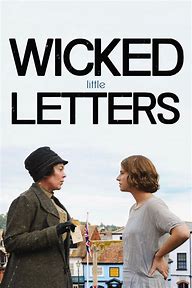
Wicked Little Letters (2023)
A gloriously wicked little film, with Colman and Buckley having a splendid time with their respective roles, as (seemingly) buttoned-up spinster and floozy.
Wind River (2017)
A very bleak tale set in a wintry Wyoming, where a Native American girl has been found dead, and she’s not the first. It’s a brutal, bloody tale, and makes it central point well, that Native American women and girls are not even monitored, unlike those in other groups, let alone properly investigated.
Woman of the Hour (2023)
Really disturbing account of a (real) serial killer who ended up as a contestant on a dating show. Tonally it’s really interesting – the section where we see the programme being filmed is funny and skewers the casual sexism of the presenters and the male contestants, but all the while we know, as Anna Kendrick’s character doesn’t, what one of those contestants has already done. The crimes themselves are shown quite graphically, which makes that part of the film really intense even whilst we’re briefly distracted by Kendricks’ attempts to subvert the format. (PS: Having seen a few series of Married at First Sight (no intervention required, I have kicked the habit now) the idea of a sociopath – or worse – participating in a show of that sort doesn’t seem the slightest bit improbable.)



Small Screen
The usual mix of crime drama (perhaps slightly more true crime – M was never as keen on those), sci-fi/fantasy, thrillers, historical drama, etc. Top sci-fi this half-year is Supacell, top crime Sherwood, true crime Five Days at Memorial, historical Wolf Hall: The Mirror and the Light, and drama, Mr Loverman. Of the documentaries, David Olusoga’s A House Through Time: Two Cities at War stands out. As always, I haven’t reviewed all of the programmes I watched – there were new series of Shetland, The Tower, DI Ray, The Lincoln Lawyer, All Creatures Great & Small, Slow Horses, Vienna Blood, McDonald & Dodds and Midsumer Murders, all ranging from serviceable to superb, which don’t feature below, even though Slow Horses is one of the best things ever (it’s just that it gets a bit tedious to ‘review’ it when all I’m really saying is ‘this is one of the best things ever), and All Creatures is massively important to my mental well-being (particular given the somewhat grim cast of a lot of my watching). And if I started something but abandoned it, you won’t see that recorded here either. I’ve tried to avoid spoilers but you should proceed with caution.
Drama
Agatha All Along
Marvel TV hasn’t given us much that’s really great recently, but this is both huge fun and packs an emotional punch – it follows on from Wandavision, which we loved. Kathryn Hahn is a powerhouse in the lead role. And it’s got a song that’s firmly stuck in my head. And it’s a female dominated storyline (because, witches), like The Marvels but unlike most of the rest of the franchise.
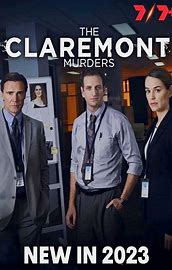
The Claremont Murders
Australian true crime, about a series of murders of young women and the lengthy failure to find the perpetrator (DNA was the breakthrough here). It does give due weight to the effects on the families of the victims, although at least one family member said how traumatic he and others had found the programme. It’s a question that surely must occur with all these true crime dramas where relatives are still living, and some are easier to defend than others, if they shed new light in some way. This is a fairly middle of the road example, but well enough done.
Day of the Jackal
Forget Edward Fox and de Gaulle – here’s Eddie Redmayne in a Mission Impossible style mask with impossible feats of marksmanship, being pursued by Lashana Lynch’s intelligence officer. Glamorous locations, high speed chases, lots of tech, and a thoroughly entertaining few hours. The Jackal and his nemesis are actually more balanced than in the original film – her moral boundaries are shown to be pretty movable, and the question of whether/how one could have a family in their line of work is pressing for both. I don’t think for the most part, however, we are overly concerned with those deeper questions…
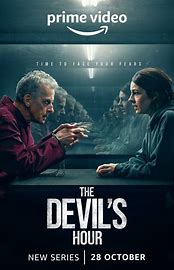
The Devil’s Hour
Very, very unsettling. Superbly played by Capaldi and Jessica Raine in particular. I won’t even begin to talk about the plot – you have to just watch it and trust that some of it will start to make some sense, in due course. Once the pieces start to fall into place, it’s still complicated, not just plot-wise, but emotionally (it reminded me of The Lazarus Project). Completely compelling and rather disturbing.
The Diplomat
Series 2 is even more fun than the first and ends with an even more dramatic cliff-hanger. Along the way there’s a lot of fun at the expense of Keri Russell’s Ambassador and her failure to look ambassadorial (I must admit the thought that she surely ought to be able to use a hairbrush occasionally had occurred to me a number of times). Rory Kinnear is brilliant as the boorish UK PM.
Discovery
The final series of Star Trek: Discovery. I loyally watched to the end, but it sustained the kind of annoying tropes that have somewhat spoiled my enjoyment throughout – the idealisation of Captain Burnham, particularly given where she started, is cloying, all of the core crew are straight-up heroes, and there are too many deaths/departures which turn out to be rather less than final. The third point is a common issue with sci-fi/fantasy – after all, if you can reverse death, why wouldn’t you? – and sometimes it is done well, for a purpose, sometimes it’s a kind of ‘have your cake and eat it’ thing, milking the death/departure for viewer tears and then bringing them back to have another go. Discovery tends very much to the latter. Strange New Worlds is far superior, and I look forward to its return.



Douglas is Cancelled
This wasn’t quite what I expected. It was billed as a comedy, for a start, and played as such initially. But the central, crucial episode, set in a producer’s hotel room, is as far from comedy as one could get. It’s deeply uncomfortable to watch and makes the humour in the remaining episodes very dark indeed. Karen Gillan is superb.
Ellis
Whilst there are a heck of a lot of crime series around, some of which are hard to remember after they’ve finished, this one plays on the strength of the lead, Sharon D Clarke, so wonderful in Mr Loverman (see below). And there’s depth to that character, and to her sidekick, so if it gets a second series I’m in.
Elsbeth
Quirky and entirely formulaic crime show which some found intensely irritatingly, but which I rather enjoyed. It’s what they call cosy crime, and there’s no ‘whodunnit’ element – we see who dunnit, we’re just waiting for Elsbeth to work it out, in various quirky ways.
The End of Summer
Twisty, dark thriller. The lead character was frustrating – I do wish from time to time we’d have protagonists in this kind of narrative who actually do their job, without huge lapses into unprofessional behaviour, there must be plenty of those around, and the plot was interesting enough without me having to shout ‘Oh, you are kidding me’ at the screen quite so often. But along the way it was atmospheric, and the twists were well handled and not merely gratuitous.
Eric
Bonkers. A mad cross between Harvey and a very dark tale of mental breakdown, political corruption and homelessness. Cumberbatch is excellent as the children’s TV puppeteer who manifests (or does he?) a new puppet to assist when his son goes missing. If that description sounds too silly to bother with, do give it a try; even if it doesn’t always manage its disparate elements perfectly, it’s never less than compelling. As the Independent reviewer said, ‘Even though the shadow of Big Bird hangs over the series like a, you know, big bird, there is a dark, misanthropic streak to proceedings. Much of the action takes place in New York’s murky, subterranean underworld, but the real sewer runs through the establishment. This is a depraved world, where even that most innocent of things – a children’s TV character – has to spit feathers to right wrongs’.
Everything you Love
Interesting Scandi drama about far-right radicalisation through the story of a young couple meeting again after a long gap, falling for each other, until the young man’s extremist views and actions fracture the relationship. Very well played by both the leads, it leaves a lot of questions unanswered, but that’s fair enough – a tidy resolution would be unrealistic and any neat answer to the question of how/why young men (in particular) are drawn to violent extremism is not yet forthcoming.


Five Days in Memorial
Absolutely riveting account of what happened in Memorial Hospital during Katrina. Initially it’s a fairly straightforward disaster movie scenario, but whilst initially we identify both with the patients and the medics and other staff desperately trying to do their jobs in impossible circumstances, gradually another strand emerges. People start talking (in corners, a bit sotto voce) about making certain patients who would be difficult to evacuate ‘comfortable’, about not leaving ‘any living patient’ behind, and these coded conversations lead to the decision to euthanise a number of those patients. The series then follows the investigation into what happened, and the eventual suppression of legal action against the doctors involved. It doesn’t give easy answers, it’s not good doctors and bad doctors, and one is reminded constantly that at the point when these decisions were taken, there was no certainty of the timescale for rescue, or even whether any rescue would come. Powerful stuff.
Funny Woman
A 60s pastiche about 60s TV and Gemma Arterton’s funny woman. It manages to avoid too crudely overlaying contemporary sensibilities on the characters and setting, though the tone varies considerably, from moments where the ‘real life’ action is as daftly farcical as that in the fictional sitcom, to dealing head on with sexual assault, the policing of homosexuality, and racial violence. A glorious soundtrack made up of the usual suspects but also quite a lot of much more obscure tracks.
A Gentleman in Moscow
Fabulous adaption of the Amor Towles novel, with a lovely performance from Ewan McGregor in the lead, and great support from Mary Elizabeth Winstead and Johnny Harris. Often touching and funny but with a constant undercurrent of dread. The action remains – until almost the end – confined in the Metropol Hotel, like Count Rostov, but what’s going on outside of the hotel’s walls is constantly impinging and forcing its inhabitants to adapt.
The Hour
Drama series about a current affairs TV programme in the late ‘50s, with an absolutely stellar cast – Romola Garai, Ben Whishaw, Dominic West and others. It only got two seasons, which was a shame – I thought it was excellent, and would have loved to see it follow these characters through into the ‘60s.
The Jetty
Jenna Coleman as a cop whose investigation of a current case opens up questions about an old missing persons case, and about her own late husband. Coleman is good, but I found myself frustrated (again) by how unprofessional her character becomes and how quickly, and also by the piling up of twist/reveals in the final episode.
Justice: Those who Kill
The world’s worst criminal profiler is still at it. Either she’s stating the bleeding obvious, or she’s barking up entirely the wrong tree – but here she is, called in again on a tricky gang violence case. It’s all entertaining enough but I keep wanting to shout at them, ‘don’t listen to what she says, she was shagging the perpetrator in her last case but one’…




The Lady in the Lake
A superb adaptation of Laura Lippmann’s excellent thriller, with Natalie Portman and Moses Ingram as the two very different women whose lives intersect unexpectedly. It’s set in the civil rights era and confronts the racial and gender oppression of the times. It isn’t afraid of deeply uncomfortable moments – such as Portman’s Maddie’s assertion that in other circumstances, she and Cleo could have been friends. ‘And what circumstances might those be?’, asks Cleo, to which Maddie has no answer. Along with all of this, and there’s a lot going on here, as the Guardian reviewer put it, ‘Lady in the Lake is also an incredibly sumptuous and fearless aesthetic experience, combining not just the meticulous recreation of the 60s, but also of Cleo’s childhood in the 40s and Maddie’s formative experiences a decade or so later. It uses dream sequences, musical interludes, flashbacks and assorted other devices that in lesser hands can be – and frequently are – mere irritants to flesh out its characters and questions more fully.’
Last Days of the Space Age
I had hopes of this being a good deal more interesting than it turned out to be. It’s too soapy, too formulaic, and glides over a lot of the issues it raises. Fun enough, but it could have been so much more interesting – the context, 1970s Australia, and the interweaving stories about industrial unrest, burgeoning feminist and First Nation activism, Vietnamese refugees, seemed to have a lot of potential.
Mr Loverman
Beautiful, funny version of Bernardine Evaristo’s book, with wonderful performances from Lenny James, Sharon D Clarke and Ariyon Bakare, among others. It doesn’t oversimplify the issues – Barry (aka Mr Loverman) has lied for his whole life, and that’s cheated his wife Carmel of the life she might have had, which in turn has embittered his daughter Donna… And yet, and yet… It’s a moving portrayal of an enduring and tender love, which was hidden because it had to be, until the weight of the years of lying seemed too heavy to shift.
Ludwig
More so-called ‘cosy crime’. There’s quite a bit of humour in David Mitchell’s character impersonating his own missing twin, and in his general nerdiness, and the puzzles are clever and intriguing. With Mitchell & the incomparable Anna Maxwell Martin, and solid back-up from the rest of the cast, it’s thoroughly enjoyable. I do dislike the word ‘cosy’. I know what it means in this context – there aren’t going to be graphic crime scene images, plots revolving around historic sexual abuse in children’s homes or rape/murders, and the detectives aren’t going to be burdened with massive trauma. And that’s fine – these dramas focus on the puzzle, usually less explicitly than Ludwig, rather than on the tortured motivations of the perpetrator. I wouldn’t want my crime fiction to be all cosy, however – and I do think the label is misused sometimes (I saw Shetland so described the other day, which I don’t think is right, as that series is more than capable of being gritty and dark). But Ludwig is great, and I look forward to the next series.
Man on the Inside
I love Ted Danson. For Cheers, obviously, but more recently for Fargo and The Good Place. And here he’s with Michael Scher, the writer for The Good Place, and it’s an utterly charming and funny tale of a widower going undercover at a retirement home. It manages to be very touching too, without sentimentality.
Nightsleeper
Don’t fret about plot holes. Just enjoy the ride, let the momentum of this thriller take you forward, breathless, until the final credits roll. There will be plenty of time after that to ponder the improbabilities/impossibilities involved.


Orphan Black – Echoes
It didn’t stand up to the original – how could it, especially without Tatiana Maslany – but it does develop the clone plot and takes it to some different places. It took me a while to get my head around where/when/who but once I’d got there it was gripping stuff, and I’m hoping for a second series.
The Perfect Couple
Slick crime drama set amongst some of the least likeable people one could imagine, even if it does dig below the glossy surface a little. Kidman et al are super rich, super brittle, and entirely engaged in maintaining the said glossy surface at all costs. One doesn’t really end up caring about any of them, but it’s entertaining in a beach read kind of way.
Platform 7
I loved Louise Doughty’s book, but this didn’t quite work as TV. Given that our protagonist is (SPOILER ALERT) a ghost, this forced her to spend much of her time observing events, and looking sad/anxious/angry, rather than participating or even influencing. As a powerful depiction of coercive control though, it worked very well indeed.
The Project
Lord, this was an uncomfortable thing to watch just after Labour’s election victory. The first part is set in the build up to the 1997 landslide, the second just afterwards, and it shows a number of young activists gradually confronting challenges to their ideals and their relationships. As the director, Peter Kosminsky, said, ‘After so many years of Conservative government, they believe anything that puts Labour back in government is acceptable. But be careful what you wish for’.
Rings of Power
Better than the first season but still flawed. Too much happening, so that the finale was rushed and perfunctory in relation to some of the narrative strands. And rather clunky in the way it reconciled what we see in the series with what we know from the books/films: the Stranger being called ‘Grand Elf’ and then deciding his name is Gandalf, and Galadriel reminding Sauron that the rings exert power over the wearer, so that you cannot be their master, and then immediately calling him ‘Lord of the Rings’. It’s got the classic prequel problem – everyone has to be manoeuvred into where they need to be at the start of LotR, and we can see the machinery whereby that happens. Along the way, however, lots of powerful sequences, and I’m looking forward to the next chunk of the story.
Rivals
Glorious, ridiculous 80s bonkfest. I haven’t ever read any Jilly Cooper so I don’t know to what extent the sexual mores have been adjusted – where they have it appears to have been with a relatively light touch. And whilst sex in general is here treated as desired and enjoyed by both, sexual assault and rape are given a very different treatment. The cast is ridiculously good, and all seem to be enjoying themselves enormously. And it’s rather touching to note that, given the trio of hotness that is David Tennant, Aidan Turner and Alex Hassall, rather a lot of us have fallen for Danny Dyer, despite his wig…




Sambre
Another true crime, this one about a serial rape case in France, viewed through a series of interventions, each of which fails due to prejudice, bureaucracy, incompetence, until a final breakthrough brings the perpetrator to justice. Very well done.
Say Nothing
This is a tough watch. There are moments when the vitality and conviction of the Price sisters sweep us along so we’re almost rooting for them, and then we are reminded of what it is they’re doing, and we’re shaken. Their belief is absolute, they are at war and thus all sorts of things are legitimate – until they are no longer at war, but didn’t win, and so all of those appalling acts were, in their eyes, for nothing. This makes the crisis of faith not primarily about conscience. It is not that Dolours (let alone sister Marian or Brendan) start to believe that they were wrong to kill alleged ‘touts’ (even though she is haunted by some of the deaths of those she drove across the border to be killed), because it is implied that had they won – i.e. the British had departed, and Ireland was united – this end would have justified those means. The heart of the series is the abduction and murder of Jean McConville and it’s not till the end that we get any answers about this – and even then there is the disclaimer on screen, the denial from two of the alleged perpetrators that they played any part in it. But the series perhaps dangerously engages our sympathies for the sisters and for Brendan Hughes, whilst Gerry Adams is played as being duplicitous and cold from the outset. Lola Petticrew as the young Dolours Price is charismatic and vibrant, and Maxine Peake as her older self powerfully conveys the damage, the doubt, the sense of loss that gradually eat away at her after her release from prison. It’s incredibly murky, and probably always will be. I also watched 2018 drama-doc I, Dolours, which covers a lot of the same ground though in less detail.
Sherwood
Bloody hell, this was riveting. And for those who thought the plot a little improbable, I know someone who was on the jury when these crimes came to court, and the drama stayed very close to the truth. Monica Dolan was terrifying and Lorraine Ashbourne magnificent, and there were wonderful performances from the rest of the cast too, amongst which I must pick out Bethany Asher in particular.
Show Trial
Michael Socha and Adeel Akhtar carry this, and the drama is most compelling when they’re facing one another across a table, as client and lawyer. I’d watch either of these two in pretty much anything, and they’re both outstanding. The plot, sure, it’s great, but whenever Socha or Akhtar or both aren’t on screen, we’re kind of waiting till they are…
The Silence
Grim Ukrainian/Croatian crime drama about trafficked girls and weapons, corrupt cops and politicians, and general indifference to the fate of dead girls when they’ve grown up ‘in care’. Compelling but exhausting.
Silo
I was very happy to see this renewed for a second season – we were only just beginning to understand the world of the show, and three episodes into season 2, there is still much to get to grips with, but perhaps most of all, the sense of how elusive and dangerous the truth may be, and what happens when lies are overturned. Rebecca Ferguson is a compelling lead, with great support from Tim Robbins, Common and Harriet Walter (and Steve Zahn in s2). This is proper grown-up, complex, intelligent sci-fi, and it’s proper gripping too.

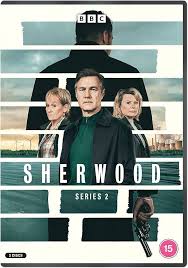


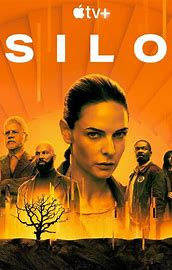
The Sommerdahl Murders
Rather soapy Danish crime series – the crime side of it is better than the romantic/domestic aspect, or at least my preference would be to dial down the latter and concentrate on the former.
Spy/Master
Excellent Romanian Cold War spy thriller about a KGB agent high up in the Ceaușescu regime, who finds himself needing to get out rather urgently. It’s a scenario that is broadly familiar but the portrayal of life with the Ceaușescus is rather less so and is fascinating.
Stalk
French drama about a student who uses his techy skills for evil rather than for good – or at least initially to get his own back on fellow students who have humiliated him. I could have done without the central character’s pccasional portentous/preachy voice-overs, but generally it’s well done. The tech is, I assume, solid, though it bemuses me. There is a second series, but I don’t feel compelled to watch.
Stateless
Powerful Australian drama about refugees, based on the real stories of four people who end up in an Australian detention centre for illegal immigrants, either as detainees or employees. It gets across with real power the impossibility of the refugees’ situation. The story of Cornelia Rau, a mentally ill white Australian woman, who was found to be one of those detainees, despite being an Australian citizen, is used not to displace the narratives of the Afghans, Syrians and other asylum seekers, but to convey the bureaucratic nightmare in which they all find themselves.
Stockholm Requiem/Hostage
Requiem is a twisty crime series, with an interesting structure – a sequence of crimes are investigated and (to some extent) resolved, but turn out to be linked, and not by the perpetrator(s). Hostage follows some of the same characters but with a very different scenario, with a hijacked plane – it’s more conventional but well done and gripping.
Supacell
Looked initially like a new version of Misfits, whereby a bunch of people suddenly get superpowers. But these aren’t random, as it gradually becomes clear. All are black, all have some family history of sickle cell disease. It’s not humourless but it certainly isn’t played for laughs – the implications of the new abilities are complicated, and the new superheroes are clearly in danger. The Guardian’s reviewer said that ‘This is not your typical superhero origin story, where preserving truth, justice and the American way is the primary concern. Instead, the characters are operating in a society where the odds are stacked against them, and they are all struggling to make ends meet and avoid violence’. Excellent series, hoping for a sequel.


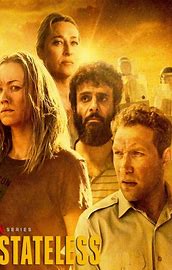


Threads
I watched this when it was first shown. I can vividly remember how unsettling it was to head off the following morning into the city centre that I had just seen destroyed on screen, to get the train to work. I wasn’t sure how well it would stand up to a rewatch, but it stood up almost too well. I’d remembered from the time feeling that the central storyline, the young couple having to plan a wedding due to an unplanned pregnancy, seemed to come from an earlier era of kitchen sink drama. This datedness seemed to be backed up by the fact that ‘Johnny Be Good’ is on the car radio and the pub jukebox. All of these years on, it seemed timeless. And it was as brutal and bleak and horrifying as I’d found it first time round, and it’s staggering what was achieved for what would now seem a fairly modest budget. But I almost wished I hadn’t rewatched it because it reminded me of all the reasons there are to fear for, not so much my future, but that of my kids, and their kids…
The Twelve
Soapy jury drama. This is season 2 of the Aussie version of a Belgian series we watched via Walter Presents a few years back. The main plot is intriguing and solid, but some of the stories involving individual jurors were rather predictable (well, of course the moment you blurt out the huge secret you’ve been keeping for years the person most directly affected by that will prove to be standing at the door, and will then rush out into the street and be hit by a car, because that’s what always happens in these things). And Sam Neill as one of the defence lawyers was giving me definite Judge John Deed vibes which is not a good thing. But it was entertaining enough.
Under the Bridge
See my books blog for the true crime book on which this is based, the murder of a teenager by her peers. It’s very watchable, though the directors took the odd (in my view) decision to insert writer Rebecca Godfrey into the narrative via a personal history that mirrors some of the experiences of the teenagers involved. None of that was real – Godfrey was a journalist who spotted a good story, investigated and wrote about it. The choice to link one of the cops to a story about forcible adoption of First Nation children is also fictional, but I don’t have a problem with the way in which, in particular, Canadian and Australian dramas are bringing this history into the foreground, and Lily Gladstone is always worth watching in any case.
Until I Kill You
Bloody hell, Anna Maxwell Martin is good. One of those actors who compel one’s attention completely, even in something lighter weight, like Ludwig. This one is not lightweight, not in the slightest. It’s true crime, based on the memoir of a survivor, and it shows, brutally, not only how someone who seems to be a ‘free spirit’, an oddball, but deeply lonely, could come under the power of a psychopath, but how her reactions, her spiky defensiveness and stubborn refusal to fully cooperate with the police or with other agencies who try to help, put her at further risk. But it does so without victim blaming. Some of what she tells the police about the man who tried to kill her is ignored, largely because she was ‘odd’ and difficult. She doesn’t behave like a victim is supposed to behave, and so she is written off as unstable and thus unreliable. When she tells the court about the lasting effects – physical and mental – of his attacks on her, it is not only heartbreaking but enraging.
We Were the Lucky Ones
The title is ironic. Yes, this is the story of a family many of whose members survived the Holocaust, against the odds, through various means. But ‘lucky’? As I said in another blog, film/TV depictions of the Holocaust should never, ever, be ‘poignant’ (don’t get me started on that), never (heaven help us) heartwarming. Here, the survival of so many of this family, who went on to build future generations, was not a ‘happy ending’ but a shout of defiance in the face of evil.
Wolf Hall
I re-watched the original series and was reminded again just what a fabulous slice of TV it was. Every performance, every detail. I could just watch Rylance’s face for hours, his stillness. Director Kosminsky described it as him listening, but he’s ‘listening’ to more than words, his antennae are picking up on gestures, sidelong glances, silences. And he’s listening as if his life depends upon it – as, indeed, it does. It took a moment in this new series to adjust to a certain number of recastings (due to death (Bernard Hill), global fame (Tom Holland) or other reasons) and to the fact that returning cast members are 9 years older than when we last saw them, though only a couple of weeks have passed for Henry, Cromwell and the rest. But it’s not lost any of its power and intensity. Cromwell, once so sure footed, now vulnerable, making mistakes, making even more enemies. I know how it ends, of course, and I remember that feeling as I read the book, that I wanted a different ending, for him to find his way to that former abbey where the bees make honey that’s scented with thyme.

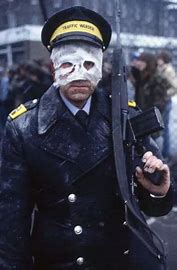


Documentary
The Battle for Black Music: Paid in Full
Exploitation by managers and record companies is not exclusively an issue for black musicians, obviously. Youth and naivety have always been taken advantage of to make sure that the big bucks don’t go to the talent. But if you add in the factor of race, and how much less power even high profile black artists had/have, there’s a pattern that isn’t just about individual bad actors, but about institutionalised racism and the entitlement that goes with it. A fascinating and infuriating account.
Black Barbie
I was never much of a one for dolls as a child. I do remember my younger sister having a black baby doll (in the early-mid 60s I think), but the first black Barbie didn’t arrive till 1980. The documentary tells the story of the women who made that happen. Of course, Barbie, black or white, doesn’t really look like any of us (even Margot Robbie), but for black girls it wasn’t just the improbably long legs and tiny waist, but the colour of her skin and hair, the shape of her features. And so it was important that black Barbie wasn’t just regular Barbie in blackface, but had a wider nose, fuller lips, and an Afro. It’s not a straightforward tale of representation and empowerment – white Barbie is still and always will be The Barbie, the first and original. But black Barbie: ‘She’s black. She’s beautiful. She’s dynamite’, as the original tagline had it.
Corridors of Power: Should America Police the World?
The title contains a question to which the obvious answer would seem to be a hard no. And the series doesn’t do much to change one’s mind on that, but it does give an in-depth account of many of those flashpoints in world history where America did too much, or not enough, and what the consequences were. With lots of insiders – Condoleezza Rice, Colin Powell, Hillary Clinton, Samantha Power, Madeleine Albright, to name only the best known – the series gives real insight into what happened, and why.
A House Through Time: Two Cities at War
I haven’t seen the previous series of A House Through Time (I will do) , but this one is riveting. He’s identified apartment blocks in London and Berlin whose occupants, between the wars and during WW2, include Jews and SS members, conscientious objectors and war heroes, and everything in between. Exemplary TV.
Into the Fire: The Lost Daughter
Cathy Terkanian gave her daughter up for adoption in 1974 – Cathy was 16 and never knew who had adopted the child. In 2010, she was approached by the adoption agency wanting to get a sample of her DNA, because a body had been found that might be the daughter, who had disappeared in 1989. Although the DNA wasn’t a match, this started Cathy on a mission to find out what had happened to Aundria. The answers she finds are devastating. It’s a gripping account, well told.
Spielberg
Excellent documentary account of Spielberg’s life and career – it was made in 2017, five years before The Fabelmans came out, and it would have been fascinating if the doc could have explored that movie too, in relation to the biographical material they’d already covered.


Stax: Soulsville USA
This first lifts your heart, with the story of how Stax came into being, of the remarkable way in which music brought black and white artists together in a time of segregation, and then breaks it as we see how the big record companies wanted what Stax had created, and gradually, ruthlessly, drove them out of business. But perhaps the most heartbreaking thing was to realise that despite the musical camaraderie, the white musicians did not get what life was for their black bandmates, and did not ask (particularly after the assassination of MLK) and that it was not possible for that communication gap to be overcome.
Union
Another exemplary Olusoga doc, this one tracing the history – much of it unfamiliar to me – of Great Britain/the United Kingdom, how the union came about and the threats it has faced over the centuries. (When I googled this to check the full title, I found it was listed as ‘Union with David Olusoga’, which sounds lovely but does not accurately reflect the contents of the programme…)
Watergate
This 1994 documentary series is fascinating. I recall these events unfolding in real time, have read the Bernstein/Woodward book and seen the film, and watched the fictionalised re-telling based on John Ehrlichman’s book, with Jason Robards as ‘President Richard Monckton’. But there’s lots of new material here, and lots of interviews with the people directly involved, so much light was shed on this whole murky episode.
The Zelensky Story
A truly remarkable man, who might in other circumstances have never been much known outside Ukraine but who now stands for his country, and as a symbol of resistance to big power aggression. I was struck by the remark, from one of his close associates, that his change of personal style after the invasion was not cosplaying a soldier, but rather identifying with a civilian resistance. It made me admire him even more than I did already, but also fear for him.


2024 Reading – the second half
Posted in Literature on December 6, 2024
My reading this year has been the usual eclectic mix. I normally (normal for me, I hasten to add) have four books on the go at any time. One will be in French, maintaining a fairly recent resolution (so far this half year, de Beauvoir, Gide, Mauriac, Fatou Diome and Francois Emmanuel, of whom the last two were new to me). At least one will be non-fiction. One will be on the Kindle, two will be by my bedside to read before I turn out the light, and one in my library room (currently the French one).
Having brought so many books, half-forgotten in many cases, down from the attic this year, I’m instituting a new ‘rule’ for 2025 – one of the four books will be a re-read. Or, possibly, a first read if it’s one I’ve had for yonks but honestly can’t recall whether or not I did read it (there’s a lot of M’s sci-fi stuff that’s in that category). But there are also books the mere sight of whose covers made me yearn to revisit them. And whilst life is short and there’s so many great new books out there, there are also so many great old books that absolutely deserve to be savoured all over again.
I read a lot of crime fiction, but would not want to be reading more than one in that genre, as clues and corpses could easily get in a muddle. When it comes to crime fiction in particular, I haven’t listed everything I read, not because it wasn’t any good, but because ongoing series are hard to review without just repeating myself about how good, e.g. Elly Griffiths or Val McDermid is.
There are a few books here that slide across genres – Thomas Mullen’s Blind Spots is crime + sci-fi, Leonora Nattrass’ Blue Water is crime + historical fiction. For more straightforward historical fiction the stand-out is Maggie O’Farrell’s The Marriage Portrait. And for books that don’t present us with the world that we know or that existed, or not straightforwardly, there’s Evaristo’s alt history/alt geography Blonde Roots, Mullen, Jenny Erpenbeck’s End of Days which plays around with how death normally operates, and Kate Atkinson’s short stories (see below). I was pleased to discover some new novelists in this batch, notably Nathan Harris, Caleb Azumah Nelson, Margot Singer and Anna Burns – my top books of this half year are Nelson’s Open Water and Burns’ Milkman, and in non-fiction, Paul Besley’s The Search. As always, I try to avoid spoilers, but do proceed with caution.
Fiction
Kate Atkinson – Normal Rules Don’t Apply
I love Atkinson – Life after Life in particular is one of my absolute favourite books. I’m not generally a fan of short stories but these are – as the title suggests – quirky and sometimes baffling, as well as being often very funny, and definitely need to be re-read asap.
Simone de Beauvoir – Les Belles Images
Reading this, I felt as if it should be one of those French films where elegant people sit around talking about ideas, when they’re not sleeping with each other’s partners. Isabelle Huppert should be in this. I’ve not found it an easy read, partly because the narrative voice switches between our protagonist Laurent, and a narrator, without the distinction always being clearly made on the page. It’s short on event (another reason why it should be one of those French films), very introspective. Worth persevering, because it’s intelligent and perceptive and sharp, and the discussions they have are still pertinent fifty years on.
Mark Billingham – The Wrong Hands
The second in his new Declan Miller police procedural series. Miller is infuriating, but funny and human (though I’m not sure he’s quite different enough from Tom Thorne, about whom the same things could be said), and the crime here is woven together with his own search for truth about the death of his wife, which gives it a lot of heart.
Anna Burns – Milkman
I’ve been meaning to read this for a long time – urged on by my Belfast-born sister-in-law in particular – and I’m so glad I did. It’s darkly funny and terribly sad and horrifying and the people in it blaze with individual life, despite not being named.
Candice Carty-Williams – People Person
I loved her debut, Queenie but this didn’t quite work for me. It started off brilliantly, with the crackling dialogue that was so enjoyable in Queenie, and the deft characterisation of the group of half-siblings and their hopeless father. But the event that dictates the rest of the plot and what flowed from it just seemed so improbable, and then it all got resolved rather too neatly. A lot to enjoy along the way but flawed.
Fatou Diome – Le Ventre de l’Atlantique
A Senegalese woman, making a living (just about) in France, talks on the phone to her younger brother who (along with many of his contemporaries) is desperate to make the same journey, with dreams of being a professional footballer. Through their phone conversations and her own account of her life in their village, we explore those dreams and the realities that the dreamers don’t want to face, all with the backdrop of the 2000 European Cup and the 2002 World Cup.


Francois Emmanuel – La Question humaine
I saw the film based on this – Heartbeat Detector, starring Matthieu Amalric – some years ago and it’s pretty close to the book. A psychologist in the HR department of the French branch of a German firm is asked to investigate the fitness of the CEO and finds himself investigating complicity or direct involvement in the Holocaust. At the heart of it is an exploration of language – the inhuman language of memos dating from the early phases of the Holocaust, and the reductive language of HR practice in large corporations.
Jenny Erpenbeck – The End of Days
The structure frequently wrong-footed me at first – characters are unnamed – it’s the daughter, the mother, the grandmother – and so as we move around in the chronology those relationships change too. Worth the effort to focus. The central conceit reminded me of Kate Atkinson’s Life after Life – a life ends, but it need not have, and what if it didn’t end then, but a bit later, or much later than that? Compelling and moving.
Bernardine Evaristo – Blonde Roots
An alternative world, where the slaves are white, their owners African. It’s not a straight reversal of history, geography has been adjusted too. It’s funny – I love the scene where the white peasant family raise the newborn to the heavens to see ‘the only thing greater than you’, a skit on that same scene in Roots, and perhaps on the Lion King too… The Independent said, ‘Running through these pages is not just a feisty, hyperactive imagination asking “what if?”, but the unhealed African heart with the question, “how does it feel?” This is a powerful gesture of fearless thematic ownership by one of the UK’s most unusual and challenging writers’.
Sebastian Faulks – Charlotte Gray
I think I read this slightly too soon after Simon Mawer’s The Girl who fell from the Sky/Tightrope which has a very similar plot (young female SOE agent parachuted into France, but with her own agenda). It was worth reading though, and it avoids the clichés of wartime heroics, with a compelling protagonist. Apparently Faulks received a Bad Sex award for this but honestly, I’ve read far, far worse…
Damon Galgut – The Promise
Across the years, from the ‘80s to 2018, a South African family wrestles with the huge changes in society, and with the titular promise, made on her deathbed by the matriarch Rachel, that the family servant, Salome, would be given a house of her own on the family farm. It’s a promise that’s explicitly disavowed, or deliberately forgotten about, or that simply is impossible to keep, but that promise speaks eloquently about South African society and its history. It’s in four sections, each beginning with the death of a member of the family, and each reflecting key episodes in the country’s recent history. In each section we see things from the perspective of one of the family members, although always with dry asides from the narrator to puncture their naivety or complacency. But the person into whom we get the least insight is Salome, who is more of a symbol than a character, let alone a protagonist.
André Gide – La Porte étroite
The only Gide I’d read before this was Thesée, his version of the story of Theseus and the Minotaur, which I read whilst writing my PhD thesis, and preoccupied with labyrinths. That was published in 1946 – this is a much earlier work, from 1909, and with a strong biographical element, as the central relationship between his protagonist Jerome and Jerome’s cousin Alissa reflects Gide’s relationship with his own cousin, who he married, despite his homosexuality. Here the issue is not so much sexuality – the relationship between Jerome and Alissa is intense but spiritual rather than physical, and mired in misunderstandings and things unspoken.



Patrick Hamilton – Hangover Square
Rather a depressing read, TBH. But bleakly funny at times. The Critic said that ‘This novel could not have been written at any other point in history. Hamilton is a great navigator of human frailty in the face of desolation. It is not the bar room drinkers, but the articulation of the tragic lack of power man has over the madness that swirls about him that makes Hangover Square a novel of its time.’
Nathan Harris – The Sweetness of Water
Set in the immediate aftermath of the Civil War, Harris’s debut novel tells of a white farmer whose encounter with two newly freed slaves both transforms his life, and brings about tragedy. It’s beautifully written, with the central characters all given depth and complexity. It’s about change, and how even the most desired, necessary, righteous social change is traumatic, and not just for its opponents. It’s about how people – individuals and communities – move on from that, about what freedom might mean at this time and in this place. Deeply moving, and with a sense of hope.
Robert Harris – Archangel
Harris never lets me down. We start off in Death of Stalin territory, and then jump forward to the post-Soviet era to meet our protagonist, an academic specialist in Soviet history who gets embroiled in highly dangerous secrets that show how that great dictator is not and perhaps cannot ever be entirely consigned to history. Thrilling up to the final page.
Sarah Hilary – Sharp Glass
The latest stand-alone psychological thriller from Hilary, and it’s another corker, perhaps her best yet. It’s not about twists for the sake of twists (I do go on a bit about this, but it really annoys me, when all credible plotting or character development is jettisoned for the sake of ‘a twist you’ll never see coming’…). Here, character is all, and these characters gradually become clearer, to themselves, to each other and to the reader, but there are loose ends left loose, not tidied away, so we’re still wondering about the protagonists after we’ve turned the final page.
Winifred Holtby – The Crowded Street
Holtby’s second published novel. I’d read South Riding many years ago, and several times – my Mum was a fan – and also Anderby Wold, but this one was new to me. Her protagonist is a young woman who feels a strong sense of familial duty but nonetheless struggles to fit the role that is expected of her. It’s often funny but there’s a deep sadness too, and anger.
Aldous Huxley – Point Counterpoint
A roman à clef about interwar intellectuals (based on, inter alia, D H Lawrence, Middleton Murry and Huxley himself). Like a fugue, the novel unfolds through a series of different voices and different debates, interweaving and recurring in different forms. As such it’s wordy and light on incident, but nonetheless fascinating.



Tom Kenneally – Fanatic Heart
I was looking forward to this – I’d read a few of Kenneally’s books years back and remember liking them, and Fanatic Heart covers an interesting period of history, spanning three continents, from the Irish Famine through to the first stirrings of civil war in the US, through the life of Irish nationalist writer John Mitchel. But the style was somehow so inert. The story was eventful enough, it should have been engaging but instead it dragged, and I ended up skim reading the last chapter or so just to finish it. The story is also cut off before what would potentially have been an opportunity to explore Mitchel’s controversial views on slavery (he was for it), and his loyalty to the Confederate cause during the Civil War. But I’m afraid I didn’t enjoy this enough to read a sequel, if there is one.
Jhumpa Lahiri – The Namesake
Touching, funny account of a young man’s life, from a Bengali family, growing up with a Russian name in the USA. Julie Myerson in the Guardian said that ‘this is certainly a novel that explores the concepts of cultural identity, of rootlessness, of tradition and familial expectation – as well as the way that names subtly (and not so subtly) alter our perceptions of ourselves – but it’s very much to its credit that it never succumbs to the clichés those themes so often entail. Instead, Lahiri turns it into something both larger and simpler: the story of a man and his family, of his life and hopes, loves and sorrows.’
Francois Mauriac – La Pharisienne
Mauriac’s Le Noeud de Viperes was one of the first French novels that I read (in French) without having to, whilst I was at school. I’ve read several of his other novels, and his remarkable clandestine pseudonymous publication Le Cahier Noir, a rallying call to Resistance during the Occupation. He’s a hero of mine – he was in many ways a conservative – family, the Church, his country – but never an unquestioning one, and his questioning led him to challenge the Church’s support for Franco, and to bring his skill as a writer to the Resistance. He was never going to be a fighter (too old, too weedy), but he still risked everything by his activities and associations. This novel was published during the Occupation, under his own name, because it isn’t, at least overtly, about that. It’s the study of a woman whose religious convictions make her seek perfection not only in herself but in those around her, and to deal harshly with those who fall short. As a critique of religious zeal it was controversial enough – but the depiction of a culture of denunciation perhaps does refer obliquely to the Occupation. It’s powerful and Brigitte Pian, the ‘Woman of the Pharisees’ is a horrifying creation.
Arthur Miller – Focus
I was prompted to re-read this by watching Joseph Losey’s film Mr Klein (see my screen blog). This is Miller’s only novel and it’s premiss is a man who gets a new pair of specs and realises he now looks like a Jew, and that people around him are suddenly seeing him as a Jew. It’s a powerful and shocking account of antisemitism in the US at the end of WWII, and all the more interesting because the protagonist is himself a repository of antisemitic and other racist prejudices (unlike, for example, Gregory Peck’s character in Gentleman’s Agreement, who is noble and righteous and allowing himself to be seen as a Jew consciously and deliberately).
Thomas Mullen – Blind Spots
I have read and loved Mullen’s trilogy (Darktown, Lightning Men and Midnight Atlanta) dealing with Atlanta’s first black cops in the era of segregation and civil rights protests. This is completely different – we’re in an unspecified future, where everyone, worldwide, gradually lost their sight. A technological solution has been found (even if it’s not available, or acceptable, to everyone), downloading visual data directly to people’s brains. But then, it gets hacked, and no one can really trust what they’re seeing… It’s a sci-fi crime thriller, which is completely gripping, but also thoughtful and thought-provoking.
Leonora Natrass – Blue Water
A cracking historical mystery, set in the days of the American Revolutionary Wars, and we’re all at sea, en route to Philadelphia with a disgraced FO clerk, who is trying to ensure that a vital treaty will reach the Americans in time to stop them joining France’s war on Britain. This is the second in a series so I should really have read Black Drop first, but thoroughly enjoyed this one nonetheless and will backtrack to its prequel asap.


Caleb Azumah Nelson – Open Water
Stunning debut from a young British-Ghanaian writer, with a second-person narrative that involves the reader intensely in the protagonist’s thoughts, emotions and experiences. It’s about love, race, masculinity. The i review describes it as ‘an emotionally intelligent and tender tale of first love which examines, with great depth and attention, the intersections of creativity and vulnerability in London – where inhabiting a black body can affect how one is perceived and treated’.
Maggie O’Farrell – The Marriage Portrait
Gorgeously written historical novel, beautiful and tragic and very memorable. Its heroine is Lucrezia de’Medici, married at 15 to the Duke of Ferrara, whose early and suspicious death inspired Robert Browning’s ‘My Last Duchess’.
Ann Patchett – The Dutch House
This almost sounds like a fairy tale – a magical house from which the children are driven out by their stepmother. But for all of the motifs from those archetypal narratives, it’s really about how we deal with the past when the past has hurt us. Maeve (an extraordinary creation) and Danny, the two exiled children, struggle with and find different approaches to this. As the Guardian reviewer put it, Patchett ‘leads us to a truth that feels like life rather than literature’.
Richard Powers – Orfeo
I discovered Powers last year through The Time of our Singing. Like that book, this one is suffused with music. The Independent reviewer said ‘There are passages that make you want to rush to your stereo, or download particular pieces to listen to as you read — Mahler’s Kindertotenlieder, Messiaen’s Quartet for the End of Time — and others that seem to offer that same experience for pieces you will never hear, pieces composed by Powers’s composer hero, Peter Els.’ It’s not just about the subjective experience of music, it’s about composition, and microbiology and technology, and it’s absolutely compelling.
Margot Singer – Underground Fugue
Another novel that invokes musical form (see also Huxley’s Point Counterpoint). In this case, fugue is both structure – there are four voices here, which alternate and interweave, and connect or echo each other in different ways – and psychological state – all four are exiled and unrooted (and there’s a connection too to the case of the so-called ‘Piano Man’). As these stories interconnect, we move closer to the climactic event of the novel, the 7/7 London bombings. Beautifully written, suffused with a sense of loss.
Cath Staincliffe – The Fells
A police procedural dealing with a cold case – the discovery of a skeleton in some caves in the fells. As always, Staincliffe is interested not just in the crime, and who was responsible for it, but in the ramifications of the crime, the effects on the family and friends. And as always, she makes you believe in her characters, including her new detective duo, and care about them.


Elizabeth Strout – The Burgess Boys/Lucy by the Sea
I do love a Strout. As always, these novels connect with each other, and with others of Strout’s oeuvre. The Burgess brothers connect here to Lucy Barton (via Bob), and we also encounter (indirectly) Olive Kitteridge and the protagonists of Abide with Me – there are more links than those, and I think some kind of a flowchart is called for. Lucy is a Covid novel, it starts with Lucy’s ex-husband William insisting on taking serious steps to isolate the people he cares about as the pandemic looms, and it explores the strange world that we all inhabited then with Strout’s remarkable insight and empathy.
Douglas Stuart – Shuggie Bain
This is a tough read. It’s brilliantly written, with profound sympathies for its characters, including some of the more hopeless ones, but most of all for Shuggie as he tries to survive a chaotic childhood and navigate a path to some kind of stability. There were many moments when I feared how this would end, when a brief period of hope ended in yet another heartbreaking betrayal or failure, but ultimately there is some hope. Just enough.
Kit de Waal – Supporting Cast
These short stories connect to de Waal’s novels – as the title suggests they take characters who played a supporting role in those narratives and bring them to the foreground. As always with de Waal, these people, the lost and the losers, are drawn with tenderness and understanding, and I found them very moving.
Colson Whitehead – Crook Manifesto
A brilliant sequel to Harlem Shuffle. We’re now in the 70s, and furniture salesman Ray Carney is trying to stay on the right side of the law, but things get messy… The writing is marvellous, edgy and with bleak humour. As the Independent says, ‘the blend of violence, sardonic observation and out-and-out comedy reflects Whitehead’s ability to neatly balance the trick of writing both a homage to, and affectionate tease of, noir crime fiction’.
Non-Fiction
Albinia – The Britannias
Alice Albinia takes us island-hopping, and on each of the islands that surround Great Britain, she explores the history (going back to ancient times, and moving gradually forward to our own), folklore, landmarks and traditions, weaving in her own personal history and the conversations she has with locals and fellow-travellers. A lovely, intriguing read.
Paul Besley – The Search: The Life of a Mountain Rescue Dog Search Team
I probably would not have come across this book had I not known its author. And that would have been such a loss. I’m not particularly a dog person – that is, I’ve never lived with a dog, and there are only a few that I have got to know at all well (Alfie, Loki and Bentley). I did have my own encounter with Mountain Rescue though, when I was a teenager with a small group on a church youth hostelling trip who got stuck in awful weather on Great Gable and I can still vividly remember hearing and then seeing our rescuers arrive, with duvet coats and hot chocolate and the relief and joy and gratitude that I felt. The book describes Paul’s own experience of being rescued (a great deal more dramatic than mine) and subsequent involvement with Mountain Rescue, culminating in training a dog, Scout, to work with him to track people who need help in the hills. It’s that training process that forms the bulk of the book, and it’s extraordinary – fascinating and moving and gripping. The title turns out to mean much more than the literal search for those lost bodies – it’s a very personal search for meaning, for a way of living well and in the present, for contentment even in the toughest of times. Do read it, whether or not you are a dog or a hiking person – it’s quite remarkable.



Jarvis Cocker – Good Pop, Bad Pop: An Inventory
Not a memoir. Rather, this is Jarvis rummaging in his attic and telling us stories about some of the stuff he finds there, whilst debating whether to keep or get rid of each item. It’s very engaging, playful and tricksy (just how random are these random items? Were they all actually in that attic at the start of the project? Did the things he tells us he decided to ‘cob’ (a Sheffield word – albeit not one I’m familiar with – for chuck out) actually get cobbed?). And along the way lots of brilliant anecdotes about Jarvis’s youth and the early days of Pulp.
Joan Didion – Blue Nights
I read The Year of Magical Thinking last year, just long enough after the sudden death of my husband. That book deals not only with her husband’s death but with the serious illness of their daughter Quintana, who was in hospital, unconscious when he died, and after an initial recovery became seriously ill again, dying just before Magical Thinking was published. Blue Nights tells – in a non-linear fashion – the story of Quintana’s adoption, her issues with depression and anxiety, her illness and death, through Didion’s eyes. Didion shows, with brutal clarity, how little she understood her daughter, and it offers no healing insights into dealing with such a loss. Cathleen Sohine wrote in the NY Review of Books that ‘Blue Nights is about what happens when there are no more stories we can tell ourselves, no narrative to guide us and make sense out of the chaos, no order, no meaning, no conclusion to the tale’. It’s utterly bleak. Whereas Magical Thinking is an act of mourning, Blue Nights, permeated by Didion’s sense of failure as a mother, and failure to understand Quintana, is a cry of despair.
Jeremy Eichler – Time’s Echo: Music, Memory and the Second World War
Brilliant, fascinating and eminently readable. A study of four composers (Richard Strauss, Schoenberg, Britten and Shostakovich) and a key work by each, responding to World War II and the Holocaust in particular. It generated a powerful playlist: Schoenberg’s A Survivor from Warsaw, Strauss’ Metamorphosen, Britten’s War Requiem and Shostakovich’s 13th Symphony (specifically the 1st movement, the Adagio, often referred to as Babi Yar) and along the way lots of other pieces are discussed, with such clarity that one almost feels as if one can hear them.
Paul Fussell – The Great War and Modern Memory
Fascinating study – published in the ‘70s – of how the ‘Great War’ was portrayed in poetry and fiction, how literary references, mythology and religious ideas permeated these portrayals, along with a strong strand of homoeroticism. Some of the work Fussell explores is familiar to me (Owen, Sassoon, Graves), some not at all, but it’s full of interest and new insights. I was particularly struck by how the ‘literariness’ of the accounts was not restricted to the officer class but is present in diary and memoir from other ranks too, suggesting a widespread familiarity with, e.g. Shakespeare and Bunyan.
Rebecca Godfrey – Under the Bridge: The True Story of the Murder of Reena Virk
An insightful account of the murder, carried out by a group of teenagers, of another teenage girl, a bullied outsider. I watched the TV adaptation of this, which oddly makes Godfrey a protagonist, getting directly involved in the investigation, and having a personal history that connects her to the suspects, none of which is actually what happened. It’s odd because it derails the drama, which really needs no embellishment. The book is much better than I was expecting, having been irritated by the dramatization (but sufficiently intrigued to see what the source material actually said).
Richard Holmes – The Age of Wonder: How the Romantic Generation Discovered the Beauty and Terror of Science
A rather wonderful account of science in the Romantic era – Herschel and Davy, Mungo Park and Joseph Banks. There are important women here too, most notably Caroline Herschel and Mary Somerville. Very readable, and not just for historians of science – one of the fascinating things about this period is that people weren’t silo’d into arts or sciences as later generations, including my own, tended to be – William Herschel was a composer and Humphrey Davy a poet.




Stuart Jones (ed.) – Manchester Minds: A University History of Ideas
Full disclosure – I contributed a small ‘vignette’ to this volume, on W G Sebald and Michel Butor. But there’s masses of interest here, all marking the 200th birthday of the University of Manchester by celebrating some of its most notable and influential figures. I was drawn to the outsiders or exiles amongst them – like economist W Arthur Lewis, from St Lucia, Gilbert Gadoffre whose time at the University was interrupted by a spell of activity in the French Resistance, Eva Gore Booth, the Irish poet and activist, and philosopher Dorothy Emmett, plus a number of Jewish academics who had left Europe either because of pogroms in the East, or the advent of the Nazis.
Hilary Mantel – A Memoir of my Former Self
A collection of Mantel’s short non-fiction, on a wide range of topics, some autobiographical (these overlap with Giving up the Ghost, a memoir that she published in 2010), some film and book reviews, and most enjoyably and interestingly her Reith lectures on writing historical fiction. As in her novels, she is sharp, funny, and sometimes fierce – her account of how her endometriosis was dismissed by a series of doctors as just female neurosis is utterly enraging.
D. Quentin Miller (ed.) – James Baldwin in Context
A collection of short essays on aspects of Baldwin, his life, his novels, his politics. I’ve immersed myself in Baldwin periodically over the years (first as a teenager when I discovered the novels and short stories, then a couple of years ago inspired by Black Lives Matter, and now for his centenary), and there is much to be savoured here, that can enrich my understanding. I supplemented the reading (I also re-read Go Tell it on the Mountain, and I am not your Negro) with watching some of Baldwin’s interviews, and as always, I find his voice so very compelling. He doesn’t do soundbites or inspirational quotes – when he talks about politics it is all about narrative, the narrative of the African American chained and trafficked and exploited, and then subjected to segregation and the daily evidence of white hatred. Rewatching his ‘debate’ with Paul Weiss was rage-inducing, Weiss’s complacency in his own privilege staggering, but Baldwin’s narrative overwhelmed him. His speech and his writing have a rhythm, a beat, that comes from the church (he was a preacher in his late teens), and from blues and jazz. He’s never less than piercingly articulate, and never less than fiercely passionate, but more than that, his humanity always shines through.
Graham Robb – The Discovery of France: A Historical Geography from the Revolution to the First World War
It’s described as historical geography but it’s also what I would have called social history – it’s about the people who didn’t make it into the history books, and who were for the most part buffeted by Great Events rather than playing an active role in them. And really, as the title suggests, it’s about how little the concept of ‘France’ meant to most of those people, vast numbers of whom did not speak any language resembling French (perhaps one of the reasons why the Académie is so protective of that language now). It also provides a fascinating context for the 19th century novels I’ve been reading since my teens – Balzac, Flaubert, Zola.
Sathnam Sanghera – Empireland: How Imperialism has Shaped Modern Britain
My schooling until the 11+ year was in two newly independent West African nations. Whilst I mixed primarily with other ‘expatriates’ I could not be unaware (and my parents were profoundly aware) of the reasons we were out there, and how the legacy of empire was still playing out. My understanding may have been primitive (I was 9 when we left) but it influenced my thinking about so many things as I grew up. So it was fascinating to read Sanghera’s exploration of the ramifications of our imperial history in British culture and politics. It is clear-sighted and forward looking, and asks what we do once we have recognised what empire did to its overseas subjects and what it did to those who grew up here in its shadow.
Claire Wills – Lovers and Strangers: An Immigrant History of Postwar Britain
The story of immigrants from the wreckage of the war in Europe, from Ireland, from the Caribbean, from across the Commonwealth, at work, at home and at play. It’s a rich and varied picture – the experiences of immigrant life varied enormously as one would expect depending on why they came, where they came from and who they’d been in their previous life. Some of these stories are familiar but a great many are not, and it is good, in particular, to get beneath the generalisation of ‘Asian’ to explore the very different communities who arrived, with different expectations, and different challenges to their integration.



Twenty Films
Posted in Film on November 3, 2024
I’ve been trying to build BlueSky as a place to focus my social media if/when X/Twitter becomes too toxic or melts down altogether. So when BookSky featured a challenge to post covers of 20 books that had had a major impact/influence on me, I jumped at it, thinking (rightly) that I might well find amongst the others joining the challenge or responding to my choices people who were worth following, and followed it up with 20 records, and 20 films. (I really, really like lists). The books that I chose are all ones that I’ve talked about on this blog at various times, as are the 20 albums. But I’ve never blogged about my top films. And the BlueSky thing specified no reviews, no details, just the book cover, CD/LP cover or film poster, so here I have a chance to tell everyone not only which 20 films I chose, but why.
This isn’t my stab at picking the 20 best films ever. I could make a case for some of them, but not all. It’s about their impact on me, and that’s subjective, whatever their critical and/or popular standing. I ruled out films where I could not readily recall that first viewing, the when and where of it, but more importantly the feeling of it. Some of these films packed a huge emotional punch, left me wrung out and still sobbing after the credits had rolled. (A lot of these films made me cry – as anyone who has watched a film with me will know, that’s a very low bar – but that isn’t a criterion in itself.) Some of them immediately intrigued me, made me want to watch them again (and again) to figure them out, to understand some of the layers of meaning. In some of them (and these aren’t mutually exclusive categories) the look or the sound of the film (not necessarily the music) were a huge part of their power. But all of these films stayed with me from that first viewing, not only as I made my way home from the cinema, or off to the kitchen to get a cup of tea, but long after. And all but the most recent have proved that they sustain their power on subsequent rewatches.
Of course, making any such list, as those who are addicted to list-making know, is about what you leave out as well as what you include. To get it to 20 meant rejecting films that I love, and that felt bad. I could easily pick another 20 wonderful films, but they wouldn’t quite meet my stringent self-imposed criteria. So these (in no particular order) are the ones that survived the cull, and I’ll tell you why.
Arrival (2016, dir. Denis Villeneuve)
A pretty much perfect film. It has everything one might want from a ‘first contact’ sci-fi movie but then more, much more, than one might expect. The search for a way of communicating is clever and thought-provoking, but also very moving (it reminded me of my favourite Star Trek: Next Gen episode, ‘Darmok’). And the final part of the film – I can’t say anything too specific because if you haven’t seen it, then you need to, and whilst it stands up to any number of rewatchings, the moment on a first watching when one grasps what it is that has happened is so powerful that it should not be compromised. It’s all visually stunning too. The score is one of Johann Johannson’s best, and that’s saying a lot. It’s worth reading too the short story on which the film is based, Ted Chiang’s ‘The Story of Your Life’.


It’s a Wonderful Life (1946, dir. Frank Capra); Music – Dimitri Tiomkin
I resisted this for years. I’d seen it described as ‘heartwarming’, which is a red flag for me – I don’t mind my heart being warmed, but I resent a film/book explicitly setting out to warm it. But when I eventually succumbed and watched it, I found that whilst the very final scene did, indeed, warm my heart, that sentimentality had been more than earned. Capra’s hero is a good man, without any doubt, but we see him tormented by regrets, and by resentment that doing the right thing, as he must, ties him down and traps him in domesticity and small-town life, when he longed and longs to travel the world. He’s angry, and that anger shows. He’s a good man, but not a saint. And so we can identify with his frustration, his regret, even the anger. I always watch this film a few days before Christmas – that became a tradition as soon as I’d watched it that first time – and each time I weep at the opening sequence, as the prayers for George go up to the heavens, and keep weeping, off and on, until The End. There are odd moments at which I wince every time (I hate the way they all patronise Annie, most particularly, and I’m not entirely reconciled to Mary’s transformation into a scared of her own shadow spinster in Pottersville, though there are ways of interpreting this). It’s not a perfect film, in other words, but it’s a powerful and profound one, that goes to very dark places but shows the way out of them. See, if you’re interested, my two previous blog posts about IAWL: You are now in Bedford Falls | Passing Time, Letting it get to you: Doctor Who and George Bailey | Passing Time


Le Mepris (196 , Jean-Luc Godard); Music – Georges Delarue
I don’t tend to love Godard – give me Resnais (see below), Truffaut or Malle any day if we’re talking Nouvelle Vague. But while I was doing a part-time French Language & Cultures degree, which had a very strong cinematic bent, we had a module on intertextuality and studied this particular film in depth. It’s absolutely rammed with intertextual references – the very presence of Fritz Lang, the film posters in the scenes at Cinecento, the books that the characters read, the Odyssey… My enjoyment of the film is more purely intellectual than for most of the films in this list, but no less powerful for that. One can analyse – and we did – every shot, for its use of colour, its framing, its intertextual details, but also the plot, which has layers of ambiguity that keep one pondering. It’s visually very striking, and that strange house – the Casa Malaparte on Capri island – is quite disturbing (I had a strong sense of vertigo when I watched the film on the big screen).


Casablanca (1942, Michael Curtiz); Music – Max Steiner
I loved Casablanca from the first time I saw it (how could one not?). Bogart, Rains and Bergman. The Marseillaise scene. The dialogue, crackling with dry wit. And somehow, that film gets richer and stronger every time I watch it. When I first realised just how many of the people involved in the film – both behind and in front of the camera – were refugees from Nazi Europe, that brought a depth to many of the scenes that I hadn’t realised on first watching. It’s not just the big names (Conrad Veidt, Peter Lorre, Paul Henreid), or the second-tier cast (e.g. Curt Bois, Madeleine Lebeau, S Z Sokall) – the couple earnestly practising their English for their hoped-for new life in the USA, Frau and Herr Leuchtag, were both played by Jewish refugees from Nazi Germany/Austria (Ilka Gruning and Ludwig Stossel). One can love the film without knowing any of this – it’s a pretty much perfect film however one looks at it. The Marseillaise scene always reduced me to sobs, but knowing that Madeleine Lebeau, who plays Yvonne, had had to flee Paris ahead of the Nazis, and that her tears (and those of many of the other cast and crew in that scene) were real and heartfelt, makes it utterly compelling. The film Curtiz provides fascinating background to the director and the production of Casablanca and is well worth seeing.


Last Year at Marienbad (Alain Resnais); Music – Francis Seyrig
I wrote a whole blog about this film. So I won’t repeat myself, other than to say that Alain Resnais is probably my favourite Nouvelle Vague film director, and that one of the things I like about him as that whilst the films he made in the 50s and 60s were enigmatic, heavily intertextual, non-linear, intellectual, he went on to make more comedies, including a number of films of Alan Ayckbourn plays (e.g. Coeurs (Private Fears in Public Places) and Smoking/No Smoking (Intimate Exchanges), much more accessible but still clever and thoughtful. In Marienbad, one of the quintessential new wave movies, there’s a moment when one can see, briefly, the unmistakable silhouette of Alfred Hitchcock (I didn’t believe that when I read about it, but it’s there, I promise – what it tells us is another question). And Resnais, apparently, was a big fan of Marvel, and wanted to work with Stan Lee. Again, I’m not joking. And that leads us neatly on to…


The Avengers (2012, Joss Whedon); Music – Alan Silvestri
The first in a stunning sequence of superhero movies that came to a powerful climax with Endgame. This one has everything that one might wish for from a superhero movie – massive battles, superb CGI, gorgeous superheroes, and a clever, witty script. That final element is courtesy of Joss Whedon, who – though we did not know it then – is highly problematic. But at the time this was released, I was a huge fan primarily because of Buffy, and his script here brings not just humour but depth to the story. Whedon didn’t continue to play much of a part in the Marvel glory years, but he set the tone. I had no background with the comics (graphic novels, whatever), so came to these characters fresh and fell for them. I wrote a blog about Marvel too…

West Side Story (1961, Robert Wise); Music – Leonard Bernstein
I love the Spielberg version – it seems to me that it honours the original without being afraid to change things about it. But for the purposes of this list, it is the original movie that I’m going back to, because the impact of that, on first and on every subsequent viewing, was so great. The choreography is mesmerising, the songs are glorious, the ending is so powerful – that moment when Tony’s guys try to lift his body, and stumble a little, and the others come to take his weight. I can write about it but I can’t talk about it without choking up. It is the finest musical ever (I’m aware that other fine musicals are available, but this just tops everything else).


Girlhood (2014, Celine Sciamma); Music – Para One
Celine Sciamma is probably my favourite current French film director. This is the first film of hers that I saw, and it is gripping, moving, powerful, from the opening sequence. The Roger Ebert site reviewer says: ‘There are many moments that linger in the mind long after the film has ended. The epic slo-mo all-female football game of the opening. An early scene showing a raucous group of girls heading back to the projects, all talking at once, until they fall into silence, collectively, when they approach a group of boys lounging on the steps…’. And I would add the scene where the group of girls try on shoplifted dresses, in a motel room, miming to Rihanna’s ‘Diamonds’… The film is desperately sad, but there’s beauty here too, and humour, and just a smidge of hope. A tough watch but eminently worth it – and I also love Petite Maman and Portrait of a Lady on Fire.

ET (1982, Steven Spielberg); Music – John Williams
Possibly Spielberg’s best. It has his trademarks – the child’s viewpoint, mirrored by an adult who hasn’t forgotten, the sense of wonder, the humour and the sense of loss. I cried through much of this when we first saw it in the cinema (I was not alone in that, as became evident when the lights went up), and cried so much when I first tried to watch it with the children that I thoroughly put them off the film for quite some time. But there’s so much joy in this film – I love the scene where ET gets tipsy at the house, and Elliott picks up his inebriation telepathically, and most of all the moment when the bikes take flight… Having watched The Fabelmans one does tend to read back into Spielberg’s movies from his own childhood, but I don’t think one needs to here – anyone can, whatever their age, if they let themselves, identify with Elliott.


Hidden/Caché (2005, Michael Haneke)
This one has an opening scene which is guaranteed to make cinema audiences start restlessly muttering about whether to alert the cinema staff that something has gone wrong, and home audiences double checking whether their TV or DVD player has frozen. M always quoted this one as the epitome of French film – in his view, a film in which nothing happens, at great length, and with a lot of talking. Which is fair, TBH, but I love it. When things do happen, they hit you with great force, and certain scenes have stayed with me through the years since I saw this at the cinema. It also sparked an interest in a largely forgotten (rather, deliberately hidden) historical event – the massacre of Algerian demonstrators in Paris in 1961. I had never heard of this when it was referred to in the film and found it hard to believe that this could have happened and yet be almost completely unknown. De Gaulle’s censorship was astonishingly effective even outside France and its territories – I discovered when talking to my father that he had heard about the event, but from the newspapers in Ghana where we were living in ’61. I noticed looking at the film’s Wikipedia and IMDB entries that no one is credited with the music – I hadn’t registered the lack of a soundtrack (other than in that opening scene) but it’s intriguing that Haneke chose not to use one. When I next rewatch the film I will be aware of that.
Little Women (2019, Greta Gerwig); Music – Alexandre Desplat
It has to be the Greta Gerwig version. I grew up with the book, identified fiercely with Jo, wept over Beth, and followed them all through to Jo’s Boys and Little Men. I’ve seen various adaptations, on film and TV, over the years, most of which have had something to recommend them, though I recently re-watched the Winona Ryder version and was cross about how girly Jo got about the Prof. But I saw the Gerwig film in very early 2020 and it was a deeply emotional experience. It took me back to the book by deconstructing the book’s chronology and leaned fully into the trope of Jo being both the author and the subject and the two not being identical. But more than that – in early 2020 I knew that very soon I would be losing my little brother, who had been diagnosed with terminal cancer in 2018, and whose journey was very close to the end. So those scenes with Jo and Beth broke me and do so still. It’s another film that I watch every Christmas – even though this version doesn’t open with Christmas – and at the same time that its depictions of family and the closeness of siblings is terribly sad when one has gone (we were four, until we were three, just like the March family), the glorious chaos of four siblings close in age and different in temperament, all talking across one another, squabbling and making up and holding each other close is joyful too.


Timbuktu (2014, Abderrahmane Sissako); Music – Amine Bouhafa
Having seen Sissako’s earlier film, Bamako, a remarkable and fascinating exploration of globalisation through the device of a trial taking place in the courtyard of a home in Mali’s capital, I caught this one at the cinema as soon as it came to Sheffield. It’s about the occupation of Timbuktu by extreme Islamist group Ansar Dine, who impose harsh laws (banning music, making women cover their bodies and even their hands, banning football). Set against this is the story of a small family based outside the city, making a living from their livestock. Sissako shows moments of resistance – the imam who rebukes the occupiers for entering the mosque without removing their shoes, the boys who carry on playing football after their ball is confiscated (a lovely sequence, in which it is very easy to forget that there is no ball, as they swerve and tackle and shoot). Like Bamako, the film is partly about language – we hear Arabic, French, Tamasheq, Bambara and English, and this is linked to the notion of justice as a man is tried for murder in a language he cannot understand. It’s a powerful, tough, beautiful and witty film – and it’s complex too, making the invaders human rather than merely monstrous. The Guardian reviewer said that Sissako ‘finds something more than simple outrage and horror, however understandable and necessary those reactions are. He gives us a complex depiction of the kind you don’t get on the nightly TV news, even trying to get inside the heads and hearts of the aggressors themselves. And all this has moral authority for being expressed with such grace and care. His film is a cry from the heart about bigotry, arrogance and violence.’


The Gospel according to Matthew (1964, Pier Paolo Pasolini); Music – Luis Enriquez Bacalov, inc. Gloria (Missa Luba), Bach, Odetta, Blind Willie Johnson, Kol Nidre
An Italian neo-realist take on Matthew’s version of Jesus’ story, with non-professional actors. It tells the story as Matthew presents it – full of the miraculous. Nothing is added – even the dialogue all comes from the Gospel. Pasolini was hardly the most likely prospect for such a film, given that he was a gay Marxist atheist, but as he said, ‘If I had reconstructed Christ’s history as it actually was, I would not have made a religious film, since I am not a believer. I do not think Christ was God’s son. I would have made a positivist or Marxist … However, I did not want to do that, I am not interested in profanations: that is just a fashion I loathe, it is petit bourgeois. I want to consecrate things again, because that is possible, I want to re-mythologize them.’ The end result is beautiful, strange, remarkable. The soundtrack draws on sacred/religious music from various cultures and introduced me to the Missa Luba, the ‘Gloria’ from which gave me goosebumps when I heard it in the film.


All of us Strangers (2023, Andrew Haigh); Music – Emilie Levienaise-Farrouch
The Guardian described this as ‘a raw and potent piece of storytelling that grabs you by the heart and doesn’t let go.’ I’d read reviews before watching but I wasn’t ready for the way the film handled Adam’s visits to his parents, let alone for the ending. It somehow tapped into my own sense of loss (my parents – one gone, one lost in dementia – my younger brother, my husband). I will watch it again some day to appreciate it fully, but it will be some time before I’m ready.


Last of the Mohicans (1992, Michael Mann); Music – Trevor Jones/Randy Edelman
From that opening sequence, with Day-Lewis running through the woods (‘like a force of nature’, as one reviewer put it), to the dramatic clifftop climax, it’s tense, violent, incredibly romantic and completely absorbing. I’ll be honest, DDL usually inspires more admiration than adoration from me, but here I was with Cora all the way. The film messes with Fenimore Cooper’s book, and with history, but that’s fine. It doesn’t have grand ambitions – it’s quite an old-fashioned film, but it works wonderfully.


Assault on Precinct 13 (1976, John Carpenter); Music – John Carpenter
The original. Obviously (I include an image below from the remake, which I’ve never seen, but maintain is entirely uncalled for). Absolutely gripping – the action is relentless, and one tends to forget to breathe. The ice cream van sequence is horrifying (and Carpenter apparently said that he would have toned that down if he’d made the film later) but I never felt it was gratuitous. The plot is stripped down to bare bones and all that you really feel whilst watching is that you are in that semi-abandoned police station and that you’re under attack, from an enemy who is not going to give up until either all of them or all of you are dead. Brilliantly done, and you might need a lie down afterwards.


The Best Years of our Lives (1946, William Wyler); Music – Hugo Friedhofer
I’ve seen this a number of times, but not for quite a while so it is overdue a rewatch. After all of the heroics of the war movies, here is a sober, realistic portrayal of what three ordinary men came home to. It doesn’t talk about PTSD – it’s not so much (at least not explicitly) about the impact of what they saw and did out there – it’s about who they are now, how they are not the same as when they enlisted, and how/whether those who loved them then will deal with this new reality. It also shows, with honesty, the sense of purpose and comradeship that these men are missing as they try to find their way in the places that were once most familiar to them. Most famously, Harold Russell’s portrayal of Homer, who’s returned with hooks instead of hands, conveys the hurt and the humiliation of being helpless, the fear of being pitied rather than loved.


Paddington (2014, Paul King); Music – Nick Urata
Both Paddington films are superb. Yes, they’re based on books aimed at young children, and yes, the message is appropriately reassuring – bad things happen to good people but it all comes out right in the end, because there are enough good people to thwart the bad guys. Paddington himself is childlike, in the way he experiences new things, and his assumption that the people he meets are going to be benign, until proven otherwise (Mrs ‘Arris, as portrayed by Lesley Manville, reminded me very much of Paddington). His clarity about right and wrong is childlike in its simplicity but adult in its courage. This first film includes some of the most brilliantly funny slapstick sequences, which – unlike some slapstick – never really wear out their welcome. And poignant moments, reminding us about the reality of the world we live in, where we have arguably forgotten how to treat strangers. I’ve listed the first film because that had the most immediate impact – I wasn’t expecting great things really, just a pleasant and amusing interlude, but I truly loved it. It’s a family film in the best sense of that term – it’s about family as well as being aimed at all the family.



Zone of Interest (Jonathan Glazer); Sound – Mica Levi
There could hardly be a more brutal contrast with the previous film listed. There is no comfort here, not a shred. The sounds that we hear throughout the scenes at the house are sometimes neutral (machinery, trains), sometimes not (screams, gunshots) but we know what is happening on the other side of the garden wall, so we know what those trains mean. And yet, after a while, I found that I had filtered the sounds out, as one does with traffic noise if one lives on a busy road. And that was horrifying too. I have only seen Zone once, and whilst it deserves a rewatch to see the detail that one inevitably misses in a first viewing, I am in no rush. I watched it alone, and am glad that I did, because I wasn’t capable of any kind of conversation afterwards, and whereas sometimes after a disturbing film the return to familiar domesticity is reassuring, after Zone it felt (albeit briefly) wrong. I’ve spent a lot of time considering how one can make fiction (film or literature) about the Holocaust, and indeed whether one should. I’ve concluded that it is possible, and indeed necessary, to do so, but that it is also incredibly risky – it should never, ever, be ‘poignant’ (don’t get me started on that), never (heaven help us) heartwarming. If, as in a recent TV fact-based drama, there is a positive conclusion (We Were the Lucky Ones), survival was not a ‘happy ending’ but a shout of defiance in the face of evil.


Pan’s Labyrinth (2006, Guillermo del Toro); Music – Javier Navarrete
I saw this twice at the cinema, and at least twice since on DVD. It’s visually stunning, magical, terrifying, shocking. Roger Ebert called it ‘one of the greatest of all fantasy films, even though it is anchored so firmly in the reality of war’. There are two realities on the screen here, even if the child at the centre of the narrative is the only one who sees the faun and the Pale Man. This taps into so many fantasy narratives – the child who has access to another world, adjacent to, and at times or in certain places merging with our own, whilst adults are oblivious, preoccupied with their own monsters and nightmares.


P.S. I didn’t make a rule that I could only include one film per director, but that’s how it panned out (honest). There is a preponderance, inevitably, of US and UK films, but also movies from Mali, Mexico, Italy and France. Cinema takes us across continents, and also across the centuries – from the ancient narrative of Matthew’s Gospel to contemporary urban life. It’s satisfying to see that this selection, not by design, illustrates that.
Three Cities – Vienna, Prague, Berlin
Posted in History, Personal, Second World War, The City, Visual Art on August 4, 2024
For most of my life, I’ve been fascinated by cities. My teenage years were spent in a rather ordinary dormitory village but I headed regularly for the nearest proper city (Nottingham) for shopping and football, and the annual Goose Fair. I’d previously lived in Kumasi (Ghana’s second city), and Zaria in the north of Nigeria. When I went off to University I settled in Sheffield where I still live, despite a few years commuting to Manchester, and a very brief period commuting to Leicester. My PhD thesis explored ideas about the city, about navigating and failing to navigate it, about the city as labyrinth, looking particularly at Manchester and Paris. And my idea of a really good holiday would be less likely to involve a beach (though a city that happened to have a beach would be quite appealing), but would definitely involve a lot of walking around in a city with heaps of history and culture.
A few years ago, I started to formulate an idea for such a holiday, encompassing two or three European cities, with as much as possible of the travel being by train. The idea never got very far when everything shut down, and we were barely starting to think again about travelling when M died, very suddenly, early one morning in October 2021. In the shock and grief that followed, I wasn’t really thinking about holidays in any practical way, but it did occur to me early on that they would be a challenge.
I can’t see myself travelling alone for any other than the simplest journeys. I take the train up to Dundee a couple of times a year to stay with friends, but always pick the direct trains, and I know I’ll be met at the station, and I went to Rome alone in December 2022, but was met at the airport, and had family to stay with. My biggest challenge in travelling alone is my highly deficient sense of direction. I got lost in Amsterdam on what should have been at most a ten-minute walk from my hotel to the conference venue – heck, I got lost in Leeds (with a similarly deficient friend) trying to get from the Trinity centre to the Grand Theatre. So the thought of a city break on my own is just too intimidating to contemplate – and of course the idea of getting lost in an unfamiliar city alone is something that triggers the hardwired caution that comes from growing up female. Add to this the fact that I am short and not particularly strong, and struggle with any case larger than a weekend holdall, so often have to rely on the kindness of strangers to get luggage on and off trains.
More than this, the pleasure of such a trip would be so diminished if I had no one to share it with. I’d need a travelling companion, and it would have to be a travelling companion who was (a) taller than me – not a major difficulty, most grown-ups are, (b) gifted with a good sense of direction, and (c) interested in the same sorts of things that I am, including with a high tolerance for WW2 history.
I said something about this dilemma one afternoon, sitting with my offspring, not long after M died. At which point the solution became obvious – my son A is (a) taller than me, (b) has an almost supernatural sense of direction and (c) is as much of a history geek as I am, with a similar interest in WW2. I started turning over in my mind what my ideal destinations would be, and Vienna, Prague and Berlin seemed to present the perfect mix of art, architecture and history, with a lot of WW2 and Holocaust sites to visit.
We started planning in earnest, once I’d checked with him that he wasn’t merely being kind when he agreed to go, but actually liked the idea, and worked out timings, and a wish list of places to go and things to see.
I decided, fairly early on in the planning, that whilst sites associated with the Jewish populations of those cities, and museums and memorials recording the destruction of those populations, were high on my list of places to visit, there would be no concentration camps. If I go back to Prague with more time, I will perhaps take a trip out to Terezín, but it was not a priority on this trip. A had visited Sachsenhausen on an earlier trip to Berlin (with school) but had no desire to go back again. This was the right decision – the history of those Jewish communities was less familiar to me than the history of the camps, and what I wanted was to honour the Jewish history of all three cities, and to see the people behind the statistics, in the Stolpersteine on the pavements, in the names on the battered suitcases from Theresienstadt, in the names painted on the walls of the synagogue.
This is a Holocaust heavy trip. I have been reading about and studying the Holocaust since I first encountered Anne Frank when I was probably around the same age as her, and I believe that if we do not understand it, or at least attempt to, we restrict and distort our understanding of post-war politics, history, art, literature and music, even of humanity. It was a significant thread in my PhD thesis, not just the Holocaust itself but how it can be written about, and I have often wrestled with the question of how – indeed, whether – fiction about the Holocaust can shed light. So, whilst I do totally understand why people would choose not to go to these sites, not to read those books or watch the documentaries, it is important to me to do so, to continue doing so. All that I have read, all that I know, has never desensitised me to its horror and it will never do so – the names and photographs, the individual stories, can and do still punch me in the gut. But I don’t go to these sites to get that gut punch, I go to continue to build my knowledge and understanding – and to pay my respects.
Part of my interest in visiting these three cities was to reflect on how they differ, and in particular how they approach their own WW2 history. Austria has described itself as Hitler’s first victim, but it is of course not quite that simple – there was enormous support for the Nazi party, and a long history of virulent antisemitism in Vienna, that ran alongside the major Jewish influence in culture and the arts as well as in business and politics. Czechoslovakia was, entirely straightforwardly, a victim of Nazi aggression, and Prague’s Holocaust memorial takes the form, most powerfully, of the names of the dead, painted on the walls of a synagogue. Berlin deals with its past – both the Nazi era and the injustices and brutalities of the DDR – with candour and without excuses, and its memorial is not about the Jews of Berlin or of Germany, but all of the murdered Jews of Europe.
This blog isn’t a guide to or a history of any of these cities. It’s an attempt to capture the experience, and my reflections on the experience, to help me remember it in all its richness. And I’ve included some of the research I did after we returned home, to find out, where possible, the stories behind the names on the Stolpersteine and other plaques, because for me this was a vital part of the trip. It is an entirely personal mix of anecdote, history, images and quotations and as such may not be a reliable source for anyone else’s city wandering…
Note: for clarity, I have used Terezín as the name of the Czech town, and Theresienstadt as the name of the Nazi ghetto/concentration camp which was created there. I have tried to be consistent with spellings, but Czech names are often to be found in multiple variants, so some inconsistencies may have slipped through.
VIENNA
We arrived on Monday evening, flew in from Manchester and got a train from the airport to the Hauptbahnhof, from where we just had to cross the road to get to our lovely hotel, Mooons (comfortable and welcoming – we were tired and a bit stressed after we’d checked in, having had a slightly less straightforward journey from the airport than we’d anticipated, and Sven the barman sorted out food and beers for us so we started to chill out and enjoy planning our time). We made the most of our two full days in the city – though there is plenty we didn’t see, buildings that we saw from the outside but didn’t go round, for example – I clocked up 59k steps, 40.5 kms. We managed to find some proper Viennese food – e.g. schnitzel and goulash, and good beer (I went for the darker beers, less lagery).
Tuesday:
From our very modern hotel, we were only a few minutes from the beautiful Belvedere Palace – we walked through the gardens which for me had strong Marienbad vibes (as in Alain Resnais’ French new wave masterpiece, Last Year in Marienbad, a film which has fascinated and haunted me for many years, and which I’ve previously blogged about on this site).
On to the Stadtpark, where we found a rather blingy statue of Strauss, and more tasteful ones of Bruckner and Schubert.


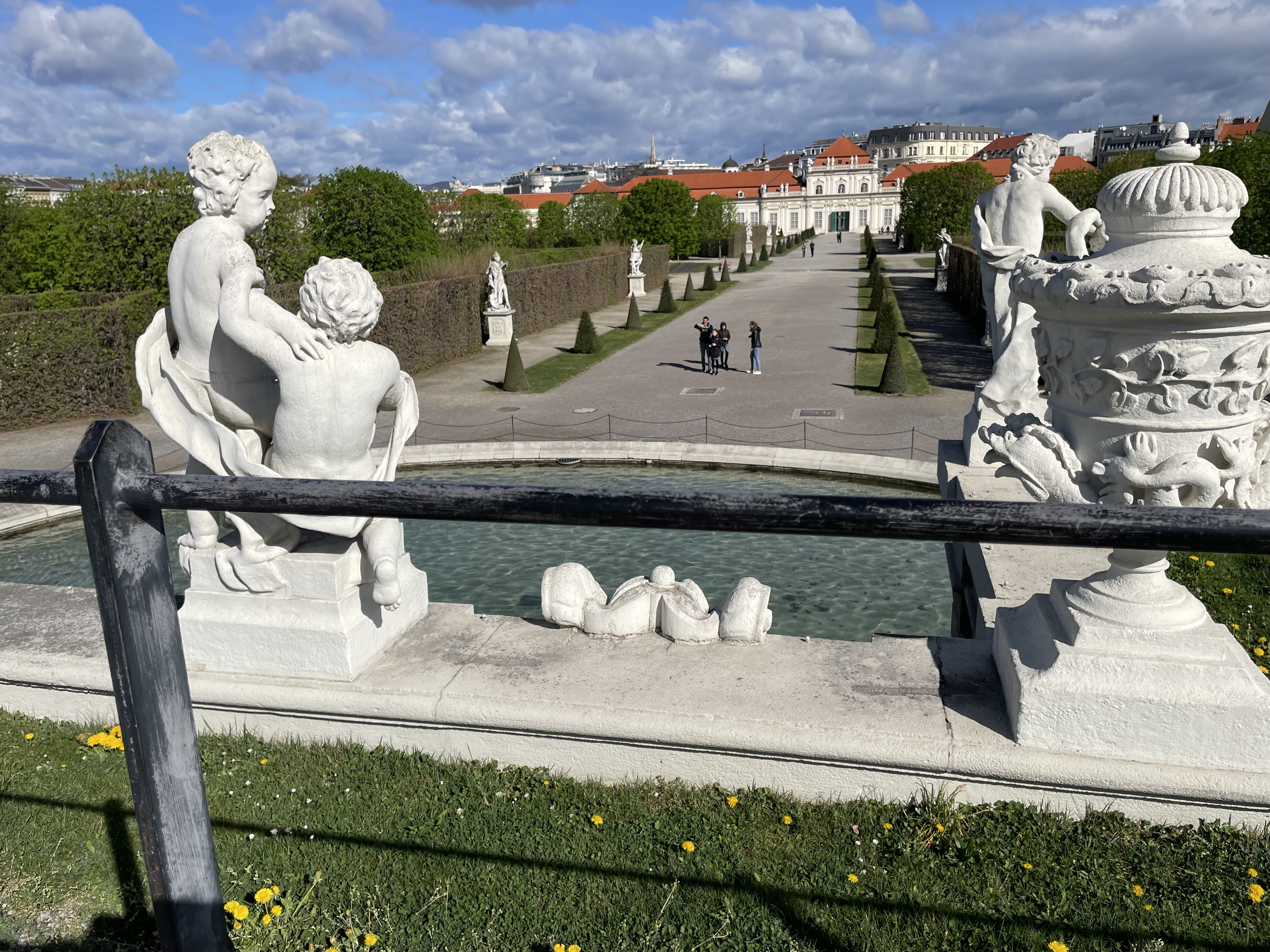

Clockwise: Mooons Hotel, Belvedere Palace, gardens and fountains, Last Year in Marienbad, Strauss statue in the Stadtpark.
Walking by the Danube – here there was graffiti, a lot of it political, e.g. re climate change. In general in Vienna, there was no litter, and an orderliness evident in what happened at pedestrian crossings, where no one walked until they were told to walk. It felt a lot safer than, say, crossing a road in Rome, where one feels as if the only way to ever get across is to walk and hope one isn’t immediately mowed down. (A told me of waiting in vain for the right moment at a crossing point in Rome, and another tourist facing the same dilemma saying cheerily, ‘OK, when in Rome…’ and launching himself into the traffic. The cars and bikes do weave around you but it never even starts to feel safe.)
There are two Jewish museums in Vienna. First up was the Museum Judenplatz, built around the excavated remains of the earliest synagogue in Vienna, destroyed in 1421 by order of Duke Albrecht V. It has a fascinating collection building up a picture of that early Jewish community, and of the exploration of the remains. The Jüdisches Museum nearby continues the story of Vienna’s Jewish population through the centuries. But there is a strange sense of a hiatus – not that the Holocaust is omitted but compared to Prague and Berlin, it is arguably underplayed, the job left to the bleak Whiteread memorial in the Judenplatz. This is a bunker, whose walls are made up of books with spines facing inwards to represent the victims whose names and stories are lost, 65,000 Austrian Jews. The names of the camps and other locations where they were murdered are inscribed around the memorial.
Stolpersteine (Schwedenplatz): Here there are three individual stones, and a plaque in memory of 15 unnamed Jewish women and men who lived here before they were deported and murdered (no details given) by the Nazis. The Stolpersteine commemorate Anna Klein, b. 14 Jan 1885, Josefine Steinhaus, b. 21 May 1884, Helene Steinhaus b. 3 August 1885. Deported to Maly Trostinec 27 May 42, killed 1 June 42. Maly Trostinec/Trostinets, a village near Minsk in Belarus, was not a location I was familiar with. Throughout 1942, Jews from Austria, Germany, the Netherlands, Poland, and the Protectorate of Bohemia and Moravia were taken there by train and then shot or gassed in mobile vans. According to Yad Vashem, 65,000 Jews were murdered in one of the nearby pine forests, mostly by shooting, but some estimates are much higher, up to 200,000.
Vienna State Opera (Staatsoper) We’d decided against trying to get tickets for any performance here because (a) cost, (b) I haven’t managed to entirely convert A to opera and (c) we didn’t want to commit an evening. That was the right choice – we walked for miles (see above), and in the evenings just wanted time to chill with some nice Austrian beers and talk over what we’d seen and make our plans for the following day. But the building itself is obviously magnificent. And we had seen inside anyway, in Mission Impossible: Rogue Nation…


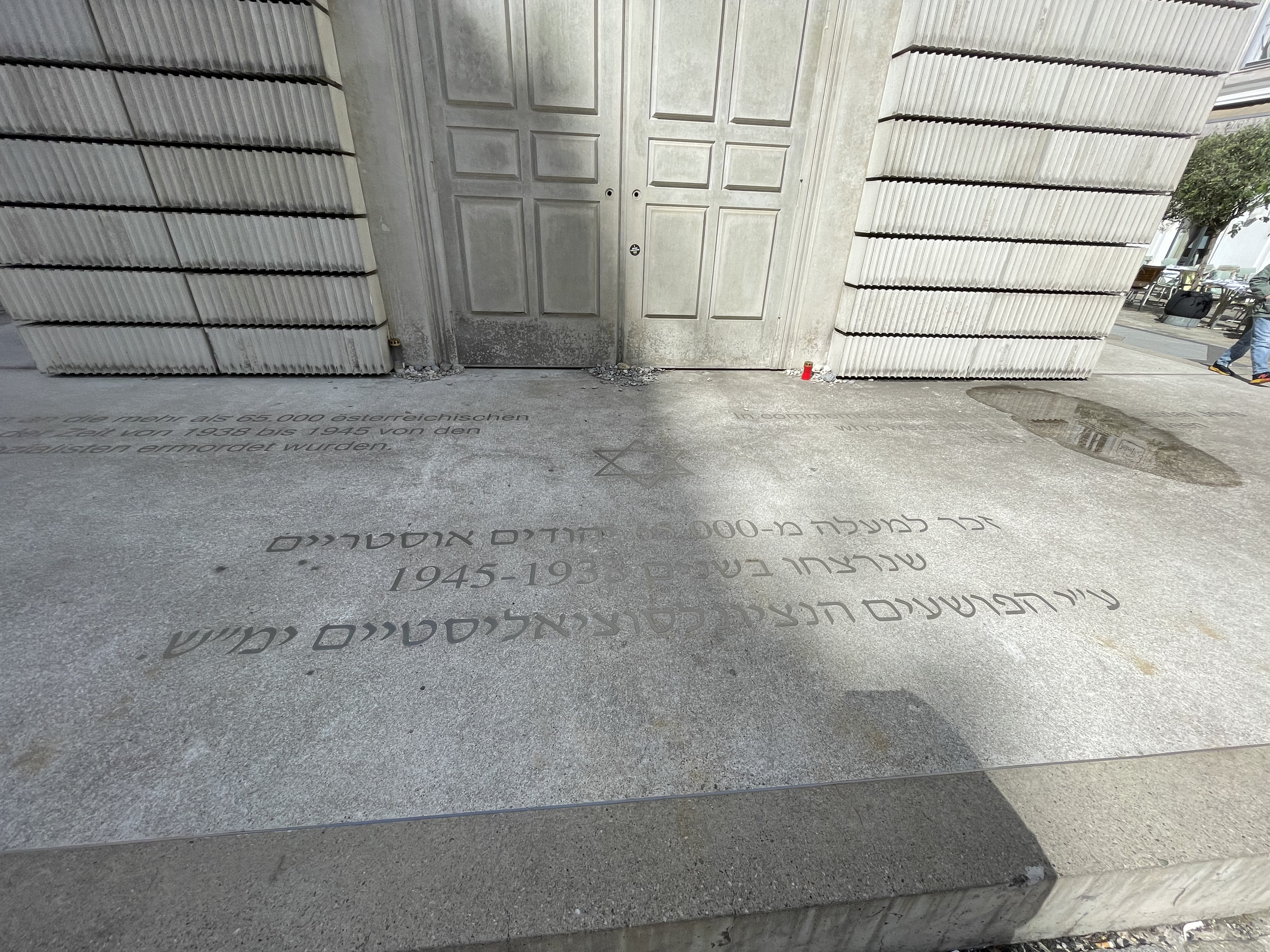


Clockwise: Stolpersteine, graffiti by the Danube, Judenplatz, Whiteread Holocaust memorial, the Opera house and nearby street
St Stephen’s Cathedral (Stephansdom). As in Paris, the survival of this and other fine buildings was achieved by a refusal to carry out orders. The City Commandant had ordered the Cathedral to be reduced to rubble, but this was not carried out – unfortunately, as the Red Army entered the city, looters set fire to shops nearby, which spread and damaged the roof and destroyed the 15th century choir stalls. Much was saved, however, and reconstruction began immediately after the war, with a full reopening in April 1952.
Watching The Third Man makes one realise just how badly Vienna was damaged during the war – not devastated like Berlin, Hamburg, Dresden, but, as Elisabeth de Waal puts it, ‘desultory bombing by over-zealous Americans on the verge of victory, and the vindictive shelling by desperate Germans in the throes of defeat’ had resulted in ‘the gaps in the familiar streets, the heaps of rubble where some well-remembered building had stood’ (The Exiles Return, p. 57). One would not know it now. Clearly, given the fear that rebuilding would destroy the character of the city, the choice was made to rebuild it as it had been, as far as possible. Which gives Vienna that feeling of being preserved in aspic, a slight unreality.
We went a bit further afield, out to Schonbrunn Palace. We didn’t go round the palace itself, preferring to explore the gardens, and head up the hill to the Neptunbrunnen and the Gloriette, to enjoy the view, which was indeed glorious.

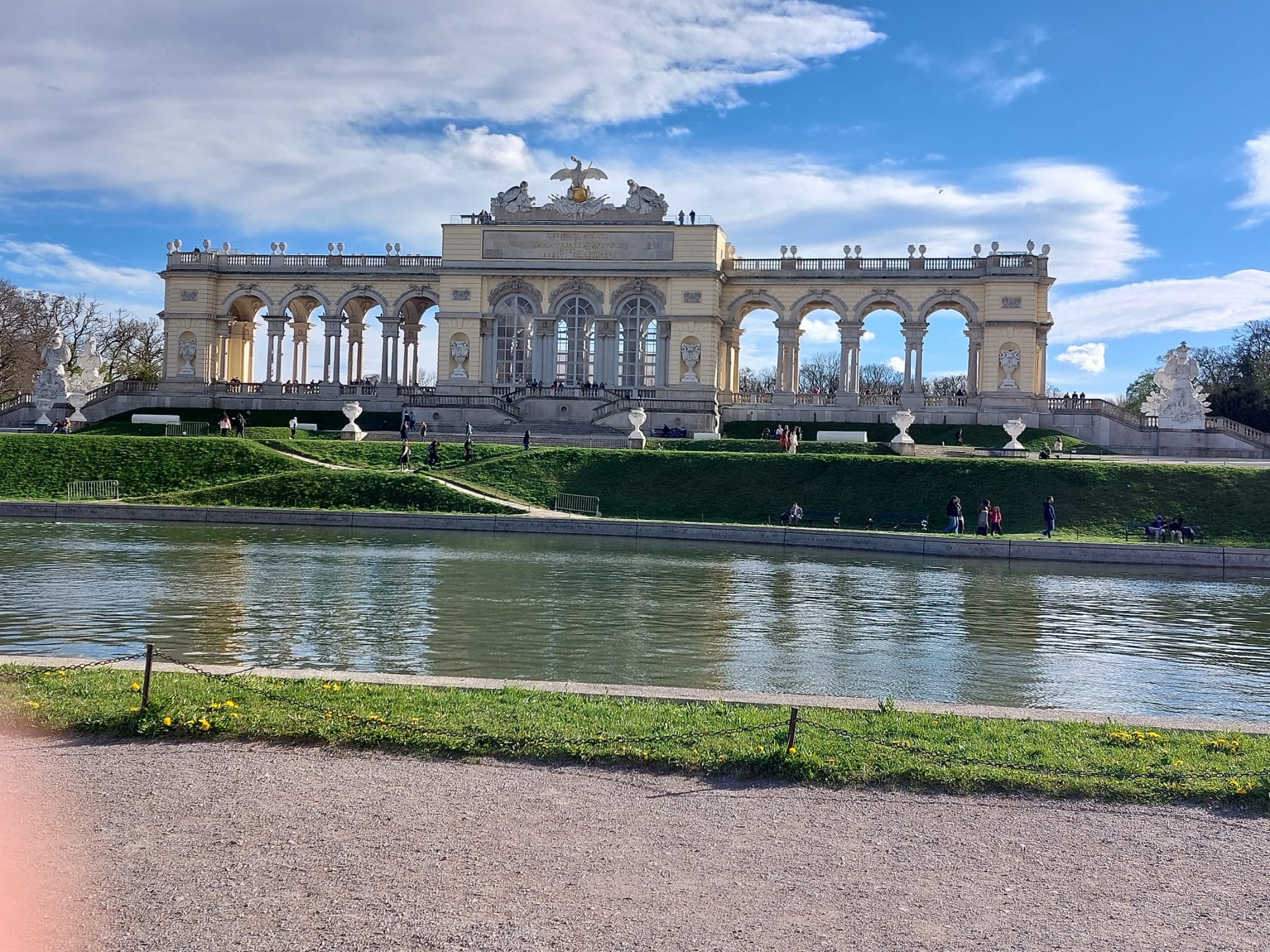

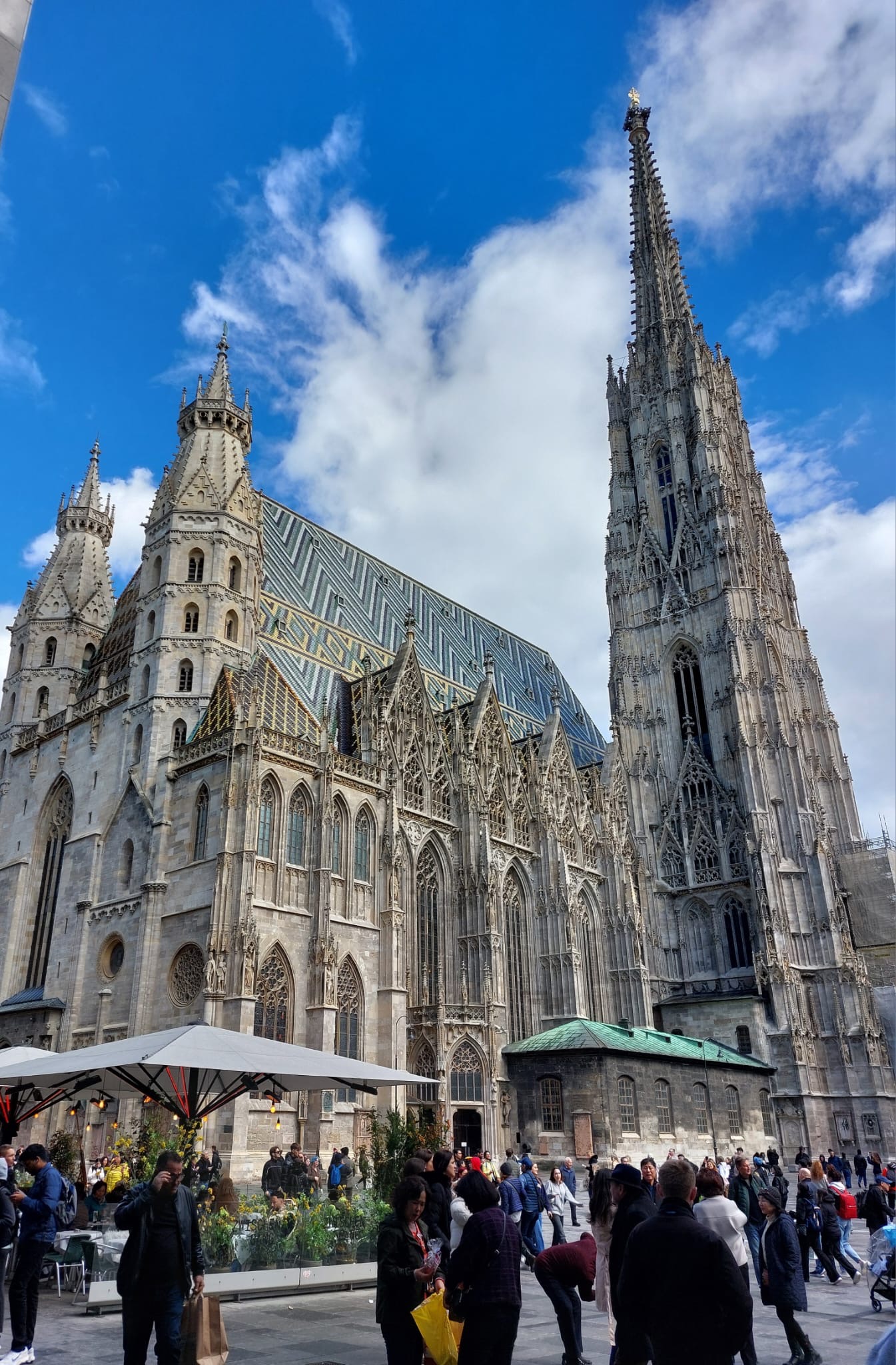


Clockwise: Schonbrunn Palace, Gloriette and Neptune fountain; Stephansdom
Maria am Gestade church – one of the oldest churches here, built 1394-1414
Memorial to liberating Soviet soldiers (Heldendenkmal der Roten Armee/Heroes’ Monument of the Red Army), in Schwarzenbergplatz, featuring a twelve-metre figure of a Soviet soldier. This was unveiled in 1945. It seemed to me remarkable that it was built so soon after the war ended, but then I hadn’t realised either that Vienna was liberated by the Red Army, or that in the hiatus before the other Allied Forces arrived, there was a real possibility of Stalin occupying all of Vienna. The memorial is about heroism in battle, not about the violence, particularly sexual violence, inflicted on civilians during and after the battle, and has been controversial and subject to vandalism over the years, including very recently in response to the invasion of the Ukraine.
Wednesday:
Stolpersteine: Paula Wilhelm (née. Mandl), born 6 April 1887, deported 29 April 44 to Auschwitz; and Dr Max Neustadtl who fled to France but was deported on 25.3.43 to the Sobibor extermination camp and murdered.
Vienna’s second Jewish Museum focuses on the later Jewish communities, covering the period of Nazi rule, but not dealing in great depth or detail with the Holocaust.
One fascinating display here is part of the collection of netsuke whose story is told in Edmund de Waal’s The Hare with the Amber Eyes. These are the Japanese miniature sculptures which belonged to the Ephrussi family, and which were kept out of the hands of the Nazis, unlike most of the contents of the Palais Ephrussi. Six weeks after the Anschluss, the family servant, Anna, was required to pack away the belongings of her former employers. There were lists, of course, to ensure that everything was accounted for. But each time that Anna was in the Baroness’s dressing room, she slipped a few of the netsuke into her apron pocket, and hid them in her room. In December 1945, Anna gave Elisabeth de Waal 264 Japanese netsuke.
‘Each one of these netsuke for Anna is a resistance to the sapping of memory. Each one carried out is a resistance against the news, a story recalled, a future held on to.’ (Edmund de Waal – The Hare with the Amber Eyes, pp. 277-83)


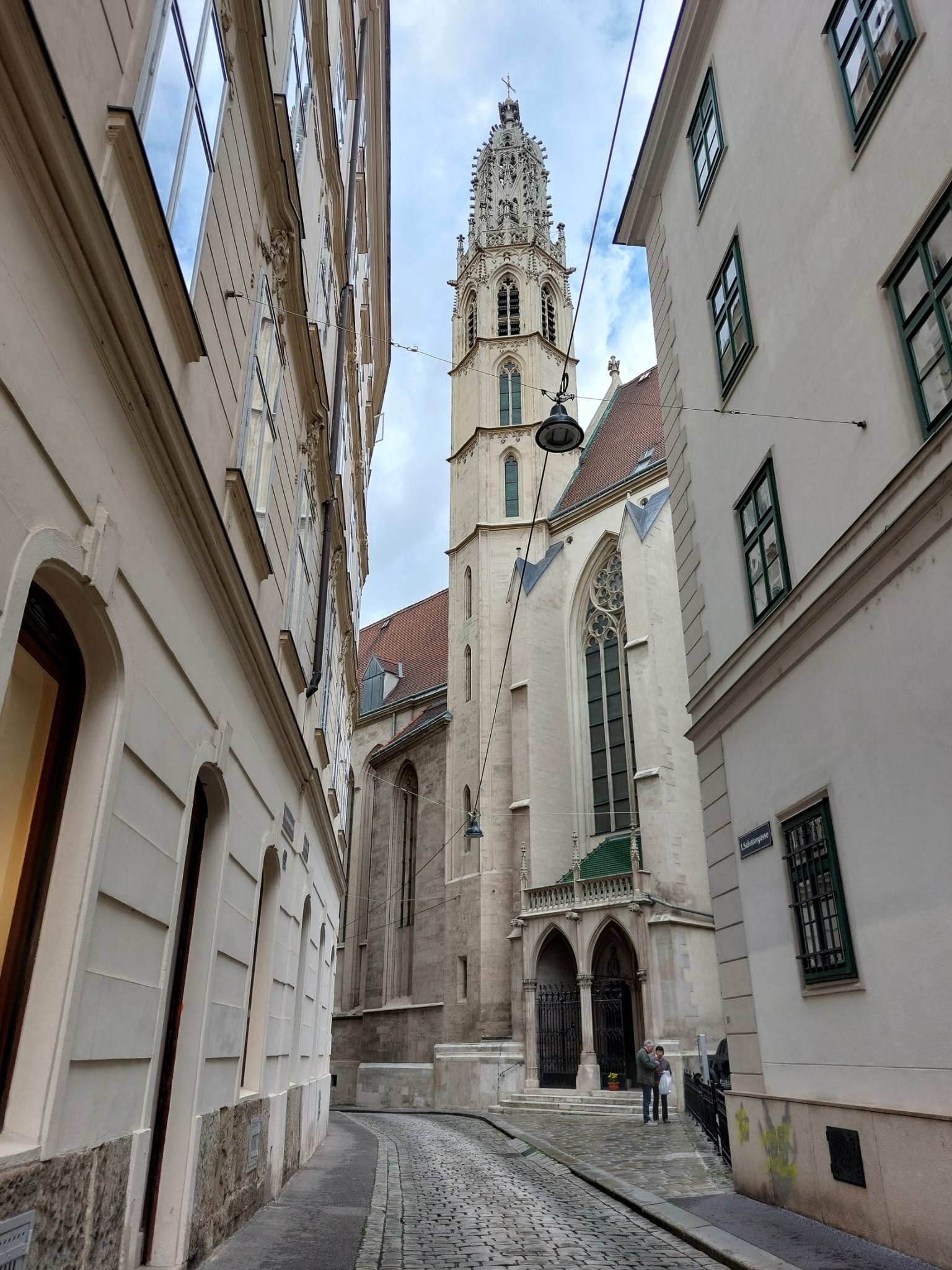

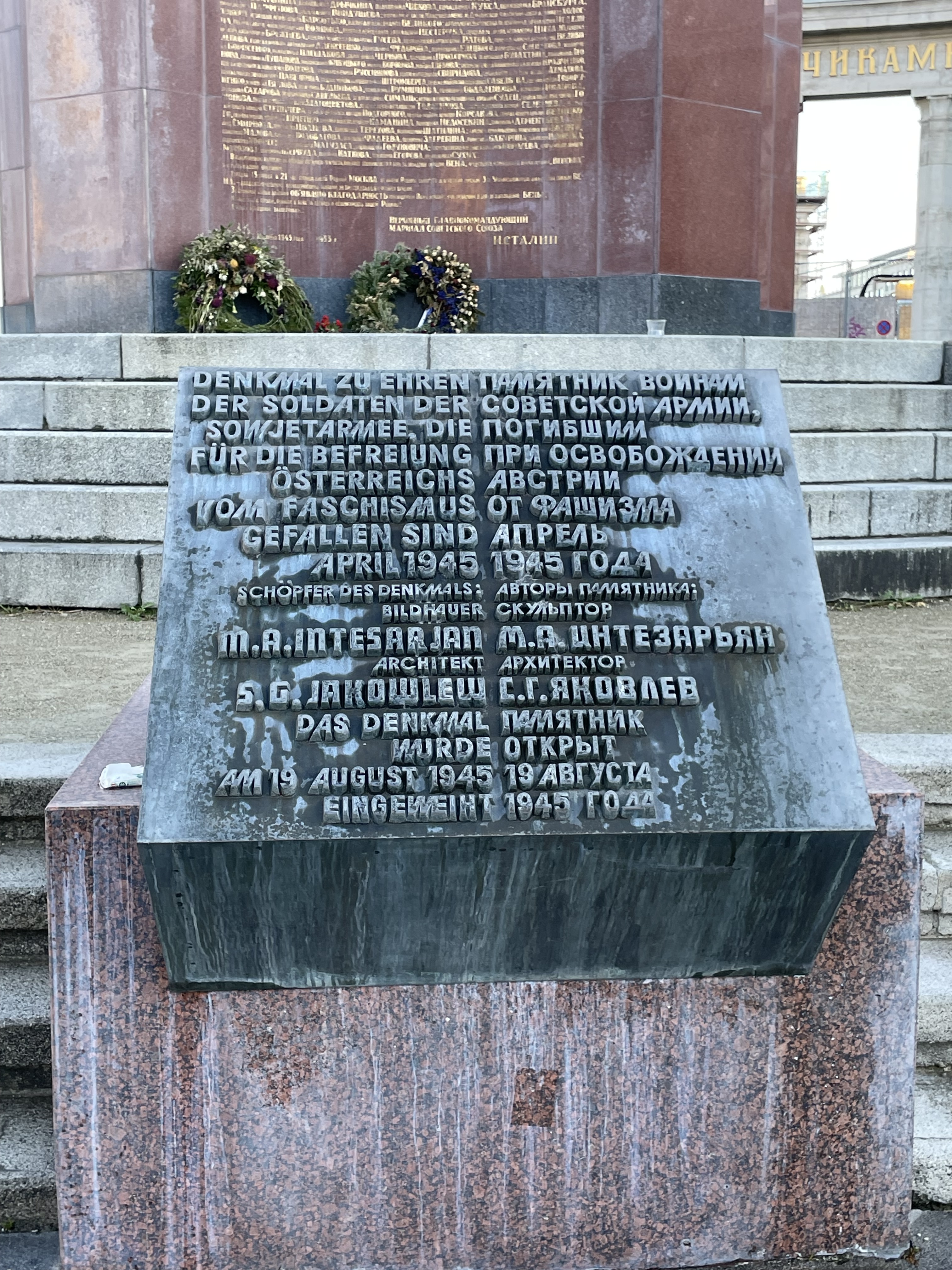
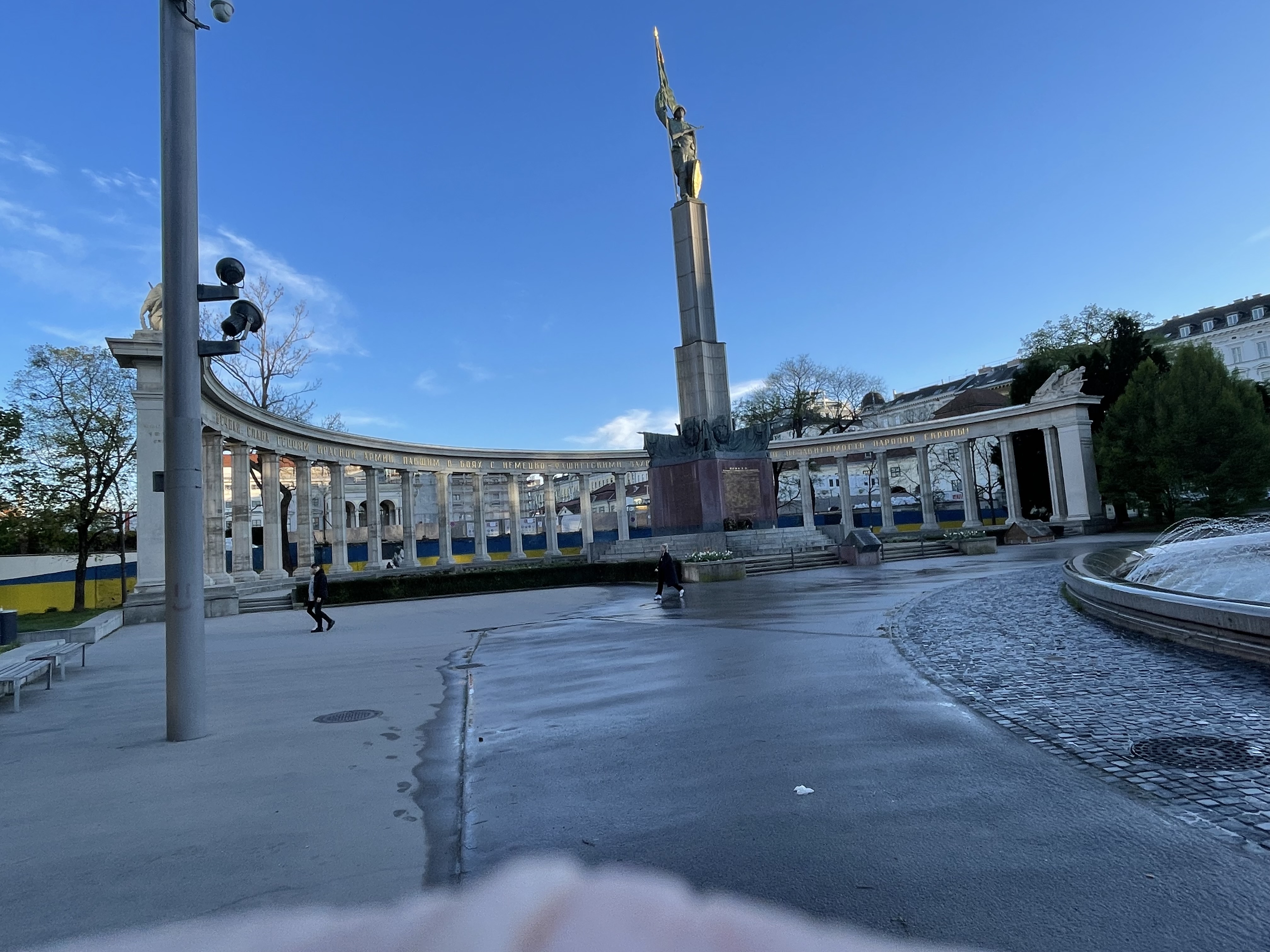
Clockwise: Stolperstein for Max Neustadtl, netsuke in the Jewish museum, Maria am Gestade church, stolperstein for Paula Wilhelm, Heroes Monument of the Red Army
A plaque on Herminengasse gives the names of Jews who lived here, in what was once part of the Jewish ghetto. Many Viennese Jews were forced to live here, until they were deported to various killing sites. Several were killed in Izbica (a town in Eastern Poland, which was turned into a ghetto) – all show the same date of death, 5 December 1942, when the inhabitants of the ghetto (Polish Jews, and those deported from Germany and Austria) were murdered. Those who escaped this massacre were deported again, to Treblinka, Maly Trostinec, Łódź Ghetto, Riga Ghetto, Theresienstadt, Sobibor, Stutthof. I know nothing about these people, other than their age, and where they were killed. But I can see that Oskar Koritschoner was only 20 years old when he committed suicide. Maly Trostinec was the place where 13-year-old Regine Frimet and 3-year-old Ernst Elias Sandor were murdered. And Josef Weitzmann, the last of these to die, was killed in Stutthof concentration camp, in 1944, just after the facilities for mass murder had been set up there. He was 18.
We found the Palais Ephrussi, on the Ringstrasse (see, again, The Hare with the Amber Eyes). I had had an insight into the efforts to trace the plundered contents of the Palais, from Veronika Rudorfer who I met in December 2019 at a conference, when she gave a talk on that project, and subsequently, very generously, sent me a copy of her beautiful book about the Palais itself.
The Burg Theatre – Sarah Gainham’s excellent novel Night Falls on the City has a lot of the action taking place at the Burg theatre, as her protagonist is one of its leading actors. One wouldn’t know that this building was largely destroyed in bombing raids during WW2, and then by a fire subsequently, and has been rebuilt.
Votivkirche (Votive Church) is a gorgeous, somehow delicate looking church, one of the most beautiful in a city of beautiful churches. It is in a neo-Gothic style and was built to thank God for the Emperor Franz Joseph’s survival of an assassination attempt in 1853.


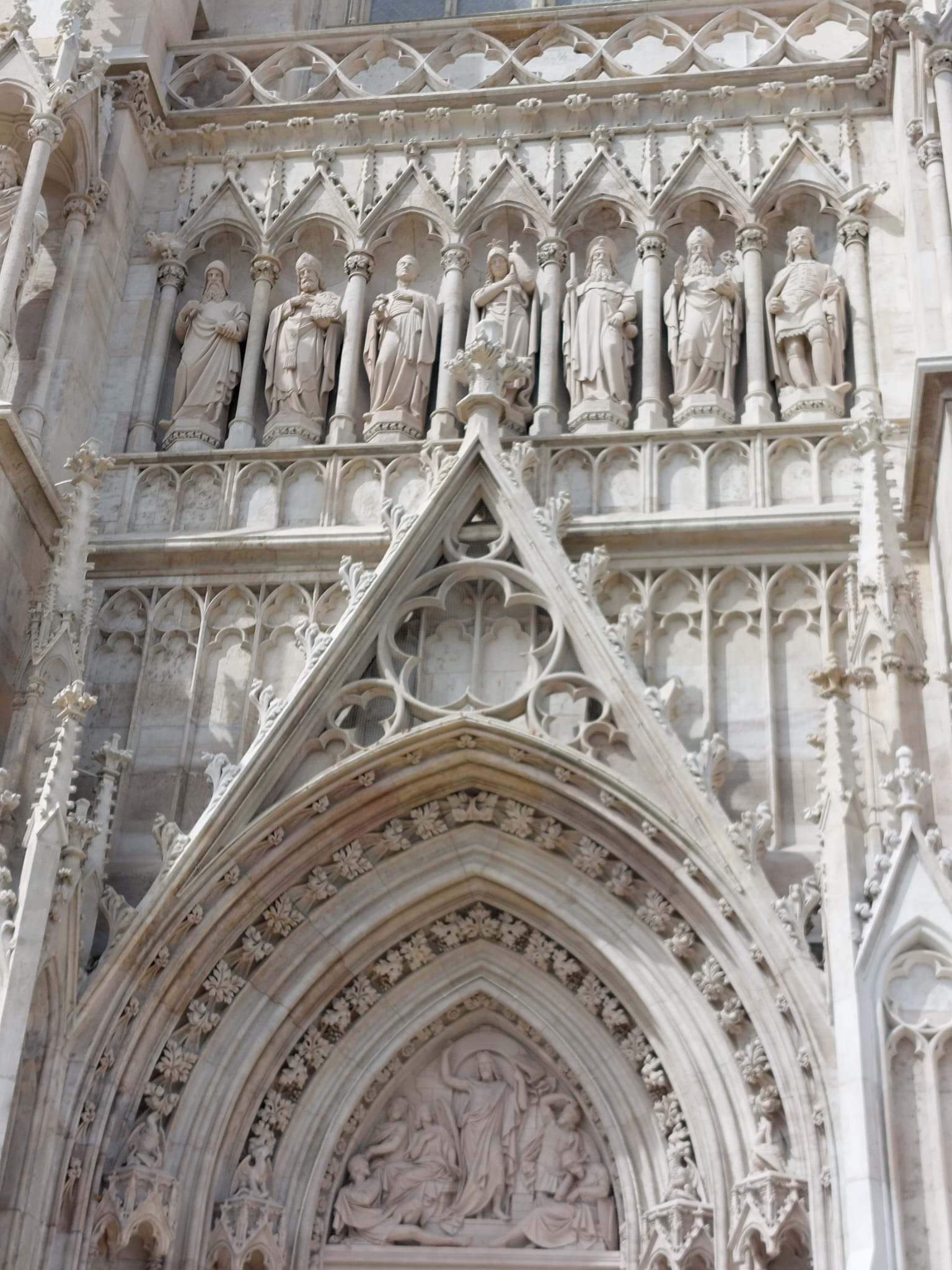

Clockwise: Burg Theatre, Herminengasse plaque, Palais Ephrussi, Votivkirche
We saw the Rathaus – Vienna City Hall – and walked through the Burggarten where we found a statue of Mozart. Then the Resselpark (Karlsplatz), where we saw Sarah Ortmeyer and Karl Kolbitz’s 2023 memorial for homosexuals persecuted by the Nazis: ‘Arcus – Shadow of a Rainbow’, the colours of the rainbow changed to grey, combining grief and hope. There’s also a Brahms statue here, which I like very much.
On to Heldenplatz (Heroes Square), in front of the Hofburg Palace.
‘The two over lifesize equestrian statues on high pedestals are what give it its name, two great military commanders on rearing horses with flowing manes and tails in the Baroque style, one carrying Prince Eugene of Savoy and the other the Archduke Charles, brother of the first Emperor Francis who, in one victorious battle, had stemmed for a while Napoleon’s advance on Vienna. … And yet, with all their panache, there is so little boastfulness in this square. What first meets the eye and impresses the mind are the broad avenues of chestnut trees lining it on three sides … They give the square its peaceful, almost countrified look; they are conducive to slow perambulation and quiet contemplation.’ (Elisabeth de Waal – The Exiles Return, p. 227)
In sharp contrast to the above description, this is where Hitler made his announcement of the Anschluss after his triumphant arrival in the city.

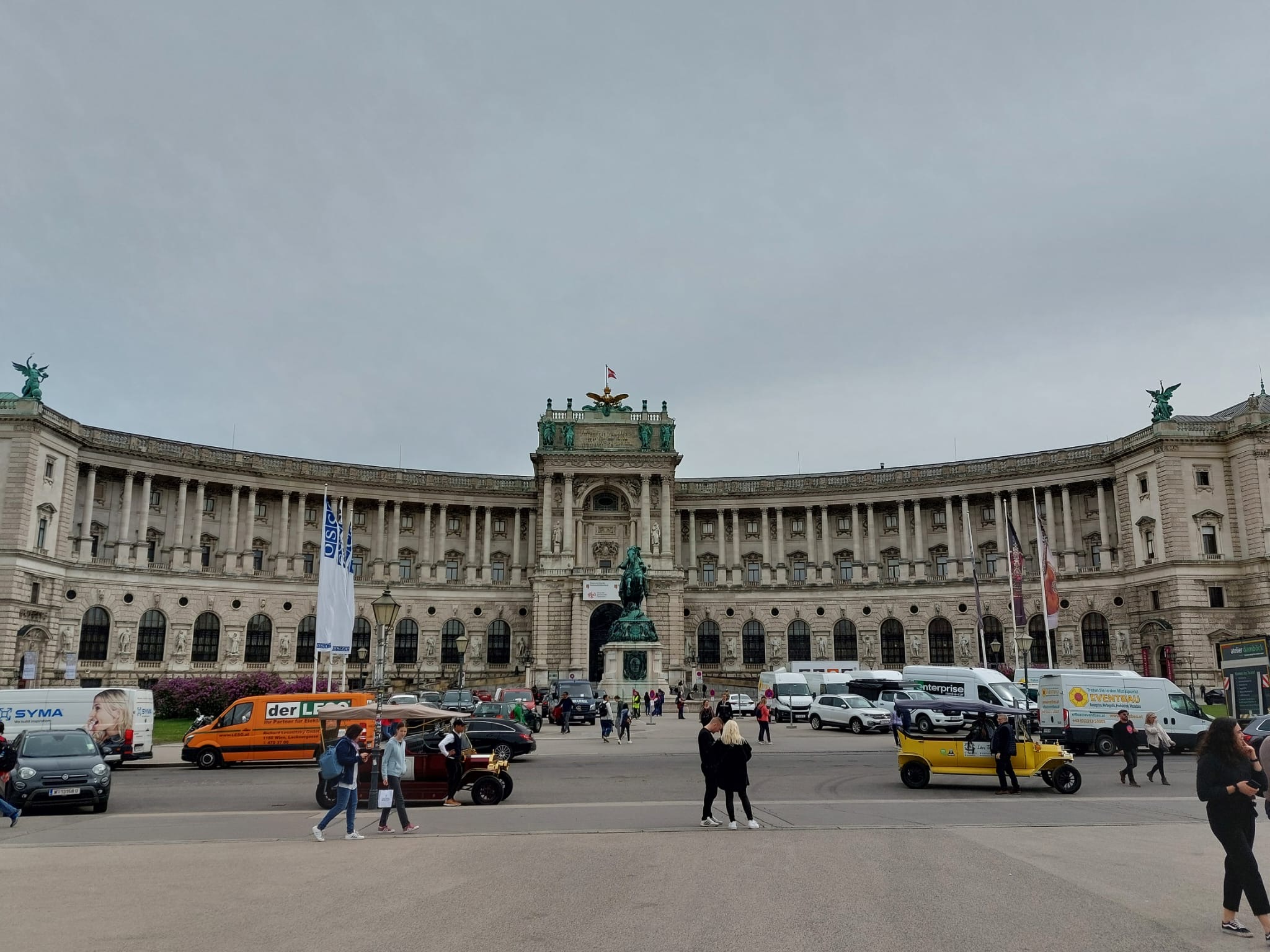


Clockwise: Brahms statue in Resselpark, Heldenplatz, Mozart statue, Rathaus, Arcus memorial in Resselpark
Parliament Building – another building that was seriously damaged in WW2 and the restored to its former glory. In front of it is the Pallas Athene Fountain – apart from Athene (statuary in Vienna is often Graeco-Roman in subject matter and style) it represents the four major rivers, the Danube, Inn, Elbe and Vltava (Moldau in German).
Hofburg Imperial Palace – the official residence and workplace of the President.
Schwarzenberg Monument, commemorating Karl Philipp, Prince of Schwarzenberg’s victory at the battle of Leipzig in 1813. Yet another equestrian statue (I cannot help it if the Bonzo Dog Doodah Band come to mind when I see these).
Here comes the Equestrian Statue
Prancing up and down the square
Little old ladies stop ‘n’ say
“Well, I declare!”Once a month on a Friday there’s a man
With a mop and bucket in his hand
To him it’s just another working day
So he whistles as he rubs and scrubs away(hooray)
(Bonzo Dog Doodah Band, ‘The Equestrian Statue’ (N. Innes), Gorilla, 1967)
Haus der Musik (Klangmuseum – museum of music and sound) is in the Palace of Archduke Charles, where the founder of the Vienna Phil lived around 150 years ago. The focus is on composers for whom Vienna was significant, with interesting material on Beethoven, Schubert, Mozart, Mahler, Schoenberg and others (not just biographical), as well as fun stuff about the science of music, my first encounter with a virtual reality headset (I didn’t do very well).


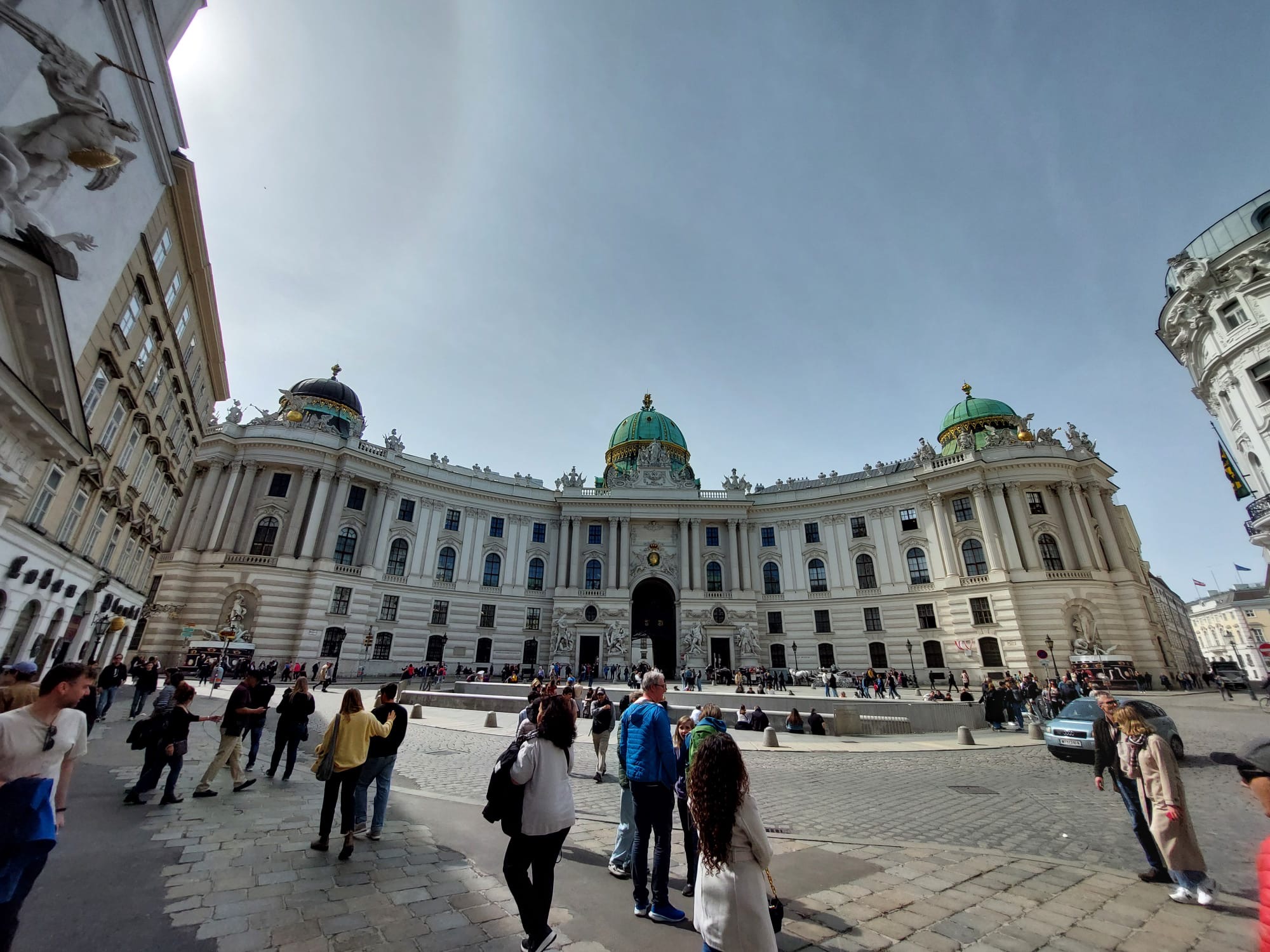
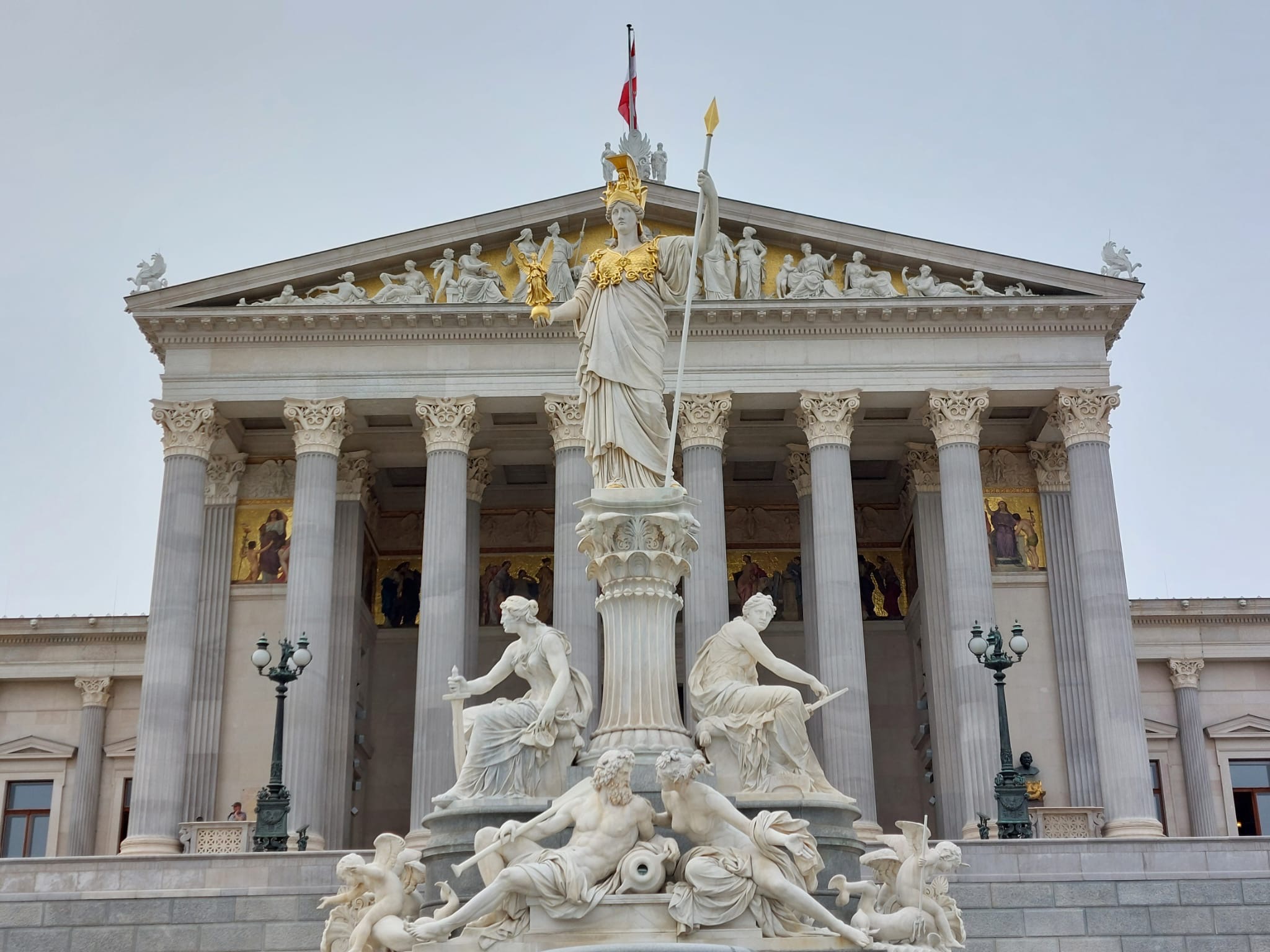
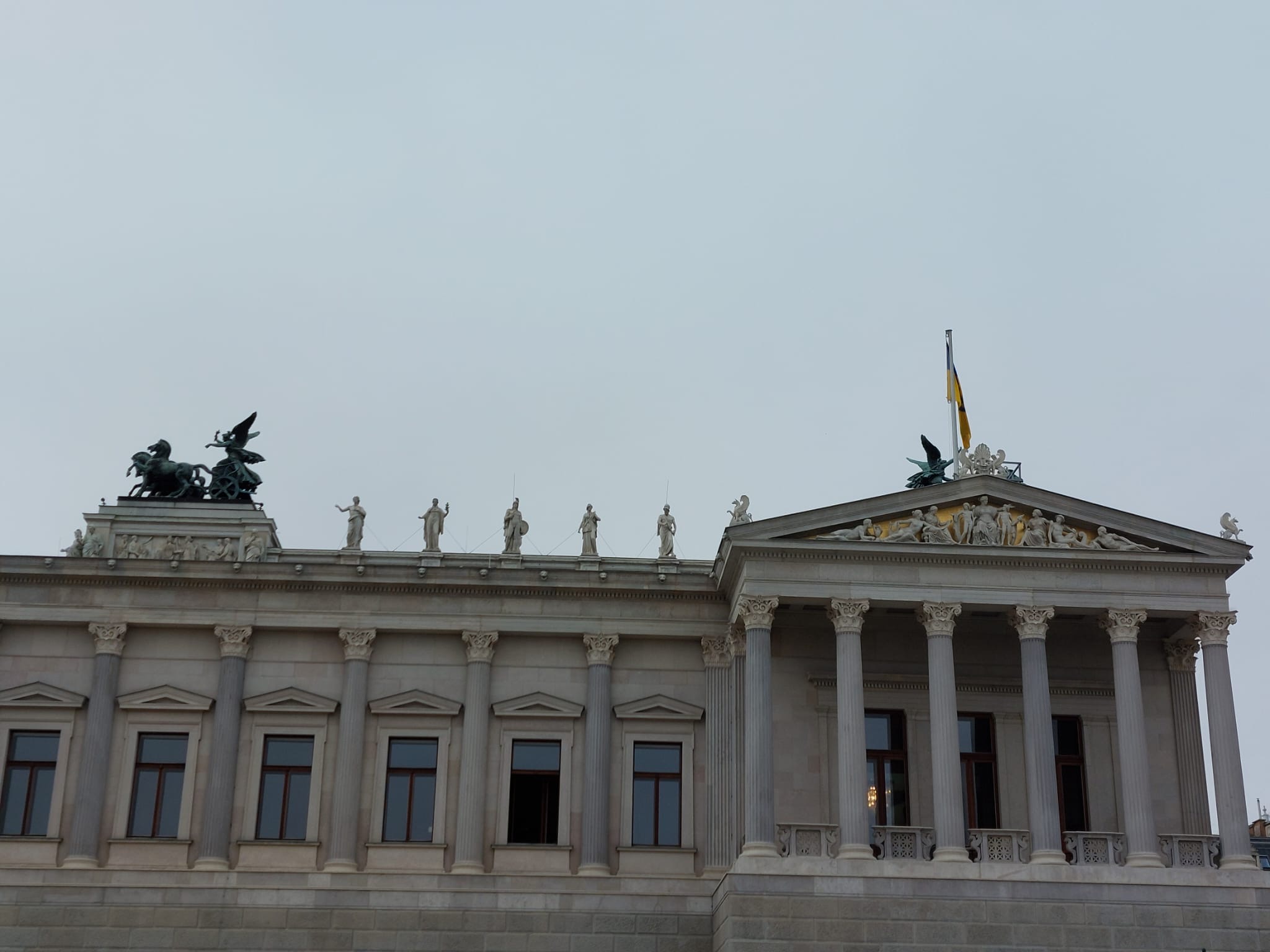

Clockwise: Haus der Musik, Archduke Charles monument, Hofburg palace (official residence and workplace of the President), Pallas Athene fountain, Parliament Building, Schwarzenberg monument
Kunsthistorisches Museum – in a palace (of course), purpose built by Emperor Franz Joseph 1 to house the rooms full of antiquities, sculpture and decorative arts. But the highlight was the picture galleries, and especially the Breughels, an absolute joy to see ‘Hunters in the Snow’ etc close up. Also paintings by van Eyck, Raphael, Durer, Holbein, Titian, Caravaggio…
What did we miss? Well, if I went back, I’d go to see the Klimts in the Belvedere gallery, I’d book a tour of the Opera House, and the Parliament building. Might even go on the Riesenrad (I think given the particular form my vertigo takes – see below – I would be OK with it, after all, I was fine on the London Eye).
Vienna Reading: Fiction: Sarah Gainham – Night Falls on the City/Private Worlds; Elisabeth de Waal – The Exiles Return. Non-fiction: Clive James – ‘Vienna’, in Cultural Amnesia; Edmund de Waal – The Hare with the Amber Eyes; Claudio Magris – Danube; Stefan Zweig – The World of Yesterday
Vienna on Film: The Third Man; Before Sunrise; Vienna Blood (TV detective series set in turn of the century (19th-20th) Vienna)
Vienna Music: Too much to mention – the city played such a key role in the lives and careers of so many great composers and musicians. Beethoven, Mozart, Schoenberg, Schubert, Brahms, Webern, Korngold… I did my best to avoid hearing ‘The Blue Danube’, a piece I heartily dislike, whilst in Vienna, but didn’t quite manage it (it’s a bit like trying to avoid hearing Wham at Christmas)
One lesser-known name, who I researched on our return. Marcel Tyberg was born and studied in Vienna but moved to Italy (present day Croatia) in 1927, when he was in his thirties. His mother followed the rules once the area was under Nazi occupation, and registered her Jewish great-grandfather. She died of natural causes, but Tyberg was arrested and deported, first to San Sabba camp in northern Italy, and then to Auschwitz, where he was murdered in December 1944. I listened to the Piano Trio in F major (1935-1936).
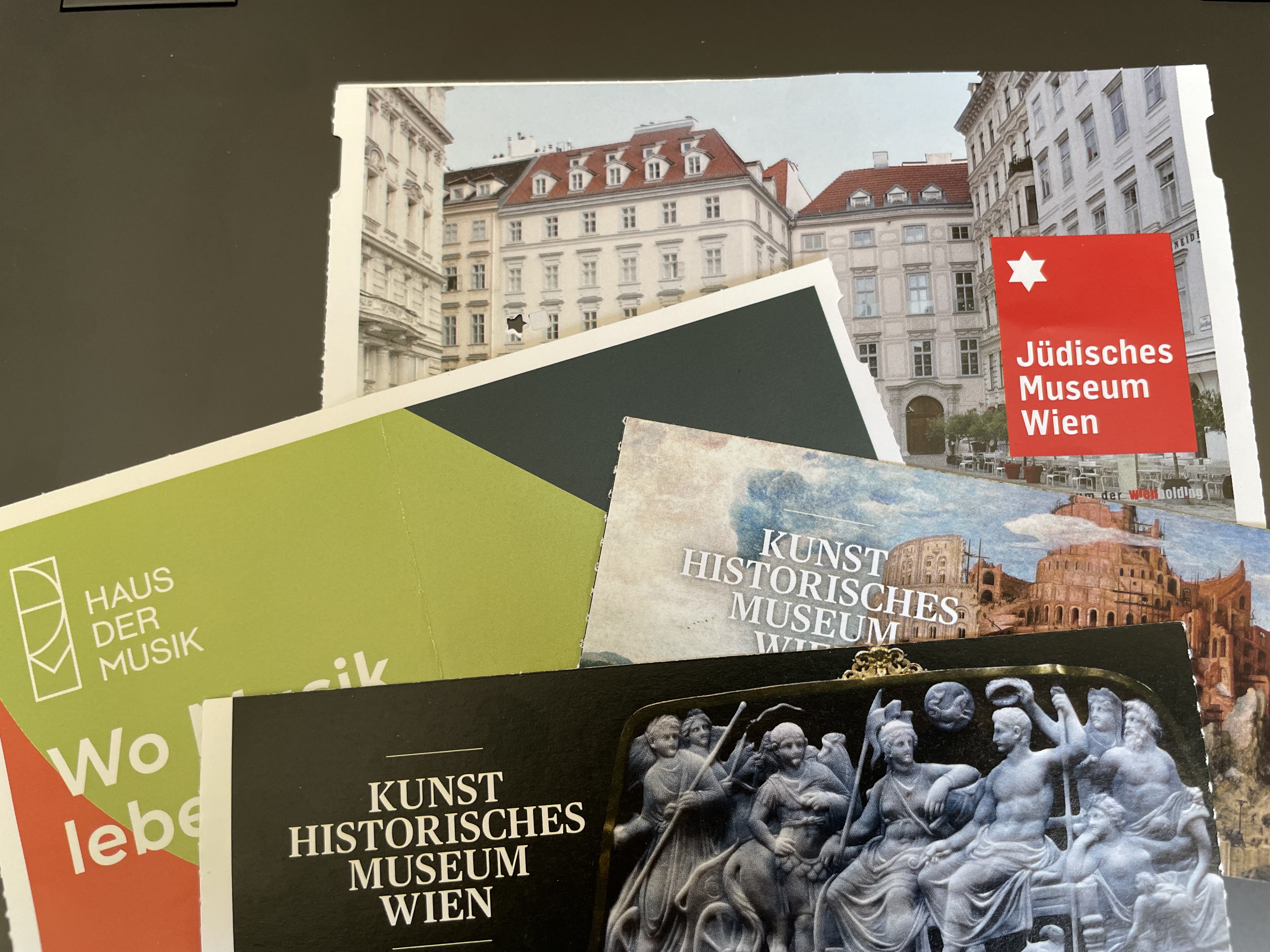
PRAGUE
Thursday:
We set off early to catch the train to Prague. Not the most scenic of journeys but travelling by train makes the journey part of the holiday and is generally less stressful. That is, once I was on board – the ‘mind the gap’ warnings do not adequately convey the hideous gulf between the train and the platform which involves one stepping out into said gulf and on to a narrow step before reaching the safety of the train. I realised this at Vienna Airport station but had vainly hoped that this wasn’t going to be the case with all the trains we caught… Fortunately A is both capable and caring, and so he grabbed the bags, put them into the train and then held my arms and made me look at him, not at the gulf, and step in. Same procedure in reverse when we got off the train, of course.
A slightly longer walk from the station to our hotel, the Majestic, near Wenceslas Square. A more old-fashioned looking hotel than Mooons but very comfortable. Having deposited our bags we set off for the Old Town. What I hadn’t anticipated is how much harder on the feet and the joints the cobbled streets in Prague would be – both of my days in the city had to be curtailed slightly early because on that first day there I crocked myself a bit. I still managed to clock up 17k steps (not bad for a half day), and 20k the following day, a total of 25.5km in the city.
Walking around Prague felt very different to walking around Vienna (and not just because of the cobbles). It is a city to wander in, to stroll down random streets, look around random corners, and be beguiled and intrigued by buildings that are a jumble of styles and eras, shapes and sizes. The terms ‘new’ and ‘old’ in Prague tend to mean ‘old’ and ‘really, really old’.


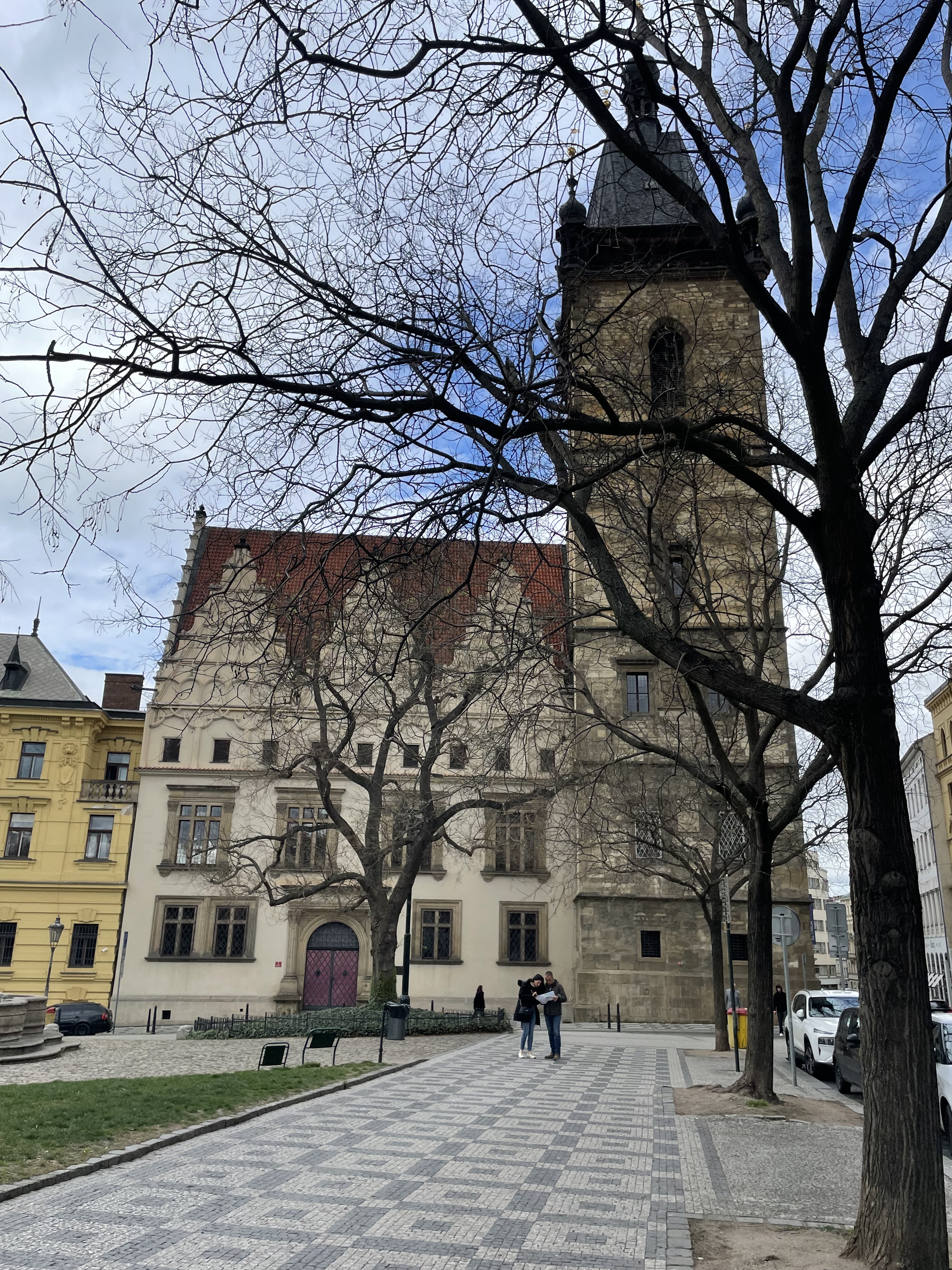
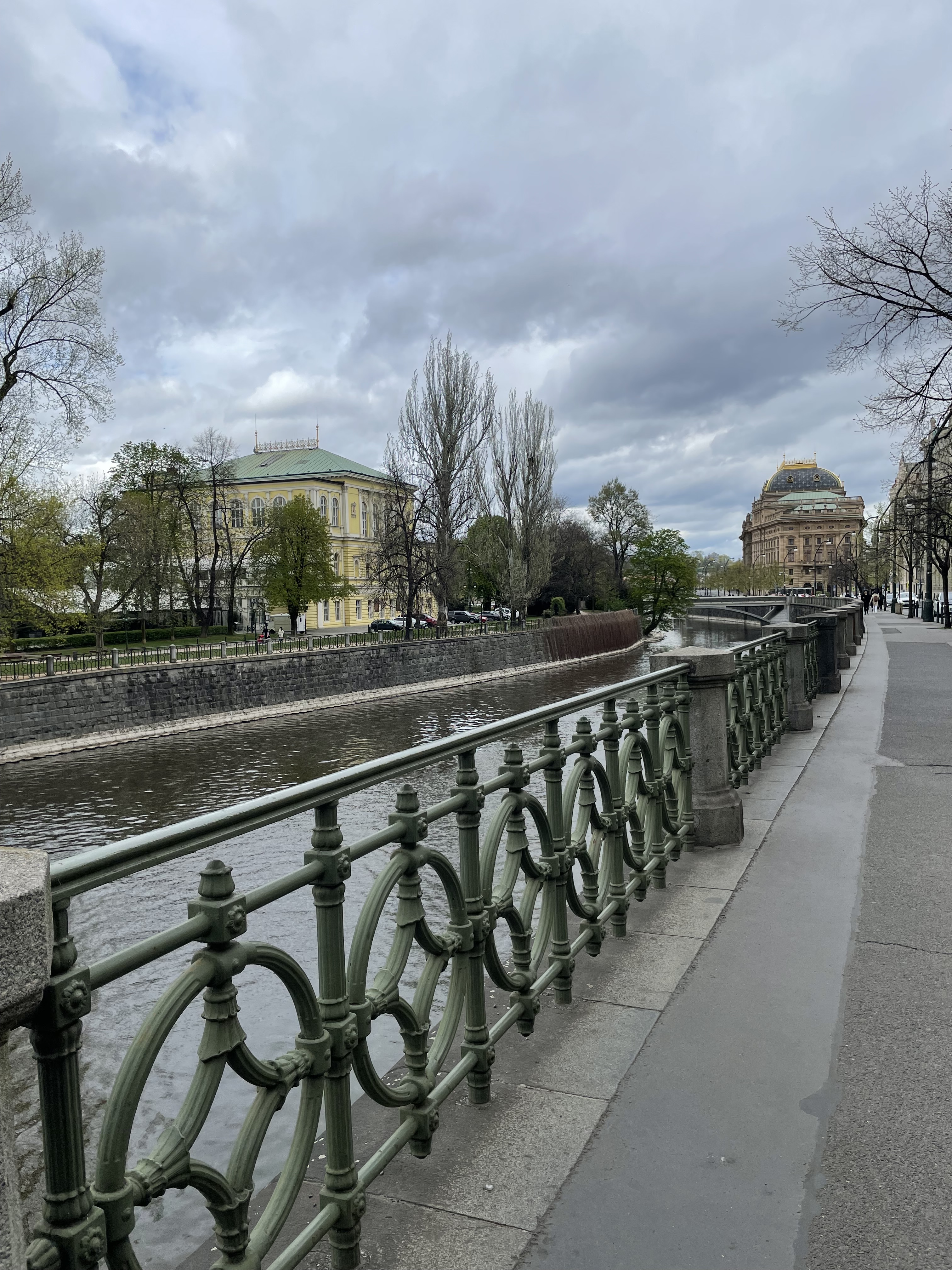

Clockwise: Charles Square, St Adalbert’s Church, Hotel Majestic, New Town Hall, view of the Zofín palace, a mysterious and ominous sign across the Vltava
Charles Bridge is always rammed with tourists – it is probably the most photographed site in the city, understandably enough. We got glimpses of it from the New Town side on Day 1, and the Prague Castle side on Day 2, when we did go part of the way across.
Jan Palach memorial, Wenceslas Square. I was 10, going on 11 at the time of the Prague Spring. I remember the news reports, and my parents’ distress (they vividly remembered the events in Hungary in 1956), and I remember hearing of Jan Palach’s suicide. A couple of years later, the English teacher at my school, an eccentric chap called Mr Pepper, mentioned this (I cannot recall in what context) and said that in a few years, no one would remember Jan Palach’s name. I decided that I would. And I did.
The Jewish Museum in Prague, based in the old Jewish quarter, comprises a number of locations – we didn’t see everything, but what we did see was unforgettable. It comprised four synagogues, the ceremonial hall, the old Jewish cemetery (and a gallery which was closed when we visited).
Pinkas synagogue – I knew what I was going to see. But that didn’t make it any easier. I wrote back in 2017 about a visit to the Mémorial de la Shoah in Paris: ‘I had braced myself for this, knowing the terrible history that would be illustrated there. Nonetheless, seeing the Wall of Names, I felt the air being sucked from my lungs, realising that I was seeing in that moment only a fragment, only some of the names from only one of the years’. That’s how I felt in the Pinkas synagogue, where the Memorial to the Victims of the Shoah from the Czech Lands comprises their names on wall after wall after wall. The names are painted on, which gives them a certain fragility, that they could fade away, unlike the stones in the Paris memorial. They mustn’t, obviously. They need to be there for generation after generation, to see wall after wall of names, each a person with a story, with a life, with a potential future.
‘The storm is within, a blizzard that stings the eyes and batters on the mind. Not snow or sleet but names. Names everywhere, names on the walls, names on the arches and the alcoves, ranks of names like figures drawn up on some featureless Appellplatz. Names and dates: given names and dates in black, surnames in blood. Dates of birth and dates of death. Seventy-seven thousand seven hundred and ninety-seven of them, names so crowded that they appear to merge one into the other and become just one name, which is the name of an entire people – all the Jews of Bohemia and Moravia who died in the camps.’ (Simon Mawer – Prague Spring, pp. 218-19)
From the Pinkas synagogue to the old Jewish cemetery, in use from the first half of the 15th century till 1786 – the oldest gravestone is from 1439. It’s the ‘Prague Cemetery’ which gives Umberto Eco’s novel its name (a book that is now on my To Read list). (We didn’t visit the New Jewish cemetery to pay our respects to Kafka – maybe next time, especially if I manage to read a few more of his works before then). We saw the Jewish ceremonial hall, and the Klausen synagogue but didn’t go in. But we couldn’t miss the ornate gorgeousness of the Spanish synagogue, whose decoration imitates the Alhambra.
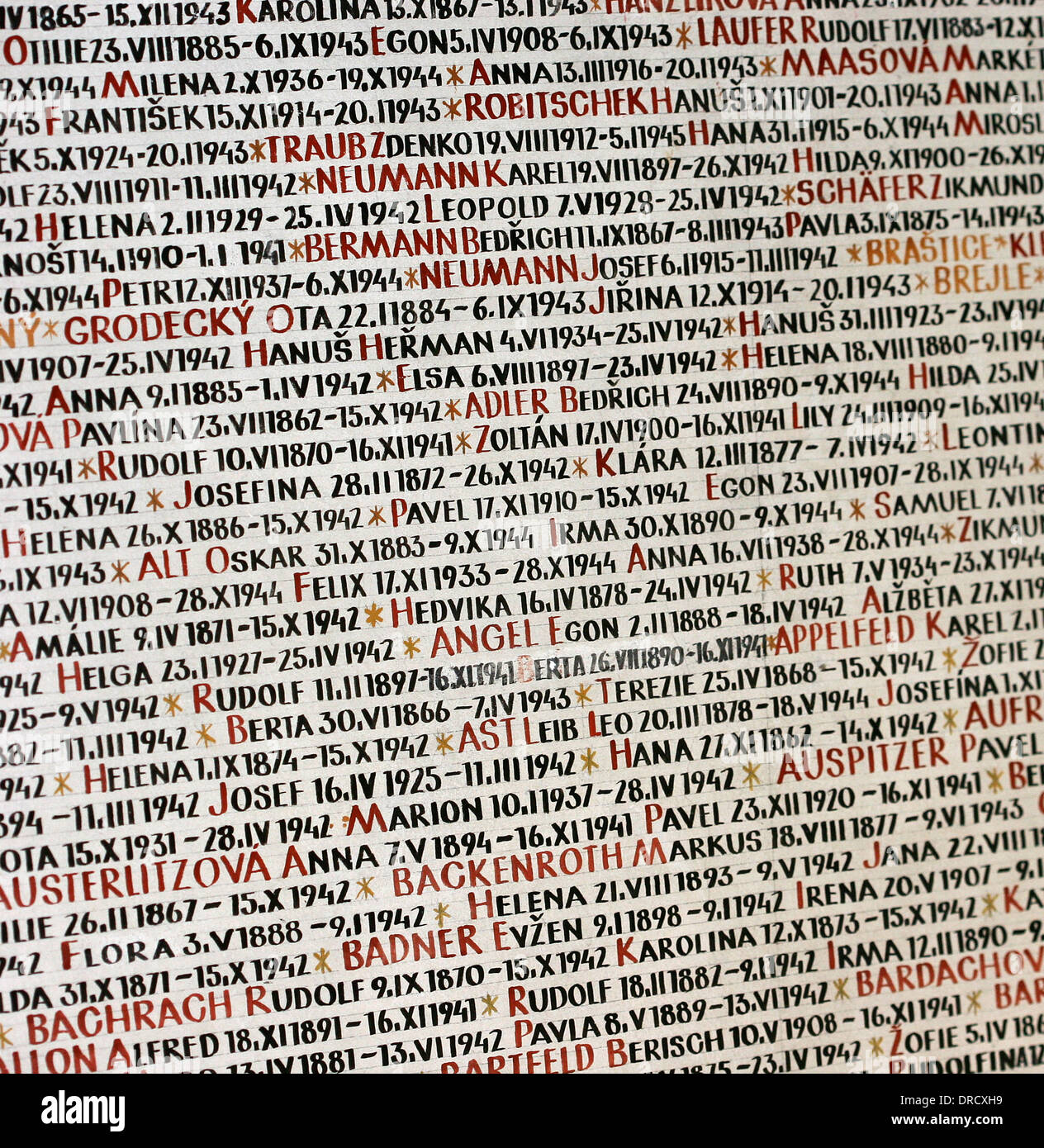

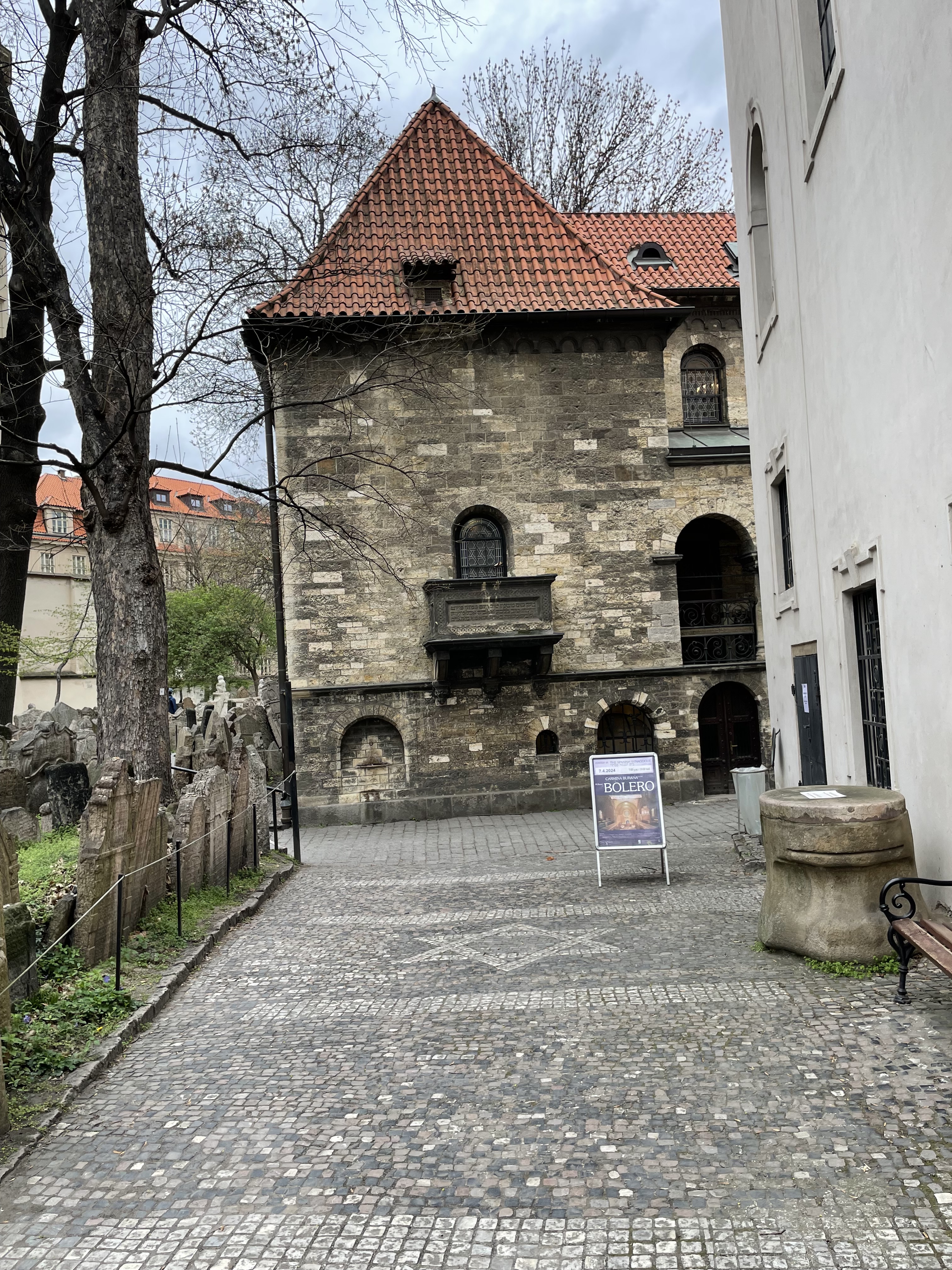


Clockwise: Pinkas Synagogue, Jan Palach memorial, Jewish ceremonial hall, Old Jewish cemetery, Spanish synagogue
The Old Town Hall is actually a medley of a number of buildings of various sizes and ages, stitched together (if I may mix my metaphors) over the centuries. At various times, bits of it were demolished/rebuilt/amended in various ways. In 1945 during the uprising in the city, a couple of wings were destroyed by fire. On another visit, I would be very intrigued to look around this properly.
The Town Hall’s most famous feature is the rather marvellous 15th century Astronomical Clock. We missed its most marvellous moment though as we failed to be there at the right time to see the apostles emerge.
Stolpersteine (Nové Město): four members of the Gotz family. Rudolf was 49, and his wife Marie 48 when they were deported from Prague to Theresienstadt; two years later both were transported to Auschwitz where they were murdered. Their sons Raoul and Harry made the same journeys at slightly different times than their parents. They were 21 and 16 respectively when they were deported, four months before their parents, to Theresienstadt, and then in September 1943, a year before their parents, to Auschwitz.
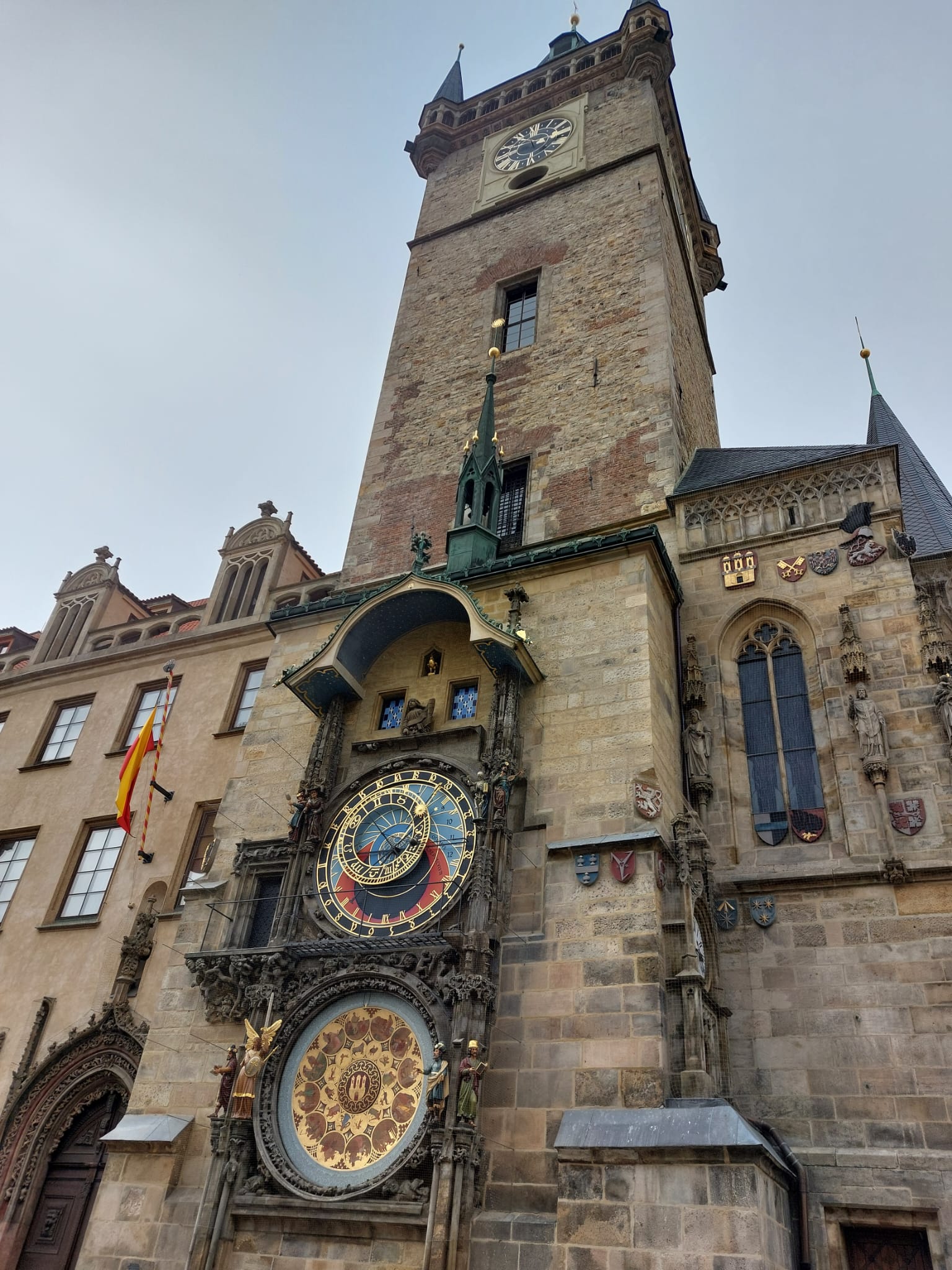


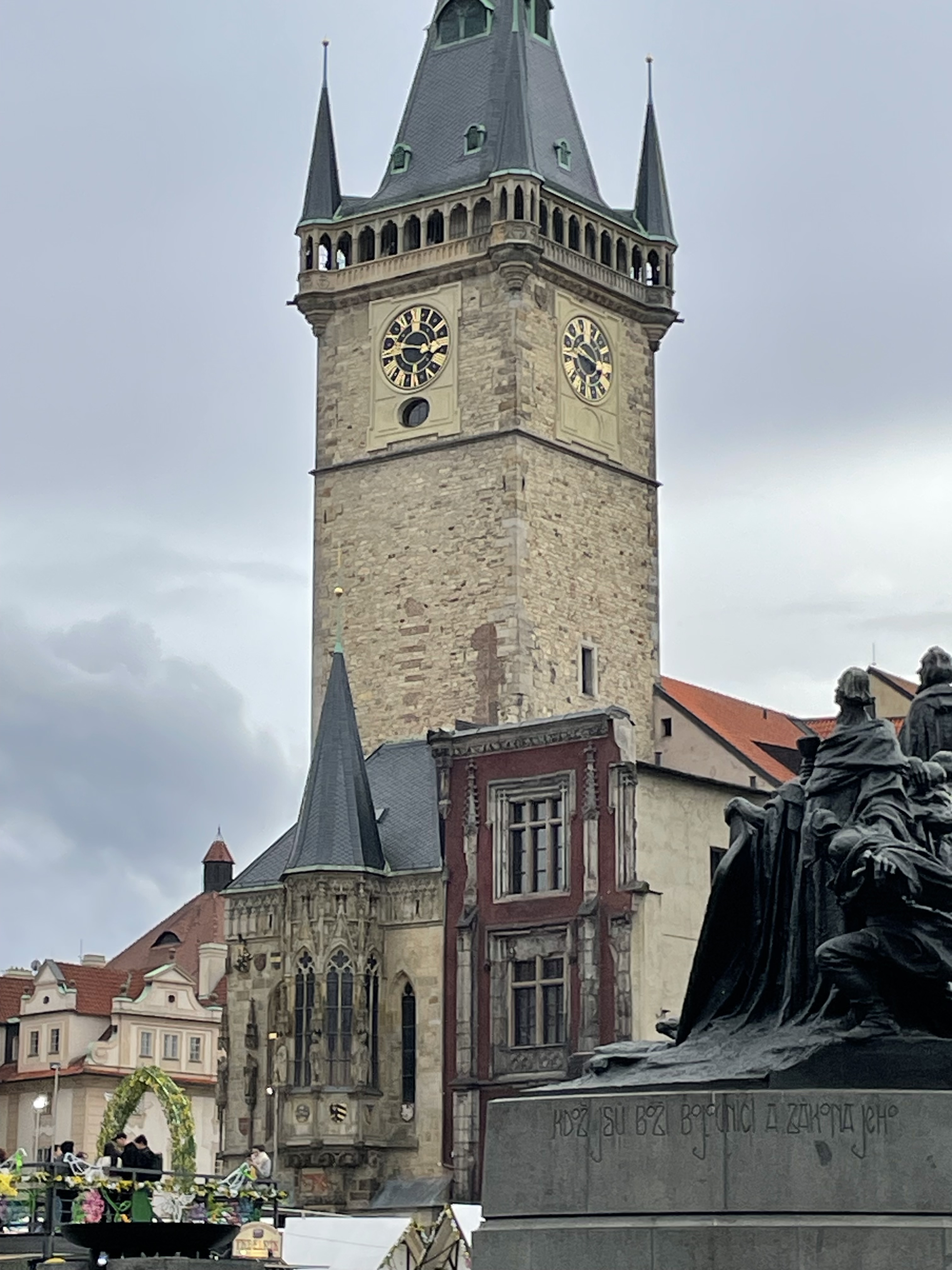
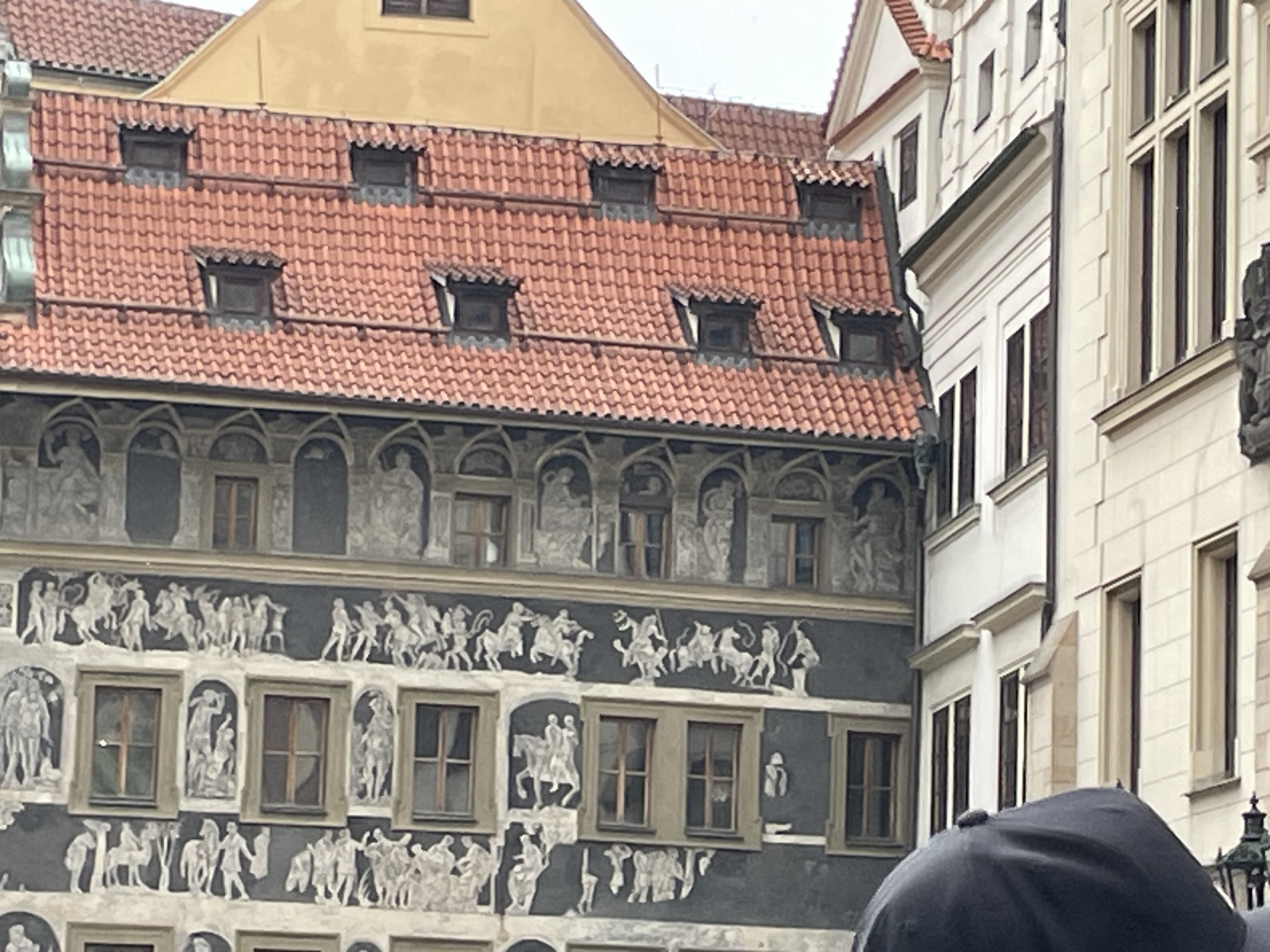
Clockwise: Astronomical Clock, Church of St Nicholas, stolpersteine for the Gotz family, Kranner’s Fountain (monument to Emperor Francis 1 of Austria), the Old Town Hall, Old Town Square
At this point, I consented to return to the hotel and put my feet up, whilst A headed off to the Prague Museum.
Friday:
Day 2 – with my feet properly blister-plastered, and a comfier pair of shoes, we headed (via the tram) to the Prague Castle complex. There’s a lot to see here, and the views of the city are stunning.
We walked through the Royal Gardens, with beautiful buildings around them, including Queen Anne’s Summer Palace. We saw a red squirrel here – I’m honestly not sure that I’ve seen one before, but we then saw another in Berlin.
St Vitus Cathedral – this took nearly 600 years to complete, 1344-1929. One of the final stages involved the installation of the beautiful stained glass. Czech art nouveau painter Alfons Mucha decorated the windows in the north part of the nave, František Kysela the rose window. Even though half of the cathedral is a neo-Gothic addition, much of the 15th century design was incorporated in the restoration.
Going up the Great South Tower was an optional extra which I unhesitatingly declined. I have been frozen with fear on spiral staircases in many of the ancient buildings of Britain, and in the Arc de Triomphe (with a posse of French schoolkids behind me helpfully going ‘Allez! Allez!’). So I let A go up the tower – there were a lot of steps, and it was indeed a spiral, but worth it (he tells me) for the view from the top.
The Basilica of St George is the oldest church building on the castle site, dating from 920.

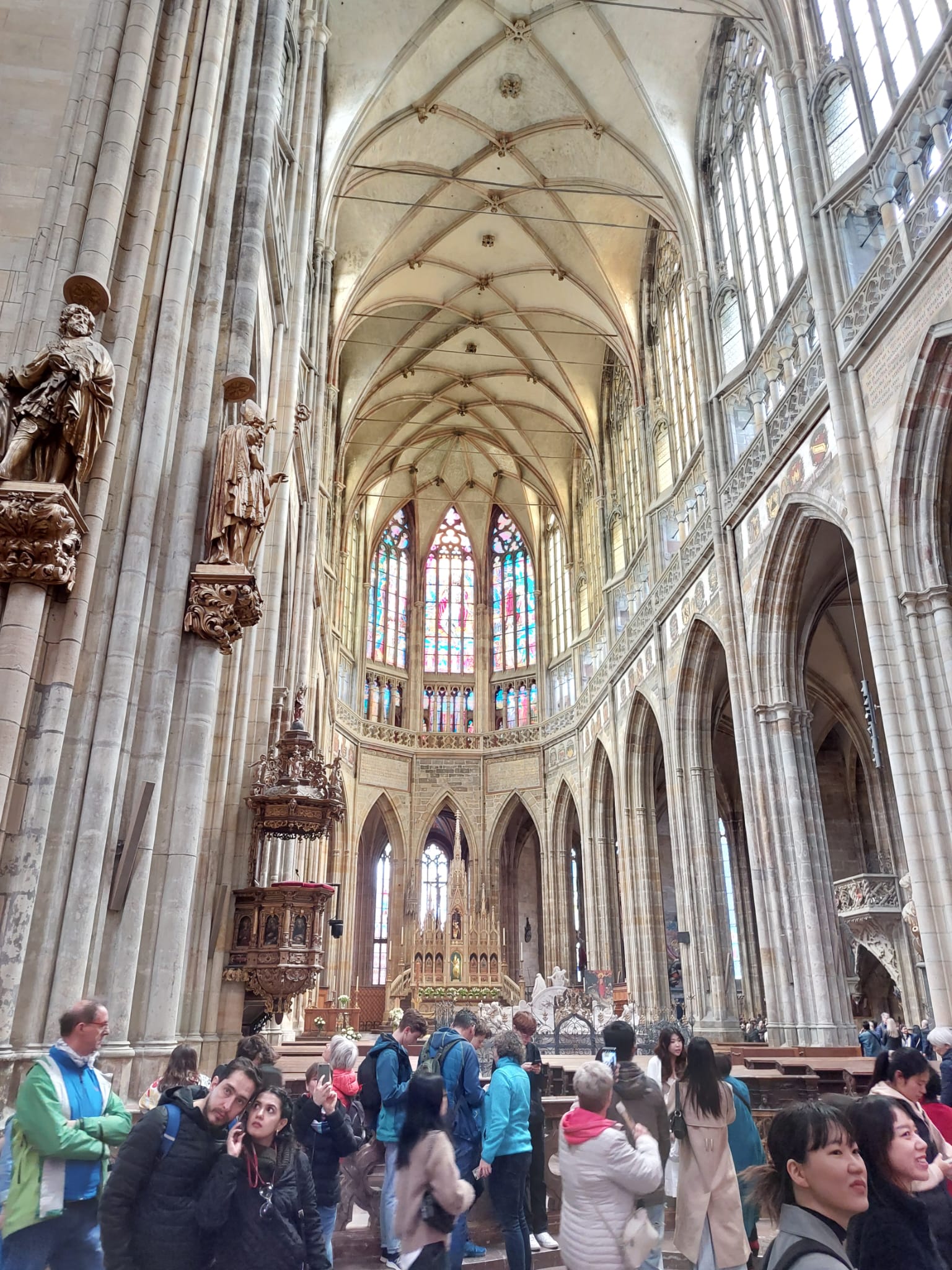


Clockwise: Basilica, Cathedral interior, Cathedral, Great South Tower, Royal Gardens, stained glass in the Cathedral, Chapel of the Holy Cross, Castle interior, Queen Anne’s Summer Palace
Golden Lane is a pretty alleyway of tiny, brightly coloured cottages. These were built for the members of Rudolf II’s castle guard and takes its name from the goldsmiths who later occupied the cottages. Kafka came here in the evenings to write, during the winter of 1916.
12 Šporkova is the building where W G Sebald’s Austerlitz found the apartment that his parents had occupied. The fictional Jacques Austerlitz left Prague in 1938 to come to the UK as part of the Kindertransport. He was brought up without knowing anything of his origins but becomes haunted by the absence of his past and starts to search for information about his parents.
‘The register of inhabitants for 1938 said that Agáta Austerlitz had been living at Number 12 in that year… As I walked through the labyrinth of alleyways, thoroughfares and courtyards between the Vlašská and Nerudova, and still more so when I felt the uneven paving of the Šporkova underfoot as step by step I climbed up hill, it was as if I had already been this way before and memories were revealing themselves to me not by means of any mental effort but through my senses, so long numbed and now coming back to life.’ (W G Sebald, Austerlitz, pp. 212-13)
Austerlitz finds his old neighbour, and learns that his mother was deported to Theresienstadt, and from there to Auschwitz. His father had already left for France before his own escape, and by the end of the book Austerlitz is still searching for information about whether he survived (or how he died).
We didn’t knock to try to go in and see if the hallway and stairs are as Sebald described – in any event, I don’t know whether Sebald himself ever did so. There are a couple of photographs embedded in the text but as always with Sebald, we can’t assume that their positioning tells us what they are. Sebald visited Prague in April 1991, and again in April 1999, at a time when he would have been writing Austerlitz, and it seems likely that he at least did as we did and wandered down Šporkova and looked at the doorway. But did he choose this location arbitrarily, or did he have some information about its past that encouraged him to link it to his fictional protagonist? As always, Sebald mingles fact and fiction in a most fascinating, infuriating, and sometimes highly problematic way (see my PhD thesis for (much, much) more on this topic!).
Estates Theatre – another Sebald connection: Austerlitz’s mother was an actress who performed at the Estates Theatre. It dates from the 1780s, and saw the premieres of Don Giovanni and La Clemenza di Tito, as well as the first performance of the Czech national anthem. It can also be seen in the film of Amadeus during the concert scenes, standing in for Vienna, as it is one of the few opera houses in Europe still intact from Mozart’s time.
I didn’t see the extraordinary Dancing House myself – on day 2 in Prague I again had to bail early (those bloody cobbles), and so A went on alone, to see this building which had intrigued him from the guidebook. The Dancing House, or Ginger and Fred, was designed by architects Vlado Milunić and Frank Gehry on a vacant riverfront plot in 1992 and completed in 1996.


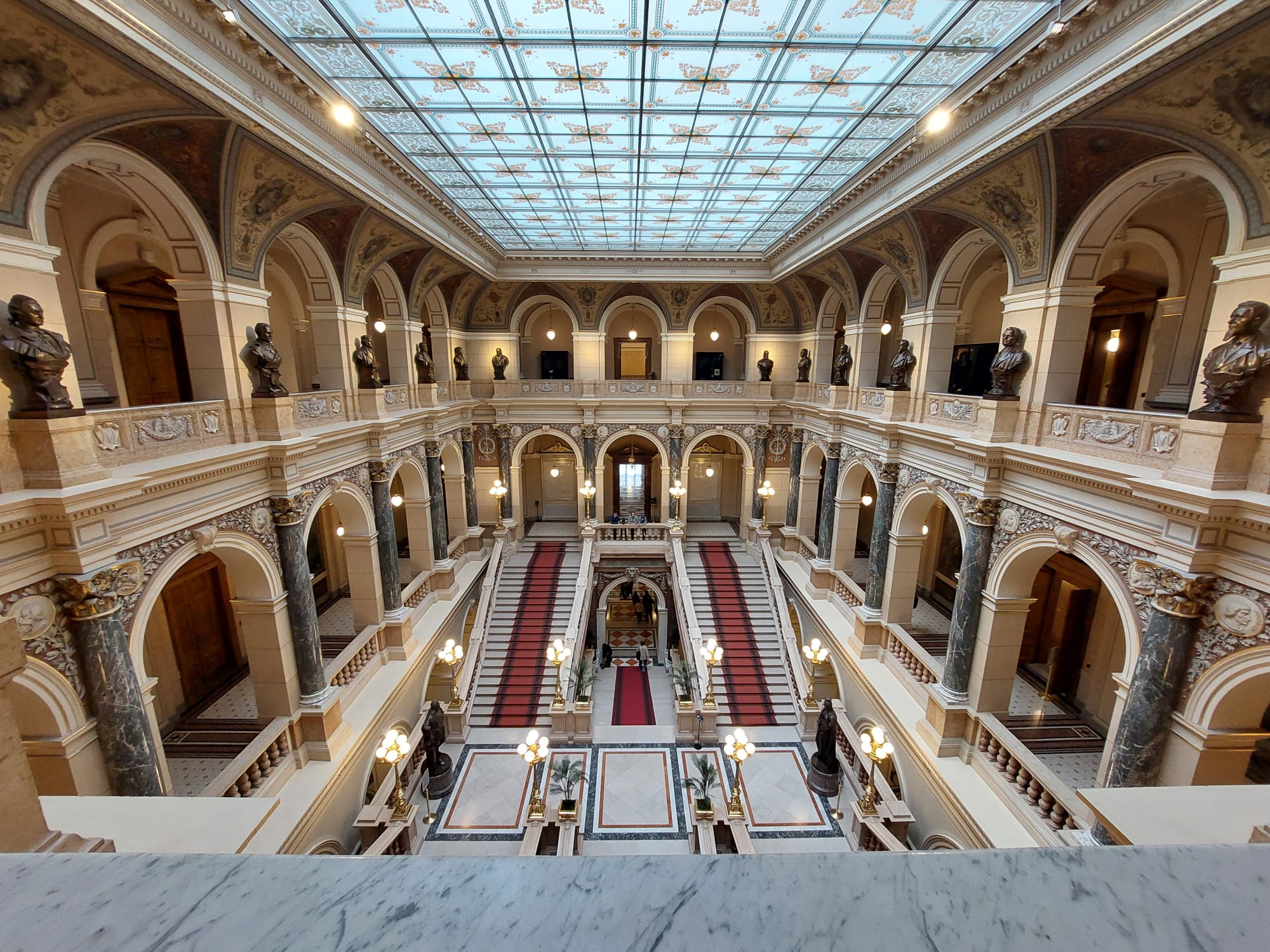

Clockwise: 12 Šporkova, the Dancing House, Estates Theatre, Golden Lane, Prague Museum, Morzin and Thun palaces.
A also visited the Ss Cyril & Methodius Cathedral, site of the last stand of seven members of a Czech resistance group including Jozef Gabčík and Jan Kubiš, who had assassinated Heydrich. They were betrayed, and the church was surrounded by 750 SS soldiers, water pumped into the crypt to try to force them out, until all were killed or had committed suicide. We were both familiar with their story from the film Anthropoid – I’d also read Laurent Binet’s HHhH, and seen the film adaptation of that, The Man with the Iron Heart.
Wenceslas Square, near our hotel. The site of celebrations and demonstrations, and home of the statue of St Wenceslas (this isn’t the original one – that was moved elsewhere in 1879, this one dates from 1912). The National Museum, which A visited on Day 1, is at the top of the square.



Clockwise: Charles Bridge, the crypt of Ss Cyril & Methodius Cathedral, Memorial to the Czech resistance, Ss Cyril & Methodius, Wenceslas Square, Prague viewed from the Castle
What did we miss? We only saw the modern part of Prague station, not the older building, nor the Kindertransport memorials there. We didn’t get to Petrin, and the funicular railway, the observatory, mirror maze or the mini Eiffel Tower (Rozhledna). But if we come back, we’d probably just spend more time wandering, I think, because there’s something to see around every corner here, not necessarily something grand like in Vienna, but something intriguing, something beautiful, something memorable.
Prague Reading:
Fiction: Lauren Binet – HHhH (a fictionalised account of the assassination of Heydrich); Franz Kakfa – The Castle (it’s not really about Prague Castle but still…); Simon Mawer – Prague Spring; W G Sebald – Austerlitz; Philip Kerr – Prague Fatale; Heda Margolius Kovaly – Innocence (a Prague-set detective noir). Non-Fiction: Anna Hajkova – The Last Ghetto: An Everyday History of Theresienstadt; Heda Margolius Kovaly – Under a Cruel Star (also published as Prague Farewell), her autobiography, covering imprisonment in the Łódź ghetto and Auschwitz, her return to Prague and the judicial murder of her husband during the Slansky show trials, finally leaving after the failure of the Prague Spring; Alfred Thomas – Prague Palimpsest: Writing, Memory and the City (especially Ch. 5 which deals with Sebald’s Austerlitz).
Prague on Film: Anthropoid; The Man with the Iron Heart; Kafka (TV series)
Prague Music: Smetana – ‘Ma Vlast’ is the obvious piece, and a wonderful one, whether one is looking out over the Vltava whilst listening or not and Janacek and Dvorak are composers who have been part of my musical life for so many decades. It’s also important to recognise the work of a number of composers who were deported to Theresienstadt, and who composed and performed music in the ghetto, before being transported to Auschwitz and murdered, notably Gideon Klein, Hans Krása, Viktor Ullmann and Pavel Haas. Inevitably much of the music is lost but what has been recovered can be found on various collections and compilations, as well as on Spotify. I also rather like Martina Trchová, a Prague-born folky singer-songwriter.
BERLIN
Onwards to Berlin. Another train, this one with old-fashioned compartments. A more scenic route than the one between Vienna and Prague (and I’m definitely not talking about the man who emerged from a shrubbery alongside the rail track, naked apart from a beanie hat).
Our hotel was immediately opposite the Hauptbahnhof, but we weren’t able to check in straight away, so we deposited our bags and headed out into the city.
Saturday:
We headed out, noting some striking pieces of political art in Kreuzberg, and the EU project, Path of Visionaries, in Friedrichstrasse, where a floor plaque bearing a quote from someone inspiring is in place for each EU member state, plus UNESCO. I didn’t check whether we had a floor plaque, but when the project was launched in 2006, we were still in the EU…
Berlin’s Jewish Museum is a powerful place to visit, both in terms of its design and its content. We particularly noted the Garden of Exile and Emigration, described here by blogger Gerry Condon:
’49 columns filled with earth are arranged in rows traversed by uneven pathways. The stelae are built on sloping land and rise at an angle, leading to a sense of disorientation similar to that felt inside the museum building. Out of each column grows an Oleaster, an Olive Willow, perhaps symbolizing rebirth. The experience of walking in this structure is comparable to that of being in the Memorial to the Murdered Jews of Europe, but though the Garden of Exile and Emigration is more modest, I think I found it more effective.’ (Gerry Condon, ‘Living with History: A Berlin City Centre Walk’, How the Light Gets In, 25/06/15)
We hadn’t at this point seen the Memorial to the Murdered Jews of Europe, but certainly the Garden was disorienting; I stumbled as soon as I went in and felt off balance whilst I was in there. But there was beauty too, sunlight, and growth.
The corridors in the Museum itself are intersecting and slanting ‘Axes’, and there are a number of voids. We looked down into the Memory Void but didn’t find our way to go into it (it’s the only one of the voids that one can enter), bamboozled by the labyrinth. But from our vantage point we could just see the ‘Fallen Leaves’ (designed by Israeli artist Menashe Kadishman), each with a face punched out of steel and covering the floor of the void so that visitors have to walk over them.
The permanent exhibition is of Jewish past and present in Germany, but there are displays that recognise the diaspora, and the continuity of Jewish life and traditions in the many nations where exiles found a home. We were very struck by the display showing, in a series of long hanging posters, covered in small print, the many, many laws implemented by the Nazi party as soon as they had power, laws covering every conceivable aspect of life for Jews. It didn’t, as we know, start with gas chambers, or even with deportations. It started with minutiae, with things that people initially may have felt they could cope with, and little by little these restrictions isolated the Jewish population from Aryan neighbours, colleagues, classmates, so that they were exposed, without allies (or only those brave enough to take a stand), when everything was finally taken from them.
We also saw an exhibit about Regina Jonas, the first woman Rabbi, born in Berlin and ordained in 1935, an inauspicious year. I hoped initially that she had perhaps been able to leave before it was too late, but a moment’s googling told me what I kind of knew in my bones, that she stayed. She was arrested in 1942 and deported to Theresienstadt, where she continued to work as a rabbi, helped with a crisis intervention service to support newcomers to the camp, and was involved in cultural and educational activities. In October 1944 she was deported to Auschwitz, where she was murdered either on arrival or two months later, aged 42.


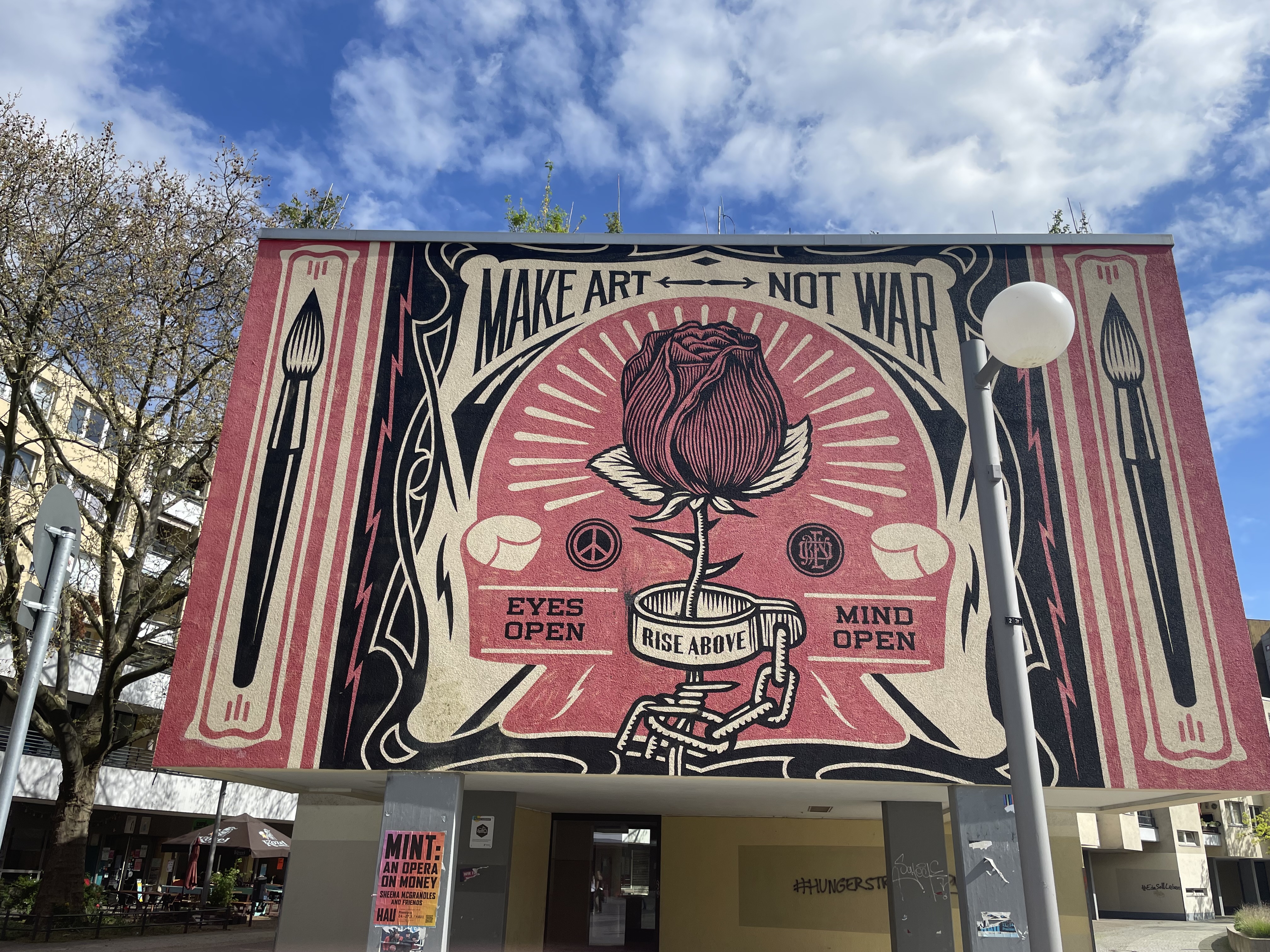
Clockwise: Garden of Exile and Emigration (Jewish Museum), Hotel Amano, Nuremberg laws (Jewish Museum), Path of Visionaries, Regina Jonas, street art
Stolpersteine (Luisenstadt): Hirsch Neumann died 30 Oct 1940, Max Neumann, Rosa Reha Neumann, killed Riga Jan 42; Nathan Moritz Carlé, Charlotte Carlé, Margarete Carlé, Alice Carlé, Theresienstadt, Auschwitz. I was unable to find more information about Hirsch, Max and Rosa Neumann, but the story of the Carlé family is worth recounting:
Nathan and Margarete Carlé lived in Frankfurt when they first married, and their first child, Hans, was born there. They then moved to Berlin in 1900, where their daughters Charlotte and Alice were born. They moved around a fair bit in Berlin as their economic circumstances waxed and waned. In 1942, Margarete and Nathan were deported to Theresienstadt, where Nathan died on 11 October (reportedly of a heart defect). Margarete died of a stroke four months later. Whilst Theresienstadt was neither a death camp nor a work camp, conditions – massive overcrowding, malnourishment, and the spread of disease – killed many of its inhabitants, especially those who were older or otherwise vulnerable, before they could be deported to Auschwitz. Alice, their younger daughter lived with her partner Eva Siewert, until Eva was denounced in 1942 for having made anti-fascist jokes and sentenced to nine months in prison. Alice and her sister Charlotte lodged with Elsbeth Raatz, until threats of denunciation forced them to leave – Raatz, however, gave them false passports. In August 1943, they were arrested by the Gestapo and deported to Auschwitz a few weeks later. Of the 54 people in this transport, only nine women were registered as new arrivals (i.e. selected for work rather than immediate death). We don’t know their names, so we don’t know whether Alice and/or Charlotte were amongst those or had been murdered on arrival in the camp. Alice’s lover Eva survived, and worked as a journalist in Berlin after 1945. Hans Carlé had left Germany in autumn 1933, initially for the Netherlands, and then emigrated to Palestine, where he married. He lived a fairly precarious life in Tel Aviv, and died of a heart condition in 1950, aged 51.
Fernsehturm – we did not go up on this visit (A had already done so on his previous trip to Berlin), but we saw it – obviously, since it is the ultimate photobomber, popping up in almost every photo taken in the centre of Berlin.
We saw but did not go into the Berlin Palace, on Spree Island. A building that would have barely been noticeable in Vienna, where palaces are around every corner, it’s very striking here. But it’s actually a reconstruction. It was damaged by Allied bombers but actually demolished by the DDR government in 1950. In its place was the modernist Palace of the Republic, the DDR Parliament building. After reunification, and after long and arduous debate, the DDR building itself was demolished and most of the Berlin Palace’s exterior was reconstructed. It now houses the Humboldt Forum museum.
Berlin Cathedral, built in the late 19th century, damaged by Allied bombing and subsequently restored.


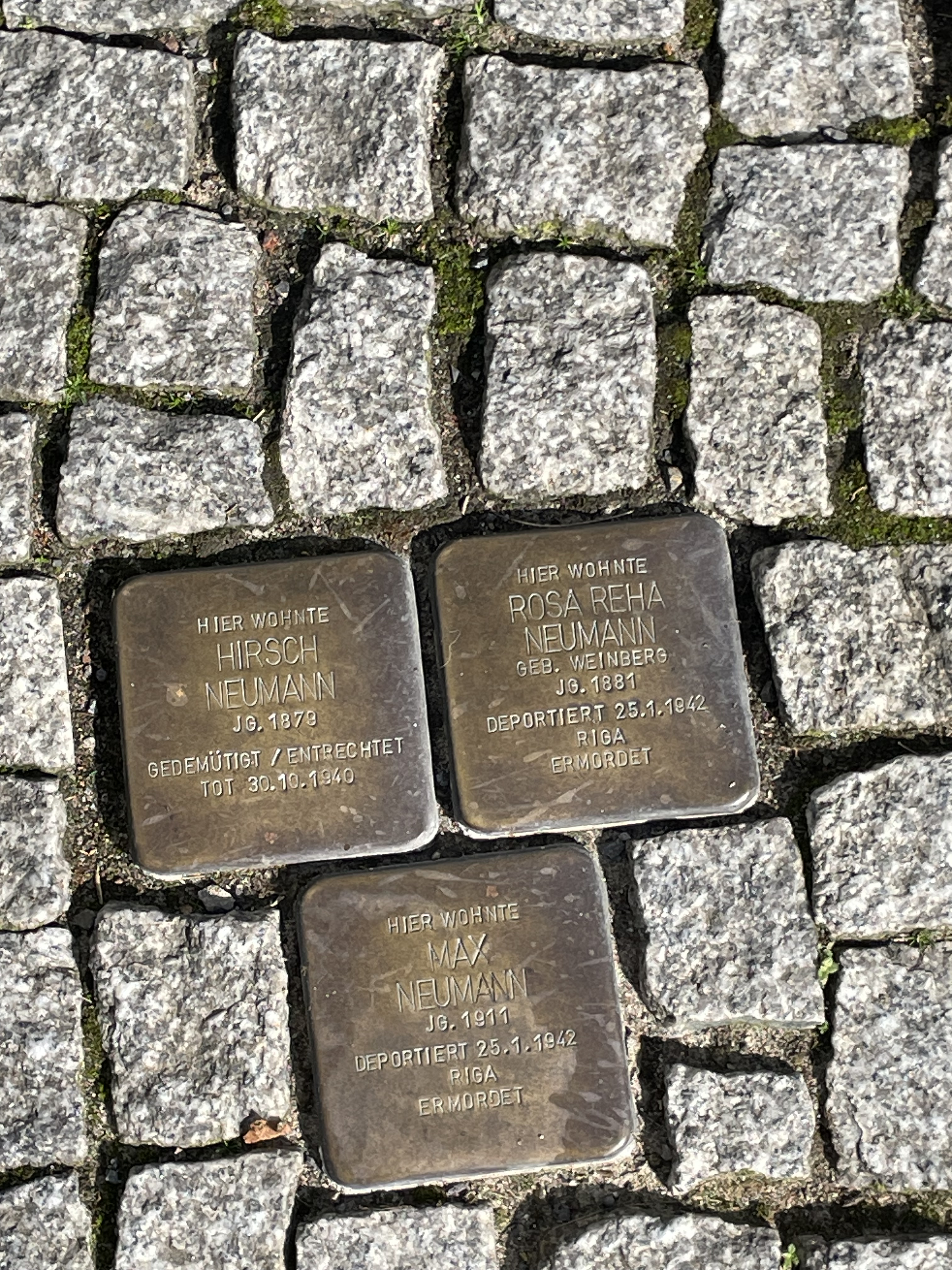
Clockwise: Berlin Cathedral, Berlin Palace, Stolpersteine: Carlé family, Fernsehturm, Humboldt Hafen (the canal harbour), Stolpersteine: Neumann family
Rotes Rathaus, Berlin’s town hall. It was the town hall for East Berlin, and the name ‘red town hall’ indicated not only the colour of the stones, but also the political colour. Mid-19th century, heavily damaged by Allied bombing, and rebuilt.
When we finally got into our room that evening (we’d decided to share, for economy), we were somewhat discomfited to discover that whilst there was, thankfully, a proper door on the toilet, the shower cubicle was all glass, and with a clear view through from the bedroom area, enhanced by the enormous mirror on the wall opposite the shower, just to make sure that the showerer would be visible from almost all points in the room, in all their glory. We devised a plan whereby the showerer would give a warning that clothes were about to be shed and the non-showerer would settle at the furthest top corner of the bed, facing the wall, and focusing intently on their phone or Kindle until the all-clear was sounded. We have since learned that this sort of thing is dismayingly common in modern hotels, in parts of Europe at least, and we don’t think much to it…
Sunday:
We headed for the Tiergarten but hadn’t fully realised the impact of the Berlin Half Marathon, which was taking place that morning. Our original route was quite impossible, so we only got a brief stroll through the Tiergarten before having to exit.
Reichstag – we’d tried to book a tour, but had evidently left it too late, or tours were unavailable due to the half marathon. Another time.
Marie Elisabeth Lüders House (Scientific dept of German govt) – On the banks of the Spree are memorials to people killed trying to cross to the West. This new building, inaugurated in 2003, owes its name to social politician and women’s rights campaigner Marie Elisabeth Lüders. Parts of the Berlin Wall have been rebuilt here to commemorate the division of the city along the former route of the Wall.
We failed to do justice to Museum Island but did go round the Alte Nationalgalerie. The problem with galleries is that once one has been through a number of rooms of paintings, it’s hard to remember exactly what one has seen, and to keep in mind the things that one particularly enjoyed and I really wish I’d made some notes. As far as I can recall, we rather liked the Romantics and the Impressionists, and I think Arnold Bocklin and Caspar David Friedrich stood out.
Solidarność wall – a section of brick wall from the shipyard at Gdansk commemorating the struggle for democracy in Poland through the Solidarity movement. I cannot find any information online about this, oddly. It’s adjacent to the Reichstag building.


Clockwise: Altenationale Gallery, Altes Museum, Reichstag, Rotes Rathaus, Solidarity wall, memorial to those killed attempting to cross from East Berlin (Marie Elisabeth Lüders House)
The Brandenburger Tor was the finishing line for the Half Marathon, and our arrival coincided with the first runners crossing the line, so we stayed and cheered for a while. Of course it is one of those sites that is iconic (a much over-used word, but here I mean that as an image it stands for Berlin in the same way that the Eiffel Tower stands for Paris), and I’ve seen it a lot recently, in coverage of the Euros. What seems remarkable is that it survived the final stages of the war, damaged but still standing, whilst so much of Berlin was reduced to rubble. Also remarkable is that shortly after the war, East and West Berlin cooperated in repairing some of the damage. Thereafter it was obstructed by the Wall and became a symbol of the city’s division – and then of its reunification after the Wall came down.
We had lunch with my friend Veronika, which was a brilliant opportunity to talk about all three of the cities we’d visited – she’d grown up and then worked in Vienna, now works in Berlin, and had visited Prague often, so it was fascinating to get her perspective on our experiences and to catch up on what had been happening since we met in December 2019.
After lunch, on to the Memorial to the Murdered Jews of Europe:
‘Two thousand seven hundred eleven concrete rectangles, as if a field of chiselled coffins of varying heights stand in formation, separated by just enough space for people to walk between them and contemplate their meaning. The stones undulate and dip towards the centre, where the ground hollows out, so that when a visitor reaches the interior, the traffic noise dies away, the air grows still, and you are trapped in shadow, isolated with the magnitude of what the stones represent. This is the memorial to the Murdered Jews of Europe who perished during the Holocaust. There is no sign, no gate, no fence, no list of the 6 million. The stones are as regimented as the Nazis and as anonymous as the captives shorn of identity in the concentration camps.’ (Isabel Wilkerson – Caste, pp. 343-4)
Opinions, as one might expect, differ about this memorial, about its purpose and the form it takes. I was surprised how similar that form was to the Garden in the Jewish Museum, although it is bleaker, somehow. But whatever form the memorialisation of the Holocaust takes, some will find it does not speak to them, or will question its location or how it presents itself (of course some will question the need for such memorials, but that question seems to me obscene in its ignorance). I did find it effective and oppressive, and the scale is very striking (the Garden does not attempt to convey that), and I applaud the use of the term ‘murdered’ here. When we speak of people dying in the Holocaust, or being killed, we diminish what was done. One might die of anything; one might be killed in a car crash. Whether through bullets or gas, disease or starvation, these deaths were planned and intentional, they were murder on an unimaginable scale.
Topography of Terror Museum, on the site of the Gestapo/SS headquarters, and one of the longest extant sections of the Wall. We didn’t exhaust this because we (or at least I) were, frankly exhausted. But we saw the open-air part of the museum, and the remains of some of the walls of the buildings once occupied by the Gestapo. It was an excellent display – much that I did not know or had not understood in context.
‘Had to get the train
From Potsdamer Platz
You never knew that
That I could do that
Just walking the dead’ (David Bowie – ‘Where Are we Now’, The Next Day, 2013)

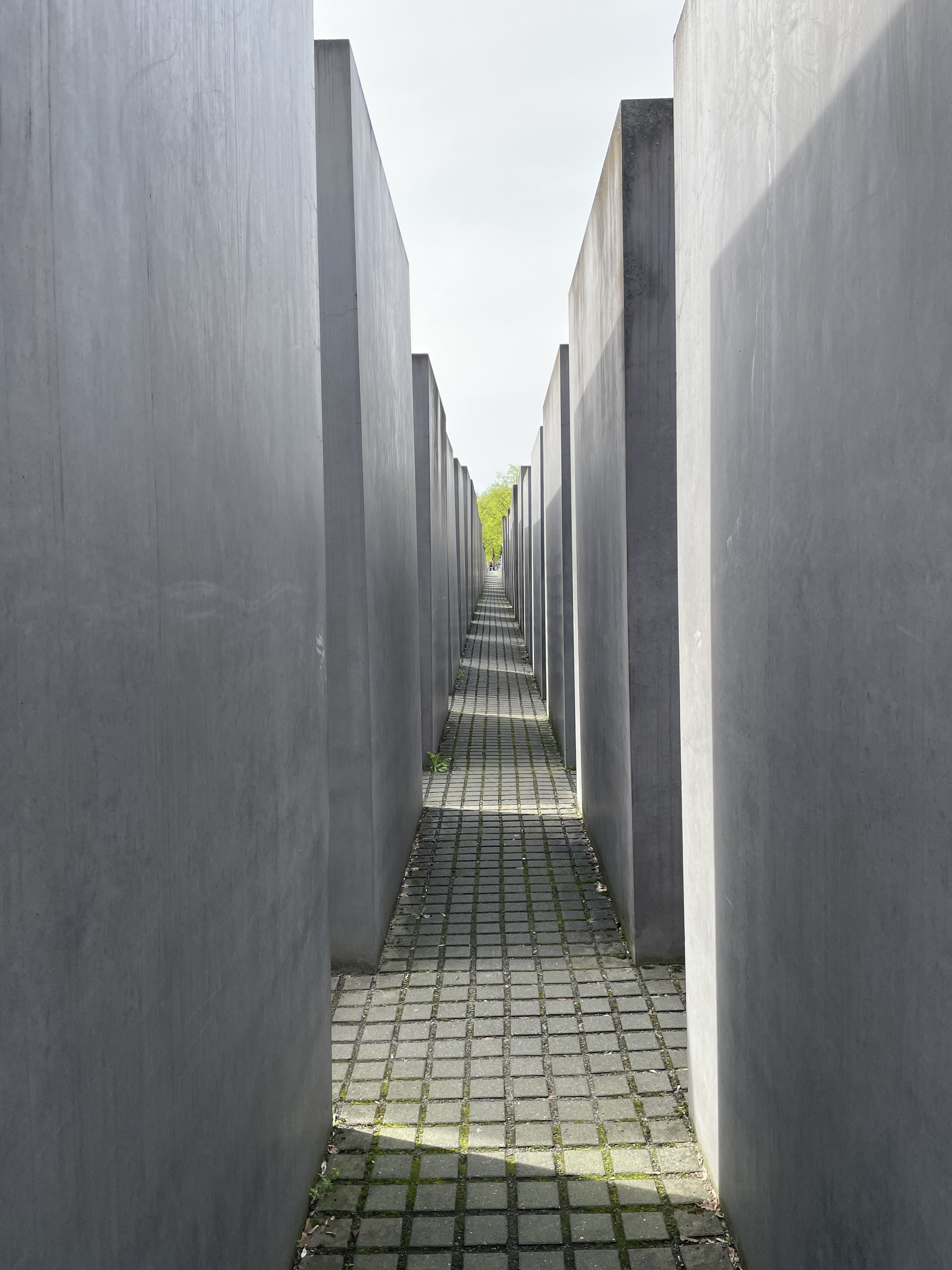


Clockwise: Brandenburg Gate, Memorial to the Murdered Jews of Europe, Potsdamer Platz, Tiergarten, Topography of Terror
What did we miss? More here than elsewhere, partly because there’s more to see, but also because our planned route for Sunday was disrupted by the Half Marathon, and to be honest, because we were knackered. If/when I go back, there are several museums to see, and I’d particularly like to focus more on the post-war DDR history – the Wall, the Stasi, etc – as well as doing the Reichstag tour, and going up the Fernsehturm for the sake of the view.
Berlin Reading:
Fiction: Christopher Isherwood – Goodbye to Berlin; Philip Kerr – Berlin Noir trilogy; John le Carré – The Spy Who Came in from the Cold. Non-fiction: Walter Benjamin – Berlin Chronicle; Sinclair McKay – Berlin: Life and Loss in the City that Shaped the Century
Berlin on Film: Wings of Desire; The Resistance; The Lives of Others; Cabaret
Berlin Music: Obviously, there is plenty of ‘classical’ music from composers who were born in or who studied in Berlin. But the soundtrack in my head was made up of the voices of Marlene Dietrich, Lotte Lenya, and David Bowie.
Final thoughts
Seeing three cities in six days invites one to make direct comparisons.
Vienna was grand, and beautiful, seemingly fixed in the nineteenth century, before all of that mid-twentieth-century unpleasantness. My response to the city was coloured by a conversation with a neighbour whose father, it turned out, had grown up there, but had had to leave, along with his family – of those who remained, many were murdered. She felt it was a soulless place, cold and hostile to her which, in a fundamental way it was – had her father not escaped it, she would probably not have existed. Another friend, who grew up in Vienna much more recently, spoke of it as claustrophobic, particularly for a teenager. So we admired its beauty but did not fall in love.
Prague is older, more of a muddle of labyrinthine streets and architectural styles, but just as beautiful in its own, less grand, way. And in the Jewish quarter of the city it acknowledges both the long history of that community, and how that was destroyed, in a simple and moving way, through the names and what that list of names conveys, rather than anything monumental. Prague took our hearts.
Berlin has, of course, a lot more to acknowledge, and it does so in various powerful ways. It leaves gaps, it leaves fragments.
‘Berlin is a naked city. It openly displays its wounds and scars. It wants you to see. The stone and the bricks along countless streets are pitted and pocked and scorched; bullet memories. These disfigurements are echoes of a vast, bloody trauma of which, for many years, Berliners were reluctant to speak openly. … The city itself is long healed, but those injuries are still stark.’ (Sinclair McKay, Berlin, p. xvii)
Its history is so complex and reflects not just one nation but two in the one city, as well as reflecting upon not just Germany (one or both) but what was done to so many in the name of that nation. There are layers upon layers to explore – and we inevitably did scant justice to that.
But we knew that seeing three cities in six days – three cities chosen because of their complex and fascinating history, their beauty and tragedy – was going to leave us with almost as long a list of things that we missed as our original list of things we wanted to see. Some of those omissions were choices – we favoured wandering around the streets over excursions that would take too big a chunk of our time, and I’m glad we did. I missed some things because I reached the end of my capacity for walking rather sooner than A did, and decided to conserve energy for the following day by a strategic withdrawal to the hotel room a little earlier than we’d intended. And there are things that we hadn’t even added to our list, that we’d include next time.
But we saw a heck of a lot, we walked for 57 miles, and I clocked up 135k steps, and we saw museums and art galleries, cathedrals, churches and synagogues, a cemetery, palaces, memorials, statues and fountains, parks and government buildings, paintings and stained glass windows, stolpersteine and commemorative plaques, three great rivers (the Danube, Vltava and Spree), street art, theatres and opera houses, bridges… We sampled the local culinary specialities (schnitzel, apfelstrudel, goulash, pork knuckle, various forms of sausage) and the local beers.
It was a trip that I dreamed up and I was afraid it wouldn’t live up to that dream, but it did, it was everything that I had hoped it would be. When we got home, it almost seemed dream-like – had we really seen and done all of that? Hence this epic blog – I needed to capture it all before memories got too hazy. I could not have done it without A and his company was not only practically essential, but also a joy. I am hugely grateful to him for making that dream a reality.
2024 Reading – half time report
Posted in Literature on June 23, 2024
There are a few new themes in my reading this half-year. First, I got back into reading in French (see Barbéry and Camus below, and Fatou Diome’s Le Ventre de l’Atlantique will feature in my December books blog as I am only one-third of the way through at present). I had new bookshelves to fill, and so books that have been exiled in my attic for many years (some since we moved here in 1987) have been brought down and places found for them on those shelves – I’ve rediscovered things I’d forgotten I owned, seized with delight on treasured books that I’d not seen for ages, and found books that I really don’t know if I ever read, as well as books that I now need to re-read. And thirdly, I went on a marvellous trip to Europe with my son, a three city, week-long holiday that started in Vienna, moved on to Prague, and then ended in Berlin. Being me, I did of course do quite a lot of preparation for this, not just in terms of the obvious travel arrangements and packing, but watching films set in those cities and reading books about them or set in them. Those books feature both in my fiction and non-fiction lists.
Otherwise, it’s a familiar mix, and the usual warning, that whilst I try to avoid spoilers, I make no absolute promises that there aren’t any. And note that I haven’t listed absolutely everything – the latest in a long-running series, for example, not because it’s not great, but because the only thing I could really say is that this is book no. x in series y. Books that I started and CBA’d to finish, or that I thought were just a bit rubbish I haven’t felt obliged to include; there are books here that didn’t work for me, but I’ve only listed them if there’s more to say than ‘this was a bit rubbish’, usually because I wanted to like the book more than I did, and so wanted to understand why I hadn’t cared for it. But generally, this blog is about sharing my enthusiasms, sharing what’s delighted, informed and inspired me, rather than my disappointments.
As always it’s difficult to pick out favourites from such an eclectic bunch. I think I’d choose, from the fiction list, Sarah Gainham’s Night Falls on the City, Simon Mawer’s Prague Spring and Francis Spufford’s Cahokia Jazz, and from non-fiction, Isabel Wilkerson’s Caste.
FICTION
Muriel Barbéry – L’élégance du hérisson
This marks my resolve to get back into reading in French (see also Camus below). I never really stopped, between reaching the point in my comprehension that reading a novel was feasible (around A level), and diving into Zola and Mauriac and de Beauvoir, and my PhD focusing on Michel Butor. But since finishing the PhD I hadn’t read a word, and this, a gift from my brother-in-law, was a good way to re-start. It was slow progress at first, which can mean you lose the impetus of the plot, but I gradually got more comfortable. The novel was entertaining and at times moving, and whilst my internal jury is out about the ending, I’m very glad I read it.
Heinrich Böll – The End of the Mission
This is one of the books that came down from the attic, where it had been in storage probably since we moved in here, in 1987… Böll’s The Lost Honour of Katharina Blum is always going to be in any list of books that have had a significant impact on me. This one didn’t live up to that but was darkly funny and acerbic and I will read more Böll (I think I read Group Portrait with Lady way back when and liked that very much but there’s another one on my bookshelf which I will turn to soon).
Octavia Butler – Patternmaster
I read a lot of sci-fi in my late teens/twenties, because my boyfriend/fiancé/husband (that’s all the same bloke, just to be clear) was really into it. Some I loved; some left me cold. In later years I’ve read much less, but in bringing boxes of books down from the attic I found, not Kindred, which was the Butler novel I remembered, but this one, and I’m still not sure if I did read it, all those years ago. No matter, it feels fresh to me, and she has the gift – so essential to writers in this genre – of acquainting the reader with the specifics of that world and those peoples efficiently and swiftly, with the minimum of exposition, so that within the first couple of pages, one is gripped.
Albert Camus – Le premier homme
Camus’s last, unfinished book, the manuscript of which was found near the site of his fatal car accident and edited and published by his daughter. It’s highly autobiographical in its rich and vivid depiction of a childhood in poverty in Algeria, a deaf and illiterate mother and a father killed in the First World War, whom he never knew.
Jane Casey – A Stranger in the Family/The Outsider
Two new ones from one of my favourite contemporary crime writers. The first is the latest in her excellent Maeve Kerrigan series, the second a stand-alone (at least so far) which connects to the Kerrigan novels. Both are, as always with Casey, tightly plotted, with great characterisation and very well-written. I’m now in a state of some anxiety waiting for the next Kerrigan, due to a very disturbing epilogue….
Aidan Chambers – Postcards from No-Man’s Land
A young adult novel, with two timelines, one contemporary, one set in the Netherlands during the Second World War. I didn’t quite believe in the contemporary protagonist, unfortunately, and it left me quite cold, to my surprise.
Louise Doughty – A Bird in Winter
Doughty writes a damn fine thriller, and there’s always depth and complexity as well as twists and turns and suspense. The opening sequence is riveting, and one remains riveted to the final page. (P.S., anyone who only knows Doughty through Apple Tree Yard, do read Fires in the Dark, her novel about the Roma holocaust – superb and unforgettable).
Cyprian Ekwensi – The People of the City
A Nigerian novel, published in 1954, before Nigeria gained independence – one of the first African novels to be published internationally. Ekwensi had previously published work based on folk tales, but this is very much a contemporary, urban narrative, the story of a young man, a crime reporter/bandleader in a city that isn’t named but seems to be Lagos. It’s quite episodic, betraying its origins in a series of short stories aimed at West Africans living in England (where Ekwensi wrote the book) , and is a vivid and engaging read.
Sarah Gainham – Night Falls on the City/A Place in the Country/Private Worlds
The first in this excellent trilogy is set in Vienna, so I read it before and during my time there. It begins just before the Anschluss and takes its protagonists’ story through to the liberation of the city by the Red Army. The second volume shifts the focus and the location to British military personnel near the border with Hungary, but in the third we’re back in Vienna. I found the final volume a bit too talky and wasn’t entirely convinced by the portrayal of the relationship between the two central characters (mind you, at one point I thought, oh, this is all getting a bit D H Lawrence, but then one of the characters said the same thing!).
Joanne Harris – Jigs and Reels/Coastliners
The first of these is a collection of short stories and I didn’t get on with them at all. I tried several (at random, following some advice I read somewhere about how to tackle short story collections) and then gave up. Coastliners is very different to the other Harris novels I’ve read (Gentlemen and Players/A Different Class) and is a slow burner but it got under my skin, and I very much enjoyed it.
Bessie Head – When Rainclouds Gather/Maru
When Rainclouds Gather is Bessie Head’s debut novel, written in exile in Botswana, where she had fled from apartheid South Africa, and published in 1968. It’s a great read, illuminating many aspects of contemporary society and politics, and offering a strong environmental message, rather ahead of its time. It’s also ahead of its time in the portrayal of the male characters, who are complex and sensitive in ways that go against the more macho stereotypes, as Helen Oyeyemi says in her introduction. Maru was Head’s second novel, published three years later, and focusing on caste, through the character of Margaret, a member of the San (pejoratively, Bushmen) people. I read Head’s later A Question of Power many years ago and will re-read in light of these two.
Mick Herron – Slough House/Bad Actors
Up to date with the books now, which means I’m eager for the next one, and for the next TV series. I started Bad Actors desperately wanting to know what had happened to one of the regulars, and Herron rather sadistically kept me dangling till the last page. The swine.
Patricia Highsmith – The Talented Mr Ripley/Ripley Underground/Ripley’s Game
I’d read the first of these, many years ago, and thought I’d read the others, but they seem quite unfamiliar. There is a degree of repetition in the plots, and it’s all very entertaining and well-written, but I’m not sure that I’m going to go on to Volumes 4 and 5 – I think I’ve spent enough time with Mr Ripley, for now at least. I watched the new adaptation of the first novel, with Andrew Scott and loved it (see my review in the screen equivalent of this blog).
Daisy Hildyard – Hunters in the Snow
The influence of W G Sebald is strong here, but this debut novel doesn’t entirely work for me. Its starting point is a young woman sorting through the papers left behind by her eccentric grandfather, which comprise his idiosyncratic history of England. This turns out to be the stories of four men: Edward IV, Peter the Great, Olauda Equiano and Lord Kitchener, and in each case the accounts are heavily weighted towards anecdote, and the sifting through anecdote for truth or deception. In between, the young woman remembers her childhood on the grandfather’s farm, and this too is of course exploring our relationship with the past. I liked a lot of things about it, but the different strands didn’t seem to come together in a satisfying way – it’s good, good enough to give it a re-read to see if I can get what Hildyard is trying to do.
Christopher Isherwood – Goodbye to Berlin
Read in preparation for our visit to Berlin. Not quite either a novel or a short story collection, these six narratives follow the same characters and are ordered chronologically, but with jumps in time that make these sections seem more free-standing. What is noticeable is how the Nazis go from being background noise in the first to being a clear and present threat by the end. The characters aren’t in general very sympathetically presented (even the one who’s called Christopher Isherwood), but they’re vividly drawn, as is the city.
Vaseem Khan – Midnight at Malabar House
A new (to me) historical crime writer – this series is set in India in the years after Independence and the protagonist is a nicely quirky character, also distinguished by being the first female copper in the newly independent police force.
Stephen King – You Like it Darker
It’s obviously not a coincidence that the title of this collection of short stories echoes that of Leonard Cohen’s final album, You Want it Darker. I knew it wasn’t, even before I read the acknowledgement in King’s Afterword, because he’s a man who knows his music. And in this collection of stories, perhaps more than ever, King’s protagonists are older, intensely aware of their own mortality, of the frailty of their bodies, of the accumulation of losses, of regret and shame for past mistakes. He’s always explored darkness, but there’s a particular note that he strikes here, again and again. He can still work that trick on my mind that he has done so often over the years, of making me read on in the hope that if I get to the end of the story that uneasy sensation in my gut would ease, only to find that the last words in the story are ‘God help me!’ and I’m not free after all, debating whether to leave the light on. I know that it isn’t real, and I know that there’s no way I will hear that particular sound in the house and I know that I’m listening for it…. The stories vary considerably in length, and one or two are slight in content as well as short on pages, but the best are King at full strength (full darkness). ‘Rattlesnakes’ in particular will stay with me for a long time, I fear (given my snake phobia, born from living in West Africa where we had to learn to be afraid of them).
John le Carré – The Spy who came in from the Cold
A re-read, whilst in Berlin, of one of the first le Carrés that I read in my teens. As brilliant as I remembered it, and as bleak.
Simon Mawer – Prague Spring/The Glass Room
More travel-related reading. The first is set, as the title suggests, at the time of the Prague uprising and its violent repression, the second spans a much longer period, beginning between the wars, and taking the story through to, again, the Prague spring. Both are fascinating and compelling, beautifully written and moving.
Simon Mawer – The Girl who fell from the Sky/Tightrope
This is a more conventional thriller from Mawer, about one of the SOE agents parachuted into Occupied France. It’s territory I know well, having been obsessed with the stories of the female agents since watching Odette and Carve Her Name with Pride in my teens, and having read Sarah Helms’ biography of Vera Atkins and Leo Marks’ memoir, Between Silk and Cyanide (both Atkins and Marks make appearances here, along with a mix of real and fictional characters). The quality of Mawer’s writing makes this stand out – and the thriller really does thrill (there is a sequel about which I can say nothing without spoilers, so I’ll say only that it’s just as tense and gripping as the first).
Saima Mir – The Khan
We’re in Godfather territory here, transposed to a northern industrial city (I’m thinking Bradford but it’s not specified) with a significant South Asian population. It’s about family, loyalty and morality, as the titular Khan faces questions of succession and of a changing city. The narrative immerses the reader in Pakhtun culture, which in itself is fascinating.
Sarah Moliner – The Whispering City
Spanish crime thriller set in Barcelona during the Franco era. The context is absolutely part of the narrative, not just a backdrop, and Moliner creates the atmosphere of fear and mistrust very effectively.
Abir Mukherjee – Smoke and Ashes
Another in the Wyndham/Banerjee series, set in 1921. What Mukherjee does by telling the story through the voice of the British officer, not his Indian sergeant, is brilliant – he doesn’t make Wyndham anachronistically enlightened, but as something of a maverick, able to contemplate other points of view than the received Raj wisdom. Nonetheless, some of his remarks about India and Indians make me wince, and his relationship with Banerjee, whilst respectful to a degree, is rooted in that view of the world. It’s nimbly done, and the plot is complex and interesting, not only in terms of the crime but of the politics of the time.
Alice Munro – The Beggar Maid: Stories of Flo and Rose
This was one of the books that came down from a long sojourn in the attic, and news of Munro’s death prompted me to re-read it. It’s a joy to read (whether this is a collection of linked short stories or a novel, who cares?), so clear and subtle, often funny and sad at the same time. I realised reading this again after many years that she must have been a huge influence on Elizabeth Strout, who I also love, both in terms of the form and the style. Both Flo and Rose are beautifully drawn – it’s interesting to re-read now and find that Flo’s story and that of the older Rose are as compelling to me now as the younger Rose’s were when I first met her.
C P Snow – The Search
Snow was probably my father’s favourite writer of fiction. He read a fair bit of fiction as a younger man, but then rediscovered its joys in later life, when his sight failed and he turned to audio books (Dickens, Trollope, le Carré, Harper Lee and others – he was entranced by The Book Thief). Sadly, Snow’s work is so out of favour that it’s hard to find affordable real books, and no audiobooks at all. Dad related to Snow’s interest in science and politics, and this one, which precedes the Strangers & Brothers series, is about academic scientific research and University politics. I would have probably found it a great deal less interesting had I not worked in higher education management for so many years, and in a Physics department until shortly before my retirement, but as it is, it resonated strongly with me.
Francis Spufford – Golden Hill/Cahokia Jazz
I discovered Spufford through Light Perpetual, a stunning novel about an alternative world in which five children didn’t die in the V2 bombing of Woolies in 1944…. Golden Hill is quite different – a rambunctious Fielding-esque tale of a young man on a mission or on the make in America, with a much darker undercurrent that becomes clear only quite late in the narrative. Beautifully done. And Cahokia Jazz is an alt-history crime novel, about which I will say little more, except to recommend it very highly indeed. He’s one of the most exciting novelists I’ve encountered over the last few years.
Anne Tyler – French Braid
I’ve read, I think, nearly all of Tyler’s novels, and have loved nearly all of them (Vinegar Girl, her take on The Taming of the Shrew, just didn’t work, I’m afraid). This is classic Tyler, as the Guardian’s reviewer put it, ‘Funny, poignant, generous, not shying away from death and disappointment but never doomy or overwrought, it suggests there’s always new light to be shed, whatever the situation, with just another turn of the prism’.
NON-FICTION
Daniel Finkelstein – Hitler, Stalin, Mum and Dad: A Family Memoir of Miraculous Survival
The title emphasises survival but throughout this family history we are aware both of how many didn’t survive, and of how easily ‘Mum and Dad’ could have been amongst the lost. That sense of loss is pervasive – ‘so many families, so many happy homes, so many childhoods’ – as is the awareness that, as Finkelstein puts it, “What happened to my parents isn’t about to happen to me. It isn’t about to happen to my children. But could it? It could. Absolutely, it could.”
Zora Neale Hurston – Barracoon: The Story of the Last Slave
I came across the story of Cudjoe Lewis (or rather, Oluale Kossola), believed to be the last survivor of a slave ship, in the documentary Descendants, which included a short film clip of Zora Neale Hurston with Lewis. This is her biography of the man, based on extensive interviews with him, and it’s extraordinary. The book wasn’t published until 2018 – Hurston failed to find a publisher in her lifetime because she kept Lewis’s account in his own words and in the vernacular that he used, and because she acknowledged African involvement in the slave trade.
Sinclair McKay – Berlin: Life and Loss in the City that Shaped the Century
Read in preparation for the trip to Berlin, this is a fascinating account of that city’s twentieth century. Unlike Vienna, Berlin, as McKay says, displays its wounds openly – in a sense it had no choice, given both the extent of the devastation from Allied bombs and the world’s knowledge of the devastation that was wreaked upon Europe, and particularly on its Jews. That makes it a remarkable city to visit, and this book was an excellent introduction to it.
Donald L Miller – Masters of the Air: How the Bomber Boys Broke Down the Nazi War Machine
See my blog about this half-year’s watching for my review of the TV series based on this book (and on interviews and memoirs from the surviving bomber boys). The book itself takes a wider sweep than the drama and gives much more context for the missions which cost so many lives, as well as exploring the ethical arguments about the bombing of civilian areas. Miller is an excellent writer, and gets the balance between technical stuff and human stuff right, so it’s a very engaging read.
Paul Newman – The Extraordinary Life of an Ordinary Man: A Memoir
Ordinary, maybe. But certainly complicated. It’s a very honest account (as far as we can judge) and often sad, but because of the extraordinary life he’s had it illuminates so much about the movies during the decades in which he was a leading light, and about American life, culture, politics more broadly.
Deborah Orr – Motherwell: A Girlhood
I used to read the late Deborah Orr’s columns in the Guardian, and later followed her on Twitter and her voice was always compelling. This memoir is remarkable, and I find it strangely hard to write about, almost as if I’m reviewing a person (who I never met), rather than a book. So I’ll let Andrew O’Hagan’s words stand: ‘forging out of living memory a glowing vision of troubled belonging. In the writing of it, Deborah found a way to rise out of her sorrows and dependencies, her own difficult loves, and create a masterpiece of self-exploration. We can only mourn her loss and the brilliant books she might have written after this.’
Lucy Pollock – The Book about getting Older (for people who don’t want to talk about it)
I am not averse to talking about getting older – I don’t embrace all aspects of it (who could!), but I accept it, and, as my late husband used to say, it is better than the alternative. Unless it isn’t. My thoughts on my own ageing are heavily influenced by having lost my mother-in-law and being in the process of losing my father to dementia, and whatever else happens to me in the remainder of my life, that is the most terrifying thing to contemplate. There’s a lot of practical stuff here, about how to prepare yourself and your family, most of which I’ve already been cracking on with (PoA, will, lists of account numbers and passwords, funeral plan), others that I’m still thinking on (e.g. advance decisions). What was particularly interesting to me was the distinction Pollock makes between what is common as one gets older, and what is normal. In other words, what is genuinely pretty much inevitable, and what might be avoidable, or should be properly investigated rather than just being accepted. It’s not a cheery read but it is practical and hopeful, which is how I intend to approach my advancing years.
Francis Spufford – The Child that Books Built: A Memoir of Childhood and Reading
I am very much a child built by books. I read voraciously from the moment those marks on the page turned themselves into words for me and have never stopped. That childhood reading shaped my adult reading, and the more I read, the more I wanted that experience of turning a page and entering someone else’s world. So I was very intrigued to read Spufford (as I mention above, a fairly recent discovery and one of the most exciting contemporary writers) talking about the books that built him. He is a fair bit younger than me, but of course we read a lot of the same things – Tolkien, C S Lewis, E. Nesbit, etc. Le Guin, who was clearly hugely important to him, became part of my life only when I was a teenager, but it’s fascinating to read his account of discovering Earthsea as a child. And the way he writes about his life in books, as I’d expect from the way he writes his novels, is beautiful and touching and funny and deep.
Isabel Wilkerson – Caste: The Origin of our Discontents
A rigorous and persuasive exploration of American racism as a form of caste system. Wilkerson draws comparisons with the Indian caste system and with Nazi Germany. Kwame Anthony Appiah described the book as beautiful and painful to read, and indeed the account of how notions of purity and pollution, for example, played out in the American South – and more widely – are horrifying, and much of this detail was new to me. It seems to me that this analysis is hugely important in understanding not only the history but the future – recognising that this is about caste allows us a clearer view of how a society can change for the better. It certainly got into my head, and I found myself referencing it after one recent episode of Doctor Who (Dot and Bubble)…
Stefan Zweig – The World of Yesterday: Memoirs of a European
It’s hard reading this and knowing that the day after posting this manuscript to the publisher, Zweig and his wife committed suicide. The book isn’t a suicide note – it doesn’t really explain that decision. They were safe, albeit in exile and (this was in 1942) with no guarantee that their safety would continue or their exile end. Clearly that sense of exile, of having left a life behind that, whatever the outcome of the war, could not simply be picked up again, was beyond bearing. But for most of the book, Zweig appears to lead a fairly charmed existence, attracting success, brilliant and talented friends, and a life of culture and comfort. He seems to have accepted the good things that came his way without any great surprise or doubt that this was his due, which isn’t an entirely appealing quality. And the way in which all of those brilliant and talented people immediately became his dearest friends was a bit queasy. So I wasn’t won over to Zweig (though Michael Hofmann’s vitriolic demolition job in the LRB seems weirdly excessive and personal). In some ways I felt about Zweig as I felt about Vienna, where he spent his early years. Somehow Vienna gives the impression of being quite pleased with itself, and to have distanced itself more than other European capitals from the ‘unpleasantness’ of events. One friend, whose father got out of Vienna just in time, described the city as soulless and another, who grew up and lived there till recently, described how claustrophobic she found the city. My two days there hardly qualify me to judge but my son and I had both asked ourselves why we loved Prague and Berlin and didn’t fall for Vienna’s undoubted charms.
Postscript
It seems appropriate to honour here the late Alice Munro (see The Beggar Maid, above, and I have read others of hers), C J Sansom (see previous years’ book blogs for his Shardlake series, and I’ve also read his alt history, Dominion, and his Spanish Civil War novel, Winter in Madrid), and Christopher Priest (see future book blogs as I revisit some of his brilliant sci-fi novels, and catch up on any I missed. A Dream of Wessex is the one I always think of first, because it had such an impact on me). Thank you all.
And thank you to all the writers listed above, for everything that they brought me over the last six months. You’ve taken me to four continents, to several centuries, as well as to places that never existed, and history that never happened. You’ve entertained me, informed me, made me think, deepened my understanding of this world and its history and of the people who inhabit and have inhabited it. The child that was built by books is still being built by books, even in her seventh decade.
2024 on Screen – half-time report
Posted in Film, Television on June 23, 2024
The Big Screen
Some superb films on my list this half-year. Most were actually seen on the smaller screen, but I did go to the cinema for The Zone of Interest, Furiosa, Dune 2, Dear England, and Rome: Open City (of those, Furiosa and Dune 2 were on the very very big screen, deservedly so). Even more than usual, I find it impossible to pick ‘the best’ or even ‘my favourite’ but I have asterisked a few that seemed to be head and shoulders above the rest. I’ve included some re-watches but not all, and I’ve missed out any film that I started and just CBA’d to continue (clearly that is a judgement, but not a judgement that I can necessarily defend, as it might have got heaps better after I switched off…). Some of my watching was to prepare me to visit Vienna, Prague and Berlin (see also my books blog, and there will be a full blog about the trip in due course). Quite a bit of it, as always, was WWII related (the trip and my watching through the last six months). But I’ve also explored other pasts, and futures…
About Time
Classic Curtis – cute, funny, with some very problematic elements (all the men in the family have a secret power that they keep secret from all the women in their lives and use to manipulate said women into liking them more). We enjoyed it enormously, despite the problematic elements. Until the narrative took a turn that we weren’t expecting and one that left my daughter and I clinging to each other and weeping.
Aftersun*
Melancholic, often sweet and funny, portrayal of a father and (just) teenage daughter on a holiday that he probably can’t really afford, their interactions showing both of their vulnerabilities and foreshadowing a future that we glimpse, intercut with the scenes from the holiday. Mescal is brilliant, Frankie Corio as his daughter extraordinary.
Ali
Will Smith is excellent, but somehow the film doesn’t quite work. So many aspects of Ali’s life seemed to be touched on (particularly his friendship with Malcolm X and loyalty to Elijah Mohammed) and then left to one side. It’s not quite hagiography but it does gloss over Ali’s affairs and their impact on his wives, and it doesn’t ask the hard questions, of Ali as a man or as a boxer. One review calls it ‘flat, curiously muted’ and notes issues with the pacing, and I think I agree on both points.
All of Us Strangers*
Devastating. The Guardian described it as ‘a raw and potent piece of storytelling that grabs you by the heart and doesn’t let go.’ I’d read reviews before watching but I wasn’t ready for the way the film handled Adam’s visits to his parents, let alone for the ending. I can’t actually talk about the film, I can’t hear Frankie’s ‘The Power of Love’ without choking up, I can’t think about certain key moments or even about why this film reduced me not just to tears (that’s not so unusual) but to sobs that actually physically hurt. It’s beautiful and unbearably sad and I might have to watch it again some day to appreciate just how it’s done, but it will be quite some time before I’m ready.
Allied
Well, this was entertaining and exciting enough, I guess. I just didn’t believe it. And I found Brad Pitt really rather wooden… Marion Cotillard deserved a better co-star.
American Fiction*
Very funny, even if painfully so. As a white reader who has consciously tried to read more by writers of colour, to hear more black voices, etc., I winced while I laughed. I wish it had explored more the interaction between Jeffrey Wright’s Paul, and Issa Rae as the author of We’s Lives in da Ghetto – I would have happily sat through an extended version of their conversation.
Anthropoid
Gripping account of the assassination of Heydrich in Prague in 1942, from the perspective of the Czech resistance. We saw this when it first came out, but I re-watched because it was filmed in Prague (the second city on our European trip) and I knew we would be visiting some of the locations. As it turned out, my son made the pilgrimage to the Cathedral of sv Cyril and Metodej (Heydrich Martyrs Memorial) without me, as Prague’s cobbled streets had temporarily done for me after several days of clocking up record numbers of steps. See my forthcoming blog about the trip for more.
The Beautiful Game
A football drama – set at the Homeless World Cup in Rome – where the usual problem (actors playing top level sportspeople) doesn’t apply because the footballers in this tournament are not there because they’re the best in their country. Micheal Ward (who was wonderful in Empire of Light) is brilliant here. It occasionally lacks subtlety, and I normally react badly to the word ‘heartwarming’, frequently used to describe this film – but what the hey, my heart was undeniably warmed. It’s funny and touching and it’s about football and I loved it.
Before Sunrise
This was a taster for a short stay in Vienna (we were there a bit longer than the characters in the film) and we did spot a few of the locations as we wandered around the city. Absolutely charming, sweet and funny.
Ben is Back
Julia Roberts and Lucas Hedges make this work with wonderfully nuanced performances. Roberts as the mother of an addict is torn between loving him, wanting to believe in him, and knowing that addicts lie and steal and that she can’t risk too much trust. And Hedges makes us believe, despite the way in which his story unravels, that he wants to be clean, that he loves his family. That’s the film, really, that relationship, and the tensions that ripple out from it to the rest of the family.
Butch Cassidy and the Sundance Kid
I saw this at the cinema when it came out, and settled down for a re-watch one afternoon when I needed something familiar and a guaranteed pleasure. I was in love with both Newman and Redford when I first saw it (heck, I still am), though had I been forced to choose one, it would have been Newman (still is). The film stands up remarkably well – Katharine Ross’s Etta Place has plenty of agency (despite that scene where she undresses at gunpoint) and character, when she might well have been a mere passive hanger on. It’s funny and touching and a delight.
Catch Me if you Can
Very entertaining. If it doesn’t explicitly portray the real damage (financial and emotional) that Frank Abagnale Jr did through his lies and scams, Tom Hanks’ FBI agent provides the balance with his relentless pursuit, so that as charming as Frank is, we never truly want him to get away with it, we just want the cat and mouse game to be fun, as it is.
Chevalier
There has been a huge amount of effort to re-establish in the musical repertoire composers of colour who had been sidelined or forgotten altogether – Florence Price and Samuel Coleridge-Taylor, for example, are now regularly featured on programmes of orchestral or chamber music. This guy, Joseph Bologne AKA Chevalier de Saint-Georges, was earlier than either of those, and his life is as remarkable as his music. Whether all of the events depicted here happened quite as shown doesn’t matter terribly – Kelvin Harrison Jr persuades us that he was brilliant, charming, bold and confident, and the music on the soundtrack confirms he deserves this starring role.
Chicago
This was fun, but I never felt entirely engaged either by the music or the plot – it was all very well done, entertaining, diverting, and the production was imaginative. Just somehow left me a bit neutral.
Collateral
Cracking thriller. I enjoyed Cruise as a baddie, and Foxx’s taxi driver/dreamer is a wonderful foil for him. OK, the final showdown (especially the subway sequence) could be said to be hackneyed but by that time I was sufficiently invested not to be quibbling about anything, just to enjoy the ride.
The Commitments
Funny, exuberant and with a nice balance between the hopes and dreams of the musical big time and the cynicism born of everyday experience. The sequence with the auditionees queueing up at Jimmy Rabbite’s door is glorious, as is the music. If the story seems to fizzle out a little at the end, well, that’s life…
Daphne
Biopic about du Maurier, focusing on her passionate relationships with women. One reviewer complained about this, but as it doesn’t claim to be the definitive exhaustive biography, and as these relationships are well documented but not well known, it seems perfectly valid to me. Geraldine Somerville’s du Maurier remains quite an enigma but is always fascinating.
Dear England
An NT Stage on Screen production. Loved every minute of it. Joseph Fiennes was perfect as Southgate, and I ended up a great deal fonder of Harry Kane through his portrayal by Will Close than I ever was before. Funny, touching, giving due recognition to mental health and to racism, without allowing either of those to overwhelm the narrative.
Decision to Leave
A truly intriguing and compelling Korean thriller, a story of obsession, of a cop with insomnia and problems with his vision (obviously metaphorical as well as literal), and a fascinating suspect in a baffling murder case.
Dune 2*
Loved the book (and several of its sequels) in the 70s, thanks to my husband who was a keen reader of science fiction (and who would have loved the Villeneuve adaptations). Saw but didn’t like the David Lynch movie version from 1984. I was blown away by the first film, despite only seeing it on a TV screen. We saw the sequel on Imax, and it was stunning. It is, to the best of my recollection, a pretty faithful adaptation of the book, which is complex and multi-layered, and reflects Herbert’s interest in ecology, messianic religion and mycology (some elements of the book were apparently inspired by his experiments with psilocybin).
Everybody’s Talking about Jamie
It took me a long time to get round to this – I’ve still never seen the stage version on any of its periodic returns to the Crucible theatre. It was hugely enjoyable, although I can’t say that any of the tunes stuck in my head at all. Obviously, I tried to spot Sheffield locations (without much success), though I already knew the social club scene was filmed at Crookes Social Club (erstwhile Working Men’s Club), where I go regularly to see Sheffield Jazz gigs. We were shopping in Crookes one day when we saw two coaches struggling to negotiate the narrow, car-lined streets, and then saw them disgorge a large number of passengers, who made their way to the Club to act as extras.
The Falling
Dark but often quite funny account of an epidemic of fainting at a girls’ school – wonderful performances from Maisie Williams and Florence Pugh (her debut) in particular amongst the girls, and Greta Scacchi and the always brilliant Monica Dolan amongst the teachers. Maxine Peake is brittle and damaged as the mother, Joe Cole charming and dangerous as the brother (in one of only two male roles in the film). And Tracey Thorn provides the perfect soundtrack of woozy, dreamy songs.
Flight
Denzel Washington as a pilot whose personal habits come under scrutiny after a crash landing. He’s excellent, of course, giving the role depth and complexity. And the scene of the crash is one of the more terrifying air disaster sequences I’ve seen.
Frances Ha
Gerwig is utterly beguiling (though Frances would no doubt be infuriating in real life), and the film is warm and funny with moments of poignancy. The whole thing has a Nouvelle Vague feel to it, accentuated by the score, which includes some of Georges Delarue’s music for Le Mépris.
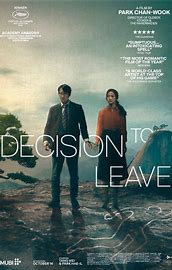
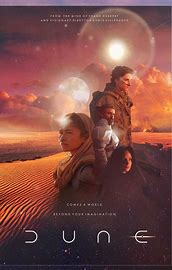
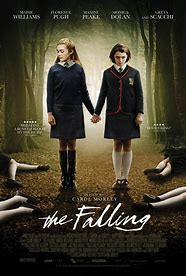
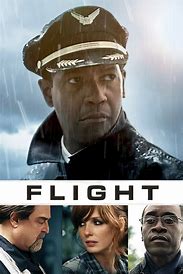
Full Time
Excellent French drama, starring, Laure Calamy, Noémie in Dix pour cent (Call my Agent) as a single parent, running (literally and metaphorically) to keep up with the various elements of her life (childcare, job, chasing her feckless ex for maintenance, commuting in the midst of strikes). It ramps up the tension to an almost unbearable level (particularly if one has ever had to juggle in this way and knows that feeling of utter panic).
Furiosa
Thoroughly entertaining, visually brilliant, with great performances from both Anya Taylor Joy and Alyla Browne as the even younger Furiosa. Chris Hemsworth is virtually unrecognisable thanks to wig and prosthetic nose in his role as the bonkers war leader Dementus. Tom Burke is arguably somewhat wasted in a very taciturn action role as Praetorian Jack, which requires him to exchange smouldering looks with Furiosa but gives him little other opportunity to flesh out his character. I enjoyed it all hugely, but it does suffer from that inevitable prequel problem – we know where it all must end up. The film even segues into the early part of Fury Road, and the end credits include brief snippets of both films. So, whilst the action along the way is thrilling, we are waiting for what we know must happen rather than genuinely wondering what will happen.
Good
I saw this twice, firstly in the film version starring Viggo Mortensen, and again in the NT production with David Tennant. It was a great deal more effective as theatre than film – the movie version filled out bits of plot that were perhaps better left ambiguous, and the device where the protagonist hears music at key moments worked much better in the very stylised theatre version. The use of actors to play multiple roles worked, for the most part, although it required some concentration, particularly in relation to Sharon Small (playing the wife, the mistress/second wife, the mother and an SS colleague) to be sure who was who. Both Mortensen and Tennant were superb in the lead roles. The play asks how a ‘good’ person could collaborate with evil, a perennial question about the Nazi era, and C P Taylor shows how the protagonist – an ordinarily decent person, if lacking in empathy, compromises his values gradually, tiny step by tiny step until he is fully identified with the regime.
Good Grief
A charming but not awfully deep study of the aftermath of a sudden bereavement. I had a lump in my throat once or twice, but I couldn’t entirely identify with these people and their world. Still, it had its moments.
Greyhound
Hanks being an ordinary hero again, this time shepherding his escort destroyer group as it protects an Allied convoy against U-boats during the Battle of the Atlantic. Not a remarkable film or performance, but good, solid stuff.
The History Boys
Alan Bennett’s script is brilliant, waspish, funny but with undertones of real melancholy. Excellent performances from the ‘boys’ too. But it felt weird that the issue of sexual molestation, however mild, by a teacher is treated so lightly, so benevolently, both by those on the receiving end and by the film itself, which doesn’t really question their reactions.
The Hours
I wasn’t totally convinced by Nicole Kidman’s take on Virginia Woolf – I’m not sure if it was the nose, or rather the knowledge that it wasn’t Kidman’s, though Bradley Cooper’s prosthesis, whilst being more controversial, didn’t get in the way of his performance in Maestro. I expected Woolf to be fiercer, perhaps. Julianne Moore and Meryl Streep are both superb, and the interlinking narratives, with Mrs Dalloway as the connecting thread, are moving and powerful. And the film reminds me that I must read Mrs Dalloway….
Just Mercy
Powerful fact-based drama about justice and race in the US. Michael B Jordan and Jamie Foxx are great as the lawyer and accused man respectively. The film’s main weakness lies in the treatment of their opponents: as the Guardian reviewer says, ‘It distracts from the reality of the case and of ongoing cases such as this, turning racists into pantomime bad guys rather than presenting them far more chillingly as real people who have normalised their hatred’.
Kidnapped
Fascinating historical drama from Italy about the 1851 kidnapping of a Jewish child after a maid in the household secretly baptises him on what she thinks may be his deathbed. It’s based on a real case, features a compelling performance by Barbara Ronchi as the child’s mother, and superb work by Aidan Hallett, in a non-speaking role, as one of the Pope’s servants.
The Last of the Mohicans
What a film. I remember loving it when I first saw it, but it blew me away all over again. From that opening sequence, with Day-Lewis running through the woods, to the dramatic clifftop climax, it’s tense, violent, incredibly romantic and completely absorbing. I’ll be honest, DDL usually inspires more admiration than adoration from me, but here I was with Cora all the way.
Little Women
The 1991 version, with Wynona Ryder as Jo. Pretty good, until the end when Jo goes a bit too girly over the Prof. I think I’ve been spoiled for other versions by Gerwig’s, which is now one of my annual Xmas watch and have a bit of a cry films, and whose rearrangement of the chronology (it seemed blasphemous at first, not to open with ‘Christmas won’t be Christmas without any presents’) brings such depth and nuance, without taking anything away from the narrative or the characters.
Maestro
Another film (see Oppenheimer) that raises the issue about non-Jewish actors taking Jewish roles. It did strike me, watching Oppenheimer, that you had on screen three of the most prominent Jewish scientists of the twentieth century (Einstein, Bohr and Oppenheimer), played by Conti, Branagh and Murphy respectively, and here one of the most prominent Jewish composers/conductors, played (with a prosthetic extension to his nose) by Bradley Cooper. At a time when we would simply not accept ‘blackface’ or ‘yellowface’ and it’s actually very difficult to watch older films in which those horrors were perpetrated (I switched off Breakfast at Tiffany’s when Mickey Rooney came on, and have never gone back to it), should we be as absolute about ‘Jewface’? I don’t know. But watching Cooper as Bernstein I forgot very quickly that the nose was fake because the performance was extraordinary, as was Carey Mulligan’s. And the music, of course, was sublime.
Mank
And right on cue, here we have Gary Oldman playing the Jewish Herman J Mankiewicz. I was occasionally reminded of Oldman’s more recent TV stint as Jackson Lamb, e.g. in the scene where he drunkenly disrupts a gala dinner… It’s a bravura performance (Mank, as well as Lamb), and backed up by Tom Burke as Orson Welles and Amanda Seyfried as Marion Davis. Fascinating, particularly if one has an interest in the movie industry of that era.
The Mist
Excellent adaptation of the Stephen King novella. Pretty much what you’d expect – until the ending. My God, that is one of the bleakest things I’ve seen in a film and my watching tends to the bleak and the grim. It’s not what King wrote, but King endorsed it (and as he tends to bottle his endings, I can imagine he rather admired what Darabont did with this). I didn’t like the leading man especially – where do they find all these square jawed types? – and, until that ending, I didn’t quite believe in him.
Moonlight*
A wonderful film, beautiful and melancholy. Brian Tallerico’s review describes it as ‘both lyrical and deeply grounded in its character work, a balancing act that’s breathtaking to behold. … it’s one of those rare movies that just doesn’t take a wrong step’.
Napoleon
I was disappointed in this – I wanted to enjoy it but found it deeply frustrating. Not because of historical inaccuracies, but somehow it was tonally all over the place – some moments were funny, but I wasn’t entirely sure all of them were intended to be. The best bits by far are the battles, which were viscerally exciting and did convey the problematic greatness of the man.
Nomadland*
A beautiful film, warm and generous, with Frances McDormand’s marvellous performance at its heart as a woman who becomes ‘houseless’ after losing first her job and then her husband, and who in the wake of those losses feels the need to keep moving, to make only temporary connections (mainly with other nomads).

Official Competition
Penelope Cruz, Antonio Banderas and Oscar Martinez are a director and two actors rehearsing for a film. That’s it really, but it’s clever, brilliantly funny and with superb performances from all three.
Official Secrets
Good, solid drama based on the true story of Katherine Gunn (Keira Knightley), who passed on information she received in the course of her work at GCHQ and was prosecuted for it. It works all the better because Gunn clearly isn’t grandstanding, she doesn’t set out to be a martyr, she just sees something that seems to her to be so clearly wrong that she has to do something about it. She’s shown to be a bit naive, in not anticipating what the consequences might be, for her or her family, but in a way she is, as the Guardian put it, a ‘classic whistleblower. She has an idealism, work ethic and professionalism that made her an excellent intelligence operative in the first place, and yet it is precisely these things that made her rebel. Most importantly of all, she is young.’ Knightley is excellent in the role.
On Chesil Beach
This was exquisitely done. Until the final act when it messed things up rather badly. We didn’t need that clichéd scene in the record shop, and we certainly didn’t need the final scene at the concert. I wondered briefly whether these scenes would turn out to all be in Edward’s imagination, but if we were meant to think that, it wasn’t signalled – I’m not sure it would have worked anyway, it would have been rather Atonement-lite. And why was the old age make-up so awful? Surely we can do better than that these days? Such a shame, because the scenes with Florence and Edward awkwardly trying to negotiate the tricky territory of sexual intimacy, without prior experience and with only minimal knowledge, were agonising but brilliant.
The Outfit
This is an odd little film, which keeps on overturning our understanding of what’s going on. It’s full of suspense, but we as the audience are somewhat at a remove from the characters. Mark Rylance in the central role is calm, tightly buttoned, and seemingly preoccupied with his business, cutting out cloth for suits – he’s a cutter, not a tailor, as he informs people several times. There are gangsters, there are guns, and there’s a clever McGuffiny plot, and it’s all very entertaining.
Palm Springs
I do love a time loop, and this is funny and clever and very entertaining. Andy Samberg, Cristin Milioti and J K Simmons are brilliant and give us some actual real emotional weight along with the comedy.
Parallel Mothers*
Gorgeous and moving film. The plot might sound improbable but it carries absolute conviction, with the message that ‘the personal is the political and that history, the future and the present are as one’.
Resistance
This is an adaptation of Owen Sheers’ alt-history novel, where England is under Nazi occupation, and the men of a Welsh valley disappear one night, leaving the women to manage the farms, and the occupiers. Slow and atmospheric rather than action packed.
The Resistance
Not to be confused with Resistance (see above). This is an account of some of the Jews who hid out in Berlin through the duration of the war, living precarious lives, figuring out who to trust. Well done, and these are not familiar narratives – I had no idea that so many managed to survive in this way.
Rome: Open City
Fascinating and powerful. Rossellini filmed this in 1945/45, in the very immediate aftermath of the liberation of the city (the ‘open’ in the film’s title is ironic, as it portrays the period when Rome was occupied by the Nazis). The narrative is absolutely compelling, and the action brutal, but never gratuitous. The film has been on my ‘really want to see this’ list for ever but has only just been re-released into cinemas (it didn’t do very well when it was first released in 1945, as people didn’t want to see the horrors that they had only just escaped portrayed on screen).
Saltburn
Heavily intertextual, the class clash is familiar territory (Brideshead, Ripley) and Emerald Fennell isn’t saying anything particularly new or insightful. It’s ‘deliciously, wickedly mean—seductive and often surreal—with lush production values and lacerating performances’, but it would have felt stronger if it had left a bit more to the imagination at the end (and I’m not talking about the dancing).
Shirley
Like last year’s Rustin, this is a good, solid biopic, with a wonderful central performance (here from Regina King) of a key black player in American politics. Shirley Chisholm was the first woman to run for US President, and what is particularly fascinating is how her presidential bid plays out in terms of support from fellow Democrats, and fellow feminists. It is, perhaps, again like Rustin, a bit worthy. But these films pave the way for other, maybe more nuanced explorations of these hugely important people, and others like them who have been somewhat neglected.
Society of the Snow
Eschews sensationalism for a subtler approach, without swerving the ‘cannibalism’ issue. Powerful and moving, it excels both at the shocking violence of the crash and subsequent avalanche, and at conveying the long, agonising wait for rescue and the physical and mental torment of trying to survive.
Still Alice
Julianne Moore is quite outstanding, and heartbreaking, as the academic with early onset dementia. Although my own experiences (vicarious) with dementia have been with much older people in whom the condition is seen as par for the course, Moore’s performance rings true, whether she’s portraying Alice’s bewilderment and fear, or her absence. And the choice to write about early onset gives opportunities as well, as both Alice and her family have to accommodate something that is both unexpected and profoundly unfair, and their interactions, entirely convincingly, do shed light.
The Talented Mr Ripley
Another re-watch, prompted in part by Saltburn’s homage, and interesting to compare with the new Andrew Scott version (see below). It’s sunlit and glossy, rather than shadowy and noir, which takes nothing away from the brutality of the murders. Damon, Law and Paltrow are excellent.
Ten Things I Hate about You
Taming of the Shrew, US high school style. It shares some of the problems of the source material – is it even possible to avoid them? – and there are moments which haven’t aged terribly well, but it’s a lot of fun along the way, and the leads are a delight. Oh, and BTW, Heath Ledger’s character was, I’m sure, the inspiration for Eddie Munson (as played by Joseph Quinn) in Stranger Things.
The Third Man
Rewatched after many years in prep for the Vienna trip (see also Before Sunrise). Aside from it being a brilliant film, with stunning cinematography, it reminded me that Vienna, which likes to give the impression of having been untouched by the centuries, was in the immediate aftermath of the war very much marked by bombing and by the Red Army’s battle to liberate the city – not reduced to rubble like Berlin, but still battered. One would not know it today.
Trumbo
Bryan Cranston is superb as the screenwriter who fell foul of the Red scare in the 50s and could only get his work on to the screen by using pseudonyms or getting others to put their names to the scripts. It’s not a super deep examination of the phenomenon, but it does convey the terrible pressure on those who saw their livelihoods taken away from them. Helen Mirren is the appalling Hedda Hopper who says out loud the quiet bit about the Red scare – its antisemitic roots.
Wil
A very dark and bleak narrative of young police officers in occupied Antwerp. In some ways it chimes with Good – how do you continue to think of yourself as a good person, to be a good person, when the rules are made by an evil regime, and enforced by brutal men? It’s an extremely tough watch.
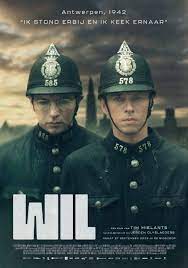
Wings of Desire
Prep for Berlin, the third city on our European trip. Released in 1988, the film is set in the still divided city, where angels literally watch over its inhabitants, observing and only occasionally connecting with them. There’s not a lot in the way of plot, but it’s an extraordinary and bewitching film. ‘Wings of Desire … creates a mood of sadness and isolation, of yearning, of the transience of earthly things. If the human being is the only animal that knows it lives in time, the movie is about that knowledge.’
The Woman in Black
I was underwhelmed by the book, TBH, despite having loved a number of Susan Hill’s previous novels (In the Springtime of the Year, Strange Meeting, and others), and subsequently loved her crime series. The film had some nice jump scares, and plenty of atmosphere, but it didn’t really amount to very much, I didn’t quite believe the lead character, and I rather disliked the ending.
The Zone of Interest*
Extraordinarily powerful. I am not sure how well I can yet articulate what the film did, and how – that might take another watching, which I’m in no hurry for, not really. I have watched many films about aspects of the Holocaust, have read histories, first-hand accounts, fictionalised accounts, watched documentaries, seen footage from the liberation of the camps. This was as shocking as anything I’ve seen, despite showing nothing. The moment when I realised that I had filtered out the sounds from the other side of the wall, as one does with traffic noise when it’s always there, was shocking in itself. I didn’t weep until the scene at the end, in the present day, as cleaners at Auschwitz polish the cabinets with the shoes and the spectacles. But I really didn’t want to talk to anybody afterwards so was glad I’d gone on my own – I didn’t want to talk about the film, but nor did I want to talk about the banalities of everyday life – not after that.
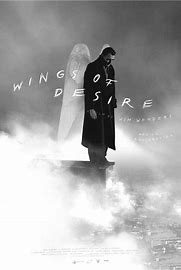
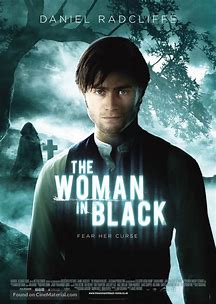
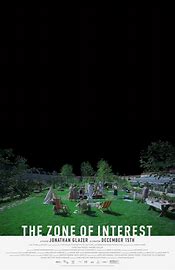
Small Screen
There’s a lot of the usual stuff here. Crime drama features very heavily, and there’s a sprinkling of SF/fantasy, as well as some superb dramas that don’t fit as easily into a genre. I haven’t covered ongoing series, however much I’ve enjoyed them (thinking of you, Vera, Vigil, Wisting) unless there’s something significant to be said about this particular series, and as with the movies I haven’t covered things that I abandoned (so what remains I watched all of, whatever its flaws). I’d pick out Blue Lights as the best of the crime, The 3 Body Problem as the best SF/fantasy, and share the honours otherwise between Mr Bates vs the Post Office and Masters of the Air.
Drama
3 Body Problem
Brilliant, brilliant stuff. This has everything – it is clever, inventive, visually stunning and has a hell of a lot of heart too. It kept me guessing throughout but was never merely clever for the sake of it. There will be a second series, I’m delighted to say (I do worry these days, as too many good, inventive TV series get dumped – Lazarus Project being the most recent example).
After the Flood
Jolly good thriller, set in a Yorkshire village, with perhaps an over-abundance of twists, but all well done and a good solid cast.
The Americans
We watched the first couple of series of this, and then it switched to one of the streaming services that we didn’t then have access to, but we always wanted to see how things played out for Philip and Elizabeth. Now it’s on Disney and so I’ve picked it up again, taking a bit of a guess as to where we’d got to, but starting again at series 3 felt about right and I binged it through to the end. The constant peril of their double life makes even the most mundane domestic scenes tense and anxious, and there’s a lot of proper spy thriller action, with a pretty high body count. The BBC documentary series Secrets & Spies (see below) proved to be a very relevant factual counterpoint to the drama. (I do have issues with Philip’s wigs though, and find the sex scenes quite disturbing as I worry about wig displacement in the throes of passion). But wigs aside, the series is superbly acted, and confronts us constantly with moral questions, about loyalty, about deception in all its forms, about what means can be justified if one believes absolutely in the end – and we might think we know the answers to those questions but as we identify with Philip and Elizabeth that starts to seem less straightforward. The final series is a masterclass – ramping up the tension, but also laden with sadness and a foreshadowing of loss.
Blue Lights
Series 2 was as good as the first series, which is saying something. Real edge of the seat stuff, and with emotional heft too. It does all of the things that regular cop dramas do, but does them better than most, and the Belfast setting provides extra layers of complexity to the interplay between cops, criminals and community. Exemplary.
Breathtaking
A fictionalised version of Rachel Clarke’s raging, heartbreaking account of the early days of Covid, from the perspective of an NHS doctor. Intercut with Government briefings and news reports, to ramp up the rage, but always focusing back on the people – staff and patients (and occasionally staff who are patients) who were on that particular frontline.
Coma
Jason Watkins’ mild everyman in an ever more complex and deadly tangle after an encounter with a young thug – my only quibble would be that the ending felt a tad unrealistic and anti-climactic (though maybe there’ll be a series 2?)
Criminal Record
Very, very noir. Capaldi and Jumbo are superb. I keep thinking about the ending, and wondering. And that theme song – I had to track it down, it’s ‘Me and You’, by the Dreamliners,
Criminal UK/France/Germany/Spain
All four series follow the same format, and use the same set – an interview room, with a viewing room alongside it, and essentially that’s it. Each episode features one interview, with a suspect/witness, and it’s very Line of Duty, though less likely to end with a urgent extraction and a shoot-out.
The Cuckoo
One of those psychological thrillers that compels you to keep watching even though in your head you’re constantly saying ‘Really? Seriously?’ and predicting with reasonable accuracy where the plot is going. Tosh, but quite well done.
Doctor Who
Ncuti Gatwa is a joy. And he is, indisputably, the Doctor. The episodes seem to me to have got better and better, which suggests that some of this is cumulative, the result of an overarching plan for the series which allows each episode to carry with it some of the ideas and the emotional import of the previous ones. It’s been much commented on that Gatwa hasn’t been front and centre of all these episodes (because he was still filming Sex Education), but that’s allowed some very inventive writing, and when he’s there, there never seems a very good reason to look away from him. The BTL comments in the Guardian cover the usual range of responses. There’s the old familiar: ‘this isn’t proper Doctor Who any more, I’m never watching it again’, from those who’ve been saying that ever since there was a line for people to comment below, and who will be back next week to say it again. Some of the detractors find it too woke, which is hardly worth arguing with. But there’s also a lot of excitement from people like me who have loved this programme through its highs and its lows. Jodie Whitaker’s tenure could have been so much more exciting – she was great, but saddled with far too many ‘meh’ scripts (and some that were worse than meh) and that’s a real shame. But, as another Doctor would say, allons-y! This is pretty bloody marvellous.
It would be remiss of me not to mark here the passing of one of the very first Doctor Who companions, William Russell, who played teacher Ian Chesterton alongside William Hartnell’s Doctor. Russell was 99, and appeared in the final Jodie Whitaker episode, The Power of the Doctor, in a rather lovely scene at a companions’ support group.
The Durrells
Given my tendency to go for the grim, I need at least one series in my life at any given time that offers essentially warm-hearted, humorous, not too dramatic dramas, which can be guaranteed not to swerve into anything too traumatic, but which aren’t merely cosy. All Creatures Great and Small fills this place to a T – it doesn’t sidestep the harshness of the lives of the farmers, or individual heartbreak, but we know, really, that everything is going to be alright and that the grumpy or mean person probably is unhappy rather than evil. The Durrells does a similar job. I read Gerald’s books about his family life on Corfu and about his wildlife expeditions as a child – they’re hugely entertaining, and are already somewhat fictionalised accounts, so that the programme takes further liberties is probably OK. The humour is broad and often slapstick, but the writing is usually subtle enough that it isn’t wholly reliant on pratfalls and comic misunderstandings and allows some real emotional connection. That emotional connection centres on Keeley Hawes’ Louisa – Hawes is superb and if you aren’t rather in love with Louisa within the first episode or so, then I don’t know what to say to you, I really don’t.
Echo
I enjoyed this less than I thought I would (though more than Secret Invasion) but there’s lots about it that I did like, including the lead, powerfully played by Alaqua Cox, and her family/community, the Choctaw heritage that is the source of her powers. The Kingpin storyline, picked up from Hawkeye, and linking in with Daredevil, had/has the potential to be powerful, and perhaps now that the exposition is all out of the way and we know who Echo is, and why, that will work better.
Fool me Once/Safe
I’ve bracketed these together because these Harlan Coben series are all rather similar (I’ve read a few of the books and it’s true of them too). I find it hard once the series is over to recall anything very much about the plot or the characters, but whilst watching I am entertained and mildly involved, even though they tend to feature a preponderance of the square-jawed male lead, who I tend to find rather annoying, and impossible to identify with.
The French Case
A dramatised account of the investigation of the death of Grégory Villemin, an incredibly murky case, involving poison pen letters and family feuds, which seems no closer to being solved now than it was when Grégory was murdered in 1984. The drama is toughest on the media, and at least some of the investigators, and perhaps most of all on Marguerite Duras, who bizarrely was brought in to consult on the case, and proceeded to pronounce, without any actual evidence or direct contact with the parents, that it was the mother who had killed the child. Intriguing but frustrating.
The Gone
Atmospheric New Zealand set crime series, with an Irish detective (a man with a secret, natch) over there to look into a disappearance, and its connection with a major Irish crime family. This could all be quite clichéd – the ‘odd couple’ pairing of said detective with his Māori counterpart, who has her own personal tragedies and conflicts – but the characters are well drawn and played and the wider issues that the crime raises turn out to be more interesting than the original premiss suggests.
Hidden Assets
More Irish crime, this time centred on the team who track down proceeds of crime, and here the Irish officers are working with their counterparts in Belgium. There are two series, with different leads in each case, but linked stories. Good solid stuff.
Kafka
It seemed appropriate to watch this after being in Prague, which reminded me that I should read more Kafka. Full disclosure, I have read The Castle and a number of short stories but nothing more (yes, OK, shame on me, and all that). It’s a quirky and often darkly funny take on Kafka’s life, his romantic attachments and his friends (especially Max Brod without whom Kafka would probably be pretty much forgotten).
Masters of the Air
Band of Brothers and Pacific were both so very, very good that this came with rather high expectations attached, and it lived up to them. I have had a particular interest in the air war, ever since my father, who during the war was an avid aeroplane spotter, and then went on to an apprenticeship with de Havillands, taught me to identify planes when I was still in my pram. This latter may be slightly apocryphal – I cannot on oath assert that I was able to lisp ‘Dragon Rapide, Daddy’ as one flew overhead to the small airfield near our home, but by the time I went with my brother to see Battle of Britain at the cinema I knew my Messerschmitt from my Hurricane. Masters of the Air is solidly researched so that even where fictional characters are created, or where real events and real people are combined for dramatic effect (i.e., this happened, but not necessarily to this person), it is absolutely credible. None of which would make it one of my top watches of the year so far if it weren’t emotionally powerful and credible too, but the performances are great, the tension of the battle scenes is incredible – I found myself watching literally sitting on the edge of my seat and not breathing – particularly as it was clear early on that none of these characters, however well known the actor playing them, was guaranteed to survive. As with Band of Brothers, the drama touches only briefly on the Holocaust but the equivalent scenes to the former’s liberation of Landsberg are done with the same intelligence and care, and they enrich the drama.
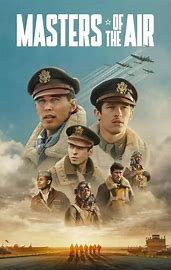
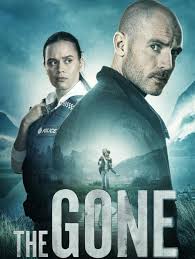
Mr and Mrs Smith
These two, played with oodles of charm, heart and humour by Donald Glover and Maya Erskine, bicker their way through a series of missions, none of which go entirely to plan, and all of which involve a startlingly high body count. Thoroughly entertaining. Apparently there will be a series 2, but not with Glover and Erskine, which is a shame, but on the other hand, makes that series 1 ending more realistic (not that realism is entirely the thing here).
Mr Bates vs the Post Office
Obviously this has been a hugely important drama not just because of its quality but because of its impact on the sub-postmasters’ claims against the Post Office, and the enquiry into how the false prosecutions came about and continued for so long in the face of what was already known about the vulnerability of the Horizon system. Toby Jones, Monica Dolan and others make this all profoundly human, so that the drama, like Breathtaking, is not only heartbreaking but rage-inducing. I thought often as I watched it of the Hillsborough families, particularly when the accountant says to Mr Bates, ‘I don’t know how you people are still standing’, but since this was broadcast, there has been renewed and reinvigorated coverage of other scandals – contaminated blood, carer’s allowances and Grenfell – and it seems that Mr – sorry – Sir Alan Bates in his own understated way is something of a beacon to other victims of injustice and cover-ups.
Mrs America
Fascinating drama about the fight for and against the ERA in the US. Excellent performances from Cate Blanchett as the monstrous Phyllis Schlaffler, Rose Byrne as Gloria Steinem, Tracey Ullmann as Betty Friedan, and more, plus a handful of fictional characters invented to convey some of the tensions in both movements. Often very funny, full of surprises, and with a cracking 70s soundtrack.
Mrs Wilson
Ruth Wilson plays her own grandmother in this drama of deception, centred on but going beyond the purely domestic sphere. The focus is very much on the wives betrayed and deceived, rather than on the deceiver, whose motivation neither we nor they ever really uncover – it’s stronger for that, as the deceiver can so easily be played as a charming rogue (since clearly he was rather good at being charming) and the damage he left in his wake underplayed.
Murder is Easy
The latest Christie adaptation – this was one I remember particularly vividly, the quote beginning ‘why do you walk through the fields in gloves’ and the strength of the murderer’s hands. As with all of the recent dramatisations, it’s been tinkered with, in ways that might well get the GB News types a bit agitated (a black protagonist! Lawks a mercy) but it retains the strengths of the novel.
A Perfect Spy
Excellent le Carré adaptation from 1987 (one of a number of dramas from the archives which have been broadcast lately, to mark the anniversary of BBC2) , based on one of the best of his books.
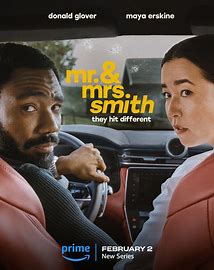
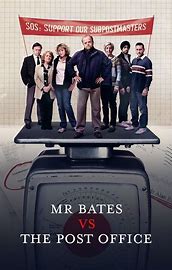
Prisoner
Bleak Scandi drama about corruption in a prison – it’s brutal but also thoughtful and not too simplistic. Not an easy watch but worth it.
Rebus
A new take on Rebus, introducing us to him as a younger man, earlier in his career, but already instantly recognisable as the Rebus we know and love and are infuriated with. I never felt that John Hannah was quite the right man to play him, and Ken Stott was very much the older, battered version, but Richard Rankin (no relation, apparently) is just right. It’s the same trick that Young Wallander tried, setting the younger version not in his own past but in the present, which allows a different take on some aspects of the established Rebus pre-history. Rebus is kind of the archetype of the rogue/maverick cop, never knowingly toeing the line, leaving a trail of wreckage (personal and professional) in his wake, so this series – and Rankin – will have to fight a bit harder in a crowded field to establish his individuality (mind you, if the competition is that execrable Crime series with Dougray Scott it shouldn’t be too difficult).
The Responder
If Prisoner was bleak, this is bleaker. Ye gods, it is relentless, Martin Freeman’s Chris is trapped and every way he turns there is merely another trap waiting for him (and the same is true for many of the other characters). Whilst he does make (many) questionable decisions he remains sympathetic, because he’s actually trying to be a good man, to do the right thing. He’s brilliant in the role, and it is brilliantly done (the late Bernard Hill is excellent too, as Chris’s father, in what presumably was his last TV role). I find I need to watch an episode of The Durrells, or something daft like Taskmaster after each episode or it’s just too much.
Ripley
This is much closer to the novel than the Damon/Law/Paltrow film (see above), except in the age of the lead protagonist – the book suggests that Ripley and Greenleaf are in their early 30s whilst Scott is in his late 40s. That does change the tone. Damon seems, if anything, younger than the character he’s playing, and that gives him a kind of naivety which might make one – at least until he starts with the bludgeoning – a bit more forgiving of what he’s up to. Scott’s Ripley is a darker character from the outset (and not just because of the b/w film noir cinematography). But it certainly works. The pace is slow, with masses of detail, motifs that recur (the cat, the ‘nice pen’, the stairs, the Caravaggios) and whereas some found that frustrating, I found it seductive and the moments of violence all the more startling. And the slow pace extends even to those moments – this makes killing look like bloody hard work, and the cleaning up afterwards even more so.
Shardlake
I’ve thoroughly enjoyed the late C J Sansom’s Tudor detective series and hope that this is just the first of the adaptations. Arthur Hughes is great as Shardlake, and it’s good to have an actor with a disability playing the role, and Sean Bean is an excellent Cromwell (it will be interesting to compare with Mark Rylance in that role when the final Wolf Hall series is out). Very moodily atmospheric, rather Gothic (mad monks and all that), and whilst I’d read the book, I had entirely forgotten who did what to whom so I enjoyed the puzzle all over again.
Shogun
This was beautifully done, often brutal, sometimes hard to follow, but absorbing and fascinating. It’s incredibly rich in detail, from the costumes to the customs, the dialogue to the action, and the cultural tensions between the Englishman and his Japanese ‘hosts’ are drawn with subtlety and without condescension.
Shoulder to Shoulder
This drama series about the Suffragette movement was first broadcast in 1974 and I thought at first I was going to find it a bit slow and stagey, going by the first episode. But it caught fire – Georgia Brown’s portrayal of Annie Kenney is great, and the episodes showing the force-feeding in prison of those women who went on hunger strike are graphic and still genuinely shocking.
Small Island
Excellent adaptation (from 2009) of Andrea Levy’s novel about young people from the Caribbean trying to build new lives in London in the 1950s. A stellar cast – David Oyelowo, Naomie Harris, Ruth Wilson amongst others – and a hard-hitting plot, with tenderness and humour.
The Tourist
A cracking thriller (two series thereof) with Jamie Dornan as the amnesiac whose forgotten past keeps catching up rather brutally with him. It’s gory and violent and very funny, and the relationship between Dornan’s ‘Elliott Stanley’ and Danielle MacDonald as police officer Helen Chambers is a delight. I have to say how much joy it brought to me that Dornan’s character is shown to fancy MacDonald, who would generally be described as a slightly larger woman, like mad, and to fall in love with her. Clearly a lot has changed since the days when plump women not only never got the man (let alone a man of Dornan’s looks and charisma) but were all too often shown as being dim and lazy and a bit of a joke.
Traces
Series 2 of this Dundee set forensic science thriller. The structure of the series goes weirdly off kilter as the first couple of episodes focus on the continuation of the plot from series 1, but that is then completely abandoned as the key characters in that strand up and leave, and the remainder of the series concerns itself with the race to catch the Dundee bomber before he blows up the V&A or Broughty Ferry. It’s almost as if the producers/writers were taken by surprise by the departure of key cast members – from a viewer’s point of view it would have been better either for that previous plot strand not to have been foregrounded initially, or for further references to it to be woven into the bomber plotline. As it was, it seemed as if the remaining cast members had simply erased all memories of those events and people – very odd. Nonetheless, it was exciting stuff (and there’s a particular frisson when one is familiar with some of the locations).
Truelove
A thriller that starts off exploiting an instinctive sympathy with the idea of assisted dying and then undermines it horribly – it doesn’t change my view that we must be able to find a way to enable the terminally ill to choose when and how they end their lives rather than lingering on in increasing misery, but it is a reminder both that the safeguards need to be carefully thought through and robust, and that palliative terminal care needs to be better, and available to everyone. (See below for my thoughts on Liz Carr’s documentary, Better off Dead.) The plot has a few implausibilities, but the lead roles are all superb – aside from Lindsay Duncan and Clarke Peters who carry the weight of the drama, Sue Johnstone in particular stands out, as does Kiran Sonia Sawar as the dogged copper who susses that something isn’t quite right.
Unbelievable
A harrowing account of a real case where a young woman alleging rape was persuaded/badgered into saying that she’d lied, and how that injustice was eventually overturned, thanks to the determination of two female detectives following the trail of the rapist. Kathlyn Dever (wonderfully funny in Booksmart, heartbreaking in Dopesick) is superb here, showing her character’s vulnerability and wilfulness, and the trauma she carries with her from a chaotic early life.
Under the Banner of Heaven
Fascinating and horrifying true crime drama based in a Mormon community, with Andrew Garfield as the massively conflicted cop leading the case.
The Way
I really, really wanted to like this. But I’m afraid it was an incoherent mess, way too many clichés, underdeveloped ideas and characters. Sorry.
We are Lady Parts
Season 2, and it’s as warm and funny and touching and clever as ever. And the music is great (both the Lady Parts originals, and their Britney cover)! Whilst Amina (the ever wonderful Anjana Vasan) is ‘the I guy’ (to use a Stephen King term), all of the band members – and their families – are given depth and breadth, and take centre stage at some point in the series. Bisma’s rendition of ‘Please Don’t Let me be Misunderstood’ – having literally put her family on pause in the midst of a row – was powerful and really rather moving, as well as beautifully sung by Faith Omole.
Documentary
Better off Dead
Liz Carr is passionately opposed to the legalisation of Assisted Dying ( or, as she calls it, Assisted Suicide) and it is impossible to simply dismiss her views, as she is someone who has been told many times that it would be better if she were dead than to live on with her level of disabilities. She rightly fears the potential for coercion, for emotional pressure on those who might see themselves (or be seen) as a burden on society and/or on their families, and the widening scope of the legislation in Canada does seem dangerous. I would still argue that there must be a way in which those who are suffering unbearably can be allowed to choose the time and manner of their death, without asking their loved ones to undertake criminal acts on their behalf. But Carr’s arguments must be listened to if any future legislation is to adequately protect people from being, even gently and kindly, shepherded into this course of action.
Can I Tell You a Secret
Documentary about online stalking and how the perpetrator was exposed. The courage of the victims is remarkable, but the production was annoyingly gimmicky – the voicing of some of the emails was confusing, and the actors speaking the lines seemed to have been told to camp it all up rather, which didn’t match the seriousness of the topic.
D-Day: The Unheard Tapes
Hearing the voices of the eyewitnesses lip synched by actors could have been clunky but it is direct and very powerful. We hear not only from the soldiers who landed on the beaches or behind the lines but the German soldiers who were there to stop them, French civilians who found themselves suddenly on the frontline and members of the French Resistance who had been waiting for the invasion to launch their own attacks. There are re-enacted sequences, featuring those actors, but the heart of the programme is the interviews, made at various times and in various places over the years since the war. Hearing those voices is a remarkable experience. If we’d just had the actors reading their characters’ words, we would wonder whether that catch in the throat was ‘acting’ or that the man speaking really couldn’t speak of that moment without choking up a bit. Fascinating and very moving.
Defiance: Fighting the Far Right
Superb, powerful documentary about how Asian communities in London, Bradford and elsewhere organised their own defence against National Front and other fascist thugs in the 70s.
The 50 Years’ War: Israel and the Arabs
The overwhelming feeling from watching this is of the intractability of the situation. The programme dates from 1998, but whilst obviously a lot has happened since then, the core of the conflict is fundamentally unchanged and so the analysis here seems as relevant as when it was first broadcast. The more one understands the history, the more one (or at least I) finds it hard to see a way forward. It’s easy, in contrast, to see what could have been done differently, both before and in the immediate aftermath of WWII, but it seems that every time there has been a glimmer of a chance of doing right both by the Jewish/Israeli population and by the Palestinians, that chance has been sabotaged by one or both sides. And things have perhaps never been more polarised than they are now, when to express horror at the 7 October attack is to be seen (by some) as a Netanyahu supporter, and to express horror at the onslaught on Gaza is to be seen (by some) as an antisemite… At least my sense of despair is based on a more informed understanding of history, thanks to this series.
Have You Got It Yet? The Story of Syd Barrett and Pink Floyd
Excellent documentary, drawing on the accounts not only of the other members of Floyd but of others who knew Barrett before and during his period of fame, and in its aftermath.
The Jury: Murder Trial
Reality TV with a more serious purpose than anointing a new Star Baker or marrying people at first sight – here a real murder case is re-presented to two juries made up of the usual mix of people who might be called up for jury service, and at the end each jury has to arrive at a verdict on which they all agree. The fact that they come up with different verdicts is obviously a cause for concern, but the process by which they arrive at that is more deeply worrying, in particular the ease with which one or two dominant personalities can skew things. Is there an alternative? I think at the very least the way in which the jury system works seems to be in need of an overhaul.
Michael Palin in Nigeria
This most amiable of world travellers makes his way from the hubbub of Lagos north to Kano and back south to Benin City. In only three episodes the series can’t hope to capture the complexity of this huge country, particularly as there are swathes of the north (including Zaria, where my family lived in 1966-67) where it was seen as too dangerous for Palin and the film crew to travel. But along the way we do get a sense of at least some aspects of the country, and of some of the more contentious issues – the legacy of slavery and colonialism, the British Museum’s determination to hold on to treasures looted from Nigeria during the colonial era, and the ecocide in the Niger Delta.
The Miners’ Strike: A Frontline Story/Miners’ Strike 1984: The Battle for Britain
Two powerful documentaries marking the fortieth anniversary of the miners’ strike. The BBC’s offering is not dissimilar in style to Once Upon a Time in Northern Ireland, which was a remarkable and unforgettable account of the Troubles, telling the story and drawing out the details through the words of people who were directly involved. It works equally well here. Channel 4’s series also draws very heavily on first-hand testimony, but focuses in each of the three episodes on a particular place or aspect of the battle. Its third episode investigates some of the machinations behind the scenes, and whilst it is of interest it lacks the immediacy of those first-hand accounts.
Royal Kill List
A documentary with (quite well done) dramatised interludes. Charles II’s vendetta against anyone who had supported his father’s execution (explored in Robert Harris’s Act of Oblivion) might be understandable on an emotional level, but combined with his absolute conviction that, as Sellar & Yeatman put it, ‘He was King and that was right. Kings were divine and that was right. Kings were right and that was right’, this led to appalling brutality, treachery and injustice. I concluded that the Royalists were not only Wrong but Wrepulsive. Which doesn’t mean the other lot were right. Obviously.
Sarah Everard: The Search for Justice
A rage-inducing account of how the police force failed to notice that amongst their ranks was a man whose behaviour (multiple sexual offences) should have automatically precluded them from police work, and how that man used his position, his badge and his authority, to kidnap a young woman on her way home, and then to rape and murder her.
The Secret Army
If someone had told me that early on in the Troubles an American film team would have been able to make a documentary film including footage of an IRA team heading off to plant a bomb, and a tutorial on weapons, I would have thought that highly improbable. But it happened. The film was made, processed in London, where MI5 had full access to it, and never shown. It’s all utterly bizarre, and the intentions of the film maker, and of the IRA top brass who approved the project, are very hard to comprehend.

South to Black Power
Isabel Wilkerson’s The Warmth of Other Suns told the story of the Great Migration, the mass movement over several decades of African Americans from the South to northern cities, in flight from the Jim Crow laws and accompanying relentless racial violence. Here writer Charles Blow makes the case for a reverse process, boosting the black population in parts of the south (areas where it is already a very significant minority) such that it might reach a tipping point of political power.
Turning Point: The Bomb and the Cold War/Secrets and Spies
It seemed almost rather too timely to be revisiting some of the scariest moments of the Cold War, when we came closest to the unthinkable. The Turning Point series was excellent (there was a previous series about 9/11 and what followed which was also exceptionally well done), with lots that I didn’t know and much richer detail and context on the bits of the story that were more familiar to me. Secrets and Spies focused in more closely on the Reagan years, and on some of the individual stories and it provided an intriguing counterpoint to The Americans, as well as reminding me of Deutschland 83 in its coverage of the Able Archer training exercise (also, obviously, featured in Turning Point) that nearly triggered disaster…
When Bob Marley Came to Britain
This was lovely. Marley playing footie in the park, doing an acoustic gig in the gym of Peckham primary school and generally connecting with the black Britons he met in a way that still, clearly, means the whole world to them today. And of course there’s the wonderful music too.
Disintegration Loops #2
Posted in Personal on March 13, 2024
In early 2019 I wrote this, a reflection on dementia, and on our experience of caring for my mother-in-law as the disease gradually took from her everything that made her her. Everyone I know seems either to have or to have had a parent (at least one) with dementia – it is so terrifyingly common that it starts to seem inevitable. And now my father is in a nursing home with the same condition.
He made it to 94 before diagnosis. Initially it had seemed that whilst his memory was deteriorating, his cognitive abilities were not impaired. And we had attributed some of his confusion to his sight loss – he had macular degeneration which by that time had taken all but a bit of peripheral vision. But there we were – he announced the diagnosis confidently, and without any evident distress. Things moved fairly rapidly – I have read since that (a) the later the diagnosis the faster the progress of the disease, which makes sense, and (b) that those who fend it off by keeping mentally active, by learning new stuff, challenging their brains, when they do succumb, find that dementia takes hold fast. It also seems to us that the pandemic, as it closed down so many social opportunities for him, just at the point when he could no longer use his computer to keep in touch, due to his sight loss, may have triggered a decline. And that the death of his youngest son to cancer in 2020, and the sudden death of my husband in 2021 may also have contributed – he had become accustomed to losing friends and relatives of his own generation, but these were shocking losses.
My sister, who lived with him before sight loss and dementia, took care of his practical needs, but these ramped up, and in the course of 2023 we realised that it was no longer possible for him to be kept safe at home (going ‘for a walk around the village’, making himself a coffee, getting himself into his armchair – all hazardous due to sight loss, lack of spatial awareness and general confusion). And as his dependency increased, so did his occasional bursts of anger at being manhandled and managed. This was verbal rather than physical aggression, but no less distressing when it was coming from one’s Dad. He no longer recognised the house where he had lived for 18 years, asking where his bedroom was, and when he would be returning home. He no longer reliably recognised me as his daughter, asking me about my family, and where I had lived, and found it difficult to accept my assurances of who I was, let alone to hold on to that information for more than moments.
As the dementia progressed, I was editing his memoirs. He’d started the process years before, but by the time we started to try to stitch the different sections (written or dictated via voice recognition software) together, we realised we were up against it, as his memory was becoming less and less reliable. Some later sections had to be discarded, or heavily edited after consultation between us to try to determine what had happened, when, or in what order. The process was frustrating, given that we could no longer check with him about details of his life before our own arrivals, and tricky, given that we wanted it to be very clearly his voice, but some rigorous editing and rewording was nonetheless necessary. Thankfully, we were able to put a copy into his hands whilst he was still able to recognise that this was The Book which had been his project and purpose for such a long time.
But now that the book is done, it means more to me than I’d expected. It is the record of a life well lived, a life of service and of leadership, of travel and adventure. And it’s the voice of a man who was always ready to take on challenges, to chair committees, to lead projects, and who was often asked to do so, a man who made bold decisions (to go into the aircraft industry rather than his father’s choice of the civil service, to then leave that industry because of his pacifist convictions, to move into education, and then to relocate his family to West Africa…). We still hear that voice occasionally – sometimes when we visit he is in conference mode, and asks us whether we’re booked in for the keynote talk, and whether we’ve got accommodation sorted out, or believes himself to be present in the home in some professional capacity. No wonder he resists sometimes when told to use his zimmer frame, or when carers want to shower or dress him. There’s no alternative – the mismatch between who he, some of the time, believes he is, and what he is actually able to do now is irreconcilable. But in his memoir he is still present.
Wendy Mitchell, whose books and blogs about her early onset dementia have given fascinating insight into the condition, decided that she was not willing to go on beyond the point when she was no longer Wendy, not willing to reach the point when she might not recognise her daughters, the point when dementia had stripped away everything that brought her joy. No one reading her books – and in particular her last book, One Last Thing, a passionate argument for assisted dying, and for provision to be made for people with dementia to have that choice too – could doubt that she had the capacity to make that decision and to take the necessary steps. Her final blog entry, posted after her death, explains, with her usual honesty, clarity and courage – and even humour – why and how she did so.
“If assisted dying was available in this country, I would have chosen it in a heartbeat, but it isn’t. I didn’t want dementia to take me into the later stages; that stage where I’m reliant on others for my daily needs; others deciding for me when I shower or maybe insisting I had a bath, which I hate; or when and what I eat and drink. Or what they believe to be ‘entertainment’. Yes, I may be happy but that’s irrelevant. The Wendy that was didn’t want to be the Wendy dementia will dictate for me. I wouldn’t want my daughters to see the Wendy I’d become either.”
https://whichmeamitoday.wordpress.com/blog/
That paragraph resonated so much with me. I remember my mother-in-law, who in general raged less than Dad about the indignities of her life, stubbornly removing her feeding tube whilst she was recovering from bronchitis, trying (and sometimes succeeding) in removing her neck brace after a fall, and saying to us, ‘oh, just put me in the bin’. Dad, until recently, was determined to live to be 100. These days he does not know how old he is – we think he sees himself as a much younger man, one reason why he cannot recognise us as his children – and I don’t think he would understand the question if we asked him whether he wanted to go on. Neither of them had or have the capacity to go through that rigorous thought process – not just whether, but when and how – and then carry it out. So the most we can hope for whilst Dad lives is that he is, as his care home notes often put it, ‘on average, content’. We know the trajectory of this disease is relentlessly downward, and all we can do is to work with his carers to ensure that he is as safe as possible, as comfortable as possible, as content as possible.
I don’t see any solution to this. I strongly support assisted dying legislation – it should not be beyond any sophisticated legislative system to put in place sufficient safeguards to ensure that no one is coerced or cajoled into ending their life earlier than they would wish – but I cannot see any way of that helping dementia patients. And so, as Wendy Mitchell says, it can’t be a case of assisted dying OR gold standard palliative care. Both are needed, so that people who would not be willing to choose the first option can be cared for such that their last years/months/days/hours are as peaceful, as pain-free, as possible, and so that people who lose the capacity to choose are kept safe, as content as possible, with as much dignity as possible. And that means carers and family working together.
When we read in those care notes that Dad has been raging – hurting himself and his carers, hitting out, shouting – it distresses us, of course. The care home staff take it in their stride (‘bless him’, they say as they recount the latest incident). They have a repertoire of things to try – bring in a new face, try to distract – but with the prime aim to prevent harm (to him or to them). Medication is part of this repertoire, and whilst the image of care home residents being doped into placidity is deeply troubling, the impression we have is that when the medication is working Dad can be more himself, not at the mercy of his frustration and anger, his distress eased, at least for a while so that he can enjoy his food, and chatting to the carers or to visitors.
I thought the other day of Dylan Thomas’s most famous poem, ‘Do Not Go Gentle’. I’ve always thought that the dying of the light is death, and the raging is heroic, courage in the face of the inevitable. But as I get older, my feelings about that have changed. To rage against the very idea of mortality is irrational but at the same time profoundly human – death makes no sense, that someone can be totally there and then in a moment totally, irrevocably not there. And we so often use the language of war when talking about terminal illness – so and so died ‘after a long battle with cancer’. To fight to hang on to life for as long as possible, to be with the people we love for as long as possible is, again, profoundly human. But it is also human to seek the most peaceful path, to, as a friend with terminal cancer once put it, negotiate with mortality, in order that the time remaining can be spent as richly as possible, without expending all of one’s energy in a battle against an unbeatable enemy. She found ways to enjoy those last months of life, spending as much time as possible in the countryside she loved and with the people she loved, refusing to waste that precious time on things that brought her no joy, or brought her additional pain. That isn’t always possible, but I found her approach inspiring.
Dementia is a kind of long, drawn out death, as the person is engulfed and extinguished, not all at once but little by little. Wendy Mitchell talked of ‘playing games with this adversary of mine to try and stay one step ahead’, and she did this for as long as she could, making her decision when she realised that it would soon be impossible, and taking that one last step before the disease could take it for her. For Dad, the time for attempting to outwit his dementia is long gone, and he is effectively at its mercy. There’s nothing for him to fight, and the more he fights the more he loses.
Reading the poem again now, I think of Dad’s raging, against the loss of dignity, the loss of control over where he is and what happens to him, against the loss – even if he can no longer articulate it – of the things that made him him, against the slow dying of the light. Even into his nineties, and even after his diagnosis, he talked about his ‘purpose’, questioning what it was now, how he could rediscover it. We felt, though it would not have helped to say, and he would never have accepted, that his purpose now could surely be to rest from all that striving, from leading, from driving forward. That’s gone now, except for an occasional echo in one of his circular monologues, but its loss is part of what he is so viscerally resisting.
We understand his rage, we really do. Ah, but we cannot truly wish for his last months or years to be spent burning and raving at close of day. Please, Dad, go gentle.
Do not go gentle into that good night,
Old age should burn and rave at close of day;
Rage, rage against the dying of the light.
Though wise men at their end know dark is right,
Because their words had forked no lightning they
Do not go gentle into that good night.
Good men, the last wave by, crying how bright
Their frail deeds might have danced in a green bay,
Rage, rage against the dying of the light.
Wild men who caught and sang the sun in flight,
And learn, too late, they grieved it on its way,
Do not go gentle into that good night.
Grave men, near death, who see with blinding sight
Blind eyes could blaze like meteors and be gay,
Rage, rage against the dying of the light.
And you, my father, there on the sad height,
Curse, bless, me now with your fierce tears, I pray.
Do not go gentle into that good night.
Rage, rage against the dying of the light.
(Dylan Thomas, 1947)


