Archive for category Personal
Disintegration Loops
Posted by cathannabel in mental health, Music, Personal on September 5, 2019
This post has been many months in the gestation. In my head, it started off as a more abstract and metaphysical musing about the nature of dementia, at least as I have encountered it, about how what made a person that person fades, gradually, until it has virtually disappeared, and yet they are still here. As a recent contributor to a discussion in the Guardian described it, ‘death on the installment plan, as every day another little piece would flicker out of existence’. But there are other things that must be said as well – the anger at how our health service and social care – and in particular the failure to join the two up effectively – can fail those rendered helpless by the disintegration of their mind and memory.
The title is borrowed from a series of pieces of 21st century music, by American composer William Basinski, which I have loved ever since a friend introduced me to them a few years after they were released in 2002/03. Basinski had magnetic tapes, recorded in the 1980s, which he wanted to transfer to digital format. But the tapes had deteriorated, so there were gaps, and cracks, which increased as he continued to play the tapes. The original recordings can be heard, but faint, distorted, broken up, fragmented. And somehow this is intensely moving. When I first heard it, I felt the general sadness of loss, of gradual loss in particular, not a sudden shock and wrench but the knowledge that something is slipping away that was and still is precious. And when I saw this happening to someone I loved, that title and the memory of listening to these albums came back to me.
And the idea of loops, of course, resonated with us. The endless loops of conversation: Where am I? You’re in hospital, Mum, you had a stroke. Oh. When can I go home? When you’re stronger. Where am I? round and round again… As the disease progressed the loops got shorter, until all that was left were the questions and our answers disappeared into the fog.
Basinski was not thinking of dementia when he created these pieces. They’re dedicated to the victims of the September 11 attacks in New York, which Basinski saw from the roof of his apartment in Brooklyn, the morning that he had completed the project. But as D H Lawrence said, trust the tale and not the teller. That Basinski associated the work with 9/11 does not prevent it from being also a powerful and poignant and heartbreaking account of a very different kind of loss.
There are as many different experiences of dementia as there are sufferers – and carers. I can only speak of our own, but there are elements in what we experienced that will be shared by many. Over the months since she died we have been gradually able to overlay the images of her the last time we saw her conscious – bewildered, afraid, unable to understand what we were saying to her, unable to smile, unable to recognise the photograph of her beloved little cat that we had brought as a gift – with the woman we had known before. That woman was funny, fiercely independent, interesting and interested, a traveller, a gardener, a musician, a teacher, a fan of detective novels and TV series, a lover of good food and wine. Dementia took all of that, little by little by little, but as we organised her funeral and started to get cards and letters from people who’d known her before, we saw her re-emerge from the shadows, heard the laughter that so many people had mentioned, literally heard her voice on a recording amongst the other members of the choir she sang in for many years.
But as we recovered some of those joyful memories, I thought about some of what had happened in the last year of her life, and I got angry. On her behalf, but also on behalf of the many, many people who suffer from dementia. Many are less fortunate than she was – she had the funds to choose (or for us to choose on her behalf) the kind of care she needed, and to not have to put up with sub-standard care (in fact, the carers who supported her in her own home until her stroke were wonderful, as was the care home that she moved to for the last six months of her life). She had family who were close enough at hand to be involved in her care, who were free to come over at short notice when needed, to spend time on hospital wards to talk to medics on her behalf. But despite all of this, and despite the loving and patient care on the wards from nurses and health care assistants, there was something terribly wrong.
If I could go back, knowing what I know now, I would interject in every discussion about her medical care and about options for discharge, to remind people that, whilst she had been admitted to hospital following a stroke, she had dementia, and that any decision about her care in hospital and about what happened once treatment was over HAD to take account of that. She could not cooperate in her own care. She removed the feeding tube that the hospital had inserted to ensure she did not aspirate and contract pneumonia, because she did not understand why it was there, she only knew it was unpleasant and uncomfortable. She tried (and occasionally succeeded) in removing the surgical collar that was needed after she fell and broke a couple of vertebrae in her neck – again, she did not know why she was wearing it, blamed the collar for the pain of the fracture. Her carers – at her home and in the care home – took her dementia into account. Staff on the wards largely did (they brought her food even if she’d said she didn’t want any and didn’t rush to take it away when she said she’d finished, understanding that seconds later she’d forget that she’d finished and have another go… ).
But when it came to preparing her for discharge, it was as if the need to free up a bed, once no further medical treatment was required, overrode other considerations. We get it, we really do, we know the NHS is overstretched, we know that hospitals can’t have beds taken up long-term by people for whom they can do nothing more. Nevertheless…
We were told how much her mobility was improving, and that with extra help for a while (equipment and additional carers) she would be fine at home. And so she was discharged. We were given a date for discharge, and a time, so planned to get there (we’re an hour’s drive away) well ahead, to sort the house out and get her shopping done. But she was delivered home much earlier and so we arrived to find her sitting, bewildered, on the sofa (where we knew and her carers knew not to let her sit, because it was so difficult to get her up from it). She had no idea how long she’d been there. We quickly realised that we, and she, were in a nightmare. We were as terrified as she was.
She would be alone for most of every day (carers came four times a day). She had forgotten, after a month in hospital, how to use her TV remote and could no longer read. She would be incontinent and thus sitting in her own waste for hours. She would be unable to change her position in the chair or the bed and thus would be at risk of pressure sores. She would be at risk of falling from her chair if she forgot that she could not get up, and tried to do so. She had forgotten how to use her ‘red button’ alarm and so if she fell would lie there until the next carer visit. She would be shouting out for help, hour after hour – she had no sense of the passing of time, and so would be convinced five minutes after a carer had left that she had been alone for hours already.
She had been promised physiotherapy, and the assumption seemed to be that she could learn, and get better at the limited means of mobility possible for her. But since the dementia took hold, she had been unlearning. Unlearning skills she had had for years, like how to dress herself, how to make a cup of tea. Her discharge took no account of this.
When the carers arrived they shared our alarm and dismay and decided that it was an unsafe discharge and that she should go back into hospital. Next day when we rang to see how she was, the nurse on the EAU said brightly how well she’d done on the rotunda and that she’d be ready for discharge soon. We headed straight over and prepared for a fight.
We pointed out that if one of us had had a stroke and lost mobility, and was discharged to live alone, we would of course be worried and miserable. But we could do something about the situation – ensure that books, radio, TV remote were within reach, keep in touch with the world via phone or laptop and talk to family and friends. We could look at the clock and know how long it would be before someone would visit. She had none of those resources.
We argued, we insisted that we could not accept her being sent home. And eventually someone said to us, what do you suggest then? And we said, well, we rather thought you might be able to offer us some advice and guidance on possible solutions. And just like that, we were put in touch with the social worker and the Age Concern contact, and were given details of suitable care homes, and within a few days, were arranging her discharge to a dementia specialist care home.
We’d never promised her that we wouldn’t ‘put her in a home’. But even if we had made that promise, we’d have broken it. What mattered was that she was safe, that someone was there 24 hours a day to take care of her, that they were able to keep her comfortable. And the language of ‘putting’ someone in a home is inherently prejudiced – we found the best care home we could for her, and we worked with the care home manager and staff to meet her needs as well as we could, just as we had worked with the carers who came to her home. We have no regrets about that – only about our naivety in our dealings with the hospital and our failure to remind them at every stage and in every discussion about her dementia.
The other thing that rapidly became apparent to us was that with every hospital admission, the dementia gained ground. This is borne out by statistics from John’s Campaign:
- One third of people with dementia who go into hospital for an unrelated condition NEVER return to their own homes
- 47% of people with dementia who go into hospital are physically less well when they leave than when they went in
- 54% of people with dementia who go into hospital are mentally less well when they leave than when they went in
John’s Campaign‘s raison d’etre is pretty simple – the belief that in all hospital settings, for patients with dementia, ‘carers should not just be allowed but should be welcomed, and that a collaboration between the patients and all connected with them is crucial to their health and their well-being’.
In that grey area, where someone may be deemed to ‘have capacity’ to make decisions, but at the same time is unable to hold on to even simple information, let alone weigh up pros and cons, the family (if the patient is fortunate enough to have family/carers who are able and want to be involved) must be seen, surely, as a tremendous benefit for the hospital.
John’s Campaign applies to all hospital settings: acute, community, mental health and its principles could extend to all other caring institutions where people are living away from those closest to them. In the time since the campaign was founded, over 1000 institutions have pledged support and a lot of progress has been made – but there is a lot yet to be done.
https://johnscampaign.org.uk/#/about
If a patient with dementia has no family to speak for them, to ensure that their dementia is taken into account in all decisions about their medical and social care, how can we provide them with advocates? As Nicci Gerrard said in a recent article, dementia is our collective responsibility. You might not have encountered it yet. But odds are, you will. It’s in all of our interests that we recognise the scale of it, recognise what’s needed to keep people with dementia as safe and as comfortable as possible, that those of us without dementia speak up for those who have it, who can no longer recognise or articulate what they need. They may no longer be able to articulate their needs, or explain the reasons for their anxiety or distress, but the anxiety and distress is no less real for that – and all the more heartbreaking to witness.
A good place to start is in collectively facing up to the fact that it is in our midst and that each year hundreds of thousands of men and women are living with it and dying with it. If not you, someone very near you. If not now, soon.
Support, Information, Advice
If dementia is now a part of your life, there are places you can go for support and advice. I’ve already mentioned John’s Campaign. I found the Alzheimer’s Association forum, Dementia Talking Point, very helpful on all sorts of practical issues, and often very reassuring.
Some books that I found both fascinating and useful. Several of them at some point made me laugh, and all of them without exception, at some point made me sob.
- Nicci Gerrard (founder of John’s Campaign) – What Dementia Teaches us about Love
- Andrea Gillies – Keeper: A Book about memory, identity, isolation, Wordsworth and cake… (Andrea Gillies took on the care of her mother-in-law, who was in the middle stages of Alzheimer’s disease. This is a journal interwoven with an investigation of how Alzheimer’s works)
- Emma Healey – Elizabeth is Missing (a wonderful novel, whose protagonist is a woman with dementia, who can’t always recognise her daughter, but knows that her friend Elizabeth is missing…)
- Robyn Hollingworth – My Mad Dad: The Diary of an Unravelling Mind
- Wendy Mitchell – Someone I used to Know (Wendy was diagnosed with early onset dementia some years ago, and writes a truly remarkable blog about her life with the disease. Her experience is very different to that of my mother in law. But it’s a rare and invaluable gift to hear someone explaining so clearly what it’s like have dementia, and a joy to hear of the rich life she can lead even now.)

Danube Diary
Posted by cathannabel in Brexit, First World War, History, Personal, Second World War on December 16, 2018

I wouldn’t have expected, even a few months ago, to have been sailing up the Danube on a luxury floating hotel. But my 90 year old father, who is partially sighted and deaf, needed a companion for his chosen cruise holiday, and, well, someone had to step up to the plate. Someone had to take one for the team. And it was fabulous.
The chances that I’ll ever be able to do it again are remote but if I could, I would, and if you can, do. (Riviera Travel, highly recommended (no, I’m not on commission…) – everything fantastically well organised, and the boat fantastically well appointed).
We arrived in Budapest on Day 1, too late to do any more than enjoy looking at the city lights as we had dinner. And then the real magic thing about a river cruise – you nod off to sleep and when you wake up you open the curtains to somewhere new.

Ezstergom, once the capital of Hungary, and now known for its basilica, the top of which apparently is and must by law remain the highest point in the country. Then onwards, and from Hungary to Slovakia, and its capital city, Bratislava.

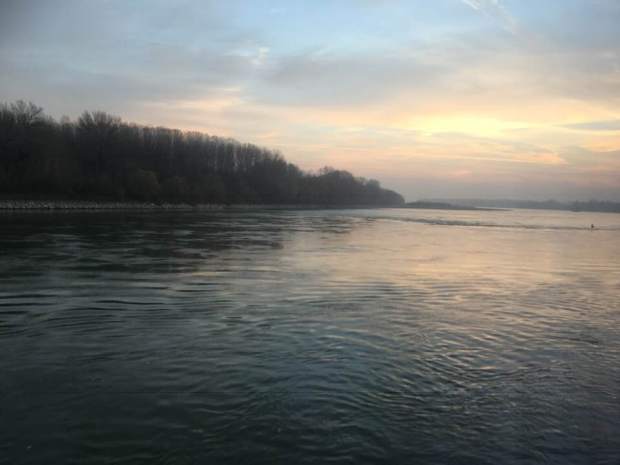
That November afternoon as we sailed on up river it was unseasonably warm, and we sat out on the sun deck. The river was so quiet, all we could hear was the low hum of the boat’s engines, and the splash of the cormorants’ wings as they skimmed the water. I can’t remember when I last felt such peace.
On the cabin TV there was a channel which just showed the view from the camera on the front of the boat, all day and night. I took to leaving it on as I fell asleep, loving the tranquillity. (It was also reassuring when we were going through some huge locks, and things got a bit bumpy).

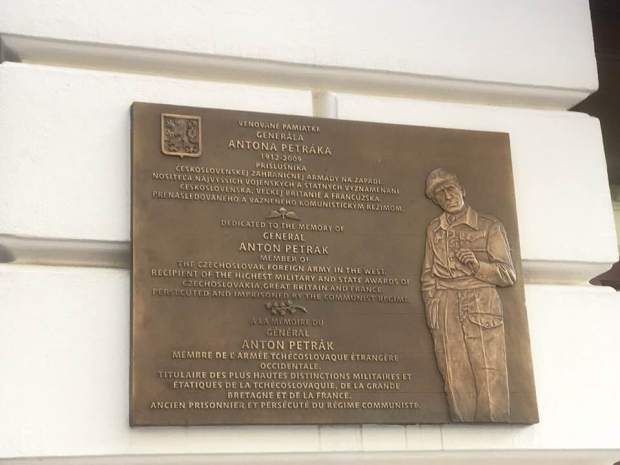
The first view of Bratislava from our mooring point was less than prepossessing, but the old city is beautiful. And part of the fascination of these cities that once lay behind the Iron Curtain is the juxtaposition of utilitarian concrete blocks from the Communist era with the rich baroque heritage. Many of the plaques in Bratislava commemorate the Second World War rather differently to those in Western Europe, mainly recording the heroism of the Red Army that liberated them from the Nazis. But others record the corrective to that simplistic version of history, as with this memorial to Anton Petrak:
For a history buff with a particular obsession with WWII and the postwar period, this stuff is obviously richly fascinating. And our local guide added to the story, with his parents’ memories of the Prague Spring, and of how after the fall of Communism the country split (‘without so much as a referendum’, our guide said, in one of many ironic Brexit references during the trip).
I’ll go back to Bratislava, if I can, and explore properly.
Onwards. En route, on the sun deck again, we glimpse a castle on the shoreline, Devin castle.
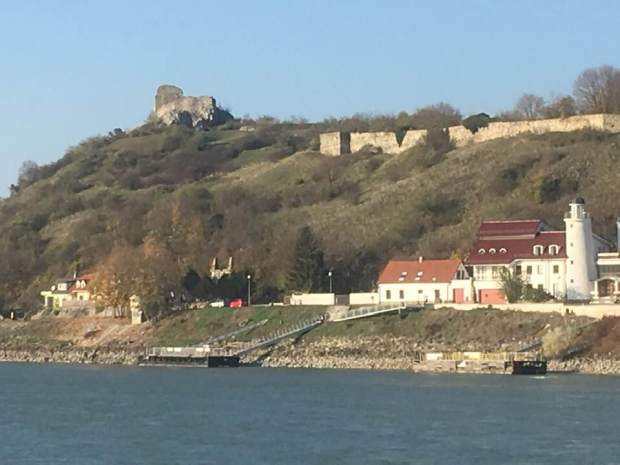
We slip quietly into Austria. Next stop Durnstein. We’ve lost the sun now, it’s a bit misty in the morning, which means the photos don’t do justice to the cruel crags above the village, and the ruined castle. (According to legend, Richard II of England was imprisoned there, and his loyal minstrel Blondel found him by singing outside the fortresses of Europe until he heard Richard joining in. Well, I did say it was a legend).


Durnstein is gorgeous, beautiful old – really, really old – buildings, and a fabulously ornate church. Back to the boat for lunch and on to Melk Abbey.
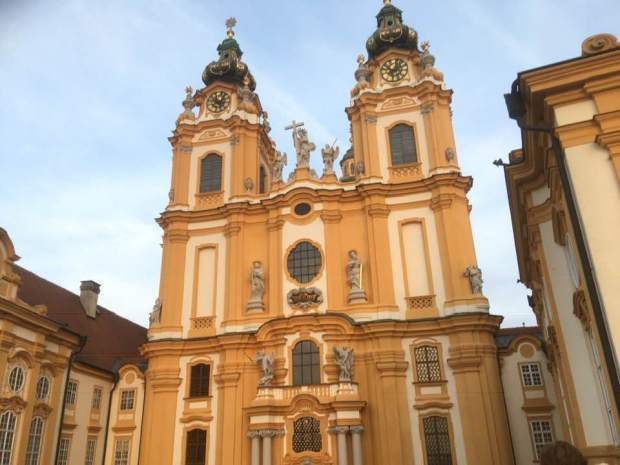
No photos allowed inside, but a really fascinating tour of a very imaginatively organised museum within this still functioning Benedictine abbey.
Next day we are moored at Linz. We’ve been forewarned that we’re going to be double parked, so we don’t fling open our curtains in the morning inadequately clad, only to see the passengers on another boat staring back. Another misty morning.

Some of our group go for a tour of Linz, but we board a coach and head off to Salzburg, which is just as fascinating and picturesque as I would have imagined.
It’s also my first sight of Stolpersteine, literally stumbling stones, plaques set into the cobbles of the city, commemorating those of its citizens who were murdered by the Nazis, usually adjacent to the houses where they lived. There are over 70,000 of these across Europe, and whilst some cities have rejected this particular way of commemorating the victims of the Holocaust, the project has prompted them to find alternatives, ways of giving back to those people the names and the homes and the stories that the Nazis took from them, along with their lives.


These two Stolpersteine commemorate Catholic priests who were murdered by the Nazis. Father Gottfried Neunhauserer died at Schloss Hartheim, used by the Nazis for their T4 euthanasia programme, and the place where thousands of prisoners from Dachau, Ravensbruck and Mauthausen were taken to be gassed. He’d been a patient in Salzburg-Lehen mental hospital from 1920, and was taken to Hartheim in 1941 where he was murdered.
Brother Jakob Furtsch was murdered in Ravensbruck in 1943. He’d been expelled from his abbey in 1942, and went back to his home town, Neuensee, where he was arrested as a dissident and deported to Dachau, then to Ravensbruck.
We also saw plaques for Rudolf Erich Muller, a Catholic convert arrested as a Jew in November 1938, deported to Vienna and then to Theresienstadt where he was murdered, and Karl Rinnerthaler, a school janitor, who died in 1948 due to the injuries he’d received in various prisons, after his arrest in 1942 as a member of the illegal Austrian Revolutionary Socialist resistance group.
So through chance, in just a small area of the city, we encountered these stories which convey so much about the Nazi horror. A victim of Aktion T4, a worker who took part in resistance activities, a Jew and a Catholic dissident.
We’d sailed straight past Vienna on our way to Linz, so now we head back there.

Obviously, there is no possibility of doing justice to Vienna in the time we have, though our guide is (as they all have been) well informed and does a brilliant job of showing us as much as we can in the time. I will have to come back some time.

That evening we have a classical string quartet performing on the boat. Yes, they do play the Blue Danube waltz (I guess it was a contractual obligation) but also some Mozart and Haydn. I quite fancied a bit of Schoenberg but there you go… More seriously, it was lovely, and well pitched for the audience. (My father has fond memories of a previous Danube cruise where there were such concerts on board most days, as well as musical outings in several of the cities they visited, including one in Vienna with the orchestra all in full 18th-century costume. )
We’re on the last leg now. Onwards to Budapest. But the low water levels which have been causing problems for river traffic means that we aren’t going to get there in time for a proper visit, so instead we dock again at Esztergom and get a coach to Budapest, whilst our boat carries on (less heavy laden!) without us, to meet us again for our last night on board after we’ve toured Budapest.
Despite this, the daylight is already fading once we have the chance to walk around the city. We look around Heroes’ Square, and then on to the Fisherman’s Bastion, a neo-Gothic/neo-Romanesque terrace which provides a wonderful vista of the old city, as the lights come on. Then we’re back to the boat for a gala dinner, and a performance of Hungarian folk music and dance to mark our final evening.


We didn’t get to see the Shoes on the bank of the Danube due to the rescheduling of that final day. Our Hungarian tour manager couldn’t speak of this, of its history and meaning, and of the fact that people still leave flowers there, without choking up. I will record it even though I didn’t see it for myself.

Film director Can Togay and sculptor Gyula Pauer created this memorial on the east bank of the Danube. Many Hungarian Jews were murdered even before the Nazis occupied Hungary in 1944. But in those last months of the war, as the Red Army surrounded Budapest, the murder of those who remained was regarded as an urgent priority, hampered by the fact that they could no longer deport to the death camps. So, with the help of the fascist Arrow Cross militia, 3,500 people, including 800 Jews, were taken to the banks of the river, ordered to take off their shoes, and shot, so that they fell into the river.
This trip has been full of such contrasts. The picturesque alongside the reminders of genocide. The Communist concrete blocks alongside the baroque. If I get the chance to come back to these cities, it’s these contrasts that I will want to explore. I want to find the Stolpersteine in all of these cities, as I sought out the plaques on the walls of Paris that tell of resistance and persecution. In these cities that embody our notions of culture, of beauty, of civilisation, people were rounded up, herded into ghettos, deported to camps and murdered because they were Jews, or Roma, or gay, or communist, or because they opposed the murderous ideology that would destroy people because of who they were. That history is ever more vital, as so many European nations seem to be drawn to nationalism and xenophobia once again.
It was poignant to be in Europe on the centenary of the Armistice, and to recall that the young men in those three nations who would be commemorated would have all fought against ‘us’. I thought of this again watching Kevin Puts’ opera Silent Night at Leeds Town Hall, which portrayed the 1914 Christmas truce through the voices of German, French and Scottish soldiers.

And I thought, with sadness and anger of how our union with all of those European nations is portrayed as something that oppresses and exploits us, rather than something from which we gain immeasurably, economically and culturally and in so many other ways. And I so wanted to dissociate myself from my government (and opposition) and from so many of my compatriots as our tour managers and guides made reference to Brexit, ironically, regretfully, in bafflement and in hurt.


So if I can I will go back, to Bratislava, Budapest, Vienna, and wander around in the way I enjoy, looking for the places where history bubbles up into the present.
I’d also love to go back on the river though, to recapture that sense of peace.
#NHS70
Posted by cathannabel in Personal, Politics on July 6, 2018

October 1990, I’m expecting my first child. After a straightforward pregnancy, we’re now getting slightly anxious that the baby is overdue and no signs that he/she is going to make an appearance without intervention. I’ve got a NCT birth plan and everything, but once the process of induction is underway that goes out of the window. I work my way up through the hierarchy of pain control, barely bothering with the gas and air, quite enjoying the pethidine until it ceases to really touch the edges of the pain. Epidural now, that does the trick. Blissful moments of peace. But still no baby, so we’re now looking at a Caesarean, and I’m conscious but pain-free as they lift him out of my belly.
Pain and exhaustion and bliss all at once. A few weeks later, at home with our son, and he’s crying all the time. Really, all the time. Nothing seems to make it better. I don’t know whether there’s something wrong, or I’m doing it wrong, but then at the 8 week check-up at the GPs, we find out that he’s lost weight. The baby books are full of reassurances that you shouldn’t panic if your baby hasn’t gained as much as the charts say, but none of them tell us that we shouldn’t panic if he has lost weight. Next day I’m at the maternity hospital for a post-C-section checkup and hand the baby to a nurse whilst they examine me. My consultant sees him and tells us to go to the Children’s Hospital A&E. Now. Don’t go home first. We head straight there and the baby and I don’t leave for a fortnight.

The consultant is baffled, but we’re taken care of and I’m looked after when I go down with a tummy bug a few hours after we’re admitted. And soon they’ve got the baby on medication and he’s starting to recover – turns out his adrenal gland either never kicked in when he was born, or stopped working, and so those hormones need to be replaced artificially. He also has to have a minor op to correct vesicoureteric reflux which is causing recurrent UTIs (one of which may have triggered the adrenal shutdown).
Once he’s settled on the meds he’s a different baby. We have a regime of medication, and an emergency kit to inject him if he has an accident or something that might provoke another shutdown, given that his meds are just keeping him at normal hormonal balance, not fight or flight levels (we never used it). He’s got regular outpatients appointments to check on his progress, and when he’s eighteen months old he goes back into hospital and is taken off the meds to see how he responds. Amazingly, his adrenal gland kicks straight in, and whilst no one can fully explain what went wrong and then what went right, he’s now a healthy small person, albeit with one kidney that’s just at the lowest level of functionality. The hospital keeps on monitoring him for several years, and whilst we continue to be anxious for a while, gradually we learn not to be. We are, as he is, incredibly and for ever grateful for the NHS staff who spotted that there was a problem and then put in place all the resources to solve it.
That is the most dramatic #NHS70 story we’ve got. But our reliance on the system has continued. It saw us through the birth of our daughter, a problematic delivery after which I needed a blood transfusion (which, ironically, is the reason both why I so much wanted to donate blood myself, and why I can’t). Between the four of us we’ve sampled pretty much all of the various outpatient clinics at the Children’s/Royal Hallamshire/Northern General. Appendicitis, type 2 diabetes, asthma, hypertrophic cardiac myopathy, hypersomnia, depression, and all the usual ear/chest infections, minor injuries, plus breast screening, smear tests, bowel cancer screening, blood tests, diabetic check-ups, retinal neuropathy screening… We’ve had help from a panoply of GPs, practice nurses, consultants, registrars, hospital nurses, physiotherapists, healthcare assistants, surgeons and counsellors.
We’ve got so many reasons to be grateful – we know that the system is over-stretched, we know that there’s a problem where medical treatment and social care intersect (or should), and of course not all consultants, nurses, GPs, healthcare assistants or therapists are as helpful, as good at listening, as each other.
But whilst it’s under-resourced, and whilst the quality of treatment will vary from area to area, from person to person, and from medical condition to medical condition, some things are constant.
We’ve had our share of worry – from the paralysing terror of losing a baby to the niggling anxiety that this lump or that twinge might presage something serious. But we’ve never had to worry about whether or not we could afford to get that niggle checked out. We’ve never had the fear that the cost of treatment would drive us into debt. We’ve always known that it’s there for us.
It’s original core principles were:
- that it meet the needs of everyone
- that it be free at the point of delivery
- that it be based on clinical need, not ability to pay
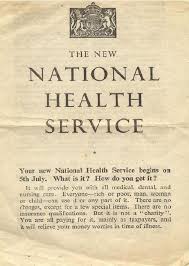
Those principles have been expanded upon over the last seventy years, as society has changed, and as our understanding of what ‘the needs of everyone’ might entail has deepened. But fundamentally, what we as a family have called upon when we needed it is the NHS as Nye Bevan envisaged it. It’s met our needs. It’s been free at the point of delivery. And it has never, ever, given a damn about our ability to pay.
To those across the pond who talk of NHS death panels whilst so many of their citizens avoid seeking medical help for fear of the medical bills – check your facts, and check your privilege. If your citizens really understood what we have here, they would want it for themselves, and they would be willing to pay for it through taxation, if they knew that they would never again have to fear the cost of treatment.
To those closer to home who want the service to die the death of a thousand cuts, to point to its deficiencies as evidence that it doesn’t work, to privatise it bit by bit until those core principles no longer mean a damn thing – know this, we will fight you every step of the way. We have something precious and we won’t let you take it away.


To the NHS, and all who work within it, thank you, we love you. And Happy Birthday.

Time to Talk
Posted by cathannabel in mental health, Personal on February 1, 2018
A few years back I took the step of talking publicly about my experience of depression, as part of Time to Talk Day:
a chance for all of us to be more open about mental health – to talk, to listen, to change lives.
The responses I received to that blog post were uniformly supportive and understanding, and reinforced the message of Time to Talk Day, that so many people are struggling with issues of mental health – their own or that of people they are close to – and are grateful and reassured to find that they are not as alone as they might feel.
Since I wrote that blog post it hasn’t been plain sailing. I didn’t really think it would be.
It’s a part of me, I think, that propensity to slip into the pit. I stay out of it mainly by being busy enough, with lots of things I care about and that bring me joy, but not so busy that I succumb to anxiety and sleepless nights and feelings of panic. I know the signs now, and can usually take preventative steps before I start to slip.
That holds true – but I was overwhelmed for a while, not long after writing that piece, and needed a lot of help (not just self-help) to get through. I was lucky to find a wonderful counsellor who worked with me for almost a year to help me to develop strategies to relax, to allay panic, to feel more confident when I went into what I knew would be difficult situations. Some of those strategies were physical – putting my arms on the table rather than crossed defensively, with my hands open rather than clenched, and popping into the Ladies and standing, feet a little bit apart, hands on hips, shoulders back. A little bit like…

Body language affects how others see us, but it may also change how we see ourselves. Social psychologist Amy Cuddy argues that “power posing” — standing in a posture of confidence, even when we don’t feel confident — can boost feelings of confidence, and might have an impact on our chances for success.
I can vouch for this. When you feel under attack your instincts are to drop your shoulders, to make yourself small (less of a target), to protect yourself physically, which stops you breathing so freely, which in turn creates or increases a sense of anxiety. If you stand like Wonder Woman you’re changing your breathing – it’s an expansive posture. Now, no one is suggesting that you swan into whatever situation it is that you’re dreading, and take up that stance. That’s a hell of a sassy stance, and it might be counter-productive. But a few minutes, in private, standing, and breathing, can help you get through what follows.
I used these approaches as survival techniques in an ongoing crisis rather than as a long-term strategy to enhance my confidence. To be honest, outside of that situation, I didn’t lack confidence in the workplace – I knew I was knowledgeable, experienced, capable, intelligent and a good communicator. I just didn’t know it right then.
That situation is long over, and I have had no serious brushes with depression since it was resolved. But it contributed to my decision to retire from work, rather earlier than I might otherwise have done, and it’s made it harder for me to look back with pride and pleasure at my achievements throughout my career.
I can live with that. I’m doing other things, things that I am unequivocally proud of.
What is becoming a bit of an issue is anxiety. I’m more or less continuously anxious these days. For me it’s a physical sensation, a tightness in my chest and throat, there most of the time with particularly strong twinges at seemingly random moments. And of course at 3 am – or 5 am – things look ‘worse and worse and worse’…
Fleur Adcock – Things
There are worse things than having behaved foolishly in public.
There are worse things than these miniature betrayals,
committed or endured or suspected; there are worse things
than not being able to sleep for thinking about them.
It is 5 a.m. All the worse things come stalking in
and stand icily about the bed looking worse and worse and worse.
The tightness becomes almost painful, there’s a weight on me that’s affecting my breathing. I can feel my heart thudding, racing, skipping beats.
The uselessness of it is infuriating. Of the things that are on my mind, there are some about which I can take sensible action – but not at 3 am. And often it’s a carousel of worries, round and round, from one to another, from real things that I might be right to be concerned about, to general forebodings, to things that any sensible person would not waste a moment’s panic about, round and round, on and on…
I’ve tried my usual ‘how to get back to sleep when the thoughts come crowding in’ techniques but they aren’t really working at the moment. I have yet to meet a relaxation tape which hasn’t made me want to throw it across the room and then stamp on it very hard indeed. Right now, the one thing I’m trying which is working – at least in the daytime – is to visualise the particular worry that’s constricting my breathing right now as a thread that I can let go of and watch it float away.
I know I’m not alone with this struggle. But I also know I need to get better at coping with it, because anxiety at this level – and the sleepless nights that go with it – can push me into the depression that I dread. It can also stop me doing things that I need and want to do.
Why am I sharing this? Because I know I’m not alone, and you need to know that too. Because we can maybe share our experiences, share the strategies that have worked for us, give each other a virtual or a real hug when we meet, remind each other that this too shall pass.
I know that my depression and my anxiety are minor irritants compared to what so many people have to deal with. But the walking wounded, those who probably aren’t on medication, or using mental health services, may be missing out on so much joy, on the possibility of pleasurable rather than dread-filled anticipation. And the world is missing out too, on the energy and passion and talent that we can give in so many fields, or could, if we weren’t lying awake every night with a heavy weight of anxiety pinning us down and sapping our strength.
The simplest and most important thing of all: the world is difficult, and we are all breakable. So just be kind.Caitlin Moran – How to Build a Girl
We need to remember that, and this:
As you look around you, in a lecture or a meeting, at a party or a gig, there will be people there, talking and laughing and making decisions and relating to those around them, who are or have been in the grip of depression or anxiety, who are struggling with or have struggled with obsessive compulsive behaviour or eating disorders, who are experiencing or have known the intense highs and lows of bipolar disorder. You’ll never know, unless they dare to share it with you.
It’s time for change. It’s time to talk.

https://www.rethink.org/about-us/our-mental-health-advice
Not Shutting Up
Posted by cathannabel in Feminism, Personal, Politics on November 5, 2017
‘Finally the tables are starting to turn…’
Listening to Jumoke Fashola singing Tracy Chapman’s ‘Talkin’ ’bout a Revolution’ as I write, and it almost feels like we could be at one of those moments when things do change, when the weight of our fury, unexpressed or suppressed for so long, can bring about real and lasting change.
Ask me in a few months or a year, and I may have to acknowledge that, despite my 60 years, I am still hopelessly naive and idealistic. But today it feels like the tables are starting to turn.
There are of course plenty of voices raised against us. There’s talk of witch hunts. There’s talk of how of course this sort of thing was fine 15 years ago. There’s talk of how this is all down to the collapse of the established moral order (because feminism) in which men and women could mix happily (it’s unclear whether the argument is that such things didn’t happen then, or that women knew their place and didn’t make a fuss about it). The women who speak up are labelled as pushy, ruthlessly ambitious, or as having a political agenda (derailing Brexit, undermining the Party, whatever). Or we’re just belittled as ‘squawking and flapping‘.
Let’s remind ourselves of what a witch hunt was. It was when the powerful in society attempted to pin the blame for bad things on to someone who was isolated, who was weak, often old, and almost always female. Not quite what’s going on here. Some are invoking McCarthyism (always linked to the witch hunt since Arthur Miller’s The Crucible) but again that’s not really what’s happening. In the McCarthyite House Un-American Activities investigations and trials, powerful people were encouraging the denunciation and punishment of those who were rumoured to or indeed actually did have links to left-wing politics.


Now the anonymous spreadsheet does have a whiff of injustice about it – the inclusion of extramarital affairs suggests a ‘moral’ agenda which is really not relevant to the issue of sexual harassment. This is likely to be more of a distraction than anything else. Its cowardly anonymity is in sharp contrast to the accounts we are hearing daily now, where women are going public about their own experiences, their own hurt and humiliation and damage, and about exactly who did that to them.
These women aren’t plotting with each other to overthrow the patriarchy, or to revenge themselves against men who’ve done them wrong. They’re only linked to each other by that common experience, and they’re only powerful now because they have given each other the courage to speak about that experience, and because there are so many of them that they can’t be silenced or ridiculed into shutting up. Not any more.
And let’s nail this nonsense about how ‘a hand on the knee’ was perfectly fine 15 or 20 years ago. My working life goes back to the late 1970s, and although such behaviour was very much more common then, we weren’t ok with it. Really, we weren’t. If we didn’t say anything it was for the same reason that people don’t speak out now – because we were less powerful than the people who were harassing us. In the mid-’80s people did talk about sexual harassment in the workplace. It was most definitely a thing. From the very early ’90s I was a harassment officer at a University, dealing with complaints of sexual and racial harassment and of bullying, so I’ve heard all the excuses.
‘It’s just banter’. ‘It was a compliment.’ ‘She’s so over-sensitive.’ ‘Yes I said that, but that wasn’t harassment.’ ‘It’s all a fuss about nothing.’ ‘It was all consensual.’
It happened, and we had policies to deal with it, and people to support the complainants, and we ran training sessions for line managers so they were aware of those policies and support structures.
Workplace harassment is about power – always. Whether that power rests in seniority, in majority, in gender, age or ethnicity, the harasser holds power and uses it to get what they want, to silence, and to punish if they don’t get what they want.
As is the case in other types of violence against women, sexual harassment is
inextricably linked with power. Whether the perpetrator is abusing a position
of power by harassing someone they see as less powerful, or whether the
perpetrator feels powerless and is using sexual harassment as a means to
disempower the target of their harassment and thus increase their own
power and status in the workplace. Several studies have found that
perpetrators of sexual harassment tend to be in a position of power over the
target of the harassment. The disempowering impact of sexual harassment
was a recurrent theme in union members’ responses to a TUC survey on
sexual harassment. Shame, humiliation, and a sense of being undermined
professionally were all cited by respondents.(https://www.tuc.org.uk/sites/default/files/SexualHarassmentreport2016.pdf)
It’s worth reminding ourselves that the stories which are coming out now are for the most part stories of workplace harassment. They are stories about actors auditioning for film roles, writers meeting with TV executives to talk about a script, journalists meeting with politicians. Even if the place where it happened is not a workplace per se (a bar or a restaurant or a hotel room) the context is that of someone doing their job, or trying to get a job.
None of us are really surprised that the women who are finally telling their stories – stories they may never have told anyone before, or only shared with a few close friends – are labelled as pushy. Any woman who speaks out, any woman who disagrees publicly with a man, any woman who challenges a man is pushy, strident, aggressive. I know this. In my almost forty years in the workplace, I’ve often been the only woman on a committee, and I rapidly discovered that if I wanted to be heard, I had to be determined, I had to not be deterred by being interrupted or talked over, I had to raise my voice (increased volume rather than higher pitch – heavens, mustn’t be shrill…). So I’ve been told, over and over, that I’m pushy, strident, aggressive.
If we stand up for ourselves, that’s what we get. If we don’t, we are assumed to be compliant and complicit. In reality we are engaging in a constant process of evaluating and avoiding risk. Looking for escape routes, for allies, for witnesses. Warning each other. Assessing at what point and how loudly we protest or refuse. Wondering what that protest or refusal may cost us.
There’s a clip circulating on Twitter of the magnificent Jo Brand on HIGNFY telling the blokes about how we feel under siege, how the constant, if low-level pattern of harassment wears us down. From the looks on their faces, I’m not sure they really got it.

I suspect very few men do and that’s because their experience of life is likely to be so different to ours, but also because we don’t often tell them what it’s like for us. We don’t tell them because we’re embarrassed, because we fear we may be blamed (what were you wearing? were you drunk? why did you share a taxi with him?), or because ‘our’ man might feel obliged to go and be manly and challenge our harasser to some kind of duel… And it’s no good asking them to imagine it happening to them, unless we make it clear we’re not asking them to fantasise about Lupita N’yongo or Romola Garai stroking their knee without asking permission first – we’re asking them to imagine someone they don’t fancy, someone they’re intimidated by, someone who has power over them – someone like Weinstein, trapping them in a hotel room and pinning them down, using physical as well as social power against them. We’ve been telling each other, for years (watch out for that one, a bit handsy, NSIT, etc) but now we’re telling men. Some of them are listening.
Some of them, of course are worried. Worried because they know damn well that even if they’re not and never have been as monstrous as Weinstein, they have crossed the line in their behaviour towards women, and they are wondering whether and when those women might speak out.
Charles Moore is worried for a different reason. He acknowledges that this is all about power. And he sees this as a moment when power has shifted.
This scandal shows that women are now on top. I pray they share power with men, not crush us
I think he’s being over optimistic (or pessimistic, depending on your point of view). I don’t think the patriarchy is history. It’s pretty resilient, and I think it will survive, overall. But I do think something has shifted. Some men are questioning their own behaviour, and some are questioning their own failure to challenge the behaviour of others.
What we’re asking for, really, isn’t so very radical or scary. It’s that men treat us as if – just imagine! – we are real people, as real as them, whose wishes and intentions, whose fears and hopes, are as real as theirs, and who can make choices, even choices that don’t suit those men. If over half of the world’s people are being subjected to varying degrees of harassment, abuse and assault because of their gender, isn’t that something about which we all ought to care? And if all this is happening in the context of equality legislation and harassment policies and so on, one can guarantee things will be so so much tougher for women in countries where there are fewer protections and a culture that reinforces prejudices against them.
The thing about speaking out, when you’ve spent so long not doing it, is that it can be exhilarating, liberating, intoxicating. We’re not going to be shutting up any time soon. And that has to mean that we – the privileged, who have access to power and the means of communication – speak out for the many girls and women who can’t.
Cause finally the tables are starting to turn
Talkin’ bout a revolution
Yes, finally…
http://www.thesecondsource.co.uk/who-we-are/
Click to access SexualHarassmentreport2016.pdf
60 Books in 60 Days: Reading Challenge Completed
Posted by cathannabel in Africa, Literature, Personal on September 30, 2017
Well, someone forced me to do it. In so far as they challenged me to do it. Or rather, they told me that someone else who’d just arrived at their sixtieth birthday had taken this challenge on. Same difference really. Anyway, I have one default response to a challenge – as long as it involves a literary or cultural feat rather than anything physical:
Challenge Accepted.
So, 60 books in 60 days, starting on 31 July, finishing on 28 September. This is the final instalment of my reading diary, covering the final four days, along with general reflections on the project, and a full list of everything I’ve read.
25 September. Day 57 – Reading Christopher Hitchens’ cancer memoir, Mortality, I am reminded of a good friend, Jos Kingston, who was diagnosed with an inoperable tumour in 2004, and died in 2007. Reading his words, I was struck that it could have been Jos talking:
To the dumb question “Why me?” the cosmos barely bothers to return the reply: Why not? … People don’t have cancer: They are reported to be battling cancer. No well-wisher omits the combative image: You can beat this. It’s even in obituaries for cancer losers, as if one might reasonably say of someone that they died after a long and brave struggle with mortality. … Whatever view one takes of the outcome being affected by morale, it seems certain that the realm of illusion must be escaped before anything else.
I recall Jos saying that she wasn’t fighting cancer, she was negotiating with it. That if she adapted her lifestyle to conserve energy, reduce stress and maximise general health, it might allow her for as long as possible to enjoy the things she’d always enjoyed – walks in the countryside near her home, music, books. That worked for her, for much longer than the medics might have anticipated.
I think also, of course, of another dear friend, Tim Richardson, who didn’t manage to confound the initial predictions of ‘how long’, despite chemo. He too wrote about his experiences, and he started the charity, Inspiration for Life, which I chair, and which raises funds for cancer research and treatment.
Mortality is a brief book – too brief, which has all sorts of layers of meaning in this context. But I need not have worried about it being gloomy fare. It starts with a diagnosis of terminal cancer, and explores what follows from that in a clear-sighted, unsentimental and unsparing manner. The thread running through it is what he calls ‘an arduous awareness’ and it’s tough to read but somehow uplifting.

In total contrast, I’m now reading Harlan Coben’s Home. This is a late entry in a fairly long-running series, and I’ve read nothing previously by him (though I did see a French film a few years back which it turns out was based on one of his novels, Tell No One). He’s one of the super best-seller thriller writers to whom I might not normally be drawn (though see my earlier caveats about not being snooty about so-called genre fiction, which at its best is a long way from merely generic) – but it was a Kindle freebie so worth a punt at that price. It’s a nice blend between a hard-boiled Chandleresque style, often quite funny even when being pretty brutal, and a more nuanced focus on emotion, trauma, grief and love. The women are utterly beautiful, the men fit and handsome, and most of them are unimaginably rich, but it’s not without subtlety, nonetheless, and Coben certainly insists that you keep turning the pages, not just to find out the twists and turns of the plot but because he’s made you care about the characters. I’d happily read more of his.

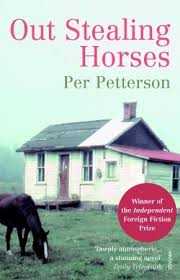
Also finished Per Petterson’s Out Stealing Horses. It’s set in eastern Norway, and focuses on the events of the summer of 1948. Beautifully constructed, beautifully written. As the Independent‘s review said, ‘unawareness and awareness, ignorance and knowledge, innocence and experience chase each other’, both for the protagonist, and for the reader.
Next: Stevie Davies’ Awakening, and Noo Saro-Wiwa’s Looking for Transwonderland.


I’ve read several of Davies’ novels in the past, most recently Into Suez, and always enjoy her writing. Looking for Transwonderland is a memoir from the daughter of murdered activist Ken Saro-Wiwa of her return to Nigeria after a decade.
26 September. Day 58 – Stevie Davies is always a fascinating writer, and this is set in a fascinating period:
Wiltshire 1860: One year after Darwin’s explosive publication of The Origin of Species, sisters Anna and Beatrice Pentecost awaken to a world shattered by science, radicalism and the stirrings of feminist rebellion; a world of charismatic religious movements, Spiritualist séances, bitter loss and medical trauma.
It’s very moving, but also acerbically funny in its portrayal of the excesses of evangelical zeal:
Even dear Mrs Spurgeon confesses that she keeps a close eye on Mr Spurgeon whenever he seems apocalyptically inclined.
Spurgeon (and dear Mrs S) are not the only real historical figures who feature here, but the focus of the novel is on the two sisters, and on ‘sisterly love, jealousy and betrayal’.
27 September. Day 59 – finished Noo Saro-Wiwa’s memoir of her return to Nigeria. She visits places that I saw as a child in the north of the country (Jos, Kano, Yankari Game Reserve) as well as parts of the country I never knew (Lagos, Port Harcourt, Abuja). Her father is a powerful (and unsentimentally portrayed) presence throughout, both at the personal level and in terms of the politics that led to his murder. Nonetheless the book is full of humour, and ultimately of a deep affection for the country, with all its chaos, corruption and division – its ‘jagga jagga’, as they say there.
Treated myself to Jan Carson’s Postcard Stories. It is, as the title says, a series of micro stories, each sent in postcard form to a friend, from various Belfast locations. There were originally 362 postcards, and 52 have been selected for the publication. They are funny, poignant, surreal, sometimes all at once. I do like the idea of teeny tiny stories, almost more than most ‘proper’ short stories which I find sometimes fall disappointingly between two stools. Cath Staincliffe, whose long-form fiction I’ve been enjoying for years now, publishes some flash fiction on her website, along with poems. And then there’s MicroSFF on Twitter.


And on to Giorgio Bassani’s Italian classic, The Garden of the Finzi Continis. Published in 1962, its setting is Ferrara, Italy in 1939, as racial laws begin to affect the lives of two Jewish families. There’s something of Sebald here.
This is the most oblique of Holocaust books. These Jews are affluent, educated, assured, assimilated. They are part of the fabric of Ferrara life and have been for centuries. And yet you know. That’s the saddest thing of all: right from the beginning, you know because the narrator knows. You know they will all be blown away “light as leaves, as bits of paper”; while they don’t. And at the end you, like him, will be bereft.
I’ve been meaning to read this since a fellow student spoke very powerfully about it at a postgraduate colloquium earlier this year, and I’m so very glad I have done.
Off to New York now, in 1943, but there’s no hint of the shadows that linger around the garden of the Finzi-Continis. This is Breakfast at Tiffany’s, another 20th-century American classic that I’ve somehow missed out on reading until now. I’ve not seen the film, either, so although my image of Holly Golightly is inevitably influenced by that of Audrey Hepburn, I’m not conscious of other differences between book and film. I was intrigued to read, however, that Capote himself favoured Monroe rather than Hepburn in the role.


28 September. Day 60! Yes, by midnight tonight I will have finished reading my 60 books. No sweat, no pressure.
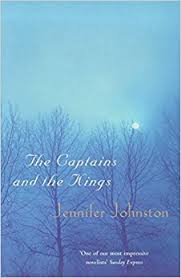
Just finished Jennifer Johnston‘s The Captains and the Kings. This was Johnston’s debut – in which the ‘turbulent history of 20th-century Ireland’ is background to a story of loneliness and isolation, of youth and age. It’s beautifully written, somehow out of time so that the past – the First World War in which Charles Prendergast fought, and the brother who died at Gallipoli, his shadowy wife, his distant parents – has a firmer reality than the present, such that I wondered when it was set. There’s a reference to ’55 years ago’ though, so the narrative is contemporaneous with the book’s creation. It’s a very simple story, in a way, and one where tragedy seems inevitable, but no less powerful for that. I am certain I read something by Johnston years ago, but cannot remember which – perhaps Shadows on the Skin, or The Old Jest?
On to my final book. Laura Lippman is one of my favourite crime writers, both for her stand-alone novels, and for the wonderful Tess Monaghan series about a Baltimore PI. This is her most recent novel, Wilde Lake.

And it’s excellent. Although the plot is complex and twisty-turny, what drives the novel, as always with Lippman, is character. Families, secrets, memory and the tricks it plays.
The present is swollen with self-regard for itself, but soon enough the present becomes the past. This present, this day, this very moment we inhabit – it will all be held accountable for the things it didn’t know, didn’t understand.
The things we don’t know, the things we don’t understand.
A great way to finish this challenge.
************************************************************************************
And that’s it! I guess I could take some time off from reading for a while now, but hey, that’s never going to happen.
From the moment when I could read for myself I’ve read hungrily, ravenously. I’ve read like it’s about to be made illegal, like I might suddenly lose the facility and words return to the mystifying symbols they were when I was 3 years old.
I read fast, like a hungry person eats. If I didn’t read fast, I could never have read 60 books in 60 days, of course. Do I sometimes miss things, details and subtleties, because I’m racing through – yes. And sometimes I wish I could slow down not just so that I can better savour the book I’m reading, but because I don’t want to run out. When I was young, I frequently ran out of ‘my’ books – Puffins for the most part, wonderful classics of children’s literature – and headed for my parents’ bookshelves where I encountered adult classics (such as Great Expectations, Jane Eyre, Morte d’Arthur) and read and understood what I could, re-reading as I got older and could reach a fuller and richer appreciation. As an adult, packing for holidays pre-Kindle, I would fill a case with books, realise there’s no room for shoes or toiletries, discard some books and then squeeze them in somehow, because I can’t bear the thought of ending up stuck in a holiday cottage in the rain with nothing to read. A serious case of abibliophobia.
Even as a child I read critically. I read Enid Blyton, because her books were ubiquitous, but because I was also reading Leon Garfield, Rosemary Sutcliff, C S Lewis, and so many other truly fine writers, I was aware of what she lacked that they had, and I read her in the way that one might read a trashy novel on holiday because it’s the only thing to hand.
But I’ve never rejected something purely because of its genre or a schlocky cover (the latter did put me off Stephen King for a while, but I gave him a try and was instantly and permanently converted). That would have ruled out so many of the books and writers that I have loved. I have, though, chucked many a book aside, straight into the charity bag, if its prose clunks, its dialogue is rigid with cliché or its characters are flat and tedious stereotypes. But everything in this list, in all its rich variety, was rewarding to read.
So this last 60 days has been a blast. It’s been a source of pressure, particularly when I’ve had unexpected periods when reading has been impossible, and I’ve panicked about falling behind. It’s been a discipline – in the interstices of the day when I might otherwise faff about on social media or the like, instead, I’ve been reaching for a book, and I hope to keep that up, albeit in a less extreme form. But most of all it’s been a delight, and writing about the books after I’ve read them has been a pleasure too – it was something I wanted to do to ensure this wasn’t an arbitrary exercise, reducing the books to a number, or even just to a list, and also to force me to pause each time I finished a book, think about it, gather my thoughts and write them down before picking up the next one.
Anyway, here’s the list:
- Kate Atkinson – Case Histories (2004)
- Margaret Atwood – The Handmaid’s Tale (1985)
- Julian Barnes – Levels of Life (2013)
- Giorgio Bassani – The Garden of the Finzi Continis (1962)
- Alan Bennett – Untold Stories (2005)
- Sam Bourne – To Kill the President (2017)
- Frank Cottrell Boyce – The Unforgotten Coat (2011)
- David Boyle – Dunkirk: A Miracle of Deliverance (2017)
- T C Boyle – Talk Talk (2006)
- Andrea Camilleri – August Heat (2009)
- Truman Capote – Breakfast at Tiffanys (1958)
- John le Carré – The Pigeon Tunnel: Stories from my Life (2016)
- Jan Carson – Postcard Stories (2017)
- Jane Casey – The Last Girl (2012)
- Ken Clarke – Kind of Blue: A Political Memoir (2016)
- Harlan Coben – Home (2016)
- Stevie Davies – Awakening (2013)
- Roddy Doyle – Two Pints (2012)
- Helen Dunmore – The Betrayal (2010)
- Helen Fitzgerald – The Cry (2013)
- Aminatta Forna – The Devil that Danced on the Water: A Daughter’s Quest (2003)
- Jo Furniss – All the Little Children (2017)
- Patrick Gale – The Whole Day Through (2009)
- Valentina Giambanco – The Gift of Darkness (2013)
- Lesley Glaister – The Squeeze (2017)
- David Grann – Killers of the Flower Moon: The Osage Murders and the Birth of the FBI (2017)
- Jarlath Gregory – The Organised Criminal (2015)
- Mohsin Hamid – The Reluctant Fundamentalist (2007)
- Jane Harper – The Dry (2017)
- A S A Harrison – The Silent Wife (2013)
- Ernest Hemingway – A Farewell to Arms (1929)
- Christopher Hitchens – Mortality (2012)
- Andrew Michael Hurley – The Loney (2014)
- Shirley Jackson – We Have Always Lived in the Castle (1962)
- Jennifer Johnston – The Captains and the Kings (1972)
- Andrea Levy – Uriah’s War (2014)
- Laura Lippman – Wilde Lake (2016)
- Peter Lovesey – The Last Detective (1991)
- Ben Macintyre – Agent Zigzag: The True Wartime Story of Eddie Chapman (2007)
- Hilary Mantel – The Giant, O’Brien (1998)
- Daphne du Maurier – Julius (1933)
- Livi Michael – Succession (2015)
- Caitlin Moran – Moranifesto (2016)
- Sarah Moss – Cold Earth (2009)
- Fay Musselwhite – Contraflow (2016)
- Flannery O’Connor – Wise Blood (1952)
- Nii Ayikwei Parkes – Tail of the Blue Bird (2009)
- Michelle Paver – Thin Air (2016)
- Per Petterson – Out Stealing Horses (2005)
- Caryl Phillips – The Final Passage (1995)
- Philip Roth – The Plot against America (2004)
- Donal Ryan – The Thing about December (2013)
- Noo Saro-wiwa – Looking for Transwonderland: Travels in Nigeria (2012)
- Elif Shafak – Three Daughters of Eve (2016)
- Graeme Simsion – The Rosie Project (2014)
- Ali Smith – Hotel World (2001)
- Tom Rob Smith – The Farm (2014)
- M L Stedman – The Light between Oceans (2012)
- Rose Tremain – The Gustav Sonata (2016)
- H G Wells – The Island of Dr Moreau (1896)
I didn’t plan what I would read. I started by raiding my Kindle and the ‘to read’ pile by my bed, and adding books that friends recommended or lent. The selection was mainly based on being not too long, not too hard, and not read before – so it’s pleasing to see the variety in the list above.
- Exactly 50% of the writers are women.
- 80% of the books are fiction, of the remainder one is poetry, the others are history or memoir.
- 58% of the writers are new to me. And what’s best about that is that I will want to follow up most of those, to read all of their stuff.
- The earliest book on the list is the H G Wells, from 1896. Slightly to my surprise, over a third are from 2016-2017 and over half from 2010 onwards. I guess this fits with the bias towards new-to-me writers.
- Just over half of the writers are from the UK, 9 from the US, 4 each from Australia and from the Republic of Ireland, 2 each from Italy and from Canada, 3 from West Africa, one each from Pakistan, Norway, Turkey.
Stories can make you fly, and over the last 60 days I’ve flown to Pembroke castle in the 15th century, rural Ireland in the 1780s, Wiltshire in the 1860s, Oklahoma in the 1920s, Kanchenjunga in 1935, Ferrara in 1939, New York in 1943, Norway and Switzerland in wartime and the immediate postwar period, Leningrad in 1952, the Caribbean in 1958, Romania in 1989. I’ve flown to an archaeological dig in Greenland, to the Ghanaian hinterland, to Sierra Leone and Nigeria, Oslo and Seattle and Chicago and New Jersey and Sicily. And into more speculative areas too, dystopian near futures and a mysterious island in the Pacific… That’s what reading can do for you.
Thanks to everyone who’s supported me in this, who’s lent or suggested books, liked/retweeted my blog posts and updates. I hope that some of you will now have some books to add to your ‘must read’ list – I’d love to know if so, especially if you read and enjoy something you might not otherwise have thought of.
And thank you most of all to Alan, Ali, Aminatta, Andrea C and Andrea L, Andrew, Ben, Caitlin, Caryl, Christopher, Daphne, David B and David G, Donal, Elif, Ernest, Fay, Flannery, Frank, Giorgio, Graeme, Harlan, Helen D and Helen F, Herbert, Hilary, Jan, Jane C and Jane H, Jarlath, Jennifer, Jo, John, Julian, Kate, Ken, Laura, Lesley, Livi, Margaret, Margot, Michelle, Mohsin, Nii, Noo, Patrick, Per, Peter, Philip, Roddy, Rose, Sam, Sarah, Shirley, Stevie, Susan, Thomas, Tom, Truman, and Valentina

With a book, you are the landscape, the sets, the snow, the hero, the kiss – you are the mathematical calculation that plots the trajectory of the blazing, crashing Zeppelin. You – pale, punchable reader – are terraforming whole worlds in your head, which will remain with you till the day you die. These books are as much a part of you as your guts and your bone. (Caitlin Moran, ‘Reading is Fierce’, from Moranifesto)
The world of literature … offered me, besides the pleasures of form, the sustentation of empathy (the first step of what Keats called negative capability) and I ran for it. I relaxed in it. I stood willingly and gladly in the characters of everything — other people, trees, clouds. And this is what I learned: that the world’s otherness is antidote to confusion, that standing within this otherness — the beauty and the mystery of the world, out in the fields or deep inside books — can re-dignify the worst-stung heart. (Mary Oliver)
The object we call a book is not the real book, but its potential, like a musical score or seed. It exists fully only in the act of being read; and its real home is inside the head of the reader, where the symphony resounds, the seed germinates. A book is a heart that only beats in the chest of another. (Rebecca Solnit, The Faraway Nearby)
So, ten years time, 70 books in 70 days? Challenge (provisionally) accepted!
From Sheffield to Zaatari – 24 hours of inspiration
Posted by cathannabel in Events, Personal on April 5, 2017

We started this year’s 24 Hour Inspire with a celebration of the city of Sheffield. City of beer, art and music – and all three were on offer over the course of the event (albeit the beer only in very restrained quantities). This remarkable and moving video summed it up:
Straight into Sheffield music, from the Vivacity choir.
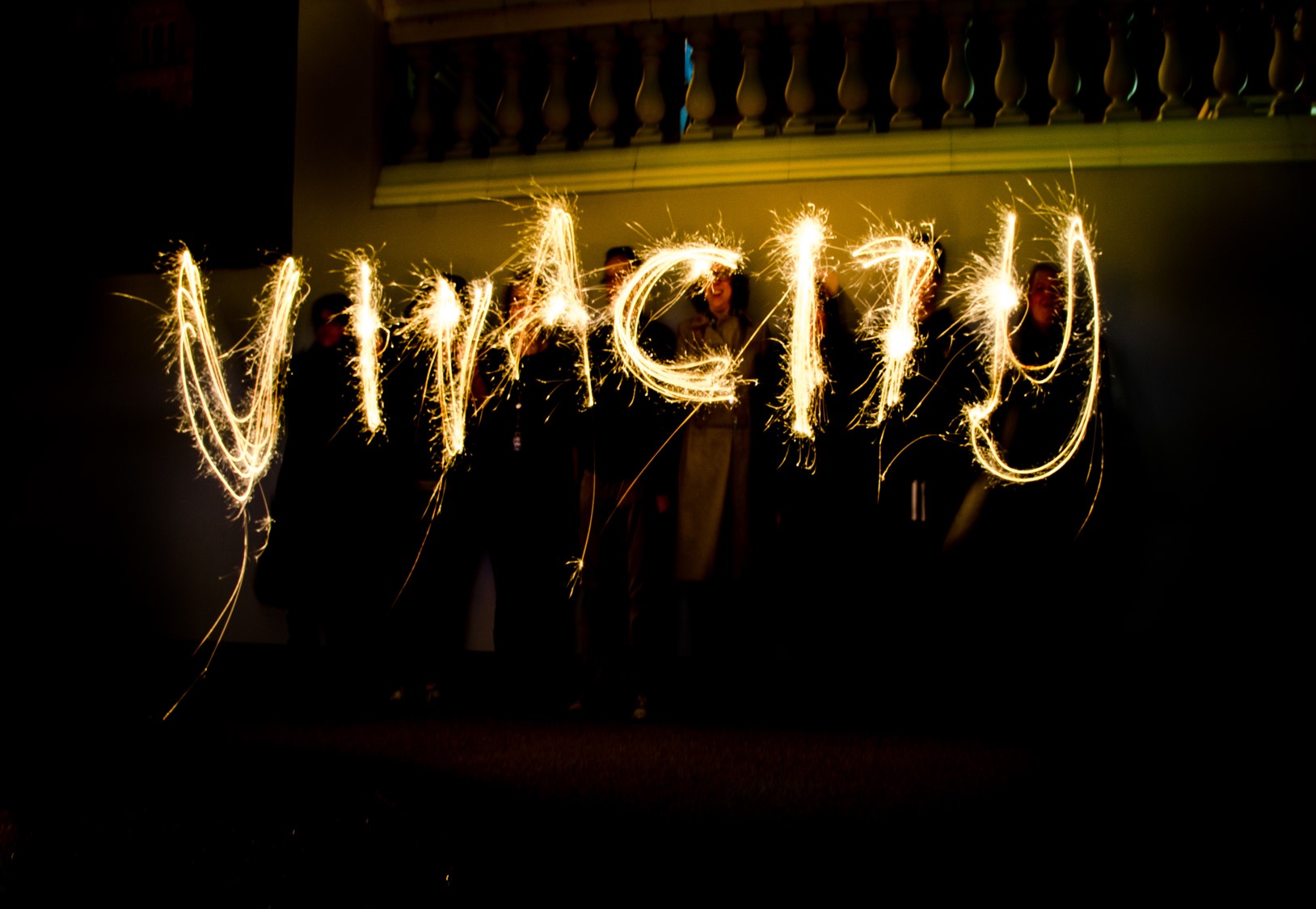 We crossed all sorts of boundaries – those between the academic disciplines, for a start. ‘Unweaving the rainbow’ brought together scientists exploring colour in physics and biology with a contemporary artist and with poets – and audiences could also explore an abstract virtual reality colour environment, and make their own contributions to a colour wheel.
We heard from a physicist at Durham University, talking about his family history in Poland, during the Nazi occupation, and from a physicist here at Sheffield, talking about Elizabethan/Jacobean revenge tragedy.
All in all, there were 45…
View original post 1,501 more words
Desert Island tunes
Posted by cathannabel in Music, Personal on May 19, 2016
Finally, I get to do my Desert Island discs. Kirsty Young appears to have lost my contact details, but no matter, because this year the 24 Hour Inspire featured a pop-up radio station, and I was asked to choose 6 tracks, a book and a luxury, and to talk about them with interviewer Chella Quint.
But how to pick just 6 tracks? It would not, realistically, have been easier if it was the BBC 8. Or even 12, or 20… Not when music has been such a huge part of life, not when it matters so much.
Listening, as I often do, to contributors to Desert Island Discs, I can see a range of different approaches to the task of selection. Some take the biographical approach – linking the tracks explicitly to key points in the life story they are describing. This is interesting, and enriching to the biography, but it may mean that the music doesn’t stand up in its own right, and has purely nostalgic value. Some just pick 8 tracks they kind of like – but you can tell in this case that music is not a passion, not an obsession but a pleasant accompaniment to other things. They have not agonised about those choices, they haven’t felt as though they have personally betrayed the artists who don’t feature in the final cut. That’s fine, but I can’t be like that.
When music really, really matters, the problem is not finding 6 or 8 or however many tracks, it’s finding a rationale for selecting for this particular purpose, on this particular date and time. That’s how I come to terms with it – on another day, in another context, I could and likely would have an entirely different set of tracks. So, what was my approach this time?
First off, I wanted to be able to say something about each track. Not just, this is brilliant, I love this, listen to this bit (although in a normal music-listening context there is a lot of that). But something about why it matters to me, how I encountered it, what it does to me. Secondly, the context. It’s the 24 Hour Inspire, so the music I pick has to be something that moves me, challenges me, disrupts me, inspires me.
Even outside this particular context, I can’t be doing with music that is merely pleasant. It has to move me – that can mean intellectual stimulation (a Bach fugue, for instance, or much of European postwar ‘classical’ music), emotional impact (much sacred music, even though I’m a humanist, and a host of songs that for some reason – lyrics, context, something in the tune, something in the vocals – make me well up or want to punch the air), physical effect (heavy grungy sounds, infectious dancey sounds, music that makes me move my feet, my hips). These are not mutually exclusive categories, of course, as my choices will demonstrate.
TRACK 1: SONGHOY BLUES – SOUBOUR
There had to be music from Mali. Because that’s where so much of the music I love was born – think Muddy Waters, think Hendrix – before it was transported across the oceans on the slave ships, asserted its power as it blended with the folk music and hymn tunes it encountered in the Americas and then made its way back home again.

Songhoy Blues grew up listening to the rich Malian tradition, and griots such as Ali Farka Toure – and to Muddy Waters and Hendrix. You can hear all of this in their music. I’ve written previously about some of the reasons why I feel such a strong emotional connection with West African music, and about the other powerful dynamic in contemporary Malian music – the resistance to the murderous jihadist bigots who invaded the north of the country, and banned football and music, inflicting brutal punishments on those who failed to comply. Songhoy Blues’ sound is joyous, a powerful riposte to the bigots, a reminder that the ‘grey zone’ as they call it is full of colour, full of melody, harmony, rhythm, full of beauty and warmth.
And this year of all years, there had to be Bowie.
TRACK 2: DAVID BOWIE – SUFFRAGETTE CITY

This one goes back to my first encounter with the Star Man, which I wrote about on the day his death was announced. It’s not necessarily my favourite ever track but it’s deeply significant as the start of a relationship that has continued throughout my teenage and adult life, and will continue, despite his death, because all of that music is still there to enjoy and explore.
Crimson were part of my teenage years too.
TRACK 3: KING CRIMSON – RED

I’ve always said that Red was my favourite album from the 70s manifestation of the band, and often said that ‘Starless’ was my favourite track on that album. But for desert island purposes, Starless would be so wrong. It could actually feature in a ‘songs that must never be played during a lonesome, marooned and possibly hopeless sojourn on a desert island’ list. Instead I picked the title track, a grungy heavy instrumental that I always loved, that I remember listening to, drinking cheap cider, sitting on the floor at my boyfriend’s house, and rocking out.
Kirsty MacColl would have to be with me on the island.
TRACK 4: KIRSTY MACCOLL – FREE WORLD

I imagine she’d have been great company in person – certainly the musicians she collaborated with talk about her with enormous affection and warmth, but also respect. She certainly deferred to no one – Johnny Marr tells a lovely story of her taking Keith Richards to task for getting something wrong on the guitar, and Keith accepting it meekly… Kirsty’s songs can be funny, poignant, sharp (sometimes all three), her voice is gorgeous, and she’s one of a number of women in rock/pop music who have managed to make their own rules, to do things their way, against the odds. This song makes me want to punch the air and change the world.
Another voice of rare beauty – actually one of the loveliest voices ever, anywhere:
TRACK 5: SAM COOKE – A CHANGE IS GONNA COME

This song is heavy with the hope and the hopelessness of the early sixties civil rights movement – people holding on to the possibility of change whilst being confronted daily with implacable hostility to change. I think of that – but I also think of the fact that an African-American currently sits in the White House, and for all the injustice and inequality that remains, for all the entrenched prejudice, things can and do change. I would never have believed, twenty years ago, for example, that gay marriage would be legal in so many parts of the world. And for all that there are still so many places where to be gay is to be outside the law and in danger of violence, it happened without that much fuss here, and in other countries, in the end. Even outside the social justice activist world, most people seemed to say, tacitly or otherwise, good on them. I have to remember and have faith that every time things seem hopeless, that a change IS gonna come.
And finally to the least well-known track of my six.
TRACK 6: FLOBOTS – WE ARE WINNING
The Flobots are hard to pin down – the highly political lyrics, spoken and sung, are backed not just with guitars and drums but with viola, cello and trumpet and the effect is intense and powerful. This track is marvellously idealistic, optimistic, hopeful. We are Winning. It doesn’t always (often) feel like it, but it’s something to hold on to, something to keep you keeping on. It speaks to my belief that what we do matters, precisely because this world is all there is. As Joss Whedon put it, in Angel: “If there’s no great glorious end to all this, if nothing we do matters then all that matters is what we do. Cause that’s all there is. What we do. Now. Today.” And there’s a particular pertinence in these lines in the context of an event that celebrates learning, teaching and research: There is a war going on for your mind. If you are thinking, you are winning.
We are building up a new world.
Do not sit idly by.
Do not remain neutral.
Do not rely on this broadcast alone.
We are only as strong as our signal.
There is a war going on for your mind.
If you are thinking, you are winning.
Resistance is victory.
Defeat is impossible.
Your weapons are already in hand.
Reach within you and find the means by which to gain your freedom.
Fight with tools.
Your fate, and that of everyone you know
Depends on it.(Flobots, 2008)
Selecting my six tracks might have been tricky, painful even. I feel I owe a personal apology to so many artists I love but have left out, and if I were to do this again (I ‘m more than willing, guys) I could easily come up with another six, and another, and another…
But these felt good. The 24 Hour Inspire is all about inspiration (obviously), and I feel inspired when I hear these songs. I feel energised, and optimistic, and I want to dance, and to punch the air and change the world. I hope at least some of the songs will affect at least some of you in similar ways. I’ll add the recording of the interview when it’s available. Meantime, enjoy!
https://www.facebook.com/Inspiration-for-Life-340350772727621/
https://mydonate.bt.com/fundraisers/mattmears1
@inspire4L
2015 – the best bits
Posted by cathannabel in Events, Film, Music, Personal, Television, Theatre on December 30, 2015
This was the year we threw off the shackles of paid employment. Martyn first, in March, and me at the very close of 2015. It feels terrifying and liberating all at once.
For me, this new freedom will give me more time to do the things I care most about. My PhD, which I hope I will now be able to do justice to. And Inspiration for Life, in particular the 24 Hour Inspire. Of all the things I’ve done over the years, this is what I’m proudest of.
And I hope of course to have more time to do the other things I love, more time to read, write, listen to music, go to gigs, go to the cinema/theatre, meet up with friends, travel, watch some of the box sets which are gathering dust by our DVD player…
Below are some of the cultural highlights of 2015. I’ve been lucky to have access to Ensemble 360, Opera North, Tramlines, Sheffield Jazz etc, and to have wonderful friends and family to share these experiences with.
Film
The best of the year, without a doubt, was Timbuktu. Abderrahmane Sissako’s film is both beautiful and harrowing, a passionate cry from the heart about the threat posed by fundamentalist jihadists to the people, the culture and the music of Mali.


I won’t rank my other favourites, but they are:
Inside Out – Pixar at its very, very best. Clever, imaginative, daring, funny and moving. As the Guardian review said, ‘In the film’s wildest moment, the wanderers enter a zone of abstract thought, where they are zapped into a series of increasingly simplified geometric shapes, as they – and the film itself – dizzyingly self-deconstruct (“Oh no, we’re non-figurative!”)’.
A Girl Walks Home Alone at Night – Ana Lily Amirpour’s film has been tagged as ‘the first Iranian vampire Western’. Atmospheric and full of unexpected touches (including a skateboarding vampire), and a powerful feminist narrative. Sheila Vand has a fascinating face that can look very young and somehow ageless at different moments.


Love and Mercy – biopic of Brian Wilson, portrayed both in the Beach Boy years and in later life, by Paul Dano and John Cusack respectively. Cusack’s portrayal is fascinating – seeing the clip of the real Brian Wilson at the end of the movie, I realised just how perfectly he had captured him, despite the lack of obvious physical resemblance.
I Believe in Miracles – the story of Nottingham Forest’s astonishing European Cup success. A joy from beginning to end. And featuring a couple of brief glimpses of my kid brother who was a ball boy at one of those games, as well as glorious clips of my all-time footballing hero John Robertson at his best. And funny and poignant anecdotes from the players, and clips of Clough running rings around interviewers.
Mad Max: Fury Road – just a blast, possibly the best action movie I’ve seen, with a powerful female lead in Charlize Theron’s Furiosa (an action movie that passes the Bechdel test!), visually almost overwhelming and with an awesome soundtrack. And the Doof Warrior.
Avengers: Age of Ultron. I’ve written previously about how much I love the Marvel films. This was a joy, thanks in large part to Joss Whedon’s crackling dialogue (the script is often where costs are cut in big budget movies, but thankfully not here).


TV
Lots of Marvel here too, with Agent Carter, Daredevil and Agents of Shield all delivering in spades. Daredevil was the darkest of the three, but the others had their moments and all had humour, well-drawn characters and moments of poignancy as well as action. In other sci-fi/fantasy telly, Tatiana Maslany continued to be astonishing in Orphan Black, The Walking Dead continued to ramp up the tension till it was almost unbearable, and left us at mid-season break with everyone we care about in mortal peril – again. The latter also spawned a prequel (Fear the Walking Dead) which showed the start of the crisis – the bit we missed as Rick Grimes was in a coma in hospital whilst society crumbled in the face of the undead onslaught. And Humans was a thought-provoking and engaging take on issues around AI and what makes us human.



As always we watched a lot of detectives. Two French series – old favourite Spiral was back (we missed you, Laure, Gilou, Tintin et al), and a new drama, Witnesses, was complex and compelling with an intriguing female lead (Marie Dompnier). River was something else – Stellan Skarsgaard’s broody Nordic cop haunted by ‘manifests’ of his dead partner amongst others. Nicola Walker was stunning in this, as was Adeel Akhtar as River’s actual living partner. Walker also caused considerable potential confusion by simultaneously leading in Unforgotten, which made one forget the implausibility of an entire police team investigating a very cold case (and nothing else, apparently) by the subtle and compassionate portrayal of the various suspects as their past actions resurfaced to disturb the lives and relationships they had built. No Offence was refreshing too (though we felt uneasy with some particular plot developments in the later part of the series) with Joanna Scanlan’s DI being startlingly rude, but also funny, forceful and warm, and a fab supporting cast.




This is England 1990
This is England deserves a much more in-depth consideration than I can give it here – one would need to re-view the whole series from the film to this final (if it is indeed that) instalment. But there’s no denying – they can be a tough watch, as brilliantly funny as they often are. It’s not just the moments of horrifying violence, I think the hardest thing would be to have to go through again with Lol her descent into despair in TiE 88. Vicky McClure’s performance was intense without any histrionics and all the more devastating for that. This final part had moments too, relating to Kelly, and to Combo, which stay in the mind. And whilst the ending was upbeat, with that long-postponed wedding and Kelly’s return to the fold, Milky’s separation from the group and the reasons for it, and the likelihood that Kelly’s recovery will not be as straightforward as all that, mean that the darkness is not far away. It’s been a hell of a series, with superb writing and direction and equally superb performances.
Raised by Wolves
When it comes to comedy I can be a hard woman to please. Not that I don’t like a laugh, GSOH, that’s me. But I’ve given up on so many sitcoms because they’ve made me cringe more than they’ve made me chuckle. However, despite feeling slightly neutral about the pilot, I did get into Raised by Wolves, and fell rather in love with the magnificent Della (Rebekah Staton) as well as with the writing, which as expected from Caitlin Moran (and sister Caroline) was rude and exuberantly funny.
Roseanne
We watched this back in the day (88-97) and rewatching it now is punctuated by cries of ‘OMG that’s George Clooney’, or spotting Big Bang Theory cast members (Sheldon’s mum and Lesley Winkle, with Leonard still to show). But what we also realised was how much of our approach to parenting came from this show, where family life is chaotic, temperamental, combative but always loving. And ‘our’ tradition of summoning family members to the meal table with a loud cry of ‘FOOOD’ appears to have been inspired by the Conners as well. As I recall, things went seriously off kilter in later series, but so far, so funny. Joss Whedon had a hand (probably just a fingertip in some eps) in the early series, which can’t ever be a bad thing.
Résistance
French drama focusing on the activities of various Resistance groups in Occupied France – this was obviously a must-watch for me. I hadn’t expected it to be as close to real events as it was, which was a mixed blessing, as I quickly realised who was doomed and who might survive… The central female character, Lili, was a fictional construct, which seems to have annoyed some viewers, but I felt it was a valid way of providing a thread to link the early activity of the Musée de l’Homme group with the Maison de la Chimie and the Combat and Manouchian groups, taking us all the way through to the Liberation. It was a powerful, well constructed drama. And the renditions of the Marseillaise, ringing out in prison cells and in the face of firing squads, came back to us so intensely in November when that spirit of defiance was called upon once again.
Fargo
If the idea of series 1 seemed in principle a bit odd, a second series was all the more so. But if anything, series 2 is even better, even madder, even wittier than the first. The film had Frances McDormand, who is always a very good thing, and series 1 had Allison Tolman, who filled those shoes admirably. In series 2 we root for her dad, Lou (we’ve gone back in time) and grandad Hank (played by Ted Danson), and her mother Betsy (I would like some time to see Cristin Milioti NOT dying of cancer, if that’s OK). And we do kind of root for Peggy too, with her passion for self-actualisation and ‘being the best me I can be’, even if it proves somewhat dangerous for those around her.
Honourable mentions to Homeland, Doctor Foster (Suranne Jones magnificent as a woman scorned), and Jonathan Strange & Mr Norrell.
And of course there was Doctor Who. This year’s Who was top notch. Capaldi really found his voice, the plots were rich and complex without being merely baffling, and the climactic episodes were powerful and moving. I will be writing more about Who in due course.

Theatre
On the Crucible main stage, we saw Arthur Miller’s Playing for Time, with a stunning performance from Sian Phillips, and Romeo & Juliet, with Freddie Fox and Morfydd Clark as the lovers. The Miller play seemed stagey at times (an odd criticism, in a way, for a stage play) but the performances carried it and I reflected afterwards on the way in which the Nazi death machine was itself stagey, whether the intention was to terrify and subjugate, or to deceive. Romeo & Juliet was terrific, but reminded me of how bloody annoying those two are, and it’s no disrespect to the actors that I wanted to give them both a good slap.


Music
Operatic outings this year included a fabulous Kiss me Kate, a powerful Jenufa, and a magnificent Flying Dutchman, all from Opera North.


I’ve written previously about the splendid Bassekou Kouyate gig at the University’s Firth Hall.
At the Crucible Studio, Ensemble 360 treated us to performances of Mendelssohn, Ives, Janacek, Watkins, Brahms, Berg, Boulez, Kurtag, Mozart and Bartok, amongst others. Such fantastic musicians, and particularly delighted to have had the chance to hear so much 20th century music this year. Same venue, different ensemble – Chris Biscoe’s Profiles of Mingus feat. Tony Kofi on sax (we’d heard him playing Mingus last year, with Arnie Somogyi’s Profiles of Mingus). More jazz, courtesy of Leeds Jazz Orchestra (feat. one Aidan Hallett) in Leeds Golden Acre Park.


And then there was Tramlines. Nothing much to add to what I said at the time, except that I can’t wait for the 2016 festival.
So, thanks to those who shared these highlights with me. I look forward to lots more in 2016.
I hope to blog more in 2016, of course. I managed a post most months in 2015, and the overall total looks more impressive thanks to eight in Refugee Week and a few reblogs from That’s How the Light Gets In and Nowt Much to Say. I blogged for Holocaust Memorial Day, wrote about the Hillsborough inquests, the 24 Hour Inspire, Marvel films, Tramlines, the phenomenon of the ‘fugueur’, the music of Mali, the ‘refugee crisis’, and the murderous attacks by Daesh in Paris and elsewhere. I also blogged for Inspiration for Life, and on the aftermath of the May General Election. Thanks to all who have read, liked, reblogged, commented, etc.
And for 2016, which may seem to hold so much threat and so little hope, I cannot do better than to quote this poem, by Sheenagh Pugh. Apparently she doesn’t rate it – scribbled it in a hurry on a card for a friend going through a tough time. I beg to differ.
Sometimes things don’t go, after all,
from bad to worse. Some years, muscadel
faces down frost; green thrives; the crops don’t fail,
sometimes a man aims high, and all goes well.A people sometimes will step back from war;
elect an honest man, decide they care
enough, that they can’t leave some stranger poor.
Some men become what they were born for.Sometimes our best efforts do not go
amiss, sometimes we do as we meant to.
The sun will sometimes melt a field of sorrow
that seemed hard frozen: may it happen for you.
May it happen for you, may it happen for all of us.
24 Hour Inspire, 16-17 April 2015 – Programme
Posted by cathannabel in Events, Inspiration for Life, Personal on April 4, 2015
If anyone had told me a few years back that I’d be organising anything like the 24 Hour Inspire, I’d have thought they were delusional. But we’re about to hold the third such event – 24 hours of non-stop lectures on all sorts of topics – and it’s one of the things I’m proudest of in my professional life. It’s not just the funds we raise, though I’m delighted to be part of raising money for charities like the ones we’re supporting this year, who provide end of life care for cancer patients or support young people with cancer. It’s the way that the event makes connections across and beyond the University which is my alma mater (twice) and my workplace, the community in which I feel so much at home. It’s the way that it taps into such a deep seam of goodwill, that people respond with such enthusiasm and generosity to our requests for help, often offering more than we ask for. It’s the way in which not only the task group who have been meeting for the last few months to plan and organise the event, but a much wider group of people want it to work, and do whatever it takes to make it work.
I get slightly nervous, of course. There are so many things that potentially could go wrong with an event on this scale. But that nervousness is always offset by the recollection that every time something has threatened to unravel, someone has sorted it out. A speaker drops out at the last minute – a quick tweet to say that we need a replacement, and half an hour later we have one. It’s a collective effort, and that’s why it’s such a joy.
It emerged of course out of great grief and loss. But in those 24 hours I believe we’re doing something special, we’re living intensely and revelling in learning, in making connections, in broadening our horizons, and in collaborating. Twelve sleeps to go now. I can’t wait.
Come along if you can, for some or all of it. If you can’t, but wish you could, you can still tweet about it using the hashtag #24HrInspire, and you can donate here: https://mydonate.bt.com/events/24hourinspire2015

| Catherine Annabel | Inspiration for Life | Introduction and welcome | |
| 17:00:00 | Professor John Flint | Town & Regional Planning | Victoria Henshaw – a tribute |
| 17:30:00 | Dr Nate Adams | Molecular Biology & Biotechnology | Throwing spanners at nanobots |
| 18:00:00 | Dr Victoria Williamson | Music | Music for wellbeing: possibilities and promise |
| 18:30:00 | Professor Paul White | Geography | Global population growth – the good news and the bad news |
| 19:00:00 | Professor Rowland Atkinson | Town & Regional Planning | Ecology of sound: the sonic order of urban space |
| 19:30:00 | Morag Rose | Town & Regional Planning | Loitering with intent: psychogeography the Mancunian Way |
| 20:00:00 | Professor Claire McGourlay | Law | Legal aid – what legal aid? |
| 20:30:00 | Dr Amanda Crawley Jackson | French | Post-traumatic landscapes |
| 21:00:00 | Professor Davide Costanzo | Physics & Astronomy | Anatomy of the ATLAS particle detector |
| 21:30:00 | Dr Tim Shephard | Music | Machiavellian sounds: how to rule a Renaissance state with music |
| 22:00:00 | Dr Catherine Fletcher | History | The insider’s guide to Wolf Hall |
| 22:30:00 |
View original post 547 more words
 Passing Time