Fiction
The usual caveats. I haven’t included absolutely everything I read – if something was mediocre to bad, I wouldn’t bother reviewing it unless that in itself was newsworthy, e.g. it’s by someone who I know to be capable of being much better than that. Crime and thrillers accounts for the largest cluster amongst my fiction reading, which is usually the case. I generally don’t review crime novels in ongoing series, unless there is some particular significance to this book. So honourable mention to Ian Rankin’s Midnight and Blue (this may or may not prove to be the last Rebus, either way it is a worthy addition to the series), Mick Herron’s The Last Voice You’ll Hear (the follow-up to Down Cemetery Road, which I review below), and Tana French’s The Hunter (follow-up to The Searcher). And of course, I do try to avoid spoilers, but read on at your own risk.
Jane Austen – Mansfield Park/Lady Susan/The Watsons/Sanditon
I studied Mansfield Park for A level, which is probably why I haven’t re-read it until now. I don’t think it will ever replace Persuasion as my favourite Austen, but there’s so much subtlety and depth in this – more than I appreciated at the time. I did defend Fanny Price vigorously though, in the exam, against Kingsley Amis who had described her as ‘a monster of complacency and pride’, who ‘under a cloak of cringing self-abasement, dominates and gives meaning to the novel’. There’s a difficulty in presenting characters who lack agency, who are largely passive and yet do pass moral judgements on others, and Amis is not alone in his view, though he is one of the most extreme. This same issue is, I’m sure, why Lynn Shepard in Murder at Mansfield Park, chose to upend the moral certainties of Austen’s novel, and clearly enjoyed doing so. I read one or two academic articles about MP and the Fanny Price issue, and nearly got tempted into writing a dissertation rather than a brief review for this blog… With commendable restraint, I will simply say that I do see the problem, but I think the book repays repeated and close reading, as much as any of Austen’s more popular novels, and there is rich enjoyment to be had.
The unfinished novels Lady Susan, The Watsons and Sanditon are tantalising. The first gives us a thoroughly reprehensible protagonist, but her adventures are cut short with a paragraph showing how she got her comeuppance, which rather spoils the fun. The Watsons I found hard to like – it felt as though Austen wasn’t really sure what she was doing with those characters, and in fact she did abandon the project. Sanditon was abandoned only because of Austen’s ill health and is the most interesting – I would have loved to see how she developed the character of Miss Lambe, a 17-year-old ‘half-mulatto’ Antiguan heiress.
Elspeth Barker – O Caledonia
What an extraordinary novel! Gothic, darkly funny, odd, with a protagonist who is all of those things and primarily in permanent and obstinate rebellion against pretty much everyone around her, which leads to her murder (this is not a spoiler – we start with her corpse and then wind back). I will leave Maggie O’Farrell’s article to tell you more about the book and its author, because she tells it so brilliantly.
Belinda Bauer – The Impossible Thing
Bauer’s novels are always quirky and apparently she initially resisted being pigeonholed as ‘crime’ but subsequently concluded that actually one can do almost anything within that genre, as she has amply demonstrated. This narrative alternates two timelines, the present and Yorkshire in the 1920s, the unifying element being a rare guillemot egg. She brings back Patrick Fort, the protagonist of Rubbernecker, who provides a neurodivergent perspective on events and characters.
Marie Benedict & Victoria Christopher Murray – The Personal Librarian
I’ve long been fascinated by the phenomenon of ‘passing’, which I recall coming across in the context of apartheid-era South Africa, where it was highly advantageous to be able to pass as ‘coloured’ rather than black. In relation to the US, I read Nella Larsen’s Passing, and a much more recent treatment, Brit Bennet’s The Vanishing Half. The Personal Librarian is the fascinating true story of Belle da Costa Greene, who became the personal librarian to J P Morgan, playing a key role in expanding his collection of art and rare books. As a young woman in that world she would have been remarkable enough, but in fact she was a light-skinned African American, passing for white (her olive skin was explained by a fictional Portuguese grandmother). It’s quite extraordinary, and the book explores the implications of living this way, for her family, for how she deals with encounters with other black people, for how she has to be constantly alert for anything that might arouse suspicion.
Ulrich Boschwitz – The Passenger
There is a fascination in reading accounts of Nazi Germany that involve no hindsight. Boschwitz himself got out of Germany and ended up in the UK only to be interned first on the Isle of Man and then in Australia as an enemy alien, and then torpedoed in 1942 on the ship that was bringing him back to Britain. So his account of a businessman, with the luck to not look Jewish, trying to find out a way of getting out when he’s left things a little too late and no longer knows who to trust, is grippingly real. It was written immediately after the events it describes (the pogroms of 1938 often called Kristallnacht), and published in 1939 but had little impact, and only reappeared in 2021. The narrative has the feel of a dream – a nightmare – in which every route one tries to get to safety proves to be impossible.
W H Clark – Made in Blood
This is the long-awaited third part of Clark’s Ward trilogy, and it’s a very satisfying conclusion, well drawn characters and an avoidance of the more irritating clichés of the genre.


Jonathan Coe – The Proof of My Innocence
This is a lot of fun, despite the deeper and more serious purpose to which all the games he plays with words and styles are bent. As the Guardian put it, ‘The narrative comes at us in various guises including memoir, autofiction, present- and past-tense personal accounts and, most amusingly, the first draft of the kind of cosy mystery destined to sell millions in spite of the deficiencies of its prose’.
Anna Funder – Wifedom
I had to question whether to put this in fiction or non-fiction – it uses Eileen Shaughnessy Blair’s correspondence and other non-fictional sources, but then adds sections which are purely fictional, however solidly based, accounts of her life with Blair/Orwell. Rebecca Solnit, whose writing I admire enormously, takes Funder to task for the way she uses some of this material and for factual inaccuracies, and makes the case that her approach gives Eileen less rather than more agency, makes her more rather than less of a victim. Unquestionably Orwell’s attitudes were not feminist, and his failings seem for the most part to have been all of a piece with attitudes to women at that time. Solnit does not comment on the incidents described by Funder where Orwell was apparently sexually aggressive to the point of attempting rape. My internal jury is out on this book – I think I would prefer a more straightforwardly non-fictional approach as Funder’s leaves one constantly wondering which bits are her own speculation and which she has evidence for. I read Solnit’s Orwell’s Roses (see below) as a companion piece anyway, to get a different, more sympathetic (though not hagiographical) approach to Orwell.
Elly Griffiths – The Frozen People
The start of a new series from a writer who I’ve enjoyed enormously over the years. This one introduces a sci-fi element to the plot which is very intriguing, and on the strength of this first title another series that I will be following eagerly.
Jack Grimwood – Nightfall Berlin
An excellent Cold War thriller, which I should have read after Moskva, the first in the series. I will correct that asap, as this is a thoroughly gripping and enjoyable read, in the tradition of John le Carré.
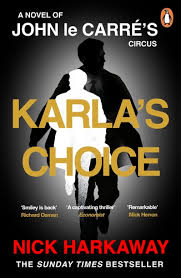
Nick Harkaway – Karla’s Choice
Harkaway has even more claim to be ‘in the tradition of John le Carré’, as he is his son, and Karla’s Choice is explicitly placed in George Smiley’s timeline. His narrative voice is perfectly pitched and it is a worthy addition to the le Carré opus, as well as a fine thriller in its own right.
Robert Harris – Precipice
Based on the correspondence between PM Henry Herbert Asquith and posh socialite Venetia Stanley, just before and during the early part of WWI, this uses Harris’ genius for painstaking research that is then worn lightly to allow his characters to live and breathe. There is real suspense here, but emotional depth too, and whilst I wanted to shake both Herbert and Venetia, Harris made me care about them both.



Mick Herron – Down Cemetery Road
The first in a new series by the author of the Slow Horses books. That was a sufficient recommendation, and this is a cracking thriller, with two female leads, so having thoroughly enjoyed this one I will now be following Zoe Boehm as well as the Slow Horses (in print and on TV).
Claire Keegan – Small Things Like These
Like Foster, the scale is small, low-key, as the title suggests, but so powerful. Like Foster, which was filmed as The Quiet Girl, this was made into a wonderful film (see my Screen reviews). Most readers will realise that the context is the history of the Magdalen laundries and their abuse of young unmarried mothers, but the protagonist does not at first see, partly because trust in the institutions of the Church is so strong in the community. The novella allows us to share his realisation and the clarity he reaches about his own responsibility. It’s beautifully written, and very moving.
Min Jin Lee – Pachinko
Epic historical novel spanning the period 1910 to 1989, following generations of a family from Korea to Japan and the US. Compelling and fascinating – so much history that I wasn’t aware of as well as insights into Korean and Japanese culture, and the characters are well drawn and engaging.
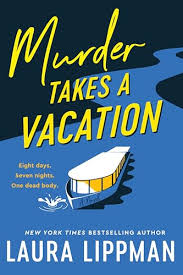
Laura Lippmann – Murder Takes a Vacation
I love Laura Lippmann. And I now LOVE Muriel Blossom. She is my new best friend and I want to go on cruises with her (though I might hope they’re slightly less eventful than this one). She is my age and widowed, and insecure about her size and appearance, but immensely capable, perceptive and clever and I hope this is merely the first of her escapades, as I foresee a feast of thoroughly enjoyable, witty and entertaining mysteries.
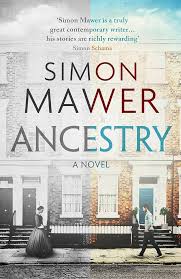
Simon Mawer – Ancestry
Mawer died this year, aged only 76. It’s a real loss – he isn’t half as well known as he deserves to be. Ancestry will thus be his last novel, and it’s a fine one. The title is quite literal, and refers to his own ancestors, whose history he pieces together from the documentary evidence and other traces of their lives. It’s described on his website as ‘an investigation into the reality of the past and an exploration of that uncertain borderland which lies between fact and fiction’. The lives that emerge are vibrant, perilous, harsh and enthralling.
Maggie O’Farrell – Hamnet
I have enjoyed everything I’ve read by Maggie O’Farrell, so it’s odd that it has taken me until now to read this one. Perhaps I sensed the intensity of the grief in the book and wasn’t ready for it. I’m still not – and I know that this particular grief, the loss of a child, is something that I could never be ready for. In our time, the death of a child seems to be an overturning of the natural order of things, even if in Shakespeare’s time and into the 20th century it was, in a way, normal – families did not assume that all children would make it to adulthood or even survive their birth. In any era, I imagine, the death of a child would be felt to be a failure of our fundamental responsibility as parents to keep them safe, and I think we may assume too readily that the frequency of childhood deaths meant that parents did not experience the shock and trauma as we might do today. All of that is here in the book. The context, that it is Shakespeare who is the grieving father, adds another dimension, but he is so much absent, and it is Agnes/Anne who is at the book’s heart.



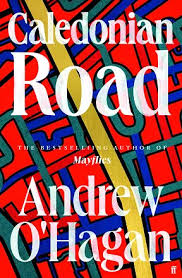
Andrew O’Hagan – Caledonian Road
O’Hagan takes Caledonian Road (the Cally) as his starting point and creates a web of connections, such as between the white male academic Campbell Flynn and his student Milo, and through those connections, many of them unexpected, builds a picture of the state of the nation, post Brexit, post Covid, which is richly characterised, full of humour and humanity. It’s been described as Dickensian, inevitably but not inaccurately.
Ann Patchett – Tom Lake
This moved me immensely. It’s about the way we think about our past, I guess, the way we mythologise and edit it even for ourselves, and so much more for others, to protect them or us. Patchett writes her characters with such warmth – tenderness even – and humour that one cannot help but care what happens to them. The narrative is built around Thornton Wilder’s play, Our Town, which is I think a great deal better known in the US than here – certainly I had never read or seen it. It’s obviously not essential to have done so, but Patchett’s afterword tells us that she hopes that it will take us to Our Town, whether on a return or a first visit. And so I tracked down a YouTube video of a production from 2003, with Paul Newman in the Stage Manager role. I’ve reviewed that in its own right on my Screen blog but suffice to say here that whilst initially I thought it might just be a bit too folksy, by the end I was moved very deeply and can understand the play’s longevity, not just in terms of performances but in terms of its impact on audiences and performers. I hope to return to the book, having seen the play.
Philip Pullman – The Rose Field (Book of Dust III)
I’ve been waiting for six years for this. I did toy with the idea of re-reading everything up to this point before I launch into the final volume, but could not wait. Pullman is drawing the threads together with immense skill and what feels like love, from all of the previous volumes in both trilogies – indeed, the movement of narrative and people in this volume is all about convergence, and there’s enormous tension and peril involved. Not all the threads are tied up. As the Guardian reviewer says, ‘The Book of Dust is a story for grownups, not children, and storybook endings are another casualty of the putting away of childish things. “There are no endings,” said Hilary Mantel on the final page of Bring Up the Bodies; “they are all beginnings.” Pullman draws his great matter to a close, but he’s clear that his characters, and their stories, will continue without him – that the end of his book marks the start of their next chapter. “We need the things we can’t explain, can’t prove, or else we die of suffocation,” says Lyra, towards the end of the novel. With The Book of Dust, Pullman has given us room to breathe.’
Jane Sanderson – Mix Tape
I’m not often particularly taken with romantic fiction, but this is lovely. I saw the dramatisation (see my Screen blog) before I read the book, and its USP is the same, that this is a love story with a soundtrack, chosen by the boy and girl, and shared via the good old-fashioned mix tape. (Do people share Spotify playlists these days as a romantic gesture? Must ask a young person.) Interestingly, there is a key plot difference between the novel and the TV series – unsurprising, as it’s rare for anything to make that transition without tweaks – which could be seen as shifting the sympathies towards or away from the lovers. I can’t really say any more without spoiling both the book and the TV series, but I think if you know both, you’ll get what I mean.
Vikas Swarup – Q&A
This was loosely adapted into the hugely successful Slumdog Millionaire. The trajectory of the protagonist towards his participation in the prize quiz very broadly provides the film’s narrative, but the book is much less romantic than the film. Both are excellent in their own right, and Swarup endorsed the film, recognising that it was and needed to be differentiated from the book.
Ngugi wa Thiongo – Weep Not, Child
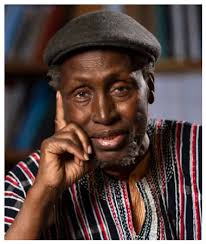
The edition I have of this is credited to James Ngugi – he subsequently rejected this colonial name. It was his debut, published in 1964 in the Heinemann African Writers series, partly thanks to the support of Chinua Achebe. (My parents collected some of these titles whilst we lived in West Africa in the ’60s – my copy is inscribed ‘Hallett. 1965’, in my father’s handwriting.) The series was designed to produce paperbacks by black African writers, ‘attractively designed with high quality production, and sold at a very cheap price’. The novel’s plot – which has strong autobiographical elements – focuses on the trial of Jomo Kenyatta (referred to simply as Jomo), and the rising activities of the Mau Mau. Ngugi’s novel was not only his debut but the first novel by an East African to be published in English, and it’s a powerful account of that era of colonial history. Ngugi wa Thiongo died in February 2025.



Colm Toibin – The Magician
Toibin here provides a fictionalised biography of Thomas Mann, during the period of the rise of the Nazi party in Germany, and his exile first in Switzerland and later in the US. It’s a fascinating life, and he is surrounded by fascinating people, not least in his own family. It’s the family that is the real focus of the novel, rather than exploring Mann as writer; here he is father, brother, husband – and yearner after young men. But there’s another strand which is equally fascinating – how various political factions want to and attempt to use his fame and his rhetorical powers for their own purposes, before, during and after the war.
Richard Wright – The Man Who Lived Underground
This was written in 1941-42, between the publication of Wright’s first major success, Native Son, and his memoir, Black Boy. It was rejected for publication, and only appeared in Wright’s lifetime in a collection of short stories, in a truncated and significantly altered form. It was only in 2021 that the full text was published. It is a remarkable and fascinating narrative. The black protagonist is falsely accused of the murder of a white couple, and goes on the run, finding shelter underground. He uses the network of sewer tunnels to move around the city, surfacing briefly in various buildings where he sees glimpses of life and of the way the city works. It reminded me a little of Colson Whitehead’s The Underground Railroad, where the railroad is both a metaphor and a physical reality. Here, as the Kirkus reviewer puts it, ‘A series of allegorical, surrealistic set pieces ensues as Fred explores the nether reaches of a church, a real estate firm, and a jewelry store. Each stop is an opportunity for Wright to explore themes of hope, greed, and exploitation.’ It’s about race – Fred is accused of the murder because he is a black man in the vicinity when a white couple is killed, and the police are happy to pin it on him – but it’s also a wider analysis of American life.
Poetry
Several of the titles below are from the estimable Longbarrow Press, based in Sheffield, and who produce beautiful books, from some fine contemporary poets, which I’m privileged to have hand-delivered as I live within walking distance from their home (by the standards of the publisher, a prodigious walker). An evening of poetry at Crookes bookshop Novel, with readings by various Longbarrow authors, is the primary reason why there’s more poetry in this half-year review than usual. I’ll try to keep that up. Dabydeen, Greenlaw and Hayes are non-Longbarrow poets.
David Dabydeen – Turner
I was prompted to read this after seeing the Turner painting which was Dabydeen’s inspiration for the title poem in this collection – Slavers Throwing Overboard the Dead and Dying—Typhon Coming On (1840), more commonly known as The Slave Ship – in an exhibition which drew attention to its context in the history of the slave trade. I hadn’t previously seen the figures and the chains in the water – having seen them now I cannot imagine how I failed to do so before. Dabydeen has depicted a notorious and horrific case where a slave ship had to jettison some of its human cargo in a storm, and then attempted to claim on their insurance for the loss of their assets. The poem burns off the page. And if one thought the poet might have welcomed Turner’s portrayal of a shameful episode in the history of that shameful trade, he does not, concluding that the intensity of the painting shows that ‘the artist in private must have savoured the sadism he publicly denounced’. This has been a controversial take and a troubling one. But it’s not an objective – or provable – position and does not need to be. Dabydeen is Guyanan and as he explained in an episode of David Olusoga’s recent Empire series, his ancestors, whilst not slaves, were transported from India as indentured labourers, so were part of that whole history. That he identifies with the Africans struggling in the water rather than the man who painted them is hardly surprising.
Pete Green – A Sheffield Almanac
‘A poem in four chapters about rivers, rain, relocation and regeneration, exploring the industrial past and post-industrial future of Pete Green’s adopted home city.’ It’s my adopted home city too and I loved the poem. It was a joy to read and will be a joy to re-read.
Lavinia Greenlaw – The Built Moment
This 2019 collection is centred on poems exploring Greenlaw’s experience of her father’s dementia and death. That is what drew me in, and the writing is extraordinarily tender and moving. I will go back to these – my own experience is probably too recent to allow much perspective.
Terrance Hayes – American Sonnets for my Past and Future Assassin
Again, I need to re-read these, but whilst I found some of the poems hard to engage with there was plenty there to absorb and move me. Anger, and hope too. ‘In seventy poems bearing the same title, Terrance Hayes explores the meanings of American, of assassin, and of love in the sonnet form. Written during the first two hundred days of the Trump presidency, these poems are haunted by the country’s past and future eras and errors, its dreams and nightmares. Inventive, compassionate, hilarious, melancholy, and bewildered – the wonders of this new collection are irreducible and stunning.’



Martin Heslop & Helen Tookey – To the End of the Land
I read this whilst listening to the CD, where the words are interwoven with recorded sounds both musical (fragments from Nova Scotian folk songs) and natural. The poem explores ‘The layered histories and complex geography of Nova Scotia – its mountains, mines, lakes and bays … To the End of the Land investigates this remarkable landscape, and draws out the voices – under the seabed, under the storm – that animate it all.’
Rob Hindle – Sapo
What links these poems, composed over about a decade, is a fascination with words and the slipperiness of their meanings, and the natural world, whether the eponymous toad (sapo means toad in parts of Latin America, along with various other meanings), the birds from the Observer’s Book of Birds, or the landscape of the North Yorkshire Coast. And there’s another thread too, about plague, in our times and in the Derbyshire village of Eyam 360 years previously. They’re all, to quote Hindle, earthly or rooted. I loved Hindle’s earlier collection, The Grail Roads, and am loving this one.
Chris Jones – Skin
‘Skin is a book of bonds, reaching back, reaching out; a sensory exploration of the world we inhabit and try to make sense of.’ I heard Jones read some pieces from this collection at a Longbarrow poetry evening, and knew I wanted to read them all. I’d previously read and loved his earlier collection, Little Piece of Harm.


Non-Fiction
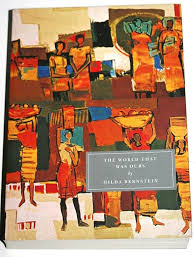
Hilda Bernstein – The World that was Ours
Bernstein’s autobiographical account of the period between the Sharpeville massacre and her family’s flight to Botswana following her husband’s acquittal in the Rivonia trial, is as tense and gripping as any thriller. The political climate of the time – justice skewed inexorably against the defendants, constant surveillance – is vividly described, from the perspective of the defendants and their supporters, but also from Bernstein’s perspective as a woman torn between her personal responsibilities as wife and mother and her political activism. Beautifully written.
Tobias Buck – Final Verdict: A Holocaust Trial in the 21st Century
This is more than an account of what must be one of the very last Holocaust trials, that of Bruno Dey, a former camp guard at Stutthof. Buck analyses the way in which these crimes have been tried, from Nuremberg onwards, and how the desire to move on from that hideous past, and the difficulty in ascribing individual guilt to a collective system of murder, has resulted both in leniency for many who took part in mass murder, and in the spectacle of very elderly men in wheelchairs being called to account for events they may barely remember. It’s fascinating and thought provoking.
Jenny Cathcart – Notes from Africa: A Musical Journey with Youssou N’Dour
This is not solely about N’Dour, though he is at the heart of Cathcart’s ‘notes’, and she clearly holds him in very high esteem. The problem is that there is not enough analysis of the music (I know, dancing about architecture and all that, but still, there are things one can usefully say about how the music works), and when it comes to N’Dour as a person and as a politician, a bit more critical distance would have been welcomed. However, it gives a flavour of the music that N’dour has done so much to bring to wider Western attention, and introduced me to some less familiar names.
Edith Eger – The Choice
Eger is not only a Holocaust survivor but a psychotherapist specialising in PTSD, and the book uses her personal story of recovery (far from a linear, simple process) to suggest that there are choices one can make in how one responds to trauma. She doesn’t oversimplify the issues, and doesn’t claim to have all of the answers. It’s a powerful read.
Mary Lovell – The Mitford Girls: The Biography of an Extraordinary Family
The family is endlessly fascinating. This biography is the basis for the TV series Outrageous (see my Screen blog) and I think tends to soften some of the political stuff – Lovell sometimes tries to be even-handed by balancing Unity’s (and other family member’s) Nazi sympathies against Jessica’s communism, but it’s not an entirely fair comparison as a great deal more was known about the Nazi regime at this stage (pre-WWII) than about the reality of Stalinist repression. Other sources do seem to suggest that the parents and their son Tom had fascist leanings, to say the least, which is barely hinted at here.
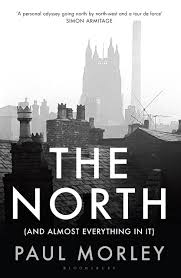
Paul Morley – The North (and Almost Everything in it)
I used to read Morley in the NME back in the day, and his style is still recognisable in this very entertaining and idiosyncratic volume, though he’s not strenuously trying to prove how clever he is these days. It’s a personal view of the north, which means that Reddish in Lancashire gets a lot more attention than any objective account would afford it, but that’s fine. It also means that the focus is more heavily – though far from exclusively – on what I think of as the other side of the Pennines. Morley’s personal story progresses chronologically in the normal way, whilst his historical and biographical vignettes start around now and go back through the decades and the centuries. This is sometimes disconcerting. Also disconcerting is that the photographs which interrupt the text seem to have been placed entirely randomly (out-Sebalding Sebald) and one would have to consult the index to find where their significance is described. It’s all most enjoyable and I had to keep a notebook to hand to jot down names and book titles as I went along.


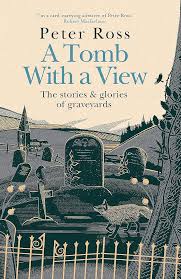
Peter Ross – A Tomb with a View: The Stories & Glories of Graveyards
I do love a graveyard. ‘So we go inside and we gravely read the stones/All those people, all those lives, where are they now?’. I remember visiting the graves in Cobham churchyard in Kent which inspired the early graveyard scene in Great Expectations – tiny stone lozenges representing infants lost at birth or soon afterwards. And I browsed happily in Pere Lachaise and Montparnasse, finding so much French history on the stones and mausoleums, not just famous names. So Ross’s book is a joy, full of interest, and of unexpected humour.
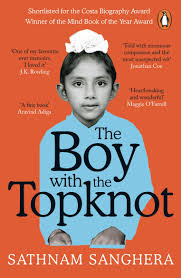
Sathnam Sanghera – The Boy with a Topknot: A Memoir of Love, Secrets and Lies in Wolverhampton
A profoundly moving memoir. Sanghera started to write to explain (to himself and to his family) why he was not intending to marry a Sikh girl, and indeed had had white girlfriends, but alongside recalling his own childhood and adolescence he has to address the puzzle of his father’s mental health. This is traumatic, for him and far more for his mother, who tells him of the early days of her marriage, before her new husband’s medical condition was diagnosed and treated. And through that he realises that his sister too suffers from schizophrenia. All of this emerges against the grain of Sikh Punjabi culture, which doesn’t do a lot of talking about feelings, and for which some of the truth that emerged was seen as shameful. Above all, it’s a deeply loving book.
Rebecca Solnit – Orwell’s Roses
Solnit is always a rather discursive writer, at the same time as being incisive and perceptive, and that’s part of the pleasure of reading her. As a reviewer for the Irish Times points out, in this book the structure reflects the organic, rhizomatic forms that Solnit discusses in relation to plants: ‘her topics … spurt and grow from one another in seemingly random yet contained patterns’. I wasn’t entirely persuaded – perhaps I just wasn’t receptive to the theme of roses and gardens and found the links sometimes a little tenuous. Nonetheless, there was a great deal of interest and enjoyment here.
Jamie Taylor – Studio Electrophonique: The Sheffield Space Age, from the Human League to Pulp
The story of Ken Patten, who set up a recording studio in a council semi in Handsworth (Sheffield), in which a generation of Sheffield musicians (most notably, but not only, Human League, ABC and Pulp) got their first chance to experiment with the electronic sounds that would make them so successful. This is a hugely entertaining account, rather charming and often very funny.
Stephen Unwin – Beautiful Lives: How we got Learning Disabilities so wrong
This is a remarkable book. It’s both authoritative in its treatment of the history of attitudes to learning disabilities, and deeply personal as the author talks – with so much love and respect – about his learning-disabled son. At times it is horrifying, and deeply shocking, but throughout there is a focus on the people with learning disabilities themselves, and he never loses hope that we can be better at understanding and supporting people in ways that recognise, respect and value who they are and what they contribute. I should declare a personal interest. I am the chair of an organisation, Under the Stars, that works with adults with learning disabilities and/or autism through music and drama, and this is a subject about which I feel strongly, and easily become emotional when I think of the people I know being – at best – marginalised, ignored, unheard. We – and many more organisations these days – put the individuals with learning disabilities at the centre of what we do. If they want to perform on stage, they won’t be fobbed off with a backstage role. And they shine. I’m grateful to Stephen Unwin for this illuminating and inspiring study.
Rebecca West – Black Lamb & Grey Falcon: A Journey through Yugoslavia
This is a monumental tome. And it needs to be, to capture even a part of the complexity of Balkan history, culture and politics. The book is based on West’s diaries of her travels in Yugoslavia in 1937, and was published in 1941 with an epigraph ‘To my friends in Yugoslavia, who are now all dead or enslaved’. It’s brilliantly written, full of wry asides and vivid characterisations, and I wish I thought I could hold in my head even a fraction of what I’ve read about the history of those countries, but I know I won’t. I will read more, and try to understand more, since – as West makes clear when she writes about the First World War and earlier history, and as became clear again to us after the disintegration of Yugoslavia and the conflicts that followed – the story of these nations is both vitally important and incredibly complicated.


As always, my reading has taken me across continents and centuries, from very close to home (Sheffield, late 1970s), to Yugoslavia in the late 30s, 16th century Stratford on Avon, colonial Kenya, Korea and Japan, and the vividly imagined alternative worlds of Philip Pullman. I always struggle to pick ‘bests’, since the books I’ve read are so varied in genre, style, subject matter and era, but if pressed (I do realise that I am the only one doing the pressing) I would pick Hamnet and The Man who Lived Underground in fiction, Chris Jones’ Skin in poetry, and Stephen Unwin’s Beautiful Lives in non-fiction. This year we mark the passing of two writers featured here, Ngugi wa Thiongo and Simon Mawer, and a writer who I read some years ago, and met when we both worked at Sheffield Hallam University, Marina Lewycka, author of A Short History of Tractors in Ukrainian.


 Passing Time